Correspondence from John P. Hehman to Jack Greenberg
Correspondence
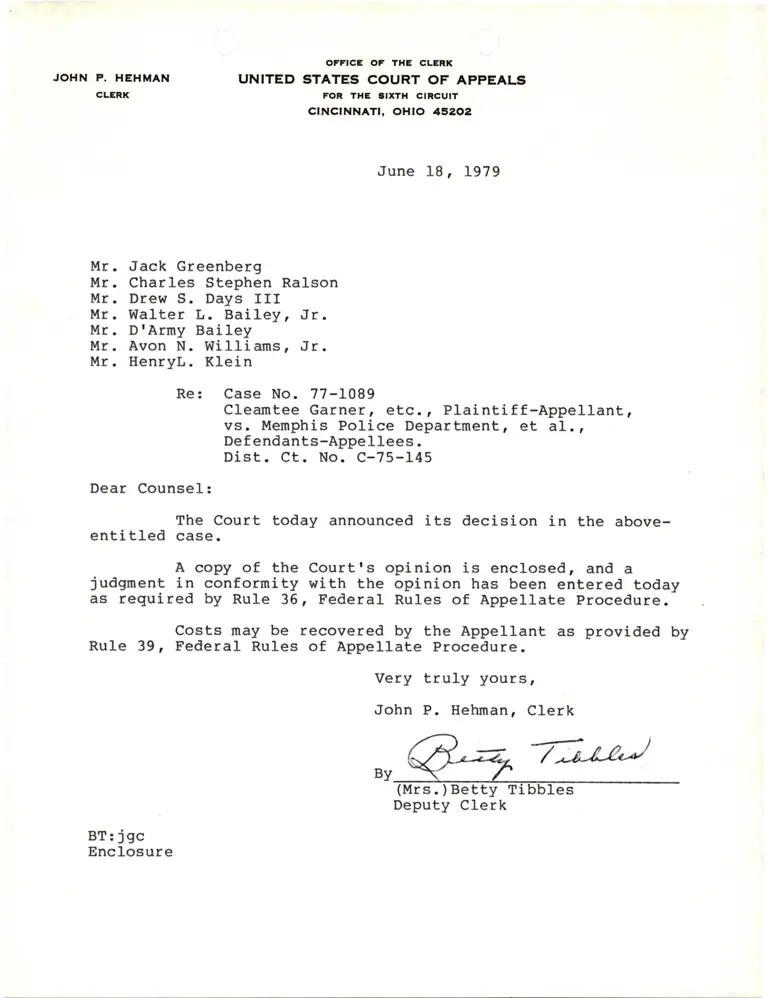
June 18, 1979
-
Case Files, Garner Hardbacks. Correspondence from John P. Hehman to Jack Greenberg, 1979. 935794ca-26a8-f011-bbd3-000d3a53d084. LDF Archives, Thurgood Marshall Institute. https://ldfrecollection.org/archives/archives-search/archives-item/5a56eaf7-2603-46aa-b8c2-607a06d0715d/correspondence-from-john-p-hehman-to-jack-greenberg. Accessed October 17, 2026.
Copied!
JOHN P. HEHMAN
CLERK
OFFICE OF THE CLERK
UNITED STATES COURT OF APPEALS
FOR THE SIXTH CIRCUIT
CINCINNATI, OHIO 45202
June 18, 1979
Mr. Jack Greenberg
Mr. Charles Stephen Raison
Mr. Drew S. Days III
Mr. Walter L. Bailey, Jr.
Mr. D'Army BaileyMr. Avon N. Williams, Jr.
Mr. HenryL. Klein
Re: Case No. 77-1089
Cleamtee Garner, etc., Plaintiff-Appellant, vs. Memphis Police Department, et al.,
Defendants-Appellees.
Dist. Ct. No. C-75-145
Dear Counsel:
The Court today announced its decision in the above- entitled case.
A copy of the Court's opinion is enclosed, and a
judgment in conformity with the opinion has been entered today
as required by Rule 36, Federal Rules of Appellate Procedure.
Costs may be recovered by the Appellant as provided by Rule 39, Federal Rules of Appellate Procedure.
Very truly yours,
John P. Hehman, Clerk
B y .(Mrs.)Betty Tibbies Deputy Clerk
BT:jgc
Enclosure
r )
Vt,
52 ^ FEDERAL REPORTER, 2d SERIES
•j . ,
pf»
SI !••'• • n
•i*
f
• * i
rant performed laundry work ordinarily
only upon the establishment’s own linens or
fabrics of those of iU guests.” The Admin
istrator later changed this interpretation of
the Act and now supports the position ar
gued by the Secretary of Labor.
The Administrator’s first interpretation
seems to us more in line with the purpose of
the 1966 legislation excluding laundries
from the small business exemption. 29
U.S.C. § 213(aX2). The Senate Committee
on Labor and Public Welfare report on the
legislation reads; “This section repeals the
[existing] wage and overtime exemption ap
plicable to employees in laundry and dry
cleaning eatablishments. . . , [Tjhe
amendments . . provide for com-
• protection for employees o f
such establiahmenta,” S.Rep. No. 1487, 89th
Cong., 1st Sess. at 28 (1966) (emphasis add
ed), U.S.Code Cong. & Admin.News 1966,
pp. 3002, 3030. ■ “ [W]hat Congress intended
to accomplish was a sweeping coverage of
the entireijaundry industry.” National Au
tomatic tMandry and Cleaning Council v.
Shultz, ,143 U.S.App.D.C. 274, 290, 443 F.2d
689, 705 (1971). Dominant segpnents of the
I industry sought the amendments. They
were already paying the minimum wage
and had to charge higher prices as a result.
They sought coverage of the entire industry
in order to remove the competitive price
advantage of small operators. Ibid.
[1,2] A motel, however, is not usually
considered “ a laundry establishment” or a
part of the “ laundry industry.” Congress
was trying to put a floor under the wages
paid by these establishments, but there is
no indication that Congress was so interest
ed in obtaining business for laundries that
it intended that small retail businesses such
as restaurante and motels should lose their
minimum wage exemption because they
wash their own laundry rather than send it
outside to a “ laundry establishment.” We
disagree with the recent decision of the
not employees of restaurants or motels who
wash tablecloths, sheets and the like for use
on the premises in the ordinary course of
business. Not a single line or word of the
legislative history suggests that Congress
intended to extend the provision to include
employees of businesses outside the laundry
industry.
Accordingly, the judgment of the District
Court is reversed.
O I KEY»UMBERSrSIEM>
Cleamtee GARNER, father and next of
kin o f Eugene Gamer, a deceased
minor, Plaintiff-Appellant,
V .
MEMPHIS POLICE DEPARTMENT,
CITY OF MEMPHIS, TENNESSEE and
Jay W. Hubbard and E. R. Hymon in
their official capacities, Defendants-Ap-
pellees.
No. 77-1089.
United States Court of Appeals,
Sixth Circuit. '
Argued Feb. 14, 1979.
Decided June 18, 1979.
. ,5f
K
Father of youth brought action against
city, municipal police officer and officials to
recover for a llege wrongful death caused
by constitutional violations when policeman
shot and killed youth as he allegedly was
escaping from the scene of a burglary. The
n- -------------- --------- United States District Court for the West-
h ifth (> cu a to the contrary, Cfoaaett v. ern District of Tennessee, Harry W. Well-
U u-^-K el Corp 569 F.2d 869 (1978). We ford. J.. dismissed suit against city and
construe the words of the statute, “employ- against officer and his superiors, and plain-
ees e n g a ^ m laundering,” to mean “em- tiff appealed. The Court of Appeals, Mer-
ployees of laundering establishments” and ritt. Circuit Judge, held that: (1) policeman •
was entitled i
a qualified “g
nity from lia'
based on hi:
which allows
felon rather
him to escape
of city unde
depended up<
whether mun
nity or pri\
whether mui
under state
missible, wht
low point bi
missible anc
flowed from
municipality
Case ag:
sideration.
1. Civil Righ
A city p<
youth as he
burglary wa*-
defense to c
“ good faith”
liability for •
his reliance <
an officer to
run the risk
prehension.
Const. Amer
2. Civil RigI'
Liability
rights statul
man of yout
burglary dep
tions as to w
ified immuH'
faith, wheth.
force under
permissible,
hollow point
missible an'
flowed from
municipality
KS
restaurants or motels who
sheets and the like for use
in the ordinary course of
single line or word of the
y suggests that Congress
d the provision to include
nesses outside the laundry
0 judgment o f the District
ET NUMBER SYSTEM!>
HR, father and next o f
I* Gamer, a deceased
lintiff-Appellant,
V .
-ICE DEPARTMENT,
t’HIS, TENNESSEE and
d and E. R. Hymon in
nacities, Defendants-Ap-
77-1089.
̂ Court of Appeals,
h Circuit.
Peb. 14, 1979.
June 18, 1979.
h brought action against
e officer and officials to
wrongful death caused
■lations when policeman
‘ th as he allegedly was
nene o f a burglary. The
ict Court for the West-
n e s ^ , Harry W. Well-
suit against city and
his superiors, and plain-
Court of Appeals, Mer-
eld that: (1) policeman
%
■> »
GARNER V . MEMPHIS POLICE DEPT., ETC.
CHea*600F.2d 52 (1979)
53
was entitled to assert, as complete defense,
a qualified “ good faith” privilege or immu
nity from liability for constitutional claims
based on his reliance on Terinessee law
which allows an officer to kill a fleeing
felon rather than run the risk of allowing
him to escape apprehension, and (2) liability
of city under federal civil rights statute
depended upon resolution of questions as to
whether municipality had a qualified immu
nity or privilege based on good faith,
whether municipality’s use of deadly force
under state law was constitutionally per
missible, whether municipality’s use of hol
low point bullet was constitutionally per
missible and whether officer’s conduct
flowed from a “ policy or custom” for which
municipality could be liable in damages.
Case against city remanded for recon
sideration.
1. Civil Rights ■9=13.8(4)
A city policeman who shot and killed a
youth as he escaped from the scene of a
burglary was entitled to assert, as complete
defense to civil rights action, a qualified
“ good faith” privilege or immunity from
liability for constitutional claims baaed on
his reliance on Tennessee law which allows
an officer to kill a fleeing felon rather than
run the risk of allowing him to escape ap
prehension. 42 U.S.C.A. § 1983; U.S.C.A.
Const. Amends. 4, 8, 14; T.C.A. § 40-808.
2. Civil Rights -9=13.8(3)
Liability of city under federal civil
rights statute for shooting by city police
man of youth as he escaped from scene of
burglary depended upon resolution of ques
tions as to whether municipality had a qual
ified immunity or privilege based on good
faith, whether municipality’s use of deadly
force under state law was constitutionally
permissible, whether municipality’s use of
hollow point bullet was constitutionally per
missible and whether officer’s conduct
flowed from a “ policy or custom” for which
municipality could be liable in damages. 42
U.S.C.A. § 1983; U.S.C.A.Const. Amends. 4,
6, 8, 14; T.C.A. § 40-808.
Jack Greenberg, Charles Stephen Ralston,
Drew S. Days, III, Steven L. Winter, New
York City, Walter L. Bailey, Jr., D’Army
Bailey, Memphis, Tenn., Avon N. Williams,'
Jr., Nashville, Tenn., for plaintiff-appellant.
Henry L. Klein, Memphis, Tenn., for de-
fendants-appellees.
Before EDWARDS, Chief Judge and
LIVELY and MERRITT, Circuit Judges.
MERRITT, Circuit Judge.
On the night of October 3, 1974, a fifteen
year old, unarmed boy broke a window and
entered an unoccupied residence in subur
ban Memphis to steal money and property.
Two police officers, called to the scene by a
neighbor, intercepted the youth as he ran
from the back of the house to a six foot
cyclone fence in the back yard. Using a
38-calibre pistol loaded with hollow point
bullets, one of the officers shot and killed
the boy from a range of 30 to 40 feet as he
climbed the fence to escape. After shining
a flashlight on the boy as he crouched by
the fence, the officer identified himself as a
policeman and yelled “ Halt.” He could see
that the fleeing felon was a youth and was
apparently unarmed. As the boy jumped to
get over the fence, the officer fired at the
upper part of the body, as he was trained to
do by his superiors at the Memphis Police
Department. He shot because he believed
the boy would elude capture in the dark
once he was over the fence. The officer
was taught that it was proper to kill a
fleeing felon rather than run the risk of
allowing him to escape.
The District Court dismissed the suit of
decedent’s father brought against the City
under 42 U.S.C. § 1983 (1976) to recover
damages for wrongful death caused by
claimed constitutional violations of the
fourth, eighth and fourteenth amendments.
In accordance with then existing law, the
District Court held that a city is not a
n
54 600 FEDERAL REPORTER, 2d SERIES
m
1
“ person” subject to suit under § 1983; but
Monroe v. Pape, 365 U.S. 167, 81 S.Ct 473, 5
L.Ed.2d 492 (1961), in which the Supreme
Court so ruled, was overruled on this point
last term by the case of Monell v. Depart
ment o f Social Services, 436 U.S. 658, 98
S.Ct. 2018, 56 L.Ed.2d 611 (1978). Follow
ing a bench trial, the District Court also
dismissed the case against the officer and
his superiors holding, in accordance with
our decisions in Beech v. Melancon, 465 F.2d
425 (6th Cir. 1972), cert, denied, 409 U.S.
l i f t , 93 S.Ct. 927, 34 L.Ed.2d 696 (1973);
Qualls V. Parrish, 534 F.2d 690 (6th Cir.
1976); and Wiley v. Memphis Police De
partment, 548 F.2d 1247 (6th Cir.), cert..
denied, 434 U.S. 822, 98 S.Ct. 65, 54 L.Ed.2d
78 (1977), that the officers acted in good
faith reliance on Tennessee law which al
lows an officer to kill a fleeing felon rather
than run the risk of allowing him to escape
apprehension.
[1] We conclude that the District Court
did not err in finding that the individual
defendants acted in good faith reliance on
' Tenn. Code Ann. § 40-808 which provides
that an officer “ may use all the necessary
means to effect, the arrest” of a fleeing
felon. As our previous cases, cited above,
point out, Tennessee courts have interpret
ed this statute as a codification of the com
mon law rule allowing officers to kill flee
ing felons rather than run the risk o f per
mitting them to escape apprehension. This
rule applies to fleeing felons suspected of
property crimes not endangering human
life, as well as life-endang;ering crimes, And
tol/elons who pose no threat of bodily harm
to others, if not apprehended immediately,
as ^ell as felons who may be dangerous to
others if left at large. Applying the quali
fied “good faith” privilege or immunity
from liability for constitutional claims, as
announced in our previous decisions cited
above, we affirm that portion of the Dis
trict Court’s judgment dismissing the case
against the individual defendants.
|‘2] We reverse and remand the case
against the City, however, for reconsiders- •
tion by the District Court in light of Monell
V. Department o f Social Services, supra.
Monell holds that a city may be held liable
in damages under § 1983 for constitutional
deprivations that result from a “ policy or
custom” followed by the city. 436 U.S. at
694 and n. 66, 98 S.Ct. 2018. .
\
Our previous decisions do not establish
the constitutionality of Tenn. Code Ann.
§ 40-808, permitting a city to authorize its'
officers to use deadly force against a flee
ing felon, nor have they established the
constitutionality of the city’s use of hollow
point bullets. Although there is discussion
of the constitutionality of the Tennessee
statute in the Beech, Qualls and Wiley
cases, supra, all three o f those cases dealt
with actions against individual officers un
der § 1983, and not liability based on the
“ policy or custom” of a governmental enti
ty. Those cases held that it “ would be
unfair” to impose liability on an officer
“ who relied, in good faith, upon the settled
law of his state that he relieved him from
liability for the particular acts performed in
his official capacity.” Qualls v. Parrish,
supra at 694, quoted in Wiley v. Memphis
Police Department, supra at 1253. The es
sential holding of those cases was that an
individual officer has a qualified privilege
or immunity from liability for constitution
al claims based on good faith performance
of his duties in accordance with statutory or
administrative authority, a holding subse
quently approved by the Supreme Court in
Butz V. Economou, 438 U.S. 478, 49&-508, 98.
S.Ct. 2894, 57 L.Ed.2d 895 (1978). Although
the qualified immunity developed in those
cases insulates the officers and officials
from personal liability in this case, as the
District Court held, the following questions
in the case against the city are still open
under Monell:
1. Does a municipality have a similar
qualified immunity or privilege based
on good faith under Mone//?*
8.
4.
2.
1. See discussion of this question In Llete v. City o f Providence, 463 F.Supp. 585, 588 (D R I
1978).
and the case
r reconsidera-
ifht o f Monell
'"vices, supra.
t)e held liable
constitutional
a “ policy or
436 U.S. at
not establish
Code Ann.
authorize its
^ainst a flee-
ablished the
ise o f hollow
is discussion
e Tennessee
and Wiley
cases dealt
officers un-
ased on the
mental enti-
“ would be
an officer
t the settled
■d him from
>erformed in
V. Parrish,
V. Memphis
'>3. The es-
■vas that an
■k1 privilege
onstitution-
•erformance
■itatutory or
ding subse
ne Court in
496-508, 98.
Although
“d in those
td officials
ise, as the .
g questions
! still open
a similar
dege based
'/?>
•<8 (D.R.I.
'i
-■
UNITED STATES v. RENFRO
cite u 600 F.2d 5S (1979)
If not, is a municipality’s use of dead
ly force under Tennessee law to cap
ture allegedly nondangerous felons
fleeing from nonviolent crimes consti
tutionally permissible under the
fourth, ^xth, eighth and fourteenth
amendments? *
3. Is the municipality’s use of hollow
point bullets constitutionally permis-
1 sible under these provisions of the
; Constitution? *
4. If the municipal conduct in any of
thdSe respects violates the Constitu
tion, did the conduct flow from a
“ policy or custom” for which the City
is liable in damages under Monell 1*
We remand the case against the City to
the District Court for reconsideration in
' light of Monell, including consideration of
these questions.
55
UNITED-STATES o f America,
Plaintiff-Appellee,
v.
Andrew RENFRO, Defendant-Appellant.
No. 78-5482.
United States Court of Appeals,
Sixth Circuit.
Argued April 9, 1979.
' Decided June 19, 1979.
Rehearing and Rehearing En Banc
Denied July 31, 1979.
2. See generally Coker v. Georgia, 433 U.S. 584,
97 S.Ct. 2523, 53 L.Ed.2d 653 (1977); Ingraham
V. Wright, 430 U.S. 651, 97 S.Ct. 1401, 51
L.Ed.2d 711 (1977): Gregg v. Georgia, 428 U.S.
153, 96 s et. 2909, 49 L.Ed.2d 859 (1976); 'fu r -
man V. Georgia, 408 U.S. 238, 92 S.Ct. 2726, 33
L.Ed.2d 346 (1972); Landrum v. Moats, 576
, F.2d 13M (8th Cir.), cert, denied,-----U.S.--------,
99 S.Ct.^82. 58 L.Ed.2d 258 (1978); Mattis v.
Schnarr, 547 F.2d 1007 (8th Cir. 1976), vacated
as advisory opinion sub nom. Ashcroft v. Mat
tis, 431 U.S. 171, 97 S.Ct. 1739, 52 L.Ed.2d 219
(1977); Jones v. Marshall, 528 F.2d 132 (2d Cir.
1975); Day, Shooting the Fleeing Felon: State
of the Law, 14 Crim.L.Bull. 285 (1978); Com
ment, Deadly Force to Arrest: Triggering Con
stitutional Review, 11 Harv.C.R.— C.L.L.Rev.
361 (1976).
I
S. See generally Paust, Does Your Police Force
Use Illegal Weapons? A Configurative A p
proach to Decision Integrating International
and Domestic Law, 18 Harv.Infl L.J. 19 (1977).
Defendant was convicted before the
United States District Court for the East
ern District of Michigan, Southern Division,
Philip Pratt, J., of income tax evasion and
failing to file, and he appealed. The Ck)urt
of Appeals, Cecil, Senior Circuit Judge, held
that: (1) the prosecutor’s supposed improp
er argument concerning expression of per
sonal opinion of guilt, misstatements of law
and fact and shifting burden of proof did
not rise to level of plain error; (2) court
properly instructed that jury could consider
reasonableness of defendant’s explanation
as to his increase in net worth as bearing on
his consciousness of guilt; (3) in prosecution
for income tax evasion and failure to file,
admission o f alleged hearsay testimony of
4. On the question of “ policy or custom,” police
records are said to show, according to reports
we do not find In this record, that during the
preceding eight years Memphis police officers
killed seventeen fleeing burglary suspects; thir
teen were black and five were youths. Accord
ing to the same reports, Memphis police offi
cers killed twenty-four individuals during this
period in connection with crimes of violence or
in self-defense; they attempted to use deadly
force on 177 occasions, 114 of which were in
connection with property crimes. See the orig
inal certified appellate record, document 45, in
Wiley V. Memphis Police Dep't, 548 F.2d 1247
(6th Cir.), cert, denied, 434 U.S. 822, 98 S.Ct.
65, 54 L.Ed.2d 78 (1977), as summarized in
Comment, Deadly Force to Arrest: Triggering
Constitutional Review, 11 Harv.C.R—C.L.L.
Rev. 361, 362 n. 4 (1976); Report, Tenn. Adv.
Committee to U.S. Civ. Rights Comm’n, Civic
Crisis-—Civil Challenge: Police-Community Re
lations in Memphis 81 (1978).
m
H ♦:'N
p '-o . A
' » 9• *.•̂1 '•̂ ■|> “ ' ■
f i:,V-
' V
i
No. 77-1089
UNITED STATES COURT OF APPEALS
FOR THE SIXTH CIRCUIT
C l e a m t e e G akneh , father and next of
kin of Eugene Garner, a decctised,
minor,
Plaint i ff-AppeUan t.
V.
M e m p iu s P o l ic e D e p a h t m e n t , C ity
OF M e m p iu s , T ennessee and Jay
W. IIouBAUD and E. R. I I v m o n in
their official capacities.
Defendants-Appellees.
O n A i ’p e a i , from the
United States District
Court for tlie Western
District of Tennessee.
Decided and Filed June 18, 1979.
Before: E dw aiuis, Cliicf Judge; L iv e ly and M e h iu t i, Cir
cuit Judges.
MEmurr, Circuit Judge. On the night of Oc+olier 3, 1974,
a fifteen year old, unanned boy broke a window and en
tered an unoccupied residenc-e in suburban Memphis to ste;d
money and property. Two police officers, called to the scene
by a neighbor, intercepted the youth as he ran from llû back
of tlie house to a six foot cyclone fence in the back yard.
Using a 38-calibre pistol loaded with hollow point bullets,
one of the officers shot and killed the boy from a range of
30 to 40 feet as he climbed the fence to escape. After shining
a flaslilight on the boy ;is he crouched by the fence, the of-
mmi
. : ; . V ^0->.
r ■■
t . .
, I'It y'*< <A
•r-
'
• ■-.'■t . . : ■ , .<r- ‘ " V
' . . - - i ' ■ <**-• - .* '■ - - ■- e ; • - v '- r /W . - ' f ' *: L .
2 Garner v, Memphis Police Department, et al. No. 77-1089
ficer identified himself as a policeman and yelled “Halt.” He
could see that the fleeing felon was a youth and was apparent
ly unarmed. As the boy jumped to get over the fence, the
officer fired at the upper part of the body, as he was trained
to do by his superiors at the Memphis Police Department.
He shot because he believed the boy would elude capture in
the dark once he was over the fence. The officer was taught
that it was proper to kill a fleeing felon rather than run
the risk of allowing him to escape.
The District Court dismissed the suit of decedent’s father
brought against the City under 42 U.S.C. § 1983 (1976) to
recover damages for wrongful death caused by claimed con
stitutional violations of the fourth, eighth and fourteenth
amendments. In accordance with then existing law, the Dis
trict Court held that a city is not a “person” subject to suit
under § 1983; but Monroe v. Pape, 364 U.S. 167 (1961), in
which the Supreme Court so ruled, was overruled on this
point last term by the case of Monell v. Department of Social
Services, 436 U.S. 658 (1978). Following a bench trial, the
District Court also dismissed the case against the officer and
his superiors holding, in accordance with our decisions in
Beech v. Melancon, 465 F.2d 425 ( 6th Cir. 1972 ), cert, denied,
409 U.S. 1114 (1973); Qualls v. Parrish, o34 F.2d 690 (6th Cir.
1976); and W iley v. Memphis Police Department. 548 F.2d
1247 ( 6th Cir.), cert, denied, 434 U.S. 822 (1977), that the
officers acted in good faith reliance on Tennessee law which
allows an officer to kill a fleeing felon rather than run the
risk of allowing him to escape apprehension.
W e conclude that the District Court did not err in finding
that the individual defendants acted in good faith reliance
on T e n n . C ode A n n . § 40-808 which provides that an officer
“may use all the necessary means to effect the arrest” of a
fleeing felon. As our previous cases, cited above, point out,
Tennessee courts have interpreted this statute as a codification
of the common law rule allowing officers to kill fleeing felons
rather than run the risk of permitting them to escape ap
No. 77-1089 Garner v. Memphis Police Department, et al. 3
prehension. This rule applies to fleeing felons suspected of
property crimes not endangering human hfe, as well as life-
endangering crimes, and to felons who pose no threat of
bodily hann to others, if not apprehended immediately, as
well as felons who may be dangerous to others if left at large.
Applying the qualified “good faith” privilege or immunit>-
from liabihtv for constitutional claims, as announced in our
previous decisions cited abo\ e, we affirm that portion of the
District Court’s judgment dismissing the case against the in
dividual defendants.
W e reverse and remand the case against the City, how
ever, for reconsideration by the District Court in hght of
Monell V. Department of Social Services, supra. Monell holds
that a city may be held liable in damages under § 1983 for
constitutional deprivations that result from a “policy or cus
tom” followed by the city. 436 U.S. at 694 and n.66.
Our previous decisions do not establish the constitutionafitv-
of T e x x . C ode A x x . § 40-808, permitting a citŷ to authorize
its officers to use deadly force against a fleeing felon, nor
have thev’ established the constitutionalitv’ of the city’s use of
hollow point bullets. Although there is discussion of the
constitutionality of the Tennessee statute in the Beech, Qualls
and W iley cases, supra, all three of those cases dealt with ac
tions against individual officers under § 1933, and not liabili
ty based on the “policy or custom” of a governmental entity.
Those cases held that it “would be unfair” to imjwse liability
on an officer “who relied, in good faith, upon the settled law
of his state that relieved him from liability' for the particular
acts performed in his official capacity.” Qualls v. Parrish, supra
at 694, quoted in W iley v. Memphis Police Depanment, supra
at 1253. The essential holding of those cases wav that an in
dividual officer has a qualified privilege or immunity from
liability for constitutional claims based on good faith per
formance of his duties in accordance with statutoiy or admin-
istrativ'e authority, a holding subsequently appnwed by the
Supreme Court in Butz v. Economou, 438 U.S. 478, 496-508
(1978). Although the qualified immunity developed in those
cases insulates the ofiBcers and officials from personal liabifity
in this case, as the District Court held, the following ques
tions in the case against the city are still open under Monell:
1. Does a municipahty have a similar qualified immuni
ty or privilege based on good faith under Monell?’
2. If not, is a municipality’s use of deadly force under
Tennessee law to capture allegedly nondangerous
felons fleeing from nonviolent crimes constitutionally
permissible under the fourth, sixth, eighth and four
teenth amendments?^
3. Is the municipahty’s use of hollow point bullets con
stitutionally permissible under these provisions of the
Constitution?^
4. If the municipal conduct in any of these respects vi
olates the Constitution, did the conduct flow from a
“pohcy or custom” for w’hich the City is hable in
damages under Monell?^
4 Garner v. Memphis Police Department, et al. No. 77-1089
> See discussion of this question in Leite v. City of Providence, 463
F. Supp. 585, 588 (D. R.I. 1978).
2 See generally Coker v. Georgia, 433 U.S. 584 (1977); Ingraham
V. Wright, 430 U.S. 651 (1977); Gregg v. Georgia. 428 U.S. 153
(1976): Furman v. Georgia, 408 U.S. 238 (1972); Landrum v. Moats,
576 F.2d 1320 (8th Cir.), cert, denied. 99 S.Ct. 282 (1978); Mattis v.
Schnarr, 547 F.2d 1007 (8th Cir. 1976), vacated as advisory opinion
sub nom. Ashcroft v. Mattis, 431 U.S. 171 (1977); Jones v. Marshall,
528 F.2d 132 (2d Cir, 1975); Day, Shooting the Fleeing Felon: State
o-f the Law, 14 (Tr im . L. B ull, 285 (1978); Comment, Deadly Force to
A rrest: Triggering Constitutional Review , 11 Harv , C. R. — C, L. L,
R ev. 361 (1976).
3 See generally Paust. Does Your Police Force Use Illegal Weapons?
A Configurative Approach to Decision Integrating International ana
Domestic Law, 18 Harv. iNriL L.J. 19 (1977).
* On the question of “pwLicy or custom,” police records are said
to show, according to reports we do not find in this record, that
during the preceding eight years Memphis police officers killed
seventeen fleeing burglary suspects; thirteen were black and five
were youths. According to the same reports, Memphis pohce o f
ficers killed tw enty-four individuals during this period in connec
tion with crimes of violence or in self-defense; they attempted to
use deadly force on 177 occasions, 114 of which were in connection
W e remand the case against the City to the District Court
for reconsideration in light of Monell, including consideration
of these questions.
No. 77-1089 Gamer v. Memphis Police Department, et al. 5
with property crimes. See the original certified appellate record,
document 45, in W iley v. Memphis Police Dep’t, 548 F.2d 1247 (6th
Cir.), cert, denied, 434 U.S. 822 (1977), as summarized in Comment,
Deadly Force to Arrest: Triggering Constitutional Review , 11 H arv.
C. R. — C. L. L. R ev. 361, 362 n.4 (1976); Report, Tenn. Adv. Com
mittee to U.S. Civ. Rights Comm’n, Civic Crisis — Civil Challenge:
Police-Comm unity Relations in Memphis 81 (1978).