Washington State v. Seattle School District No. 1 Reply Brief of Appellants
Public Court Documents
October 5, 1981
-
Brief Collection, LDF Court Filings. Washington State v. Seattle School District No. 1 Reply Brief of Appellants, 1981. a98c4597-c89a-ee11-be36-6045bdeb8873. LDF Archives, Thurgood Marshall Institute. https://ldfrecollection.org/archives/archives-search/archives-item/5a588ef7-b72d-44ae-802b-fd604f697b8d/washington-state-v-seattle-school-district-no-1-reply-brief-of-appellants. Accessed October 05, 2026.
Copied!
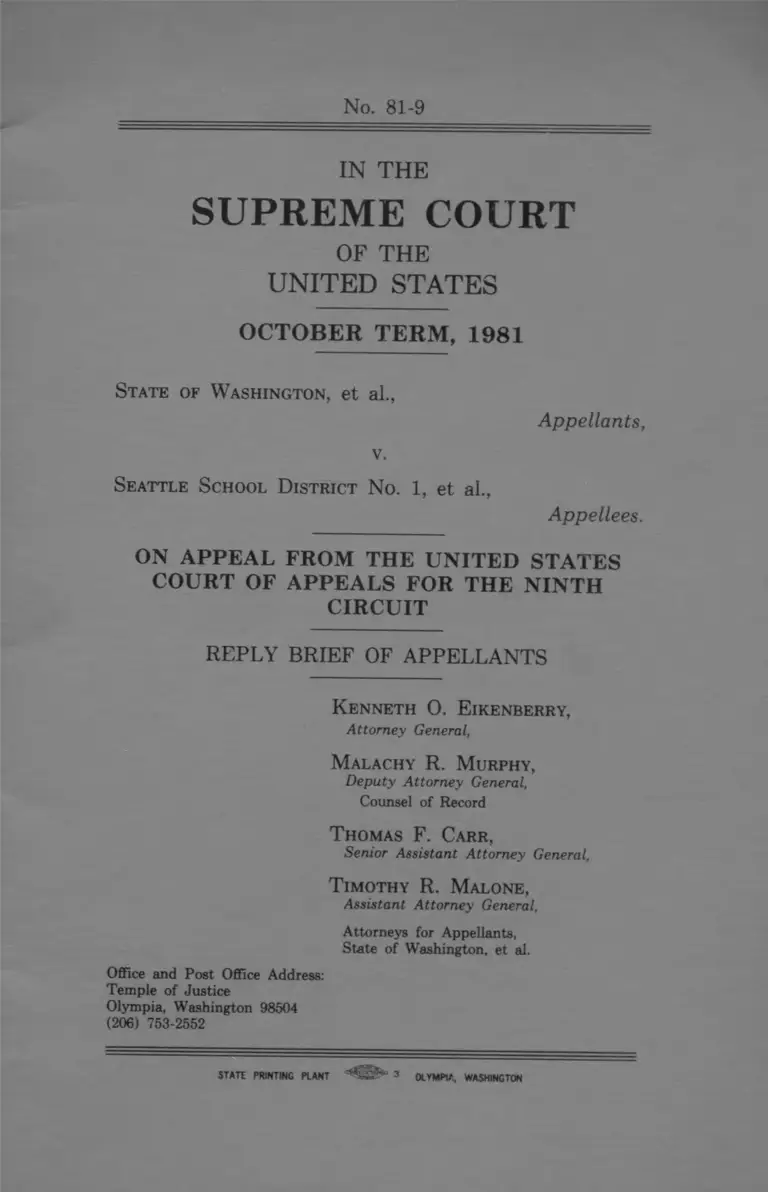
No. 81-9
IN THE
SUPREME COURT
OF THE
UNITED STATES
OCTOBER TERM, 1981
State of Washington, et al.,
Appellants,
v.
Seattle School District No. 1, et al.,
Appellees.
ON APPEAL FROM THE UNITED STATES
COURT OF APPEALS FOR THE NINTH
CIRCUIT
REPLY BRIEF OF APPELLANTS
Kenneth O. Eikenberry,
Attorney General,
Malachy R. M urphy,
Deputy Attorney General,
Counsel of Record
T homas F. Carr,
Senior Assistant Attorney General,
T imothy R. Malone,
Assistant Attorney General,
Attorneys for Appellants,
State of Washington, et al.
Office and Post Office Address:
Temple of Justice
Olympia, Washington 98504
(206) 753-2552
STATE PRINTING PLANT 3 OLYMPIA, WASHINGTON
IN THE
SUPREME COURT
OF THE
UNITED STATES
OCTOBER TERM, 1981
State of W ashington, et al.,
Appellants,
v.
Seattle School District No. 1, et al,
Appellees.
ON APPEAL FROM THE UNITED STATES
COURT OF APPEALS FOR THE NINTH
CIRCUIT
REPLY BRIEF OF APPELLANTS
Kenneth 0 . Eikenberry,
Attorney General,
M alachy R. Murphy,
Deputy Attorney General,
Counsel of Record
T homas F. Carr,
Senior Assistant Attorney General,
T imothy R. Malone,
Assistant Attorney General,
Attorneys for Appellants,
State of Washington, et al.
Office and Post Office Address:
Temple of Justice
Olympia, Washington 98504
(206) 753-2552
TABLE OF CONTENTS
Page
INTRO D U CTIO N ......................................................................... !
I. Inititative 350 Does Not Embody a Racial
Classification Nor Was It Adopted For A
Discriminatory Purpose..................................................... 6
A. The Relationship Between The “Classification”
Issue And The “Purpose” Issu e ........................... 6
B. The Fact That The Initiative Was Prompted By
The Seattle Plan, Does Not Show A Racially Dis
criminatory Purpose.................................................... 8
C. If The State Cannot Limit Extra-neighborhood
Student Assignments, Who Can? The Issues of
State Control Versus Local Control and State
Intrusion Into Local Affairs.................................... 10
II. The Initiative Does Not Resegregate Any School
District In The State of Washington......................... 13
III. The “Overbreadth” Issue................................................ 17
CONCLUSION........................................................................... 18
TABLE OF CASES
Arlington Heights u. Metropolitan Housing Development
Corp., 429 U.S. 252 (1977).................................................... 7 ,9 ,19
Brown v. Board of Education, 347 U.S. 483 (1954)____ 6, 7
Dayton Board of Education v. Brinkman, 433 U.S. 406
(1977)............................................................................................. 11
Hunter v. Erickson, 393 U.S. 385 (1 9 6 9 )..............................6 ,7 ,8 ,
12,13,19
James v. Valtierra, 402 U.S. 137 (1971)............................. 8, 9
Mandatory Bussing v. Palmason, 80 Wn.2d 445, 495 P.2d
657 (1972).................................................................................... 12
Pasadena Board of Education v. Spangler, 427 U.S. 424
(1976)............................................................................................. 15
Personnel Administrator v. Feeney, 442 U.S. 256
(1979)...................................................................................... 7, 8, 9,19
Swann v. Board of Education, 402 U.S. 1 (1 9 7 1 )......... 15
Washington v. Davis, 426 U.S. 229 (1976) ............. 7 ,9 ,10 ,19
l
Washington Statutes Pase
Chapter 340, Laws of 1981, §§ 87-91............................. 13
Initiative Measure No. 350 (Chapter 28A.26
R C W ) ...................................................................................... Passim
Washington Revised Code § 28A.58.754 .............................. 13
United States Constitution
Fourteenth Amendment (Equal Protection
Clause).....................................................................................3 ,11 ,17
Other Texts and Authorities
Bell, Book Review, 92 H.L.R. 1826 (1 9 7 9 ).................. 5
Report No. 81-6, The Effect Of The Seattle Plan For
School Desegregation On Achievement Test Scores. . 5
li
No. 81-9
IN THE
SUPREME COURT
OF THE
UNITED STATES
OCTOBER TERM, 1981
State of W ashington, et al.,
Appellants,
v.
Seattle School District N o. 1, et al.,
Appellees.
ON APPEAL FROM THE UNITED STATES
COURT OF APPEALS FOR THE NINTH
CIRCUIT
REPLY BRIEF OF APPELLANTS
INTRODUCTION
This case involves a clash between school officials and
the voters of the State of Washington on a critical issue of
social policy.1 But contrary to appellees contention, it does
not involve as well a clash between the voters and the con
stitutional rights of its minority children, as should
become clear to this Court.
We do not propose to show that the policy adopted by
the voters in Initiative 350, which overrode that adopted
by the school officials, was the wisest or even the
preferable policy. Just as one can always argue whether the
'We use the broader term “social” rather than “educational” policy
for the clash involves, as we shall see, fundamentally different views as
to the proper role of an educational system.
2
voters’ choice of a president, governor, or legislator is the
preferable choice, so too here. Whether the voters’ choice
was the best or not is probably unresolvable. The relevant
question is whether it was constitutionally theirs to make
in the first place.
The policy question and the constitutional question,
however, cannot be completely divorced. Indeed, an exami
nation of the relationship between the two raises the
principal issues upon which we focus in this reply, as we
take up the various points made by the appellee school dis
tricts.
First, we examine the relationship between the issue
of improper statutory classification (albeit covert as
appellees now admit) and the issue of improper purpose,
and ask in light of that examination: Are the two issues re
ally separate? Is not the charge of an improper covert clas
sification, analytically, the same as the charge of improper
purpose? And more importantly, does not the overt classi
fication which the Initiative actually makes belie the
charge of improper purpose?
Admittedly, Initiative 350 was prompted by, and in
that sense aimed at, the Seattle Plan. But what, in the vot
ers’ minds, was wrong with the Seattle Plan, as shown by
the Initiative itself, and particularly by the classification
that it makes? What feature of the Seattle Plan was it that
prompted the Initiative? These questions bring the classi
fication issue and the issue of improper purpose into focus
and will show that they are not really distinct. In turn,
they will provide no basis for invalidating the Initiative.
This first line of inquiry leads to the second: In what
precise sense is the policy decision adopted through the
Initiative “ race conscious”? After all, the Initiative was
proposed in response to another decision that was unques
tionably “race conscious” ; i.e., the adoption of the Seattle
Plan itself and the departure from the traditional neigh
borhood school assignment policy which it embodied. Does
this unavoidable element of “ race consciousness” in the
adoption of the Initiative make it constitutionally
impermissible for the voters?
Next, we ask: If the voters of the State cannot
3
override the policy decision made by the school officials in
volved in this litigation—and especially that made by the
Seattle School District officials—is there anyone who can
override that decision? Can those very same officials do
so? And if they can, why cannot the voters themselves? By
what constitutional analysis is this power to override given
to the one group, and not to the other? This question is
particularly important where, as here, the policy being re
scinded was not itself constitutionally required in the first
place.
There is another facet to this problem, best
illustrated by the claim of Seattle School District. That
claim, in essence, is that Initiative 350 is unconstitutional
because it prevents the District from attaining the precise
racial balance prescribed by the specific percentages es
tablished for Seattle. But what is it in the Fourteenth
Amendment’s Equal Protection Clause which provides
that protection to these percentages? If they (or any per
centages) are so protected, can the voters change them so
as to require a lesser level of racial balance? More impor
tantly, can even Seattle School District change them? Is
the Fourteenth Amendment in effect a legal ratchet which
allows changes in the percentages only in one direction, if
by the voters, but in both directions if by the District
itself? We will explore these questions as well.
Lastly we again examine the “overbreadth” issue to
show that, viewed in its proper perspective (i.e., from the
perspective of the constitutional and statutory rights of
school children) it is really a “non-issue,” the resolution of
which will only determine a constitutionally insignificant
procedural issue; i.e., who might bring the next possible
round of litigation.
Before taking up these points, however, one question
should be addressed at the outset: If the Initiative is
upheld, what will be the effect on the education of
minority children, so far as the record tells us?
For minority children in the Pasco School District,
4
the result will be that they are no longer bussed to the
other end of the school district and are instead free to at
tend the two or three schools closest to their own neighbor
hood. At the same time majority children in Pasco, if the
district determines to maintain its precise percentages,
will, for the first time be required to ride the bus to the
next nearest school. (See, App. Br. 16, and JA 53).
Whether they would receive a better education there than
that which they are receiving now is not known.
For minority children in the Tacoma School District,
the result would be no change whatsoever. (See, App. Br.
17-18).
For minority children in the Seattle School District,
the answer depends upon the decisions which the District
and the students (and their parents) would make.
How close Seattle might come to its own definition
within the limitations of the Initiative is impossible to de
termine, because the answer principally depends upon two
factors: The success or lack thereof for the voluntary pro
grams, and the District’s own policies regarding school clo
sures. Because of its declining enrollment, school closures
are economically necessary, though politically difficult.
(C/., FF 3.9).2 Closing schools which would not meet the
District’s criteria for racial imbalance would obviously
bring the District much closer than would closing those
which do meet them.3
So much for the numbers—or lack thereof. What does
all this mean in terms of the quality of education which
would be received by minority students in Seattle if the
Initiative were upheld?
No one really knows. But an indication may be found
2This stems, of course, from parents’ strong belief in neighborhood
schools, and can hardly be gainsayed. It comes from minority as well as
majority parents. However, when some schools must be closed
nevertheless, because of declining enrollments, the only question is
which schools must be closed. And that choice is the District’s, and will
effect the degree of racial balancing.
3A11 of this is dependent upon one critical factor. Seattle
presupposes that they are under an affirmative duty to meet that
specific level of balance. We submit they were not, and are not now.
That, of course, is the core question the Court must answer. (See pp. 13-
17, infra)
5
in a report referred to, though not identified, in appellees’
brief.4 In August of last year, Seattle issued Report No. 81-
6, entitled “The Effect of the Seattle Plan for School De
segregation5 on Achievement Test Scores.” The reason for
the study covered in the report is states as follows:
“ One of the frequently asked questions is, ‘What
effect has desegregation had on student
achievement?’ It should be remembered that the goal
of the Seattle Plan was to eliminate racial
imbalance; not to raise achievement levels.
Nevertheless, some concern has been expressed that
desegregation might somehow lower achievement
levels for some students. The report addresses this
concern.” (Emphasis supplied.)
The report concludes:
“ The purpose of the Seattle Plan was to reduce
racial imbalance in the schools. Achievement of that
goal has demonstrated the Plan’s success. Any effect
of the Plan on achievement test scores is irrelevant
to evaluation of the Seattle Plan i t s e l f (Emphasis
supplied)
This is hardly a ringing endorsement for the Seattle
Plan as a means of attaining higher achievement levels,
and falls considerably short of showing a significant
correlation between levels of racial balance and levels of
educational achievement.
But even more importantly, the report shows that the
Seattle Plan embodies a particular educational—or rather
social—policy: Racial balance must be achieved, even
when not constitutionally required, simply as a matter of
good social policy, completely independent of the actual
results on educational achievement.6
“See, SD Br., 14, note 15: “Test scores in Seattle have slightly im
proved.” This 1981 report would appear to be the source for that stat-
ment.
5This term itself assumes a legal conclusion which is at the heart of
this litigation. See discussion pp. 13-17, infra.
6One is reminded of Dean Derrick Bell’s comment on Gary Orfield,
who was one of the appellees’ witnesses in this case: “But school inte
gration for liberal campaigners like Orfield is too important to confuse
with education.” See, Bell, Book Review, 92 H.L.R. 1826, 1836 (1979)
reviewing Orfield’s “Must We Bus?”
6
This may indeed be sound social policy. The question,
however, is whether it is to be embedded in the
requirements of the Fourteenth Amendment.
The Seattle Plan, we should add, does not reject the
values inherent in a neighborhood school policy; nor does
the Initiative reject the values inherent in increased racial
balance. The critical difference lies rather in the different
weights each assigns to these competing values, and in the
accommodation that they strike.
Thus, the Initiative allows mandatory assignments to
the next nearest school, for the purpose of achieving racial
balance, or for any other purpose. Similarly, decisions as to
which schools should be closed and where new schools
should be located will have a substantial impact upon the
level of racial balance; and the Initiative does not control
those decisions in any way. So too the Seattle Plan manda-
torily assigns not just individual students, but “ entire
neighborhoods of students” away from their nearest or
next nearest school. (FF 6.11, J.S. A-17) And as we have
seen, one of the justifications for such mandatory
assignments is the opposition to school closures from
neighborhood groups which purportedly make school
closures an impracticable tool for achieving racial balance.
(See, FF3.9.)
We now turn to the legal issues.
I. INITIATIVE 350 DOES NOT EMBODY A
RACIAL CLASSIFICATION NOR WAS IT
ADOPTED FOR A DISCRIMINATORY PUR
POSE.
A. The R ela tion sh ip B e tw e e n the “C lassi
fica tion ” Issu e and the “P u rp o se ” Issue.
The reason for the school districts’ efforts—so far
successful—to establish that the Initiative embodies a
racial classification is readily understandable. Once such a
classification is found it is invariably fatal to the law or
other governmental decision under attack. See, e.g., Brown
v. Board of Education, 347 U.S. 483 (1954), and Hunter v.
7
Erickson, 393 U.S. 385 (1969). In contrast, attacks
grounded on a charge of racially discriminatory purpose
have, in recent cases, failed. See, e.g., Washington v.
Davis, 426 U.S. 229 (1976) and Arlington Heights v. Me-
troplitan Housing Development Corp., 429 U.S. 252
(1977), cf., Personnel Administrator v. Feeney, 442 US.
256 (1979).
Certain portions of the school districts’ brief,
however, raise the question: Are the two arguments really
distinct? In arguing that the Initiative creates a racial clas
sification, they state: “ It [the Initiative] is race-conscious
in its history and race-related in its purpose and effect.”
(SD Br. 18, emphasis supplied.) The Initiative’s
classification, it is argued, is “ covert” (SD Br. 21), and
must be judged on the basis of its “objective.” (SD Br. 21).
Similarly, under this same argument, the school districts
emphasize “ the potential for corruptive influence of
prejudice.” (SD Br. 24).
This suggests that the school districts’ “ classification”
argument and its “purpose” argument are not really all
that distinct— and indeed they are not. The search for a
“ covert” classification is really the search for an improper
purpose.
We suggest that the focus instead be upon a
somewhat different distinction which, though not
altogether tidy, may be analytically more useful. That dis
tinction would be between (1) governmental decisions
which are per se violative of the Fourteenth Amendment
regardless of motive and (2) those which are
constitutionally permissible, in and of themselves, but may
be invalidated because of the reasons or motives behind
their adoption. Brown v. Board of Education and Hunter
v. Erickson would illustrate the first category of cases; and
Washington v. Davis, Arlington Heights, and Feeney the
second.
When we say that the Initiative does not embody a
racial classification we are saying only that it is a govern
mental decision which falls into the second category and
not the first. More specifically, we are saying that a gov
ernmental decision to prohibit mandatory assignments
8
beyond the next nearest school except for reasons related
to the individual needs of the student is, in and of itself,
perfectly permissible. It is not off limites to the
government’s decision-making process. It is, in this
respect, no different from a decision to give a veterans’
preference in employment, (c/., Feeney) or to require
minimum literacy requirements for applicants to a police
force. (Davis). But just as in Feeney and Davis, so too here
a racially discriminatory purpose may invalidate that
decision. And whether one couches the legal result in those
terms, or in terms of a “ covert” classification, is really
beside the point.
This is perhaps best illustrated by comparing Hunter
v. Erickson, supra, with James v. Valtierra, 402 U.S. 137
(1971). In Valtierra, it will be recalled, the lower court had
invalidated, on the basis of Hunter, an amendment to the
California constitution requiring local voter approval for
any low-rent public housing project. In reversing, this
Court stated: “The present case could be affirmed only by
extending Hunter, and this we decline to do.” 402 U.S. at
141.
The Court did not engage in a search for a “ covert”
classification or attempt to determine whether the
classification actually made by the amendment, though
nonracial in “ form,” was racial in “ substance.” (C/., SD Br.
21). Rather, it went directly to the question of whether the
amendment was “ aimed at a racial minority,” i.e., the
question of discriminatory purpose.
The Court should take the identical approach here.
B. The Fact that the Initiative was Prompted
by the Seattle Plan D oes not Show a Racially D is
criminatory Purpose.
The school districts’ principal contention as to
racially discriminatory purpose, however phrased, really
sifts down to a single assertion: The Initiative was
intended to impede the Seattle Plan, and any other plan
which relied upon mandatory extra-neighborhood student
assignments to achieve racial balance. Indeed, this effect
9
on the Seattle Plan was the basis for the District Court’s
finding that a discriminatory purpose existed. (See, J.S. A-
24).
But this overlooks the critical question: Is the objec
tionable feature of such plans that they achieve greater
racial balance than would exist without them? Or is it that
they mandatorily assign students outside their
neighborhoods, without any justification in terms of the
specific needs of specific students?
The classification established by the Initiative itself
provides a large part of the answer. It shows that the ob
jectionable feature was not the former but the latter. This
is shown by the fact that the scope of the Initiative is not
limited to plans for attaining racial balance, such as the
Seattle Plan, but covers all extra-neighborhood mandatory
assignments, for whatever reason, unless they can be
justified in terms of specific needs of specific students.7
The Initiative no more evidences an intent to
discriminate than did the constitutional amendment
involved in Valtierra, the test for police force applicants
involved in Davis, the zoning decision in Arlington
Heights, or the veterans’ preference provision involved in
Feeney. And the burden of showing such an intent remains
with the appellee school districts, just as it remained with
the plaintiffs in those four cases. They simply have not
met that burden.
In attempting to meet that burden, the school
districts also face a major factual hurdle: In the campaign
for Initiative 350 the Initiative’s sponsors made no appeals
to racial bias, and in fact deliberately took steps to avoid
race becoming an issue. (FF 7.27, 7.29, J.S. A-23). Indeed,
as we earlier pointed out, advertising and public relations
witnesses called by both sides gave unrebutted substantive
testimony that a statewide campaign in favor of a ballot
proposition would lose support in Washington if designed
’Compare FF 8.3 and 8.8 (JS A-24) and the District Court’s use of
the qualifiers “most,” “major” (FF 8.3) and “almost all” (FF 8.8). That
bussing of students for purposes other than racial balance was taking
place in Washington, which would be precluded by the Initiative, was
demonstrated in the record, as the District Court acknowledged. See JS
18, St. Br. 10, N. 6.
10
to appeal to segregative and racist attitudes. (Tr., pp. 496-
98, 505-06, 509-11, 538; JA 21, 26; Ex. 2)
This does not mean that some of the voters were not
influenced by racial bias. It does show, however, that such
bias was in no way a decisive factor in the Initiative’s suc
cess.8 Indeed, the converse is shown; lack of bias was the
decisive factor. And it further shows what should be
obvious from the Initiative itself, and from any balanced
view of the record. To the extent that the voters
considered race at all, they decided that any benefits from
increased racial balance stemming from extra
neighborhood school assignments were outweighed by the
benefits of a policy allowing the choice of one’s
neighborhood school.
The school districts simply suggest that the Initiative
is nevertheless invalid because it was “ race conscious.”
Certainly, because it was developed as a response to the
Seattle Plan which was itself “race conscious” a
corresponding element of race-consciousness was
inevitable. But this factor should no more invalidate the
Initiative than it should invalidate the Seattle Plan itself.
The critical question is the role which this race-
consciousness played in the decision-making process. Did
it lead to the adoption of the Initiative for a discriminatory
purpose? As we have seen, it did not. And the school dis
tricts’ efforts to equate race consciousness with
discriminatory purpose only confuse the issues, by
substituting “buzz” words for legal analysis.
C. I f the State Cannot Limit E xtra
neighborhood Student Assignments, who can?
The Issues o f State Control Versus Local Control
and State Intrusion into Local Affairs.
The issue of discriminatory purpose is next examined
from another aspect. Under the opinion of the Court of
Appeals, Seattle could completely dismantle its own plan,
and revert back to its prior policy of a neighborhood school
8As Justice Stevens has reminded us: “A law conscripting clerics
should not be invalidated because an atheist voted for it.” Washington
v. Davis, 426 U.S. at 253.
11
system, at least absent any prior de jure segregation. J.S.
App. B-10. And on this point, the Court of Appeals was
correctly following this Court’s opinion in Dayton v. Board
of Education v. Brinkman, 433 U.S. 406 at 414 (1977).
But if the arguments of the school districts on the
issue of discriminatory purpose are correct, then the Court
of Appeals (along with this Court in Dayton) was
incorrect, and Seattle would be forever precluded from dis
mantling its plan, even though it had no constitutional ob
ligation to adopt it in the first place. For if Initiative 350
was discriminatory in purpose only because it embodied a
decision to undo the racial balance brought about by the
Seattle Plan, the same decision, with the same effect, must
also be discriminatory when made by the school board
members themselves, rather than the voters.
Similarly, if the Initiative is unconstitutional because
it deprives minority groups of educational benefits
stemming from increased racial balance brought about by
the Plan, then it should also be unconstitutional for the
school board to do the same thing. If it is discriminatory
for the voters to change the accommodation between
neighborhood schools and racial balance struck by the
Seattle Plan by assigning more importance to
neighborhood schools, it should be discriminatory for the
school board to do so as well. The school districts’
arguments as to discriminatory purpose, in short, prove
too much. They permanently would lock in all efforts to
achieve racial balance even where not constitutionally
required in the first place. This Court, however, has never
given such an effect to the Fourteenth Amendment and, as
pointed out by the Court of Appeals, has indicated in Day-
ton that it has no such effect.
And quite wisely so, in our view. If efforts to achieve
greater racial balance were constitutionally irreversible,
that would be a great disincentive to undertake such
efforts in the first place.9
9Not only would efforts to achieve racial balance in schools be
impeded, but governmental efforts to promote those programs generally
described as “affirmative action” would logically be irreversible as well,
and for that reason similarly impeded.
12
There is, to be sure, a further argument offered by the
school districts which does not have this boomerang effect.
For it involves a theory which would, if accepted,
invalidate Initiative 350 without also prohibiting Seattle
itself from adopting the same policy as that embodied in
the Initiative. The argument is that the Initiative skews
the political process in the same manner as it was skewed
in Hunter. But let us see if this parallel really exists.
The constitutional violation in Hunter was not that
the Akron open housing ordinance was repealed. Clearly
the Akron city council could have repealed it without vio
lating the Fourteenth Amendment, and so could the voters
themselves, through the referendum process (393 U.S. 390,
note 5). The constitutional violation rather involved the
procedures for restoring that ordinance. Those procedures
established a “gauntlet,” i.e., the necessity of an automatic
referendum to the voters, which no other ordinances
relating to housing— and indeed, no other types of
ordinances at all— had to run. (393 U.S. at 390, 391)
The school districts contend that the Initiative has
created a similar gauntlet which must be run only by the
proponents of extra-neighborhood mandatory assignments
for racial balance.
We have already touched upon one reason why it does
not. The proponents of extra-neighborhood mandatory as
signments for several reasons must now, under the
Initiative, convince the legislature or the voters of the
merits of their cause, unless the reason can be found as an
exception within the Initiative justified in terms of specific
needs of specific students.
The parallel fails for two additional reasons. The op
ponents of the Seattle Plan simply did not have available
to them a local referendum procedure similar to that
available in Akron. The only choice they had in presenting
their case to the voters was the choice they actually
made— a statewide initiative.10 They changed the locus of
the decision-making process from the local to the state
level because State law made that their only choice.
10Citizens Against Mandatory Bussing v. Palmason, 80 Wn.2d 445
at 449, 495 P.2d 657 (1972).
13
Consider the supposed parallel next from the point of
view of the proponents of extra-neighborhood mandatory
assignments, rather than that of the opponents. It is not
just minority groups that must make their case on the
state level in order to bring about what they perceive to be
educational improvements. (See generally, State Br. 21, 22;
U.S. Br. 21-24.) If any group, minority or not, wishes major
curriculum changes, they must change state law. See
Wash. Rev. Code § 28A.58.754. If they want lower ratios of
students to classroom teachers, or if they believe those
teachers are inadequate because they are underpaid, they
must look to the legislature. (See §§ 87-91, chapter 340,
Laws of 1981, establishing funding levels in terms of salary
levels and student-staff ratios.) Likewise, they must look
to the legislature if they wish to assure more hours of in
struction for their children.
What we are saying, quite simply, is that because of
the State’s constitutional “paramount duty” in the field of
education, broad state control over the decisions of local
school boards is the norm, not the exception. And for this
reason, as well, the parallel with the situation in Hunter v.
Erickson does not exist.
II. The Initiative Does Not “R esegregate”
A ny school District in the State o f Washington.
At page 2 of the Brief of Appellees, the school
districts make the following statement which they
characterize as part of the “historical background” of this
case:
“The Seattle, Tacoma, and Pasco * * * districts
have determined that racial desegregation is an
important educational goal. The overall education of
students * * * suffers when schools are segregated,
* * * The greater the racial imbalance, the greater
the impairment. * * * Since the early 1960’s, these
public school districts have taken steps to reduce
school segregation. * * * “Because the antibusing
statute in question arose mainly in opposition to
effective desegregation in Seattle, events there must
be recited in some detail.” (Emphasis added.)
14
The underscoring in this excerpt emphasizes a critical se
mantical ambiguity which the districts have quite deliber
ately—and so far, at least, successfully—sought to
interject into this case since the very outset. The words
“ segregation” and “racial imbalance,” one will note, are
used interchangeably (as they have been throughout this
litigation).
The inference to be drawn from repeated use of such
words as “segregation,” “ segregated” and “ desegregation,”
of course, is that de jure segregation (i.e., some form of
dual school system, some officially imposed or sanctioned
separation of the races) exists in all three districts
compelling remedial action (i.e., steps taken pursuant to a
constitutional duty) which is, according to appellees,
frustrated by Initiative 350.
As much as these school districts may imply that Ini
tiative 350 interferes with the performance of some consti
tutional duty to remedy the effects of a dual school system,
however, the instant case does not present that issue at all.
There has been no showing that there is now or ever has
been “ segregation” (in the sense of de jure segregation) in
any of these districts or, for that matter, any other school
districts in Washington. The only showing so far made is
that the traditional and natural distribution of students in
Washington’s 300 school districts results in a condition in
three of those districts which, according to differing ad
ministrative formulae developed by those districts, could
be described as racial “ imbalance” in their respective
student populations.
The districts have strived mightly to insure that this
particular element of confusion remains ingrained in any
analysis of the pivotal issue of this case, for the policy un
derpinnings of their position depend upon its presence.
Their insistence upon the presence of some affirmative
constitutional duty on the part of individual school board
members, for example, is predicated on equation of the
terms “ racial imbalance” and “de jure segregation.” And
the validity of their contention that Initiative 350, if im
plemented in Seattle, will somehow accomplish
“ resegregation” of Seattle’s schools depends absolutely on
15
some constitutional sanctity being accorded that district’s
definition of “ racial imbalance” in its schools. Logically,
their argument in this regard depends on some perfect
equation of their own criterion for determining racial im
balance in student distribution with the term
“segregation.” To this extent, then, it is transparent that
the position taken by the districts before this Court posits
the existence of a constitutional standard of racial balance,
a proposition specifically rejected by this Court in Swann
v. Board of Education, 402 U.S. 1 (1971) and Pasadena
Board of Education v. Spangler, 427 U.S. 424 (1976). In
Spangler this Court noted at 427 U.S. 434 that:
“The District Court’s interpretation * * * appears
to contemplate the ‘substantive constitutional right
[to a] particular degree of racial balance or mixing’
which * * * Swann expressly disapproved.”
If for no other reason, the weakness of their analysis
is apparent from the fact that these formulae are eternally
subject to change.
But there are other reasons. Even if the criteria for
determining when Seattle’s schools suffer from “racial im
balance,”11 or when Tacoma’s school children suffer from
“ racial isolation” 12 or when Pasco’s schools are
“ The Seattle School Board currently defines “racial imbalance” as
the condition which exists when:
“ * * * the combined minority enrollment in a school
exceeds the district-wide combined minority average by 20
percentage points, provided that the single minority enrollment (as
defined by current federal categories) of no school will exceed 50
percent of the student body.”
FF 6.9. Under this definition, of course, a school where the relative
school enrollment is one-third black, one-third Asian and one-third
white majority, would nevertheless be “racially imbalanced” since the
minority population would exceed the district-wide combined minority
average by more than 20 percent. If, on the other hand, the combined
minority population in the District some day exceeds 80 percent then,
without a change in Seattle’s definition, a school which is one-third
black, one-third Asian, one-third Hispanic, but which is not attended
by a single white student, will nevertheless be “racially balanced,” and
minority students in that school will not be “isolated” from white stu
dents.
The District Court found that the Tacoma School District defined
racially imbalanced schools as those which had a combined minority en
rollment of 50 percent or more or a single minority of 40 percent or
16
“ segregated”* 13 were not subject to change by the several
districts which have chosen to adopt them, they simply do
not rise to the dignity of constitutional standards. They
are too flawed.
The Seattle School District’s own expert witnesses
testified, for example, that if the District had, instead, re
quired that no school within the district could have a ma
jority enrollment of less than 18 percent, then Seattle
schools could all have been racially balanced (within the
constraints of that criteria) under Initiative 350.14 In
Pasco, a school which is perfectly “balanced” on a one-to-
one basis (i.e., 50 percent minority students and 50 percent
majority students) becomes “ segregated” if one more
minority student is added to the student population.
The definition of “ racial isolation” adopted by the
State Board of Education and the State Human Rights
Commission leads to absurd results when applied in other
major metropolitan areas throughout the State of
Washington. In Spokane, for instance, where the combined
minority population atthe time of trial was 7.05 percent, a
student in a school which has a combined minority
population in excess of 27.05 percent would suffer “ racial
isolation.” Vancouver is an even more dramatic example of
these senseless results. According to that criterion, a
minority student in a Vancouver school which was fully 75
percent majority would, nevertheless, be “ racially iso
lated.”
The point is this. There are various definitions of
“ racial balance,” “ racial isolation,” etc., in place in Wash
more. FF 5.1. This is a correct finding, but the situation in Tacoma
changed during the period immediately leading up to this litigation.
The Tacoma School District’s definition of a “de facto segregated”
school is determined by reference to the State Board of Education’s
definition of “racial isolation.” When, in turn, the State Board changed
its definition of “racial isolation,” the Tacoma School District
immediately found itself with more “segregated” schools than it had
previously (although no change in school enrollment had occurred). (Tr.
386-88).
13The Pasco School District has never developed any working
definition at all. It simply uses a federally-imposed guideline of 50
percent minority enrollment as a breakpoint. (Tr. 624-28).
14Ex. 92, pp. 12-13.
17
ington’s school districts at this time. While some or all of
them may make sense in some contexts, they are absurd in
others. This fact underscores the correctness of this
Court’s holding that no one of them is embodied as an un
changeable standard incorporated into the Fourteenth
Amendment. And because of this, it is absurd to argue that
Initiative 350 will have any impact on “desegregation” in
Washington.
III. THE “OVERBREADTH” ISSUE:
The School Districts’ claim of an affirmative
constitutional duty to achieve greater racial balance has
another facet which is especially important with respect to
Seattle. While we have addressed this issue, with clarity
we hope, in our opening brief, a few further thoughts seem
warranted in light of appellees submissions.
On the issue of whether predecessor school boards in
Seattle have committed acts of de jure segregation, the
District is studiously ambivalent. (See SD Br. 4, note 3) It
apparently wishes this Court to view it as being in
precisely the same position as a school district which has
been judicially determined to have committed such acts.
At the same time, however, it apparently wishes to
preserve the option of presenting a defense to any charges
of de jure segregation in Phase II of this litigation, should
that phase occur.
But if Seattle is to be viewed in the present phase of
this litigation as being in the same position as a district
which has been judicially determined to have committed
such acts, then Seattle’s case is actually moot. For such a
school district is simply outside the scope of the Initiative,
as we have previously shown.
To keep its challenge to the Initiative from becoming
moot, however, the Seattle School District suggests that
the Initiative prevents the District itself from determining
that it has committed such acts, and therefore has a con
stitutional duty to adopt a remedy. (SD Br. 38-42)
The Office of the Attorney General does not so
18
construe the Initiative. (State Br. 37-40)15 But how does a
constitutional issue arise if that construction is wrong?
And what practical difference does it make as to who is
correct on this issue of statutory construction?
If the members of the Seattle School Board make a
good faith determination that their predecessors have
engaged in acts of de jure segregation, one result is certain.
They may continue the Seattle Plan without fear of any
lawsuit from the Attorney General or any state agency.
This does not mean that Seattle’s determination is
not subject to legal challenge. A student or parent remains
free to sue the District and to obtain a judicial ruling that
Seattle was wrong in its determination. But until that hap
pens Seattle is entirely free to rely upon its good faith
judgment that it must continue its policy of extra-neigh
borhood assignments.
We again note, however, that this whole discussion is
entirely academic. Phase II of this litigation has been de
signed by the District Court to answer that very question,
if necessary. Seattle need not speculate on who might sue
them. They already know. The Seattle Intervenor-
Plaintiffs already have.
The issue of the proper construction of § 6 is, in the
final analysis, a “non-issue,” which has interesting
procedural aspects, but no constitutional significance.
CONCLUSION
It should now be clear to the Court that upholding the
validity of Initiative 350 will result in no retreat
whatsoever from any of this Court’s prior desegregation
15The so-called Seattle Intervenor-Plaintiffs’ attempts to persuade
the Court that our position on the false issue of overbreadth “lacks can
dor” itself lacks the truthfulness which a submission to this Court de
serves.
They claim that we somehow declined to give a formal opinion on
the question of what a school district may lawfully do under Initiative
350 to remedy de jure segregation, and thus ducked the question for
purposes of this litigation. ACLU, et al., Br. pp. 51-57. An examination
of the questions posed which were admitted as Ex. A-89 at tried shows
clearly, however, that the Attorney General was not even asked that
question.
19
cases. On the other hand, invalidation of Initiative 350 will
result in an unwarranted extension of Hunter u. Erickson,
and a retreat from the principles announced in
Washington v. Davis, Arlington Heights and Personnel
Administrator of Massachusetts v. Feeney.
Initiative 350 is remedial legislation, intended to
restore the traditional neighborhood school policy in the
State of Washington. It will not result in any
“ resegregation” of schools in the State of Washington.
Respectfully submitted,
K enneth O. Eikenberry,
Attorney General,
M alachy R. M urphy,
Deputy Attorney General,
Counsel of Record,
T homas F. Carr,
Senior Assistant Attorney General,
T imothy R. M alone,
Assistant Attorney General.