Memorandum of James E. Swann, et al., in Opposition to Motion for Stay
Public Court Documents
August 24, 1970
11 pages
-
Case Files, Swann v. Charlotte-Mecklenburg Hardbacks. Memorandum of James E. Swann, et al., in Opposition to Motion for Stay, 1970. 471e1c4d-2e34-f111-88b4-0022482cdbbc. LDF Archives, Thurgood Marshall Institute. https://ldfrecollection.org/archives/archives-search/archives-item/5abed402-fc16-4675-8e31-81fb3e2455a5/memorandum-of-james-e-swann-et-al-in-opposition-to-motion-for-stay. Accessed October 15, 2026.
Copied!
     [||32281f3c-80be-49fb-8848-bb1e46a5de50||] # *
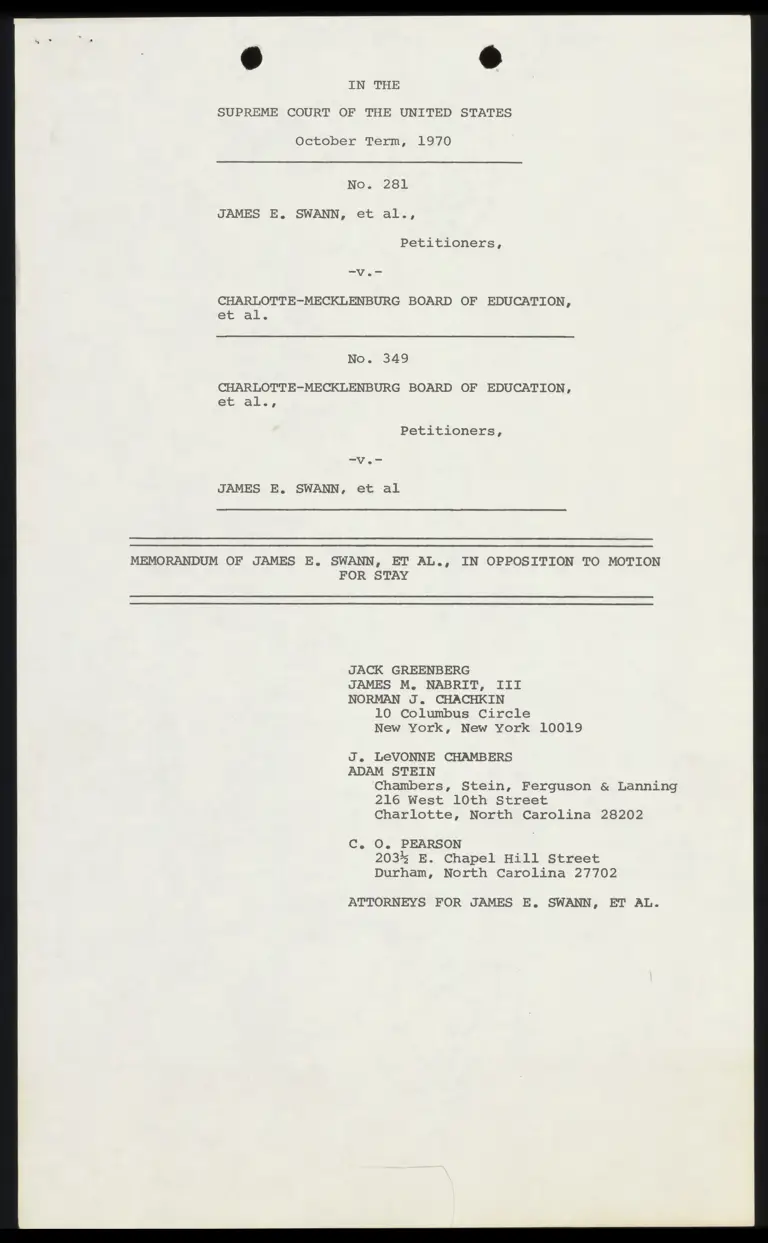
IN THE


SUPREME COURT OF THE UNITED STATES

October Term, 1970


No. 281

JAMES E., SWANN, et al.,

Petitioners,

oi

CHARLOTTE~-MECKLENBURG BOARD OF EDUCATION,

et al.


No. 349

CHARLOTTE-MECKLENBURG BOARD OF EDUCATION,

et al.,

Petitioners,

-Ve

JAMES E. SWANN, et al


MEMORANDUM OF JAMES E. SWANN, ET AL., IN OPPOSITION TO MOTION
FOR STAY


JACK GREENBERG

JAMES M, NABRIT, III
NORMAN J. CHACHKIN

10 Columbus Circle

New York, New York 10019

J. LeVONNE CHAMBERS

ADAM STEIN

Chambers, Stein, Ferguson & Lanning
216 West 10th Street

Charlotte, North Carolina 28202

C. O., PEARSON

203% E. Chapel Hill Street
Durham, North Carolina 27702

ATTORNEYS FOR JAMES E. SWANN, ET AL.


IN THE

SUPREME COURT OF THE UNITED STATES

October Term, 1970


No. 281

JAMES E, SWANN, et al.,

Petitioners,

-t. -

CHARLOTTE-MECKLENBURG BOARD OF EDUCATION,

et al. :


No. 349

CHARLOTTE-MECKLENBURG BOARD OF EDUCATION,

et al.

Petitioners,

-_-V

JAMES E. SWANN, et al.


MEMORANDUM OF JAMES E. SWANN, ET AL., IN OPPOSITION TO MOTION
FOR STAY


To The Honorable Warren E. Burger, Chief Justice of the United
States And Circuit Justice for the Fourth Circuit:

The Board of Education of Charlotte-Mecklenburg, North Carolina

has made application for a stay of the August 3 and August 7, 1970

orders of the District Court for the Western District of North Carolina

which were entered following proceedings directed by this Court on

June 29, 1970. The black pupils and parents, the plaintiffs below,

oppose the application.

STATEMENT

On June 18, 1970, the plaintiffs filed a petition for writ of

certiorari seeking review of the decision and judgment of the United

States Court of Appeals for the Fourth Circuit. At the same time they


moved the Court to advance and for pendente lite relief. The Court


granted certiorari on June 29, deferred decision on the motion to

advance and reinstated the district court's desegregation order of

February 5, 10. The Court also authorized further proceedings

in the district court to consider alternative means to desegregate

the Charlotte-Mecklenburg schools.

The remand instructions of the court of appeals required the

school board to file a new desegregation plan. The school board

did not file a new plan. Instead, it offered again the plan which

had been rejected by the district court in February and by five

of the six members of the court of appeals.

At the recent hearing, the district court considered the

"known plans for desegregation" (Br. X15 rhea were three "known

plans” under review in addition to the Finger plan ordered on

February 5 and the previously rejected board plan. There was a

plan prepared by HEW, a plan prepared and offered by four of the

nine members of the school board and an earlier plan prepared by

Dr. BOS plans are described in petitioner's brief on

the merits (pp. 30-34), a copy of which is attached.

The Court again rejected the board plan as unconstitutional

and also rejected thi HEW plan which had been roundly criticized by

both plaintiffs and Stata ok As to the other plans, the court

concluded:

The court ordered (Finger) plan is the only
complete plan before the court, and it is a


1/ The order is printed at page 8l19a of the printed appendix which

is on file with the Court.

2/ The Memorandum of Decision and Order of August 3, 1970 is appended

to petitioner's brief on the merits which is on file with the Court.
A copy of the brief is attached to this Memorandum.

3/ The board has erroneously described this plan as leaving some
all-black schools (Appendix to Stay Application, A-6, p. 39). Under
the plan, all the schools would be predominantly white.

4/ See defendants' criticism of the HEW plan, appendix to petition,

A-6, PP. 35-36.


reasonable plan. The Board is herein directed

to put the court ordered plan (with authorized

modifications, if desired) into effect with the

opening of school in the fall, unless they ex-

ercise the options set out herein to adopt the

4/5 minority Board plan (the Watkins plan) or

an earlier draft of the Finger plan, or any

combination of the three plus excerpts from the

HEW plan, which complies with the directives in

the February 5 order (Br. A2).

The district court emphasized that its February 5 order, which had been

reinstated by this Court, had left to the board the opportunity to

fashion a different plan as long as the plan achieved the required

results.

The board exercised none of the choices afforded by the court

(Br. A40), so the court again directed that the February 5 order be

implemented (Br. A39). Thus the board now seeks relief from the same

order which this Court reinstated on June 29, 1970.

ARGUMENT

(1) This Court has already decided in its June 29 order that

the desegregation plan now in effect is an appropriate plan to be

implemented pending final determination of the case. No reason has

been advanced for disturbing that judgment of the full Court.

The Court's order of June 29, 1970 directed the district judge

to formulate the plan to be implemented pendente lite from plans be-


fore him including the court ordered plan. Judge McMillan has been

faithful to that task. He concluded after an eight day hearing that

the only complete plan before him was the court ordered Finger plan

(Br. A2), and therefore continued this Court's order in effect.

The June 29 order of the full Court was based upon the doctrine


of Alexander v. Holmes County Board of Education, 396 U.S. 19 (1969),


which requires the establishment of a unitary Sghbol system

pending litigation concerning the efficacy of any of its parts.

The order of June 29 represents a judgment by the full bench that

the plan ordered by the district court on February 5 would establish

a unitary school system and is, at the least, an adequate plan for

  implementation on a pendente lite basis. Nothing has transpired

since June 29 which undermines that decision of the Court. On the

contrary, the carefully considered decision by the district court

on August 3, 1970 sets forth facts Joh lestailien that the plan

ordered on February 5 is not only a proper plan pendente lite, but


is an appropriate final plan for the desegregation of the Charlotte

schools.
|

(2) The board's assertions that it lacks the buses and funds

to carry out the Court's orders are in onflict with the fact findings

of the district court. These findings have not been shown to be

clearly erroneous.

The board has orgaged in exaggerations of this kind since

February in the hopes of avoiding its obligation to desegregate   its schools. Similar unsupported assertions resulted in a partial

stay by the court of appeals on March 5, 1970 (922a). Supplementary

proceedings resulted in findings by the district judge that the

board's claims were grossly exaggerated (1198a, 1221a) which findings

were found to be not clearly erroneous by the court of appeals (l262a).

Most recently, these matters were fully litigated again during an

eight day hearing. The district judge concluded:

The defendants have plenty of money,

plenty of know-how, plenty of buses on hand

or available upon request, and plenty of

capacity to implement the court ordered plan

or the minority plan or any combination of

the various plans. Their contentions to the

contrary, and their five million dollar


"estimates," when heard against the actual
facts, border on fantasy (Br. A26).

Factual assertions in paragraphs 6, 7, 8 and 9 of defendants’

application for a stay are filled with erroneous statements of

fact concerning the transportation requirements of the court ordered

plan. (Many of the board assertions are contradictory from paragraph

to paragraph). These bald assertions are made in the teeth of the

district court's findings. Under settled principles of law, the

court's findings are not to be set aside unless clearly erroneous.

Findings of fact shall not be set
aside unless clearly erroneous, and
due regard shall be given to the oppor-
tunity of the trial court to judge of
the credibility of the witnesses.
(Rule 52 (a), Federal Rules of Civil

Procedure).

In considering defendants' application for a stay, the clearly

erroneous rule should be given full effect. Board of Education of


the City of New Rochelle v. Taylor, 82 S. Ct. 10 (1961) (Memorandum


of Mr. Justice Brennan); Magnum Import Co. v. Coty, 262 U.S. 159


(1923). Indeed, since the court of appeals has already explicitly

determined that the essential findings under attack by the defendants

were not clearly erroneous and because of the mandate of the Alexander


v. Holmes County Board of Education, supra, that schools are to be


desegregated "at once," the rule of Board of Education of the City


School District of the City of New Rochelle, supra which requires an


"extraordinary showing" should apply. The defendants make no such

showing.

Defendants also make several factual assertions which were

never presented to the district court. Their claims about certain

facilities which they say will have to be moved (Stay Application,

paragraph 10) should be ignored. They have had more than an ample


opportunity to litigate these matters below but have chosen not


to do so. It is entirely improper for them to seek to do sO now,

Claims are also made by way of assertion and affidavit as to

the number of buses "actually" required to implement the order for

secondary schools (Stay Application, paragraph 9). ‘Predictably,

the numbers are large. We have no doubt that the board can design

a transportation system to conform to its inflated estimates. We

can hope that in the end it will operate an economical system. How-

ever, as Judge McMillan observed in March: vperendants have offered

various estimates of large increased costs for administration, parking,

maintenance, driver education and other items. If they chose to incur

excess costs, the Court can not prevent it" (l219a). The board cannot

be allowed, however, to defeat the present rights of black children

in Charlotte to a desegregated education, because of its gross ex-

aggerations of the transportation requirements to achieve that end.


We do not attempt to present a detailed rebuttal to the board's

many assertions oF: fact in its application because they are so

obviously in conflict with the facts as found by the district court

and amply supported by the record. We ask that the Court consider

our brief on the merits which fully sets forth the facts of the case

with citations to the printed appendix on file with the Court as

opposed to the unsupported and erroneous assertions of the defendants.

(3) This Court's prior decisions in school desegregation cases

require that the stay be denied. Schools are to be desegregated "at

once" pending further litigation concerning remaining contentions

of the parties. Alexander v. Holmes County Board of Education, 396


U.S. 19 (1969); Carter v. West Feliciana Parish School Board, 396


U.S. 290 (1970); Dowell v. Board of Education of the Oklahoma City


Public Schools, 396 U.S. 269 (1969); Northcross v. Board of Education,


397 U.S. 232 (1970),


Since Brown v. Board of Education, 347 U.S. 483 (1954);


349 U.S. 294 (1955), this Court and the individual justices of the

Court, in Chambers, have uniformly refused to use the discretionary

power to issue stays in such a way as to delay implementation of

lower court orders requiring that school desegregation proceed.

Such a stay would be entirely unprecedented as the following cited

cases, where stays have been denied or vacated, indicate. Lucy v.

Adams, 350 U.S. 1 (1955); County School Board of Arlington County,


Virginia v. Hamm, 4 Race Rel. L. Rep. 14 (1959) (order of Mr. Chief


Justice Warren); United States v. Louisiana, 364 U.S. 500 (1960) ;


Ennis v. Evans, 364 U.S. 802 (1960) ; Houston Independent School


District v. Ross, 364 U.S. 803 (1960); Orleans Parish School Board


v. Bush, 364 U.S. 803 (1960); Danner v. Holmes, 364 U.S. 939, 5 Race

Rel. L. Rep. 1092 (1961); refusing to reinstate a stay dissolved by

Chief Judge Tuttle of the Fifth Circuit in Holmes v. Danner, 5 Race

Rel. L. Rep. 1091°.(1961); Board of Education v. Taylor, 82 8.Ct. 10


(1961) (Opinion of Mr. Justice Brennan in Chambers); Meredith v. Fair,


9 L. Ed. 2d 43, 83 S.Ct. 10 (1962) (Opinion of Mr. Justice Black in

Chambers) ; Board of School Commissioners v. Davis, 11 L. Ed. 24 26,


84 S. Ct. 10 (1963) (Opinion of Mr. Justice Black in Chambers); Wallace

v. Lee, 387 U.S. 916 (1967); Caddo Parish School Board v. United


States, 386 U.S. 1001 (1967); Boomer v. The Beaufort County Board of


Education (August 30, 1968) (an unreported order by Mr. Justice Black


vacating stay orders in two cases issued by a panel of the Fourth

Circuit, and reinstating injunctions requiring prompt school desegrega-

tion); School District of Greenville County v. Whittenberg, 25 L.ed.


2d of 82 (1970); School District of Darlington County v. Stanley, 25


L. ed. 2d 83 (1970); Board of Public Instruction of Manatee County v.


Harvest, 25 L. ed. 24 529 (1970).


    The board, however, seems to be asking this Court to reconsider

Brown and the line of decisions enforcing its Cedvirgs, In the

first place, it concludes from some fragmentary achievement test

scores (Stay Application, paragraph 12) that the academic improve-

ment of black children in elementary schools is insufficient to

make desegregation worth the price. Secondly, it argues that there

are other cities where residential segregation has also been produced

by governmental action which have segregated schools and therefore

charlotte schools should remain segregated.

Without conceding for a moment the validity of the conclusions

drawn by the defendants from the test data, it is sufficient to say

that Brown requires the elimination of an evil more profound than can

be measured upon standardized achievement tests. "Segregation would

not become lawful, however, if all children scored equally on the

tests" (Br. Al5). The board's argument that Charlotte can violate

the constitutional rights of black children because other cities

also remain segregated is morally flawed.

"rhe fact that other communities might be

more backward in observing the Constitution

than Mecklenburg would hardly seem to support

denial of constitutional rights to Mecklenburg

citizens . . . There is no "Dow-Jones average"

for such rights (663a)."

Finally, we would ask the Court to consider precisely what

these defendants seek. The school system was judged unlawfully

segregated in April of 1969. It continued to operate essentially

as before during the 1969-70 school year. The court of appeals

concurred in these judgments of the district court. The board now

requests that it be permitted to open school another year without

change. Such a result would signal to these defendants and to

school boards throughout the country that the tactics of delay


Respectfully submitted,

JACK GREENBERG

JAMES M. NABRIT, III

NORMAN J. CHACHKIN

10 Columbus Circle

New York, New York 10019

J. LeVONNE CHAMBERS

ADAM STEIN

Chambers, Stein, Ferjuson & 7.

216 West 10th Street

charlotte, North Carolina 28202

C. O. PEARSON
203% E. Chapel Hill Street
Durham, North Carolina 27702

ATTORNEYS FOR JAMES E, SWANN, &T


iN THE


SUPREME COURT OF THE UNITED STATES

Cc. 7.1970, Ro.: 281


JAMES E. SWANN, et al.,

Petitioners,

ll

CHARLOTTE-MECKLENBURG BOARD OF EDUCATION,

et al.,


O.7. 1970, No. 349

CHARLOTTE-MECKLENBURG BOARD OF EDUCATION,

et al.,

wy. ™

JAMES E. SWANN, et al.


CERTIFICATE OF SERVICE


This is to certify that on the 24th day of August, 1970, a cop:

of the foregoing Memorandum of James E. Swann, et al., in Opposition

to Motion for Stay was served upon counsel for the parties here

by the United States mail, airmail, postage prepaid, as follows

William J. Waggoner, Esq.
Weinstein, Waggoner, Sturges, Cdom and Bigger
1100 Barringer Office Tower
Charlotte, North Carolina

Benjamin S. Horack, Esq.
Ervin, Horack and McCartha

806 Trade Street

Charlotte, North Carolina

Hon. Erwin N. Griswold
Solicitor General of the United States
Department of Justice
Washington, D. C.

Honorable Robert Morgan
Attorney General
State of North Carolina
Raleigh, North Carolina


Attorney for James E. Swann,
et al. [||32281f3c-80be-49fb-8848-bb1e46a5de50||]