Memorandum in Support of Plaintiffs Motion for Summary Judgment and in Opposition to Defendants Memorandum on Status of the Case on Remand
Public Court Documents
February 25, 1977
3 pages
-
Case Files, Campbell v. Gadsden County District School Board Hardbacks. Memorandum in Support of Plaintiffs Motion for Summary Judgment and in Opposition to Defendants Memorandum on Status of the Case on Remand, 1977. 98e424ed-a111-f111-8407-0022482cdbbc. LDF Archives, Thurgood Marshall Institute. https://ldfrecollection.org/archives/archives-search/archives-item/5ae72a7a-8b2b-4322-8027-43101cf534bc/memorandum-in-support-of-plaintiffs-motion-for-summary-judgment-and-in-opposition-to-defendants-memorandum-on-status-of-the-case-on-remand. Accessed October 17, 2026.
Copied!
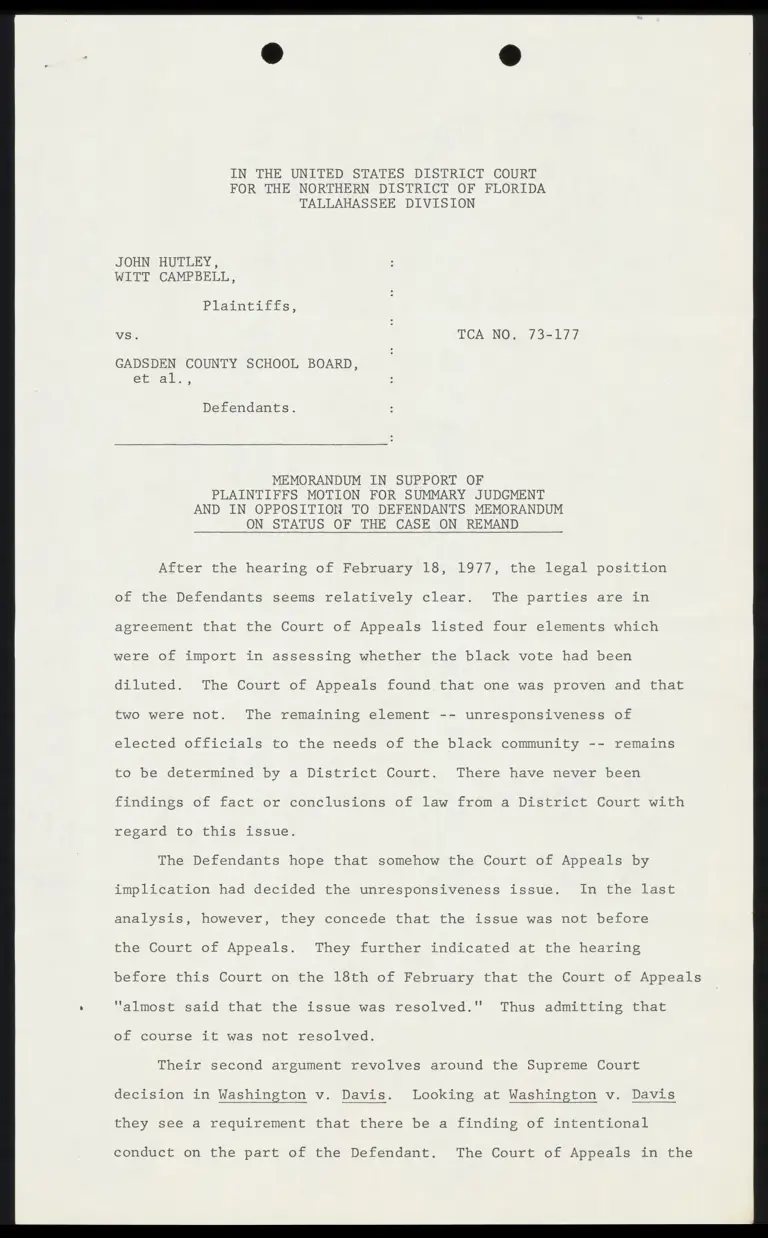
    IN THE UNITED STATES DISTRICT COURT

FOR THE NORTHERN DISTRICT OF FLORIDA
TALLAHASSEE DIVISION

JOHN HUTLEY,
WITT CAMPBELL,

Plaintiffs,

vs. : PCA ‘NO. 73-177

GADSDEN COUNTY SCHOOL BOARD,

et al.,

Defendants.

MEMORANDUM IN SUPPORT OF
PLAINTIFFS MOTION FOR SUMMARY JUDGMENT

AND IN OPPOSITION TO DEFENDANTS MEMORANDUM
ON STATUS OF THE CASE ON REMAND

After the hearing of February 18, 1977, the legal position

of the Defendants seems relatively clear. The parties are in

agreement that the Court of Appeals listed four elements which

were of import in assessing whether the black vote had been

diluted. The Court of Appeals found that one was proven and that

two were not. The remaining element -- unresponsiveness of

elected officials to the needs of the black community -- remains

to be determined by a District Court. There have never been

findings of fact or conclusions of law from a District Court with

regard to this issue.

The Defendants hope that somehow the Court of Appeals by

implication had decided the unresponsiveness issue. In the last

analysis, however, they concede that the issue was not before

the Court of Appeals. They further indicated at the hearing

before this Court on the 18th of February that the Court of Appeals

"almost said that the issue was resolved." Thus admitting that

of course it was not resolved.

Their second argument revolves around the Supreme Court

decision in Washington v. Davis. Looking at Washington v. Davis

they see a requirement that there be a finding of intentional

conduct on the part of the Defendant. The Court of Appeals in the


Albany, Georgia case dealing with dilution of the black vote

indicated that the finding of intention 'may' be required.

Assuming arguendo that they are required, the argument based on

the District Court's earlier determination of a lack of racial

intent fails for a very fundamental reason. The Defendants are

looking at the intention at the time of the passage of the

statute. However, it is not the statute or the circumstances of

its passage that is at issue here. The Plaintiffs have very

clearly maintained throughout the litigation that there is no

allegation that the statute is unconstitutional on its face.

This is a situation in which the statute, when applied to the

facts of a given county, produces an unconstitutional result,

The correct analysis of the Plaintiffs' attack is discussed at

some length in the Briefs of both sides and the Order of the

District Court on the three judge court question, While this

question was not briefed in the Court of Appeals, it was

discussed at some length during oral argument and the Court of

Appeals chose not to interfere with the judgment of the District

Court based on the three judge court issue, Defendants' citation

of authority not withstanding. Thus, if there is a requirement

of intent, the intent that is at issue here is the intent of the

School Board Defendants reflected through their unresponsiveness,

This is an intent reflectad in the late 1960's and 1970's. The

intent is abundantly clear, In the late 60's the Defendants ran

a de jure segregated system which could hardly be considered any-

thing short of overt racial discriminatory intent, Having been

precluded from doing this in the 70's by this Court's Order in

TCA No. 1616, they then embarked upon what has now been adjudicated

as retaining segregation of elementary children within the class-

room and discrimination in the selection of black persons for

principal, assistant principal, county staff, and teacher positions.

More pervasive racial discrimination in the period of supposed

desegregation could scarcely be imagined.

ay


The final argument against the position taken by the

Defendants -- that the judgment of the Court of Appeals makes

dismissal on remand imperative -- is that had that been the

intention of the Court of Appeals they would simply have

expressed it and asked that this Court enter a dismissal.

They did not do so. Thus, the only reasonable inference is

that was not what they had in mind.

The summary judgment for the Plaintiffs should issue be-

cause there is no way in which as a matter of law the Defendants

can show that it was ''responsive' as a matter of law to the

needs of the black community in light of judgments already

entered by this Court and the Court of Appeals.

Respectfully submitted,

—L AN V LC O0d OM

324 West College Avenue
Tallahassee, Florida 32
(904) 224-8701

Ze Spriggs/(larry =

01

Jack Greenberg
Charles Williams
Legal Defense Fund
10 Columbus Circle
New York, N. Y.:10019

Attorneys for Plaintiffs

Certificate of Service

I HEREBY CERTIFY that copies of the foregoing have been

furnished by mail to Mr. Graham Carothers, Post Office Box 391,

Tallahassee, Florida; and Mr. Richard Gardner, 201 Quincy State

Bank Building, Quincy, Florida 32351 this 28 Yay of February,

1977.

0% il SS CBANM [Log OU
Kent i of ie oi