Motion for Leave to File Brief Amicus Curiae and Brief Amicus Curiae
Public Court Documents
August 30, 1985
-
Case Files, Thornburg v. Gingles Hardbacks, Briefs, and Trial Transcript. Motion for Leave to File Brief Amicus Curiae and Brief Amicus Curiae, 1985. a5d7df36-d992-ee11-be37-6045bddb811f. LDF Archives, Thurgood Marshall Institute. https://ldfrecollection.org/archives/archives-search/archives-item/5b4558d4-7f6f-49c3-b5f8-9f323da02e9d/motion-for-leave-to-file-brief-amicus-curiae-and-brief-amicus-curiae. Accessed September 17, 2026.
Copied!
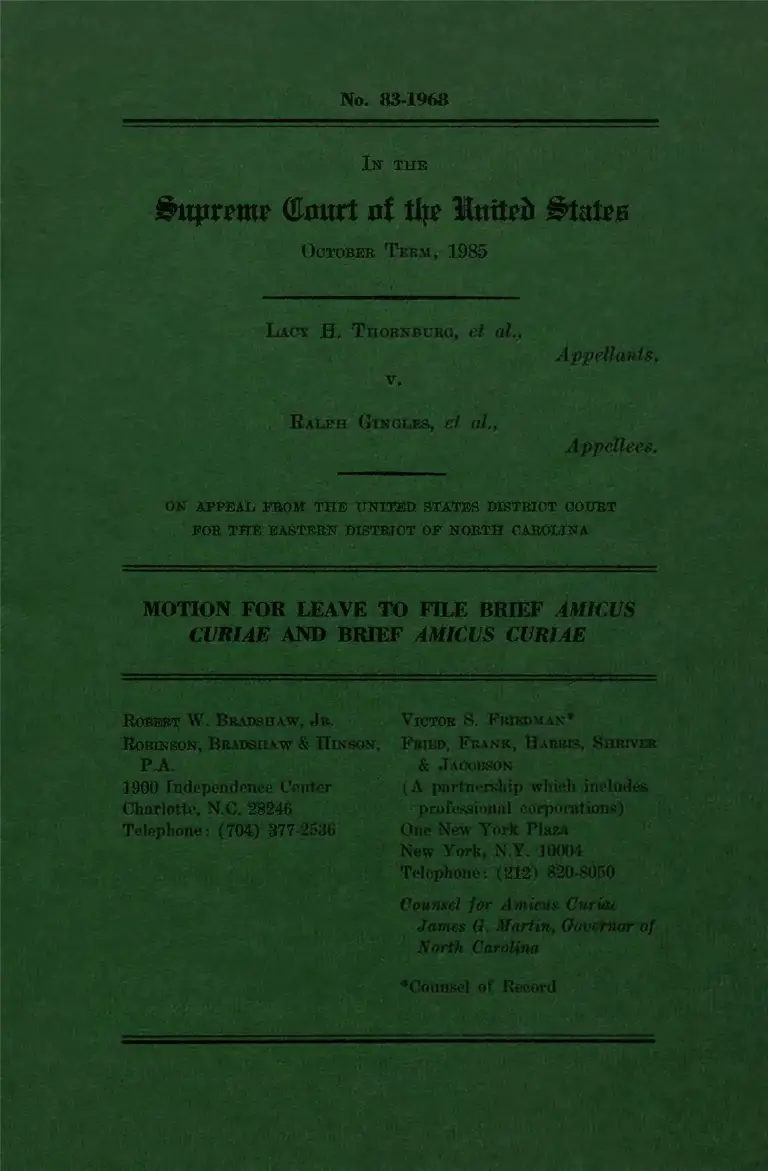
No. 83-1968
IN THE
~upr.rm.r <nnurt nf tq.r llhtit.r~ ~tat.rn
OcToBER TERM, 1985
LAcY H. THoRNBURG, et al.,
Appellants,
v.
RALPH GINGLEs, et al.,
Appellees.
ON APPEAL FROM THE UNITED STATES DISTRICT COURT
FOR THE EASTERN DISTRICT OF NORTH CAROLINA
Motion for Leave to File Brief Amicus Curiae
The Honorable James G Martin, Governor of North
Carolina, hereby respectfully moves for leave to file the
attached brief amicus curicte in this case. The consent of
the attorney for the appellee has been obtained. The con
sent .of the attorney for the appeUant has been requested
but refused.
The interest of Governor Martin arises from his posi
tion as the chief executive of the State of North Carolina,
and hence, as the senior elected representative of all North
Carolinians.
In the instant case the appellant argues that the recent
electoral success of some minority candidates makes the
District ~Court's findings of racial vote dilution clearly
erroneous. The brief which Governor Martin is requesting
to file argues that the District Court' s finding is clearly
l
11
correct and that perpetuation of North Carolina's multi
member district system, particularly in those districts where
its discriminatory effects have been established, will hinder
his efforts to open the political pro·cess in North Carolina
to all of its citizens.
August 30, 1985
Respectfully submitted,
'
VICTOR s. FRIEDMAN
FRIED, FRANK, HARRIS, SHRIVER
& JACOBSON
(A partnership which includes
professional corporations)
One New York Plaza
New York, New York 10004
( 212) 820-8050
Counsel for J ames G. Martin,
Governor of North Carolina
No. 83-1968
IN THE
~uprrmr Qluurt nf tl}r lbtitr~ ~tat~n
OcToBER TERM, 1985
LAcY H. THORNBURG, et al.,
Appellants,
v.
RALPH GINGLEs, et al.,
Appellees.
ON APPEAL FROM~ THE UNITED STATES DISTRICT COURT
FOR THE EASTERN DISTRICT OF NORTH CAROLINA
BRIEF OF AMICUS CURIAE, THE HONORABLE
JAMES G. MARTIN, GOVERNOR OF NORTH
CAROLINA, SUPPORTING APPELLEES
The Honorable James G. Martin, Governor of the Sta·te
of North ·Carolina, submits this brief amicus curiae in sup
port of the decision of the United States District Court for
the Eastern District of North Carolina invalidating six of
North ·Carolina'·s multimember districts on the ground that
those districts had the effect of diluting black votes in vio
lation of Section 2 of the Voting Rights Act of 1965.
Interest of Amicus Curiae
The Governor wishes to make clear to the Court that
the highest elected official of the State of North Carolina,
and one with extensive knowledge of and experience in
North Carolina politics, does not ' share the views of the
State's Attorney General as set forth in appellant's briefs
2
before the Court. As a former three-term Mecklenburg
County Commissioner (1966-1972), during which time he
was elected •Commission ·Chairman and served as President
of the North Carolina Association of County Commis
sioners; a six-term Congressman (1972-1984) from the
9th •Congressional District, encompassing Iredell, Lincoln,
Mecklenburg and part of Yadkin counties; and, since his
election in N ovem'ber 1984, the 6hief Executive Officer of
the State, he believes that his views will be of special value
to the Court.
The Governor's interest is two-fold. As a member of a
minority political party in North ·Carolina (only the second
Republican governor in this century), he is well aware of
the disadvantages North Carolina's multimember voting
system creates for any minority group where the majority
group tends to vote on the basis of criteria other than the
particular candidate's merits. As the representative of all
of the people of the State, he is keenly aware of the need
to eliminate as quickly as practicable the vestiges of past
discrimination and to bring into the political life of the
State all of its citizens without maintaining or erecting
artificial barriers to full participation of any group. To
the extent that multimember districts create such barriers,
and the Governor agrees fully with the District Court that
in the districts at issue (if not the entire State) they do,
they should be stricken down.
Argument
We eschew the opportunity to enter the debate over
whether ·the "clearly erroneous" standard governs this
·Court's review because of the Governor's view that, far
from "clearly erroneous", the District Court's essential
findings were clearly correct. There can be little question
that multimember districts in North Carolina dilute the
effect of black votes wherever there are smaller included
3
districts with clear black majorities. The election of some
blacks to the State legislature does not detract from the
simple, but obvious, truth that, although in some circum
stances the artificial barrier of multimember districts can
be overcome, the barrier surely exis·ts.
As the record below amply demonstrates, North Caro
lina's multimember districts create additional difficulties
for blacks seeking to participate fully in the <State's political
process. The significantly higher cost of campaigning in the
larger multimember districts (Pl.Ex. 20; R. 130-31, 133),
coupled with the greater difficulty black candidates face
in raising campaign funds (R. 437, 443, 468), act as further
deterrents on black candidacies. Thus, the significant eco
nomic disparity between whites and blacks in ·the State
exacerbates the discriminatory impact of multimember dis
tricting.
This administration is committed to opening the politi~al
process to all North Carolinians. In making appointments
to State Boards and Commissions, the Governor is seeking
to attract qualified ci·tizens regardless of race, age, sex,
political party or geography. He has already made, and
will continue to make, significant progress in broadening
the base from which these executive appointments are made.
Such progress necessarily will be of limited impact, how
ever, if the State legislature (with its unusual powers)·»
continues to be chosen by a proces·s which is, after all, the
remnant of an earlier time when the government in North
Carolina was conducted solely by white male Democrats.
Black citizens of North ·Carolina, because of their economic
disadvantage, feel the discriminatory impact of multi
member districting even more than other minorities in the
political process. The ·Court is thus respectfully urged to
strike down this anachronistic system at least in those dis-
*North Carolina is the only state where the legislature alone
can enact legislation; there is no provision for any gubernatorial
veto.
4
tricts where the District Court found ample proof .of its
discriminatory impact.
Conclusion
The judgment of the District Court should be affirmed.
ROBERT w. BRADSHAW, JR.
ROBINSON, BRADSHAW & HINSON,
P.A.
1900 Independence Center
Charlotte, N.C. 28246
Telephone: (704) 377-2536
Respectfully submitted,
VICTOR S. FRIEDMAN*
FRIED, FRANK, HARRIS, SHRIVER
& JACOBSON
(A partnership which includes
professional corporations)
One New York Plaza
New York, N.Y. 10004
Telephone: (212) 820-8050
Counsel for Amicus Curiae
James G. Martin, Governor of
North Carolina
~·counsel of Record
NAACP0290
NAACP0291
NAACP0292
NAACP0293
NAACP0294
NAACP0295
NAACP0296
NAACP0297
NAACP0298
NAACP0299
NAACP0300
NAACP0301