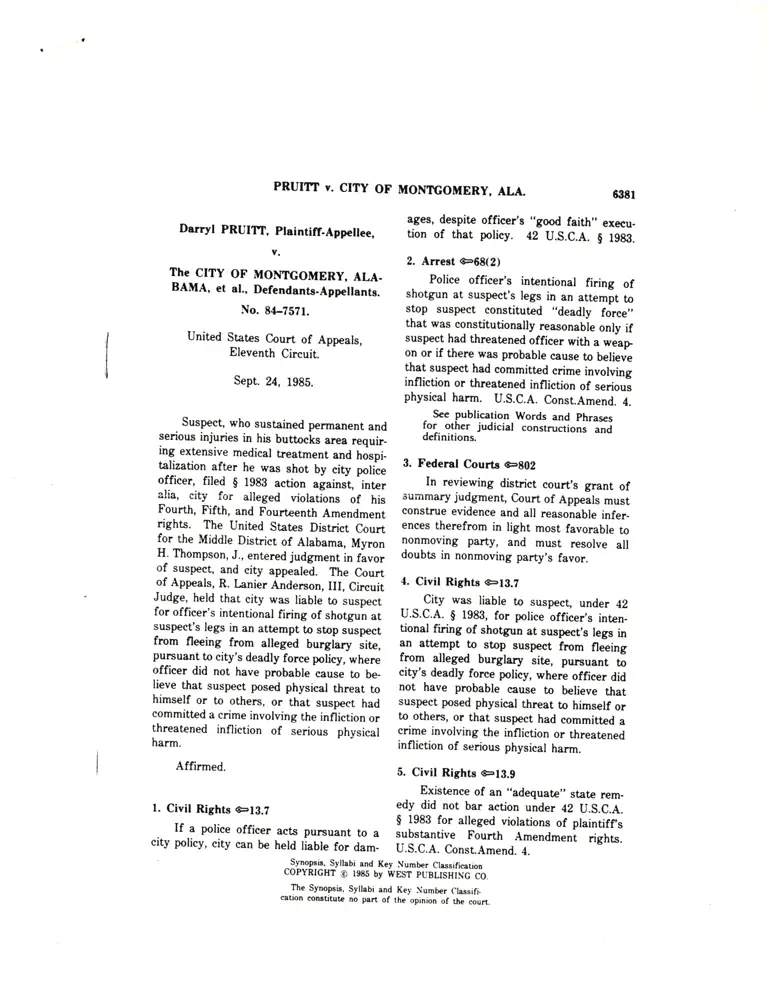
Pruitt v. Montgomery Court Opinion
Public Court Documents
September 24, 1985
12 pages
-
Case Files, Garner Working Files. Pruitt v. Montgomery Court Opinion, 1985. cc5a743e-35a8-f011-bbd3-000d3a53d084. LDF Archives, Thurgood Marshall Institute. https://ldfrecollection.org/archives/archives-search/archives-item/5b77b980-5e4d-41e2-ac20-6119a1dc07bc/pruitt-v-montgomery-court-opinion. Accessed September 26, 2026.
Copied!
PRUITT V. CITY OF MONTGOMERY. ALA. 6381
Darryl PRUITT, Plaintiff-Appellee,
V .
The CITY OF ^MONTGOMERY, ALA
BAMA, et al., Defendants-Appellants.
No. 84-7571.
United States Court of Appeals,
Eleventh Circuit.
Sept. 24, 1985.
Suspect, who sustained permanent and
serious injuries in his buttocks area requir
ing extensive medical treatment and hospi
talization after he was shot by city police
officer, filed § 1983 action against, inter
alia, city for alleged violations of his
Fourth, Fifth, and Fourteenth Amendment
rights. The United States District Court
for the Middle District of Alabama, Myron
H. Thompson, J., entered judgment in favor
of suspect, and city appealed. The Court
of Appeals, R. Lanier Anderson, III, Circuit
Judge, held that city was liable to suspect
for officer’s intentional firing of shotgun at
suspect s legs in an attempt to stop suspect
from fleeing from alleged burglary site,
pursuEnt to city s deadly force policy, where
officer did not have probable cause to be-
lieve that suspect posed physical threat to
himself or to others, or that suspect had
committed a crime involving the infliction or
threatened infliction of serious physical
harm.
Affirmed.
1. Civil Rights «=13.7
If a police officer acts pursuant to a
city policy, city can be held liable for dam-
Synopsis. Syllabi and Key Number Classification
COPYRIGHT ® 1985 by WEST PLBLISHING CO.
The Synopsis, Syllabi and Key Number Classifi-
cation constitute no part of the opinion of the court.
ages, despite officer’s "good faith’’ execu
tion of that policy. 42 U.S.C.A. § 1983.
2. Arrest <^68(2)
Police officer’s intentional firing of
shotgun at suspect’s legs in an attempt to
stop suspect constituted “deadly force”
that was constitutionally reasonable only if
suspect had threatened officer with a weap
on or if there was probable cause to believe
that suspect had committed crime involving
infliction or threatened infliction of serious
physical harm. U.S.C.A. Const.Amend. 4.
See publication Words and Phrases
for other judicial constructions and
definitions.
3. Federal Courts «=802
In reviewing district court’s grant of
summary judgment. Court of Appeals must
construe evidence and all reasonable infer
ences therefrom in light most favorable to
nonmoving party, and must resolve all
doubts in nonmoving party’s favor.
4. Civil Rights «= 13 .7
City was liable to suspect, under 42
U.S.C.A. § 1983, for police officer’s inten
tional firing of shotgun at suspect’s legs in
an attempt to stop suspect from fleeing
from alleged burglary site, pursuant to
city’s deadly force policy, where officer did
not have probable cause to believe that
suspect posed physical threat to himself or
to others, or that suspect had committed a
crime involving the infliction or threatened
infliction of serious physical harm.
5. Civil Rights ^ 1 3 .9
Existence of an “adequate” state rem
edy did not bar action under 42 U.S.C.A.
§ 1983 for alleged violations of plaintiffs
substantive Fourth Amendment rights.
U.S.C.A. Const.Amend. 4.
6382 PRUITT V. CITY OF MONTGOMERY. ALA.
Appeal from the United States District
Court for the Middle District of Alabama.
Before FAY and ANDERSON. Circuit
Judges, and GIBSON *, Senior Circuit
Judge.
R. LANIER ANDERSON, III, Circuit
Judge:
Appellant City of Montgomery (the
“City”) challenges a jury verdict in favor of
appellee Darryl Pruitt (“Pruitt”) on Pruitt’s
claim under 42 U.S.C.A. § 1983 that a
Montgomery police officer’s unconstitution
al use of 'deadly force” caused him severe
and permanent physical injury. The dis
trict court held, based upon its earlier deci
sion in Ayler v. Hopper, 532 F.Supp. 198
(M.D.Ala. 1981), that the City’s “deadly
force” policy was unconstitutional as ap
plied to the shooting of an unarmed fleeing
burglary suspect. Finding no issue of dis
puted material fact on the question of the
City’s liability, the district court granted
partial summary judgment to Pruitt. The
court then submitted the issue of damages
to the jury which came back with a $100,-
000 verdict in Pruitt’s favor. We affirm.
I. BACKGROUND
On the night of September 1, 1982,
Pruitt, an 18-year old, and four of his
friends were walking in a commercial dis
trict in downtown Montgomery, Alabama.
* Honorable Floyd R. Gibson. U.S. Circuit Judge
for the Eighth Circuit, sitting by designation,
i. The parties agree that the police officers who
arrived on the scene had probable cause to
believe that a burglary of the auto parts store, a
felony under Alabama law, see Ala.Code
§§ 13A-7-1—13A-7-7 (1982 & Supp. 1984), had
taken place. The parties also agree that no
burglary in fact took place. Stipulation.
Record, vol. II at 77. Pruitt was charged in city
court with statutory rape, see Ala.Code § I3A-6-
Pruitt went to a wooded area behind an
auto parts store located at 614 Fairview
Avenue with one of his friends, a young
woman, and had sexual intercourse with
her. Meanwhile, a citizen who had heard
noises behind the store reported to the
police that a possible burglary was in
progress.' Among the first two police offi
cers to respond to the reported burglary
was Lester Kidd (“Kidd”). He arrived as a
passenger in a police car driven by his
senior officer. The senior officer dropped
Kidd off at a street intersecting with Fair-
view Avenue about two doors from the
auto parts store. The senior officer pro
ceeded in the police car to the front of the
store. Meanwhile, Kidd walked through a
wooded area toward the rear of the store.
As Kidd approached the rear of the
store, the senior officer informed Kidd by
walkie-talkie that two suspects had been
apprehended in front of the store. Kidd
walked two or three steps further toward
the rear of the store and then Pruitt came
out from behind some bushes or brush,
approached or “came at” Kidd (at which
point Kidd and Pruitt were in close proximi
ty to one another), and then took off run
ning away from the back of the store
through the woods. To summarize,^ at this
point Kidd yelled “halt, police” several
times, Pruitt failed to heed Kidd’s com
mand, and Kidd fired his weapon at Pruitt.
Kidd believed that this shot had not hit
Pruitt, and he fired his shotgun a second
62. The grand jury, which was presented with
evidence concerning the incident, declined to
indict Pruitt. Stipulation, Record, vol. II at 77.
The officers called to the scene of the reported
burglary had no knowledge of any act of alleged
rape, statutory rape, or sexual intercourse prior
to the shooting of Pruitt.
2. The events leading up to the shooting, as ex
plained in Kidd’s deposition, will be discussed
in much greater detail in Part II.B„ infra.
PRUITT V. CITY OF MONTGOMERY, ALA. 6383
time. This second shot hit Pruitt in the
buttocks area. Pruitt’s injuries required
extensive medical treatment and hospital
ization, and have resulted in permanent and
serious injury to one of Pruitt’s legs which
has been described in expert testimony as
paralysis.
In August 1983, Pruitt filed suit under
42 U.S.C.A. § 1983 against the City, Mont
gomery Mayor Emery Folmar, Chief of Po
lice Charles Swindall, and Kidd, alleging
violations of the Fourth, Fifth, and Four
teenth Amendments. However, the only
defendant before us on appeal is the City. ̂
Pruitt also alleged pendent Alabama state
claims of assault and battery, and negli
gence. On July 12, 1984, after presenta
tion of affidavits and other evidence, and
full briefing of the issues, the district court
issued an order in response to the parties’
cross-motions for summary judgment.
First, relying on its prior holding in Ayler
V. Hopper, 532 F.Supp. 198 (M.D.Ala. 1981),
the district court reiterated (1) “that the
use of deadly force to stop a fleeing or
escaping felon constitute[s] a civil rights
violation actionable under § 1983 ‘unless
the [state] official has good reason to be
lieve that the use of such force is necessary
to prevent imminent, or at least a substan
tial likelihood of, death or bodily harm,’ ’’
and (2) that Ayler had held the Alabama
3. Pruitt's motion to dismiss defendants Fulmar
and Swindall was filed on April 2, 1984, and
granted by the district court three days later
leaving Kidd and the City as the only remaining
defendants. See Record, vol. II at 55-57.
Thereafter, at a pre-trial hearing on July 26,
1984, Pruitt dismissed Kidd from the § 1983
claim. See Record, vol. I at 5. The City is.
therefore, the only defendant left in the § 1983
claim, which is the only claim before this court
on appeal. See infra note 6.
4. On July 26, 1984, the district court issued an
order amending its earlier partial summary
judgment order and substituting new language
to the effect that Kidd had indicated in his
“fleeing felon’’ statute unconstitutional to
the extent that it authorized the use of
deadly force by police in other circumstanc
es. District Court Order at 3-4, Record,
vol. II at 92-93 {quoting Ayler, 532 F.Supp’
at 201).
[1] 'The district court then proceeded to
grant partial summary judgment in favor
of Pruitt under the standard set out in
Ayler, concluding that no issue of material
fact had been raised by the instant case.
Based on Kidd’s deposition testimony, the
district court found that the sole reason
Kidd shot Pruitt, a fleeing unarmed burgla
ry suspect, was to prevent Pruitt from
escaping, not because Pruitt posed a threat
of death or bodily injury to Kidd or others.
District Court Order at 4, Record, vol. II at
93. ̂ The court, therefore, granted summa
ry judgment against the City and in favor
of Pruitt on the issue of § 1983 liability
only.* In addition, the court found that the
City was liable for Kidd’s unconstitutional
use of deadly force because Kidd had been
acting pursuant to the City’s deadly force
policy (which itself was based upon the
Alabama statute).* Id. at 93; see also Kidd
Deposition (hereafter cited as “K.Dep ’’) at
9-14.
The district court sent the § 1983 claim
to the jury on the issue of damages and the
deposition that he feared an attack by Pruitt
when Pruitt first came out of the bushes but
that his only concern at the time of the shooting
was the effectuation of Pruitt’s arrest. See
Record, vol. II at 196; see generally Part II.B
infra. ' ’’
5. The district court, of course, denied the de
fendants' motion for summary judgment. Dis
trict Court Order at 5, Record, vol. II at 94.
6. See Monetl v. Department of Social Services
436 U.S. 658, 98 S.Ct. 2018, 56 L.Ed.2d 611
(1978). There was no real dispute over the fact
that Kidd was acting pursuant to the City's dead
ly force policy, and the City does not appeal the
6384 PRUITT T. CITY OF MONTGOMERY. ALA.
jury returned a verdict for $100,000. Pur
suant to Fed.R.Civ.P. 54(b). the court en
tered final judgment for Pruitt against the
City. This appeal ensued.^
II. DISCUSSION
A. Legal Standard
On March 27, 1985, the United States
Supreme Court decided the case of Tennes
see V. Gamer, — U.S. ----- , 105 S.Ct
1694, 85 L.Ed.2d 1 (1985). In Gamer, the
Court considered the constitutional validity
of the Tennessee “fleeing felon” statute
which codified the common law rule that
after a police officer pves a felony suspect
notice of intention to arrest the officer
“may use all necessary means to effect the
arrest” if the suspect flees or forcibly re
sists. Tenn.CJode Ann. § 40-7-108 (1982);
see Gamer, — U.S. a t ----- & n. 5, 105
S.Ct. at 1698 & n. 5, 85 L.Ed.2d at 5 & n. 5.
The evidence produced at trial in Gamer
indicated that a Memphis police officer shot
and killed an unarmed, fleeing burglary
suspect in order to apprehend him.
First, the Supreme Court held that the
shooting itself was a “seizure” within the
district court’s finding under Monell that
Pruitt’s shooting was merely an execution of
this policy." District Coun Order at 4, Record,
vol. II at 93. If an officer acts pursuant to City
policy, the City can be held liable for damages
despite the officer’s “good faith" execution of
that policy. Owen v. City of Independence, 445
U.S. 622, 100 S.Ct. 1398. 63 L.Ed.2d 673 (1980).
The district court recognized, on the other
hand^ that the issue of Kidd’s qualified ’’good
faith immunity, see Harlow v. Fitzgerald 457
U.S. 800, 102 S.Ct. 2727, 73 L.Ed.2d 396 (1982),
complicated the issue of liability as to Kidd.
The district coun further noted that it had been
informed by Pruitt that he might dismiss Kidd
from the case if the City were found liable. The
court, thus, declined to reach the issue of Kidd’s
liability “at this time." District Court Order at
meaning of the Fourth Amendment and
was thus subject to that amendment's “rea
sonableness” requirement Id. a t ----- , 105
S.Ct at 1699, 85 LEd.2d at 7. Second, the
Court held that “[tjhe use of deadly force
to prevent the escape of all felony sus
pects, whatever the circumstances, is con
stitutionally unreasonable.... Where the
suspect poses no immediate threat to the
officer and no threat to others, the harm
resulting from failure to apprehend him
does not justify the use of deadly force to
do so---- The Tennessee statute is uncon
stitutional insofar as it authorizes the use
of deadly force against such fleeing sus
pects.” Id. a t ------------- , 105 S.Ct. at
1700-1701, 85 L.Ed.2d at 9-10. The Ck)urt
continued:
It is not, however, unconstitutional on
its face. Where the officer has probable
cause to believe that the suspect poses a
threat of serious physical harm, either to
the officer or to others, it is not constitu
tionally unreasonable to prevent escape
by using deadly force. Thus, if the sus
pect threatens the officer with a weapon
or there is probable cause to believe that
he has committed a crime involving the
infliction or threatened infliction of seri
ous physical harm, deadly force may be
5, Record, vol. II at 94. The court similarly
declined to address Pruitt’s pendent state
claims. Id Thereaher, Pruitt did in fact dis
miss Kidd from the § 1983 claim. See supra
note 3.
7. This court granted the State of Alabama inter
vener status only on the issue of the constitu
tionality of the "fleeing felon" statute. The state
filed a brief and presented oral argument. Just
prior to oral argument, Pruitt moved to dismiss
the state in light of the United States Supreme
Court’s decision in Tennessee v. Gamer, __ U S
----- . 105 S.Ct. 1694, 85 L.Ed.2d 1 (1985). The
motion was carried with the case. In light of
our disposition of the case, Pruitt’s motion to
dismiss the state as intervenor is DENIED as
moot.
PRUITT T. CITY OF MONTGOMERY. ALA. 6385
used if necessary to prevent escape, and
if, where feasible, some warning has
been given. As applied in such circum
stances, the Tennessee statute would
pass constitutional muster.
Id. a t ----- , 105 S.Ct at 1701, 85 LEd.2d at
10.
Finally, the Court applied the above-de
scribed rule to the facts before it, and
found “the statute unconstitutional insofar
as it purported to give [the officer] the
authority to act as he did__ ” Id. a t ------ ,
105 S.Ct. at 1706, 85 L.Ed.2d at 16.
As the parties agree, the Alabama “flee
ing felon” statute also attempts to pre
serve the common law rule. Gamer, —
8. We note that the prior ruling by Judge Myron
H. Thompson in Ayler v. Hopper, 532 F.Supp.
198 (M.D.Ala.l981), set a standard by which the
constitutional validity of the Alabama statute
could be assessed which is strikingly similar to
the one adopted in Gamer. The district court is
to be commended for its accurate analysis of
the emerging constitutional standard in this dif
ficult area.
9. The Alabama "fleeing felon" statute provides,
in relevant part;
A peace officer is justified in using deadly
force upon another person when and to the
extent that he reasonably believes it necessary
in order:
(1) To make an arrest for a felony or to
prevent escape from custody of a person ar
rested for a felony. . . .
Ala.Code § 13A-3-27(b)(l) (1982). The deadly
force policy of the Montgomery Police Depart
ment incorporates the common law rule as ex
pressed in the statute, see Plaintiffs Exhibit No.
5, Montgomery Police Departmental Manual 531
§ 2.500; K.D^. at 10-12; see generally Deposi
tion of Charles Swindall; and. as we have indi
cated, Kidd was acting pursuant to that policy
when he shot Pruitt. See supra note 6. The
only question, then, is whether Kidd’s actions
violated the rule in Gamer.
10. Although not precisely delineated on appeal
as an issue requiring reversal, the City also
argues that the shooting in this case did not, as
a matter of law, constitute "deadly force" be
cause Kidd had not tried to kill Pruitt but.
U.S. a t -----n. 14. 105 S.Ct at 1703 n. 14,
85 L.£ki.2d at 12 n. 14, and is, therefore,
under Gamer,* subject to both constitu
tional and unconstitutional applications.*
Accord, Acoff v. Abston, 762 F.2d 1543,
1547 (11th Cir.1985).
[2] We turn, then, to the question
whether, under the standard set out in
Gamer, the district court’s grant of sum
mary judgment in favor of Pruitt was prop
10er.
B. Summary Judgment
Although the pre-trial depositions of both
Kidd and Pruitt were presented to the dis-
rather, only shot to stop him by hitting his legs.
See K.Dep. at 15, 20, 83. The State of Alabama,
which was granted intervenor status by this
court only on the issue of the constitutionality
of the “fleeing felon" statute, also pressed this
issue at oral argument. We reject this argu
ment as did the district court. See District
Court Order at 3 n. 1, Record, vol. II at 92.
The City does not argue, nor could it, that
"deadly force” occurs only when the victim ac
tually dies. See Acoff v. Abston. 762 F.2d 1543
(11th Cir.1985) (Gamer applicable where victim
was paralyzed). The City points to language in
Gamer which, when taken in isolation, might
suggest that the use of deadly force occurs only
when an officer shoots to kill. Gamer, — U.S.
a t ---- - , ----- , ----- , 105 S.Ct. at 1699, 1700, 1701,
85 L.Ed.2d at 8, 9, 10. A close analysis, how
ever, makes clear that although the Court held
that "[a] police officer may not seize an un
armed, non-dangerous suspect by shooting him
dead," id. a t ----- , 105 S.Ct. at 1701, 85 L.Ed.2d
at 10, the Court’s prohibition extends more gen
erally to the “use of deadly force" in such cir
cumstances. Id. a t ----- , ___ , ___ , ___ , ___
----- . ----- . 105 S.Ct. at 1699, 1700, 1701, 1703
1704, 1705, 1706, 85 L.Ed.2d at 8, 9, 10, 12, 13,
14, 15; see also id a t ----- , 105 S.Ct. at 1705, 85
L.Ed.2d at 15 (citing with approval amicus brief
of the Police Foundation to the effect that "the
obvious state interests in apprehension are not
sufficiently served to warrant the use of lethal
weapons against all fleeing felons ...").
6386 PRUITT V. CITY OF MONTGOMERY, ALA.
trict court, the City has only placed Kidd’s
deposition in the record on appeal. We
now review that deposition in detail, quot
ing from it liberally, to determine whether
Kidd “had probable cause to believe that
[Pruitt] pose[d] a threat of serious physical
harm to the officers or to others.” Gar
ner, — U.S. a t ----- , 105 S.Ct. at 1701, 85
L.Ed.2d at 10.
Early in his deposition, Kidd gave the
following description of the incident which
ensued as he approached the back of the
auto parts store;
I had the shotgun. After I flipped [my
flashlight] back down I took the shotgun
back into my hand. I was going at low
port I took about three steps and then
the subject came out of the bushes. He
came at me and I went up with my
shotgun at high port, and once I went up
at high port the subject veered to the
right and then when he veered then I
yelled “halt, police”. At this time I was
thinking this was the third subject that
was involved in the burglary coming
from the back. I knew the subject had
to have been looking at me because I
didn’t hear anything until I more or less
The Model Penal Code, which recommends
abandonment of the common law rule and
whose "deadly force" rule the Gamer Court
adopted in large part, see — U.S. a t -----n. 4.
1698 n. 4, 85 L.Ed.2d at 6 n. 4, defines "deadly
force” as follows:
force which the actor uses with the purpose of
causing or which he knows to create a sub
stantial risk of causing death or serious bodily
harm. Purposely firing a firearm in the di
rection of another person or at a vehicle in
which another person is believed to be consti
tutes deadly force.
Model Penal Code § 3.11(2) (1962); see also
Mattis V. Schnarr, 547 F.2d 1007, 1009 n. 2 (8th
Cir.1976) (en banc) (adopting Model Penal Code
definition), vacated as moot sub nom., Ashcroft
V. Mattis, 431 U.S. 171, 97 S.Ct. 1739, 52 L.Ed.2d
219 (1977): Ala.Code § 13A-3-20(2) (1982)
ran up on this bush. When I got too
close he jumped out
As soon as I said halt the first time—
the subject came at me and veered off to
the right I said “halt, police”. The
subject kept running. I yelled “halt po
lice” again. At that time I could hear
[the police car’s] tires screeching and
they were coming out down around the
back. 'Then I yelled a third time and the
subject went down into a ditch. And
when he came up out of the ditch I had
to make a decision whether I was going
to stop this fleeing felon or what I was
going to do.
I could see the subject’s legs and body,
his complete body, because it was silhou
etted and he had a white shirt and white
tennis shoes. I could tell that. I shot at
the subject’s legs to stop him. And I
shot the first round and the subject kept
moving, and I shot the second round and
the subject kept going, and maybe two or
three seconds later I heard the subject
yell and he fell.
K.Dep. at 19-20.
There are conflicts in the deposition as to
the manner in which Pruitt emerged from
("Force which, under the circumstances in
which it is used, is readily capable of causing
death or serious physical injury"). The above-
quoted definitions clearly encompass Kidd’s ac
tions in shooting Pruitt; Kidd, at the least, pur
posely fired his shots at Pruitt’s legs, and in
doing so used force capable of causing serious
physical injury.
We find such action a "use of deadly force" in
the constitutional sense, concluding that such
finding is consistent with Gamer. See Gamer,
— U.S. a t -----, 105 S.Ct. at 1705, 85 L.Ed.2d at
15; id. a t ------------- , 105 S.Ct. at 1711-1712, 85
L.Ed.2d at 22-23 (O’Connor, J., dissenting) (de
crying the majority’s failure to narrowly define
"use of deadly force" and attempting to limit
such definition to the shooting of an unarmed,
non-dangerous burglary suspect).
PRUITT V. CITY OF MONTGOMERY. ALA. 6387
the bushes. In the above-quoted descrip
tion he “came out of the bushes,” “came at
me,” and “jumped out.” At another point,
Kidd stated that Pruitt “took about three
steps” toward him when he came out of the
bushes. Id. at 39. At still another point,
Kidd reasoned that he must have walked in
Pruitt’s path and “boxed him in.” Id. at
42.
At several points in the deposition, Kidd
indicated that he was momentarily put in
fear by Pruitt’s emergence from the bush
in Kidd s direction. Kidd stated that he
thought Pruitt was trying to hit him or
knock him down or “tangle” with him. Id.
at 35-36. However, Kidd stated, “[t]he
subject I guess saw that I had responded to
him coming at me, then he ran off.” Id. at
36. Kidd also stated that “I felt that the
subject was trying to harm my physically
which means if he’s trying to harm me
physically and I also have a shotgun and
another weapon on my side he could easily
get them and kill me. Once he did that,
that also prompted me to think about
shooting the subject to stop him.” Id. at
83; see also id. at 40 (indicating that Kidd
thought Pruitt was dangerous when Pruitt
came at him out of the bushes in that Kidd
believed that Pruitt might knock him down
and take the two weapons he was carry
ing).
At several points in his deposition, Kidd
described in detail the sequence of events
from the point at which Pruitt emerged
from the bushes and when he was shot.
II. This must be a reference to Kidd's "halt,
police" order. Earlier in the deposition, Kidd
stated that he yelled "halt, police" once when
Pruitt first emerged from the bush and three
times right before he went down into the ditch.
K.Dep. at 19-20. As indicated in the text, Kidd
stated later in his deposition that the "halt, po
lice commands were issued after Pruitt came
back out of the ditch and that he was not sure
When Pruitt came out of the bushes, he
was 7-10 feet away from Kidd. I± at 33.
Then, Pruitt “took about three steps . . . , ”
at which point he was very close to Kidd.
Id. at 39. Pruitt then “veered off to the
righ t” Id. At this point, Kidd took four
or five steps to go after him but realized he
couldn’t catch him. Kidd stated that Pruitt
“went off like he was O.J. Simpson and
kept running.” Id.; see also i± at 36
(“When he ran off he was just running. I
don’t know whether he knew exactly where
the path was through there or what. He
was just running”).
Kidd’s deposition describes that Pruitt
ran off into a wooded area down into a
ditch, where apparently Kidd lost sight of
Pruitt temporarily, and then back up out of
the ditch. Id. at 34. At this point Kidd
yelled at Pruitt two or three times, /d.*'
Pruitt kept running. Kidd shot at Pruitt
once. Pruitt continued to run.'^ Kidd
fired again. According to Kidd’s deposi
tion, Pruitt continued to run for a few
seconds more, and then he fell to the
ground. Id. at 44.
Kidd also testified as to his reasons for
shooting Pruitt. Kidd testified;
I thought the subject had broken in and
tried to get away and so forth so I
thought for certain that the subject had
broken into the building or was trying to
get away and I decided, I had to make a
decision whether I was going to stop the
subject or just let the subject go__ I
didn’t know where I was going exactly
exactly how many times he gave the command.
In any event, this discrepancy is unimportant.
12. Apparently, Pruitt claimed on deposition that
this first shotgun blast hit him, spraying him
with ammunition on his back and arm. Kidd
was under the impression, however, that the
first shot did not hit Pruitt.
«388 PRUITT T. CITY OF MONTGOMERY. ALA.
back there. That’s when I knew for a
fact there was no way I was going to run
the subject down because he was famil
iar—from the way he was going and as
fast as he was going he knew exactly
where the trail was and how he was
going to get out of there___ I took the
initial two or three steps there and
looked and there was nothing I could do
as far as running. I couldn’t run the
subject down. I had to make a decision
whether to stop him or let him go.
Id. at 38, 39-40. Kidd further testified,
with respect to why he took the action that
he did rather than radioing for police as
sistance:
I still could not have gotten to the radio
if I had to make a decision whether I was
going to shoot the subject or not to stop
him by gunfire. I had made my decision
once I initially ran those few steps and
saw that I was not going to catch up
with this subject. ’That’s when I had to
make the decision whether to fire or not
to fire. If I had of gone for the radio
then without a doubt the subject would
have gone.
Id. at 52-53.
Finally, the deposition concluded with the
following colloquy between Pruitt’s counsel
and Kidd:
Q. Now, on that evening when you shot
Darryl Pruitt, was it necessary to shoot
him in order to arrest him?
A. It was necessary to shoot him in my
thinking, in my judgment in order to stop
that subject
Q. When you say stopped you mean
arrest?
A. All right. Arrest is one thing you
understand. ’The subject is going to be
placed under arrest but first I’ve got to
get the subject and to place him under
arrest In order to have stopped that
subject that night I had to shoot him.
Once I stopped the subject I would place
the subject under arrest for whatever
crime was committed.
Q. When you shot Darryl Pruitt did you
think he was about to kill or seriously
harm yourself or some other person?
A. When I shot Darryl Pruitt my
thoughts were not as far as trying to
harm another person but myself when
the subject initially came at me. I felt
that the subject was trying to harm me
physically which means if he’s trying to
harm me physically and I also have a
shotgun and another weapon on my side
he could easily get them and kill me.
Once he did that, that also prompted me
to think about shooting the subject to
stop him. I never at any time really
thought about killing Darryl Pruitt. I
wanted to stop him. I was trying to aim
for the subject’s legs at the time. I
yelled out at the subject three times and
he never stopped so I had to make a
decision.
Q. Listen to the question this time if
you would. When you shot Darryl
Pruitt did you think he was about to kill
or seriously harm you or some other
person?
A. Yes.
Q. Was it you you thought he was
about to harm or kill?
A. When I shot him that thought had
already gone through. When I initially
shot him I thought that he had already
burglarized the place plus he had the
thought of harming me. That’s the rea
son I shot him. As far as what you’re
PRUITT V. CITY OF MONTGOMERY, ALA. 6389
saying, as far as immediately when I
shot him right then was he going to
harm me, no, because he was running
at the time. But see, other incideiila led
up to him being shot by me.
Q. Are you saying then that ynn shot
him because you thought before In' had
tried to hurt you?
A. No, that’s not what I’m siiying.
That’s one factor in me making Ih" ‘Inci
sion of shooting him.
Q. So is it correct then that I In' time
you shot Darryl Pruitt you didn'l think
he was about to kill or harm some other
person?
A. No. At the time that I shot Durryl
Pruitt my thinking was that he wan a
fleeing felon coming from a Inirghiry;
that he also had made an attempt to
physically harm a police officer hut he
avoided that attempt and he was a sub
ject that 1 felt needed to be slopped.
Q. Is it also true then at the linm you
shot Darryl Pruitt you didn’t think he
was about to kill or harm you?
A. No. As fa r as [at] that point, no.
Id. at 82-85 (emphasis added).
[3] We recognize that in reviewing the
district court’s grant of summary jinlgment
we must construe the evidence and all rea
sonable inferences therefrom in the light
most favorable to the City, and must re-
13. Although the City does not question die retro
active effect of Gamer, the Acoff court hel<J *haf
the Gamer decision will be applied irtroac-
tively. See Acoff, 762 F.2d at 1548-JO
14. Gamer and Acoff contain a possible implica
tion that probable cause to believe ihni die sus
pect poses a serious physical threat m ‘he per
son of the police officer exists onlv wlieie ihe
officer is threatened with a weapon. < •( ‘
there was no weapon in this case. Cf. nifru no*e
17. Assuming, however, that such (iinbable
cause can exist without an armed ihirnl by ‘be
solve all doubts in its favor, since it is the
nonmoving party. See Warrior Tombigbee
Transportation Co. v. M /V Nan Fung,
695 F.2d 1294, 1296-97 (11th Cir.1983).
The question is whether, as a matter of
law, Kidd’s deposition testimony when con
strued in this manner indicates that Kidd
engaged in an unconstitutional use of dead
ly force. In doing so, we look to the stan
dard which was announced in Gamer.
Our court has very recently delineated
the Gamer standard as follows:
The Gamer standard contains three
elements. First, an officer must have
probable cause to believe that the sus
pect poses a threat of serious physical
harm to the officer or to others. Proba
ble cause of this sort exists where the
suspect actually threatens the officer
with a weapon or where there is probable
cause to believe that the suspect has
committed a crime involving the infliction
or threatened infliction of serious physi
cal harm. Second, deadly force must be
necessary to prevent escape. Third, the
officer must give some warning regard
ing the possible use of deadly force
whenever feasible.
Acoff, 762 F.2d at 1547.' ̂ It is clear from
our review of the Kidd deposition that
Kidd’s use of deadly force is unconstitu
tional under the first element described
above.'^
suspect, we doubt seriously whether Kidd’s sub
jective fear, caused by Pniitt's coming at him
momentarily, could constitute probable cause to
believe that Pruitt posed a threat of serious
physical harm to Kidd. However, we need not
decide in the instant case whether a threat with
a weapon is necessary, or even if not, whether
Kidd's subjective fear at the earlier time was
sufficient, because at the time of the shooting,
with Pruitt fleeing away from Kidd, any alleged
subjective fear of physical harm to Kidd had
already passed. See discussion in text infra.
6390 PRUITT V. CITY OF MONTGOMERY, ALA.
First, there could be no argument on this
record that Kidd had probable cause to
believe that Pruitt was a threat to others.
Kidd’s deposition indicates that he had no
such belief. K.Dep. at 83 (“my thoughts
were not as far as [Pruitt] trying to harm
another person . . . Id. at 84 (“Q. So is
it correct then that the time you shot Dar
ryl Pruitt you didn’t think he was about to
kill or harm some other person? A. No.
At the time I shot Darryl Pruitt my think
ing was that he was a fleeing felon coming
from a burglary . . . ’’).
Second, there is simply no credible evi
dence that Kidd felt in the least bit threat
ened by Pruitt at the time o f the shooting.
Our review of Kidd’s testimony indicates
that after Pruitt came out of the bushes, he
veered off from Kidd and ran away very
quickly. After this, Kidd began to give
chase, then stopped, then lost sight of
Pruitt, and then yelled several warnings
before firing two shots, all unmistakably
indicating that Pruitt was a good distance
away from Kidd with his back toward Kidd
at the time of the shooting. Kidd’s testi
mony repeatedly indicates that his concern
at this point was to stop Pruitt because he
was a fleeing burglary suspect. See
Record, vol. II at 196 (Order amending
district court’s Summary Judgment Order)
(“Although Kidd testified that he initially
feared an attack from Pruitt, his deposition
testimony repeatedly indicates that Kidd’s
own subjective concern was for effecting
Pruitt’s arrest and not for his own or an
other’s safety”).
The City points to the fact that Pruitt
answered “yes” to the question whether he
thought when he shot Pruitt that Pruitt
was about to harm or kill him or someone
15. In Bonner v. City of Prichard, 661 F.2d 1206
(11th Cir.1981) (en banc), this court adopted as
binding precedent all of the decisions of the
else. See K.Dep. at 83. However, Kidd’s
prior and subsequent answers make clear
that Kidd misunderstood this question.
These other answers indicate unambig
uously that Kidd’s subjective fear had al
ready passed, see e.g., K.Dep. at 40, 82, 83,
84, and that his only purpose in shooting
was to stop Pruitt. Moreover, even if Kidd
had some subjective fear of Pruitt at the
time he shot him, such fear would be pat
ently unreasonable given the facts testified
to by Kidd, and, thus, would hardly have
presented a disputed issue of material fact
under G am er’s “probable cause” stan
dard. See Gamer, — U.S. a t ------------- ,
105 S.Ct. at 1700-1701, 85 L.Ed.2d at 9-10
(“Where the suspect poses no immediate
threat to the officers or to others, the harm
from failing to apprehend him does not
justify the use of deadly force to do so”)
(emphasis added); cf. id. a t ----- , 105 S.Ct.
at 1705, 85 L.Ed.2d at 15 (although officer
was not certain that suspect was unarmed,
“[rjestated in Fourth .\mendment terms,
this means [the officer] had no articulable
basis to think Gamer was armed”); United
States V. Tinkle, 655 F.2d 617, 621 (5th Cir.
Unit A Sept. 8, 1981) (“The definition of
probable cause [to stop and arrest] is easily
stated: probable cause exists whenever the
facts and circumstances known to the offi
cer, and of which he has reasonably trust
worthy information, are sufficient to war
rant a person of reasonable caution to be
lieve that an offense has been or is being
committed”).'*
We turn briefly to the second half of the
first element of the Gamer test, i.e.,
whether “there is probable cause to believe
former Fifth Circuit handed down prior to the
close of business on September 30, 1981. Id. at
1209.
PRUITT V. CITY OF MONTGOMERY, ALA. 6391
that the suspect has committed a crime
involving the infliction or threatened inflic
tion of serious physical harm.” Acoff, su
pra, at 1547. There simply is no evidence
that Kidd had such probable cause. All
Kidd reasonably believed was that a bur
glary had taken place, and that Pruitt was
fleeing from it. His deposition indicates
that one reason he felt Pruitt was danger
ous was that he was “a felon coming out of
a building.” K.Dep. at 40. However, the
essential meaning of G am er—that a po
lice officer may not shoot at a suspect
simply because he is a fleeing felon—un
dermines any reliance on this statement as
indicative of probable cause that a crime
involving the infliction or threatened inflic
tion of serious physical harm had taken
place.'® Finally, there is no evidence that
Kidd believed, reasonably or otherwise,
that Pruitt was armed, a factor which
might indicate that the suspect had commit
ted a crime involving the infliction or
threatened infliction of serious physical
harm.” Compare Gamer, — U.S. at
----- , 105 S.Ct. at 1705, 85 L.Ed.2d at 15 (no
16. In this regard, it is interesting to note that
Gamer involved the nighttime burglarj’ of a
dwelling, a crime more likely to involve vio
lence or threatened violence against the person
than the suspected crime in this case. i.e., the
nighttime burglary of a closed commercial es
tablishment. See Gamer, — U.S. at -----, 105
S.Ct. at 1709-1711, 85 L.Ed.2d at 19-21 (O’Con
nor, J., dissenting).
17. Pruitt had no weapon. Moreover, Kidd nev
er mentioned that he believed Pruitt to be arm
ed. In fact, his deposition indicates to the con
trary. Kidd stated that he saw Pruitt fairly well
from close range, see e.g., K.Dep. at 33 (detailed
description of Pruitt’s clothing), that he had a
good view of Pruitt while running, id. at 34, and
that he did not notice Pruitt in possession of any
burglary tools when Pruitt approached him. Id.
at 38. Finally, Kidd stated that he feared that
Pruitt would attack him and take his weapons
and use them against him, indicating that Kidd
believed Pruitt to be unarmed. Id. at 40.
articulable reason to believe that the sus
pect was armed).
[4] We readily conclude that there is no
genuine issue of fact material to the ques
tion whether Kidd had probable cause to
believe that Pruitt posed a physical threat
to himself or to others, or material to the
question whether Kidd had probable cause
to believe that Pruitt had committed a
crime involving the infliction or threatened
infliction of serious physical harm. There
fore, Pruitt was entitled to summary judg
ment as a matter of law. That being the
case, we need not reach the second and
third elements of the Gamer test, i.e.,
whether the use of deadly force was neces
sary to prevent escape, and whether the
officer gave “some warning regarding the
possible use of deadly force [if] feasible”."̂
Acoff, 762 F.2d at 1547.
III. CONCLUSION
[5] In light of the foregoing, the deci
sion of the district court is
.A.FFIRMED.'®
18. Pruitt argues that summary judgment is re
quired on this third element because Kidd
should have warned "halt, or I’ll shoot" instead
of "halt, police," indicating both that a warning
was feasible and that the warning actually used
did not advise of "the possible use of deadly
force." We note that Gamer refers to "some
warning" rather than "some warning regarding
the possible use of deadly force.” Acofj, 762
F.2d at 1547. Because of our disposition of the
case, we decline to decide whether such warn
ing was feasible or if the term "halt, police” was
sufficient under Acoff.
19. The City makes one final argument which
warrants only brief discussion. The City claims
that the district court was without jurisdiction
to hear Pruitt's § 1983 claim because there was
an "adequate" state remedy under Hudson v.
Palmer. — U.S.----- , 104 S.Ct. 3194, 82 L.Ed.2d
393 (1984), and Parratt v. Taylor, 451 U.S. 527,
101 S.Ct. 1908. 68 L.Ed.2d 420 (1981). As we
6392 PRUITT V. CITY OF MONTGOMERY, ALA.
Note 9—Continued
have stated on minieK"** occasions, this argu
ment is dexoHl of .«r< H "̂ 55
F.2d 786. 787-88 tU 'l ' Clr. 1985) (Parra« docs
not bar claim thai I” I '” ’’ officials retaliated
against prisoner f»t n«crlion of constitutional
right of to Ihr courts); Cate v. Oldham,
707 F.2d 1176. 1188 i>. 'M llth Cir.1983) {Parratt
does not bar First Amnidment claim); Duncan
V. Poyihress. 657 F -M 704-05 (5th Cir. Unit
B Sept. 28, 1980 USi'nill does not bar substan
tive due process claim that state officials disen
franchised sute elcs loiulc in violation of state
law), cert granted. I' S. 937. 102 S.Ct. 1426,
71 L.Ed.2d 647 (1487). cert dismissed. 459 U.S.
1012, 103 S.Ct. 368. 74 I..Ed.2d 504 (1982); cf.
Lewis V. Hillsborough Transit Authority, 726
F.2d 668 (11th Cir.) (on rehearing), cert, denied,
— U.S.-----, 105 S.Ct. 95. 83 L.Ed.2d 41 (1984).
Thus, it is clear that the rationale of Hudson and
Parratt does not apply to alleged violations of
substantive constitutional rights, such as the
Fourth Amendment rights implicated here. See
Hudson, — U.S. a t ----- , n. 4, 104 S.Ct. at 3207,
n. 4. 82 L.Ed.2d at 412 n. 4 ("[T]he Court's
holding [does not] apply to conduct that violates
a substantive constitutional right—actions gov
ernmental officials may not take no matter
what procedural protections accompany them”)
(Stevens, J.. concurring in relevant part).
Adm. Offh'**. U.S. Courts—West Publishing Company, Saint Paul, Minn.