Affidavit of William R. Bracey; of Lawrence W. Sherman
Public Court Documents
June 20, 1980
-
Case Files, Garner Hardbacks. Affidavit of William R. Bracey; of Lawrence W. Sherman, 1980. ba869807-27a8-f011-bbd3-000d3a53d084. LDF Archives, Thurgood Marshall Institute. https://ldfrecollection.org/archives/archives-search/archives-item/5bd2f91c-71c2-4a28-9d88-ebec18bc20b3/affidavit-of-william-r-bracey-of-lawrence-w-sherman. Accessed September 26, 2026.
Copied!
l o
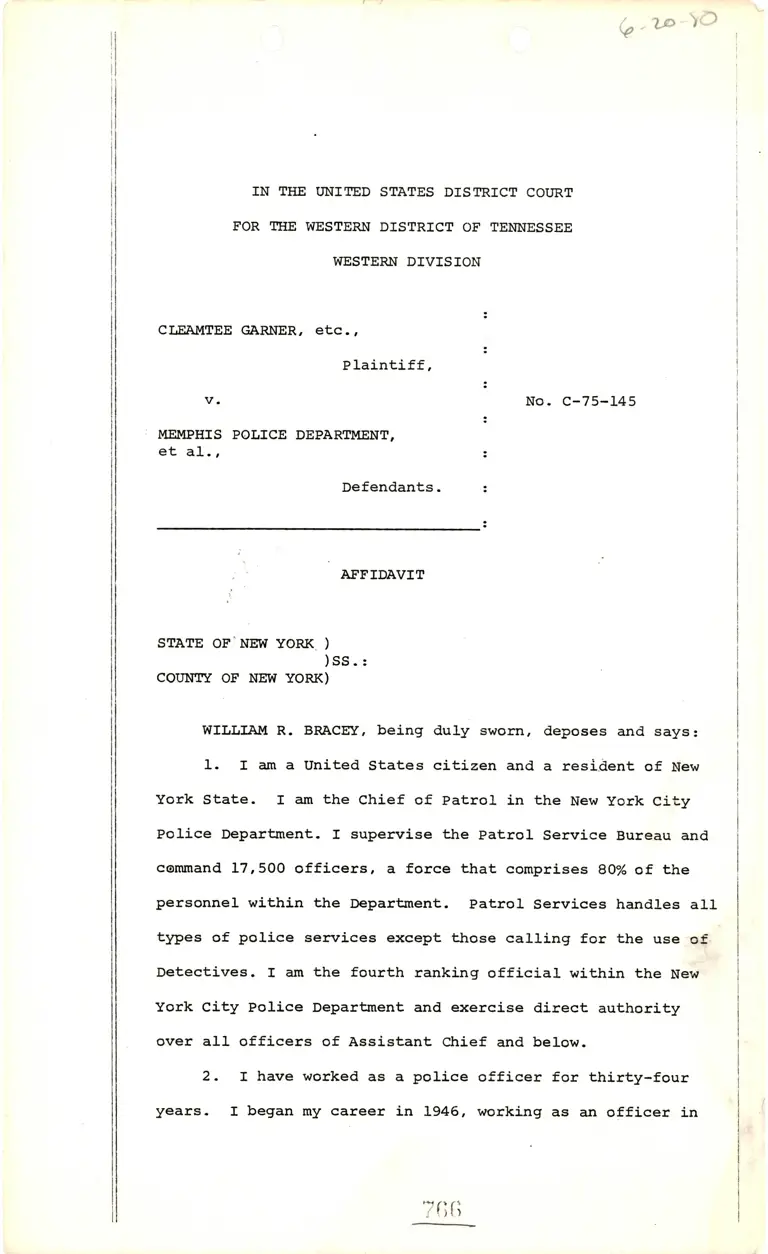
IN THE UNITED STATES DISTRICT COURT
FOR THE WESTERN DISTRICT OF TENNESSEE
WESTERN DIVISION
CLEAMTEE GARNER, etc..
Plaintiff,
V .
MEMPHIS POLICE DEPARTMENT,
et al..
Defendants.
No. C-75-145
AFFIDAVIT
STATE OF NEW YORK )
)SS. ;
COUNTY OF NEW YORK)
WILLIAM R. BRACEY, being duly sworn, deposes and says;
1. I am a United States citizen and a resident of New
York State. I am the Chief of Patrol in the New York City
Police Department. I supervise the Patrol Service Bureau and
command 17,500 officers, a force that comprises 80% of the
personnel within the Department. Patrol Services handles all
types of police services except those calling for the use of
Detectives. I am the fourth ranking official within the New
York City Police Department and exercise direct authority
over all officers of Assistant Chief and below.
2. I have worked as a police officer for thirty-four
years. I began my career in 1946, working as an officer in
? n n
Bedford-Stuyvesant, Brooklyn. After eight years I was promoted
to Sergeant and moved to the Borough of Queens, then a pre
dominantly white neighborhood. I was the first black Police
Sergeant ever assigned to Queens. In 1959 I was promoted to
Lieutenant and assigned as a desk officer in a Precinct on the
east side of Manhattan, where I worked for eleven years. In
1970 I became a Captain and was moved to the Central Harlem
Precinct. Two years later I was promoted to the rank of
Deputy Inspector and the following year, in 1973, was named
an Inspector and sent to Brownsville in the Borough of Brooklyn.!
iLater in 1973 I was promoted to Deputy Chief, becoming second
in command of the police forces in Brooklyn, a force of 2500 |
officers charged with serving a population of about two millionJ
I was elevated to Assistant Chief and became the borough |
Commander. Finally, on March 23, 1979, I was appointed to
my present post as Chief of Patrol.
3. During my career I have belonged to a number of pro
fessional law enforcement organizations. I was one of the
founders of NOBLE, the National Organization of Black Law
Enforcement Executives, and for three years was its recording
and corresponding Secretary. Presently I serve as NOBLE's
Sergeant-at-Arms.
I am also a member of the lACP, the International Associa
tion of Chiefs of Police, serve on its Committee on Arson, and
have addressed lACP workshops on the use of deadly force. The
Guardians Association, an organization of black policemen, and
the Policeman's Benevolent Association are among the other pro
fessional groups with which I am affiliated.
- 2 -
7G7
4. I graduated from Alexander Hamilton High School in
Brooklyn, New York. I have taken a wide variety of courses
at Baruch College and John Jay College and have earned the
equivalent of fifty-eight college credits.
5. With regard to the use of deadly force, the New York
Police Department policy since 1973 has allowed an officer
to fire his weapon only if he feels that his life or the life
of another person is in danger. Our policy also dictates that
there be no firing at moving vehicles, no firing of warning
shots and no shooting of animals. These rules are strictly
enforced with mitigating circumstances given appropriate
weight. What we emphasize, however, is that officers seek
alternatives to using their weapons. We urge them to seek
cover, to call for assistance and to use the full range of
their training and sophisticated equipment to apprehend sus
pects without loss of life.
5. Guidelines are very important. This cannot be
stressed enough. But reduction in firearm discharges cannot
be accomplished unless officers are made to obey strict guide
lines. The key to actual influence exercised by regulations
is the support these regulations receive from the top of the
police bureaucracy. The police leadership must make it clear
that regulations are to be followed and that officers who
violate regulations will be disciplined. Otherwise, it becomes |
I
iquickly known that strict-sounding regulations are "just for |
the record" and have no real bite. This is not to say that
police officers should constantly be second-guessed. Their
- 3 -
7GS
judgments, viewed in the light of Department guidelines,
must be viewed realistically. But it is important that those
in authority within police depar tments enforce deadly-force
regulations and that they stress the need to use alternatives ■
to firepower that will decrease the risk of unnecessary in
juries and deaths. !!
7. The tightening of the deadly-force regulations has j
i
had a considerable impact. The reforms instituted in 1973 have
reduced firearms discharges by at least 30%. (See Exhibit A.)!
This reduction in unnecessary use of firearms has not hampered!
the New York Police Department's pursuit of effective law
enforcement. Nor have the tightened regulations threatened
the safety of our officers. In fact, just the opposite is
true; regulations have enhanced police safety. Four officers
i
Iwere killed last year, a year which saw the fewest firearm !
discharges in the history of the New York police. In contrast]
ieleven policemen died in 1972, the year before the current
policy went into effect. Moreover, the rates of assaults
decreased in the wake of the tighter deadly-force guidelines.
8. One reason why we think that restrictive deadly-force
policies enhance the safety of our officers is that they be
come more aware of the need to act with prudence and to employ
tactical procedures which minimize the situations where
officers shoot or are shot at. Strict rules discouraged
sloppy and unnecessary handling of weapons which pose a threat
not only to civilians but to officers as well. Furthermore,
- 4 -
7(;:)
as noted previously, there is no indication that police ad
herence to regulations curbing the use of deadly-force has en
couraged a higher rate of attacks upon officers. Here it
needs to be emphasized that the rationale behind strict poli
cies is not to restrict necessary resort to firearms, but
only unnecessary reliance upon deadly-force. I
9. Evaluating an officer's resort to deadly-force is a |
icomplicated matter. Officers should be judged by a different i
!
standard than that applied to the conduct of civilians. On thej
I
one hand, this standard should be more strict since the officerj
I
.is a professional trained to act with prudence and due consid- j
i
eration of alternatives even under pressure. On the other !i
hand, because an officer has been trained and is the person
who actually makes these difficult decisions under pressure,
I am loathe to second-guess him unless it is obvious that his
judgment was poor.
10. Training is a key phase in our effort to reduce Ii
unnecessary resort to deadly-force. In the first two years j
after we tightened our deadly-force regulations, all the |i
training units in all the boroughs of the city devoted about j
Ian hour a day to discussion and questions about the new rules.
We made sure that these discussions were led by officers of
high rank. Captains or above. This campaign to thoroughly
familiarize Department personnel with the changes in policy
and the reasons behind these changes has undoubtedly exercised
a positive influence. More important, though, than these
initial efforts have been our consistent and continuing efforts
- 5 -770
to train officers in such a way that they will utilize fire- i
!arms only as a last resort. The Department provides officers
with extensive shooting practice at the range so that if they
are forced to shoot they can do so effectively. But the
Department also uses classroom discussion, film, and simula
tion training. By acquainting an officer as fully as possible
with what he can expect on the streets, we hope to allay the
jumpiness that sometimes causes errors in judgment. Often,
for instance, ill-trained officers will exaggerate the danger
posed by particular suspects. We try to train our officers
so that they can quickly come to a realistic appraisal of the
degree of danger they face in a particular situation. Even
more importantly, we stress throughout our training process
that good police work includes doing everything possible to
heighten safety and preserve life. What we try to promote
is not the macho image of the cop but the need for highly
professional law enforcement.
11. Disciplinary procedures comprise another important
aspect of our effort to discourage unnecessary resort to fire
arms. Anytime an officer discharges his weapon — whether or
not it results in injury — he is required to report the in
cident to his commanding officer. In all cases our process of
investigation and discipline proceeds as follows: A Duty
Captain investigates a report of firearms discharge. He does
this immediately for experience has taught us the necessity
of eliciting testimony and collecting evidence while the
- 6 -
771
incident is still "hot." This Captain files his report of
the initial investigation with the Precinct Commander and the
Chief of Patrol. The Precinct Commander is required to sub
mit a report of his own investigation of the incident within
72 hours if possible. Periodically reports of firearms dis
charge incidents are reviewed by a Borough Firearm Discharge
Review Board, a board comprised of a Borough Commander, an
Inspector, a Captain and a line police officer. This group
makes its own recommendation regarding the disposition of a
case and passes on its evaluation to the Headquarters Review
Board, chaired by the Chief of Operations. The Headquarters
Review Board makes the final determination regarding the dis
position of an incident. In those instances where the firearms
discharge is not within the guidelines, disciplinary measures
include official censure, instruction of the guidelines, re
training, change of assignment, loss of pay for a certain
amount of time, suspension, or, upon occasion, discharge.
12. It requires special effort to make a disciplinary
process operate with fairness and integrity. Police officers
are naturally going to empathize with other police officers,
for we have all faced difficult situations when it would have
been easy to have made the wrong sort of decision about using
our weapons. That is why I usually find it difficult to second-)
1
guess officers without good reason.There is, however, no excuse tc
disregard restrictive policies and their enforcement.
13. The best way to insure the integrity of the disci
plinary process is by leadership from above. When line officers
- 7 -
( /
see their superiors are serious about deadly-force regulations ’
they will tend to observe these regulations since indifference I
might pose a threat to present assignment and career advance- i
ment. This leads me to a final point concerning intra-Depart-i
ment discipline: the necessity for official criticism of un- |
!
necessary recourse to firearms. Police officers take pride j
i
in their performance and are sensitive to criticism from their I
superiors and colleagues.
14. From my experience it seems that shooting a fleeing
felony suspect is mostly related to an officer's urge to punish
a criminal. This instinct for punishment is especially strong
when the suspect is thought to have just committed a violent
crime. Much of the resistance we faced when the Department
tightened its deadly-force regulations was grounded in the
feeling that criminals deserved no chance of escaping punish
ment and that the punishment of being shot when fleeing from
a police officer was not excessive.
15. It takes time, patience and constant effort to nudge
old attitudes into line with new, professional, more restrict
ive deadly-force policies. It can be accomplished.
15. Turning to the case at hand, the situation in Memphis
Tennessee, it appears to me that a definite message was
transmitted in 1972-1973 when the police department there re- !
!
iterated its policy of shooting "to stop" and at the same time |
1!introduced the use of dum-dum bullets. The message transmitted]I
to line officers would seem to suggest the department's support
of firearms use. If dum-dum bullets had always been used, the
fact that they are deadlier than other more conventional
r
I
- 8 -
ammunition would not be so significant. Their importance i
Iin the Memphis situation is likely to have stemmed from their |
newness, the fact that they were introduced seemingly in tan
dem with the renewed emphasis on shooting to stop.
17. Unlike Memphis, the New York City police department
does not use dum-dum bullets. We believe that conventional
.38 caliber ammunition is potent enough for our needs. We
do, however, believe that when it is necessary to shoot, an
officer's duty is to stop immediately and fully the aggression
of the suspect.
18. In teimas of training, I think that heavy reliance
upon films like "Shoot, Don't Shoot" poses some problems. In th,i
first place, such films present some unrealistic situations
which ill prepares officers for what they will face at their
posts. More importantly, such films tend to leave some
officers far too jumpy. Rather than reliance upon films,
we emphasize actual simulation of bank robberies and other
violent police-criminal confrontations. While we provide
intensive training in firearms use, we stress seeking alterna
tives to firearms; taking defensive or holding positions, ask
ing for assistance and other tactical options.
19. With reference to the statistics suggesting that
50.4% of the police shootings in Memphis involve those sus
pected of crimes against property, I can only say that such a
trend seems wrong and excessive, particularly if one believes
in the doctrine of letting the punishment fit the crime.
Teamwork, effective use of communications systems and good
- 9 -
7 7/■i
detective work is more than adequate to apprehend the vast
majority of fleeing suspects no matter what the crime.
20. I react negatively to the policies of the Memphis
police Internal Affairs Board insofar as those policies include
subjecting those who complain of police misconduct to polygraphj
tests. Making the complainant take a polygraph test immediatel^
while exempting the officer complained of is an unjustified
double standard. This practice is bound to discourage many
citizen complaints.
21. It is very difficult to comment on the actions the
police officers took in the Garner case since I am not in-
t
timately and thoroughly familiar with the facts and total
context'of the tragedy. I can say, however, that in a simi
lar situation as that faced by the officer in question, several
alternatives should immediately spring to mind that could avoid
resort to deadly-force. Using a radio to summon assistance is
nearly always correct tactically. With a quick call for
assistance, a fleeing suspect can be eventually caught even if
he does manage to escape temporarily. Or if the suspect is
unarmed, moving up on him quickly with a drawn nightstick and
an air of determination will do wonders toward halting a suspeo
thinking about fleeing. The point is that in most cases there
are alternatives to deadly-force if officers are expected and
trained to reach for these options.
/ /
Sworn to before me this
o c 0 day of June, 1980.
IVALINA R. PASS?
Notary Public, State of New Yod
N«. ^14526688
Qualified in Queens County „
Commission Expires March 30,
- 10 -
EXHIBIT A
Incidents of Firearm Discharges
By New York City Police Officers
1971 to the Present
January - June
1971
1972
1973
1974
1975
1976
1977
1978
1979
1980
630
803
556
470
439
374
414
372
364
160
PART 2: Affidavit by Lawrence
W. Sherman, Ph.D., Director of
Reasearch, Police Foundation
777
IN THE UNITED STATES DISTRICT COURT
FOR THE WESTERN DISTRICT OF TENNESSEE
WESTERN DIVISION
CLEAMTEE GARNER, etc..
Plaintiff,
MEMPHIS POLICE DEPARTMENT,
et al.,
Defendants.
No. C-76-145
AFFIDAVIT
STATE OF NEW YORK )
) SS. :
COUNTY OF NEW YORK)
LAWRENCE W. SHERMAN, being duly sworn, deposes and says:
1. I am a United States citizen and a resident of
Washington, D.C.
2. I hold a Bachelor of Arts Degree from Denison
University, a Master of Arts degree from the University of
Chicago, and a Ph.D. degree from Yale University.
3. I am presently Director of Research at the Police
Foundation in Washington, D.C. Other posts I have held in
clude the following: Executive Director, National Advisory
Commission on Higher Education for Police Officers; Director,
Project on Homicide by Police Officers, Criminal Justice
Research Center, Albany, New York; Consultant to Civil Rights
Division, United States Department of Justice; Consultant to
Solicitor General of Canada. I have also served as a consul
tant to several metropolitan police departments including those
in New York City, Dayton and Kansas City. I have served as
an expert witness in four prior court cases involving police
use of firearms and have spent several thousand hours riding
in patrol cars in ten American cities and four European cities
observing police decide whether or not to resort to firearms.
Finally, I have written extensively in the area of police
administration and police behavior. My publications include
Scandal and Reform: Controlling Police Corruption (University
of California Press, 1978); The Quality of Police Education
(Jossey Bass Publishers, 1978) with National Advisory Commiss
ion on Higher Education for Police officers; Team Policing
(Police Foundation, 1973); "Measuring Homicide by Police
Officers," 70 Journal of Criminal Law and Criminology 546
(1979) with Robert H. Langworthy; "Execution Without Trial:
Police Homicide and the Constitution," 33 Vanderbilt Law
Review 71. In addition to these publications I have written
about twenty-five other articles or chapters in books, and
serve as the Criminal Law Bulletin's Contributing Editor for
Law Enforcement.
4. Guidelines are extremely important. The best avail
able empirical evidence clearly indicates that even minor
changes in the direction of restricting firearms use will
- 2 -
reduce the number of citizens shot. These changes in regula
tions must, however, be supported by strict enforcement if
they are to become effective.
5. Extensive statistical studies by James J. Fyfe and
others indicate that reforms restricting police use of deadly-
force reduce the numbers of citizens shot without causing
corresponding increases in crime or assaults upon police
officers (see Exhibit A). My own research has verified Fyfe's
conclusions. In Kansas City and Atlanta, changes in police
deadly-force regulations have substantially decreased the
number of citizens wounded or killed by police firearms. At
the same time, neither of these cities has experienced an
increase in crime as a result of more restrictive policies.
In Atlanta, moreover, there was no increase in assaults
against officers. Data on the number of police assaults
following the change of regulations in Kansas City is not
available. But in New York, the number of assaults against
police decreased substantially after policy reforms tightened
the rules governing police useof deadly force.
6. Even more important than regulations however, is
strict enforcement of rules curbing unnecessary resort to
deadly force by police officers. If enforcement is strict,
strong guidelines will quickly exercise significant influence
on the conduct of officers- The message will go out that the
Department is serious about its deadly-force rules. If en
forcement is lax, the opposite message will be transmitted,
no matter what the regulations themselves actually prescribe
as required conduct. The point, then, is that the tone of
enforcement and the a t t i t u d e a police administration tre
equally as important^in the successful implementation of re
strictive deadly force policies. Thus, the cities that have
been most effective in curbing police resort to deadly force
have been those where the ranking officers have created an
atmosphere of administration sympathetic to restrictive poli
cies .
7. One method of enforcing strict discipline with re
gard to the use of firearms, is for police departments to
investigate every single firearms discharge whether or not
the incident involves injury or death. This process of exten-
( o- A i i /“ ■
sive review is used in New York City^and has probably played
a significant role in that city's effective campaign against
unnecessary resort to deadly force by the police.
8. Training is also an important factor in reducing pol
ice use of firearms. Based upon my experience with firearms
decision training in New York City, the most effective train
ing techniques involve simulation drills which accustom
officers to processing the ambiguous situations they are like
ly to encounter in the course of their work. Drills where
officers actually have people jump out at them suddenly or
where officers have to quickly appraise whether someone is a
suspect or a victim add to the readiness of an officer to
face his duties with added poise and a disciplined readiness
to use alternatives to deadly force.
9. In my view, the Memphis Police Department's policy
regulating the use of deadly force is deficient in several
- 4 -
important respects. The policy includes no provisions concern
ing the protection of bystanders. In contrast, both the Model
Penal Code and the 1977 President's Commission on Law Enforce
ment and the Administration of Justice recommend that use of
deadly-force be prohibited when bystanders might be injured.
More importantly, the Memphis policy insufficiently stresses the
need of police officers to use alternatives to deadly-force in
apprehending fleeing felons. What these significant omissions
indicate is a glaring looseness in policy regarding police resort
to firearms. It is clearly inappropriate, for
instance, for police guidelines to allow officers to use deadly
force against fleeing property crime suspects when convicted
criminals of these same violations are exempt from the death
penalty and most often are sentenced to jail terms far less
severe than life imprisonment. When property crimes were punish
able by the death penalty, police use of deadly force against
property violators at least rested upon an internal logic. Now,
however, that logic has been shattered by charges in our concep
tion of appropriate punishments. Under modern conditions, then,
regulations allowing force to be used against fleeing suspects
of property crimes is a dangerous anachronism.
Dated; June , 1980
Sworn to and subscribed before
me this '■'> day of June, 1980.
i /.. ,L
Notary Public
i ’̂ iy Coin in icjion L x p ir r j DrccinbrT 15. I93-I
IN THE UNITED STATES DISTRICT COURT
FOR THE WESTERN DISTRICT OF TENNESSEE
WESTERN DIVISION
CLEAMTEE GARNER, etc..
Plaintiff,
MEMPHIS POLICE DEPARTMENT,
et al.,
)
No. C-75-145
Defendants
A F F I D A V I T
STATE OF NEW YORK )) SS . :
COUNTY OF NEW YORK)
JAMES J. FYFE, Ph.D., being duly sworn, deposes and says:
I am a United States citizen and a resident of New York State.
1. I am an associate professor at The American University,
College of Public Affairs, School of Justice and I submit this
affidavit on behalf of Cleamtee Garner.
2. I was a member of the New York City Police Department
for sixteen years, and retired with the rank of lieutenant in
1979. During my tenure with the New York City Police Depart
ment, I performed patrol duties for more than eight years in
Brooklyn, Queens and Staten Island. I also held the following
assignments:' Chairman, Police Academy Police Science Depart
ment; Executive Officer, Police Academy Management Training
Unit; Commanding Officer, Police Academy Management Training
Unit; Coordinator, Executive Development Program; Director,
Firearms Discharge/Assault Research Project.
3. During my tenure with the New York City Police Depart
ment, I designed a multi-media firearms training program in
which more than 20,000 police officers have participated.
4. I hold a Bachelor of Science degree in Criminal
Justice from the John Jay College of Criminal Justice, City
University of New York. I also hold a Master of Arts degree
in Criminal Justice from the State University of New York at
Albany and a Ph.D. degree in Criminal Justice from the State
University of New York at Albany.
5. I have held fellowships and grants for graduate study
from the Ford Foundation, the National Science Foundation, and
the New York City Police Foundation. I was an adjunct assistant
professor of police sicence at John Jay College of Criminal
Justice for four and one-half years.
6. I wrote a doctoral dissertation on the use of deadly
force which analyzed 2926 incidents in which 3827 New York City
police officers discharged firearms between 1971 and 1975.
These incidents are enumerated by year in Exhibit A attached.
My doctoral dissertation was awarded the American Society for
Public Administration's Annual Award to the Outstanding National
Contribution to Criminal Justice Administration in 1979.
7. I have written articles on police use of deadly force
which have appeared in the FBI Law Enforcement Bulletin, the
Journal of Criminal Justice, the Journal of Research in Crime
and Delinquency and the Los Angeles Times. I have served as
a consultant on police deadly force to the United States Depart
ment of Justice, Civil Rights Division; United States Department
of Justice Community Relations Service; United States Civil
Rights Commission; Chicago Law Enforcement Study Group; and
the Police Foundation. Also, I have lectured on police use
of deadly force at universities and professional meetings
throughout the United States.
8. A major conclusion of my research and studies is that
police use of deadly force to apprehend fleeing non-violent
suspects is inconsistent with the concern for life characte
ristic of the operations of the rest of the criminal justice
- 2 -
system.
9. A major conclusion of my research is that police use
od deadly force to apprehend fleeing non-violent suspects does .•
not deter criminal behavior or increase law enforcement effec
tiveness in any measurable way.
10. A major conclusion of my search is that police ad
ministrators can take direct action in the form of agency
policies which will significantly reduce the incidence of police
use of deadly force to apprehend fleeing non-violent suspects.
This administrative action to reduce police use of deadly force
to apprehend fleeing non-violent suspects does not endanger the
lives and safety of police officers.
11. A major conclusion of my research is that minority
citizens are disproportionately and negatively affected by polic^
use of deadly force.
12. I have examined data provided by the NAACP Legal Defens^
Fund in connection with this case. Those data concern crime
and police use of deadly force in Memphis, Tennessee during
the years 1969 through 1974. I have compared those data to
data on crime and police use of deadly force and firearms in
New York City during the years 1971-1975. That comparison shows
the following:
a) The annual rate at which Memphis police officers
discharged firearms (33.45 shootings per 1000 officers annually)
is 71 percent higher than that of New York City (19.50 per
1000 officers annually).
b) When controlling for risk of exposure to situ
ations likely to percipitate police shooting, the rate at which
Memphis police officers discharged firearms during 1969-1974
is nearly three and one-half times greater than the 1971-1975
New York City rate. During 1959-1974, Memphis police reported
- 3 -
55.98 shooting events for each 1000 violent crime arrests
effected (murder; non-negligent manslaughter; forcible rape;
robbery; aggravated assault). The New York City rate was 16.71
shootings for each 1000 arrests effected.
c) More than hald (50.7 percent) of the police shoot
ings in Mehphis during 1959-1974 involved shooting at property
crime suspects. The comparable percentage in 1971-1975 in New
York was no more than 11.3 percent. This comparison is not
precise because the New York City figure includes all shootings
to "prevent or terminate crimes." Thus, it includes shootings
precipated by both property crimes and crimes of violence. My
estimate of the percentage of New York City police shootings
which involved property crime suspects only is four percent.
d) Using the same figures described in "c" above,
the average annual rate at which Memphis police fired their
guns at property crime suspects during 1959-1974 (15.95 shootings
per 1000 officers annually) is at least 5.8 times greater than
the New York City average annual rate during 1971-1975 (average
annual rate of shooting to prevent or terminate all crimes - 2.9C
estimated average annual rate of property crime shootings = 1.28)
e) The 1980 census indicates that 38.85 percent of
the population of Memphis is black, but blacks accounted for
84.21 percent of the property crime suspects shot at by Memphis
police during 1969-1974. Thus, the likelihood that black citi
zens were shot at as property crime suspects during 1959-1974
(rate = .40 per 1000 population) is approximately ten times
higher than is true for white citizens (rate = .042 per 1000
population). The rate at which blacks were wounded in property
crime shootings (.054 per 1000 population) is approximately 20
times higher than the white rate (.0025 per 1000). The rate
- 4 -
at which blacks were killed in property crime shootings (.058
per 1000) is nearly six times higher than the white rate (.01
per 1000).
f) These great discrepancies hold true even when one
controls for differential involvement among the races in property
crime. Memphis police shot at 4.33 black perotery crime suspects
for each 1000 blacks arrested for property crimes (burglary,
larceny, and auto theft) during 1959-1974. This rate is more
than twice as high as the white rate (1.81 shootings per 1000
property crime arrests). Black property crime arrestees were
shot and wounded more than five times as often as white property
crime arrestees (.586 black woundings per 1000 arrests, versus
.113 white woundings per 1000 arrests). Black property crime
suspects were shot and killed 40 percent more often than white
property crime suspects (.63 black deaths per 1000 arrests,
versus .45 white deaths per 1000 arrests). In New York City,
differential racial involvement in police shootings also exists,
but it is almost totally accounted for by differential racial
involvement in the types of activities likely to precipitate
shootings.
g) Memphis police officers were more than 15 times
more likely to have shot at black property crime suspects than
at white property crime suspects during 1959-1974. More than
one in five Memphis officers (206.05 per 1000) shot at black
property crimfe suspects during 1969-1974, while approximately
one in 75 officers (14.27 per 1000) shot at white property
crime suspects. The rate at which Memphis police wounded black
property crime suspects (11.50 per 1000 officers) was more than
13 times higher than the rate at which they wounded white pro
perty crime suspects (.89 per 1000 officers). The rate at which
Memphis police killed black property crime suspects (12.49 per
1000 officers) was nearly three and one-half times greater than
- 5 -
■ * V > w 'in'* _. • t • / / - y ilf.
the rate at which they killed white property crime suspects
(3.57 per 1000 officers).
13. On the basis of these findings, I have reached the
following conclusions:
a) The police shooting rate discrepancy between
Memphis and New York City is almost totally attributable to
the high incidence of Memphis police shootings at property
crime suspects. These shootings could be reduced significantly
by strong addministrative action, such as that taken in New York
City in 1972. Since that time, "fleeing felon" shootings have
declined by 75 percent in New York City.
b) As a result of the Memphis Police Department's
apparent tolerance of police shootings not precipitated by
violent crime and not involving danger to police or citizens,
black citizens of Memphis were far more likely to have been
shot at, wounded, or killed by police than were white citizens
during 1959-1974.
c) For reasons which cannot be precisely identified
from data made available to me, the individual black citizen
of Memphis suspected of a property crime was far more likely
to have been shot at, wounded, or killed by police than was the
individual white property crime suspect. In other words, the
data indicate that Memphis police responded with more force to
black property crime than to white property crime during 1959-
1974.
14. I have examined data on fatal police shootings in
Memphis during the years 1959 to 1975. The source of these
data is the report of the Tennessee Advisory Commission to the
United States Commission on Civil Rights, Civic Crisis-Civic
Challenge: Police Community Relations in Memphis 81 (1978) .
These data which do not include information on police shooting
occurring between January 15 and December 31, 1972, indicate
that 39 persons were killed by the Memphis police during the
rest of the period between 1959 to 1975. Of these, 25 were
- 5 -
, j.- ■ i' ■
black, 8 were white, and 5 were not identified by race.
15. I analyzed these data to determine whether the black
and white among these victims were shot in similar circumstances.
Table I, attached as Exhibit B, shows the results of that ex
amination. The table shows that 1/2 (13) of the black victims
and 1/8 (1) of the white victims were unarmed and none were
assaultive at the time they were killed. Conversely, the table
shows that 1/2 (13) of the black victims and 87.5% (7) of the
white victims were reportedly engaged in assaultive behavior
against police or other citizens immediately prior to the deaths,
of these assaultive victims, 7 blacks (26.9% of total black
deaths) and 5 whites (62.5% of total white deaths) were re
portedly armed with guns when shot by police. These are super
ficially dramatic differences, but no measure of their signi
ficance is possible. This is so because the only statistically
significant category of whites killed is those armed with guns.
16. On the basis of this analysis, I have reached the
following conclusions:
a) The circumstances under which the Memphis Police
shot and killed citizens during 1969 to 1976 varied dramatically
with the race of the victims.
b) Memphis police were far more likely to shoot and
kill blacks in non-threatening circumstances than they are to
shoot whites in non-threatening circumstances in this period.
c) The great disproportion of black citizens shot
and killed by Memphis Police between 1969 to 1976 is largely
accounted for by the great number of black citizens shot in
circumstances in which they presented little or no danger to
police or other citizens. In those years, Memphis police shot
or killed 0.6 armed and assaultive whites for each non-assaultive
white killed; but they shot and killed nearly 2 unarmed non-
assaultive blacks for each armed assaultive black killed.
17. I have examined the account of the fatal shooting of
Eugene Garner set forth in the Sixth Circuit Court of Appeals
opinion. My opinion of this case is that it involves a well-
intentioned action on the part of a police officer who acted
up to the expectation of his superiors. On the basis of the
limited account available to me, I can find no fault with the
officer, who did only what he had been trained to do by his
super iors.
The larger question raised by this tragedy involves
the validity of what the officer's superiors trained and expected
him to do. It was not wrong for the officer to do what he was
told; but it was very wrong that the officer had been told to do
what he did. Had Garner been apprehended, tried in accordance
with due process guarantees, and found guilty beyond a reasonable
doubt of the burglary he is alleged to have committed, he cer
tainly would not have been executed. He is dead, however, be
cause of policy and training which authorized the summary shooting
of non-dangerous suspects on the basis of suspicion or probable
cause.
JAMES J. FYFE
DISTRICT OF COLUMBIA, ss:
ON THIS DATE, before me, a Notary Public in and for the afore
mentioned jurisdiction, personally appeared James J. Fyfe, iden
tifying himself as James J. Fyfe, and acknowledged himself as
the person who executed this document as his free and voluntary act.
GIVEN under my hand and Notarial Seal, this
My commission expires
day of June, 1980,
EXHIBIT B
TABLE 1.
Actions of Memphis Shooting Fatalities by Race
1969 to 1976
Victim Actions Race of Victim
Black
Race of Victim
White
Non-assaultive 50.0% (n=13) 12.5% (n=l)
Assaultive - not
armed with gun
23.1% (n=6) 25.0% (n=2)
Assaultive - armed 26.9% (n=7)
with gun
62.5% (n=5)
Totals 100.0% (n-26) 100.0% (n=8)