Fields v. City of Fairfield Jurisdictional Statement
Public Court Documents
October 31, 1962
-
Brief Collection, LDF Court Filings. Fields v. City of Fairfield Jurisdictional Statement, 1962. 2fa73ea8-b19a-ee11-be36-6045bdeb8873. LDF Archives, Thurgood Marshall Institute. https://ldfrecollection.org/archives/archives-search/archives-item/5c030957-e97f-4b02-ad70-283bf55f56fc/fields-v-city-of-fairfield-jurisdictional-statement. Accessed October 07, 2026.
Copied!
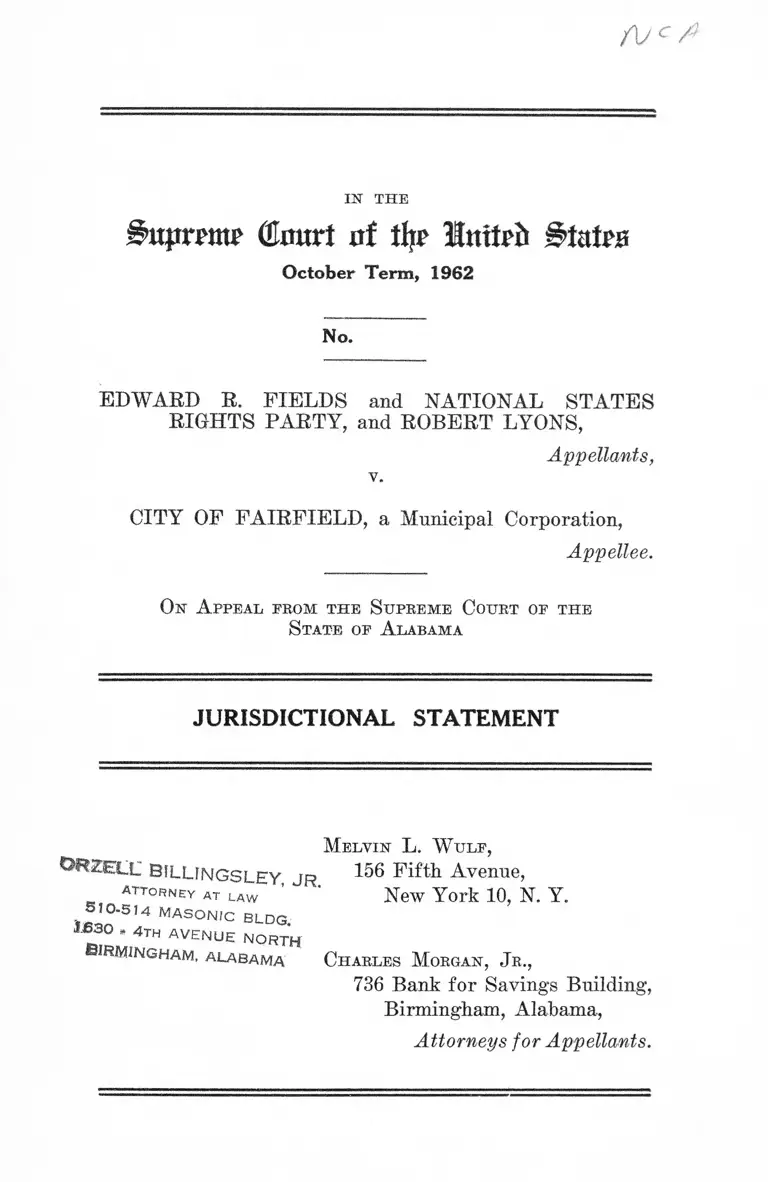
IN THE
^uprwitr GJmtrt of tk? Hmfrft States
October Term, 1962
No.
EDWARD R. FIELDS and NATIONAL STATES
RIGHTS PARTY, and ROBERT LYONS,
Appellants,
v.
CITY OF FAIRFIELD, a Municipal Corporation,
Appellee.
On A ppeal from the Supreme Court of the
State of A labama
JURISDICTIONAL STATEMENT
ORZELL' Bill in g sl e y
atto r n ey at LAW
5 10 -5 1 4 MASONIC BLD<
1 6 3 0 . 4 th AVENUE NOR
Birmingham , a l a b a m ,
Melvin L. W ulf,
156 Fifth Avenue,
New York 10, N. Y.
Charles Morgan, Jr.,
736 Bank for Savings Building,
Birmingham, Alabama,
Attorneys for Appellants.
I N D E X
Opinions B e lo w ............................................................. 1
Jurisdiction ..................................................................... 1
The Statutes Involved................................................... 2
Questions Presented..................................... 3
Statement of the C a se ................................................... 4
The Questions Are Substantial ................................. 7
Conclusion ...................................................................... 16
Table of Authorities
Cases :
Ayres, Re, 123 U. S. 433 ............................................ 13
Bates v. Little Rock, 361 U. S. 5 1 6 ......................... 11
Bridges v. California, 314 U. S. 252 ........................ 8,11
Building Service Employees v. Gazzam, 339 U. S.
532 ........................... 13
Burstyn v. Wilson, 343 U. S. 495 ............................. 8
Cantwell v. Connecticut, 310 IT. S. 296 .................. 11
Carpenters and Joiners Union v. Ritter’s Cafe,
315 U. S. 722 ........................................................... 13
Cox v. New Hampshire, 315 U. S. 569 .................... 9
Craig v. Harney, 331 U. S. 367 .............................. 8
DeJonge v. Oregon, 299 U. S. 353 ........................... 9,11
Fisk, Ex Parte, 113 U. S. 713 .............................. 13
Garner v. State of Louisiana, 368 U. S. 1 5 7 .......... 15
Giboney v. Empire Storage & Ice Co., 336 U. S. 490 13
Gitlow v. New York, 268 U. S. 652 ........................... 11
Green, In the Matter of, 369 U. S. 689 .................. 14
Grosjean v. American Press Co., 297 U. S. 233 . . . . 8
Hague v. CIO, 307 U. S. 496 ..................................... 7, 8
Hughes v. Superior Court, 339 U. S. 460 .............. 13
PAGE
11
Jamison v. Texas, 318 U. S. 4 1 3 ..................... 2, 7
Kunz v. New York, 340 U. S. 290 ........................... 8, 9
Local 309 v. Gates, 75 F. Supp. 620 ..................... 9
Local Union No. 10i v. Graham, 345 U. S. 1 9 2 ........ 13
Lovell v. Griffin, 303 U. 8. 444 ................................. 2, 7, 8
NAACP v. Alabama, 357 U. S. 449 ..................... 11,12
NAACP, Ex Parte, 265 Ala. 349, 91 So. 2d 214 .. 12
Near v. Minnesota, 283 U. 8. 697 . .................. .. 8
Niemotko v. Maryland, 340 U. S. 268 .................... 8
Pennekamp v. Florida, 328 U. S. 3 3 1 .................... 8
Rowland, Ex Parte, 104 U. S. 604 ................. .. 13
Rockwell v. Morris, 10 N. Y. 2d 721, cert, denied,
368 U. S. 913 ........................................................ 11
Sawyer, Re, 124 U. S. 200 ................................. . 14
Schenk v. United States, 249 U. S. 4 7 ................... 11
Schneider v. State, 308 U. S. 147 ......................... 7
Staub v. Baxley, 355 U. S. 313 ............................... 2,14
Talley v. California, 362 U. S. 60 ......................... 7
Terminiello v. Chicago, 337 U. S. 1 ........................ 11
Thomas v. Collins, 323 U. S. 5 1 6 ................... 2,9,10,11
Thompson v. City of Louisville, 362 U. S. 199 ........ 15
United Gas, Coke & Chemical Workers v. Wis
consin Employment Relations Board, 340 U. S.
383 ............................................................................ 14
United States v. United Mine Workers, 330 U. S.
258 ................................................................... 12,13,14,15
Whitney v. California, 274 U. S. 357 ....................... 15
Yates v. United States, 354 U. S. 298 .................. 11
PAGE
PAGE
Constitution- and Statutes:
United States Constitution:
First Amendment............................... 3, 4, 7, 8,10,12,14
Fourteenth Amendment ............................... 3 ,4 ,7 ,9 ,15
General City Code of Fairfield:
Sections 3-4 .......................................................... 2, 3, 7, 8
Sections 3-5 ...........................................................2, 3, 7, 8
Sections 14-53 ......................................................... 1> 3, 8
Norris LaGuardia Act, 47 Stat. 7 0 .................... ... 12,13
28 U. S. C. §1257(2) ................................... ............ 2
Other A uthorities:
New York Times, October 30, 1962 .......................... 15
iii
1ST THE
j&uprrmr (Enurt at % Ittttefc States
October Term, 1962
No.
Edwakd E. F ields and National States E ights Party,
and E gbert Lyons,
Appellants,
v.
City op F airfield, a Municipal Corporation,
Appellee.
On A ppeal prom the Supreme Court of the
State of A labama
—-------— --------- O'— ------- -— •— •—
JURISDICTIONAL STATEMENT
Opinions Below
The opinion of the Supreme Court of Alabama is re
ported at — Ala.—, 143 So. 2d 177 and set out infra at pp.
2a-7a. No opinion was written by the Circuit Court of
Jefferson County, but its oral opinion rendered at the
time of judgment is contained at E. 71-73 and is set out
infra at pp. 8a-9a.
Jurisdiction
(i) Appellee filed a bill of complaint (E. 2-3) in the
Circuit Court of Jefferson County on October 11, 1961,
alleging that appellants intended to hold a public meeting
without obtaining a permit, in violation of Section 14-53
2
of the General City Code of Fairfield, and had distributed
handbills announcing the meeting in violation of Sections
3-4 and 3-5 of the General City Code. The bill prayed that
“ a temporary writ of injunction or restraining order be
immediately issued by this Court * * * restraining [ap
pellants] from holding said meeting * * * and distributing-
said handbills,” and that the injunction be made permanent
after final hearing. The temporary writ (R. 5-6) was issued
the same day on appellee’s ex parte application. The next
day, appellants Fields and Lyons were found in criminal
contempt of the injunction and sentenced to five days in
jail and a $50 fine.
(ii) The judgment of conviction was affirmed and en
tered by the Alabama Supreme Court on June 14, 1962
(R. 101) and a timely application for rehearing was denied
on July 12, 1962 (R. 104). Execution of sentence was
stayed pending this appeal (R. 108). Notice of Appeal
to the Supreme Court of the United States was filed with
the Supreme Court of Alabama on September 10, 1962
(R. 109-111). An amended Notice of Appeal was filed on
September 18, 1962 (R. 112-113).
(iii) The jurisdiction of this Court to review by appeal
the judgment of the Supreme Court of Alabama is con
ferred by 28 U. S. C. % 1257(2).
(iv) The cases which sustain the jurisdiction of this
Court are Lovell v. Griffin, 303 IT. S. 444; Jamison v. Texas,
318 U. S. 413; Thomas v. Collins, 323 U. S. 516; Staub v.
Baxley, 355 U. S. 313.
The Statutes Involved
General City Code of F airfield, A labama
See. 3-4. Handbills, etc.—Distribution on streets.
It shall be unlawful for any person to distribute or
cause to be distributed on any of the streets, avenues, alleys,
parks or any vacant property within the city any paper
3
handbills, circulars, dodgers or other advertising matter,
[Ord. No. 354, §4 (1957).]
Sec. 3-5. Same—Placing or throwing in automobiles.
It shall be unlawful for any person to distribute in the
city any handbill or other similar form of advertising by
throwing or placing the same in any automobile or other
vehicle within the city. [Ord. No. 354, §5 (1957).]
Sec. 14-53. Public meetings; permit required.
It shall be unlawful for any person or persons to hold
a public meeting in the city or its police jurisdiction without
first having obtained a permit from the mayor, to do so.
[Ord. No. 184, § 4, 11-9-32.]
Questions Presented
1. Whether Sections 3-4 and 3-5 of the Oeneral City
Code of Fairfield, Alabama, upon which appellants’ con
tempt convictions rest, on their face or as construed and
applied in this case, abridge appellants’ rights of free
speech, press and assembly in violation of the due process
clause of the Fourteenth Amendment and the First Amend
ment to the United States Constitution.
2. Whether Section 14-53 of the General City Code of
Fairfield, Alabama, upon which appellants’ contempt con
victions rest, on its face or as construed and applied in
this case, abridges appellants’ rights of free speech, press
and assembly in violation of the due process clause of the
Fourteenth Amendment and the First Amendment to the
United States Constitution.
3. Whether consideration by the Supreme Court of the
United States of a challenge on federal grounds to the
validity of a municipal ordinance on its face, or as construed
and applied, may be precluded where appellants are found
in contempt of an ex parte temporary injunction which
4
purports to enforce compliance with the ordinance, and the
state court refuses to entertain the merits of the challenge
on the procedural ground that appellants “ chose to disre
gard the temporary injunction rather than contesting it by
orderly and proper procedure,” where the consequence of
the state procedural rule is to nullify appellants’ rights of
free speech, press and assembly in violation of the due
process clause of the Fourteenth Amendment and the First
Amendment to the United States Constitution.
4. Whether appellants’ convictions for contempt, being
unsupported by any evidence of guilt, constitute wholly
arbitrary official action and thereby violate the due process
clause of the Fourteenth Amendment to the United States
Constitution.
Statement of the Case
I. When and How the Federal Questions Were Raised.
The federal questions presented by this appeal were
first raised by appellants in the Circuit Court on their oral
motion to dismiss (R. 66-69). They were raised thereafter
in appellants’ petition for certiorari to the Supreme Court
of Alabama (R. 84-86), and on the application for rehear
ing (R. 103).
II. The Facts.
Appellant Fields is Information Director of the National
States Rights Party. Appellant Lyons is Youth Organizer
of the Party (R. 57). The Party, which stands for white
supremacy and segregation (R. 53), has been on the ballot
in Alabama (R. 58).
Sometime prior to Wednesday, October 11, 1961 (R. 44),
the Party had handbills distributed in Fairfield which con
tained the following announcement (R. 42):
W hite W orkers
Meeting
*Niggers A re Taking Over U nions !
*Niggers W ant Our Parks and Pools !
#Niggers Demand M ixed Schools!
Communists in NAACP and in Washington say
Whites Have No Rights!
The Nigger gets everything he Demands !
White Supremacy Can be saved
Whites Can Stop this second Reconstruction!
Hear Important Speakers Prom 4 States
Time—8 P. M. Date—'Wed. Oct. 11
Place—5329 Valley Road
In Downtown Fairfield, Alabama
A bove the Car W ash
Thunderbolt Mobile Unit Will be Parked Out
Front Sponsored by National States Rights Party
Box 783, Birmingham, Alabama
P ublic I nvited
Come and Bring Your Friends
At about 5:00 P. M., Tuesday, October 10, 1961, the
day before the scheduled meeting, the Mayor of Fairfield
sent a notice to appellant Fields that he had violated a
city ordinance that prohibited the distribution of handbills.
The Mayor also informed Fields that another ordinance
forbade public meetings without a permit (R. 43).
At about 6 :00 P. M. the same evening, Fields phoned the
Mayor at his home to discuss the issuance of a permit for
the meeting (R. 36-38). Fields called the Mayor’s office
the morning of the following day and made an appointment
for 2 :Q0 P. M. that afternoon for further discussion (R. 55).
Around noon of that day, however, Fields was served with
an injunction (R. 24) forbidding him, the National States
6
Rights Party, their servants, agents and employees, from
holding the scheduled meeting and from distributing any
handbills announcing the meeting. Fields did not keep his
2:00 P. M. appointment.
The injunction was issued on the ex parte application
of the City of Fairfield. The Bill of Complaint (R. 2-4)
alleged, among other things, that the appellants were “ dis
tributing handbills of an inflammatory nature designed to
create ill will and disturbances between the races in the
City of Fairfield,” that the purpose of the announced meet
ing “ is to create ill will, disturbances, and disorderly con
duct between the races,” and that the meeting “ will con
stitute a public nuisance, injurious to the health, comfort,
or welfare of the City of Fairfield and * * * is calculated
to create a disturbance, incite to riot, disturb the peace,
and disrupt peace and good order in the City of Fairfield.”
About 7 :30 P. M. on the evening of the scheduled meet
ing, appellants Fields and Lyons arrived at the meeting
place to announce that the meeting site had been transferred
to the city park at Lipscomb, a nearby town (R. 16, 22, 25,
27, 49, 54, 60, 62, 63).1 Subsequent to the service of the
injunction, no meeting was held in Fairfield (R. 48, 55),
no handbills were distributed (R. 18, 22, 26, 31, 44, 47, 54,
63, 72),2 nor was there any disturbance whatsoever (R.
17, 25, 28, 55).
Appellants were arrested for violating the injunction.
On the following day, October 12, 1961, after a hearing,
each was found in contempt and sentenced to serve 5 days
in jail and pay a $50 fine.
1 Earlier the same day, appellant Lyons and another person were
prohibited by the police from entering the meeting place (R . 33, 50).
2 Some copies of the Party’s newspaper, Thunderbolt, were dis
tributed near the original meeting place, but it contained no notice of
the Fairfield meeting, nor had its distribution been enjoined. A copy
of the newspaper is contained at R. 19.
III. The Disposition Below of the Federal Questions.
The Circuit Court, although it found that “ the ordi
nances are a legal exercise of the police power of the
municipality” (R. 72), also found that “ I don’t believe it
is the law of this State that you can collaterally attack the
constitutionality of an ordinance in a contempt proceed
ing * * * ” (R. 71).
The Supreme Court of Alabama also found, the ordi
nances not unconstitutional (R. 100), but held that appel
lants “ may not raise the question of its unconstitutionality
in collateral proceedings on appeal from a judgment of con
viction for contempt of the order or decree * * * ” (R.
100).
The Questions Are Substantial
1. Sections 3-4 and 3-5 of the Code of Fairfield purport
to prohibit the distribution of “ any paper handbills, circu
lars, dodgers or other advertising matter,” at all times and
in all public places. A statute of that magnitude is uncon
stitutional on its face, for it abridges the rights of free
speech and free press that are secured by the First and
Fourteenth Amendments to the United States Constitution.
Lovell v. Griffin, 303 U. S. 444; Hague v. CIO, 307 U. S. 496;
Schneider v. State, 308 U. S. 147; Jamison v. Texas, 318
U. S. 413; Talley v. California, 362 U. S'. 60.
Sections 3-4 and 3-5 are almost identical to the ordi
nances involved in Numbers 13, 18 and 29 in Schneider,
which, as the Court said, “ absolutely prohibit [distribution]
in the streets and, one of them, in other public places as
well.” 308 U. S. at 162. The Court held those ordinances
invalid on their face on the ground that they abridged
“ the free communication of information and opinion se
cured by the Constitution.” Id. at 163.
This case is aggravated by the fact that appellants were
restrained in advance from distributing any handbills what-
8
ever. Thus, appellee, relying upon Sections 3-4 and 3-5,
burdened appellants with a prior restraint, a particularly
noisome violation of the First Amendment, Near v. Minne
sota, 283 U. S. 697; Burstyn v. Wilson, 343 U. S. 495.
Moreover, the trial court explicitly found that no hand
bills were distributed after the injunction was served (ft.
72). What the court in fact found, was that appellants had
distributed copies of their newspaper, The Thunderbolt,
whose circulation had not been enjoined. Though the court
acknowledged that there was no announcement of the meet
ing in the issue distributed,8 it said, “ That was an artifice
on the part of someone to bring home the fact that the
meeting was going to be held while artfully evading the
exact language of the handbill that had been previously
distributed” ( R. 72). Thus, the high order of protection
conferred by the Constitution on the freedom of the press,
was arrantly disregarded. Near v. Minnesota, supra;
Grosjean v. American Press Co., 297 U. 8. 233; Bridges v.
California, 314 U. S. 252; Pennekamp v. Florid,a, 328 U. S.
331; Craig v. Harney, 331 U. 8. 367.
2. Section 14-53 of the Code of Fairfield requires that
a permit be obtained from the Mayor “ to hold a public
meeting in the city or its police jurisdiction.” Because the
ordinance contains no “ narrowly drawn, reasonable and
definite standards for the officials to follow # * it is
invalid on its face. Niemotko v. Maryland, 340 U. S. 268,
271; Hague v. C. I. 0., 307 U. S. 496, 516; Runs v. New
York, 340 TJ. S. 290. Mr. Justice Frankfurter, concurring 3
3 The issue consists of eight pages. The front page headline says
“ ‘Freedom Riders’ Burn Bus While Bobby Kennedy Blames 9
Innocent White Alabamians.” The centerfold headline said “ Ken-
nedys Start Second Reconstruction of South.” Two and a half pages
are devoted to excerpts from Henry Ford’s The International Jew
(R. 19).
9
in Runs, said, “ I f a municipality conditions holding street
meetings on the granting of a permit * * *, the basis which
guides licensing officials in granting or denying a permit
must not give them a free hand, or a hand effectively free
when the actualities of police administration are taken into
account.” 340 U. S. at 284-285.
The size of the free hand wielded against appellants,
when measured by its reach in this case, is remarkable.
The power it assumed was not restricted to regulating the
“ time, place and manner,” of a meeting on the streets or
in the parks,4 5 but rather it asserted the power to suppress
in advance a meeting of a political party to be held in a
private hall.
There have been two cases before this Court which
were concerned with the power asserted by a State to
prohibit a peaceful public meeting held in a private hall
merely because the purpose of the meeting was disagree
able to the government : DeJonge v. Oregon, 299 U. S. 353;
and Thomas v. Collins, 323 U. S. 516.®
In DeJonge, an Oregon statute purported to make crim
inal, among other things, “ the organization of an * * *
assemblage which advocates [criminal syndicalism], and
presiding at or assisting in conducting a meeting of such
an organization, society or group.” DeJonge’s “ sole of
fense as charged # # was that he had assisted in the
conduct of a public meeting, albeit otherwise lawful, which
was held under the auspices of the Communist Party.”
299 U. S. at 362.
The Court, holding the conviction repugnant to the due
process clause of the Fourteenth Amendment, said:
“ The holding of meetings for peaceable political
action cannot be proscribed. Those who assist in
4 Compare Cox v. New Hampshire, 312 U. S. 569, 576.
5 Compare Local 309 v. Gates, 75 F. Supp. 620.
1 0
the conduct of such meetings cannot be branded as
criminals on that score. The question, if the rights
of free speech and peaceable assembly are to he
preserved, is not as to the auspices under which the
meeting is to be held hut as to its purpose; not as
to the relations of the speakers, hut whether their
utterances transcend the hounds of the freedom of
speech which the Constitution protects. If the per
sons assembling have committed crimes elsewhere,
if they have formed or are engaged in a conspiracy
against the public peace and order they may be
prosecuted for their conspiracy or other violation
of valid laws. But it is a different matter when the
State, instead of prosecuting them for such offenses,
seizes upon mere participation in a peaceable as
sembly and a lawful public discussion as the basis
for a criminal charge.” 299 U. S. at 365.
In Thomas, an official of a labor union was held in
contempt of a restraining order-issued ex parte, as here—
that forbade him from violating a Texas statute regulating
the solicitation of membership in trade unions. The order
was issued in anticipation of a meeting at which the appel
lant was scheduled to speak. He appeared and spoke at
the meeting, and was held in contempt. The Court, hold
ing that the statute contravened the First Amendment,
said that “ a requirement that one must register before he
undertakes to make a public spech to enlist support for a
lawful movement is quite incompatible with the require
ments of the First Amendment,” 323 U. S. at 540.
Whether or not a State has the power to prohibit
in advance peaceful assemblies merely because its officials
prefer to suppress discussion of issues of public importance
or maintain the status quo, is a constitutional question of
the first magnitude. It is presented here in graphic form.
The purpose of the meeting organized by appellants was
to discuss race relations. Appellants maintain that the
white race is superior to the Negro race and are entirely
opposed to any form of racial integration. They intended
11
to discuss—and oppose—the integration of labor unions,
parks, pools and schools. Their opposition to integration,
of course, is constitutionally irrelevant. Compare Termi-
niello v. Chicago, 337 U. S. 1, and Rockwell v. Morris, 10
N. Y. 2d 721, cert, denied, 368 U. S. 913, with N.A.A.C.P. v.
Alabama, 357 U. S. 449 and Bates v. Little R od , 361 U. S.
516.
The power of a State to suppress speech and assembly
may not be applied in advance, but only, if at all, when
there is a clear and present danger that the speech or as
sembly threatens to incite illegal conduct. Schenk v. United
States, 249 U. S. 47, Gitlow v. New York, 268 U. S. 652 (dis
sent), DeJonge v. Oregon, supra, Bridges v. California, 314
U. S. 252, Thomas v. Collins, supra. Compare Yates v.
United States, 354 U. S. 298. The record here is barren
of evidence of any such danger. Appellee’s bill of com
plaint contains no factual allegations to support its con
clusions that the purpose of the meeting was “ to create
ill will, disturbances, and disorderly conduct between the
race,” and that it “ will constitute a public nuisance, in
jurious to the health, comfort or welfare of the City of
Fairfield and * * * is calculated to create a disturbance,
incite to riot, disturb the peace, and disrupt peace and good
order in the City of Fairfield” (R. 3).6
The true purpose of the restraints imposed on appel
lants was revealed by the sentencing court. It said, ‘ ‘ Back
several years ago wTe did have a movement to move into
one of our public parks here but that was straightened out
within a matter of a few weeks * * *. And it is the intention,
I know, of the public officials * * # that we are going to do
everything we can to maintain that status quo” (R. 72).
But a State “ may not suppress free communication of
views * * # under the guise of preserving desirable con
ditions.” Cantwell v. Connecticut, 310 U. S. 296, 308.
6 The record shows that a meeting held by appellants the previous
evening was entirely peaceable (R . 47).
12
The ruling below, if permitted to stand, will empower
the States to burden free speech, press and assembly to an
extent not heretofore tolerated by this Court. The decision
whether those burdens offend the First Amendment, re
quires full briefing and oral argument before the Court.
3. Whether or not a state rule of procedure may be
interposed between an individual and his rights of free
speech, press and assembly under the circumstances present
in this case, is a substantial federal question that has not
been decided by this Court.
The Alabama Supreme Court held that appellants could
test neither the constitutionality of the ordinances on which
the temporary injunction was based, nor the validity of
the injunction itself, by violating its terms. It relied
principally 7 on United States v. United Mine Workers, 330
U. S. 258, which involved the question whether the Norris-
LaGuardia Act prohibited a United States District Court
from enjoining a coal miners’ strike when the United
States was in possession of the mines. Although United
Mine Workers affirmed convictions of contempt of an ex
parte restraining order, the case is not authority for the
proposition that a contempt conviction is valid even if the
underlying order is void on constitutional grounds.
First, of the five Justices in the majority, three held the
order valid. Though they went on to declare that even
if the order were void, the defendants nonetheless were
required to obey it, that much of their opinion was unneces
sary to their decision and therefore not binding. Mr.
Justice Black and Mr. Justice Douglas likewise found the
order valid and thought it unnecessary, therefore, to decide
the academic problem of a void order. They dissented in
part on other grounds. Mr. Justice Murphy and Mr. Justice
Rutledge concluded both that the order was void and the
7 The opinion also cites E x Parte National Association for Ad
vancement of Colored People, 265 Ala. 349, 91 So. 2d 214, but
neglects to note that that case was reversed, in N.A.A.C.P. v. Ala
bama, 357 U. S. 449.
13
contempt conviction therefore invalid. Only Mr. Justice
Frankfurter and Mr. Justice Jackson held the contempt
conviction valid even though the order on which it was
based was, in their opinion, invalid. Thus, of nine Justices
writing five opinions, only Justices Frankfurter and Jack-
son squarely adopted the proposition advanced here by the
Supreme Court of Alabama.
Second, the issue in United Mine Workers dealt only
with the question whether the Norris-LaGuardia Act was
to be interpreted to prohibit a United States District Court
from enjoining a strike under the unique facts of that case.
There was no discussion in the Court’s opinion bearing
on the A ct’s constitutionality, nor was there any claim that
the Act was unconstitutional.
Third, there was substantial doubt whether the Norris-
LaGuardia Act applied to the facts in United Mine Workers,
for as the Court noted, the question “ had not previously
received judicial consideration.” 330 U. S. at 293. In
the case at bar, to the contrary, it is perfectly clear that
the ordinances in question are unconstitutional both on
their face and as construed and applied. See Points 1
and 2, supra. Consequently, the “ different result” which
Mr. Chief Justice Vinson anticipated, “ were the question
of jurisdiction frivolous and not substantial” , 330 U. S.
at 293, is required in this case.
Fourth, the nature of the United Mine Workers case,
dealing as it does with a labor dispute, sets it apart from
the instant case which comes here unfettered by the quali
fications that may attach to cases that concern industrial
conflict. Compare, Carpenters and Joiners Union v. Rit
ter ’s Cafe, 315 U. S. 722; Giboney v. Empire Storage d Ice
Co., 336 U. S. 490; Building Service Employees v. Gazsam,
339 U. S. 532; Hughes v. Superior Court, 339 U. 8. 460;
Local Union No. 10 v. Graham, 345 U. S. 192.
Fifth, cases decided by this Court both before and after
United Mine Workers have held that a contempt conviction
under a void order is itself void. Ex Parte Rowland, 104
14
U. S. 604; Ex Parte Fish, 113 U. S. 713; Re Ayers, 123 U. S.
443; Re Satvyer, 124 U. S. 200. See also United Gas, Coke
& Chemical Workers v. Wisconsin Employment Relations
Board, 340 U. S. 383; In the Matter of Green, 369 U. S. 689.
By utilizing the supposed doctrine of United Mine
Workers, Alabama has effectively curtailed appellants’
rights of speech, press and assembly, and Mr. Justice Rut
ledge’s prophecy in his dissent in United Mine Workers
has come to pass:
“ [I ] f [the Court’s holding] should become the
law, for every case raising a question not frivolous
concerning the court’s jurisdiction to enter an order
or judgment, that punishment for contempt may be
imposed irrevocably simply upon a showing of vio
lation, the consequences would be equally or more
serious * *.
The First Amendment liberties especially would
be vulnerable to nullification by such control. Thus,
the constitutional rights of free speech and free
assembly could be brought to nought and censorship
established widely over these areas merely by apply
ing such a rule to every case presenting a substantial
question concerning the exercise of those rights.
* * * These and other constitutional rights would be
nullified by the force of invalid orders issued in flat
violation of the constitutional provisions securing
them, and void for that reason.” 330 TJ. S. at 351-
352.
If appellants were not judged in contempt of the pre
liminary injunction, but rather were convicted directly of
violating the ordinances on which the injunction was based,
there is no question that the ordinances’ constitutionality
could have been tested by violating them. Staub v. Baxley,
355 U. 8. 313. But Alabama, by interposing a temporary
injunction between appellants and the ordinances, has de
vised a method that, if ratified by this Court, will allow
circumvention of the Staub doctrine and confer on the states
a technique to nullify the precise purpose the First Amend
ment is intended to serve—full discussion of all matters of
15
public concern, which Mr. Justice Brandeis called “ a politi
cal duty.” Whitney v. California, 274 U. S. 357, 376 (con
curring opinion). Public issues frequently are short run,
and if the government were empowered to suppress dis
cussion by use of an injunction issued, as here on the
flimsiest ground,8 the purpose of the discussion may well
have passed by the time the appellate remedies were ex
hausted. For example, it would enable a political candidate
to be enjoined from speaking during the campaign period
preceding an election. I f he violated the injunction he
would be imprisoned; if he bowed to the injunction and
tested its constitutionality in “ orderly and proper pro
ceedings,” the election will have long ended. In either
case, the electorate would not have heard him and the
electoral process would be crippled.9
8 So flimsy “ as to be usurping judicial forms” , thereby satisfying
Mr. Justice Frankfurter’s criterion for treating the injunction “ as
though it were a letter to a newspaper.” United Mine Workers,
supra at 309-310.
9 On the day this Jurisdictional Statement was printed, the New
York Times carried the following story (October 30, 1962, p. 22) :
Los A n geles, Oct. 29— California Democrats won a court
order today against the sale and distribution of the controversial
Little Red Book until after the election.
Democrats alleged that the booklet, “ California: Dynasty of
Communism,” implied that Gov. Edmund G. Brown and other
Democratic incumbents were soft on Communism.
Superior Judge Kenneth N. Chantry issued a temporary re
straining order prohibiting the printing, posting or distribution
of the 32-page booklet. He set Nov. 7, the day after Election
Day, for a hearing on an injunction.
The order followed a libel suit for $500,000 damages brought
by Eugene L. Wyman, the state chairman, and other Demo
cratic leaders.
They alleged the booklet was designed to “ injure, defame,
discredit and defeat” Democratic officials.
It was contended the booklet contained false statements and
doctored photographs.
* * *
Judge Chantry ordered defendants to take back any copies
in the hands of postal officials.
16
Whether or not the Alabama rule of procedure an
nounced by the court below shall be permitted to stand
between appellants and their rights under the Constitution,
is a substantial federal question that should be fully briefed
and argued before the Court.
4. This Court has held that convictions devoid of evi
dentiary support are unconstitutional under the due pro
cess clause of the Fourteenth Amendment. Thompson v.
City of Louisville, 362 (J. S. 199; Garner v. State of
Louisiana, 368 IT. S. 157. This is such a case.
The Circuit Court expressly found that “ there is no
evidence that the pamphlet was re-distributed” (R. 72),
but as we pointed out above, he held that the injunction
was violated by the distribution of appellants’ newspaper
even though it contained no notice of the meeting. The
Circuit Judge said nothing at all about whether the evi
dence sustained a finding that appellants had violated the
ban on the scheduled meeting—nor could he, for it is un
disputed that appellants had cancelled it. Although appel
lants were in the vicinity of the meeting hall, it was only
to notify those persons who may have come to the an
nounced meeting place, that the meeting was to be held
elsewhere, outside the City of Fairfield. Nonetheless, the
Supreme Court of Alabama said that “ There is evidence
to support the finding that they did violate the terms of
the temporary injunction” (R. 100).
CONCLUSION
For the reasons stated, it is urged that jurisdiction
be noted.
Respectfully submitted,
Melvin L. W ulf,
156 Fifth Avenue,
New York 10, N. Y.
Charles Morgan, Jr.,
736 Bank for Savings Building,
Birmingham, Alabama,
Attorneys for Appellants.
October 31, 1962.
APPENDIX
The Supreme Court op A labama
Thursday, June 14, 1962
The Court Met Pursuant to Adjournment
Present: All the Justices
Jefferson Circuit Court
Bessemer Division
6th Div. 801: 802: 809
---------------------- o—----------------------
Dr. E dward E. F ields and National States Rights Party,
vs.
City of F airfield, a Municipal Corporation.
---------------------- o----------- ----- ——
The said causes having been consolidated, W hereupon,
Come the parties by attorneys and the record and mat
ters therein assigned for errors, being argued and sub
mitted on motions and merits and duly examined and
understood by the Court, it is considered that in the record
and proceedings of the Circuit Court' there is no error.
It is therefore considered, ordered and adjudged that
the judgment of the Circuit Court be in all things affirmed.
I t is further considered, ordered and adjudged that
the Appellants-Petitioners, Edward R. Fields and Robert
Elsworth Lyons, and Dr. Fred Short and Pearce S. John
son, sureties on the appeal bond, pay the costs of appeal
of this Court and of the Circuit Court.
And it appearing that said parties have wrnived their
rights of exemption under the laws of Alabama, it was
ordered that execution issue accordingly.
[Judgment of the Supreme Court of Alabama]
2a
-------------------------------- o — — --------------- --------
Dr. E dward R. F ields and National States Rights Party,
[Opinion of the Supreme Court of Alabama]
v.
City oe F airfield, a Municipal Corporation.
A ppeal from Jefferson Circuit Court
------------------------- o—------ — —■—-
Merril, Justice:
Dr. Edward R. Fields and Robert Lyons were adjudged
to be in contempt of circuit court because they had been
found guilty of violating a temporary injunction issued
by the court against them as individuals, and against the
National States Rights Party, of which they were officers,
enjoining them from conducting an advertised meeting in
Fairfield. Fields and Lyons were each fined $50 and
sentenced to five days in jail.
Petitioners "appealed” their judgment of conviction
to this court and later their attorney "discovered that
writ of certiorari is the proper remedy in this case,”
and asked that the purported appeal be considered as a
petition for writ of certiorari. We have complied with
the request and so treat the cause now under review.
Petitioners were distributing handbills in the City of
Fairfield, which read:
3a
“ W hite W orkers
‘ ‘ Meeting
‘ ‘ * Niggers A re Taking Over U nions!
“ #N iggers W ant Our Parks and Pools!
“ * Niggers Demand M ixed Schools!
“ Communists in NAACP and in Washington say
“ Whites H ave No Rights!
“ The Nigger gets everything he Demands!
“ White Supremacy Can be saved!
Whites Can Stop this second Reconstruction!
“ Hear Important Speakers from 4 States
‘ ‘ Time—8 P. M. Date—Wed. Oct. 11
“ Place—5329 Valley Road
“ In Downtown Fairfield, Alabama
“ A bove the Car W ash
“ T hunderbolt Mobile Unit Will Be Parked Out
Front Sponsored by National States Rights Party
“ Box 783, Birmingham, Alabama
“ P ublic I nvited
“ Come and Bring Your Friends!”
The attorney for the city sought a temporary injunc
tion to enjoin petitioners from holding the advertised
meeting because they had not complied with an ordinance
of the City Code which provided “ It shall be unlawful for
any person or persons to hold a public meeting in the
city or police jurisdiction without first having obtained
a permit from the mayor to do so.” The judge issued
Opinion of Supreme Court of Alabama
4a
the temporary injunction and a copy was served on Fields
at Noon, Wednesday, August 11th. Lyons also had notice
of the temporary injunction which enjoined them “ from
holding a public meeting at 8 P.M. on Wednesday, October
11, 1961, at 5329 Valley Road, Fairfield, Alabama, as
announced, and from distributing further in the City of
Fairfield, handbills announcing such meeting such as were
distributed in the City of Fairfield, Alabama, on October
10, 1961, until further orders from this Court; and this
you will in no wise omit under penalty, etc.”
Fields and Lyons were arrested that night where a
crowd had gathered across the street from the advertised
place of meeting. Fields was making announcements to
the crowd and both he and Lyons were distributing copies
of ‘ ‘ The Tunderbolt, ’ ’ the newspaper of the Party.
The petitioners make two points in brief. They say
first that the evidence shows they did not violate the terms
of the injunction. There is evidence to support the find
ing that they did violate the terms of the temporary in
junction, and we have held that upon petition for certiorari,
the court does not review questions of fact but only ques
tions of law; but if the court below misapplies the law
to the facts as found by it or there is no evidence to sup
port the finding, a question of law is presented to be
reviewed upon the petition for certiorari. Ex parte Wetsel,
243 Ala, 130, 8 So. 2d 824.
We now come to the main point argued by petitioners—
“ that the temporary injunction was void ab initio on ac
count of being contrary to and in violation of both the
United States and Alabama Constitutions.” This argu
ment is based upon the premise that the ordinance of the
City of Fairfield is unconstitutional. We cannot say that
it is unconstitutional on its face.
In Ex parte National A ss ’n for Adv. of Colored Peo
ple, 265 Ala. 349, 91 So. 2d 214, we said:
Opinion of Supreme Court of Alabama
5a
“ On the petition for certiorari the sole and only
reviewable order or decree is that which adjudges
the petitioner to be in contempt. Certiorari cannot
be made a substitute for an appeal or other method
of review. Certiorari lies to review an order or
judgment of contempt for the reason that there is
no other method of review in such a case. Ex parte
Dickens, 162 Ala. 272, 50 So. 218, 220. Review on
certiorari is limited to those questions of law which
go to the validity of the order or judgment of con
tempt,, among which are the jurisdiction of the court,
its authority to make the decree or order, violation
of which resulted in the judgment of contempt. It
is only where the court lacked jurisdiction of the pro
ceeding, or where on the face of it the order diso
beyed was void, or where procedural requirements
with respect to citation for contempt and the like
were not observed, or where the fact of contempt is
not sustained, that the order or judgment will be
quashed.”
Here, the circuit court had jurisdiction of the parties and
the subject matter. It had the authority to make the de
cree or order, and on its face, the order disobeyed was not
void. It is not contended that any procedural requirements
were omitted.
In the face of this, petitioners, without moving to dis
solve the temporary injunction, seeking a hearing, or in
any way contesting the writ, proceeded to meet a crowd
gathered across the street from the advertised place of
meeting and distributed inflammatory literature.
As a general rule, an unconstitutional statute is an ab
solute nullity and may not form the basis of any legal right
or legal proceedings, yet until its unconstitutionality has
been judicially declared in appropriate proceedings, no per
Opinion of Supreme Court of Alabama
6a
son charged with its observance under an order or decree
may disregard or violate the order or the decree with im
munity from a charge of contempt of court; and he may
not raise the question of its unconstitutionality in collat
eral proceedings on appeal from a judgment of conviction
for contempt of the order or decree, or an application for
habeas corpus for release from imprisonment for contempt.
United States v. United Mine Workers of America, 380
U. S. 258, 91 L. Ed. 884, 67 S. Ct. 677; Eowat v. Kansas,
258 U. S. 181, 66 L. Ed. 550, 42 S. Ct. 277; People v. Bou
chard, 6 Misc. 459, 27 N. Y. S. 201; McLeod v. Majors, 5th
Cir., 102 F. 2d 128; Pure Milk Asso. v. Wagner, 363 111. 316,
2 N. E. 2d 288.
In the United Mine Workers case, supra, the court said:
“ Proceeding further, we find impressive author
ity for the proposition that an order issued by a
court with jurisdiction over the subject matter and
person must be obeyed by the parties until it is re
versed by orderly and proper proceedings. This is
true without regard even for the constitutionality
of the Act under which the order is issued. In Howat
v. Kansas, 258 U. S. 181, 189-190 (1922) this Court
said:
‘ An injunction duly issuing out of a court of
general jurisdiction with equity powers upon
pleadings properly invoking its action, and served
upon persons made parties therein and within
the jurisdiction, must be obeyed by them how
ever erroneous the action of the court may be,
even if the error be in the assumption of the
validity of a seeming but void law going to the
merits of the case. It is for the court of first
instance to determine the question of the valid
ity of the law, and until its decision is reversed
Opinion of Supreme Court of Alabama
7a
for error by orderly review, either by itself or
by a higher court, its orders based on its decision
are to be respected, and disobedience of them is
contempt of its lawful authority, to be punished.’
“ Violations of an order are punishable as crim
inal contempt even though the order is set aside on
appeal, Worden v. Searle, 121 IT. S. 14 (1887), or
though the basic action has become moot, Gompers
v. Bucks Stove d Range Co., 221 U. S. 418 (1911).
“ We insist upon the same duty of obedience
where, as here, the subject matter of the suit, as well
as the parties, was properly before the court; where
the elements of federal jurisdiction were clearly
shown; and where the authority of the court of first
instance to issue an order ancillary to the main suit
depended upon a statute, the scope and applicability
of which were subject to substantial doubt. * * * ”
Under these authorities, petitioners were guilty of con
tempt, as they chose to disregard the temporary injunction
rather than contesting it by orderly and proper proceedings.
Affirmed.
Livingston, C. J., Simpson and Harwood, JJ., concur.
Opinion of Supreme Court of Alabama
8a
The Court: Well, gentlemen, before I give you my
decision, I have a remark or two I would like to make.
First, I don’t believe it is the law of this State that
you can collaterally attack the constitutionality of an ordi
nance in a contempt proceeding without first purging your
self of that contempt, if there is any there.
And, second, it has been, either through good luck or
the grace of somebody bigger than all of us here in the
Bessemer Cut-off, that we have been singularly blessed
with not having any race incident here in this area; and,
particularly, I think, Fairfield has never had one. Back
several years ago we did have a movement to move into
one of our public parks here but that was straightened
out within a matter of a few weeks by the City Attorney
for Bessemer and other people. And since that time I
don’t believe we have had a singie clash between the races,
either in Bessemer, or Fairfield, or any of the other city—
cities of the Bessemer Division of this County. And it
is the intention, I know, of the public officials, both of this
county and of the various municipalities of the Bessemer
Division of this County that we are going to do everything
we can to maintain that status quo. We are going to try
to keep peace between the races here and we are going
to do everything that we can to keep people from agitating
trouble.
Getting down to this case here:
While there is no evidence that the pamphlet was re
distributed, the writ of injunction says “ distribute further
handbills, announcing such meetings, as were distributed
in the City of Fairfield. ’ ’
I am impressed by the tone and the context of the
paper that was admittedly distributed and I simply think
that was an artifice on the part of someone to bring home
the fact that the meeting was going to be held while artfully
[O p in io n o f th e C ircu it C o u rt o f J efferso n C o u n ty ]
9a
evading the exact language of the handbill that had been
previously distributed.
If these respondents were of the opinion and so advised
that these ordinances were unconstitutional they could have
filed their motion to dissolve it and had their day in court
and the final hearing on this injunction was to have been
set down or was set down on November 17th, giving every
body adequate time to prepare their cases to come in and
test the constitutionality of these ordinances.
It is my opinion that the ordinances are a legal exercise
of the police power of the municipality.
Therefore, Dr. Fields and Mr. Lyons, if you will stand:
It is the judgment of the Court that you are in contempt
of this Court and it is the judgment of the Court that you
be and are hereby adjudged in contempt and you are
fined $50.00.
And as additional punishment you are ordered to be
confined in the county jail for five days.
Opinion of the Circuit Court of Jefferson County
DRZEU- B'lUNSSLEV, JR.
a tto rn ey AT
avenue north
rS B 30 a ATH AVt.1 ■
T he Hecla Press, 54 Lafayette Street, New Y ork City, BEekman 3-2320
«sgfjî 39
(2145)