Hartford Disparities Study - Outline of Analyses; Proposed Agenda
Working File
June 10, 1992
3 pages
-
Case Files, Sheff v. O'Neill Hardbacks. Hartford Disparities Study - Outline of Analyses; Proposed Agenda, 1992. 2554a7a7-a146-f011-8779-7c1e5267c7b6. LDF Archives, Thurgood Marshall Institute. https://ldfrecollection.org/archives/archives-search/archives-item/5c34d053-ee22-410b-988b-5ff216ae430e/hartford-disparities-study-outline-of-analyses-proposed-agenda. Accessed October 07, 2026.
Copied!
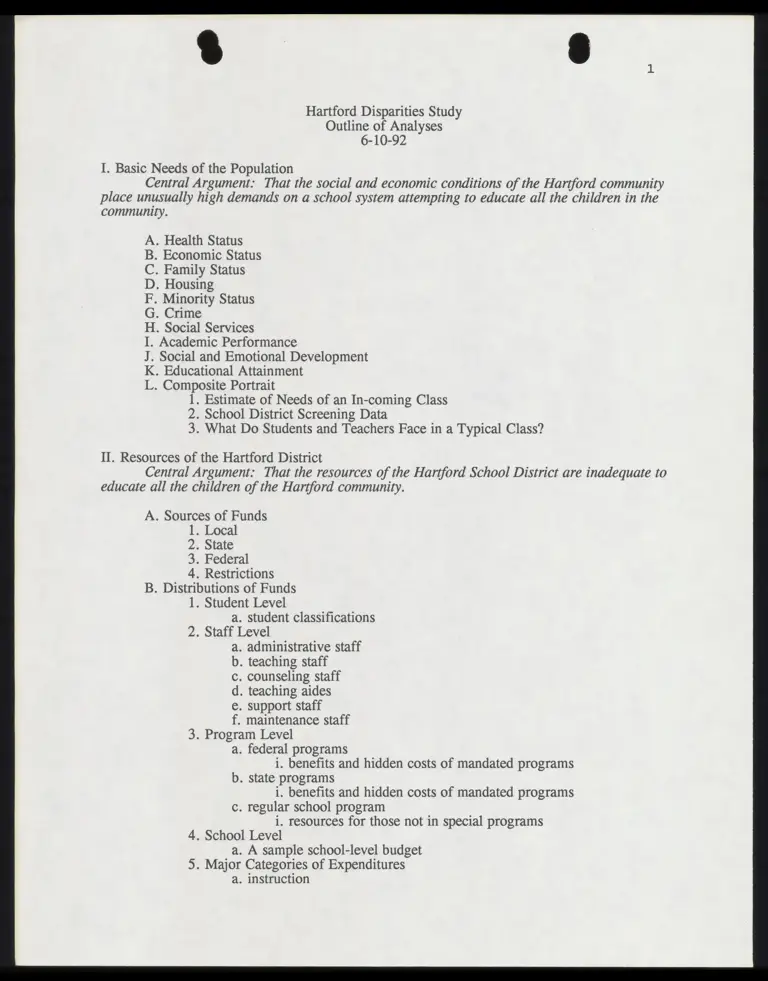
    Hartford Disparities Study
Outline of Analyses

6-10-92


I. Basic Needs of the Population
Central Argument: That the social and economic conditions of the Hartford community

place unusually high demands on a school system attempting to educate all the children in the
community.

A. Health Status
B. Economic Status
C. Family Status
D. Housing
F. Minority Status
G. Crime
H. Social Services
I. Academic Performance
J. Social and Emotional Development
K. Educational Attainment
L. Composite Portrait

1. Estimate of Needs of an In-coming Class
2. School District Screening Data
3. What Do Students and Teachers Face in a Typical Class?

II. Resources of the Hartford District
Central Argument: That the resources of the Hartford School District are inadequate to

educate all the children of the Hartford community.

A. Sources of Funds
1. Local
2. State
3. Federal
4. Restrictions

B. Distributions of Funds
1. Student Level

a. student classifications
2. Staff Level

. administrative staff
. teaching staff
. counseling staff
. teaching aides

. support staff
f. maintenance staff

3. Program Level
a. federal programs

i. benefits and hidden costs of mandated programs
b. state programs

i. benefits and hidden costs of mandated programs
c. regular school program

i. resources for those not in special programs
4. School Level

a. A sample school-level budget
5. Major Categories of Expenditures

a. instruction

O
0
0


o
P


b. administration
c. facilities

6. Special Needs
e.g., special educational programs
e.g., the space needs of special social services
e.g., the space needs of mandated programs
e.g., the reduced flexibility caused by mandated programs
e.g., the costs of maintaining order in disrupted communities
e.g., attendance monitoring, transfer volume


III. Comparative Disadvantage
Central Argument: That the resources of the Hartford School District for educating all

the children in the community are substantially less than those of other Connecticut districts.

A. Statewide Comparisons
1. State averages for disaggregated items
2. Impact of state and federal program mandates on the regular program

B. Local Area Comparisons
1. Hartford area districts

C. Single District Comparisons
1. West Hartford

IV. Absolute Disadvantage
Central Argument: That the resources of the Hartford School District prevent it from

offering an educational program for all the children in the community that conforms to
commonly accepted standards of educational quality.

A. Internal Comparisons
1. Identification of local programs that are deemed effective
2. Estimate of the costs of expanding local programs to serve all appropriate

students
B. Comparisons with Connecticut Standards

1. Identification of Connecticut state standards on various dimensions of
educational quality

2. Estimate of the cost of meeting Connecticut state standards in the Hartford
schools

C. Comparisons with Standards Set by Accrediting Bodies
1. Identification of standards set by various accrediting bodies

. early childhood educators
. math educators
. English educators
. science educators
. guidance counselors

. college board
. regional accrediting body
. National Goals Panel

2. Estimate of the costs of meeting the standards set by accrediting bodies
D. Comparisons with the Costs of Programs Thought to Be Effective

1. Success for All
2. Comer Program
3. Accelerated Schools
4. STEP Program

=
e


H
o


0


O
R


PRIVILEGED AND CONFIDENTIAL

PROPOSED AGENDA


Sheff Lawyers’ Meeting
Wednesday, June 10, 1992

11:00 a.m,
Wes Horton's Office

1. Presentation by Gary Natriello/discussion

2. Discussion of strategy re: first set of defendants’
experts to be deposed

3. Trial preparation

--Discuss draft list of lay witnesses (due soon)

v~ --Review list of new plaintiff experts (due next week) av
2\

v~ --Review upcoming deadlines/expert deposition schedule %

" --Alves testimony/approve payment vo

~~ --Discuss planned response to defendants’ May 14 motion
to compel

--Status of William Gordon (potential expert)

--Status of Julio Morales (potential expert)

--discussion of possible deposition of Tirozzi

4, Other business