Appendix Volume I
Public Court Documents
June 29, 1970
485 pages
-
Case Files, Swann v. Charlotte-Mecklenburg Working Files. Appendix Volume I, 1970. 3479b193-2d34-f111-88b4-7c1e526962fd. LDF Archives, Thurgood Marshall Institute. https://ldfrecollection.org/archives/archives-search/archives-item/5c556b57-b13f-481c-9923-0d253a07daff/appendix-volume-i. Accessed October 15, 2026.
Copied!
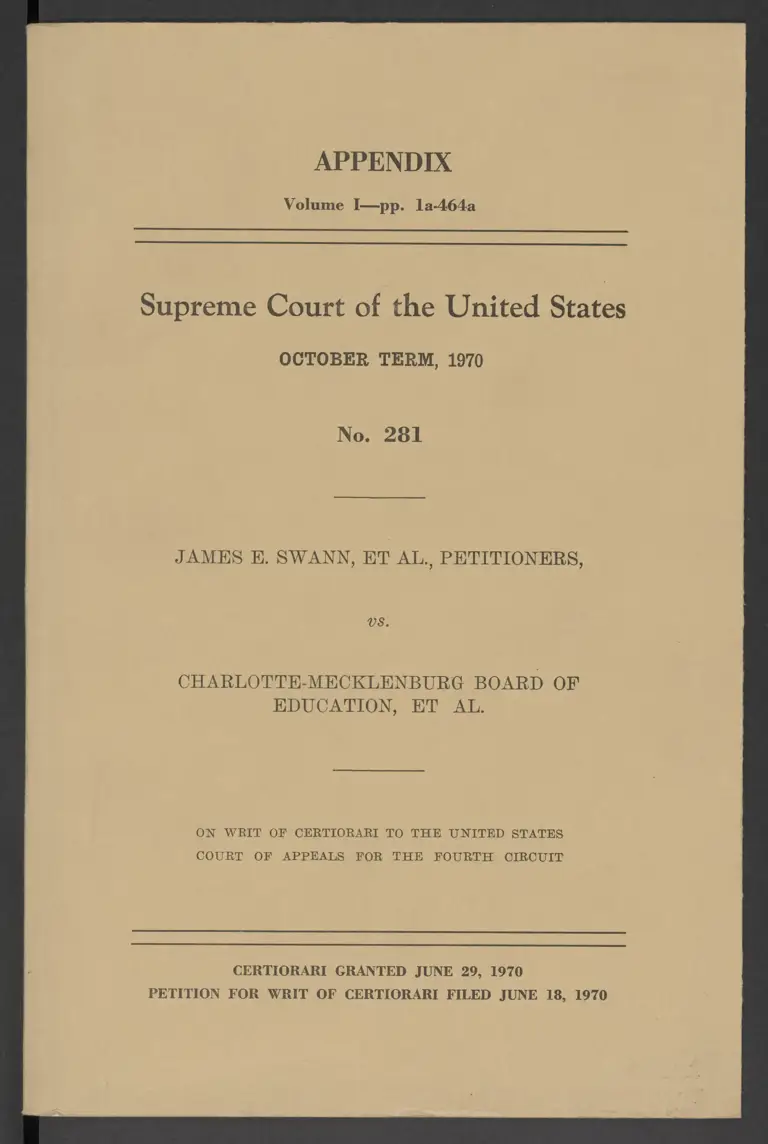
[||a8bcd128-8f97-4066-ba27-6314f7ce1c91||] APPENDIX
Volume I—pp. la-464a
Supreme Court of the United States
OCTOBER TERM, 1970
No. 281
JAMES E. SWANN, ET AL. PETITIONERS,
CHARLOTTE-MECKLENBURG BOARD OF
EDUCATION, ET AL.
ON WRIT OF CERTIORARI TO THE UNITED STATES
COURT OF APPEALS FOR THE FOURTH CIRCUIT
CERTIORARI GRANTED JUNE 29, 1970
PETITION FOR WRIT OF CERTIORARI FILED JUNE 18, 1970
INDEX
Volume 1
Docket Entries
Motion for Further Relief, filed September 6, 1968...
Answer to Motion for Further Relief
Transcript of March 10, 1969, hearing, pages 18-39,
line 20; page 41, line 15 through page 85, line 23;
page 352, line 10 through page 487, line 17; and
page 544, line 3 through page 678, line 25
Opinion and Order Dated April 23, 1969, Regarding
Desegregation of Schools of Charlotte and Meck-
lenburg County, North Carolina
Appendix
Plaintiffs’ Motion for Temporary Restraining Order
dated May 15, 1969
Defendants’ Plan for Desegregation, filed May 28,
Defendants’ Report in Connection with Plan of De-
segregation filed May 28, 1969
Defendants’ Response to Motion for Temporary Re-
straining Order, filed May 29, 1969
Order Dated June 3, 1969
2a
|
#
| f
|
i
|
!
I
f
{
E
E
3
11
Order Adding Additional Parties, dated June 5, 1969
Motion to Set Aside Order Joining Additional Par-
ties Defendant, filed June 12, 1969 ........................
Plaintiffs’ Response to Defendants’ Motion to Strike
Additional Parties Defendant, filed June 16, 1969
Transcript of June 16, 1969, Proceedings, page 487,
ine 22 through page 544, line 8...
Tentative Plan for the Integration of the Charlotte-
Mecklenburg Schools (for discussion purposes),
dated May 8, JOB
Opinion and Order dated June 20, 1969 .......................
Supplemental Findings of Fact in Connection with
the Order of June 20, 1969 (dated June 24, 1969)
Plaintiffs’ Motion to File Supplemental Complaint,
filed July 22, 1980 ........... coves itscnsis rrsssiirsssiissianuin:
Order Allowing Filing of Supplemental Complaint,
filled July 22.1060 o.oo sienna ssn:
Volume 1I
Plaintiffs’ Supplemental Complaint, filed July 22,
183 1 ee SE Ra ri ee Ne
Exhibit A Attached to Foregoing Supplemental
Complaint «lanl a...
Defendants’ Amendment to Plan for Further Deseg-
vegalion, Nled July 29, 1969 ................... .;..
PAGE
372a
376a
379%
383a
431a
448a
459a
460a
464a
46Ha
477a
iii
Defendants’ Report in Connection with Amendment
to Plan for Further Desegregation, filed August 4,
19689 nin a EE LR (I Bd sain
Transcript of August 5, 1969, Proceedings: page 4,
line 22 through page 41, line 17; and page 57, line
D through. page 84, Une 25 «iodine aiid. LD.
Answer of the Defendants, the North Carolina State
Board of Education and the Superintendent of
Public Instruction for the State of North Caro-
lina, to the Supplemental Complaint, filed August
E¥ kL etn tiem toi, be. orieeBbbaendnilintln ng
Order dated August 35,3969 ............ 0
Order dated Auguat: 20,1909 ici dio aiiaain.
Plaintiffs’ Motion for Further Relief, filed Septem-
ber 2, 0089 LE
Order dated October 10,1069 "= ~~~
Defendants’ Response to Motion for Further Relief,
filed: October 11, 1969... "= rt:
Summation of Integration 1965 (March) and 1968-69
(Oct. 1, ’68) and 1969-70 (Oct. 2,69) (App. 1, pp.
B3-70) ol a Sh
Defendants’ Report to the Court Pursuant to Order
of October 10, 1969, and filed October 30, 1969 .._._.
Exhibits annexed to foregoing Report ...........
PAGE
491a
498a
H525a
575a
979a
993a
596a
601a
606a
608a
616a
626a
I
|
I
I
18
|
|
1v
Order dated November 7, 1969 ...............idiiJiib
Memorandum Opinion dated November 7, 1969 ........
Amendment to Plan for Further Desegregation of
Schools, filed November 17, 1969 .........................
Report submitted in Connection with the November
13 (17), 1969, Amendment to Plan for Further
Besagregalion nee
Exhibits annexed to foregoing Report ...............
Plaintiffs’ Response to Defendants’ Amendment to
Plan for Further Desegregation of Schools, filed
November 21, 19689 ................ccieuseniidinscthionirsasssminss
ODIIAON i... noisier cirisnrinnsrsasmrissnivnssrsssstesassstadnsss sminsaseonnsy
Order dated December 1, 1969 ........ eon.
Order dated December 2, 1969 ............. eee sees
Motion for Immediate Desegregation, filed January
3 LL Ln nn en Rn ee OR
Plan for Desegregation of Schools Submitted Keb-
PHALY 2, 1970) o.oo aan
Kxhibits annexed to Foregoing Plan ..................
Transcript of February 2 and February 5, 1970,
Proceedings: page 43, line 5 through page 11, line
15; and page 137, line 1 through page 150, line
670a
680a
691a
692a
698a
714a
17a
718a
726a
744a
Motion for Hearing on Plans for Desegregation of
Charlotte-Mecklenburg Public Schools, filed Feb-
YOAry 6, J070 .... 0 i idioms si ibis
Order dated February 5, 1970... cee
Motion to Add Additional Parties Defendant and for
Further Relief, filed February 13, 1970 ...............
Notification and Request for a Three-Judge Court,
filed February 20, 1970.00 iim tiniciocissnusintesmiin satis
Defendants’ Tender of Evidence Nune Pro Tune and
Objections filed February 24, 1970 .................0..
Affidavit of William C. Self Referred to in Forego-
ing Tender of Evidence coi iiaini ilies iiss:
Affidavit of J. D. Morgan Referred to in Foregoing
Tender of Byidence .....oocviiinn. dh iii
Board of Education Plan Referred to in Tender of
Evidence ....o-st. anil... 0k. vii tess dts hind vases
Volume III
Affidavit of Louis W. Alexander Referred to in Ten-
dor of Evidence ........oueiciinicanciinnnn 0 1
Affidavit of Herman J. Hoose Referred to in Tender
of Bvidence''... nt apa on
Affianvit of Robert Li. Deaton Referred to in Tender
ob-Uvidence .. C0 ll Suan Sonn te
PAGE
817a
819a
840a
845a
8483,
850a
853a
867a
891a
8944,
|
|
I
}
|
|
\
|
I
|
|
!
i
| |
i
vi
Order Adding Additional Parties Defendant, filed
February 29, 19704 ...c. Ll i ns
Notice of Appeal, filed February 25, 1970 .................
Plaintiffs’ Motion to Add Additional Parties Defen-
dant and for Further Relief, filed February 27,
1970 i. ods a WRB ae Ci
Plaintiffs’ Motion for Temporary Restraining Order
and for Contempt, filed February 27, 1970 ............
Plaintiffs’ Request for Admission of Facts, filed Feb-
ruary 27, 1970 tn LL
Amendment, Correction or Clarification of Orders of
February 5, 1970, dated March 3,1970 .................
Court of Appeals Order Granting Stay Order of
March 5; 1970 ...coviiiiiviiniinnssmimmmiinsasisnnies
Order Suspending Superior Court Temporary Re-
straining Order, entered by Judge Snepp, filed
March 6, 1970 ..............cccoecrcerssenizsrsosinsomsssensssmssssirsussvns
Order of March 6, Directing Parties to Prepare and
File Additional Evidence by March 13, 1970, dated
March 6 1970 ............ccoonmsincniscrsssrsnmnnisnsitistithriidochensd
Order Directing Parties to Submit Information with
Respect to Specific Inquiries of the Court, filed
March 6 1070 ..................ccccoencrorerncsmacimsaunmivssapimnnarsrsen
Deposition of John A. Finger, dated March 11, 1970
PAGE
901a
9044
906a
914a
918a
921a
922a
925a
928a
930a
932a
vii
PAGE
Defendants’ Response to Plaintiffs’ Request for Ad-
missions dated Mareh 13, 1970... ...... 1011a
Defendants’ Submissions to Court in Response to
March 6, 1970, Order and Motion for Extension of :
Pime, filed March 13, 1970... >... 1014a
Exhibits Annexed to Foregoing Submissions .... 1015a
Affidavit of Herman J. Hoose Referred to in Forego-
ng Submissions... 1038a
Defendants’ Submissions to Court in Response to
March 6, 1970, Order, filed March 17,1970 1041a
Affidavit of William C. Self Referred to in Foregoing
Submissions... 0 1042a
Affidavits of J. D. Morgan, Ralph Neill and W. H.
Harrison Referred to in Foregoing Submissions .. 1045a
Exhibits Annexed to Foregoing Affidavits .......... 1047a
Deposition of J. D. Morgan dated March 19, 1970 .... 1069a
Exhibit Annexed to Foregoing Affidavit .............. 1188a
Defendants’ Response to Plaintiffs’ Supplemental
Exhibit of March 20, 1970, submitted March 21,
1970 oe ei 1192a
Response to Plaintiffs’ Supplemental Exhibit of
March 20,1970 ...........ioo 1193a
Tabulation... lr. 0 oo re 1196a
|
)
|
|
]
|
1
i
viii
PAGE
Supplementary Findings of Fact dated March 21,
1070 on LL 1198a
Supplemental Memorandum dated March 21, 1970... 1221a
Defendants’ Objections and Exceptions to Supple-
mentary Findings of Fact of March 21, 1970, and
Motion for Modification and Clarification Thereof
dated March 25. 1970 .........cisnioriosieisssesssnrsersiamsssntans 1239a
Order dalled March 25, 1970... 1255a
Further Findings of Fact on Matters Raised by the
March 26, 1970, Motions of Defendants dated
ADL] 3. 1970) ........c.0occiecriecsthisicsusbventossnramssntiiobgitmmnsentss 1259a
Opinions of Court of Appeals dated May 26, 1970 .... 1262a
Judgment of Court of Appeals .............................. 1304a
Order of Three-Judge District Court dated April 29,
1070 1305a
Order Granting Certiorari dated June 29, 1970 ........ 1320a
civ. #1974 - page #2
Ar4O1 IMT
ont: nD IN
DATE FILINGS—PROCEEDINGS TOCOLOMENT
RETURNS
1-19-65 | A Fil complaint w/bond for costs and petition w/judgment therefor
authorizing parents and guardions of minors to maintain this action
as next friends. Iss suwwons and handing to Marshal - orig. and
2 cys of complaint, petition and judgment. Jas JS 5
1-22-65 | #2 Fil summons retwmned executed by iarshal by serving David M. Harris
} and Dr. A. Craig Fuillips on 1-15-05
2-5-65 #3 | Fil answer w/certificate of service
2-10-65 |#4 Fil interrogatories of pltf., w/cert. of serv.
2-19-65 | #5 Fil motion w/affidavit and notice of hearing w/cert. of service
2-23-65 6 Fil pltf's opposition to def's motion for extension of time to asmswer
answer interrogatories w/affidavit therefor.
3-11-65 Hearing on def.'s motion for extension of time to answer interrogatorips-
Def. allowed until April 15, 1965
3-11-65 [#7 Ent and fil order allowing def. until April 15, 1965 to file objections to
Interrogatories or to answer the interrogatories. Cy of order mailed
to Mr. ‘Chambers and Mr. Barkley.
4-15-65 [#8 Fil answers to pltf.'s interrogatories w/cert. of serv.
5- 3-65 lig Fil notice of taking depositions - Drs. A. Craig Phillips and Willian L.
Anderson
5-26-65 [#10 Fil motion for preliminary injunction, together with cert. of serv.
one copy handed to U. 8S. Attorney's office
5-27.65 [11 Fil answer to motion for preliminary injunction, with certificate
of servico.
5« 1-65 | Az Fil notice, motion to intervene, and Complaint in Intervention, w/
certificate of service
6- 1-65 #13 Fil memorandum of decision and order on motion for preliminary injunttion -
motion for preliminary injunction denied; copies mailed to counsel of
record
6- 9-65 | AL Fil answer to motion of the N. C. Teachers Association to intervene
or be added as a party plaintiff, w/cert. of serv.
6-21-65 (#15 Fil deposition of Dr. A. Crais Pnillips
6-25-65 | #16 Fil plaintiff's interrogntorics, w/cert.. of serv. (1 copy handed to USA)
T- 9-65| #171 Fil defendant's answers to interrogatories, with certificate of service.
7-12-65 Case called, issues joined, proceeds to trial w/o intervention of jury.
Pitf's. wit. Dr. Reginald aA. Hawkins S & Fx & X-Ex. Pltf's. wit.
Louis I. Kramer S & Ex & X-Ex. Pltf. rests. Def's. wit. Richard H.|Brown $ (not
Def s. wit. Dr. A. Craig Phillips S & Ex & X-Ex. End 5:40 P.M. examir
T-13=-65 Case recalled. Proceeds to trial before court w/o intervention of Jury.
Pltf's. wit. Dr. A. Craig Phillips recalled & X-Ex completed and Re-x & Re+4X-EX
and Re-Ex. Def's. wit. Frank Dowd, Jr. S & Ex & X-Ex. Def's Wit.
David W. Harris, S & Ex & X-Ex. Pltf's. wit. Mrs. Betsy McCloud Kelly S & Ix.
Pltf. submits briefs to Court. Def. makes closing statement & submits briefs.
Pl1tf. makes closing statement. Court adjourned .
65 | #18] Fil memorandum of decision
-65 #10 Ent and fil judgment approving proposed plan of desegregation submitted
by Charlotte-Mecklenburg Board of Education except that the resolution
with respect to teachers and staff is ORDERED to be amended so as fo
delete the word "ultimate" and substitute the word "immediate" thexefor;
and jurisdiction is retained to consider (upon motion of parties)
implementation of the plan. Ins 35 7, (#19,div.0rd.[)
7-16-65 | #20| Fil defendant's answer to complaint in intervention, with certificate of seryice.
7 -16-65 #2 R m
a
Fil plaintiffs’ notice of appeal, with designation of -.cord on appedl, and
certificate of service.
(Cont'd on pare 2 FP - -LK—2-5-64—20M—23080
D. CO. 110A CIV. #197hk - Page #3
CLERK'S FEES AMOUNT
DATE FILINGS—PROCEEDINGS / REFORTID IN
EMOLUMENT
PLAINTIFF DEFENDANT RETUNNG
: I
7-21-65 Wor #il plaintiffs’ cost bond on nppeal
| i : : ak
7-27-65 i ¥il defendant's designation of wvdditional parts of i
record on appeal, w/cert. of service
8-20-65 Certifying record on apreal to Clerk, U.S5.Court of :
Appeals for the hth Circuly; copy letter and of
index to Mr. Chambers snd to Mr. Barkley
11-25-66 | ff2k| Fil plaintiffs' interrogatories, w/cert. of serv.
11-29-66 Fil mandate and printed copy of opinion, U.S. Court |of
Appeals for the Fourth Circuit, affirming judgment of
District Court with costs. Record on appeal returned also}
12- 2-66 | #29 Fil objection to interrogatories, with notice of
hearing. 3 copies to Asst. DA.
.
12-15-65 [26 Fil motion to compel answers to interrogatories w/pert. of dvc.
1- 4-67 Hearing on objections to interrogatories - WW - taken under
advisement
9- 6-68 |#27| Filing motion for further relief, w/cert. of servide
O- 10.65 kop Fil plaintiffs' interrogatories, with cert. of seryice.
9=16-68 |#29! Fil answer to motion for further relief (by def.),
w/cert. of serv.
9-16-68 #30] Fil motion for extension of time until 11-1-68 to flile
objections to interrogatories, w/cert. of serv.
10-14-53 iy Fil Responne oo Dofendant’'s Motion for Eaxtonslion off timel- llropy fo 14 A.
10- 7-68 |#32! Entering and filing order (JBM) - defendant to haved until 11+1-68
to file answers to interrogatories; defendant required|to make
objections on or before 10-14-68. CO-Vol. Vol. Y-#9.
10-31-68 |#33| Filing answers to interrogatories propounded by pldintiffs, |
consisting of pleading, tables and exhibits together wyseparate |
; packet containing maps required by interrogatories w/cert. of serv.
11-13-68 |#34| Filing DEFENDANT's Interrogatories, w/cert. of ser..
11-26-68 #3 Fil order (consent) for extending time for plaintilff to |ansver
defendant's interrogatories to and including the 10th day
of January, 1968(JBM)
1- 9-69 (436 Fil answers of PLAINTIFFS to Interrogatories of DEFENDANT, w/certl
of service :
1-21-69 Hearing on motion by counsel for plaintiffs for adverse|examination
or deposition of a number of officers and agents of|the School
Board, and on motion by cou nsel for defendants for|an order
requiring more factual answers than filed Jan. 9, 1969.
1-21-69 |#37 Ent & Fil Order (JBM) Court ruled plaintiffs entitled to proceed
with discovery suggested and that defendants gntitled to answers
requested. Deadline for discovery set for March 3,|1969 if possiple,
with case to be set for hearing during week off Mar.|10, |1969.
CO. VOL. IV, /f103. Copies to counsel and D. Aj
2- 3-69 #38 Fil plaintiffs’ interrogatories to defendant. Cqpy to|D.A,
Cert.of service attached.
2-10-69 # 39| Filing Motion of defendant for extension of time 0 answer
plaintiff's interrogatories, w/cert. of serv.
2-13-69 0 Filing order (consent) for extension of time for defendant Yo have
up to and including the 2nd day of March, 1969| to fille dnswersg
to interrogatories submitted and filed Jan. 31} 1969.
Cont'd on page U
—y - ——
Civil #1974 - page k
co —— ew
CLERK'S FEXS AMOULT
YRTED DATE FILINGS—PROCEEDINGS Pins A
PLAINTIFF DEFENDANT RETURNS
0-26-69 |#41i Filing Defendant's Interrogatories to Plaintiff,
w/cert. of service
‘hoi Fil plaintiffs' answers to interrogatories, with
certificate of. service
3. 3-69 | 43 Fil plaintiffs’ interrogatorics to defendenis, with pert. i gervice.
: IR! " “im = 4 . Lo» ~ . A 3- L-69 | i¥" Fil Defendants Answers to Plointiffs' interrogatorids, w/dert{ of sqrv.
3- 6-69 # 49 Fil Plaintiffs' answers to Defendants' Interrogatories, w/certl. of
serv.
3-10-69 {46| Fil depositions of Carroll O. York, Ralph W. Eaton, |James Burgh,
Dorothy Boone, James Clark, Mary Jane Kistler, Dr. Willian C. Self,
William E. Poe, Gertrude Coward, J. B. Davis, Jr., Joseph [Frankford
Dr. James Mikkelson, William L. Anderson, Dr. Roberti C. Hgnes,
John W. Phillips, Dr. W. Leslie Bobbitt, Herbert L. [Prickdtt,
John W. Harrilson, Ann Hausmann, Henry L. Smith 3-10-69 Cese called - hearing on pltf.'s motion for further [relief]. H1tf.
enters documentary evidence, - P-wit, Chas L. Breen gq, ex #nd M-ex, [P-wit.
yo cantel J. Mermlgar Sand gy, Col. mes tegsinove ov shig witress He
3 rioNern « ~o=irrn lenis P=wit., Paul RR. feonard Ss, 2% 23i yeas A-Wwin
Jack 1. Larson s 2nd ox, - J Bil -
3-11-69 Case -re-called - Dr. Jack L. Larson ex and x-cx. P-wit. John A. Finger,
Jr., 8, ex and x-ex,; P-wit. Robert A. Passy s and ex.
; 3-12-69 Case re-called - P-wit. Robert A. Passy ex and x-ex.| Pltfls. nest. [D-vilt.
Jomes Thomas Burch s, ex and x-ex. D-wit. William (|. Self] s, |ex and x-4gx.
3-13-69 Case re-called - D-wit. Wm. C. Self ex and x-ex.; P-fit. Ralph W. Eston
8, »x and x-ex.; D-wit, Robert C. Hanes s, ex and x-ex.; D-witji. John W.
Phillips s, ex and x-ex. Further testimony for pltfs. to pe taken 3I-17-69.
: Record remains open for any further evidence either party ni ghlt want{ to
: introduce. Parties to submit briefs, etc. by 3-2u4-6D
3-17-69 Case re-called- P-wit. Yale Rabin s, ex and x-ex. Rpcord [Left| open pnti
further notice. Pltfs. to submit findings of fact, gtc., py March 2} an
X defendants to have five days thereafter.
3-26-69 Case re-called. D-wit. Wm.McIntyre s, ex and x-ex.
4-23-69 nl Ent & fil Order {JBM) - Defendant is to submit by Moy 15, 19608 a pila Thr
acclive and complete desegregation of teachers, to be{cffectivejwilh 969+ TO
school ycar; defendant to submit by May 15, 1969, a plan apd time table for
active decegregation of pupils, to be predominantly ¢fifective in fal} of
1969 and completed by ll of 1970; Foard is fir: to se all of]its om
rosources and any or all of numerous methods; plan should Ye pr cffgctiye
cperation of schcolc in a desepregated atmosphere.
CO. VOL. IV, A850 Copies to counsel.
5- 1-69 # 48 Fil Court Reporter's transcript, two volumes
5-14-69 | Fil Petition for Extension of Time to File Plan of D¢segregatipn w/cprt. of scpvice
5-14-69 |/4a Ent & Fil Order (JBM) allowing extension of time extended to ahd includihg
May 29, 1969. Coples to counsel. CO VOL. Iv, fi9l..-.-
5-15-69 (#5Q Fil Motion for Temporary Restraining order restraining the|def| from|initiating
or continuing construction of new schools or new f cilities at any | existing
schools without specific prior approval of Court. |Cert.|of service attached)
28-69 51) 111 Plan for Desepreration of Schools w/cortiricube off service.
5-28-69 [52] Fil Report in Connection with Submissionol Plan of Dopepregptiohn ( cepiifficase of
gsorvice with Plan overs this document also.
5- 29wm69 #53| Fil Defendant's response to Motion for Temporary Restraining Order, w/cert. of
service
. ei . 7 » : it fos iy : r : « 3 . tion
6-4-69 |/5} Fnt & ¥il Order (J7M) ordering members of Charlotte Mecklepbur; Boarfl oi] Fduca
7 l formal parties LO this aebion.. C0. VOL. Tv. #230
T
S
RA Ea
“ yz) :
iV EL 9 D. C. 110A Ag - Pape 5
CLERK'S FEES AMOUNT DATE FILINGS—PROCEEDINGS Bo
PLAINTIFF DEFENDANT CT REZTUNNG
| |
PE
did
FI y : nora ‘ 1 YA ' ‘ ve vw fhm UA LF 2 Pil Ovder {IPM) on, vol, TV,
6- 9-69 Coonokdt Pursuant to Order of Court dated
29 Requesting. vlce w/rerveet to productisn
of exighing records, w/ cart. of nervy. |
o
- oe sn ,, Pela ay 6-10.09 #57. Piz Yerohal! 5 rehiia on C+ nord 32 - Served dn i :
= ' : not AF i S Ww 3 Sr .
-ef
: = Rist Lan Hood; Den alk
Coleman Caan ria oulding Sam 8S. McMinch 131;
Betsy helly - June 5, 1909
6-12-69 |#58 Fil Motion to set aside order joining additional
parties defendant, w/cert. of service
6-12-69 |#59 : Fil Plaintiffs' response to Defendants' Plan for
Desegregation of schools and Motion for Civil
Contempt, w/cert. of serv.
6-13-69 [#60 i Fil Motion tc set aside or drop William E. Poe ad a defendant.
6-13-00 | &1 Fil Marshal's return - served on Board Mexber Henderson Felli,
- ~ A ~ ~~ -
ny - . SM, on June os
Ss -, wie ~ - CC vase -\ . Sn RB
6-16-69 #62 Fil Response of Defendant william E. Poe to Motion of Plaintiffs, w/cert. of serv.
6-16-69 | #63 | Fil Response to Defendants’ Motions to Strike Additional Parties
Defendant, w/cert. of serv.
6-18-69 | #64 | Fil Marshal’ Heturn served on Dr. Carlton G. Watkins, |at
1630 Mockingbird Lane, Charlotte, N. C., at 11:15 A.M, Jtne 13; 1950. 6-16-69 Case called (JBM). Motion of individual members |of Board of Educa-
tion to set aside order joining additional defendants denied.
Hearing on Plan for Desegregation submitted by Bdard of Educatio
|
|
|
| held. P-wit. Dan Hood s and ex and x-ex.; P-wit. Ben F. Hi tley
|
|
|
[=
4
S, ex and x-ex.; P-wit. Rev. Coleman W. Kerry, Jr., s and ex.
Case re-called - P-wit. Rev. Coleman W. Kerry exsmined|and X-eX.}
P-wit. Sam S. McNinch III s, ex and x-ex.; P-wit., Wm. E. Poe, 5,|ex
and x-ex.; P-wit. Julia Maulden s, ex and x-ex.; [P-wit| Mrs. Betsey
Kelly s, ex and x-ex.; P-wit. Mary Hazel Hatchet s and ex]
| Case re-called - proceeds to trial. P-wit. John [Finge 5, ex and
| x-ex.; P-wit. Henderson Belk Ss, ex and x-ex.; P-wit. Carlten C.
| Watkins s, ex end x-ex.; P-wit. Jo G. Foster s, ex. PIltf. rests,
| Def. wit. Dr. Robert C. Hanes s and ex; D-wit. Dr. William|Self
| 8, ex and x-ex. Dr. Robert C. Hanes re-called and x-ex. by Mrs.
| Betsy Kelly.; Dr. Watkins re-called by Mrs. Kelly and examined;
|
6-17-69
6-18-69
D-wit. Wm. E. Poe re-called and examined. Defendants rest! Matter
taken under advisement.
Ent & Fil Opinion and Order (JEM) CO VOL. IV, #420.
(Copies mailed to Mr. Barkley and Mr. Waggoner. |Copiep pifked u
by Julius Chambers office). Copy to Gaston Gage and |Mrs{ Betsy Kell
8 copies sent to Mr. Barkley for school board mcimbers.
(1) Motion of individual defendants to dismiss denied; |
) No citations for contempt are made;
) Decision on faculty assignment plan deferred pending report [on
progress on or before Aug. 4, 1969; |
) Penalty on transferring high school athletek disdpprqgved; |
) Transportation provision for transferring studentls approved;
)
6-20-69 | #65 |
<<
Directed to halt action on Metropolitan High Schdol until ddequate
proof of desegregation of school;
Motion restrainted on construction of other| building projedts;
Defendants ordered to proceed to prepare anfi subnlit g§ positive|plan
for desegregation =- Plan to be submitted by August 4, 1969.
(¢ontd on page 6)
F
N
S
T
N
T
N
S
T
N
Page 6 CIVIL ,i97k Page 6
CLERK'S FEES AMOUNT
DATE FILINGS—PROCEEDINGS pita A
PLAINTIFF DEFENDANT RETURNS
0-10-69 #06| F.° i.lendsnt's answer to Quesi.ons posed by the Court in L.
! order dated ©-ik-69
6-16-69 #07 | Fil Defendant's answer to responss and motion of PALate,
| pertainirs to plat. Thy school deneorepation ;
6-24.60 455 Fd guppleantol findings of Taal Cn comicetion with the drant of ;
7} 3D, 1065. Copies to counsel and $0 cach monber df tie Schaol foszd.
{CO v4 7226)
7-15-69 | #69 Fil Vol. I of Court Reporter's Transcript - June 16) 1969 he ing
7-22-69 | #7Q Fil Motion for Leave to File Supplemental Complaint; to Add Additional
Defendants and for Temporary Restraining Order, faffi avit of
Reginald A. Hawkins, w/cert. of service
7-22-69 $#71| Fil Memorandum of Law in Support of Plaintiffs' Motion for leave to|fil¢
: a supplemental complaint, add parties-defendant and for t porary
restraining order.
7-22-69 |#72| Fil Vol. II of Court Reporter's Transcript - June 16, 1969 hearing
7-22-69 | #73] Ent & Fil Order (JBM) allowing plaintiffs' motion for leave tp file| a
supplemental complaint ; U S Marshal directed to perve pame| upon fHef:iilints
CO VOL. Vv, 5. Copies to counsel.
7-22-69 |#74| Fil Supplemental Complaint % ertificate of service| - contains request [for 3-judge
7-23-69 EL Eg al ari 2 3 ER VL {nvelpntery bu She v2h.S tadepts iling
to Mr. Brock Barkley for distribution.
Mailing to US Marshal, Asheville, N. C., summon and true [copies of |s
true copies of supplemental complaints plus true [copies of [#70
for service on Dr. A. Craig Phillips, Superintendent of] Puljlic Instruction,
Raleigh, N. C., and Dr. A. Craig Phillips, State Board |of Education, |Raleigh, N.C.
T=-20-L9| #75 Fil amendment to plan for further desegregation of (schools, with certificate
of service.
8- 4-69 #16 Fil report in connection with amendment to plan for further desegregation
a by sel for Charlotte-Mecklenburg Board of Education |
8- 5-69 . Case, Ca [ed 55 h r ng 0 pi8 - p . Wm, Self s, ex and X-ex{ Rev. |Leak & Paul
8- 7-69 #71 Fil is ot] Jails geratit fen ores 7-29-69 orl Dr. Qraig Phillips, Supexintende:
of Public Instruction and on Dr. Craig Phillipg, Secxyetayy of Stat Board
of Education.
8-11-69 #738 Fil Answer of the Defendants, the North Carolina Stlate Bdard |of Edycation and
Superintendent of Public Instruction of the Stdte of |N. (., tothe
Supplemental Complaint, w/cert. of serv.
8-12-69 |#791a Fil Motion with Notice of Motion to Intervene as a Plaintiff|in a (las
Action , with certificate of service
#79lb Til Complaint of Intervening Plaintiffs = Paw Creel Schodl District
8-15-69 |#80 Fil plaintiffs' response to motion to intervene, with certifficate pf service.
8-15-6981 Fil petition to file another plan(presented by Thomus Ray) by|a groip of citipens.
Handing to Judge McMillan with letter, and chart.
8-15-69 182 Ent & Fil Order (JBM) that 1) policy statement of Hoard gpprdved; 2) fdculty
desegregation program approved; 3) closing of 71 all-Ylack schodls d4pprov¢d
reluctantly for a one-year, temporary arrangement; I) |plan to reassign 1,345
students from overcrowded black schools approved; 5) neassignment of Paw (reek
students to Woodland approved; 6) proposals of Hoard flor restrudturg of
attendance lines, etc. approved as presented; 7) Board is |further d rected to
plan for complete faculty desegregation for 1970-71 ag well as fo
V
v
desegregation of students to the maximum extent |possifjleand pregent
report showing, complete with figures and maps, [location gnd nature
construction project proposed, etc; 8) Board ordered rot fo divest jtself|of
land, etc. in Second Ward area; 9) jurisdiction |retained.| CO vQL. |, /22
Copies mailed to counsel and School Board members . New plan to| be uli tited
b] November 17,] 1969.
bros
Fy
Civil #1974 - page 7
or C. 110A. Rev. Civil Docket Continuation
ps I aera————r—————re fT ATT : rn — ————— a ————— 4 ———— a a — mn x a a —— an —— pr ——
DATE o PROCERDINGS Fo
8-29-66 751 Fil Gefn! motion Tor order pia and approving rroposed amend-
ment Wo use IRVTX AVE Sunes Hh Instead of ZEB VYARCE Blementary
8-29-09 | #54 Ent and Til order allowing ors.wobion to amend plas to use IRWIN AVE.
Junior Mizh instead of ZEB JANCE ELEMENTARY; disapproving proposal
to provide transportation for any students attending IRWIN AVE. Copy
mailed to counsel of record. Ten copies mailed to Waggoner for
School Board Members
9- 2-69 #85| Fil pltfs.' motion for further relief and for show cause, w/cert. of serv.
9- 4-69 #86, Fil Court Reporter's Transcript (orig.) of proceedings of 8-5-69
9-11-69 #87| Ent and fil order releasing certain plaintiffs' exhibits to plaintiffs’
counsel for period of 30 days - JBM. CO-Vol. V-#82
9-12-69 #88] Fil defs' response to motion for further relief, w/cert of serv.
9-16-69 #89| Ent and fil order (JBM) allowing Board of Education to surrender premises
formerly occupied by GLIDDEN PAINT CO-Vol. V-92. Copies to counsel
10- 2-69 #90| Fil defs' motion for extension of time to file desegregation plan w/cert.
of serv.
10- 8-69 #91| Fil pltfs' response to motion of defs. for extension of time, w/cert. of
serv.
10-10-69 #92| Ent and fil order (JBM) - Board directed to file w/Court by 10-29-69
answers to numerous questions re results to date of efforts, as well as
details of instructions to Mr. Well, mission, goals, etc. Action deferred
on motion for extension of time, as well as pltfs' motion which requests
abolition of freedom of choice and appointment of outside expert to devise
plan in default of Board Action. CO=-Vol. IV-#123. Ten copies mailed
Waggoner for counsel and school board members; copies mailed Chambers and
Barkley, and two copies mailed VANORE
10-30-69 #93| Fil defendants' Report to Court Pursuant to Order of 10-10-69 w/cert. of
serv.
11- 3-69 #9Lk| Fil plaintiffs' further response to defendants' motion for extension and
motion for further relief, w/cert. of serv.
11- 5-69 #95| Fil defendants' reply to plaintiffs' further response to defendants’
motion for extension of time and plaintiffs' motion for further relief,
w/cert. of serv.
11-10-69 #96| Fil order (JBM) - motion of defendants for extension of time denicd.
CO-Vol. V-//136 =~ also filing Memorandum Opinion
11-17-69 #971 Fil defendants' Amendment to Plan for Further Desegration of Schools, and
Report submitted in connection with 11-13-69 amendment to plan for
further desegregation
11-18-69 #98] Ent and fil order (JBM) directing pltfs to file by 11-21-69 objections or
comments to amendment to plars of defendants. CO-Vol. V-#1L43. Copies
mailed counscl
11-19-69 #9¢! Fil certificate of service for amendment to plan for further desegregation
and report in connection therewith.
11-21-69 1100 Fil pltfs. response to defs.' amendment to plan for further desegrfation of
schools, w/cert. of serv.
12- 1-69 {1.01} Ent and fil Opinion and crder (JBM) thal November 17 plan is disapproved;
defs. directed to desegregate faculities in all schools effective not later
than Sept. 1, 1970, so ratio of black teachers to white teachers in each
will be approximately same as ratio of black teachers to white teachers
in entire school; consultant will be designated by court; defs. directed
to cooperate w/consultant, providing space, pay fees and expenses, etc.;
pltfs.' motion for order directing immediate desegregation of entire
(Cont'd on page 8)
Civ. #1974 - page 8
DATE : PROCEEDINGS sa an tug
{Cont'd from page 7) :
fchool sysiem delerrcd: uriher orders re restraining construction and
| crilargemen® of schools deferred; motion for citation of school board
. abonoi members J nhoiot of court delerred. CO-Vol. V-#150
10= 2-09 #1021 Ent and £15 caer (JBM: appointing DR. JOIN A. FINGER, JR., consultant.
i CO-Vol. V-i7151. Copies mailed to counsel.
1-20-70 | #103| Fil motion for immediate desegregation of public school, w/cert. of service
1- 20-70 |#104| Ent and fil order (TBM) directing Clerk to set case for immediate hearing
2- 2-70 |#105| Fil defendants’ plan for desegregation
2- 2-70 Hearing - JBM =- on plaintiffs' motion for immediate desegregation. Motion
taken under advisement. School Board Plan and Statement of Coleman
Kerry presented to Court. Dr. Wm. C. Self s and questioned by Court.
Tourt will discuss w/counsel need for further testimony on schzol plans -
nearins left cpen : ;
2- 4-70 |#10¢| Fil defendants’ motion for nearing on plans for desegregation of schools, w/
cert, of serv.
2- 5=T0 Hearing - JBM -(further hearing) - on plans for desegregation. D-wit. Wm. d.
Self s, ex and x-ex.; D-wit. J. D. Morgan S$, ex and x-ex,: Dewit, D. "J.
Dark s and ex.
2- 5-70 |#107| Ent and fil order (JBM) setting out guidelines for desegregation of schools.
Jurisdiction retained. CO-Vol. VI-#59.
2-12-70 [#108 | Fil Report of the School Board to Judge McMillan, dated this day.
2-13-70 #109 Fil motion to add additional parties defendant and for further relief
w/certificate of service
2-13-70 #110 Fil points of authorities in support of above motion, w/certificate of
service
2-18-70 A111 Fil reporter's transcript of proceedings February 2, 1970 and Feb. 5, 1970
2-19-70 | #112 Fil Report of the School Board to Judge McMillen, dated this day.
2-20-70 | #113 Fil Notification and Request for Designation of Three=-Judge Court
2-24=70 | #11k4 Fil DESIGNATION OF THREE-JUDGE COURT = designation of Judges Craven
and Butzner, Circuit Judges, and Judge James B. McMillan, District Judge
2-24=70 | #115 Fil certificate of mailing - notification and request for designation
of three-judge court and designation of three-judge court
2-24-70 | #11 Fil Tender of Evidence Nunc Pro Tunc and Objections by Defendants,
together with Affidavits of Dr. William C. Self, J. D. Morgan,
Louis W. Alexander, Herman J. House and Robert L. Deaton and
tender of evidence contained in Report of Court Consultant delivered
to Court but not introduced into evidence, w/cert. of serv.
2-25-70 |#117] Fil notice of appeal of Charlotte-Mecklenburg Board of Education, Wm. E. Poe,
2-25-70 #118
Henderson Belk, Dan Hood, Ben F. Huntley, Betsey Kelly, Sam McNinch,III gnd
Carlton G. Watkins toFourth Circuit Court of Appeals from the following
orders: 1. Opinion and Order dated 4/23/69;
3. Opinion and Order dated 6/20/69; U4. Order dated 8/15/69; 5. Order ds
8/29/69; 6. Order dated 10/10/69; T. Order dated 11/7/69; 8. Order dat
12/1/69 and opinion; 9. Order dated 12/2/69; and 10. Order dated 2/5/70
together w/findings of Fact and conclusions of law in support of foregoin
orders. Copies of notice to J. LeVonne Chambers, Ralph Moody, and Andre
Vanore, Jr.
Fil gppeal bond, cash bond in amount of $250.00 - R#733h4
(Cont'd on page 9)
2. Two Orders dated 6/4/69
Civ. #1974 - Page O
D. C. 110A Rev. Civil Tlocket Continuation
ee S—— ee —————— re ee eet eee + ee ne eel tn. Aim.
|
DATE | PROCEEDINGS
i
- i |
~ ! . . 30 £Y TV 4 oli - 0u285.70 #119 Fil notice of three-Judre court to consider current matiers before |
: Judges Craven, Butzner znd McMillan, at US Distriet Court, Charlotte,
N. C.,, av 10 A.M., Tuesday, March 10, 19/0. Copies mailed - certiricd,
return rcceipt requested - to additional parties, defendant. Copies
mailed to other counsel by regular mail.
2-25-70 #120 Ent & Fil Order (JBM) additional party defendants made parties -
Hon. Robert ¥. Scott, Hon. A. C. Davis, Hon. W. K. Mclean, Tom B. Harris,
G0. Don Roberson, A. Breece Breland, James M. Postell, W. EZ. Rorie, Jr.,
Chalmers R. Carr, R. T. Wilson, Concerned Parents Association, James IH.
Carson, Jr., and W. H. Booe. Plts. directed to prepare and file on or
before Monday, March 2, 1970, proposed findings of fact and conclusions
of law and a proposed order, and brief in support of their position.
Other parties directed to preparc and [ile on or before Friday, March 6,
» 1970, proposed findings of [act and conclusions of law and a proposed
order, and brief in support of their positi-n. CO VOL. VI, #01
2-26-70 #121 Fil answer of Defs. N., C. STATE BOARD OF FUUCATION , Dr. A. Craig Phillips,
Superintendent of Public Instruction, Robert H. Scott, Governor of the
State of North Corolima, A. C. Davis, Controller of the State Department
of Public Instruction, and William K. Mclean, Judge of the Superior
Court of Mecklenburg County to Motion to Add Additional Parties Defendant
and for Further Relief, w/certificate of service.
2-26-70 #124 Fil report to Judge McMillan by Supt. Self of Charlotte-Mecklenburg gh
2-27-=T0 #123 Fil Plaintiffs' motion to add additional parties defendant and for
further relief
2-27-70 #12l Fil motion of plaintiffs for temporary restraining order and for contempt, with certificate of service
2-27-T0 {#129 Fil plaintiffs' request for admission, to be served on pltfs.' attorneys
within ten (10) days - w/cert. of service
3- 2-70 #126 Fi 1 copy of application for stay, w/accompanying papers, directed to
Judge J. Braxton Craven, Jr., Circuit Judge
3- 2-70 A127 Fil motion for hearing on Superior Court Order in Civil 2631
3-2-70 128 Fil Deposition of J. D. Morgan
3-2-70 #129 Fil Deposition of William C. Self
3-2-70 A130 Pil Deposition of D. J. Dark
3-270 JA311Fil Deposition of E. D. McMillan, Jr.
3=- 2-70 #132] Fil motion to dismiss and vacate order (making Concerned Parents Assn.
additional defendant) by their counsel, Wm. H. Booe, w/cert. of service
3= 2=T0 #133 Fil motion to dismiss and vacate order (making Harris, Roberson et al.
additional parties defendant), w/cert. of service
3« 2-70 134] Fil motion for continuance, w/ cert. of service.
3- 3-70 [#135 Fil Plaintiffs’ proposed findings of fact, conclusions of law and order,
together w/brief and cert. of serv.
3- 2-70 #136] Fil Defendants' Application for Order
3- 2-70 A371 Fil Plaintiffs' Brief in Support of their Motion for a Temporary Restrain-
ing Order and for Contempt
3- 3-70 |f138] Fil Motion of Defendants, State Officials, for Continuarce, together
with Notice of Motion
3- 3-70 [#139] Ent and fil order continuing three-judge hearing to 10:00 AM on Tuesday,
March 24, 1970. Copies mailed all counsel of record. CO-Vol. VI-#98
(Cont'd on page 10)
Civ. #1974 - page 10
DATE PROCEEDINGS | br vn
o AS Ww ah 3 er 3, + voit 3 Yay -3 i Fat and £21 amendment, correction or clarification of order of Vebrunry 3,
3 a Porat ~ 3 ~ - rh 0 al. ‘counsel of record. CO0=Uol, Ti-dM Te
Tl Pr oy cnn Teed Saas wiser, od
~
ES SH SE SE SO ERS Ne GP i a
is a py - NT N= en »8 EY WA ey x \ - a HE PN Gr Sars adavhe om bd ov Coda a
-
o-~ a 21451 4 5 vn -~ SOY A 3 3 $ : A Aad : : 3« 3.70 .S1s] Pil Defendants’ answers and objections to plaintiffs’ Request for Admission,
w/cert. of serv.
3-5=T70 #143 Fil Motion of Robert Morgan, attorney General of N. C. requesting that the
Honorable James B. McMillan disqualify and remove himself from the puncl
assigned to hear this case; w/certificate of service.
#144] Fil School Board's Report to Judge McMillan for the week ending March 5, 197D 3= 5=T0
3= 6-70 [#145| Fil Objections to Plaintiffs’ List of Additional Exhibits and Proposed
Evidence
3- 6-70 [#146| Fil Motion of William H. Booe, et al, to Recuse and Disqualify
3-6-T70 #1L4T Fil motion for relief from conflicting orders from the courts , w/certificate
of service
3-6-70 #148 Ent & Fil Order (JBM) motion filed by Atty. Gen. requesting Judge James B.
McMillan to disqualify himself from three-judge panel denied . CO VOL. vi, # 103
3-6-T0 #149 Ent & Fil Order (JBM) motion to recuse and disqualify by William H. Booe,
disallowed. CO VOL. VI, # 102
3-6=70 #15d Ent & Fil Order (JBM) objections of defendants to requests for admissions
submitted by plaintiffs overruled, and defendants directed to answer all
requests for admissions, under oath, in full, not later than Fri., March 13,| 1970.
CO VOL. VI, #103
3-6-70 #151] Ent & Fil Order (JBM) order heretofore signed by Judge Snepp in Civil Action #2631
in Superior Court of Meck. County hereby suspended and held in abeyance and lof
no force and effect pending the final determination by a three=judge court dr
by the Supreme Court of the issues which will be presented to the three-judle
court; and, that the Moore Case, No. 2631, be referred to the three-judge cdurt
on March 24, 1970, for such hearing and determination as that court may find
proper. CO NOL. Vi, # 104
3-6-70 #154 Ent & Fil Order (JBM) court directed to prepare and file with Clerk of this
court not later than Fri., March 13, 1970, all evidence they would l ke the
court to consider hearing upon factual questions referred to in March 5, 197
order of Court of Appeals; counsel for all prties directed to produce upon
written request of opposing counsel all documents, etc. requested by opposing
counsel; counsel directed to appear before the court at 2 P.M., Monday, March
16, 1970 for purpose of examining such evidence as may then be available, etc.;
if further hearing is necessary after conference among court and counsel
scheduled for March 16, 1970, it will be conducted on Tuesday, March 17, 1970,
at 10 A.M, CO VOL. VI, # 108
3-6=70 #153 Ent & Fil Order (JBM) parties directed to procure and supply the court by
March 13, 1970, with information and stastities. CO VOL. VI, #106
3~9=70 jrL5k Fil motion to The Honorable, The Chief Judge of the United States Court of
Appeals For The Fourth Circuit by Attorney Gen. of N., C., Robert Morgan,
requesting thrt The Honorable James B. McMillan be disqualified and removed
from the panel of the three-judge court.
3-09-70 |#155 Ent & Fil Order (Chief Judge, Fourth Circuit of Appeals, Clement F. Haynswory
Jr.) denying motion that Judge McMillan be disqualified and removed from
panel of threc-judge court. CO VOL. VI, # 109
3-9-70 |#15d Fil notice of deposition ~- depositions of James H. Carson and Dr. John A,
Finger and J. D. Morgan to be taken by plaintiffs on March 11, 1970 » w/
certificate of service, (comtinued)
D. C. 110A Rev. Civil Docket Continuation
DATE
=p
CIV. # 1974 - page #11
PROCEEDINGS imate Ore
Judriaent
3-11-70
3-11-70
3-11-70
3-12-70
3-12-70
3-13-70
3-13-70
Fil motion to qunch subpoena ror taking deposition of J. D. Morgan,
w/cer.iticate of service
Fil plaintiffs’ response to defencunts' motion to quash subpoena,
w/certilicate 0 scrvice
Hearing - WW - on defendants' mction to quach subpoena for taking
deposition of J. D. Morgan - Court ruled deposition should be
taken at 5:00 P., M., 3-11.70,
Fil stipulation - by pltfs. and State Supt of Public Instruction and
State Board of Education - re enrollment in public schools of N. C.
Fil Report of School Board to Judge McMillan
Fil Brief in behalf of Robert W. Scott, finvernor of North Carolina;
State Board of Education; Btatc Superintendent of Public Instruction;
A.C. Davis, Controller; William K. McLean, Judge of the Superior
Court, and James H. Carson, Jr., Member of the North Carolina General
Assembly. Copies mailed to Judges Craven and Butzner.
Fil Submissions to Court in Response to March 6, 1,70 Order and Motion
for Extension of time, including Maps requested by Court Order of
March 6, by def. Affidavit of Herman J. Hoose, Director of Traffic
Pnunineering for city of Charlotte att., w/cert. of service.
Def's Response to pltf's Request for Admissions; w/cert. of servic
Motion for Public Hearing or Presence of Court Reporter at Conferec
w/certificate of service.
Adoption of Attorncy Gencral's Brief on Behalf of the Defendant
Board of Education and the Individual Board Members. w/cert. of sc
Fil Findings of Fact and Conclusions of Law submitted by Robert Morgan,
Attorney General. Copies to Judges of Three-Judge Court.
Fil Deposition of J. D. Morgan.
Fil Deposition of James H. Carson, Jr.
Fil Deposition of John A. Finger.
Fil plaintiffs’ submission of additional data pursuant to order of the
court of March 6, 1970 (plus exhibits), w/certificate of service
Fil submissions to Court on behalf of defendants (affidavits of John W.
Harrison, J. D. Morgan, John W. Harrison Sr., and letter from Chas.
M. Lowe to Wm. E. Poe - all dated March 16, 1970) w/
Fil defendants' submissions pursuant to orders of March 6, 1970, cert.
Fil submissions to Court in response to March 6, 1970, order (data),
w/certificate of service.
Fil plaintiffs' list of additional exhibits , w/certificate of service
Fil
Fil
Fil
Fil objection to further submission by plaintiffs of exhibit 30, part 1,
w/certificate
Fil Transcript of Proceedings of March 16, 17, 1970.
Ent and Fil Order (JBM) for deposition of Mr. J.
Exhibit 30 to be filed with Clerk, and that all parties be accorded
opportunity to examine same. Copies to Counsel of record. CO Vol. JAY
D. Morran, and allowing
|
:.
nce.
fice.
} A113
Fil Report to Judge McMillan of William C. Self, Superintendent of Schodls.
Fil Briel in behalf of Tom B.
James M. Postell, William E. Rorie, Jr., Chalmers R. Carr, Robert T.
Wilson, and William H. Booe. w/certificatc of service.
Fil COPY of Renewal of application for stay or portion of court order
of February 5, 1970 as amended by order of March 3, 1970
Fil copy of Jydege McMillan's supplementary findings of fact and suppleme
memorandum submitted toU.S.Court of Appeals, Richmond,dated 3/21/70
Harris, GC. Don Roberson, A. Breece Breland,
ntal
CIVIL #i197h - page #12
DAT PROCKETDINGS Wom
3-23-20 Jeanine summons cokins clditional parties
~~
3-23-70 AEA "11 Defondanbts' Hesponse to Plaintifis' Supplemental Exhibit of March 26,1 17410,
: vith ceriitieate of service.
3-24-70 | #183] Fil Plalntifis' Memorsndws of Additional Points of Authority. w/cert. of sprvice,
3-25-70 18% Ent and {il order noting exceptions to order by Court on 2-6-TO disallowing
motion Lo recuse and dlsqualify filed by Wm. H, Boot
ard others. CO0-Vol., VI-#122.
3-25-7¢ | #185] Eat and fil order staying time table for implementation of this court's
order of 2-5-70 until September 1, 1970. <{0-Vol. VI-#123. JEM
Copics moiled to counsel of record.
3-26-70 [#186 Fil by Defendants Charlotte-Mecklenburg Board of Education and individual
members ,objections and exceptions to Supplementary Findings of Fact
of March 21, 1970, and motion for modivication and clarification thereof
3.26.70 (#1871 Fil Notice of Appeal by plaintiff. Copies mailed to counsel of record,
3=21~70 #108 FE2 Platnt 12Pr! oonen) bora in gw of 2050.00 « Unit 2 Sistas Fidelity
and Oversyte Corpaps, rocky
3-30-70 | #189] Fil Marshal's return of service of summons, complaint and exhibits for
plaintiffs on additional defendants, executed by serving Whiteford S.
Blakeney (individually and as attorney) and William H. Booe (individually
and as attorney), representing Mrs. Robert Lee Moore et al., additional
parties-defendant - on March 23, 1970
4- 2-70 #:90i Fil Deposition of J. D. Morgan, taken 3/19/70 - 98 pages
L- 2-70 Certifying record to Clerk, USCA, Richmond
Y- 6-70 #191] Fil Further Findings of Fact on matters raised by March 26, 1970,
Motions of Defendants (original filed by Court with Clerk, USCA)
4-29-70n | #193 Fil Opinion - Three Judge Court - Copies to counsel.
6- 9-70 | #193| Fil copy of order USCA - Judge Craven's order of disqualification and
memorandum of decision
6-22-70 | #194] Ent & Fil Final Judgment (JBC-JDB-JBM) - N. C. General Statute 115-176.1 pro-
hibitin. assif nment by race and bussing be and is hereby held unconstitutional;
pltfs. motion io hold defendants in contempt denied; various motions to
dismiss are denied. CO VOL. VI, #208 =~ Copies to counsel
(1-30-70 #195 | il Submission Pursuani. to Order of Court of Appeals for the Fourth Circuit
w/certificate of service and exhibits A (HEW's plan lor the establishment of
a unitary system Tor the Charloite-Mecklenburg School District; exhibit B
(Statement of Poard Minority Members); and, exhibit C (Resolution).
7- 2-70 |#196| Fil Notice of Appeal to Supreme Court of United States by Defs. Scott, Davis)
Mclean, N. C. State Board of Fducation and Phillips. Copy mailed to
: counsel for all parties.
7-7-7170 97 Fil Plaintif{fs' Response to tne Defendunts' submission to Order of the Court
of appeals for the Fourth Circuit. w/cert. of service
7-13-70 #198 Fil deposition of John P. Cross, July 8, 1970
7-13-70 |#199| Fil deposition of Henry L. Kemp, July 8, 1970
7-170 (f#~n0]| Fil dep siti n of Dr. Carlton G. Watkins - July 8, 1970
7-14-70 |#201| Fil deposition of William E. Poe =- July 10, 1970
7-14-70 |/202] Fil motion for leave to participate as amicus curiae
7-14-70 [#203] Ent & Fil Order (JBM) granting leave for the United States to appear and
participate in the July 15, 1970 hearing respecting the HEW plan.
CO. VOL. #217 Copies mailed to counsel
Continued on Page 13
Civil Ayih - Page 13
D. C. 110A Rev. Civil Docket Continuation
ms Tm Soo = A —
: ~
PROCEEDINGS bo Jue
1
T=-15-70 feOh Fil venosition of J. UD. Moran.
T=15-70 12053 Fil Uerogition of Dr. william C. self.
7-17-70 | #20..: Fil objection and excepiion to certain portions of final Judgment of
3-Judge courv by ~auiilional parties-defendant, signed by Judge McMillan;
also object to the signing and entry of the judgment. Copies to
Mr. Waggoner, Hon. Robt.Morgan, Mr. Chambers, and Mr.Booe (who submitted
paper) . (CO VT #8)
|
|
Docket Entries
2a
Motion for Further Relief
(Filed September 6, 1968)
IN THE
UNITED STATES DISTRICT COURT
For THE WESTERN DisTricT oF NORTH CAROLINA
CHARLOTTE Division
Crvin Action No. 1974
James E. Swann, et al.,
Plawmtiff's,
and
Tae NorTH CAROLINA TEACHERS ASSOCIATION, a corporation,
Plawntiff-Intervenor,
enh TC Mee
Tae CHARLOTTE-MECKLENBURG Boarp or EbpucaTion,
a public corporate,
Defendant.
The plaintiffs and plaintiff-intervenor, by their under-
signed counsel, respectfully move the Court for further
relief in the above-styled cause, and, as grounds therefor,
show the Court as follows:
1. This cause was initially filed by plaintiffs on January
15, 1968, seeking injunctive relief against the racially dis-
criminatory practices and policies of the defendant in the
operation of the Charlotte-Mecklenburg Public Schools.
3a
Motion for Further Relief
Plaintiffs challenged at that time (a) the attendance zones
of the various schools which limited or restricted desegre-
gation; (b) the exception by the School Board of 10 Negro
schools from attendance zoning; (¢) the use of freedom of
choice imposed on attendance zoning, permitting students
assigned to integrated schools to transfer out, thus re-
segregating the schools and (d) the failure of the board
to take immediate and effective steps to desegregate teach-
ers and staff personnel.
2. Following the hearing of this cause in July, 1965, the
District Court entered an order dated July 14, 1965 approv-
ing of the plan adopted by the school board providing for
attendance zones for 99 of the 109 schools, exception of
the 10 Negro schools from geographic attendance plan,
transfer of pupils from integrated schools to segregated
after initial assignments, and modification of the plan with
respect to teachers, requiring immediate integration of
teachers. The United States Court of Appeals for the
Fourth Circuit affirmed the District Court order on Decem-
ber 24, 1966, reasoning that the 10 excepted Negro schools
had been closed, that there was no affirmative duty on the
school board to act consciously for the purpose of achieving
the maximum mixture of races in the schools, and holding
further that any party may apply to the District Court
for further relief or for modification of the District Court
order, the United States Supreme Court decided Greene v.
County School Board of New Kent County, U.S, ’
20 L.ed.2d. 727; Monroe v. Board of Commissioners of the
City of Jackson, U.S. , 20 L.ed. 2d 733, and Raney
v. Board of Education of Gould School District, U.S.
, 20 L.ed. 2d 727, and the United States Court of Ap-
peals for the Fourth Circuit decided Brewer v. School
4a
Motion for Further Relief
Board of the City of Norfolk, ¥.24 — (Fourth Cir.
#11782, May 31, 1968). It is clear from these decisions’
that the further modification of the District Court order
of July 14, 1965, is warranted.
3. Since the District Court order of July 14, 1965, the
school board has closed the 10 Negro schools, excepted from
the geographic attendance program of 1965 and has estab-
lished new boundary lines for the schools. In addition, the
school board has constructed and made additions to several
new schools. The new boundary lines established and the
placement of the mew schools and additions to existing
schools were designed and have had the effect of perpetu-
ating segregation in the school system. The defendant has
also continued the free transfer provisions allowing stu-
dents to transfer out of integrated schools and has failed to
take appropriate steps to completely desegregate staff and
school personnel.
4. Specifically:
(A) Defendant has perpetuated attendance area school
districting in such manner as to maintain and perpetuate
segregated schools. The all-white, all-Negro and tokenly
integrated schools in this system result from racially gerry-
mandered school districts, the use of attendance areas based
on racially segregated and developed housing, both pub-
licly and privately contrived, the use of a feeder system
which perpetuates the racially segregated system as existed
before Broww v. Board of Education. This practice has
been condemned both by the Supreme Court and by the
United States Court of Appeals for the Fourth Circuit. Al-
ternative methods exist here for complete disestablishment
of the segregated system, and, under the decision cited
oa
Motion for Further Relief
above, the school board is required to pursue these alterna-
tive methods.
(B) Defendants use of the freedom of choice or free
transfer plan is clearly for the purpose of perpetuating
segregated schools. The use of freedom of choice in this
system, imposed on geographic attendance zones where the
results have been to perpetuate segregated schools, has
been condemned by the Supreme Court and the United
States Court of Appeals for the Fourth Circuit. Under the
decisions cited above the school board is constitutionally
required to eliminate this practice.
(C) Defendant’s “feeder system” has also been used to
perpetuate racial segregation of students. This system,
as used by the defendant, tends to filter Negro and white
students, who initially began their education in segregated
elemetary schools, into segregated junior and senior high
schools. Such a system, if properly oriented, may be a
constitutionally permissable step in the integration of the
public schools. See Monroe v. Board of Commissioners of
the City of Jackson, supra. However, where such a system
is used to perpetuate segregation, as here, it violates the
requirements of Brown v. Board of Education.
(D) Defendant has failed to take immediate and effec-
tive steps to desegregate its teachers and school personnel.
Where such integration has taken place, the school per-
sonnel assigned have consisted primarily of librarians,
music, art, reading and Special Education teachers. Schools
with large Negro or white student enrollments have fairly
completely segregated faculties. This practice fails to meet
the constitutional mandate of the Supreme Court, the
United States Court of Appeals for the Fourth Circuit
and the Court order entered in this case.
ba
Motion for Further Relief
(E) Defendant has followed a practice and policy of
discrimination against predominantly or all-Negro schools
by providing them with inferior educational programs and
facilities. Defendant has maintained ability grouping (“ad-
vanced,” “regular,” and “basic”) systems in predominantly
white schools. Negro students in predominantly white
schools, are for the most part, relegated to the lower group-
ings and given little opportunity to reach the “advanced”
levels. In general, the curriculum in the white schools 18
broader and more varied than that in the Negro schools.
Defendant has failed to provide adequate funds for build-
ing and school construction and the purchase of needed
school facilities at the all-Negro or predominantly Negro
schools. Funds even though immediately allocated to Negro
schools have been diverted to white schools often to the
detriment of the Negro schools. Moreover, even with the
construction of new schools or the additions to existing
schools, the effect has been to limit the integration of
schools. There is presently no plan for the construction
of new schools which would bring together a highly inte-
grated student body.
WrEREFORE, plaintiffs respectfully pray that this matter
be set for hearing at the earliest possible date and that
upon such hearing the Court permanently enjoin defendant:
(1) to present a plan within a period of time that will
permit its implementation at the beginning of the 1969-70
school year, establishing school zone lines, school and grade
consolidation, or both, in order to completely desegregate
all schools in the school system, and to eliminate the racial
identity of the various schools;
Ta
Motion for Further Relief
(2) to completely desegregate all teachers and school
personnel in the school system so that for the 1969-70 school
year the percentage of Negro and white teachers and school
personnel in all schools in the system will approximate the
number of Negro and white teachers in the school system ;
(3) to cease planning and constructing schools, additions
to schools, and school facilities on the basis of race and
color. In this connection, that the defendant be enjoined
to present to the Court, with copies being served upon
plaintiffs, a report of any planned construction, addition,
alteration or closing;
(4) to eliminate, effective with the beginning of the 1969-
70 school year, any and all disparatives in school facilities,
school buildings, curriculum and equipment ;
(5) to discontinue and eliminate any and all other prac-
tices in the school system based on race and color.
Plaintiffs further pray that pending a full and complete
implementation of the Order of the Court that the Court
retain jurisdiction of this cause; that the plaintiffs be
awarded the causes herein and granted such other and fur-
ther relief as the Court may deem equitable and just.
8a
Motion for Further Relief
Respectfully submitted,
Conran O. PEArsON
2031, East Chapel Hill Street
Durham, North Carolina
Jurius LEVonNE CHAMBERS
James E. Fercuson, 11
James HE. LanNiNg
216 West Tenth Street
Charlotte, North Carolina 28202
JACK GREENBERG
James Nasrit, I11
RoBerT BELTON
10 Columbus Circle
New York, New York
Attorneys for Plaintiff
9a
Answer to Motion for Further Relief
(Filed September 6, 1968)
IN THE
UNITED STATES DISTRICT COURT
For THE WESTERN DisTRicT OF NORTH CAROLINA
CHARLOTTE Division
Crvi. Action No. 1974
James E. SwawnN, et al,
Plaintiffs,
—VS8.—
TaE CHARLOTTE-MECKLENBURG Boarp oF EbucaTion,
Defendant.
The defendant, answering the motion of the plaintiffs
filed herein on the 6th day of September, 1968, says and
alleges
1. The allegations of paragraph 1 deal with matters
and things appearing of record in this case and this de-
fendant is not required to either admit or deny said alle-
gations, except that it is alleged that this cause was initially
filed on January 12, 1965.
2. The allegations of paragraph 2 deal with matters
and things appearing of record in this case and this defen-
dant is not required to either admit or deny the same
except that it is denied that further modification of the
District Court order of July 14, 1965 is justified.
10a
Answer to Motion for Further Relief
3. Answering the allegations of paragraph 3, it is ad-
mitted that since said Court order of July 14, 1965, the
defendant has abolished the dual school system as it relates
to race, has made some necessary changes in boundary lines
of attendance areas, has constructed and made additions to
new schools and old schools and has permitted pupils to
transfer from one attendance area to another when there
was sufficient room in such other attendance area to accom-
modate the pupils. Except as herein admitted the allega-
tions of paragraph 3 are denied.
4(A). The allegations of paragraph 4(A) are denied.
4(B). Answering the allegations of paragraph 4(B), this
defendant denies that the transfer plan permitting pupils
to transfer from one attendance area to another has been
for the purpose of perpetuating segregated schools and this
defendant alleges that such transfer plan has been used by
pupils without regard to race and has proven of value and
convenience to pupils without regard to race.
4(C). The allegations of paragraph 4(C) are denied.
4(D). The allegations of paragraph 4(D) are denied.
4(E). The allegations of paragraph 4(E) are denied.
Wherefore, the defendant prays the Court that the relief
demanded by the plaintiffs in said motion be denied, that
this action be dismissed and that this plaintiff recover its
cost and have such other and further relief as it may be
entitled to receive.
Brock BARKLEY
Attorney for the Defendant
814 Law Building
Charlotte, North Carolina 28202
11a
Transcript of Hearing March 10, 1969
[18] * % *
All right, the plaintiffs may proceed with their testimony.
Mr. Chambers: We would like to identify Plaintiff’s Ex-
hibit #1, Defendant’s answers to plaintiff’s interrogatories
of September 9, 1968, defendant’s answers being dated
October 31, 1968.
Court: This is the defendant’s answers?
Mr. Chambers: Yes, sir, defendant’s answers. As Plain-
tiff’s Exhibit 2 the defendant’s answers to plaintiff’s in-
terrogatories of January 31, 1969, defendant’s answers
being dated March 3, 1969. We would like permission of the
Court to substitute the original of these answers now on
file with the Clerk in lieu of our copies.
Court: I was looking at the exhibit and didn’t realize
you were asking a question. You asked if the original might
[19] be substituted, it may be, yes.
Mr. Chambers: Plaintiff’s Exhibit 3, Collective Exhibit
3, consists of the depositions of Mrs. Gertrude Coward,
Mr. James Burch, Mrs. Mary Jane Kistler, Dr. Robert
C. Hanes, Mr. Joseph Frankford, Mr. John B. Phillips;
Mr. William L. Anderson, Mrs. Ann Hausmann, Mr. Car-
roll C. York, Mr. John W. Harrison, Mr. Henry L. Smith,
Mr. Ralph W. Eaton, Mr. Herbert L. Puckett, Mr. James
Clark, Mr. J. B. Davis, Jr., Dr. James Mikaelson, Mrs.
Dorothy Boone, Dr. Leslie Bobbitt, Dr. William C. Self,
and Mr. William E. Poe.
Plaintiff’s Exhibit #4 I'd like to identify an overlay
showing the racial housing pattern in the City of Charlotte.
Court: That’s an overlay on itself or on something else?
Mr. Chambers: It’s an overlay of the County map of
the various district lines of the School Board.
Mr. Chambers: Prepared by Mr. Green. We will call
him as the first witness. We just wanted to identify them
12a
Colloquy
now. As Plaintiff’s Exhibit 5, a census tract map of
Mecklenburg County for 1960.
Court: What is a census tract map?
Mr. Chambers: The Bureau of the Census prepares
various districts for the County for census purposes.
Court: What does a tract mean?
[20] Mr. Chambers: That is the district, the tract it-
self.
Mr. Barkley: We are not admitting the competency.
Mr. Chambers: Plaintiff’s Exhibit 6, we have a racial
breakdown on the census tract map showing the percent-
ages of nmon-whites in the various tracts in the City of
Charlotte as of 1960. As Plaintiff’s Exhibit 7 we have an
overlay of that census tract map showing the racial com-
position as of 1968, October 31, 1968. As Plaintiff’s HEx-
hibit 8 we have a map showing the income for family in
the various tracts of Mecklenburg County as of the 1960
census. As Plaintiff’s Exhibit 9 we have a zoning map
for the City of Charlotte for 1947.
Court: Mr. Chambers, we have some visitors in the back
who may be personally involved in the suit. Is the nice
looking lady in the back row in charge of these folks? Are
you the teacher?
Voice from the Audience: Yes, I am.
Court: If you’ll tell us who you are, we'll be glad to
welcome you to the court as long as you want to stay.
Mrs. Kelley: Thank you. I am Betsy Kelley, member
of the School Board and this is a group of students from
St. Gabriel’s Elementary School, eighth graders.
Court: We are glad to have you with us, Mrs. Kelley.
Mr. Chambers: Plaintiff’s Collective Exhibit 10, zoning
ordinance for the City of Charlotte 1968 and the [211]
zoning maps with index for the City of Charlotte 1968.
Plaintiff’s Exhibit 11, copy of zoning ordinance for the
County of Mecklenburg.
13a
Colloquy
Court: Is that current?
Mr. Chambers: Current. Plaintiff’s Exhibit 12, a pub-
lication of the Charlotte-Mecklenburg Planning Commis-
sion entitled The Next 20 Years with the map showing the
recommended residential zoning and industrial zoning for
the next twenty years for the City of Charlotte. Plaintiff’s
Fixhibit 13, a map showing the major thoroughfares for
the City of Charlotte dated June 1, 1968. Plaintiff’s Ex-
hibit 14 a map showing the urban renewal areas for the
City of Charlotte dated November, 1968. Plaintiff’s Ex-
hibit 15, a publication of the Charlotte-Mecklenburg Plan-
ning Commission entitled Residential Blight in Charlotte
dated September, 1962. Plaintiff’s Kxhibit 16, a copy of a
publication of the Charlotte-Mecklenburg Planning Com-
mission entitled Review of Community Facilities, dated
1964. Plaintiff’s Exhibit 17, a copy of publication by the
Charlotte-Mecklenburg Planning Commission entitled A
Statistical Summary of Population and Economic Data dated
March, 1968. Plaintiff’s Exhibit 18, publication of the City
of Charlotte entitled Model Neighborhood Proposal dated
April, 1967. Plaintiff’s Exhibit 19, a copy of the Workable
Program Report submitted by the City of Charlotte to the
United States Department of Housing and [22] Urban
Development, dated January 27, 1969. Plaintiff’s Exhibit
20, a two volume publication of the Charlotte Area Fund
prepared by the North Carolina Fund entitled A Profile
of Community Problems dated 1964. Plaintiff’s Exhibit 21,
a publication of the Charlotte Area Fund prepared by the
North Carolina Fund entitled Characteristics of Individuals
in Areas Served by the Charlotte Community Action Pro-
gram, dated August, 1967. Plaintiff’s Collective Exhibit 22,
a copy of the Code of the City of Charlotte 1946, Chapter
14; Code of the City of Charlotte 1946, Chapter 1; Code
14a
Colloquy
of the City of Charlotte 1931, Chapter 5, Section 320(a),
Chapter 14, Sections 483 through 486, Chapter 15, Section
544; Code of the City of Charlotte dated 1902 showing
the City census Part 1 and the unofficial appendix attached
to the code. Plaintiff’s Collective Exhibit 23, interim re-
ports and summary prepared by Engelhardt & Engelhardt
for the Charlotte-Mecklenburg Board of Education.
Your Honor, for the purpose of the hearing we would
like to identify also exhibits that are attached to defen-
dant’s answers to interrogatories which show elementary,
junior high and senior high school distribution for the
City of Charlotte.
We'd like to follow with Exhibit 24, a map of the City
of Charlotte elementary school districts; as Plaintiff’s Ex-
hibit 25 the map of the City of Charlotte junior high
[23] school districts; and as Plaintiff’s Exhibit 26, the
map of the senior high school districts for the school
system.
Court: What vintage is that?
Mr. Chambers: 1968-69.
Court: Are they separate, you say the City of Charlotte.
Mr. Chambers: The Charlotte-Mecklenburg School
System.
Court: You're still talking about the same thing. Those
three are all 1969.
Mr. Chambers: 1968-69 school year. We'd like to call
at this time Mr. Green.
Court: Let’s take a ten minute recess.
SHORT RECESS
Mr. Chambers: In connection with Plaintiff’s Exhibit 14,
we have a statistical listing by the Charlotte Redevelop-
ment Commission showing where families in the urban
15a
Charles L. Green—for Plaintiff s—Direct
renewal areas were located and we’d like to have this
document attached to our Exhibit 14.
Court: All right.
Mr. Barkley: We haven’t had a chance to read any of
these or check them. We have agreed that we will admit
that the source of the material comes from where it appears
that it comes. This particular document, it doesn’t show
it, but we have one like it and we will admit it comes from
the Redevelopment Commission.
Court: Let me see if I can put this question in a [24]
light that will leave everybody at ease about it. I intend
to entertain all objections to any evidence before the record
is closed, but I intend to consider all evidence that is
pertinent to the case that is introduced if, in my opinion,
it is pertinent to the case and is not incompetent for some
clear reason. But all of these exhibits are being accepted
subject to your right to make any objection that appears
when you have had time to study them and before the
record is closed with the presumption being that the Court
is going to sift the wheat from the chaff in making any
decision that is made and with your objections in mind
when that is done.
Mr. Barkley: It is understood that we do not admit the
competency of any of this material.
Court: That’s all right.
Mr. Chambers: As Plaintiff’s Exhibit 27 we’d like to
introduce a copy of the regulations of the Department of
Agriculture dealing with the school lunch program.
Crarnes Li. GREEN, a witness for the plaintiffs, having
first been duly sworn, was examined and testified as follows:
16a
Charles L. Green—for Plaintiff s—Direct
Direct Examination by Mr. Chambers:
Q. Will you state your name, please? A. Charles L.
Green.
Q. What is your address, Mr. Green? [25] A. 711
Baugh Building in Charlotte.
Q. What is your occupation, Mr. Green? A. 1 am en-
gaged in Marketing Research.
Q. Would you describe for the Court what this consists
of? A. It consists of various studies, statistical, primarily
in the development of information dealing with a number
of things, socio-economic problems, the testing of radio
commercials, interviewing people for consumer products,
sales, any sort of information that is concerned with
marketing or social problems.
Q. Does your work consist at any time of counting
houses or where people live or determining where people
live? A. That is correct. I have done a considerable
amount of this type of work.
Q. How long have you been involved in this particular
kind of practice? A. Since 1954.
Q. In studying where people live, have you concerned
yourself with racial areas where people live, whether they
were black or white? A. I have done a study on this, yes,
sir.
Q. Have you studied residential patterns according to
the income of families? A. This was in connection with the
study on the white and non-white population distribution.
[26] Q. Now, were you requested, Mr. Green, to make a
study of the City of Charlotte for us for this lawsuit? A.
That is correct.
Q. Were you requested to do a map to show the racial
housing patterns in the City of Charlotte? A. That is
correct.
17a
Charles L. Green—for Plaintiff s—Direct
Q. Were you requested to do a study for the plaintiffs
to show the income of families according to the census
tract? A. That is correct also.
Q. Did you prepare such maps? A. I did.
Q. I show you a document which has been marked plain-
tiff’s Exhibit 4 and ask if you prepared this document. A. I
did, sir.
Q. Would you state for the record what this exhibit is.
A. This is an overlay of a map of Mecklenburg County. On
the overlay the census tracts are outlined and the overlay
itself is color-coded by census tract as to the percentage of
non-white population within the individual tract. These
percentages are as of September 1, 1968. I think you should
clarify that in view of the other exhibits.
Q. The overlay, Plaintiff’s Exhibit 4, is a representation
of the non-whites in the various census tracts as of Sep-
tember 1,1968? A. Right.
[27] Q. Now I show you a document marked Plaintiff’s
Exhibit 5 and ask if you will tell us what that is. A. This
is a blank census tract map showing the census tracts within
the Charlotte area, commonly called the urbanized area
of Charlotte.
Q. Who prepared that document, Mr. Green? A. The
base map was prepared by the Bureau of Census.
Q. Do you know the basis for the divisions of the tracts?
A. The Bureau of Census, in connection with a local com-
mittee, establishes census tracts and they try as much as
possible to get homogeneous groups of population, income,
size, not necessarily geographic size but the size of the
population should be fairly consistent. The average of 4000
is the national average within a census tract.
Mr. Waggoner: We object to this line of testi-
mony because it’s based on what he assumes other
18a
Charles L. Green—for Plaintiff s—Durect
people have done and at best on hearsay.
Court: Is this identification necessary for any
testimony he is going to give? It’s a map of an area.
Do I understand you're going to fill in what you
want the Court to know about his testimony?
Mr. Chambers: Yes, sir.
Court: I think the objection is technically well
taken. I’ll sustain it.
Q. Mr. Green, is there a publication that sets out how the
[28] census tracts are established? A. Yes, sir.
Mr. Chambers: I'd like to identify as Plaintiff’s
Exhibit 28 a document prepared by ServAnalysis of
Charlotte entitled Charlotte, North Carolina, Census
Tracts 1 through 54, estimates of number of house-
holds and populations by tract as of June 1, 1966.
Mr. Barkley: It’s not contended that was prepared
by him, is it?
Mr. Chambers: By Mr. Green. I'm just going to
establish that.
Q. Would you look at that document, Mr. Green, and
tell us what it is? A. It is an update of the 1960 census
figures, estimated number of households and population
by census tract in the ’54 urban census tracts of Charlotte
as of the 1st of June, 1966.
Court: Updated from—?
A. 1960 census figures.
Q. Did you prepare this document, Mr. Green? A. I did.
Q. I show you another document marked Plaintiff’ Ex-
hibit 6 and ask if you will state what this is? A. This is a
19a
Charles L. Green—for Plaintiffs—Direct
map showing by census tract the percentage of non-white
population in Charlotte as of 1960. These are 1960 census
figures.
[29] Q. Did you prepare that document, Mr. Green?
A. 1 did, sir.
Q. I show you a document marked Plaintiff’s Exhibit 7
and ask if you will state what that is. A. This is an overlay
for Exhibit 6, which is the previous map, showing the esti-
mated percentages of non-white population in the census
tracts of Charlotte as of 1968, September 1.
Q. I show you a document marked Plaintiff’s Exhibit 8
and ask if you will state what that document is. A. This
1s a map showing by census tracts the median family in-
come for the Charlotte census tracts as of 1960. These also
are Census Bureau figures.
Court: Is this exhibit something you prepared?
A. Yes, sir.
Court: You prepared #4, #6, #7 and#8?
A. That is correct, Your Honor.
Q. Mr. Green, would you state to the Court the pro-
cedure you followed in preparing Exhibit #4? A. Well,
having the 1960 census figures and the percentages and
the number of people within the various tracts according
to race, I had conferences with the City Planning Com-
mission, with the Redevelopment Board, relocation people,
with real estate agents, with the Chamber of Commerce,
with various and sundry people who would have some
knowledge of any shift in population since 1960. We estab-
lished roughly the areas [30] into which there had been
population shifts, especially of the non-white. That
20a
Charles L. Green—for Plaintiff s—Dairect
was really the main thing we were trying to determine,
where the non-white population had migrated since 1960.
Having established these areas, we were then able to work
from small maps that the Planning Commission has and
street by street to come up with percentages of the non-
white population on these streets. This was done only in
the areas of transition. There were some areas that were
quite obvious there had been no change, no significant
change. Having established these percentages, of mnon-
white population, we could then equate that to numerical
population. The overlay was prepared from the percent-
ages. It is color-coded in 20% gradations.
Q. Looking at the overlay, Mr. Green, would you tell the
Court the various percentages represented by the colors?
Court: Are they set out on the face of the exhibit?
Mr. Chambers: Yes, sir.
Q. Would you accompany me over here to this map and
explain how this overlay is to work on the maps of the
School Board? (The witness does so.) Mr. Green, where
would your greatest concentration of non-whites reside?
A. Your greatest concentration of non-whites would be in
the areas of shaded purple. That percentage runs from
81 to 100% of non-white population, in these purple areas.
Q. That would include this section down here indicated
by 237 [311 A. That would include census tract 23.
Court: Is that near Griertown?
A. Yes, sir.
Q. As you indicated just a moment ago, the overlay is
based on the various census tracts? A. That is correct. The
black lines on the overlay are the outlines of the census tract
21a
Charles L. Green—for Plaintiffs—Direct
boundaries. These are the census tract numbers.
Q. Now, while you're there, Plaintiff’s Exhibit 8 is also
based on the census tract as of 1960, is that right?
Court: This exhibit on the board, #4 and 24, this
speaks as of what time, 1968?
A. Yes, sir,
Court: Go ahead.
Q. This exhibit shows the income level in the community
as of 1960, is that correct? A. That is correct.
Court: You're talking now about exhibit what?
Mr. Chambers: Exhibit 8.
Q. The only difference in your Exhibits 6 and 7 and
Exhibit 4 is that you show a change in the population in
Exhibit 6 and 7 from 1960 to 1968. A. Right.
Q. Take the stand. (The witness does so.)
Mr. Chambers: I'd like to mark as Plaintiff’s Ex-
hibit [321 29 copies of the census tracts 39 and 36,
and as Plaintiff’s Exhibit 30 copy of the census
tract 38.
Q. Mr. Green, would you look at Exhibit 29 and explain
to the Court what that is? A. Your Honor, this is a more
detailed map of all portions of these two census tracts.
They are two that are in transition as far as black and
white inhabitants go.
Court: Those tracts are what?
22a
Charles L. Green—for Plaintiffs—Cross
A. Tract 36 and Tract 39.
Court: Where is that in the town?
A. Both of these tracts are bounded on the north by the
Southern Railway tracks. They are in the western part
of town, West Boulevard runs through them. You get into
the Clanton Park area.
Q. Would you look at Exhibit 30 and tell the Court what
that exhibit is? A. This is also a more detailed map of
census tract 38 which is north of Yorkmont Road. It runs
over off the Revolution Park area. All three of these tracts
are together. This is the northern portion and this includes
also portions of the Clanton Park, Rolling Wood area.
Q. Mr. Green, you prepared the Exhibit 4, the Exhibit
6 and 7, the Exhibit 29 and 30 which you have just been
testifying about. In your opinion do they truly and ac-
curately represent the non-white population in the County
of Mecklenburg? [331 A. Yes, sir, I think they do. We
consider they are accurate within plus or minus 5% which,
in the fields of statistics, is quite an acceptable figure.
Q. You also prepared Exhibit 8, which is the income dis-
tribution by census tract for 1960. In your opinion does
that exhibit truly and accurately represent the income by
census tract for 1960? A. I think that as far as Govern-
figures go, that is 100% accurate.
Mr. Chambers: I have no further questions.
Cross Examination by Mr. Barkley:
Q. Mr. Green, what is your profession? A. Marketing
research.
Q. Did you graduate from college in Marketing Research?
23a
Charles L. Green—for Plaintiffs—Cross
A. No, sir. My degree is Bachelor of Science on Commerce.
It included courses in marketing, marketing research, statis-
tics. At that time we were required to write a thesis for a
degree and my thesis was in the field of Marketing and
Research, or Polling, really, at the time.
Q. Where did you graduate? A. Washington and Lee
University.
Q. When did you graduate? A. 1949.
Q. And you went into this business in 1954? [34] A.
Yes, sir.
Q. For whom do you prepare charts and make surveys
of this nature? Have you done this before? A. Yes. Some
of my clients have included local banks in connection with
the location of branch banks, the Chamber of Commerce,
the Model Cities people, several insurance companies. There
is a wide range of people who need and use marketing re-
search of one kind or another.
Q. And your specialty is Marketing Research, I would
figure. A. Yes, sir.
Q. Now, this overlay that you have here, Exhibit #4, it’s
not based on school attendance lines under any circum-
stances, is it? A. No. My commission was to work by
census tracts.
Q. And you worked solely by census tracts? A. That is
correct, yes, sir.
Q. And you have no knowledge as to the attendance areas
in those particular sections? A. Not as such, no, sir. I
tried to do no correlation between the two.
Q. Can you tell us the approximate distance between the
southern boundary of this purple, which I believe you say is
colored, and the northern boundary, just your best estimate
as to the number of blocks or miles that it would be. A.
Sir, would you object if I came closer?
24a
Charles L. Green—for Plaintiff s—Cross
[35] Q. Well, the northern boundary of the Negro area
with the southern boundary of the Negro area, which ap-
pears to be about Dilworth Road. A. It runs up to I-85, if
I am not mistaken.
Q. That is what it may be, yes. A. Well, IT would esti-
mate that that would possibly be five miles.
Q. Now what is the yellow here, the orange, what is this
supposed to show? A. You have the color-coding chart on
the overlay, sir. I do not have it before me.
Q. You don’t remember what your code was? A. No,
sir, I code so many things it’s difficult to remember.
Q. Well, on your code of orange you have 61-80%, what
does that mean? A. That means that within the census
tracts coded in orange your estimated non-white popula-
tion is between 61 and 80%.
Q. It would be between 61 and 80%? A. Yes, sir.
Q. Now, what area of the community is that, do you
know? A. That is west of Pineville Road and parts of
South Boulevard, your large area there.
Q. Well, would that also take in large residential areas
in there? A. Yes, sir. Parts of those tracts are industrial-
ized but the southern part of, I think it’s tract 38, the lower
part there, [36] has had a tremendous residential growth
in the past several years.
Q. And you say that is only 61% white? A. Non-white,
Sir.
Q. 61% non-white? A. Yes, sir.
Q. Do I understand that a majority of the people living
in the area shown by the orange color would be Negro?
A. That is correct.
Q. What residential areas does it embrace?
25a
Charles L. Green—for Plawmtiffs—Cross
Mr. Chambers: Your Honor, Mr. Green would like
to come down and look at the map.
Court: Go on down and look at the map.
A. I would like to look at it, sir. (The witness goes to the
map.)
Q. This area here 38 and 39, first tell me, if you can,
roughly where does it run? A. This is Camp Green, I be-
lieve it runs south of the Southern Railway tracks over to
the Wallace Neil Road. It runs then on Byrum Drive and
down to Beam Road to the Arrowood Road and then over
to the Pineville Road.
Q. The southern part of that tract is Pineville Road,
then? A. The boundary, yes, sir.
Court: Mr. Green, you're going to get me con-
fused right at the beginning. I think Pineville Road
runs [37] north and south and the Southern Rail-
road runs east and west. I’m wrong, of course, geo-
graphically, but that’s the way it always seems to
me. You're talking about an area west of the Pine-
ville Road and south of the Southern Railroad gen-
erally speaking?
A. Yes,
Court: And it runs generally along the west side
of South Boulevard and Pineville Road for three or
four miles and extends along the Airport Road and
south of that?
A. Yes, sir.
Court: What is the northern boundary, the upper
boundary the way the map is hanging now?
26a
Charles L. Green—for Plawntiff s—Cross
A. The upper boundary would be the Southern Railway.
Q. And what is this neighborhood in here? A. Arrowood
Road down here.
Q. And you say that is 60% black? A. Between 60 and
80%, yes, sir. You see, you have a large concentration up
in these areas.
Q. What does this green mean? Is that industrial or busi-
ness? A. No, sir. That means between 41 and 60% of the
population is non-white. The witness returns to the stand.)
Q. Did you make the samples yourself from which you
determined your estimate of the population within the
area? A. I don’t understand your question, sir.
[381 Q. Did you examine the residents to determine the
number of Negro residents in a given area? A. Yes, we
sampled. We did a great deal of visual inspection.
Q. How many people would you see during the course of
your sampling? A. In certain areas there was no need to
sample. In a transition area in some cases we checked each
household.
Q. What are the transition streets or areas, can you tell
me that? A. I can tell you by tract numbers. Would that
help any?
Court: It won’t mean a thing.
A. Well, your main areas are in the Clanton Park, Rolling
Wood and Barringer Wood areas. You have some transi-
tion up off Tuckasegee Road. You have had a great deal
over in the northeastern part of town, headed up towards
North Charlotte, starting at the Seaboard Railroad tracks
and working up north towards the North Charlotte area,
up through Belmont and Villa Heights. That is in a tremen-
dous state of transition. You're having some transition off
27a
Charles L. Green—for Plawmtiffs—Cross
North Tryon Street. Those are the major areas of transi-
tion.
Q. Your study wasn’t concerned with the white race as
far as its location and transition. A. Only in respect to if
you get percentages for one, you have the percentage for
the other.
Q. That would be by deducting the black percentage from
the [39] total, would it not? A. Yes, sir, that’s correct.
Court: Did your studies take into account that
we've got a lot of pastureland where there used to be
a lot of people living?
A. We allowed for that, yes, sir. It also takes into con-
sideration the fact that there has been a considerable
amount of demolition of housing through the Urban Re-
newal Programs and express right-of-ways, and such.
Q. You were really looking for transition areas, weren’t
you? A. I was looking for the total picture. The transi-
tion areas were the ones that we had to devote the most time
to. There was no point, really, in taking a sample of the
Greenville area, for instance, because that is, I would say,
100% non-white population.
Mr. Barkley: That is all I care to ask him, if it
please the Court.
Mr. Chambers: Does the Court have any ques-
tions?
Court: No, sir.
Mr. Chambers: Thank you very much, Mr. Green.
* * * * *
[41] * * %
28a
Daniel O. Hennigan—yfor Plaintiff s—Direct
Daxnien O. HexnnicaN, a witness for the plaintiffs, having
first been duly sworn, was examined and testified as fol-
lows:
Direct Examination by Mr. Chambers:
Q. Will you state your name, please? A. I am Daniel
O. Hennigan. The O is Othello.
Q. What is your address, Mr. Hennigan? A. 2500 New-
land Road.
Q. That’s here in Charlotte. A. Here in Charlotte.
Q. What is your occupation? A. I am an ordained Pres-
byterian Minister and a real estate broker.
Q. Would you tell the Court your educational back-
ground? [42] A. Yes. I completed the elementary and
high school education, Salisbury, North Carolina; I am a
graduate of Johnson C. Smith University, both college and
seminary with majors in mathematics and Bachelor of
Divinity.
Q. Have you had any further study since then? A. Not
formally. I have attended a number of institutes in rela-
tionship to appraising and in relationship to the pursuit of
brokerage work, etc. I have not pursued anything in terms
of a Masters or Doctorate.
Q. Were you born in Charlotte? A. I was not. I was
born in Salisbury and at the age of 2 I came to Charlotte.
My father and grandparents, this is their home, and from
age 2 on I have lived principally in Charlotte and Salisbury,
North Carolina. Because of family reasons I did my ele-
mentary and high school education in Salisbury. However,
until that time I lived in Charlotte and after which I re-
turned to Charlotte.
Q. Where did you live when you first moved to Charlotte?
29a
Dawiel O. Hennigan—for Plaintiff s—Direct
A. My home place is on Douglas Street, 2224-26, and my
grandparents on my father’s side have lived here as long as
I can remember.
Q. Is Douglas Street in the northwestern part of Char-
lotte? A. It is.
Q. Is it out near Johnson C. Smith University? A. Be-
yond Johnson C. Smith University. Douglas Street inter-
sects [43] Beatties Ford Road, or enters Beatties Ford
Road. It does not go all the way across, just in front of the
City Water Works.
Q. When you first moved to Charlotte had Beatties Ford
Road developed to the extent that it is today? A. It had
not. Beatties Ford Road was, of course, one of the main
and respected streets and so was Douglas Street at that
time and perhaps was the section where most of the echelon
Negroes lived when I was a boy.
Court: What is your age, Mr. Hennigan?
A. Sorry you asked that, sir, but T am 43.
Q. Now, when you first moved to Charlotte had the Grier-
town area been developed to the extent that it is today?
A. Grier Heights had not been developed. When I first
moved to Charlotte there was some scattered families in
that section. Arthur Grier developed the Griertown sec-
tion I think somewhere around age 12 or 13. I was some-
where in that age range when the Grier Heights section de-
veloped as a community as such under the leadership of the
late Mr. Arthur Grier.
Q. Had the Cherry section of Charlotte developed to the
extent that it is today? A. The section in Cherry was a
budding community and had developed to some extent but
not to the extent to which it is today. Cherry, as most of
30a
Daniel O. Hennmigan—for Plaintiff s—Direct
us who are settlers in Charlotte know it, is the section that
was principally developed for [44] the convenience of those
who were servants to the Myers Park and I believe the Dil-
worth area, and this characteristically is what Cherry has
meant to the City of Charlotte and to us who have lived
here.
Q. Would these servants be black or white?
Mr. Barkley: I don’t want to be interrupting the
court but we object to all of this testimony. I take
it to be testimony relative to racial patterns. I
don’t want to keep interrupting the Court but it is
understood we can object to these questions after
they are all in?
Court: Yes, sir. It’s all right with me if you ob-
ject at any time.
Mr. Barkley: I just don’t think it’s competent.
Court: I have a little trouble knowing what is
relevant and what isn’t. This would be competent,
if relevant, and I think we just have to go ahead and
find out what the relevance is. There may not be
any. You may object any time or later on, if you
want to. The real problem is one of relevance to any
question the Court has to decide.
Mr. Barkley: Yes, sir, I think relevance is more
correct than my idea of incompetency. The point
that I am undertaking to make is that the testimony
with reference to racial patterns, residential pat-
terns, is [45] not relevant to this case.
Court: I’d have to turn my strainer down a little
finer than I have it now to say it’s not relevant. So
let’s go on and see what he says. If it’s not relevant,
it will be disregarded.
3la
Dawel O. Henmigan—for Plaintiff s—Direct
Q. Mr. Hennigan, what were basically the Negro or
black sections of Charlotte when you moved to Charlotte?
Court: When is this you're talking about now,
what year?
Q. What year did you move here, Mr. Hennigan? A.
1927, or ’28,
Q. What basically were the Negro or black areas of
Charlotte at that time? A. Greenville was a Negro com-
munity at that time. The Brooklyn area and, of course, the
First Ward area, and we have mentioned already the Cherry
community and of course, the Grier Heights area. These
were the principal Negro communities at the time I came to
Charlotte.
Court: How do you locate the Greenville area
today?
A. How do I locate it?
Court: How would you describe it?
A. Generally the northwest section. Statesville Avenue
back over to Beatties Ford Road and Beatties Ford Road
on now to the new I-85 which, I guess, would be a natural
divider. We normally consider it to be in the northwest
section.
[46] Court: How far into town do you come in
locating what you refer to as Greenville?
A. We come to the Seaboard Railroad. That comes across,
let’s see—there’s a school there on Burton Street, Fairview
32a
Daniel O. Hennigan—ifor Plaintiff s—Direct
I believe it is, and the Seaboard Railroad track comes across
there on the other side of that property and on—
Court: Generally north between Beatties Ford
and Statesville Road?
A. That’s right. Oaklawn Avenue, perhaps, would be the
other boarder for Greenville going north?
Court: Oaklawn?
A. Oaklawn.
Court: Oaklawn is a Quartermaster Depot, isn’t
it?
A. No, that’s on Statesville Avenue, between Graham and
Statesville, and Oaklawn is, I guess, the last natural thor-
oughfare this side of Newland Road and the next thorough-
fare going across to Beatties Ford would be I-85.
Mr. Chambers: I'd like to identify as Plaintiff’s
Exhibit 31 a map of the City of Charlotte as of 1950
with various census tracts and wards.
Mr. Barkley: Let the map speak for itself. We
admit the source of the map is as stated on the bot-
tom but we don’t admit anything else.
Court: All right, sir.
Mr. Chambers: And as Plaintiff’s Exhibit 32,
census [47] population figures by wards for the City
of Charlotte 1940.
Q. Mr. Hennigan, you were talking about the general
Negro areas of the City as of the time that you moved
33a
Daniel O. Hennigan—for Plawnitiffs—Direct
here. Could you point out by words on the Exhibit 31 the
areas you were referring to? A. Yes, I can. What we
normally consider to be the Brooklyn area is designated on
this map as Wards 1 and 2. What we consider to be the
First Ward area normally—
Court: You say that First Ward was thought of
as including Brooklyn?
A. No. I am saying that what we consider to be the Brook-
lyn area is designated as Wards 2 and 1 on this map. What
we normally consider to be First Ward is that section
north of Kast Trade Street and I believe it’s shown here
as Wards 4 and 3.
Court: Wasn’t the line between First and Second
Ward East Trade or Elizabeth Avenue?
A. Just a minute, I think we have the map turned around.
This is north here. In that particular case, that would be
correct. South of Trade would be Wards 1 and 2 and
north of Trade would be Wards 3 and 4. May 1 correct
that with the map then being in its proper direction we find
then that what we normally consider to be the Brooklyn
area is designated on this map as Wards 3 and 2 and what
we normally consider to be [48] the First Ward area is
designated on this map as Wards 1 and 4.
Q. Now, where would the residents around Johnson C.
Smith be indicated on that map, in which ward? A. In Ward
4 would be the designation of Johnson C. Smith on this
map. Of course, it’s beyond Ward 4.
Court: Did First Ward extend west of Tryon
Street? It did not, did it?
34a
Daniel O. Henmigan—;for Plaintiff s—Direct
A. It did not extend west of Tryon. It extended east of
North Tryon.
Court: I had the notion that the wards were num-
bered starting at Tryon you just go around the
clock, 1, 2, 3 and 4, clockwise.
A. That’s generally correct. I believe those four wards
are around Tryon Street and I believe Ward 4 is from
Tryon to Graham or Statesville, basically, and then of
course the Greenville area adjoining Ward 4 going in a
northerly direction which is not shown on that map.
Court: Does this make a difference in reading the
exhibits?
Mr. Chambers: No, Your Honor, we just wanted to
indicate where the areas were.
Court: Let’s go on to something else, then.
Q. Mr. Hennigan, you have had an opportunity to ob-
serve the growth and development of Charlotte since you
moved to Charlotte? [49] A. Yes, I have.
Q. Now, how long have you been in real estate as a
broker? A. Since the spring of 1962.
Q. Has all of that time been here in Charlotte? A. It
has been.
Q. Have you in your work had an opportunity to pur-
chase property for clients? A. I have.
Q. Have you had an opportunity to sell property for
clients? A. I have.
Q. Have you had an opportunity to rent apartments or
houses for clients? A. I have.
Q. Have you had an opportunity to know the City of
Charlotte residentially? A. I have.
35a
Dawiel O. Hennigan—for Plaintiff s—Direct
Q. Have you in your work, Mr. Hennigan, encountered
any discrimination in the sale or rental of houses?
Mr. Barkley: I'll object to that. I don’t believe—
how can you answer a question like that.
Court: What is the pertinence of this, Mr. Cham-
bers?
Mr. Chambers: Your Honor, our contention here
is that the residential housing pattern has developed
through public and private discrimination and we
propose to show through Mr. Hennigan and his ex-
perience in real [50] estate that we have had private
discrimination in Charlotte in the sale and rental
of housing. The Fourth Circuit Court of Appeals
in the Norfolk school case indicated this would be a
relevant and pertinent inquiry by the Court and we
were trying to establish here that we have the hous-
ing pattern because of practices that the Court said
should be considered by the District Court. I might
say further that in the Fourth Circuit opinion that
we are referring to, Brewer versus Norfolk City
School Board, the Court specifically indicated to
the District Court that the inquiry there should be
whether the racial housing pattern in the City of
Norfolk developed from public or private diserimina-
tion or both and that, if so, that the School Board
would not be able to utilize the basic boundary lines
they were then employing for the assignment of high
school students to the school. This is our conten-
tion here relevant to the elementary, junior high
and senior high schools.
Mr. Waggoner: We have a copy of the Brewer
case and I can read the language Mr. Chambers was
36a
Colloquy
referring to in its entirety, if you like. It’s about
one paragraph.
Court: I'm a little puzzled. You know, it’s rough
enough on a green judge when you allege what
yowre complaining about, but when you don’t al-
lege what you’re [51] complaining about the theory
is just a little strange, you make it even harder. You
don’t say anything in your pleadings about this
subject you're now going into.
Mr. Chambers: In the motion for further relief
we do, Your Honor.
Court: This is what I’ve just gotten through read-
ing and I don’t find anything in here on that point.
That’s not the end to inquiry on it, of course, but
I just say you're launching off on a mission of your
own on uncharted country as far as this case is
concerned. Does it make any difference on your
theory whether you do or don’t prove the motive
by which a pattern of living is developed?
Mr. Chamber: Your Honor—
Court: I don’t think we can sit here and try the
whole community and go into all the forty thousand
reasons people build houses where they did as op-
posed to another over a forty-year period.
Mr. Chambers: We would contend that it should
not make any difference. However, the Fourth
Circuit said that this should be an inquiry by the
Distriet Court.
Court: Let me see the Brewer opinion.
Mr. Waggoner: Yes, sir. This is not very clear.
Court: Here it is. I don’t see that an historical
[52] study of why people bought, built, sold and
rented houses is going to help us any, but if you
want to pursue it, I’ll hear what he knows about it.
37a
Daniel O. Hennwigan—for Plaintiff s—Direct
Q. Mr. Hennigan, have you encountered in your practice
any discrimination in the sale, racial discrimination in the
sale or rental of houses in Charlotte?
Mr. Barkley: I object to that as to the form of
the question. Discrimination, I take it, is a conclu-
sion from facts and not a fact itself.
Mr. Chambers: I'll rephrase the question.
Court: I think the objection is well taken. I don’t
know the history of Charlotte thoroughly but I would
figure from what the place looked like twenty-five
years ago that there had been mighty little built
here from 1930 to about 1947, or ’46, ’45, and that
whatever pattern was established, whatever building
was done in these zones you're talking about had
already been done in 1927 when he moved to town.
This is a theory you're developing by an incompetent
witness, I think. What he could testify about what
happened after 1962 in the way of discrimination
probably wouldn’t be of any pertinence because you
had a situation existing at that time in which the
present school system operated. Am I wrong about
that?
Mr. Chambers: Your. Honor, I think we can
establish [531 some practices of discrimination that
further perpetuated the housing pattern subsequent
to ’62. In addition, I think that from 1929 when he
moved to Charlotte until the time that he actually
became involved in real estate, he can testify of his
own knowledge of practices that existed that con-
tributed to the racial housing pattern. That testi-
mony as well as that subsequent to 1962 would
clearly be competent. We have some other matters
38a
Daniel O. Hennigan—yfor Plaintiff s—Duirect
that are now in evidence relative to discriminatory
practices even prior to 1929. We didn’t propose
through live witnesses to go back and show exactly
how every house was set up or the housing pattern
developed prior to the time he came in.
Court: To make this sort of question competent,
I think you just probably have to ask him for oec-
casions he knew of that people had refused to buy,
sell or rent to people of the Negro race. This is
what you're talking about, isn’t it?
Mr. Chambers: That’s correct, Your Honor.
Court: If he knows of instances of that sort, why
he can testify to that.
Q. Mr. Hennigan, do you know of any instances where
Negroes have been denied the right to purchase houses in
white or predominantly white areas in the City of Char-
lotte? A. I know of, yes, some instances where this has
been true [541 I was not the collaborating broker, how-
ever, in instances where Negroes have actually gone to see
houses and have offered to buy and did not have the
opportunity to do so. I have had personal experience where
Negroes—and I have been a part of three groups where
we have sought to buy land that we could develop housing
for our people or for all people and for various reasons
even though signs have been on these properties, either
the selling broker would come back and say either we have
a contract or I’m sorry, the price has suddenly gone up,
and in other instances the property was suddenly taken off
the market and reappeared three and four months later.
Mr. Barkley: Your Honor, I move that answer
be stricken out on the ground that it states no fact
39a
Daniel O. Hennigan—rfor Plaintiff s— Direct
whatsoever that would tend to show any diserimina-
tion.
Court: Motion denied.
Q. Mr. Hennigan, let me ask this; have you followed
the Charlotte News & Observer in its advertisement of
housing in the City of Charlotte? A. I have.
Mr. Barkley: I object to that.
Court: Objection overruled.
Q. Have you followed the Charlotte News in its adver-
tising of housing in the City of Charlotte? A. I have.
[551 Q. Prior to 1968, Mr. Hennigan, would you state
whether they advertised housing for colored and housing
for white? A. This has been the pattern of advertising
as long as I can remember.
Mr. Barkley: Move that be stricken, the testimony
what some third party has done.
Court: Motion denied.
Q. Now, Mr. Hennigan, would you tell us further some of
the specific instances you know of where Negroes have been
unable to purchase houses in white or predominantly white
areas? A. I was involved, I was the broker in one instance
where I had a house for sale in a white community and, of
course, I had a purchaser. In this instance it was not a
case of a non-cooperative owner, the owner was perfectly
willing to sell the house to any qualified buyer. However,
upon the submission of an application for a mortgage loan,
the lending institution refused to get involved on the
grounds that it might cause some reprisals on the part of
40a
Daniel 0. Hennigan—Tfor Plaintiff s—Direct
their patronizing clientele if they should make a loan in this
particular area.
Mr. Waggoner: Objection, motion to strike as to
what the lending institution did, or reason it did the
same.
Court: Motion denied.
Q. Go ahead, Mr. Hennigan. A. I think that completes
that story and that was the end of that case. We, of course,
could not find a lender that would make [56] a loan to this
particular family in this particular instance. I had, of
course, another experience where I had a house that was
listed. Again, the owner had no compunctions about who
bought the house. The house was for sale and the house
was, of course, put on the market and was the next day
bought off the market. The presumption was . . .
Mr. Waggoner: Objection.
Court: Don’t tell us about presumptions. Tell us
what you know.
A. All right. The house was bought off the market by a
mortgage company who bought it in for a community or-
ganization that was formed in this particular community.
There was an agreement when these homes were initially
sold by this same mortgage company that developed the
area with regard to the swimming pool. It was a covenant
relationship whereby the initial owner had right to share
and use the swimming pool but in the event that the prop-
erty should be sold and should be sold to a client that was
not desirable to this particular association, then the as-
sociation had the right to buy the property back in, and
the house was bought by this particular firm for this as-
41a
Daniel O. Henmgan—;for Plawntiffs—Direct
sociation, and subsequently sold to a white family.
Q. Are you familiar with the development of Double
Oaks? A. I am.
Q. Now what section of Charlotte is that in, Mr. Henni-
gan? A. Double Oaks is just beyond the Greenville area to
the north [57] of Oaklawn Avenue in the northwest section
of the City of Charlotte.
Q. Is that presently occupied by Negroes or whites? A.
Negroes.
Q. Was there built at the same time that Double Oaks
was built an apartment project that is now occupied pre-
dominantly by whites? A. In what community, sir?
Q. In the section of Charlotte near Wilkinson Blvd. A.
These two projects were built, according to my recollection,
about the same time and the one on Wilkinson was for
whites and the one called Double Oaks was for Negroes.
Q. Are you familiar with the development of Dalebrook?
A. Iam.
Q. Will you tell the Court approximately where that sec-
tion is located in the City of Charlotte? A. Dalebrook is
in the northwest section fronting on Newland Road, bound
by I-85. Incidentally, I happen to live in that community.
Q. Would you tell the Court whether a similar white
section was built in the City of Charlotte at the same time
by the same developer? A. Yes, sir. There were several
sub-divisions at the same time being built by the same de-
veloper and these were for white and the Dalebrook com-
munity was for Negroes.
[581 Q. Are you familiar with the development of Uni-
versity Park? A. I am.
Q. Would you tell the Court what section of town that is
in? A. Northwest section of town. It’s to the west of
Beatties Ford Road. LaSalle Street and I-85 and Beatties
42a
Dawiel O. Henwigan—for Plaintiff s—Direct
Ford Road are the boundaries of this subdivision.
Q. Is that section or subdivision occupied by Negroes or
whites? A. Negroes.
Q. Are you familiar with the development of Northwood
Estates? A. I am.
Q. Would you tell the Court whether that section is oec-
cupied by Negroes or whites? A. It is occupied by Ne-
groes. It’s also in the northwest section beyond I-85. Prior
to its development it was in the county, the Long Creek com-
munity. The developer was able to have it included as a
part of the City of Charlotte and I'm sure it’s the way it’s
classified currently. It is the only community outside of the
city limits of Charlotte, so far as I know of, for Negroes
that is incorporated as a part of the City of Charlotte.
Q. Let’s indicate something on the map. Is this the area
here, Northwood Estates?
Court: Is that north of 1-85?
Mr. Chambers: North of I-85.
Court: And straddling Beatties Ford Road?
[59] Mr. Chambers: Yes.
A. Northwood Estates fronts on Beatties Ford Road and
runs west from Beatties Ford Road about a quarter of a
mile or maybe half a mile from I-85 going north.
Q. Would this be the section commonly referred to as
University Park? A. That’s right.
Q. That’s tract 46. A. I can’t see the tract but from what
you say and from what I can see from here, I didn’t bring
my glasses—I do have an impairment—that is it.
Q. Would this be the section commonly referred to as the
Dalebrook section, tract 48? A. To the east of Newland
Road, bounded by Newland and I-85.
43a
Daniel O. Hennigan—for Plawmtiffs—Direct
Q. That’s correct? A. Yes.
Q. Mr. Hennigan, had Myers Park been developed at the
time you came into the city? A. Yes. It was a developed
community. However, it has developed some since that
time. Dilworth was budding and the new community at the
time I came.
Court: What did you say was the new community?
A. Dilworth.
Court: Dilworth is a much older community than
Myers Park, isn’t it, Mr. Hennigan?
[60] A. Both of them are old communities. When I say
budding community, perhaps it was an expanding com-
munity at the time. I am not saying that Dilworth was
beginning or a new community at that particular time,
but Myers Park basically was developed and has not really
developed substantially beyond the point that it was, I
think, twenty-five or thirty years ago. However, the Dil-
worth community has had some substantial numbers of new
homes built in that length of time.
Court: I think you’ve got it confused with busi-
ness building but I don’t think it matters here.
A. Well, of course, you know, we didn’t really have much
occasion to go into these communities unless we had a
specific purpose there and that primarily would have been
to perform some service. Most of what we knew is what
we heard or read. So I could be in error on a lot of that.
Q. Mr. Hennigan, are you a member of the Charlotte
Board of Realtors? A. I am.
44a,
Dawmel O. Hennigan—for Plaintiff s—Direct
Q. How long have you been a member of that organiza-
tion? A. About a year and a half. October a year ago
I was admitted to the Board of Realtors.
Q. Will you tell the Court what the Charlotte Board of
Realtors is? A. The Charlotte Board of Realtors is a
trade organization composed of persons who are interested
in the real estate industry [61] or those who are practicing
real estate brokerage and who subscribe to a specific code
of ethics.
Q. How many Negroes are members of that Board?
A. One, and that’s me.
Q. Would you tell the Court your experience in becom-
ing a member of the Board of Realtors? A. I'll be glad
to. I went into real estate in 1962. Of course, there is a
required state examination.
Mr. Waggoner: If the Court please, it seems this
is straying quite far from the inquiry we are about
today.
Court: I agree with you. Can you give us any
reason for pursuing this, Mr. Chambers?
Mr. Chambers: Yes, sir. We are trying to estab-
lish, Your Honor that there was not only private
discrimination but institutional discrimination in the
sale and rental housing and we think in this testi-
mony we can point out some evidence to substantiate
the institutional discrimination.
Court: Now let me see where we're going. How
much of your evidence is addressed to this general
area, that the present Charlotte school plan is de-
fective because once upon a time and now people
practice racial discrimination in the sale and renting
of houses? How big a part of your case is this?
45a
Colloquy
Mr. Chambers: We have three witnesses we pro-
pose to [62] call to testify about the discrimination
in the sale and rental of houses.
Court: Let’s try the lawsuit first and then get
around to that. I don’t think it matters at all for the
purpose of the present community problem we're
dealing with why people are living now where they
are now living. I'll be glad to hear you put all that
evidence in but it does not help me in coming to any
conclusion nor the School Board as to what we ought
to do here.
Mr. Chambers: May I request of the Court
whether the Court will take judicial knowledge of
that fact.
Court: I'll be glad to hear your testimony on
whatever you want to offer. I might take judicial
knowledge of more than you can competently prove.
I'd like to get to the lawsuit first.
Mr. Chambers: Your Honor, we considered it an
important part of the lawsuit. We think that a
showing of this further compounds the illegality of
the Board’s utilizing boundary lines on the pattern.
If the Court feels, however, that this evidence would
not be necessary, we can, of course, forego that. We
would request, however, permission to depose the
witnesses that we have.
Court: Well, if you've got them here it’s cheaper
for everybody, especially your client and including
the [63] rest of us, to take the testimony while
they’re here. But I'm just telling you I don’t see
where it helps or hurts. I might be more impressed
by it if you said more about it in the complaint or
motion.
46a
Daniel O. Hennigan—rfor Plaintiff s—Direct
Mr. Chambers: We did refer in the motion, we
thought, to the matter but perhaps not as clearly as
we should have. We have, in fact, taken a lot for
granted in the motion in terms of what the courts
were now saying relative to utilization of boundary
lines. We had assumed that this evidence would be
some evidence that the Court would want to consider.
Be that as it may, may we have a five minute recess
and regroup our troops and move on to something
else?
Court: Well, I'm not going to cut you off. If you
want to make out a prima facie case on this theory,
go head, but maybe under the circumstances that’s
the proper thing for you to do, but I think we're
all far more interested in other phases of the case.
Mr. Chambers: Would the Court permit me to go
ahead and finish with Mr. Hennigan and then go
into something else?
Court: Sure.
Q. Now, Mr. Hennigan, would you go ahead and describe
the problems you had in becoming a member of that Board?
A. Yes. After completing the state examination and, of
course, [641 opening up my business I did apply for mem-
bership in the Board and I was told that I would have
to have at least three years of experience and that I would
have to have an office and it would have to meet certain
prescribed conditions, and ete. At the end of the third
year I applied again and, of course, was told that I was
not eligible for membership in that the bylaws had been
changed and I would have to attend the Realtors Institute
and complete Course 1. I then, of course, applied for ad-
mission to the Realtors Institute and found there was an-
47a
Daniel O. Henwigan—rfor Plaintiff s—Direct
other requirement which was that I had to have three
sponsors and since I was not a member of the Board I
could not voluntarily enroll in the Institute. After, I
guess, about three or four months and conversing with some
thirty or forty different real estate brokers in this town
appealing to them for their consideration of this request,
I did get three persons to sign this application form and
I went to Chapel Hill and, of course, took Course 1. At
the end of Course 1 I then was advised that my enrollment
was still contingent upon evidence that was to be received
by the Institute and I learned that a state investigation
had been launched and that persons from the state office
had to come to Charlotte and had conducted an inquiry
with regard to my business. And then on Saturday I was
advised that my examination would be given and that I
would be considered as a full-fledged student and I asked
for the permission to then take Course 2 [65] while I was
there, which was being offered the following week, in
anticipation of maybe some changes in bylaws by the time
I got back to Charlotte and I thought I'd get ahead of the
game and go ahead and take Course 2. My examination
paper was graded and I did pass Course 1 and was advised
if I could get the same three endorsers then, of course,
I could come back that Monday and enroll in Course 2.
I then came back to Charlotte that Saturday afternoon and
made contact with the three persons who had endorsed
me for Course 1. One was out of the City and after a
series of experiences I did make an appointment with the
other two and they signed it and I went back to Chapel
Hill that Monday and was admitted tentatively on the
condition that the third person who was out of the city
would endorse the application. On Wednesday I was ad-
vised that the third person had sent them a telegram ex-
48a
Daniel O. Hennigan—ifor Plaintiff s—Direct
pressing his desire to sign and that he would do so and
so I did complete Course 2. I came back to Charlotte and
then went back to apply for membership in the Board and,
having completed Course 1 and 2 successfully, I was ad-
vised that I could not then enroll or make application un-
less I got a member of the Charlotte Board of Realtors to
get the application form. I could not go to this office to the
Board office and myself pick up a form and fill it out and
submit it for consideration. I then talked to some, I guess,
sixty persons, members of the Board, and all of these de-
clined the invitation to go get an [66] application for me
and I had an attorney who worked with me and used his
influence to get some of them to do so. After this I wrote
the Board a letter and asked the Board of Directors if
they would give me an application as a whole, hence elim-
inating the necessity of some one person either putting
himself out in this particular way, just to pick up a form
and give it to me. The Board, of course, declined, indicat-
ing that this had not been done in the past and saw no
reason to break with the tradition to do this for me. I
believe some four or five months later some Negroes had
raised a concern that no Negro had been admitted to the
Board and I believe one such person is present in this
room, and this was a meeting with the Board of Realtors
and some other interested persons and this group was told
that there was no Negro in the City of Charlotte that
would qualify for membership in the Board and they then
advised the Board that they understood that I was quali-
fied. The following day I was asked to pursue the matter
again to see if I couldn’t get an application. It so hap-
pened that T happened to have been in a governmental office
the following day and one of the persons who was a part of
this group wanted to know why I had not been admitted.
49a,
Dawiel O. Hennwigan—for Plaintiff s—Direct
I recited the story I have just recited here and this govern-
mental agency then turned to one of their real estate prac-
titioners and asked if he was aware of this and in the mean-
while the conversation then ended, that this [67] Real Es-
tate Board member agreed to use his influence to get an ap-
plication for me. He picked the phone up in our presence
and called the Board office and after an hour and a half of
conversation by telephone he was advised that if he wanted
to do this he would, of course, have to do it and suffer
any consequences that may come. He assured the person
at the other end of the line that he was willing to assume
any responsibility for any of the consequences and if he
would leave the application where he could pick it up,
he would be down to get it. I got the application in that
way and this same person said that he would sign it and
he would use his influence to try to get another Board
member to do so, and I went to the other Board member
and indicated all that I had done in the pursuit of this and
this person agreed to sign and then I finally got a third
person. I had to have three. In addition to this I got some
supplementary references from two banks and from two
attorneys that I knew and had worked with down through
the years who could attest to my character and this sort
of thing. I believe about two months later, after a series
of conferences, these conferences centered around the con-
cern that the Board had because my application had regis-
tered interest in becoming a full member of the Board to
include a member of multiple listing. I was advised that
if IT pursued this matter of multiple listing that I could
do so but that it would go against me and that perhaps I
could [681 be hurt seriously if I insisted on this.
Q. Would you tell the Court what multiple listing is?
50a
Dawiel O. Hennmigan—for Plaintiff s—Direct
Mr. Waggoner: If Your Honor please, I'd like to
move to strike the last answer. It’s based on state-
ments attributed to other people, suppositions, it’s
hypothetical. It has nothing to do with this lawsuit,
it’s irrelevant.
Court: I think so, too. Motion denied.
A. Multiple listing is a separate organization of the Board
and—
Court: You'll have to admit it’s a good story,
though.
A. And so is the Charlotte Board of Rental Agencies.
These are sub-corporations of the overall corporation. You
do have to be a member of the Board before you can become
a member of multiple listings. Multiple listing is where all
of the brokers who are members of multiple listing pool
listings and any member has the right to show any home
that has been listed and registered with the multiple listing
agency. There is a key, for example, if I were a member
of the multiple listing I would have a key and in the event
that the house was empty I would not have to say to any-
body when I wanted to go see the house or who I was
bringing to see it. However, there is a code of ethics and
matter of courtesy. If the home is occupied, naturally the
brokers work together and in the interest of the owner the
appointments are normally made through the listing broker.
But all have the right to show [69] it and all have the right
to sell it. The agreement is that the commission—and this
is how we make our money in this field—the commission
is split between the listing broker and the selling broker.
Q. Mr. Hennigan, if you were a member of multiple list-
ing with the Board, you would have the opportunity, would
ola
Daniel O. Henwigan—rfor Plaintiff s—Direct
you not, to show Negroes homes in white areas that might
be listed in multiple listing? A. I’d have the opportunity
to show anybody a home anywhere in the City of Charlotte
if it’s listed in multiple listing and I would have the op-
portunity to take a Negro and to show a home in a white
community if I were a member of multiple listing.
Court: You are not now a member of the multiple
listing ?
A. I am not. We entered into an agreement, sir. I con-
sented that perhaps what they were saying might be real
true and, being young in the field and being in an area all
alone, I did not see I had much opportunity to wage a battle
with this strong body, but I did insist that, well, there is a
fee that we have to pay. Currently it’s $1,200.00 to become a
member and, of course, you have to be approved by the
multiple listing committee and I did ask for the privilege
of knowing and the privilege of joining prior to any subse-
quent changes in the rules or in the governing documents
governing this [70] particular agency. Primarily if any
increase in multiple listing enrollment should occur, I
wanted the right to do this and then I also asked for the
right to work and I asked the Board of Directors to use
their influence among any brokers in the City of Charlotte
who happened to be broadminded enough and willing to
work with a Negro and I insisted that T did not particularly
care for a working relationship or to force a working rela-
tionship on any who did not care to work with me. The
Board agreed to use their influence to do this and also
agreed to give me the privilege to join prior to any subse-
quent changes in the multiple listing bylaws.
52a
Daniel O. Hennmigan—rfor Plaintiff s—Direct
Mr. Chambers: Your Honor, I'd like to mark as
Plaintiff’s Exhibit 32—
Mr. Barkley: I don’t believe we’ve gotten him on
the Board yet, Mr. Chambers.
A. I’m sorry, yes, you're right. After these conferences and
these agreements then, of course, I was admitted to the
Board membership, October a year ago. Of course, from
the time I first pursued this until the time I got in was three
and a half to four years.
Court: Are you selling any more houses?
A. I have not had the cooperation I anticipated. I do have
some real friends, I think, at least I hope I have, but we
have not been able to get down to a working relationship.
I am not sure I can say just what the character of the rela-
tionship [71] is except we are good friends. We eat to-
gether, have dinner occasionally and I am on one committee
that meets about twice a year and this has been the extent
of my participation thus far.
Q. I show you a document marked Plaintiff’s Exhibit 33
and ask you if you will state what this is. A. This is the
Code of Ethics and this is published by the National As-
sociation of Real Estate Board.
Mr. Barkley: We object to that.
Mr. Waggoner: Could we take a look at this before
he reads from it?
Court: Certainly.
Q. Would you state whether or not as a member of the
Charlotte Board of Realtors you are governed by that Code
of Ethics?
93a
Daniel O. Hennigan—for Plaintiff s—Direct
Mr. Barkley: Objection.
A. I am, yes.
Mr. Barkley: That’s another third party’s interest.
I don’t see how it’s got any business in this court . . .
without someone competent to identify it.
Court: He said it’s a copy of the regulations under
which his trade organization operates and to which
he subscribes. Isn’t that what he said?
Mr. Barkley: Approximately, but I wonder if I
would be competent to sit on the witness stand to
testify to the Code of Ethics of the American Bar
Association.
[72] Court: I think you would, Mr. Barkley, as
well as anybody I know.
Mr. Barkley: Well, I'll try that on Your Honor
some day.
Q. I will show you another document marked Plaintiff’s
Exhibit 34 and ask you to state what that is. A. This is
a circular that, of course, came to all members of the
Board of Realtors. The date is March 8, 1968, and I did
receive a copy of this and it has to do with the concern
for the legislature to abolish the practice of allowing real
estate brokers to list properties honoring the prerogative
of the owner to say to whom this house may be sold and
to whom it may not be sold.
Q. Was that sent out by—
Court: Now, what you said probably made good
English but I got lost in it. That circular is in
favor of —
04a,
Daniel O. Hennigan—for Plaintiff s—Direct
A. To have the option to say this. As perhaps most you
know, the Real Estate Board nationally objected to the
recent legislature which made it unlawful for an owner
to restrict in his listing agreement to whom the house may
be sold and this has been one of the practices, I think
nationally and certainly here in Charlotte, if an owner
listed property with a real estate agent, the owner had the
right to say it may be sold to whites and not to Negroes
and many of these listings were accepted under this ar-
rangement. Of course, when this [73] open housing legis-
lation came up, then of course the real estate industry
nationally was a lobbying agency against the enactment
of open housing legislation. This circular, of course, came
from our Board. I received a copy of it and have one in
my file, asking that we use our support to write our legis-
lators and ask them to vote against this particular bill
and that the inherent right of the owner should be sup-
ported and that this should be a continuing practice.
Q. I show you a document marked Plaintiff’s Exhibit 35
and if that is a circular also from the Charlotte Board
of Realtors. A. This is.
Q. Did you receive such a document in the mail? A. I
did.
Q. As a member of the Board of Realtors? A. That’s
right. Might I say this, I don’t know what the record would
indicate but I did respond to this circular and I wrote
to our Congressmen and I did ask them to use their in-
fluence to support the bill and I think at one of our meet-
ings it was indicated that perhaps I was the only Board
member that did this.
Court: What is the date of that circular?
A. March 25, 1968.
29a
Dawiel O. Henwigan—for Plaintiff s—Direct
Court: What did they ask you to do?
A. This comes from the Board of Realtors and Home
Builders Association of Charlotte. The subject is: Forced
Housing. [74] It indicates that the Directors of the Board
of Realtors and the Directors of the Home Builders
Association hereby reassert their support of the principle
of equal opportunity in the acquisition or employment of
real property . . . enjoyment, rather, of real property,
and the right of individuals to determine the disposition
of that property, and of course it goes on to say how they
feel about it and they also indicate on this letter that the
forced housing measure is supposed to remove discrimina-
tion in housing and, of course, the contention at that time
was that they were taking the right away from the owner
and giving it to a minority group and to take one right
and to give it to another was discriminatory. This is
the essence of this letter.
Q. Mr. Hennigan, the section of the Code of Ethics that
dealt with the right of the owner to direct how his property
should be sold or rented is what section? A. This is Part 2,
Article 2, and the heading is Relationship to Client, and
of course this is the article that, according to the Code
of Kthics, gave to the real estate broker the real tie with
an owner and indicated that his first responsibility, of
course, was to the owner or the person who lists property
with him and his rights should be protected above all else
and that this was the moral responsibility of the realtor,
to uphold and protect the private interests of the owner
of the property, and of course this is the article that
primarily [75] gave to the realtor the strength in his claim
that the right of the owner was, of course, inherent and
that he then as an agent for the owner should have his first
o6a
Daniel O. Hennigan—rfor Plawntiffs—Direct
loyalty to the owner and the request of the owner. So then
the owner had the right when the property was listed with
a broker to spell out how this property would be disposed
of and realtor, then, of course, was bound contractually
to an agreement with this owner in terms of a listing
agreement.
Q. Would one be in violation of the Code of Ethics as a
real estate agent if one sought to sell a house to a person
of a race other than the one indicated by the owner? A.
Today that is true. This, of course, in our national associa-
tion and in our state association last September all of this,
of course, has been legally clarified. The real estate indus-
try has been advised that it is no longer constitutional for
this to be done and any broker now listing property is in
violation to list it indicating that it must be sold to a
white or to a Negro or to some other ethnic group. So the
listing agreements today do not carry along with it these
built-in prerequisites that the owner has spelled out.
Q. You have had an opportunity to look at Plaintiff’s
Exhibit 4, which is this overlay here, indicating the racial
composition of the census tracts of the City of Charlotte
and the County of Mecklenburg, have you not? A. I have.
[76] Q. You've also had an opportunity to observe the
various neighborhoods in the City of Charlotte—
Mr. Barkley: I object to his leading now.
Court: That’s the poorest objection you made yet,
Mr. Barkley. That’s the only one you made that
hasn’t bothered me.
Q. Have you, Mr. Hennigan, had an opportunity to ob-
serve the various racial housing situations in Charlotte?
A. Yes, I have.
o7a
Paul R. Leonard—for Plaimitiffs—Direct
Q. In other words, you know where the blacks stay and
where the whites stay generally? A. Yes, I do.
Q. In your opinion does this map, overlay Exhibit 4,
fairly and accurately depict where the blacks and whites
stay in the City of Charlotte and County of Mecklenburg?
A. It 1s a fair and relatively accurate picture of the hous-
ing situation today in the City of Charlotte.
Mr. Chambers: Your witness.
Mr. Waggoner: We have no questions.
Mr. Barkley: We move all the testimony be
stricken out.
Court: The motion is denied but, although tre-
mendously interesting, I'm still not sure it helps me
to decide the case. Motion is denied.
Mr. Chambers: Thank you very much, Mr. Henni-
gan. May I approach the bench with opposing coun-
sel ?
[771 Court: Yes, sir.
(Conference is had out of the hearing of the Court
Reporter.)
SHORT RECESS
Paur R. LeoNarp, a witness for the plaintiffs, having
first been duly sworn, was examined and testified as follows:
Direct Examination by Mr. Chambers:
Q. State your name, please. A. Paul R. Leonard.
Q. What is your occupation? A. I am a Minister, or-
dained Presbyterian Minister.
Q. How long have you been a resident of Charlotte? A.
Since June of 1964.
o8a
Paul R. Leonard—for Plaintiff s—Direct
Q. Have you had occasion, Rev. Leonard, to study the
housing patterns and practices in the City of Charlotte?
A. Yes, I have.
Q. What has been your occasion to make that study? A.
I made it in relation to a class in Urban Sociology that I
was taking at the University of North Carolina at Char-
lotte and I chose the topic of Housing Patterns in Charlotte
because of my relationship to the Charlotte Fair Housing
Association as its President.
Q. What is the Charlotte Fair Housing Association?
A. This is a voluntary association of a membership of about
[78] sixty-five citizens that was formed in February of
1968 to work for an end to discrimination in the sale and
rental of housing in Charlotte and Mecklenburg County.
Q. Under whom were you studying at the time that you
did this paper? A. Dr. Barbara Goodnight.
Q. And would you tell the Court how you proceeded with
your studies?
Court: Was that here or in Chapel Hill?
A. It was here. From work with the Fair Housing Associa-
tion we had compiled by the help of the Redevelopment
Commission, primarily depending upon them, we had com-
piled a map, drawn up a map which showed the racial
patterns in housing as they existed in Charlotte in the
summer of 1968. My main attempt in the paper was to see
what changes had taken place and how fast over the last
eight years. I had really wanted to go back further than
1960 but the census material prior to 1960 was not broken
down by tracts as it is now and as it was in 1960. So the
paper was primarily an attempt to compare what had hap-
pened in Charlotte in the last eight years and to ask the
59a
Paul R. Leonard—for Plaintiffs—Direct
question of why, what were the factors involved in the
changing neighborhoods and in the racial patterns as they
existed.
Q. In your work did you use census figures? A. I used
census material; I used a good bit of material furnished by
the Charlotte-Mecklenburg Planning Commission, one [79]
report in particular. I can’t quite remember the title but
I think it was entitled Blight September 1962, and this re-
port the Planning Commission had, by census tract, broken
the census tracts into blocks, indicated which areas of the
city were occupied by blacks and which areas were occupied
by whites. So it became a relatively simple matter to use
this as a basis of comparison with the present racial pat-
terns.
Q. Did you consider any data supplied you by the Re-
development Commission of the City of Charlotte? A.
Yes, I did. I considered this in relation to the question of
what had happened in those eight years.
Q. Did you consider any data supplied you by the Char-
lotte Public Housing Authority? A. Yes, primarily data
concerning the existing housing projects and those that
were planned and the racial makeup.
Q. Did you reach any conclusions? A. Yes. The major
conclusion was that Charlotte is rapidly dividing . . .
Mr. Waggoner: Your Honor, we object to his giv-
ing a conclusion which is in effect an opinion. He is
not qualified as an expert.
Court: Well, without couching it in terms of con-
clusions or estimates, tell us what you observed about
the housing patterns or situations of last summer
compared [80] with whatever the other time was
you started with.
60a
Paul R. Leonard—for Plaintiffs—Direct
A. Yes, sir. I observed that the city was divided and
rapidly the division was increasing between blacks and
whites living . . . with whites living in the east and blacks
predominantly in the west and kind of taking a line from
North Tryon to the Plaza to Independence Blvd., coming
south on the map following those streets I found that, ac-
cording to my figures, 96% of the Negro population in
Charlotte lived west of that line. There appeared to be to
me, if you consider the areas that were in transition, only
one area in the west that still remained predominantly white
and where transition had not taken place. So I found the
city divided and the division increasing.
Q. Did you have an opportunity to see any data from
the Redevelopment Commission of the City of Charlotte
relative to relocation of families from the urban renewal
areas? A. Yes, I did.
Q. I show you an exhibit marked Plaintiff’s Exhibit 14
and ask if you had a chance to see that document. A. Yes.
Q. Does that document show that families in the redevel-
opment areas involved have been relocated in primarily
Negro areas?
Mr. Barkley: He’s telling us what some other doc-
ument says. Wouldn’t that document be the best evi-
dence of that?
[811 Court: It would, but if it shows that and en-
ables me to put a label on that document while he’s
going at it—
A. I found that more than 50% of the families had been
moved into areas which, according to the 1960 census, were
high density black.
Court: What percentage?
6la
Paul R. Leonard—for Plaintiffs—Direct
A. 50%, and the others had been moved into areas that
since 1960 had changed from predominantly white areas
of residence to high density black today.
Q. You referred to a document that you used in your
study a moment ago called Residential Blight. Is this a
copy of the document you referred to? A. Yes, it is.
Q. And that’s Plaintiff’s Exhibit 15. A. Yes.
Q. Did you observe anything else relative to the public
housing in the City of Charlotte? A. As I began to try to
answer the question of why the racial patterns existed as
they did, in looking at the makeup of the public housing
racially and in a conversation with Mr. Cock, who is the
assistant to Mr. Dillehay, he indicated that approximately
95% of the occupants of public housing were Negroes.
Mr. Barkley: Move to strike Mr. Cock’s testimony.
Court: That testimony is technically incompetent.
The [82] motion is sustained. Have you got some
other way of proving those figures, whatever they
are.
Q. Were you given any figures, statistics, Rev. Leonard,
about the occupation of public housing racially?
Court: Consistent with my ruling, he can’t tes-
tify what those figures are? Have you got them in
some official publication?
Mr. Chambers: We’ll have them in the morning,
Your Honor. The Public Housing Authority is giv-
ing them to us this afternoon.
Court: This is a valid objection he’s making and
I guess I ought to sustain it as to competency of the
witness to testify about what he’s saying.
Mr. Chambers: That’s correct.
62a
Paul R. Leonard—for Plaintiff s—Cross
Q. Rev. Leonard, I show you a document which has been
marked as Plaintiff’s Exhibit 36 and ask if you will state
what that document is. A. This document is a mimeo-
graphed copy of the paper I did on the housing pattern in
Charlotte.
Mr. Chambers: We have no further questions.
Court: You can review that if you wish and make
objection to it later. The use I would make of such a
study is simply as a convenient way of having col-
lected whatever the figures are on which he’s making
his conclusions. You can make your objection now
and I'll rule [83] on it after I read it and find out
what parts of it are really incompetent and what
parts are not.
Mr. Waggoner: We noted a difference in the ex-
hibit we have and the one introduced and by agree-
ment of counsel we are going to substitute our Page
3 in the official exhibit.
Court: All right. 36 is the one you're talking
about?
Mr. Chambers: 14, Your Honor, the list showing
the relocation of families in urban renewal. We have
to duplicate his copy of Page 3 and insert that in the
morning.
Court: Take it away now so we can be sure we've
got it right in the morning.
Mr. Chambers: All right.
Cross Examination:
Q. With reference to your study on housing patterns,
did you pay any particular attention to school districts as
such? A. No, I didn’t. In one particular instance involved
63a
Paul R. Leonard—for Plaintiffs—Cross
in the paper which I reported about, this was concerning
the Barringer Woods elementary school where there had
been a rapid turnover of population from white to black
in the year 1967-68 and, as President of the Fair Housing
Association, I was involved in two community meetings in
the Burringer Woods community prior to the opening of
school in September of 1968 in which one black family had
moved into the neighborhood and the [84] residents were
coming together to ask what shall we do. In the meetings
prior to the opening of the school they were pretty much in
agreement to stay and not flee. They had been approached
by realtors indicating that blacks would be moving in and
their property values would be going down, but the day
school opened the racial balance in Barringer Woods school
had shifted because of the change in the other community
from a predominantly white school to where there were
now, according to the people, 75% black. And the—
Q. With reference to the Barringer—
Mr. Chambers: Your Honor, we request that the
witness be permitted to finish his answer,
Court: Finish the rest of that statement.
A. And the day the school opened seven more houses went
up for sale.
Q. Barringer Woods is a subdivision in itself, is it not?
A. Yes, fifty-six homes, right.
Q. Are there any other subdivisions in that school dis-
trict? A. I don’t know the makeup of that district. I
think that the children from Clanton Park, which is the
area that had gone from all white to black, I feel the chil-
dren from this must be filtering into the Barringer Woods
school. I don’t know.
64a
Paul R. Leonard—for Plaintiffs—Cross
Q. Are you familiar with Rolling Wood? A. Are you
talking about the school?
Q. No, Rolling Wood subdivision. [85] A. Yes, next to
Clanton Park.
Q. All of these areas were all white within the past sev-
eral years, were they not? A. That’s correct.
Q. And now they are practically all black, is that correct?
A. Right.
Q. The white people sold their homes to the colored
people, is that right? A. Yes.
Q. Your study was based primarily on the census tracts
as we see them on the overlay, is that correct? A. That's
right.
Court: Have you talked to any members of the
School Board about these problems that you were
studying?
A. TI have on occasion talked to one, yes, sir.
Q. Who was the one School Board member you talked to?
A. Mrs. Kelley.
Mr. Waggoner: I have no further questions.
Mr. Chambers: I have nothing further. Rev.
Leonard has indicated he would like to be excused
unless the defendant needs him.
Mr. Waggoner: We have no objection.
Court: Thank you, Mr. Leonard.
65a
Dr. William C. Self—for Defendant—Direct
[352] * * =
Dr. WiLiam C. Serr, a witness for the defendant,
having first been duly sworn, was examined and testified
as follows:
Direct Examination by Mr. Waggoner:
Q. Would you state your name and residence address,
please? A. William C. Self, 6137 Devern Drive.
Q. What is your official position with the Board of
Education? A. I am Superintendent.
Q. Dr. Self, what is your training in the field of educa-
tion? A. I had my undergraduate degree at Catawba
College ; Masters Degree and Doctorate at the University
of North Carolina at Chapel Hill.
Q. What is your educational experience from a work
standpoint? A. I was a teacher and assistant principal,
a principal in the elementary field at Winstom-Salem; I
moved from the principalship to Directorship in Instrue-
tion in the central office capacity; I was Assistant Super-
intendent in Instruction in Winston-Salem City Schools;
moved to Charlotte as the [353] Associate Superintendent
prior to becoming Superintendent. This is the second year.
Q. Dr. Self, what is the size of the staff at the Board
offices at the present time? A. In terms of the professional
staff I think the number is 3558 teachers.
Court: Are there any exhibits that have these
figures in them?
A. I can furnish a fact sheet which has these figures in
it. I have only one copy right at the moment. I mentioned
the teaching staff, 3553 is the exact figure. To this you
add 404 other members of the staff. You begin to get into
the non-professional people, the clerical, cafeterial, custo-
dial, maintenance, transportation, television station, and
66a
Dr. William C. Self—for Defendant—Direct
the grand total would be slightly in excess of 5800 em-
ployees total.
Q. Dr. Self, how does this compare with other employers
in the school district? A. I understand that the Charlotte-
Mecklenburg School System is the largest employer in the
County.
Q. With reference to the dimensions of the school dis-
trict, have they always been the entire County of Meck-
lenburg? A. No. They have this size since 1960, the year
of the consolidation of the two existing school systems.
That was the Mecklenburg County System and the Char-
lotte City System.
[3541 Q. Were these two systems autonomous of each
other? A. Yes, they were.
Q. As I understand it, you came here in 1962, is that
correct? A. That’s correct.
Q. Were there any problems that flowed from the merger
of the two systems? A. Yes, very definitely.
Q. Has this been a time consuming problem that your
staff has had to meet through the years? A. Yes.
Q. With reference to the composition of the City system
of schools as against the County system of schools—
Court: Are you going to leave it right there? You
say the merger created a lot of problems and I just
wondered what they were.
Mr. Waggoner: Judge, 1 don’t want to stir up
some things that have been buried. I wanted to show
the Board has been occupied.
Court: Go ahead.
Q. With reference to the racial composition of the City
at the time of the merger as against racial composition
of the County, do you have an opinion as to whether there
were more whites percentagewise in the County than in
67a
Dr. William C. Self—for Defendant—Direct
the City? A. I have no facts to go on. I do understand
that the changing ratio of Negro to white was one of the
factors that entered [3551 into the deliberations about
consolidation.
Q. Has this merger of the two systems facilitated inte-
gration of the student population?
Mr. Chambers: Isn’t that a conclusion of law?
Court: Is that an objection?
Mr. Chambers: Objection.
Court: Overruled.
A. Would you repeat the question?
Q. Has the fact of merger of the two school systems
facilitated the integration of the student population in the
schools? A. I think I would answer that in the affirma-
tive because it relieved the problem I referred to pre-
viously, at least it made it a problem of the entire county,
and it also solved the problem of the tax base, the dimin-
ished tax base behind the pupils that resided in the
Mecklenburg County School System.
Court: Now you're beginning to make me think
it was a pretty good idea after all.
Q. With reference to the size of the present school Sys-
tem, do you know the approximate number of square miles
in the system? A. Yes. The county is right at 550 square
miles, I believe.
Q. How far is it from north to south, do you know? A.
The length is approximately 35 miles and width about 23
miles.
Q. Do you have some general facts about the educational
system that we have in this county that you can give to
the Court? [356] A. Do I have—again, please.
68a
Dr. William C. Self—for Defendant—Direct
Q. As I understand it, your office has distributive in-
formation sheets about the public school system and this
is what I have reference to. Could you tell the Court some
of the major points that may be of interest with reference
to this system?
Court: Have you got that information sheet with
you?
A. Yes. Are you referring to this paper, Facts about the
Charlotte-Mecklenburg Schools?
Q. Yes.
Court: Let me look at that. Can I just get Mrs.
Wentz to duplicate this and let you render any ob-
jection to it that you want to?
Mr. Chambers: That would be fine.
Court: It will save me taking notes. Go ahead,
Dr. Self.
A. I really think what Mr. Waggoner was getting at was
some indication of the size of the school system once again.
If that’s not what he wished, he can ask subsequent ques-
tions to get at it. The consolidation of the Mecklenburg
County System and the Charlotte City System was the con-
solidation of the #1 and #2 systems in the State and, of
course, when you combine two large school systems, as they
were, you get a mammoth school system which is what we
have today. At the time of the consolidation I understand
that the student enrollment was right at 58,000. That was
in 1960. Our size today is [357] 83,000, which indicates a
prodigious growth over a relatively short period of time.
There have been years when the pupil population increased
by 3600 pupils. The low point in the terms of our increase
69a
Dr. William C. Self—for Defendant—Direct
was 2000. At the present time we feel that the pace of in-
crease in terms of our pupil enrollment has slackened off
slightly and we will probably be a school system increasing
by about 2500 pupils per year from this point on.
Court: Is that about 100 classrooms a year or 90?
A. If we take 2500 pupils and if we figured arbitrarily on
25 per classroom for ease of division, you’d get your 100
classrooms. We are not fortunate enough to have that 25
pupils per classroom so you would assume that’s 85 or 90
classrooms that would be required. This growth has pro-
duced some terrific problems for us in terms of being able
to house youngsters. At the same time that we have tried
to gear construction programs to meet the increased en-
rollment, we have been faced with the problems of trying
to update facilities that went through the war years with
very little money spent on them and with very little mainte-
nance. So it has presented something of a problem for the
Board of Education to deal with.
Q. With reference to the School Board which administers
this district, how are the Board members selected? A.
They are selected by an election process, bi-partisan [358]
election. It occurs every two years and three of the nine
members of the Board of Education are elected every two
years.
Q. Have you had any vacancies created by moving from
the County or any other reasons on the Board of Education
in the past two years? A. Yes, sir. We had a resignation
by reason of a move out of the City on the part of Mr. Tom
Braden.
Q. Did the Board of Education appoint someone in his
place? A. Yes.
Q. What is his name? A. Rev. Coleman Carey.
70a
Dr. William C. Self—for Defendant—Direct
Q. Will you state whether or not he is a Negro? A. Yes,
he is.
Q. Has he been a candidate for the School Board in prior
years? A. Yes.
Q. With reference to an elementary school, what proce-
dure does the Board follow in deciding, or what does it do
to reach the point of construction of a new school? What
facts give rise to the location and selection of this particu-
lar location? A. Well, I'm sure that our studies would have
revealed that this elementary school that you're talking
about would have encountered housing problems for a num-
ber of years, its enrollment would have exceeded its rated
capacity, and the excess of youngsters would be accommo-
dated in existing facilities through the use of what we have
called sub-standard spaces. [359] These may be basement
classrooms, a classroom on a stage in an auditorium, parti-
tioning of a larger classroom into two sections, things of
this nature. In other words, there would be crowding within
the elementary school. In all likelihood the neighboring
schools would also be crowded. This would reflect a general
tendency within the neighborhood of inability to house the
youngsters in the neighborhood in the existing facilities. In
all probability we would reach the point where mobile units
would need to be brought into play to house the yougsters of
these schools. I would have hoped that in the earliest stages
we would have recognized the problem and might have
acquired a site, at least, before homes were built on it, so
that we would have a site available for that school. We have
in the past employed architects to draw up plans and de-
velop them to the stage of working drawings so that the
moment the money becomes available we can build a school
in that area. We eventually will reach the point where we
must have a new facility and then we put that school down
71a
Dr. William C. Self—for Defendant—Direct
on that particular site. We are not able to afford the luxury
of overbuilding which will mean that it is quite likely that
everyone of the classes would be filled the first year. As a
matter of fact, it is not an infrequent occurrence that a
new school may have a mobile unit. As the elementary
school nears completion, Mr. John Phillips, who is the
Assistant Superintendent for Elementary Education, will
have called in [360] to conference the principals of these
surrounding schools and enlisted their aid and the aid of
the principal of the new school, too, if we are fortunate
enough to have appointed him, and ask these people to join
him in designating the attendance area that will be served
by this school. The starting point in their deliberations will
be the capacity, the number of pupils that that school will
house, and in essence their problem is carve out of the
surrounding school areas enough territory to give us the
required number of pupils so that that school may open at
capacity when it’s ready.
Q. Now, these principals make recommendations to the
Assistant Superintendent in charge of that? A. Yes, they
do. They are encouraged also to discuss this matter with
the School Committees—there is a School Committee at
every school—so that there will be communication with the
lay public regarding the location of these attendance lines.
Q. Now, the final act of establishing the school lines is
performed by whom? A. By the Board of Education.
Q. Is this on your recommendation? A. Yes, it is.
Q. With reference to Independence High School how did
it become located at its particular location? Could you give
us the history of that? [3611 A. Of course, the problems of
overcrowding that I spoke of appeared in the neighboring
high schools, Garringer and East Mecklenburg. A site was
selected. We used principles of triangulation in terms of
72a
Dr. William C. Self—for Defendant—Direct
selecting sites with a school located at each of the angles
in the triangle. A piece of property was located by a real
estate consultant employed by the Board of Education and
negotiations were entered into to acquire the property.
That deal was consummated, the property was available,
the Board elected an architect and the school was built.
Court: Where is Independence High?
A. Independence High School is in the eastern section.
It is off Wilson Grove Road.
Court: Wilgrove?
A. Wilgrove, I beg your pardon.
Q. Dr. Self, would you come to the large map and point
that out, please. (The witness does so.)
Court: I believe that’s off your map, Mr. Wag-
goner.
Mr. Waggoner: My map is a little dated.
Court: Is that between Central Avenue and In-
dependence or is it above Central Avenue? It’s south
of Albemarle Road, isn’t it?
(Conference is had out of the hearing of the Court
Reporter.)
Q. Dr. Self, did the School Board own property adjacent
to York Road Junior High for the purpose of constructing
a high school nearby? [362] A. Yes, sir.
Q. Has a high school been constructed over in that site?
A. No, it has not.
Q. What action was taken with reference to that project?
A. The Board of Education had employed an architect and
73a
Dr. William C. Self—for Defendant—Direct
the architect had developed plans up to a particular point.
The Board decided that to locate the school there would be
to assure that it would be totally black from then on. They
abandoned the plans, instructed the architect to alter his
work, acquired a site, which we now know as the Olympic
site, and built the school in that area.
Q. For the purpose of the record, what area is Olympic
located in? A. Southwest section, off Sandy Porter Road.
Q. Now, with reference to Randolph Junior High School,
could you tell us the considerations that went into the loca-
tion of that school? A. The same pattern was repeated
here. There was a site available and we referred to it com-
monly as the Mason Wallace Junior property. It was
located off Billingsly Road. Again the same factor entered
into the decision of the Board of Education. That site was
abandoned and another site was acquired. This was the
Wagner property off of McAlway Road and Randolph
Junior High School was constructed there.
Court: Is that to the south of McAlway?
[3631 A. It’s actually to the east, where McAlway meets—
I’m sorry, the name of the other road escapes me.
Q. Dr. Self, what kind of school population does Randolph
Junior High serve? A. An integrated student population.
Also one that I would judge varies in socio-economic level.
Q. What action, if any, did your office take with reference
to freedom of choice at that school? A. Probably you are
referring to the section of the Pupil Assignment Plan which
prohibits transfers out of a newly established school. The
reason for that, of course, is that the Board of Education
has felt that there ought not to be freedom of transfer that
first year, that the school ought to have an opportunity to
74a
Dr. William C. Self—for Defendant—D:irect
establish itself. In this particular circumstance pressure
was brought to bear to try to get the Board of Education
to relax this particular policy. They did stand firm on it
and the policy helped.
Q. With reference to Olympic, was the same rule enforced
there? A. Yes.
Q. Is this also an integrated school? A. Yes, it is.
Q. With reference to the pupil assignment policy of the
Board, have there been any changes in the operation of this
policy since 1965? A. Yes.
[364] Q. In what way? A. It’s quite difficult. Could
I use an exhibit to explain it?
Q. Certainly.
Mr. Waggoner: We have a document entitled
Charlotte-Mecklenburg Elementary Schools 1968-69
and we’d like it marked Defendant’s Exhibit #1.
A. Mr. Waggoner, do you have the junior high and senior
high document to go along with that?
Q. This is just the elementary. A. There is another
group that was with it.
Q. I don’t seem to have the senior high. A. It’s stapled
to the junior high.
Mr. Waggoner: Your Honor, we would offer the
junior high and senior high as a composite part of
Exhibit 1 for identification.
Q. Dr. Self, would you first tell the Court what Defend-
ant’s Exhibit for identification #1 1s? A. In the first place,
the title is quite misleading. It just says Charlotte-Meck-
lenburg Elementary Schools. What it is is an administra-
tive work sheet which was used in making the recommenda-
75a
Dr. William C. Self—for Defendant—Direct
tion to the Board of Education regarding the capacity of
schools.
Court: Do you have a copy of high and junior
high.
Mr. Waggoner: Yes, sir, I'm sorry.
Q. Dr. Self, if you will, identify Defendant’s Exhibit for
[365] identification #1. A. It’s headed Charlotte-Meck-
lenburg Elementary Schools. As I said, the title tells you
nothing and I had sought to elaborate upon it by saying
that this is a work sheet that was used by the administra-
tion in making a recommendation to the Board of Educa-
tion preliminarily to their setting the capacities of all of
our schools. Capacity, of course, is directly related to
pupil assignment and to freedom of choice because the only
thing that determines whether or not a request for change
of transfer is granted is whether the receiving school has
space to accommodate these youngsters. It stands to rea-
son that if you have a school capacity that is set on rather
generous terms that you have a more liberal freedom of
choice. With that in mind, I think we can get the gist of
the paper by looking across the column headings. The
name of the school is in the first column, of course; the
total teaching spaces is next. That’s an actual count of
the number of classrooms. In this case at Albemarle Road
Elementary there were sixteen classrooms. We next multi-
ply that number of classrooms, 16, by 28, 28 being the ap-
proximate average for the elementary school grades of
the system. That gives us a rated capacity for Albemarle
Road Elementary of 448 students. We are not always able
to have 28 per classroom. Depending upon our [366]
fortunes with the General Assembly, we have gone to 30
76a
Dr. William C. Self—for Defendant—Direct
and up. So we next get the figure in the third column, maxi-
mum capacity, by multiplying the 16 teaching spaces by 30.
That would run the housing capacity of the school up to
480. We next take a look at the projected enrollment for
the entire school system, Elementary, junior and senior
high school youngsters, and we find that the projected en-
rollment invariably will exceed our rated capacity. We
try to determine the percentage by which the anticipated
enrollment exceeds our housing capacity and we use that
percentage to multiply the maximum capacity to get an
adjusted maximum capacity for the school. In this case
Albemarle Road Elementary adjusted maximum capacity
is 518. This is the figure which is used in terms of making
a final judgment as to whether or not Albemarle Road can
receive transfers by freedom of choice and the judgment
is made by comparing that 518 by the projected enrollment,
431. You would judge from this that Albemarle Road can
receive transfers. If you look on down to the third school,
Allenbrook, the same computation gives you 518 as a maxi-
mum adjusted capacity and the projected enrollment is 530.
This is in the spring of the year. If the projected enroll-
ment exceeds the maximum capacity, we close the school
immediately and will accept no pupils in there by way of
transfer.
Q. It’s closed to transfers is what closed means here.
A. Right. The process which I have just described closed
32 [3671 schools last year to freedom of choice. The reason
I said there has been a change is that this computation was
not done in a similar way in previous years. Let me tell
you how it varied. In the first place, the teaching spaces
included any sub-standard facilities like partitioned class-
rooms, mobile units, and the like, so it in effect inflated
the number of teaching spaces. Then when you get over
7a
Dr. William C. Self—for Defendant—Direct
to the fourth column instead of comparing the projected
enrollment with the maximum capacity, we looked at the
number of pupils that were actually assigned and compared
it with the maximum capacity and if it did not exceed the
maximum capacity we permitted transfers. Of course, the
flaw in this is that the number of pupils assigned in the
spring does not allow for that increase in your student
population that you're sure to get during the summer
months. The projected enrollment is always a larger figure
than would be the number of pupils assigned. So the net
difference between the operation in 67-68 and 68-69 was
to close more schools to freedom of transfer. The figure
in the first year was 10 schools and the figure for 68-69
was 32; 19 elementary, 10 junior high and 3 senior high.
Q. Dr. Self, where are most of these closed schools
located or a reasonable percentage of them? A. I think
that you’d find that the majority of them are in the white
neighborhoods. The word “closed” in the righthand column
indicates the exact schools that were closed, Allenbrook,
[368] Ashley Park, Bain, and so forth.
Q. Was there any particular concentration of closed
schools? A. I think that the majority of them were at the
junior high school level.
Q. Has the Pupil Assignment Act been administered
without discrimination on account of race? A. Yes, it has.
Mr. Chambers: Objection.
Court: Yes, that’s a legal conclusion that has to
be drawn from the evidence. Objection sustained.
Q. Dr. Self, has freedom of choice to your knowledge,
or the Pupil Assignment Act permitted substantially whole-
sale transfers of students from one school to another?
78a
Dr. William C. Self—for Defendant—Dzirect
A. That might have been the case before the tightening up
process on freedom of choice. I do not think that is the
case now.
Court: What is the number of the exhibit that has
a listing in it of the assignments or transfers that
were requested in various years, 66, 67, 687
Mr. Chambers: Table 7 in the interrogatory, KEx-
hibit 1; Table 7 in Exhibit #2.
Court: Dr. Self, let me ask the question about
the accumulative effects of some of this. I'm looking
at the table that shows 66, 67 and 68 for assignment
and, for example, take Berryhill, which is about the
eighth or ninth one down from the top. It shows
that in ’66 [369] there were 212 requests for trans-
fers, in ’67, 43; and in ’68, 45. Are the requests listed
for the later year duplicates of previous years or
are they accumulative, in addition to those of pre-
vious years?
A. I believe they would be in addition to, Your Honor.
Court: Derita, for example, you have requests for
those three years totaling 64 and those also are ac-
cumulative, 1 take it.
A. Yes, sir, they would be.
Court: Do you have data available from which
you can determine how many school children of
particular ages live within particular districts? By
districts I mean the area served by a particular
school.
79a
Dr. William C. Self—for Defendant—Direct
A. I could tell you what we do have. I noticed that Your
Honor was examining the grid system that is on the map.
This is a school system device for locating children. We
work with the various utility companies planning depart-
ment in developing it. What it was was the basis for
computerizing the pupil census. The county was laid out,
as you see by the map, in these grid sections. There is a
heavy larger grid and the larger grid is divided into four
smaller grids. Each one of four small grids is a 2500 foot
square. So that if you think of the larger grid you have
slightly less than one mile, 5000 feet instead of 5280.
Court: On that map there it’s two miles.
[370] Q. Dr. Self, would you come down to the map
and demonstrate the grid you're talking about.
Court: Are you telling me that you do not have
figures which develop the number of children in a
particular school zone?
A. We do have figures but this was to give us a map code.
Our school secretaries will take the address of each child
and will code it according to the grid on the map. They
can tell that the child lives in census tract 19, square #208,
subsection A, and this of course is all computerized and
the information can be regurgitated from the computer
so that we can then go to our map and say in this one
particular 2500 foot square there live 100 children. Of
these 100 children so many of them are first grade, so many
2nd and 3rd and so on. We are able also to tell how many
of those first grade children are white and how many are
Negro.
80a
Dr. William C. Self—for Defendant—Direct
Q. Dr. Self, do the mobile units that are utilized by the
school system furnish an educational need? A. Yes, they
do.
Q. Would you tell in what way you use these mobile
units? A. Well, we accommodate problems of crowding.
The most visible evidence of this, I think, is present at a
school where you find a large number of mobile units
clustered. Had we looked at McClintock Junior High School
last year you would have found 17 mobile units. These
mobile units were housing the [3711 children who ulti-
mately were assigned to Randolph Junior High School.
They were housed there until their school was completed.
The same situation was repeated at Landsdowne Kle-
mentary School—I think we had about 15 there—housing
the children until the completion of the Old Providence
School. As we get more and more in our construction
program and deal with renovations of facilities instead of
replacements or instead of additional classrooms, you will
probably find the mobile units used to house the children
who are displaced while the workmen are renovating the
building.
Q. Are mobile units inferior classrooms? A. We have
two types. The first unit that we bought was a smaller one,
approximately 450 square feet. This unit is not as good as
a comparable classroom that would be built in a new school.
The second purchase was a larger unit. It’s twice that size,
approximately right at 750 square feet. This unit in a
number of ways is superior to some of the classrooms in the
regular building itself.
Court: What do these cost, the big ones?
8la
Dr. William C. Self—for Defendant—Direct
A. Approximately $5,000.00.
Q. Will you describe for the Court the procedure followed
in the employment of personnel?
Court: I expect we better deploy for about a ten
minute break before we get to that.
SeORT RECESS
[372] Q. Dr. Self, I believe I just completed asking you
about the employment policies of your office. A. The em-
ployment of personnel, the responsibility, is vested with
the Assistant Superintendent for Personnel, Mr. William
Anderson. The first stages of the employment are handled
by his offices. There is a recruitment stage which involves
a team of people from the school system, usually made up
of directors and coordinators from the central office staff,
principals from the schools, visiting on college campuses.
We visit the college campuses of this state and surrounding
states. The attempt here, of course, is to induce as many
people as possible to submit an application to the Charlotte-
Mecklenburg School System. Upon receiving the applica-
tion the central office’s responsibility is to reference each
applicant, get a record of the student teaching of the candi-
date and make an assessment as to the potential of the
person for employment in the Charlotte-Mecklenburg
schools. The applications are reviewed again generally by
the principal, sub-area director, if one is available, and a
judgment is made as to whether or not the person will be
employed. Generally speaking the person is employed on
an unassigned basis. This is quite important to our employ-
ment process because we must employ people before we
know whether vacancies occur. We will have the majority
of our employment completed by the end of the school year.
82a
Dr. William C. Self—for Defendant—Direct
Assignments are made later on [373] as principals review
the assigned contracts of the teachers and make a judgment
as to whether or not they would fit into a vacancy at their
particular school.
Q. Does your office direct a principal to accept a particu-
lar teacher? A. Direct a principal to accept a particular
teacher?
Q. Yes. A. No, we do not.
Q. What are the considerations on employing a teacher?
. . with reference to race being a factor. A. We are in-
structed by Board of Education policy to disregard race as
factor in employment.
Q. What is the primary factor of employment? A.
Qualifications of the candidate as best they can be deter-
mined.
Q. Are there teachers in the system who are required to
have several skills or several areas of proficiency? A. Yes.
Q. Could you give us an example? A. The first example
that comes to my mind are the teachers at the secondary
level who would certified to teach, perhaps, in two areas,
English and history, or who might teach a full teaching
load and accept responsibilities in extracurricular assign-
ments such as directing the work of the drama or newspaper
activities, school annual or perhaps even coach an athletic
team.
[374] Q. Do these specialties of teachers sometimes lead
to problems in filling a vacancy at a particular school? A.
Yes, they do. In employment of a coach, for example, you
are required to fill a teaching position first and to assess his
coaching competency second and he must fit into both cate-
gories.
Q. We have seen some mention of learning academies in
the answers to interrogatories. Could you tell the Court
83a
Dr. William C. Self—for Defendant—Direct
what the learning academies are? A. I can in general. If
detailed information is desired, I think Dr. Hanes can
testify in detail. Learning academy is an innovative educa-
tional program supported by Title 3 funds of ESEA. It
was referred to in previous testimony as a PACE project.
Court: What does PACE mean?
A. I'm sorry, I do not know.
Court: Does anybody know what those letters
mean ?
A. The program at the learning academy is designed to
help underachieving boys at the junior high school level.
The program is a resident school. By that we mean that
youngsters are taken out of their home environment and
stay for varying periods of time at the school. The staff
there uses all of their skill in trying to reinforce the young-
ster, get him ready to re-enter the regular academic pro-
gram.
Q. What determines eligibility for a student as a member
of the [375] learning academy? A. The fact that he is
underachieving. By that we mean that he has ability to
achieve and yet all evidence seems to indicate that he is not
working up to his potential.
Court: Is that a 24-hour thing?
A. Yes, sir.
Court: Where is it conducted?
A. It’s at the Huntersville community in the facility known
84a
Dr. William C. Self—for Defendant—Direct
originally as Torrence Lytle School, one of the closed
schools.
Q. With reference to the teaching personnel, how is com-
pensation for a teacher determined? A. On the basis of
teaching experience, measured in numbers of years, and
the certificate held. The A certificate is awarded for the
Bachelor’s Degree work and the G certificate for the gradu-
ate credit based on a Masters Degree.
Q. What is the source of funds for paying teachers? A.
Well, the prime source is the state. Teachers are supple-
mented in the Charlotte-Mecklenburg community through
the aid of a local supplement.
Q. Since 1965 have any schools been closed in the system?
A. You mean closed, not closed to transfer.
Q. Right. The doors are closed to students. A. Yes, sir.
There have been schools closed.
Q. How many schools have been involved? A. Well, it
depends on how you count them. Can I explain?
[376] Q. Yes, if you will. A. Ada Jenkins School in
the far north, Torrence Lytle School referred to a moment
ago, Crestdale in the Matthews community, Sterling in
the extreme southern section, Plato Price which is mear
the airport, Woodland is in the northwestern section, the
Moores Chapel community; and J. H. Gunn, the present
location of the education center headquarters. They were
7 schools that were closed. In addition to that there were
some school closings like the York Road Senior High School
relocated at Olympic, Second Ward Junior High School,
Bain Junior High School, Matthews Junior High School.
The reason it’s confusing to count is that Bain still exists,
for example, as an elementary school, as does Matthews.
York Road still exists as a junior high school and Second
Ward continues to exist as a senior high school although
85a
Dr. William C. Self—for Defendant— Direct
the junior high school grades were closed out. But in terms
of total schools there were 7 schools closed in that round
of school closings. The most recent one was last year and
at this time Morgan and Seversville, Biddleville, Wesley
Heights and Woodlawn. There is one other, Myers Street
Elementary School.
Q. Has the closing of these schools had any effect on
integration, Dr. Self? A. Yes.
Q. In what way? A. The children were reassigned to
other schools. :
[3771 Q. With reference to the schools they were as-
signed to, were they roughly put into schools in their
former attendance area within the new school? Perhaps
that question is not clear. A. I think the answer 1s yes.
For example, the Ada Jenkins students are going either to
Cornelius or Davidson; Torrence Lytle students by and
large are at North Mecklenburg and the junior high stu-
dents are at Alexander Junior High and the elementary
youngsters would be located for the most part at Hunters-
ville, and I think similar circumstances prevail with the
other school closings.
Q. Were the ones that you just mentioned integrated
schools? A. The schools to which the children were trans-
ferred would be integrated. The schools that were closed
would be classified all black.
Q. Now, with reference to the athletic facilities at the
schools, what criteria are used in determining athletic fa-
cilities at the junior high level? A. The criteria for the
program are set forth in what the educator calls an edu-
cational program which is a document setting forth the
square foot requirements and that sort of thing, which is
given to the architect who uses it in drawing up plans for
the building.
86a
Dr. William C. Self—for Defendant—Direct
Q. With reference to equipment at junior high schools,
do you have equivalent or similar equipment at each of the
schools? A. Yes. The athletic equipment is provided by
a Board of [378] Education fund.
Q. With reference to high schools, are they similarly set
up from an athletic program standpoint? A. Yes, with the
exception of Second Ward. I couldn’t say that about Sec-
ond Ward facilities. I think they must be upgraded in
terms of the completion of the Metropolitan High School.
In terms of the equipment, a new school for example which
is just formed is provided with an outlay of money to pur-
chase the equipment but the athletic program is supported
through gate receipts and it is anticipated that the school
will repay the Board of Education fund in terms of equip-
ment allotted.
Q. Are the inter-school athletic programs arranged on
a non-racial basis? A. You mean the competition of
games?
Q. Yes. A Yes
Q. ‘Any school in the system can play any other one, is
that correct? A. In terms of football they are divided
into two leagues and they play within the two leagues.
Q. These are biracial groupings in the school? A. Yes,
they are.
Mr. Waggoner: If the Court please, we have four
exhibits we would like to have this witness identify.
The first is Defendant’s Exhibit #2 for identifica-
tion, [3791 Summation of Integration 1965 (March)
and 1968-69 (Oct. 1, 1968); Defendant’s Exhibit 3
for identification entitled payroll by Schools; De-
fendant’s Exhibit 4 is captioned Table 3, Library
Department, Books per child; Defendant’s Exhibit 5
87a
Dr. William C. Self—for Defendant—Direct
for identification is entitled 1968 Per Pupil Value
of Facilities.
Q. Dr. Self, I hand you Defendant’s Exhibit 3.2, Do
you have a document similar to this? A. Yes, I do.
Q. With reference to Defendant’s Exhibit 2, Dr. Self, 1
direct your attention to Page 3. This is the page with a
heading Pupils and Professional Staff by Race March 6,
1965, and 1968-69. Would you tell the Court what appears
upon this page with reference to the writing thereon? A.
There are statistics here. The statistics are grouped to-
gether under four major columns. The first two columns
are statistics dealing with numbers of pupils. The last two
columns deal with professional staff. Each of these is sub-
headed the pupils, for example, into two years, 1965 and
the second column 1968-69, and a similar pattern prevails
in terms of professional staff. The next sub-head is a
Negro and white column under each of these years. The
far left column lists the names of all of the schools in the
school system and the statistics reflect the number of Negro
and white pupils in a particular school in 1965 and, if the
school were [380] not one of the closed ones, the number
of Negro and white pupils in 1968-69. The same sort of
analysis holds true as far as the professional staff is con-
cerned.
Q. For instance, looking at the school called Bain, what
information is disclosed for that school? A. The statistics
reflect here that in 1965 Bain had 674 children and all of
them were white; that in 68-69 Bain had 25 Negro pupils
and 699 white. As far as staff is concerned, Bain had
28 2/10 white teachers and ’68-69 they had one Negro and
28 white.
Court: How do you get 2/10 of a teacher?
88a
Dr. William C. Self—for Defendant—Direct
A. It’s a statistical way of dealing with a traveling teacher
who will spend two days a week in a particular school or
one day per week or something of that nature.
Q. Dr. Self, with reference to 1968-69 I do not note any
fractional teachers. Is there an explanation for this? A.
Yes. I think that’s attributable to a different technique for
computing the statistics. The figures, of course, are made
to comply with HEW reports and in the 1965 school year
it was permissable to note these itinerant teachers, who
are logged in terms of tenths. It was suggested that it
would give a better picture of the degree of staff integra-
tion if these people were eliminated from the count in
'68-69. They were and therefore the statistics in 68-69
do not reflect itinerant teacher assignment.
[381] Q. Did the 67-68 school year reflect the itinerant
teachers? A. I'm sorry, I do not know.
Court: How many floating teachers did you have
in the system that you know of?
A. There would be quite a few. I don’t know the exact
number, but to give some idea as to the size it would be
35 elementary music teachers, a comparable number of
physical education teachers, and that would be up to 70.
There would be 20 corrective reading teachers. That's the
bulk of them.
Court: Something less than an average of one per
school.
A. Yes, wir,
Q. Dr. Self, the information appearing on Defendant’s
Exhibit 2, was this prepared under your direction and
supervision? A. Yes, sir, it was prepared by the Research
89a
Dr. William CO. Self—for Defendant—Direct
Department. The actual information was contained in the
interrogatories, the first column, of course, coming from
the interrogatories of the court case of 1965, Table 1, and
the statistics for the 68-69 column came from the Table 1
of this year’s response to interrogatories.
Q. Does this exhibit correctly reflect the changes within
the schools with reference to numbers of students and pro-
fessional staff by race?
Mr. Chambers: Objection.
Court: What is the basis of the objection?
Mr. Chambers: The witness did not prepare this
matter [382] and he is asking a witness to give, as
one might say, hearsay evidence.
Court: These statistics were prepared in your of-
fice under your supervision?
A. Not in my direct office but in an office which is a part
of the central office administration.
Court: Prepared by the people who prepare sta-
tistics for the school system?
A. Yes, sir.
Court: Objection is overruled. Do you reckon
you could get them to prepare some more statistics
for the Court?
A. Yes, sir.
Court: That is, just take every other one of these
columns, either N or W, whichever is easiest, and
run a percentage on that to show what those abso-
90a
Dr. William C. Self—for Defendant—D:irect
lute numbers are in terms of percentage of the
totals. For example, Albemarle Road 68-69, you've
got 4 out of 489. That would be roughly 1%.
A. Yes, sir, we could do that.
Court: I'd appreciate it.
Mr. Waggoner: Would you like that for the pro-
fessional staff also?
Court: Yes. Since this is all here together this
can be done with one run of the calculator, can’t it?
[3831 A. Yes, sir.
Q. Let’s refer to Page 2 of Defendant’s Exhibit #2 for
identification, will you tell the Court what this sheet indi-
cates? A. This sheet is headed Racial Distribution of
Pupils and Professional Staff for 1965 and for 68-69.
Q. I'll ask you if this isn’t similar information as that
contained on Pages 3, 4, 5, 6, 7 of Defendant’s Exhibit #2
except it relates to elementary schools, junior high schools
and high schools by category. A. Yes. I think in reality,
as the document is stapled together, the top sheet is a
summary sheet and the attached sheets offer details in
support of the summary sheet.
Q. Now, for instance, on Page 2 I notice that in 1968
there are listed 23,601 Negro students. A. That is correct.
Q. And 58,599 white students. A. That is correct.
Q. And then there are other students within the system.
A. Yes, sir. Those other students, I believe, are special
education.
Q. And those totals are added down on the bottom lines,
is that correct? A. Yes.
Q. Now, with reference to Page 1 of the Defendant’s Ex-
91a
Dr. William C. Self—for Defendant—Direct
hibit #2, would you explain the meaning of the informa-
tion contained [384] thereon? A. I'll do my best. When
you try to determine the degree of integration or the inei-
dent of integration you must determine are you trying to
speak from the standpoint of the schools in which there is
integration or from the number of pupils who are involved
in the integration or the number of teachers and this sheet
attempts to do that. At the top of the sheet the section
headed Schools Having Integration is an attempt to see
the integration, incident of integration from the standpoint
of the number of schools involved. and again we have the
two year comparison. For example, in 1965 there was
one Negro and 22 white schools in which there was inte-
gration. I think it must be pointed out that we termed
the presence of one member of a minority race in the school
to classify a school in this manner. That meant that 23 out
of the 109 existing schools were experiencing integration,
or 21%. Comparable figures in 1968, 84 out of 112 or 75%
are experiencing integration in terms of pupils. As far as
staff people are concerned, 3% of the schools, 3 out of 109,
were experiencing some degree of staff integration in 1965.
The comparable figure in 1968 is 98 out of 112. The reason
that that 112 does not agree with the total we have used
frequently in our testimony is that it includes the child
development centers and the learning academy. The cen-
tral section of the page picks up the number of students
and faculty members involved [385] for both of these
years. You have to read the page actually horizontally
from top to bottom; that one Negro school back in 1965
had 9 white youngsters, 343 Negro youngsters, making a
total of 352 pupils experiencing some degree of integra-
tion. That, of course, was Bethune school. The 22 white
schools had 469 Negro youngsters. 16,446 whites, or a total
92a
Dr. William C. Self—for Defendant—Direct
of 16,922 youngsters. Adding the total number of Negro
pupils to the total number of white pupils gives us the total
found at the bottom of the page, 17,274 or 24% of our stu-
dent body. Without going through the whole process for
1968, comparable percentage is 77.
Q. TT%? A. 77% of the student body. In like manner
you can come up with two comparable percentages for staff.
5% of our staff were experiencing some degrees of integra-
tion in 1965; 91% are experiencing some degree of inte-
gration in 1968.
Q. Dr. Self, I next direct your attention to Defendant’s
Exhibit #3 headed Payrolls and ask if this was prepared
under your direction and supervision. A. Prepared by the
same Research Department, yes, sir.
Q. Would you describe for the Court the information
contained on Defendant’s Exhibit #3? A. Again we have
a listing of the schools and in the columns the payrolls of
the third school month and the fourth school month for
each of these schools. Actual payroll data includes [3861
the salary of the Principal, assistant principal, the teacher,
secretary and teacher aides for all of the schools. The total
salary for each school for both months is listed. That total
salary is divided by the number of persons served by that
total salary and an average salary is computed. I feel
compelled to point out to the Court that in examining this
document I found what is an obvious error which should
be pointed out. It’s on the second page and it pertains to
East Mecklenburg High School where in the third school
month you see 112 teachers listed, and the fourth school
month 102. It’s obvious that we didn’t dismiss ten teachers.
In looking for the error I think I fond it at Eastway Junior
High School, two schools down, where the number in the
third month is listed as 61 and the fourth month as 71.
93a
Dr. William C. Self—for Defendant—Direct
I believe somehow we got the names Fastway and East
Mecklenburg confused.
Court: What would you do to straighten it out?
A. Given a bit of time. I didn’t find it until I got here
today.
Q. Now, with reference to Defendant’s Exhibit #3, tak-
ing at random Albemarle Elementary School. This is a
new school, as I understand it, is that correct? A. Yes.
Q. What is the average salary per teacher for the fourth
month? A. $610.98.
Q. Would you tell us what the similar figure for Alex-
ander Street would be? [387] A. Alexander Street is
$711.19.
Q. Would you give us Barringer? A. Barringer is
$669.30.
Q. Would you give us Devonshire? A. Devonshire is
$584.86.
Q. Would you give us Double Oaks? A. $717.54.
Q. Druid Hills.” A, £703.57,
Q. Huntingtowne Farms. A. $638.08.
Q. Erwin Avenue Junior High.
Court: I can read the rest of this, Mr. Waggoner.
Mr. Waggoner: If the Court please, I wanted to
touch on some of these. Some of these schools are
predominantly white, some are predominantly col-
ored.
Court: I am familiar with the widely known fact
that your colored teachers as a group have higher
salaries than the white because they stay at it longer
and have more graduate education. Is this the point
you're making?
94a
Dr. William CO. Self—for Defendant—Dairect
Mr. Waggoner: Yes, sir.
Q. Dr. Self, I next direct your attention to Defendant’s
Exhibit #4 for identification entitled Table 3 and ask if
this was prepared under your direction and supervision.
[388] A. Yes, it was. It was prepared in the Library De-
partment.
Q. Would you explain to the Court the information ap-
pearing thereon? A. It’s a tabulation of the number of
books per child in the libraries of the schools listed.
Mr. Waggoner: If the Court please, I would like
to ask Dr. Self if you are able to detect that pre-
dominantly Negro schools have less library books
per student.
A. I don’t think I could make that generalization.
Q. All right, sir, would you look at Albemarle Road?
Court: It looks like the poor people at Quail
Hollow are in bad shape—7% books per student.
Q. Dr. Self, do you detect a pattern of discrimination
in favor of either of the races with reference to library
books?
Mr. Chambers: I object to that, Your Honor.
Court: Objection is overruled.
A. No.
Court: Let me ask about this thing. Is it gener-
ally true that the older the school the more books
they’ve got regardless of the race of the students?
This would appear to be a pattern looking at this.
95a
Dr. William C. Self—for Defendant—Direct
A. I think that would be generally true, Your Honor.
Court: Zeb Vance, for example, with 15.8 and
Quail Hollow with 7.6. Do they illustrate that propo-
sition?
[389] A. Probably would. I think the only thing that might
cause it to vary from that pattern is the vigor with which
the librarian purges the shelves . . . of old books.
Court: West Charlotte 10%; West Mecklenburg
TV.
Would that be illustration of the same proposi-
tion?
A. Yes, sir. Also it would account for the fact that Albe-
marle Klementary is 6.6. It’s a new school just getting
started.
Court: OK, you want to get to something else?
Had you finished with that?
Mr. Waggoner: Yes, sir, I had finished with it.
There has been an allegation that inferior facilities
have been furnished and I was seeking to establish
there has been something in the nature of equality
subject to the problems of a big School Board.
Q. Dr. Self, I direct your attention to Defendant’s Ex-
hibit #5 for identification and ask if you can identify it.
A. I believe you are referring to the one headed 1968 Per
Pupil Value of Facilities.
Q. That is correct. A. This is a tabulation of the amount
of money, the per pupil amount of money that the facility
is worth. It was obtained by taking the value of the facility
96a
Dr. William C. Self—for Defendant—Dairect
from the principal’s final report, which is a part of the
interrogatories, and dividing that by the number of pupils
housed in the facility. Again, there are wide disparities in
terms of the dollar amount. [390] Generally speaking the
average is a more valid figure than is an individual figure.
The average shows that the per pupil facility value for
elementary schools is $861.00; the per pupil value of facili-
ties in the junior high school is $1,229.00; and the per pupil
value in the senior high schools is $1,567.00.
Q. Dr. Self, these values, as I understand it, are prob-
ably cost values of that particular school plant? A. Yes,
Sir.
Court: Are they in fact cost figures or are they
in fact current appraisals?
A. I think they would reflect the insurance values of the
building.
Court: This is not land value but simply buildings
and equipment, or can you tell about that?
Mr. Chambers: That is one reason we objected to
these documents. As I understand it, the principal
sits down and says a building and land is worth
X-number of dollars and he files his report and sends
it to Raleigh.
There is, I submit, no real expertise at all on the
part of the principal to determine what the building
is actually worth and this is the way they get the
figure to make the contention here that the per pupil
value of, for instance, Fairview is $1,000.00. The
value of Myers Park Elementary School is $830.00.
[391] A. May I explain?
97a
Dr. William C. Self—for Defendant—Direct
Mr. Waggoner: If the Court please, this does in-
clude the site evaluation.
Court: What comment do you have on that?
A. The distortion in the case Mr. Chambers mentioned
would be produced by the enrollment. Fairview is a com-
munity in which the pupil population is decreasing. The
quotient, then, in this arithmetic problem is rather small.
It would produce a higher per pupil value. Myers Park
Elementary is relatively filled so your quotient here di-
vided into the value of the building would produce less
value per pupil.
Court: Mr. Chambers, I believe I’ll admit this as
nothing but the opinion of the principals as to the
value of the facility without any feeling that it has
any material bearing on the case.
Mr. Chambers: We didn’t object, really, because
we thought it might be admissable for whatever it’s
worth but we think these matters should be brought
to the attention of the Court.
Court: If you find, Dr. Self, that this does not
include the value of the land, which I assumed it did
from the size of the figures, let me know. I assume
this includes an estimate as to the value of every-
thing that’s there.
A. All right, sir.
[3921 Q. Dr. Self, could you give us the senior high
average evaluation? A. Reading from the list, East Meck-
lenburg $1,249.00. . . .
Court: I can read the rest of the figures.
Mr. Waggoner: I want to get the average.
98a
Dr. William C. Self—for Defendant—Durect
A. $1,567.00.
Q. Dr. Self, there has been a great deal said in the past
three days with reference to Metropolitan High School to
be located on Second Ward. When was the plan formulated
to commit for this location of this type of school? A. I
believe the plans have been underway since prior to Dr.
Philips departure which would mean it’s at least two years.
Q. Would you describe to the Court the type of curricu-
lum that would be offered at this school? A. It’s antici-
pated that the school would offer the courses usually found
in a comprehensive high school and that the vocational
offerings of the school system would be heavily supple-
mented, that we would have here what we call one of a
kind courses, meaning by that that they would not be of-
fered in any other school in the system—this sort of thing.
Q. I’ve heard this school described as a magnet type sort
of school. Is that proper terminology? A. I would class
it as a magnet type school. That certainly is our hope.
Q. This means that it would attract students from all
over the school district, is that correct? [3931 A. That is
our anticipation.
Q. What were the considerations that led to deciding on
this particular location for this type school? A. There is
certainly a need for offering a secondary program in this
area. The program itself needs to be unique in terms of
the ultimate goal of the pupils served. It is housed in close
proximity to what will be the educational center head-
quarters for the whole school system. We will have in that
educational center some of the outstanding curriculum peo-
ple in the whole southeast who will be most anxious to
work in this Metropolitan High School, offering support
and reinforcement for the types of programs undertaken
there.
99a
Dr. William C. Self—for Defendant—Direct
Q. Was there any community participation in developing
this type school? A. Yes, sir. The Second Ward School
Committee, I recall, met with Dr. Philips at which time
they talked the whole thing through and came to some
conclusions in terms of the type of school that would be
offered there and the fact that it would be located there.
Q. Do you have an opinion satisfactory to yourself as to
whether or not this is a good location for this type of
school ?
Mr. Chambers: Objection.
A. Yes.
Q. What is your opinion? [3941 A. TI think it’s a good
location.
Court: Dr. Self, from the corner of Independence
Blvd. to McDowell Street how far is it to the nearest
high school, which I would believe would be Myers
Park High School? Do you know?
A. No, sir, I do not.
Court: Is it between four and five miles, about
four miles?
A. I was going to guess between three and a half and four.
Court: How far is it to East High School?
A. A good bit further.
Court: About seven or eight miles?
A. Seven would be a good guess.
100a
Dr. William C. Self—for Defendant—Direct
Court: And to Garringer what is it?
A. Garringer would be closer.
Court: Around four, maybe more?
A. Three, three and a half.
Court: How far to West Charlotte?
A. About the same distance as to Garringer, about three
and a half.
Court: Is there any high school in Charlotte now
closer to the center of town than the four that I have
just asked you about?
A. The only question would be Harding and I'd say Hard-
ing falls in that three or four mile category.
[3951 Court: So you have at present, then, a city
of over a quarter of million with a hole about eight
miles square in the middle without a high school
in it,
A. We do have the Second Ward High School there now.
Court: That’s not slated to remain, is it?
A. This school will replace the Second Ward High School.
Court: If you don’t maintain or build a school
there, you will have a space about eight miles square
without a high school?
A. That’s true.
101a
Dr. William C. Self—for Defendant—Direct
Q. Dr. Self, with reference to the Greenville area of
Charlotte, I understand the residents of that area have
asked the School Board to construct a school in that par-
ticular area, is this correct? A. Thats true.
Q. Would you tell the Court the facts and circumstances
surrounding the possible location of a school in the Green-
ville area? A. The Board of Education in its thirty-five
million dollar bond program allocated the thirty-five mil-
lion dollars by sections. In the section that we are speaking
of here there was $750,000.00 set aside for the construction
of an elementary school. The community was in a state of
transition, urban development moving in the area, Model
Cities planning for the area, and the Board simply held
the money in abeyance until such time as they could plan
more definitely. The thing first [396] was brought to the
attention of the Board of Education when the representa-
tives of Urban Redevelopment presented a plan for land
use in the area. Their plan assumed that you would set
aside a certain portion of the redevelopment land for the
construction of a school and it was at that time that in-
terested groups petitioned the Board of Education to make
the decision to build a school in that area. The Board has
delayed its decision in this matter,
Q. Does the Board give any reason for the delay? A. No.
I think that they simply indicated that they wanted to
delay it.
Court: How long do you want to delay it?
A. The Board hasn’t indicated that, Your Honor.
Q. Does the Board have any concern as to the possible
racial composition of this school? A. Yes, they do. I think
that concern was voiced by Mr. Bureh, it being that the
102a
Dr. William C. Self—for Defendant—Darect
community itself would be housed as an all Negro neigh-
borhood and then that the school population would be all
Negro.
Court: Do you know how many folks live in the
area that school would serve if it were built?
A. No, sir, I do not and I believe that the more relevant
matter would be how many homes it’s planned in Urban
Redevelopment to put back in the area and the figures
we've gotten there is 700 to 1,000.
[3971 Court: How do you describe the Greenville
area? :
A. Graham Street north of the cemetery that’s behind Kr-
win Avenue Junior High School, that sector in there.
Court: Between Graham and Beatties Ford Road?
A. No, sir, between Graham and actually north of Highway
16.
Court: That’s Rozzels Ferry Road?
A. Yes, sir.
Court: Aren’t there several schools in there now?
A. Fairview is the only school that’s in the section under
consideration here.
Court: Bethune School is south of there, isn’t it,
south of that area?
A. It’s on the fringe of it, yes, sir.
103a
Dr. William OC. Self—for Defendant—Direct
Mr. Waggoner: We have the plaintiff’s experts’
proposal and we would like to go into this. This may
be a convenient time for all to stop. It probably
would take a while.
Court: All right. If there is no objection we'll
quit until 9:30 in the morning.
OverNiGHT RECESS
Thursday, March 13, 1969
Q. Dr. Self, I understand there is a point pertaining to
the athletic equipment at junior high schools that you
would like to clear up at this time based on your testimony
of yesterday. A. Yes, sir, Mr. Waggoner. Dr. Hanes spoke
to me after court [398] was recessed yesterday afternoon
and called my attention to the fact that I had made an
error in testimony pertaining to the athletic equipment,
the purchase of athletic equipment for the junior high
schools. I had stated that the Board of Education provided
a fund for the junior high schools with which they pur-
chased their athletic equipment, football uniforms, base-
ball uniforms, etc. What I failed to add is that this fund
is extended as a loan and the school is expected to repay
that over a period of years.
Court: That’s from the Board of Education?
A. That’s right.
Q. You used the term athletic equipment, does this have
to do with the entire physical education program at the
school? A. No. Mr. Waggoner. In education circles we
distinguish between the physical education program in
which all pupils are involved and the athletic program
which, in effect, involves team sports.
104a
Dr. William C. Self—for Defendant—Direct
Q. These would be the interschool sports you're talking
about? A. That’s true.
Q. Dr. Self, have you had occasion to review the analysis
and recommendations of Drs. Larsen, Finger and Passey
that have been referred to in this case? A. I have, not as
thoroughly as I would wish but to a degree.
Q. Dr. Self, is there any educational basis for classifying
a school as integrated when it has 10% of one race or more?
[300] A. I don’t believe there would be an educational basis
for it.
Court: What does that question and answer mean?
What does that mean to me?
Mr. Waggoner: If the Court please, that means to
me—I'm not sure it would mean this to you—from
an educator’s standpoint there is no arbitrary level
of mixing races which creates an integrated situa-
tion, no educational basis for this. Any basis would
be a legal basis which the Court would have to draw.
Q. Dr. Self, with reference to the recommendations of
Dr. Larsen, which I understand to be Alternative I Phase 1,
have you had an occasion to review this plan, Page 11 of
the report? A. Yes, I have.
Q. Would you give the Court your observations, please,
sir? A. The plan itself has some prerequisites, as I under-
stand it, and these are that an additional six elementary
schools would be closed that are located in the central sec-
tion of the city. Erwin Avenue Junior High School would
eventually be closed. I don’t believe that the plan calls
that the school be abandoned immediately; that construec-
tion at Northwest Junior High School would be stopped;
that the Metropolitan High School would be located on the
105a
Dr. William C. Self—for Defendant—Direct
Hawthorne Junior High site, which would necessitate the
relocation of Hawthorne Junior High School. They sug-
gested but didn’t hold firm to the suggestion that that
location might be Shamrock Gardens [400] Elementary
School; that the district lines be redrawn, respecting the
fact these schools were closed, and no freedom of choice
be allowed. Basically I think the plan is one of transport
out of the central city section, an attempt to design a new
elementary building program on sites which are not in what
was termed the Negro downtown area, then pair or link
together elementary schools in such a way as to achieve
integration, and then assure the maintenance of this inte-
gration as the youngsters progress through the grades
through the use of a feeder system which would move the
integrated elementary pupils into integrated junior high
schools and subsequently to senior high schools. I think
that the plan has some weaknesses as any plan would.
One that appears to me is that it would assume the ability
of the school system to house the youngsters who are
moved out of the closed schools. This would be a severe
housing problem as far as the school system is concerned.
I think another questionable point, at least it’s debatable,
is that it would almost abandon the center city as far as
education is concerned. It would impose the problems of
transportation. I am not familiar enough with this tech-
nique of pairing to know what account is taken for the
growth problems of the schools in such a plan and I think
philosophically the plan itself is not a very good respecter
of elementary education principles.
Q. Does this particular plan square with Dr. Passey’s
statement [401] that he favors neighborhood schools for
grades 1 through 4? A. I believe that it would conflict in
this particular instance.
106a
Dr. William C. Self—for Defendant—Dairect
Q. Dr. Self, beginning on Page 14 there are various clus-
terings or pairing of schools. Could you come down to the
map and point out the schools that are involved in these
particular groupings? (The witness does so.) A. The
three schools of the first cluster are these three, Marie
Davis, Collingswood and Sedgfield. Group B is Dilworth
and Myers Park and Wilmore.
Q. Dr. Self, do you have an opinion as to the distance
between Wilmore and the Myers Park Schools? A. We can
get a rough approximation by using our blocks.
Court: Are these blocks a mile square?
A. This block right here is a mile square. This is a two
mile section, Your Honor. Using a rough technique, slightly
over two miles between Myers Park and Wilmore and
slightly less than two miles between Dilworth and Myers
Park.
Q. The next grouping, please, sir. A. Group E-1, Bruns
Avenue. . . .
Court: I don’t know that it matters but I'm curious
about the distances. Where is Wilmore? The dis-
tance between Wilmore and Myers Park . . . you're
talking about Myers Park Elementary?
A. Yes, sir.
Court: That’s just under three miles as the crow
flies, [402] two and a half miles.
A. Yes, sir. Group E-1 is Bruns Avenue which is here.
Court: What artery is that nearest, Highway 162
A. Off Highway 16. This is the bypass for Johnson C.
Smith and Bruns Avenue branches off of there.
107a
Dr. William C. Self—for Defendant—Direct
Q. While you are on Bruns Avenue, what schools does it
replace? A. Bruns Avenue replaced Wesley Heights and
Seversville and Biddleville.
Q. Dr. Self, what was the racial composition of these
schools in 1965, if you know? A. Biddleville I feel certain
was black. I think that Wesley Heights and Seversville
were totally white at the time. I am not sure.
Q. Did Bruns Avenue roughly take on the same school
boundaries covered by the other two schools? A. Yes...
the other three.
Q. If you will, continue with E-1. A. Ashley Park is
here; Enderly Park is here; and Westerly Hills is a new
school which I do not believe is on the map. It’s right be-
hind the Harding High School. They are clustered right
here.
Q. The next grouping? A. Group E-2 is Lakeview, which
is here, and Thomasboro, which is here.
Court: Lakeview and Thomasboro are on the
south and [403] north side of Interstate 85, are they?
A. Interstate 85 will divide them right here.
Q. The next group. A. Group E-3 is Hoskins and Univer-
sity Park, right here.
Q. Are those two schools again separated by Interstate
85? A. They are.
Q. Let’s go to the final grouping, Group H. A. Group H
is Alexander Street, which is one of the schools which was
recommended for closing, and it’s right here; Highland is
here; Merry Oaks . ..
Court: On Central.
A. Yes, up here. Midwood, again off Central. I believe
108a
Dr. William C. Self—for Defendant—Direct
that’s this. Plaza Road is here; Shamrock Gardens is here
and Villa Heights is here.
Q. Dr. Self, do you have an opinion satisfactory to your-
self as to the distance between Alexander Street and Merry
Oaks? A. If we use the same technique of applying the
blocks, it would be in the neighborhood of two and a half
miles.
Court: Three miles in a straight line.
Q. Would you go to the next grouping? A. Group K-1
is Hidden Valley and Tryon Hills.
Q. Group M-1. A. Chantilly and Elizabeth.
Q. And the final grouping? A. Billingsville, Cotswald
and Eastover, these three.
[404] Court: Mr. Chambers, you feel free to go
whenever you wish.
Mr. Chambers: I promised to leave this afternoon
at 2:00.
Q. Dr. Self, I direct your attention to Page 16 of the re-
port and as I understand the listing on this page, these
schools would not be affected in any way by the recommen-
dations of Dr. Larsen, is that correct? A. I interpret in
the same manner, yes.
Q. How many schools are listed on that page, if you
know? A. I do not know. Are they to be counted?
Q. Yes, sir. A. At the top of the page there is a group-
ing which the authors state are already desegregated and
they will remain as they are. There are 13 schools in that
category. At the bottom of the page there is a grouping
of schools that the author states would remain segregated
and they categorized into two sections, predominantly
109a
Dr. William C. Self—for Defendant—Direct
black—and in this section there are 12 schools—and another
section labeled predominantly white 24, if my counting is
correct.
Q. As I understand, out of the 76 elementary schools
this plan would not affect 49 of the schools, is that correct?
A. T believe that’s correct.
Court: Those have a school population of roughly
what? It looks like about 8000 in that top pair,
6500, that’s [405] 14,500—29 or 30,000.
A. That’s correct.
Q. Dr. Self, do you know approximately how many
students you have in your elementary school system? I
direct your attention to Defendant’s Exhibit 2 which con-
tains—this is a sheet with a summation of integration,
the second page. A. The elementary population is 13,290
Negro, 31,545 white, and to this you would need to add
probably several hundred youngsters in special education
who appear in that other figure down at the bottom.
Q. Mr. Self, does the Charlotte-Mecklenburg School Sys-
tem employ a feeder system? A. Not a pure feeder system.
Q. Would you explain what is meant by a feeder system?
A. As I understand the rigid concept of the feeder system
it is determined that all of the pupils in a particular ele-
mentary school will feed into a single junior high school
and that all of the students in this junior high school will
feed into a single senior high school. Our system is not
pure in that we have circumstances in which two-thirds of
an elementary school will feed into one junior high school
and the other one-third will feed into another junior high
school and then the junior high school population might be
similarly divided.
110a
Dr. William C. Self—for Defendant—Dairect
Q. Dr. Self, referring to Page 17 of the analysis and
recommendations, did you have occasion to review the
assignment [406] areas for the junior and senior high
schools under Dr. Larsen’s recommendations? A. I have
not studied this in any detail.
Q. Turning to Page 25, Alternative 1, Phase 2, Desegre-
gation Plan based on Districts and Transportation, have
you had occasion to review these recommendations? A.
Yes, I have.
Q. Would you tell us what you find? A. As I understand
the recommendation again this proposal would divide the
county into four racially balanced districts. The best I
can understand, Highway 74 and 77 are used to pretty
much determine what these districts would be. Within those
racially balanced districts desegregated elementary schools
are established, again by pairing or linking or clustering,
and by drawing attendance zones around these schools in
such a way as to achieve desegregated elementary schools.
Again I believe that a feeder pattern is established which
would assure the continuance of the integration to the
junior high school and the senior high school level. The
plan again assumes that no freedom of choice would be
allowed and I believe differs from the first phase in that
it calls for extensive bussing.
Q. Dr. Self, do you furnish bus service for the Charlotte
City schools or the schools located primarily within the
City? A. No, we do not, with one exception. The law
which was passed, [407] I believe, in 1957 said that county
residents who had been provided transportation and who
were annexed into the City may not be deprived of their
transportation. In effect, with annexation or with extension
of City limit lines, we do have some children in the City
limits who are furnished transportation.
111a
Dr. William C. Self—for Defendant—Direct
Court: How big a group of students is in that
fringe area now?
A. Ido not know. I assume it would be a fairly small group.
Q. Dr. Self, is it true that roughly one-fourth of the
student population is furnished bus service, some 23,0007?
A. I believe that that’s a pretty accurate figure. :
Mr. Chambers: I object to that and move to strike.
There is the transportation officer who has the in-
formation and the question, first of all, was leading
and, secondly, Dr. Self has not stated he knows
definitely or approximately that that is the figure.
Court: You have a copy of the dope sheet, don’t
you, that Dr. Self handed in when he first started
to testify? This says that 23,000 students were fur-
nished busses this year at a cost of $19.00 per
student. That’s on Page 4 near the bottom. 271
busses, 23,000 children, cost per year per child
$19.00.
Mr. Chambers: I have a copy here.
Court: Motion denied. Go ahead.
[408] Q. Dr. Self, with reference to Alternative 1,
Phase 2, have you had occasion to consider this plan from
an educator’s standpoint? A. I have.
Q. Is this proposed plan a feasible plan for operating
the school system in this county?
Mr. Chambers: I object. That calls for a conclu-
sion of law on the part of the witness. I think the
witness can state whether or not he has some objec-
tion, some specific defects.
Court: I think that’s correct.
112a
Dr. William OC. Self—for Defendant—Dairect
Mr. Waggoner: If the Court please, this question
related to his opinion as an educator.
Court: Give your comments on it from the stand-
point of educational advantages or disadvantages.
I believe that would be a competent question.
A. 1 think that the same problems posed by the first Alter-
native 1, Phase 1, would be posed by Alternative 1, Phase 2,
and I listed those as the fact that it requires that the
schools in the central city be closed and the students be
transported out, thereby imposing a housing problem on
the school system. I stated that it would mean the virtual
abandonment of education in the central part of the city;
that transportation problems would be imposed and that
it again does not respect to a degree the principles of
elementary education.
[409] Court: As far as the theory of education
is concerned, you say the two plans have substan-
tially the same objections as you see them.
A. You sir,
Q. Dr. Self, if you will, referring to Page 42 of the
report, captioned Alternative 2, a Desegregation Plan
Based on Districts and Transportation, have you had oc-
casion to examine these recommendations? A. Yes, I have.
Q. Give the Court the benefit of your observations.
Court: Is this the plan that Dr. Passey described?
Mr. Waggoner: Yes, sir, as I understand it, it is.
Dr. Passey: No, it’s a combination of two.
Mr. Chambers: Are you talking about Alternative
2?
113a
Dr. William C. Self—for Defendant—Direct
Mr. Waggoner: Alternative 2, beginning Page 42.
Dr. Passey: This second one is a combination
of the four sectors that Dr. Finger delineated.
Court: A plan was described by Dr. Larsen, a
plan was described by Dr. Finger, a plan was de-
scribed by Dr. Passey. My question is is this the
one that Dr. Passey described?
Dr. Passey: No.
Mr. Waggoner: I believe Dr. Passey’s begins on
Page 46, which is Alternative 3. There are four
plans really that they presented.
[410] A. As I understand Alternative #2, this is a dese-
gregation plan which is based on districts and transporta-
tion. The uniqueness of this plan is that it asked for a
reorganization of the school system itself from a 6-3-3
pattern to a primary, middle grade and senior high school
pattern.
Q. Would you explain the 6-3-3? A. This means that
six elementary grades are housed together, three junior
high school grades are housed together and three senior
high school grades are housed together. The other or-
ganizational plan calls for the first four grades, or kinder-
gartens, if kindergartens are there, to be housed in the
primary school; for grades 5 through 8 to be housed in
the middle school—this is the usual pattern of operation—
and for grades 9 to 12 to be housed in the senior high
school building. As I understand Alternative #2, it calls
for no abandonment of schools in the central section of the
city and I believe it assumes that they would continue
to be used. I believe that the basic difference between
that and Alternative #3, as I was able to detect it, was
that Alternative #2 is geographically based and Alterna-
114a
Dr. William C. Self—for Defendant—Dairect
tive #3 is not geographically based, if I understand it
correctly.
Q. With reference to Alternative 3 beginning on Page
46, you stated that it is not geographically based. By what
means would students be assigned under this? A. Again,
as I understand it, the primary school would be [411]
neighborhood oriented. I understand Dr. Passey was at-
tempting to respect these principles of elementary educa-
tion that we alluded to earlier and this sort of an organiza-
tion; that a feeder system would be established that would
assure the continuation of integration in the junior and
senior high schools.
Q. Would there be substantial transportation under
Alternative 3? A. Yes, there would.
Court: Does anyone of these plans contain any
proposals about changes in the county schools as
such, or what we used to call the county schools?
A. Yes, I believe that the outlying schools are incorporated
in the plans, on Page 47, for example. The schools that
would be contained in learning complex A are identified
as being East Mecklenburg. . . .
Court: That’s in the city.
A. Well, it was formerly a Mecklenburg County School.
The community has grown up around it. If you look at
Page 48, learning complex B, you can see a mixture of
former city, former county, South Mecklenburg being
county oriented, Smith Junior High School county oriented,
Erwin Junior High School central city, Collingswood and
Pinewood are right on the periphery, Shamrock Gardens
is in the inner limits of the city; Bethune is central city.
|
|
|
115a
Dr. William C. Self—for Defendant—Direct
So there is a mixture of what would be termed former
city and former county in this plan.
[412] Q. Dr. Self, on Page 47 dealing with learning
complex A, I notice that the students at Williams Junior
High School would be going to high school at East Meck-
lenburg High. Where is the Williams Junior High School
located? A. Williams Junior High School is near the
intersection of I-85 and Statesville Road.
Q. Where is East Mecklenburg High School? A. East-
ern section of the city off of Old Monroe Road, just beyond
the point where Old Monroe Road intersects Rama Road.
Q. Do you have an opinion as to the distance between
these two schools? A. It would be in excess of five miles.
Court: Does the area served by Williams Junior
High School extend north of 1-85?
A. I'm not certain, Your Honor, we could look at the map
to determine it, if we had a junior high school map.
Mr. Waggoner: Are the junior highs located on
this map?
Mr. Chambers: There is a junior high school map.
Q. Come down to the map, Dr. Self. (The witness does
$0.)
(Conference out of the hearing of the Court Re-
porter.)
Court: Dr. Self, in this dope sheet that you gave
me yesterday you indicated that transportation cost
per pupil is $19.00 a year. Does that include the
cost of the busses, maintenance? What does that
$19.00 include?
116a
Dr. William C. Self—for Defendant—Dairect
A. I think that would include the operating costs, the gas,
oil, [413] tires, upkeep and probably the salary of the
driver. It would not include the capital outlay expenditure
for buying the bus.
Court: Are there some figures on the total cost
of bus transportation?
A. Yes, sir. If they are not available in the deposition,
we can make them available.
Court: How many of the first three or four grades
in the county ride busses to school?
A. Again I could only approximate. There are 42,000 ele-
mentary youngsters. Of that 23,000, 22,000 will be primary
—10,000 would be a very rough guess.
Court: Is the school bus operation in the county,
generally speaking do they haul as many of the first
four grades on busses as they do the other grades?
A. I wouldn’t think that would be true because of our at-
tempt to locate the elementary schools in closer proximity
to the youngsters than we do the secondary schools.
Court: Is there any information on that subject?
A. I’m sure there is.
Q. Dr. Self, with reference to establishing boundaries of
an elementary school, is there any rough guide that you at-
tempt to use insofar as establishing distance of the school
boundary to the school itself? A. A very rough guide is
a mile but, of course, you will vary [414] that radius that
117a
Dr. William C. Self—for Defendant—Direct
you would use to draw circles around the elementary school
depending on the section in which you were locating it.
In the central section of the city or in densely populated
areas you may have a radius much less than that and in
the sparsely populated sections a radius in excess of that
mile.
Q. In the city section how far will a school ordinarily be
located at a maximum from the boundary of the school dis-
trict? A. It’s an approximation—I’d say 34 of a mile to
a mile, and again you will have exceptions to that.
Q. Dr. Self, with reference to these four recommenda-
tions, or do you have an opinion as to whether or not any
one of these or any two or any three or any four of them
could be applied to Mecklenburg County on an education-
ally sound basis?
Mr. Chambers: We object to that.
Mr. Waggoner: I'll withdraw the question.
Court: That’s a fairly pertinent inquiry.
Mr. Chambers: I would think that the witness
ought to say what objections he might have to the
plans rather than to say definitely they cannot be
worked. I understood when he started off that he
hasn’t had a chance to study the plans in detail.
Mr. Waggoner: If the Court please, I will take
each plan separately.
Q. Dr. Self, referring to Page 11, Alternative 1, Phase 1,
a [415] Desegregation plan based on Elementary School
Pairing and Elementary-Secondary Feeder Systems. Do
you have an opinion satisfactory to yourself as to whether
or not this plan from an educational standpoint could be
feasibly implemented in this school district?
118a
Dr. William C. Self—for Defendant—Direct
Mr. Chambers: Objection.
Court: Well, I believe I'll overrule the objection.
Q. Do you have an opinion? A. Yes.
Q. What is your opinion? A. I think the plan would
cause considerable problems for the school system in terms
of housing. It would impose rather sizeable burdens of
transportation upon the school system.
Q. Would it have any effect on the neighborhood concept
of schools?
Mr. Chambers: Objection, leading.
Court: Overruled.
A. Yes.
Q. In what way?
Mr. Chambers: Your Honor, my objection now,
the question is would it have any effect on the neigh-
borhood school concept, what neighborhood school
concept?
Mr. Waggoner: The one that Dr. Self has testified
to.
Mr. Chambers: I haven’t heard any testimony
about a neighborhood school concept.
[416] Court: I heard Dr. Passey talking about it
and another witness talked about it a day or two ago.
Mr. Chambers: I understand but we have different
ideas of what neighborhood schools are.
Court: Let’s go at it the quickest way. You go
ahead and answer the question and I'll overrule the
leading element in it.
A. When you asked the question I was thinking about the
youngsters from the central city area that would be bussed
119a
Dr. William C. Self—for Defendant—Direct
out to surrounding schools. If the youngsters are taken out
of their home community in this way, in my thinking it
does violate the neighborhood school concept.
Court: How far would you say children in the
county travel the first three or four grades to get to
school? I know this is like asking how far is it to a
star, but can you give me some idea how far the
average county child has to go to get to his first,
second, third grade school.
A. As I recall in one response to a question in a deposition
Mr. Harrison indicated that the average round trip mile
for school bus was 30. I don’t know whether he has any
breakdown between elementary and secondary youngsters
from that general figure or not, Your Honor.
Court: Is there any limit on how short a trip
youll haul folks on a bus?
[417] A. The rules and regulations state that we transport
children who live beyond a mile and a half radius of that
school.
Court: So everybody who rides the bus is sup-
posed to ride at least a mile and a half.
A. Yes, sir.
Q. Dr. Self, could Alternative 1, Phase 1, be accom-
plished by the Charlotte-Mecklenburg School System on
your present budget?
Mr. Chambers: Objection.
Court: Overruled.
120a
Dr. William C. Self—for Defendant—Direct
A. No. I believe that Plan 1 would impose additional
demands in terms of transportation expenses. It might
also cause some financial problems in terms of housing
the youngsters.
Mr. Chambers: Your Honor, I hate to keep ob-
jecting but the witness still hasn’t gotten to any-
thing, I submit, that is relevant or competent here.
He said would the plan pose some problem within
the present budget. How can he state that? The
witness doesn’t even know what it’s going to cost
in terms of transportation and the budget, as I
understand it, is submitted for 1968-69. Now, how
would a 68-69 budget apply to 69-70 in terms of this
plan?
Court: I just hear him saying that he thinks it
would cost more money, that’s all it means. Do you
get any more than that out of his answer, Mr.
Waggoner?
Mr. Waggoner: No, sir, we haven't had a chance
to cost [418] this out. It is more expensive is what
he testified to.
A. If T might explain, Your Honor. I certainly know that
I can come up with no concrete figure. I make my deduc-
tion on the basis of the fact that I feel that transportation
would be required for youngsters who are not now getting
transportation. So you're led to believe that this would be
an additional expense.
Court: I am aware of all the infirmities which
your objection suggests. Go ahead with the next
question.
—
—
—
—
—
—
121a
Dr. William C. Self—for Defendant—Direct
Q. With reference to Alternative 1, Phase 2, beginning
on Page 23, do you have an opinion from an educational
standpoint as to whether or not this particular recom-
mendation could be feasibly initiated in the Charlotte-
Mecklenburg School System?
Court: Where does that start?
Mr. Waggoner: Page 23, Your Honor.
Court: Hasn’t he already answered that question
about all of these things?
Mr. Waggoner: If the Court please, it may very
well be.
Court: This is the one Dr. Finger proposed, is it?
Mr. Waggoner: Yes, sir, as I understand it.
Court: And as I remember what he said, he said
this does violence to his view of the community
school system and abandons the center of the city
and raises questions of capacity to house the stu-
dents, raises questions of transportation, doesn’t
allow for growth [419] and doesn’t comply with the
elementary educational principles. Are you just ask-
ing for a repeat of that?
Mr. Waggoner: No, sir, I'll withdraw the ques-
tion.
Court: Ask another question.
Q. Dr. Self, with reference to the Alexander Street
School, do you know approximately how far the school
is located from the school boundary of the most distant
point? A. No, I don’t.
Court: Has the boundary got some black lines
around it up here?
122a
Dr. William C. Self—for Defendant—Direct
A. Yes, sir.
Q. Would you come over to the map and take a look,
if you would.
Court: I'll make a guess of half to three-quarters
of a mile, but I’d like to hear what he says.
Mr. Waggoner: We'll accept the Court’s guess.
A. The school is within a block of the attendance line at
one point.
Court: Which street is that?
A. 11th Street.
Court: So that district extends north from 11th
Street.
A. Yes, sir.
Court: What is the western boundary of it?
A. North Tryon and 16th Street.
Court: What about on the east? Is it Seigle
Avenue?
A. McAden Street I believe is that boundary.
[420] Court: That particular district is about
five blocks deep and ten blocks wide, isn’t it?
A. That’s about right, yes, sir.
Q. Dr. Self, do you have an opinion how far a student
residing in that school district would have to travel if he
123a
Dr. William C. Self—for Defendamt—Direct
were assigned to Plaza Road? A. As the crow flies dis-
tance again is approximately two miles.
Court: Dr. Self, are the buses supplied by the
State or County?
A. The buses are purchased by the local school system
initially. The operating costs are paid by State funds.
Then that bus is replaced by State funds when it is traded
in.
Court: That’s the way the transportation in what
used to be the county schools is now provided.
A. That’s true.
Court: And the local unit buys the equipment.
A. Initially.
Court: And they replace it from time to time by
State funds.
A. Yes, sir.
Court: And the gas and oil and maintenance are
provided by. . . .?
A. The State.
Court: And the drivers are hired by. . . .?
A. By the State.
[421] Court: So the expense to the local unit of
transportation is the initial purchase of the equip-
ment ?
124a
Dr. William C. Self—for Defendant—Cross
A. That’s correct.
Court: What do school buses cost now?
A. Approximately $4,500.00, depending upon the size.
Cross Examination by Mr. Chambers:
Q. Dr. Self, you're reasonably familiar with the racial
housing pattern in the City of Charlotte, aren’t you? A.
Reasonably so.
Q. In your opinion would that map there with the purple,
green and orange reasonably depict where the minorities
are residing in the City of Charlotte? A. I believe so.
Q. I believe within that cluster of schools in what we
refer to as the inner city you have several elementary
schools, do you not? A. Yes.
Q. I count something there of approximately 17 ele-
mentary schools. How would you integrate those schools,
Dr. Self? A. I don’t know.
Q. Some of those schools are relatively new, aren’t they?
A. Yes.
Q. I call your attention to your exhibit in answers to
[422] interrogatories, Table #4, which gives you the dates
that the schools were constructed and additions made to
the schools. I think University Park is in this section, this
area right here.
Court: Is that between Beatties Ford Road and
1-852
Mr. Chambers: I-85 is north of it and Beatties
Ford on the eastern boundary.
Q. I believe that school was built about 1957. A. That’s
correct.
125a
Dr. William C. Self—for Defendant—Cross
Q. And you made additions in 1958 and 1968. A. 1964,
yes, Sir. .
Q. All of this took place subsequent to the Supreme
Court’s decision in 1954. A. That’s correct.
Q. The school is all black. A. Yes, it is.
Q. I think also in this district is Lincoln Heights.
Court: Locate that for me, if you will.
Mr. Chambers: Lincoln Heights is off Lasalle and
Newcastle.
Court: It’s also west of Beatties Ford Road and
below 85.
Mr. Chambers: East of Beatties Ford Road and
below 85, between Beatties Ford and Newland Road.
Q. That school was built in 1956. [423] A. That’s correct.
Q. Addition in 1958. A. That’s right.
Q. Also subsequent to the Supreme Court decision in
1954. A. That’s right.
Q. It’s all black. A. Right.
Q. I believe also in this district is Oaklawn, is that cor-
rect? A. Yes.
Q. That school was built in 1964. A. Correct.
Q. All black. A. Yes.
Q. Also in this district is Bruns Avenue. A. Yes.
Q. That school was built in 1968. A. That’s correct.
Q. All black. A. I’m not absolutely certain about that.
There were one or two children at one time.
Q. I call your attention to Table #1, also in the answers
to interrogatories. Bruns Avenue shows a population of
740 Negro and 4 white. A. That’s right.
Q. Now, I think you were testifying a moment ago that
in 1955 or [424] sometime that two of those schools in the
126a
Dr. William C. Self—for Defendant—Cross
Bruns Avenue district were all white, is that correct? A.
I believe I said either all white or nearly all white.
Q. I believe that Seversville formerly covered students
on Summitt Avenue? A. I think that’s true.
Q. I believe that when you started constructing Bruns
Avenue that that was a racially transitional area. A. Yes.
Q. In fact, before Bruns Avenue was actually constructed
Seversville and Westerly Heights had become almost all
Negro. A. That's true.
Q. Didn’t you know, Dr. Self, that when you opened
Bruns Avenue that it was going to be all black? A. We
could have deduced that.
Q. I believe also in this district is Fairview Elementary
School, is that correct? A. That’s true.
Court: Fairview, I saw it on the map a while ago
but I’ve forgotten.
Mr. Chambers: In the Greenville area we were
talking about. I think it’s on or somewhere near
Oliver Street—near on Oliver Street.
Mr. Barkley: In the Model Cities area.
Mr. Chambers: It’s one block north of Oliver
Street.
[425] That school was built in what year, Dr. Self?
A. Fairview?
Q. Fairview. A. Built in 1925.
Q. And you had one addition in 1937. A. That’s correct.
Q. I think you now plan to close that school, or that’s
what is proposed in your five year plan. A. That's true.
Q. I think also in that district is Bethune. A. That’s
right.
Q. That school was built in 1912. A. That’s right.
127a
Dr. William C. Self—for Defendant—Cross
Q. No additions since that date. A. No.
Q. I think also in your five year plan you plan to phase
out that school. A. That’s correct.
Q. I believe also in that district is Zeb Vance. A. That's
true.
Q. That school was built in 19 ..... A. 18
Q. 1918, no additions since that date. A. That’s right.
Q. I believe that in your five year plan you plan to phase
that [426] out also. A. Yes.
Q. Does it have a cafeteria? A. No.
Q. Is it the only school in the system without a cafeteria?
A. I believe it is.
Q. How do you feed the children? A. Transport the
food in.
Q. Where do they eat? A. They eat in the open space.
I assume it’s part of an auditorium.
Q. I believe also in that district is First Ward. A. Yes,
First Ward is in the district.
Q. And I take it it was replaced in 1968. A. Yes.
Q. All black. A. Yes.
Q. Dr. Self, couldn’t you reasonably surmise hereto that
when you opened that school it would be all black? A. Yes.
Q. I believe in 1964 you also built Devonshire. A. Yes.
Court: Devonshire is one I don’t have in mind.
Where is it? Is it pretty far south?
A. No, sir, it’s in the northeastern section.
[427] Court: I see Devonshire. It’s out off
Hickory Grove Road. Is that on the same lot with
Cochran at the end of the Plaza?
A. Yes, sir, on the back side of that lot.
128a
Dr. William C. Self—for Defendant—Cross
Q. That's all white, isn’t it, Dr. Self? A. Yes, it is.
Q. Didn’t you reasonably believe when you opened that
school that it would be all white? A. I don’t know that
you could reasonably believe that that school would be
totally white.
Q. Did you reasonably believe it would be predominantly
white? A. Yes.
Q. I believe you had a few Negroes assigned there, didn’t
you? A. I believe at one time there were.
Q. And under the freedom of choice they transferred
out. A. I do not know the circumstances.
Q. I call your attention to Table 7 in your second an-
swers to interrogatories. Devonshire shows that for the
three years under the freedom of choice you had no
Negroes to transfer out of Devonshire. A. That’s right.
Q. And Table 1 in your first answers to interrogatories
shows that you had 889 white and no Negroes in Deven-
shire. A. That’s correct.
Q. And for 67-68 you didn’t have any Negroes in the
school. [428] A. That’s true.
Q. You apparently didn’t have any Negroes in the
district. A. Evidently.
Q. I believe you also built Albemarle Road in 1968.
A. That’s right.
Q. Didn’t you reasonably believe, Dr. Self, that when
you opened that school it would be predominantly or all
white? A. Predominantly white, yes.
Q. I believe its enrollment right now is 499 white and 4
Negroes. A. That’s true.
Q. In 1969 you built Beverly Woods. A. That’s correct.
Q. Did you reasonably believe when you opened that
school it would be predominantly white? A. Yes.
Court: Where is Beverly Woods?
129a
Dr. William C. Self—for Defendant—Cross
A. Southern section, near the Huntingtowne Farms sec-
tion, below Sharon School, off of Sharon Road.
Court: I see it now. It’s right at the tip end of
the city limits off Sharon Road.
A. Yes sir,
Q. Your Table 1 figures show that Beverly Woods has
286 white and no Negroes in 1968-69. A. That’s correct.
Q. Now, Dr. Self, despite your change in the construction
plans [429] for Olympic and Independence you have built
several all white schools and several all black schools since
1954, have you not? A. As it has turned out, yes.
Q. And I think that on your drawing board right now
are plans to build more schools that are going to be all
white and some that will be all black. A. I’m sure that the
enrollment in the schools will be affected by the neighbor-
hood served.
Q. You know, Dr. Self, that if you use geographic bound-
aries and build another school in this area now colored
pink that you're going to end up with an all black school,
is that correct? A. I think that’s the apprehension that
the Board of Education was expressing when they held up
on the Greenville School.
Q. You know also, Dr. Self, that if you build Second
Ward right here in the green it’s going to end up all black.
A. I do not know that.
Q. How would you change it, Dr. Self? A. By offering a
program at that school that would induce enrollment from
outside the area.
Q. I believe you testified in deposition that in your
opinion it would probably end up all black even with those
programs. A. I admit there is an element of risk in the
location of the school there.
130a
Dr. William C. Self—for Defendant—Cross
[430] Q. I think, Dr. Self, that you are talking about
building a magnet school that would draw people from all
over the area because of the special programs you're going
to have? A. Yes.
Q. Would you tell the Court, Dr. Self, approximately
what it would cost to build such a school? A. An estimate
in the neighborhood of three and a half million dollars.
Q. In your opinion you can build a school that would
serve as a magnet for the whole county for three and a
half million dollars? A. I think that a more relevant fact
is not how much you're going to put in the building but
how much you're going to put in terms of current expense
to continue to operate the school year after year.
Q. I meant to include that in the question. In your opinion
what would it cost to build and equip such a school? A.
That would be the three and a half million.
Q. To build and equip? A. Yes, sir.
Q. How about to institute an operating program for one
year? A. I think that the only way I can give you an
opinion on that is to assume that a number of the course
offerings would require a more favorable pupil-teacher
ratio than we now know. That is, instead of having 1 to 30,
you're talking about 1 to 15 [ 431] or 20 in terms of some
of the vocational programs. This would mean a higher per
pupil expenditure. The present level of expenditure is
$536.00 so a horseback guess would be that the per pupil
expenditure would rise to $700.00, $750.00.
Q. Overall how much are we talking about? A. It depends
upon the number of students you had there then.
Q. Let’s estimate that we have the projection that you
have projected for that school. A. Let’s say that we have
800 pupils there and assume it would cost $150.00 more
per pupil to provide the type of program. If you could
131a
Dr. William OC. Self—for Defendant—Cross
multiply these—and I doubt my own ability to do it—you’d
come out with an approximation.
Q. Would it be approximately a million dollars or two
million dollars?
Court: I'm not following this question. Are you
asking questions about the annual operating cost?
Mr. Chambers: I'm trying to show, Your Honor,
that they don’t even have the money to build what
they're talking about putting there.
Court: As I have heard his testimony he says that
the estimated cost of construction is about three and
a half million dollars and for 800 pupils the possible
additional cost of tuition and operation would be
about $200.00 per pupil which would be 150 or $200,-
000.00 a year extra for that school. Is that a [432]
correct interpretation of what you said?
A. That is a correct interpretation.
Mr. Chambers: He says $150.00 over and above
the regular rate.
Court: This is what I'm saying. This is what I
thought he said.
Mr. Chambers: I thought he was saying that if
you got $650.00 average per teacher, you now need
$800.00 per teacher.
A. That’s true. If you would offer at this school the type
of program that would attract youngsters there, you would
have to do something above what we’re presently doing.
Q. Dr. Self, just taking the construction cost itself, I
think you estimated three and a half million dollars. A.
That’s correct.
132a
Dr. William C. Self—for Defendant—Cross
Q. How much money have you allocated for that school?
A. If my memory serves me right, it’s about 2.2 million.
Q. When do you plan to allocate the other? A. The rest
of it would have to come in a subsequent bond issue.
Q. Right now you don’t even have the money to build the
school you're talking about. A. Not the total school. How-
ever, we are accustomed to building our schools a piece at
a time. Practically every school we build goes through this
period.
Q. Dr. Self, when you built schools since 1954, what
efforts did [433] you make, other than what you have testi-
fied to yesterday, to locate the schools in an area that would
effect the greatest maximum integration of students in the
system? A. The schools were located in such a way as to
house the youngsters, Mr. Chambers, not to effect a maxi-
mum amount of integration.
Q. You did not attempt to do it. A. We made an attempt
to house the youngsters in the neighborhood.
Court: Have you had any expression of opinion
which you can recognize as representative from the
people in these communities that you have been talk-
ing about, that is, Greenville and Second Ward, as
to what they think about building schools in those
places, the people who live there?
A. Your Honor, I think the presentation which the Board
of Education received from a delegation in the Greenville
community, petitioning the Board to locate the school there,
could be regarded as such an example.
Q. Several Negroes in the area have approached the
Board and asked them to build schools in the Greenville
and Second Ward areas. A. 1 believe it’s more than several,
133a
Dr. William C. Self—for Defendant—Cross
Mr. Chambers. It seems to be a pretty well organized
effort. I do believe there is difference of opinion within
the community whether the school should be located there
or not.
[4341 Q. Is that any different, though, Dr. Self, from
some of the white groups who have appeared before the
Board and asked for schools in their community? I call
your attention to Old Providence. A. I didn’t get the first
part of your question.
Q. Is that any different from some of the white groups
that have appeared before the Board and asked for schools
to be located in their communities? A. Oh, no.
Q. Now, Dr. Self, I think you indicated yesterday that
the Board had instructed you to employ and assign teachers
without consideration of race. A. That's correct.
Q. First of all, in 1965 when you closed the seven schools
you indicated yesterday, how many of the black principals
were assigned to schools as principals? A. None of the
seven.
Q. I think they were all assigned as Assistant Principals
with the same salary. A. That is correct,
Q. And I think that at Villa Heights right now you have
continued with the Negro assistant principal at the same
salary. A. That’s true.
Q. This isn’t in line with your regular pay scale, is it?
A. No,:it dan’t.
[435] Q. I think that the only assignment of a person
of the opposite race to a school where the race is in the
minority are two cases that were effected this year, one
at Albemarle Road and one at another elementary school.
Court: Will you be going on for a little while
longer with Dr. Self?
134a
Dr. William C. Self—for Defendant—Cross
Mr. Chambers: Yes, sir.
Court: Maybe we better take a recess until 11:15.
SuorT RECESS
Q. Dr. Self, do you have today any white principal as-
signed to a predominantly or all Negro school? A. No.1
beg your pardon, hold on just a second. I believe Bar-
ringer would fall in that category .
Q. Would Tryon Hills be another example? A. Yes, it
would.
Q. Would Hawthorne be another example? A. Yes.
Q. Would Piedmont be another example? A. No.
Q. Those three schools we just named, I believe, are all
in transitional areas, Negroes moving in and whites are
moving out. A. They are transitional.
Q. I believe that when these white principals were as-
signed there the schools were predominantly or all white.
[436] A. Yes.
Q. I believe that Piedmont was another example of a
transitional area that started off with a white principal
and a white student body that became all Negro in student
body and you assigned a Negro principal. A. The school
has a Negro principal but it’s not all Negro.
Q. It’s predominantly Negro. A. It’s predominantly
Negro.
Q. He was assigned there after the student body became
predominantly Negro, was he? A. He was assigned there
during the transitional period.
Q. Have you really changed your policy, Dr. Self, of
assigning white principals to white schools and Negro prin-
cipals to Negro schools? A. I don’t believe that we had a
policy of assigning principals according to race related to
the composition of the school, Mr. Chambers.
135a
Dr. William C. Self—for Defendant—Cross
Q. I believe, Dr. Self, that before 1954 you had such a
policy, didn’t you? A. I would call it custom rather than
policy. Policy, to my way of thinking, is the word that
we have in a policy notebook, which is direction by the
Board of Education.
Q. I believe it was constitutionally required then? A.
I'm sorry, I don’t understand that.
Q. Well, we'll use your word custom. Have you really
changed [437] your custom of assigning Negro principals
to Negro schools or white principals to white schools? A.
I believe we have altered the pattern, yes, sir.
Q. Your statistics don’t quite show that, do they? A.
If you're talking about overwhelming numbers in terms of
statistics, they may not, but there is still a white principal
at Hawthorne Junior High School. It’s been transitional
for a number of years.
Q. I believe this year it just became predominantly Ne-
gro, didn’t it? A. I believe this year was the turning point
in terms of percentage ratio.
Q. That’s about the same as the other three schools that
we talked about, isn’t it? A. We do have a white prin-
cipal at Cornelius and the ratio is about 50-50 there.
Q. Now, you hired several new teachers in 1966-67 , 67-68
and 68-69, did you not? A. I'm sure we did.
Q. I call your attention to Table #10 contained in your
first answers to interrogatories, which is Plaintiff's Ex-
hibit #1. Do you have that? A. Yes, I do.
Q. Would you look at Page 5 of that table 10? A. Yes.
[438] Q. T believe for the 1966-67 school year you hired
34 Negro teachers and 279 white teachers new to the Sys-
tem in the elementary schools? A. That’s correct.
Q. And T believe you hired 64 Negro teachers and 304
136a
Dr. William C. Self—for Defendant—Cross
white teachers new to the system in 1967-68. A. That’s
right.
Q. And 39 Negro and 291 white teachers for 1968-69.
A. That’s true.
Q. What accounts for the disparity of the number of
Negro and white teachers hired? A. I think that one of
the conditions behind the circumstance is the fact that this
is new teacher only, that there have been increased oppor-
tunities for employment by young Negro graduates during
this period of years. I know specifically that northern
school systems have recruited our campuses very heavily.
This means, of course, that ultimately the number of teach-
ors that are available for employment are reduced. I think
that opportunities other than teaching are beginning to
open up for young Negro graduates as well, so that he
might have some choice in terms of his employment. We
are beginning to see for the first time that we are begin-
ning to lose good candidates in terms of employment to
fields other than the teaching field and to other school
systems.
Q. Are you saying that you don’t have any Negro appli-
cations? [4391 A. I am saying that the number of Negro
applications is decreasing.
Q. I believe, Dr. Self, that you indicated your policy for
employing teachers that you had an interview with the
teacher after you received the application? A. Well, we
will interview if we possibly can even prior to receiving
the application. The purpose of the interview here is more
to disseminate information about the school system in an
offort to interest the prospective applicant in coming to
Charlotte-Mecklenburg.
Q. Does the principal of the school play a part in the
selection of the applicant? A. Yes, they do.
137a
Dr. William C. Self—for Defendant—Cross
Q. And would the principal of the school know whether
the applicant was white or Negro? A. In terms of the
intervew or the application blank?
Q. At any stage in the process? A. He would not de-
duce this from the application blank unless he looked at
the experience of the person or the training college at-
tended and made such a deduction.
Q. He could do that relatively easily from the college
that the applicant had attended, could he not? A. He
could, yes, sir.
Q. I believe you have a policy of requiring teachers to
have a score of 500 on the National Teachers Exam. [440]
A. That’s a State policy I believe, yes, sir.
Q. Is it the State policy or the local Board policy? Isn’t
the State policy 450? A. Yes, that’s right.
Q. Is the City Board policy 500? A. I believe that’s
true.
Q. When did you institute that policy? A. I don’t know.
Q. Dr. Self, does every teacher in this system have a 500
score in the National Teachers Exam? A. I would assume
so. I do not know for sure.
Q. Does every teacher in this school system have a Class
A certificate or above? A. 1 am fairly certain that we
would have a handful, probably less than five, without a
Class A certificate.
Q. Would they be Negro or white, Dr. Self? A. I don’t
know.
Q. How does the Board justify its policy of 500 or above
on the National Teachers Exam with some teachers with
less than a Class A certificate? A. I don’t know.
Court: Does this relate to anything pertinent to
the case?
138a
Collogquy
Mr. Chambers: We think so, Your Honor, we
think it relates to the matter of discrimination in the
employment [441] and assignment of teachers.
The Court: The requirement that the teacher
have a certain proficiency?
Mr. Chambers: Our contention is that, although
we haven’t given you all the evidence you prob-
ably want in order to find a fact of employment less
Negro teachers than white, we were bringing that
out only to show the next thing we’re getting to and
that’s how the teachers are assigned after they are
employed.
Court: Have you got some figures on the number
of black and white teachers in the school system?
Mr. Chambers: Yes. That’s included in Tables 9
and 10 and in Table 1.
Court: It’s not in 10.
Mr. Chambers: Also in the defendant’s exhibit
that was introduced yesterday. I think it’s Defen-
dant’s Exhibit #2. Table 1 also has the number of
teachers in the system. I think it’s by school rather
than total.
Court: Is there a total on hand?
Mr. Chambers: Defendant’s Exhibit 2.
Mr. Waggoner: Page 2.
Court: Let me see what that is so I'll know where
we're starting here.
Mr. Chambers: 907 Negroes, 2706 white.
Court: 25% of the teachers are Negro and the
other is [442] white. What does this prove?
Mr. Chambers: I'm talking about the way the
teachers are assigned after they get in the system
and that’s why I was going to Table #9.
139a
Colloquy
Court: Is that the one you had out a while ago
or is that another one?
Mr. Chambers: We had out Table 10. Table 9 is
what we have now.
Court: Mr. Chambers, as you probably know, I
haven’t read all the law on this subject. Has the
Fourth Circuit Court or the Supreme Court said
anything definitive on the subject you are pursuing
now?
Mr. Chambers: The Fourth Circuit said something
and the Supreme Court rather definitively in Brad-
ley vs. the City of Richmond which was the first
Supreme Court decision with respect to teachers.
It said that teacher desegregation was one of the
requirements of the Supreme Court decision in
Brown.
Court: The Charles City case, is that the latest
one the Fourth Circuit actually wrote an opinion in?
Mr. Chambers: The latest Fourth Circuit opinion
was Brewer.
Court: That’s not an opinion.
Mr. Chambers: It says something on teachers and
that’s the thing we were getting into here. Brewer
says [443] and Bowman also says something on
teachers.
Court: Brewer and Bowman are both one or two
paragraph per curiam opinions, aren’t they?
Mr. Chambers: No. Bowman sets out the require-
ment that the School Board present to the Court a
time table for desegregation of teachers.
Court: In the context where you had all black
teachers in black schools and all white teachers in
white schools.
140a
Colloquy
Mr. Chambers: I'm not certain whether there had
been some integration or not.
Court: I'm asking this question as purely prac-
tical matter. If you've got between 25 and 30% of
the student body Negro and between 24 and 25% of
the teachers Negro and some assignment of both
races to both types of schools, I just wonder as a
practical matter if the teacher problem isn’t some-
thing that we could just spin our wheels over from
now on without getting to anything worth having
spent the time on.
Mr. Chambers: I think it’s relatively clear now that
the school system has to take some steps to completely
desegregate teachers in the school system.
Court: You think the Charles City case did not
reflect the law in what Judge Haynsworth said?
Mr. Chambers: I think it did. I think the Charles
[444] City case requires that this School Board
present a plan for complete desegregation of teach-
ers. I think that Bowman required it. I think that
Brewer required it.
Court: You've got a different factual situation
here than you had in those cases.
Mr. Chambers: I submit not, Your Honor.
Court: Where there had been mo pretense at
breaking down the line.
Mr. Chambers: What about Brewer. Brewer is
Norfolk City and Norfolk City had taken steps to
desegregate teachers. The court said that it simply
had not done enough.
Court: I don’t know the cases well enough to stand
you down on it but I'm puzzled about the state of the
law and I’m also puzzled about the practicalities of
141a
Colloquy
it in Charlotte for us to worry about this subject
when we've got more fundamental things to worry
about.
Mr. Chambers: Your Honor, I think this is very
fundamental and really we hadn’t pursued it that
much because we felt the statistics here were clear
enough to show something had to be done. The Table
1 sets out the amount of integration of teachers in the
system and, although I am sure Mr. Barkley would
probably disagree, I submit that they haven’t done
what the court [445] required. I submit further that
contrary to their table, their Exhibit #2, that rather
than have the increase in teacher desegregation here,
they have had decrease in teacher desegregation
and the courts have clearly pointed out and this was
required in 1965. The HEW requirements said in
1966 specifically that you should have two teachers
of the opposite race in each school.
Court: You're not citing HEW requirements, who-
ever they help, as being the law in the case, are you?
Mr. Chambers: This has been one of the standards
that the courts have required and there have been
several cases where the courts in 1966-67 were re-
quiring at least two teachers of the opposite race to
each school. Now the courts are requiring complete
desegregation of teachers for 1969-70 and that cer-
tainly means more than one or two teachers of the
opposite race to each school.
Court: What’s a case where I could look and read
some law on that point?
Mr. Chambers: Again, Bowman is one case.
United States vs. Jefferson is another case and I
think that Bradley vs. City of Richmond is another
142a
Dr. William C. Self—for Defendant—Cross
case. I think that two cases out of Arkansas are
other cases. I was just trying to think of the names
of them offhand. Kemp vs. Beasley and Kelley vs.
Altheimer.
[446] Court: The Fourth Circuit cases were
Charles City and Brewer and Bowman.
Mr. Chambers: The Fourth Circuit cases are
Brewer vs. Norfolk City, Bowman versus New Kent
County. These are the more recent cases.
Court: Where in this file is the motion or plead-
ing in which you cited several of these cases? I've
forgotten. Was this in the motion filed last fall?
Mr. Chambers: We filed a motion but I don’t
know what paragraph it is.
Mr. Waggoner: If the Court please, the motion
for further relief, in Paragraph 2 are a list of the
cases.
Court: I found them. Go ahead.
Q. Dr. Self, would you look at Table 9 containing Plain-
tiff’s Exhibit 1? A. Yes.
Q. I note that in 1965-66, for example, you hired 12 new
teachers all Negro and assigned them to the Alexander
Street Elementary School. A. Mr. Chambers, I believe
this table reflects all of the staff people assgined to Alex-
ander Street Elementary School and other schools. They
would not necessarily be newly employed.
Q. Well, all staff assigned for 1965-66 would be 12 Ne-
groes? A. That’s correct.
Q. And 13 for 66-67? [447] A. That’s correct.
Q. And looking at Table 10 for Alexander Street I think
for 67-68 you hired two new teachers, all Negro. A. That's
true.
143a
Dr. William C. Self—for Defendant—Cross
Q. This pattern seems to follow throughout for 67-68
and 68-69. A. Yes.
Q. Would you explain to the Court, Dr. Self, why the
substantial majority of the new Negro teachers hired would
be assigned to Negro or predominantly Negro schools? A.
I'll say that it’s probably because of the role of the prinei-
pal in the employment of staff.
Q. Would that same thing be true for the white teachers
hired for 67-68 and 68-69? A. It’s probably true.
Q. And your present teacher compositions in the school
are set out in Table 1 in answers to interrogatories. A.
That’s correct.
Q. And I think also, Dr. Self, you have testified at one
time that you have had and allowed for 1967-68 and 68-69
freedom of choice among teachers. A. I don’t believe it
could quite be called freedom of choice. There are three
parties to a transfer of a teacher in the school system, the
sending principal, the receiving principal and the teacher
herself and there must be concurrance along the way on
the part of all three for a transfer to be effected.
[448] Q. Do you give some consideration to the choice ex-
pressed by the teachers? A. Yes.
Q. In most instances the white teachers have preferred
white schools and the Negro teachers Negro schools. A.
Yes.
Q. I think also, Dr. Self, that after ’65 and the court
order where you were required to assign some Negro teach-
ers across racial lines and white teachers across racial
lines that some teachers so assigned have gone back to
schools of their race. A. 1 did not know of the circum-
stances but I would suspect that’s true.
Q. Finally with respect to teachers, how much integra-
tion of coaching staff do you have in the City? A. Very
144a
Dr. William C. Self—for Defendant—Cross
little of that at the present time. I think there was some
integration at Quail Hollow but I don’t believe that that’s
true this year.
Q. You don’t have a Negro on the coaching staff of Myers
Park, do you? A. I don’t believe so.
Q. You don’t have a white coach on the coaching staff at
West Charlotte, do you? A. No.
Q. I believe this is about true of the other high schools
in the system, isn’t it? [449] A. Yes.
Q. It’s also true of your junior high schools, too, isn’t
it? A. Yes.
Q. Why, Dr. Self, would you not have any integration
of coaching staff? A. I would say because of the role
again of the principal and the athletic director that they
play in the selection of coaches and because of the fact
that there is very little change in these positions from one
year to the next.
Q. Dr. Self, if you have assigned teachers in the past
on the basis of race and if this has been reflected in your
statistics, what have you done to disestablish the old effect
of past racial discrimination? A. We have attempted to
influence the principal’s judgment in selection of his staff.
When the schools that were referred to in previous testi-
mony were closed we insisted these teachers be reassigned
to existing vacancies before a newly employed teacher
could be assigned.
Q. Is that the extent of it? A. Our work with the prin-
cipals has been to use what I would term serious persuasion.
Q. The success of your work thus far is reflected now
in Table 1 in answers to interrogatories? A. That’s cor-
rect.
Q. Do you have, Dr. Self, any plans now for complete
desegregation [450] of teachers in the school system? A.
145a
Dr. William C. Self—for Defendant—Cross
We plan to continue to attempt to desegregate staff in the
way we have in the past.
Q. Do you have any time schedule for when you will
complete it? A. No, sir.
Court: What do you call complete desegregation,
Mr. Chambers?
Mr. Chambers: Now pending before the United
States Supreme Court is a case that challenges the
requirement that the percentage of teachers at each
school reflect the percentage dof the race of the
teachers in the system as a whole. Since the record
here indicates that there are 25% Negro teachers
in the system, we contend that the complete deseg-
regation of teachers in the system would require
25% of the Negro teachers in each school in the
system. There are several decisions now so holding
and have said that there should be no greater varia-
tion than 10% either way.
Court: What is the closest to this that the Su-
preme Court has ever come?
Mr. Chambers: The Supreme Court itself has
not, as I understand it, yet defined exactly what
complete desegregation would mean in terms of
teachers. That decision won’t even be argued until
the fall term, but there are decisions in the Fourth
Circuit, decisions [451] in the Fifth Circuit and
there are decisions in the Sixth Circuit that set out
what they hold to be complete desegregation and
that is that the percentage of Negro teachers in
each school reflect the percentage of teachers in the
whole system. It has been held in this circuit.
Mr. Barkley: What case?
146a
Colloquy
Mr. Chambers: Brewer vs. Norfolk School Sys-
tem. Check the citation in the case of Kier.
Court: I didn’t read anything like that in Brewer.
Mr. Chambers: Brewer cites the case of Kier.
Kier holds specifically that that is the standard that
is required. That’s in the Fourth Circuit out of
Virginia. It is a District Court case. The Fourth
Circuit cited it with approval.
Court: Well, you've answered my question as to
what you mean when you're talking about complete
desegregation. For convenience of description you
just take the mathematical approach towards the
racial composition of the community.
Mr. Chambers: Your Honor, I think there has to
be some beginning point.
Court: I’m not fussing about the approach you're
taking, I'm trying to get in my head what you're
saying. Now I understand what you mean when you
use the words. [4521 This makes it a purely acci-
dental figure which is dependent on where the school
lines happen to lie at the particular time.
Mr. Chambers: Not with respect to teachers, Your
Honor. Teachers are assigned by the Superintendent
and they can be assigned by contract to any school
in the system.
Court: It means, for example, that if the county
north of Interstate 85 were one district and if First
Ward were another, each of those would have a
totally different kind of constitutional obligation.
Mr. Chambers: No, Your Honor, we are talking
about the school system as a whole and not a dis-
trict within a school system.
147a
Dr. William C. Self—for Defendant—Cross
Court: You say the Constitution requires that we
apply a mathematical rule to the ratio of the people
who live in the particular political subdivision that
constitutes the school system.
Mr. Chambers: I'm saying this, Your Honor, the
school system could have 50% Negro teachers in
the system. If it did, each school in the system
should have 50% Negro teachers. It could have 10%
Negro teachers in the system. If so, each school
should have 10% Negro teachers. The approach of
the courts has been that once they reach this situa-
tion, it then proceeds to [453] employ and assign
teachers without any consideration of race and then
in one year, two years you might have a situation
where a system has 10 or 15%.
Court: Go ahead.
Q. Dr. Self, yesterday you indicated that you had ap-
proximately 5800 professional and non-professional staff
in the system. A. That’s correct.
Q. I assume this non-professional staff would also in-
clude janitors. A. Yes.
Q. Excluding janitors in the system, approximately how
many of your total professional and non-professional staff
would be Negroes? A. I think the 25% figure you find in
the professional staff would probably be true in the non-
professional.
Q. That’s your best approximation? A. It’s an approxi-
mation only.
Q. Now, I think you indicated that you have approxi-
mately 25 new students per year in the system. A. 2500,
yes.
Q. Which means that you are building approximately
148a
Dr. William C. Self—for Defendant—Cross
how many schools a year, Dr. Self? A. Well, I think at
one time we reduced that to a classroom figure of about
80 or 90 and that, I think, represents the amount of build-
ing that you'd need to house the additional [454] enroll-
ment. But at the same time you need to try to catch up
in terms of the older buildings, replace some of the out-
moded facilities, that sort of thing, so that the amount of
building will exceed the number of classrooms that you
need to house your new pupils. Last year, for example,
we opened 256 classrooms.
Q. Do you average approximately 250 classrooms a
year? A. No, sir, that was an unusual year.
Q. What would your average be, approximately 200?
A. No. I'd say a probable average would be maybe 130
for the past three or four years.
Q. 130 new classrooms a year? A. I believe so.
Q. Now, how many, classrooms do you average per
school, Dr. Self? . . . or try to average for elementary
schools. A. Elementary schools I think would be around
24.
Q. For high schools it would be what? A. We go by
housing capacity here. Usually you think in terms of an
optimum size of 750 for junior high schools and somewhere
around 1250 and up for senior high schools.
Q. What is your preferable land acreage for junior and
senior high schools? A. We have a rule of thumb figure
of 15 acres for elementary, about 25 for junior high and
around 40 for senior high.
Q. How many do you project for Second Ward?
[4551 A. I believe that with the acquisition of surrounding
land from urban redevelopment we will have somewhere
around 10 to 12 acres.
Q. Now, Dr. Self, you introduced several exhibits yes-
149a
Dr. William C. Self—for Defendant—Cross
terday. #2 was a summation of integration. Do you have
that exhibit before you? A. Yes, I do.
Q. Now, you give a figure in your total down here that
pupils in 1965 you had approximately 24% attending in-
tegrated schools. A. That’s correct.
Q. And in 1968 you have approximately 77%? A. That's
correct.
Q. How do you figure this, Dr. Self? A. I believe I
stated in my testimony, Mr. Chambers, that where there
was any incident of integration we counted the school.
For example, at Bethune in 1965 there were 9 white pupils
and 343 Negro pupils, producing a total of 352 pupils who
were encountering integration in one form or another. That
352 was contained in the ultimate total of 17,274 and
counted in the percentage of 24%.
Q. So that if your school has just one student of the
opposite race you count that as an integrated school. A.
That’s right.
Q. And I think you were doing the same thing with re-
spect to teachers. [456] A. That’s right.
Q. So in the situation where you have one Negro teacher
and 32 white teachers you count this as an integrated
school. A. As an integrated staff, yes.
Q. And you say that 33 teachers are in an integrated
situation. A. Yes.
Q. Dr. Self, you said the other day that you stopped
counting percentages of teachers like 32.2 or 32.3 pursuant
to the regulations of HEW for 1968-69. A. That’s right.
Q. Did HEW have a regulation relative to how you
count an integrated school situation? A. I don’t believe
that they did initially but I believe that the forms now
require, you are now instructed not to count the floating
teacher or the teacher who serves more than one school.
150a
Dr. William C. Self—for Defendant—Cross
Q. What about students? A. There are no regulations
in regard to the students as I know of.
Q. Dr. Self, isn’t it true that HEW itself says that if
you have just one Negro student in a school with three
hundred and some white students that you do not have an
integrated school?
Mr. Waggoner: If the Court please, we object to
that, what HEW has to say about this. These are
matters that will speak from the record if they are
competent in any [457] way.
Mr. Chambers: He certainly testified what HEW
required about teachers.
Court: Objection overruled.
A. I do not know the answer to your question.
Q. You are now required, are you not, Dr. Self, to submit
a report to HEW on the racial composition of students
in the school system? A. Yes.
Q. Did you file such a report? A. Yes.
Q. In your computation are you required to indicate
those schools that are integrated and those that are not?
A. We are required to list the number of pupils in the
student body according to race but I do not know that you
are required by the form to indicate whether the school
is thereby integrated.
Q. Now, Pages 3 and following on your Exhibit 1 would
indicate the racial breakdown by schools. A. Yes.
Q. Dr. Self, would you call Second Ward integrated with
1139 Negro and 3 white students? A. I wasn’t attempting
to define, Mr. Chambers, whether the school was integrated.
I would say, though, that those pupils were experiencing
some degree of integration.
151a
Dr. William C. Self—for Defendant—Cross
[4581 Q. Would Second Ward be racially identifiable?
A. I'm sure that it would be.
Q. Now, looking at your Exhibit #3, this shows all the
money paid to each school for salaries. A. That's correct.
Q. And you get your average by dividing the total
number of employees into the amount paid. A. That's
right.
Q. Would you say that the average student at Bethune
was receiving $671.05 per pupil? A. Yes, in terms of pay-
roll.
Q. What about in terms of the actual amount paid per
pupil?
Court: What exhibit are you looking at now?
Mr. Chambers: Defendant’s Exhibit #3.
Q. Dr. Self, what I'm getting at, you have to show more
than the total salary paid to the school, don’t you? A. In
terms of coming up with a per pupil expenditure, yes.
Q. This doesn’t reflect very much, does it? A. It reflects
only the salary.
Q. Now, going back to Exhibit #3, I believe this also
includes the Federal moneys that are appropriated to each
school to be included in salaries. A. You would find some
Federal moneys in this, I'm sure. For example, Bruns
Avenue has a teacher employed to implement the IP],
Individually Prescribed Instruction Program, so that her
[459] salary would be reflected there.
Court: These averages are per month payments
to teachers?
A. Yes, Your Honor.
Court: Is that twelve months or eight?
A. Nine and a quarter months for teachers.
Dr. William C. Self—for Defendant—Cross
Q). Looking at your Table 3, this shows the total or
average number of books per pupil at each school in the
system A. Yes.
Q. It doesn’t show how many of these books were pur-
chased by Federal funds. A. It does not. It would show
the number of books purchased with all funds.
Q. This document also doesn’t show very much either,
does it, Dr. Self? A. It shows the number of books per
child in each of the libraries in the school system.
Q. This estimate was made by the Director of Library
Services? A. That’s correct.
Q. Does it include magazines? A. No, it does not.
Q. Does it include supplementary reading material?
A. No, sir.
Q. It doesn’t indicate the kind of books that are there.
A. No.
[4601 It doesn’t indicate whether all the books are en-
cyclopedias or some other texts. A. Encyclopedias I don’t
believe would be counted in this.
Q. It doesn’t include textbooks. A. No.
Q. Now, going to your Exhibit 5, which shows the per
pupil value of facilities. A. Yes.
Q. This doesn’t show very much either, does it? A. It
shows just what it claims to, Mr. Chambers, the facilities
value per pupil.
Q. Based on the estimate given by the principal of each
school. A. And I don’t think there is a great deal of fault
in that figure. We did admit yesterday, however, that the
number of pupils in the school might influence the assessed
valuation per pupil since that was used in the computation.
Q. Would you think, Dr. Self, would you state for the
153a
Dr. William C. Self—for Defendant—Cross
record that the average per pupil value of the facilities at
Fairview is $61,000.00? A. Yes, at the present circumstance,
but it’s because of the diminishing enrollment at Fairview
Elementary School.
Q. While the average per pupil value at Myers Park is
$650.00? A. That’s correct.
Q. Now, are you saying that the pupil at Billingsville
has a much better facility than the pupil at Myers Park
Elementary? [461] A. The table simply shows the per pupil
value.
Q. Would you say, Dr. Self, that the pupil at Fairview
has that much better school than the pupil at Myers Park
Elementary? A. I don’t make that claim.
Q. Dr. Self, do you charge fees in the school system?
A. Yes.
Q. What are they for? A. For instructional supplies at
the elementary level; for the rental of textbooks at the
secondary level.
Q. How much are the fees for elementary students? A. I
believe it’s $1.50 . . . $1.00, Mr. Philips corrected me on
that.
Q. $1.00 for the elementary students? A. That’s correct.
Q. How much for the high school students? A. These will
vary. I’m sorry, I can’t recall that figure.
Q. Are they $5.00, $20.00? A. It’s $7.50, if I’m not mis-
taken.
Q. Does anyone know the facts? A. Dr. Hanes would
know, I believe.
Q. Dr. Self, what is the percentage of the collection of
these fees of the schools in the inner city? A. I would esti-
mate 50%.
Q. What is the percentage of the collection of these fees
of the schools in the outer city? [4621 A. Near 100%.
154a
Dr. William C. Self—for Defendant—Cross
Q. So your white or predominantly white schools would
collect nearly 100% of the fees and your Negro schools or
predominantly Negro schools would collect 50% ? A. That’s
correct.
Q. Does that reduce, Dr. Self, the instructional supplies
for the Negro schools? A. It does.
Q. Does it reduce it rather substantially, Dr. Self? A. It
would in terms of those schools that have that 50% collec-
tion factor.
Q. Have you seen this document over here, Dr. Self, that
gives the income percentage by census tract for 1960? A.
Not close. From a distance, yes.
Q. If the white would represent income from 2,000 to 399
or zero to 399 would your opinion be that the residents
would be concentrated in this area? A. Yes.
Q. And this area here, 37, would be Marie G. Davis? A.
Yes.
Q. And this area here, 23, would be Billingsville. A. Yes.
Q. So the schools in these areas would collect about one-
half of the fee? A. As an estimate, yes.
[463] Q. Does the School Board supplement the pro-
grams, Dr. Self, in order that they may get the instructional
supplies? A. No, they do not.
Court: What are we talking about in instructional
supplies ?
A. We're talking about art materials, paints. We're talking
about papers of all sorts. We're talking about work books,
if these are used, the expendable supplies.
Court: Are these items which the State supplies
to the School System or which it does not supply?
155a
Dr. William C. Self—for Defendant—Cross
A. They do not supply them.
Q. I believe you would consider these instructional sup-
plies necessary or helpful in an educational program,
wouldn’t you? A. Yes.
Q. Dr. Self, we have received some test results in answer
to interrogatories showing that students in grades 3 in
some schools are reading at a level or achieving at a level
of a student in grade 1 or grade 2. That situation exists
in the system, does it? A. Yes, it does.
Q. I believe, Dr. Self, that the State of North Carolina
supplies the basic curriculum textbook. A. That’s true.
Q. What happens when a student in grade 3, or take other
examples, a student in grade 6 is reading at a level of
grade 3 and gets [464] a 6th grade textbook, can he read it?
A. He cannot. You try to put in his hands a book that he
can read.
Q. Now, how does he get it? A. From the supplementary
reader collection. Hopefully in the future, with our move
from a single adoption at the State level to a multiple adop-
tion, through one of the basic reading programs which
does take into account this variance in grade level, the
program is to be implemented next year.
Q. Who supplies the supplementary material? A. The
school purchases its supplementary material.
Q. The individual school? A. Yes.
Q. The individual school would have to take some of the
money which it could do something else with and buy sup-
plementary material for the students in these schools? A.
That’s true.
Q. And thereby reduces its average per pupil expenditure
even more, does it not? A. It reduces it, the amount of
money available, yes.
Q. So not only would the schools in the more affluent
156a
Dr. William C. Self—for Defendant—Cross
areas collect their fees 100%, they would also have stu-
dents reading at a higher level and could use the textbooks
actually furnished free by the State, could they not? A.
Would you mind repeating that?
[465]1Q. The schools in the more affluent areas would col-
lect the school fees? A. Yes.
Q. They would also have, according to your test results,
students reading at the grade level and would therefore be
able to read the textbooks furnished free by the State. A.
Yes.
Q. Your schools in the inner city collect only 50% of the
school fees. A. Yes.
Q. And their students read lower than the grade in which
they are enrolled. A. Yes.
Q. And they cannot use the free textbooks furnished by
the State. A. To a lesser degree, yes.
Q. And they have to use what funds they do have to
purchase supplementary material. A. That’s right. The
only thing that your analogy overlooks is that the priv-
ileged school may have a problem of supplying books for
the children above the grade level.
Q. So your student in the inner city gets on an average,
do they not, Dr. Self, less per pupil expenditure than the
student in the more affluent areas. A. There would be less
money behind the pupil for the provision of these supplies,
yes.
[466] Court: When you put it altogether is there
less State money expended for the children in the
inner city area?
A. No, sir.
Court: Is there less local money expended for
them?
157a
Dr. William C. Self—for Defendant—Cross
A. No, sir.
Court: Is there more money expended for them?
A. Under certain circumstances, yes.
Court: The difference is the amount of the fees
that aren’t collected.
A. That’s one of the differences, yes.
Court: Are there other differences?
A. This matter explored in other testimony about the par-
ticipation of PTA’s in terms of financial support.
Q. Would there also be the difference, Dr. Self, of the
inability of these students to use the free textbooks and
having to use the money to buy supplementary material?
A. That is a problem but it is not a problem that is con-
fined to the center city schools.
Court: I may not have been listening too well, but
if the textbooks are free, they can’t use them because
they are too advanced for them, is this the point?
A. This would be the point, yes. The textbook is meant to
accommodate a child at a particular level. You seldom will
find a classroom where there are not variations from that
particular level. These youngsters must be accommodated
[467] through provision of other material.
Q. Dr. Self, in your opinion should the school system at-
tempt to supplement the moneys available for the schools
in the inner city or lower economic areas to compensate the
schools for the loss of funds to be collected from the fees
and the inability to use the free State textbooks? A. I
would answer that yes and I think the school system has
158a
Dr. William C. Self—for Defendant—Cross
attempted to do something about it. It falls under the head-
ing of elimination of school fees. We have had this item
inserted in our budget in the past and have had it taken
out of the budget.
Q. Do you presently require school fees? A. Yes, we
do.
Q. And you don’t know when, if ever, you'll be able to
eliminate them. A. I don’t know when but I would hope
to be a little more optomistic than the last part of your
statement.
Q. Now, I believe that a substantial portion of the money
appropriated to the schools is also based on a per pupil
basis A. Yes.
Q. In other words, you appropriate $500.00 per pupil in
each school, as an example. A. As an example, yes.
Q. Dr. Self, what is the average daily attendance of the
students in the inner city schools? [468] A. I don’t know.
Q. Is it lower, Dr. Self, than the average daily attendance
of the students in the outer city? A. I'm sure that it would
be.
Q. Isn’t it more substantially lower than the students in
the more affluent areas?
Court: Are there some figures on this subject?
Mr. Chambers: They are in the principals’ final
reports contained in our Exhibit 1 and in the princi-
pal’s preliminary reports.
Court: Show me what you're talking about.
Mr. Chambers: This is Exhibit 8.
Court: You pick out an example of what you're
talking about so I'll know what it is.
Mr. Chambers: All right. Look at Alexander
Junior High School. The total enrollment is 1115,
159a
Dr. William C. Self—for Defendant—Cross
total withdrawal 79, total membership 1036. This
shows, as I understand it, the basic average daily
attendance.
Q. Is that correct, Dr. Self? A. Yes.
Court: What, the total membership?
A. No, the membership is different from the attendance.
The membership, in layman’s terms, is a figure which re-
flects the true enrollment of the school. When you are
talking about total enrollment, that figure is confused by
immigration and [469] outmigration.
Q. What is the average daily attendance here? A.
Which sheet were you on, please?
Q. Alexander Junior High School. A. I can’t detect
from this which is the figure. I can offer this statement
which might clarify it. If you're talking about per capita
distribution, do you base the per capita on the attendance
figure or the membership figure. The answer is member-
ship and October 1 of the year is the day on which the
membership is taken for each school. This allows the
schools time to get all of their pupils in and it is the official
day for logging that membership figure.
Q. That’s the membership. A. That’s correct.
Q. That’s shown in the principals’ preliminary reports.
A. It would be, yes.
Court: Mr. Chambers, that sheet, if I read it right,
shows an almost incredibly high attendance.
Mr. Chambers: That's Alexander Junior High
School.
Court: This is the one you were calling my atten-
tion to. This shows that out of 1030 membership
160a
Dr. William C. Self—for Defendant—Cross
the average—well, I won’t try to interpolate it now,
but it looks like pretty high attendance.
Mr. Chambers: I know, but look at Elizabeth.
Court: Do you continue to make the point that
average [470] daily attendance is used in a dis-
criminatory fashion?
Mr. Chambers: I'm saying it’s used in a way that
deprives the Negro student, the student in the lower
income areas of equal distribution of funds.
Court: I thought I heard Dr. Self’s answer to be
that the figures on the distribution per capita of
funds are based upon the membership in the school
rather than upon the average daily attendance. If
that’s an admitted fact, I'll forget about this and
go to something else. Is that something that you
take as a fact?
Q. Are you saying that the schools on the 10th day
of October would indicate the membership and that was
the basis you use for the per capita distribution? A.
That is. Let’s take, for example, library allocations. The
library allocation which comes from the State will come
to this school system in terms of last year’s figures. It
will not be enough, you see, to give the required amount
on a per capita basis. We will take local funds and add
to that amount of money that comes from the State and
then on October 1st we check our membership and we will
allocate, on a per pupil basis, to every school, on the basis
of membership figure, not attendance. The money allocated
at the beginning of the year is spent and presumably the
supplies, whatever it is that is bought, is available to the
youngsters for the entire school year.
[471] Q. That’s for your capital outlay. Are all your
161a
Dr. William C. Self—for Defendant—Cross
expenditures based on per pupil determined that way?
A. Anything that’s on a per capita basis.
Q. What about State aid, Dr. Self, is it based on the
same? A. Itis based on average daily membership as well.
It always lags behind because the figure that is available
to the State authority is last year’s figure. In the mean-
while we grow by our 2500 pupils and we must take care
of the 2500 pupils through the use of local funds.
Q. State aid, really, is based on average daily attendance,
isn’t it? Your teachers are allotted on that basis, aren’t
they? A. The teacher allotment formula is extremely
complicated. I can’t explain it.
Q. Dr. Self, you talked about some of the weaknesses in
the plans that were presented by Drs. Larsen and Finger
and Passey. I think you also indicated that you didn’t
know how you would integrate the Charlotte-Mecklenburg
School System. A. That’s true.
Q. Would you anticipate any plan that desegregated this
system to be easy? A. No, I would not.
Q. Would you anticipate that it would have some diffi-
culty for the School Board? A. I would.
[472] Q. Would you anticipate that it would require
some busing of students, Dr. Self? A. In all probability.
Q. Dr. Self, you talk about the mileage from one school
to another. How far does the student in Northwood Estates
have to travel to go to senior high school? A. Northwood
Estates to senior high school?
Q. Going to North Mecklenburg. A. A good five miles,
more probably.
Q. Could it be 13 miles, Dr. Self? A. I'm sorry, I don’t
know, but it certainly would be a good distance.
Court: Where is Northwood?
162a
Dr. William C. Self—for Defendant—Cross
A. Just across I-85.
Court: Out Highway 16?
Mr. Chambers: No, Beatties Ford Road.
Q. Where is your high school, on up here a bit, isn’t it?
A. On the other side of the map.
Mr. Chambers: Do they go to North High School?
Mr. Chambers: North Mecklenburg.
Q. Dr. Self, how far do the students living in this district
have to travel to get to Independence High School? A.
Again, that’s a considerable distance. It’s, I'd say, 7 miles.
Q. How far do the students living in the southern part
of the county have to travel to South? [473] A. A long
distance.
Q. In fact, Dr. Self, wouldn't your average mileage in
your districts for high schools be between 7 and 10 miles?
A. Well, in that area, yes.
Q. Now, coming into the city, what is the average mileage
for the student in the Garringer district? A. I don’t know.
Q. Would it be about 5 miles, Dr. Self? A. The prepon-
derance of Garringer students live in close proximity to it.
However, the Garringer area does run out to the county
line so there would be some students that would travel a
considerable distance.
Q. I believe, Dr. Self, it runs from the inner city, the
Second Ward boundary, out to the county line, doesn’t it?
A. Yes, I just stated that.
Q. That’s about how far? A. That’s a good 7 miles.
Q. Could it be about 20, Dr. Self, from the inner city to
the line? A. I don’t know about the inner city.
163a
Dr. William C. Self—for Defendant—Cross
Q. Now, if Second Ward were not located here and the
students in this area were assigned to other schools, would
they be going any further than the student out here going
to Garringer? A. No.
Q. Would they be going any further than the student
out here [474] going to Independence? A. No.
Q. Would they be going any further than the student
living up here in Northwood going to North Mecklenburg?
A. No.
Q. We talked, Dr. Self, about the schools of Lakeview
and Hoskins being separated by Interstate 85. I believe that
the boundary line for the student in the elementary district
of Tuckaseegee Road crosses 85, doesn’t it? A. Yes.
Q. I believe the boundary line for the students in the
Newell District crosses 85, doesn’t it? A. I believe so.
Q. It isn’t unusual, then, for the boundary lines to cross
89, I mean it happens. A. It happens, ves. We don’t like
it but it does happen.
Q. I believe that the boundary line for the school district
of Myers Park Elementary School crosses Morehead Street,
doesn’t it? A. I believe so.
Q. We have several examples, don’t we, in this district
of boundary lines going across major highways? A. Yes.
Where we find evidence of these, it’s evidence of the fact
that we must get our children to fill the classrooms irres-
spective of the highway arteries.
[475] Q. Now, do you know of any studies that differ
with you on the elementary principles that you were refer-
ring to a moment ago, that is, that the student ought to
attend school near his home? A. I know of no studies.
Q. Do you know of any authorities that would differ with
you on that? A. I'm sure there are plenty of authorities
that would differ.
164a
Dr. William C. Self—for Defendant—Cross
Q. You indicated, I think, that your elementary schools
are located approximately three-fourths of a mile of the
outer boundaries of the district line? A. I did but I also
indicated that density of population would effect changes
in this.
Q. What is your opinion, Dr. Self, about students in
junior high and senior high schools being transported to
school? A. Transportation at that level is more acceptable
in my own opinion than is transportation of elementary
youngsters.
Q. Dr. Self, are several of your students in the inner city
being transported by city bus line to high school? A. I don’t
know. I'm sure that some of them do use the city trans-
portation.
Q. I think that several buses go out to several of the
high schools to pick up and carry students, don’t they? A.
I’m sure they do.
Q. It’s not unusual, then, in the district for the students
to [476] ride city buses to school as distinguished from
State buses? A. It’s not unusual.
Q. I think that the Head-Start students are also bused,
are they not? A. Yes, they are.
Q. They are elementary or below elementary students?
A. Yes.
Q. They are sent quite a few miles to school? A. Yes.
Q. You project about six schools for this summer for
Head-Start? A. Five or six.
Q. To service the whole county system? A. That’s true.
Q. They are going to be bused several miles to school,
aren’t they? Yes, they are.
Q. These are young children? A. Yes, they are.
Q. Dr. Self, one specific, would it violate your elementary
principles to pair Billingsville with one or two of those
165a
Dr. William C. Self—for Defendant—Cross
adjacent schools? A. It wouldn’t violate my principles. It
would cause a lot of problems that I would be most anxious
to try to deal with.
Q. Would it violate your elementary principles to pair
Marie Davis with one of the adjacent white schools? [4771
A. If you could do it in such a way as to allow the ungraded-
ness within the school it would not.
Q. You said ungradedness. A. I object to the Princeton
plan. As I understand the Princeton plan it is more or less
an arbitrary determination that this school will house
grades 1 and 2 and another school will house 3 and 4. The
present thought in elementary education is to move away
from gradedness and the Princeton plan binds you to it.
Q. Would you talk about extending the boundary line of
Marie Davis to cover the white school and then assign the
students to it? A. If they were paired, I would prefer that
technique.
Court: Do you want to play that over again so
Ill know what you're saying? You say you don’t
like gradedness as the Princeton plan suggests. Is
the Princeton plan the idea of taking an entire grade
from one location and moving it bodily to another?
A. As I understand it, the Princeton plan is used for bring-
ing together schools that are far apart geographically and
the idea is to transpose grade sections with school A hous-
ing grades 1 and 2 and school B housing grades 3 and 4
and school C housing grades 5 and 6, that sort of thing.
Court: And you would prefer, if that had to be
done, to do it how?
[478] A. To locate your school in such a way that you have
grades 1 through 4 or 1 through 6.
166a
Dr. William C. Self—for Defendant—Redirect
Mr. Chambers: I have nothing further.
Court: Any more questions?
Mr. Waggoner: Yes, sir.
Court: Let me see the lawyers for just a minute.
(Conference out of the hearing of the Court Reporter.)
Court: I guess it’s late enough to eat so let’s eat.
Take a recess until 2:00 o’clock.
Recess For LuNncu
Court: Defendant’s Exhibit 6 received in evidence
is a five-page double-spaced typewritten writing en-
titled Facts about Charlotte-Mecklenburg schools.
Mr. Waggoner: If the Court please, Exhibit 7 is
the same as Exhibit 2 except it contains percentages
as you requested yesterday.
Court: Good. I thank you for preparing that.
Mr. Waggoner: If the Court please, we have one
additional tabulation which we will offer as Exhibit
#8 and it is entitled Tabulation of Percent Negro
of Total for Schools Enrolling Predominantly White
Pupils March 1965 and October 1968. This is a per-
centage of schools having varying degrees of inte-
gration. I'll have Dr. Self explain this.
Court: Have you got a copy of that that I can
look at?
[479] Mr. Waggoner: Yes, sir.
Redirect Examination by Mr. Waggoner:
Q. Dr. Self, have you had an opportunity to review the
Defendant’s Exhibit #8 dealing with the tabulation of per-
167a
Dr. William C. Self—for Defendant—Redirect
cent of total for schools enrolling various numbers of
pupils percentagewise? A. Yes, I have.
Q. Could you explain to the Court the information con-
tained on this exhibit? A. This statistic presentation
shows the percent of the pupil population and the pro-
fessional staff which are Negro in terms of various per-
centage catagories ranging from zero % up to 100%. It’s
actually a summation of the percentages that Your Honor
asked us to do on Exhibit #2, pulling them out for easier
understanding.
Q. Is this based on 5% gradations? A. Yes, it is.
Mr. Waggoner: If the Court please, I believe the
statement is self-explanatory unless you want to g0
further into this.
Court: I don’t want to put you to a lot of further
unnecessary work but if you have or could develop
without a lot of trouble the absolute figures that
would fit each one of these lines, it might have some
useful purpose now or later. This is very helpful
and I [480] appreciate it.
Mr. Waggoner: We would like to substitute a
typed copy, this is rough draft.
Q. Dr. Self, will you take the columns entitled Pupils
1965 and 1968 and explain the meaning of the figures in
those columns? A. Well, at the top of the lefthand column
is the 100% Negro figure. Going down from that column
you go to zero 7% at the bottom of the page. The first entry
in the column that you referred to is 30, indicating that
in 1965 there were 30 schools that were 100% Negro. If
you move over to your right the comparable figure for
1968 is 17. In the 95 to 99% there was one such school in
168a
Dr. William C. Self—for Defendant—Redirect
'65 and there are 5 in ’68, and so on down through that
column to right at the bottom where you have zero %
Negro. That, of course, is an all white school, and in 1965
there were 63 such schools and in 1968 there are 22 such
schools.
Q. So this indicates that the number of all white schools
decreased from 63 to 22.
Mr. Lanning: Objection, the table is quite clear
on what it reflects.
Court: Objection overruled.
A. Yes.
Q. Would you take the two columns under Professional
Staff and explain the meaning of those figures? A. Com-
parable data is given here, comparison between 1965 and
'68 [481] except that the statistics are based on the num-
ber of teachers rather than numbers of pupils. It indicates
that in 1965 there were 28 all Negro schools as measured
by faculty. In 1968 the comparable figure is 14. Then go-
ing to the other extreme end of the chart zero 7% Negro
or all white, in 1965 there were 78, in 1968 there are none.
Q. Dr. Self, I direct your attention to Page 16 of the
recommendations and analysis of the plaintiff’s experts.
As I recall, Mr. Chambers in his cross examination inquired
of you as to how you might desegregate the schools located
in what is called central city and listed the number of
schools which indicated being nearly all black or all black.
A. I recall.
Q. I'll ask you if University Park School is listed as one
of the schools that the plaintiff’s experts would permit to
remain segregated. A. Yes.
Q. I'll ask you if Lincoln Heights is such a school. A.
Yes.
169a
Dr. William C. Self—for Defendant—Redirect
Q. I'll ask you if Oaklawn is such a school. A. Yes.
Q. I'll ask you if Fairview is such a school. A. Yes.
Q. I'll ask you if Bethune is such a school. A. Yes.
[482] Q. I'll ask you if Zeb Vance is such a school. A.
Yes.
Q. I'll ask you if First Ward is such a school. A. Yes.
Q. Now, referring to the schools to remain segregated
predominantly white I'll ask you if Devonshire school is
listed. A. Yes.
Q. Albemarle Road? A. Yes.
Q. And Beverly Woods. A. Yes.
Q. As I recall, the only other school he mentioned was
Bruns Ave. and I believe you previously testified that this
school encompassed an area that would have had an inte-
grated pupil population as of 1965. A. Yes.
Q. Dr. Self, there was some discussion about the custom
with reference to employment of teachers. What has been
the custom with reference to once a teacher identifies in a
particular school faculty with reference to moving to an-
other school? How would that be initiated? A. Generally
the move is a request to transfer on the part of the faculty
member and the request, as I indicated earlier, is subject
to approval by the principal of the school the teacher would
be leaving and subject to the approval of the principal
[483] to whom the transfer is requested.
Q. So then it is your custom if a teacher does not request
moving she is normally reassigned to that same school.
A. Yes, it is.
Q. With reference to principals, how does a principal
ordinarily or how would a principal be transferred from
one school to another? A. He would usually be trans-
ferred upon the recommendation of the Assistant Super-
intendent of Elementary Education if he were elementary
170a
Dr. William C. Self—for Defendant—Redirect
or the Assistant Superintendent of Secondary Education
if he were secondary. In general he would probably ini-
tiate the request for a change of assignment although it
is quite possible for an Assistant Superintendent who is
opening a new school to cast about for a person that he
feels is competent to do the job and make the initiation
himself.
Q. Is it the custom in this school system to employ a
person just out of school as a principal of one of your
schools? A. No, it is not.
Q. Where do you ordinarily find new principals? A.
They ordinarily come from within the system although
we are not absolutely prohibited from doing so and we
have on occasion employed some principals from outside
the school system.
Q. Would they be principals with teaching experience?
A. Yes,
Q. Dr. Self, is the teaching assignment or principal as-
signment [484] normally one of long tenure barring resig-
nation at the same location year after year? A. I'd say
yes it is but it’s becoming less so. I think more and more
teachers are beginning to think in terms of teaching as-
signments that are different, recognizing the value of some
change in terms of their own professional growth and de-
velopment. We do encourage some change in principal-
ships, thinking again that a new assignment, a new role,
different people to deal with, brings personal and profes-
sional renewal to the person.
Q. Dr. Self, you previously mentioned that there was
integration on the staff at Quail Hollow Junior High last
year, is this correct? A. Yes. I think that had to do with
the coaching staff.
Q. Now as I understand there were two assistant Negro
171a
Dr. William C. Self—for Defendant—Redirect
coaches assigned to the school, is that correct? A. That’s
correct.
Q. Are they still at this school? A. No, they are not.
Q. Do you know the reasons for their leaving the school?
A. One of the gentlemen is deceased and the other gentle-
man requested a change of transfer.
Q. Did he request transfer to some other school in the
system? A. Yes, I believe so.
Q. Did he request assignment to a predominantly Negro
staff school? [485] A. I do not know.
Q. Dr. Self, with reference to the high school attendance
areas do you attempt to achieve a neighborhood attendance
area for your high schools? A. I don’t think it could be
called a strict neighborhood in the concept that a neighbor-
hood is a small, closely knit community. It is a section of
the county very definitely, however.
Q. It would be referred to more as a geographic area,
is that correct? A. Yes.
Q. With reference to collection of half of the school fees
and absence of PTA contributions for the central schools,
do you know approximately how much money is involved
per pupil in losses that the center city may have as against
the so-called affluent schools? A. At the elementary school
it would be that $1.00 fee, $1.00 per pupil. When you get
up to the junior high school your loss would be the amount
of the fee that was called out by Dr. Hanes this morning.
Court: You're talking about the losses from not
receiving the full fees from the students?
A. From non-collection, yes, sir.
Court: How far up do you get before you exceed
the dollar?
172a
Dr. William C. Self—for Defendant—Recross
A. At the 7th grade level.
[4861 Q. In the elementary schools how much loss are
you talking about? A. Well, a 600 pupil elementary school
would have collected $600 and with 50% collection they
would have $300.
Q. So that would amount to 50 cents per pupil per year,
is that correct? A. In terms of funds available, yes.
Q. In funds not available. A. It would be true equally
either way you approach it.
Q. There was some mention of busing Head-Start stu-
dents during the summertime. How many students have
been involved in this program? A. I believe it’s 1500.
Q. Were your school busses being then utilized in the
other operations of the school system? A. Not in terms of
a regular school program. Where child development centers
were in operation some busses would be in operation.
Q. So this was not a time when your busses were ordi-
narily in other use, is that correct? A. That’s correct.
Mr. Waggoner: You may examine.
Recross Examination by Mr. Lanning :
Q. Dr. Self, do you recall the age range of the children
served by Head-Start? [487] A. These youngsters would
have been entering the first grade in the regular school
session following the summer program. So they would have
been about five years old.
Q. Subsequent to 1965 the Board disestablished and
closed several schools, did it not? A. Yes.
Q. And do you recall how many of these schools were at
that time either all Negro or predominantly Negro? A.
The 7 schools that were closed in the outer periphery of the
county were all Negro. The 6 schools that were closed this
173a
Colloquy
past school year, five were either Negro or predominantly
Negro and one was predominantly white.
Q. So you since 1965 you have closed approximately 12
all black or predominantly black schools? A. Yes.
Mr. Lanning: No further questions.
Mr. Waggoner: You may come down.
* #* * * *
[5441 Monday, March 17, 1969—
Court: I suppose the best thing for us to do is
to go ahead with the witness you had left to put on
today and then let’s talk a little among the lawyers
and find out whether I’ve asked all the questions I
should have asked.
Mr. Chambers: Your Honor, we’d like to call Mr.
Yale Rabin. :
Court: Would you tell me what exhibits he’s go-
ing to be talking about, if any.
Mr. Chambers: He’s going to be talking about
Bxhibits 10,11, 16,6, 7, 14,8, 17, 13,12, 15, 9 and 18,
In addition we have two maps that he has prepared
and some data.
Court: 1 believe you’ve got all those exhibits.
Mr. Chambers: I do and I can pass them up to the
Court now.
Court: If I was going to have to find them I
wanted to start looking.
Mr. Chambers: I’d like to state preliminarily that
what we propose to establish by this witness is the
effect of city action or activity on the racial housing
pattern in the City of Charlotte.
Court: Are you going to let me know what the
174a
Yale Rabin—for Plaintiff—Direct
effect [545] the Federal Government action on that
score 1s?
Mr. Chambers: We hope to show what Federal
programs have been implemented here in the City
of Charlotte and how the implementation of those
programs has effected the racial housing pattern.
We think that all of the activity we're considering
here would involve both local action and local ac-
tion taken in conjunction with Federally funded pro-
grams.
Court: Can you separate them?
Mr. Chambers: I don’t know how much separation
we can do because we're talking about urban re-
newal and redevelopment under the Federal pro-
gram.
Mr. Chambers: We would hold that the City, in
its practices, has contributed to the creation of the
racial housing pattern that exists here and that be-
cause of that that the School Board would have to
go further than merely establish its boundary lines
because the result otherwise would be the making of
segregation in the school system. We are not asking
for an injunction against the Federal Government.
Oourt: T just wanted to know what to be on the
lookout for.
Yare Rapin, a witness for the plaintiff, having first been
duly sworn, was examined and testified as follows:
[5461 Direct Examination by Mr. Chambers:
Q. Will you state your name, please? A. Yale Rabin.
Q. What is your address, Mr. Rabin? A. 21 W. Tulpe-
hocken Street, Philadelphia, Pennsylvania.
175a
Yale Rabin—for Plaintiff —Direct
Q. What is your occupation? A. I am an urban planning
consultant.
Q. Would you explain for the record what that consists
of? A. Yes. I work on a private basis for clients, either
public or private clients, in activity such as housing, urban
renewal, community development, transportation planning
and so on. I assist in the preparation of plans or in the
evaluation of plans or in the development of alternative
plans on behalf of people who are affected by planning
programs.
Q. Would you give the Court your educational back-
ground? A. Yes. I have a Bachelor of Fine Arts and
Bachelor of Science Degree in education. I have a graduate
degree in architecture and studied City Planning at the
graduate level at the University of Pennsylvania. I have
taught both in the public schools following my graduation
as a teacher and I have also taught in colleges and univer-
sities both here and in England on city planning and urban
problems and guest lectured at various colleges both here
and abroad.
Q. Do you belong to any professional organizations?
[547] A. Yes. I am an associate member of the American
Institute of Planners; member of the American Society
of Planning Officials; Urban and America; Planners for
Equal Opportunity; the Society for College and University
Planning; Philadelphia Citizens Council for City Planning;
Delaware Valley Regional Housing Association. I think
that’s about it.
Q. Would you give the Court your work experience?
A. Yes. As I indicated at present and since early 1967
I have been engaged in private practice as a planning
consultant, and prior to that I was on the staff of the
University of Pennsylvania from 1963 to 1967. Prior to
that. . .,
176a
Yale Rabin—for Plaintiff—Dairect
Court: Have you got this written down anywhere?
Mr. Chambers: No, we don’t have, Your Honor.
A. From 1961 to 1963 I was a planning officer for the
London County Council in England where I was responsible
for the civic design planning of four of London’s twenty-
eight burroughs and in addition I taught town planning
in the graduate school at the Polytechnique there. Prior
to that, from 1959 to 1961, I was the senior planner for the
City of Camden, New Jersey, where I was responsible for
the preparation of the municipal facilities portion of their
comprehensive plan, that portion of the plan including
schools and libraries and facilities such as that. Prior to
that I was a student, graduate, for three years and before
that a public school teacher.
[548] Do you have any publications? A. Yes, an article
called Development Control in Great Britain, published in
1966, I believe, Municipal Facilities Portion of the Compre-
hensive Plan for Camden, New Jersey, and a report entitled
the Eviction of Negro Families in the South which was
a report of the agenda planning committee of the 1966
‘White House Conference.
Q. Mr. Rabin, were you requested to come to Charlotte
to look at the city activities as they relate to the racial
housing pattern in Charlotte? A. Yes, I was,
Q. Were you requested by me to come and make this
study? A. Yes, 1 was.
Q. Did you make this study? A. Yes.
Q. Would you tell the Court how you proceeded in your
study? A. Well, I first attempted as well as. . . .
Court: When was it?
A. This was over a period of time.
177a
Yale Rabin—for Plaintiff—Direct
Court: When was it? When did this take place?
A. The initial request back in the fall of this year.
Court: You started to say what you did. When
did you come here first?
A. I first came here in the fall, September, October. The
second visit. . . .
[5491 Court: Of what year?
A. 1968. My second visit to Charlotte was in February of
this year and my most recent visit this one, two days ago.
I attempted on these visits to familiarize myself—
Court: How long did you stay the first visit?
A. One day, and on the second visit three days and on this
visit three days. I spent a considerable amount of time
driving around and familiarizing myself with the city
and, in addition, I have assembled quite a bit of documen-
tary material relating to development in Charlotte, both
from an historical point of view and from the point of view
of demographic data which is produced by the census, the
Planning Commission, by the analysis studies which have
been done here, and various other materials which I have
accumulated. I guess I ought to go through and list all
of these data sources. I have gone through the summary
of the Model Cities application. I have reviewed the census
data for 1940, 1950, 1960. I have reviewed the Greater
Charlotte Plan, that is, the document entitled The Next
Twenty Years; I have reviewed the Central Area Plan
178a
Yale Rabin—for Plaintiff —Direct
which is the plan for the downtown business district; I
have reviewed the Blight Study prepared by the Planning
Commission; I had had a study done under my direction
by staff people at the University of North Carolina; I have
obtained material from the Housing Authority, from the
Relocation Officer ; I have reviewed the documents on Urban
Renewal, including the [5501 Workable Program, and the
reports of the Housing Authority to the Department of
Housing and Urban Development on occupancy. I have
reviewed the reports of the Relocation and highway con-
struction over the entire period of years which that office
has been in existence. Quite obviously these studies were
not carried out during my visits to Charlotte. These com-
prised a considerable amount of time in my own office and
with people working for me back in Philadelphia. So that
I was able to spend as much time as I could during my
visits here learning about the visual aspects of the city
itself.
Q. From your study, Mr. Rabin, did you have any im-
pressions of the effect of city activities on the racial hous-
ing pattern? A. Yes. I think there are some general ob-
servations that can be made. I think that I should first note
that the activities that I looked at were cerainly not all
the activities. They were what we call comprehensive plan-
ning.
Mr. Waggoner: We'd like to object at this time
and establish some of thew» documents that they are
relying on as being reliable or worthy of considera-
tion. Some we haven’t seen. We really don’t know
what he’s going to be testifying from. Can he be
more specific as to the pages of these documents so
that we can get to the nut of it and know what we're
talking about.
179a,
Colloquy
Court: The testimony is incompetent as offered
unless [551] its got some justification which doesn’t
appear yet, Mr. Chambers. What you're doing is
asking him to review a history of migration and say
that it was done for foul purposes and the history
of the migration, I take it, is fairly clear. Does a
man who never came to Charlotte before October,
1968, have any special way of telling us the motives
by which people were moved from 1860 to 19692
Mr. Chambers: I think he is perfectly competent to
testify as an expert in this case about the effect of
city planning, city zoning, city activity on the hous-
ing patterns in the City of Charlotte. Of course, it
is the Court’s prerogative to decide whether the city
has actually created the housing patterns. We are
not attempting to displace the Court’s opinion with
respect to that. We do think, however, that his tes-
timony as an expert on this would be competent and
relevant in this proceeding.
Court: What I'm asking you to do is tell me what
kind of questions you aim to put. Are you going to
ask him simply to describe the physical results of
what these things did?
Mr. Chambers: Basically that’s correct.
Court: Because I don’t see how he could do any-
thing but say the records I have examined show the
relocation of [552] people in the following ways
and here’s where the statistics show they live now.
Mr. Chambers: That’s true, and how they zoned
various areas of the city and where the proposed
streets are to be placed and where public housing
are located, all of this data is taken from material
furnished us by the appropriate officials of the City
of Charlotte.
180a
Colloquy
Court: Well, the reason I interrupted is this, if
we go by any standard of evidentiary competence
Mr. Rabin will have to testify not as an expert on the
points you are seeking to make but simply making a
concensus of a lot of statistical material.
Mr. Chambers: We expect to go further, Your
Honor, and ask his opinion on the effect of the zoning
on the racial housing pattern, the effect of the city
planning on the racial housing pattern, the effect of
the relocation on the racial housing pattern, the
effect of the location of public housing, the effect
of the streets on the racial housing pattern and we
think that he is competent to testify to that. This is
true although he came here for the first time in Oc-
tober, 1968. That is the purpose for calling Mr.
Rabin in rather than calling an ordinary layman in
the City of Charlotte.
Court: It may be a play on words, talking about
effect and result.
[553] Mr. Chambers: Since the Court is sitting
without a jury, would the Court hear us and then
decide subsequently whether it wants to consider
some of the evidence relevant?
Court: I think that’s what I’ve got to do. Are
you seeking to show that the effect of all the money
the Federal Government spent on relocating people
has been one of racial discrimination?
Mr. Chambers: We are seeking to show that in
relocating people the City of Charlotte has further
segregated the people in housing and, if necessary,
with Federal money.
Court: You jumped the track if that’s the case.
181a
Colloquy
Mr. Chambers: Again, Your Honor, we're going to
the same point that the court referred to in the
Norfolk school case. If this pattern has existed in
the City of Charlotte, the School Board is going to
have to do something else to desegregate the schools
in the system. We are not seeking in this action an
injunction against the city zoning.
Court: Mr. Lanning on Thursday didn’t want to
tell me what that something else was. Are you pre-
pared to tell me what you want the Board to do?
Mr. Chambers: Your Honor, we submitted three
plans, any one of which might be modified by the
School Board. [554] My preference would be four
schools serving all the students in the school sys-
tem. That’s my preference and I don’t speak as an
educator. That's why we tried to get someone who
knew a little more than I did what ought to be done
and there is available to the school system the agency
under Title 4, and to the Court.
Court: What is that?
Mr. Chambers: An agency that will assist the
Court in designing a plan that should be implemented
in the City of Charlotte.
Court: You're not making any recommendations
to the Court yet, are you?
Mr. Chambers: We made four recommendations
with Drs. Larsen, Finger and Passey.
Court: You go ahead. This is only the second
case I’ve ever tried when lawyers never would tell
me what they wanted the Court to do.
Mr. Chambers: I'll tell you what we want you to
do but I don’t presume to be an educational expert
and we tried to call some people to show different
182a
Yale Rabin—for Plaintiff—Direct
alternatives. Really it isn’t our responsibility to
design the thing, it’s the School’s Board’s. We just
drew up some possibilities that could be considered
by the Board in designing what plan it ought to bring
in.
Court: What I'm going to try to do is to hear
whatever [555] he says, not in terms of expert opin-
jons because in my mind recent history is not a mat-
ter of expert opinion. But I'm going to try to listen
to him for the purpose of trying to get information
about what the result of various governmental ac-
tions has been. You can ask questions going beyond
that if you like but I don’t believe I've got any busi-
ness considering opinion as to why folks did this.
Mr. Chambers: Your Honor, we would tender Mr.
Rabin as an expert and maybe in our examination
the Court will see why we're talking about recent
history. That's why I request you to let us show
what we're trying to show and decide whether it
ought to be admitted.
Court: Go ahead.
Q. Mr. Rabin, you were giving us your general impres-
sions of the city activities on the housing pattern. A. Yes.
I think, as I said, first I should describe what the ac-
tivities were, what I looked at. I didn’t look at all the ac-
tivities of local government.
Court: I don’t want general impressions. I
thought we were going to have someone to testify
about factual conclusions based upon statistics ap-
plied. General impressions, this is just preaching
and preaching is good for many purposes but it
doesn’t help to decide a question of this sort.
183a
Yale Rabin—for Plaintiff—Direct
[5561 Mr. Chambers: Your Honor, I think this
could properly be defined as his opinion.
Q. Why don’t you give us your opinions, then, Mr. Rabin?
Mr. Waggoner: If the Court please, we object.
Court: This is not the point, Mr. Chambers. The
witness can help the Court by describing in detail
the history which he has read from the books be-
cause it’s fairly voluminous, but drawing some
olympian opinion why all this was done or what the
overall effect of it has done is not something that
helps at all.
Mr. Chambers: What we’re trying to show at this
stage is an outline of the effect of the city activities
in the areas he’s going to talk about on the racial
housing patterns in the City of Charlotte and I sub-
mit that he is perfectly competent to testify.
Court: The evidence as solicited by that question
is incompetent and I believe I have indicated what I
believe is an approach you can follow that will help
the Court. Somebody simply giving abstract opin-
ions about this doesn’t help me a bit, but if you want
him to review these exhibits in detail and indicate
that he knows more about them than we do, that will
help me. But simply somebody drawing conclusions
from the hasty review of the mass of data like this,
this doesn’t help the Court in any question that the
Court’s got to decide.
[5571 Mr. Chambers: First of all, we would say
it wasn’t a hasty review that Mr. Rabin made but
in view of the Court’s feeling that we ought to go
into detail about the facts, we will go into detail
about the facts. We were just trying to set up a
184a
Yale Rabin—for Plaintiff—Direct
pattern for how we were examining the witness and
trying to set some outline for the Court to follow,
but we will go into details on the other matters.
Court: If he can summarize these exhibits, which
I hope he can, in a factual manner, this would be
helpful, but I don’t think impressions or general
opinions is going to be helpful at all, in addition
to which they are totally incompetent from an evi-
dentiary standpoint.
Q. Mr. Rabin, would you describe for the Court what
areas of city activities you considered? A. I looked
at city planning, comprehensive planning, zoning, urban
renewal, public housing construction and highway planning
and construction.
Q. What did city planning consist of? A. As I indicated
earlier, in city planning I looked at plans and documents
prepared by the Charlotte-Mecklenburg Planning Com-
mission. These consisted of the document entitled The
Next Twenty Years, which is the comprehensive develop-
ment plan; the plan for the greater Charlotte central area,
which is the downtown business district development plan;
a document [5581 which I believe is entitled Blight in
Charlotte. Anyway, it is dated September, 1962, and it’s
one of the exhibits.
Court: What was the title of that?
A. Blight in Charlotte. It’s the second document from the
top there. I examined these documents, the proposals they
made in relation to the distribution of residents by racial
groups and the changes that took place in that distribu-
tion as revealed by the United States census, the analysis
185a
Yale Rabin—for Plaintiff—Direct
survey which was taken here during the past year in
Charlotte. Now, if I might refer to those... . also, Your
Honor, may I point out the very specific relationship be-
tween these activities and schools?
Q. We'll come into that, Mr. Rabin. First of all, is this
document Plaintiff’s Exhibit 12 the one you referred to
as the city planning for the next twenty years? A. Yes.
Q. Now, does this document contain a map that you also
considered? A. Yes, it does.
Q. And what is the map entitled? A. The map is en-
titled General Development Plan and it summarizes piec-
torially the recommendations of the plan.
Q. Can you explain for the record the coloring of the
map? A. Yes. The yellow areas depict the recommended
areas for residential development; the green areas the
major public and semi-public uses; the pink areas office-
institutional; the deep red area the central business dis-
trict; the bright red, [559] the general business and the
blue areas commercial-industrial; and then there is a
designation for flood plain areas.
Q. Now, the document you referred to as Residential
Blight is Plaintiff’s Exhibit 15. Would you explain for
the record what this document shows? A. Yes. This docu-
ment, which is dated September, 1962, describes each
census tract within the City of Charlotte as of the date
of the document and contains information each census tract
on housing conditions, present and future land use and
zoning, the tenure and race of the residents living in each
census tract and the existence or non-existence of over-
crowding and poor streets within each census tract, and
then each one contains also a general description of the
character and development of the tract itself.
186a
Yale Rabin—for Plawntiff—Direct
Court: Who prepared this Blight in Charlotte?
A. The Charlotte-Mecklenburg Planning Commission.
Court: That’s Exhibit 15?
Mr. Chambers: Exhibit 15.
Q. Looking, for instance, at Census Tract 4 on this
exhibit, what is this census tract depicting at the top of the
page 12 for Census Tract 4? A. It shows housing condi-
tions as they existed at the time of the publication of this
study within that census tract.
Q. What does the bottom census tract show on Page 12
of Census Tract 4? [560] A. Present and future land use.
Q. What does the top census tract on Page 13 of Census
Tract 4 show? A. It shows the tenure and race of the resi-
dents in the census tract as of the time of the study.
Q. How does this tract show the race of the residents?
A. Those residential areas which are predominantly occu-
pied by non-whites are bounded by a red line.
Q. That goes around the streets of the non-white resi-
dents? A. It goes around the area which is occupied by
non-whites.
Q. What does the bottom census tract on Page 13 of
Census Tract 4 show? A. It shows overcrowding within
dwellings and shows the location of inadequate streets.
Court: How do they define inadequate streets?
A. The definition is given here as streets of inadequate
width.
Court: Like the main streets in Philadelphia?
A. There are some narrow streets downtown.
187a
Yale Rabin—for Plaintiff—Direct
Court: What’s the name of that street that runs
along parallel to the big one? What’s the name of
the big hotel towards the east?
A. Bellview-Stratford.
Court: The one about six blocks east of that?
A. Ben Franklin.
Court: What’s the name of that street that runs
in [561] front of the Ben Franklin?
A. Chestnut.
Court: That's an inadequate street, I reckon.
A. Not by these standards. This is 30 feet or less. This is
very inadequate and that is only a little inadequate.
Court: Is the street in front of the Ben Franklin
Hotel 30 feet wide?
A. Oh, yes. When they say width of street they are talking
about the distance from property line to property line, not
the width of the actual carriageway.
Court: I just wanted to know if you've got one
standard for middle-sized cities and one for big
cities.
A. This standard is not mine. This standard which I am
describing is the standard used by the Charlotte-Mecklen-
burg Planning Commission which is streets rights of way
of 30 feet or less. I don’t know whether it would be the
standard I would use.
188a
Yale Rabin—for Plaintiff—Direct
Q. In connection with city planning, did you consider any
other document? A. Yes. I considered the Greater Char-
lotte Central Area Plan which is a more detailed version
of the section on central area which appears in the plan
entitled The Next Twenty Years.
Court: Unfortunately that never rose to the level
of government action, did it, Mr. Chambers?
Mr. Chambers: I don’t think it did, Your Honor.
There were some variations approved in the bond
issue of [562] 1967 or ’68. We'd like to mark this
as Plaintiff’s Exhibit 40.
Q. Mr. Rabin, in looking at those documents would you
tell the Court what those documents show factually? A.
They show the proposals which the Planning Commission
had developed for the use of land within the area covered
by the plan and, quite obviously, we all recognize that plans
have no controlling force, that is, these are recommenda-
tions for the use of land in the area. The only elements
of the plan which develop any compelling force are those
elements which relate to facilities or land uses which are
normally provided by government, things such as roads
or public building. Quite naturally the development of
residential or industrial land is subject to the decision-
making of private developers within, of course, whatever
the other legal constraints are which the city imposes. But
the plan very definitely sets a direction in the recommenda-
tions which it develops and it’s those recommendations
which are particularly significant in this case.
Mr. Waggoner: If the Court please, we object
and move to strike his answer. This is an area of
189a
Collogquy
speculation. Various committees meet and make
recommendations and they may gather dust on the
shelf. If any of the material is pertinent it would be
the official action adopted by some governmental
body.
[563] Mr. Chambers: Your Honor, first of all I
disagree very much with Mr. Waggoner’s position,
but we would like for the Court to just let us go
ahead and develop the case and then decide whether
you want to admit the evidence or not. I submit
that if the City of Charlotte has an official body
called the City Planning Commission and it works,
then this is the action of the City of Charlotte. Any
agency of the City of Charlotte is an agency of the
City of Charlotte and the City of Charlotte is re-
sponsible for its activities, and what it plans or
what it says is competent with respect to what the
city proposes to do or has done.
Mr. Barkley: The city is not responsible unless it
adopts it.
Court: What is the legal basis upon which you
are contending that the action of unofficial planners
for the City of Charlotte or the Federal Government
is binding upon the School Board?
Mr. Chambers: I contend that on the basis of the
Brewer case and on the basis of Green and on the
basis of Rainey and Monroe.
Court: There is some language in Brewer, the
second opinion, one of those sort of rush block prob-
lems nobody has ever decided to which you have to
elaborate rightfully to get to the point you're making
here. [564] Has there been any case that ever ad-
dressed itself to that subject? I’m not asking you
190a
Collogquy
to tell me how much new ground you're setting out
to clear.
Mr. Chambers: Your Honor, the one case that
approached it somewhat was the case out of Duval
County, Board of Public Instruction of Duval County
versus Braxton.
Court: They didn’t hold anything that would sup-
port this contention, did they?
Mr. Chambers: The question there concerned the
use of school district lines in the racial housing pat-
tern situation. The Fifth Circuit has had several
cases on that. The Fourth Circuit’s most recent opin-
ion was in the Norfolk School case.
Mr. Barkley: In Brewer case, as I recall, they
adopted the city precinct plan for their lines.
Mr. Chambers: I submit that if the Court finds
there has been public or private discrimination in
the development of the housing pattern, something
else has to be done. I submit that that was not just
thrown into the opinion just to be thrown into the
opinion.
Court: It was thrown in just to keep the question
open, as I read it. Is that the only authority on this
subject. I just wanted to know what you think of
your legal position here.
Mr. Chambers: I think our legal position goes
back to [565] 1954 when the court was talking about
separate but equal. At that time it was clearly talk-
ing about compulsory segregation of the students
in the schools. In 1968 in the Rainey case and the
Green cases the courts are talking about other fac-
tors which make for continued segregation of stu-
dents in the schools and it is binding on the School
191a
Colloquy
Board, whether it is action of the city, action of
private individuals or what have you, all of these
actions have to be taken into consideration by the
Board in designing the plan it tries to implement
and it has to establish to the court’s satisfaction that
the plan it’s proposing will eliminate black and white
schools in the system.
Court: So what you're really saying is that you
want the Court to hold that any predominantly black
school in Charlotte is unlawful.
Mr. Chambers: That’s correct, and any predom-
inantly white school.
Court: What would be going pretty far, wouldn’t
it?
Mr. Chambers: I don’t think so, Your Honor.
Court: Has anybody ever held that?
Mr. Chambers: The Court might differ with me
but that’s the way I read Green and that’s the way
I read Rainey and Brewer. Your Honor, I think
really we have to go back and look at the whole
history of school [566] desegregation. We started
off talking about state constitutional provisions re-
quiring separate schools. We then get into public
accommodation and we strike that down because that
continues segregated schools and then we get into
freedom of choice and we strike that down because
that continues segregated schools. We then begin to
look at all the other factors.
Court: Why did we strike down freedom of
choice?
Mr. Chambers: It has been outlawed where it
does not eliminate the all black and all white schools.
Court: There have been statements and opinions,
as I read them, where freedom of choice with a view
192a
Colloquy
to perpetuate segregation won’t stand. We all agree
with that. If there are elements of that result in the
freedom of choice plan here, they need to be ex-
plored.
Mr. Chambers: It says more than that, Your
Honor. Rainey wasn’t dealing with freedom of
choice necessarily. These cases are looking at what
the Board comes in with. Anything that perpetuates
a segregated, all black or all white school, is uncon-
stitutional.
Court: Well, is your theory dependent upon some
improperly motivated decisions by the city ten or
fifteen or twenty years ago?
Mr. Chambers: It would be effected by it, Your
Honor, because whatever housing pattern results
from the action [5671 of the city must be considered
by the School Board in designing the plan it pro-
poses to follow.
Court: Is the purity of the motives a factor in
your problem?
Mr. Chambers: I’m not questioning the motives,
Your Honor, I'm questioning only the results.
Court: So you say that if a thousand black fami-
lies decided to build a school on an island in the
Catawba River the School Board would have to pro-
vide for that island a school with 70% white and
30% black students?
Mr. Chambers: Is the Catawba River in Mecklen-
burg County?
Court: Half of it is.
Mr. Chambers: Your Honor, I’d say that under
Griffin and under the recent Supreme Court deci-
sions it would have to do that. And I go further and
193a
Colloquy
say either we're going to do that or provide a sepa-
rate school system for that island in the Catawba
River and let them have their own system.
Court: I don’t suggest you start that.
Mr. Chambers: I'm not suggesting that, I'm say-
ing that this is what we’re going to unless we are
doing something about it.
Court: This would be the easiest way to avoid all
responsibility on the part of the citizens of [568]
Mecklenburg County.
Mr. Chambers: That’s correct, Your Honor.
Court: Well, I think the best way for us to get
through with this witness this week is for me to hear
whatever you want him to say with your under-
standing that I don’t see very much of what he can
say 1s going to help me nor be competent for me
to consider. But if he can provide a road map
through these exhibits, which the question suggests
that he really can, he can be helpful. I’m just going
to tell Mr. Waggoner to let’s listen to it all and I'm
going to have to listen to it with a very jaundiced
ear because I’m having trouble seeing where it can
be properly considered except as it marshalls the
facts and figures, instead of simply opinions.
Mr. Chambers: We hope to submit a brief to the
Court following this hearing where we will try to
show the relevance of his testimony to the proceed-
ing.
Court: Mr. Waggoner, if you withhold your ob-
jections and I'll withhold mine and we’ll find out
what Mr. Chambers wants to get from the witness.
But you have the right to take objection and excep-
tion to the evidence that is incompetent. If you wish,
you can make objections as you go and I'll just over-
194a
Yale Rabin—for Plaintiff —Direct
rule all of them and we’ll get along with the testi-
mony.
[5691 Q. Mr. Rabin, we were looking at the city plan-
ning and you were giving us what the city planners were
proposing. A. Yes. This map here, I'd like to refer to the
map which is in the back of the plan entitled The Next
Twenty Years and which summarizes the proposals made
in the plan. This map should actually be looked at in
comparison to a map which appears on Page 16 in the
document itself because the comparison of these two maps
indicates the major kind of change in land uses within the
planning areas that are recommended. The map on Page
16 shows existing and proposed industrial land. The exist-
ing industrial areas are shown in a deep brown color
and the proposed industrial lands are shown in a light
brown color. Now, this is the same land which is shown
in a deep blue—both of these together—on the large map
which is contained in the back of the book. Looking at the
small map one immediately sees that the volume of in-
dustrial land, which it is proposed to develop, is several
times the volume of existing industrial land within the
county. Now, I am in no way questioning the decisions
which led to the determination of the amount of land
needed. I am just pointing out that the amount of in-
dustrial land called for is several times, perhaps five times
the amount of industrial land now in use within the county.
The next things I would point out are the sections of the
city from which this proposed industrial land is to be
taken. Almost entirely this industrial land is taken out of
[570] what might be called the western half of Charlotte.
Now, since I am going to refer to this division again I am
going to be specific about what I'm using as a line. I am
195a
Yale Rabin—for Plaintiff—Direct
saying that beginning on North Tryon . ... do you want
me to show this on a map?
Court: No, I can hear it.
A. Running down Tryon into the center to the point near
where Tryon Street is near the line of the Southern Rail-
way, south of the very center of town, and then proceeding
along the line of the Southern Railway out of the city in
that direction, that I have used this line to distinguish
between what I shall call the eastern half and the western
half of Charlotte. This proposed industrial development
does two things. Ome, it creates a wide belt of industrial
land separating the two halves. This belt of land runs
entirely through the city, separating the two halves, and
the other thing that it does as I indicated earlier, was to
take substantial areas of land which are already in use
as residential areas from the western portion of the city.
Now, it was noted before that this has no compelling force.
I want to point out as I go along that this has been for-
malized by a zoning ordinance, but this precedes the 1962
zoning ordinance. This planning document was developed
in 1960 so that this is the major impact. The secondary
effect of this document is to outline the proposed inter-
state highway system and the major [571] arterial streets
in the Charlotte area and again one can see that the major
north-south route -I-77—tends to reinforce this north-south
division by running adjacent to and parallel to the indus-
trial band which runs through the city.
Q. Mr. Rabin, from your study, so that we can keep the
record clear, what is the racial composition of this western
half that you're talking about? A. Well, in general it is
the area in which Negroes live.
196a
Yale Rabin—for Plaintiff—Direct
Court: What time are you talking about now?
Mr. Chambers: Today, 1968.
A. In 1968 this is the general area of the city in which most
or almost all Negroes live.
Q. What is the racial composition of the eastern area?
A. The racial composition of the eastern area is predom-
inantly white with the exception of the one area Griertown
which is in the 24 census tract.
Q. Did you notice anything about the proposed zoning
for the Griertown area? A. Well, yes. I think that within
the city the only industrial land proposed on the eastern
side is on the northern edge of Griertown.
Q. What is the effect of this industrial zoning on the
northern edge of Griertown? A. This is not zoning we're
talking about.
Q. Proposed zoning. [572] A. This proposed use of
land, if implemented, would create a barrier. It would
create a zone of non-residential use, a zone of adverse use
certainly adjacent to a residential area between Griertown
and the area to the north.
Q. Would those areas to the north be white or Negro?
A. They are at present white.
Q. You indicated that the proposed zoning would dis-
place the present residential areas with industrial zoning?
A. The land which is proposed to be used for new in-
dustrial development consists in large part of land which
is presently developed and occupied residentially. That is
more clearly shown in this document, which takes on a tract
by tract basis the present uses of land and describes this
in comparison to their future zoning. If we go to the tract
which you referred to just a moment ago, Census Tract
#4 which is on Pages 12 and 13, one can see that. . . .
197a
Yale Rabin—for Plaintiff—Direct
Court: What part of town is Census Tract #4?
A. TI have to have a good look at a map.
Court: Can you read the names of some of the
streets in it?
A. Most of it is west of Tryon Street.
Mr. Chambers: That’s South Graham Street,
South Tryon Street, over to. . . .
A. Most of it is on the west side of Tryon and a bit of it. . ..
Court: How far north does this go?
[5731 A. A bit of it goes up to Second Street and the
southern limits are Summit Avenue and Park Avenue.
Mr. Chambers: Some of it goes up as far as 7th
Street, this area here. Down here it’s 2nd Street.
Court: This is an area south and west of the
Square starting along 2nd Street and running down
Morehead ?
Court: I just wanted to know what part of town
you were talking about.
A. Southwest of the central business district. As this clearly
indicates the top map in the upper lefthand corner shows
existing housing conditions and the map opposite it at the
top on the other page shows that the housing is predomi-
nantly non-white occupied, but the map at the bottom of
Page 12 indicates that almost none of the area is now
zoned for residential. Now we're talking about zoning,
not planning. This document indicates the legal use of the
198a
Yale Rabin—for Plaintiff—Direct
land as defined by the zoning ordinance is now non-resi-
dential.
Q. Would the proposed future use also be non-residential ?
A. The future use is implicit in the zoning laws.
Q. Would you look at Census Tract 52. ‘Would you tell
us if you see any proposed changing in the zoning in Census
Tract 52?
Court: Tell us the area of 52.
A. That is in the northwest section.
Court: Are there street names?
[5741 A. It’s completely surrounded by railroad.
Court: Mr. Chambers, where is 52? What’s the
name of the streets?
A. Between Graham and Tryon.
Mr. Chambers: Up as far as Atando Street, Gra-
ham and Tryon.
A. This tract shows the drawing on the left showing exist-
ing housing conditions, the shaded areas being the areas in
which housing now exists. The second drawing shows those
section of the housing districts which are zoned to remain
as housing, and the third map shows those areas of the
housing which were non-white occupied. Quite clearly
comparing the third drawing to the second it is clearly
indicated that just the housing occupied by non-whites has
now been zoned non-residential.
Q. Would you look at Census Tracts 43 and 44? A. Cen-
199a
Yale Rabin—for Plaintiff—Direct
sus Tract 43 is on Page 53 and it is also located in the
western portion. It’s the far western corner, northwestern
corner of the city. The streets in there are Thrift Road,
Hovis Circle. It’s bounded on the north by the P & N Rail-
way and on the west by the city limits and on the east by
I-85. Again the maps show the same kind of development
that the first map showed, the shaded areas which are
occupied by housing, the second map shows the areas which
are zoned for housing and in this case all of the undeveloped
area is additionally zoned for housing in addition to the
areas which [575] were occupied by housing. While the
third map clearly indicates that there were at this time no
non-whites.
Court: What is the time you're talking about?
A. September, 1962, was the date of the publication of this
document.
Q. Does the map show the race of the people who live
there? A. Yes. It shows the race of the residents as all
white. Census Tract #44, which is just to the east of this
tract...
Court: The one you've been talking about is 439%
A. Yes. This is just to the east of this tract across the
P & N Railway tracks and this is indicated here as a census
tract which had both white and Negro residential areas in
it, but the proposed zoning eliminates from the residential
zoning those areas which were occupied by Negroes. They
are now zoned non-residential.
Court: Have there been any areas occupied by
white people in 1962 that have been zoned industrial ?
200a
Yale Rabin—for Plaintiff—Direct
A. Only, as I indicated, those areas immediately adjacent
to Griertown on the north. This is the only area, this area
shown right here, in which proposed industrial develop-
ment is taking place and also in the census tracts on the
east side of the line, which I described earlier, in the areas
adjoining the line. There is industrial zoning, some of which
may be occupied by white house-owners at the present.
Court: Youre testifying what the map shows.
What [576] does the map show? Does the map show
the areas occupied seven years ago by white people
have been zoned industrial or are proposed to be
zoned industrial?
A. Predominantly, no. There may be such areas but the
discrepancy in the volume is very significant.
Court: Did you just testify that east of Tryon
Street there were some areas that you refer to as
white that have been recommended for industrial
zoning ?
A. Adjacent to Griertown.
Court: What about the place which you indicated
on the east side of Tryon Street?
A. Census Trace #4. No, that’s just about all non-white
right now, sir.
Q. Mr. Rabin, how can city planning effect housing pat-
terns?
Mr. Waggoner: Objection.
Court: The objection is sustained. I think that
question simply says what are the limits to the kind
201a
Yale Rabin—for Plaintiff—Direct
of laws that a city council may take a notion to pass.
Mr. Chambers: That’s not our position, Your
Honor. Your Honor, if we call a doctor in to testify
he can testify that a man probably died because he
got a blunt instrument hit him beside the head. We
only call in another person as an expert to talk about
effects of action on housing patterns.
Court: What people can do by city planning is not
[577] pertinent here. You asked him what can be
the effect of city planning on housing patterns. The
objection is sustained.
Mr. Chambers: May I show what the answer
would have been had the Court allowed him to an-
swer?
Court: No. I think the question is what he infers
from the papers has been the effect, not what might
be in some imaginary circumstance.
Q. Mr. Rabin, what in your opinion was the effect of
city planning on the housing pattern?
Mr. Waggoner: Objection.
Court: The objection is sustained. If it is shown
to have an effect I think this is the duty of the Court
to infer or not to infer from whatever competent
evidence there is. You have a witness who hasn’t
the faintest idea about the subject and is speculating
upon the same basis as the Court is being invited to
speculate.
Mr. Chambers: Your Honor, would the Court
again allow me to show what the witness would have
answered ?
Court: The objection is sustained. You go ahead
and answer for the record.
202a
Yale Rabin—for Plamtiff—Direct
A. I would say that the most telling effect is that the recom-
mendations of the plan were two years later reflected in a
zoning ordinance which adopted most of the recommenda-
tions of the [5781 plan and legalized the restrictions on
the use of the land which were only proposals in the plan.
Q. Now, Mr. Rabin, going to zoning, in your study did you
look at the zoning ordinance of 1947? A. Yes, I did, the
map, not the text of the ordinance itself.
~ Q. This is Plaintiff’s Exhibit #9, is that correct? A. Yes.
Q. Now, would you tell the Court what this map shows?
A. This map shows the City of Charlotte as it was bounded
and divides the city up into five districts, which are defined
as single family residence, business #2, industrial, business
#1, and residential #2.
Q. Now, just for illustration did you prepare a document
to show the boundary lines of the City of Charlotte for
1947? A. Yes, I did.
Mr. Chambers: We'd like to get this marked as
Plaintiff’s Exhibit #41.
Court: What kind of map is that, Mr. Chambers?
Mr. Chambers: It’s a map of the City of Charlotte
downtown.
Court: Who made it?
Mr. Chambers: This was prepared by the Cham-
pion Map Corporation, Charlotte, North Carolina.
Q. Mr. Rabin, does the green outline on this map show
the city boundaries in 1947? [579] A. The green lines show
the boundaries as they are shown on this map.
Q. Now, did you notice anything . . .
Court: Does the green outline show what you read
to be 1947 boundaries of the city?
203a
Yale Rabin—for Plaintiff—Direct
A. On this map they are not described. There is a line
which simply encloses the area which is zoned. I assume
that it’s the city boundary. The title of the map is City
Building-Zoning Map for Charlotte, 1947, and I think it’s
reasonable to assume the line is the city boundary and that
is the line I duplicated, but I don’t know.
Court: Well, what’s the number of the exhibit
you copied the lines from?
A. Exhibit #9.
Court: You took #9 and saw something on there
you thought was the 1947 city boundary?
A. Yes, sir.
Court: And you put a green line on Exhibit 41 to
show on Exhibit 41 what you think the ’47 boundary
was ?
A. Yes, sir.
Q. Mr. Rabin, will you tell the Court what you found on
Exhibit 9? A. Well, I compared this map to the map, the
census racial distribution—I don’t know what the exhibit
number is, it’s in evidence—and examined the proposed
zones in comparison to [580] the then existing uses of
land and I found that with the exception of two small areas
—one is called Double Oaks which is an area just east of
Statesville Road and north of Oaklawn Avenue, a very
small area there, and an area just southeast of the central
business district which I believe is known as Cherry—with
the exception of those two areas, all other Negro residential
204a
Yale Rabin—for Plawntiff—Direct
areas of the city were zoned industrial by this 1947 zoning
map. Those are the only two then Negro residential areas
of the city which were zoned residential.
Q. What indications on the map show industrial zoning?
A. A dashed line shows industrial zoning; a slanted line
shows single family residence—and by the way none of
the Negro residential areas are zoned single family resi-
dences—the crossed hash lines are business #2; the dotted
areas are business #1; the blank areas are residence #2,
other than single family.
Q. And the zoning map of 1947 zones basically all of the
Negro residential areas as industrial? A. Yes.
Q. What is the effect of that, Mr. Rabin? A. The effect
of that is to do several things. First of all, it makes the
land on which people live accessible to other uses, even
desirable for other uses. It also permits the rapid deteri-
oration of the quality of the land—and this is [581] clearly
evident from the amount of industrial development which
has taken place in areas of Negro residences. It’s quite
common. One drives around and finds residences and in-
dustry adjacent to each other. It’s unquestionably a fact
that many of the industries have a blighting effect on the
housing which adjoins them. Consequently, there is an
effect on the value of housing and although it might be
contended that a residential property inside an industrial
zone reasonably might be enhanced, it certainly could be
contended that the residence which remains across the
street from the industrial zone, and if it continues to be
zoned residential, is deprived of value by virtue of the
zoning of the areas across the street as industrial and the
threat of the introduction of blighting or noxious uses into
that area.
Q. When was the next change in the zoning in the City
200a
Yale Rabin—for Plaintiff—Direct
of Charlotte? A. The next change that I examined was in
1962. This was a major change and adoption of a new ordi-
nance. I would assume that in the intervening time between
1947 and 1962 there were amendments to this map which I
did not examine.
Court: Our City Council meets every Monday to
amend zoning ordinance.
Q. Mr. Rabin, I show you Plaintiff’s Exhibit 10 and ask
you if this is the 1962 zoning ordinance you were talking
about. A. Yes, it is.
[5821 Q. I show you also Plaintiff’s Exhibit 10 and ask
you if this exhibit depicts the zoning as set out in the zon-
ing ordinance? A. No, it doesn’t. The large map is a key
map to a series of smaller maps which depict the zoning,
as the new ordinance is a very detailed kind of thing, and
there are sixty sheets each of which outlines the zoning of
a single tract and those tracts are numbered according to
the designations on this map and they do not correspond
to earlier ward lines or census tract lines. They are lines
determined in some other way by the Planning Commission.
This is the key map to the census sheets.
Q. These small sixty sheets you are referring to are in-
cluded in this exhibit. Are these the sheets you're talking
about? A. Yes, they are.
Court: This is a big map rolled up and sixty little
maps, 1s it? What is the number of that?
Mr. Chambers: It’s Exhibit 10.
Court: Are the sixty smaller zoned maps part of
Exhibit 10?
Q. Mr. Rabin, will you tell the Court what the 1962 ordi-
206a
Yale Rabin—for Plaintiff—Direct
nance does? A. The ordinance which we are referring to
now deals with an area considerably larger than the area
dealt with in the 1947 zoning ordinance. This ordinance
zones land, not only within [583] the present boundaries
of the City of Charlotte, which are considerably larger than
they were in 1947, but also beyond those boundaries out
into Mecklenburg County. Of the sixty sheets which com-
prise the entire zoning map, approximately thirty of them
cover the area within the City of Charlotte.
Q. Now, you indicated a moment ago an industrial zone
that runs from North Tryon Street to the southwest Char-
lotte. Did you examine the residential zoning on the east
and west side of this? A. Yes. I took the approximately
thirty sheets which comprise the city itself and I divided
them up into two groups, those falling on the east side
of the line I described earlier and those falling on the west
side. Only one of the zoning tracts, that is, Tract #18, is
bisected by that line. All of the others either fall to one
side or the other of the line, and I tabulated these census
tracts according to the following characteristics. I noted
what the predominant zoned use was; I noted what the
subsidiary zoned uses were; and I noted what the overall
character and general nature of the residential uses were.
I found that the zoning on the east and west side differs
very significantly. Zoning on the west side of the line
which I described, the residential zoning, is considerably
more dense than the zoning on the east side of the line.
All of the residential zoning in the thirteen zoning tracts—
and they are tracts number, 2, 3, 4, 5, 11, 12, 13, 14, 15, 16, 17,
[584] and the western portion of 18. The residential zoning
in all of those tracts is either R-6, R-6 multi-family, R-9 or
R-9 multi-family. On the east side of the line which I
described residential zoning is predominantly R-12 and
207a
Yale Rabin—for Plaintiff—Direct
R-15, considerably less dense. I think this assumes some
significance from a statement which is contained in the
comprehensive plan which clearly sets forth the idea on
Page 23. It says: The plan proposes that the density of
population be held to comparatively low levels to avoid the
unfavorable consequences of crowding too many people
too close together on too little land. Yards and open spaces,
a quiet, restful atmosphere and family privacy result from
low population density.
Q. Mr. Rabin, what is meant by R-6? A. R-6 is a single
family residential district in which 6000 square feet of
land are required to accommodate one family.
Q. What is meant by R-12? A. R-12 is a single family
residential family district where 12,000 square feet are
required to accommodate one family.
Q. And R-15 would require 15,000 square feet? A.
That’s correct.
Q. Your testimony is that there is no R-12 or R-15 in
the west side or predominantly Negro side of Charlotte?
A. That’s correct.
Q. And that the zoning in the east side is predominantly
R-12 or R-15? [585] A. That’s correct.
Q. TI think you also testified that your industrial zoning
in the City of Charlotte is primarily in the west side, the
Negro side. A. Of the thirteen zoning tracts on the west
side, all of them have industrial zoning in them and five
out of the thirteen range anywhere from 14 to over 1% in-
dustrially zoned. All of the remaining have lesser amounts
of industrial zoning in them.
Court: Do these thirteen tracts that you are talk-
ing about include all of the city west of Tryon
Street and the railroad tracks?
208a
Yale Rabin—for Plaimtiff—Direct
A. Yes, they do. On the east side there are fifteen tracts
and their numbers are 6, 7, 8, 9, 10, 18, 19, 20, 21, 22, 23, 24,
26, 27 and 32. I would note that 18 is only part, only the
eastern part of that tract. There is no tract on the eastern
portion which has a major part of its area industrial. All
of the tracts on the eastern portion adjoining the western
portion have industrial lands on their western edges and,
in addition, the tract which is #22 and which is immediately
to the north of Griertown, has industrial uses along its
southern boundary which is the northern edge of Grier-
town. I would say one other difference which I noted is that
office zoning, that is, the permitted use of the location of
offices generally in residential areas—this is as distin-
guished from offices in the [586] central business district—
twelve of the fifteen zoning tracts on the east side per-
mitted office uses, while four of the thirteen zoning tracts
on the west side have permitted office uses.
Q. Mr. Rabin, what effect would the more densely zon-
ing areas have on property values? A. Well, quite obvi-
ously where a great amount of land is required to build a
house the cost of housing is going to be higher. Where a
lesser amount of land is required to build, the cost of hous-
ing is going to be lower.
Q. Did you note in the zoning on the west side where
there was multi-family zoning? A. Yes, there is a great
deal of multi-family zoning. In fact, eleven of the thirteen
tracts on the west side have multi-family zoning.
Q. Now, moving to Urban Renewal, did you study docu-
ments pertaining to Urban Renewal in the City of Char-
lotte? A. Yes, I did. There is a document which is an
exhibit which displays the extent and location of all of the
Urban Renewal projects.
Q. Are you referring to Plaintiff’s Exhibit 14? A. Yes.
209a
Yale Rabin—for Plaintiff—Direct
Q. That exhibit shows the present Urban Renewal areas
in the City of Charlotte? A. Yes, it does.
[5871 Q. Does it also show where the families who were
relocated were relocated? A. Yes, it does.
Q. Would you tell the Court what those documents show?
A. Well, taking the map of Urban Renewal areas first, all
of the Urban Renewal areas and consequently all of the
displacement from the Urban Renewal areas took place
in what were Negro residential areas at the time of the
initiation of those projects. The relocation figures which
were furnished. . . .
Court: How do you define a Negro residential
area?
A. One which is predominantly occupied by Negroes as
shown by the figures given by the census.
Q. Ome further point, Mr. Rabin on that, do the figures
for relocation of people in Urban Renewal appear in the
Workable Program submitted by the City of Charlotte?
A. Yes, they do.
Q. Go ahead. A. Somewhere under here I have another
map.
Mr. Chambers: I'd like to get this exhibit marked
as Plaintiff’s Exhibit 42.
Court: Is that another Champion map?
Mr. Chambers: Another Champion map.
Q. Mr. Rabin, tell us what this map shows, Plaintiff’s
Exhibit 42. A. Yes. This map has on it in yellow the
areas which appear in blue as industrial on the comprehen-
sive plan. It has on it [588] in red the location of all
210a
Yale Rabin—for Plaintiff—Direct
of the existing public housing projects. It has on it in blue
the locations of proposed public housing projects for which
sites have been identified by the Housing Authority. It
has on it in green the locations of schools which are pre-
dominantly Negro in enrollment. It has on it numbers
which represent the number of households relocated by the
Relocation Office to the neighborhood on which the number
appears.
Court: Say that again.
A. It has on it numbers which indicate the number of
households which have been relocated either from Urban
Renewal or highway construction to the area on the map.
Court: The number appears where the people
now live?
A. Yes, sir. The map identifies the location of several over-
crowded schools.
Court: How are they identified?
A. They are identified by numbers which appear next to
the school which give the present enrollment over the rated
capacity.
Q. What do the figures with respect to Urban Renewal
and relocation show, Mr. Rabin? A. As I indicated to
start with, all of the original displacement took place from
Negro residential areas and all of the relocation, with the
exception of 189 families, took place into Negro residential
areas. Those 189 families were all relocated into one area
which was at the time the relocation process [589] began
an area of low income white residence called Villa Heights,
211a
Yale Rabin—for Plaintiff —Direct
I believe . . . . yes, and this is an area in the vicinity of
20th and Parkwood which has since become a predomi-
nantly Negro area. All of the other relocation activities
have moved people into what were areas of Negro con-
centration before.
Q. Mr. Rabin, what was the effect of this relocation on
classroom facilities in the schools? A. Well, the map
clearly shows. .
Mr. Barkley: If the Court please, I believe I'll
object to that. This man hasn’t been here to get that
information himself. All he knows is something he
read and we’d like to know what he’s read.
Court: Are there figures in the record on which
this, . ..
Mr. Chambers: That’s correct, defendant’s an-
swers to interrogatories, Plaintiff’s Exhibit 1, al-
ready in evidence.
Court: Well, as I understand it, he’s giving me a
road map through these exhibits and I'm trying to
take some notes on it so I can find the exhibits.
Q. Have you looked at the figures that show how many
people were moved into crowded schools or what this did
to the schools? A. What I have looked at, Your Honor,
is the areas into which people have moved and I have
looked at the then enrollment of those schools as it was
effected by the number of people [5901 who then lived in
the area.
Court: Did you look at other areas in town to
make any kind of comparison how schools were or
were not crowded in other areas?
212a
Yale Rabin—for Plaintiff—Dairect
A. No. I was trying to determine only whether there was
a relationship between the movement of people by the re-
location office and the overcrowding of the schools into
which they had been moved. I did not look at areas to
which no one had been moved.
Court: You're not suggesting that crowding in
schools is confined to the areas you referred to as
Negro areas, are you?
A. No, sir. I am aware of the fact that there is overcrowd-
ing in schools which are predominantly white. What I'm
trying to show is that some overcrowding is the direct
consequences of public action.
Court: And you say that map contains on it your
copying of the figures from the statistics showing
the comparison of school capacities with students
enrolled in several schools in that area.
A. T would say so. The two I would cite are the North-
west Junior High School, which is as the map indicates
completly surrounded by relocation figures, and the Bar-
ringer School which is similarly surrounded by relocation
figures. It’s quite clear that a great bulk of the displace-
ments have been [591] moved into the areas served by
these two schools.
Mr. Barkley: I believe I'll object to that and move
it be stricken out. I believe the evidence will show
that the Barringer School, for example, was due to
the Negroes themselves voluntarily branching out,
as is the custom here.
213a
Yale Rabin—for Plaintiff —Direct
Mr. Chambers: Your Honor, I don’t know where
that appears.
Mr. Barkley: It doesn’t show it was the result of
the zoning plan.
Mr. Chambers: We're talking about relocation.
Court: Mr. Rabin, I'm not asking for you to draw
conclusions from this data but I’m simply asking you
if you have figures which show the number of re-
located people who were moved into the school areas
you have talked about here.
A. Yes, sir.
Court: And you do not have figures on how many
people moved for other reasons in or out of those
areas.
A. No, sir.
Court: Your figures simply reflect the fact that,
disregarding mobile classroom units, the schools in
those areas on a chart have a rated capacity of so
many students and you find more than that enrolled
there.
A. Yes, sir.
[592] Court: Let’s take a break.
SHORT RECESS
Court: With reference to this Exhibit 42, which
is a map of Charlotte, can you tell me the number of
the exhibit from which you got the figures as to the
crowded conditions in the schools?
214a
Yale Rabin—for Plaintiff—Direct
A. Not by number, no, sir.
Mr. Chambers: It’s Plaintiff’s Exhibit #1, Table
1. That’s the enrollment in the school, Your Honor,
and the student capacity is Table #2.
Mr. Waggoner: These two exhibits don’t use the
same legends. One is based on census tracts and the
other one is based on school districts which do not
coincide.
Mr. Chambers: Which map?
Mr. Waggoner: I thought you were valine about
this population on this.
A. The material I'm referring to is simply taken from the
table furnished by the school which lists the enrollment
during the 1968-69 school year and it lists the capacity of
that particular school. It’s neither zoning tract or census
tract, it’s just data specifically referring to the school itself.
The figures on the relocation were also not related to census
tracts or zoning tracts. Those figures, as provided by Ex-
hibit #14, that describes by neighborhood name, such as
Brooklyn, Cherry, Clanton Park, and so on, the neighbor-
hood [5931 to which a certain number of families—I want
to emphasize that. I think Your Honor said before these
numbers represent the number of persons. The numbers on
this Exhibit #42 represent the number of families who
have been relocated, not the number of individuals.
Court: How can one look at this map and see what
figure represents families transferred into an area
and what figure represents what you say is the excess
of school population over the rated capacity?
A. There are only two of those noted, 932 enrolled as com-
215a
Yale Rabin—for Plaintiff—Direct
pared to 801 capacity for this Northwest Junior High
School, and the other one is Barringer which is 799 as op-
posed to 616 capacity. All of the other figures are reloca-
tion figures.
Court: That simplifies that.
Q. Mr. Rabin, moving to public housing, does your Ex-
hibit 42 map show the present public housing in the City of
Charlotte? A. Yes, it does.
Q. How are they shown on the exhibit? A. These are
designated by red areas at the location of the public hous-
ing. These projects also appear on the Exhibit #14 which
is the map of Urban Renewal projects and shows those
public housing projects shaded in gray existing within the
area covered by the map.
Q. Now, does your Exhibit 42 also show the proposed
public housing? [594] A. Yes, it does.
Q. How does it show those proposed housings? A. It
doesn’t show all of the proposed. It shows only those pro-
posed public housing projects for which sites have been
identified. It’s my understanding that there are authoriza-
tions for units in excess of what’s represented by these
sites but no sites have yet been selected for those. These
represent all of the sites which have been designated and
they are shaded in light blue on this Exhibit #42.
Q. Mr. Rabin, what does that exhibit show in terms of
the racial composition of the area where the public housing
is located and where they are projected to be located? A.
All of the public housing with the exception of the existing
housing for the elderly structure which is adjacent to the
central business district, all of the others are located in
Negro residential areas and all of the proposed public
216a
Yale Rabin—for Plaintiff —Direct
housing is also in the western section. Three of the five
sites proposed for public housing are quite close to the
Barringer School which I referred to before as having been
an area into which a good deal of relocation has been car-
ried out by the Relocation Office. As a consequence it’s my
opinion that school has become overcrowded.
Q. Mr. Rabin, what do your figures show with respect to
the racial composition of residents in public housing? A.
Well, according to the Workable Program for Charlotte all
of [595] the housing projects except the housing for the
elderly are predominantly occupied by Negroes. I can site
the actual figures for you.
Court: What are the figures?
A. Piedmont Courts has 368 units of which 256 are black
occupied, 112 are white occupied; Fairview Homes has 468
units of which 468 units are black occupied; Southside
Homes has 400 units of which 400 units are black occupied;
Belvedere has 200 units of which 122 are black occupied
and 78 white occupied ; Earle Village has 409 units of which
409 units are black occupied; and Erwin Towers, which is
the housing for the elderly project I just referred to, has
175 units, 2 of which are black occupied and 173 of which
are white occupied.
Q. Mr. Rabin, did you also look at the streets and pro-
posed streets and highways for the City of Charlotte? A.
I looked at the major thoroughfare plan, that is, primarily
those proposals for the construction of highways, U. S.
highways and interstate highways, within the city.
Q. Are these also shown on Plaintiff’s Exhibit #13?
A. Yes, they are.
Q. Would you tell the Court what this exhibit and your
study have shown? A. Well, as within Urban Renewal
217a
Yale Rabin—for Plawntiff—Direct
virtually all of the displacement for the acquisition of the
right of way for these roads has involved the movement of
non-white families and has been [596] virtually no displace-
ment for the roads which involved white families. The
second factor is that the major interstate road which runs
through the city—I-77—tends to reinforce this industrial
band which runs from north to south through the city, which
I referred to before, by running parallel and adjacent to
it, thereby adding to the physical barrier which would sepa-
rate east and west Charlotte.
Mr. Chambers: Your Honor, I have two questions
and one question that I proposed to ask Mr. Rabin
I think the Court has indicated he considers it in-
competent.
Court: Go ahead and ask it and I’ll rule it out and
let him answer it.
Q. Mr. Rabin, from your study with respect to the five
areas that we have discussed do you have any opinion about
the effect of the city activities in these areas and the racial
housing pattern as it presently exists?
Mr. Waggoner: Objection.
Court: He’s making the assumption that if the
activities reflected in the exhibits have taken place
what is the effect of it.
Mr. Chambers: Is the Court asking plaintiffs—
Court: No, I'm simply thinking about the ques-
tion. You're asking a question, I suppose, which is
too broad. It seems to me, though, that you could ask
him that if the Court assumes that all of the activity
[5971 reflected in these exhibits has taken place,
218a
Yale Rabin—for Plaintiff —Direct
what, if any, effect would it have upon or has it had
upon the housing paterns. I think that would be a
competent subject for speculation.
Q. Mr. Rabin, if the Court should find that the matters
you have testified to with respect to city activities and
actions have, in fact, taken place, what effect, if any, would
these activities have on the racial housing patterns in the
City of Charlotte?
Mr. Waggoner: Objection.
Court: I believe I'll overrule that objection.
A. First of all, I think these activities have had the effect
of perpetuating the separation of racially distinct areas of
residence. Some of these things, of course, have in fact
taken place and are not, I think, matters of my opinion and
those should be separated from what the consequences of
what has not yet taken place.
Court: What he is asking you is historically, not
speculatively about the future, but what has been, if
any, the effect on the racial housing pattern.
A. I think the effect has been to perpetuate the separation
of racially distinct residential areas. I think the effect
has also been to create physical barriers which did not
exist before between those racially distinet residential areas.
I think the effect has been to reduce the quality of the
[598] residential environment in areas predominantly oc-
cupied by black people.
Court: I think I’m going to have to sustain the
objection to that because without some personal
219a
Yale Rabin—for Plaintiff —Cross
knowledge of the residential environment I believe
you're going to feel that. Stick to the question.
A. Your Honor, I have some personal knowledge of areas
which have been effected by industrial construction.
Court: I’m not asking you to answer that ques-
tion. I’m instructing you not to continue to answer
that part of it. This deals with personal knowledge.
It goes beyond the scope, I think, of a proper answer
to the question.
Mr. Chambers: That will be all, then, Mr. Rabin.
Cross Examination by Mr. Waggoner :
Q. Mr. Rabin, as I understand, you have based your
opinion in part on Plaintiff’s Exhibit #4, on the overlay
marked Plaintiff’s Exhibit 4, is that corect? A. In part,
yes.
Q. Let me ask you with reference to Census Tract #51.
Do you know the number of people within Census Tract
#517 A. No, I do not.
Q. You do not know the racial composition of that? A.
I can by referring to my papers.
[599] Q. Do you know the degree of Negroes or per-
centage of Negroes who live in Census Tract #53? A. If
you allow me a minute, I can tell you that, yes.
Q. All right, sir. A. The non-white population of Census
Tract 53, the percentage according to the 1960 was 3.6%.
Q. What is this based upon? What information in the
record do you base this upon? A. The ’60 census. I don’t
know whether that has been entered in the record or not.
Q. But your information, then, is based on the 1960
census, is that correct? A. Yes.
220a
Yale Rabin—for Plawmtiff—Cross
Q. And you do not know whether or not the ’60 census
is in the record. A. No, I don’t.
Q. Now, with reference to the proposed Twenty Year
Plan, which is Plaintiff’s Exhibit # ...
Court: Where is Tract 53, Mr. Waggoner?
Mr. Waggoner: Tract 53, Your Honor, is roughly
the Hidden Valley area.
A. Exhibit 12 is The Next Twenty Years.
Q. All right, sir, would you come down to the map, please,
sir. (The witness does so.) Now, I believe you testified
that most of the industrial location will displace Negroes
as they [600] are presently situated in the city, is that
correct? A. Yes, sir.
Q. All right, sir. I direct your attention to the map at-
tached to Exhibit 14 and ask you to refer to a large area
adjoining N. C. 16, the P & N Railroad and this area which
appears to be a rather substantial area in the northwestern
part of the city and ask if there any Negro population in
that area at the present time. A. Whether there is any
Negro population in that area at the present I couldn’t
specifically say, but this does not reflect exactly the area
which is zoned industrial, the 1960 Comprehensive Plan.
Q. This is a comprehensive plan but this is the one you
testified with reference to. A. Oh, no, I testified with
reference to the amount of industrial land zoned in each one
of the zoning tracts on the map which you just removed.
This is a recommendation and the statement that I made
was that in general the 1962 zoning laws followed the
recommendations set forth in this plan, but in specific de-
tail they differ.
Q. Is there any difference in this area? A. We would
have to examine that. That can be done.
221a
Yale Rabin—for Plaintiff —Cross
Q. Do this for me, please.
Court: Mr. Rabin, isn’t that the map you were
testifying from a while ago?
[601] A. Yes.
Court: Is that one of the maps you were using in
your testimony?
A. Yes, it is, but it’s not the map to which I related the
zoning of the industrial areas. That was Exhibit 10.
Court: Well, the planning map is the one . .. go
ahead.
A. Do you want to point out to me on this map which areas
we're concerned about?
Q. Bounded by a creek on the east. A. Let me qualify
one more thing. All three of the areas are outside the City
of Charlotte and I stated in my statement on the stand that
I examined only those thirty tracts which lie within the
City of Charlotte. I made no examination of the areas.
Here’s the city line right here, 15, 43, 39 . ..
Court: Well, in order to get past that semantic
difficulty, the school district includes the entire
county. Will you examine the map that counsel is
showing you and answer whatever questions he’s
putting about the contents of the map.
A. Area 15 is zoned R-9, I-2, R-6 and 1-2. All of the indus-
trial zoning with the exception of one small part in the
lower corner is in undeveloped land. The residential zon-
2228
Yale Rabin—for Plaintiff—Cross
ing is in land presently residentially developed and a good
deal of land which is undeveloped.
Court: How big is that area?
[602] A. The area we just looked at is this one which is
bounded by Beatties Ford Road, Peachtree Road, Cobbs
Hill something . ..
Court: Mr. Waggoner, is there a scale on the map
you have in your hand?
Mr. Waggoner: Yes, sir, there is a scale.
A. On here 2,000 feet to the inch, on this map.
Mr. Waggoner: This one has a scale in thousands
of feet and it appears that I would estimate 31%
inches to each two miles, roughly, two inches to a
mile.
Q. Before you pass on from #15, I'll ask you if the resi-
dential areas zoned R-6 do not adjoin Beatties Ford Road.
A. Yes, it does.
Q. Is that not a predominantly Negro community? A. I
don’t know.
Q. I'll ask you if the great bulk of map #15 is zoned
industrial. A. I would say that half of it is zoned industrial.
Q. And half residential, is that correct? A. That’s cor-
rect. There is a buffer of office uses and multi-family uses
running between the two.
Q. All right, sir, I direct your attention next to zoning
map #43. A. Zoning map #43 is on two sides of Bellhaven
Blvd. With the exception of an entirely undeveloped area
in the southern portion, the rest of it is zoned R-9 and R-12.
223a
Yale Rabin—for Plaintiff —Cross
I would estimate that the industrial zoning is about a fifth
or a sixth [603] of the entire area.
Court: Mr. Waggoner, to save a little confusion
on my part will you give me the census tract num-
bers of the areas that you have been asking him
about which, I take it, you say involves some in-
dustrial zoning.
Mr. Waggoner: If the Court please, the only num-
bers that appear here are 44 . . .
Court: Let me see the little map you've got so I
can get them in my hand, the one you have in your
hand.
Q. The map we have just discussed is what number? A.
43.
Court: This is not marked. Is this a part of the
exhibit?
Mr. Waggoner: This is my copy. This is the one
that was in evidence, Your Honor.
Q. I next direct your attention to zoning map 39. I'll ask
you if probably 34 of that zoning map is zoned industrial.
A. I'd say most of that zoning tract is zoned industrial,
ves, and most of that zoning tract is also undeveloped and
the areas which are developed are zoned R-6 and some of
the undeveloped land is zoned R-9 multi-family.
Q. I next direct your attention to zoning map #42.
Court: Where is 39?
Mr. Waggoner: This is 39.
Court: Tell me what part of town.
[604] Mr. Waggoner: This is on the Piedmont-
Northern Railway and Bellhaven Blvd.
224a
Yale Rabin—for. Plawntiff—Cross
Court: 43 is also in that neighborhood.
Mr. Waggoner: Yes, sir. 15 is also there.
Mr. Chambers: I'd like to interpose an objection
to this because I don’t think it’s relevant to the testi-
mony we were bringing out on the matter of racial
housing patterns in the City of Charlotte. I would
like to interpose that objection. We were talking
about what action of the city within the City of
Charlotte effected the housing patterns. We are
confronted with the purple drawing on that overlay
within the City of Charlotte.
Mr. Waggoner: Some of the areas we have been
discussing lie within the city limits.
Court: It doesn’t make any difference whether
they lie within or without. If any of it is relevant,
all of it is. The school district is the county. Where
the notion we're trying the city case alone arose,
I don’t know.
Mr. Chambers: Your Honor, the question, though,
is whether the racial housing patterns within the city
have been developed through or encouraged by ac-
tion of the city.
Court: Do you want to try it on just that bald
[605] proposition?
Mr. Chambers: No, no. We have our great prob-
lem right here in the City of Charlotte.
Court: Granted. The objection is overruled. Go
ahead.
Q. With reference to #42, I'll ask you the area lying
adjacent to the Piedmont and Northern Railway, how is
it zoned? A. I see the Seaboard. Some of it is zoned
industrial, some of it is zoned R-9 multi-family; I would
say some of it is zoned business 1. The uses vary. Taking
225a
Yale Rabin—for Plaintiff —Cross
the frontage as a whole, I would say, oh, half or a little
bit more is industrial and the other half is residential.
Q. In this area I'd like to ask you about one further
map, #39. Is there any industrial zoning in this zoning
area? A. Yes, there is.
Q. Would it be fair to say it’s roughly 15 to 1% of the
area of this map? A. Yes.
Q. So then we have clustered in zoning map areas 15,
43, 42 and 39 substantial areas of industrial zoning, is this
not correct? A. I think I pointed out in my testimony
that large areas west of the line, which I pointed out, were
planned for industrial use and these areas were in excess
of the land now being used for industry. These areas that
you picked are all in that area I discussed.
Q. All right, sir. Now will you point out on the zoning
map the [606] area of greatest concentration of Negroes
within the county? A.I could do that more easily on the
census tract map.
Q. All right, sir, let’s take this one down. A. These
areas in here.
Q. You're referring to what census tract numbers? A.
5, 47, 49, there is a concentration. Of course, the other
thing that—
Q. Will you just go ahead and list the numbers, please.
A. The other point that has to be made is that concentra-
tion doesn’t necessarily coincide with the boundary.
Court: He’s asking you to read the map.
A. I have pointed those out here and here, census tracts
47, 5, 49. I have observed large concentrations in 8 and
in:9.
Court: When you talk about census tracts you
lose me. If you’ll talk about where in the city.
226a
Yale Rabin—for Plamtiff —Cross
A. 8 and 9 is the Villa Heights area; census tracts 5, 49,
47, 46, 48 are the census tracts going roughly north from
the central business district, University Park, Lincoln
Heights, that area. This area is also concentrated.
Court: Are you going by the color of the map?
A. No, sir, I have been in Grier Heights. By the way,
again there is a situation in which the non-white population
does not coincide with the limits of the census tract itself.
The non-white population is pretty much limited to the
north side of whatever that road is.
[6071 Court: Most of that is a big field, isn’t it?
A. Yes. There is a park on the south side of the road and
a good deal of undeveloped land and some ballfields down
in here, but it gives a misleading impression of the distri-
bution or population to put the shading in.
Court: Griertown occupies a small portion of the
north end of that census tract and the rest of it is un-
developed land.
A. Yes, sir. Well, there is developed land down here.
Court: Most of the rest of it, then.
A. Yes, sir.
Q. I specifically direct your attention to Census Tract
#48, which encompasses the area of West Charlotte,
Census Tract 46 which encompasses the school of Univer-
sity Park, and Census Tract #47 which encompasses the
part of the old Biddleville School area, and ask you if any
227a
Yale Rabin—for Plaintiff—Cross
one of those census tracts have been substantially zoned
industrial by the Planning Commission. Please refer to
your maps. A. Again we’d have to look back at the maps.
Would you help me to identify the relative numbers in the
other maps. Perhaps if you put one on the floor we can do
that.
Q. I direct your attention to zoning map 4.
Court: Mr. Waggoner, you're looking at the
zoning maps and he’s looking at the census tracts.
A. We're trying to relate the two.
[608] Q. Has some industrial zoning. . . . A. Not a
whole lot, although the southern and eastern boundaries.
Q. I'll ask you if it comprises as much as 10% of the
zoning map. A. Oh, no.
Q. So then in the heart of a predominantly Negro area
we have all residential zoning, do we not? A. Surrounded
by industrial zoning.
Court: His question was whether the area he
referred to is residentially zoned.
A. I wouldn’t say without looking at some of the other . . .
we have just looked at one of the maps. This particular
zoning tract is predominantly residentially zoned.
Court: How much of it is other than residential?
Mr. Waggoner: We can read from the map the
boundaries shown here. On zoning map #4 the
northern boundary crosses U. S. Highway 29 bypass
perhaps a quarter of a mile; then it follows along
Newland Road to Erwin Creek, along Erwin Creek
to West Trade Street. At West Trade Street it
228a
Yale Rabin—for Plaintiff —Cross
follows Tuckaseegee Road and then follows Pied-
mont & Northern Railroad and then it follows
Stewart Creek up to Hoskins Creek, which is the
northern limit. If the Court please, it is roughly this
area here.
A. Actually it’s a piece right out of the center like that,
comes right down there. It includes part of 48, just about
all of [609] 46. . . .
Q. You're referring to census tracts? A. Yes. This
zoning tract 5 includes. . . .
Court: I'll tell you what let’s do about that. These
words will be meaningless to me apart from the
maps and I think it would be far more useful if
counsel would just take a map and point out the
parts of the map they want the Court to consider,
if this question is competent. I think I'm looking
at what you're talking about and I think the blue
area is an area which lies just to the right of the New
Mount Holly Road, but I'm not certain, Highway 16.
A little sliver of blue along the north side of Bell-
haven Blvd., is that what you're talking about as the
industrial encroachment within that industrial area?
A. This area only has industrial, like that, at the very
bottom of it.
Mr. Waggoner: If the Court please, we will relate
this to school districts, if that would be helpful.
Court: This map here, which was mentioned as
being a portion of Exhibit 14, was identified, I think,
as a map of the Planning Commission going back
somewhere around 1960.
229a,
Yale Rabin—for Plaimtiff—Cross
Mr. Waggoner: And they said these recommenda-
tions were made and adopted almost without excep-
tion.
[610] A. T didn’t say that. I said they generally follow
almost without exception. The zoning map in general re-
flects the recommendations of the 1960 plans, only these
particular maps. They specifically illustrate how it’s zoned.
That map does not.
Mr. Waggoner: If the Court please, I would like
to pursue this further in view of the statement that
only Negroes will be displaced by the proposed zon-
ing. It’s a laborious process. . . .
A. IT didn’t say that. I said that the proposed industrial
land is west of the line which I described. I did not say
what you were saying. I said that there is a band of indus-
{rial land... ..
Court: Never mind repeating the testimony. You
are illustrating the difficulty of having to try to
manage testimony which is not testimony but de-
scriptions of testimony, but I think it’s been helpful
in understanding the maps. Go on and answer the
rest of the questions.
Q. With reference to Census Tract #53 I'll ask you if
it isn’t substantially zoned industrial.
Mr. Waggoner: If the Court please, that covers
four zoning maps and I hate to put the Court to the
time and delay on this.
230a
Yale Rabin—for Plaintiff —Cross
A. The zoning tract 18 includes most of 53, part of 14 and
part of 13 and comes over to a line which is represented
by Sugar [6111 Creek, so that this thing we're talking
about, Sugar Creek is right here.
Q. I'm asking you for the— A. That's #18, is that
correct.
Q. 18 covers part of it, yes. A. It covers more than all
of it—excuse me, it doesn’t cover this bit of 53 at the very
west of the section.
Q. Can you relate that to the census tract? A. This is
Tryon coming down here and that area is zoned, except
for a bit in the south, almost entirely residential.
Q. Would you say as much as 1, of that is zoned indus-
trial? A. No, sir, I wouldn’t.
Q. What percentage would you attribute to it?
Court: What census tract are you in?
A. This is a map covering 53, 14, 13—
Q. You didn’t understand my question. I asked about
Census Tract 53. A. That’s entirely residential.
Q. I ask you to move closer to town towards census tract
52, the next one in.
Court: I'm confused by your answer that census
tract 53 is entirely residential.
A. Here is the map.
Court: Youre looking at a different bunch of
papers, go ahead. You're looking at a zoning map
and I'm [612] asking about a census tract.
A. Yes, I'm sorry. These in general are larger than the
census tract maps and tend to include either more than one
231a
Yale Rabin—for Plamtiff—Cross
tract or parts of several tracts, which this one does. It does
not include the far eastern portion of tract #53, I mean
west. It doesn’t include the far western portion of tract 53.
Q. I'll ask you if the western portion of zoning map 18
does not contain all industrial or substantially so. A. The
western portion of tract #18 has home industrial zoning
in the southwest corner.
Q. Would you next go to zoning map #17, if you will,
please. With reference to map #17, which as I understand
it contains the western portion of Census Tract 53, I'll ask
you if the greater portion of that zoning map is not zoned
industrial. A. Yes, it is.
Q. I'll ask you what the racial composition of Census
Tract #53 is, I'll ask you if it isn’t less than 20% Negro?
A. That may be so. I can’t tell by this map where those
Negroes live. For example—
Q. Will you just answer the question.
Mr. Chambers: Your Honor, I think the witness
is entitled to explain his answer.
Court: He hasn’t answered the question.
A. I can’t say whether this portion or that portion is where
the Negroes live. This census tract is on two zoning map
sheets.
[613] Court: All he’s asking you is what the pa-
pers show, the same papers you have been testifying
about. What do the papers show in response to his
question?
Q. I'll ask you if substantially developed residential
areas are not zoned industrial. A. That’s correct.
232a
Yale Rabin—for Plaintiff —Cross
Q. This is an area having less than 20% Negro, is that
correct? A. I don’t know that. The census tract has less
than 20% Negro. This is only a portion of the census tract.
Q. You may return to the stand, please, sir. (The witness
does so.)
Court: Which is the bigger unit, census tract or
zoning map in most cases?
A. Zoning map.
Court: Zoning tracts are bigger than the census
tracts?
A, Yes, sir.
Court: Just for comparison, let me see the zoning
map you were just referring to. What was the num-
ber of that?
Mr. Waggoner: 17 and 18.
Q. Is it fair to say that the proposed zoning or the zon-
ing now in existence in the City of Charlotte includes
industrial zoning for both black and white areas? A. Would
you repeat that, please?
Q. Is it fair to say that the industrial zoning in the zon-
ing [614] area in the industrial areas include not only
white but black neighborhoods? A. I'm not sure I under-
stand what you mean by include. By include do you mean
that they zone existing residential land for industrial use?
Is that what you mean?
Q. Yes. A. May I qualify my answer?
Q. Certainly. If you answer the question first, then you
may qualify it. A. The answer to the question is yes. My
233a
Yale Rabin—for Plawmtiff—Cross
observations are that considerably more developed residen-
tial land is taken from existing black resident areas than
white.
Q. Let me ask you this, are the value of the homes that
have been newly zoned industrial, are these valuable homes
in dollars and cents? A. This is going to depend entirely
on demand. I think that the effect on adjacent homes is
far more specific than the effect on homes which lie within
the industrial area.
Q. Are the homes that are located in proposed industrial
areas homes of substantial value? A. This will vary.
Q. Will you answer my question and then qualify it,
please. A. In the inner area they are of less value than
they are in the outlying, more expensive, recent subdivi-
sions. Unless you mean are they of more value by virtue
of the industrial [615] zoning.
Q. No. I'm asking you if the homes that are physically
within the industrial boundaries are not less valuable than
the normal or average home in the City of Charlotte. A.
I would say that generalization simply could not be made,
since the industrial band runs over such a wide quality of
housing.
Q. You stated that you had gone around these homes
and had seen them and you know the city. We'd like to get
an answer to my question. A. I answered your question.
I said I don’t think that it would be reasonable to gener-
alize.
Court: Do you have an opinion on the answer to
the question that he put whether the land that was
zoned industrial, whether the houses in industrial
areas are more valuable or less valuable than houses
in other areas?
A. Generally less valuable.
234a
Yale Rabin—for Plamtiff—Cross
Q. Thank you. Now, the proposed industrial zoning
roughly follows the existing rail lines in this city, does it
not? A. Not all of it. It follows some of them along great
parts of their length and it follows some of them only at
intermittent locations.
Q. Is it not true that in your study of Charlotte that the
industrial location along the main line of the Southern Rail-
way [616] starting at Concord and going to Gastonia or
Columbia, as the case may be, had industrial developments
along them since the railroads came here? A. That’s his-
torically true but not necessarily good planning.
Q. I'll ask you if it is not normal to expand existing in-
dustrial areas rather than spot them all over the city.
A. I made no suggestion about spotting them. I am merely
suggesting that historical trends, which directly related
all industry to waterways or rail lines, no longer applies
to modern practices in industry and many industries no
longer require any direct proximity to those kinds of
transportation facilities. That’s all I’m suggesting.
Q. Is it not true that many businesses do require access
to rail? A. Some businesses do, yes.
Q. Is it not also desirable to build your interstate high-
ways and circulators in areas that have a lower land cost?
A. TI don’t believe it’s desirable to run an interstate high-
way through a city. There’s no reason for it.
Q. Then you would differ with the city planners in that
aspect of the plans? A. Yes, sir, yes, sir.
Q. Do you see a conscious design to further separate the
races by barriers of highways? A. I wouldn’t speculate
about that.
Q. With reference to the displaced people who were
moved out of [617] Brooklyn, are you familiar with the
Urban Renewal in Brooklyn? A. Yes, sir.
235a
Yale Rabin—for Plaintiff —Cross
Q. Where these people went and where they stayed are
two different things, are they not? A. I don’t know that,
no.
Q. As an urban planner you find that the lower income
people are substantial movers, do you not? A. I find that
lower income people are substantially moved by public
action, yes, repeatedly.
Q. And you're saying that any time a low income person
moves it’s because of some governmental action? A. No,
sir, I didn’t say that. I said that I find that low income
people are repeatedly moved by public action such as
Urban Renewal, code enforcement, highway construction,
eminent domain proceedings for all kinds of public facil-
ities.
Q. You mentioned code enforcement. Is this not an at-
tempt on the part of governing authorities to upgrade the
type of home these people live in? A. Not necessarily. It’s
an attempt to prevent people from living in substandard
housing. It’s not necessarily an attempt to upgrade their
housing or that house. The object and, in fact, the result
is very often the demolition of the property in which the
people live and their displacement.
Q. Did you see the kind of homes people were living in
in Brooklyn? A. No, sir, I didn’t. It was torn down
largely before I got here. [618] However, I have seen some
of the homes they have been relocated into.
Q. Have you seen the homes they are living in in Biddle-
ville? A. I don’t know that area specifically so I couldn’t
say.
Q. Have you seen the kind of homes they are living in
in Barringer Woods? A. Yes.
Q. Have you examined the kind of homes that are in
the West Charlotte School District area? A. No, I don’t
236a
Yale Rabin—for Plawntiff—Cross
know the West Charlotte School District area specifically
so I couldn’t say.
Q. I'll ask you if you didn’t find some excellent homes
in all Negro districts. A. Yes, sir, of course.
Q. Now, in the course of your examination of the records
in this case—
Court: Mr. Waggoner, you think you'll be at this
for some time?
Mr. Waggoner: If the Court please, I have about
twenty more minutes I’d like to pursue.
Court: I’m agreeable to staying with it until we
finish with Mr. Rabin or coming back at 2:00 o’clock,
whichever you gentlemen prefer. I'd rather finish
now if it can be done without pressing anybody.
Mr. Chambers: I'd like to do it.
[619] Mr. Barkley: I spoke to the Court Friday
and I told the Court again this morning—
Court: We opened court early hoping we could
get through before you had to leave, Mr. Barkley.
If and when you have to leave, you may go. We'll
continue right now and you feel free to go when you
have to.
Q. Now, in your study of the history of location of homes
in or near industries, do you find that industry always
follows the homes into a community? A. No, not mneces-
sarily.
Q. Are you familiar with the fact that Charlotte was
surrounded by a number of outlying mills which have now
been incorporated in the city limits? A. No, I am not.
Q. So you have no real opinion as to how the areas be-
came industrial, whether they were residential and then
237a
Yale Rabin—for Plaintiff—Cross
became industrial or were industrial and the residents
Just came to them, are you? A. I would assume—
Court: The question is what you know, not what
you assume.
A. Repeat the question, please.
Q. Read the question back, please.
(The Court Reporter reads the question on Line 15
above.)
A. I have an opinion, yes.
[620] Q. What is your opinion? A. My opinion is that
the early development was that industry and the housing
of people who worked in it developed side by side years ago.
Q. This was the mill village concept, was it not? A.
Yes.
Q. Does not industry often seek the lowest cost building
to tear down and locate on the land?
Mr. Chambers: Your Honor, I object to that.
Mr. Waggoner: He’s an industrial planner or ur-
ban planner.
Court: Overruled.
A. First of all, IT have no knowledge that industry seeks
buildings to tear down. I am aware that industry has to
seek land in industrially zoned areas and I am aware that
industrially zoned land with any kind of a building on it
is going to cost more than similarly zoned land without
any building on it. Therefore, it seems quite reasonable
that industry seeking to locate would seek to locate on land
on which they don’t have to incur the expense of tearing
down an existing building.
238a
Yale Rabin—for Plaintiff—Cross
Q. Do I understand you to say—and this is without qual-
ification—that industry will pay more for undeveloped
land no matter where it’s located? A. I didn’t say any-
thing resembling that. I said customarily land with no
buildings on it—in fact, I said the opposite—[621] land
with no buildings on it customarily costs more than sim-
larly zoned and located land with existing buildings on it
that must be torn down. If I’ve got to buy a building site
and I can buy a piece of vacant land for X-dollars and I
can buy a similarly located piece of land with buildings on
it that I have to pay for and then have to bear the expense
of tearing down, I'm going to buy the less expensive vacant
land on which to build.
Court: Have you ever bought any industrial land?
A. No, sir.
Court: Let’s go on to something that he’s supposed
to know about.
Q. As an urban planner have you found that Negro fami-
lies ordinarily have more children than white families?
Mr. Chambers: Objection. That has absolutely no
relevance.
Mr. Waggoner: If the Court please, Barringer
School was criticized for—
Court: The objection is overruled. Go ahead and
answer the question, if you know.
A. I find that Negro families have about the same number
of children as white Catholic families.
239a
Yale Rabin—for Plamtiff—Cross
Q. What about an urban southern Protestant commu-
nity? A. Fertility does seem to be a bit lower among the
white folks down here.
[622] Court: I think taking the state at large it
was about 5.2 children per family twenty years ago.
I don’t know what it is now. Can you answer his
question?
A. Well, taking census figures as a generalization about
3.10 is white family average size, about 3.8 average black
family size.
Q. So you will find in a changing neighborhood from
white to black that there is usually some taxing of the
school facility, don’t you? A. If young families with chil-
dren are moving in, yes. If you are displacing elderly
people and white families with children are moving out,
you might have the opposite effect. This would depend on
the age range in which the people are who are being dis-
placed.
Court: Is this asking you for an answer to a
question that you don’t know the answer to?
A. I think that the question is not worded in specific
enough terms.
Court: Let’s go on to another question. We can
look up the birth rate if we need to, Mr. Waggoner.
I had sixteen aunts and uncles at one time on one
side so I don’t believe the birth rate inquiry is
going to point to anything material.
Q. One further thing. You're aware of the fact that
Plaintiff’s Exhibit #4 does not purport to be a study of
240a
Yale Rabin—for Plaintiff —Redirect
the entire City [6231 of Charlotte. A. Identify Plain-
tiff’s Kxhibit 4.
Q. This is the overlay we referred to. A. Well, this is
true but I have looked at the census data and have it here
and if it needs to be made an exhibit, possibly it can be.
This lists all of the census districts and the percentages
of their white and non-white population.
Q. And you are familiar with the fact that the publica-
tion called Blighted Areas September, 1962, did not pur-
port to be a study of the entire city, too. A. That’s cor-
rect. It’s a study of blighted areas.
Q. It only studied certain census tracts that were desig-
nated in there, is that correct? A. Yes, sir. I don’t know
the exact proportion. As the map in the beginning shows,
it substantially covers the entire western part of the city.
Q. You read the preface to the study, did you not? A.
I don’t recall it. Yes, I did read it but I couldn’t quote
from it without looking at it.
Q. These two rather incomplete studies form a substan-
tial part of the conclusions you have drawn, do they not?
A. Plus my observations. I rather extensively have driven
around and through the eastern sections of the city as well.
Mr. Waggoner: No further questions.
[6241 Redirect Examination by Mr. Chambers:
Q. One question, Mr. Rabin. You say that that blighted
area map considers only those areas in the western side?
A. 1 didn’t say that. I said that it covers all of the western
section. It reaches over, as you can see, into the central
business district area and over to include Griertown, but
other than that it’s substantially the entire western portion
of the city.
241a
Yale Rabin—for Plaintiff —Recross
Q. Does it follow somewhat, too, the same belt you were
talking about running from south to north? A. Yes, sir,
it does.
Mr. Chambers: Nothing further.
Mr. Waggoner: If the Court please, I'd like to
ask him just a few more questions.
Recross Examination by Mr. Waggoner:
Q. You are familiar with the fact that the City of Char-
lotte has a land area of approximately 64.8 miles, are you
not? A. I am now, if that is so.
Q. I'll ask you if Washington, D.C., does not have a
land area of approximately 62 square miles. A. Thats
true.
Q. So Charlotte is a bigger land area than Washington,
DC. A Nes.
Mr. Waggoner: No further questions.
[625] Mr. Chambers: Nothing further.
Court: Mr. Rabin, thank you very much for
coming.
Mr. Chambers: Your Honor, I’d like to make sure
we have all our exhibits back before the Court.
Court: You probably would like to take all ex-
hibits on the bench here and put them altogether.
Do the defendants have any further evidence?
Mr. Waggoner: If the Court please, I am consid-
ering two exhibits here which are taken from the
American Jurisprudence Lawyers Desk Book. It
shows the population of land areas of the various
cities for comparison purposes. We also have the
areas of the states and the only purpose there is to
show the land area of the District of Columbia.
242a
Colloquy
Court: All right. Have you got the land area
of this school district?
Mr. Waggoner: 542 square miles.
Mr. Chambers: We’ll stipulate that but I don’t
know the relevance of the land area for Washington.
Mr. Waggoner: Your witness had a lot to say
about school district and we wanted to show that he
had a rather small area.
Court: The Washington district has about 45%
more pupils than the Charlotte-Mecklenburg District.
Mr. Waggoner: Yes, sir.
Court: Roughly half again as many in Washing-
ton.
[626] Mr. Waggoner: We will offer these.
Court: Some question came up about the census
figures. Is there in this batch of exhibits anything
which shows how many people lived in these vari-
ous census tract areas when the 1960 census was
made?
Mr. Chambers: It shows the percentage of non-
white residents in the various census tracts. We
didn’t introduce a copy of the 1960 census.
Court: How about somebody introducing that.
Mr. Chambers: All right. Your Honor, this is
shown in this document giving the facts and figures
of the population and economic data for the City of
Charlotte dated March, 1968. We would like permis-
sion to introduce a copy of the 1960 census.
Court: I would appreciate it if you would.
Mr. Waggoner: If the Court please, we would like
to introduce a composite exhibit, Defendant’s Ex-
hibit #9, which indicates the population of the
United States cities over 100,000 people and also
243a
Colloquy
contains a land area designation.
Court: Is that the latest figures?
Mr. Waggoner: This is 1960. These are the latest
figures that we have.
Court: Well, the World Almanac has a lot of
those figures up to date.
Mr. Wagonner: We will substitute if that will be
all [627] right.
Mr. Chambers: It's my understanding, too, that
there is a supplement dated 1968 to the 1960 census
Mr. Rabin: I understand that there has been
some annexation since 1960 so that any figures which
the ’60 census might give as the population of
Charlotte would be distorted to the extent that the
area has been added to and additional population
not caused by migration or birth.
Court: Current estimates, taking those things
into account, run about 255 or 260 thousand in the
city limits and a third of a million in the county.
If somebody has got the latest dope on that, I'd like
to have it for whatever use it may be.
Mr. Rabin: Any data which is taken from the ’60
census should then include those tracts which in 1960
were outside the city but which now by annexation
have been included so you would get a true picture
of the area we're talking about.
Court: As a matter of curiosity I looked up the
population of Rhode Island and found that it’s un-
doubtedly considerably less now than the popula-
tion of Charlotte. It was about 10,000 more nine
years back and the witness said it wasn’t growing,
so I suppose Charlotte is about a fourth again as
big as Providence.
244a
Colloquy
Mr. Waggoner: They have an 18 square mile
school district, though. 17.9 is the area of Provi-
dence.
[628] Court: I want to keep this record open a
little while and if there is no objection, I'll keep it
open until further notice. I may find in studying
these data that there is a lot of other information
that is readily available from public sources that
ought to be looked at. I doubt that I will discover
anything really pertinent that isn’t somewhere in
the mass of exhibits. The record will remain open
and if either of you discover you'd like to introduce
or have the Court consider something, the record
will be open until further notice for that purpose.
Is the pupil assignment plan fully described in the
exhibits?
Mr. Chambers: The present one, Your Honor?
Court: The present one. It’s portions of your Ex-
hibit 1, I know. The items I have in mind are the
answers to interrogatories 2, 3, 4, 5 and 6, I guess.
Mr. Waggoner: Your Honor, we have a publica-
tion that is given to the schools called Pupil Assign-
ment Guidelines.
Court: How about introducing that so I can study
it if I don’t get the answers to the questions.
Mr. Wagonner: We will offer Pupil Assignment
Guidelines June, 1967, as Defendant’s Exhibit 10.
Court: There is also a paper on faculty assign-
ment which is the answer to interrogatory #8 and
there is a [6291 good deal of testimony on that
subject. Is there any other learning on the subject
of employing and assigning teachers that I ought
to know about?
245a
Colloquy
Mr. Chambers: Your Honor, there was an amend-
ment to the North Carolina General Statutes in
1967. What we hope to do, with the Court’s per-
mission, is to submit to the Court on Monday a
brief setting forth our position relative to the whole
suit along with proposed findings and we would in
that brief call the Court’s attention to the General
Statutes applicable to teacher employment,
Court: All right. The only information we have
in the record on transportation is that the 23,000
county pupils being transported with a day to day
cost of about $19.00 a year, plus the initial outlay
for buses. Are there any more figures on that sub-
ject that would be of any particular pertinence?
Mr. Chambers: I don’t think so, Your Honor. It
might be that we could secure from the City bus
company the number of students who are trans-
ported to and from school each day.
Court: That figure is in one of the exhibits that
the defendants produced, 23,000.
Mr. Chambers: I'm talking about on the City
buses rather than on the school buses. There is
some testimony in the record that some of the stu-
dents within the city who are not entitled to ride
the school buses are being transported to [630]
school by the Charlotte City buses.
Court: At city expense?
Mr. Chambers: No, at their own expense. I said
that might be of some relevance but we didn’t get
those figures before.
Court: If the School Board wanted to go into the
business of transporting more children, wouldn’t
they have to face the problem with either the Legis-
246a
Colloquy
lature or constitution to get the money for that
purpose?
Mr. Chambers: Unless the School Board decided
to provide local funds for that purpose. The present
statute does not authorize students within the city
to be transported on the regular basis and if the
School Board decided to get into the business of
transporting students, they would either have to
provide funds locally or go to the Legislature and
get some statutory amendment. I know there is
presently pending before Judge Stanley a suit
challenging the statute of the state refusing to give
transportation for students within the city.
Court: I was wondering if that issue was being
tested or proposed to be tested because you ask your-
self why the state would take money from the cities
and spend it purely on the basis of whether you
live within or without a municipality.
Mr. Chambers: It is being challenged now. The
case [6311 was argued and submitted to Judge
Stanley.
Court: He didn’t tell you how he was going to
rule, did he?
Mr. Chambers: I didn’t participate in the case.
The case was brought by the American Civil Liber-
ties Union.
Court: Is it a suit to restrain the spending of
money to transport rural pupils?
Mr. Chambers: It’s a suit to enjoin the State from
continuing to appropriate funds to transport stu-
dents in the county unless it provides bus transpor-
tation for students in the city. It’s really an affirma-
tive suit to get bus transportation for students in
the city.
247a
Colloquy
Court: I don’t suppose there’s any need in my
racking my brains to think of any further questions.
I'll remember the other questions after we've all
broken up, but I will feel free to call counsel on both
sides for any further information necessary if any-
thing else develops that appears to be of value.
Mr. Hicks reads more law than I do and he very
correctly says have you given me already the names
of the cases you think are the leading cases and I
ought to get familiar with them?
Mr. Chambers: Your Honor, we plan to present
those on Monday. What we were hoping to do in
the brief was to try to trace the basis of our con-
tentions and set out the authority we think would
support what we are suggesting here. There [632]
have been two recent Fifth Circuit opinions that in-
volved areas here. The names escape me but I'll
be glad to call Mr. Hicks and give them to him.
They are not printed yet in the report.
Court: Is there anything later or farther out than
the sentence I was quoting to you this morning from
the Fourth Circuit opinion?
Mr. Chambers: There is a case out of Illinois.
Court: I mean from the Supreme Court or from
the Fourth Circuit.
Mr. Chambers: Not from the Supreme Court.
There’s nothing later than the Green case.
Court: I read the 180,000 word opinion and I
didn’t see anything in it that was any farther out
than that little vague suggestion in the second
Brewer case. That’s what you're basing this morn-
ing’s evidence on, the Brewer case, isn’t it?
Mr. Chambers: That’s correct.
248a
Colloquy
Court: That’s where they said the District Court
should consider these things.
Mr. Chambers: We would contend that it ought
not make any difference whether there had been
diserimination or not in the sale or rental of houses,
that as long as you have this kind of housing pattern
it ought to require that something else be done. 1 |
was thinking of a case in Mississippi. They [633]
had a situation where whites staying on one side of
town and Negroes on the other and they had a
railroad running through the town as the dividing
line and the School Board said we're going to inte-
grate and drew school district lines right down the
railroad track. That case went on for about eight
years and the court decided they have to do more
than that. There was no inquiry in the court
whether this housing pattern developed from pri-
vate or public discrimination.
Court: I thought a week ago when I suggested to
you that I didn’t think this type of evidence was
material that it didn’t make any difference as far
as present living is concerned whether it got into
this situation through one reason or another. The
second Brewer opinion, which I didn’t have in mind
at that time, suggests that might make a difference.
T'm not sure that it’s good law. I’m not sure that
we ought to have to go back and examine the think-
ing of everybody who had a little part in the present
social situation in order to reach a conclusion as to
whether something can or can’t be done about it.
Mr. Chambers: It makes for difficult inquiry but
that’s what the court indicated might be done.
Court: I'm not sure that I agree with Judge Butz-
ner’s suggestion there. Well, unless there is some-
249a
Colloquy
thing further on this we’ll meet again Friday after-
noon. I [634] believe, isn’t it, on the Anson County
case?
Mr. Chambers: Yes, sir. Mr. Stein will be here
Friday afternoon and I’ll be ready to go with the
court to Anson County Saturday morning.
Court: We had some fool notion such as that and
I think we may follow through on it. Do you have
evidence to present in the Anson County case?
Mr. Chambers: It’s all taken in depositions and I
think we can probably close the case in about an
hour.
Court: Have the depositions been filed?
Mr. Chambers: They have not been filed, Your
Honor. Mrs. Ferster took the depositions and she
was completing the depositions for this case and
she’s working on the depositions for that case. Your
Honor, I have one final thing.
Mr. Waggoner: I just read this.
Mr. Chambers: He knows what they are. These
are principals’ preliminary reports for 1968-69 and
they have been certified by Mr. William Peak, the
Director of Statistical Service for the State Depart-
ment of Public Instruction.
Court: What am I supposed to do. . ..
Mr. Chambers: We're going to decipher that for
you, Your Honor, and tell you what we're trying to
show you. This is Plaintiff’s Exhibit 44.
Mr. Wagonner: I have never seen these. It would
be helpful to us to know what they contend. They
are presented [635] at the tail end of the case and
then great conclusions are going to be drawn from
them. I have no idea what he’s driving at. It seems
250a
Colloquy
to me that we're entitled to some fair notice of what
is involved in this lawsuit.
Mr. Chambers: Mr. Wagonner, we came by your
office and went over all these exhibits and that in-
cluded that. We had to order that from the State
Department.
Court: I’ve been trying to find out what you want
the Court to do for a week.
Mr. Chambers: Well, we tried to set out at the
beginning of the hearing a statement of our basic
contentions and what we would like the Court to do.
We will try to set it out more extensively in a brief.
We will try to file it by Monday.
Mr. Waggoner: It puts us to the point of prepar-
ing a brief on each little inference that might be
drawn from this evidence. Would it be possible to
get their brief and then, in effect, have an answer
for it so we know what they’re driving at.
Court: I’m thinking this might be more useful to
everybody because if we do this, it will put the
plaintiffs under the burden of being concrete instead
of general in their request for relief. I don’t want
to stretch out the completion of the lawyer’s part
of the handling of this phase of the case, but I do
think [6361 it might be well to have a little gap
between your filing of your request for findings of
fact and proposed order and brief and the filing by
the defendants. Are you going to be able to make
the Monday time?
Mr. Chambers: Your Honor, we are going to try.
I am going to plan to start working on it tonight.
Court: Let’s modify that original arrangement to
this extent, that you will be expected to file by Mon-
251a
William E. McIntyre—for Defendant—Direct
day or show good reason for not doing it and that
the defendants will have five days after that to file
their own requested findings. Does that take a little
of the strain off of everybody?
Mr. Wagonner: Yes, sir.
Court: Let’s take a recess.
RECESS
Wednesday, March 26, 1969—
Mr. Wagonner: At this time we would like to
examine Mr. William McIntyre.
WirLiam E. McINTYRE, a witness for the defendant, hav-
ing first been duly sworn, was examined and testified as
follows:
Direct Examination by Mr. Wagonner :
Q. Will you give us your name and residence, please, sir?
A. William E. McIntyre, 200 Middleton Drive, Charlotte.
[6371 Q. What is your official position with the Char-
lotte-Mecklenburg Planning Commission? A. Planning
Director.
Q. How long have you held that position? A. Since Jan-
uary, 1955.
Q. What is your educational background? A. I gradu-
ated the University of Michigan 1938. I took post-graduate
work there the following year.
Q. Have you held prior employment before coming to
Charlotte in 1955? A. Yes. Before I came to Charlotte
in 1955 I was employed by the Cleveland City Planning
252a
William E. Mclntyre—for Defendant—Direct
Commission, Cleveland, Ohio, as a City Planner. Before
that I was employed by the Tennessee State Planning Com-
mission as a City Planner.
Q. What was the condition of zoning in the City of Char-
lotte when you came here in 1955? A. In 1955 when I came
here the City of Charlotte was zoned. It was zoned by an
ordinance enacted by the City Council in 1947.
Q. Do you know how the 1947 zoning was developed?
A. I know from having been told by various people who
were here on the scene when I came in 1955 who were also
on the scene in 1947. I have not had any direct contact
with the people who prepared the 1947 ordinance but with
people who were associated with people who prepared it.
Q. Would you tell us what you know of 1947 zoning?
[638] A. The 1947 zoning plan was prepared by an engi-
neer who was employed by the city. I believe the man’s
name was Marshall, and the zoning ordinance that he pre-
pared covered the city as it existed at that time. The ordi-
nance was a fairly simple one as compared to the ordinance
we have today in that it established fewer classifications
of uses than we now have. It had two residential districts,
I think it had two business districts and two industrial
districts, I believe.
Q. In that zoning code, as I understand it, residence could
be built in industrial zomes, is that correct? A. That's
right.
Q. Now, did your office engage in any efforts to improve
on the 1947 zoning? A. Yes. One of our basic purposes
after we started our planning operation in 1955 was to
prepare a general development plan for the city and the
perimeter area that had been established around the city
at that time, to prepare a general development plan, which
is a guide to growth and development and then, on the
253a
William E. McIntyre—for Defendant—Direct
basis of that general development plan, to establish zoning
as one means of carrying out the plan.
Q. What criteria did you use zoning in preparing the
new code with reference to residential housing? A. Well,
we used a variety of criteria. Basically, of course, as in
most zoning, we started off with surveys and studies of
the community as it existed at that time so that we would
[639] understand what types of development were located
where. This naturally covered the residential sections of
the area as they were established at that time. We sur-
veyed these residential areas, not only to find out where
residential neighborhood and development was located but
also to find out the kind of development that it was in
terms of density. We have a fairly wide range of residen-
tial densities here and we wanted to establish residential
categories of densities via the zoning ordinance that would
be compatible with the residential development that was on
the ground at that time insofar as possible, and then we
wanted to plan for the expansion and enlargement of the
established residential areas to accommodate the new and
additional population that we expected to see come into
the community out to the year 1980.
Q. Now, as I understand it the criteria for zoning in a
large part were dictated by the existing land uses, is that
correct? A. Yes, to a very large extent they were diec-
tated by land use. They were predominantly determined by
the existing land use where we were dealing with large,
built-up and established urban areas.
Q. Would this be true not only for residential but office
and business and industrial categories? A. It was true,
certainly, for office, business and industrial categories, but
I think we always have to keep in mind that we are not
only planning for what is there but also for what [640]
254a
William E. McIntyre—for Defendant—Direct
is to come with the growth and development of the com-
munity. But certainly our zoning plan was guided very
much by the types of development, industrial, business or
office, that we found in various locations at that time.
Q. What effect, if any, did the industrial zoning pro-
posed and subsequently adopted have with reference to the
1947 industrial zoning areas? A. There was a very sub-
stantial cut-back from industrial zoning to residential zon-
ing particularly as it related to some of the residential
areas that were already established in the community. We
found that quite a few areas that were established as resi-
dential sections had been zoned as industrial areas by the
1947 ordinance and we were concerned to forestall the
invasion of industrial development into these areas by
changing the zoning of those areas from industrial to resi-
dential.
Q. Would it be fair to say that you substantially reduced
the amount of industrial zoning in the residential areas?
A. Yes.
Q. Do you have in mind any particular areas? A. Well,
I remember that the section known as Greenville was en-
tirely zoned industrial by the 1947 ordinance and we elim-
inated most of the industrial zoning that covered that area.
The section known as Brooklyn in the city was entirely
zoned industrial by the 1947 ordinance and we eliminated
that [641] industrial zoning and changed it to combination
of business and office zoning in view of the forthcoming
redevelopment of that particular area that was known at
that time. We changed from industrial to residential some
sections of First Ward also.
Q. With reference to the 1947 zoning code, were there
substantial inroads of industry to residential areas? A.
No, I don’t think there was very substantial inroads of
255a
William E. McIntyre—for Defendant—Direct
industry into the residential areas, particularly those that
I have described. We changed from an industrial zoning
to a residential zoning.
Q. In coming up with your present zoning map were
racial considerations involved to any degree? A. No.
Q. I next hand you a map from Plaintiff’s Exhibit 12,
which is captioned General Development Plan, which I un-
derstand to be the twenty year projection of zoning for
your office. I'll ask you if the zoning indicated on that map
is substantially identical with existing zoning in the City
of Charlotte and perimeter area. A. I think I must cor-
rect the impression of what this map is. This is not a
zoning map so I can’t respond to your question which im-
plied that this is a zoning map. This is a general develop-
ment plan map. It is an indication of the planned uses of
land and of the major traffic arteries that would be [642]
compatible with and would serve the planned uses of land.
This map provided us with the basis to formulate zoning
for the area on a planned basis, on the basis of an estab-
lished plan for the community. Now, I’ve forgotten your
question.
Q. All right, sir. With reference to the area in blue
which the legend indicates to be commercial and industrial
are these blue areas substantially identical with the exist-
ing zoning ordinances of Charlotte-Mecklenburg Planning
Commission? A. Very substantially. There are some
changes, few changes here and there, but they are com-
paratively small in the context of the total industrial zoning
scheme.
Q. Would there be as much as a 5% deviation from this?
A. Possibly. I don’t think it would be much more.
Q. Is the business zoning or business land use indicated
on this map substantially in accordance with existing zon-
ing? A. I think substantially, yes.
256a
William E. McIntyre—for Defendant—Direct
Q. With reference to residential, is it substantially in
accordance with existing zoning? A. Substantially, yes.
Q. Does this general development plan reasonably depict
the existing zoning in the City of Charlotte today? A.
Yes. I think it should be pointed out, however, again that
this is a general development plan and the zoning is much
more specific and much more precise with respect to indi-
vidual properties. The zoning is developed on a much more
detailed [643] map. As a matter of fact, it’s developed on
about 63 or 68 section sheets where we can see every lot
and every last street in some detail. Also I think it ought
to be pointed out another difference between this map and
the other zoning is that this map proposed residential areas
in general. The zoning map specifies what kind of residen-
tial areas in terms of single family, multi-family and in
terms of the density of the residential areas.
Court: You say this map shows all residential
areas in the same color whereas the zoning is in
grades of residence.
A. Yes, sir.
Court: Concentration?
A. Right.
Court: The substantial portions of this are in yel-
low, are they?
A. Yes, gir,
Q. Do you employ zoning districts in preparation of
zoning? A. Yes. We establish a district structure as a
basis for zoning the area.
257a
William E. McIntyre—for Defendant—Direct
Q. With reference to your general map, which indicates
area 1, 2, 3, 4 and so on, are these zoning districts? A.
You're not referring to this map.
Q. No. A. Yes. Those maps do show zoning districts.
[644] Q. Would you give me a definition of zoning dis-
tricts as used by your office? A. A zoning district is an
area in which there are specific regulations established for
that district that are different from the regulations that
are established for other districts. By way of illustration
in terms of residential zoning districts, in the present ordi-
nance we have R-6 districts, R-9, R-12, R-15.
Court: What do those mean?
A. The R-6 district means that a minimum lot size is re-
quired for a residence—
Court: Yes, I remember. That 6 indicates lot
area in thousands of square feet.
A. Yes, sir.
Court: If a piece of land is zoned R-6 it means
that any single family house in that area has got to
have 6000 feet of real estate under it.
A. Yes, sir. Also, continuing in response to your question,
using the same structure, R-6, R-9, R-12, within each of
these districts there are different dimensional requirements
that are established for set-back of buildings, amount of
yard space, offsets from side and rear property lines, and
to some extent there are differences in uses permitted
within the district, although the district is essentially a
residential one.
258a
William E. McIntyre—for Defendant—Direct
[645] Q. As I understand the zoning maps maintained
in the Building Inspection Office, there is a key map and
then there are pages within that book. Are these zoning
districts? A. Yes.
Q. Bach one of the pages would be a separate zoning dis-
trict? A. Oh, no. Each page shows the zoning of the
territory that is on that page. Now, on one page you may
have quite a number of different types of zoning districts.
In other words, the maps aren’t structured, the area isn’t
divided up by a set of maps showing only one district on
a map. The area is divided up by geographic sections and
then the map shows whatever zoning districts happen to
fall within that section of the community.
Q. Would it be fair to say these are conveniently sized
areas that will fit on one of the zoning map pages? A.
Yes.
Court: District is the term to indicate the use of
the land instead of a general geographical section of
the city.
A. Yes, sir.
Court: You may have an R-1 district adjacent to
an office and business district in the next block.
A. Right.
Court: But it would all show on one section of the
zoning map.
[6461 A. Yes, sir.
Q. Mr. McIntyre, some criticism has been made of this
existing zoning, stating that an industrial buffer zone sep-
259a
William E. McIntyre—for Defendant—Direct
arates the southeastern and northeastern parts of the city.
Why does this industrial zone exist through the center of
the community? A. Well, the industrial zoning exists
through the center of the community for many reasons.
Many of these reasons, of course, are historical ones.
Through the center of the city and running practically
parallel with the industrial zones that divide the city,
yowll notice that we have one, two, three or more major
traffic arteries that parallel this so-called industrial buffer
zone, which I think is not a buffer zone. Also some of the
mainline railroads, particularly the Southern Railway and
the Norfolk & Southern Railroad, traverse this corridor.
The existence of the railroads through that area for a
great number of years resulted in a fair amount of indus-
try concentrating within that corridor. When we did the
surveys for the land development plan that we have here
and for the zoning that followed it, we found a very sub-
stantial amount of industry already established in that cor-
ridor that cuts across the city from northeast to southwest.
The fact that the industry was already there really estab-
lished the core of this feature. It was really on the ground
before any comprehensive planning was done in the area.
Q. I next direct your attention to the area south of
Wilkinson [647] Blvd. which is zoned industrial. What
criteria were used in establishing that as an industrial
area? A. Three criteria, or four, really. One, existing
industrial uses in the area; two, a railroad practically
paralleling Wilkinson Blvd. to the south. Wilkinson Blvd.
itself is a heavy duty traffic artery which is an asset for
industrial development, to bring the heavy concentrations
of traffic into and out of the industrial area, and is a highly
useful facility for industrial development in that corridor;
and finally, on the westerly side of the area south of Wil-
260a
William E. McIntyre—for Defendant—Direct
kinson Blvd. and south of the Southern Railway you will
notice that’s the location of the airport and the airport
with its noise and industrial character dictated that the
land immediately north of the airport be used for industry
rather than for residence which would have been bothered
considerably by the noise emanating from the airport and
the aircraft flying overhead.
Q. I next direct your attention to the area bounded
roughly by Graham Street, Interstate 85 and Statesville
Road. What criteria were used in establishing that as an
industrial area? A. That area had several characteristics
that in our judgment indicated it would be better used for
industry than residence. On the Statesville side of the
area there had long been established a city dump which
would not make the area very suitable for residential devel-
opment in the immediate proximity. [648] The southerly
portion of the area there was established Attando Indus-
trial Park. North Graham Street and the Southern Rail-
road on the easterly side of the area provided a plus for
industrial development and use, and Interstate 85 also pro-
vided a useful facility for the industrial type development.
Q. When this area was zoned was there any substantial
residential development in this area? A. There was scat-
tered residential development in this area. It was quite
scattered, very thin, and taking the area as a whole, it was
essentially a vacant area.
Q. I next direct your attention to the area bounded
roughly by Piedmont & Northern Railway and N.C 16
and the contiguous area zoned industrial and ask you what
criteria were used in zoning that area industrial. A. Again,
our industrial zoning was in part conditioned on the fact
that there was industrial development in the area at the
time. The area is traversed by two railroads, Piedmont &
261a
William E. McIntyre—for Defendant—Direct
Northern Railroad and the Seaboard Railroad, and N. C. 16
and Mount Holly Road were major traffic arteries which it’s
desirable to have to provide access into and out of indus-
trial areas.
Q. I'll ask you if there is a tank farm located in this area.
A. Yes. On the westerly end of that area colored in blue
there is an oil tank farm.
[649] Court: You're talking about the oil depot
at Thrift?
Mr. Waggoner: Yes, sir.
Q. Mr. McIntyre, some criticism has been made with ref-
erence to the zoning roughly bounded by Statesville Ave-
nue, Highway 16 and Interstate 85 with reference to
smaller lots for the zoning in that area. Could you tell the
Court the reason for such zoning? A. Well, when the zon-
ing was done again we were influenced to a very substan-
tial degree by the established pattern of development and
the established pattern of the development in that area
consisted of comparatively small lots. I think the lots were
generally probably in the vicinity of 6000 square feet, plus
or minus. Naturally no area is developed with a completely
uniform size Jot, but the lots did range towards the lower
level of lot size.
Q. Then was the purpose of zoning to merely zone in
accordance with existing land use there? A. Yes.
Q. Did you participate with the Redevelopment Commis-
sion in its action in having the Brooklyn area removed of
houses? A. Yes. The Planning Commission has the re-
sponsibility under State law of certifying that an area is
blighted before the Redevelopment Commission can go into
the area and acquire it. We did, then, make a finding that
262a
William E. McIntyre—for Defendant—Direct
the Brooklyn area was a blighted area under the provi-
sions of North Carolina statutes [650] and therefore eli-
gible for redevelopment.
Q. What criteria did you use in establishing areas of
blight? A. We used the criteria that are established by
the State law and that is that we must find, in order to
determine that an area is blighted we must find it is old,
dilapidated, deteriorated, obsolete, and a finding also be
made that because of the age and obsolescence of the physi-
cal structures in the area that these produce adverse con-
sequences in terms of health, morals, safety, welfare, as
they effect the people of the area.
Q. And you certify this to the Urban Redevelopment
Board and they in turn submit their application, is that
correct? A. Yes.
Q. With reference to the Brooklyn area, did you partici-
pate in this Urban Redevelopment project? A. Yes.
Q. How did the Brooklyn area compare with other areas
in Charlotte? A. Well, the Brooklyn area was one of the
most seriously blighted sections of the city when we studied
it back several years ago. So it compared in that sense,
it compared very unfavorably with most of the residential
sections of the community. There were, however, other
similarly blighted sections in the city at that time.
Q. Could you tell us some of the other blighted areas?
[6511 A. The First Ward area.
Q. Has that subsequently been cleared also? A. No.
The First Ward area has not been cleared through Rede-
velopment. A part of the First Ward area has been cleared
and rebuilt with public housing, but that clearance did not
take place through the Redevelopment processes or stat-
utes. The Greenville area is a seriously blighted area;
sections off of West Morehead Street on the west side of
263a
William E. McIntyre—for Defendant— Direct
the central business district are seriously blighted sections
also.
Q. Are all of these areas scheduled for demolition of the
buildings or have already been demolished? A. Not all of
these areas are yet scheduled for Redevelopment. The
First Ward area is scheduled for Redevelopment. The
Planning Commission has made a finding that area is
eligible. A bond issue was passed by the voters, I think
two or three years ago, which set up the funds to defray
the cost of doing that work. The Greenville area, we have
since officially certified as a Redevelopment area and the
Redevelopment Commission at the present time is at work
on plans for the redevelopment of that section.
Q. Are or were the districts you have just described as
blighted principally populated by Negroes? A. Yes.
Q. Would it be fair to say they have moved into better
housing from these blighted areas?
[652] Mr. Chambers: I object to that.
Court: Overruled.
A. Well, I personally don’t know where the people have
moved when they have left the areas. This is a responsi-
bility of the Redevelopment Commission and I am not
directly involved in that process. I think all I can say about
it is the Redevelopment Commission operates under a man-
date from the Federal Government which says that they
are required to assist in the relocation—
Mr. Chambers: Your Honor, I object to that. We
can submit the mandates of the Federal Government
and we don’t think this witness is qualified to state
what the rules and regulations of HEW are. In ad-
264a
Colloquy
dition, he already stated he didn’t know where the
people moved and he certainly wouldn’t be able to
state if the Redevelopment Commission has carried
out the requirements of HEW.
Court: Let me ask a question and see whether
this matters. Your contention as it relates to this
case is that they were moved to particular locations
and followed there by the School Board. Isn't it a
plain fact that the quality of the housing into which
people have been removed by this process is gener-
ally superior to the housing they formerly occupied?
Mr. Chambers: That’s what we contend is not the
case, [653] Your Honor. We have not attempted
to make an offer of evidence on the condition of the
houses. The position that we took—
Court: Do you remember what the houses in
Brooklyn looked like?
Mr. Chambers: Yes, sir. I also remember what
those looked like in Greenville.
Court: Greenville hasn’t been redeveloped, has it?
Mr. Chambers: They have removed some of those
houses in Greenville, not all of them, and they re-
moved some of the houses in First Ward, not all of
them. I also know something about some of the con-
ditions of the housing into which these people have
moved. We have not attempted to make any showing
with respect to that because we didn’t think it was
particularly relevant in this proceeding. The thing
we're objecting to now is the witness clouding the
record with what HEW requires without being able
to state whether the Redevelopment Commission has
complied with that regulation.
Court: Well, T understand he says he hasn’t in-
260a
William E. McIntyre—for Defendant—Direct
spected the houses. I'll let him go ahead and tell
what he understands the requirements to be.
A. I understand the requirements to be that the Redevel-
opment Commission must attempt to relocate the people
into decent, safe and sanitary housing that’s within their
economic means.
[654] Q. Does the Urban Redevelopment Board actually
place people in specific homes or do they simply offer as-
sistance? A. My understanding is that they offer assis-
tance. They cannot direct people to live in any particular
location.
Q. Now, it’s been stated in this case that railroads are
not essential to industrial development or industrial zoning.
Is this—
Mr. Chambers: Your Homor, I object to that.
That’s not a true restatement of what the witness
stated.
Court: Well, ask the witness to testify as to his
knowledge or understanding about the role of rail-
roads in industry, whatever he knows about that.
Do it briefly, please.
Q. Will you tell the Court the role the railroad plays in
industrial zoning? A. The railroad played a very sig-
nificant part in industrial zoning in this community. We
found a great deal of our established industry when we
started to work here was located adjacent or in the vicinity
of railroads. So that has a very substantial effect upon
industrial zoning.
Q. I next hand you Plaintiff’s Exhibit #13, which I un-
derstand to be the major thoroughfares proposal or plan,
266a
William E. McIntyre—for Defendant—Direct
and I ask you if you had any participation in the prepara-
tion of that plan. A. Yes.
[655] Q. What participation did you have? A. We par-
ticipated in this as a part of the comprehensive planning
of this whole area, together with transportation planner
consultants, State Highway Department, City Traffic Engi-
neering Department and City Engineering Department. It
was a collaborative effort on the part of those agencies.
Q. With reference to the north-south expressway, what
criteria were used in locating that particular thoroughfare?
A. One of the essential facts in the location of this is that
this was a part of an interstate route.
Court: Youre talking about the north-south ex-
pressway or the northwest expressway?
A. North-south expressway.
Court: That’s the one down here?
A. Yes, sir,
Court: Is that the one that destroys a part of the
golf course?
A. TI don’t recollect the golf course being destroyed by it.
Court: Go ahead.
A. A part of this route was influenced by the fact that it
was to become part of Interstate 77, a route that goes up
into Cleveland, Ohio, or coming down from Cleveland into
this area. The route was otherwise influenced by the need
for a north-south expressway route through the commu-
267a
William E. MclIntyre—for Defendant—Direct
nity to expedite traffic in that direction. The specific loca-
tion of the route [656] in the northern half, you might say,
from the central business district up to the rest of the area,
was influenced by the fact that there was vacant land along
Erwin Creek Valley and this provided a comparatively
inexpensive location and a location that would disrupt ex-
isting development to a more moderate degree than might
otherwise have been the case. The location of the route
from the central part of the city southward was influenced
to some extent by the open space available that comprised
Revolution Park and also I think it was influenced by the
fact that it was desired to get it as close to existing devel-
opment as possible without running through extensively
developed areas. The area immediately to the east of this
expressway is substantially developed. That’s the area to
the east of Pineville Road, so there is a comparatively
open corridor through this area where the north-south ex-
pressway was located. Finally the southerly end. The loca-
tion was influenced to some degree by the fact that Arrow-
wood Industrial Park had been established in that section
and again it was felt that the expressway coming up, actu-
ally running along the side margin or in the side margin
of Arrowood Industrial Park would provide a heavy-duty,
high level traffic carrying facility to serve the great deal
of traffic that is expected to be generated by industrial
development in that industrial park.
Q. Are you aware of any racial considerations in the
location of [657] of the north-south expressway? A. No,
sir.
Q. With reference to the other expressways in the city
and proposed thoroughfares, were any racial considera-
tions made in proposing this plan? A. No, sir.
268a
William E. McIntyre—for Defendant—Cross
Mr. Waggoner: You may examine him.
Cross Examination by Mr. Chambers:
Q. Mr. McIntyre, would you state for the record what
city planning is? A. City planning is the comprehensive
planning of a community with the effort to develop a good
community for people to live in, a valuable community
economically.
Q. It’s mapping out land useage, whether it should be
used for industry, business, office or residence? A. That’s
a part of city planning.
Q. What other considerations do you have? A. Well, I
think basically when we start off our planning we are
concerned with determining how many people we are going
to have to provide for in a community. We're concerned
about the economy of the community and what planning
can do to assist and foster the economic development of
the area. We're concerned about provision of utilities and
facilities that are necessary for good urban living. We're
concerned about open [658] space and recreation. We're
concerned about the elimination of developments that aren’t
good for the community such as blighted areas. We are
interested in things like the revitalization of the central
core of the community. Planning is a fairly diverse matter
and it’s expressed in different ways, I think, in different
communities.
Q. Taking residential areas, what factors would dictate
that a particular area be zoned as residential? A. The
principal factor to start with is whether an area is resi-
dential today or whether it isn’t. If an area is residential
today, then I think in all probability it would be zoned
residential mnless with the anticipated growth and devel-
opment of the community there would be some reason for
269a
William E. McIntyre—for Defendant—Cross
planning a change of that residential area to some other
kind of activity or use. It’s possible, for instance, that—
let’s say in a central city area, that an expansion of the
downtown with the growth of the community might take
over and replace a residential section. Does that answer
the question?
Q. The basic thing that you mentioned is the existing
land use. If it’s presently residential it probably would
be zoned residential. Is there anything else that you con-
sider in determining whether to zone a particular area
residential? A. Yes. We consider the quality of the en-
vironment in the area; we consider the suitability of the
land for residential development; we also consider the de-
sireability of establishing [659] residential areas in com-
prehensive enough fashion so they are more or less self-
protecting. I don’t know whether that makes much sense
or not but we like to establish fairly sizeable residential
areas to the extent possible. We like to establish residen-
tial areas of a size that can be easily served with schools,
for instance, and parks and playgrounds and recreational
facilities. These are some of the other factors that are
taken into consideration.
Q. In an instance where you have an existing residential
area that you propose to zone to industrial or commercial,
is there a corresponding residential area created some-
where else in the city? A. No. No, I wouldn’t say that.
Q. How do you plan for accommodating those persons
who are zoned out of the residential area? A. Well, tak-
ing our own plan as an illustration, we knew that we had
many thousands of acres of land that we were going to
allocate to residential use. As a matter of fact, in the plan-
ning process we distributed the anticipated population over
this planning area to know where people would be located,
270a
William E. McIntyre—for Defendant—Cross
or rather to know that we had space for residential use and
development.
Q. We'll come back to that. In the zoning of residential
areas—
Court: As I understand your answer you said
that you don’t automatically create another residen-
tial zone if [660] you cut into a residential area for
business or industrial purposes, but you also said
that when this redevelopment took place you did
establish some other residential areas in other parts
of the city.
A. No, sir, I didn’t say that.
Court: Well, I heard you two ways and I'm just
asking you to tell me again what you just got through
saying. I misunderstood you, obviously, so just what
did you just get through saying?
A. I said when we found a residential area we felt was
going to be eliminated we did not make a specific provision
for the relocation of this residential neighborhood to an-
other place. What we did and what we do in our planning
is allocate residential land on the basis of anticipated need
for housing developments, whether they be by relocation
of people from established residential areas or new in-
fluxes of population. In other words, our planning is not
to say specifically we’ll eliminate residential neighborhood
located on spot X and we’ll plan to put residential neigh-
borhood located on spot X out here at the intersection of
Y and Z. We do not do this type of specific planning.
Court: What you’re saying is you have enough
residential space in your overall plan but you don’t
271a
William E. McIntyre—for Defendant—Cross
try to put people in a particular place if they are
kicked out of one neighborhood.
[661] A. That’s right.
Q. Mr. McIntyre, you say that you zone areas residen-
tially R-6, R-9 and R-12. What dictates besides existing
land use whether a particular area should be zoned R-6 or
R-9 or R-12? A. In addition to the existing zoning we are
influenced, I think, to a very large extent by the estab-
lished character of the area.
Q. What do you mean by the established character of
the area? A. Whether it’s a high income area or a low
income area. We're influenced to a very large extent by
this. We are also influenced by the need for various kinds
of residential type of developments. For instance, we know
that we have to have low and moderate cost housing for
some people. We know that higher cost housing is avail-
able to other people and this influences the amount of
ground space that people can afford and the kind of devel-
opment they can afford to have and the amount of ground
space, of course, is reflected in the zoning plan, R-6, R-9,
R-12, and so forth.
Q. The multi-family zoning, I gather, would follow some-
what your same criteria. In other words, you think that
you have to have a certain number of units for low income,
middle income families and R-6 MF would be dictated by
that, and if you were planning expensive apartment units
or multi-family units you would zone it R-12 or R-20, is
that right? A. Right.
[662] Q. Now, what effect, Mr. McIntyre, would planning
for the zoning of a residential area as industrial have on
the land value of those homes, or the value of the homes
in those areas? A. Planning a residential area for indus-
trial, what effect would it have on the value of the homes?
272a
William E. McIntyre—for Defendant—Cross
Q. That’s correct. A. I am really not sure. I think it
would vary a lot with different cases. I'm not in the real
estate business and I don’t really deal in property values
as such.
Q. Let’s take an instance. The 1947 zoning ordinance
zoned all black residences industrial. A. Uh huh.
Mr. Waggoner: Objection.
Court: What was the answer? The objection is
overruled.
Q. What effect would that type of zoning have, Mr.
McIntyre, on the home values in those areas? A. Again,
I really don’t know what effect it had on the values because
I’ve never made any studies of values of homes in such a
situation as contrasted with the opposite situation where
those homes might have been in a residential area.
Q. I think you indicated that residences could be built
in industrial zoning under the 1947 ordinance. A. Right.
Q. Would not the industrial zoning also allow for other
land [663] uses or variations, for instance, multi-family
dwellings? A. Yes. In the industrial zones as they were
established at that time you could have single family, multi-
family dwellings, business. In other words, the industrial
zone was really a mixed use zone. It allowed practically
all uses that you might find in a city to locate there.
Q. Isn’t it also true that the 1947 ordinance zoned basic-
cally all of the white residential areas residential? A.
Basically, yes.
Q. Mr. McIntyre, isn’t it true that this kind of zoning
would effect the land value of the black residences, they
being zoned industrial and the white being zoned residen-
tial? A. I really can’t answer that. I don’t know how it
273a
William E. McIntyre—for Defendant—Cross
affects the land value because when you say land value I
assume you mean land value and not building value.
Q. I'm talking about the value of the homes themselves,
rather than the land. A. I really don’t know for a fact.
Q. Would one anticipate in your area, Mr. McIntyre, the
same value being assessed to a home in an area zoned in-
dustrial or zoned for multi-family use as a home in an
area zoned for residential use with perhaps an R-12? A.
The same assessed value. . . .
Mr. Waggoner: If the Court please, we’ll object to
this there is no . . .
[6641 A. I really don’t know. Again, I don’t deal in as-
sessed valuation.
Mr. Waggoner: You have to deal with specific
properties. Some industrial zoning change would
enhance value and some would decrease it.
Court: The question relates to the value of the
home, independent of any industrial value that might
be attached to the land on which it stands. Do you
want to stipulate an answer to this or do you want
me to come in with some other witness by deposition
to cover the point?
Mr. Waggoner: If the Court please, I really don’t
know the relevance of the depreciation or apprecia-
tion of value of homes in a school case of this type.
Court: I don’t know that it is but it is a point
under consideration. Do you want to stipulate that
the answer to the question is that if you put an in-
dustrial zoning on a neighborhood where people live
the value of the property for dwelling purposes is
less than if it was zoned for residential?
274a
Colloquy
Mr. Waggoner: No, sir, I don’t think that is a
true statement. People are appearing before the
Zoning Board all the time trying to get changes of
zoning from residential to business to industrial.
Industry likes to locate where people live so they
have a supply of [665] people coming in, so I don’t
think you can make a general statement of that
kind.
Court: Why don’t you just get an affidavit from
somebody who will answer the question of some
knowledge and submit it to the defendant and see
if they will agree to introduction of the affidavit or
any other affidavit they want to put in on that sub-
ject. I don’t want to have another hearing because
I think this is a routine point. Your point, Mr. Wag-
goner, is that land may be worth much more because
of industrial zoning and, of course, that’s true. Mr.
Chambers’ point, as I understand it, which he is
trying to show, is that the use of that land, when
that land is used for people to live in the value of
the homes on that land is less because of industrial
zoning. I would think that both of those proposi-
tions would be true without argument. If you can’t
stipulate it, both of you get affidavits to cover it
and save a little time. Maybe the question is off base.
Maybe desirability and attractiveness are more im-
portant than money value, but I think you're both
right. I don’t blame either one of you for stopping
where it is and try to cover it by affidavit so we
don’t spin our wheels on it.
Mr. Waggoner: We would be willing to stipulate
that, depending on the land, it may be worth more
or it may [666] be worth less, which is pretty much
of a nothing statement as far as I can see.
275a
William E. McIntyre—for Defendant—Cross
Mr. Chambers: Your Honor, I think we've already
got this particular point in by Mr. Rabin.
Court: I don’t remember what was said on that
subject. Mr. Rabin was the man with the Van Dyke
beard?
Mr. Chambers: That’s right.
Court: Go ahead to something else.
Q. Mr. McIntyre, as Planning Director do you have oc-
casions to go out into the community to view the residen-
tial areas and the industrial areas? A. Yes, sir.
Q. You indicated that in the planning for the 1962 zoning
ordinance that you did extensive investigation of existing
land use. A. Yes.
Q. Didn’t you on this occasion, Mr. McIntyre, have occa-
sion to determine whether the residential areas were white
or black? A. We made no particular note of this.
Q. You know, though, Mr. McIntyre, that blacks stay out
Beatties Ford Road? A. Certainly.
Q. And that whites stay over in Myers Park? A. Cer-
tainly.
Q. You know, too, that most of the blacks in the city stay
west [667] of Tryon Street, north and south? A. Right.
Q. And that most of the whites in the city stay east of
Tryon Street. A. Right.
Q. Now, is there on the west side of Tryon Street any
residential zoning R-12? A. Yes, I think there is.
Q. Would you be able to pick out that section?
Mr. Waggoner: If the Court please, we have a
zoning map here he might like to refer to.
A. I happen to recall the section west of Little Rock Road
I'm fairly sure is zoned R-12 and up off N. C. 27 there is
276a
William E. McIntyre—for Defendant—Cross
a section that I believe is zoned R-12. They are the only
ones that I can recall.
Q. This is the index to the zoning ordinance. A. That
wouldn’t tell me. That’s an index. It doesn’t show the
specific zoning.
Q. Would you be able to get from this the area you are
referring to? A. Yes. As I recall, and this is from mem-
ory, I think we have places in map 41 and map 38 that are
zoned R-12 and I believe on map 42 there are also places,
areas that are zoned R-12.
Q. Looking at 38, the area you are talking about being
zoned R-12, would you state whether there are any resi-
dences in that area [668] presently? A. Yes, there are.
Q. Are they black or white? A. To the best of my
knowledge they are white.
Q. You're looking at map 38% A. Right.
Q. Would you look at Map 41. In the area zoned R-12
would you state whether there are presently any residences
in that area? A. Yes, there are some residences in that
area.
Q. Would you state whether they are black or white. A.
To the best of my knowledge they are white. I don’t know.
I haven’t made a survey of them.
Q. Mr. McIntyre, do you know of any black residential
areas zoned R-12 in the City of Charlotte? A. In the
City of Charlotte, no, I don’t.
Q. Now, I believe that areas like Northwood Kstates,
Dalebrook, University Park were developed subsequent to
the 1962 ordinance. A. I think they were.
Q. I believe that your comprehensive plan, the Next
Twenty Years, which is Plaintiff’s Exhibit 12, was pub-
lished prior to 1962 or published in 1962. A. Prior to.
Q. Why didn’t you in the planning at that stage, Mr.
277a
William E. McIntyre—for Defendant—Cross
McIntyre, plan for some R-12 zoning in some black resi-
dential areas? [669] A. What?
Q. Strike that. Does your office also in its planning, Mr.
MelIntyre, plan for recreation? A. No, we do not have
any official responsibility of planning for recreation. We
do upon request and rather infrequently, as a matter of
fact, collaborate with the Park and Recreation Commission
on a specific question, but the responsibility for planning
for recreation is theirs.
Q. In your twenty year comprehensive plan did you set
aside some areas for parks? A. No. The Twenty Year
Plan does not indicate a park plan. It recognized some of
the major existing parks as features of land use and the
closest it came to expressing anything on parks aside from
that was our recommendation that the low lands along
streams that are subject to flooding be kept open and hope-
fully some of these might have been used for community
open space or recreation. But it was not a specific recrea-
tion recommendation, it was rather a recommendation of
what we felt the appropriate use of the land would be, not
to be intensively developed.
Q. You indicated earlier that city planning involved
comprehensive proposals dealing basically with everything
in terms of land use. A. Right.
Q. And your testimony now is that you don’t set aside
areas in [670] comprehensive planning for parks and rec-
reation? A. We do not have that responsibility here al-
though this is normally considered a part of comprehensive
planning in city planning.
Q. In your Twenty Year Plan you just didn’t do that.
A. That’s right.
Q. Now, would you look again at the map Plaintiff’s Ex-
hibit 12. Now, comparing this map with the map for 1947
278a
William E. McIntyre—for Defendant—Cross
and the residential areas then existing, the proposed in-
dustrial zoning will carve out a substantial part of the
residences, would it not? A. What do you mean carve out?
Q. Would eliminate. A. The industrial proposals here
would eliminate a substantial part of the existing resi-
dences?
Q. Yes. A. No, I don’t think it would eliminate a sub-
stantial part of the existing residences. As a matter of
fact, I think to a greater extent existing residential areas
were put into residential zoning districts than the opposite.
Q. You're talking about the change from the 1947 ordi-
nance A. Right.
Q. I’m talking about the existing land use at the time
that you proposed this plan.
Court: I thought your first question was asking
for a [671] comparison between the Twenty Year
Plan and the ’47 zones.
Mr. Chambers: No, sir. I was trying to establish,
if I could, that the proposed Twenty Year Plan would
cut out a lot of the existing residential areas.
A. It would cut out the Brooklyn residential area because
it was anticipated that would be redeveloped at the time.
It would cut out a residential area over off of West More-
head Street, which is here indicated to become an indus-
trial area. The reason for that is that we thought this was
not a suitable place for housing and that that area should
be cleared of the slums that were there and redeveloped
for industrial and commercial purposes. It would be more
appropriate to the character of that area. The other dis-
placements of residential development by our industrial
area plan I think are comparatively minor and fragmen-
279a
William E. McIntyre—for Defendant—Cross
tary here and there. I can’t identify any major areas of
residence that was to be replaced by industrial use.
Q. Now, the industrial band that runs along Tryon Street
and then along the Southern Railroad, I think you said you
would not describe that as a buffer zone because of the
proposed interstate routes or expressways running through
the city? A. I wouldn’t describe it as a buffer zone be-
cause I think it’s a use that stands on its own two feet.
I don’t think it serves the purpose as a buffer at all. It
serves the purpose of a [672] legitimate function and not
a transition, which is my understanding of the term buffer.
Q. Does it not, in fact, form a dividing line between the
black residences and white residences of the City of
Charlotte? A. The blue area along Tryon Street, that’s
the question?
Q. That’s correct. A. Would you state that question
again, please?
Q. Does it not, in fact, form a dividing line between the
black residents and the white residents in the City of
Charlotte? A. Well, I don’t know what it does today. At
the time that this plan was done, if I am not mistaken, the
residential areas between North Graham Street and Tryon
Street that are indicated on this map were white residential,
so that the blue industrial strip in that context is not
separating white from black but rather white from white.
Now, this may be separating there today. I don’t know
whether that area is changed from white to black or not.
Q. Even in 1962 the substantial majority of the whites
in the City of Charlotte resided on the east side of that
line, did they not? A. Oh, yes.
Q. And the majority of the blacks in the city resided
on the west side of the line. A. Right.
280a
William E. McIntyre—for Defendant—Cross
Q. If you were to give the Court some division between
the black [673] and white residents of the City of Charlotte
would you not use that line? A. Yes, I think that would
be a fair description to say that the black residences lie to
the west of Graham Street and the white residences lie
to the east of Tryon Street.
Q. Going further, Mr. McIntyre, in designing or plan-
ning for zoning don’t you try to get some residences and
then you perhaps might have some land office use or some
business zoning before you get to the industrial zoning
to provide some kind of buffer between the residences and
the industrial area? A. To the maximum degree possible
we do try to do this. We try to either have a transition
kind of zoning district from industrial into residential or
we try to capitalize on some existing natural feature in
the ground—a stream course or something like that—
that would help to make an easier transition from in-
dustrial activity to residential activity. To a large extent
we use a light industrial district classification adjacent to
residential areas.
Q. It makes for a more palatable home situation to have
residential areas that are sort of protected from industrial
areas either by office use or some light industry or business.
A. Yes, sir.
Q. Looking at Plaintiff’s Exhibit 12, the map, you have
an industrial zone bordering on the east or northeastern
part of the Billingsville or Griertown area. [674] A. Yes.
Q. TI think Griertown is basically all black. A. (Shakes
head affirmatively.)
Q. I think the adjacent areas are basically all white.
A. Right.
Q. Does not the industrial zone form a buffer between
the black residents in Griertown and the white residents
281a
William E. McIntyre—for Defendant—Cross
on the adjoining area? A. Well, I think it forms a different
use district but I wouldn’t say that it’s a buffer. Again,
I don’t regard industrial districts as a buffer in that
context.
Q. Now, looking on the west side of Griertown, I believe
there are only two entrances into the Griertown area, or
perhaps one off Randolph Road. A. Yes.
Q. It wouldn’t be necessary to have a buffer or anything
in that area, would it? . .. . between the black residents
of Griertown and the white residents in the adjacent areas.
A. It wouldn't be necessary as far as I’m concerned. It’s
not necessary to have a buffer anyplace for that purpose.
Q. I don’t believe that anywhere along the railroad track
on the eastern part of Griertown other than adjacent to
Griertown that the Planning Commission planned any in-
dustrial zoning. A. To the east of Griertown?
Q. Right. [675] A. How far east are you including
in your view?
Q. I'm looking basically at the street Beale Road and
going as far north as Briarcreek.
Court: Going which way?
Mr. Chambers: Going northwest,
Court: Along 7th Street?
Mr. Chambers: Along Seaboard Railroad from
Beale Road to Briarcreek.
Court: Coming back into town.
Mr. Chambers: Yes, sir.
Q. Nowhere else along that railroad track is there any
industrial zoning in that area, is there? A. Not within
that area.
Q. Now, running down Southern. .
282a
William E. McIntyre—for Defendant—Cross
Court: Is Briarcreek the road which crosses 7th
Street at Firemen’s Hall or is Briarcreek the one
further down?
A. It crosses at the Firemen’s Hall.
Court: You're talking about a distance of a half-
mile or less?
Mr. Chambers: I think it is.
Q. Mr. McIntyre, you indicated that you determined
blighted areas for the Urban Renewal Commission in the
City of Charlotte. A. Uh huh.
Q. And you determined that Brooklyn and First Ward
and Greenville and I guess an area we might describe
as Dilworth were [676] considered blighted areas. A. Yes.
Q. Did you determine also in your investigation whether
there were available homes to which the residents in these
areas could move into? A. No.
Q. You indicated a moment ago that when you closed
out or changed an area from residential to commercial
or industrial you didn’t really create another area residen-
tially into which these people could move but anticipated
that you had enough residentially zoned areas for the
residences that would be necessary. A. Right.
Q. Do you know, Mr. McIntyre, whether Negroes in this
community have had some difficulty in securing homes in
white or predominantly white residential areas? A. I
don’t know personally. I understood this to be the case
but not through my own professional experience.
Q. You also have seen, have you not, Mr. McIntyre, that
at least up through 1968 the Charlotte News and Observer,
the Charlotte News advertised homes and apartments for
283a
William E. McIntyre—for Defendant—Cross
sale on the basis of race. A. Yes.
Q. Is it not also true, Mr. McIntyre, that many of the
developers for private homes have developed sections for
Negroes and [677] sections for whites? A. That appears
to be the case.
Q. Now, in the Urban Renewal that has taken place in
the City of Charlotte did you know that the Negroes who
have been relocated have been relocated in predominantly
or all Negro residential areas?
Mr. Waggoner: Objection, he already stated he
didn’t know where they went.
Court: Overruled.
A. I don’t know personally where they went.
Q. If the Court were to find, Mr. McIntyre, from the
evidence that’s already in the record that the Negroes who
were relocated from Brooklyn and who have been relocated
from First Ward and from some other residences that
have been effected by the expressway in all Negro areas,
in your opinion would this further segregate the racial
housing pattern? A. Certainly, if this were true.
Q. Now, in the relocation of these families has the City
Planning Office taken into consideration the fact that the
people involved might not be able to secure homes in any
area of the city but would be limited to certain areas?
A. No. We have not been particularly concerned with this
because this is again the responsibility of the Redevelop-
ment Commission to provide for the relocation of families.
Q. You therefore did not consider whether without
adequate [678] planning and preparation Urban Renewal
of particular areas would create more blighted areas in the
city rather than really relieve the city of blighted areas?
284a
William E. McIntyre—for Defendant—Cross
Mr. Barkley: I believe I'll object to that. That’s
an assumption.
Court: Objection is overruled.
A. Restate the question, please.
Q. I'll withdraw the question.
Court: Mr. Chambers, are you anywhere near
finished?
Mr. Chambers: Yes, sir.
Court: I have an appointment that I made be-
fore we set this hearing and I ought to leave if this
is going to take more than five minutes or so.
Mr. Chambers: As a matter of fact, I'll stop now.
Court: Do you have any further direct examina-
tion?
Mr. Waggoner: No, sir.
Court: I don’t want to shut you off. I want you
to make a record I can read and I had in mind if
it’s going to go on more than another five minutes
or so I'll ask Mrs. Berger to write this up today.
But if you think we'll be through in another five
minutes or so, I'll stay.
Mr. Waggoner: We have no further questions,
Your Honor.
Mr. Chambers: We have no further questions.
Court: Thank you all for coming early, I appre-
ciate it.
* #* * * *
285a
Opinion and Order dated April 23, 1969 Regarding
Desegregation of Schools of Charlotte and
Mecklenburg County, North Carolina
PRELIMINARY SUMMARY
The case, originally filed in 1965, is now before the
court under the “Motion ror FurrHER RELIEF” filed by the
plaintiffs on September 6, 1968. The motion seeks greater
speed in desegregation of the Charlotte-Mecklenburg
schools, and requests elimination of certain other alleged
racial inequalities. Evidence was taken at length on March
10, 11, 12, 13, 17 and 26, 1969. The file and the exhibits are
about two and one-half feet thick, and have required con-
siderable study. In brief, the results of that study are
as follows:
The Charlotte-Mecklenburg schools are not yet desegre-
gated. Approximately 14,000 of the 25,000 Negro students
still attend schools that are all black, or very nearly all
black, and most of the 24,000 have no white teachers. As
a group Negro students score quite low on school achieve-
ment tests (the most objective method now in use for
measuring educational progress); and the results are not
improving under present conditions. The system of assign-
ing pupils by “neighborhoods,” with “freedom of choice”
for both pupils and faculty, superimposed on an urban
population pattern where Negro residents have become
concentrated almost entirely in one quadrant of a city of
270,000, is racially diseriminatory. This discrimination
discourages initiative and makes quality education impos-
sible. The quality of public education should not depend
on the economic or racial accident of the neighborhood in
which a child’s parents have chosen to live—or find they
must live—nor on the color of his skin. The neighborhood
school concept never prevented statutory racial segrega-
286a
Opinion and Order Dated April 23,1969, Etc.
tion; it may not now be validly used to perpetuate segre-
gation.
Since this case was last before this court in 1965, the
law (or at least the understanding of the law) has changed.
School boards are now clearly charged with the affirmative
duty to desegregate schools “now” by positive measures.
The Board is directed to submit by May 15, 1969 a positive
plan for faculty desegregation effective in the fall of 1969,
and a plan for effective desegregation of pupil population,
to be predominantly effective in the fall of 1969 and to be
completed by the fall of 1970. Such plan should try to avoid
any re-zoning which tends to perpetuate segregated pupil
assignment. The Board is free to consider all known ways
of desegregation, including bussing (the economics of which
might pleasantly surprise the taxpayers) ; pairing of grades
or of schools; enlargement and re-alignment of existing
zones; freedom of transfer coupled with free transporta-
tion for those who elect to abandon de facto segregated
schools; and any other methods calculated to establish ed-
ucation as a public program operated according to its own
independent standards, and unhampered and uncontrolled
by the race of the faculty or pupils or the temporary hous-
ing patterns of the community.
Tae Law WHIcH (GOVERNS
This case vitally affects 83,000 school children of Char-
lotte and Mecklenburg County—and their families. That
means virtually all of us. The School Board and this court
are bound by the Constitution as the Supreme Court inter-
prets it. In order that we think in terms of law and human
rights instead of in terms of personal likes and prefer-
ences, we ought to read about what the Supreme Court
has said.
287a
Opwion and Order Dated April 23,1969, Etc.
Before 1954, public education in North Carolina was
segregated by law. “Separate but equal” education was
acceptable. This de jure segregation was outlawed by the
two decisions of the Supreme Court in Brown v. Board of
Education, 347 U. S. 483 (1954) and 349 U. S. 294 (1955).
The first Brown opinion held that racial segregation of
schools by law was unconstitutional because racial segre-
gation, even though the physical facilities and other tan-
gible factors might be equal, deprives Negro children of
equal educational opportunities. The Court recalled prior
decisions that segregation of graduate students was un-
lawful because it restricted the student’s “ability to study,
to engage in discussions and exchange views with other
students, and, in general, to learn his profession.” The
Court said:
“Such considerations apply with added force to chil-
dren in grade and high schools. To separate them
from others of similar age and qualifications solely
because of their race generates a feeling of inferiority
as to their status in the community that may affect
their hearts and minds in a way unlikely ever to be
undone.”
Quoting a lower court opinion, the Supreme Court con-
tinued :
«Segregation of white and colored children in public
schools has a detrimental effect upon the colored
children. The impact is greater when it has the sanc-
tion of the law; for the policy of separating the races
is usually interpreted as denoting the inferiority of
the Negro group. A sense of inferiority affects the
motivation of a child to learn. Segregation with the
sanction of law, therefore, has a tendency to [retard]
288a
Opinion and Order Dated April 23,1969, Etc.
the educational and mental development of Negro chil-
dren and to deprive them of some of the benefits they
would receive in a racial[ly] integrated school system.’
“We conclude that in the field of public education the
doctrine of ‘separate but equal’ has no place. Separate
educational facilities are inherently unequal. . . .”
The second Brown case, decided May 31, 1955, directed
school boards to do whatever was necessary to carry out
the Court’s directive as to the pending cases “with all de-
liberate speed” (349 U. S. 301).
North Carolina’s most significant early response to
Brown was the Pupil Assignment Act of 1955-56, under
which local school boards have the sole power to assign
pupils to schools, and children are required to attend the
schools to which they are assigned.
It is still to this day the local School Board, and not
the court. which has the duty to assign pupils and opegate
the schools, subject to the requirements of the Constitution.
1N.C.G.S.. §115-176. Authority to provide for assignment and
enrollment of pupils; rules and regulations.—Each county and city
board of education is hereby authorized and directed to provide
for the assignment to a public school of each child residing within
the administrative unit who is qualified under the laws of this
State for admission to a public school. Except as otherwise pro-
vided in this article, the authority of each board of education in
the matter of assignment of children to the public schools shall be
full and complete, and its decision as to the assignment of any
child to any school shall be final. . . . No child shall be enrolled in
or permitted to attend any public school other than the public
school to which the child has been assigned by the appropriate
board of education. In exercising the authority conferred by this
section, each county and city board of education shall make assign-
ments of pupils to public schools so as to provide for the orderly
and efficient administration of the public schools, and provide for
the cficetive instruction, health, safety, and general welfare of the
pupils. Each board of education may adopt such reasonable rules
and regulations as in the opinion of the board are necessary in the
administration of this article. (Emphasis added.)
289a
Opwion and Order Dated April 23, 1969, Etc.
It is the court’s duty to assess any pupil assignment plan
in term of the Constitution, which is still the Supreme law
of the land.
Some token desegregation of Charlotte city schools oc-
curred during the late 1950’s. In 1961, upon economic and
administrative grounds not connected with questions of
segregation, the Charlotte City schools and the Mecklen-
burg County schools were consolidated into one school
administrative unit under one nine-member board known as
the Charlotte-Mecklenburg Board of Education. By 1964
a few dozen out of more than 20,000 Negro school chil-
dren were attending schools with white pupils.
This suit was filed on January 19, 1965, by Negro pa-
trons, to seek orders expediting desegregation of the
schools. At that time, serious questions existed whether
Broun required any positive action by school boards to
eliminate segregated schools or whether it simply forbade
active discrimination. An order was entered in 1965 by
the then District Judge in line with the law as then under-
stood, substantially approving the Board’s plan for de-
segregation. The Fourth Circuit Court of Appeals af-
firmed the order.
Pursuant to the approved plan the Board closed certain
all-Negro schools, established school zones, built some new
schools, and set up a freedom of choice arrangement for
the entire system. The students in a zone surrounding
each school are assigned to that school: a period is allotted
each spring to request assignment to another school: no
reason for transfer need be given; all transfer requests
are honored unless the requested schools are full; no trans-
portation is available to implement such transfer.
In appraising the results under this plan in 1969, four
vears later, we must be guided by some other and more
recent things the Supreme (‘onrt has said.
290a
Opinion and Order Dated April 23,1969, Etc.
In Green v. New Kent County School Board, 391 U. S.
430 at 435 (1968), the Supreme Court held unlawful a
county school pupil assignment system which maintained
a black school and a white school for the same grades. The
(Court said:
“It was such dual systems that 14 years ago Brown I
held unconstitutional and a year later Brown II held
must be abolished ; school boards operating such school
systems were required by Brown II ‘to effectuate a
transition to a racially nondiseriminatory school sys-
tem. 349 U. S., at 301. It is of course true that for
the time immediately after Brown II the concern was
with making an initial break in a long-established
pattern of excluding Negro children from schools at-
tended by white children. The principal focus was on
obtaining for those Negro children courageous enough
to break with tradition a place in the ‘white’ schools.
See, e. g., Cooper v. Aaron, 358 U. S. 1. Under Brown
IT that immediate goal was only the first step, how-
ever. The transition to a unitary, monracial system
of public education was and is the ultimate end to be
brought about; . ..”
#* * * * *
“Tt is against this background that 13 years after
Brown II commanded the abolition of dual systems
we must measure the effectiveness of respondent
School Board’s “reedom-of-choice’ plan to achieve
that end.
* * * * *
“. .. In the light of the command of that case, what
is involved here is the question whether the Board
has achieved the ‘racially nondiscriminatory school
system’ Brown II held must be effectuated in order
291a
Opinion and Order Dated April 23, 1969, Etc.
to remedy the established unconstitutional deficiencies
of its segregated system. In the context of the state-
imposed segregated pattern of long standing, the fact
that in 1965 the Board opened the doors of the former
‘white’ school to Negro children and of the ‘Negro’
school to white children merely begins, not ends, our
inquiry whether the Board has taken steps adequte to
abolish its dual, segregated system. Brown II was a
call for the dismantling of well-entrenched dual sys-
tems tempered by an awareness that complex and mul-
tifaceted problems would arise which would require
time and flexibility for a successful resolution. School
boards such as the respondent then operating state-
compelled dual systems were nevertheless clearly
charged with the affirmative duty to take whatever
steps might be necessary to convert to a unitary sys-
tem in which racial discrimination would be eliminated
root and branch. . . .”
* * * * *
“... ‘The time for mere “deliberate speed” has rum
out, Griffin v. County School Board, 377 U. S. 218,
234; ‘the context in which we must interpret and ap-
ply this language [of Brown II) to plans for deseg-
regation has been significantly altered.”
* * * * *
“... The burden on a school board today is to come
forward with a plan that promases realistically to
work, and promises realistically to work now.
“The obligation of the district courts, as it always has
been, is to assess the effectiveness of a proposed plan
in achieving desegregation. . . .”
* #» # * *
292a
Opinion and Order Dated April 23,1969, Etc.
“We do not hold that ‘freedom of choice’ can have no
place in such a plan. We do not hold that a ‘freedom-
of-choice’ plan might of itself be unconstitutional, al-
though that argument has been urged upon us. Rather,
all we decide today is that in desegregating a dual
system a plan utilizing ‘freedom of choice’ is not an
end in itself. As Judge Sobeloff has put it,
«Freedom of choice’ is mot a sacred talisman; it 1s
only a means to a constitutionally required end—
the abolition of the system of segregation and its
effects. If the means prove effective, it is accept-
able, but if it fails to undo segregation, other means
must be used to achieve this end. The school offi-
cials have the continuing duty to take whatever
action may be necessary to create a ‘unitary, non-
racial system.’” Bowman v. County School Board,
382 F. 2d 326, 333 (C. A. 4th Cir. 1967) (concurring
opinion).
. . . Although the general experience under ‘freedom
of choice’ to date has been such as to indicate its in-
effectiveness as a tool of desegregation, there may
well be instances in which it can serve as an effective
device. Where it offers real promise of aiding a de-
segregation program to effectuate conversion of a
state-imposed dual system to a unitary, nonracial sys-
tem there might be no objection to allowing such a
device to prove itself in operation. On the other hand,
if there are reasonably available other ways, such for
illustration as zoning, promising speedier and more
effective conversion to a unitary, nonracial school sys-
tem, ‘freedom of choice’ must be held unacceptable.”
* * * * *
293a
Opwnion and Order Dated April 23, 1969, Ete.
“... The Board must be required to formulate a new
plan and, in light of other courses which appear open
to the Board, such as zoning, fashion steps which
promise realistically to convert promptly to a system
without a ‘white’ school and a ‘Negro’ school, but just
schools.”
(All emphasis added except for the word “required”
in the first quoted paragraph and the word “now” in
the fifth quoted paragraph.)
It is obvious that between 1955 and 1968 the meaning
and the force of the constitutional guaranty that educa-
tion if tax paid be equal for all has been intensified. The
duty now appears as not simply a negative duty to refrain
from active legal racial discrimination, but a duty to act
positively to fashion affirmatively a school system as free
as possible from the lasting effects of such historical
apartheid. It is in this light that the actions of school
boards must now be studied.
Fixpines or Fact
Some Facts ABour THE CHARLOTTE-MECKLENBURG
SCHOOL SYSTEM:
a) General Information.—The system covers 550 square
miles and serves more than 82,000 pupils. It is 43rd in
size among the school administrative units of the United
States. The county population is over 335,000. The popu-
lation of Charlotte is now about 270,000. The student
population increases at a rate betwen 2,500 and 3,000 stu-
dents per year. The schools are 107 in number, including
76 elementary schools (grades 1 through 6), 20 junior high
294a
Opinion and Order Dated April 23,1969, Etc.
schools (grades 7 through 9) and 11 senior high schools
(grades 10 through 12). The Board also operates a learn-
ing academy, 4 child development centers (kindergartens
for the underprivileged) and 3 psycho-educational clinics.
The students on the rolls as of January 1969 include
44 835 elementary students, 20,675 junior high students
and 16,690 senior high students. Of these students, about
99% are Negro and about 71% are white. The ratio of
black to white of all ages in the county is about one to
three.
The 5,880 school employees include 3,553 classroom
teachers; 404 other members of the instructional staff in-
cluding principals, directors and special staff members.
These include 60 guidance counselors and 114 librarians. .
Other employees include 325 secretaries and other clerical
employees, 995 cafeteria employees, 357 janitors and maids,
919 maintenance and transportation workers and 27 people
assigned to educational television work. The school sys-
tem is the largest employer in the state’s most populous
county.
The nine members of the Board of Education are elected
three every two years on a non-partisan basis for six-year
terms.
Over 18% of the 3,553 classroom teachers have graduate
certificates. Some 2,870 or nearly 81% have Class A cer-
tificates. Some 852 teachers are men.
Of 1968's 4,095 high school graduates, about 62% or
92,539 entered college. The drop-out rate for the past two
years has been approximately 2.3% of the total enrollment
of the schools.
The operating budget for the system (not counting con-
struction costs) was nearly $40,000,000 last year. Average
per pupil expense was over $530. Teachers’ salaries range
295a
Opinion and Order Dated April 23, 1969, Etc.
from $5,669 to $10,230.25. School funds come 08% from
the state, 35% from local sources, and 7% from federal
funds.
Class size averages approximately 28 students in ele-
mentary schools (the first six grades) ; 26.4 in junior high
schools and 29.3 in senior high schools.
All schools have libraries. The total number of books
in the libraries is over 806,000, which is nearly 10 books
per pupil, with a value estimated at $2,677,804. (This may
be compared with the average of roughly one-half a book
per pupil in the schools of the District of Columbia a
couple of years ago.) These are not the textbooks which
are furnished free by the state for individual use, but are
library books for general circulation. Circulation last year
was 2,884,252, or an average per pupil of 36 books.
The Board operates the largest food service industry in
the state, serving over 70,000 meals a day on a budget of
four and one-half million dollars.
Nearly one-fourth of the students (almost 20,000 last
year) attend classes at the planetarium in the Children’s
Nature Museum. This is reportedly more children than
attend regular classes at any other planetarium in the
country.
Special consultants and teachers are provided in special
areas such as art, music, languages, social studies, science,
mathematics and physical education. Special teachers are
employed to teach classes for the gifted, the mentally re-
tarded and the physically handicapped. Guidance counsel-
ors, school psychologists and social workers are available
where needed.
Faculty salaries are higher in Mecklenburg County than
in most other counties of the state, by virtue of a sub-
stantial salary supplement from local taxpayers.
296a
Opinion and Order Dated April 23,1969, Etc.
b) History and Geography; Background of De Facto
Segregation.—Charlotte (270,000-plus) sits in the center of
Mecklenburg County (550 square miles, total population
over 335,000). The central city may be likened to an auto-
mobile hub cap, the perimeter area to a wheel, and the
county area to the rubber tire. Tryon Street and the
Southern Railroad run generally through the county and
the city from northeast to southwest. Trade Street runs
generally northwest to southeast and crosses Tryon Street
at the center of town at Independence Square. Charlotte
originally grew along the Southern railroad tracks. Tex-
tile mills with mill villages, once almost entirely white,
were built. Business and other industry followed the high-
ways and the railroad. The railroad and parallel highways
and business and industrial development formed something
of a barrier between east and west.
By the end of World War IT many Negro families lived
in the center of Charlotte just east of Independence Square
in what is known as the First Ward—Second Ward—
Cherry—Brooklyn area. However, the bulk of Charlotte’s
black population lived west of the railroad and Tryon
Street, and north of Trade Street, in the northwest part
of town. The high priced, almost exclusively white, coun-
try was east of Tryon Street and south of Trade in the
Myers Park—Providence—Sharon—Eastover areas. Char-
lotte thus had a very high degree of segregation of housing
before the first Brown decision.
Among the forces which brought about these concentra-
tions should be listed the original location of industry
along and to the west of the Southern railroad; the loca-
tion of Johnson C. Smith University two miles west of
Tryon Street; the choice of builders in the early 1900s
to go south and east instead of west for high priced dwell-
ing construction; the effect of private action and public
law on choice of dwelling sites by black and by white pur-
297a
Opinion and Order Dated April 23, 1969, Ete.
chasers or renters; real estate zoning which began in 1947;
and the economies of the situation which are that Negroes
have earned less money and have been less able to buy or
rent expensive living quarters.
Local zoning ordinances starting in 1947 generally allow
more varied uses in the west than in the east. Few if any
areas ldentified as black have a residential restriction
stronger than R-6, which means that a house can be built
on a lot as small as 6,000 square feet. Zoning restrictions
in other areas go as high as 12,000 and 15,000 square feet
per lot. Nearly all industrial land in the city is in the west.
The airport in the southwest with its jet air traffic inhibits
residential development. Many black citizens live in areas
zoned industrial, which means that the zoning law places
no restriction on the use of the land. The zoning laws
follow the pattern of low cost housing and industry to the
west and high cost housing with some business and office
developments to the east.
City planning has followed the same pattern.
Tryon Street and the Southern railroad were not built to
segregate races. In the last fifteen years grade crossings
have been eliminated at great expense at Fourth Street,
Trade Street, Twelfth Street and Independence Boule-
vard; and an elevated half-mile bridge, the Brodie Griffith
Skyway, is now being built across the railroad in North
Charlotte at a cost of more than three million dollars. The
ramparts are being pierced in many spots and inner-city
highways now under construction will make communication
much simpler.
However, concentration of Negroes in the northwest con-
tinues. Under the urban renewal program thousands of
Negroes were moved out of their shotgun houses in the
center of town and have relocated in the low rent areas
to the west. This relocation of course involved many ad
298a
Opinion and Order Dated April 23,1969, Etc.
hoe decisions by individuals and by city, county, state and
federal governments. Federal agencies (which hold the
strings to large federal purses) reportedly disclaim any
responsibility for the direction of the migration; they re-
portedly say that the selection of urban renewal sites and
the relocation of displaced persons are matters of decision
(“freedom of choice?) by local individuals and govern-
ments. This may be correct; the clear fact however is that
the displacement occurred with heavy federal financing and
with active participation by local governments, and it has
further concentrated Negroes until 95% or so of the city’s
Negroes live west of the Tryon—railroad area, or on its
immediate eastern fringes.
Onto this migration the 1965 school zone plan with free-
dom of transfer was superimposed. The Board accurately
predicted that black pupils would be moved out of their
midtown shotgun housing and that white residents would
continue to move generally south and east. Schools were
built to meet both groups. Black or nearly black schools
resulted in the northwest and white or nearly all white
schools resulted in the east and southeast. Freedom of
students of both races to transfer freely to schools of their
own choices has resulted in resegregation of some schools
which were temporarily desegregated. The effect of clos-
ing the black inner-city schools and allowing free choices
has in overall result tended to perpetuate and promote
segregation.
Some Boarp Actions Founp Nor To Be DISCRIMINATORY
No racial discrimination or inequality is found in the
following disputed matters:
1. The use of federal funds for special aid to the dis-
advantaged. The testimony and the exhibits failed to show
299a
Opinion and Order Dated April 23, 1969, Etc.
that federal money was used with any discrimination by
race or with any improper displacement of local money.
2. Use of mobile classrooms. In recent years the system
has required the addition of nearly two classrooms per
week. Mobile classrooms have been used to provide extra
space temporarily to cope with shifts and growth in school
population. Mobiles are not inferior in quality and com-
fort to permanent classrooms, and recent models are supe-
rior in many ways to many existing permanent classrooms.
Their use and location are matters to be determined by
the Board in light of the court’s instructions hereafter on
the preparation of a new plan for pupil assignment.
3. The quality of the school buildings and equipment.
The evidence showed the per pupil value of the land and
buildings and equipment of the various schools. Average
value of these items per pupil for elementary schools was
$861; for junior high schools $1,229; and for senior high
schools $1,567. Schools described by witnesses as “white”
ranged well up and down on both sides of that average
figure and schools described by witnesses as “black” showed
a similar variation. Several of the oldest and most re-
spected “white” elementary schools in the county (Sharon
Road and Steele Creek, for example) have very low per
pupil facilities values. One of the newest but still all black
high schools (West Charlotte) has one of the highest per
pupil facilities values. The highest priced school (Olympic
High) is totally desegregated (522 white and 259 black
students). No racial discrimination in spending money or
providing facilities appears.
4. Coaching of athletics. Coaches at the predominantly
black schools are usually black. Coaches at the predomi-
300a
Opinion and Order Dated April 23,1969, Etc.
antly white schools are usually white. Several black coaches
have been employed at “white” schools. No black coach was
shown to have applied and been refused a job. No pattern
of discrimination appears in the coaching ranks.
5. Parent-Teacher Association contributions and activi-
ties. Parents contribute to school projects through vol-
untary Parent-Teacher Associations. This voluntary pa-
rental action is not racial discrimination against children
whose parents are less able to make such contributions, and
it does not come about through state action.
6. School fees. It was contended that the school fee
system is discriminatory. For example, at the elementary
level, grades 1 through 6, cach student is supposed to bring
a dollar to school at the beginning of the year to provide
some extra learning aids in the form of paper, art materials
and the like. In poor communities collection of this fee
averages only about 50%, whereas nearly all wealthy
children pay all the fees assessed In their schools. This
non-payment of school fees by the poor is not a racial
discrimination against the poor. The schools where people
are poorer have other funds by which this 50¢ per pupil
can be made up.
7 School lunches. School lunches are provided free to
needy students. The court finds that no one has ever
knowingly been denied a free lunch on racial grounds if
he could not pay for it.
8. Library books. Library books of comparable quality
and content are available to all students, black and white,
in all schools in an average number of nearly ten per pupil.
301a
Opinion and Order Dated April 23, 1969, Etc.
9. Elective courses. Some elective courses such as Ger-
man are offered at some but not all of the high schools.
They are offered at a school only if enouch students ex-
press a desire for the course. Not all schools therefore
have all elective courses every vear. This situation is not
the result of discrimination on account of race.
10. Individual Evaluation of Students. Individual stu-
dents are evaluated annually in terms of achievement in
particular subjects, and divided into groups for the study
of particular subjects in accordance with their achievement.
(This is not, truly deseribed, the “track” system which
was elaborately criticized by Judge Skelly Wright in his
119-page opinion in Hobson v. Hansen, 269 F. Supp. 401
(D.C. D.C., 1967).) Few black students are in the advanced
sections and most are in regular or slow sections. Assign-
ments to sections are made by the various schools based
not on race but on the achievement of the individual stu-
dents in a particular subject. There is no legal reason
why fast learners in a particular subject should not he
allowed to move ahead and avoid boredom while slow learn-
ers are brought along at their own pace to avoid frustra-
tion. It is an educational rather than a legal matter to
say whether this is done with the students all in one class-
room or separated into groups.
11. Gerrymandering. Gerryvmandering was contended in
the 1965 hearing of this case. Perhans the evidence comes
closer to proving it this time. The court is not by this order
foreclosing the later assertion of that contention or for
that matter any other contention which may be advanced,
because it is the court’s duty to keen the matter under ad-
visement. However, in view of the comrt’s orders herein
which are expected to produce substantial changes in the
302a
Opinion and Order Dated April 23,1969, Etc.
pupil assignment system and a reappraisal of all zoning
considerations, it is believed that nothing in particular
need be said here about specific school district lines.
SoME COMMENT ON SPECIFIC ISSUES
a) The Present State of Desegregation.—Defendant’s Ex-
hibit Seven (attached as an appendix to this opinion) shows
pupil and faculty population for each school in the system,
by races, in March of 1965 and in October of 1968. From
this and other evidence the following facts are apparent:
1) The Rural Schools Are Largely Desegregated.
Of the 32,000 rural children of all twelve grades, some
23,000, black and white, are being hauled by bus to
desegregated schools. No rural schools are all-black.
The only all-white county schools are four new schools
in the south and east portions of the county: Beverly
Woods, Devonshire, Idlewild and Lansdowne.
2) The City Schools are Still Largely Segregated.
A few city schools, Elizabeth (58% Negro); Highland
(13% Negro); Plaza Road (19% Negro); Randolph
(28% Negro); Sedgefield (19% Negro); Spaugh
(18% Negro) and Harding (17% Negro) have a sub-
stantial degree of apparently stabilized desegregation.
However, most of the fully desegregated city schools
are not stable in that situation, but are rapidly mov-
ing (through a temporary desegregation) from an all-
white to an all-black condition. Dramatic examples are
Barringer (84% Negro); Villa Heights (86% Negro);
Piedmont (89% Negro); Tryon Hills (50% Negro);
Hawthorne Junior High (52% Negro) ; Lakeview (65%
Negro); and apparently Dilworth (39% Negro) and
Wilmore (33% Negro).
303a
Opwion and Order Dated April 23, 1969, Etec.
3) More Than Three-Fourths of the Children At-
tend Schools Which Have One or More Children of
the Opposite Race. In Cornelius (49% Negro), Dil-
worth (39% Negro), Elizabeth (58% Negro) and a few
others, the races are close to being balanced in num-
bers. However, most schools have only a small handful
of the minority race. Illustrations are: Second Ward
High School (1,139 black and three white); Midwood
(522 white, one black); Lincoln Heights (817 black,
two white).
4) Most Black Students Attend Totally or Almost
Totally Segregated Schools. Out of 24,000 black stu-
dents:
4,780 attend nine all-black elementary schools;
3,380 attend six elementary schools which are more
than 99% black;
2,491 attend three all-black junior high schools;
727 attend York Road with only six white fellow
junior high students;
1,569 high school students attend all-black West
Charlotte; and
1,139 black Second Ward High School students have
only three white classmates.
14,086
In other words, of the 24,000 or so black students, 14,086
of them attend school daily in schools that are all-black
unless at York Road they see one of the six white students
or at Second Ward they see one of the three white students,
who were enrolled there last October.
304a
Opinion and Order Dated April 23,1969, Etc.
5) Most White Students Attend Largely or Completely
Segregated Schools. Thirteen elementary schools with
8,044 pupils are 100% white; eighteen other elementary
schools with a pupil enrollment of 10,651 have only 150
black students. The total number of white elementary stu-
dents is only 31,545. At the junior high level, 7,641 out of
14,741 white students attend school with only 193 black
students in six schools. In the high schools, 12,310 white
students attend school with 1,642 blacks, while 2,735 black
students at West Charlotte and Second Ward attend school
with three white students.
b) The Opinions of Experts—Doctors Larson, Finger
and Passy, all from Rhode Island College, of Providence,
Rhode Island, testified at length. They submitted a 55-page
report which outlines several possible plans for realign-
ment of school zones and for provision of transportation;
for pairing schools; for setting up feeder systems; for
educational parks; and other approaches towards desegre-
gation. None was as familiar with the local situation as
the local Board and school administrators. All drew certain
conclusions from the Coleman Report, which is a collection
of statistics on performance of school children in certain
areas about the country. Some said that kindergarten for
all children would help the situation. Some said under-
privileged children should start getting public education
several years before first grade age. Some said that im-
proving the faculty was important. Available statistics
and expert opinion agreed that Negro students as a group
do noticeably worse on achievement tests than students
generally. The experts agreed that if children are under-
privileged and undercultured, their school performance will
be generally low. One expert, Dr. Passy, said that socio-
300a
Opinion and Order Dated April 23, 1969, Etec.
economic-cultural background is the sole major determinant
of school performance. The Abraham Lincoln-Charles Ket-
tering theory of the rise of Americans from poor back-
grounds received small support.
One point on which the experts all agree (and the statis-
ties tend to bear them out) is that a racial mix in which
black students heavily predominate tends to retard the
progress of the whole group, whereas if students are
mingled with a clear white majority, such as a 70/30 ratio
(approximately the ratio of white to black students in
Mecklenburg County), the better students can hold their
pace, with substantial improvement for the poorer students.
¢) The “Neighborhood School” Theory—Recently, the
School Board has followed what it calls the “neighborhood
school” theory. Efforts have been made to locate elementary
schools in neighborhoods, within walking distance of chil-
dren. The theory has been cited to account for location and
population of junior and senior high schools also.
“Neighborhood” in Charlotte tends to be a group of
homes generally similar in race and income. Location of
schools in Chalotte has followed the local pattern of resi-
dential development, including its de facto patterns of
segregation. With a few significant exceptions, such as
Olympic High School (about 14 black) and Randolph Road
Junior High School (28% black), the schools which have
been built recently have been black or almost completely
black, or white or almost completely white, and this proba-
bility was apparent and predictable when the schools were
built. Specific instances include Albemarle Road Elemen-
tary (99% + white) ; Beverly Woods (100% white) ; Bruns
Avenue (99% + black) ; Hidden Valley (100% white) ; Olde
Providence (98% white); Westerly Hills (100 white) ;
Albemarle Road Junior High (93% white).
306a
Opinion and Order Dated April 23, 1969, Etc.
Today people drive as much as forty or fifty miles to
work ; five or ten miles to church; several hours to football
games ; all over the county for civic affairs of various types.
The automobile has exploded the old-fashioned neighbor-
hood. Parents with children of all ages may be members
of two or three separate and widely scattered school “com-
munities.” Putting a school in a particular location is the
active force which creates a temporary community of in-
terest among those who at the moment have children in
that school. The parents’ community with the school ordi-
narily ends the day the youngest child graduates.
If this court were writing the philosophy of education,
he would suggest that educators should concentrate on
planning schools as educational institutions rather than as
neighborhood proprietorships. The neighborhood school
concept may well be invalid for school administrative pur-
poses even without regard for racial problems. The Char-
lotte-Mecklenburg School Board today, for example, is
transporting 23,000 students on school buses. First graders
may be the largest group so transported. If a first grader
lives far enough from school to ride a bus, the school is
not part of his neighborhood.
When racial segregation was required by law, nobody
evoked the neighborhood school theory to permit black
children to attend white schools close to where they lived.
The values of the theory somehow were not recognized
before 1965. It was repudiated by the 1955 North Carolina
General Assembly and still stands repudiated in the Pupil
Assignment Act of 1955-56, which is quoted above. The
neighborhood school theory has no standing to override
the Constitution.
d) Bussing.—Under North Carolina General Statutes,
§115-180, the Board is expressly authorized to operate
307a
Opinion and Order Dated April 23, 1969, Etc.
school busses to transport school children. The state pays
bus expenses only for rural children and for some who have
been annexed into the city in recent years. This apparent
discrimination against city dwellers is reportedly under
attack in another court. This Board already transports
23,000 students to school every day out of the 32,000 who
live in the area presently eligible for bus service. The
present cost of school bussing is about $19 for bus operation
plus the cost of the bus which at $4,500 per bus should not
exceed $20 per pupil a year. In other words, it costs about
$40 a year per pupil to provide school bus transportation,
out of total per pupil school operating costs of about $540.
The income of many black families is so low they are not
able to pay for the cost of transportation out of segregated
schools to other schools of their choice.
The Board has the power to use school buses for all
legitimate school purposes. Buses for many years were
used to operate segregated schools. There is no reason
except emotion (and I confess to having felt my own share
of emotion on this subject in all the years before I studied
the facts) why school busses cannot be used by the Board
to provide the flexibility and economy necessary to de-
segregate the schools. Busses are cheaper than new build-
ings; using them might even keep property taxes down.
e) Faculty Desegregation.—The Board employs over
2,600 white teachers and over 900 black teachers. New
teachers hired last year numbered 700. Technically their
contracts are with the Board of Education to teach where
assigned. The Board makes no sustained effort to desegre-
gate faculties. The choice where to teach is a matter be-
tween the principal and the prospective teacher. The Board
assumes white teachers will tend to choose white schools
and black teachers black schools.
308a
Opinion and Order Dated April 23,1969, Etc.
The results of this passive selection policy are obvious.
Of the thirteen all-black schools in the system serving 8,840
students, only four have any white teachers. Those four
have ten white teachers and 161 black teachers for 3,662
students. Few predominantly black schools have any sub-
stantial number of white teachers except a few schools
which serve areas rapidly turning from white to black.
Eight other schools 99% or more black had only six white
teachers among them for 5,246 black and 24 white pupils.
Second Ward and West Charlotte High Schools, with 2,700
black students and three white students, have 131 black
teachers and only nine white teachers.
All of the white elementary schools have at least one
and in a few cases as many as three or four black teachers.
The proportions of black teachers in the junior and senior
high schools run slightly higher. The system has not
operated, however, to produce any substantial teaching of
black students by white teachers.
Desegregation of faculties does not depend upon proof
of superiority of one group of teachers or students over
the other. Whatever the discrimination that may result
from a segregated faculty, it will be eliminated only when
a child attending any school in the system will face about
the same chances of having a black or a white teacher as
he would in any other school. Mecklenburg schools pay a
sizeable salary supplement. Desegregation is proceeding
‘n other counties and school districts. It can not be as-
sumed and should not be a tacit part of Board policy that
white school teachers are opposed to equality of educa-
tion or that they will refuse to teach in black schools. In
fact, white and black teachers are working together in
substantial numbers in several schools of this system and
there was no evidence at the hearing of any friction or
309a
Opinion and Order Dated April 23, 1969, Etc.
difficulty caused by a bi-racial faculty. It is from the
teachers that children learn their first glimmerings of the
right to equality of opportunity which still constitutes
America’s chief contribution to modern civilization. The
right of all children to equal education is part of that
right. It is believed that if the Board takes a stand that
requires faculty desegregation and treats all teachers
equally in working towards that end, the teachers will
participate wholeheartedly.
tf) Metropolitan High School—Supported by impressive
recommendations from Engelhart, Engelhart & Leggett,
educational consultants, the Board has planned and has
two million dolars on hand to build Metropolitan High
School at or near the location of present Second Ward
High School. In addition to being a school for conven-
tional high school work, it is to be a center for vocational
training and special courses in music, the creative and
performing arts and other special subjects not practical
to offer in all the high schools. Second Ward is now a
99% + black school in the Brooklyn urban renewal area
four or five blocks south of the Court House and City Hall
The First Baptist Church and the School Board itself have
buildings under way on adjacent or nearby land. This is
near the geographical and traffic center of the city and
county, one-half a mile from the central business district,
a few blocks from Central Piedmont Community College
and within easy travel distance of most of the city. The
location and proposed purposes appear ideal.
Plaintiffs’ attorneys object to Metropolitan High School.
Some present school patrons want the school built. The
School Board has announced a stoppage of work on that
school pending this decision.
310a
Opinion and Order Dated April 23,1969, Etc.
All three groups may be proceeding upon an erroneous
assumption—that the school if built will be a black school
because the pupil and faculty populations will be governed
by freedom of transfer and school zones as presently admin-
istered. That assumption should no longer be entertained.
Pupils for regular and vocational subjects can travel or
be transported to and from this area, in all directions, with
greater ease than is true of any other location in the
county. The nearest other high schools, Harding, West
Charlotte, Garinger, East and Myers Park, form a hollow
pentagon six or seven miles on the side surrounding Sec-
ond Ward. It would be tragic to refrain from building a
needed educational facility simply upon the assumption
that it has to be an all-black school and therefore either
unlawful or unattractive. The School Board is advised to
make plans for desegregation of this school along with
other schools in the system. With the unrestricted statu-
tory power to assign pupils and provide transportation,
the only thing necessary to build Metropolitan High School
according to the dreams of its planners is the decision
to do so.
g) The Percentage Racial Miz—Counsel for the plain-
tiffs says that since the ratio of white to black students
is about 70/30, the School Board should assign the children
on a basis 70% white and 30% black, and bus them to all
the schools. This court does not feel that it has the power
to make such a specific order. Nevertheless, the Board
does have the power to establish a formula and provide
transportation; and if this could be done, it would be a
great benefit to the community. It would tend to eliminate
shopping around for schools; all the schools, in the New
Kent County language, would be “just schools”; it would
make all schools equally “desirable” or “undesirable” de-
31ia
Opinion and Order Dated April 23, 1969, Etec.
pending on the point of view; it would equalize the bene-
fits and burdens of desegregation over the whole county
instead of leaving them resting largely upon the people
of the northern, western and southwestern parts of the
county; it would get the Board out of the business of law-
suits and real estate zoning and leave it in the education
business; and it would be a tremendous step toward the
stability of real estate values in the community and the
progress of education of children. Though seemingly radi-
cal in nature, if viewed by people who live in totally
segregated neighborhoods, it may like surgery be the most
conservative solution to the whole problem and the one
most likely to produce good education for all at minimum
cost. It would simply put the all-white and all-black school
people in the same school situation now being experienced
by patrons of Cornelius, Davidson, Ranson, Long Creek,
Dilworth, Olympic, Huntersville, Pineville, Randolph Road
Junior High, Statesville Road, and similar schools. Such
action would be supported by the unanimous testimony of
all the experts and by inferences from the Coleman Report
that although mixing a few whites and a heavy majority
of blacks retards the whole group, nevertheless mixing a
substantial majority of whites and a few blacks helps the
blacks to advance without retarding the whites.
h) A Word About the School Board.—The observations
in this opinion are not intended to reflect upon the motives
or the judgment of the School Board members. They have
operated for four years under a court order which re-
flected the general understanding of 1965 about the law
regarding desegregation. They have achieved a degree
and volume of desegregation of schools apparently un-
surpassed in these parts, and have exceeded the perfor-
mance of any school board whose actions have been re-
312a
Opinion and Order Dated April 23, 1969, Etc.
viewed in appellate court decisions. The Charlotte-
Mecklenburg schools in many respects are models for
others. They are attractive to outside teachers and offer
good education. The problem before this court is only
one part (albeit a major part) of the educational problem.
The purpose of this court is not to criticize the School
Board, but to lay down some legal standards by which
the Board can deal further with a most complex and
difficult problem. The difference between 1965 and 1969
is simply the difference between Brown of 1955 and Green
v. New Kent County of 1968. The rules of the game have
changed, and the methods and philosophies which in good
faith the Board has followed are no longer adequate to
complete the job which the courts now say must be done
“now. »
CONCLUSIONS OF LAW
1. Since 1965, the law has moved from an attitude
barring discrimination to an attitude requiring active
desegregation. The actions of school Boards and district
courts must now be judged under Greem v. New Kent
County rather than under the milder lash of Brown v.
Board of Education. The court has outlined changes
which should be made in the activity and theory of the
local Board.
9. The manner in which the Board has located schools
and operated the pupil assignment system has continued
and in some situations accentuated patterns of racial
segregation in housing, school attendance and community
development. The Board did not originate those patterns;
however, now is the time to stop acquiescing in those
patterns.
313a
Opwion and Order Dated April 23, 1969, Etc.
3. Freedom of transfer as operated in this system does
not answer the problems of racial segregation. The evi-
dence shows that the black students as a group have very
low incomes. Freedom of transfer without transportation
is to such a student often an empty right.
4. The faculties have not been adequately desegregated
as directed. This permits and promotes inequality of
education.
5. The court does not find any inequality based upon
racial motives or reasons in the use of federal funds: the
use of mobile classrooms; quality of school buildings and
facilities; athletics; PTA activities; school fees; free
lunches ; books; elective courses; nor in individual evalua-
tion of students. The problem of alleged gerrymandering
of district lines need not be covered separately from the
general order herein made.
6. There has been substantial desegregation in many
areas—mostly the rural areas—of this large and com-
plicated school system. A majority of the black students,
however, still attend segregated schools and seldom, if
ever, see a white fellow student. Many all-black and all-
white schools still remain. The neighborhood school con-
cept and freedom of choice as administered are not further-
ing desegregation.
7. The School Board has an affirmative duty to promote
faculty desegregation and desegregation of pupils, and to
deal with the problem of the all-black schools.
8. The School Board is free and encouraged to use
school busses or other public transportation and to use
314a
Opinion and Order Dated April 23, 1969, Etc.
mobile classrooms as needed to provide equality of educa-
tional opportunity.
9. The Board has assets and experience beyond the
reach of a judge to deal with all these problems, and
should be requested to formulate a plan and time table
of positive action.
ORDER
1. All findings or statements of fact in this opinion and
order shall be deemed conclusions of law, and all conclu-
sions of law shall be deemed to be findings of fact as
necessary in support and furtherance of this order. All
competent and relevant evidence in the record has been
considered in support of this order.
9. The defendant is directed to submit by May 15, 1969,
a plan for the active and complete desegregation of teach-
ers in the Charlotte-Mecklenburg school system, to be
effective with the 1969-70 school year. Such plan could
approach substantial equality of teaching in all schools by
seeking to apportion teachers to each school on substan-
tially the same ratio (about three to one) as the ratio of
white teachers and black teachers in the system at large.
It is suggested that teachers’ preferences not be especially
sought and that teachers be assigned as a routine matter
for the purpose of accomplishing this equalization of the
application of educational manpower and womanpower in
the public schools. Such a plan should provide safeguards
against racial discrimination in the discharge of any
teachers whose jobs might be changed or abolished. Such
safeguards should include provisions that if anyone has
to be discharged, his qualifications will be weighed against
15a
Opinion and Order Dated April 23, 1969, Etec.
those of all personnel in the system rather than simply
against those in the capacity in which he has been working;
no teacher should be dismissed or demoted or denied em-
ployment or promotion because of race or color. In other
words, the Board will be expected to see to it that teachers
displaced by virtue of this order will not be discriminated
against on account of race.
3. The defendant is directed to submit by May 15, 1969,
a plan and a time table for the active desegregation of the
pupils, to be predominantly effective in the fall of 1969
and to be completed by the fall of 1970. Freedom of choice
and zoning may be used in such a plan provided they
promote rather than defeat desegregation. If freedom
of choice is retained in such plan, it should include pro-
vision for transportation free for any student who requests
transfer out of a school where his race is in the majority,
and to any school where his race is in the minority, and
a means of insuring that all students have full and timely
knowledge of the availability of such transportation.
4. In formulating its plan the Board is, of course, free
to use all of its own resources and any or all of the
numerous methods which have been advanced, including
pairing of grades and of schools; feeding elementary into
junior high and into senior high; combinations of zone
and free choice where each method proceeds logically
towards eliminating segregation; and bussing or other
transportation. The Board may also consider setting up
larger consolidated school units freely crossing city-county
lines to serve larger areas. There is no magic in existing
school zone lines nor in the present size of any school.
The Board is encouraged to get such aid as may be avail-
able from state and federal agencies including the offices
316a
Opinion and Order Dated April 23, 1969, Etc.
of the Department of Health, Education and Welfare.
The court does not direct a treaty with the Department,
but does suggest that since its employees are in the busi-
ness of dealing with these problems, they have a store
of technical assets and manpower and information which
could be useful in the Board’s making any particular
judgment or analysis.
5. The plan should be the plan of the Board for the
effective operation of the schools in a desegregated at-
mosphere, removed to the greatest extent possible from
entanglement with emotions, neighborhood problems, real
estate values and pride. The court’s task has not been
easy, but it is fully realized that the task facing the Board
is far more difficult and will require a conspicuous degree
of further public service by the Board’s members.
This the 23rd day of April, 1969.
/s/ James B. McMiLrax
James B. McMillan
United States District Judge
317a
APPENDIX
Page 1
The Charlotte-Mecklenburg Schools
Research Report 2-'69
SUMMATION OF DEGREE OF INTEGRATION 1965 (MARCH) AND 1968-69 (OCT. 1,
For Pupils Professional Staff
Schools Having Inteqration
. For 1965 1968 « For 1965 1968 -
Pupils | N+ 22 W 16 N + 68 W Staff 3 N+OW 16 N + 82 W
= 23 of 109 = 84 of 112 = 3 of 109 = 98 of 112
or 21% or 75% or 3% or 874%
I
1965 1968 1965 1968
N Ww N W N W N W
A. Number in
Minority Race
(integrated)
Pupils OM L76N 5.W ON
1192wW 6704N 131W 208N
B.
Number in
Majority Race
(integrated)
. Pupils
343N 16, LLbW 143,3N +0W
8697N L47,356W 37LN 2575W
Total Involved by
Integration
. Predominantly
Negro Schools
ww Pupils
352 9889 Staff 149 505
. Predominatly
White Schools
- = Pupils 16,922 54,060 Staff 0 2783
.Total
- = Pupils 17,274 63,949 Staff 149 3288
or or or or
24% of of 5% of 1% of
72,336 3,11} 3140 incl. 3613 assigned
Enrolled part assignments at one definite
in schools school
The Charlotte-Mecklenburg Schools
318a
APPENDIX
Page 2
RACIAL DISTRIBUTION OF PUPILS AND PROFESSIONAL STAFF
1965 (March) and 1968-69 (Oct. 1, '68)
Professional Staff
No. 1965 Pupils No. 1968 Pupils 1965 1668
Grade School N W School N W N Ww N W
1-6 72 9,364 27,69 76=- 13,290 31,545 377+ 1161% 478 1329
7-9 17 2,475 11,804 21 5,934 14,741 11- 533 228 708
10-12 8 1,625 10,677 1 4,377 12,313 65 L79% 178 bli
97 13,464 50,177 1¢8- 23,601 58,599 553% 2184 884 2679
285% ~ FTw0 Wyk
Other }2 6,877 1,818 + 640 271 323% 79 23 2
; : Kgn. + Trainable
1-4 | 360 15%
1-7 2 431 207 17 9%
1-9 3 729 1611 32 68
5-9 ] 505 25%
1-12 3 2400 113% :
7-12 2 2452 120 13
Total 109 20,341 51,995 112 2k, 241 58,870 877 2263 907 2706
so Pry 7
: ud
| 733%T | Fair, ilu San ol
280 WP 21.27 704%
Among teachers assigned to
more than one school
319a
APPENDIX
Page 3
COMPARISON OF PUPILS AND PROFESSIONA. STAFFING BY RACE
March 6, 1965 and 1968-69 *
Professional Staff
School 1965 Pupils 1968-69 Puplls 1966 1968-69%
Elementary N W N W N Ww N W
- 3 (other) % 7 (other)
v 7 v Vv
Albemarle Rd. L 1% 499 6 3% 13
Alexander Street 342 168% 257 100% 14.1 100% 11 100s
Allenbrook 50 10% 452 2 10 18
Ashley Park 0% 694 0% 553 0% 22.9 2. 9%, ap
Bain 0% 674 25 37 699 0% 28.2 i 3% 28
Barringer 0% 6ob 668 B45 131 O% 24.8 13 43% 18
Berryhill 0.1026 119 15% 685 0% 39.6 2 L932
Bethune 343977 9 223 99%. 3 17.6160 11 1007s
Beverly Woods 0% 286 ] he 12
Biddleville 434 100% 17.2100
Billingsville 729 100% 619 100% 2 32.1 100% 25 100%
Briarwood 2 0% 582 8 17 640 0% 23.9 3 27 22
Bruns 740 99% 4 26 23% 2
Chantilly 07. L445 2 0% 49) 01.18.8 | 5h 21
Clear Creek O% 207 58 201.225 0% 9.6 ] Th 12
Coll inswood CL 375 72 13% 490 0%. 16. | Sh 21
Cornelius 0 24) 239 49% 252 0%:11.3 7 33% 14
Cotswold 01. 631 Yi 1% 567 0% 25.0 ] S% 21}
Crestdale 97 10C% 5.0100"
Davidson 0% 178 101 235% 186 0% 7.8 ] 7 11
Marie Davis 808 100% 705 100% 34.3 100" 29 100%
Derita 6 17 892 165 13% 728 0.35.4 3: 9%. 32
Devonshire 2 Ow474 0% 889 07%.19.5 4: 30% 37
Dilworth 100 20%401 223 391355 0%23.8 4 15% 22
Double Oaks 703 (oo% 800 10C le 28.2160" 32 100°
Druid Hills 520 00% coh M% 3: 20.7 100% 20 100"
Eastover 0% 704 49 3% 580 on27.) ] Bl 24
Elizabeth 5 \%% 448 270 S%Kw 194 0%22.9 2 9% 2)
Enderly Park 0% 368 2 1". 37 O'Llb4,.9 1 67 18
Fairview 702 100% 363 100% 28.0100 19 100%
First Ward
212 J, H. Gunn
Hickory Grove
Hidden Valley
Highland
473 100%
696 100%
041. 530
2 1% 273
320a
749 100%.
80 13% 531
Oo 977
47 131.324
22.8 100%
33.6 100%
0%21.7
Q'kl4.0
30 (oC
] 4% 23
2 5% 35
1 17 14
* Does not include staff assigned to more than one school per HEW request.
fe N .q neared whole per Cent phot A a OF Leta l
APPENDIX
Page 4
2
COMPARISON OF PUPILS AND PROFESSIONAL STAFFING BY RACE
March 6, 1965 and 1968-69 *
Professional Staff
School 1965 Pupils 1968-69 Pupils 1965 1968-69%
7 7 7 .
Elementary N N W N # VM N N % W
(other) (other)
y \ J b
Hoskins 0% 342 18 672261 0% 14.7 2 9
Huntersville 09553 162 237560 on 22.9 2 M25
Huntingtowne Farms 09,358 7 /7%695 O% 15.1 1 “wl. 26
Idlewild 090592 2 0%521 0% 23.9 | Y1. 22
= Amay James 360 00 9 477 100% | 15.5 woe 19 100%
13L Ada Jenkins 431 700% "17.0 loo
Lakeview 092/400 269 45%147 0%.18.5 4 MY §
Lansdowne 02,633 07758 09.23.9 1 31. 30
Lincoln Heights 783 00 2 817 700% 2 29.1 100% 30 \0O%
Long Creek 09423 250 35%U66 0%.17.6 2 Th 2
" atthews 02937 (1-6)93 717742 0139.7 1: 3% 32
Merry Oaks 09538 07.469 0% 21.9 12.5% 13
Midwood 0 2,560 1 ©7522 0.24.9 2 99. 21
Montclaire 07420 0 %722 07. 29.1 1 4% 27
Morgan 305 spo Po 14,9 100%
1-12
321a
Myers Park 0%575 23 47543 07. 24.9 | 4 23
Myers Street 820 woy, 32.2 100%
Nations Ford 09513 63 707.585 0.21.6 | Ya. 25
Newel | 0%, 463 73 757423 0118.3 1 5h 18
Oakdale 0 %402 72 1372480 0%l17.2 1 5% 21
Oakhurst 0% 548 2 0%615 04. 22.8 1 44, 23
Oaklawn 666 100 % 650 700% 26.0 {60% 25. 93» 2
Olde Providence 10 2%134 1 17
Park Road 0% 583 090551 0%22.7 1 5% 21
Paw Creek 09,793 63 79361 0%30.3 | 3% 31
Pineville 0% 364 168 JF2 74363 0% 16.2 1 5% 21
Pinewood 09719 0%:707 0% 28.1 1 Ha, 26
Plaza Road 09, 400 99 /9 7409 O%l}.7 1 5% 21
Rama Road O%o Ly2 2 0%1777 0%18.7 2 T™e 27
Sedgefield 3 /%526 7 17.545 0%21.8 2 MT 20
Plato Price 5065 /00% 25.4 100%
Selwyn 07531 5 /74598 0% 21.9 1 Yq, 22
Seversville 96 305,229 0% 14.8
Shamrock Gardens 09536 0 76539 021.9 1 S% 20
Sharon 0%59! 6 %519 0% 22.9 1 Sh
APPENDIX
Page 5
3
COMPARISON OF PUPILS AND PROFESSIONAL STAFFING BY RACE
March 6, 1965 and 1968-69 *
Professional Staff
School 1965 Pupils 1968-69 Pupils 1965 1968-69%
Elementary Nie MW N Te Ww NW Noy
N N (other) N N (other)
+ —r 4 $
Starmount OL 481 25 39% 713 on 20.9 1 3% 28
Statesville Road Ot 650 295 3b% 534 0% 25.9 3 9% 29
-12 Steele Creek On. 222 12 2% 53) OL l10.7 ] 9 20
ister ing 699 1007s 33.9 100%
Thomasboro 0% 885 Of 705 0.34.3 2 Th '28
Torrence-Lytle 1005 1007. Lb.1 1007
Tryon Hills 0% 324 241 Soh 245 0.15.0 ] 5% 20
Tuckaseegee 0% 631 61 10% 553 0723.9 ] HY 23
University Park 700 100%, 777 1007s 25.8 1007. 0 97% |
Zeb Vance L65 100s 257 100% 19.5 100% 1 100
322a
Villa Heights 23 ‘, 594 796 Slle126 01. 28.3 23 LANs 14
Wesley Heights 214 100% 8.3 Ph 2.2
Westerly Hills 0Y. 569 ] YT 22
Wilmore 6 17 323 145 33, 293 0% 15.4 8 HOA 12
Windsor Park 1 07 679 2 01.737 07 25.8 1 7 27
Winterfield Ol 455 0% 689 Ohi18.7 ] 47 26
Woodland 360 100% 14.8 100%
Woodlawn O07 283 Oklk.0
Isabella Wyche 383 100 Te 222 10070 18.6 1000 12 100%
Child Development (Kgn.)
Davidson, Center #l 83 $7117 3 SC 7
Pineville, Center #2 166 3% 37 2 ao g
Seversville, Center #3 174 91% 26 8 $07 2
Morgan, Center #4 188 91% 6 8 90% 2
APPENDIX
Page 6
COMPARISON OF PUPILS AND PROFESSIONAL STAFFING BY RACE
March 6, 1965 and 1968-69 *
Professional Staff
School 1965 Puplls 1968-69 Pupils 1965 1968-69 *
Junior High api Ta . W N Jo
(other) N (other)
i Y : y y
Albemarle Road 66 1 881 4 43
Alexander . 0% S77 347 31 755 O% 28.9 6 12h
Cochrane oO 872 76 5% 1444 07 35.4 6 \C'h 56
Coulwood 3 1". 574 119 1. 727 Oe 27.1 L ul 34
Eastway 0% 1046 3 01364 O01. 43.2 3 5h 55
Alex. Graham 0%. 1048 8 1°. 1084 0% 43.8 Lh 9% 43
Hawthorne 25 41. 670 492 527 47 07 33.9 12 21%. 33
Irwin Ave. 785 1007s 666 100 42,7 100% 32 91%
McClintock 01.1273 L6 47 1228 0h 51.5 2% 49
Northwest 773 1007. 932 100 33.7100. 39 100°»
Piedmont 121. 09% 29; 428 99% 53 07 26.8 13 5312 Quail Hollow Oe 766 171 121261 0% 35.2 3 5%6] Rando ph 272 Wn7) 2 5% 38 Ranson 9 |% 6658 253 307.586 C7 30.0 6 IL 3)
Sedgefield 6 I'h 920 189 19%. 802 0% 40.5 5 4U%.38
Smith 0*%L1115 07.1389 Ch 48.6 3 5 57 Spaugh 1 07% 930 186 19 871 oLk2.5 6 129 43 Williams 752 1007 893 (007s 34.9 100% 37 1007s
Wilson 0% 1064 60 S% 1132 07. 45.6 Le 45 York Rd. (7-12) 1041 100% 727 PW 6 49.9 I00%e 32 Mh 1
Learning Academy = 7th & 8th grades
counted in JH, above, 5 192
APPENDIX
Page 7
COMPARISON OF PUPILS AND PROFESSIONAL STAFFING BY RACE
March 6, 1965 and 1968-69 *
Professional Staff
School 1965 Pupils 1968-69 Pupils 1965 1968-69%
Senior High ND oy Nay Ne nT
iy N (other) N N (other)
Jo | : | I N + te
East Mecklenburg O% 1782 155 ¥7c1739 0% 79.2 6 Vi. 85
Garinger 2 ON 2266 202 9% 2157 07.100.0 8 oN 102
Harding O07. 1002 169 11% 814 Ol 48.0 4 3% 4s
Independence 92 9A 962 6. Ih SS
Myers Park 31 27 1772 158 ¥7.18¢5 0% 76.7 6 7 87
North Mecklenburg 1 OTs 1155 410 2141109 0" 51.8 6. FTI 63
Olympic 259 3% 522 5 WT 39 stl Second Ward 1411 1007, 1139 10070 3 70.0 1% 1,5 57. 95% 3
South Mecklenburg 30 2° 1430 106 ©7.1812 0%72.0 4 ©% 78
West Charlotte 1560 Wo 1569 10070 65.0 971. 2.0 74 3 6 West Mecklenburg 1 OL 1270 118 311340 0%61.4 4 S%. 73
324a
Motion for Temporary Restraining Order
(Filed May 15, 1969)
Plaintiffs, by their undersigned counsel, respectfully
move the Court for an order temporarily restraining the
defendants from initiating or continuing the construction
of new schools or new facilities at any existing schools
without the specific prior approval of the Court and, as
grounds therefor, show the following:
1. This action was initially filed in 1965 by forty-two
black parents and students in the Charlotte-Mecklenburg
School System seeking the elimination of racial segrega-
tion in the Charlotte-Mecklenburg Public Schools. An order
was entered by this Court on July 14, 1965, from which the
plaintiffs appealed. The Court of Appeals for the Fourth
Circuit issued its opinion in 1966. Swann v. Charlotte-
Mecklenburg Board of Education, 369 F.2d 29 (4th Cir.
1966).
The plaintiffs moved this Court for further relief on
September 6, 1968, contending that the Board had failed
to meet its affirmative duty to adopt and implement plans
for the total and complete desegregation of the Charlotte-
Mecklenburg Public Schools. (A more detailed history of
this litigation is contained in plaintiffs’ motion for further
relief.)
9. On April 23, 1969, this Court filed an opinion and
order requiring the defendant to submit plans, by May 15,
1969, “for the active and complete desegregation of teachers
in the Charlotte-Mecklenburg school system, to be effective
with the 1969-70 school year” and “for the active desegrega-
325a
Motion for Temporary Restraining Order
tion of the pupils, to be predominantly effective in the fall
of 1969 and to be completed by the fall of 1970.”
3. The Court concluded as a matter of law:
“2. The manner in which the Board has located schools
and operated the pupil assignment system has con-
tinued and in some situations accentuated patterns of
racial segregation in housing, school attendance and
| community development. The Board did not originate
those patterns; however, now is the time to stop ac-
quiescing in those patterns.”
4. The plaintiffs contended and offered evidence in sup-
port of their contention that attendance lines had been
gerrymandered to foster segregation within the various
schools. The Court reserved judgment on this issue:
“ll. Gerrymandering. Gerrymandering was contended
in the 1965 hearing of this case. Perhaps the evidence
comes closer to proving it this time. The court is not
by this order foreclosing the later assertion of that
contention or, for that matter, any other contention
which may be advanced, because it is the court’s duty
to keep the matter under advisement. However, in view
of the court’s orders herein which are expected to pro-
duce substantial changes in the pupil assignment sys-
tem and a reappraisal of all zoning considerations, it
is believed that nothing in particular need be said here
about specific school district lines.” (Emphasis added.)
5. The Court’s expectation that its order would produce
“substantial changes in the pupil assignment system and a
reappraisal of all zoning considerations” was entirely rea-
326a
Motion for Temporary Restraining Order
sonable. The order required as much and a United States
District Court should expect compliance with its orders.
However, the actions of the defendant since April 23, 1969,
when the Court entered its order, strongly suggest that
what was expected—and required—is unlikely to occur.
The administration, in response to the Court’s order and
under the direction of the Board, spent approximately two
weeks preparing a plan. In light of the Green trilogy de-
cided approximately one year ago, the Norfolk, Virginia
school case (Brewer v. School Board of the City of Norfolk,
397 F.2d 37 (4th Cir. 1968)) decided in June of 1968 and the
pendency of plaintiffs’ motion for further relief, (see also,
Felder v. Harnett County Board of Education, F.2d —
(No. 12,894, 4th Cir., April 22, 1969) ) a school board acting
in good faith would be expected to have developed some
contingency plans. There is no evidence of such planning.
The plan which is now before the Board and which ap-
parently is the only plan under consideration, is totally un-
responsive to the directions of this Court. It does not call
for “substantial changes in the pupil assignment system”
and reflects no “reappraisal of all zoning considerations.”
It contains no hint of “active desegregation of the pupils”
for the 1969-70 school year. There is no plan for pupil de-
segregation for the 1970-71 school year as required by the
order. There is, at best, a plan to develop a plan if a con-
sensus can be reached.
6. The Board has neither accepted the decision of the
Court as a statement of the applicable law under the facts
of the case nor has it sought review. Instead, it has held
public meetings to hear expressions from citizens as to the
social wisdom of this Court’s decision. It has failed to as-
sume its responsibility to educate the public as to the re-
327a
Motion for Temporary Restraining Order
quirements of the law as enunciated by this Court (and
the Supreme Court of the United States) but has offered a
forum to those who disagree with the law. In fact, members
of the Board, including its Chairman, have encouraged and
joined those who express resistance to the kinds of changes
required by the Constitution of the United States. (See
Monroe v. Board of County Commissioners, 391 U.S. 450,
where the Court reasserted and quoted from Brown v.
Board of Education, 349 U.S. 249 (Brown II) a fundamental
principal: “ ‘But it should go without saying that the
vitality of these constitutional principles cannot be al-
lowed to yield simply because of disagreement with
them.” ”)
7. The Board has had before it at its two most recent
meetings the plan which was prepared by the administra-
tion—a plan which is totally unresponsive to the order of
this Court. The Board has yet to act upon or even discuss
the plan submitted by the administration. At the most re-
cent meeting, on Tuesday, May 13, 1969, the Board de-
cided only that it would ask for an extension of time within
which to submit plans to the Court. (The Court has now
granted a two-week extension.) No instruction was given
to the administration as to the preparation of any other
plan and no decision was reached as to the plan before
the Board. No date was set for a further meeting of the
Board.
8. At the meeting of May 13, 1969, the Board, while
failing to take action upon a desegregation plan, did take
action on further construction of school facilities. It ap-
proved bids on “Project 600,” a new facility, and bids for
renovations and additions to Wilson Junior High School,
328a
Motion for Temporary Restraining Order
Clear Creek Elementary School and Myers Park Senior
High School. These projects involve more than two mil-
lion dollars in construction costs. The action taken on each
of these projects was done without having adopted a plan
or even a policy for the desegregation of the Charlotte-
Mecklenburg Schools and, of course, no such plan had been
approved by, or even filed with, this Court.
9. Plaintiffs contend that the construction of new school
facilities in the absence of a legally acceptable plan for
desegregation should be temporarily enjoined until it is
demonstrated to the satisfaction of the Court that such
facilities would contribute to, rather than detract from, the
desegregation of the schools. Plaintiffs sought such relief
in their motion filed in September of 1968. Plaintiffs sub-
mit that such an order was appropriate then and that such
an order is required now. See, e.g., Kelley v. Altheimer, 378
F.2d 483 (8th Cir. 1967); Wheeler v. Durham City Board
of Education, 346 F.2d 768 (4th Cir. 1965); Brewer v.
School Board of the City of Norfolk, supra.
The Court has suggested that “[t]he Board may also con-
sider setting up larger consolidated school units freely
crossing city-county lines to serve larger areas.” It may
be that the Board will be required to take this course of
action as part of its legal obligation to desegregate the
schools. However, in continuing to plan and approve new
school constructions without having adopted an effective
desegregation plan, the Board is foreclosing its options in
this respect. This would be true even if the Court’s assump-
tion were correct that the Board has proceeded and would
continue to proceed in a good faith effort to comply with
the requirements of the law. We submit that the Court can
no longer indulge in such an assumption. It is crucial at
329a
Motion for Temporary Restraining Order
this time that the Board be enjoined from continuing or
initiating any further construction where evidence of good
faith compliance is absent. A new school stands for genera-
tions. The course of action taken by the Board since the
order was entered on April 23 is entirely inconsistent with
the Board’s constitutional duties and legal obligations to
the Court; rather, the Board’s actions have been consistent
with a policy of delay and resistance to the requirements of
the law.
WaEREFORE, plaintiffs respectfully pray that this motion
be heard at the earliest practicable time and that upon
hearing of this motion the defendant be temporarily en-
joined from initiating or continuing the construction of new
schools or new facilities at any existing schools.
Respectfully submitted,
Conrap O. PrArsox
203%, Kast Chapel Hill Street
Durham, North Carolina
CraMBERS, STEIN, FERGUSON & LANNING
216 West Tenth Street
Charlotte, North Carolina 28202
JACK GREENBERG
James M. Nasrrr, IIT
10 Columbus Circle
New York, New York 10019
Attorneys for Plaintiffs
330a
Plan for Desegregation of Schools
(Filed May 28, 1969)
In compliance with the order of the Court dated April
23, 1969, the Board of Education proposes to amend and
modify the plan or policy adopted by the Board on March
11, 1965, which plan was approved by the Court, and which
plan was amended by action of the Board of Hducation on
June 13, 1967, by substituting therefor the following pro-
visions:
Puri. ASSIGNMENT (GUIDELINES
1,
Attendance Areas
Attendance areas are hereby established for all schools
within the Mecklenburg County Administrative School Unit
and the boundaries thereof are hereby established as shown
on those three certain maps this day exhibited to the Board
and approved by the Board. These maps are identified
and designated as follows: “Map No. 1, Attendance Areas
for Elementary Schools,” “Map No. 2, Attendance Areas
for Junior High Schools” and “Map No. 3, Attendance
Areas for Senior High Schools.” The Chairman and Secre-
tary of this Board shall each affix his signature to each
map in his official capacity and the official seal of the Board
shall be affixed, as evidence of its adoption by the Board.
A copy of each map shall be kept at each school in the at-
tendance areas shown thereon. The maps shall be open to
public inspection in the office of the Superintendent and at
the schools.
331a
Plan for Desegregation of Schools
2.
Assignment of Pupils
All pupils within any attendance area shall be assigned
to the school of his or her grade within such attendance
area. Assignment for any forthcoming school term shall
be made not later than the last school day or as soon there-
after as possible. In the case of children enrolled during
such term, notice of assignment may be given by noting the
same on the report card of the pupil thereof or any other
means that will adequately insure the delivery of written
notice to the parent. Except for beginners, pupils not then
enrolled shall be assigned at the time of their application
for enrollment.
3.
Assignment from Pre-School Clinics
Beginners (children entitled to enrollment under G.S.
115-162) may attend any pre-school clinic but shall be as-
signed to the first grade of the school in the attendance
area where the parent resides. Written notice of each
assignment shall be given by mail to the parent at the same
time as the report card or other written notice to pupils
already enrolled. (The word parent as used in these regu-
lations shall denote the parents, if living together, or the
parent or person in loco parentis with whom the pupil
resides.)
4.
Free Choice or Transfer
After original assignment, the parent of any pupil may
apply to the Board for reassignment of such pupil to any
school serving his or her grade and located in any other
332a
Plan for Desegregation of Schools
attendance area. Any such request for transfer shall be
allowed as of course to the extent that the facilities and
accommodations of the chosen school will permit. Applica-
tion may be made for Choice I, Choice II and Choice III
and transfer will be permitted, in the order of choice, to
the school having the facilities and accommodations to ad-
mit such child or children. Requests for transfer shall be
on a printed form available at the office of the Superin-
tendent or at any school office. When signed, the form may
be delivered or mailed to the principal of the school of
original assignment or to the office of the Superintendent.
No reason need be given therefor. Application for a trans-
fer or reassignment shall be made within ten days after
the date of the original assignment. If there should be re-
quests for transfer to a particular school by more pupils
from other attendance areas than the transferee school can
accommodate, proximity to the school shall be the con-
trolling factor. To encourage transfer by students from
schools in which their race is in the majority to a school in
which their race is in the minority, free transportation will
be provided for students exercising and granted such
transfer.
D.
Transfers Limited in Case of New Schools
In the case of mass assignments of pupils to newly (newly
described to mean the first full year of operation) opened
schools in newly created attendance areas, the Board may
deny the request for the transfer of any pupil back to the
school in which he was previously enrolled, if in the judg-
ment of the Board it appears that the number of transfer
requests is of such volume as to unduly reduce the enroll-
ment in such new school or interfere with the orderly ad-
ministration thereof.
333a
Plan for Desegregation of Schools
6.
Varsity Athletics
A student who exercices the privilege of free choice under
these regulations and is granted transfer to a senior high
school (grades, 10, 11 or 12) other than the senior high
school serving the attendance area in which he resides,
shall not be eligible for participation in varsity or junior
varsity athletics for the duration of the first school year of
assignment in the chosen school: Except that where by
reason of changes in the boundaries of attendance areas a
pupil is originally assigned to a school other than the one
in which he was previously enrolled, such pupil, if he
chooses to return to said school and is assigned accord-
ingly, shall be immediately eligible for varsity participa-
tion.
When a student returns to the school of original assign-
ment, he may exercise all the privileges at said school
without penalty.
The Director of Physical Education and Athletics shall
administer the above regulations pertaining to athletic
participation and shall maintain appropriate records in his
office and shall require that similarly appropriate records
be kept in the individual senior and junior high school
offices pertaining to total athletic participation eligibility.
1.
School Capacity to be Determined
A rated capacity shall be established and adopted by the
Board for each school facility in the Mecklenburg County
School Administrative Unit prior to the date of initial
assignments for any ensuing school term. Under normal
334a
Plan for Desegregation of Schools
circumstance, additional assignments of students from out-
side the official attendance area of each specific school will
be limited to a total anticipated enrollment to be established
within 10 days after the close of the school term in each
year not to exceed the maximum capacity of the school plus
ten per cent of such capacity in the school. All requests
from a majority race to a minority race will be granted
within 20 per cent of such capacity before other transfers
are granted.
The determination of the majority race will be based upon
the pupil enrollment of the school at the time original as-
signments are made.
The limitation of school capacity shall not apply to new
residents in an attendance area.
The Board will act upon transfer requests immediately
after determination of such anticipated enrollment for an
ensuing term, as hereinabove provided for, and the deter-
mination at that time shall control notwithstanding subse-
quent changes in enrollment at any school.
8.
Transportation
Where transportation is provided in any school attend-
ance area, the school buses will not normally operate be-
yond the boundaries of such attendance area, and therefore,
it will not be practicable to transport a pupil residing in one
attendance area to the school of his choice in another at-
tendance area. The only exception to this provision will be
that for pupils who have exercised free choice of transfer
from a school in which their race is in the majority to a
school in which their race is in the minority, free trans-
335a
Plan for Desegregation of Schools
portation will be provided. Provided, however, that any
other pupil residing in any attendance area and attending
school in another attendance area may have transportation
to such school from any regular stop for receiving pupils
and from the school to any regular stop for discharging
pupils within such attendance area.
9.
Enrollment Continues for School Term
Any child enrolled in any school after original assign-
ment or by transfer after original assignment shall remain
in the school of enrollment for the school term, and no subse-
quent transfer will be permitted except for a change of
residence from one attendance area to another, or for a
return to the original assignment as provided in Section 4,
or for other good cause shown. In the event of change of
residence, the pupil may elect to remain in the school of
enrollment for the remainder of the school term. A pupil
enrolled in a school in an attendance area other than that
of his or her residence shall be advanced, at the appropriate
time, to junior or senior high school, as the case may be,
serving the attendance area in which the pupil resides.
This provision shall not have the effect of denying such
pupil the right to transfer to another school of his grade
and choice at the end of the term of the school in which the
pupil is enrolled.
In the event a student has dropped out of school and
then desires readmittance, requesting a transfer to a school
other than the school to which he was last assigned, a period
of at least one semester must have lapsed since last date
of attendance and the request must follow the procedure
heretofore outlined in these guidelines.
336a
Plan for Desegregation of Schools
10.
Special Education and Special Abilities and
Talents Students
When children are identified as eligible for Special Kdu-
cation and SAT classes, they will be assigned to the suit-
able class in their attendance areas or, if no space is avail-
able, they will be placed on the appropriate waiting list
for assignment as space is available. Currently applicable
attendance areas are identified on attendance area maps
for Special Education and SAT. While administrative re-
sponsibility for assignment to Special Education or SAT
classes is shared by the home school principal and the
pupil assignment office, the recommendation for such as-
signment must come from the Special Education or SAT
Department. Such recommendations are made to the home
school principal after the prescribed identification and
evaluation procedures have been completed.
Freedom of choice as outlined elsewhere in this document
will apply to Special Education and SAT pupils insofar
as comparable class placement is available in the schools
of choice.
Requests for assignment from Special Kducation or SAT
classes to regular classes will be received and acted upon
by the principal of the school in which the pupil is enrolled.
Decision of such requests can be made only after appropri-
ate involvement of and recommendations from the Director
of Special Education or the Director of SAT.
337a
Plan for Desegregation of Schools
11.
Tuition Students
No student residing outside of Mecklenburg County shall
be permitted to attend the Charlotte-Mecklenburg Schools.
If a student is living within Mecklenburg County but his
parents or legal guardians are living outside the county,
said student may attend the Charlotte-Mecklenburg Schools
upon payment of a $100 tuition fee for the school year
subject to approval by the Superintendent of Schools. This
tuition fee is to be collected by the principal of the school
the student is entering and forwarded to the Treasurer of
the Charlotte-Mecklenburg Schools.
If a parent owns property on which he resides and it is
partially in Mecklenburg County and partially in another
county but it is a continuous piece of property, the child
or children of said parent would be permitted to attend
the Charlotte-Mecklenburg Schools. Students of parent re-
siding outside of Mecklenburg County but who own a sepa-
rate piece of property in Mecklenburg County are not
eligible for attendance in the Charlotte-Mecklenburg
Schools.
Determining legal residence of a student shall be the
responsibility of the principal in the school where the child
is requesting entrance.
12.
Effective Date and Duration of Rules and Regulations
These policies and guidelines shall control the assign-
ment and reassignment of pupils for the forthcoming 1969-
1970 school term and shall be and remain in full force and
338a
Plan for Desegregation of Schools
effect until amended, modified or altered by the Board and
due public notice thereof given. Upon the opening of new
schools, the policies set forth herein shall prevail in the
establishment of new attendance areas for such schools.
13.
Notice of Rules and Regulations
These policies and guidelines shall be spread upon the
Minutes of this Board and notice of their adoption by the
Board shall be given promptly once a week for two weeks
in the Charlotte Observer and the Charlotte News and by
such other means as the Board may consider desirable to
give adequate and effective notice of the same.
IT
MzeTrROPOLITAN HIGH
The Board of Education has determined that Second
Ward High School shall be converted into a model special-
ized school serving all students residing with Mecklenburg
County. The high school attendance areas surrounding
Second Ward High School will be redrawn in order that
students attending Second Ward High School may be re-
assigned to the school serving the district in which they
reside. It is anticipated that as a result of the elimination
of the present Second Ward High School a large majority
of the Second Ward students would be reassigned to pre-
dominantly white schools.
339a
Plan for Desegregation of Schools
111
FacuLty DESEGREGATION
The Board of Education in recognition of its duty to
achieve substantial faculty desegregation within the school
system, will carry out the following procedures:
1. Teachers having a high degree of motivation and
an interest in volunteering for service in achieving
this objective will be actively sought.
2. Currently employed teachers will be allowed to
move with co-workers wherever possible.
3. Currently employed teachers will be given an oppor-
tunity to indicate their choices of schools and con-
sideration will be given to these insofar as possible.
4. Newly employed teachers will be carefully assigned
in an effort to further desegregate faculties.
In the event the above procedures fail to achieve a sub-
stantial faculty desegregation, the Board will exercise its
power to assign faculty for this purpose.
These policies and guidelines shall control the assign-
ment and reassignment of teachers for the forthcoming
1969-70 school term and shall be and remain in full force
and effect until amended, modified or altered, by the Board
of Education and due public notice thereof given. These
policies and guidelines shall be spread upon the Minutes
of this Board.
340a
Plan for Desegregation of Schools
IV
EDUCATIONAL ASSISTANCE TO UNDER-ACHIEVERS
The Board of Education recognizes that it has a respon-
sibility to provide the best educational program possible
for all students. It further recognizes that there are some
students who are served less effectively than others and
that the system has a unique responsibility to these stu-
dents. The Board of Education intends to make every effort
to offer supplementary support to these young people by
providing additional funds to the extent that they can be
made available for use in employing additional staff, pro-
viding a broader range of curricular offerings and de-
veloping learning materials for pupils of varying levels of
educational maturity.
I, William C. Self, Superintendent of the Charlotte-
Mecklenburg school system and Secretary to its Board of
Education, do hereby certify that the foregoing is a true,
perfect and correct copy of the plan for further desegre-
gation of the Mecklenburg School Unit as adopted by the
Board of Education on the 21st day of May, 1969, and
spread upon its minutes, as amended on May 27, 1969.
This the 28th day of May, 1969.
Secretary to the Board
William C. Self
341a
Report in Connection With Submission of
Plan of Desegregation
(Filed May 28, 1969)
The defendant, through its attorneys of record, respect-
fully submits to the Court its plan, the same being attached,
for further desegregation of the schools of the Charlotte-
Mecklenburg School Administrative Unit as approved by
the Board of Education.
With reference to pupil desegregation, the Board held
extensive deliberations and study of the alternative sug-
gestions by the Court and other alternatives and reached
the conclusion that there were no possible means of getting
the children together without substantial compulsory buss-
ing and, in effect, destroying the neighborhood system,
whereby, in the City of Charlotte, children in general at-
tended those schools near to their homes as has been the
practice in the City of Charlotte for many years.
It is the judgment of the Board that the plan submitted
herewith will accomplish further desegregation of pupils
within the various schools. Under this plan, after the con-
struction of Metropolitan High School, less than 500 Negro
students (some West Charlotte High School graduates)
during the course of their education may finish school with-
out attending a predominantly white school. By continuing
freedom of transfer and providing free transportation for
students transferring from a majority race to a minority
race school, these students, as is the case with all students
within the system, may attend desegregated schools at all
levels of their education. All white students will continue
attending some desegregated schools in the course of their
education. The Board and its staff will give reasonable
publicity and notice of its free transportation offer.
342a
Report in Connection With Submission of
Plan of Desegregation
With reference to Metropolitan High School, the plan
provides for establishing a county-wide attendance area
for this school. Upon construction of the school, students
of Second Ward High School will be assigned to those
schools with attendance lines adjoining those of Second
Ward High School, most of which have predominantly
white student enrollment. The student and faculty popu-
lation of the new Metropolitan High School is expected to
be substantially desegregated.
In connection with faculty desegregation, it is believed
that the present plan offers substantial progress in achiev-
ing a reasonable degree of faculty desegregation. The plan
embodies a voluntary approach to teachers in seeking their
agreement to transfer, assignment of new personnel and
assignment of teachers in the event reasonable desegrega-
tion is not achieved. It was reported that the Classroom
Teachers Association out of a survey of 1,300 teachers
reporting indicated that 240 teachers were agreeable to
transfer to schools in which their race was in a minority.
By projecting this figure, it would appear that in excess of
600 teachers in the system would be willing to voluntarily
transfer. In addition, the school system expects to employ
700 new teachers to fill an expected 600 vacancies and 100
positions created by growth in the student population, such
new teachers to be assigned in such manner as to achieve
further racial balance of faculties. In the event the fore-
going procedures do not insure substantial desegregation
of faculties, the Board will then reassign faculty members
to achieve this result.
The Board of Education’s staff proposes to implement
faculty desegregation in the following manner:
343a
Report in Connection With Submission of
Plan of Desegregation
1. Solicit the help of the presidents of the local pro-
fessional organizations.
2. Use the facilities of the educational television sta-
tion to encourage teachers to volunteer.
3. Make available to teachers a form requesting volun-
tary reassignment. (See attached copy.)
4. Call together those who are presently teaching in
opposite race situations to request their assistance.
5. Seek to retain in their present positions as many
as possible of those who are teaching in opposite race
situations,
6. No faculty member will be dismissed or demoted
or denied employment or promotion because of race
or color,
7. Encourage schools to invite volunteers to meet
faculty members prior to the end of the school term.
During the 1969-70 school year, the Board of Education
will carry on an intensive in-service education program
for volunteers and newly assigned personnel who are teach-
ing in opposite race situations. To accomplish this:
1. Teachers who are transferred and newly assigned
teachers will be offered a two weeks’ summer workshop.
Those who participate will receive a stipend of $100
per week. The cost of such a program is estimated as
$200,000. An extensive effort will be made to under-
write the cost with funds from federal and state
sources. If this attempt is unsuccessful, the project
will be supported by local funds.
344a
Report in Connection With Submission of
Plan of Desegregation
9. The Board of Education will renew the request for
curriculum planning time for teachers which was ap-
proved by the Board of Education on October 8&, 1968.
The original plan which provided for planning time
twice a month will be amended to provide for dismissal
of pupils at approximately 1:00 p.m. one day per week.
If necessary, the Board will petition the legislative
delegation for emergency enabling legislation.
3. The in-service education department will be as-
signed a sum of $10,000 for the employment of substi-
tute teachers. The substitutes will be used to free
experienced and highly qualified staff members for a
period of time so that they may give added support to
their fellow teachers through in-service workshops.
Attached to this report is a form for voluntary reassign-
ment which the Board presently contemplates using in the
faculty assignment. The Board does not represent that
the procedures are inflexible or fixed as conditions in the
future may warrant change as circumstances may dictate.
In further improving the quality of education, the Board
will seek to secure supplementary support for schools with
pupils having test scores which are two years or more below
the Charlotte-Mecklenburg median on paragraph meaning.
In order to bring the expenditure for these pupils up to the
national average per pupil, expenditure will require an
additional $100 per pupil. Since approximately 13 per cent
of the pupils in the system are in this category, the total
expenditure will be about $1,100,000. A small percentage
of this amount will be used to employ staff support not
assigned to a specific school, and the remainder will be
apportioned among the schools on the basis of the per-
345a
Report in Connection With Submission of
Plan of Desegregation
centage of qualifying pupils enrolled in each school. The
principal and his teachers will be asked to submit a plan
outlining how the allocation is to be spent. By a special
formula, the allocation for supplementary support will be
determined.
Submitted for information of the Court are proposed
letters to be delivered to the child for delivery to the parent
with respect to free choice of transfer, marked Exhibit
“B”, notice of assignment, marked Exhibit “C”, tabulation
of school capacities and projected enrollment, marked
Exhibit “D” and data on effect of free choice of transfer,
marked Exhibit “BE”.
The Board is not unmindful of the suggestions by the
Court in its order and therefore sought the assistance of
the State Department of Public Instruction prior to formu-
lation of the attached plan. At a recent conference of the
National School Board Association attended by several
School Board members, it was reported by a representative
of the Department of Health, Education and Welfare that
his department regarded desegregation under court orders
as basically a local matter, and therefore, no real assistance
was offered to local school boards in preparing plans for
compliance with court orders. It was, therefore, deemed
fruitless to pursue the suggestion of the Court in this
regard.
Respectfully submitted,
/s/ Brock Barkley
818 Law Building
Charlotte, North Carolina
/s/ William J. Waggoner
1100 Barringer Office Tower
Charlotte, North Carolina
346a
Staff Member's Statement
Recognizing my professional responsibility to teach young people
of all races and the value which an integrated faculty can have for the
total education of pupils, I volunteer for reassignment to a school
where the majority of the current staff is of a race other than mine.
I shall appreciate consideration being given to the following requests:
1. To be reassigned to one of the following schools:
1st choice Grade/Subject
2nd choice = Grade/Subject
3rd choice : Grade/Subject
2. To be reassigned with the following co-workers who have volua-
teercd for similar school assignments:
i. 2.
2, 4.
Certification: | } Class "A" }" Class YG" fo Other:
Record of service in the Charlotte-Mecklenburg Schools:
School Grade/Subject Dates of employment
From To_
¥r. Mrs: Miss: Race:
(signature)
Address: Telephone:
(street)
Date:
[city] (state)
Please send onc copy of this ferm to the personnel office by June 4,196
Ono copy should also he filed with your principal.
Administrative action by the Personnel Department
School assienment for 1969-70: Gradce/Subject:
Exliibit "A"
347a
May 27, 1969
Dear Staff Members:
As the first step in achieving substantial faculty integration
for 1969-70, the Board of Education has directed that we actively
seek volunteers for reassignment from our current stals.
li -
We ask that you consider the importance of this undertaking
and the role which you may have in it. 1f you are willing.to
volunteer for this service, please complete the form on the
reverse side and -yeturn it to the personnel office by June 4;
We appreciate your cooperation and your understanding as ve
seek the attainment of this goal.
Sincerely,
/ nf oil ph
William C. Self
Superintendent
J
i cd, po
-— oe feo Zon. sion “4 2
W. L. Anderson, Jr
Assistant Superintencent
Personnel
THE CHARLOTTE-MECKLENBUPG SCHOOLS
’
348a
Pupil's last name
First name
Address = = Telephone number
School last attended ce ae a ee
Original Assignment for 1969-70: Grade:
(Please so indicate if in Special Education or SAT Program.)
School:
Date of original assignment: June 5,
Request for Transfer:
First Choice:
Second Choice:
Third Choice:
1969
School Address Code
__ School
School
School
Signature of adult with whom pupil lives:
Relationship to pupil:
Mail or deliver by June 15, 1969 to any school office or to the Pupil
Assignment Office, Charlotte-Mecklenburg Schools, P.O. Box 149,
Charlotte, North Carolina 28201
Assignment:
Date:
Signature:
Do not write in space below this line
“Tor school official receiving request:
Date received or Postmarked
By Whom Received:
349a
CHAPLOTTL-MECKLEXBURG SCHOOLS
ROBINSON CHURCH ROAD
CHARLOTTE, NORTH CAROLINA
Notice to All Parents:
Your child has been assigned on the back of this notice
to the school serving the attendance area in which you
live or to the school which your child attended through
free choice during the 1968-69 school year. The Board of
Education policy states that "After original assignment
the parent of any pupil may apply to the Poard for
reassignment in any other attendance area' and that 'any
such request for transfer shall:be allowed - to the extent
that the facilities and accommodations of the chosen school
will permit.” The only exception to this is in newly
constructed schocls for which attendance areas have been
created.
FREE TPANSPORTATION SHALL RE PROVIDED TO ANY PUPIL WHO
EXERCISES AND 1S GRANTED A MAJORITY RACE TO MINORITY PACE
TRANSFER.
Provision is made on the back of this notice for your
use if you are not satisfied with the assignment of your
child and want to request reassignment. This request for
reassignment must be made not later than June 15, 1969.
Parents are assured that school personnel will neither
favor nor penalize any pupil because of the choice he makes
in the exercise of his rights under this plan.
Maps showing school attendance areas may be found in
the office of each school of the system and at the Board
of Education office.
< = me
ITI Tes. Camis
Charlotte-Mecklenbyrg Poard of Education
Villas CL
William C. Self, Superintendent =
Charlotte-Mecklenburg Schools
Exhibit "BR"
CHARLOTTE -MECKLENBURG SCHOOLS
Charlotte, North Carolina
NOTICE OF ORIGINAL ASSIGNIIENT
The original assignment for your child
for the 1969-7C term is grade s S Cil
Date: Signed:
HIk mf
Exhibit "C"
11
]
CHARLOTTE-MECKLENBURG SENIOR HIGH SCHOOLS
1969 ~- 1970
TOTAL RATED MAXIMUM PROJECTED OPEN OR NAME OF SCHOOL TEACHING CAPACITY CAPACITY ENROLLMENT CLOSED SPACES | (27) (30) + 15% + ons
Last Mecklenburg 70 1890 2100 2310 2520 2130
Garinger 72 1971 2190 2409 2628 2515 >
tlarding 37 999 1110 1221 1332 1000 en
| independence 41 1107 1230 1353 1476 1150 : 8
¥ - iV
Myers Park 60 1620 1800 1980 2160 1990 Ii
North Mecklenburg 49 1323 111470 1617 1764 1670 rie
Olympic 31 837 970 fjyges jigs 785 .
Second Ward 41 1107 1230 1353 1476 1135 po phe
Scuth Mecklenburg 55 1485 { 1650 i315 1980 2115 a
West Charlotte 65 1755 1950 2145 23490 1475 =
|
West Mecklenburg : 55 1485 1650 1815 1980 1575 ’S
Exhibit "D"
CHARLOTTE-MECKLENBURG JUNIOR HIGH SCHOOLS
1969-70
po : TOTAL RATED MAXIMUM PROJECTED OPEN OR
NAME OF SCHOOL | TEACHING CAPACITY CAPACITY ENROLLMENT CLOSED
SPACE (27) (30) + 10% + 20% a !
f
Albeniarle Road | 295 675 750 825 900 990
Aesandee 33 864 960 | 1056 }1152 1150
i
3 Bh ’
Corhrane ! Lt 1188 1320 §1452 } 1584 1590 ;
} do H i un ; :
§ Co lwood | 297 | 729 810 i 891} 972 830 |
on mete . ‘ |
Footway | 41 | 1107 1230 j1353 1476 1360 |
La ;
#1. :cnder Graham 34 ; 918 1020 §1122 {1224 1030
a ; —,
Hewsliorne 4, 1188 1320 | 1452 {1584 1075
a ! :
| Irvin Avenue | 29 ¢ 783 870 | 957 {1044 630
{ }
McClintock i 38 | 1626 1140 § 1254 1368 1465
i :
Northwest | 40 | 1080 1200 {1320 § 1440 940
-—
YY] ADDY 7A Prey os
BG
GE
CHARLOTTE-MECKLENBURG JUNIOR HICH SCHOOLS
BE
CE
1969-70
TOTAL RATED MAXIMUM PROJECTED | OPEN OR NAME OF SCHOOL TEACHING! CAPACITY CAPACITY ENROLLMENT | CLOSED
SPACE (28) (30) + 10% + 20%
Picdmont 25 8 750 825 900 495
Quail Hollow 49 1323 1470 1617 | 1764 1490
Randolph 40 1080 1200 1320 | 1440 1020
Ranaon 23 621 690 759 828 £65 |
Sedgefield 32 864 960 1056 | 1152 1020
Smith 44 1188 1320 1452 | 1584 1430
Spaugh 34 918 1020 1122 {222 1040
Williang 32 864 960 1056 | 1152 940
Wilson 35 945 1050 1155 | 1260 1265
York Road 26 yor 780 858 | 936 785
| | |
| JI
§
|
|
|
{
—
—
—
S
e
n
s
e
S
a
—
I
—
—
—
e
l
e
3 r
a
n
t
|
r
a
re
r
e
—
—
Dr
—
—
CHARLOTTE~-MECKLENDBURC ELEMENTARY SCHOOLS
1969-70
TOTAL RATED MAXIMUM PROJECTED OPEN OR
NAME OF SCHOOL TEACHINGY CAPACITY CAPACITY J ENROLLMENT | CLOSED |
SPACE (28) {30 += 107 . + 207
Albemarle Road 16 448 480 528 576 S65
Alexander 15 420 450 495 540 260
Allenbrooi: 20 560 600 660 720 520
Ashley Park 23 644 690 759 828 575
Bain 22 616 660 726 792 760 |
Barringer i9 1+ 532 570 627 €84 805 |
Berryhill 36 1008 1080 1188 1296 815 &
Bethune 15 420 450 495 540 105 4
Beverly Woods 20 560 600 660 720 550
Pillingoville 24 672 720 792 864 635
Briarwood 20 560 600 660 726 675
Bruns Avenue ae MeL 728 | 780 858 936 780
Chantilly 18 504 | 540 594 648 480
Clear Creek | 7 | 196 | 2310 23) 252 285
Collinswood | 23 644 | 620 759 828 580
Cornelius | 18 | 504 | 540 594 648 480
Cotswold | 20 | 560 600 660 720 555
Davidson iz | 336 366 306 432 285
| Davidsse 12 320. nt Lr an py 283... .
CHARLOTTZ-MECKLIANBURG ELEMENTARY SCHOOLS
1969-79
To7aL RATED HAXINUS [PROJECTED [OPEN OR
NAME OF SCHOOL TEACHING] caPaciTY CAPACITY ; PANEL CLOSED
ois \ SPACE (28) 1 (30) 4-107 ~b 207
| Derita 31 8638 930 | 1023 1116] 895 |
Devonshire 25... 1. en 720 792 | sc | 935
Dilworth 24 672 720 | 792 £84 4 580
ltouble Oaks 25 700 750 | 825 | 500 | 810 |
[pruid Bills 18 504 | 540 | 594 | 648 | 565 |
| Badtover Na We 672 720 | 792 i 364 | 540
Elizabeth 21 588 630 €93 | 756 | 490 5
Enderly Park 100. 580 360 396 432 | 375 | 2
Falrview | 26 728 780 858 | 236) 330
{ fi ]
First Ward 23 784 840 924 | 1005] 73% |
tcsony Crove : 17 4756 510 561 | 612 | 585 |
liidden Valley | 24 672 720 792 | 864 | 1055 |} : :
i120 100d 12 336 360 396 | wi 375
Hoskins 12 336 360 396 432 | 230
luntersville 26° {| "728 780 858 oho) 725 |
Huntingtowne Farms | 22 | 516 660 726 792 280
Iélewild 2¢ | an 720 | 792 | 864] 575 |
: x
Amay James | 10 280 300 i 330 360 505 |
CHARLOTTE-MECKLENBURG ELEMENTARY SCHOOLS
1969-70
TOTAL RATED MAXIMUM PROJECTED | OPEN OR
NAME OF SCdOOL TEACHING{ CAPACIIY CAPACITY ENROLLMENT | CLOSED
SPACE (28) (30) + 10% + 20%
Lakeview 16 448 480 528 576 430
Lansdowne 28 784 840 924 1008 770
|
Lincoln Heights 24.672 720 792 864 765 :
{
Long Creek 19 532 Vo 570 6271884 735
i {
Marie Davis |. 20 840 {900 990 | 1080 695 |
: : i ) i
Matthews 35 0 L080 | 2080-1 115%] 1240 gan}
i y : : }
Merry Oaks foina I 504 {ong fotapoproonng 460 1 &
; ; Fo ¥
Midwood bo oolong 83g ten Ls em ms Kd £84 | Ch
h. 3 Gute aia abel Samad Fig 1 3
! : Montclaire biwas. done I. 950 +} inns ang i 7207
| Myers Park 20 ' 560 : 600 ! .66D bs 1904 5553 ol
rr : sa :
i Narions Ford bo Bh 8D i a £95 |
| : : - ; TOT
| Newell LEE REY fronted veh od ovepd gogo
; MA ma a tal ;
'! Oakdale i 74) 1.580 i Soft nbn. von] Cp : f
| I 4 Sus a i py
i Oakhursc ; 20 ‘560 ! $00 4 460 77.0 | R40
i meres jroo ~
| Oaklawn bites am bor 00d Types] wes | 565
| 01de Providence b..20. 1. 560 {800 -1-lakg | 120 | 545
boss : ° wee} fe sign : g '
; 4 } i ! 4 | Park Road bial i... 540 i © 600 J 640 | 720} 540 |
i i | . | ; i | a 22 1 eae ! geo 3 ves of wood S50 i
357a
o
m
2
S
n
m
o
r
n
m
a
m
2
ort
t
e
m
.
n
r
A
cr
TR
he
pt
ms
e
r
m
.
r
o
(5)
Q
Q
£3
n
v
)
1
:
0
|
J
P
R
S
|
io
Sd)
i
[2]
0
P|
=
oO
vy
(>)
Cs
wy
45
23
[So]
5)
uy
o
<2)
7
(>)
Q
(e)
vw
Oo
0
21
id
A
~
i=
~
0
ol
™
~
<i
oy
0
a
~~
oS
vey
0
ro)
-~
0
5
=
Va)
r~
un
a
Fa
0
nn
Sg
(0)
de)
nN
fol
~t
\O
>
3
Ne)
“+
i MO
O
r
n
A
pYERAS)
|
gesewn
e
s
a
e
a
m
oo
bi
en,
M
n
o
n
ol
x]
of
elt
ol
ol
m
l
e
id
Ml
em
ot
rdial
Ho)
oy
o
—
BN
olf
~~
No)
wn
ol
oi
Ga.
Oo!
fo)
~~
~~
~
~
ye)
D
V
r~
=
%
lo
Oo
~1
n
>)
~
~
0
~~
of
0
8)
a
~
~
2
v
l
ny
Oo
o
L
e
|
-
5
Te
I
SN
n
T
i R
l
er
TO
a
EL
el
eh
ad)
yo
1
9
j
|
i
©
.
o
f
=
i
o
i
o
I)
o
oy
o
d
~
~N
fo»)
—
o
I>)
~
A
0
|
=
o
=
EN
v
e
l
5)
[on
ts
RE
S
T
243
O
[24
0
o
v
ol
n
[o}
Na
i)
~N
N
o
h
o
ol
For
D
E
O
Oo
r~
W
i
To)
No}
"
p)
r~
~
‘nN
“0
iD
0
~
n
oh
MY
3
135
i
|
=
=
©
|
a
r
d
A
IAG
h
e
l
e
e
e
r
e
|
n
m
A
n
©
r
n
1
7
7
m
y
r
m
l
i
r
e
E
a
t
P
R
P
S
r
r
a
S
—
—
e
r
m
ver
|
[$3]
r
a
|
cl!
=
R
i
0]
oF
of
©
Q
O
OQ
&
Sy
©
Q
Df
Dk
OF
S
O
L
o
oO
os
723
25
co
>)
cd
foo)
N
™)
oO
~~
2D
~N
N
0
—
D
9)
aN
ny
Se
—
0
a
Ee
~{
<=
~
To!
n
wy
Io
~
p
o
~
T
3
O
5)
as
~1i
N
7
m
~~
~
~
i
i
e
i
{1}
|
R
e
o
n
2
O
re
es a
e
T
e
s
e
i
I
a
y
A
S
U
s
a
N
t
n
a
st
—
—
co
—
—
1 —
—
—
gt
os
—
a
v
on"
r
t
—
-
—
—
i
r
-
c
r
.
\
!
\
he
[on
Pa
'
i
i
ow
i.
n
t
3
i
\
]
=
=]
~~
:
!
4
3
=~
O
w
G
rs
J
e
d
©
~
(S}
~
[ee]
o
I ei
be
NY
ov
0
No)
o
D
~
o
0
“0
oo
pe
B
e
s
t
oi
=~}
wo]
~1
»
D3
oO
\g
nf
ond
a)
oad
B
B
~
lds
|
=
~
6)
oO
IS)
wn
0
~
0
nN
nN
wy)
nN
O
No)
Sd
I~
aR
ETo)
NS)
—
.r
~
1
.
’
==
3
3
7
Tn
md a
FE
So
Sines
e
k
Je vs
ol
ma
alt
Bell (EL
m
Q
=
z=
2
NS
RFP
S|
bs
oO
=
=
Q
o
<<
Ro)
Tr
—
|
[¢o)
5]
=
T
2
~
>
OQ
: 5
13)
Vo)
r~
a
rd
5
9
HM
lwp
A
i
r
oN
4]
e
d
4
~
BY
N
e
w
e
y
=
ed
a
“le
<4
F
a
»
}
=
=
i
1
ae
O
D
a
—
—
a
—
Ly
rr
—
—
+
P
n
\
n
e
t
r
t
,
e
t
.
|
g
e
{
A
A
t
t
et
A
A
0
5.
E
R
E
-
i
~
)
ery
o
o
ir
nd
3
ay
tial
p
i
1
A
-
Q
=
od
2
3
14
o
ot
2
Q
©
2
=
A
=e
J
i
|
0
rd
A
0)
4
)
>
"3
-
XM
S|
)
3
igo]
oe
3
4
-
'q
~~
£3
Fl]
4
0)
2)
—~
3
2
3
o
:
4
Co]
=
©
)
Bs
V]
“1
J
>
.
:
=
le)
4
(0)
4
y
O
=
>
b}
a
7)
a
3
~~
1
w
4
wd
le]
[41
RE]
3
Q
[2]
o
0
5]
0)
5)
~
tq
Lu
C
©
>
3
3
Sy
>»
0
>)
gf
ol]
a
3!
“
3
)
3
Q
fo)
:
J
[9]
N
3
Sh
ee
=
bt
~
13
b}
23
6]
24
ir
4
hv)
3
n
=
=
r
3
7]
3
:
3
it
$
:
")
>
Sn
2
“4
4
Eo)
=
IS
gin
4
~
r+
3
“J
0?
=
pd
+
+)
1d
Ar
3
ty
“4
2)
4
n
i)
ta
fa
~~
4
tn
Q
n
wn
"3
Nn
£2
‘
4
i
oD
os
:z
=:
i
re
|
|
5;
SSE
lin
He Nh,
cn S
e
t
l
See
So
e
e
s
BERGE
)
{
|
1
|
|
1
[
|
|
i
-—ed
—
—
—
a
CHARLOTTE-MECKLENBURG ELEMENTARY
SCHOOLS
1969-70
TOTAL RATED MAXIMUM PROJECTED | OPEN OR
NAME OF SCHOOL TEACHING| CAPACITY CAPACITY ENROLLMENT | CLOSED
SPACE (28) (30) + 10% + 20%
Windsor Park 24 672 720 792 864 770
Winterfield 24 672 720 792 864 715
Isabella Wyche 19 532 570 627 684 215
Zeb Vance 12 336 360 396 432 235
TOTAL 1595 44560 17,850 p2635 [57420 45,630
B8
GE
burg -Schools 3592
O5L RU =a
4 i owe Bas z ES z 1 1 ’ SU WV. C EPRI
PUPILS 0 SE MOYED IF FREEDOM OF CEGICE 15 EXD
Schoois Pupils to Pupils to Total fe et effect
— send to receive from to to minority
own district another school Move (more de-
{reside in districl) segregation)
W N Ww N
76 Elemantiary 15306 292 1520 2
20 Junior High 1040 410 1040 4
N
N
W
u
w
o
n
—t
Cy
p>
D
O
WD
a
oS
0
(6)
W.. 11 Senior High RES 6756 5% 2518 F 336
107 Schools 3945 177% 3246 178 9062 +1356
NET EFFECT IN DETLIL
ed Schinols Xo. Pupils
t2 Sm Ar
4 = [3 “ Sh 4
— 1. 70 15 schools {predouinatly Negro): Add 515 White pupils
2. Dp 16 schools (predominatly White): Add £3 Negro pupils
3. in 16 schools (predominatly White): Send 73 Negro pupils
Junior High
— 2. To & schools i: Bdé 50) White pupils
2. To 6 schools 1: Bie 98 Nooro poplin
Je In & schools 20 Serd 65 Negro pupils
]
Coa ~r 1
Senior High
1. To 2 schools {1 - oY: Add 5 White
2. Ts 7 schools {j 1etly 3 te}: Add 255 kzgro
3. In 2 schools (predéominatly White): Send © Negro pupils
NET EFFECT Z2dd 1356 Pupils to Minority
* 323584 upon count of Pupil Bcecowmting ond Data Processing offices.
Lount has errors Guc to limited tine and difficulty to count pupils
residing in grid squares on map which were crosscé by school boundary.
Exibit "&"
School
Predomi -
nant race
Elementary
S-
Freedom of Choice
DATA ON EFFECT OF FR M OF CHOICE
Pupils in district
attending another
Pupils attending
from outside
{) Ww
Albemarle Road (W)
Alexander Street N
Allenbrook W
Ashley Park Ww
Bain W
Barringer N
Berryhill Ww
Bethune N
Beverly Woods W
Billingsville N
Briarwood W
Bruns Avenue N
Chantilly Ww
Clear Creek W
Coll inswood W
Cornelius
Cotswold
Davidson
Marie Davis
Derita al
J
oi
a
Devonshire
Dilworth
Double Oaks
Druid Hills
Eastover E
Z
z
Z
E
E
Elizabeth
Enderly Park
Fairview
First Ward
Hickory Grove E
E
>
Hidden Valley
Highland
Hoskins
Huntersville
Huntingtowne Farms W
T
E
L
E
X
Ww
W
=
~
O
N
e
Z
Z
Z
+
4+
+
-
—
\
0
|
\
O
1!
2
2
2
2
2
36la
Shoot Pupils attending Pupils In district Net fffect
Predomi- from outside attending another without
nant race district school Freedom of Choice
Elementary to
| Ly NN MW N Minority
ice
Idlewild W 70 ] 3 0 -1N
Anay James N 0 0 216 0 +216 W-- 4, p27
— Lakeview N 6 9 51 10 +45 W
Lansdowne W 50 i ] 0 - 1 N
Lincoln Heights N 0 11 0 L -
Long Creek W 19 0 25 3 + N
Matthews W }1 0 26 0
Merry Oaks W 23 0 7 0 -
Midwood W 57 0 3 L + N
Montclaire IN 52 0 30 0 -
Myers Park W Have Adv. Classes 8 0 -
Nations Ford W 0 0 13 1 + 1 N
Nevel W 37 L 13 0 - 4 N
Oakdale WwW 45 23 2 3 -20 N
Ozkhurst W 21 2 7 0 -i 2.N
Oaklawn N 0 26 2 17 + 2 ¥W
Olce Providence W 26 0 12 0 -
Park Road ¥W 4p 0 13 0 -
Paw Creek V 0 0 7 0 =
Pineville W 0 0 1) 12 +]2 N
Pinewood W 57 0 6 0 -
Plaza Road W 8 0 Sh 7 + 7 N
Rama Road W 0 0 24 0 -
Sedgefield W 10 0 1 0 -
Selwyn W 3 0 5 0 -
Shamrock Gardens Ww 28 0 4 0 -
Sharon W 18 0 26 1 + I N
Starmount W 15 0 722 0 -
Statesville Road W 11 11 35 24 +13 N
Steele Creek W 0 0 0 L + 4 N
Thomashoro W 35 0 19 0 =
Tryon Hills (Trend to N)2 0 91 6 +89 W-~
Tuckaseegee W356 0 1 0 -
University Park N 0 34 | 7 +1 W
Zeb Vance N 0 0 0 0 -
Villa Heights N 0 0 L2 6 +42 W
Westerly Hills W 63 0 3 0 -
Wilmore W 0 0 12 2 +2 N
Windsor Park @] 0 20 0 -
Winterfield I'S 5 0 73 0 -
lsabeila Wyche N C 0 1 1 +1V
362a
School Punils attending Pupils in district Net Tffeoct
Precomi- from outside attending another without
nant race district® school Freedom of Choic
Junior High
to
Ly 0 N M N Minority
Albemarle Road W 52 Zz 17 0 - 2 N
Alexander Ww 15 6 23 18 +12 N
Cochrane W 73 0 29 19 +19 N
Coulwood Ww 3% 1 12 [3 + 4 N
Eastway Ww 79 1 34 0 -1N
Alexander Graham Ww 95 1 30 1 -
Hawthorne N 30 12 174 5h +144 W—
lrwin Avenue N 0 Ly 33 Lh +33 W
McClintock W 105 0 36 5 + 5 N
Northwest N 0 30 14 5h +14 W
Piedmont N 21 21 131 29 +110 W
Quail Hollow W 45 2 L6 0 - 2 N
Randolph w 73 6 Lg 7 +1 N
Ranson W Lb Lo 15 17 -23 N
Sedgefield W 105 Lg 102 8 -37 N
Smith Ww 92 0 36 0 -
Spaugh Ww 77 1S 53 18 -1N
Williams N 0 96 10 32 +10 W
Wilson Ww 71 3 17 22 +19 N
York Road N 0 74 190 67 +190 VW
Sc
363a
Scrent Pugi'ls zttarding Punils in district Net Effect
Predori- fron or sics attending another without
nant race district: school Freedom of Choice
hoi Senior High to
) yr M N Minority
——t East Mecklenburg i - 99 0 03 69 +69 N
Garinger y.. 8} }3 138 66 +53 N
Harding Ww 109 27 51 Lh +17 N
Independence Ww 128 3 35 0 - 3 N
Myers Park W 78 21 55 82 +61 N
North Mecklenburg 1% Lg 19 22 30 +11 N
Olympic 1) 25 16 58 Lo +24 N
- Second Ward N 0 353 7 36 +57 W
South Mecklenburg VW °E2 L 59 1 - 3 N
West Cherlotte N 0 11:1 29 189 +29 W
Vest Mecklenburg Wi 62 5 62 26 +21 N
364a
~
State of Nortlp Carclina
Al ELE, Superintendent of Jublic Jnstrnction May 22, 1969
ET EE TIE I 1) :
Naletgh 27602
Mr. William E. Poe, Chairman
Charlotte-Mecklenburg Board of Education
Box 149
Charlotte, North Carolina 28201
Dear Mr. Poe:
This letter is to indicate to all concerned that you and
several members of the Charlotte-Mecklenburg school staff have
consulted with me and members of my staff regarding the recent
Court Decision handed down by Judge James B. McMillan.
While we were not able to find a perfect solution to the
tremendous problem which you face, I do hope that our comments
were of some help to you.
You and your Beard are faced with a most difficult task.
The entire State will be interested in the steps you take to deal
with it.
You have our best wishes.
Sincerely,
State Superintendent of Public Instruction
ACP/jt
365a
Response to Motion for Temporary Restraining Order
(Filed May 29, 1969)
The defendant, by and through its counsel, responding to
the plaintiffs’ motion for a temporary restraining order
dated May 15, 1969, respectfully shows unto the Court as
follows:
1. Paragraphs 1 through 7 of the plaintiffs’ motion for
a temporary restraining order relate to plaintiffs’ conten-
tions and conclusions with respect to the present posture
of this action and also contains plaintiffs’ erroneous con-
ception of action taken by the Board of Education subse-
quent to entry of the order of April 23, 1969. Suffice it to
say, the Board of Education has been moving diligently in
an effort to review not only the various alternatives sug-
gested by the Court, but also other alternatives.
2. The construction of Project 600 and renovations to
Wilson Junior High School, Clear Creek Elementary School
and Myers Park Senior High School represent the culmina-
tion of extensive planning, representations to voters, rep-
resentations to communities within the system, and ex-
penditure of substantial time, not only by the school staff
and affected principals, but also by architects who are now
entitled to and have been paid substantial commissions
for the services performed thus far.
3. In 1967, prior to the $35,000,000 school bond vote, the
School Board gave extensive publicity by way of news-
paper, television, public meetings throughout the county
and other methods by which specific use of the proceeds
of the proposed bond issue was outlined with reference to
how it would affect and improve educational facilities in
the various areas of the school district. Substantial reli-
366a
Response to Motion for Temporary Restraining Order
ance by the voters upon the proposed allocation and use
of funds is believed to be a major factor in the passage
of the bond issue. The proposal specifically covered the
schools and the approximate amount of funds to be ex-
pended at the various schools. To halt the construction
proposed at these schools would, in effect, amount to a
breach of trust to the voters of this school district.
4, It is submitted that the $35,000,000 bond issue as ap-
proved represents a most minimal capital funds program
to provide an upgrading of schools in the school district.
The school staff initially proposed a building program of
$70,000,000 to be expended over a five-year period begin-
ning 1967. After evaluating the proposed program and the
anticipated voter response, the Board of Kducation re-
duced the bond request to $35,000,000 to cover the most
acute building needs in the community. The building pro-
gram sought to be enjoined represents some of the most
pressing needs as indicated by the following:
A. Project 600—This facility will be a junior high school
located in the Carmel Road area, which is one of the fastest
growing areas in the school district. It is projected for
the school year beginning September, 1969, that Smith
Junior High School will be overcrowded by 230 pupils,
McClintock Junior High School will be overcrowded by
350 pupils. It is contemplated that the attendance lines
will be adjusted in such manner as to place approximately
600 students in this facility by relocating the Smith Junior
High, Alexander Graham Junior High, Quail Hollow Junior
High and McClintock Junior High attendance lines. It
is estimated that a minimum of 125 Negro children will
attend the new facility.
367a
Response to Motion for Temporary Restraining Order
B. Clear Creek Elementary—This school will be replaced
as it represents one of the oldest facilities in the school
system. It was previously examined by architects, struc-
tural, electrical and mechanical engineers who determined
that the structure should be replaced at the earliest oppor-
tunity. The students now utilize an old auditorium which
was divided into three classroom teaching spaces, the school
cannot conduct an adequate library program and it is
projected that the school will need four additional class-
rooms for the next year. All mobiles owned by the county
are now in service and it will be difficult to provide relief
with mobile units. During the current school year, the
school has a student population of 58 Negro and 225 white
students.
C. Wilson Junior High—Renovations proposed for this
building relate to doubling the library, art and science
facilities. The present facilities are based on a school hav-
ing a 600 student enrollment and it is projected that the
1969-70 enrollment will be approximately double this
amount. This school has the most severe shortage of the
facilities proposed for construction of any junior high
school in the system. The present student population is
comprised of 60 Negro and 1,132 white students.
D. Myers Park Senior High—This school has inade-
quate physical education facilities and the proposed con-
struction would provide additional dressing rooms and
showers which would bring it on a par with other senior
high schools in the system. Enrollment consists of 158
Negro and 1,855 white students.
368a
Response to Motion for Temporary Restraining Order
5. The school system, in the past four years, has ex-
perienced a rise in construction costs of approximately 25
per cent. In view of the continued spiraling costs of con-
struction, any delay in the building program will in all
likelihood create substantial additional costs in providing
much needed educational facilities.
6. Each of the projects has been bid by the contractors,
the bids have been accepted by the Board of Education
(except for Myers Park High School, which was rejected
and will be offered for rebidding) and the contractors have
scheduled material and personnel to commence immediate
construction and any delay imposed on the School Board
may give rise to claims to be asserted by the various con-
tractors or subject the projects to rebidding at increased
cost.
7. The continued construction of new schools and addi-
tions to existing schools is consistent with the duty of the
Board of Education to provide equal educational facilities
for all students served by the school system.
WrEREroRrE, the defendant respectfully prays that the
motion for a temporary restraining order be denied; and
in the event the restraining order should be allowed, then
in such event, the plaintiff be required to post good and
sufficient bond to indemnify the defendant from any loss
36%a
Response to Motion for Temporary Restraining Order
it may sustain by reason of the improvident granting of
such restraining order.
Respectfully submitted,
s/ Brock BARKLEY
Brock Barkley
818 Law Building
Charlotte, North Carolina
s/ WriLLiam J. WAGGONER
William J. Waggoner
1100 Barringer Office Tower
Charlotte, North Carolina
Attorneys for Defendant
370a
Order dated June 3, 1969
The defendants have filed a proposed plan of action pur-
suant to the court order of April 23, 1969. The plaintiffs
have filed a motion requesting restraint on further school
construction until the school board has dealt satisfactorily
with the segregation question. A further hearing is indi-
cated. The court has two weeks of criminal court starting
June 2; and Monday, June 16, 1969 is the earliest predict-
able time that a hearing could be conducted.
All parties are therefore notified that a hearing will be
held in the United States Court House in Charlotte start-
ing on Monday, June 16, 1969, at 10:00 a.m. All parties are
requested to be present.
Under the law the burden is upon the school board to
come forward with a plan which “promises realistically to
work now” to eliminate segregation in the Charlotte-
Mecklenburg schools. The obligation of the court under the
law is “to assess the effectiveness of a proposed plan in
achieving desegregation.” KEvidence will be received from
all parties on these general subjects.
Without limiting any party in the scope and type of rele-
vant evidence which he may wish to produce, the court
directs the parties to come forward with exhibits, statistics,
records, and other information so that the court will be in
adequate position to make findings upon the following sub-
jects, among others:
1. What has been accomplished, by June 16, toward
achieving the duty which the defendants have accepted of
“achieving substantial faculty desegregation,” and what the
plan proposed by the defendants may be expected to ac-
complish further along that line by September, 1969.
9. What school zones may fairly be said to have been
gerrymandered (either by control of their boundary lines
371a
Order Dated June 3,1969
14. Scholastic aptitude tests and achievement tests and
intelligence tests for all grades for which such data are
available in all schools in the county and city since 1954.
15. What concrete and specific steps, if any, plaintiffs
would have the defendants adopt in order to comply with
the Constitution. The court is not interested in a restate-
ment of the previous demand of plaintiffs that all the
schools in the system be populated on a 70/30 basis, because
as previously stated the court does not have the power to
make such an order and the defendants have served notice
that they will not undertake such an assignment themselves.
What is desired is some tough and detailed thinking and
planning as to detailed methods to reduce and promptly
eliminate segregation in the Charlotte-Mecklenburg schools.
The above questions and requests, insofar as they call
for facts and figures, call for the production—not the crea-
tion—of the desired information. Counsel are requested
to advise the court immediately if the production of already
existing records does not provide any of the statistical in-
formation mentioned above. It is not the intention of the
court to put the parties to work creating new charts nor
re-assembling existing statistics, but rather to make avail-
able existing information.
This the 3rd day of June, 1969.
/s/ James B. McMillan
James B. McMillan
United States District Judge
372a
Order Adding Additional Parties dated June 3, 1969
Several changes in the personnel of the defendant school
board have taken place since this suit was instituted. In
order that all parties may be fully before the court and that
there be no avoidable technical irregularity.
It Is OrpereD that all the present members of the Char-
lotte-Mecklenburg Board of Education be and they are
hereby made formal parties to this action; that copies of
the Motion ror FurtHER RELIEF filed September 6, 1968
be served upon them and that there also be served upon
them copies of all orders and motions that have been filed
since that time.
Service of these motions and orders (including this
order making new parties and the order of this same date
regarding the further hearing of June 16, 1969) should be
made by the United States Marshal. The members of the
school board and their addresses are:
Mr. William E. Poe, Chairman
2101 Coniston Place (Home)
1014 Law Building (Office)
Charlotte, North Carolina
Mr. Henderson Belk Rev. Coleman W. Kerry, Jr.
529 Hempstead Place 1022 Kohler Avenue
(Home) Charlotte, North Carolina
308 East Fifth Street
(Office)
(Charlotte, North Carolina
Mr. Dan Hood Mrs. Julia Maulden
Route 4 Box 6
Matthews, North Carolina Davidson, North Carolina
373a
Order Dated June 3,1969
8. Statistics on school population by race in the system
for the years since consolidation and similar statistics for
the separate county and city units from 1954 until con-
solidation.
9. The facts about school bussing operations of the
Charlotte-Mecklenburg school system, including such rec-
ords as already exist on bus routes, year by year, since
1961, including where the busses get the pupils and where
they take them, and the races of the pupils transported.
10. The pupil attendance zones or school zones, year by
year, for all years since 1954.
11. What the pending school construction programs will
do in terms of creating pupil accommodations, and whether
the programs will tend to perpetuate or to alleviate segre-
gation in the schools.
12. Why decision on the construction and purposes of
Metropolitan High School should not be postponed until
after a final court ruling, appellate or otherwise, has been
rendered, so that the decision on the educational questions
can be made in a quieter and non-racial atmosphere. Also,
why the defendants should not retain any land or control
over any land they may now have, pending such decision.
13. Why no action has been taken by the defendants on
the various possible methods for further reduction of seg-
regation such as re-examination of zones, enlargement or
combination of school zones, reorganizing the existing 23,-
000 pupil bus system, pairing of schools, consultation with
the Department of Health, Education and Welfare, and
other possible methods.
374a
Order Dated June 3,1969
or by control of their student capacity or both) so as to fit
a particular pocket or community of all- or nearly all-black
or all- or nearly all-white students; and what could be done
to reduce or eliminate segregation in those zones.
3. What progress if any toward desegregation of pupils
may reasonably and predictably be expected by September,
1969, from the pupil plan presented by the defendants.
4. What effect if any the pupil plan may be expected to
have upon the present large group of all-black or 995, --
black schools, and upon the more than 14,000 children who
still attend them.
5. Why students allowed to transfer from one zone to
another to avoid racial discrimination should be penalized
by being required to wait a year before taking part in
varsity athletics, as the proposed pupil plan requires, which
self-admitted “penalty” is lifted if they return to the zone
originally assigned by the defendants.
6. The actual meaning of the “free transfer” plan—the
numerical extent to which the plan requires that students
wishing to transfer and being supplied transportation to
transfer will actually find space in the schools of choice if
they exercise their option to transfer. This is not a trick
question but one directed to the ambiguity of the plan and
the conflicts in the language used in the plan. (Clarification
is requested.
7. What steps will be followed to insure that the transfer-
with-transportation choice is actually communicated per-
sonally to children who may be entitled to the choice, and
to their parents, and affirmatively accepted or rejected by
them.
375a
Order Adding Additional Parties Dated June 3, 1969
Mr. Ben F. Huntley Mr. Sam S. McNinch, ITT
Box 128 2914 Hampton Avenue
8301 Pineville Road (Home)
(Office) 4037 E. Independence Blvd.
Pineville, North Carolina (Office)
Charlotte, North Carolina
Mrs. Betsey Kelly Dr. Carlton G. Watkins
3501 Mountainbrook Road 1223 Marlwood Terrace
Charlotte, North Carolina (Home)
1630 Mockingbird Lane
(Office)
Charlotte, North Carolina
This the 3rd day of June, 1969.
/s/ JamMEs B. McMILLAN
James B. McMillan
United States District Judge
376a
Motion to Set Aside Order Joining Additional
Parties Defendant
(Filed June 12, 1969)
The defendants, corporate and individual, by and through
their attorneys, respectfully request the Court to set aside
the order entered on the Court’s own motion, without notice
and hearing, wherein Mr. William E. Poe, Chairman, Mr.
Henderson Belk, Mr. Dan Hood, Mr. Ben F. Huntley, Mrs.
Betsey Kelly, Rev. Coleman W. Kerry, Jr, Mrs. Julia
Maulden, Mr. Sam S. McNinch, III, and Dr. Carlton G.
Watkins were added as parties defendant and served with
copies of all orders and motions that have been filed since
September 6, 1968, and in support thereof respectfully
show unto the Court as follows:
1. Rule 17-B of the Federal Rules of Civil Procedure
dealing with the capacity of parties plaintiff and defendant
states as follows:
“(b) Capacity To SUE or Be Suen. The capacity of an
individual other than one acting in a representative
capacity, to sue or be sued shall be determined by the
law of his domicile. The capacity of a corporation to
sue or be sued shall be determined by the law under
which it was organized . ..”
9. The defendant, Charlotte-Mecklenburg Board of Edu-
cation, is a corporate body as provided by G.S. 115-27,
which provides as follows:
«115-27 Boarp a Bopy CorporaTE.—The Board of Edu-
cation of each county in the state shall be a body cor-
porate by the name and style of ‘The ... county board
of education’ and the board of education of each city
administrative school unit in the state shall be a body
377a
Motion to Set Aside Order Joining Additional
Parties Defendant
corporate by the name and style of ‘The city board of
education’. The several boards of education, both
county and city, shall hold all school property and be
capable of purchasing and holding real and personal
property, building and repairing school houses, selling
and transferring the same for school purposes, and of
prosecuting and defending suits for or against the
¢arporation ., ..”
3. In Kistler v. Board of Education, 233 N. C. 400, the
plaintiff instituted suit against the Board of Education and
others including the members of the Board of Education
seeking to restrain the purchase of a site for a new school.
Mr. Justice Denny of the Supreme Court stated:
“The Board of Education of Randolph County is the
body corporate and by that name it shall hold all school
property belonging to Randolph County, and it is au-
thorized to purchase and hold real and personal prop-
erty, build and repair school houses and to prosecute
and defend suits for or against it in its corporate
capacity. G.S. 115-45.
“The demurrer ore tenus to the complaint by the indi-
vidual defendants was properly sustained. These de-
fendants as individuals possessed no authority to exer-
cise any of the powers that the plaintiffs seek to en-
join. Board of Education v. Commissioners, 192 N.C.
274, 134 SE 852.”
In McLaughlin v. Beasley, 250 N.C. 221, suit was instituted
against the individual members of the county board of edu-
cation and others to enjoin the Union County Board of
Education from proceeding with plans to acquire a school
378a
Motion to Set Aside Order Joining Additional
Parties Defendant
site. Again, the North Carolina Supreme Court through
Justice Bobbitt stated:
“As to the individuals, who, according to the caption,
constitute the members of the Board of Education, the
demurrer ore tenus was properly sustained. Kistler v.
Board of Education, supra as stated by Denny, J.
‘These defendants as individuals possessed no author-
ity to exercise any of the powers the plaintiff seeks to
enjoin.’ ”’
4. Under the pleadings and evidence in this action, the
Court is without authority to join the individual members
of the Charlotte-Mecklenburg Board of Education as they
have no capacity to be sued under the state and federal
law applicable to this action.
WaERerFoRE, the defendants pray that the order dated
June 4, 1969, entered by the Court in this action joining
the individual members of the Board of Education as parties
defendant be set aside and that this action be dismissed as
to such individual defendants.
/s/ Brock BARKLEY
Brock Barkley
808 Law Building
Charlotte, North Carolina
/s/ WiLLiam J. WAGGONER
1100 Barringer Office Tower
Charlotte, North Carolina
Attorneys for Charlotte-Mecklenburg
Board of Education, Defendant
379a
Response to Defendants’ Motions to Strike
Additional Parties Defendant
(Filed June 16, 1969)
Plaintiffs, by their undersigned attorneys, respectfully
move the Court to deny defendants’ motions to strike
the Court’s order adding them as additional parties dec-
fendant, and as grounds therefor, respectfully show the
Court as follows:
1. This action was brought by Negro plaintiffs seeking
an order enjoining further racially discriminatory policies
and practices by the School Board in the operation of the
Charlotte-Mecklenburg Public Schools. On April 23, 1969,
the Court entered an Opinion and Order in connection
with plaintiffs’ motion for further relief, finding that the
Board had failed to take effective steps to desegregate
the school system. The Court accordingly enjoined the
defendant to present plans for complete desegregation of
the system. On May 28, 1969, the Board filed its proposed
plan which completely ignored the instructions of the
Court and proposed to do nothing further than provide
free transportation for students moving from racial ma-
jority to racial minority situations. By order, date June 4,
1969, the Court noted that there had been several changes
in the personnel of the School Board since this action
was instituted and ordered that all present members of
the School Board be made parties-defendant to the action
in order that they may be fully before the Court and
aware of all proceedings in this matter. The Court directed
that copies of the Pleadings, Motions and Orders, be
served upon the new parties. The new parties defendant
have now moved the Court that the Court strike its order
adding them as parties defendant contending that they
have no capacity to sue or to be sued in this proceeding
380a
Response to Defendants’ Motions to Strike
Additional Parties Defendant
and that the Court is without the authority to add them
as parties defendant.
9. In view of the numerous cases, particularly school
cases, in which individual members of school boards have
been added and found to be proper parties defendant in
a school desegregation case, one is hardput to understand
defendants sincerity with their motion to strike their
additions as parties defendant. Rules 19 and 20 permit
joinder of parties whose additions are considered neces-
sary or proper in order to provide complete relief in pend-
ing proceedings. These rules permit joinder of parties
by the Court, with or without a motion by either party,
| if the Court should deem their additions proper for effec-
tive disposition of the pending action. 3A Moore’s Federal
Practice §§ 19.18, 19.19, 20.06; 2 Barron and Holtzoff,
Federal Practice and Procedure, §§ 513.7, 533. See e.g,
Griffin v. County School Board of Prince Edward County,
377 U.S. 218,12 L. ed. 2d 256; Coppedge v. Franklin County
Board of Education, 273 F. Supp. 289 (E.D.N.C, 1967),
aff’d 394 F. 2d 410 (4th Cir., 1968) ; Scott v. Winston-Salem/
Forsyth County Board of Education, F. Supp. —
(M.D.N.C., 1968), proper not only to join the Board of
Education, but also County Board of Commissioners, State
Board of Education, and State Superintendent of Public
Instruction. It is patently clear that the Court has author-
ity to join as parties all persons having responsibility for
implementing the Court decree or who might interfere with
others having the responsibility to implement the decree.
Lee v. Macon County Board of Education, 267 F. Supp. 458
(M.D.N.C., 1967), aff’d; Wallace v. United States, 389 U.S.
381a
Response to Defendants’ Motions to Strike
Additional Parties Defendant
215, 19 L. ed. 2d 422. The School Board cannot act without
the action of the individual members of the Board. The in-
dividual members, and not some supposed, imaginary entity
are the true parties preventing the implementation of the
Court’s order. Plaintiffs have moved that each of the mem-
bers of the School Board be ordered to show cause why they
individually, and in their representative capacity, should
not be held in contempt of the Court’s order. As the Court
has stated in its order of June 4, 1969, in order to avoid
any misunderstanding or technicality, it is necessary and
proper that all of the members of the School Board be
brought individually before the Court and fully apprised
of the Court’s instructions. Their joinder is necessary
and proper in order that the plaintiffs might have complete
relief in this proceeding.
3. Defendants have cited several North Carolina deci-
sions, all of which are completely inapposite to the matters
involved here. The cases cited by the defendants concern
generally the question of how title of school property is
held. Plaintiffs do not challenge that, under North Carolina
law, title of school property is in the local board of educa-
tion. We are dealing here, however, with the question of
desegregation of the school system and implementation
of the Court order. The Courts have long sustained joinder
of the individual members of school boards in such cases.
WHaEREFORE, plaintiffs respectfully pray that the Defen-
dants’ Motions to Strike Additional Parties-Defendant be
382a
Response to Defendants’ Motions to Strike
Additional Parties Defendant
denied, and that plaintiffs be granted relief as they have
prayed in this proceeding.
Respectfully submitted,
/s/ J. LEvoONNE CHAMBERS
Conrap O. PEARSON
20314 East Chapel Hill St.
Durham, North Carolina
J. LEvonNE CHAMBERS
216 West Tenth Street
Charlotte, North Carolina
Jack GREENBERG
Derrick A. Bern, JE.
10 Columbus Circle
New York, New York 10019
383a
Transcript of June 16, 1969 Proceedings (Excerpts)
[487] * Kk
Recess ror LuNnca
Mr. Chambers: Your Honor prior to closing our
case we have some additional documents we’d like to
identify, introduce as exhibits for the plaintiff.
Court: All right. If you will prepare a list of
[488] these documents and give a copy to the Clerk
and to opposing counsel, we will dispense with read-
ing the list or identifying them one by one. Just tell
me what they’re about.
Mr. Chambers: They consist of a list of the bus
routes and descriptions in the Charlotte-Mecklen-
burg School System; annual reports on bus trans-
portation by the Transportation Department of the
Board.
Court: Where are they?
Mr. Chambers: For the school years 64-65 through
67-68; and maps showing the district boundary lines
for the school system from 1965 through 1967-68.
Mr. Waggoner: These are the documents we
brought in as a result of the Court’s direction.
Court: Mr, Waggoner, I received as evidence to
the extent that it contains evidence the paper that
you filed Monday entitled Answer to questions posed
by the Court in June 4 order.
Mr. Waggoner: If the Court please, do I under-
stand that the Court also is receiving in evidence the
report filed with our plan of desegregation on May
287
Court: Yes. If there are any specific objections,
I'll entertain the objections but I assumed there
were none because none have been made.
Mr. Chambers: As to the Board’s report?
384a
Colloquy
[489] Court: Yes.
Mr. Chambers: We have no objection.
Court: Is there any further evidence for the
plaintiffs?
Mr. Chambers: None, Your Honor. We would
like to tender in evidence the exhibits that we previ-
ously identified.
Court: Let them be received.
Mr. Barkley: We'd like to have an objection en-
tered to the whole bunch of newspaper clippings en-
tered in evidence. I don’t believe we can try the case
on the basis of newspaper clippings.
Mr. Chambers: Your Honor, we don’t have but
about three or four newspaper clippings that we
identified and used, and the only reason for intro-
ducing those was to corroborate some testimony
given by a witness.
Mr. Barkley: I don’t believe a newspaper cor-
roborates necessarily. Bring the reporter in here,
his testimony might tend to corroborate or might not.
Court: I don’t know whether the newspaper clip-
pings you're talking about would contain anything
corroborative or not but if they are considered by
the Court that will be the only purpose for which
they will be considered, whether they corroborate or
rebut or impeach the testimony that has otherwise
been offered: So to that extent the objection is sus-
tained.
[490] Mr. Chambers: We have nothing further,
Your Honor.
Court: Any further evidence for the School
Board?
Mr. Waggoner: Yes, sir. I'd like to call Dr. Hanes.
385a,
Dr. Robert C. Hanes—for Defendant—Direct
Dz. RoserT C. Hangs, having first been duly sworn, was
examined and testified as follows:
Direct Examination by Mr. Waggoner :
Q. Will you state your full name and residence address?
A. Robert C. Hanes, 1510 Audubon Road.
Q. What is your official position with the Charlotte-
Mecklenburg Board of Education? A. I am Assistant
Superintendent for Secondary Education.
Q. You cover the junior and senior high schools, is that
correct? A. Yes, sir.
Q. Dr. Hanes, did you have occasion to deliver some
documents pertaining to Metropolitan High to Mrs. Betsy
Kelly? A. Yes, sir, I did.
Q. Would you tell the Court the circumstances of the con-
versation you had with Mrs. Kelly?
Mr. Chambers: Your Honor, I object again on the
same ground that I raised yesterday. I take it that
the defendant now tends to discredit his own client
and a witness, I submit, should be a witness of the
defendant. The party involved is a named party de-
fendant [491] and I submit it would be improper
for this type of examination to attempt to discredit
one of the defendant’s attorneys own clients.
Court: I’m going to overrule the objection but I
do want Mr. Waggoner to say whether he does or
does not continue to represent the witness Kelly, or
the party Kelly.
Mr. Waggoner: If the Court please, I discussed
this with Mrs. Kelly this morning and told her that
in view of the developments of yesterday that I had
some concern that I could properly continue repre-
386a
Colloquy
senting her and offered to withdraw. She said that
she had no personal feelings toward me and—
Court: I’m not asking a question about consent
or lack of it applying but it raises a rather serious
question about the propriety of the attorney in
attacking the credibility of a client of his whom he
is representing in court in this fashion. I have never
seen it done before.
Mr. Waggoner: If the Court please, I ask per-
mission of the Court to withdraw as counsel for Mrs.
Betsy Kelly.
Mr. Chambers: I object to that, Your Honor.
Court: Tell the Court who you do represent, Mr.
Waggoner. Do you represent all the members of this
[492] Board except Mr. Poe.
Mr. Waggoner: If the Court please, we represent
the Board of Education. The Court joined then all
the members of the Board.
Court: The motion on behalf of Mrs. Kelly was
filed by you and argued by you on her behalf.
Mr. Waggoner: Yes, sir. It was fairly well under-
stood that we would continue representing the Board
and represent the members of the Board for the pur-
poses of this motion. I have had no private conver-
sations with Mrs. Kelly in the nature of an attorney-
client, no more than I have had with any other mem-
ber of the Board. This was a convenience to them.
We filed a joint motion on behalf of the Board and
also on behalf of the individual members. I feel that
perhaps it would be a little unfair for us at this time
to withdraw as representing Mrs. Kelly because she
hasn’t had an opportunity to consult with counsel.
By the same token, we have an obligation to the
387a
Colloquy
Board of Education to present the facts as fully and
fairly as we can. We did not introduce this evidence
into the case.
Court: Was this conflict foreseeable?
Mr. Waggoner: No, sir, I was not aware of this.
As late as last week we had a meeting and we dis-
cussed [493] the plan and what we proposed doing
with the motion and at that time I understood that
Mrs. Kelly fully supprted the Board policy.
Court: Wasn't it foreseeable that there would be
some differences between some of your clients and
some of your other clients about facts in the case?
Mr. Waggoner: Yes, sir, it was foreseeable but
I had no idea it would ever reach the evidentiary
stage. We objected to this but we have been pushed
into this—
Court: As a professional matter does it leave you
any comfort to know that you have come into a situa-
tion here where you are cavalierly making a choice
in open court to abandon one client and pursue the
others?
Mr. Waggoner: If the Court please, it is not
cavalierly. The election to represent the individual
Board members was purely a fortuitous circumstance
that came up within the last two weeks. We have
represented the Board continuously through this
case. I came into it in February. If the Court please,
to avoid any problem I will withdraw Dr. Hanes from
the stand.
The Court: I’m not going to exclude his testimony.
Frankly, I overlooked the problem when you were
attacking Mrs. Kelly yesterday until it was all done.
388a
Dr. Robert C. Hanes—for Defendant—Direct
Mr. Waggoner: It didn’t occur to me until late
in the evening that there was the professional possi-
bility [494] of conflict. Mr. Gage is present. He has
filed papers on behalf of Mr. Poe. Perhaps he could
represent Mr. Poe as far as this aspect of the case
is concerned. I think under any circumstances it
would be unreasonable to expect new attorneys to
come into the case when the order was entered to
appear at this hearing and been of beneficial counsel
to the parties.
Court: I don’t know why that would be so. The
order was entered two weeks ago.
Mr. Waggoner: If the Court please, this case is
extremely complicated.
Court: The thing that is bothering me is a pro-
fessional matter which I overlooked calling to your
attention yesterday. A client is entitled to an at-
torney without a conflict of interests. Obviously you
made a choice to pursue a conflicting course. I don’t
think you can pursue both courses. As a purely
strongarm way out of it, if Mr. Gage wants to pur-
sue the examination for this purpose, I'll let him
question the witness but I believe in the interest of
propriety you better not.
Mr. Waggoner: All right, sir.
Court: That doesn’t satisfy the propriety but at
least it keeps us from being afoul of it from this
point forward.
[4951 By Mr. Gage:
Q. Dr. Hanes, would you testify about the substance of
your conversation with Mrs. Kelly, please, sir? A. I was
not in court yesterday so I don’t know exactly what was
389a
Dr. Robert S. Hanes—for Defendant—Direct
said but I shall relate the incident that I think she was
referring to as I recall it.
Q. We wish for you to give your own recollection of it.
A. On a Saturday morning, shortly after the Court’s order
was published, Mrs. Kelly called me at home. She said that
she and several of her friends were reviewing the Second
Ward-Metropolitan situation and that she needed another
copy of the staff study on the Metropolitan High School. I
told her I would be glad to mail her a copy the first thing
Monday morning. As we talked on she said she needed it
before then and if I were going to the office any time over
the weekend would I mind picking up the document and
bringing it by her house. She suggested that I should just
leave it in the mail box if she were not there. Late on
Saturday afternoon I took the document by her house and
gave it to her son. As I was getting in the car she came to
the door and called me from the porch and I walked back
down the walk and stood in front of her house on the walk
and talked for a few minutes. We talked about a number of
things. As I tried to recall all the things that we talked
about, she was critical of me and other members of the
staff because she felt that we did not [496] express our
views strongly enough at Board-staff meetings. I replied
to the effect that the Board members themselves were di-
vided on most issues and this was a most difficult environ-
ment in which to work. She made some comment that we
should not feel that our jobs as employees of the Board of
Education were threatened in that she represented five
votes on the Board. I disagreed with her and said, as I re-
call, that my estimate was that she was one of only four
people on the Board who agreed on most matters and there
were five others that disagreed. I do recall saying some-
thing to the effect that this kind of split was a threat al-
390a
Dr. William C. Self—for Defendant—Direct
though I personally was not concerned about job security.
I recall saying that the tensions were high among the Board
and the staff and that people were under stress and that
Dr. Self and Mr. Poe had certainly had disagreements as
did other Board and staff members. I don’t recall making
such a statement that five members of the Board were
threatening Dr. Self’s position. If our conversation led
Mrs. Kelly to this conclusion, I regret it but it’s not to my
personal knowledge that this is a fact. We talked briefly
about the Metropolitan High School situation and about
some other individual school situations which she asked
me some questions about and we discussed.
Q. Was that the entire substance of the conversation?
A. As I recall it.
Mr. Gage: Thank you, Dr. Hanes.
[497] Mr. Chambers: No questions.
Dr. WiLLiam SELF, having been duly sworn, was examined
and testified as follows:
Direct Examination by Mr. Waggoner :
Q. Dr. Self, will you state your name and residence ad-
dress? A. Dr. William C. Self, 5834 Kirkpatrick Road.
Q. Are you Superintendent of Schools for Charlotte-
Mecklenburg? A. I am.
Q. Dr. Self, when did you first receive a copy of the
Court order dated April 23? A. I believe that I received
it on that same day or if not, on the following morning.
Q. Did your office make these Court orders available to
all members of the Board of Education? A. They did. I
talked with Mrs. Gattis about this since this has been an
391a
Dr. William C. Self—for Defendant— Direct
object of testimony and she informed me that the copies
were in Mr. Poe’s hands, that Board members were called
individually and were told they were there and they might
pick them up, if they chose to go by.
Court: Let me inquire about this. There’s been a
lot of testimony about an unnecessary thing. I
handed about a dozen copies to the attorneys for the
School Board. What happened to those copies that
day before [498] this thing was delivered to the
newspapers or Clerk? What happened to those
copies?
Mr. Waggoner: If the Court please, the copies
were handed to me on April 23 approximately 2:00
or 2:30.
Court: It was just before or within minutes after
the thing was filed in the court. What is the mystery
about the information getting to the Board?
Mr. Waggoner: There is none although there has
been a suggestion of it. This is what Dr. Self is
testifying to.
Court: I guess I'm asking what the lawyers did
with the copies of the order. The thing was held up
until the order could be duplicated so there would be
a copy for every member of the Board so they could
have it before they read the newspapers.
Mr. Waggoner: They were not duplicated, as I
understand it. Perhaps they were.
Court: Duplicated by me.
Mr. Waggoner: I received the copies that the
Court instructed me were copies for the members of
the Board of Education. I delivered them to Mr.
Poe’s office and the Board members were called in-
392a
Dr. William C. Self—for Defendant—Duirect
dividually on the same afternoon and told they could
come by and pick up a copy if they wanted to come
get them in a hurry. Dr. Self was telling what hap-
pened next.
[499] Court: Let’s go on. I've been wondering
about this all along.
A. To complete the picture, I believe Mr. Watkins did go
by and pick up his copy. Mrs. Maulden instructed Mrs.
(Gattis to have hers mailed to her and the other Board mem-
bers received their copy by courier the following day.
Q. So no later than April 24 every Board member should
have had their copy, is this correct? A. That is my under-
standing.
Q. Dr. Self, upon receiving the order did you hold any
staff meetings with reference to reviewing the order? A.
Yes, we did. We met the following morning.
Q. Did you distribute copies to members of your staff?
A. 1 did.
Q. Now, did you have occasion prior to preparing the
so-called Self Plan to confer with the attorneys for the
Board of Education? A. On several occasions, yes.
Q. And at that time the various aspects of the order
were reviewed with you, were they not? A. Yes.
Q. And based on this, our recommendations, recommen-
dations of your staff and other sources of information, you
began the preparation of the Self Plan, is this correct? A.
That’s correct.
[500] Q. Was very much time spent in preparation of
this plan? A. Quite a bit, yes.
Q. Was any consideraiton given to pairing? A. Yes.
Q. Was any consideration given to establishing a feeder
system? A. Yes.
393a
Dr. William C. Self—for Defendant— Direct
Q. Was any consideration given to busing? A. Yes.
Q. Would it be fair to say that consideration was given
to all the alternatives suggested by the Court? A. I think
we considered all the alternatives.
Q. Were there other alternatives that you considered?
A. We, at one point in our thinking, were talking about
exchange programs of both students and teachers. I don’t
believe you have mentioned that. We considered the pos-
sibility of alteration of attendance zones in such a way as
to accomplish more integration.
Q. Now, the plan that you finally submitted to the Board
of Education, was this proposed by you and the staff as a
final plan? A. It was proposed as a tentative plan and
was so marked. It was intended to generate discussion
among staff members and Board members.
Q. In other words, this was to get conversation going in
various areas of the plan, is this correct? [5011 A. That’s
correct.
Q. Dr. Self, with reference to the proposed plan, I under-
stand that it was submitted to the Board of Education.
A. Yes.
Q. Would you describe the circumstances under which
it was submitted? A. Copies of the plan were given to
the Board for study. A press conference was held prior
to the meeting of the Board of Education to brief them so
that they might have an opportunity to more thoroughly
digest the information and perhaps do a good job of re-
porting. We met. The Board heard the staff presentation.
They asked questions for clarification and agreed at that
point to take it under advisement and come back later and
discuss it.
Q. Was this a public hearing? A. It was.
Q. Were television cameras present? A. No, they were
394a
Dr. William C. Self—for Defendant—D:irect
not although we did meet at WTVI. I beg your pardon, the
commercial cameras were present, the WIT'VI cameras. This
was not a school televised meeting.
Q. Dr. Self, could you tell us the occasions on which the
staff and/or the School Board met to consider the Court
order of April 23? A. I have a chronology of the meet-
ings that were held. Is it your intention that I review these
dates?
[5021 Q. Yes, if you would. Just tell us the meeting date
and if you recall, what took place on that date. A. As I have
said previously, on April 24 we held our first meeting of
the executive staff to discuss the plan. On April 28 we
met with the elementary principals, distributed copies of
the plan and interpreted the plan, solicited their opinions
and reactions. There was on that same date a meeting of
the Board of Education at which time the Board directed
the staff to begin preparation of the plan. On April 29 the
executive staff set to work. We considered the results of
the principals’ meetings. We began to develop the format
of the plan. We followed with meetings with the secondary
principals, paralleled the meetings that we had with the
elementary principals earlier. There was on April 29 a
meeting of the Board of Education and the professional
organizations study group representatives. This was just
prior...
Court: What professional organizations are you
talking about?
A. Your Honor, the professional organizations study group
is a committee of the Presidents of the professional organ-
izations.
395a
Dr. William C. Self—for Defendant—Direct
Court: What professional organizations are you
talking about?
A. The NCEA, the NCHA, the Classroom Teachers Associ-
ation, and I believe it’s called the Mecklenburg Classroom
Teachers Association. This meeting was held just prior to
an area [503] meeting of the Board of Education.
Court: Where was that?
A. Garinger High School. The executive staff continued
to work on the plan, meeting again on May 1. On that same,
May 1, there was a meeting of staff members, namely, Self
and Anderson with the same representatives of the pro-
fessional organization. The primary purpose of this meet-
ing was to discuss faculty integration and how it might
be implemented. This was held at Dilworth School, a site
which we frequently choose for meetings because of its
central location. On that same date, May 1, we met again
with elementary principals to follow up the first meeting
that we had with them. We met on May 2 to continue
our work on the plan. It was on this date that I spoke
to the faculties of the various schools and tried to share
with them the problem we were facing. I asked them to
meet as a faculty and to select one member of their faculty
to follow back to the executive staff their opinions and
their concerns. That same date there was a meeting of
the Board of Education and the so-called Harris School
Study Committee. On May 3, which was a Saturday, we
manned our telephones at the central office to receive the
comments from teachers who had viewed the telecast on
the previous day.
Court: What telecast was that?
396a
Dr. William C. Self—for Defendant—Direct
A. The one where I spoke to the faculty. We asked the
faculties to meet in schools and I used the channel WTVI
to speak to [5041 them about what techniques we might
employ to achieve faculty desegregation. We continued
to work on May 4 and on May 5 the directors and coordi-
nators of the school system, which I called our second line
of people, began to consider the problem and what their
contribution might be in terms of helping to resolve it. On
May 8 I held a general staff meeting of all directors and
coordinators and principals to interpret the developing
staff plan to them and on that evening we met with the
Board of Education to present the staff plan. 1 believe
that May 12 was the meeting between the Board of Kduca-
tion and representatives of the same professional organiza-
tions. This meeting was held at Dilworth. On May 13
there was a meeting of the Board of Education and this
was a televised Board meeting using the educational tele-
vision channel. I recorded that on May 19 the Board held
its work session on the staff plan at the education center.
On May 15 we met as an executive staff to consider the
reactions of the Board of Education to our staff plan and
see what alterations or amendments were called for. We
continued to meet, this time on May 20 and on May 21 the
Board of Education met to adopt the plan of desegregation
which is presented to the Court.
Q. Dr. Self, do you have any estimate as to how many
people were involved in the preparation of the plan? A. In
terms of what I would call making heavy contributions, the
[505] executive staff did the prime work. Beyond that
directors and coordinators were involved particularly as
it concerns faculty desegregation, as were all the principals
in the school system.
397a
Dr. William C. Self—for Defendant—Direct
Q. Would it be fair to say that the proposal that you
came forward with was not lightly made? A. It certainly
was not.
Q. Dr. Self, were you given any detailed rules or regu-
lations under which you were to formulate your plan? A.
No, I wasn’t, Mr. Waggoner. I thought our charge was a
rather broad and general one. I took it that we had the
restraint of attempting to comply to the Court order and
at the same time to attempt to prepare a plan with which
the professional family could live and at the same time
prepare a plan with which the community as a whole could
live.
Q. Dr. Self, what is your opinion with reference to the
accomplishment on faculty desegregation as of the present
time under the plan? A. Please state your question again.
Q. What has the plan of desegregation accomplished at
the present time with reference to faculty desegregation?
A. According to a report presented to me this morning by
Mr. Anderson, Assistant Superintendent for Personnel,
there are 66 teachers who have volunteered. Twenty-eight
of these are at the elementary level; twenty of the twenty-
eight are black [506] and eight are white. At the junior
high school level —this would include the Learning Academy
—there are twenty-five volunteers; fifteen are black and
ten are white. At the senior high school level there are
thirteen volunteers; three are black and ten are white.
The total then is thirty-eight black and twenty-eight white
and the grand total is sixty-six.
Court: Are these all teaching positions?
A. These are all teaching positions, Your Honor.
Court: This is the final report?
398a
Dr. William C. Self—for Defendant—Direct
A. This is the report as of this date. We are continuing to
get some of the blue assignment sheets in from time to
time.
Court: What was the significance of Sunday the
15th of June in this connection?
A. Sunday the 15th of June is the terminal date for pupil
request of transfers. There is no terminal date to accept
a teacher request.
Court: I'm sorry, I’d forgotten what that date
referred to.
Q. Dr. Self, with respect to newly employed persons, has
there been change in the report we filed with the Court in
which we indicated that seventy-six newly employed
teachers would be assigned across racial lines? Has there
been any change in this? A. It’s still our plan to use newly
employed teachers wherever [507] possible to effect faculty
integration. That seventy-six, of course, can change from
one day to another and hopefully we can increase it.
Q. Is the staff prepared to make assignment of non-
voluntary personnel?
Mr. Chambers: I object to that unless he can show
they have authorization from the School Board to
make such assignments.
Court: The testimony is that the plan under which
it has been operating for four years, all teachers are
employed by the Board and are assigned wherever
the Board says. Is there any testimony that that’s
been changed?
399a
Dr. William C. Self—for Defendant—Direct
Mr. Waggoner: If the Court please, I'm simply
asking him if his staff is prepared to make a recom-
mendation on this,
Court: Objection overruled. You can ask him
about the authorization later.
A. I am prepared to share some feelings with the Court
in terms of what effect the volunteers and newly assigned
teachers will have on the overall faculty integration pic-
ture. May I use a chart to do that?
Q. Certainly. Do you have additional copies of that,
Dr. Self? A. Yes.
Mr. Waggoner: May I have this identified as
Defendants’ [508] Exhibit #1.
A. The chart which has been passed out is one that is
familiar to the Court.
Q. Dr. Self, you're referring to Defendants’ Exhibit #17?
Court: I'm sorry. This is a chart that I have
spent some hours trying to read but have never
become familiar with it. Have you got a better way
to tell me what you’ve got in mind?
A. TI think so, if you can follow with me down the righthand
column. I share your frustration at trying to interpret the
figures. They are rather difficult. Down the righthand
column under the heading of Professional Staff we have
accumulated data in terms of faculty desegregation. Be-
neath those words are the year 1968 which reveals that we
had 98 of our 112 schools with some degree of faculty
integration, some degree meaning one or more. Those 98
400a
Dr. William C. Self—for Defendant—Direct
was really made up of sixteen predominantly Negro schools
and 82 predominantly white schools.
Court: Are you talking now about the way it’s
been up through last month?
A. That’s right and I was going to try to show you how it
would be updated.
Court: Youve got 900 black teachers and 2800
white teachers in the system? Maybe it’s 2600 white
teachers and 900 black, is that about right?
[5091 A. The total is the total at the bottom of the page,
505 and 2783; grand total of 3288. The key figure is in the
middle of the page where you see the 131 and the 208.
Can we dwell on that? That 131 represented 131 white
teachers that were in predominantly Negro schools. The
9208 are 208 Negro teachers in predominantly white schools.
With the assignment of our volunteers and of our new
people, this number that Mr. Waggoner read out a moment
ago, that 131 white teachers will grow to 170 white teachers.
The 208 Negro teachers will become 292. Those figures
are penciled in to the right.
Mr. Chambers: Your Honor, I object.
Court: You've got 208 black teachers teaching
in white schools. Where do you get the other 56?
A. Newly employed personnel, Your Honor.
Mr. Chambers: Your Honor, I object to this testi-
mony because it’s more confusion than factual. I
assume this 208 means he is going to have the same
208 Negro teachers in the school next year.
|
|
|
401a
Dr. William C. Self—for Defendant—Direct
Court: Is that part of your assumption?
A. There are 13 of those Negro teachers who are no longer
in the position. We have to make up that amount of in-
tegration that we had won before we assign from this
point on. There are 24 of those 131 white teachers who are
no longer with us and we have to make up that loss before
we assign additional teachers.
Court: I have never followed the theory of this
page. [510] Can you tell me in words what it is
you've got in mind? This page doesn’t confuse me,
it just doesn’t enlighten me at all or darken me at all
because of the way it’s made up. Ill have to get
you to tell me what you’ve got in mind.
A. Well, Your Honor, there were fourteen schools last
year that did not experience any degree of faculty integra-
tion. As I recall it, these were all black schools. If we
are going to have faculty integration in these schools, we
must place white teachers in vacancies which exist on those
school faculties. There are vacancies in five of those all
black schools now. We intend to fill them with white
teachers. To move in faculty integration in the other nine
schools, we will have to take teachers from the faculty roll
and move them somewhere else before we can assign white
teachers there. The staff is interpreting the Board’s plan
on faculty integration, that part of which says that if
voluntary efforts fail that the Board will use its power
to assign teachers, to mean that we can move staff members
from these all Negro schools.
Court: Aren’t all of the teachers in the system
subject to assignment wherever you ask them to
serve unless they want to quit?
402a
Dr. William C. Self—for Defendant—D:irect
A. Yes.
Court: Do you create a vacancy by just transfer-
ring a teacher from one school to another?
[5111 A. If there are no vacancies, particularly in a school
with a diminishing enrollment, then the only way that
you can have a vacancy into which you can move a white
teacher is by transferring the Negro teacher out.
Court: What do you have in mind other than
filling vacancies?
A. Moving some teachers from the all black schools to
create vacancies so we can effect faculty integration.
Beyond that, I think we would go to those schools which
have minimal faculty integration and attempt to in-
crease it.
Court: Anything else?
Mr. Waggoner: Yes, sir.
Q. Dr. Self, is it true that of the approximately eight or
nine hundred black teachers in the Charlotte-Mecklenburg
system that 292 of those teachers will be in predominantly
white schools? A. That’s our projection.
Q. That is purely on the voluntary and newly assigned
teacher basis. A. That’s right.
Q. So this is nearly a third of the black teachers in the
community that will be in these situations? A. That’s
correct.
Q. Now, do I understand the lower figures to indicate
that 95% of all teachers will be teaching in integrated
schools next [512] year insofar as this part of the plan
403a
Dr. William C. Self—for Defendant—Direct
goes? A. Assuming that you accept one teacher of an
opposite race as evidence of integration.
Court: How do you view that particular proposi-
tion. If you've got one white teacher in a school
with fifty black teachers is that an integrated
faculty? And, if so, what benefits accrue to the stu-
dents from having that arrangement?
A. Your Honor, it’s integrated in terms of statistical
accounting. In terms of it being a desirable situation, I
would not judge it to be so.
Court: What would deem to be a desirable situa-
tion in this county?
A. I would say that there ought to be enough members
of that minority race on the faculty so they can produce
reinforcement and support for one another. That would
mean a considerable number.
Court: Do you have the same essential feeling
about the role of the black teacher who is assigned
to a white school with fifteen or forty white faculty
members?
A. 1 do.
Court: If the plan were designed so that you
reorganized the faculty of the schools so there was
a thorough going desegregation of the faculty,
wouldn’t [513] the whole process be more acceptable
to those teachers who participated in that?
404a,
Dr. William C. Self—for Defendant—Direct
A. T think that this was the sentiment that the heads of the
professional organizations did state.
Court: Will desegregation of faculties produce
closer to an equality of educational calibre in all the
schools that it would be if we carried on the way we
are? Would it tend to equalize the educational oppor-
tunities as far as instruction is concerned?
A. I don’t believe it would guarantee it.
Court: I didn’t ask to guarantee it, what would
be the tendency of it?
A. It would be the tendency, yes.
Court: All right, go ahead.
Q. Dr. Self, with reference to the Court’s question about
gerrymandering, are there any zones or school attendance
districts known to you which were developed on racial
lines to perpetuate segregation?
Mr. Chambers: Objection.
Court: Overruled.
A. I think our attendance lines reflect natural boundaries.
There are in most instances natural boundaries between
white and black neighborhoods. I think the net result of
this has been to draw out attendance areas that produce,
in some instances, all white schools and all black schools.
[514] Q. Now, with reference to pupil desegregation,
in the present desegregation as it pertains to pupils what
do you expect to accomplish by the beginning of the school
405a
Dr. William C. Self—for Defendant—Direct
year September 1969? A. Our tabulation in terms of
pupil assignment thus far indicates that 1816 pupils have
requested change of assignment. Of this 1816 requests,
1484 are what I term regular assignments; 332 are major-
ity to minority transfers.
Court: How many of the 332 are white children
asking to go to black schools?
A. Two at the present time.
Q. Dr. Self, as I understand it, it would be impossible to
construct and equip the new Metropolitan High School
prior to the beginning of this school year. Do you have a
target date in mind for the availability of the new facility?
A. We had hoped the fall of next year, not this year but
next year. I would anticipate some difficulty in meeting
that schedule right at the moment.
Q. What effect do you expect the pupil plan to have on
the all black schools that exist in this system? A. The only
effect that I can see that it would have would be to slightly
decrease the enrollment in some of the all black schools.
Q. Is this circumstance of having all black schools pecu-
liar to the Charlotte-Mecklenburg School System?
Mr. Chambers: Objection.
[515] Court: Overruled. It’s a well known fact
but it won’t hurt to prove it again.
A. No.
Q. Now, with reference to the varsity athletics prohibi-
tion of engaging in sports where you transfer to a new
high school, what is the rationale for this rule? A. I think
the previous testimony on this has been correct. It was
406a
Dr. William C. Self—for Defendant—D:irect
actually an attempt to prevent pirating of star athletes
from one school to another.
Q. Do you feel that this particular provision of the plan
would act to the detriment of desegregation? A. I do not
feel so. If it developed that it was proving to be a detri-
ment, then I think it should be reviewed.
Court: Can you tell what the effect of it is when
people don’t apply that may be subject to the rule?
A. The only way that I can think of that you would be able
to tell, Your Honor, would be that people who do not apply
because of this rule would have a tendency to speak out.
Court: You assume they would.
A. Yes, sir.
Court: If you have only two requests from white
students to transfer to black schools, whatever ef-
fect this athletic rule has is not one that is going to
prohibit the freedom of choice for white students, is
it?
[516] A. That’s right.
Court: Because they’re not choosing to go to black
schools anyhow.
A. That’s right.
Court: So the only prohibiting effect that rule has,
as a practical matter, is on black ninth graders,
isn’t it? . . . ninth and tenth graders.
407a
Dr. William C. Self—for Defendant—Direct
A. It would have a tendency to be more inhibitive to the
students in eleventh or twelfth grade because this is where
the student begins to make the varsity. He could partici-
pate on the other teams.
Court: If an athlete is required by this rule to
choose between playing football and going to a school
otherwise of his choice, the effect of the rule is to
discourage him from exercising his theoretical free-
dom of choice, isn’t it?
A. Yes, it would be.
Court: And it’s only black people who would be
deterred by this, isn’t it?
A. According to the present facts, yes, sir.
Court: Are these facts substantially any different
than they have been through the last four years?
A. No, they are not.
Court: You've never had more than a tiny handful
of white students choosing to go to black schools, have
[517] you?
A. That’s right.
Court: How has that figure run through the years?
Has it been two or three, a dozen or two?
A. I don’t recall. I would agree it’s been only a handful.
Court: Well, if it should develop that the restrie-
tion prevents the exercise of a constitutional right,
408a
Dr. William C. Self—for Defendant—Direct
do you think that the constitutional right or the
orderliness of the athletic recruiting program is
more important to the community?
A. I think the constitutional right is, of course, more im-
portant.
Court: Did you ever play football?
A. Yes, sir.
Court: If you had to lay out a year, would you
have chosen to go to a school as a first year high
school when you had a school you could go to and
play freshman football?
A. That’s been a long time ago, sir, I don’t know.
Court: You don’t think you would, do you?
A. No, sir.
Q. Dr. Self, this varsity athletic transfer rule, what was
the basis for originally formulating it, what circumstance?
A. Well, it had to do with an attempt on the part of an
aggressive coach to recruit athletes of known ability from
other schools and it was a rule that was attempted to deter
that [518] sort of practice.
Q. As an educator do you regard athletics as a major
portion of the students education? A. Yes.
Court: You recommended striking that thing out
of the plan in your first draft, didn’t you?
A. Yes, sir.
409a
Dr. William C. Self—for Defendant—Direct
Court: You still think it ought not to be in there?
A. I think it’s subject to some question and I think that we
might come up with some provision for having our athletic
director to review cases where someone is being penalized
in this case.
Court: You still consider it a penalty, though,
don’t you?
A. Yes, sir.
Court: And you so said in the plan.
A. Are you referring to the staff plan, sir?
Court: Well, this plan says this penalty will be
lifted if he goes back to the school he was told to go
to originally, doesn’t it?
A. Yes, sir.
Q. Dr. Self, you're familiar with the language of the
Court in the order of April 23 in which it says one point
on which the experts all agree and the statistics tend to
bear them out is racial mix in which black students heavily
predominate tends [519] to retard the progress of the
whole group. Do you recall this statement? A. Yes, sir.
Q. Now, referring to the data submitted to the Court. . .
Court: There’s another piece of that sentence.
Mr. Waggoner: All right, sir, I'l] read the entire
sentence: Whereas if students are mingled with a
clear white majority, such as a 70-30 ratio, approxi-
mately the ratio of white to black students in Meck-
lenburg County, the better students can hold their
410a
Dr. William C. Self—for Defendant—Direct
pace, with substantial improvement for the poorer
students.
Q. This is, as I understand it, the Court’s language.
Now, referring to the data submitted in connection with
freedom of choice, do you have such a table? A. Are you
referring to the statistics I just read out?
Q. No, sir. This is the preparation by Dr. Church con-
sisting of three or four pages on the effects of a freedom of
choice if it were abolished. A. Yes, I have that.
Court: Is that in the ...?
Mr. Waggoner: In the report of May 28, I believe,
Your Honor.
Court: This is Exhibit 71 or 73, whatever it was,
that Mr. Belk was identifying . . . 71. All right, I'm
with you.
[5201 Q. Dr. Self, would you point out to the Court
those schools which would tend to improve the ratio to-
ward a 70 white-30 black population in the school.
Court: I haven’t sustained many objections, but
if yowll rephrase that so I can understand iH,1
would appreciate it.
Q. Will you point out those schools in which the black
students heavily predominate to which a few whites would
be returned? A. Well, to do this we would have to turn
to the second page where the schools are actually listed.
If T might just go across the top of the first line just to
sort of get my own mind focused on the question, Mr. Wag-
goner. Albemarle Road Elementary School, which is indi-
cated by the W as a predominantly white school—in the
411a
Dr. William C. Self—for Defendant—Direct
next two columns we see that there are 72 pupils attending
Albemarle Road from outside of their school district. 70
of these are white and 2 are Negro. In the next two
columns, we see that there are 19 white pupils, no Negroes,
who are from that district but who are attending other
schools in the school system. If you eliminated freedom
of choice and if you returned all of these pupils to their
original school, it would have the effect of taking those 70
white pupils who are attending outside of the district. It
would also have the effect of sending from Albemarle
Road the two Negro pupils and bring back no Negro pupils.
So [521] that the net effect in terms of the minority race
at Albemarle School would be the loss of 2 Negro pupils
and that’s the last column, minus 2N.
Q. With reference to Barringer School, what effect would
abolishing freedom of choice have on this school? A. It
would have the net effect of sending 19 white pupils back
into Barringer School.
Q. Barringer is a school that is heavily predominantly
black, is this correct? A. It is predominantly black.
Court: Is it a fair summary of all this data that
if you eliminated freedom of choice you would return
to mostly black schools some twelve or fourteen
hundred white students and most of this would be
in the north and west parts of town, most of it in
low income areas?
A. That’s true. The summary, Your Honor, is on the pre-
ceding page.
Court: I’m asking the question primarily with
reference to the places where this would take place.
412a
Dr. William C. Self—for Defendant—Direct
Is it generally true that freedom of choice has
tended to enable white people in low income areas
to get out of black schools?
A. It has had that tendency.
Court: Such as in Amy James 216; Tryon Hills
89; Villa Heights 42; Piedmont 110; Hawthorne 144,
and [522] so on.
A. Yes, sir.
Court: And York Road 190. Is this one of the
problems that the Court called to the Board’s atten-
tion in the previous opinion.
A. In that section, Your Honor, where you said that free-
dom of choice could be permitted if it did not have the
effect of perpetuating segregation.
Q. Dr. Self, with reference to the beneficial effect or
detrimental effect of the freedom of choice plan, has it
had any substantial influence on creating a favorable edu-
cational condition for certain students?
Mr. Chambers: Objection.
Court: Overruled.
Q. Would you like the question restated? A. Please.
Q. With reference to the freedom of choice plan, from
a sound educational standpoint, has it been beneficial or
detrimental to retain it under the plan of desegregation?
Mr. Chambers: Objection.
Court: Well, you've got another element in there
but I'll overrule it.
413a
Dr. William C. Self—for Defendant—Direct
A. I think it’s been beneficial to retain it for reasons other
than educational.
Court: You mean that people have raised less
cain about [523] the situation because it’s been in
there?
A. I think it’s proved to be an outlet, pop-off valve, yes,
sir. I think that there might be education reasons asso-
ciated with the assignment of a small handful of a minority
race in another school, but to generalize on that topic, 1
don’t think I can.
Q. Well, in the vast majority of schools there is a small
handful or no students of the other race effected under
this, is that correct? A. That’s correct.
Q. Dr. Self, the Court has been puzzled by the free trans-
portation provision of the plan. Could you elaborate on
how the plan actually operates? A. Well, the plan states
that if they are majority to minority transfers the Board
of Hducation will provide transportation. The details of
the plan have yet to be worked out. The administration
assumes that if there are three pupils who elect to go from
West Charlotte to Harding High School that it’s our re-
sponsibility to furnish them with transportation, the same
manner as we furnish transportation to the student going
from a section of the connty to Independence High School.
Q. All right, now, with reference to school capacities,
would you explain how the mechanics of how the plan works
with reference to determining which students will be ac-
cepted under free transfer? [5241 A. The plan calls for
the acceptance of majority to minority requests at any
school up to a number which exceeds the maximum capacity
by 20%. These transfer requests are to receive considera-
414a
Dr. William C. Self—for Defendant—Direct
tion before any regular transfer requests receive considera-
tion, so they are given priority.
Court: Suppose your school is already closed?
A. Then we would have to resort to a second or third choice
if one were given and if second and third choices are not
given, it’s been our custom to communicate with the ap-
plicant and say the school 1s closed, would you care to
select another one. This was the purpose of our publishing
in the paper the names of the fifteen closed schools. We
hoped to save some people some trouble in terms of apply-
ing for them.
Court: So those schools can be filled up already
before any outside choices are made to go to those
schools.
A. There are fifteen schools that are filled up already. By
that we mean they are 20% over their capacity. There are
two schools in which majority to minority requests would
be effected. They are Ranson and Albemarle Road Junior
High School. There were thirty requests to Ranson Junior
High. 16 of the 30 requests listed a second choice so that
we can accommodate them. 14 did not list a second choice
and we would have to communicate with these parties and
see if they would care to have another school. One request
was made to [5251 Albemarle Road Junior High School
which is one of the 15 closed schools. They also had a sec-
ond choice and we can grant their request to the second
choice.
Court: So that freedom of choice means freedom
of choice if they happen to have room over there
under these rules.
415a
Dr. William C. Self—for Defendant— Direct
A. Yes, sir, but it’s a rather liberal interpretation or if
they happen to have room.
Q. Dr. Self, do you feel that there is sufficient space in
the white schools to accommodate the blacks who may re-
quest transfer?
Mr. Chambers: Objection.
Court: Objection overruled.
A. There is space, according to my previous statement, to
accommodate all but fourteen of the majority to minority
requests that I enumerated earlier. These may be accom-
modated in terms of second choices.
Court: Well, you're not going to get any more
requests, are you?
Mr. Waggoner: No, sir.
Court: Do you expect any more?
A. No, sir.
Q. Dr. Self, what means of notice to students and parents
was given with reference to the free transfer provision
from majority to minority schools?
[526] Mr. Chambers: Objection, it’s already in
the record.
Court: What’s in the record?
Mr. Chambers: The provisions or degree of no-
tice the School Board gave to the parents. I call
the Court’s attention to the document filed with the
Court on Monday, and we indicated at the time that
we didn’t have any objection to the document being
introduced.
Court: Well, he may have something else in mind.
Go ahead.
416a
Dr. William C. Self—for Defendant—Direct
A. Notice was sent home with the children the last day of
school and the notice had a letter which told of the assign-
ment plan. One paragraph in the letter did state that free
transportation would be furnished majority to minority
transfers. Public notice was also given in the newspapers.
These public notices were printed by the Board of KEduca-
tion as it had stated it would do in the plan.
Court: Is that the fine print ad that ran in the
classified section?
A. Yes, gir,
Q. Dr. Self, was any prominence given in all notices with
reference to the free transportation? A. If you mean was
it set apart in bold type, yes. It was also set apart in bold
type in the public notice but it was scarcely discernible.
[5271 Court: The headlines in the public adver-
tisement I believe were about two-thirds of the size
of a typewriter, weren’t they?
Q. Dr. Self, do you believe the measures employed to
get notice to these students and their parents were reason-
able means to communicate?
Mr. Chambers: Objection.
Court: I guess that’s a matter I'll have to decide.
Go ahead and answer the question.
A. Yes.
Court: Do you feel a fine print ad between the
obituaries and classified ads is reasonably calculated
to notify school children of anything, or are you
417a
Dr. William C. Self—for Defendant—Direct
relying on the letter that was handed to them at
school?
A. The letter would attract a good bit more attention,
Your Honor. I think also that the attention surrounding
this whole field and the news articles which have been
written about it would attract more attention than the
public notice.
Court: You're not including the published fine
print advertisement in your feeling that a notice
was reasonable, are you, as a part of it?
A. TI think this was a satisfaction of a sort of a pseudolegal
requirement that the Board felt it had to do.
Court: But as practically giving notice to a school
[528] child, that printed notice in the paper wasn’t
worth much, was it?
A. It would be of much more value to the parent than
the child.
Q. Dr. Self, have you had an opportunity to review Dr.
Finger’s proposed plan of desegregation of pupils? A.
Very briefly.
Q. Did you find it to be substantially the same proposal
he had made previously? A. It did seem to me to be a
blending together of the three reports that were presented
in earlier testimony.
Q. Did your office or your staff give consideration to
redrawing some school attendance lines? A. Yes.
Q. And I assume that you rejected this idea, is that
correct? A. At this time.
418a
Dr. William C. Self—for Defendant—Direct
Q. For what reason? A. Well, the staff plan as it was
proposed placed heavy emphasis on faculty desegregation.
We had hoped to have a period of preparation of the com-
munity for further steps in pupil desegregation. So since
the pupil desegregation major move was postponed, that
particular type of intervention was not considered in the
staff plan.
Court: When was it first postponed, was that at
the first meeting?
A. As a part of the staff plan, sir.
[529] Court: Well, did the first staff plan make
a staff decision to postpone everything but faculty
desegregation?
A. Yes, sir.
Court: Was that pursuant to instructions from
the Board or members of the Board?
As No, sir,
Court: Was that decision postponed or under-
stood when you started to work on the plan?
A. It was an understanding that developed as we worked
on it, Your Honor. There were two major reasons I think
for it. One of them was the tremendous amount of work
that would need to be accomplished, and the second was
the tremendous need that was apparent at that time for
preparing the community for such steps.
419a
Dr. William C. Self—for Defendant—Direct
Court: You're saying, then, that sometime shortly
after the first meeting of the School Board the 25,
26, 27 or 28 of April, shortly after that the staff
stopped work on the details of any possible plan for
pupil desegregation.
A. We laid heavy emphasis on the faculty desegregation.
Court: I was asking you about the pupils. Your
plan was prepared for presentation about the first
of May, wasn’t it, and withheld for presentation
until the 8th of May?
[5301 A. No, sir. It was almost a deadline job. We were
coming off the press with it, I believe, about May 8.
Court: May 8 was the date of the Board meeting,
wasn’t it?
A. Yes, sir. We didn’t finish it much before that date.
Court: And between the 23 of April and the 8
of May you had concentrated on the faculty desegre-
gation question?
A. We had concentrated, our major emphasis was there.
We had not overlooked student desegregation.
Court: And you had done no work on student
desegregation plans since you reached that conclu-
sion before firming up the May 8 plan, is that
correct?
A. That’s correct.
420a
Colloquy
Mr. Waggoner: No further questions.
Mr. Gage: Your Honor, there are a few questions
I'd like to ask for the same purpose as before either
now or after cross examination.
Mr. Chambers: Objection.
Court: What do these questions relate to?
Mr. Gage: Concerning the allegations made about
the Chairman of the School Board by Mrs. Betsy
Kelly.
Court: Mrs. Kelly came to this hearing with a
lawyer and she doesn’t have one now.
Mr. Waggoner: Mrs. Kelly presented me with a
note. [531] She would like to 2o on the stand as a
witness. She has not released me as counsel and
I will represent her to the best of my ability.
Mr. Chambers: Your Honor, I submit that this
case is not involving a problem that counsel now
proposes to go into. As the Court set forth at the
beginning of the hearing, the question was whether
or not a plan submitted by the Board complied with
the Board’s constitutional requirements. I under-
stand now there’s some question whether counsel
wants to inquire whether some threat has been made
against Dr. Self. I submit that has no relevance
whatever to this matter now in controversy.
Mr. Gage: Your Honor, I'm puzzled that counsel
for the plaintiff now wishes to limit the scope of
the inquiry when he first broached the subject on
cross examination of the Chairman on the witness
stand and it was on his examination of Mrs. Betsy
Kelly that all this came out. I believe that Mrs.
Kelly has conferred with him. I believe Your Honor
ought to strike all of this testimony out of the record
if the scope of inquiry is to be now restricted.
421a
Colloquy
Court: As I told you a while ago, I am not going
to restrict the inquiry because we’ve been into it
before. Mrs. Kelly, you may cross examine Dr.
Hanes if you [532] want to recall him for that
purpose and you may cross examine Dr. Self if you
want to and if you now have a lawyer, which I
thought twenty minutes ago you did not have, you
may want to confer with him.
Mrs. Kelly: Do you want me to do it now?
Court: Do what, talk to Mr. Waggoner?
Mrs. Kelly: Yes.
Court: If you wish.
Mr. Waggoner: May we have a short recess, Your
Honor?
Court: Take a ten minute recess.
SHORT RECESS
Court: Gentlemen, the Court yesterday was per-
haps concentrating too much on what was being
heard and not enough on the proportions of some-
thing that happened, I believe innocently, but it
happened nevertheless. When your client is called
by the opposite party and he gets through asking
questions, the attorney who represents that client
has a right to cross-examine his own client if he
chooses to. This right does not extend to impeaching
questions or suggestions. I overlooked this situa-
tion yesterday and 1 believe Mr. Waggoner over-
looked it also and it did not come back to my atten-
tion until a moment ago when I interrupted the
proceedings. Mr. Waggoner is in the position of
having received confidences from two people who are
in this [533] matter of impeachment on opposite
422a,
Colloquy
sides of the fuss and he has not been released by the
School Board or by Mrs. Kelly and is in an impos-
sible position. The Court has advised him on this
subject to have nothing further to do with it by way
of conducting the hearing or conferring with clients.
The Court advises Mr. Gage that if his examination
of the witness on the subject he is talking about is
based upon information that came in any way from
Mr. Waggoner, he must not ask questions based on
that information. This is the reason I interrupted
the conference between Mrs. Kelly and Mr. Wag-
goner a while ago because I thought for their mutual
protection they ought to become separated immedi-
ately. A lawyer cannot have clients with interests
which conflict and I am sorry I didn’t see this when
it first came up yesterday. This is probably not a
matter of substance in the final conclusion of the
case because, as I said a while ago, I expect to hear
everything that may be pertinent and to make my
decision on what I believe the facts to be. It is of
importance to Mrs. Kelly and Mr. Waggoner that
we get our amenities straightened out and proceed
with some care from now on. She will be accorded
the right to cross-examine Dr. Hanes, cross-examine
Dr. Self if she chooses and to testify further or offer
further [534] evidence if she wishes to after they
conclude their testimony. Do the attorneys think
that this now leaves us in a position to proceed
without any further confusion?
Mr. Gage: Your Honor, I'd like to say that the
information on which I now propose to proceed came
to me directly from Dr. Self and Mr. Poe. I have
not been briefed by Mr. Waggoner.
423a
Dr. William C. Self—for Defendant—Cross
Cross-Examination by Mr. Gage:
Q. Dr. Self, would you state to the Court, please, sir,
whether your job has ever been threatened by Mr. Poe.
A. It has not. I think, as Dr. Watkins testified this morning,
this is a time of tension. We have some very traumatic
questions before the Board of Education and the staff. It
is to be expected that the questions under consideration
will produce differences of opinion and there have been
differences of opinion among Board members, among the
staff and among the Board and staff. At no time in my
relationship with Mr. Poe have any differences of opinion
which we have had reached the point where either of us
felt that they must be resolved by my leaving the job.
Mr. Gage: Thank you, that’s all.
Court: Mrs. Kelly, do you want to ask him some
questions now?
[535] Mrs. Kelly: I would like to cross examine
Dr. Hanes.
Court: Do you want to ask Dr. Self any questions?
Mrs. Kelly: No.
Court: If you're going to be asking questions,
come up and sit at one of these tables so you can
be heard a little better. Anybody else want to ask
Dr. Self any more questions?
Cross Examination by Mr. Chambers:
Q. Dr. Self, you assisted in the preparation of the plan
that was submitted to the Board on May 8, 1969? A. I did.
Q. The proposal submitted by the staff provided for
the complete desegregation of teachers effective 1969-70.
A. It did.
42432
Dr. William C. Self—for Defendant—Cross
Q. In your professional opinion, Dr. Self, would it be
feasible for this school system to completely desegregate
the staff beginning September 1969? A. Yes, but I would
qualify it by saying it would be extremely difficult at this
point.
Q. It would, however, be feasible? A. Yes.
Q. Dr. Self, in answer to some questions from the Court
you intimated that the staff early stopped consideration of
combining any school districts, pairing of any schools or
changing [5361 or establishing a feeder system. Did you
hear the testimony of one of the Board members yesterday
—Mr. Poe, I believe it was—that the staff understood from
the first Board meeting that the Board did not want to
consider any changing in the student assignment which
would require busing? A. I heard the testimony.
Q. Will you tell the Court, Dr. Self, whether when you
began the preparation of your plan you proceeded with
this understanding? A. Yes.
Q. Now, you testified about extensive consideration that
the staff gave in the preparation of the plan it presented to
the Board. A. Yes.
Q. Despite your extensive study, the Board saw fit to
modify your plan and, in fact, water it down considerably.
A. Acting within their authority, yes.
Q. So all of the study that you made with respect to
teachers was changed by the Board. A. Again within their
authority, yes.
Q. Did they spend half as much time as the staff in the
staff’s preparation of the plan? A. I do not know.
Q. From the time that you spent in the preparation of
that plan, did you spend comparable time as Secretary to
the Board with the Board in its consideration of the plan?
£5371 A. No.
425a
Dr. William C. Self—for Defendant—Cross
Q. Did you hear Dr. Finger’s testimony? A. Yes.
Q. And I think that you testified earlier that you had
had a chance to glance at the proposal he submitted. A.
Very briefly, yes.
Q. In your study or consideration of the Court’s order,
did you have a chance to consider some desegregation
efforts in other communities? A. Not extensively. Some,
but not extensively.
Q. Did you have a chance to consider some proposals
dealing with pairing of schools? A. I did not read any
information of this sort. I know generally about the pair-
ing technique.
Q. Do you also know generally about consolidation of
school districts? A. Yes.
Q. Do you also know generally about feeder systems?
A. Yes.
Q. Are you familiar with the boundary lines for the East-
over Elementary School. A. Yes.
Q. Are you familiar with the boundary lines for
Chantilly? A. Yes.
Q. Cotswald? A. Yes.
[5381 Q. Is it Oakhurst? A. Oakhurst, yes.
Q. Approximately how far would Elizabeth be from
Chantilly? A. In the neighborhood of two, two and a half
miles.
Q. It would be feasible, would it not, Dr. Self, to combine
these two school districts effective September 19692 A.
From an administrative point of view it could be done. I
think that a great deal of discussion has to go on regarding
the use of transportation since I think transportation would
have to be employed to do this.
Q. Now, if the districts of Eastover, Billingsville, Oak-
hurst and Cotswald were combined, approximately what
426a
Dr. William C. Self—for Defendant—Cross
would be the mileage in diameter of those combined dis-
tricts? A. I would estimate four to four and a half miles.
Q. Is it true that Eastover district presently has a di-
ameter running north and south of approximately three
and a half miles? A. I think that’s a close estimate. It’s
elongated.
Q. Do you provide bus transportation in that district?
A. No, we do not.
Q. Now, your combined district of Chantilly and Eliza-
beth would be about two miles. Would it be necessary to
provide bus transportation within that district if they were
combined? A. I think it would if you think in terms of
the extremes of the district.
Q. Now, would it be feasible effective September 1969 to
combine [539] the districts of Kastover, Billingsville, Cots-
wald and Oakhurst? A. Again, from an administrative
point of view it could be accomplished. From the amount of
community preparation standpoint, there is a tremendous
amount of that that has yet to be done.
Q. Did you hear Dr. Finger’s testimony about combining
Marie @&. Davis with Sedgefield and Collingswood? A.
Yes. :
Q. In your professional opinion would it be feasible to
combine these districts effective September 1969? A. I
would answer in the same way.
Q. You also heard his testimony about combining Bruns
Avenue, Enderly Park and Ashley Park. A. Yes.
Q. Would your answer be the same with respect to doing
that effective September 1969? A. I believe it would.
Q. You also heard his testimony about Thomasboro and
Lakeview. A. Yes.
Q. Would your answer be the same with respect to com-
bining those two school districts effective September, 19697
427a
Dr. William C. Self—for Defendant—Cross
A. It would be.
Q. You also heard his testimony about combining Tryon
Hills and Hidden Valley. [540] A. Yes.
Q. Would your answer be the same with respect to com-
bining those two school districts effective September 1969?
A. Yes.
Q. Did you hear his testimony about the school districts
of Plaza Road, Highland, Villa Heights, Alexander Street,
Midwood, Shamrock Gardens and Merry Oaks? A. Yes, I
did.
Q. Would you agree that the diameter, if these districts
were combined, would be approximately two miles? A. I
believe that would be a little bit on the slight side. I’m not
sure.
Q. Would your answer be the same with respect to com-
bining those school districts effective September 19692 A.
That was not as clearcut as some of the others.
Q. It’s not as clearcut? A. Yes.
Q. Did you hear his testimony about Wilmore, Dilworth
and Myers Park? A. I did.
Q. Would it be administratively feasible to combine these
districts effective September 1969? A. Administrative de-
tails could be accomplished.
Q. Now, did you look at the proposal with respect to
establishing a feeder system for desegregating the junior
high schools [541] and the senior high schools? A. Yes.
Q. Would it be administratively feasible to effect that
proposal in your professional opinion effective September
1969? A. There are some points, I think, that would need
clarification. I wasn’t able to detect where Dr. Finger was
proposing to send the children of the closed out schools,
Fairview into McClintock, for example. I'm confused over
that part.
428a
Dr. William C. Self—for Defendant—Cross
Q. Otherwise, assuming that we found a place to put
those children, would it be administratively feasible to
implement the proposal with respect to the junior high
schools and senior high schools? A. Yes.
Q. Now, is it true the Board presently proposes to close
Bethune, Isabella Wyche and Zeb Vance Schools in Sep-
tember 1969? A. No. It is true that these schools that you
mentioned are marked for abandonment but the final deci-
sion on that has not been made yet and before that can be
done, the matter of whether or not they would be replaced
by a school in locale or whether these students would be
transported to outlying schools has yet to be made.
Q. Well, now, there was some consideration given to
building a school to replace these schools when they were
closed. A. That’s correct.
Q. And I don’t believe that the Board has yet decided
where to [542] place this school to replace these three
schools. A. That’s correct.
Q. Now, would the schools in the adjacent districts be
able to accommodate the students if these schools were
closed effective September 1969? A. I am not certain of
my facts but I doubt it.
Q. Well, we don’t know the figures or the capacities of
the schools in the adjacent districts? A. I could look that
up, yes, Sir.
Q. Do you have the figures with you? A. (No answer
given.)
Q. Do you have a copy of Plaintiff’s Exhibit #52 A. If I
do, I don’t know the number of it, Mr. Chambers.
Q. This is a copy of the proposal submitted by the plain-
iff. A. Yes.
Q. Would you look at Page 2 of that proposal? In the
429a
Dr. William C. Self—for Defendant—Cross
last paragraph would you look at the sentence beginning
on the last line.
Court: What are we looking at now?
Mr. Chambers: This is the plan submitted by the
plaintiffs.
Q. Would you read whether this plan requires the closing
of those three schools we were talking about? A. The sen-
tence begins: The Schools are Bethune, Wyche, Zeb Vance
and Fairview. There are approximately 1,000 students
[543] involved. The plan is not contingent upon the clos-
ing of these schools but if they are not closed, some modifi-
cation in the plan will be required.
Q. It would be possible, therefore, to implement this plan
and maintain those schools even next year? A. If I read
this correctly, yes.
Court: Dr. Self, I have some recollection of hear-
ing you or reading about you telling the Second Ward
students to put in a request to go somewhere else
next year. Where are the high schools with room
for those 1,100 or so students? Where is it contem-
plated they’d go?
A. Your Honor, that was Dr. Hanes, I believe, that spoke
to the Second Ward students. The high schools, though,
would be those that surround the Second Ward district,
they being Harding, Myers Park, Garinger and West Char-
lotte.
Court: Well is the Second Ward building sub-
stantially more decrepit now than it was sixty days
ago? I just wondered.
430a
Dr. William C. Self—for Defendant—Cross
A. No, sir.
Court: Is it the intention of the Board to close
that school regardless of whether Metropolitan is
built or not?
A. As T understand the intention of the Board, it is to
establish a specialized school on that site.
[544] Court: I’m asking about the operation of
Second Ward School in 1969-70. The inference from
the urging of students to go somewhere else and
this was the last graduating class was there would
be no school there next year. Has that been decided?
A. Not fully, sir.
Mr. Chambers: I have nothing further.
Mr. Waggoner: I have nothing further, Your
Honor.
431a
A Tentative Plan for the Integration of the
Charlotte-Mecklenburg Schools
For Discussion Purposes
Self Plan
Introduction
In accordance with the educational philosophy adopted
by the Board of Education on December 18, 1968, it is the
belief of the Board that the democratic way of life con-
tributes the most benefit and happiness to members of so-
ciety and that the school, as an agency of society, should
be dedicated to the development, improvement, and pres-
ervation of democratic ideals. It is the feeling of the Board
that all individuals should be given an equal opportunity
to develop to the greatest possible extent their capacities
for happy, useful, successful lives.
We feel that all individuals regardless of their abilities,
past experiences, race, place of residence, social or eco-
nomic status should have the right:
1. To share the skills, values, and knowledge of the
human race.
2. To develop initiative and the ability to weigh facts,
make judgments, and act cooperatively.
3. To attain a reasonable standard of living.
Note: The Board of Education is engaged in the process
of developing a plan to comply with the District
Court order of April 23, 1969. It should be em-
phasized that the statements made in this document
are not final and should be regarded as such.
5/8/69
432a
A Tentatwe Plan for the Integration of the
Charlotte-Mecklenburg Schools
4. To enjoy the widest share of freedom compatible with
the equal freedoms of other people.
The schools have been recognized as the workshops of
democracy. For generations the basic principles of Amer-
ican life have been introduced through the schools. By the
effective use of the democratic processes, we believe that
the complete integration of the Charlotte-Mecklenburg
Schools can become a reality.
We are convinced that integration has provided and will
continue to provide a more complete, realistic education for
all individuals. It is our intent to present a reasonable plan
for integration, which is designed to maintain and improve
the quality of education in the Charlotte-Mecklenburg
Schools.
As indicated in the District Court order of April 23,
1969, the Board of Education has “achieved a degree and
volume of desegregation of schools apparently unsurpassed
in these parts, and has exceeded the performance of any
school board whose actions have been reviewed in appellate
court decisions. The Charlotte-Mecklenburg Schools in
many respects are models for others.” In this order the
Court directed that the Board “submit by May 15, 1969,
a plan for the active and complete desegregation of teachers
in the Charlotte-Mecklenburg school system, to be effective
with the 1969-70 school year. Such plan could approach
substantial equality of teaching in all schools by seeking
to apportion teachers to each school on substantially the
same ratio (about three to one) as the ratio of white teach-
ers and black teachers in the system at large.” The Court
further directed the Board to “submit by May 15, 1969, a
433a
A Tentative Plan for the Integration of the
Charlotte-Mecklenburg Schools
plan and a time table for the active desegregation of the
pupils, to be predominantly effective in the fall of 1969
and to be completed by the fall of 1970.”
In order to implement the Court order, we are prepared
to take significant steps in achieving complete faculty in-
tegration beginning with the 1969-70 school year. In so
doing, however, we realize that support must be given to
faculty members through an intensive in-service educa-
tion program. We intend to revise the present pupil assign-
ment plan for the 1969-70 school year in order to promote
further integration of pupils. It should be recognized that
significant moves in pupil integration must be accompanied
by a period of time during the 1969-70 school year in which
the entire community will study and evaluate ways in which
this might be accomplished. We are prepared to make some
recommendations as alternatives for additional pupil in-
tegration to begin with the 1970-71 school year. Therefore,
the objectives of the plan shall be as follows:
- To prepare the school system for complete integration.
- To achieve complete faculty integration.
- To revise the present pupil assignment plan.
- To prepare the community for additional pupil inte-
gration.
- To present some alternative plans for pupil integra-
tion.
Preparation of the School System
Much careful planning must be done to be certain that
additional staff and pupil integration is accomplished with
a minimum of disruption. The main thrust of this planning
will call for significantly greater attention to the student’s
4344,
A Tentatwe Plan for the Integration of the
Charlotte-Mecklenburg Schools
individual needs and will require sustained and creative
effort on the part of educators as they seek to cope with
this problem. The planning must also deal with the em-
ployment of additional staff, the provision of a much broader
range of curricular offerings, and the production of learn-
ing materials to reach pupils of varying levels of educa-
tional maturity.
In seeking to improve their own effectiveness, educators
must gain a better understanding of pupils of both races.
They must better understand individualized learning ap-
proaches and gain an appreciation of personal values and
feelings. To accomplish these things during the 1969-70
school year, the staff must have time to plan adequately,
especially for activities involving other staff members.
Teachers must also have time to evaluate the effectiveness
of newer teaching techniques. To accomplish the above:
a. Teachers who are transferred will be offered a two
weeks summer workshop. Those who participate will
receive a stipend of $100 per week. The cost of such
a program is estimated as $200,000. An extensive ef-
fort will be made to underwrite the cost with funds
from federal or state sources. If this attempt is un-
successful, the project will be supported by local
funds.
b. The Board of Education will renew the request for
curriculum planning time for teachers which was ap-
proved by the Board of Education on October 8, 1968.
The original plan which provided for planning time
twice a month will be amended to provide for dis-
missal of pupils at approximately 1:00 p.m. one day
435a
A Tentatwe Plan for the Integration of the
Charlotte-Mecklenburg Schools
per week. If necessary, the Board will petition the
legislative delegation for emergency enabling legisla-
tion.
c. The in-service education department will be assigned
a sum of $10,000 for the employment of substitute
teachers. The substitutes will be used to free ex-
perienced and highly qualified staff members for a
period of time so that they may give added support
to their fellow teachers through in-service workshops.
Other approaches to educational improvement involve
staffing, curriculum, and supplies and materials. To facil-
itate improvement in these areas, supplementary support
will be assured through the use of a special formula as fol-
lows:
Number of pupils in system
two years or more below times $100 = Supplementary
C-M median on paragraph allocation
meaning
Approximately 13 per cent of the pupils in the system
have scores which are two years or more below the Char-
lotte-Mecklenburg median on paragraph meaning. In order
to bring the expenditure for these pupils up to the na-
tional average per pupil expenditure will require an addi-
tional $100 per pupil. The total expenditure will be approx-
imately $1,100,000. A small percentage of this amount will
be used to employ support staff not assigned to a specific
school, and the remainder will be apportioned among the
schools on the basis of the percentage of qualifying pupils
enrolled in each school. The principal and his teachers will
436a
A Tentative Plan for the Integration of the
Charlotte-Mecklenburg Schools
be asked to submit a plan outlining how the allocation 1s
to be spent.
Faculty Integration
The integration of all Charlotte-Mecklenburg school fac-
ulties is a highly complex task in which the system has al-
ready had a great deal of positive experience. The degree
of integration within respective schools has varied, but all
schools have had some experience. In order to achieve an
approximate three to one white to black racial balance in
all grades and departments insofar as possible will require
the cooperative effort of all teachers and administrators
throughout the system. Based upon the experience of the
past and the acceptance of professional responsibility by
the members of our staff, we feel that complete faculty in-
tegration can be accomplished.
The school system will actively seek those teachers who
have a high degree of motivation and are interested in
volunteering for service to help in achieving this objective.
Since the future will require a broad base of experience
for all teachers, it is felt that most teachers will wish to
become involved for a reasonable period of time in a variety
of teaching opportunities.
The elementary, junior high, and senior high schools will
be grouped geographically into clusters of schools in order
to expedite the reassignment of teachers on the present
staff for the 1969-70 school year. Such an arrangement will
create smaller units within which there can be more co-
operative effort and greater convenience of travel to those
being reassigned.
The procedure for reassigning the present teaching staff
will be as follows:
437a
A Tentatwe Plan for the Integration of the
Charlotte-Mecklenburg Schools
. Hach principal will be provided a professional staff
allotment for his school.
. On the basis of this allotment, each principal will
determine a table of organization for the 1969-70
school year.
. Hach principal will retain all teachers on his present
staff who will have reached their sixtieth birthday
by July 1, 1969, and who wish to remain in that
school.
. Hach principal will retain all teachers on his present
staff who are members of the black race in that
school provided this number does not exceed the
approximate desired ratio.
. Hach principal may retain on his staff such other
teachers as he may believe to be absolutely essential
to the continued efficient operation of the educational
program in that school. The principal is urged to
limit the number of teachers retained in #5 to a
minimum. The total number retained in #3 and #5
may not exceed 25% of the total professional allot-
ment.
. Hach principal will determine the number of volun-
teers on his present staff who wish to be reassigned
for the purpose of helping to create a racial balance
in all schools.
. The principal of each predominantly black staff will
determine the number of vacant positions in his
school by reason of resignation, voluntary reassign-
ment, or growth in pupil enrollment. He will then
10.
11.
438a,
A Tentatwe Plan for the Integration of the
Charlotte-Mecklenburg Schools
determine the number of remaining teachers who
must be reassigned in order to create the proper
racial balance. The teachers to be reassigned will
be determined by the principal and his staff using
a procedure that they feel will be most effective for
their particular school. This procedure may recog-
nize factors such as seniority, travel, ete.; or the
teachers to be reassigned may be chosen by random
selection.
The principal of each predominantly white staff will
determine the number of vacant positions in his
school by reason of resignation, voluntary reassign-
ment, or growth in pupil enrollment.
Volunteers from both races will be the first teachers
placed in vacancies. Consideration will be given to
allow teachers to move with co-workers wherever
possible.
Black teachers who have been declared eligible for
reassignment will be placed in vacancies in each pre-
dominantly white staff created in #8 above.
Those black teachers whose teaching assignment
does not match vacancies created in #8 above will
be assigned to each predominantly white faculty to
provide the total proper number of black teachers
on the school staff. White teachers will be reassigned
to match the teaching assignment of the incoming
black teachers. If more than one white teacher holds
such assignment, the teachers to be reassigned will
be determined by the principal and his staff using
a procedure that they feel will be most effective for
12.
13.
14.
439a
4 Tentative Plan for the Integration of the
Charlotte-Mecklenburg Schools
their particular school. This procedure may recog-
nize factors such as seniority, travel, etc.; or the
teachers to be reassigned may be chosen by random
selection.
All other vacancies will be filled by newly employed
teachers.
All personnel to be reassigned will be notified in
writing of their assignment for the school year 1969-
70 prior to June 5, if possible.
A procedure will be established through which teach-
ers may appeal their assignments.
Revision of Present Pupil Assignment Plan
At the present time, pupils are assigned to the various
schools in the system under the provisions of the Charlotte-
Mecklenburg Schools Pupil Assignment Guidelines officially
adopted on June 13, 1967. The 1967 plan is based upon
geographic zones surrounding each school. It permits free-
dom of transfer within the limits of available space.
It is the intention of the Board to revise the present
pupil assignment plan as follows: (A copy of the revised
plan is attached.)
A.
B.
“Attendance Areas,” Item 1, Page 1
Eliminate the phrase “with the temporary excep-
tions hereinafter noted under the article entitled
‘Exceptions’.”
“Free Choice of Transfer,” Item 4, Page 2
Alter the section to read as follows:
440a
A Tentative Plan for the Integration of the
Charlotte-Mecklenburg Schools
“The right to exercise free choice of transfer is
limited to any pupil who requests transfer out
of a school where his race is in the majority,
and to any school where his race is in the minor-
ity. Free transportation will be provided to any
pupil who exercises and is granted a transfer
under these conditions.”
“Transfers Limited in Case of New Schools,” Item 5,
Page 3
Eliminate this section.
“Varsity Athletics,” Item 6, Page 3
This section needs to be reviewed thoroughly
(Eliminate, if possible).
“School Capacity to Be Determined,” Item 7, Page 4
Eliminate this section.
“Transportation,” Item 8, Page 4
Add the following after the first sentence:
“The only exception to this provision will be that
for pupils who have exercised free choice of
transfer as outlined in Item 4 (Revised), free
transportation will be provided.”
“Enrollment Continues for School Term,” Item 9,
Pages 4-5
Add the following after the third sentence:
“Rising 12th grade pupils for the school term
1969-70 may request to remain at the school to
441a
4 Tentative Plan for the Integration of the
Charlotte-Mecklenburg Schools
which they were assigned and attended for the
school term 1968-69. For the school term 1970-
71, all pupils shall be assigned to the school serv-
ing the area in which they reside. A free choice
of transfer will be considered as outlined in
Item 4 (Revised).”
H. “Effective Date and Duration of Rules and Regula-
tions,” Item 12, Page 7
Change the first sentence as follows:
“These policies and guidelines shall control the
assignment and reassignment of pupils for the
forthcoming 1969-70 school term. . . .”
I. In addition to the above revisions the Board of Edu-
cation will reassign all students (except 12th grad-
ers) now attending a school outside their geographic
area to the school serving that area.
Preparation of the Community
In recent years the schools have become the focal point
of action in connection with many broad social issues and
a number of problems facing the community. Some exam-
ples are as follows: Providing for national defense educa-
tion, teaching health and safety education, offering driver
education, providing food for hungry children, combating
poverty, lessening unemployment problems, easing social
and racial tensions, caring for the mentally and physically
handicapped, resolving civil rights issues, ete. As the most
visible institution of community life, the schools have had
to undertake these responsibilities with very little assis-
tance from the community. In considering additional pupil
442a,
A Tentative Plan for the Integration of the
Charlotte-Mecklenburg Schools
integration, it is imperative that the schools solicit the
cooperative efforts of all, for the solution to this problem
is complicated yet dependent upon finding answers to seg-
regated housing, public transportation, employment prac-
tices, better financial support, a more tolerant attitude
toward integration, and a real concern for all children.
In order to develop the pupil integration plans for the
school year 1970-71 and succeeding years, the following
procedures will be implemented immediately:
1. In assuming its leadership role, the Board of Kdu-
cation will solicit active help from all community groups.
These groups will include the County Commissioners, City
Council, Chamber of Commerce, news media, churches,
civie clubs, PTA groups, real estate agencies, ete.
2. In order to involve the community, the Board will
arrange to hold a number of public hearings at various
locations throughout the county beginning at the earliest
date possible. These meetings will be operated under strict
guidelines in order to obtain the best thinking from every
person or group who wishes to make a contribution. The
guidelines for public hearings will be as follows:
a. The time and place will be announced publicly at
least five days prior to each meeting.
b. Each individual who wishes to speak will make a
written request to be heard to a designated person
prior to the meeting.
c. The time for each individual speaker will be limited
to five minutes except in the case of a group which
will be allowed one spokesman who may speak for
3.
443a
A Tentative Plan for the Integration of the
Charlotte-Mecklenburg Schools
ten minutes. A timekeeper will be provided by the
Board of Education. Each person will be allowed to
speak only once.
Kach speaker will be asked to give his name and state
whether he is speaking as an individual or in behalf
of a group.
For the benefit of those who wish to speak and have
not made a written request, they will be asked to come
to the front and talk with a screening committee prior
to the beginning of the meeting. If the request is
legitimate, they will be given an opportunity to speak
after the others have been heard provided there is
sufficient time.
The speakers will be divided into proponents and
opponents. Time will not be allowed for a rebuttal.
It will be stated at the beginning of the meeting that
there will be no demonstrations, no applause, ete. If
there is disruption during the meeting, the chairman
may close the meeting at any time.
The Board members will not question individuals as
they speak, but instead, will make notes, and after
all have been heard, will ask questions.
The length of the meeting will not exceed 21% hours.
These guidelines will be announced at the beginning
of the meeting.
The Board will arrange to hold meetings with local
school committees and with their help develop a plan for
involvement of each local school community.
4444
A Tentative Plan for the Integration of the
Charlotte-Mecklenburg Schools
4. The Board will call on such groups as the Chamber
of Commerce, League of Women Voters, Junior League,
and American Association of University Women to organ-
ize a committee or committees to receive calls from citizens
who would like to make suggestions. These suggestions
would then be organized and submitted to the Board of
Education for study and action.
5. The Board will identify school systems such as Evans-
ton, Illinois; Shaker Heights, Ohio; Berkeley, California;
White Plains, New York; and Hartford, Connecticut that
have in operation plans for integration of teachers and
pupils and will arrange to visit and study these systems.
It is highly recommended that other governmental, civie,
and community leaders visit these places along with the
Board.
6. The Board will request that individual schools de-
velop innovative ways to bring about additional pupil
integration. School principals, teachers, and school com-
mittees might work in integrated clusters or groups in
geographic areas in order to find the most effective ways
to integrate the schools in that particular cluster or group.
Some Alternative Plans for Pupil Integration
With positive action on the part of the community, the
school system will be able to move in the direction of addi-
tional pupil integration. It should be recognized that there
are no easy solutions to the problem and that the final
outcome of any plan can not possibly be known in advance.
Some of the alternative plans that have been used sue-
cessfully in other communities that might be discussed and
4453,
A Tentative Plan for the Integration of the
Charlotte-Mecklenburg Schools
evaluated through the involvement of the local community
are the following:
1. Redrawing of present geographical attendance areas.
This plan would accomplish some additional pupil
integration and would reduce overcrowded conditions
that now prevail at certain schools.
Providing student exchange programs. Students
would be temporarily assigned to another school for
a specified period of time, not to exceed one semester.
Pairing of certain schools. Students in grades 1-3
would attend one school, and students in grades 4-6
would attend the other school.
Clustering specific schools. There would be open en-
rollment to any of the schools within a cluster in
which the student is enrolled provided the approxi-
mate desired white-black ratio
Utilizing the educational park concept. Under this
plan, students would be brought together from ele-
mentary school through high school. It would require
extra large sites and adequate building space.
Providing students with the opportunity to go to an-
other school for a specific type of program. This
would be particularly suitable for secondary students
whose interests, aptitudes, and needs have been highly
defined. At the elementary level the plan could be
adopted for reading and other specialized instruction.
Transporting students to another school. Under this
plan students would be bussed to another school in
446a
A Tentative Plan for the Integration of the
Charlotte-Mecklenburg Schools
order to obtain an approximate desired white-black
ratio. :
8. Other alternatives. Plans other than these might be
developed for consideration.
In order to develop the most acceptable plan for fur-
ther pupil integration, the Board of Education requests
additional time for study and evaluation. A plan for pupil
integration would be submitted to the court for its review
on or before January 1, 1970. Elements of this plan may
be tried out experimentally during the 1969-70 school year
in order to gain practical experience. The approved plan
will be put into effect beginning with the 1970-71 school
year.
Summary
In summary, the Board of Education has made consid-
erable progress in the integration of schools. In order to
continue this positive approach and to carry out the Court
order, the Board of Education will take the following action
by the year indicated unless otherwise stated:
1969-70 school year
1. Achieve complete faculty integration.
2. Carry on an intensive in-service education program
in order to assist teachers in their new assignments.
3. Provide staff, materials, and learning experiences to
reach pupils of varying levels of educational maturity.
4, Revise the present pupil assignment plan to promote
further pupil integration.
447a
A Tentative Plam for the Integration of the
Charlotte-Mecklenburg Schools
5. Involve the entire community in the study and evalu-
ation of ways in which additional pupil integration
may be accomplished.
6. Submit a plan to the Court on or before January 1,
1970, which will provide for increased pupil integra-
tion.
1970-71 school year
1. Put into effect a plan which will provide for increased
pupil integration.
2. Continue a program of teacher assignment which will
maintain the same approximate racial balance in each
school as that existing in the total school system.
3. Continue to offer an in-service education program to
assist teachers in their new assignments.
4. Continue to provide staff, materials, and learning
experiences to reach pupils of varying levels of edu-
cational maturity.
4484
Opinion and Order dated June 20, 1969
Pursuant to notice dated June 4, 1969, a hearing was
held in Charlotte on June 16, 17 and 18, 1969, on various
matters including (1) the motion of the individual defend-
ants for dismissal; (2) the motion of the plaintiffs for
contempt citations against the individual defendants; (3)
the proposals offered by the defendants pursuant to the
April 23, 1969 order as a plan for desegregating the Char-
lotte-Mecklenburg schools; and (4) the motion of the plain-
tiffs for an order restraining further school construction
until the segregation issue has been satisfactorily resolved.
lL
Tue MoTioN oF THE ScHooL Boarp MEMBERS To Dismiss.
The motion of the individual defendants, members of the
school board, to dismiss was and is denied. This is a suit
under the Civil Rights Act involving questions of equal
protection of laws and racial discrimination and segre-
gation in the public schools. The individual defendants are
proper parties and their presence is appropriate and
desirable.
11,
Tae Motiox For A CoNTEMPT CITATION.
The motion of the plaintiffs that the individual defend-
ants be found in contempt of the court is on this record
denied. The board is badly divided and many of its recent
decisions appear to be made by a five to four vote. Supreme
Court judges now and then make five to four decisions.
(Fortunately their votes in all major school segregation
cases appear to have been unanimous.) The members of
449a
Opinion and Order dated June 20, 1969
the board have had uncomplimentary things to say about
each other and about the court, and many of them obviously
disagree with the legality and propriety of the order of
the court; but these latter sentiments may be regarded by
the court as evidence of disagreement with rather than
contempt for the court who is himself not far removed from
active participation in the time-honored custom of criticiz-
ing a judge who has ruled against him. Moreover, on an
issue of such significance, the amount of foot-dragging
which has taken place, up to now at least, should not be
considered as contempt of court.
III.
THE PLAN oF THE DEFENDANTS.
1. The history of the plan.—The order of this court di-
recting a further plan for desegregation was entered April
23, 1969. Within hours, various of the defendants ex-
pressed sharp views pro and con. The board met on April
28, 1969, and for the first time briefly discussed the order.
By a five to four margin, apparently, they decided in-
formally not to try to appeal immediately, upon the basis
that the right of appeal from the order to prepare a plan
was doubtful. The school superintendent was instructed to
prepare a desegregation plan. No express guidelines were
given the superintendent. However, the views of many
members expressed at the meeting were so opposed to seri-
ous and substantial desegregation that everyone including
the superintendent could reasonably have concluded, as the
court does, that a “minimal” plan was what was called for,
and that the “plan” was essentially a prelude to antici-
pated disapproval and appeal. In a county and city eriss-
450a
Opwion and Order dated June 20, 1969
crossed by school bus routes for 23,000 pupils, more than
twenty thousand citizens, mostly from affluent suburbia,
many of whose children undoubtedly go to school on school
busses, signed petitions against “involuntary” bussing of
students. The frenzy of parents received a ready forum
in televised meetings of the board. The staff were never
directed to do any serious work on re-drawing of school
zone lines, pairing of schools, combining zones, grouping
of schools, conferences with the Department of Health,
Education and Welfare, nor any of the other possible
methods of making real progress towards desegregation.
The superintendent revealed the general terms of his
plan within a few days and later presented it formally on
May 8, 1969. It provided for full faculty desegregation in
1969, which the superintendent said he considered feasible.
It provided moderate changes in the pupil assignment
plans; and it contemplated future study of the other
methods of desegregation suggested in the April 23, 1969
order.
The board then met, struck out virtually all the effective
provisions of the superintendent’s plan, and asked for more
time from the court, which had previously been promised.
The board’s committee on buildings and sites, newly re-
constituted, met and voted to cancel the long standing plans
for Metropolitan High School, and voted to build it as only
a specialty and vocational school without including the com-
prehensive high school which consultants and experts, in-
cluding the school board’s staff and superintendent, had
recommended and still recommend. No new facts except the
order of court had developed to account for the sudden
change of plan. The stated reason for the change was that a
general high school in Second Ward (though not a voca-
tional or technical school) would necessarily be black and
451a
Opinion and Order dated June 20, 1969
therefore should not be built. [The Second Ward school
site, where Metropolitan is scheduled to be built, is squarely
in the center of the city’s population; is a scant four blocks
from the south boundary of its zone; and is apparently the
easlest high school in town to desegregate; its boundaries
could easily be re-drawn by extending its southern boundary
(Morehead Street) and its eastern boundary (Queens
Road) a few blocks. ]
Thereafter, on May 28, 1969, the plan was filed. Volun-
teers were requested among the teachers; pupil transfer
requests were set out; and data on the workings of the
plan began to accumulate.
During the early debate over the court order, events
transpired between the chairman and the superintendent
which were thought by an assistant superintendent and
others to threaten the superintendent’s job if he pushed
for compliance with the court’s order. A few days before
this hearing, the board committee on personnel declined
to accept the superintendent’s recommendation that Robert
Davis, a Negro, be appointed principal of one of the schools.
This was the first time such a recommendation had not
been accepted. After some debate, the decision was post-
poned, with the superintendent requested to bring in al-
ternate names. The publicly stated reasons for not approv-
ing the appointment were that Davis, whose training, ex-
perience and qualifications were unquestioned, is a plaintiff
in this case and a member of the Negro Classroom Teachers
Association and has spoken out publicly in favor of compli-
ance wth this court’s order—including one television ap-
pearance before the board itself to which the board had
invited interested citizens. Davis, according to the press,
was eventually confirmed for the job on June 19, 1969,
but only after a “loyalty oath” had been exacted. The
452a
Opwmion and Order dated June 20, 1969
effect of the so-called “job threat” and the Davis incident,
following the public statements of board members, is a clear
message: School employees voice opinion contrary to the
board majority on desegregation at personal risk.
2. The June 16, 1969 hearing.—The defendants, under
the law, had the burden of showing that their plan would
desegregate the schools. To carry that burden they intro-
duced a short written brief and some statistical data and
rested their case without live testimony. The plaintiffs
called all members of the school board and the Rhode
Island expert, Dr. Finger, who testified at the March hear-
ing, and a few other witnesses. There was some rebuttal
from the board.
3. Findings as to General Board Policy.—
a) The board does not admit nor claim that it has
any positive duty to promote desegregation.
b) School sites and school improvements have not
been selected nor planned to promote desegregation
and the board admits no such duty.
c) Board policy is that the Constitution is satisfied
when they locate schools where children are and pro-
vide “freedom of transfer” for those who want to
change schools.
d) Despite its inclusion in the “Plan,” the decision
of the board about Metropolitan High School is not
really a final one; several members consider the issue
in doubt, and the full board has not formally con-
sidered it.
453a
Opinion and Order dated June 20, 1969
4. The Pupil Assignment Plan.—The plan now proposed
is the plan previously found racially discriminatory, with
the addition of one element—the provision of transporta-
tion for children electing to transfer out of schools where
their races are in a majority to schools where they will be
in a minority. Such provision of transportation is approved.
Another provision of the plan makes high school athletes
who transfer from one school to another ineligible for
varsity or junior varsity athletics until they have been a
year in the new school. For the current year, with the re-
turns almost complete, only two white students out of
some 99,000 have elected to transfer from white schools
to black schools. Some 330 black students out of some
24,000 have elected to transfer to white schools. Only
the tiniest handful of white students have ever in any year
asked to transfer to black schools. The effect of the athletic
penalty is obvious—it discriminates against black students
who may want to transfer and take part in sports, and is no
penalty on white students who show no desire for such
transfers. The defendants’ superintendent considers ath-
letics an important feature of education. This penalty
provision is racially discriminatory. The board is directed
not to enforce it any more and to give adequate individual
notice to all rising 10th, 11th and 12th grade students that
they may reconsider their previous choice of schools in
light of the removal of the penalty.
Freedom of transfer increases rather than decreases
segregation. The school superintendent testified that
there would be, net, more than 1,200 additional white stu-
dents going to predominantly black schools if freedom of
transfer were abolished. The use of a free transfer provi-
sion is a decision for the board; it may make desegregation
more palatable to the community at large; it is not, per se,
454a
Opinion and Order dated June 20, 1969
if the schools are desegregated, unconstitutional. Never-
theless, desegregation of schools is something that has to
be accomplished independent of freedom of transfer. This
is a fact which because of the complexity of the statistics
has only become clear to the court since the previous order
was issued. :
5. The Faculty Assignment Plan.—The plan originally
proposed by the superintendent would have desegregated
the faculty as a routine matter in 1969. The plan proposed
by the hoard however is not materially different from the
already existing plan. It continues to rely upon voluntary
transfers and it contemplates affirmative assignment of
teachers to black schools only late in the day after a hope-
ful routine of filling vacancies (some of which do not exist)
has been followed. The board has not taken a position of
leadership with the teachers and the results are apparent.
Only 28 out of 2,700 white teachers, and only 38 out of 900
black teachers, had on June 18, 1969 indicated a willingness
to transfer to schools of the opposite race. Testimony of
the board members who comprise the majority of the board
suggests that they do not really contemplate substantial
faculty desegregation and that they may consider figures
of “109%”: or one black teacher to each white school and
one white teacher to each black school; or filling vacancies
from the opposite race as they arise, to be compliance with
the needs of the situation. None of these ideas, of course,
amounts to desegregation of the faculty. The evidence sub-
mitted by the board does not demonstrate that the faculty
plan will work. Several board members said that the plan
to assign teachers is not an “idle promise.”
All that it takes to make the faculty plan work is timely
decision by the board to implement the assignment of teach-
455a
Opinion and Order dated June 20, 1969
ers. Board members are requested in this connection to
consider the latest unanimous Supreme Court decision,
United States v. Montgomery County Board of Education
(October Term 1968), Case No. 798, decided June 2, 1969,
reversing the Fifth Circuit Court of Appeals and upholding
a district court order for faculty desegregation under a
mathematical formula. Ruling on the factulty plan will there-
fore be deferred until after August 4, 1969, by which time
the board is directed to file a report stating in detail what
the plan has done and what the status of faculty assign-
ments then is. The court considers the faculty assignment
plan to be important and agrees with the superintendent of
schools that immediate desegregation of the faculty is
feasible. This is a substantial improvement which is avail-
able without arousing ghosts of “bussing,” “neighborhood
schools,” or additional expense.
IV,
(GERRYM ANDERING
This issue was passed over in the previous opinion upon
the belief which the court still entertains that the defend-
ants, as a part of an overall desegregation plan, will elim-
inate or correct all school zones which were created or
exist to enclose black or white groups of pupils or whose
population is controlled for purposes of segregation. How-
ever, it may be timely to observe and the court finds as a
fact that no zones have apparently been created or main-
tained for the purpose of promoting desegregation; that
the whole plan of “building schools where the pupils are”
without further control promotes segregation; and that
certain schools, for example Billingsville, Second Ward,
Bruns Avenue and Amay James, obviously serve school
456a
Opinion and Order dated June 20, 1969
zones which were either created or which have been con-
trolled so as to surround pockets of black students and that
the result of these actions is discriminatory. These are
not named as an exclusive list of such situations, but as
illustrations of a long standing policy of control over the
makeup of school population which scarcely fits any true
“neighborhood school” philosophy.
¥* * * #* *
The findings of fact in the April 23, 1969 order and
all statements in this opinion are treated as findings of
fact in support of the order. All of the evidence in the case
is considered in support of the order.
ORDER
Based upon the evidence and upon the foregoing findings
of fact the orders of the court are as follows:
1. The motion of the individual defendants to dismiss
is denied.
92. No citations for contempt are made.
3 Decision on the faculty assignment plan is deferred
pending receipt of a progress report from the board on or
before August 4, 1969.
4. The one year penalty on transferring high school
athletes is disapproved with direction as above for appro-
priate personal communication to rising high school
students.
5. The provision of transportation for students trans-
ferring from a majority to a minority situation is approved.
457a
Opinion and Order dated June 20, 1969
6. The board is directed to proceed no further with
action on Metropolitan High School pending a showing by
the board that the school if constructed will be adequately
desegregated and a finding by the court to that effect.
This is based upon the previous findings that the board’s
decision on Metropolitan was unduly affected by racial
considerations and that the board has not accepted its
affirmative legal duty to build school facilities so as to
promote desegregation.
7. As to the other building projects referred to in the
motion for restraint on construction, the burden remains
upon the defendants to show that these programs will
produce desegregation. The written material tendered by
the defendants on this subject is lengthy, and does not
appear to sustain that burden. However, decision on the
request for injunction against projects other than Metro-
politan will be delayed pending further study of the evi-
dence.
8. It is further ordered that the defendants proceed to
prepare and submit by August 4, 1969, a positive plan for
desegregation of the pupils of the Charlotte-Mecklenburg
school system, as originally directed on April 23, 1969.
A witness, Dr. Finger, described in detail a plan for de-
segregation by changing certain school zone lines and
merging certain schools into districts and using certain
schools as feeders for others. This plan shows a high
degree of realism in that it minimizes the necessity for
long-range transportation and takes substantial advantage
of location and makeup of populations. Local school ad-
ministration consider such a plan feasible. The local school
administrative staff are also better equipped than Dr.
458a
Opinion and Order dated June 20, 1969
Finger, a “visiting fireman,” to work out and put into
effect a plan of this sort. It is believed that if the resources
of the board can be directed as originally ordered toward
preparing a Charlotte-Mecklenburg plan for the Char-
lotte-Mecklenburg schools, desegregation of both faculties
and students may be accomplished in an orderly fashion.
Counsel are requested to notify the court promptly if more
time beyond August 4, 1969 1s needed.
This is the 20th day of June, 1969.
James B. McMILLAN
James B. MeMillan
United States District Judge
459a
Supplemental Findings of Fact in Connection With the
Order of June 20, 1969 (Dated June 24, 1969)
The relatively complete extent of the segregation of the
schools in this system is demonstrated by study of the de-
fendants’ statistics which were attached to and included
in the original opinion of this court of April 23, 1969.
There are about 24,000 black students in the county. As
near as can be estimated, approximately 21,000 of these
attend schools within the City of Charlotte. When Brown
v. Board of Education was decided in 1954, the City of
Charlotte had less than 7,500 black students. Today within
the City of Charlotte 14,086 black students attend 21 schools
which are totally black or more than 99% black. An addi-
tional 2,895 black students attend six schools whose black
population is between 50% and 86% black. These schools
are all rapidly moving to a totally or near-totally black
condition under present policies. When all this is put to-
gether and understood, it becomes clear that of the (City’s
21,000 or so hlack students, nearly 17,000 of them according
to the figures, and certainly more than 17,000 when the
population trends are considered, are attending racially
identifiable black schools.
This the 24th day of June, 1969.
JAMES B. McMiLLax
James B. McMillan
United States District Judge
460a
Motion for Leave to File Supplemental Complaint,
to Add Additional Defendants and for
Temporary Restraining Order
(Filed July 22, 1969)
Plaintiffs, by their undersigned counsel, respectfully
move the Court for leave to file a Supplemental Complaint
and for a temporary restraining order restraining the de-
fendants from giving consideration or effect to and from
enforcing, administering, or applying certain provisions of
North Carolina General Statutes $115-176.1 and as grounds
therefor show the following:
1. Plaintiffs seek, by this motion, leave to file a Supple-
mental Complaint, copies of which are being forwarded this
day to the Court together with summonses for service upon
the North Carolina State Board of Education and Dr. A.
Craig Phillips, Superintendent of Public Instruction of the
State of North Carolina, parties which the plaintiffs seek
to add as defendants to this action. Plaintiffs have served
copies of the Supplemental Complaint upon counsel for
those defendants now parties to this action.
9. The Supplemental Complaint seeks injunctive and
declaratory relief against the following prohibitions con-
tained in North Carolina General Statutes $§115-176.1
«No student shall be assigned or compelled to attend
any school on account of race, creed, color or national
origin, or for the purpose of creating a balance or ratio
1 North Carolina General Statutes §115-176.1 was enacted as
Chapter 1274 of the Session Laws of the 1969 North Carolina
General Assembly which was ratified on July 2, 1969. A copy of
the Ratified Bill is attached to the Supplemental Complaint as
Exhibit A.
|
461a
Motion for Leave to File Supplemental Complaint, to Add
Additional Defendants and for Temporary
Restraining Order
. of race, religion or national origins. Involuntary buss-
ing of students in contravention of this Article is pro-
hibited and public funds shall not be used for any
such bussing.”
3. For reasons stated more fully in the Supplemental
Complaint, plaintiffs allege that the purpose, motive and
effect of the statutory provisions complained of therein is
to forbid the defendants, now parties to this action, and
other school officials in the State of North Carolina from
complying with existing lawful orders of this and other
courts and to forbid them from complying with the re-
quirements of the Thirteenth and Fourteenth Amendments
to the Constitution of the United States. Plaintiffs allege
that this is so because compulsory assignments and invol-
untary bussing, prohibited by North Carolina General Stat-
utes §115-176.1, are necessary devices for complying with
the orders of this Court entered on April 23, 1969, and
June 20, 1969, and for complying with constitutional re-
quirements.
4. Plaintiffs seek to add as parties-defendant, the North
Carolina State Board of Education and Dr. A. Craig Phil-
lips, the Superintendent of Public Instruction. These par-
ties are charged by the constitution and laws of the State
of North Carolina with the general supervision and admin-
istration of the public schools and the disbursement of
public funds to the various public schools in North Caro-
lina. They are thus required by North Carolina law to
insure that public funds are not spent for involuntary buss-
462a
Motion for Leave to File Supplemental Complaint, to Add
Additional Defendants and for Temporary
Restraining Order
ing and pupil assignments. They are therefore proper and
necessary parties to an adjudication of the constitutional
issues raised by the plaintiffs in the Supplemental Com-
plaint. In addition, they are proper parties to this pro-
ceeding because, they, together with local school officials
have an affirmative duty to take active steps to disestablish
the dual school system in Charlotte-Mecklenburg County
and other administrative units throughout the State.
5. Plaintiffs, in their Supplemental Complaint, request
that a three-judge Court be constituted to determine their
constitutional challenge to a statute of state-wide applica-
tion. This motion for a temporary restraining order is
addressed to the single District Court judge hearing this
case pursuant to 28 U.S.C. §2284(3).
6. Plaintiffs allege that, unless immediately restrained,
the defendants will apply the statutory provisions com-
plained of herein and will thereby fail to comply with the
orders of this Court of April 23 and June 20, 1969, thus
causing plaintiffs irreparable damage. In support of this
allegation, the plaintiffs attach hereto the affidavit of Regi-
nald A. Hawkins, the next friend of plaintiffs in this action.
WaEReroRE, plaintiffs respectfully pray that they be
granted leave to file their Supplemental Complaint, that
they be allowed to add the North Carolina State Board of
Education and Dr. A. Craig Phillips, Superintendent of
Public Instruction of the State of North Carolina as de-
fendants in this action and that all defendants be restrained
|
|
|
463a
Motion for Leave to File Supplemental Complaint, to Add
Additional Defendants and for Temporary
Restraining Order
from enforcing the complained of provisions of North Caro-
lina General Statutes §115-176.1.
Respectfully submitted,
Coxngrap O. Pearson
203145 East Chapel Hill Street
Durham, North Carolina
CEAMBERS, STEIN, FERGUSON & LANNING
216 West Tenth Street
Charlotte, North Carolina
JACK GREENBURG
James M. Nasrir, ITT
Norman CHACHKIN
10 Columbus Circle
New York, New York 10019
Attorneys for Plaintiffs
4644,
Order Granting Leave to File Supplemental Complaint
and Adding Defendants
Upon motion by plaintiffs for leave to file a supplemental
complaint and add The North Carolina State Board of
Education and Dr. A. Craig Phillips, Superintendent of
Public Instruction for the State of North Carolina as de-
fendants and it appearing to the Court that good cause is
shown therefor
Tt is orpErED that plaintiffs’ motion for leave to file a
supplemental complaint and to add The North Carolina
State Board of Education and Dr. A. Craig Phillips, Super-
intendent of Public Instruction of the State of North Caro-
lina as defendants is granted.
The United States Marshal is directed to serve the sup-
plemental complaint and summons upon the above named
defendants.
This 22nd day of July, 1969.
James B. McMann
United States District Judge [||a8bcd128-8f97-4066-ba27-6314f7ce1c91||]