Plaintiffs' Response to the Defendants' Submission to Order of the Court of Appeals for the Fourth Circuit
Public Court Documents
July 7, 1970
7 pages
-
Case Files, Swann v. Charlotte-Mecklenburg Hardbacks. Plaintiffs' Response to the Defendants' Submission to Order of the Court of Appeals for the Fourth Circuit, 1970. 1904ee96-2e34-f111-88b4-000d3a56bc6e. LDF Archives, Thurgood Marshall Institute. https://ldfrecollection.org/archives/archives-search/archives-item/5caec263-b1e5-4082-a843-7d70a9497fb8/plaintiffs-response-to-the-defendants-submission-to-order-of-the-court-of-appeals-for-the-fourth-circuit. Accessed October 16, 2026.
Copied!
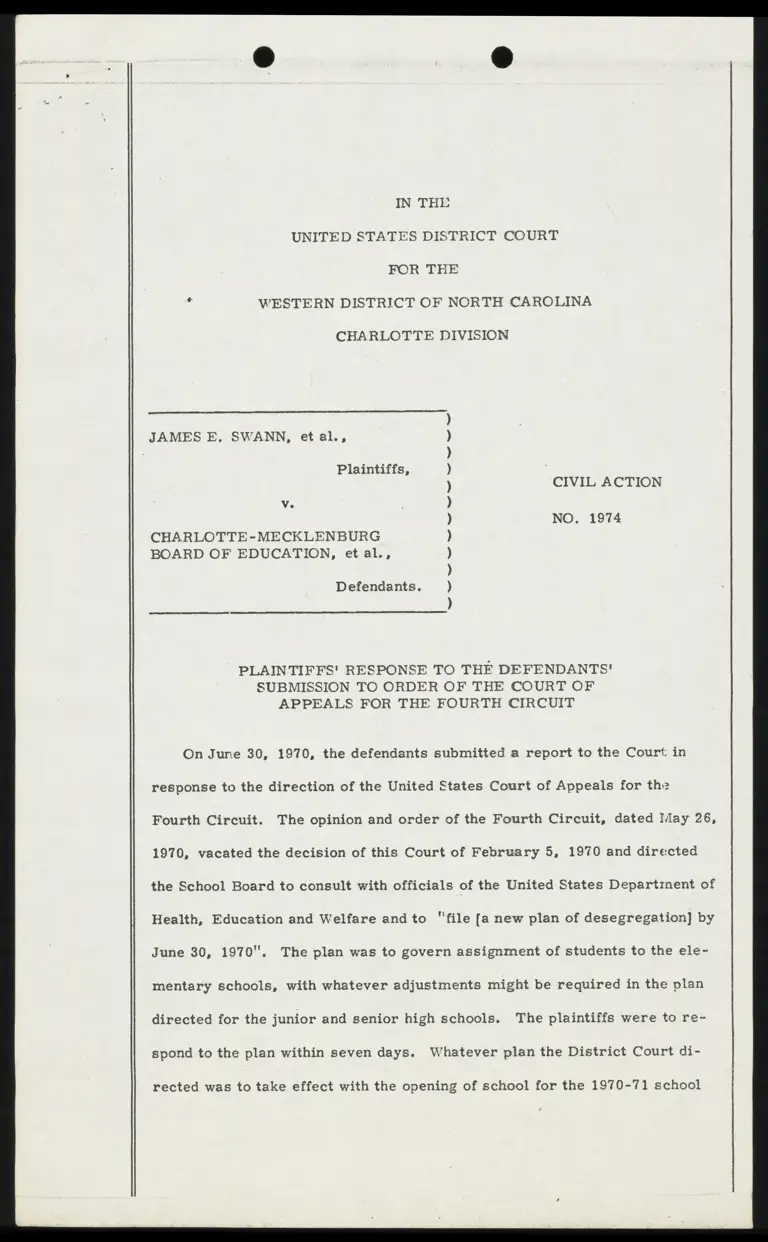
     [||20a7ec81-f5b7-49cb-b5a9-26b75f48f12a||] IN THE

UNITED STATES DISTRICT COURT

FOR TEE

i WESTERN DISTRICT OF NORTH CAROLINA

CHARLOTTE DIVISION


JAMES E. SWANN, et al.,

Plaintiffs, :
CIVIL ACTION

Ve.

NO. 1974

CHARLOTTE-MECKLENBURG

BOARD OF EDUCATION, et al.,

Defendants.

n
f


ee
”

N
e
’


w
e
”


a
”


a
”


N
w


N
w
?


S
e
”


w
t


“
a
t
h


S
e
r


PLAINTIFFS' RESPONSE TO THE DEFENDANTS’

SUBMISSION TO ORDER OF THE COURT OF

APPEALS FOR THE FOURTH CIRCUIT

On Jure 30, 1970, the defendants submitted a report to the Court in

response to the direction of the United States Court of Appeals for th:

Fourth Circuit. The opinion and order of the Fourth Circuit, dated l/lay 26,

1970, vacated the decision of this Court of February 5, 1970 and directed

the School Board to consult with officials of the United States Department of

Health, Education and Welfare and to 'file [a new plan of desegregation] by

June 30, 1970". The plan was to govern assignment of students to the ele-

mentary schools, with whatever adjustments might be required in the plan

directed for the junior and senior high schools. The plaintiffs were to re-

spond to the plan within seven days. Whatever plan the District Court di-

rected was to take effect with the opening of school for the 1870-71 school

/


year.

On Junie 29, 1970, the United States Supreme Court granted certiorari

to review the decision of the Fourth Circuit. The Supreme Court left the

decision of the Fourth Circuit undisturbed only insofar as it remanded the

case to the District Court for further proceedings which the Supreme Court

authorized. The Supreme Court reinstated the decision of the District Court

pending subsequent proceedings.

Rather than submit a plan as directed by the Fourth Circuit and the

Supreme Court, defendants have only offered to the Court a submission’ for

the District Court's consiceration. The Meitbrmignion! purportedly reports

on subsequent action of the School Board, following the decision of the Fourth

Circuit, in contacting officials of HEW and the Board's efforts to assist HEW

in the formulation of a plan. The defendants contend that the officials of

HEW failed to consult with the Heart The defendants also reported that

four members of the Board, constituting a minority, propose to submit a

plan to the Court. The defendants included in their "'submission' a copy

of a resolution adopted by the Board on June 29, 1970 which disapproved the

plan submitted by HEW, indicated that thie minority of the Board approved

"in principle' a minority plan prepared by Dr. Carlton G. Watkins, and

expressed the conviction of the majority of the Foard that there was no

reasonable alternative plan to desegregate the schools. The resolution di-

rected that the HEW plan and the minority plan be submitted to the Court along

with other pertinent information and that every effort be made to secure an

early determination by the Supreme Cou -t regarding the necessary i1-

gredients of a unitary system".

Plaintiffs submit that the report submitted by the defendants fails to


1/
It should also be noted in passing that HEW also failed to consult

with the plaintiffs.

«3a

:


comply with the judgment of the Fourth Circuit; that the failure of the de-

fendants to comply with the order of the Pourih Circuit is another example

of the defendants’ recalcitrance which has prevailed throughout this pro-

tracted litigation; that neither the plan of HEW nor that of the minority of the

Board complies with the responsibility of the defendants to convert to a uni-

tary &chool system; and that the Court should order into effect and should di-

rect the defendants to implement the plan ordered by the Court on February

5, 1970. Plaintiffs submit the following in support of their contentions.

1. The defendants have not submitted a plan which would convert the

elementary schools into racially integrated schools. They have only sub-

mitted reports of plans prepared by HEW and by a minority of the Board.

They accept the findings of the District Court that the plan directed on

February 5, 1970 is the only way ''to get the job done''. They contend that

they need not desegregate all schools and adhere to their previous position

that they need only redraw attendance zones. They reject the findings and

holding of the Fourth Circuit and of this Court that the steps directed to de-

segregate are constitutionally required ¢nd they offer no alternative other

than their already rejected rezoning proposal,

2. The plan prepared by HEW also fails to discharge the constitutional

obligation of the Board to create a unitary system. HEW proposes to utilize

the Board's restrisiiss attendance zones and to create seven clusters of

schools in order to affect some of the schools which the Board would leave

all-black. The Board's plan would have desegregated some of the black

schools adjacent to white neighborhoods and several white schools which are

adjacent to black neighborhoods. HEW's plan would involve many of these

same schools but would substantially increase the black population in the

schools which would have been desegregated by the Board's proposed new

attendance zones. Basically, all of the clustered schools involved under

HEW's plan are on the west, predominantly Negre, section of the City.

3


The District Court and the Fourth Circuit found the Board's plan to

be unconstitutional because of the substantial number of the elementary

pupils, both black and white, who would remain in segregated schools.

HEW's plan fairs no better. It would leave 23 schools attended by more than

14, 3i6 white students with a white student enrollment of 86 to 100%; 9 of the

schools would be 99 to 100% white; 10 of the schools would be 90 to 98% white

and 4 of the schools would be 86 to 89% white. This represents approxi- |

mately 46% of the white elementary pupil enrollment in the system.

HEW would leave two schools, Caklawn and Double Oaks, all-black.

These schools would serve y 422 black pupils. The plan further provides

for the assignment of 6, 244 black pupils to schools having 40 to 51% black

enrollment. More than 60% of the black elementary pupils would be at-

tending schools which would be all-black, or predominantly black or rapidly

changing into all-black schools.

As the record in this case clearly demonstrates, such concentration of

blacks and whites in separate and segregated sections of the City precipitates

rapid resegregation of most, if not all, of the schools in a very short time.

The alternstive offered for desegregation of the remaining all-black schools

further emphasizes HEW's lack of concern for creating or maintaining a de-

segregated school system, for the alternative clusters proposed for desegre-

gating the all-black schools would only further concentrate black pupils in

the western side of the City. |

Additicnally, the plan submitted by HEW would over-utilize certain

facilities and under-utilize others. In short, HEW's proposal evidences a

clear lack of appreciation or understanding of the system, the short period

spent in attempting to devise a plan and little more than some shortsighted.

ill-conceived effort to balance political expediency with the constitutional

rights of the black and white children in this system. |

3. The minority plan does not include sufficient information for an

ne


objective determination of what it would, in fact, accomplish. The statistics

indicate that the schools in the clusters proposed would result in black -

white student assignment of approximately 30 - 70%. How the students

would be assigned to each school within the clusters, what the racial com-

position would be in each school, or whether the method of assignment would

be more feasible than that directed by the Court cannot be ascertained.

1 4. The Court is, therefore, again confronted with the same situation

as that prevailing during most of this Htipation with no constitutionally ac-

ceptable alternative plan, despite the urging and orders of this Court and

now the Fourth Circuit and the Supreme Court. The Court does have before

it a constitutional and feasible plan which the Supreme Court has reinstated

pending further proceedings. Both the plaintiffs and the defendants agree

that the February 5, 1970 plan desegregates the system and will afford to

all children an equal educational opportunity. The plan was developed with

the aid of an educational consultant and the staff of the school system. Hav-

ing no other feasible and constitutionally acceptable plan before it, the Court

should direct the implementation of the plan ordered on February 3, 1970,

to be fully implemented at the beginning of the 1870-71 school year.

5. Defendants have now threatened not to implement any plan allegedly

because the Mecklenburg County Commissioners refuse to appropriate funds

to desegregate the school system. The Court should direct the defendants

to proceed immediately with all necessary steps to desegregate, including

the purchase of or arrangement for necessary transportation facilities,

notification to parents and children of school assignments and reorganization

of schools and should enjoin the opening of school for the 1970-71 school year

pending full and complete implementation of the plan directed by the Court.

See Carter v. West Fdiciana Parish School Board, 38 U.S. L. Week 3220


-5-


(U.S. Sup. Ct., Dec. 13, 1969) and Bradley v. School Board of City of Rich-

‘mond FR. Supp. __ (E. D. Va., No. 3353, June26, 1970).

WHEREFORE, blaintiffe respectfully submit that the Court should reject

the submission of the Board of June 30, 1870; that the Court should reject

the plan submitted by the Department of Health, Education and Welfare and

the proposed plan of the minority of the Board; and that the Court should

direct implementation of the plan as ordered on February 5, 1970.

Plaintiffs further submit that the Court should direct the defendants to

begin immediately with preparation for implementation of the plan, including

the purchase of or arrangement for necessary transportation facilities,

notification to parents and children of assignments and reorganization of

the schools and should enjoin the opening of school pending full and complete

compliance by the defendants with the Court order.

Plaintiffs further submit that the Court should allow them their costs

herein, reasonable counsel fees and such other alternative or additional

relief as the Court may deem the plaintiffs entitled.

Respectfully submitted,


CONRAD O, PEARSON

203 1/2 East Chapel Hill Street
Durham, North Carolina

J. LeVONNE CHAMBERS

ADAM STEIN

Chambers, Stein, Ferguson &
Lanning

216 West Tenth Street

Charlotte, North Carolina

JACK GREENBERG

JAMES M, NABRIT, III

NORMAN CHACHKIN

10 Columbus Circle

New York, New York

Attorneys for Plaintiffs


= CERTIFICATE OF SERVICE --

The undersigned hereby certifies that he has this day served copies of

the foregoing Response to the Defendants' Submission to Order of the Court

of Appeals for the Fourth Circuit upon counsel for the defendants by de-

| positing copies of same in the United States Mail, postage prepaid, addressal

to:

Brock Barkley, Esq.

Law Building

Charlotte, North Carolina

William J. Waggoner, Esq.
Weinstein, Waggoner, Sturges & Odom

1100 Barringer Office Tower
Charlotte, North Carolina

Gaston H. Gage, Esq.

Grier, Parker, Poe, Thompson

Bernstein, Gage and Preston
1014 Law Building

Charlotte, North Carolina

Honorable Robert Morgan

Attorney General

State of North Carolina

Raleigh, North Carolina

James H. Carson, Jr., Esq.

Law Building

Charlotte, North Carolina

Benjamin S. Horack, Esq.

806 East Trade Street

Charlotte, North Carolina

Whiteford S. Blakeney, Esq.

North Carolina National Bank Building
Charlotte, North Carolina

William H. Pooe, Esq.
Law Building

Charlotte, North Carolina

This 7th day of July, 1970,


Attorney for Plaintiffs [||20a7ec81-f5b7-49cb-b5a9-26b75f48f12a||]