Memorandum in Support of Plaintiffs' Response to Motion for Order of Dismissal and Plaintiffs' Motion for Supplemental Relief
Public Court Documents
May 22, 1979
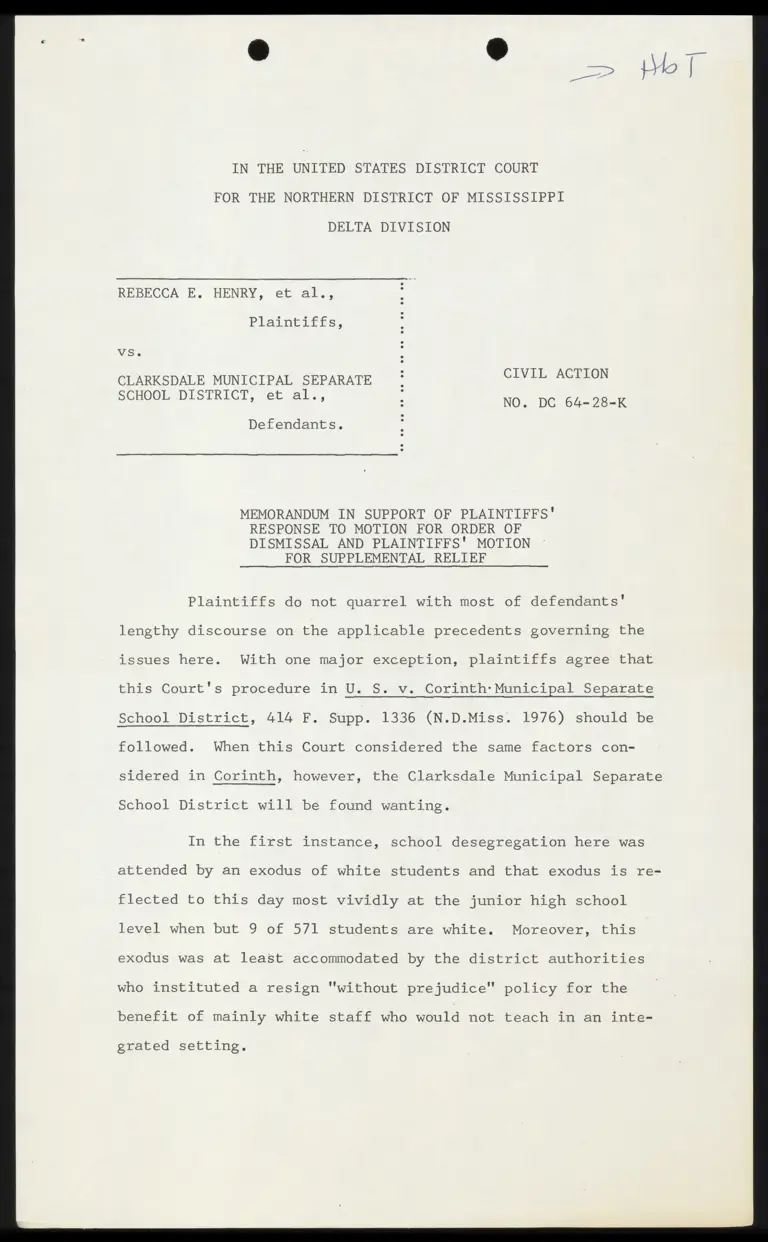
4 pages
-
Case Files, Henry v. Clarksdale Hardbacks. Memorandum in Support of Plaintiffs' Response to Motion for Order of Dismissal and Plaintiffs' Motion for Supplemental Relief, 1979. 34abcf66-8418-f111-8342-7c1e526962fd. LDF Archives, Thurgood Marshall Institute. https://ldfrecollection.org/archives/archives-search/archives-item/5cd8697c-48d2-433e-a3d9-2ef11c4b1e7f/memorandum-in-support-of-plaintiffs-response-to-motion-for-order-of-dismissal-and-plaintiffs-motion-for-supplemental-relief. Accessed September 28, 2026.
Copied!
     [||07a37686-03f2-4539-8ef0-d80215377dff||] IN THE UNITED STATES DISTRICT COURT

FOR THE NORTHERN DISTRICT OF MISSISSIPPI

DELTA DIVISION

REBECCA E. HENRY, et al.,

Plaintiffs,

VS.

CLARKSDALE MUNICIPAL SEPARATE CIVIL ACTION
SCHOOL DISTRICT, et al., : REY

Defendants.

MEMORANDUM IN SUPPORT OF PLAINTIFFS
RESPONSE TO MOTION FOR ORDER OF
DISMISSAL AND PLAINTIFFS' MOTION

FOR SUPPLEMENTAL RELIEF

Plaintiffs do not quarrel with most of defendants’

lengthy discourse on the applicable precedents governing the

issues here. With one major exception, plaintiffs agree that

this Court's procedure in U. S. v. Corinth-Municipal Separate

School District, 414 F. Supp. 1336 (N.D.Miss. 1976) should be

followed. When this Court considered the same factors con-

sidered in Corinth, however, the Clarksdale Municipal Separate

School District will be found wanting.

In the first instance, school desegregation here was

attended by an exodus of white students and that exodus is re-

flected to this day most vividly at the junior high school

level when but 9 of 571 students are white. Moreover, this

exodus was at least accommodated by the district authorities

who instituted a resign "without prejudice" policy for the

benefit of mainly white staff who would not teach in an inte-

grated setting.


Although there have been few demonstrations in recent

years, plaintiffs have had to return to this Court for relief

with regard to educational policy most notably the refusal to

recognize Black History Week.

Plaintiffs expect a hearing to show that there have

been no "convincing efforts by both whites and blacks in the

community to establish a significant dialogue between the

school officials and minority race members.' Despite the fact

that Clarksdale is a majority black city and that more than

83% of the pupils are black, only one black is among the five

members of the Board of Trustees of the Clarksdale Municipal .

Separate School District. All key administrative positions

are filled by whites. Both recommendations and protests of

black parents and community leaders have fallen on deaf ears

with few exceptions.

This lack of community cooperation has manifested it-

self in the failure to even attempt passage of a bond issue

which was scheduled in the Srring of 1970 and abruptly can-

celled at the advent of desegregation.

Finally, in terms of faculty hiring and assignment,

defendants have failed to comply with the "Singleton'" pro-

visions of this Court's order. The decree provided that the

racial makeup of each school should reflect as nearly as pos-

sible the racial makeup of the faculty as a whole. This dis-

trict has never complied with that provision as manifested by

the contrasting racial makeup of the junior high faculty with

that of the senior high faculty. Moreover, this Court has

found that defendants engaged in discriminatory hiring pract-

ices as late as 1974, Hardy v. Porter, # 77-94-K, and litiga-

tion is pending concerning still other and later allegations

of discriminatory assignment practices.

In addition to the factors discussed in Corinth,

plaintiffs intend to produce evidence to establish disparate


treatment and allocation of resources between schools attended

primarily by blacks and those with substantial white popula-

tions and that black pupils are continually and discrimina-

torily overlooked and otherwise mistreated.

The major exception that plaintiffs take with the de-

cision in Corinth is that the court dismissed the action rather

than simply close the file. Plaintiffs submit that should this

Court after hearing be convinced that this case is at a proper

stage for some kind of termination the proper course is that

followed in Swann v. Charlotte-Mecklenburg Board of Education,

67 F.R.D. 649 (W.D. N.C. 1975) when the district court simply

closed the case Halding that [d]ismissal is neither usual nor

correct in a case like this where continuing injunctive or

mandatory relief has been required."

Finally, defendants have raised the issue of mootness

in light of Pasadena City Board of Education v. Spangler, 49

L.Ed.2d 599 (1976). Plaintiffs cannot deny the fact that no

present named plaintiff is a pupil nor the fact that no class
—

has been certified. The overriding fact, however, is that
a —————

this Court has entered a mandatory, permanent injunction and

it is the duty of the court to insure compliance with that

decree. To the extent that additional relief is required it

may be necessary to pin additional currently affected plain-

tiffs. This can be done with ease in the discretion of this

Court and their absence at the moment should not be de=

terminative of a motion to dismiss.

Respectfully submitted,

TRED L. a

BANKS & NICHOLS
318 East Pearl Street
Jackson, MS 39201

BILL LANN LEE
Suite 2030, 10 Columbus Circle
New York, New York 10019

i


CERTIFICATE OF SERVICE

I hereby certify that on this 22nd day of May, 1979,

I caused to be served by United States mail, postage prepaid,

a copy of the foregoing Memorandum In Support of Plaintiffs

Response To Motion For Order of Dismissal And Plaintiffs’

Motion For Supplemental Relief upon Semmes Luckett, Esquire,

121 Yazoo Avenue, Clarksdale, MS 38614.

\
cc

FRED L. BANKS, JK. ; x [||07a37686-03f2-4539-8ef0-d80215377dff||]