Brief of the State of Tennessee
Public Court Documents
May 6, 1983
19 pages
-
Case Files, Garner Working Files. Brief of the State of Tennessee, 1983. d5be519f-34a8-f011-bbd3-000d3a53d084. LDF Archives, Thurgood Marshall Institute. https://ldfrecollection.org/archives/archives-search/archives-item/5d5cb325-f00c-411a-9947-77251b6e94c0/brief-of-the-state-of-tennessee. Accessed September 28, 2026.
Copied!
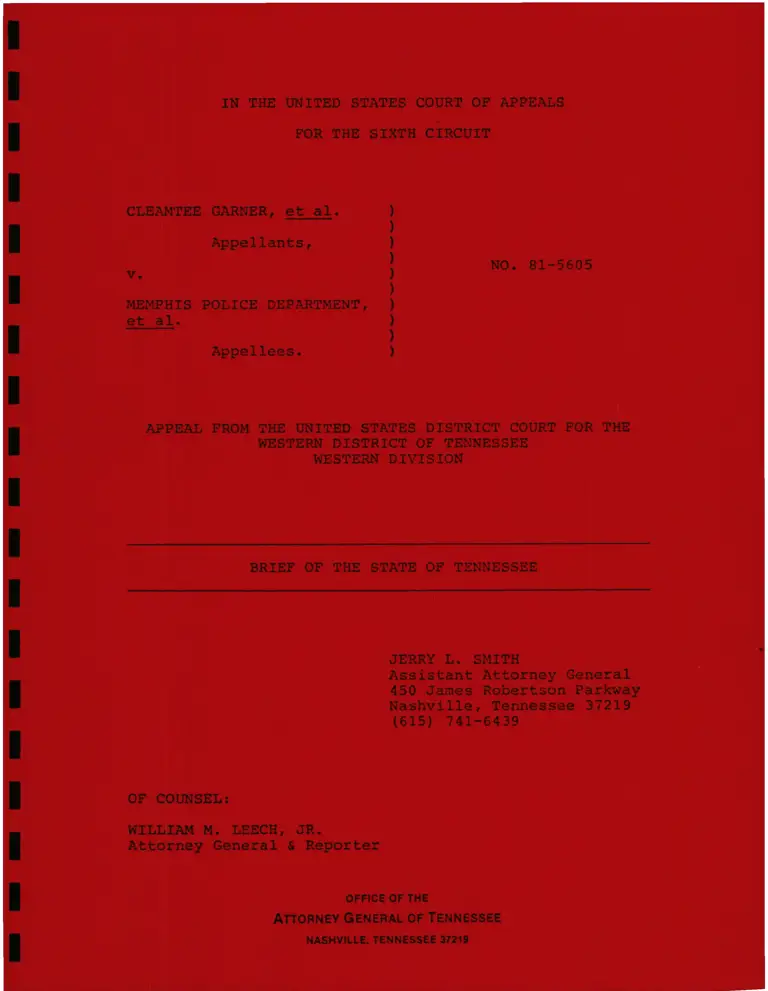
IN THE UNITED STATES COURT OF APPEALS
FOR THE SIXTH CIRCUIT
CLEAMTEE GARNER, et al.
Appellants,
V .
MEMPHIS POLICE DEPARTMENT,
et al.
Appellees.
NO. 81-5605
APPEAL FROM THE UNITED STATES DISTRICT COURT FOR THE
WESTEPJSI DISTRICT OF TENNESSEE
WESTERN DIVISION
BRIEF OF THE STATE OF TENNESSEE
JERRY L. SMITH
Assistant Attorney General
450 James Robertson Parkway
Nashville, Tennessee 37219
(615) 741-6439
OF COUNSEL;
WILLIAM M. LEECH, JR.
Attorney General & Reporter
OFFICE OF THE
Attorney General of Tennessee
NASHVILLE, TENNESSEE 37219
PAGE (S)
ISSUE PRESENTED FOR REVIEW......................... 1
STATEMENT OF THE CASE.............................. 2-3
STATEMENT OF THE EVIDENCE.......................... 4
ARGUMENT:
THE DISTRICT COURT CORRECTLY FOUND
TENN. CODE ANN. § 40-7-108 TO BE
CONSTITUTIONAL UNDER THE CIRCUMSTANCES
PRESENTED IN THE INSTANT CASE............ 5-15
CONCLUSION......................................... 16
CERTIFICATE OF SERVICE............................. 16
TABLE OF CONTENTS
-1-
TABLE OF AUTHORITIES
CASES CITED: PAGE (S)
Beech v. Melancon, 465 F.2d 425
(6th Cir. 1972).......................... 7,9,10,14
Cunningham v. Ellington, 323 F.Supp.
1072 (W.D. Tenn. 1971)................... 8,10,11,14
Jones V . Marshall, 383 F.Supp. 358,
aff'd 528 F.2d 132 (2nd
Cir. 1975)............................... 11,12
Landrum v. Moats, 576 F.2d 1320
(8th Cir. 1978).......................... 13
Love V . Bass, 145 Tenn. 522, 238
S.W. 94 (1921)........................... 5
Mattis V . Schnarr, 547 F.2d 1007
(8th Cir. 1976).......................... 13
Reneau v. State, 70 Tenn. 720 (1879)............... 5
State V . Boles, 598 S.W.2d 821, 823
(Tenn. Crim. App. 1980).................. 5
United Public Workers v. Mitchell, 330
U.S. 75, 67 S.Ct. 556, 91 L.Ed.2d
754 (1947)............................... 10
Vorbeck v. Schnicker, 660 F.2d 260, 264
(8th Cir. 1981).......................... 10
Wiley V . Memphis Police Dept., 548 F.2d 1247,
1251 (6th Cir. 1977)..................... 5,7,8,9,10,14
Wood V . Georgia, 450 U.S. 261, 101 S.Ct.
1097, 1100, 67 L.Ed.2d 220 (1981)......... 10
OTHER AUTHORITIES CITED;
Tennessee Code Annotated § 40-7-10 8................ 2,5,8,9,15
Tennessee Code Annotated § 40-7-108................ 1,8
Tennessee Rules Appellate Procedure 13(e).......... 17
-1 1-
ISSUE PRESENTED FOR REVIEW
Whether T.C.A. § 40-7-108 which states, "If,
after notice of the intention to arrest the defendant,
he either flee or forcibly resist, the officer may use
all the necessary means to effect the arrest", is con
stitutional?
-1-
In the instant case the State of Tennessee was
permitted, upon motion of the State, to intervene as a
party-appellee for the purpose of litigating the constitu
tionality of Tenn. Code Ann. § 40-7-108. Intervention by
the State was obtained pursuant to 28 U.S.C. § 2403(b),
which mandates the intervention of the attorney general of
a state which has one of its statutes under constitutional
attack in an action to which the state is not otherwise a
party. The sole purpose of the State's intervention is to
defend the constitutionality of Tenn. Code Ann. § 40-7-108
as that statute has been interpreted by the courts of the
State of Tennessee.
The State of Tennessee would respectfully adopt
the Statement of the Case found in the Brief of the
Appellees, Memphis Police Department, et al., as an accurate
account of the procedural history of the instant case prior
to the intervention of the State on appeal. The State would
only add that it appears the district court specifically
found that Tenn. Code Ann. § 40-7-108, under the circum
stances of the instant case involving a fleeing burglary
suspect, whom police did not definitely know was unarmed and
STATEMENT OF THE CASE
-2-
who for all police knew had committed a violent crime,
met constitutional muster. (App. 27, 39, 61).
-3-
The State would respectfully adopt as a
correct account of the facts herein those findings
of fact made by the district court in its memoran
dum of September 29, 1978, February 29, 1980, and
July 8 , 1981. (App. 22-35, 36-46, 55-62).
STATEMENT OF THE EVIDENCE
-4-
ARGUMENT
THE DISTRICT COURT CORRECTLY FOUND TENN. CODE ANN.
§ 40-7-108 TO BE CONSTITUTIONAL UNDER THE CIRCUM
STANCES PRESENTED IN THE INSTANT CASE.
Tenn. Code Ann. § 40-7-108 states;
Resistance to officer. - If, after
notice of the intention to arrest
the defendant, he either flee or
forcibly resist, the officer may
use all the necessary means to effect
the arrest.
On its face this statute is only a codification of the
common law. Wiley v. Memphis Police Department, 548 F.2d
1247, 1251 (6th Cir. 1977). The statute has been inter
preted by Tennessee courts to permit the use of deadly
force to apprehend a fleeing felony suspect when no lesser
means of apprehension reasonably appears available. Reneau
V. State, 70 Tenn. 720 (1879); Love v. Bass, 145 Tenn. 522,
238 S.W. 94 (1921); State v. Boles, 598 S.W.2d 821, 823
(Tenn. Crim. App. 1980). Thus, on its face there is nothing
unconstitutional about Tenn. Code Ann. § 40-7-108. The
real issue is whether constitution permits the use of deadly
force to apprehend what an officer knows to be a non-
dangerous felony suspect fleeing from a non-violent felony.
-5-
i.e. the constitutionality of the statute as applied to
a particular fact situation. The State submits, however,
that given the state of facts as found by the district
court it is not necessary for this Court to address the
constitutional question of the use of deadly force
against a non-dangerous felony suspect fleeing a non
violent felony.
In the instant case the district court found
that Officer Hymon could not be certain whether there was
an accomplice in the burglarized house, or in the area,
and whether the accomplice might be armed. The area of the
shooting was dark and Officer Hymon was uncertain of the
terrain. Finally, Officer Hymon did not know if some
violent offense had been committed, and he did not de
finitely know Garner was unarmed. (App. 27, 61). These
findings may not be set aside unless clearly erroneous.
Fed. R. App. P. 52(a). The State submits these findings
are clearly supported by the record and are not erroneous.
(App. 644, 645, 656, 674, 675).
Given the facts found by the district court in
the instant case the situation of an officer shooting an
individual whom he had no reason to suspect was dangerous
-6-
nor whom he had any reason to believe had committed a
crime'of violence is simply not made out in this case.
Of course it was ultimately determined that Garner was
unarmed and had not committed a crime of violence, but
officers did not know this at the time of the shooting.
The State respectfully submits the instant
case falls within the previous holdings of this Court
in the cases of Beech v. Melancon, 465 F.2d 425 (6th Cir.
1972); and Wiley v. Memphis Police Department, 548 F.2d
1247 (6th Cir. 1977). In both Beech and Wiley this Court
was faced situations very similar to the one presented
in the instant case. In both cases, as in the present
one, police shot and killed felony suspects at night as
they fled from police officers who were unable to appre
hend them otherwise. In both cases, as in the present
one, officers were uncertain whether the suspects were
armed and dangerous, and uncertain as to the dangerousness
of accomplices. In both cases, as in the present one,
officers identified themselves and warned the suspects to
halt. In Beech this Court found that the district court
was not guilty of clear error in finding the use of deadly
force necessary to effect the arrest. Also noted was the
-7-
holding in Cunningham v. Ellington ̂ 323 F.Supp. 1072
(W.D. Tenn. 1971); that Tenn. Code Ann. § 40-808
[40-7-108] was constitutional. In Wiley this Court
held that under the circumstances the district court's
findings that the shooting was necessary was not clearly
erroneous. Further, this Court indicated that under
the circiamstances the use of deadly force was constitu
tionally permissible. This Court stated with respect to
Tenn. Code Ann. § 40-808 [40-7-108]:
The Eight Circuit is the only
Court to our knowledge which has ever
held that such a statute, which is so
necessary even to elementary law en
forcement, is unconstitutional. It ex
tends to the felon unwarranted protec
tion, at the expense of the public.
We agree with the dissent in the
Eighth Circuit Case (Mattis v. Schnau),
which was highly critical of the majority
opinion for not following the decisions
of other Circuits and for embarking on a
new course which should have been left to
the state legislatures where it belongs.
548 F.2d at 1252.
In both Beech and Wiley Judge McCree entered a
concurring opinion finding it was not necessary to render
an opinion concerning the constitutionality of the use of
-8-
deadly force against a non-dangerous fleeing felon since
in both Beech and Wiley the finding of the district court
was that officers did not know the suspects were non-
dangerous. 548 F.2d at 1256; 465 F.2d at 426. Judge
McCree stated in Beech:
. . . courts should not second-guess
police officers, who faced with making
split-second decisions, reasonable and
in good faith believe that their lives
or those of third persons would be en
dangered if they refrain from employing
deadly force to attempt to apprehend
fleeing felons whose arrest cannot
reasonably be accomplished by less dangerous
means.
Id.
In the instant case there are findings by the
district court that this case does not involve a clearly
non-dangerous suspect fleeing a non-violent felony. (App.
27, 61). Unless these findings are set aside as clearly
erroneous the question of the constitutionality of Tenn.
Code Ann. § 40-7-108, as applied to allow the use of deadly
force against a non-dangerous suspect fleeing a non-violent
felony, is not before this Court and should not be addressed
by it. Federal courts should not reach constitutional
questions not squarely before them on the facts of the case;
-9-
and should refrain from addressing a constitutional issue
when possible. Wood v. Georgia> 450 U.S. 261, 101 S.Ct.
1097, 1100, 67 L.Ed.2d 220 (1981); United Public Workers
V . Mitchell, 330 U.S. 75, 67 S.Ct. 556, 91 L.Ed. 754
(1947); Vorbeck v. Schnicker, 660 F.2d 260, 264 (8th Cir.
1981).
The State respectfully submits therefore that this
court should in the instant case refrain from unnecessarily
announcing a broad constitutional principle involving the
use of deadly force against non-dangerous, non-violent
fleeing felony suspects; and should determine the case
based on facts as found by the district court, and in
accordance with the previous decisions of this Court. See:
Beech v. Melanion supra.; Wiley v. Memphis Police Dept.,
supra.
In Cunningham v. Ellington, 323 F.Supp. 1072 (W.D.
Tenn. 1971); a three (3) judge panel sitting in the
Western District of Tennessee held that Tenn. Code Ann.
§ 40-808 [40-7-108] was not violative of the United States
Constitution's prohibitions against cruel and unusual
punishment, nor did the statute violate due process or equal
protection. The Court found that to characterize the use of
-10-
deadly force to apprehend a fleeing felon as punishment
would mean that any exercise of force to apprehend a
fleeing suspect is punishment. The Court noted that any
force used by an officer to punish a suspect as opposed
to apprehending him would be a crime, but that the use
of necessary force, including deadly force, to apprehend
a fleeing felon is not violative of the Eighth Amendment,
The Court stated:
It may well be, as plaintiffs argue,
that as a matter of value judgment
it would be better to allow persons
thought to be felons to escape than
to incur the risk of killing them . .
This, however, is a policy question
for the Tennessee legislature or per
haps the Tennessee courts and not for
the federal courts in the guise of
constitutional adjudication.*
The district court in Cunningham also held the statute
comported with due process and did not deprive any per
sons of equal protection.
In Jones v. Marshall, 383 F.Supp. 358, aff'd . 528
*No Tennessee case has ever specifically held that Tenn.
Code Ann. § 40-7-108 would authorize the use of deadly force
against what an officer knows to be a non-dangerous suspect
fleeing a non-violent felony.
-11-
F.2d 132 (2nd Cir. 1975); the court upheld the consti
tutionality of a Connecticut law similar to Tenn. Code
Ann. § 40-7-108. The court found the constitution does
not require a restriction of the use of deadly force
to non-dangerous fleeing felony suspects. The court
concluded the state legislature was the proper place for
the plaintiff to turn if he wished to change the common
law rule permitting the use of deadly force to effect
an arrest.
The State submits that the use of deadly force
to apprehend a fleeing felony suspect is constitutional
given the state's interest in protecting the safety of
officers and other citizens and the prevention of future
criminal activity. Whie it may ultimately be determined,
after a shooting, that the fleeing suspect was not
dangerous or violent, this cannot always be determined in
the heat of a chase, often at night in situations fraught
with the potential for danger to police or citizens. It is
unreasonable to allow a possibly dangerous suspect escape
under circumstances similar to those in the instant case,
when it is peculiarly within the power of the suspect to
prevent the application of deadly force by his yielding
-12-
to the lawful commands of officers to halt.
The plaintiffs in the instant case rely heavily
upon the case of Mattis v. Schnari; 547 F.2d 1007
(8th Cir. 1976). In Mattis the Missouri statute similar
to Tenn. Code Ann. § 40-7-108 was found unconstitutional
as applied to the use of deadly force to effect the
arrest of fleeing felons suspected of a non-violent felony
whom the officers do not reasonably believe will use deadly
force against the officers or others. 547 F.2d at 1011.
See also: Landrum v. Moats, 576 F.2d 1320 (8th Cir. 1978);
essentially following Mattis; and Ayler v. Hopper, 532
F.Supp. 198 (M.D. Ala. 1981).
Respondent submits, however, the foregoing cases
are distinguishable from the instant case or are of
limited precedential value. In Mattis the court was deal
ing with a situation where officers did not reasonably
believe the suspect to be dangerous or violent. This same
set of facts was evidently the case in Landrum. In the
instant case, howver, the trial judge found that officers
could not know Garner was not dangerous or violent. (App.
27, 61). Also in Mattis there is a strong dissent highly
critical of the majority's unwarranted intervention in what
-13-
is essentially a legislative policy decision. This Court
in Wiley v. Memphis Police Dept. , supra., was also
highly critical of the Mattis decision and in fact quoted
extensively and with approval from the Mattis dissent.
Thus, the State submits Mattis is both distinguishable
from the instant case and somewhat limited in its pre
cedential value before this Court. With respect to the
Ayler case the State submits its precedential value is
limited due to the fact the opinion does not set forth
with sufficient detail the circumstances of the shooting
so as to determine the applicability of its holding to
the facts of the instant case.
In summary the State of Tennessee respectfully sub
mits this Court should not unnecessarily rule on the con
stitutional question of whether deadly force may be applied
to apprehend a clearly non-dangerous suspect fleeing a
non-violent felony since that issue assiames facts contrary
to those found by the district court and which are not
clearly erroneous. Finally, the State respectfully sub
mits that given the prior holdings of this Court in Beech
and Wiley, supra. and the holdings of the district courts
in Cunningham and Jones, supra., this Court should find
-14-
Tenn. Code Ann. § 40-7-108 constitutional in all
respects.
-15-
CONCLUSION
In light of the foregoing the State of Tennessee
respectfully requests that the judgment of the United
States District Court for the Western District of
Tennessee be affirmed.
Respectfully submitted.
j e r r y l / SMii'H i
'^ssist^t'Attorney General
/450 James Robertson Parkway
Nashville, Tennessee 37219
(615) 741-6439
CERTIFICATE OF SERVICE
I hereby certify that a copy of the foregoing
Brief has been forwarded by first-class, U.S. mail,
postage prepaid to Messrs. Jack Greenberg, James M.
Nabrit, III, and Steven L. Winter, Suite 2030, 10
Columbus Circle, New York, New York 10019; and Mr. Henry
L. Klein, 2108 First Tennessee Building, Memphis, TN.
38103, this the ^ // day of May, 1983.
-16-