Correspondence on Firearm Discharge Policy
Correspondence
June 29, 1967 - December 29, 1971
12 pages
-
Case Files, Garner Hardbacks. Correspondence on Firearm Discharge Policy, 1967. a72a66bb-24a8-f011-bbd3-000d3a151b15. LDF Archives, Thurgood Marshall Institute. https://ldfrecollection.org/archives/archives-search/archives-item/5ddbfb4b-3707-466b-be8e-7ecffba1fbe6/correspondence-on-firearm-discharge-policy. Accessed October 11, 2026.
Copied!
I ■, ' : ■, ■
P O L I C E A D M I M S T K A l ION' B U I L D I N G
Police Dcpnrlmcnt
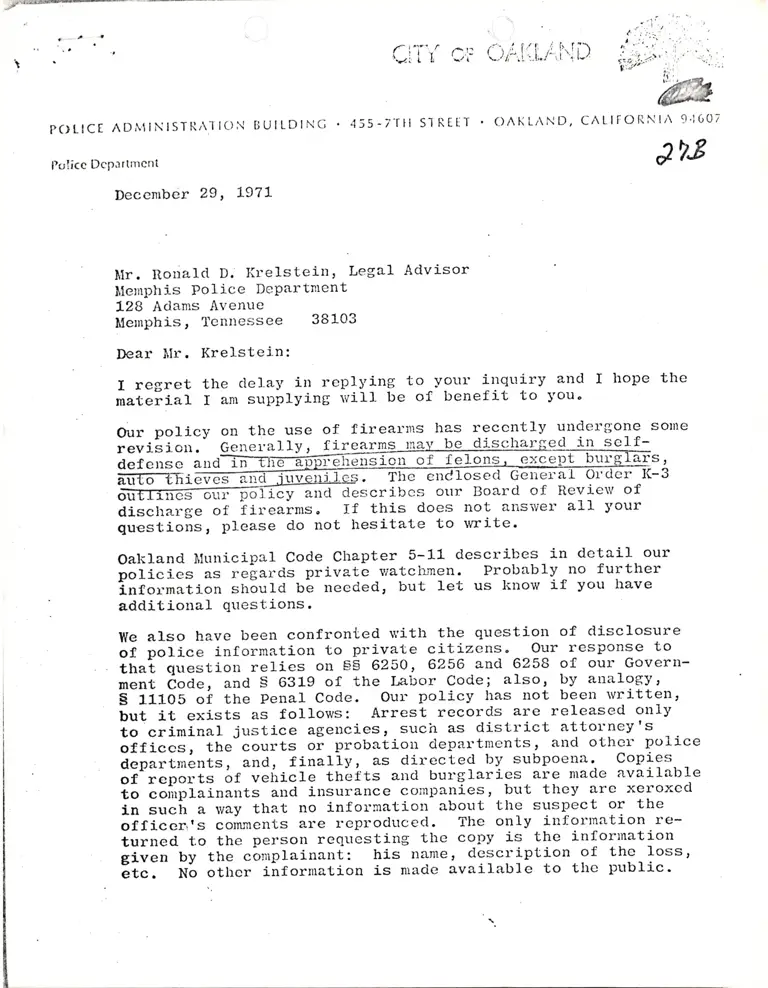
December 29, 1971
f^V T r " " C"'s -A ' • Dv ,
\:.y'
^155-7TH STREET • O A K L A N D , C A L I E O R N I A 9-:607
Mr. Ronald D. Krelstein, Legal Advisor
Memphis Police Department
128 Adams Avenue
Memphis, Tennessee 38103
Dear Mr. Krelstein:
I regret the delay in replying to your inquiry and I hope the
material I am supplying V'/ill be of benefit to you*
Our policy on the use of firearms has recently undeigone some
j*gvision. Generally, firearms may be discharged in self
defense
auto thieves
outlines
and in tile appx*eliens~ion of felons, except burglars,
nnd ~jnven3.]-CS. The encilosed General Order K-3
our pô licy and describes our Board of Review ofnot answer all your
write.discharge of firearms. If this does
questions, please do not hesitate to
Oakland Municipal Code Chapter 5-11 describes in detail oui
policies as regards private watchmen. Probably no further
information should be needed, but let us know if you have
additional questions.
We also have been confronted with the question of disclosure
of police information to private citizens. Our response to
that question relics on §§ 6250, 6256 and 6258 of oui* Govern
ment Code, and § 6319 of the Labor Codej also, by analogy,
§ 11105 of the Penal Code. Our policy has not been written,
but it exists as follows: Arrest records are released only
to criminal justice agencies, such as district attoiney s
offices, the courts or probation departments, and other police
departments, and, finally, as directed by subpoena. Copies
of reports of vehicle thefts and burglaries are made available
to complainants and insurance companies, but they are xeroxed
such a way tha.t no information about the suspect or the
officerds comments a.re I’eproduced. The only infoimation re
turned to the person requesting the copy is the infoimation
given by the complainant: his name, description of the loss,
etc. No other information is made available to the public.
Mr. Ronald D. Krelstciii -2 - December 29, 1971
The matter of juvenile records, however, remains somewhat
confiised. The recent case of T . N . G . v. Superior Court, 4̂
Cal. 3d 7G7 (May G, 1971) has presented a new interpretation
of Welfare & Institutions Code 6/6, 781 and 827 (related
to disclosure of juvenile records), (1) to "permit the juve
nile, who has been temporarily detained by the authorities
and subsequently released v.'ithout further proceedings, not
only to deny that he has been arrested, but, also, to deny
that he has been detained or otherwise subjected to juvenile
court proceedings," and (2) to "establish the Juvenile Court
as the sole arbiter of when and in what circumstancejjuvenile
records may be released to third pai'ties including, state
agencies." The court is now preparing an order, v/hich we
will forward to you when it is completed.
We are now considering tlie circumstances v/herein it might
be appropriate to release criminal records to members of the
press.
I hope that v/e have been of assistance to you and look for
ward to receiving a copy of your finished work.
Sincerely yours.
C. R. Gain
Chief of Police
Linda A. Moody f?
Legal Advisor ''
LAM: ps
Enclosure
OFFICE OF CHIEF OF POLICE
Oakland Police Department
SPECIAL ORDER NO. 1072
DATE: 9 Jul 68
■ TO; All Personnel
SUBJECT: DISCHARGE OF FIREARMS
Departmental General Order K-3 (DISCHARGE OF
FIREAPJIS) is being reviewed. Until such time
as the review is completed, members shall not
discharge firearms for the purpose of effect
ing the capture of, or preventing the escape
of, a person whom the member has reasonable
cause to believe has committed a burglary,
automobile theft, or any felony violation of
the California Vehicle Code, and the member
has no reasonable cause to believe the person
has committed any other felony.
All of the other provisions of Departmental
General Order K-3 remain in effect.
By order of
OFFICE OF CHIEF OF POLICE
Oakland Police Dcparti.icnt
I-IEMOIi'lNDmi
TO; All Personnel DATE: 29 Jun 67
SUBJECT; Revision of General Order 60-54, DISCHARGE
OF FIRE>\PuMS (K-3, 1 Sep 63)
The subject order, first issued 3 Dec 58, has been
extensively revised to provide additional regulations
regarding the discharge of firearms, to more precisely
delineate the function of the Board of Review, and
to establish procedures regarding the disposition of
Board of Review findings and reports.
Command officers shall reviev/ the contents of this
order with all their subordinate personnel.
All personnel shall place the revised order in their
General Order Manuals. No indexing changes are necessary.
Preston
riEF OF POLICE
OAi:LAXi) rO L IC I :: D - ’>\!nAii ;NT
Index as;
Discin\rr;e ox Fircai'nis
Firoariiis, Dischax’gc of
Weapons, Discharge of
U-. j hi.". .
Date first issued
Revised
Dll 11 i//
h Dec oh
1 Sep r,;;
d is char ge o f firearms
The purpose of this order is to state regulations, reportinr-- n-ofP'i'i "f--
and investigative procedures governing the discharge of fireirV Departmental members.
I. POLICY
A.
B.
The policy of tnis Department is that members shall exhii-c:T
every other means before resorting to the use of firearms
Policy and regulations governing the discharge of firearm^; are needed xor the following reasons;
1.
2 .
To inform members of when they are authorized to
use firearms in the performance of a police duty.
To preclude the unnecessary discharge of firearms.
3. To protect the lives and property of the public as well as members of the Department.
■II. REGULATIOXS
Firearms may be discharged in the performance of a police
duty only under the following circumstances and subject to the additional restrictions in Part II, B.
1. At an approved range.
2 .
1 ^ .
1^.
5.
When killing seriously wounded or dangerous animals
where other disposition is impractical.
When necessary in the defense of their own lives when
all other available means have failed.
When necessary in the defense of another person’s" life
when all other available means have failed.
When necessary to effect the capture of, or prevent the
escape of, a person Jenown of believed by the member to
be an adult whom the member has reasonable cause to
believe has committed a felony, when all other reasonable
means have failed. However, firearms shall not be dis
charged if the member has reason to believe, based upon
the attendant circumstances, that the discharge'may
endanger the lives of passersby or other persons not
involved in the crime from which flight is beino- made or attempted.
Page 1 o f 5 pages
K- Rc v .
29 Jun 67
When used in this order, the word "adult" is defined
as a person who is 1C years of age or older.
B. ui^rearms shall not be discharged under the following circumstances:
1. As a warning.
3.
4.
At a person know'n or believed by the member to be under the
age of 18 years unless necessary in the defense of the
member's life or another person's life when all other
reasonable means have failed.
a. The member's knowledge or belief of a person's age
may 'oe based upon factors such as his previous knowledge
of the person, his observations of the person's appear
ance or upon reliable information imparted to him oy
other persons.
In any masdemeanor case.
From a moving vehicle or at a moving or fleeing vehicle
except as follov/s:
a .
b.
When necessai’î in the defense of a member's life or
another person's life when all other reasonable
means have failed.
to effect the capture of, or prevent
a person known or believed by the memoer
whom the member has reasonable cause
committed a felony when all other reason-
However, firearms shall still
member has reason to believe,
circumstances, that the
may endanger the lives of passersby or
not involved in the crime from which
V/hen necessary
the escape of,
to be an adult
to believe has
able means have failed,
not be discharged if the
based upon the attendant
discharge
other persons
flight is being made or attempted.
Ill, REPORTING AND INVESTIGATION OF FIREARMS DISCHARGING
A. Whenever a member discharges his firearm either accidentally
or officially, eircept at an approved range, he shall notify
an on—duty command officer of his organizational unit as
soon as possible. If a command officer is not on duty in his
organizational unit at the time, the member shall notify the
command officer of the Patrol Division.
1. In addition to notifying a command officer, the member
shall submit a detailed written report of the circumstances
through channels to the Chief of Police.
B. A command officer shall personally investigate the report of
the firearm discharge. He shall submit a detailed written
report of the results of the investigation through channels to
the Chief of Police. The report shall also contain his ob
servations and conclusions regarding the incident.
Page 2 o f 5 pages
-V> I'ov.
29 Jun 67
IV. BOARD OF REVIDA'
A. The Board of Review shall consist of the following members;
1. The Deputy Chief, Bureau of Field Operations, who is
designated Chairman of the Board.
2. The commanding officer of Training Division.
3. The command and supervisory .officers of the member who discharged his weapon.
4. Two members of the same rank as the member who dischargedhis weapon. ^
5. Any others designated by the Chief of Police.
B. Meetings of the Board
1.
2 .
The Chairman shall call a meeting of the Board of Review
within a reasonable time after he receives a report of a firearms discharge.
In those cases where the discharge was for a purpose of
killing wounded or dangerous animals and there was no
property damage or personal injury, the Chairman may
approve the report of the investigating command officer
without holding a meeting of the Board of Review
C. ‘Authority of the Board
1. The Board of Review shall inquire into the circumstances
attending each discharge of firearms by a Department
member for the purpose of determining the facts resulting-
in the discharge. The inquiry shall encompass con
tributory causes to determine if the officer’s actions
brought about the need to discharge his weapon.
2, After inquiring into the circumstances attending the
discharge of firearms and determining the facts, the
Board shall deliberate the facts presented and arrive at
a finding -that the discharge was either Justifiable
Non-Justifiable or Accidental as defined herein.
,/ . a. When the circumstances at the time of the firing
are justifiable but the firing was the result of
the officer’s departure from acceptable police
procedures, the finding shall be that the discharge was Non-Justif iable.
b. A finding of Accidental shall be made only when there
■ ■ is no element of negligence on the part of the member.
negligence on the part of the member is an element
resulting in the discharge, the finding shall be Non-Justifiable . .
Page 3 of 5 pages
K~3 Rev.
29 Jun 67
3,
4.
The Board shall recommend to the Chief of Police that
training programs be undortal:en when circumstances indicate
such need.
Witliin five days after a Board meeting, the Chairman shall
submit a Discharge Board of Review Report to the Chief of
Police. The Report shall contain a summary of the cir- .
cumstances attending the discharge, a summary of the
Board's deliberations,
recommendations relati:
the finding of the Board and ..any
ig to training programs.
V. DISPOSITION OF BOARD OF REI^IEW REPORTS
A. The Chief of Police will review such Discharge Board of Review
Report for the purpose of approving or disapproving the
finding and any recommendation made.
1. If the Chief of Police disapproves the finding, further
action v/ill be taken as he may direct, and the Report
will then be re-submitted to him for approval.
2. When a Report is approved by the Chief of Police, a copy
will be forwarded to the member involved, to each of his
command and supervisory officers, ■fhe Training Division
commander and to each Deputy Chief. In addition, when a
discharge has been found by the Board to be Non-justifiable
and such finding has been approved by the Chief of Police,
a' copy of
Office to
personnel
the Report will be forwarded by the Chief's
the Personnel Division for filing in the member’s
jacketi
a. The Office of the Bureau of Field Operations shall
maintain permanently a file copy of each Board of
Review Report together with all written material
relating thereto.
B, When corrective action is indicated by a Discharge Board of
Review finding, the Chief of Police will determine whether he
will immediately initiate the action in conformity with the
finding or refer the Report to the commanding officer of the
involved member for recommendation of corrective action to be
taken.
1. Reports which are forwarded to a commanding officer for .
a recommendation shall be returned through channels to
the Chief of Police v/ho will approve or disapprove the
recommendation and make the final decision regarding
the corrective action to bo taken.
C. One or more of the follov/ing corrective actions may be taken
by the Chief of Police when indicated, subject to the provisions
of the Charter of the City of Oakland, the rules of the Civil
Service Board, and when necessary, the approval of the City
Manager.
Page 4 of 5 pages
O
2 .
3 .
4 .
5 .
6 .
7 .
8 .
9 .
10.
11.
1.
Kev.
29 Jun G7
Counselling
Training
Oral Reprimand
Written Reprimand
Voluntary surrender of time off in lieu of other'action
Voluntary surrender of accumulated overtime in lieu of other action
Demerits
Suspension
Fine
Demotion
Dismissal from the Service
OFFICE OF CHIEF OF POLICE
OAKLAND POLICE DEPARTMENT
memoran dum
d a t e : 15 Nov 71TO: All Personnel
• • r^noral Order 60-54, DISCHARGE OFSUBJECT: Revision of GeneralFIREARMS, (K-3, 29 Jun 67)
̂ Vnc revised to establish policy regard-The subject order has been p When the discharge
“ :„“ r:f£?Lr^?o"acras chairauaS of the Boara of Beview.
1 oVa-,11 nlace the revision in their DepartmentalAll personnel shal p index changes.General Order Manual. There are
By order of
./
ir'-,.. I J'-h:;!v
/ 'OAK]. A N D }‘C'!.H:i; 1; T. i-A ;. T M K T / c . r . c /. i n. c h i r r o k p o l i c e
F-CLlCC / r/MSiiT K AT i.'?i tU*Lr!^'C, ASS 7 T H5 T . , OAKLAKP. CALI f A 9A407
October 21, 1970
Royce A. Fincher, Jr., Esq.
Legal Advisor
San Jose Police Departir.ent
San Jose, California 95110
Dear Royce:
The Chief v.’ill not permit rae to release our memorandum on the use
of deadly force by peace officers, as it is still in need of some revisions.
I am authorized to send you, however, a copy of v;hat v;e consider a "model"
regulation on the use of deadly force:
Deadly force by peace officers is permissible when it is
reasonably believed to be necessary:
(1) in defense of their own or another's life, or
(2) to effect a felony arrest vdien the use of such
force creates no substantial risk of injury to
innocent persons,' and
(a) the felony for v/hich the arrest is made
involved conduct (i) that included the
.. . ; use or threatened use of deadly force, _or
(ii) that, by its nature, created a sub
stantial risk of death or serious bodily
harm, or
‘ (b) there is a substantial risk that the ‘ -
person to be arrested for a felony v;ill
cause death or serious bodily harm if
his apprehension is delayed.
As I mentioned to you yesterday, this model is taken substantially
from the IIODEL PENAL CODE with the one minor addition that appears in
Paragraph (2) (a) (ii) . That provision v/as added to include offenses such
as kidnaping that might not, in a particular case, involve the use or
threatened use of deadly force, but that by its nature does pose a substantial
risk of death or serious harm.
VThat all this comes down to, of course, is very simply stated: OFFICERS
SHOULD USE DEADLY FORCE ONLY VdlEN NECESSARY TO DEFEND LIFE OR TO PROTECT
PERSONS FROM SERIOUS BODILY HARM. It is no secret that Chief Gain considers
this a model deadly force policy, and thus you may cite his views, if you have
occasion to. The Oakland General Order, as you know, does not read this
/
vr.y, but its practicril effect is to accor".p.Tish the same results. It is for
tliat reason tliat v.’c liavc neither taken the effort to revise General Order
K-3 nor formulated any plans to do so in the foreseeable future.
Vith cordial regard, I am
Very truly yours,
C. R. GAIN
Chief of Police
Linda A. Moody
Legal Advisor
LAM;hs
cc: Herbert L^echsler, Esq.
Director, The American Law Institute
\