Brief of the Defendants-Appellees
Public Court Documents
December 18, 1992
27 pages
-
Case Files, Garner Working Files. Brief of the Defendants-Appellees, 1992. 858135e9-35a8-f011-bbd3-000d3a53d084. LDF Archives, Thurgood Marshall Institute. https://ldfrecollection.org/archives/archives-search/archives-item/5eb0ef65-3118-469d-acdb-6960c3f40091/brief-of-the-defendants-appellees. Accessed September 25, 2026.
Copied!
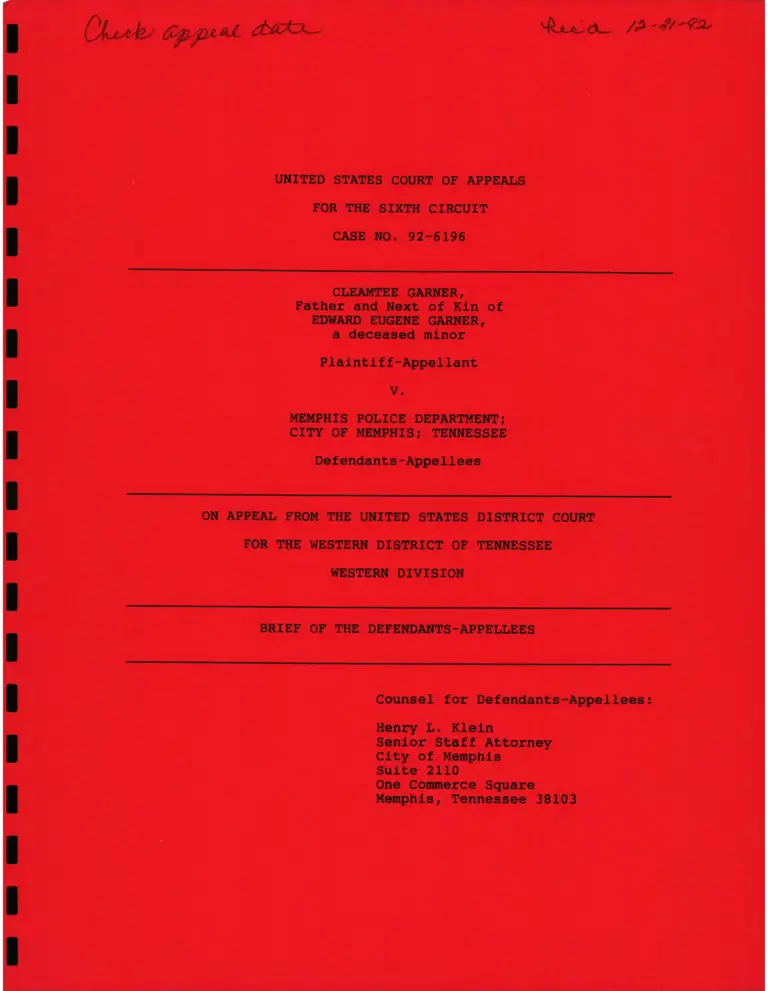
    UNITED STATES COURT OF APPEALS
FOR THE SIXTH CIRCUIT

CASE NO. 92-6196

CLEAMTEE GARNER,
Father and Next of Kin of
EDWARD EUGENE GARNER,

a deceased minor
Plaintiff-Appellant

V.
MEMPHIS POLICE DEPARTMENT;
CITY OF MEMPHIS; TENNESSEE

Defendants-Appellees

ON APPEAL FROM THE UNITED STATES DISTRICT COURT
FOR THE WESTERN DISTRICT OF TENNESSEE

WESTERN DIVISION

BRIEF OF THE DEFENDANTS-APPELLEES

Counsel for Defendants-Appellees:
Henry L. Klein
Senior Staff Attorney
City of Memphis
Suite 2110
One Commerce Square
Memphis, Tennessee 38103


UNITED STATES COURT OF APPEALS
FOR THE SIXTH CIRCUIT

CASE NO. 92-6196

CLEAMTEE GARNER,
Father and Next of Kin of

EDWARD EUGENE GARNER,
a deceased minor

Plaintiff-Appellant
V.

MEMPHIS POLICE DEPARTMENT;
CITY OF MEMPHIS; TENNESSEE

Defendants-Appellees

ON APPEAL FROM THE UNITED STATES DISTRICT COURT
FOR THE WESTERN DISTRICT OF TENNESSEE

WESTERN DIVISION

BRIEF OF THE DEFENDANTS-APPELLEES

Counsel for Defendants-Appellees;
Henry L. Klein
Senior Staff Attorney
City of Memphis
Suite 2110
One Commerce Square
Memphis, Tennessee 38103


IN THE UNITED STATES COURT OF APPEALS
FOR THE SIXTH CIRCUIT

CLEAMTEE GARNER, Father and
next-of-kin of EDWARD EUGENE
GARNER, a deceased minor

Plaintiff - Appellant
VS.
MEMPHIS POLICE DEPARTMENT;
CITY OF MEMPHIS, TENNESSEE

Defendants - Appellees
WYETH CHANDLER, Mayor of Memphis;
JAY HUBBARD, Director of Memphis
Police; E. R. HYMON, Police Officer
of the City of Memphis

Defendants

No. 92-6196

DISCLOSURE OF CORPORATION AFFILIATIONS AND FINANCIAL INTEREST

Pursuant to Sixth Circuit Rule 25, Memphis Police
Department; City of Memphis, Tennessee, Defendants/Appellees herein
make the following disclosure:

1. Is said party a subsidiary or affiliate of a
publicly-owned corporation? ^

If the answer is YES, list below the identity of the
parent corporation or affiliate and the relationship between it and
the named party: Not applicable

2. Is there a publicly-owned corporation, not a party
to the appeal, that has a financial interest in the outcome? ^

If the answer is YES, list the identity of such
corporation and the nature of the financial interest: Notapplicable

------- ^  ■

Date

//

Signature bf Counsel for Appellees


TABLE OF AUTHORITIES...........................................
SUBJECT MATTER AND APPELLATE JURISDICTION ................... 1
STATEMENT IN SUPPORT OF ORAL ARGUMENT ....................... 1
STATEMENT OF ISSUES ..........................................  1
STATEMENT OF C A S E ............................................  2
ARGUMENT ....................................................  3
CONCLUSION.................................................. ...
CERTIFICATE OF SERVICE ...................................... 18
A D D E N D U M .................................................... ...

TABLE OF CONTENTS


TABLE OF AUTHORITIES

Anderson v. Creighton,
483 U.S. 635 ( 1987) ........................................ 14
Bacchus Imports, Ltd, v. Dias,
468 U.S. 263 ( 1984)........................................ 8, 9
Beech V. Melancon,
465 F.2d 425 (6th Cir. 1972),
cert, denied, 409 U.S. 1114 ( 1973) ........................... 4
Belcher v. Oliver,
898 F.2d 32, (5th Cir. 1990) ...........................  15, 16
Carter v. City of Chattanooga, Tenn.,
850 F.2d 1119 (6th Cir. 1988) (en banc)
cert, denied 488 U.S. 1010 (1989) ........  1, 3, 4, 8, 9, 10, 16
Chevron Oil Co. v. Huson,
404 U.S. 97 ( 1971) ...................................... 5, 7, 9
City of Canton, Ohio v. Harris,
489 U.S. 378 ( 1989)........................................ 15, 16
City of Los Angeles v. Heller,
475 U.S. 796 ( 1986).............................  12, 13, 14, 17
City of Oklahoma v. Tuttle,
471 U.S. 808 ( 1985)........................................ 5, 11
Coal Resources, Inc, v. Gulf & Western Industries,
865 F.2d 761 (6th Cir. 1989) ...............................  10
Cunningham v. Ellington,
323 F.Supp. 1072 (W.D. Tenn. 1971) ...........................  4
Dodd V. City of Norwich,
827 F.2d 1, (2nd Cir. 1987) cert, denied
108 S.Ct. 701 ( 1988) ........................................ 13
Doe V. Sullivan County, Tenn.,
956 F.2d 545 (6th Cir. 1992) ...........................  13, 14
Garner v. Memphis Police Department,
710 F.2d 240 (6th Cir. 1983)..................... 3, 5, 6, 7, 10

11


James B. Beam Distilling Co. v. Georgia,
_____ U.S. ______,
111 S.Ct. 2439 ( 1991)........................................8, 9
Johnson v. State,
173 Tenn. 134, 114 S,W.2d 819 ( 1938) ......................... 4
Kori Corp. v. Walco Marsh Buggies & Draglines, Inc.,
761 F.2d at 649 ..............................................  10
Leach v. Shelby County Sheriff,
891 F.2d 1241 (6th Cir. 1989)...............................  16
Love V. Bass,
145 Tenn. 522, 238 S.W. 94 ( 1921)............................. 4
Mitchell V. City of Sapulpa,
857 F.2d 713 (10th Cir. 1988)................................. 8
Monell V. New York City Department of Social Services,
436 U.S. 658 ( 1978)................... 2, 9, 10, 12, 14, 15, 16
Pembaur v. City of Cincinnati,
475 U.S. 469 ( 1986)...................................... 11, 16
Qualls V. Parrish,
534 F.2d 690 (6th Cir. 1976) ..................................4
Reneau v. State,
70 Tenn. 720 ( 1879)............................................ 4
Reynolds v. City of Little Rock,
893 F.2d 1004 (8th Cir. 1990)...............................  13
Rhyne v. Henderson County,
973 F.2d 386 (5th Cir. 1992) ...........................  15, 16
Rivas V. Freeman,
940 F.2d 1491 (11th Cir. 1991) ............................. 16
Rodriquez v. The City of Passaic,
730 F.Supp. 1314 (D.N.J. 1990) aff'd,
914 F.2d 244 (3rd Cir. 1990) .............................  8, 14
Ruqe V. City of Bellevue,
892 F.2d 738 (8th Cir. 1989) ...............................  16
Scarbrough v. State,
168 Tenn. 134, 76 S.W.2d 106 ( 1934)........................... 4

111


state V. Boles,
598 S.W.2d 821 (1980)............................................
Swank v. City of Paqedale,
810 F.2d 791 (8th Cir. 1987) ...............................  13
Tennessee v. Garner,
471 U.S. 1 ( 1985).........................  5, 6, 7, 8, 9, 10, 15
Wiley V. Memphis Police Dept.,
548 F.2d 1247 (6th Cir. 1977), cert, denied,
434 U.S. 822 .................................................. ..

STATUTES

T.C.A. § 40-7-108 ..............................................  4
42 U.S.C. § 1983 ..............................................  14

IV


SUBJECT MATTER AND APPELLATE JURISDICTION
Defendants accept the statement regarding subject matter

and appellate jurisdiction as set out in Plaintiff's brief.

STATEMENT IN SUPPORT OF ORAL ARGUMENT
Defendants submit that because of the lengthy history of

this case, which includes two opinions from this Honorable Court
and an opinion from the Supreme Court of the United States and
because there are significant legal issues involved, oral argument
is deemed to be important from the standpoint of counsel and
hopefully helpful to the Court,

STATEMENT OF ISSUES

I,
Whether the holding in Carter v. City of Chattanooga,

Tenn. , 850 F.2d 1119 (6th Cir. 1988) (en banc) cert, denied 488
U.S. 1010 (1989) justifies the granting of a summary judgment by
the District Court.

II.
Whether the City of Memphis had in place a policy which

was in violation of the deceased's constitutional rights.

Ill.
Whether in the absence of liability on the part of the

officer involved the City can be held liable.


Whether there was a deliberate or conscious decision on
the part of the City of Memphis to ignore the constitutional rights
of the deceased.

IV.

STATEMENT OF CASE
Defendants accept Plaintiff's statement of the case, but

would add the following:
The answer of Defendants filed in response to the

complaint did not assert a qualified immunity defense on behalf of
officer Hymon. R.8.

In the Memorandum Opinion filed in this cause following
the trial of the case, the Court commented on the difficult
decision that officer Hymon had to make leading up to the
unfortunate shooting of young Garner, together with the fact that
eventually, but not realized at the time. Garner was unarmed. The
Court concluded that after taking into consideration the various
circumstances involved "Hymon acted within his responsibility as
a reasonable police officer. He certainly acted without any
malice, predisposition or racial animus towards Garner." The Court
went on to say that he acted within the guidelines afforded him as
a Memphis policeman "and the policy has been one essentially
established by the Tennessee legislature which has been determined
to be a constitutionally acceptable one." R.57.

In the Order entered by the District Court following the
first remand for consideration in light of Monell, the trial judge

2


noted that "although the evidence presented at trial in this case
suggested that Garner appeared unarmed, the officer could not have
known this with certainty." R.72.

ARGUMENT

I .

The holding in Carter v. City of Chattanooga, Tenn.,
supra, justified the granting of a summary judgment by the District
Court.

A. The City of Memphis had the right to formulate a
course of conduct previously declared to be constitutional.

The District Court in denying Plaintiff’s motion for
partial summary judgment and in dismissing the case made a
comparison of the facts in the Carter decision to those in the case
at bar and concluded that contrary to the decision in Garner v.
Memphis Police Department, 710 F.2d 240 (6th Cir. 1983), (Garner
II)/ municipalities have a defense to a claim pursuant to 42 U.S.C.
§ 1983 based upon their reliance on a policy or course of conduct
previously determined to be within constitutional limits.

General Order No. 5-74 of the Memphis Police Department,
which was in effect at the time of the incident involved herein,
authorized the use of deadly force to, among other things,
apprehend a felon fleeing from the commission of a burglary in the
first degree.


The General Order was predicated upon Tennessee Code
Annotated, § 40-7-108 (Former § 40-808) which reads as follows:

Resistance to Officer - If after notice
of the intention to arrest the defendant, he
either flees or forcibly resists, the officer
may use all the necessary means to effect the
arrest.
Several Tennessee cases have interpreted this statute.

Johnson v. State, 173 Tenn. 134, 114 S.W.2d 819 (1938); Scarbrough
V. State, 168 Tenn. 134, 76 S.W.2d 106 (1934); Love v. Bass, 145
Tenn. 522, 238 S.W. 94 (1921); Reneau v. State, 7 0 Tenn. 720
(1879); and State v. Boles, 598 S.W.2d 821 (1980).

The constitutionality of T.C.A. § 40-7-108 was considered
on several occasions and each time it was upheld. Cunningham v.
Ellington, 323 F.Supp. 1072 (W.D. Tenn. 1971); Beech v. Melancon,
465 F.2d 425 (6th Cir. 1972), cert, denied, 409 U.S. 1114 (1973);
Qualls V. Parrish, 534 F.2d 690 (6th Cir. 1976 ); and Wiley v.
Memphis Police Dept., 548 F.2d 1247 (6th Cir. 1977), cert, denied,
434 U.S. S 2 2 \

It is obvious that the author of the General Order relied
upon a statute that had passed the test of time not only by the
Courts of the State, but also Federal Courts deciding cases
pursuant to § 1983. As the Court in Carter stated:

. . . Cities such as Chattanooga are faced
with serious risks and burdens in carrying out
their police powers under the general
Tennessee law and the long established common
law as to capture of fleeing felons. The City
ought not be deterred in its exercise of what

It should be noted that certiorari was denied by the
Supreme Court in both Beech and Wiley.


it has good reason to believe is
constitutional conduct in the face of repeated
and unsuccessful court challenges to the
policy it pursued. This was more than merely
exercising good faith; it was acting in
reliance on what appeared over many years to
have been valid and proper state directed
police conduct and policy . . .
850 F.2d at 1131
Furthermore, to hold the City liable for following the

existing law would be to depart from the important and established
principle of stare decisis. As Justice Rehnquist said in City of
Oklahoma v. Tuttle, 471 U.S. 808 (1985) at page 819 n.5:

. . . One reason why courts render decisions
and written opinions is so that parties can
order their conduct accordingly, and we may
assume that decisions on issues such as this
are appropriately considered by municipalities
in ordering their financial affairs. The
principle of stare decisis gives rise to and
supports these legitimate expectations, and,
where our decision is subject to correction by
Congress, we do a great disservice when we
subvert these concerns and maintain the law in
a state of flux.

B . The holding in Tennessee v. Garner, 471 U.S. 1
(1985) and Garner II should not be applied retroactively.

In Carter this Court declined to apply Tennessee v.
Garner and Garner II retroactively. The Court carefully analyzed
the three standards of Chevron Oil Co. v. Huson, 404 U.S. 97 (1971)
which were set forth as follows:

In our cases dealing with the
nonretroactivity question, we have generally
considered three separate factors. First, the
decision to be applied nonretroactively must
establish a new principle of law, either by
overruling clear past precedent on which


litigants may have relied . . ., or by
deciding an issue of the first impression
whose resolution was not clearly foreshadowed
. . . . Second, it has been stressed that 'we
must . . . weigh the merits and demerits in
each case by looking to the prior history of
the rule in question, its purpose and effect,
and whether retrospective operation will
further or retard its operation.'
Finally, we have weighed the inequity imposed
by retroactive application, for "[wjhere a
decision of this Court could produce
substantial inequitable results if applied
retroactively, there is ample basis in our
cases for avoiding the 'injustice or hardship'
by a holding nonretroactively."
Id. at 106-07, (citations omitted).
In resolving the first standard this Court in Carter

makes an in depth review of the prior decisions and various
authorities which focused on the Tennessee fleeing felon statute
and concluded that as enunciated in Chevron Oil it has been
satisfied. This Court goes on to say;

. . . Garner II, as affirmed in Tennessee v.
Garner, established a new and unexpected
principle of law by setting aside clearly
established precedent, particularly in this
circuit, on which the City of Chattanooga and
its police officers had a right to rely when
this most unfortunate episode occurred in
1982. If it did not overrule a clearly
established precedent in the Supreme Court,
Tennessee v. Garner decided 'an issue of first
impression whose resolution was not clearly
foreshadowed.' 404 U.S. at 106 . . .
850 F.2d at 1129.
Then applying the second standard this Court found that

applying the Garner rule retroactively would not further the
purpose of deterrence. On this point this Court says:

Weighing and balancing of the equities in
this case in light of the 'prior history of


the rule in question' (the fleeing felon
rule), and 'its purpose and effect,' we are
persuaded that the City of Chattanooga did
have a legitimate basis at the time to believe
that its policy, in conformity with Tennessee
law and longstanding common law was not
unconstitutional. See Chevron Oil, 404 U.S.
at 106, 92 S.Ct. at 355. The second standard
of Chevron Oil, then, was met, and it is
appropriate to apply the new principle of
Garner II and Tennessee v.____Garner
prospectively . . .
850 F.2d at 1130.
Lastly the Court focuses on the third standard dealing

with the equities of retroactive application. In making a most
significant point and one which goes to the heart of one of the key
issues in this case, the Court says:

. . . A state or city having notice that a
given and settled or legal principle will
henceforth be considered unenforceable or
violative of newly decided federal
constitutional principles may have an
opportunity in the future to protect itself
against liability by changing its policies
thereafter. To impose liability against the
City in the present situation would be
inequitable and might present severe financial
strain in the case of smaller municipalities.

That reasoning applies with equal force
in this case because the City of Chattanooga
was justified in relying on the apparently
established constitutionality of the Tennessee
fleeing felon rule under Sixth Circuit
rulings, a three-judge district court decision
in the circuit, and the nearly unanimous
judicial approval of the common law rule. To
change the rule retroactively to the detriment
of defendants and potentially hundreds of
other municipalities that would be adversely
affected by such a ruling would be unfair.
850 F.2d at 1131.


As discussed in the Carter decision, some Courts have
applied Garner retroactively, however, others have declined to do
so. See Mitchell v. City of Sapulpa, 857 F.2d 713 (10th Cir.
1988); Rodriquez v. The City of Passaic, 730 F.Supp. 1314 (D.N.J.
1990) aff'd 914 F,2d 244 (3rd Cir. 1990).

The reasoning in Carter as to why the Garner rule should
not be applied retroactively holds true in the case at bar.
Plaintiff concedes that the opinion of the Supreme Court "lacks
explicit directive concerning its retroactive effect in all cases",
but argues that "the opinion clearly states the Court's mandate
with regard to the parties before it" (Plaintiff's Brief at 14).
The fallacy with Plaintiff's position is that it presupposes that
the Carter decision will have no impact on this case. To accept
Plaintiff's position would be to penalize the City of Memphis where
under the same set of circumstances the City of Chattanooga is
absolved of liability. In other words, it could hardly be said to
be equitable to find on the one hand that the City of Chattanooga
was entitled to a judgment as a matter of law because it was not
at the time following a clearly established unlawful or
unconstitutional policy, and on the other hand, hold the City of
Memphis liable when it was following the same procedure.

On the subject of retroactive application. Plaintiff
relies upon James B. Beam Distilling Co. v. Georgia, _____  U.S.
______, 111 S.Ct. 2439 (1991). Defendants submit this reliance is
misplaced. Since the Supreme Court had previously ruled on a
similar issue in Bacchus Imports, Ltd, v. Dias, 468 U.S. 263

8


(1984), the question in Beam was whether it was error to refuse to
apply a rule of federal law retroactively after the case announcing
the rule has already done so. The Court held it was. Ill S.Ct.
at 2446. The Court goes on to say:

The grounds for our decision today are
narrow. They are confined entirely to an
issue of choice of law: when the Court has
applied a rule of law to the litigants in one
case it must do so with respect to all others
not barred by procedural requirements or res
judicata. We do not speculate as to the
bounds or propriety of pure prospectivity.
Ill S.Ct. at 2448.
The distinction between Beam and Garner is that in Garner

the Court was not confronted with a previous Supreme Court ruling
on the same issue. It would appear that Beam modifies Chevron Oil
only to the extent that the Courts cannot determine the choice of
law relying on the equities of each case. The principles of
equality and stare decisis must prevail on a claim based on a
Chevron Oil analysis. Ill S.Ct. at 2446. Defendants submit that
the Beam case does not alter in any way this Court’s reliance on
Chevron Oil in the Carter decision.

C. The "law of the case" doctrine is not applicable to
this case.

Plaintiff argues that when this case was remanded by the
Supreme Court and Court of Appeals, the trial Court was under
mandate to follow the law as established by these Courts, which in
effect was to make its findings exclusively under Monel1
(Plaintiff's Brief at 18). In support of this position. Plaintiff


cites Coal Resources, Inc, v. Gulf & Western Industries, 865 F.2d
761 (6th Cir. 1989). While Coal Resources does confirm the "law
of the case" doctrine, this Court goes on to discuss the exceptions
to the rule quoting one of its previous decisions at page 767:

The [law of the case] doctrine precludes
our reconsideration of the [previously decided
issue] unless one of three 'exceptional
circumstances' exists: the evidence in a
subsequent trial was substantially different;
controlling authority has since made a
contrary decision of law applicable to such
issues; or the decision was clearly erroneous,
and would work a substantial injustice.
(emphasis added)
Kori Corp., 761 F.2d at 657.
The notable exception here is this Court's subsequent

decision in Carter, holding that Garner and Garner II are not to
be applied retroactively based upon equitable and other
considerations^.

II.
The City of Memphis did not have in place a policy which

was in violation of deceased's constitutional rights.
The real question here is whether the General Order of

the Memphis Police Department authorizing the use of deadly force
to apprehend a fleeing felon was technically a policy within the
meaning of Monell v. New York City Department of Social Services,

Certiorari was denied in Carter, 488 U.S. 1010 (1989).
This is particularly significant since the thrust of this Court's
decision was not to apply Garner retroactively, which lends
credence to Defendants' position that it should not be applied
retroactively in this case.

10


436 U,S. 658 ( 1978) and its progeny. Since the order was based
upon state and casebook law, any policy as such was established by
the legislature and the courts and not the City^. The City was
merely following the well-settled law. If the City was to provide
for the use of deadly force, it had no choice or alternative but
to follow existing law.

In Pembaur v. City of Cincinnati, 475 U.S. 469 (1986),
the Court in attempting to define what is meant by "policy" said
at pages 484-484:

. . . We hold that municipal liability under
Section 1983 attaches where - and only where -
a deliberate choice to follow a course of
action is made from among various alternatives
by the official or officials responsible for
establishing final policy with respect to the
subject matter in question. See Tuttle, supra,
at - 105 S.Ct., at 2436 ("'policy' generally
implies a course of action chosen from among
various alternatives.").
Analyzing this definition of "policy" and applying it to

the case at hand, it certainly would not be reasonable to say that
the City made a deliberate choice from among various alternatives.
The fact that City officials could have chosen to implement various
guidelines for the use of deadly force is not the choice referred
to by the Court. When the City set a standard for its officers
which was more restrictive than the State statute, it was following
the law and not making a deliberate choice among alternatives.

Judge Wellford in his Memorandum Opinion following the
first trial found that the Memphis Police Department policy "has
been one essentially established by the Tennessee legislature which
has been determined to be a constitutionally acceptable one."
(emphasis added) R.53.

11


For the foregoing reasons. Defendants maintain that the
City of Memphis was not acting pursuant to a policy within the
meaning of Monell.

Ill.
In the absence of liability on the part of the officer

involved, the City cannot be held liable.
Initially Elton Hymon, the police officer who attempted

to apprehend Edward Eugene Garner, was named as a Defendant. At
the conclusion of the trial, the trial judge, sitting without a
jury, held that Hymon acted within his duties as a reasonable
police officer without malice, predisposition or racial animus and
within the guidelines afforded him as a Memphis policeman. R. 53.
This finding by the Court was not challenged on appeal.

In City of Los Angeles v. Heller, 475 U.S. 796 (1986),
the court held that

If a defendant has suffered no constitutional
injury at the hands of the individual police
officer, the fact that the departmental
regulations might have authorized the use of
constitutionality excessive force is quite
beside the point".
Id. at 799.
In his dissent. Justice Stevens comments on the proof in

the case as follows:
. . . The verdict merely determined that the
officer's action was not unreasonable 'in the
light of all the surrounding circumstances' -
which, of course, included the evidence that
Officer Bushey was merely obeying orders and

12


following established Police Department
policy.
475 U.S. at 803.
The significant point is that in both Heller and this

case the officers were exonerated on evidence that their actions
were reasonable and that they followed established guidelines,
which was to say that the deceased suffered no constitutional
injury at their hands. Under those circumstances, the City cannot
be held liable. Also see Swank v. City of Pagedale, 810 F.2d 791
(8th Cir. 1987); Dodd v. City of Norwich, 827 F.2d 1, 8 (2nd Cir.
1987) cert, denied 108 S.Ct. 701 ( 1988) and Reynolds v. City of
Little Rock, 893 F.2d 1004, 1007 (8th Cir. 1990).

Defendants are not unmindful of this Court's decision in
Doe V. Sullivan County, Tenn., 956 F.2d 545 (6th Cir. 1992) where
it was held that a city is not necessarily immune from liability
because an officer was entitled to qualified immunity. Id. at 554-
55. This would be controlling here if the District Court had found
in favor of officer Hymon on the basis of qualified immunity'*.
However, when the Court predicates its ruling on the fact that the
officer acted "within his duties as a reasonable police officer
without malice or racial animus", this goes beyond qualified
immunity. It is immaterial that the department guidelines may have
authorized the use of excessive force.

Qualified immunity was neither plead by officer Hymon as
a defense in this case nor did the Court ever make reference to
this defense.

13


Contrary to this Court's holding in Doe, other Courts
have absolved the municipality of liability where the officer has
been granted gualified immunity.

In Rodriquez v. City of Passaic, supra, the Court
discusses a similar situation dealing with qualified immunity and
the application of the Heller decision:

Applying the 'objective legal
reasonableness ' standard established in Harlow
and fine-honed in Anderson v. Creighton, Kicha
could reasonably have believed that she was
justified in shooting plaintiff. Even
assuming the retroactivity of Garner, an
assumption made with the greatest of
difficulty, Kicha is entitled to qualified
immunity.

Because Kicha has not violated
plaintiff's constitutional rights, there is,
as discussed at pp. 1320-21 supra, no basis
for a finding of liability against the
remaining defendants. Liability under § 1983
is derivative; where its agent or employee is
exonerated as to acts for which a municipal
corporation is allegedly responsible, so, too,
is the municipal corporation.

[T]his was an
neither Monell
Social Services

action for damages, and
V . New York City Dept, of

______ 436 U.S. 658, 98 S.Ct.
L.Ed.2d 611 ( 1978), nor any

our cases authorizes the award
against a municipal

on the actions of one

2018, 56
other of
of damages
corporation based
of its officers when in fact the [court]
has concluded that the officer inflicted
no constitutional harm.

Heller v. City of Los Angeles, supra, 475 U.S.
at 799, 106 S.Ct. at 1573. Therefore, the
absence of § 1983 liability against Kicha
requires a finding that there is no § 1983
liability against the City of Passaic or its
Police Department.
730 F.Supp. at 1327-28.

14


Also see Belcher v. Oliver, 898 F.2d 32, 36 (5th Cir. 1990).

IV.
There was no deliberate or conscious decision on the part

of the City of Memphis to ignore the constitutional rights of the
deceased.

The Supreme Court on remand in this case held that the
possible liability of the Police Department and the City hinges on
Monell. Tennessee v. Garner, 471 U.S. at 23. To determine
liability, if any, not only would it be necessary to consider the
holding in Monell, but also to take into consideration all
developments in the law since the Court first decided Monell in
1978.

Since Monell, the Supreme Court, as well as the lower
Courts, have wrestled with the difficult task of defining "policy"
and the contours of municipal liability. They have worked their
way through this legal maze and settled on a rather specific and
definitive pronouncement in City of Canton, Ohio v. Harris, 489
U.S. 378 (1989). There the Court in discussing the definition of
a policy under Monell, settled on a standard of "deliberate
indifference". The Court held that there can only be liability
against a municipality "where the City's failure to train reflects
deliberate indifference to the constitutional rights of its
inhabitants." Id. at 392.

While the guidelines laid down in City of Canton apply
to the adequacy of training, subsequent cases have held this test
likewise applies to other situations. Rhyne v. Henderson County,

15


973 F.2d 386, 392 (5th Cir. 1992) (care of pre-trial detainees
known to be suicidal); Rivas v. Freeman, 940 F.2d 1491, 1495 (11th
Cir. 1991) (failure to establish a policy and procedures); Belcher
V. Oliver, supra at 34 (failure to afford medical treatment and
screening); Huge v. City of Bellevue, 892 F.2d 738, 742 (8th Cir.
1989) (whether city had a deliberate policy of not shoring up
ditches and then requiring employee to work in them); Leach v.
Shelby County Sheriff, 891 F.2d 1241, 1248 (6th Cir. 1989) (failure
to supervise and investigate).

Applying this standard, it can hardly be said that by
following established law in formulating the guidelines for its
officers, the City of Memphis made s deliberate or conscious
decision to ignore the constitutional rights of its citizens. The
City "policy" must be a deliberate and conscious choice by its
policy maker. City of Canton, 489 U.S. at 389 (quoting Pembaur v .
City of Cincinnati, supra at 483).

CONCLUSION
Defendants submit that the District Court was correct in

applying this Honorable Court's decision in Carter v. City of
Chattanooga, supra, in denying Plaintiff's motion for partial
summary judgment and dismissing the case. In addition, the case
should be dismissed on the basis that the City did not have in
place a policy in violation of the deceased's constitutional rights
within the meaning of Monell v. New York City Dept, of Social
Services, supra; the exoneration of the officer involved would

16


relieve the City of liability under City of Los Angeles v. Heller,
supra; and the Memphis Police Department General Order was not the
result of a deliberate or conscious decision to ignore the rights
of the public.

For these reasons and those set out more specifically
herein. Defendants respectfully request that the District Court's
Order Denying Plaintiff's Motion for Partial Summary Judgment,
Granting Summary Judgment for the Defendants and Dismissing Case
be affirmed.

Respectfully submitted.

/

Henry L/ Klein
Attorney for Defendants/Appellees
Suite 2110
One Commerce Square
Memphis, Tennessee 38103

17


CERTIFICATE OF SERVICE
I hereby certify that two copies of the Brief of the

Defendants-Appellees were mailed by United States Mail to Walter
Lee Bailey, Jr., Attorney for Plaintiff/Appellant, 200 Jefferson
Avenue, Suite 800, Memphis, Tennessee 38103, this / o  ■' day of
December, 1992.

Henry L.' Klein

18


ADDENDUM

UNITED STATES COURT OF .APPEALS
FOR THE SDCTH CIRCUIT

, 9 2 -6 1 9 6CiS€ no
Uâ e Cap'.ion:

CLEAMTEE GARNER,
Father and next of kin of
EDWARD EUGENE GARNER,
a deceased minor,

Plaintiff-Appellant,

vs.

MEMPHIS POLICE DEPARTMENT;
CITY OF MEMPHIS, TENNESSEE,
Defendants-Appellees.______

lUK^eimXPSUAPPELLEE'S DES'G.N'ATIO.N
OF .APPENTDDC CONTENTS

AppeiioEX/appellee, pursuano to Sixth Circuit Rule 11(6), nereby designates the following rilings ;n '..-.e ;
court s record as items to be included in the joint appendtx:
.Appellant's designation is complete and appellees do not have a need to supplement
the designation.

DESCRIPTION OF ENTRY DATE j RECORD
' ENTRY NO

'

19


DESCRIPTION OF ENTRY DATE

d e s c r i p t i o n  o f
PROCEEDIN'O OR TESTIMONY'

I ; rR-\-\;CRIPT
a\'d '.'ollat:

Respectfully submitted

NOTE: Appendix designation to be included in briefs.

6CA-108

20