Petition for a Writ of Certiorari
Public Court Documents
January 13, 1993
27 pages
-
Case Files, Garner Working Files. Petition for a Writ of Certiorari, 1993. 5d4fd847-36a8-f011-bbd3-000d3a53d084. LDF Archives, Thurgood Marshall Institute. https://ldfrecollection.org/archives/archives-search/archives-item/5ecae1df-abeb-4bc6-8430-21aaaf8601d7/petition-for-a-writ-of-certiorari. Accessed September 25, 2026.
Copied!
w
/ r
V
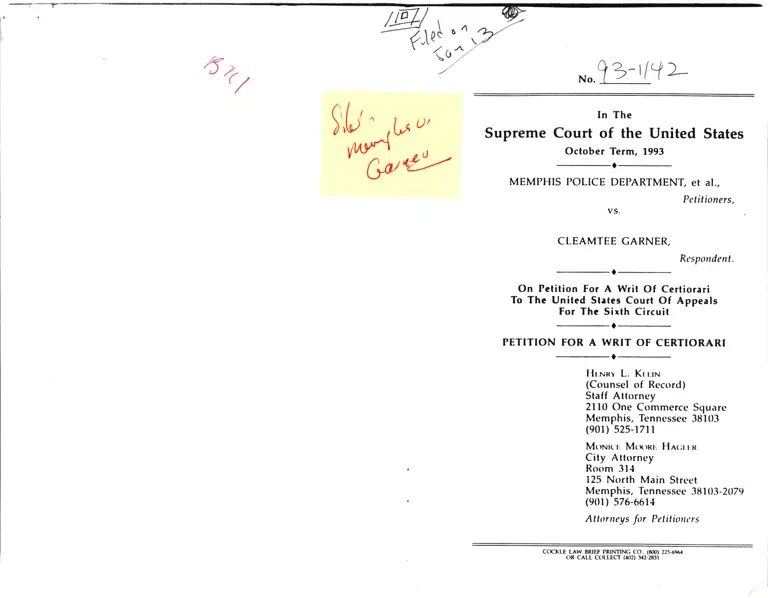
In The
Supreme Court of the United States
October Term, 1993
---------------- ♦-----------------
MEMPHIS POLICE DEPARTMENT, et al„
Petitioners,
vs.
CLEAMTEE GARNER,
Respondent.
On Petition For A Writ Of Certiorari
To The United Slates Court Of Appeals
For The Sixth Circuit
PETITION FOR A WRIT OF CERTIORARI
---------------4---------------
lIlNKV L. Kiiin
(Counsel of Record)
Staff Attorney
2110 One Commerce Square
Memphis, Tennessee 38103
(901) 525-1711
M onici MtxiKi; H ac;i i r
City Attorney
Room 314
125 North Main Street
Memphis, Tennessee 38103-2079
(901) 576-6614
Attorneys for Petitioners
COCKLE LAW BRIEF PRINTING CO , (800)
OR CALL COLLECT (402) ,T42-2g31
QUESTIONS PRESENTED
The questions presented for review in this Petition
for Writ of Certiorari are:
1. Whether the City's Departmental Order authoriz
ing the use of deadly force to apprehend a fleeing felon
based upon well established law is an official policy or
custom created by the City or Department, the execution
or implementation of which caused the particular consti
tutional injury involved.
2. Whether the City's good faith reliance on a flee
ing felon rule determined to be within constitutional
limits prior to this Court's decision in Tennessee v. Garner,
471 U S. 1 (1985) precludes liability for the shooting in
this case.
3. Whether the holding in Tenm’s.sct' i>. Garner, 471
U S. 1 (1985) should have retroactive application to the
City and its Police Department in this case.
4. Whether the exoneration of a police officer from
liability in a fleeing felon shooting based upon qualified
immunity or actions not unreasonable, relieves the City
of liability.
LIST OF PARTIES
I hc parties involved are Cleamtee Garner, father, and
next of kin of Edward Eugene Garner, a deceased minor,
the Memphis Police Department and the City of Mem
phis, Tennessee.
ni
TABLE OF CONTENTS
Page
Questions Presented............................................... i
List of Parties..................................................................... ii
Opinions Below........................................... \
jurisdiction........................................................................... 2
Constitutional Provisions and Statutes Involved . . . . 2
Statement of the Case...................................................... 4
Keasi>ns for Granting Certiorari.................................... 9
Ct>nclusion........................................................................... 13
TABLE OF AUTHORITIES
Page
C asils
Beech v. Melattcon, 465 F.2d 425 (6th Cir. 1972), cert,
denied, 409 U.S. 1114 (1973)......................................... 10
Carter v. City of Chattanooga, Tenn., 850 F.2d 1119
(6lh Cir. 1988) (en banc), cert, denied, 488 U.S.
1010 (1989)............................................................. 8. 10, 11
City of Los Angeles v. Heller, 475 U.S. 796 (1986) 12
Coal Resources, Inc. v Gulf & Western Industries, 865
F.2d 761 (6th Cir 1989)............................................... II
Cunningham v. Lllington. 323 F. Supp 1072 (WI)
Tenn. 1971)...................................................................... 10
Doe V. Sullivan County, Tenn., 956 F.2d 545 (6th Cir.
1992), cert, denied, 113 S.Ct. 187 (1992).........................12
Johnson v. Slate, 173 Tenn. 134, 114 S.W.2d 819
(1938)...................................................................................
Love V. Bass, 145 Tenn. 522, 238 S.W. 94 (1921)........... 9
Mitchell V. City of Sapulpa, 857 F.2d 713 (10th Cir.
1988)................................................................................... 12
Monell V. Department of Social Services, 436 U.S. 658
(1978)............................................................. 6, 7, 9, 10, 11
Qualls V. Parrish, 534 F.2d 690 (6th Cir. 1976).............10
Reneau v. State, 70 Tenn. 720 (1879)....................................9
Rodriguez v. City of Passaic, 730 F. Supp. 1314
(D.N.J. 1990), aff’d., 914 F.2d 244 (3rd Cir. 1990) 11, 13
IV
TABLE OF AUTHORITIES - Continued
Page
Scarbrough v. State, 168 Tenn. 134, 76 S.W.2d 106
(1934)...................................................................................... 9
State V. Boles, 598 S.W.2d 821 (Tenn. Crim. App.
1980).................................................................................... 10
Tennessee v. Garner, 465 U.S. 1098 (1984)...........................8
Tennessee v. Garner, 471 U.S. 1 (1985).........................8, 11
Wiley V. Memphis Police Department, 548 F.2d 1247
(6th Cir. 1977), cert, denied, 434 U.S. 822 (1977) . . . . 10
CoNbiiiUTK)NAi Provisions
Fourth Amendment to the United States Constitu
tion .............................................................................. 2, 3, 7
Sixth Amendment to the United States Constitu
tion ..........................................................................................7
Eighth Amendment to the United States Constitu
tion ..........................................................................................7
Fourteenth Amendment to the United States Con
stitution .......................................................................2, 3, 7
OtHKR AuTHORITlIi
Tennessee Code Annotated § 40-7-108................... 3, 6, 7
28 U.S.C. § 1331....................................................................... 5
28 U.S.C. § 1343(3)................................................................. 5
42 U.S.C. § 1981....................................................................... 5
42 U.S.C. § 1983..................................................... 3, 5, 9, 12
42 U.S.C. § 1985.......................................................................5
42 U.S.C. § 1986....................................................................... 5
42 U.S.C. § 1988.......................................................................5
V
No.
In The
Supreme Court of the United States
October Term, 1993
MEMPHIS POLICE DEPARTMENT, et al..
Petitioners,
vs.
CLEAMTEE GARNER,
Respondent.
On Petition For A Writ Of Certiorari To The
United Stales Court Of Appeals
For The Sixth Circuit
-------------- e---------------
PETITION FOR A WRIT OF CERTIORARI
Petitioners pray that a Writ of Certiorari issue to
review the opinion and judgment of the United States
Court of Appeals for the Sixth Circuit decided and filed
in this case on October 22, 1993.
OPINIONS BELOW
The Order Denying Plaintiff's Motion for Partial
judgment. Granting Summary Judgment for the Defen
dants and Dismissing Case entered in the United States
District Court for the Western District of Tennessee, West
ern Division, and filed on June 30, 1992, has not been
1
officially published, and appears in the Appendix at Al.
The opinion of the United States Court of Appeals for the
Sixth Circuit decided and filed October 22, 1993, revers
ing the district court order and remanding the case for
further proceedings has been recommended for full-text
publication and appears in the Appendix at A5. The order
of the United States Court of Appeals for the Sixth Circuit
denying the petitioners' petition for rehearing en banc
and for rehearing by the original hearing panel was filed
December 7, 1993, and has not been officially published.
It appears in the Appendix at A30.
JURISDICTION
The judgment of the United States Court of Appeals
for the Sixth Circuit was entered October 22, 1993. On
December 7, 1993, the court filed an order denying the
petitioners' timely request for a suggestion of rehearing
or rehearing en banc. This petition was filed within
ninety (90) days of the decision of the court and the
denial of rehearing.
CONSTITUTIONAL PROVISIONS AND
STATUTES INVOLVED
The constitutional provisions involved in this case
are the Fourth and Fourteenth Amendments to the United
States Constitution. Those amendments read as follows,
in pertinent part:
AMENDMENT IV
The right of the people to be secure in their
persons, houses, papers, and effects, against
unreasonable searches and seizures, shall not be
violated, and no warrants shall issue, but upon
probable cause supported by oath or affirma
tion, and particularly describing the place to be
searched, and the persons or things to be seized.
AMENDMENT XIV
Section 1. All persons born or naturalized in
the United States, and subject to the jurisdiction
thereof, are citizens of the United States and of
the State wherein they reside. No State shall
make or enforce any law which shall abridge the
privileges or immunities of citizens of the
United States; nor shall any State deprive any
person of life, liberty, or property, without due
process of law; nor deny to any person within
its jurisdiction the equal protection of the laws.
I he State statutory provision applicable to the case at
the relevant time was Tennessee Code Annotated
§ 40-7-108 (formerly codified as § 40-808), which pro
vided as follows:
Resistance to Officer - If after notice of the
intention to arrest the defendant, he either flees
or forcibly resists, the officer may use all the
necessary means to effect the arrest.
I he Federal statute involved is 42 U.S.C. § 1983,
which provides as follows:
§ 1983. Civil action for deprivation of rights
Every person who, under color of any stat
ute, ordinance, regulation, custom or usage, of
any State or Territory or the District of Colum
bia, subjects, or causes to be subjected, any citi
zen of the United States or other person within
the jurisdiction thereof to the deprivation of any
rights, privileges, or immunities secured by the
Constitution and laws, shall be liable to the
party injured in an action at law, suit in equity,
or other proper proceeding for redress. For the
purposes of this section, any Act of Congress
applicable exclusively to the District of Colum
bia shall be considered to be a statute of the
District of Columbia.
STATEMENT OF THE CASE
On the night of October 3, 1974, an individual broke
a window at the rear of a residence within the city limits
of Memphis, Tennessee, and entered the house. Police
were called by a neighbor, and two (2) officers were
dispatched to the scene. When they arrived, the officers
were advised by the neighbor only that "they are break
ing in". While one officer reported their arrival to the
dispatcher, the other went toward the rear of the house.
As he approached the corner of the house, he heard the
rear door slam and, rounding the corner, saw with the aid
of his flashlight the figure of a black male crouching next
to the fence at the rear of the residence approximately
thirty to forty feet (30-40') away. Jhg^fficer could not tell
^whether the man was armed^
The officer shouted "halt" and identified himself.
After a momentary pause, the suspect sprang to the top
of the fence, extending half his body over the fence, at
which time the officer fired, striking the suspect in the
head. The-offirer believed thern i.r-w nr.ry |jftlp nppn^
tunity of identification of the suspect for the purpose of
tutufe arrest if he escaped: there were several obstacles,
IriHuding a clothesline and other objects outlined in the
dark, between the officer and the suspect, making pursuit
almost certainly futile; and the officer was unfamiliar
with the location and the neighborhood.
The suspect, who was fatally wounded, turned out to
be a fifteen-year-old who was iinnrmpH nt fhn timn A
small amount of money and jewelry, shown to have come
from the residence, was on his person. ̂It was also later
learned that the residence was unoccupied at the time of
the break-in, although this was not known to the officers.
On April 8, 1975, a civil rights action was brought by
Cleamtee Garner in the United States District Court for
the Western District of Tennessee pursuant to 42 U.S.C.
§§ 1981, 1983, 1985, 1986, and 1988 and 28 U.S.C. §§ 1331
and 1343(3), to seek redress for the fatal shooting of his
son, Edward Eugene Garner, by an officer of the Mem
phis I’olice Department. Named as defendants were the
Memphis Police Department; City of Memphis, Tennes
see; Wyeth Chandler, Mayor of Memphis; jay W. Hub
bard, Director of the Memphis Police Department; and
E.R. Hyman, Police Officer of the City of Memphis.
The complaint alleged that defendant Officer Hyman
violated the constitutional rights of Edward Eugene Gar
ner when he shot and killed Garner in an attempt to
apprehend him while fleeing from a private residence in
Memphis. The other defendants were sued on grounds
that their failure to exercise due care in hiring, training,
and supervision of defendant Hyman made them equally
responsible for Garner's death. All defendants were also
sued on the grounds that use or authorization to use the
"hollow point" bullet further caused the deprivation of
Garner's rights under the Constitution and laws of the
United States.
On September 18, 1975, defendants filed their
Answer denying liability, any violation of the Federal
Civil Rights Statutes, and any deprivation of the
deceased's constitutional rights. In further answering,
defendants alleged that the actions of defendant Officer
Hyman were governed by Tenn. Code Ann. § 40-7-108.
------Trial was held on August 2-4, 1976, without the inter
vention of a jury. At the conclusion of the plaintiff's proof
on August 4, 1976, the district court granted a directed
verdict for defendants Hubbard and Chandler, and a
partial directed verdict as to the City of Memphis and the
Memphis Police Department with respect to hiring prac
tices.
On September 29, 1976, the district court found in
favor of all defendants on all issues. On appeal, the
United States Court of Appeals for the Sixth Circuit
affirmed the judgment of the district court dismissing the
case against the individual defendants. However, the case
was remanded as against the City of Memphis for recon
sideration in light of Motiell v. Department of Social Ser
vices, 436 U.S. 658 (1978). The court instructed the district
court to consider the following questions, among others,
on remand:
1. Whether a municipality has qualified immu
nity or privilege based on good faith under
Monell.
2. If not, is a municipality's use of deadly force
under Tennessee law to capture allegedly
nondangerous felons fleeing from non
violent crimes constitutionally permissible
under the Fourth, Sixth, Eighth, and Four
teenth Amendments?
On remand, the trial court ordered memoranda and
oral argument on the issue of whether the trial should be
reopened. By order dated February 29, 1980, the court
denied further hearings and dismissed the case on the
merits, holding that the constitutional claims had already
been fully adjudicated. Because there had been no consti
tutional violation, the holding t)f Monell that cities could
be liable for violations occurring pursuant to a policy or
custom of the city did not require a different result.
Plaintiff's motion for reconsideration was granted and he
was allowed to submit further briefs and make an offer of
proof. The Judge considered the offer of proof and once
again ruled against plaintiff in a written opinion dated
July 8, 1981. The court held that the wisdom of a statute
permitting the use of deadly force against all fleeing
felons was a matter of policy for the legislature rather
than the judiciary, and that the Tennessee statute was
neither unconstitutional on its face, nor as applied by the
police officer in this case.
An appeal was again taken to the Sixth Circuit Court
of Appeals. In its opinion, the Court of Appeals deter
mined that Tenn. Code Ann. § 40-7-108 was violative of
the Fourth and Fourteenth Amendments to the United
States Constitution. The court found that insofar as Tenn.
Code Ann. § 40-7-108 would permit the use of deadly
force against a nondangerous felony suspect fleeing a
nonviolent felony, the statute permitted an unreasonable
and excessive seizure of the person. The court went on to
hold that the due process provisions of the Fourth and
Fourteenth Amendments prohibit deadly force except
where the officer has probable cause to believe that the
felon is dangerous or has committed a violent crime. The
case was remanded for further proceedings consistent
with the opinion.
The City of Memphis filed a Writ of Certiorari to this
Court, which was granted at 465 U.S. 1098 (1984). In 1985,
this Court affirmed the ruling of the Sixth Circuit Court
of Appeals pertaining to the fleeing felon rule, holding
that the Tennessee statute was unconstitutional insofar as
it authorized the use of deadly force against unarmed and
nondangerous fleeing suspects. Tennessff i’. Ciiirncr, 471
U. S. 1, 11 (1985). This Court went on to hold that "|Ilhe
possible liability of the remaining Defendants - the Police
Department and the City of Memphis - hinges on MonrII
V. New York Citxf Dt’f’arlmnil of Social Seri’iccs, 436 U S. 658,
98 s e t . 2818, 56 L.Ed.2d 611 (1978), and is left for
remand.” Tetwessee v. Garner, 471 U.S. at 23. This Court
further concluded that "(Ajs for the policy of the Police
Department, the absence of any discussion of this issue
by the courts below, and the uncertain state of the record,
preclude any consideration of its validity.” Tennessee v.
Garner. Id.
On remand, plaintiff filed a motion for partial sum
mary judgment as to liability of the City of Memphis and
Memphis Police Department, which was opposed by
defendants based upon a subsequent decision by the
Court of Appeals in Carter v. City of Chattanooga, Tenn.,
850 F.2d 1119 (6th Cir. 1988) (en banc), cert, denied, 488
U.S. 1010 (1989). The district court denied the plaintiff's
motion for partial summary judgment, granted summary
judgment for the defendants and dismissed the case.
The plaintiff appealed, and in a split decision, the
Court of Appeals reversed, granting plaintiff's motion for
partial summary judgment and remanded the case for a
hearing on damages.
REASONS FOR GRANTING CERTIORARI
I.
In Monell, this Court held that there are three (3)
elements necessary to establish liability on the part of the
municipality; (1) an official "policy or custom”, (2) cre
ated by the city or department, (3) the execution or imple
mentation of which caused the particular constitutional
injury. Monell, 436 U.S. at 694. The Court of Appeals,
speaking through the majority, found that all of the ele
ments, including causation, were present, thus establish
ing liability on the City. They held that the City had a
policy which was the "moving force of the constitutional
violation". Id. In so ruling, the court decided a question
pursuant to 42 U.S.C. § 1983 in a way that conflicts with
this Court's holding in Monell.
The Departmental Order established by the City of
Memphis was predicated on the Tennessee fleeing felon
statute which had passed the test of time, not only by the
courts of the State, but also federal courts deciding cases
pursuant to § 1983. Reneau v. Slate, 70 Tenn. 720 (1879);
Love V. Bass, 145 Tenn. 522, 238 S.W. 94 (1921); Scarbrough
V. State, 168 Tenn. 134, 76 S.W.2d 106 (1934); Johnson v.
10 11
State, 173 Tenn. 134, 114 S.W.2d 819 (1938); Cunningham v.
Ellington, 323 F. Supp. 1072 (W.D. Tenn. 1971); Beech v.
Melancon, 465 F.2d 425 (6th Cir. 1972), cert, denied, 409 U.S.
1114 (1973); Qualls v. Parrish, 534 F.2d 690 (6th Cir. 1976);
Wiley V. Memphis Police Department, 548 F.2d 1247 (6th Cir.
1977), cert, denied, 434 U.S. 822 (1977); and Slate v. Boles,
598 S.W.2d 821 (Tenn. Crim. App. 1980).
The City's Departmental Order was not in reality a
"policy or custom" pursuant to Monell, but an extension
of well-settled law. Furthermore, even if the City's order
is considered a policy, since the officer involved was
merely implementing or executing a long existing statute
and common law rule, it cannot be said that the policy
was the moving force of the constitutional violation
II.
Following this Court's opinion in Garner, 471 U S. at
1, the Sixth Circuit Court of Appeals, sitting en banc,
decided Carter v. City of Chattanooga, 850 F.2d at 1119. In a
similar factual situation involving the Tennessee fleeing
felon statute, the court in Carter held that where a city
was acting in reliance upon well-established law in carry
ing out its police powers, there would be no liability
based upon an unforeseen change in the law. The court
concluded that a city should not be deterred in the exer
cise of what it has good reason to believe is constitutional
conduct in the face of repeated court challenges and that
"this was more than merely exercising good faith; it was
acting in reliance on what appeared over many years to
have been valid and proper state-directed police conduct
and policy". Id. at 1131. The Carter Court went on to
.0 \
up
reason that to attach liability against the City of Chat
tanooga would not only be inequitable, but would have
"little, if any, effect of furthering the deterrent goal of
Garner". Id. at 1130.
By holding that the City does not have a good faith
reliance upon previous judicial decisions, the Sixth Cir
cuit, in its majority opinion, decided an important ques
tion of federal law which conflicts with the law in its own
circuit as established in Carter, and should be settled by
this Court.
III.
In Carter, the court declined to apply Garner retroac
tively. The reasoning in Carter as to why the Garner rule
should not be applied retroactively holds true in the
instant case. However, the Court of Appeals, in rejecting
the non-retroactivity analysis in Carter, holds that it is
basic that a rule should be applied retroactively in the
very case that establishes the rule. The "law of the case"
doctrine would ordinarily apply except for the fact that
following the remand by this Court for a determination of
the City's liability under Monell, the Carter case was
decided. Carter establishes an exception to the doctrine
since a "controlling authority has since made a contrary
decision of law applicable to such issues." Coal Resources,
Inc. V. Gulf & Western Industries, 865 F.2d 761, 776 (6th Cir.
1989).
The holding of the Sixth Circuit that Garner is to be
applied retroactively is in conflict with decisions in the
Third and Tenth Circuits. See, e.g., Rodriguez v. City of
Passaic, 730 F. Supp. 1314 (D.N.J. 1990), aff'd., 914 F.2d 244
12
13
(3rd Cir. 1990); and Mitchell v. City of Sapulpa, 857 F.2d 713
(10th Cir. 1988).
IV.
The officer involved in the shooting in this case was
exonerated on evidence that his actions were reasonable
and that he followed established guidelines. In City of Los
Angeles v. Heller, 475 U.S. 796, 799 (1986), this Court held
that if there has been no constitutional injury at the hands
of the police officer "the fact that the departmental regu-
. lations might have authorized the use of constitutionally
excessive force is quite beside the point". The facts in
Heller are similar in that the evidence shows that the
/ actions of the police officer were not unreasonable and
f thaTTie was merely obeying orders and following estab-
lished police department policy. Heller, 475 U.S. at 803
' (Stevens, J., dissenting). The factual similarity between
the instant case and Heller indicates that the Court of
Appeals has decided a federal question in a way that
conflicts with an applicable decision of this Court. The
City should be absolved of liability.
Although there was no such ruling at the trial level,
the Court of Appeals concluded that the officer's dis
missal was not based upon the absence of a constitutional
violation, but because he was protected by the doctrine of
qualified immunity. (A18). The court cites Doe v. Sullivan
County, Tenn., 956 F.2d 545, 554 (6th Cir. 1992]7^f. denielT
T lT s ^ t . 187 (1992) for the proposition that in the Sixth
CircritrT^unicipality may not escape liability for a
§ 1983 violation where the officer involved is entitled to
qualified immunity. This ruling by the Sixth Circuit _i&-i«
conflict with a decision from the Third Circuit, which
holds to the contrary. See, e.g., Rodriguez v. City of Passaic.
730 F. Supp. at 1327-28, aff'd., 914 F.2d 244 (3rd Cir. 1990).
CONCLUSION
For all the foregoing reasons. Petitioners pray that a
Writ of Certiorari issue to review the judgment and deci
sion of the United States Court of Appeals for the Sixth
Circuit in this case.
Respectfully submitted,
III NK1 L. Kl I IN
(Counsel of Record)
Staff Attorney
2110 One Commerce Square
Memphis, Tennessee 38103
(901) 525-1711
Mdnh I Mi x >ki f 1a«.i 1 k
City Attorney
Room 314
125 North Main Street
Memphis, Tennessee 38103-2079
(901) 576-6614
Attorneys for Petitioners
A1
APPENDIX
IN THE UNITED STATES DISTRICT COURT
FOR THE WESTERN DISTRICT OF TENNESSEE
WESTERN DIVISION
CLEAMTEE GARNER, Father and 1
next-of-kin of EDWARD EUGENE 1
GARNER, a deceased Minor, 1
Plaintiff, 1 No. C-75-145-H
1
V.
MEMPHIS POLICE DEPARTMENT,
1
11
el al.. 11
Defendants.
1
1
ORDER DENYINC', PLAINTIFF'S MOTION FOR
PARTIAL SUMMARY JUDGMENT
GRANTING SUMMARY JUDGMENT FOR THE
DEFENDANTS AND DISMISSING CASE
(Filed Jun. 30, 1992)
This case is presently before the court on remand
from the United States Supreme Court's decision in Ten
nessee V. Garner, 471 U S. 1, 105 S.Ct. 1694, 85 L.Ed.2d 1
(1985), affirming the Sixth Circuit Court of Appeals' deci
sion in Garner i>. Memphis Pnliee Depl., 710 I'.2d 240 (6th
Cir 1983).' Plaintiff has filed a motion for partial sum
mary judgment as to the liability of the two remaining
‘ This decision is referred to as the Garner II. Garner i>. City
of Memphis, 600 F.2d 52 (6lh Cir. 1972) is referred to as Garner I.
A2
defendants in this case, the City of Memphis and the
Memphis Police Department. Defendants oppose the
motion and, by supplemental response, argue that the
Sixth Circuit's subsequent decision in Carter v. City of
Chattanooga, Tenn., 850 F.2d 1119 (6th Cir. 1988) (en banc)
{cert, denied, 488 U.S. 1010, 109 S.Ct. 795 (1989)), requires
that judgment be entered for defendants, and that the
case be dismissed. This court agrees.
The facts of this case have been clearly set out in the
previous decisions by the Supreme Court, the Sixth Cir
cuit Court of Appeals and this court. Accordingly, the
court will not repeat them. Furthermore, it is worth men
tioning at this point that the relevant facts concerning the
shooting in this case and in the Carter case arc strikingly
similar, thereby lending additional support for this deci
sion.
In analyzing the issue of defendants' liability, the
court begins with the Supreme Court's decision in Tennes
see V. Garner, supra. There the Court stated that
We wish to make clear what our holding means
in the context of this case . . . We hold that the
statute is invalid insofar as it purported to give
Hymon the authority to act as he did. As for the
policy of the Police Department, the absence of
any discussion of this issue by the courts below,
and the uncertain state of the record, preclude
any consideration of its validity.
471 U.S. at 23.
Based on the above and the Carter decision, the court
looks upon the panel decision in Garner II with some
hesitancy where the Court stated that "there is not good
A3
faith immunity for municipalities under § 1983." 710 F.2d
at 248. To the contrary, the Court in Carter stated that
in applying the Chevron Oil analysis in this case,
we conclude that Garner II and Tennessee v. Gar
ner should not have been retroactively applied
to the City of Chattanooga. On that basis, the
defendant City would be entitled to judgment as
a matter of law . . . He [the fudge) should have
granted judgment as a matter of law to the City
because it was not at the time following a clearly
established unlawful or unconstitutional policy.
850 F.2d at 1137.
Upon considerable reflection, the court can find no
basis upon which to distinguish the Carter decision from
this case and the issue presently before court. It seems the
Carter decision in effect overturned that part of the Garner
II decision, holding that municipalities do not have a
defense to a § 1983 claim based on their reliance on a
policy or course of conduct previously determined to be
within constitutional limits.
For the reasons stated in this opinion and in Carter v.
City of Chattanooga, Tenn., 850 F.2d 1119 (6th Cir. 1988) (en
banc) (cert, denied, 488 U.S. 1010, 109 S.Ct. 795 (1989)), the
court hereby DENIES plaintiff's motion for partial sum
mary judgment. For the same reasons, the court enters
summary judgment for the remaining defendants, the
City of Memphis and the Memphis Police Department.
This case is therefore DISMISSED and closed.
A4
It is so ORDERED this the ^ day of June, 1992.
/s/ Odell Horton
ODELL HORTON,
CHIEF JUDGE
UNITED STATES
DISTRICT COURT
A5
RECOMMENDED FOR FULL-TEXT PUBLICATION
Pursuant to Sixth Circuit Rule 24
No. 92-6196
UNITED STATES COURT OF APPEALS
FOR THE SIXTH CIRCUIT
C l i ; A M T t i ; G a r n e r , F a t h e r )
a n d n e x t - o f - k in o f E d w a r d )
E u i .i n e G a r n e r , a )
d e c e a s e d m in o r . ) O n A i ’I’e a i . f r o m th e
) U n i t e d S t a t e s D i s t r i c t
) C o u r t fo r th e W e s t e r n
Plainltff-Appellanl,
V. ) D i s t r i c t o f T e n n e s s e e
M l Mi l l i e l ’(H K 1 )
D i I’A K i M i N i ; C i t y «>i )
M i M I ’HI S, T l N N I i ^ l E , )
Df/enJaiilsApfiflltn. )
D e c i d e d a n d F i l e d O c t o b e r 22 , 1993
Before: MERRITT, Chief Judge; and KEITH and
SUHRHEINRICH, Circuit Judges.
MERRITT, Chief Judge, delivered the opinion of the
court, in which KEITH, Circuit Judge, joined. SUHR
HEINRICH, Circuit Judge (pp. 15-22), delivered a sepa
rate dissenting opinion.
MERRITT, Chief Judge. This is a wrongful death
action brought under 42 U.S.C. § 1983 which has now
been to this court three times and once to the Supreme
Court. It involves the fatal shooting by a Memphis police
A6
officer of a fifteen-year-old fleeing felony suspect under
circumstances which this court and the Supreme Court
have held violated the Fourth Amendment right to be
free from unreasonable seizure. Garner v. Memphis Police
Dept., 710 F.2d 240 (6th Cir. 1983); Tennessee v. Garner, 471
U.S. 1 (1985). The case was back before the district court
on remand from the Supreme Court for consideration of
whether the shooting occurred pursuant to municipal
"policy" under Monell v. Nen> York City Dept, of Social
Services, 436 U.S. 658 (1978). On remand, the district court
held that the Supreme Court's ruling in this case should
not be applied retroactively to this case Accordingly, the
court entered summary judgment in favor of the defen
dants, and denied plaintiff’s motion for partial summary
judgment on the issue of liability Plaintiff appeals both
rulings. We reverse the district court's grant of summary
judgment in favor of the defendants and its denial of
plaintiff's partial summary judgment motion We also
remand for entry of an order granting plaintiff's motion
for partial summary judgment and for a determination of
damages.
On the night of October 3, 1974, a fifteen-year-old,
unarmed boy broke a window and entered an unoccupied
residence in suburban Memphis to steal money and prop
erty. Two police officers, Elton Hymon and Leslie Wright,
were called to the scene by a neighbor. The officers inter
cepted the youth as he ran from the back of the house to a
six foot cyclone fence in the back yard. After shining a
flashlight on the boy as he crouched by the fence. Officer
Hymon identified himself as a policeman and yelled
A7
"Halt." He could see that the fleeing felony was a youth
and was apparently unarmed. As the boy jumped to get
over the fence, the officer fired at the upper part of the
body, as he was trained to do by his superiors at the
Memphis Police Department. He ^ o t because he believed
the boy would elude capture in the dark once he was
over the fence. The youth died of the gunshot wound. On
his person was ten dollars worth of money and jewelry
he had taken from the house.
Officer Hymon had been taught that it was proper
under Tennessee law to kill a fleeing felon rather than run
the risk of allowing him to escape. A Tennessee statute
provided that "lijf, after notice of the intention to arrest
the defendant, he either flee or forcibly resist, the officer
may use all the necessary means to effect the arrest."
Tenn. Code Ann. § 40-7-108.' The Memphis Police Depart
ment's policy on use of deadly force was slightly more
restrictive than the statute, but still allowed the use of
deadly force in cases of burglary. Tennessee v. Garner, 471
U.S. at 5. The Police Department's policy was promul
gated by the Department's Director, with the consultation
and approval of the Mayor.
Decedent's father filed this action under 42 U.S.C.
§ 1983 to recover damages for wrongful death caused by
claimed constitutional violations of the Fourth, liighth
and I'ourteenth Amendments. Ihe complaint named as
defendants Officer Hymon, the Police Department, its
' At the time of the shooting, this statement was codified
at Tenn. Code Ann. § 40-808.
A8
Director, the City of Memphis, and the Mayor of Mem
phis. After a three day bench trial, the district court
dismissed the claims against the Director and the Mayor
for lack of evidence. It also dismissed the claims against
Officer Hymon, holding that his actions were authorized
by the Tennessee statute, which the court held was consti
tutional. In accordance with Monroe v. Pape, 365 U.S. 167
(1961), the district court also dismissed the claims against
the City and the Police Department holding that a city is
not a "person" subject to suit under § 1983.
On appeal, this court affirmed the district court s
dismissal of the individual defendants, holding that they
were protected by the doctrine of qualified immunity
because they acted in got>d faith reliance on Tenn. Code
Ann. § 40-7-108. Garner v. Memphis Police Ih’pt . 600 F2d
52 (6th Cir. 1979) (Garner /). We also remanded for recon
sideration of the possible liability of the City and Police
Department in light of Monell v. Department of Social Ser
vices, 436 U.S. 658 (1978), which had come down after the
district court's decision.
Because Monell held that a city may be liable in
damages under § 1983 for constitutional deprivations that
result from a "policy or custom" followed by the city, 436
U.S. at 694, 700-01, we instructed the district court to
consider the following: (1) whether a municipality enjoys
qualified immunity; (2) whether the use of deadly force
was unconstitutional under the circumstances; (3)
whether the use of hollow point bullets was unconstitu
tional; and (4) whether any unconstitutional municipal
conduct flowed from a "policy or custom" under Monell.
Garner I, 600 F.2d at 54-55.
A9
On remand, the district court ordered memoranda
and oral argument on the issue of whether the trial
should be reopened. Upon consideration of the parties'
submissions, the court denied further hearings and dis
missed the case on the merits, holding that the constitu
tional claims had already been fully adjudicated. Because
there had been no constitutional violation, the holding of
Monell that cities could be liable for violations occurring
pursuant to a policy or custom of the city did not require
a different result. Plaintiff's motion for reconsideration
was granted and he was allowed to submit further briefs
and make an offer of proof. The court considered the
»)ffer of proof and once again ruled against plaintiffs. It
held that the wisdom of a statute permitting the use of
deadly force against all fleeing felons was a matter of
policy for the legislature rather than the judiciary, and
that the Tennessee statute was not unconstitutional on its
face, nor as applied by the police officer in this case.
Addressing the question of the City's good faith
immunity, the district court held that Owen v. City of
Imlependence, 445 U.S. 622 (1980), prevented the City from
claiming immunity from liability based on the good faith
of its agent. Nevertheless, it found that it was still an
open question whether the City might claim immunity if
the City itself was relying in good faith on the Tennessee
law as interpreted by the federal and state courts. The
ilistrict court did not believe it necessary to address the
constitutionality of the use of hollow point bullets,
because it found that there was no causal connection
between the use of hollow point bullets and Garner's
death.
AlO
We reversed and remanded, holding that Memphis'
deadly force policy, as applied to this case, violated the
Fourth Amendment right to be free from unreasonable
seizures. Garner v. Memphis Police Dept., 710 F.2d 240, 246
(6th Cir. 1983) {Garner II). We held that police officers
cannot resort to deadly force to apprehend fleeing felons
unless they have "probable cause—an objective, reason
able basis in fact to believe that the felon is dangerous or
has committed a violent crime." Id. The Supreme Court
granted certiorari and affirmed. The Court held that the
Tennessee statute "is invalid insofar as it purported to
give Hymon the authority to act as he did." Tennessee u
Garner, 471 U.S. at 22. Eight years ago the case was
remanded to the district court for resolution of the Monell
issue, and there is languished.
On remand, plaintiff filed a motion for partial sum
mary judgment on the issue of the liability of the City and
Police Department under Monell. Plaintiff attached twt)
exhibits to the motion. The first was a copy of General
Order No. 5-74, the Police Department policy statement
authorizing use of deadly force in certain circumstances.
The second exhibit was deposition testimony by the
Mayor of Memphis, in which the Mayor states that he
considered whether all types of burglary should be
included on the list of felonies justifying the use of
deadly force, and concluded that they should. Defendants
responded to the motion by asserting various legal argu
ments; they did not submit any additional evidence.
Last year, the district court finally denied plaintiff's
motion for partial summary judgment and granted sum
mary judgment in favor of the defendants, holding that,
under Carter v. City of Chattanooga, 850 F.2d 1119 (6th Cir.
A l l
1988) (en banc), cert, denied, 488 U.S. 1010 (1989), the
Supreme Court's ruling in Tennessee v. Garner should not
be applied retroactively to the parties. The court then
dismissed the case. Plaintiff filed this timely appeal, chal
lenging both the grant of summary judgment in favor of
the defendants and the denial of plaintiff's motion for
summary judgment.
II.
We first consider the district court's holding that
defendants are not liable because of their good faith
reliance on previous judicial determinations that their
fleeing felon policy was constitutional. The court based
Its decision upon Carter i>. C/fy of Chattanooga, Tenn., 850
F2d 1119 (6th Cir. 1988) (en banc), cert, denied, 488 U S.
1010 (1989). In Carter, a case factually similar to this one,
this court held that "Tennessee v. Garner should not have
been retroactively applied to the City of Chattanooga. . . .
jThe City] was not at the time following a clearly estab
lished unlawful or unconstitutional policy." Id. at 1137.
Carter's retroactivity analysis is clearly not relevant to the
instant case. In Tennessee v. Garner, the Supreme Court
applied its ruling retroactively to these parties. Neither
this court nor the district court is free to reexamine the
Supreme Court's ruling and reach a different conclusion.
Moreover, this case is itself the case in which the Supreme
Court declared the fleeing felon rule, and it Ts Tidrnbook
law that the rule should be applied retroactively in the
very case that lays down a rule. Otherwise parties would
have no incentive to argue for such a rule because they
would get no benefiTTroni" winning the case.
A12
Although the Supreme Court did not explicitly state
that its holding was to be applied retroactively to the
parties before the Court, the Court's intent is unmistak
able:
We wish to make clear what our holding means in
the context of this case. . . . The possible liability
of the remaining defendants—the Police Depart
ment and the city of Memphis—hinges on Mon-
ell V. New York City Dept, of Social Services, 436
U S. 658 (1978), and is left for remand. We hold
that the statute is invalid insofar as it purported
to give Hymon the authority to act as he did. As
for the policy of the Police Department, the
absence of any discussion of this issue by the
courts below, and the uncertain state of the
record, preclude any consideration of its val
idity.
Tennessee v. Garner, 471 U.S. at 22 (emphasis added).
The conclusion that the Supreme Court intended its
holding to be applied to the parties before the Court is
compelled by the reasoning of lames B. Beam Distilling Co.
V. Georgia, 111 S. Ct. 2439 (199). In Beam, the Court consid
ered whether its holding in Bacchus Imports v. Dias, 468
U. S. 263 (1984), should be retroactively applied in other
cases pending when Bacchus was decided. As in Tennessee
V. Garner, the Supreme Court in Bacchus had remanded
the case to the district court for further proceedings with
out explicitly stating that the rule established in the case
was to be applied retroactively to the parties before the
Court. The Beam court held unanimously that BaceJuisL
silence on the retroactivity issue indicated that the Court
intended toTlonow the usual practice of applying its
decision to the parties before it. See Beam, 111 S. Ct. at
A13
2445 (plurality opinion) ("Because the Bacchus opinion
did not reserve the question whether its holding should
be applied to the parties before it . . . it is properly
understood to have followed the normal rule of retroac
tive application in civil cases."); see also id. at 2451
(O'Connor, ]., dissenting) ("1 agree that the Court in
Bacchus applied its rule retroactively to the parties before
it. The Bacchus opinion is silent on the retroactivity ques
tion. Given that the usual course in cases before this
Court is to apply the rule announced to the parties in the
case, the most reasonable reading of silence is that the
Court followed its customary practice "). The same rea
soning applies to Tennessee v. Garner.
The Supreme Court intended its ruling in this case to
be applied retroactively to the parties. The defendants do
not, therefore, have a non-retroactivity defense based
upon their good faith reliance upon previous judicial
decisions. Because the district court's grant of summary
judgment in favor of the defendants was based solely
upon a retroactivity analysis, the court's ruling must be
reversed.
III.
We now consider the district court's denial of plain
tiff's motion for partial summary judgment on the ques
tion of liability. A denial of summary judgment is an
interlocutory order, not ordinarily subject to appeal.
Nazay v. Miller, 949 F.2d 1323, 1328 (3rd Cir. 1991). Where,
however, an appeal from a denial of summary judgment
is presented in tandem with an appeal from a grant of
summary judgment, this court has jurisdiction to review
A14
the propriety of the district court's denial of summary
judgment. Id.
Plaintiff's motion for partial summary judgment
asserts that there remain no genuine issues of material
fact, and that the law clearly establishes defendants' lia
bility. Defendants' response to the summary judgment
motion raises only legal arguments and does not assert
that there remain genuine issues of material fact. Where a
motion for summary judgment is denied on the grounds
that there exists a genuine issue of material fact, review
of this ruling is under the abuse of discretion standard.
Pirwry Dock and Transport Co v. Penn Cent. Corp., 83H F- 2d
1445, 1472 (6th Cir ), cert, denied. 488 U.5 880 (W88)
Where, however, a denial of summary judgment is based
solely upon legal grounds, review is de novo See Pnyene
D. V. Karntan, 889 F 2d 701, 706 (6th Cir. 1989), cert, denied.
496 U.S. 931 (1990). Because the district court denied
plaintiff's partial summary judgment motion solely upon
legal grounds, we review this denial de novo.
As the Supreme Court stated, defendants' liability
hinges on Monell. Tennessee v. Garner, 471 U.S. at 22. In
Monell, the Supreme Court overruled Monroe v. Pape, 365
U.S 167 (1961), and held that municipalities are "persons"
subject to suit under § 1983. Monell, 436 U.S. at 700-01.
Municipalities are not, however, liable for every misdeed
of their employees and agents. "Instead, it is when execu
tion of a government's policy or custom, whether made
by its lawmakers or by those whose edicts or acts may
fairly be said to represent official policy, inflicts the injury
that the government as an entity is responsible under
§ 1983." Id. at 694. This circuit has stated that to satisfy
the Monell requirements a plaintiff must "identify the
A15
policy, connect the policy to the city itself and show that
the particular injury was incurred because of the execu
tion of that policy." Coogan v. City of VJixom, 820 F.2d 170,
176 (6th Cir. 1987) (adopting the test articulated in Bennett
V. City of Slidell, 728 F.2d 762, 767 (5th Cir. 1984) (en banc),
cert, denied, 472 U.S. 1016 (1985)). Plaintiff has met this
standard.
First, it is clear that the defendants had a policy
authorizing use of deadly force when necessary to appre
hend a flecTng burglary suspect. Memphis Police Depart-
men rT^erunTTOrder 5-74(3)(b)(3) provides:
(3) Other Felonies Where Deadly Force is
Authorized.
After all reasonable means of preventing or
apprehending a suspect have been exhausted,
DEADLY f'OKCE is authorized in the following
crimes:
(a) Kidnapping
(b) Murder in the 1st or 2nd degree
(c) Manslaughter
(d) Arson (Including the use of firebombs)
(e) Rape
(f) Assault and battery with intent to carnally
know a child under 12 years of age
(g) Assault and battery with intent to commit
rape
(h) Burglary in the 1st. 2nd. or 3ri/ degree
(i) Assault to commit murder in the 1st or 2nd
degree
A16
(j) Assault to commit voluntary manslaughter
(k) Armed and simple robbery
App. 81 (emphasis added). This order was signed by the
Director of the Memphis police. The Mayor of Memphis
testified in a deposition that he was also involved in the
decision to include all types of burglary on the list of
felonies justifying use of deadly force: "One of the argu
ments was to eliminate burglary and this type thing,
some kinds of burglary, which I did not do. I did not
think it should be done." App. 103. Defendants do not
contest that General Order 5-74 represented the official
policy of the Memphis Police Department and the City of
Memphis.
Defendants argue instead that it was not a policy
under the Monell line of cases because it did not represent
a "deliberate choice to follow a course of action . . . from
among various alternatives." Penibaur v. Ciiy of Ciiiciiwali,
475 U.S. 469, 483 (1986). In devising their fleeing felony
policy, defendants relied on a Tennessee statute, Tenn.
Code Ann. § 40-7-108:
Resistance to Officer - If after notice of the inten
tion to arrest the defendant, he either flee or
forcibly resist, the officer may use all the neces
sary means to effect the arrest.
Defendants argue that they had no choice but to follow
this statute.
This argument is without merit. The defendants were
bound to follow the statute in that they could not adopt a
more permissive deadly force policy by, for example,
eliminating the requirement that an officer give notice of
an intention to arrest before employing deadly force. The
A17
statute did not, however, prevent the defendants from
adopting a more restrictive deadly force policy. In fact,
defendants did exercise their freedom to choose a more
restrictive policy, refusing to authorize use of deadly
force to apprehend certain non-violent felony suspects
such as embezzlers and frauds. App. 93; see also Tennessee
V. Garner, 471 U.S. at 5 (noting that Memphis' policy was
slightly more restrictive than the Tennessee statute).
Defendants' decision to authorize use of deadly force to
apprehend nondangerous fleeing burglary suspects was,
therefore, a deliberate choice from among various alter
natives under Pembaur.
Having identified the policy and connected it to the
defendants, plaintiff need only show that the policy
caused the injury complained of, the death of plaintiff's
son. See Coogan, 820 F.2d at 176. Defendants did not in
their briefs or at oral argument contest the causation
issue. The Police Department taught Officer Hymon that
it was proper to shoot a fleeing burglary suspect in order
to prevent escape. That was their policy. Garner /, 600 F.2d
at 53. As the Supreme Court stated in this case, "Hymon
was acting under the authority of a Tennessee statute and
pursuant to Police Department policy." Tennessee v. Gar
ner. 471 U.S. at 4. Thus, there is a sufficient link between
defendants' deadly force policy and Hymon's actions to
establish that the policy was the "moving force of the
constitutional violation." See Monell, 436 U.S. at 694.
Plaintiff has satisfied all of the Monell requirements.
Defendants raise two additional objections to plain
tiff's motion for partial summary judgment. First, they
argue that the Police Department and the City should be
A18
dismissed from the case because the district court dis
missed Officer Hymon, finding that he had not commit
ted a constitutional violation. Ihe district court found
that Officer Hymon "acted within his duties as a reason
able police officer without malice, predisposition or racial
animus and within the guidelines afforded him as a
Memphis policeman." Defendants rely upon City of l.os
Angeles v. Heller, 475 U.S. 796 (1986), in which the Court
upheld the district court's dismissal of the City of l.os
Angeles and its Police Commission, holding that "li|f a
person has suffereil no ci>nstitutional injury at the hands
of the individual police officer, the fact that the tlepart-
mental regulations might have iiulhorizeJ the use of con
stitutionally excessive force is quite beside the point U
at 799.
Defendants' reliance on Heller is misplaced Ihe point
in Heller was that the city could not be held responsible
for a constitutional violation which could have occurred
but did not. In the instant case there is no doubt that a
constitutional violation occurred. "A police officer may
not seize an unarmed, nondangerous suspect by shooting
him dead. The Tennessee statute is unconstitutional inso
far as it authorizes the use of deadly force against such
fleeing suspects." Tennessee v. Garner, 471 U.S. at 11. The
district court's holding to the contrary was overturned by
this court, and the Supreme Court affirmed. Garner II, 710
F.2d 240; Tennessee v. Garnery |sic], 471 U.S. 1.
This court upheld Officer Hymon's dismissal from
the case not because he committed no constitutional vio
lation, but because he was protected by the doctrine of
qualified immunity. Tennessee v. Garner, 471 U.S. at 5;
Garner II, 710 F.2d at 242; Garner I, 600 F.2d at 54. Under
A19
the law of this circuit, a municipality may not escape
liability for a § 1983 violation merely because the officer
who committed the violation is entitled to qualified
immunity. Doe v. Sullivan County, Tenn., 956 F.2d 545, 554
(6th Cir.), cert, denied, 113 S. Ct. 187 (1992).
Defendants' final argument is that a municipality
may be held liable under § 1983 only if its policy reflects
"deliberate indifference" to constitutional rights under
City of Canton, Ohio v. Harris, 489 U.S. 378, 392 (1989).
They argue that they w'cre not "indifferent" to the consti
tutional rights of fleeing felony suspects, but developed
their policy in the good faith belief that it was within
conslilulional limits Harris addressed the question under
what circumstances a municipality is liable if a con-
cededly valid policy is unconstitutionally applied by a
municipal employee" because of the municipality s fail
ure to adequately train that employee. Harris. 489 U.S. at
.387.
Harris is a "failure to train" case, and is not on point.
I he "deliberate indifference " test is employed to deter
mine when "inadequate training can justifiably be said to
represent 'city policy.' " Id. at 390. In the instant case
there is no question that General Order 5-74 can justifia
bly be said to represent City policy. The distinction
between the type of case to which Harris is properly
applied and the case at bar is apparent from the follow
Isic) passage from Harris, in which the Court illustrates
how the "deliberate indifference" test would be applied
in a variation on the Tennessee v. Garner fact pattern:
For example, city policymakers know to a moral
certainty that their police officers will be
required to arrest fleeing felons. The city has
A20
armed its officers with firearms, in part to allow
them to accomplish this task. Thus, the need to
train officers in the constitutional limitations on
the use of deadly force, see Tennessee v. Garner,
471 U.S. 1 (1985), can be said to be "so obvious,"
that failure to do so could properly be charac
terized as "deliberate indifference" to constitu
tional rights.
Id. at 390 n.lO. This case is not a variation on Tennessee v.
Garner, it is Tennessee v. Garner. There is no need for an
elaborate analysis of whether the defendants' failure to
act was the result of such "deliberate indifference" that it
was essentially a matter of policy bar from failing to tram
their officers in the constitutional limitations on the use
of deadly force, defendants trained their officers to
exceed these limitations That the defendants did not
intend to violate the Constitution is no defense In Hams,
"deliberate indifference" refers to indifference to in)uries
likely to result from a failure to act, not indifference to
whether such injuries constitute deprivation of a constitu
tional right.
Having decided that plaintiff's motion for partial
summary judgment should have been granted, the only
remaining question is the appropriate disposition of the
case. Under 28 U.S.C. § 2106, this court has jurisdiction to
"remand the cause and direct the entry of such appropri
ate judgment, decree, or order, or require such further
proceedings to be had as may be just under the circum
stances." In a case such as this, where both sides have
had an opportunity to present evidence, the facts are
uncontroverted, and the proper disposition is clear, this
court may direct the entry of summary judgment. See
Nazay, 949 F.2d at 1328; Weber v. Dell, 804 F.2d 796, 798 n.2
A21
(2d Cir. 1986), cert, denied, 483 U.S. 1020 (1987); Morgan
Guaranty Trust Co. v. Martin, 466 F.2d 593, 600 (7th Cir.
1972).
Accordingly, we REVERSE the district court's grant
of summary judgment in favor of the defendants and its
denial of plaintiff's partial summary judgment motion.
We also REMAND with directions that the district court
enter an order of partial summary judgment in favor of
the plaintiff on the issue of liability. The only issue
remaining for the district court to resolve upon remand is
the appropriate measure of damages.
SUHKHEINRICH, Circuit Judge, dissenting. The
majority reverses the district court's decision and grants
summary judgment in favor of Garner on the issue of
liability. Because I believe that the majority's actions
ignore the facts of this case and the law of this circuit, I
must respectfully dissent.
I.
This case began eighteen years ago when Officer
Hymon, a young black policeman with the Memphis
Police Department, shot and killed Edward Garner,
another young black man who, though unarmed, was
attempting to avoid arrest for the burglary he had just
committed. Officer Hymon's decision, made in a split
second and under potentially-threatening conditions, has
been evaluated and re-evaluated in courtrooms from the
Western District of Tennessee to the United States
Supreme Court.
A22
Ihis litigation has spanned and, in some instances,
created many of the most profound changes in the law
surrounding actions brought under 42 U S C. § In
1975, when this suit was filed, it was absolutely clear that
the City and the Police Department, the only remaining
defendants in this case, could not even be sued under
§ 1983.' Moreover, it was virtually undisputed that a
police officer could use all reasonably necessary force,
including deadly force, to stop a fleeing felon. Ihe len-
nessee legislature adopted the common law "fleeing
felon" rule before the turn of this century, Tenn Coile
Ann. § 40-7-108, and that statute had withstood repeated
state ami federal jiulicial scrutiny.
Officer Hymon's conduct was assailed as unconslilu
tional despite the fact that the lennessee statute and llu-
long-standing common law rule specifically authori/nl
the use of deadly force in such circumstances In 197fi, the
district court entereil judgment in favor of the defendants
on the grounds that the shooting of young Garner was
not a violation of the United States Constitution
This court affirmed the district court's judgment as to
the individual defendants but remanded for reconsidera
tion in light of Monell v. Department of Social Services, 436
U.S. 658 (1978), which had held that municipalities could
' See Monroe v. Pape, 365 U.S. 167 (1961) (municipalities not
"persons" within the meaning of § 1983), overruled bi/ Monell v.
Department of Social Services, 436 U.S. 658 (1978). Originally, the
City and the Department, not amenable to suit under § 1983,
were sued directly under the Fourth and Fourteenth Amend
ments and the general federal question statute, 28 U.S.C. § 1331,
in a Biuens-style action. See Bivens v. Six Unknown Named Agents,
403 U.S. 388 (1971).
A23
be sued under § 1983. ̂ The district court again entered
judgment for the City and the Department, again on the
grounds that there had been no constitutional depriva
tion. This court again reversed, holding that Officer
Hymon's actions violated the Fourth and Fourteenth
Amendments.'’ That decision was affirmed by the United
States Supreme Court and the case was once again
remanded to the district court for consideration of the
City's and Department's liability under MonellA Again,
the district court found no liability, this time on the
grounds that intervening case law in this circuit prevents
a city from being held liable for ''Cartier shootings that
occurred before the Supreme Court's ruling on that issue.
Now, again, this ccnirt is determined to reverse.
A. Monell
It has been clear, at least since 1978, that liability in
this case, if any, must be determined under Monell. The
majority, continually dissatisfied with the district court's
results, now enters summary judgment itself against the
City and the Department on that basis. The majority errs,
in my view, because the facts of this case, as presented in
the record before us, do not support Monell liability.
The majority correctly sets forth the three elements of
Monell liability; (1) an official "policy" or "custom" (2)
̂ Garner v. Memphis Police Dep t, 600 F.2d 52 (6th Cir. 1979).
’ Garner v. Memphis Police Dep t, 710 F.2d 240 (6th C ir. 1983)
(hereinafter "Garner 11").
Tennessee v. Garner, 465 U.S. 1098 (1985) (hereinafter "Gar
ner").
r
A24 A25
created by fhc city or department, (3) the execution or
implementation of which caused the particular constitu
tional injury. Maj. Op. at 8. See Alone//, 436 U S. at 6S4. I he
majority identifies the policy upon which it would base
liability, Memphis I’olice Department General Order
5-74-(3)(b){3), and lu)lds that it is the official product of
departmental and city policymakers. Maj. Op. at 8-9 1
have no quarrel with the majority over these assessments.
The majority's error, I believe, lies with its analysis of the
third Monell element:
Having identified the policy and connected it to
the defendants, plaintiff need only show that the
policy laiised the injury complained of, the death
of the plaintiff's son Defendants do not lontest the
eaiisation issue
Id. at 9 (emphasis added).
I disagree. The City and the Department have done
nothing for the last eighteen years but contest the fact
that this policy caused Garner's^ileath. The defendants
have consistently and urgently pleaded with this court
and the district court to understand that Officer Hymon
acted under the authority of Tennessee state law, a law
that governed the conduct of all Tennessee law enforce
ment. Now, simply because the Department and the City
took upon themselves the task of drafting a more restric
tive—but, in the exercise of hindsight, still unconstitu
tional-policy, the majority is holding them liable.^
5 Given this court's decision in Carter v. City of Chattanooga,
850 F.2d 1119 (6th Cir. 1988) (en banc), cert, denied, 488 U.S. 1010
(1989), discussed infra, the City and the Department in this case
will most assuredly be the only entities held liable for acting in
Id hold the Department and the City liable, however,
the majority must ignore the third Monell element: causa
tion. The policy upon which the majority fixes liability is
Departmental Order 5-74. The majority makes no mention
of the fact that the order is dated February 5, 1974, only
eight months before Officer Hymon shot Garner and more
than six months after Officer Hymon's initial eight-week
training course that he received upon joining the Depart
ment. There is no evidence that Officer Hymon was ever
trained under Departmental Order 5-74. On the other
hand, the record contains every indication that Officer
Hymon was trained on the use of deadly force according
to the guidelines established by the Tennessee legislature
and the common law.
liven if the majority's assumption is correct, that
between February and October of 1974, Officer Hymon
was informed of Departmental Order 5-74, it is illiigical to
assume that he was instructed as to anything other than
how the new policy differed from the state guidelines and
common law rule he had already been taught.
It is not disputed that Officer Hymon's actions that
night came within that portion of the fleeing felon rule
that Departmental Order 5-74 left unchanged. He had
been taught, before Departmental Order 5-74 was ever
written, that he was allowed, even duty-bound, to use
deadly force in such situations, provided it was reason
ably necessary in order to effect the arrest. Officer
reliance upon the hundreds of years of the fleeing felon rule, at
least in this circuit.
A26
Hymon was not "executing" or "implementing" Depart
mental Order 5-74 when he shot Garner; he was acting as
he had been taught to act, in accordance with a one-
hundred-and-sixteen-year-old statute and a common law
rule that had existed for hundreds of years. Therefore, it
cannot be said that the Department's policy was the
"moving force of the constitutional violation."
The majority is impaled upon the horns of a
dilemma. It cannot hold the City and the Department
liable for failing to ilrafl a constitutional policy or for
failing lo train its officers in the constitutional use of
deailly force. 1 hese theories reijuire a showing of the
City's and the Department's "deliberate indifference" lo
the rights of arrestees Such a showing is impossit l̂e m
this case due lo the centuries of approval courts had
given the fleeing felon rule. Nor can the ma)oritv rest
liability on the statute or the common law, the patently
obvious "moving forces" here, because these cannot be
fairly attributed to the City. Ihe majority's only means of
holding the City and the Department liable, therefore, is
to assert that Departmental Order 5-74 killed (iarner,
despite the fact that there is no evidence to support a
conclusion that Officer Hymon was "executing" or
"implementing" that policy, rather than the statute or
common law, when he shot Garner.*’
*> Ironically, the majority cannot even assert that the Depart
ment is liable for failing to train its officers under the new policy
in a more timely manner because the new policy made no
change to the fleeing felon rule relevant to the shooting of
Garner.
A27
B. Carter
In 1982, after the shooting in this case but before the
Garner decision, a Chattanooga police officer shot and
killed a fleeing burglary suspect. Carter v. Ci7y of Chat
tanooga, 850 F.2d 119 (6th Cir. 1988) (en banc), cert, denied,
488 U.S. 1010 (1989). In Carter, therefore, neither the City
of Chattanooga nor its police department had any more
reason to believe that the common law rule or Section
40-7-108 of the Tennessee Code were unconstitutional
than did the City and the Department in the case before
us now On those grounds, in Carter, a majority of this
C ourt en banc held that Ihe city was not liable for the
unconstitutional shooting. I he majority in this case, how
ever, refuses lo adhere lo this holding.
Ihe court in Carter reasoned that it would be point
less and ineijuitable lo impose liability for a city's failure
to foresee fhe Supreme Court's decision in Garner,
because Garner "established a new and unexpected prin
ciple of law setting aside clear precedent, particularly in
this circuit, on which the City of Chattanooga and its
police officers had a right to rely." Carter, 850 K2d at 1129
(emphasis added). I’ointless, because to impose liability
would "have little, if any, effect of furthering the deter
rent goal of Garner." Id. at 1130. Inequitable, because the
City of Chattanooga "was more than merely exercising
good faith |as to a murky area of the law); it was acting in
reliance on what appeared tiver many years to have been
valid and proper state directed police conduct and pol
icy." Id. at 1131.
The district court, in the present case, found "no
basis upon which to distinguish the Carter decision from
A28
this case and the issue presently before the court."
Accordingly, it entered summary judgment in favor of the
City and the Department. The majority rejects the district
court's conclusion and asserts that Carter has no impact
because "the Supreme Court intended its ruling in [Gar
ner] to be applied retroactively to the parties." In this
single utterance, the majority misconstrues both the Car
ter and the Garner decisions.
The Supreme Court's holding in Garner was carefully
limited to declaring unconstitutional the actions of officer
Hymon and the Tennessee statute which authorized
them. No one is arguing that Garner should not be
applied retroactively. The Supreme Court's holding is
being given full force and effect; it is now undisputed m
this case, just as it was undisputed in Carter, that the
officer's shooting was unconstitutional. The ultimate
issue, however, both in Carter and in the present case, is
whether the City and the Department are liable in dam
ages for that deprivation. On this issue, the Supreme
Court carefully expressed no opinion and thus there is
nothing to be given "retroactive effect." In Carter, on the
other hand, this court squarely held that such liability
could not be imposed. The majority's cryptic warning,
therefore, that "[njeither this court nor the district court
is free to reexamine the Supreme Court's ruling," is mis
directed. It is the majority that should take care not to
attribute to the Supreme Court rulings it has not made.
To be sure, a panel of this court in Garner II opined
that the City's and the Department's reliance was irrele
vant. Garner II, 710 F.2d at 248-49. Carter, however, dis
avowed this dicta and held that a City's good faith
reliance on the fleeing felon rule prior to the Supreme
A29
Court's decision in Garner precludes liability for pre-Gar
ner shootings. Therefore, I would hold that the district
court correctly applied Carter to resolve this case in favor
of the City and the Department. The majority errs, in my
view, by refusing to give Carter controlling effect.
II.
Cleamtee Garner has persuaded the highest court in
the land to declare, without equivocation, that his son
died in violation of some of this county's most deeply-
held principles. Just as fundamental, however, is the prin
ciple upon which this court relied in Carter: it is simply
not lair, and not in keeping with the letter, the purpose or
the intent ol 42 U.S C. ̂ to hold the City and the
Department liable in damages for young Garner's death
when they could not have known that the actions of its
officers were unconstitutional. The determination that the
death of Mr Garner's son was unconstitutional is, and
must be, a separate question from whether the citizens of
Memphis must compensate that tragedy under § 1983.
1 would affirm the district court's judgment in favor
of the City and the Department and, therefore, respect
fully dissent.
A30
No. 92-6196
UNITED STATES COURT OF APPEALS
FOR THE SIXTH CIRCUIT
CLEAMTEE GARNER, FATHER )
AND NEXT-OF-KIN OF EDWARD )
EUGENE GARNER, A DECEASED )
MINOR,
Plaintiff-Appellant,
V.
MEMPHIS POLICE DEPARTMENT;
CITY OF MEMPHIS, TENNESSEE,
ORDER
(Filed
Dec. 07 1993)
Defendants-Appellees, )
WYETH CHANDLER, MAYOR OF >
MEMPHIS, ET AL.,
Defendants.
BEFORE: MERRITT, Chief Judge; KEITH and SUHR-
HEINRICH, Circuit Judges.
The court having received a petition for rehearing en
banc, and the petition having been circulated not only to
the original panel members but also to all other active
judges of this court, and no judge of this court having
requested a vote on the suggestion for rehearing en banc,
the petition for rehearing has been referred to the original
hearing panel.
The panel has further reviewed the petition for
rehearing and concludes that the issues raised in the
petition were fully considered upon the original submis
sion and decision of the case. Accordingly, the petition is
A31
denied. Judge Suhrheinrich would grant rehearing for the
reasons stated in his dissent.
ENTERED BY ORDER OF THE
COURT
/s/ Leonard Green
Leonard Green, Clerk pe