Causey v. Ford Motor Company Court Opinion
Unannotated Secondary Research
July 24, 1975
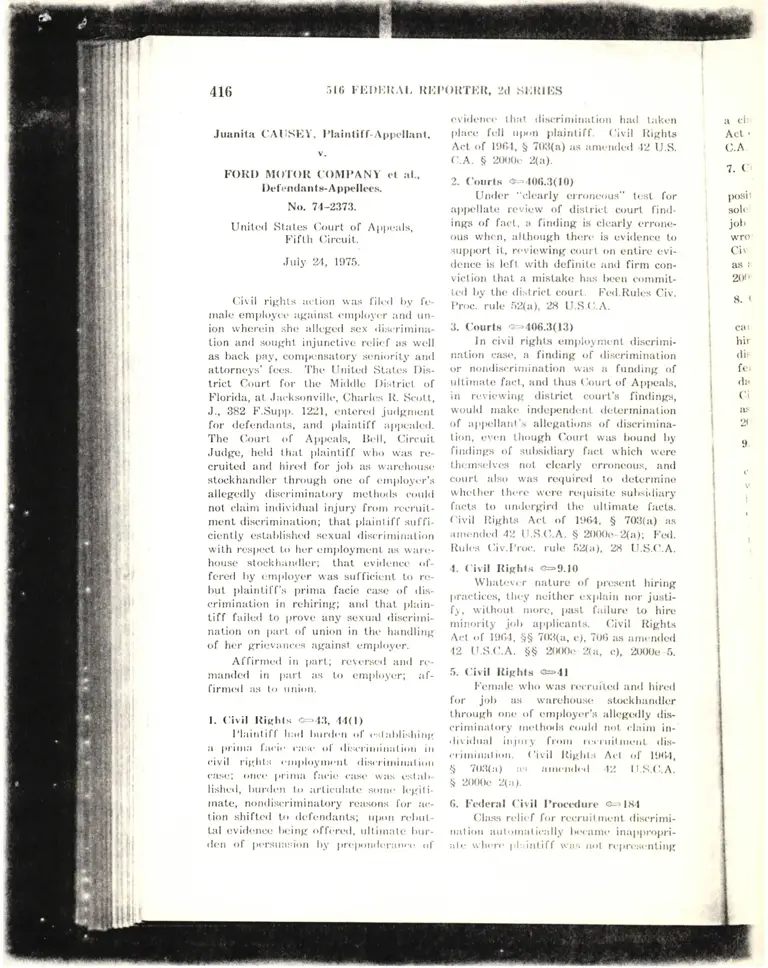
6 pages
-
Case Files, Garner Working Files. Causey v. Ford Motor Company Court Opinion, 1975. de2a5df3-34a8-f011-bbd3-000d3a53d084. LDF Archives, Thurgood Marshall Institute. https://ldfrecollection.org/archives/archives-search/archives-item/5edc7c04-84f7-4ff3-8ad4-c15fe4f7ba49/causey-v-ford-motor-company-court-opinion. Accessed September 27, 2026.
Copied!
41() .')!(; r i :m;uAi- i{ i :im) i{t k k , 2d si;inKS
Juanila C'AIISKV. I’ laiiitifr-A|>|H'llaii(,
V.
FOKI) MOlOK t'OMl’ANV H al.,
DoOndantH-ApiHdIoes.
No. 71-2.373.
United Stato.s (tuiirt of Apjieals,
Fifllt (Jircuil.
•luiy 24, 197.'').
(4vil rif^hls action was filed hy f»‘-
niale omployic anainsl employee .and un
ion whofein shi; alleg'ed sex ili.scrimimi-
lion and .son>rhl injunctive ladief as well
as hack pay, compensatory st'riiority and
attorneys’ fees. The United States Dis
trict Court for the Middle District of
Florida, at .laeksonville, (tharles K. Scott,
382 F.Su|)p. 1221, entered judjrment
for defendants, and plaintiff appealed.
The Coiirt of Appeals, Hell, Cinaiit
.Judge, held that plaintiff who was n.‘-
cruited and hinal for joh as w.arehou.se
stockhandler through one of employer’s
allegedly discrimimitory methods could
not c'hiim indi\ idutd injury from recruit
ment discrimination; that plaint iff suffi
ciently estidilished .S(,'xual di.scriminalioti
with respect to Iut em|)loyment as wate-
house stockhamller; that twiditice o f
fered l>y (.'mployer was sufficiimt to r<!-
hut plaintiff’s primti facie case of dis
crimination in rehiring; and that plain
tiff failed to |irove any sexual discrimi
nation on p;ut of union in the handling
of h(!r gri(!vances against employer.
Affirrni'd in part; r<;versed anil re
manded in part its to employer; af
firmed as to union.
I. Civil KiKids Orj i;i, 14(1)
I’laitdiff had hurden of e.sl ahlishinp
a prim.a facii' case of disci'imlnal ion in
civil rip.hls einployment. di.scriminal ion
c.ase; once prim.a facie I'ase was esl.ah-
lislu'd, hurden to articulate some legiti
mate, nondiscriminatory reasons for .ac
tion shifted to defendants; upon rehut-
t;d (widence being offered, ullimale hur
den of [lersuasion hy preponderance of
I'vidence that disimimination had tak»ai
place fill upon plaintiff. Civil Rights
Act of Rlfil, 5} 703(a) as amended 42 U.S.
C.A. § 2(»00e 2(a).
2. Courts '3̂ ='10(!.3(I0)
Under "detirly erroneous” test for
tipjiellate review of district court find
ings of fact, a finding is clearly errone
ous when, idthough tluna‘ is evidence to
support it. reviewing court on entire evi
dence is left with definite and firm con
viction that :i mistake has heen I'ommil-
ted hy the district court. Fed.Ruli's Civ.
Proc. rule .̂ >2(a), 28 U.S.C.A.
3. Courts '3^406.3(13)
In civil rights emiiloyment discrimi
nation cause, !i finding of discrimination
or nondiscrimiruition was a funding of
ultimate fiict, and thus Court of Ap|>eals,
in reviewing district court’s findings,
would make inde)K“ndent determination
of apjiellanl’s allegiitions of discrimina
tion, even though Court was hound hy
findings of suhsidiary fact which were
themsc'lves not ckairly erroneous, and
court also wais reipjirisl to determine
whether there were reipiisite suhsidi.ary
facts to undergird the ultimate facts,
t'ivil Rights Act of l ‘.M>4, § 703(a) :is
aim-nded 42 C.S.C.A. § 2000e-2(:i); Fed.
Rules Civ.Proc. rule .'>2(a), 28 U.S.(’.A.
4. Civil Rights <3=!).10
Whatewor nature of present hiring
prjictices, they neither explain nor justi
fy, without more, past failure to hire
minority joh apjilicants. Civil Riglits
Act of 1904, 703(a, c), 700 ;is amended
42 U.S.C.A. §§ 2000e 2(a, c), 2000e .O.
.O. Civil Riglits c^4J
Fcmi.'ile who was reeruitcsl and hired
for joh as warehouse stockhandler
through oni.‘ of (unployer’s allegedly dis
criminatory methods could not claim in
dividual in jui y from reel nil meut dis
ci imiiial ion. t'ivil Righls All of P.lCi-l,
tj 703(a) :ci amended 42 II.S.ttA.
ij 2()00e 2(a).
0. Federal Civil PriK-edure C^>I84
Class relief for rei'ruilnient discrimi
nation automal ically heeame inappropri
ate where phiinliff was not representing
7. (
8 . '
t *
ikon
U.S.
t for
find-
rone-
>'C to
• evi-
con-
'iinil-
Civ.
riini-
I'ltion
'K of
|)0!lls,
linjjs,
iilion
nina-
i(i by
wore
am]
mine
diary
facts,
i) as
Foil.
i.G. A.
■iiring
justi-
hiro
.’ if^bts
■ndoii
0o-5.
CAUSKY V. FOUl)
Cil«- as ."iH5 I
a class of discrimiiiatocs. ri\ll ItiKbts
Act of UMVl, § 70:i(a) as amondcil 12 U.S.
C.A. § 2000e-2(a).
7. Civil KiRlits o=.9.11
If female applicant for warehouse
position was not hired before five males
solely on basis of sex, employer’s later
job offer could not riRhl the statutory
wrong that it had earlier committed.
Civil Rights Act of likU. §!? 70;i(a. c), 7Ut;
as amended 42 IJ.S.C.A. §§ 20U0e 2(a, c),
20t)0e r>.
rojiri-
nting
8. Civil Rights fi=9.14
If, because of her sex, femah' appli
cant for wari'house position was not
hired before men, ein|)loyer could not
discount such discrimination by mingling
female’s suliscipient initial employment
date with dates two men were hired.
Civil Rights Act of RkU, §§ 702ta, c), 706
as amcndeil 42 U.S.C.A. §§ 2000e 2(a, (),
2000e 5.
9, Civil Rights c=>4Ur))
Female civil rights plaintiff suffi
ciently established sexual discrimination
with respect to her employment as ware
house slockhandler. despiti' employer’s
contention that previously hired males
were better ipialified than female pluin-
l i f f for job openings at warehouse. Cdvil
Rights Act of 1961, §§ 7t«(a, c), 7or> as
amended 42 U.S.tl.A. §§ 2000e ’2(a, c),
2l)00e f).
10. Civil Rights c=14(r>)
Kvidence offered by employer that
female warehouse stockhaudler s job |>er-
formance had been marginal during ini
tial five days of employment, that she
had been a disruptive influence on ware
house operations and that her husband
had reipiested a transfer at time rehiring
bi’gan was sufficient to rebut finnale
employee’s prima facii- case of discrimi
nation in rehiriiig. Civil Rights Act of
Itk’U, 70:t(a, c). 70('. as amended 42
U.S.C A. ’ZOOUe 2(a, c), 2000e 5.
11. Civil Rights rs^lltr.)
Feniak' warehouse stockhaudler
failed to carry her burden of persuasion
on claim of sexual discrimination on part
of emplo.ver in its failure to rehire him
r ?ti ?7
M O )R C O M l ’ A N V 4 1 7
■.'Jil I I I ) ( I ' .U . ' ) )
siibse.pient to being laid off. Civil
Rights Act of 1961. §§ 70:t(a, c), 706 as
amended 42 U S.C.A. §§ ’2000e ‘2(a, e).
2U0t)e 5.
12. Civil Rights g=44(5)
Kvidi'iice failed to (>stablish claim of
fimiale warehouse stockhaniller that em
ployer hail discriminated against her by
not providing adeipiate restroom
ties anil supplies at warehouse. Civil
Rights Act of Hk’vl, §!? 7(l2(a, c), 706 as
amendeil 42 U.S.C.A. ‘2(MK)e 2(a, c).
2lK)0e T).
i;i. Civil Rights ©=>44(6)
Female warehouse stockhaniller s
claim that extra ha/.ing she receivisl
from her fellow employees was product
of sex discrimination on part of employ
er was unsupported. Civil Rights Act of
Itk’i'l, §§ 70:i(a, c), 706 as amended 42
U.S.(7A. §§ 2000e 2(a, c), 2000e 5.
14. Civil Rights ©=^41(.6)
Female warehouse stockhaudler, on
claim that union had discriminated
against her in processing grievances, had
luirden of proving by preponderance of
evidence that union’s alleged actions
were arbitrary, liiscriminatory or in bad
faith Civil Rights Act of 1961, § 7(W(c)
as amendeil 42 U.S.C.A. § 20(K>e 2(a).
1.6. Civil Rights c=>44(5)
Female warehouse stockhaudler
failed to prove any sexual discrimination
on iiart of union in the handling of her
grievances against employer. (7vil
Rights Act of Itk’vl, § 70:t(c) as amended
42 U.S.C.A. § ’2000e '2(a).
Reese Marshall. Uarry R. Jackson. Karl
M. Johnson, Jacksonville, Fla., for plam-
tiff-ap|iellanl.
(hiry Ik 'I'uHis, Jere D. McWinti, Jack
sonville, Fla., for Ford Motor Co.
Richard II. Frank, I’ampa. Fla., for
United Automobile Workers, etc. and
...... 970.
A]i|ieal from
tiict Couit for
Florida.
1 Inited
Middle
States Uis-
District of
IS'
)KI{AI. mj'OffTKff. L>(| SKlfllOS
liclorc HKM,, DYKK iiimI SIMPSON
(■ircilit .IlKijrcs.
HIOI/P, ('im iil ,In(I(>(':
1 Ills ;i|)|)(>:il is taKi ii from a ju(lfr„|,.,,(
:ulv(>rs.' 1.) appollanl Juanita Causey in
her employ,n.nt diseriininalion action
ufrainst I'ord Motor Comjjany, I In.- Unit
ed Autoniohile, Aeros|,ace, and Aj^ricul-
lural Implement VVorkei’s of Ameiica
(U AW ) an.l its Local <I70. Suit was
I'rouKht unde,- Title VII of ||„. Civil
Ilifthts Act of [JO li.S.ttA
§§ 200ne 2(a) (Fo,-d), 2IK)l)e 2(c) (the Un
ion)), aj.pellant alle>rintr di.sc-iniinatio,,
I'lisod on .sox in Ko,-d’s |,i,-inK and e,n-
ployment practices, and in tlu- union’s
e,„ployee re|>,-e.sentation.' T|,o district
com-t ml,si that appellant ha,l failed to
estahlish hy a p,'epo„derance of the evi
dence her clainis afrainst either Fo,-d
the union. Cau.sey v. Ford Motor (7,
M.D.Fla., It,71. 3H2 F.Supp. 1221. We
affirn, in |,;,rt and ,eve,-.se in |>art as to
l-'onl, hut affirn, as to the uni,,,,.
I he I'o,-d parts distrihution wa,-ehou.s<'
in Ja.-ksonville, Flo,-ida, r<'K„larly e,n-
i)loys between sixty and sixty-five per
sons. The wa,-eh(,use taps th,-ee basic
sou,-ce.s lor new employees: ,-efer,-als
froni |„-e.sent employees, refcrals of mi-
no,-,ty frroup me,nbe,-s f,-<„n the National
Alliance of Husinessme,,, and unsolicited,
“ walk-in” applications. Prior i,, the date
of a|)pellanfs a(>plication. a won,an had
never b,'en |,i,-(sl at the wan-house, ;d-
Ihoufrh four wonien had applied. FonI
did not have a ,-ecruit ment pidfr,-am
aimed at hirinjr women.
A[)l)ellanl expeiiencsl th|-ee employ,
ment phases with FonI. .She was fi,-'st
lure,I on July 2<J, 1971. and worked for
one week before bein r̂ |ai,| ,,ff hocau.se
of a nsluclion i„ Fonl's work foioe. A,,,
pellant vvas rohn-ed in (h-loho,- ipyi hut
was l.iiil o ff a .se,-oi„| |i„„,
ll'n-.l ,.,.,-io.| of ...nploy,,,,,,,!
I. In s . r i i o n 70li „( ||„.
|iloviiic,it ( )p|.nriiimly Ac, of 1U72 |12 U s
• tiled chaozi'.s with
11,C l,,n|>lny„„.„| 0|,|,oiluMiiv Commis
"""■ "■ I o'm
on Mm-eh «. 1972. an.l laste.i for
nearly two years (throuKhout most of
'b<‘ period o| the suit). She was laid off
for Ihe ̂thinl a,„| h,st time on January
On Januai-y I8, 1971, ap,K.|lanl file.l an
application for emi,loym<-nt with Ford
haviuKr iK-en referred by her husband.’
who was, at the time, also employed at
the warehouse. Although FonI offo,-ed
her a job as a stoekhandlcr on July 29, it
hire,I five n.ales for the same position '
<iur,ng tin- interim, all of who,,, had ap-
plie.l for jobs after a|)i>e|lant. The
warehouse supervisor in chai-Ke of hiiin.r
test,fie.l that he ,li,| not .-ompai-e appli
cants for job oixminirs, but chose sia-cific
persons ba.se.l ujxm his “subjective ap-
Iiraisal” of their (lualifications for the
• lesire.l positions.
Of the five males hii-e.l .luring the
Janna,-y-July intei-im, the first, who was
hire,! on Ap,il 13, ha,I i„-evious experi
ence at another warehouse; anotlu-r was
an NAP ,ni„„rity jrrouj, referral; a thii-d
was a “ walk-in” ap))lica„t with experi
ence at a FonI parts ,l,-p„t; two others
were sons o," wai-ehou.se employe s.
In May 1971, appellant went to the
wan-house to diseuss po.ssible job open
ings with the warehouse supervisor and
111,- local union president. The latter
toM her that her emjiloymcnt ,-hances
vvouhl I,.- pn-ater were sl„- to picket the
warehoii.se. As a con.s,.<)uer,e(-, aiipellant
|»ck,-t,-.l FonI for thre.- .lays .luring
May. 7 he warehouse sup.-rvi.so,- losU-
fled that appellant’s pick.-tinj was an
indication of |„-r .serious ,lesii-e to work
for FonI. an.l she was hire.l two months
Inter. It is nn.hsputed that no mah- aj,-
plicant w:is r.-.,ui,-e,l to picket in onler to
show niten-st in, jrain employment
with, Foril.
Ibniiifjf ;ipp,.II,ant's initial
'■ni|.loymeni, sh.- was subj,-,-|,
by h,-i- li-ll.iw ,-mp|oy,.,.s,
e \ p ,- r i,r , i| - ni-w wiukeis.
W.'i 'k-lo ll fr
d lo ha/iiif,
ensi omai-y
( alli-d I Ili
um,.11 w ill, \„ i,,n „„s fni,. \ It ,,|
egh is A . , of On A,,n| W 12. ,|,e
l . < ) ( .•ulvi,.,.,) ■,p|„.||a„| lo
uniins, l■o,,| IIAW, „n,l .su,,
r. IiImI ||,„,v ,-,ill,-r.
Iht
ur
\v;
lai
r o '
til
lit
<ii
rt
hi
!>'
si
II
I»
n
h
c
V
1.
c a u s e y V. FORI)
{‘il«> MS ."iin
“ box treatmoni;’ this lui/.ing involved
the throwing of an inordinate number of
used boxes into the aisles that appelbrnt
was cleaning for her to iliseard. Appel
lant also testified that the women’s rest
room w-as not ajipropriately marked, and
that both janitorial supplies and union
literature were stored therein.
On August 5, appellant w-as laid off
due to a reduction in work force, and not
rehired until October 1, 1971. Ford
hired five male stockhandlers, a 1 of
whom had applied for jobs after .July -.»,
prior to rehirintt appellant. Under provi
sions of the collective barKainmn agree
ment between Fonl and the union, ap
pellant, as a probationary imiployee. had
no riKht to be recalled by Ford. ̂ I'or.l
has allegeil, moreover, and the district
court found, inter a//a, that there wi.'re
palpable reasons for not immcsliately re
hiring appellant: (1) her job |.erlonn-
ance had lieen marginal, if not siibst.ind-
2 Article VIM, Section 4 of tlie collective liai-
gaVning agreement tietween Icrcl and UAW
provides;
(a) Acquiring Seniority
New employes and rehired employes
regarded as probationary employes and shall
establish seniority after the first ttiree (.i)
months of continuous employment with the
Company, and if retained tliereafter shall lie
placed upon the seniority list in the senionty
group in tlie Unit or plant where ttiey are thcai
working with seniority as of Ihe date ol hiiiiig.
In order to tiecome a seniority employe, a pro
bationary employe must have been employed
for a total of three (3) months withn. the year
following the date he was hired or last rehned
whichever is the later. For the purposes ot
this Section, periods during whicli Ihe employe
was laid off, or on leave of absence for any
reason, or employed on an exc hided classilica-
lion, shall nol be considered as peinals ot ein-
ploymenl.
Following completion of Itis probatimiai y peri
the employe shall lie given seiiioiiiv as ol
.late he was lute...... hel lelllied. wlll. ll
cvei is the l.ilei. as set loill, in the In .1 p.n.i
graph of this Snlisectioii
MOTOIf ( ’()> ANY
■,2.i .1111 (iii7:>)
ard; (2) sdic bad ba<l a distuitlivc itiflu-
cnco on Ibc warcbotisc uiMtraliotis; and
(If) her litisbiind bail rc'|Ucsfod a transfer
subsciiuent to tbe July 21) biy-off.
Ncvcrtbeless, appellant was rebired on
October 4 and worked until October ‘29,
when site w:is laid o ff <iuring anotber
work force rmluction. It was not until
March 6, 1972 tbiit site was rebired for
tbe second time, but thereafter, she
worked tit the warebou.se until January
18, 1974.
(c) Proliationary lanployes—1 .ayolI and Kei .ill
When possible, the < omisniv di.dl .idheie to a
policy of laving oil and relniing, i>i obat lonai y
employes, within an occiipation.il gtonp, oi
within the Labor I’ool. m accordance wilb
This action wits commenced on May
16, 1972.’ Appellant charged tluit Ford’s
(1) recruitment itrocedtires, (2) ftulure
initially to hire her prior to hiring male
applicants for tbe stiine |>o.sition, (8) fail
ure to rebire her during tbe July-Octolier
1971 interim prior to hiring mtiles for
the siime position, (4) ftiilure to jirovidc
adequate restroom facilities, tmtl (6) con
donation of employee htizing, were viola
tions of 42 U.S.C.A. § 2000e ‘2(a).^
their date of liire, provided that the Company
shall retain the sole discretion as to Ihe laying
off transferring and rehiring of probationary
employes, except in t .ises of c laimed discrtmi-
nation
.3, The action was origin.dly bled by appellant
"on her behalf and on behall of other persons
similarly situated who have been denied or
l,een dismissed from employment by the Ford
Motor Company at its plants and/or other fa.
cilities located in the .Stale of Florida, and in
Olid around the City of .lacksonville." <>n Feb
ruary 26, M174. the district court disallowed
class action status for lack of mmierosity and
adequaev of representation by aiipellant. This
order has not been challenged on appeal.
■I 42 U.S.C.A. S 2l)l)Ue ’2(a) stales that it shall
be an tinlawlul employment practice for an
(1) to tail or refuse to hire or to di.se haige any
mdividiial. or olheiwise to discriminate against
..„V individual with inspect t.l his compensa
, i„o leims, .■onditions, oi piivileges ol cm-
,,|os'ineiil. because ol sneb individnal s race,
io lo l lellgion, s e x , ...... alloll.d oligin; oi 12) to
liilill,' segiegale. ni , lassily bis ...... . ol
,„ ants loi en.ploynieni in any way will h
would dep.ive or ................ ,iny mdividu
,, cniplovinent oppoi tiiiiit les or olberwise
a.lveiselv alic.t bis .stains as all ein|.loyee, be
cause ol such individual s la.'e, lo lo i , ndigion,
sr\. or «»i
,iO
120 r>ir> FEDIOltAL KEI'OIM'EK, 2<\ SEHIKS
5 *
41
‘i ! 1
ii 4
15 ■
• f
f i 4
-1.
i i
’t j
4 l(
.»’ :Z T
M.* h
91
AppHlanls rlaims ap.amst tl)<- iiniffii
stem rroiii Die laUcr’.s allcpcd cutuldna-
lion of tanployoc liazinjr (i. o,, tlio Iio.n
troal riK'til disoussod siiprii ), and its al-
logod failuro sufficiently to pursue the
H r̂icvanccs filed l>y her against Ford.
These f,n'i‘ 'vanees bewail in Oeloher
1!)71 wluni ap|K!llant jrrieved that she
liad been denied a forklift operator’s
license. She testified at trial that she
hail voluntarily abandoned this frrievance
and did not fault the union therefor.
On March 2\, 1!)72, appellant f,>rieved
that the two lay-offs that stie had expe
rienced were the result of .sexual dis
crimination. 'I’liis grievance was prejiar-
ed l)y the union president, presented to
Ford’s warehouse foreman, and denied
hj him two days hiU'r. A union commit
tee later agreed that this Kfievance was
without merit.
A third Krievanee was filed in early
•luiR' i;i7t:. Appellant had been promot
ed fr-onr stockhandler to “ war-ehotrse-
r7ian in May, hut was demoted on .tune
2. She complained to the irnion ami a
^rii.’v.tnce wa.s filed, ’i'he pr'oci'ssirrjĵ of
the f^rievanee eiilminateil in an arbitra
tion award frranting- ajrpidlant the
claimed |)osition. (This grievance was
concerned with an event which look
place after the filing of suit birt was
included as an issue by pre-trial stiprrla-
tion )
|l| Appellant .sought injirncti\c relief
agiunst both Fonl and tire union, as well
as back pay, com])ensatory .seniority, and
itltorneys’ fees. The district <■01111 de
nied all i-elief, holding that appellant had
failed to establish di.scrimination by a
preponderance of thi' evidence on any
ground alleged.'’
.t. I l v p i e l n : i l s i i p i i l . i l II III II l ) e r : i i i i e i li .11 ||,.,|
l l i e l l . l l l o l i i i t l i i i i i u i w i e . I l l l l l g i l i i i p c i l l l i i i i i i p l i
r i l e i l l l e p e i l e i i i l i t i u l ii| ||i e l o i . i t W e l e l e l I n
l i o l l l I IS I t l e " i i i i i o i i " .
r». As lo eacli .illegcil aet ol itisi 1 iininal 11111. ap
peltaiil tlait Itie tninlcn ot estatilistliiig a pijiiia
facie ease ol disciiiiiiiuujon Mi IJonnell Doug
las Coip. V . (iici'ii. |<)73. 411 tt.S. 7112. S02. Iti
.SCI. 1817. .id I.,t;d.2d (i(i8. d77. Once a puma
tacii' case was esialilislied, Itie Imnleu - lo .11
liy way of a preliminary summation,
we find error only in the holding of non-
disci'iniination in the original hiring of
appellant. 'J'he district court will U? af-
liiineil in all other ix’speets.
II.
121 At the out.set, it is important to
delineaU' our stanilard of review for a.s-
sessing the correctness of the district
court’s nomiiscrimination findings. Rule
f)2(a), F.R.Civ.I’., lays down the “clearly
<■rl•oneous’’ test for appellate review of
district court findings of fact. Under
Ihr.s lest,j i finiliiij^ is clearly eri-oneous
w Iren although there is evidence to su^
[joi t it, the reviewing court on the entire
'<l<-nce is I.Tt with the definite and
fTmTconvictionTliat a mistake ha.s" lR7Ti
committed” by th^TdiStnlT court.— Dnit-
ed̂ 7?raT.es v. United States U.ypsum 0>.,
;?;w U.S. 89.5, 68 S.Ct. 525, 542̂
92 li.Fd. 746, 766. Soc also Chaney v.
Uily of Calveston, 5 Cir., 1966, 8(W F 2d
771, 776.
I here exists, however, a significant
ilislinction for the pui-|K).se of applying
till’ clearly erroneous test liQ'tween find
ings of subsidiary fact and "fin<|in(fa o7~
iilli'iniite fact. See Galena OaK.s Corji. V.
ScofidTlTTrUIr., 1954, 218 F.2<l 217, 219 -
Finding a subsidiary fact involves
the iletermination of an evidentiary oc
priiiTaiy fact; fimlii^r an u kbm ^^
Oil Lllc~7)tlier hand, “ niay iiivailveTtuTviê /
basis oiiTvhich judgment of fallible evi-
iiT'ttr-tie^^^ile.’’ Hjiumgartner v.
United States, 1944, 322 U.S. 665, 671, 64
S.Ct. 12-10, 1211, 88 L.hkl. 1.625, 1529.
Thus, for example, a finding of infringe
ment of a patent is a finiling of ultimate
fai-t, .see Industrial Instrument Corp. v.
Foxboro Go., 5 Fir., 1962, 807 F.2d 7̂ 8,
7,86 n. 2; as is a finding that a gain
I I I I I I . l i e s o m e .................... , l i o n , l l s l ■ l l m i l l . , | „ , v
lc.lM,M•■ loi Oh II .11 lion sliiln-il lo Oic iip|)<-|
I ' '- . h i . I l l D . s ,ii 802, lilt .S n I II IH2I. 3li
t i l l -’ ll III Ii7s .See .lis t) I’oiiil V Hriinilt Air-
wiivs. liK ., .'t ( II , 11171, riOO t 2d ICl. 167.
Upon ictinlliil cvidciit (> liciiig nffi icd. ih ’. ,,10
iniile tinnlcii ol pcrsniision hy ii prcpondi-rancc
ot llic l■vi(lcnc(■ iliiii disciiniiniilion had taken
l>liir-c tell upon iippcllunt's .slioiildcrs. C l. Bit-
lin V Ail Ciniiidii, h C ir. 197,̂ 1. 612 f 2d 582
.5s:< s:i.
>n,
in-
of
if-
to
:is-
■ict
ule
rly
of
ier
ous
U[>-
l i re
ind
c;on
nit-
th.,
-.42,
V.
’ .2(1
i
- i
I
CAIISI‘]Y V. r o u l )
< 'itc MS r)l() I '
should 1)0 troaU‘d as (*a[utul raLhor than
ordinary for income tax (.iirposes. Sea
Gamble’ V. O.mmissioner, 5 Cir., 1957,
242 F.2<i 5H6, 590. Willi ii ’spect to iilU-
mato findbigH (if fact, furthermore, wo
noted in Industrial j nstruinont Gprji. v.
FoxBoro tl<7., siifiru, 307 l*.2d at 7S(> n. 2.
We may reverse f ree of the cleaily
erroneous rule whore the is-
sue" revolves around an uTtunatc fact
question asTTistinj^uished from sulisidi-
af3T fact Tfuesti oils
See~3f5tr'GaI^a Oaks Gorp. v. Scofield,
supra, 218 F.2d at 219.
[3] Although discrimination vrl non
is essentially a question of fact it is, at
the same time, the ultimate issue for
resolution in this case, being expressly
proscribed by 42 Ll.S.t .A. § 2000e 2(a).
As such, a finding of discrimination or
nondiscrimination is a finding of ulti
mate fact. See Hester v. Southern Rail
way Co., 5 Cir., 1974, 497 F.2d 1374,
1381; United States v. .lacksonville Ter
minal Co., 5 Cir., 1971, 451 F.2d 418,
423-24. In reviewing the district courts
findings, therefore, we will proceed to
make an independent determination of
appellant’s allegations of discrimination,
though bound by findings of subsidiary
fact which are themselves not clearly er
roneous. Also, as in llumpbieji v.
Southwestern F’ortland Cement Co., 5
Cir., 1974, 488 F.2d 691, 694, we must
determine’ whether there are iv<iuisite
subsidiary facts to undergird the ulti
mate facts.
7 ̂ Xestimony was adtliicial at liial that l.ctwccn
July 1971 and March 1974, appm.xiinatcly sev
en women were hired by lord, rttsnUing in <i
ten percent female workforce at the waie
house. It is well-set tieil, however, that
“ [w’Jhatever the nature of present hiritij; prac
tices, they neither explain nor justify, without
more, the jiast failure to hiie minoiity
Ijol) applicatilsj.' ' Hodiiitiie/ v. l-.ast Ii-xas
Motor I ren’.ht. .5 ( it.. 1974. 9tl.9 t.7d III, 94.
.S’ec also ( ianihle V. Iliu iiini’hairi .9 l( K ( 'o , !>
Cir 1!I79, .914 I' 7d h.S, Powe v (in ie ia l Mo
tors Coip.. .9 Cir.. 197'.', 497 t .191 94H, :t99,
Jenkins v. United (ias Coi|i., 9 ( ir., I9lis, 40(1
F.2d 28, :S3.
8. A similar result obtained in Del unis v. (ide
gaard, 1974, 41(i U .S. .'112, 94 S< I. 17(|4. 411
M O T O C O M P A N Y 4 2 1
'.L’ ll lilt ( 9|
1. Ford’s RecruiUnent Methods
|4| Apiicllant contends Unit the dis
trict court erred in finding h’ord’s rc-
cruitment methods to be nondiscriminal-
ory. It is agreed that Ford hires new
warehouse employees from three
sources: walk-ins, employee referrals,
and NAB minority group referrals. Pri
or to appellant, four women had sought
employment at the warehouse, all with
out success.’'
(5,6) Review of the merits of appel
lant’s contention on this point has be
come unnecessary, however, because ol
the coalescence of two factors. First,
appellant herself w;is recruited and hired
through one of the allegedly discrimina
tory methods: her husband, a Ford em-
[iloyee, referred her for the job. 'rhus,
she cannot claim individu.il injury from
recruitment discrimination." Second, ap
pellant is not representing a class of dis-
criminatees. See note 3 supra. Conse
quently, class relief for recruitment dis
crimination automatically becomes inap
propriate within the cont.i’xt of this dis
pute."
2. Ford's Initinl Hiring o f Ai>pellunl
Appellant’s claim of discrimination in
Ford’s origiiiid decision to hire her rests
upon a more solid foundation. The dis
trict court concluded that the three
mides hired in April :uid Mtiy 1971 be
fore apjiellant was hired in July “ were
hired solely on their (iiialifications to
jierform the work at the wtire.house fa-
I. 1.(1.2(1 1114 I bcK', priil iom i siicil the ic-
spoiuleiit law school lor alleged rcvorsti racial
discrimination. No class relict was sought,
and petitioner's individual claim was found to
be moot. In effect, petitioner had no case
against the law school because he had suffered
lua real injury, htiving been admitted and al
lowed to comiilete his course o f study there
9. W heie coiiils have loimil recuilment inelh
ods to he in violation of 42 tl .S ( '.A. § 2(l(l(le
2(a), ihe leliel p.ianied h.e. nsually been In
lesponse to cl.e,'. di:a liiiiination ;if:pei Is ol the
respeelivi' eat.es .See. e )•, I’el lway v. Aineii
e;ni Cast Iron I'ljie ('o., .9 ( it., 19/4, 494 l',2ii
211, 244 45; United .Stales v. Georgia Powei
Co.. 5 ( ir , 1973, 474 r.2d 90(1, 925 2(1; I’ .ir
ham V. Soutliwesleiii Hell telephone C o , H
Cir., 1970, 433 I 2d 421, 429 28.