Brief in Support of Board of Education Defendants' Motion to Dismiss Plaintiff-Appellants' Appeal
Public Court Documents
January 1, 1970
7 pages
-
Case Files, Milliken Hardbacks. Brief in Support of Board of Education Defendants' Motion to Dismiss Plaintiff-Appellants' Appeal, 1970. 03247d61-52e9-ef11-a730-7c1e5247dfc0. LDF Archives, Thurgood Marshall Institute. https://ldfrecollection.org/archives/archives-search/archives-item/60837dfb-3748-4aec-b3ab-cc05a004b43f/brief-in-support-of-board-of-education-defendants-motion-to-dismiss-plaintiff-appellants-appeal. Accessed October 05, 2026.
Copied!
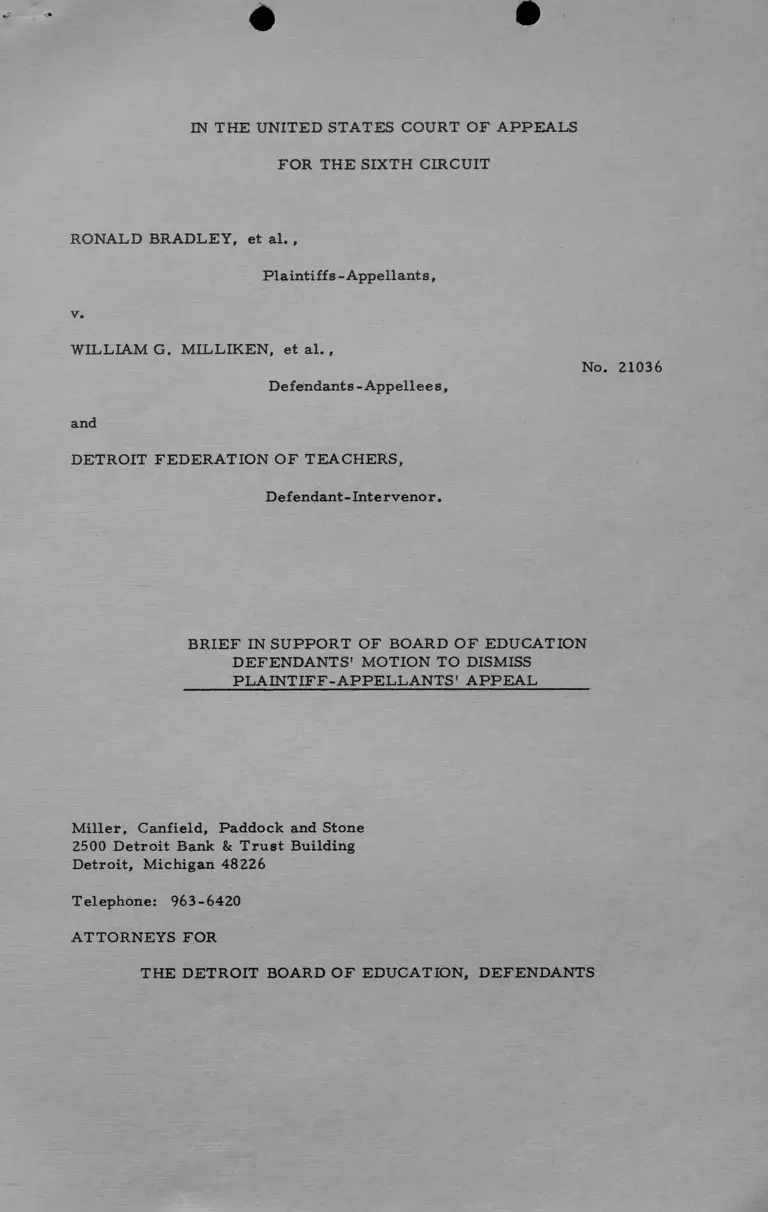
IN THE UNITED STATES COURT OF APPEALS
FOR THE SIXTH CIRCUIT
RONALD BRADLEY, et al. ,
Plaintiffs-Appellants,
v.
WILLIAM G. MILLIKEN, et al. ,
Defendants-Appellees,
and
DETROIT FEDERATION OF TEACHERS,
Defendant-Intervenor.
No. 21036
BRIEF IN SUPPORT OF BOARD OF EDUCATION
DEFENDANTS' MOTION TO DISMISS
PLAINTIFF-APPELLANTS’ APPEAL
Miller, Canfield, Paddock and Stone
2500 Detroit Bank & Trust Building
Detroit, Michigan 48226
Telephone: 963-6420
ATTORNEYS FOR
THE DETROIT BOARD OF EDUCATION, DEFENDANTS
M
IL
LE
R.
C
AN
FI
EL
D
, P
AD
D
O
CK
A
N
D
S
TO
N
E.
2
30
0
D
ET
RO
IT
B
AN
K
ft
T
RU
ST
BU
IL
D
IN
O
. D
ET
RO
IT
, M
IC
H
IG
AN
4
B
22
S
IN THE UNITED STATES COURT OF APPEALS
FOR THE SIXTH CIRCUIT
RONALD BRADLEY, et al. ,
Plaintiffs - Appellants,
v.
WILLIAM G. MILLIKEN, et al. ,
Defendants - Appellees,
and
No. 21036
DETROIT FEDERATION OF TEACHERS,
Defendant-Intervenor 0
________________________________________________________________________________ /
BRIEF IN SUPPORT OF BOARD OF EDUCATION
DEFENDANTS' MOTION TO DISMISS
PLAINTIFF-APPELLANTS' APPEAL
I. PLAINTIFFS LACK STANDING TO RAISE, AND THIS
COURT LACKS JURISDICTION TO ENTERTAIN, AN
APPEAL FROM THAT PORTION OF THE DECEMBER
3, 1970 ORDER OF THE DISTRICT COURT ORDERING
IMPLEMENTATION OF THE MAGNET PLAN.
(a) Plaintiffs Are In No Way Aggrieved By that
Part of the District Court's Order of
December 3, 1970 Ordering the Board of
Education to Implement the Magnet Plan.
It is well settled that no appeal may be had from a judgment or order
entered by a Federal District Court by a party not aggrieved by such order or
judgment. Sperry Rand Corp. v. Bell Telephone Laboratories, Inc. , 317 F. 2d
491 (2d Cir. 1963); Milgrim v. Loew's, Inc. , 192 F. 2d 579 (3rd Cir. 1951),
cert, denied, 343 U. S. 929 (1952); 13 Cyclopedia of Federal Procedure, §58.07.
For purposes of determining whether such a right to appeal exists, resort must
be had to:
. . the decretal portion of the decree. It is this and this
only that becomes the final judgment of the Court from
which an appeal will lie. " McGhee v. Leitner, 41 F. Supp.
674 (W.D. Wis. 1941).
- 1 -
M
IL
LE
R,
C
AN
FI
EL
D
, P
AD
D
O
CK
A
N
D
S
TO
N
E,
2
30
0
D
ET
RO
IT
B
AN
K
A
T
RU
ST
B
U
IL
D
IN
G
, D
ET
RO
IT
, M
IC
H
IG
AN
4
82
20
4
No feature of that portion of the District Court's Order of December 3, 1970
ordering implementation of the Magnet Plan denies relief sought by Plaintiffs,
grants relief against Plaintiffs, or in any way operates adversely to Plaintiffs.
In their "Motion for Summary Reversal or In the Alternative for
Injunction Pending Appeal" at page 3, Plaintiffs state that the December 3 Order
" , . . den[ied] the request to implement the 'April 7, 1970' plan for the second
semester of the current school year. " An examination of this Order demon
strates the absolute falsity of this representation. In fact, the thrust of this
Order is to mandate action by the Board of Education Defendants. Further,
this Court may not indulge in the assumption that the District Court's Order man
dating action by the Board of Education Defendants necessarily denies Plaintiffs'
Motion to Implement Plan, since the testimony in the record is clear that the
two plans are compatible and not mutually exclusive. (11/19 Tr. at 217).
In addition, the record below makes absolutely clear that none of the
named plaintiffs would have been affected by the April 7 Plan. (11/25 Tr. at
316, 361). Since the District Court has not yet rules Plaintiffs' purported class
action to be appropriate pursuant to F. R. C. P. 23 (c), Defendants-Appellees
contend that the question of whether Plaintiffs are aggrieved must be determined
by reference to the named Plaintiffs alone. In fact, none of the name Plaintiffs
have been so aggrieved.
In short, Plaintiffs premise their appeal to this Court upon the
District Court's denial of their Motion to Implement Plan. In truth, no such
denial can be found in the District Judge's Order, his Rulings, or anywhere else
in the record below. Rather, the District Judge ruled in favor of Plaintiffs-
Appeliees and mandated action by the Board of Education Defendants. Further,
no named Plaintiff would have been aggrieved even if the Motion to Implement
Plan had been denied. Plaintiffs-Appellants may not therefore be heard to com
plain of the Order entered by the District Court on December 3, 1970.
-2 -
H
IL
LE
R,
C
A
N
ri
E
LD
, P
AD
D
O
CK
A
N
D
S
TO
N
E,
2
SO
O
D
ET
RO
IT
B
AN
K
&
TR
U
ST
B
U
IL
D
IN
G
, D
ET
RO
IT
. M
IC
H
IG
AN
4
82
20
• •
(b) This Court Lacks Jurisdiction To Hear Plaintiffs -
Appellants' Appeal with Regard To the Magnet
Plan Since It Is Interlocutory and Does Not Come
Within the Terms of any of Those Sections of the
United States Code which Permit Interlocutory
Appeals.
As jurisdictional bases for their appeal, Plaintiffs-Appellants cite
28 U. S .C . §291 (c), 292(b), 1254 and 1292(b). None of these sections provides
this Court with jurisidction to entertain this appeal. Section 291 (c) permits
designation of a circuit judge to sit as a district judge. Section 292(b) permits
designation of a district judge to sit in other than his home district. Section
1254 provides for methods by which cases in the courts of appeal may be re
viewed by the Supreme Court. Section 1292(b) provides for discretionary review
by courts of appeal of controlling questions of law certified by order of a district
court. Clearly none of these sections applies to the case at bar. Indeed, none
but 1292(b) speaks to the question of interlocutory appeals at all.
The only jurisdictional provision of any relevancy whatsoever to
Plaintiffs-Appellants' appeal is 28 U. S. C. 1292(a), which provides for inter
locutory appeals in several situations. However, since this Section carves out
exceptions to the strong Federal policy against piecemeal appeals from Federal
District Courts, it must be narrowly construed. Baltimore Contractors, Inc, v,
Bodinger, 348 U. S. 176 (1955); Switzerland Cheese Ass'n. v, E. Horne's
Market, Inc. , 351 F. 2d 552 (1st Cir. 1965); Florida v, U. S. , 285 F. 2d 596
(8th Cir. I960). So construed, this section cannot be read to support an appeal
by Plaintiffs from the Order entered below.
Among the exceptions contained in this section, only that contained in
§ 1292(a)(1) applying to injunctions requires discussion here. This section pro
vides in its entirety:
"The courts of appeals shall have jurisdiction of appeals from:
Interlocutory orders of the district courts of the United
States, the United States District Court for the District of the
-3 -
M
IL
LE
R,
C
AN
FI
EL
D
, P
AD
D
O
CK
A
N
D
S
TO
N
E,
2
SO
O
D
ET
RO
IT
B
AN
K
ft
T
RU
ST
B
U
IL
D
IN
G
, D
ET
RO
IT
, M
IC
H
IG
AN
4
82
2S
4«
Canal Zone, the District Court of Guam, and the District Court
of the Virgin Islands, or of the judges thereof, granting, con
tinuing, modifying, refusing or dissolving injunctions, or re
fusing to dissolve or modify injunctions, except where a direct
review may be had in the Supreme Court;"
Thus, for Plaintiffs-Appellants to successfully base this Court’ s jurisdiction on
§ 1292(a)(1), they must show that the District Court's direction to the Board of
Education Defendants to implement the Magnet Plan presented to the Court
constitutes an order granting or denying an injunction. They also must show, as
emphasized in the earlier section of this brief, that the thrust of such in
junctive order was adverse to them.
Many cases emphasize that not all orders containing words of re
straint, direction or command constitute injunctive orders. United Bonding
Ins. Co. v. Stein, 410 F. 2d 483 (3rd Cir. 1969); International Products Corp. v.
Koons, 325 F. 2d 403 (2d Cir. 1963); Taylor v. Board of Education, 288 F. 2d
600 (2d Cir. 1961). Certainly the Order-drafted by Appellants and opposed by
Appellees- which was entered by the District Judge herein is not styled as an
injunctive order. In this context the cases cited above are yet more persuasive.
In school desegregation cases, there is a split of authority as to whether an order
!
requiring a board of education to submit a plan of desegregation constitutes an
injunctive order. Taylor v. Board of Education, supra. But cf: Board of Public
Instruction of Duval County, Fla, v. Braxton, 326 F. 2d 616 (5th Cir. 1964),
cert, denied, 377 U. S. 924 (1964).
Defendants-Appellees submit that the serious question concerning
whether the Order here involved constitutes an injunction at all, together with
the patent fact that the Order runs against the Board of Education Defendants and
not against Plaintiffs-Appellants, requires this Court to decline jurisdiction over
the instant appeal.
-4 -
M
IL
LE
R,
C
AN
FI
EL
D
, P
AD
D
O
CK
A
N
D
S
TO
N
E.
2
30
0
D
ET
RO
IT
B
AN
K
ft
TR
U
ST
B
U
IL
D
IN
G
, D
ET
RO
IT
, M
IC
H
IG
AN
4
S2
20
II. THIS COURT LACKS JURISDICTION TO REVIEW
THAT PORTION OF THE DECEMBER 3, 1970
ORDER CONTINUING THE TRIAL OF THIS
MATTER, SINCE IT IS INTERLOCUTORY AND IS
NOT INJUNCTIVE IN ANY MANNER.
Even were this Court to assume jurisdiction to review that portion of
the December 3, 1970 Order requiring implementation of the Magnet Plan on
the basis that it constitutes an injunctive order, jurisdiction may not similarly
be conferred upon this Court to review that portion of the Order granting a
continuance of the trial of this matter. As noted earlier, §1292(a)(1) must be
narrowly construed, since its effect is to fragment litigation and permit
multiple appeals arising out of a single lawsuit. However, even if broadly con
strued, this provision granting interlocutory appeals from injunctive orders
cannot encompass the District Judge’ s granting of a continuance. Matters such
as continuances are purely procedural in nature and have no injunctive aspects
whatsoever.
In their recent letter to this Court, counsel for Plaintiffs-Appellants
cite United States v. Texas Education Agency, 431 F. 2d 1313 (5th Cir. 1970),
which held an order setting pretrial conference to be reviewable under § 1292(a)
(1). However, the order there in question was found to have had the effect of deny
ing plaintiffs' pending order to show cause why a desegregation plan should not
be implemented immediately. In short, the order there involved was one deny
ing Plaintiffs' motion for injunctive relief. In the matter at bar, the District
Judge's grant of a continuance of trial does not have the effect of denying to
Plaintiffs-Appellants any injunctive relief whatsoever. Further, Texas
Education Agency, supra, involved a remedial situation wherein the District
Court's order effectively frustrated compliance, by an admittedly dual system
of schools, with the mandate of Alexander v. Holmes County Board of Education,
396 U. S. 19 (1969). In our case, as Judge Roth pointed out in his Ruling on
Plans, the segregated or dual nature of the Detroit Public Schools may not be
presumed. Absent the unusual and compelling factors present in Texas
-5 -
M
IL
LE
R,
C
AN
FI
EL
D
, P
AD
D
O
CK
A
N
D
ST
O
N
E,
2
50
0
D
ET
RO
IT
B
AN
K
ft
TR
U
ST
B
U
IL
D
IN
G
, D
ET
RO
IT
, M
IC
H
IG
AN
4
82
26
Educational Agency, supra, an order such as present there would not be
appealable on an interlocutory basis. See: Scholl v, Felmont Oil Corg. , 327
F. 2d 697 (6th Cir. 1964), holding denial of a continuance not a reviewable
decision; City of Morgantown, W. Va. v. Royal Insurance Company, 33 t b.S.
254 (1949), wherein an interlocutory order setting case for trial was held
unappealable.
Finally, assuming that this Court holds that that portion of the
December 3 Order pertaining to implementation of the Magnet Plan is properly
appealable, the portion thereof pertaining to the continuance does not become
automatically appealable since contained in the same order as the Magnet Plan
matter. The case law is clear that only those portions of a single interlocutory
order which grant or refuse injunctive relief are reviewable, and that other
portions thereof may not be so reviewed. Zwack v . Kraus Bros, h Co. 23 7
F. 2d 255 (2d Cir. 1956).
Attorneys for The Detroit Board of
Education Defendants
2500 Detroit Bank & Trust Building
Detroit, Michigan 48226
Telephone: 963-6420
6-