Questions and Answers About Dum-Dum Bullets Pamphlet with Cover Letter
Correspondence
October 11, 1974
2 pages
-
Case Files, Garner Working Files. Questions and Answers About Dum-Dum Bullets Pamphlet with Cover Letter, 1974. b4af5c3d-33a8-f011-bbd3-000d3a53d084. LDF Archives, Thurgood Marshall Institute. https://ldfrecollection.org/archives/archives-search/archives-item/60a8ffdb-7aab-495f-b054-f4183a0a1718/questions-and-answers-about-dum-dum-bullets-pamphlet-with-cover-letter. Accessed October 24, 2026.
Copied!
Is the hollow-point bullet the same
as the dum-dum bullet?
Yes. The hollow-points have the same charac
teristics as the outlawed dum-dums: (1) The
partial jacketing and wavy border between the
jacket and expoised lead portions of the bullet,
(2) the hollow point, and (3) the flattened top
which is the result of a hollow point configura
tion. And what is more relevant is the tendency
to easily expand or mushroom in the human
body.
Why is it wrong to shoot
to kill?
Shooting to kill, if not actually necessary, is
tantamount to a summary execution (execu
tion without trial) and violates not only the hu
man rights laws, but also the Fifth and Four
teenth Amendments’ prohibition against the
deprivation of “ life, liberty or property without
due process of law.” The dum-dum bullet also
violates the Eighth Amendment’s prohibition of
"cruel and unusual punishment” , and theNinth
Amendment rights of all persons to freedom
from cruel, inhumane or excessive death, inju
ry orsuffering.
Does the public favor dum-dums?
No. A poll conducted by Connecticut Maga
zine (Nov. 1974) showed that 66 per cent of
those responding opposed the weapons while
only 34 per cent favored them. The Hartford
Courant said that 2 of 3 letters-to-the-editor
oppose thebullets.
The anxiety and hostility produced by the
weapons may damage and hinder the public
support which the police need in order to per
form their functions adequately. The police
cannot operate effectively without public sup
port and the decision to use inhumane weap
ons is bound to be counter-productive.
What can I do?
You can write or call your state representative
and state senator. Urge them to support bills
which prohibit the use of dum-dum bullets
against state c itizens or anyone else. You
should also write to your representative in
Congress to push for federal legislation.
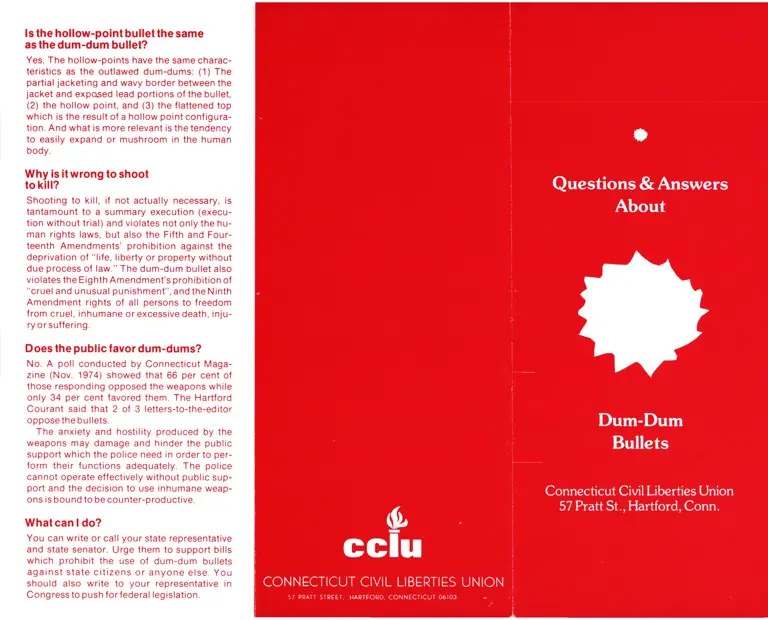
Questions & Answers
About
cclu
Dum-Dum
Bullets
Connecticut Civil Liberties Union
57 Pratt St., Hartford, Conn.
CONNECTICUT CIVIL LIBERTIES UNION
57 PRATT STREET. HARTFORD, CONNECTICUT 06103
What is a dum-dum or
hollow-point bullet?
A “dum -dum " b u lle t is one tha t produces a
mushrooming or expanding effect within the
human body. The word “dum-dum” has, over
the years, been used as a general term for bul
lets which expand or flatten easily in the hu
man body. As a result, they cause greater rip
ping and tearing of human flesh - and often
death. Hollow-points are merely one type of
“dum-dum” bullet. Such bullets are so cruel
they are banned in time of war or peace by in
ternational treaties and customs.
Why is there opposition to
the dum-dum bullet?
The ACLU is opposed to the dum-dums be
cause weapons which are impermissible or
illegal in international warfare should not be
used against Americans in peace time. The
bullets cause unnecessary wounding and un
necessary deaths. The ACLU believes that
only the minimum force needed to protect the
life of a police officer or that of a third person
isproperand reasonable.
What international laws are violated?
The 1899 Hague Declaration on expanding
bullets, the 1907 Hague Convention No. IV, the
1949 Geneva Coventions, the United Nations
Charter, and the Universal Declaration of Hu
man Rights prohibit the use of dum-dum bul
lets. The U.S. signed the 1907 Hague Conven
tion, the 1949 Geneva Convention, and the
U.N. Charter. Moreover, Article VI, Section 2 of
the U.S. Constitution declares that all treaties
to which the U.S. is a party are part of the “Su
preme Law of the Land” , as is customary law.
What does the U.S. Army say?
The U.S. Army does not permit its troops, on
foreign or domestic soil, to use dum-dum bul
lets. U.S. Army pamphlet No. 27-200, Subject
Schedule No. 27-1 and Army Field Manual
27-10 all recognize this prohibition. The ban
also applies to the military police. The Army
cites the principles of the Hague convention as
a basis for this prohibition.
How much more damage can the
dum-dums cause?
The severity of a wound is directly related to
the amount of kinetic energy it transfers to the
body. .38 hollow-points transfer from 2'/2 times
to more than 4 times the kinetic energy that a
normal round nosed .38 bullet would transfer,
as confirmed by a Dallas police report and
otherstudies.
Since the severity of the wound and tissue
damage will increase in direct proportion to
increased energy transfer, the .357 magnum
hollow-point bullet can cause, under the right
circumstances, an increase in wound severity
and tissue damage that is 10 times more than
a .38 special. Suffering, obviously, will also
increase.
Do all police departments
use dum-dums?
No, there is a split among the police depart
ments across the country as to whether they
are proper. For example, Los Angeles Police
Chief Edward Davis opposes the dum-dum
bullets because he says that over 50 per cent
of police officers who are shot are shot with
their own weapons, and he doesn’t want his
officers to be hit by a dum-dum because it most
likely will cause death or cruel wounds. Davis
says: “They make a great big hole in people.”
The Los Angeles Police Department banned
them under its own regulations.
Hartford Police Chief Hugo Masini declared
that “ it’s not unlikely both of these officers
would have been killed had they been shot
with a .357 magnum ho llow -po in t......... ” His
statement followed the shooting of two Hart
ford police officers in 1974 by a person who
had snatched away one of the officers’ .38 cali
ber revolvers.
Form er Police Chief Jerry W. W ilson, of
Washington, D. C. notes that 3/4ths of the
police officers killed never fire a shot at their
assailants. Wilson says that the “ increased
firepower has had no practical effect on the
problem.” He recommends the wearing of
newly developed bullet proof vests.
Lt. McGee, commander of the New York Po
lice Department firearms section, adds that
magnums can be “counter effective” , because
of excessive recoil, muzzle blast and muzzle
flash. The N.Y.P.D. refuses to switch from the
.38 special.
Shouldn’t the police be the judge of
what ammunition they use?
No, especially if the decision to use a notori
ously cruel weapon is made casually in the ab
sence of public standards and public scrutiny.
At the least, police should have to prove at
public hearings that nothing else will protect
them and third parties.
What has the U.S. Justice
Department recommended?
William Saxbe, while serving as U.S. Attorney
General, told the national news media that he
opposed the police use of dum-dum bullets,
and he cited the arguments made by Los An
geles Police Chief Edward Davis. Saxbe point
ed out that the dum-dums created too great a
risk to the life of police officers - since they
often are hit with their own weapons.
What do national commissions say?
The National Advisory Commission on Crimi
nal Justice Standards and Goals observed:
“The police sidearm is primarily a defensive
weapon intended to protect the lives of o ffi
cers or other persons. It must be able to inca
pacitate the individual against whom it is used.”
It added that the standard weapon continues
tobethenorm al .38special.
What about the Red Cross report?
The International Committee of the Red Cross,
in a 1973 report, stated that the likelihood of
death is “particularly” increased by “massive
tissue destruction that may be caused by . . .
projectiles which flatten, expand, or tumble on
impact, or which enter the body with high ve
locity . . . the bullet will then exhibita truedum -
dum effect even though it was not primarily
designed to do so.” The Red Cross also recog
nizes that hollow-point ammunition produces
such effects within the human body.
Jordan J. Paust
93 Towns House Rd
Hamden, CT. 06514 Phone:(203)288-6576
Oct. 11. 1974
Dear Attorney Kendall:
Enclosed is a copy of an article that is relevant to the
dum-dum controversy. It will be printed very soon in the
Denver Journal of International Law and PolicyCNov. 1974)
Also of direct interest should be a forthcoming article on
"Human Rights and the Ninth Amendment: A New Form of Guarantee,"
60 Cornell Law Review(Jan. 1975), copyright, Cornell University,
1974. I could send you a copy if you agree to protect my
intellectual property rights by quoting the piece and the
Cornell copyright reference if you merely cite the article
for a point or two, or by adding my name to your brief if
you wish to substantially incorporate the material or
arguments contained thereinCplus citing the piece somewhere
and the Cornell copyright).
I also enclose a copy of a newspaper article that discloses the unabashed and egregious disconcern of the Connecticut
State Police Commissioner for the difference in wound volume,
temporary cavitational effect, hydrodynamic shock effects,
rip-and-tear, and so forth with the .357s or any hollow-points
as compared with the normal .38s. He doesn't care what these
bullets do to humans I
I will keep you posted on other developments, but you should
also keep in touch with Bill Olds and the trial attorneys for
CCLUCsee enclosed letter from Frank Cochran).
This one we will wini Best regards. I
Assoc. Prof, of Int'l Law, Houston
P.S. Please publicize the fact that the porposed national
legislation is before Rep. Hungate's Subcommittee on Criminal
Justice. No formal sponsor of the legislation exists yet--
we could use a Congressional sponsor and a little lobbying.'I
cc: Bill Olds