Plaintiff-Intervenor Houston Lawyers' Association's Pre-Trial Brief
Public Court Documents
September 14, 1989
17 pages
-
Case Files, LULAC and Houston Lawyers Association v. Attorney General of Texas Hardbacks, Briefs, and Trial Transcript. Plaintiff-Intervenor Houston Lawyers' Association's Pre-Trial Brief, 1989. 1d3fd6c9-1c7c-f011-b4cc-7c1e52467ee8. LDF Archives, Thurgood Marshall Institute. https://ldfrecollection.org/archives/archives-search/archives-item/60dab667-338d-4be9-9c96-5ff66c2a73c8/plaintiff-intervenor-houston-lawyers-associations-pre-trial-brief. Accessed September 26, 2026.
Copied!
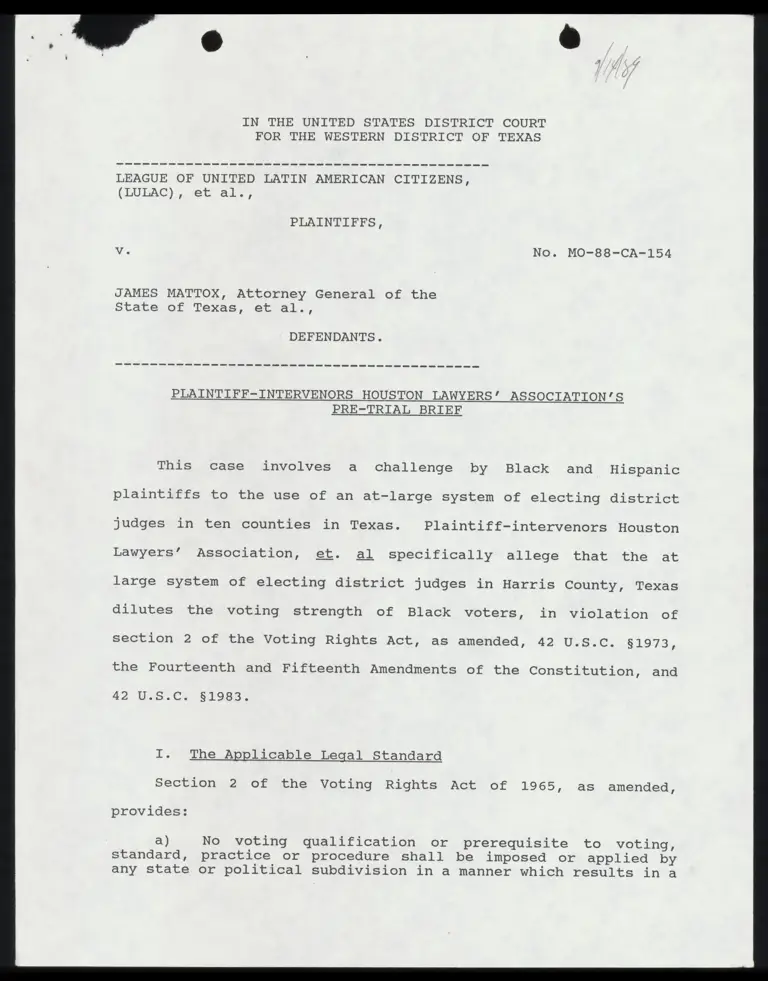
    IN THE UNITED STATES DISTRICT COURT

FOR THE WESTERN DISTRICT OF TEXAS

LEAGUE OF UNITED LATIN AMERICAN CITIZENS,
(LULAC), ef al.,

PLAINTIFFS,

7 No. MO-88-CA-154

JAMES MATTOX, Attorney General of the
State of Texas, et al.,

DEFENDANTS.

PLAINTIFF-INTERVENORS HOUSTON IAWYERS’ ASSOCIATION’S
PRE-TRIAL BRIEF


This case involves a challenge by Black and Hispanic

plaintiffs to the use of an at-large system of electing district

judges in ten counties in Texas. Plaintiff-intervenors Houston

Lawyers’ Association, et. al specifically allege that the at

large system of electing district judges in Harris County, Texas

dilutes the voting strength of Black voters, in violation of

section 2 of the Voting Rights Act, as amended, 42 U.S.C. §1973,

the Fourteenth and Fifteenth Amendments of the Constitution, and

42 U.S.C. §1983.

I. The Applicable Legal Standard


Section 2 of the Voting Rights Act of 1965, as amended,

provides:

a) No voting qualification or prerequisite to voting,
standard, practice or procedure shall be imposed or applied by
any state or political subdivision in a manner which results in a


denial or abridgment of the right of any citizen of the United
States to vote on account of race or color....

42 U.S.C. 81973

The Voting Rights Act further provides:

b) A violation of subsection (a) of this section is esta-
blished if, based on the totality of circumstances, it is shown
that the processes leading to nomination or election in the
state or political subdivision are not equally open to participa-
tion by members of a class of citizens protected by section (a)
of this section in that its members have less opportunity than
other members of the electorate to participate in the political
process and to elect representatives of their choice...

42: J.8.C. $1973.

Since section 2 of the Voting Rights Act "necessarily

embraces judicial elections within its scope," the well-developed

~ standards for determining a dilution claim are applicable to this

case. Chisom v. Edwards, 839 F.2d 1056, 1061 (5th Cir. 19088),

rehearing and rehearing en banc denied, 853 F.2d 1186 (5th Cir.

1988) cert. denied, 57 U.S.L.W. 3345 (Nov. 14, 1988). See also,


Martin wv. Allain, 658 F.Supp 1183, 1200 (S.D. Miss. 1987);

Mallory v,. Byrich, 839 F.2d 275 (6th Cir. 1988).

The Supreme Court has articulated three central elements of

a minority’s group’s cause of action in a section 2 challenge:

first, the minority group must show that it is sufficiently large

and geographically compact to constitute a majority in a single

member district; second, the minority group must show that it is

politically cohesive, and that its members tend to support the

same candidates; third, it must show that the white majority

usually votes sufficiently as a bloc to result in the defeat of

the minority group’s preferred candidates. Thornburg v. Gingles,


478 U.S. 30, 50-51 (1986). Most importantly, both the legisla-

tive history and the Supreme Court emphasize the need for courts

to engage in an intensely fact-specific appraisal when assessing


the legality of a challenged electoral scheme. See, S.%.,

Gingles, 478 U.S. at 79; Senate Report No. 97-417, 97th Cong.,

p. 30 (1982).

A. Plaintiffs’ Section 2 "Results" Claim

In 1982, Congress amended section 2 of the Voting Rights Act

to make clear that plaintiffs need not show that challenged

voting practices are the product of purposeful discrimination.

Thornburg v. Gingles, 478 U.S. at 35. Instead, the Supreme Court

deemed the relevant question to be whether,

based on the totality of the circumstances, it is
shown that the political processes leading to
nomination or election in the State or political
subdivision are not equally open to participation
by members of a class of a citizens protected by
subsection (a) in that its members have less
opportunity than other members of the electorate
to participate in the political process and to
elect representatives of their choice. 42 U.S.C.
'§1973 (b).

478 U.S. at 36.

The "results" test recognized by the court in Gingles, and

by Congress in its amendments to the Voting Rights in 1982,

reflects the view that an intent test "asks the wrong question...

[i]f an electoral system operates today to exclude blacks or

Hispanics from a fair chance to participate, then the matter of

what motives were in the official’s mind 100 years ago is of the

‘most limited relevance." Senate Report at 36.

3


Gingles indicates that the Senate factors are a significant

portion of plaintiffs case. The Senate Report accompanying the

1982 amendments to the Voting Rights Act list several "[t]ypical

factors" that are probative to show that a violation of this

"results test" exists. These factors are:

1. the extent of any history of official discrimi-
nation in the state or political subdivision that
touched the right of the members of the minority group
to register, to vote, or otherwise to participate in
the democratic process;

2. the extent to which voting in the elections of the
state or political subdivision is racially polarized:

3. the extent to which the state or political sub-
division has used unusually large election districts,
majority vote requirements, anti-single shot provi-
sions, or other voting practices or procedures that
may enhance the opportunity for discrimination
against the minority;

4. 1if there is a candidate slating process, whether
the members of the minority group have been denied
access to that process;

5. the extent to which members of the minority group
in the state or political subdivision bear the effects
of discrimination in such areas as education, employ-
ment and health, which hinder their ability to parti-
cipate effectively in the political process;

6. whether political campaigns have been characterized
by overt or subtle racial appeals;

7. the extent to which members of the minority group
have been elected to public office in the jurisdiction.

Additional factors that in some cases have had probative
value as part of plaintiffs’ evidence to establish a
violation are:

whether there is a significant lack of responsiveness on the
part of elected officials to the particularized needs of the
members of the minority group.


v

whether the policy underlying the state or political sub-
division’s use of such voting qualifications, prerequisite
to voting, or standard, practice or procedure is tenuous.

Senate Report at 28-29. The Report goes on to make clear that

"[t]he cases demonstrate, and the Committee intends that there is

no requirement that any particular number of factors be proved,

or that a majority of them point one way or the other." Id. at

29; see, e.gqg., Carrollton Branch of NAACP v. Stallings, 829 F.2d

1547,1554 (11th Cir. 1987).

In reviewing the Senate Factors and determining the weight

to be accorded to them, the Supreme Court held that "the most

important Senate Report factors . . . are the ’extent to which

members of the minority group have been elected to public office

in the jurisdiction’ and the ‘extent to which voting in the

elections of the state or political subdivision is racially

polarized.’" Gingles, 478 U.S. at 48, n.15. The other factors,

the Court stated, "are supportive of, but not essential to, a


minority voter’s claim." Id. (emphasis in original).

B. Plaintiff-Intervenors’ Intent Claim

Plaintiff-intervenors have raised both constitutional and

statutory claims regarding the reasons for the enactment and

maintenance of the at large method of electing district judges in

Harris County. This Court is obliged to decide the case on

statutory grounds, if possible, before reaching the

constitutional issues. Escambia v. McMillan, 466 U.S. 48 (1984).


The standard for plaintiff-intervenors’ Fourteenth and

Fifteenth Amendment claims is set out in Rogers v. Lodge, 458


U.S. 613 (1982), and this Court may infer "intent" by using " the

normal inferences to be drawn from the foreseeability of

defendant’s actions," See Senate Report at p.27, n.108 and at p.

37,.n.136. Plaintiff-intervenors therefore, need not show that

the challenged actions were taken ‘because they would have a

discriminatory effect.

In Rogers, the Court noted that the factors identified in

Zimmer v. McKeithen, 485 F.2d 1297 (5th Cir. 1973), aff'd on


other dgrounds sub nom. East Carroll Parish School Board v.

Marshall, 424 U.S. 636 (1976) (per curiam) =-- which are the

factors identified in the Senate Report, see Senate Report at 28,

n. 113 -- provided substantial circumstantial evidence to support


a finding of discriminatory intent. See Rogers, 458 U.S. at 624-

27. Accordingly, this Court in assessing plaintiff-intervenors’

intent claims, should rely on the evidence of the Senate factors.

In addition, there is significant evidence of racial motivation

for the enactment and maintenance of the at large configuration

of Harris County’s district judge.

Plaintiff-Intervenors Establish the Three Central Elements
of their Section 2 Claim


A. Plaintiff-Intervenors Established that Blacks in
Harris County are Sufficiently Large and Geographically
Compact to Constitute a Majority in Single Member District

Plaintiff-intervenors will present both lay and expert

testimony demonstrating that Blacks in Harris County are suffi-

6


.

ciently large and geographically compact to constitute a

majority in a single member district.

Plaintiff-intervenors’ expert, Mr. Jerry Wilson, who has

drawn numerous districting plans currently in effect throughout

the country, found that 13 majority Black single member districts

could be fairly drawn in Harris County. Each of these districts

would be majority Black in total population, voting age popula-

tion and estimated registered voter population.

Although the one person-one vote principle does not apply to

judicial districts, Wells v. Edwards, 347 F.Supp. 453 (M.D. la.

1972), aff’d, 409 U.S. 1095 (1973), nor does the Texas state

Constitution require that election districts for the Supreme

Court be equally apportioned by population, plaintiff-intervenors

proposed districts were drawn in accordance with this principle.

The court need not at this liability phase, address the

precise contours of a proper division of Harris County into

single member districts. This is particularly true where, as

here, plaintiff-intervenors have alternatively sought relief in

the form of modified at large voting systems such as limited or

cumulative voting. See, Complaint of Plaintiff-intervenor at Pp.

11, paragraph 42.

B. Plaintiff-intervenors Establish the Existence of
Racially Polarized Voting in Harris County, TX

"Evidence of racially polarized voting ’is the linchpin of a

section 2 vote dilution claim,’" Westweqo Citizens for Better


Government, et al., v. City of Westweqo, Civ. Ac. 87-3761 at P15

7


(5th Cir. 1987) (three-judge court) Slip Op. at 15, quoting

Citizens For a Better Gretna v. City of Gretna, 834 F.2d 496, 499


(5th Cir. 1987). Moreover, evidence of racially polarized voting

"is relevant to establishing two of the three elements set forth

in the Gingles decision -- the political cohesiveness of the

minority group and the ability of the white majority usually to

defeat the minority’s preferred candidate. " Id. at 51, <iting

Gingles, 478 U.S. 30, 56 (1986) and Campos Vv. City of Baytown,


840 F.2d 1240,1244 (5th Cir. 1989).

Dr. Richard L. Engstrom, a nationally recognized expert in

the quantitative analysis of rac¢ial voting patters, and whose

scholarly writings were cited with approval in Gingles, 478 U.S

at 53, n. 20, 55 & 71, analyzed 17 Harris County district judge

election contests involving Black and white candidates during the

period 1980 to 1988.

Dr. Engstrom used the analytic techniques -- bivariate

ecological regression and extreme case analysis -- recognized as

standard in the literature and approved by the Supreme Court in

Gingles, 478 U.S. at 53, n. 20. See also, Citizens for a Better


Gretna v. City of Gretna, 636 F.Supp. 1113 (E.D. 1a. 1986),

gff’'d, 834 P.24 496 (5th Cir. 1987); Martin v. Allain, 658


F.Supp. at: 1193. In each of the seventeen elections, Dr.

Engstrom’s analysis revealed a clear pattern of racially

polarized voting, with Blacks overwhelmingly supporting Black

candidates and white voters supporting the opposing white

candidates in 16 out of the 17 elections.


Dr. Engstrom's focus on elections in which a Black candidate

was opposed by a white candidate is well supported, particularly

when, as in this case, Black voters almost always preferred the

Black candidate in a contest involving both Black and white

candidates. See Gingles, 478 U.S. at 57, "Ne 25. See also,


Citizens for a Better Gretna v. Gretna, 636, F.Supp. at 1133;


Citizens for a Better Gretna v. Gretna, 834 F.2d at 503; McNeil wv.


City of Springfield, 658 F.Supp. 1015, 1030 (c.D. Ill, 1987);


Smith v. Clinton, 687 F.Supp. 1310 (E.D. Ark. 1988). As the trial


court noted in Clark v. Edwards, Civ. Ac. No. 86-435 (M.D. La.


Aug. 15, 1988), quoting East Jefferson Coalition v. Jefferson


Parish, 691 F.Supp. 991, 1001 (E.D. La. 1099), "[t]he fact that

Blacks and whites prefer the same candidates in white only

elections, but different candidates when Blacks enter the race is

strong evidence that racially polarized voting exists." Slip Op.

at 31.

Defendants' attempt to rebut the plaintiff-intervenors' clear

evidence of racially polarized voting by asserting that factors

other than race explained the lack of success by Black candidates

is unpersuasive. Specifically, defendants argue that factors such

as party voting and not race are determinant factors in district

judge elections in Harris County. The court in Gingles recognized

however, that consistent with congressional intent "it is the

difference between the choices made by blacks and whites - not the


reasons for that difference -- that results in blacks having less


opportunity than whites to elect their preferred representatives."

Gingles, 478 U.S. at 63 (emphasis in original).

An electoral system is not immunized from section 2 attack

merely because it utilizes partisan elections, or because members

of one race belong to one political party in greater numbers than

another. By attempting to resuscitate the old "intent" standard,

the defendants in this case seek to do exactly what the North

Carolina defendants in Gingles v. Edminsten were unsuccessful in


doing.

The defendant's theory that other factors such as incumbency,

campaign spending, Bar Association poll results and newspaper

endorsements were determinant factors in district judge elections

is equally unpersuasive. Attempts to show that particular

candidates preferred by the minority community are not "viable

candidates" based on these factors, is contrary to this circuit's

interpreation of section 2. A "viable candidate is one which the

minority group sponsors," Campos Vv. City of Baytown, 840 F.2d


1240, 1245 (5th Cir. 1988).

Finally, defendant's may not rely on the aberrant success of

a few Black candidates to rebut the plaintiff-intervenors' clear

showing of racially polarized voting. "Gingles, . . . cautions


against finding a lack of racially polarized voting where the

successs of a minority candidate can be attributed to special

circumstances." Collins v. City of Norfolk, Virginia, Civ. Ac.


No. 88-3950 (4th Cir. Aug. 18, 1989). Slip Op. at 20. Gingles

specifically identifies incumbency, and the absence of an

10


opponent as special circumstances that may accompany minority

electoral success. 478 U.S. at 57. One or both of these

factors, as well as other special circumstances,l are present in

almost every general district judge election won by a Black

candidate in Harris County since 1980.

C. Plaintiff-intervenors Establish that Blacks in
Harris County are Politically Cohesive

As discussed above, the level of racial polarization in

Harris County demonstrates the presence of cohesiveness among

Black voters. In 16 of the 17 outcome determinative elections

identified in Plaintiff-intervenors’ Exhibit 1, Black candidates

were the overwhelming choice of Black voters, receiving no less

than 95% of the vote of the votes cast by Blacks in Harris

County.

III. Additional Senate Factors

A. History of Discrimination

Texas’ history of official discrimination touching upon the

right to vote cannot be seriously disputed. As this Court noted

in an extensive appendix to its decision in LULAC v. Midland


Independent School District, 648 F.Supp. 596 (W.D. Tex. 1986),

aff’d 812 F.2d 1494 (5th Cir. 1987), Texas has a constitutional

and statutory history replete with racially discriminatory


lThe court in Gingles notes that the special circumstances
identified in that case are "illustrative, not exclusive." 478
UeS, at 57, Ne 26.

11


provisions and codes which required among other things, the

payment of a poll tax as a prerequisite to voting, segregated

schools for Black and white students, segregated rail cars,

buses, libraries, orphanages, employee bath facilities, parks.

Democratic primary elections in Texas were restricted to whites

in Texas until a Black resident of Houston successfully

challenged this discriminatory practice before the Supreme Court

of the United States in 1944. Smith v. Allwright, 321 U.S. 649


(1944). No law school in Texas admitted Black students until

that practice was challenged, resulting in the Supreme Court’s

decision in Sweatt v. Painter, 339 U.S. 629 (1950). In Harris

County, the Houston Independent School District, which had been

challenged as segregated 25 years ago, was not declared unitary

until 1981. See Houston Independent School District v. Ross, 699

F.2d 218 (5th cir. 1983).

This Court may take judicial notice of findings by other

courts with regard Texas’ history of official discrimination.

Fed. R. Evid. 201; see United Steelworkers v. Weber, 443 U.S.

193, 198, n. 1 (1979) (findings of discrimination in craft unions

were so numerous as to be a proper subject for judicial notice).

B. Texas’ Use of Voting Practices and Procedures that
Enhance the Opportunity for Discrimination

This case involves all three practices expressly identified

by the Senate Report and many of those identified in Gingles as

"potentially dilutive electoral devices." 478 U.S, rat" 56,

Harris County as a judicial electoral district is unusually

12


large. It is the largest judicial electoral district by popula-

tion, and has the greatest number of district judges of any

county in the State.

District judge elections in Harris County are subject to a

primary election majority vote | veunirement. Moreover, the

staggered terms and numbered place system for district judges in

the county is the functional equivalent of an "anti-single shot"

provision. These feature enhance the discriminatory potential of

the at large electoral system in Harris County.

C. The Extent to Which Members of the Minority Group
Bear the Lingering Effects of Discrimination

Both the Senate Report and the courts have acknowledged the

role "that disproportionate educational, employment, income level

and living conditions arising from past discrimination" have on

minority political participation. Senate Report No. 417, 9th

Cong., 2d Sess. 3, at 29, n. 114. See also, White v. Regester,


37 L.Ed.2d 314, 325 (1973); Major v. Treen, 574 F.Supp. 325, 341

(B.D. la. 1983).

The Black population in Harris County continues to bear the

effect of racial discrimination in such areas as education,

employment and health. These effects hinder its ability to

participate in the political process on an equal basis with the

white population. The 1980 Census population reports reveal a

striking disparity in the socioeconomic indicators for Blacks and

whites. According to the 1980 Census for example, the median

13


income for white families in Texas was $20,955. The median

income for Black families in Texas was $13,042.

D. Racial Appeals in Campaigns

Former Black candidates for district judge in Harris County

will testify that given the nature of campaigning in the county,

voters are aware of the race of judicial candidates. In the

racially polarized atmosphere of Harris County, this awareness of

race in itself operates as a racial appeal. See, Anderson V.


Martin, 375 U.S. 399 (1964). Race continues to play such a role

in elections in Harris County, that some Black candidates elect

not to use their photographs in campaign literature prior to

election day.

E. The extent to which members of the minority group
have been elected to public office in the
jurisdiction

Of the 59 district judges currently serving Harris County,

only 3 are Black. In fact no more than three district judges

have ever served Harris County at one time, despite the fact that

at least one Black candidate has run in each and every district

judge election since 1980.

F. The tenuousness of the policy underling the use and
maintenance of the at large system for the election
of district judges in Texas

The fact that a challenged practice has been used since the

turn of the century has never been thought to immunize that

practice from challenge. See, Loving -v. Virginia, 388 U.8. 1


14


.


(1967); Brown v. Board of Fducation, 347 U.8. 1 (1954). The

legislative history specifically addresses this issue:

Under the Voting Rights Act, whether a discriminatory
practice or procedure is of recent origin affects only
the mechanisms that trigger relief. . . The
lawfulness of such a practice should not vary by when
it was adopted, i.e., whether it is a change.

H.R. Rep. No. 97-227, p.28: (1982). See, Citizens for a Better


Gretna v. City of Gretna, 636 PF. Supp. 1113 (E.D. la. 1986),

aff’d, 834 F.2d 496 (5th Cir. 1987) (practice adopted in 1913);

Perkins v. City of West Helena, Ark., 675 F.Supp. 201 {8th Cir.

1082), aff’d, 459 U.S. 801 (1982) (practice in effect since

1920); Bolden v. City of Mobile, Ala., 542 F.Supp. 1050 {S.D.

Ala. 1982) (since 1911); McNeil v. City of Springfield, 658

F.Supp. 1015 (C.D. "111. 1987), app. dism’d, 818 F.2d 565 (7th

Cir. 1987) (since 1912); Gingles, 478 U.S. at 52, n. 9.

Moreover, the fact that a change in the current system might

require even a costly reorganization of the state’s judicial

administrative’ structure "is not a sufficient ground for

maintain-ing an otherwise flawed system." Westwego Citizens for


a Better Government v. City of Westwego, Slip Op. at "23.

Conclusion

Based on the totality of the circumstances in this case,

including the existence of racially polarized voting, political

cohesion, as well as the history of discrimination that continues

to impede the ability of Blacks to participate in the political

process, the presence of discriminatory voting practices that

15


v

enhance the opportunity to discriminate, the socio-economic

conditions under which Blacks and whites currently exist, the

lack of Black electoral success, and the tenuousness of the

State’s policy, the Court should hold that the use of an at large

county wide election system for the election of district judges

in Harris County, Texas denies Black voters an equal opportunity

to participate in the electoral process, and elect representa-

tives of their choice, in violation of section 2 of the Voting

Rights Act of 1965.

Respectfully submitted,

widen A HAL
JULIUS Lf BH HAMBERS |
SHERRILY IFILL

99 Hudson Street, 16th Floor
New York, New York 10013
(212) 219-1900


Of Counsel: GABRIELLE K. McDONALD
MATTHEWS & BRANSCOMB 301 Congress Avenue
A Professional Corporation Suite 2050

Austin, Texas 78701
(512) 320-5055

Attorneys for Plaintiff-
Intervenors Houston Lawyers’
Association

16


CERTIFICATE OF SERVICE

I hereby certify that on this 14th day of September,

Houston Lawyers’ Association’s

William L. Garrett
Brenda Hull Thompson
Garrett, Thompson & Chang
8300 Douglas, Suite 800
Dallas, TX 75225

Rolando L. Rios
Southwest Voter Registration

Education Project
201 N. St. Mary’s, Suite 521
San Antonio, TX 78205

Susan Finkelstein
Texas Rural Legal Aid, Inc.
201 N. St, Mary’s, Suite 521
San Antonio, TX 78205

Edward B. Cloutman, III
Mullinax, Wells, Baab &

Cloutman, P.C.
3301 Elm

Dallas, TX 75226-9222

Jim Mattox
Mary F. Keller
Renea Hicks
Javier Guajardo
Attorney General’s Office
1401 Colorado
Supreme Court Building, 7th Floor
Austin, TX 78701

Pretrial Brief was

Federal Express to counsel of record in this case, as follows:

J. Eugene Clements
John E. O’Neill
Evelyn V. Keys
Porter & Clements

1989, a

true and correct copy of the foregoing Plaintiff-intervenors

mailed by

700 Louisiana, Suite 3500
Houston, TX 77002-2730

Michael J. Wood
Attorney at Law
440 Louisiana, Suite 200
Houston, TX 77002

David R. Richards
Special Counsel
600 W. 7th st.

Austin, TX 78701

Robert H. Mow, Jr.

Hughes & Luce
2800 Momentum Place
1717 Main Street
Dallas, TX 75201

Jill J Ohi


/ Sherrily A v
Attorney ne is -Intervenors
Houston Lawyers’ Association