Bivins v. Bibb County Board of Education and Orphanage for Bibb County Brief for Appellants
Public Court Documents
January 1, 1969
-
Brief Collection, LDF Court Filings. Bivins v. Bibb County Board of Education and Orphanage for Bibb County Brief for Appellants, 1969. 8ae1a0ec-c99a-ee11-be36-6045bdeb8873. LDF Archives, Thurgood Marshall Institute. https://ldfrecollection.org/archives/archives-search/archives-item/615bcc30-c0d6-4a81-88ff-cd381fb2dcd3/bivins-v-bibb-county-board-of-education-and-orphanage-for-bibb-county-brief-for-appellants. Accessed September 29, 2026.
Copied!
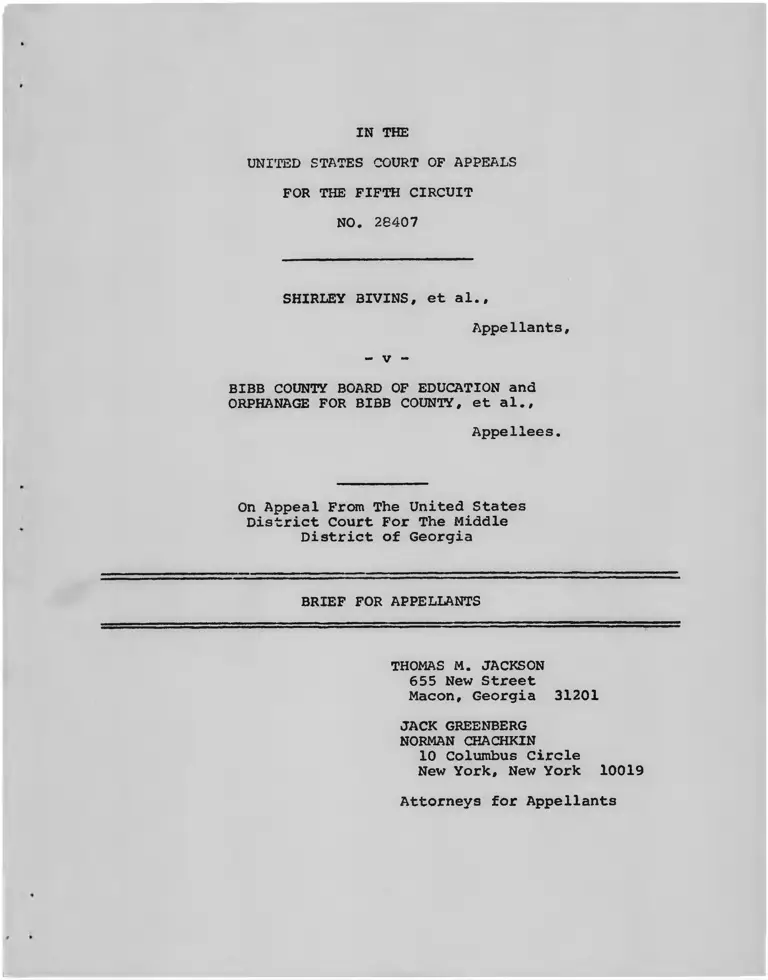
IN THE
UNITED STATES COURT OF APPEALS
FOR THE FIFTH CIRCUIT
NO. 28407
SHIRLEY BIVINS, et al..
Appellants,
- v -
BIBB COUNTY BOARD OF EDUCATION and
ORPHANAGE FOR BIBB COUNTY, et al.,
Appellees.
On Appeal From The United States
District Court For The Middle
District of Georgia
BRIEF FOR APPELLANTS
THOMAS M. JACKSON
655 New Street
Macon, Georgia 31201
JACK GREENBERG
NORMAN CHACHKIN
10 Columbus Circle
New York, New York 10019
Attorneys for Appellants
TABLE OF CONTENTS
Issues Presented for Review • « • • • • • • ........
Statement of the Case • • • • • • • • • • • • • • « ■
Argument
I. The District Court Erred In Approving A
Free Choice Plan For Bibb County Where
Five Years Of Operation Under Free Choice
Had Resulted In But 27% Of The Negro
Students Attending Predominantly White
Schools And Twenty Schools Without A
Single White Student Enrolled ............
II. An Otherwise Ineffective And Unconsitu-
tional Freedom-Of-Choice Plan Is Not
Made Legally Palatable By The Institution
Of Elective Courses Offered Only At Schools Having All Negro Student Bodies . .
III. The District Court Erred In Permitting
The School District To Limit The Opera
tion Of Its Free Choice Plan At Predominantly White Schools By Establishing
A Maximum Number Of Negro Students Who
Are To Be Permitted To Attend Those Schools, Although No Such Limitation
Was Effected At All-Negro Schools ........
Conclusion .........................................
Page
1
2
7
11
14
16*
TABLE OF CASES
Page
Adams v. Mathews, 403 F.2d 181 (5th Cir, 1968) • • 10
Bowman v. County School Board of Charles City
County, 382 F.2d 326 (4th Cir. 1967) • • • • • 8
Brica v. Landis, Civ. No. 51805 (N.D. Cal.,
August 8, 1969) . . . . . . .................. i2
Graves v, Walton County Board of Education,
403 F.2d 189 (5th Cir. 1 9 6 8 ) ................ 10
Green v. County School Board of New Kent
County, 391 U.S. 430 (1963).................. 2,3,7.8
Hall v. St. Helena Parish School Board___ F.2d ___ (5th Cir., May 28, 1969)........ 3
Hilson v. Ouzts, Civ. No. 2449 (M.D. Ga.,
August 8, 1969).............. .. 10
United States v. Board of Education of
Baldwin County, ___ F.2d ___ (5th Cir.,
July 9, 1969) . . . . . ............ . . . . . 4,7,13
United States v. Jefferson County Board
of Education, 372 F.2d 836 (1966),
aff'd on rehearing en banc, 380 F.2d
385 (5th Cir.), cert, denied sub nom.
Caddo Parish School Board v. United
States, 389 U.S. 840 (1967).................. 2,9
- ii
IN THE
UNITED STATES COURT OP APPEALS
FOR THE FIFTH CIRCUIT
NO. 28407
SHIRLEY BIVINS, et al..
Appellants,
- v -
BIBB COUNTY BOARD OF EDUCATION and
ORPHANAGE FOR BIBB COUNTY, et al..
Appellees.
Appeal From The United States District Court
For The Middle District Of Georgia
BRIEF FOR APPELLANTS
Issues Presented For Review
1. Whether the district court erred in approving a desegrega
tion plan contemplating freedom-of-choice pupil assignment where five
years of operation under free choice had resulted in but 27% of the
Negro students attending predominantly white schools and twenty
schools without a single white student enrolled.
2. Whether an otherwise ineffective and unconstitutional
freedom-of-choice plan i« made legally palatable by the institution
of elective courses offered only at schools having all-Negro student
bodies.
3. Whether the district court erred in permitting the school
district to limit the operation of its free choice plan at pre
dominantly white schools by establishing a maximum number of Negro
students who are to be permitted to attend those schools, although
no such limitation was effected at all-Negro schools.
Statement 0f The Case
This is a school desegregation action.
On April 24, 1964, the Bibb County schools were ordered by
federal district court to desegregate on a gradual basis extending
over several years. This order was subsequently amended June 29,
1967, to require the mandatory exercise of free choice by students
in all grades beginning 1967-68, in accordance with this Court's
opinion in United States v. Jefferson County Board of Education,
372 F.2d 836 (1966), aff'd. on rehearing en banc, 380 F.2d 385 (5th
Cir.), cert, denied sub nonu Caddo Parish School Board v. United
States. 389 U.S. 840 (1967). After the decision in Green v. County
School Board of New Kent County. 391 U.S. 430 (1968) and companion
cases, appellants (plaintiffs below) filed a Motion for Further
Relief which sought to require implementation of a plan other than
freedom of choice. September 16, 1968, the district court issued
an "interim order" requiring appellees to reassess the operation
- 2 -
of the Bibb County schools under free choice in light of Green and
to report their conclusions to the Court, November 29, 1968,
appellees accordingly proposed minor modifications of the plan but
affirmed that freedom of choice was the best ~ and the only —
method of pupil assignment which would create a unitary school
system in Bibb County.
June 4, 1969, appellants filed a second Motion for Further
Relief (A. 1-8) relying upon this Court's decision in Hall v. St,
Helena Parish School Board, ___ F.2d ___ (5th Cir. 1969), again
seeking the district court's disapproval of free choice as a con
stitutional means of operating the Bibb County schools. After a
hearing July 7 and 8, 1969 (A. 106-322) the appellees submitted pro
posed further modifications of their basic free choice plan (A. 29—
37) to which appellants objected (A. 38-52). August 12, 1969, the
district court approved continued free choice in Bibb County (A. 53-
62) and this appeal followed.
The Bibb County Board of Education operates 58 public schools
(A. 25), of which number 20 have enrolled only Negro students (A.
140)• During the five years in which freedom of choice has been
offered to students in the county, no white child has ever exercised
a choice to enroll in one of these 20 schools (ibid.). Through
the same period, Negro enrollment in predominantly white schools has
increased so that about one quarter of the county's Negro students
are attending integrated schools (A. 24, 56). By the district's
- 3 -
own admission —- and giving credence to its claim to increase "free
choice" integration by September 1, 1969 (see A. 56) — over seventy
per cent of the Negro students in the system are still in all-black
schools.
The district sought to continue to assign students according
to a freedom-of-choice plan, but proposed to ameliorate it position
by instituting two elective courses, driver education (A. 172) and
prevocational training (A. 270) which would be offered only at
schools with all-Negro enrollments. Thus white students desiring
to take these courses would have to enter these all-Negro schools
for one or more school periods to receive instruction. By this
feature, and by promising to increase faculty integration to the
minimum levels required by this Court in United States v. Baldwin
County Board of Education. ___ F.2d ___ (5th Cir. 1969), the district
declared, it would achieve the goal of a unitary system without
1/"black" schools and "white" schools, but "just schools."
Little consideration was given to alternative plans of pupil
assignment. Rather, the Board engaged in the circular reasoning
that freedom of choice was the best plan "[o]n the basis that it
1/ However, to prevent "resegregation," the Board proposed to
limit the number of Negro students who could choose to attend
formerly white schools. A motion addressed to this Court, seeking
an injunction pending appeal against this "quota" provision was
denied September 24, 1969.
- 4 -
gives every individual an opportunity to select their own schools
through freedom of choice and it is not discriminatory — " (A. 122-
23). The district did not consider new feeder patterns (A. 132-33)
or make any determined effort to develop any alternative to free
choice (A. 137, 145, 213). Although its administrators opined
that attendance zoning would not be feasible because of segregated
residential patterns (A. 161-62, 262), they had never really tried
to put actual zone lines on a map and evaluate the results (A. 284-
85). It was admitted that pairing of school facilities was feasible
(A. 180-81) but the district opposed this concept because it feared
white students would change their residences causing both paired
schools to become all-Negro (A, 187).
At the hearing, prior to the submission of the district's pro
posed amendments to its plan, the district court expressed its
desire to maintain free choice:
Let me say this. It looks like under
the Green case the racial identiflability
of these schools must be disestablished. I
take it that is what you are trying to do.
I take it that is why you are putting in your
education courses, . . . Evidently you
realize that this must be done, and evidently
you realize that there must be an invasion of
these erstwhile Negro schools by White teachers
and vice versa.
There are certain alternatives that we
may have to face, and those alternatives might
be all this zoning that you don’t want. It
might be this pairing that you don't want. • . .
I'm not particularly anxious for it myself.
It may just possibly be that this is one
5
system where freedom of choice can work if,
as X tried to tell you in my interim order,
you want to make it work.
I think that the freedom of choice
comports with the American dream much more
beautifully than drawing lines and grouping
people and herding them as if they were
cattle, irrespective of their wills and their choices and irrespective of the wills
and choices of their parents. I think freedom
of choice is worth saving if we can save it.
. . . And there is another thing . . . And I
think Judge Parker of the Fourth Circuit was
right, eternally right, when he said that the
Brown decision did not say and was not intended
to say that the people must bring about integra
tion, meaning by that mixing for mixing's sake.
It didn't say that.
Now for these reasons I'm willing to help
the Bibb Board of Education try to save freedom
of choice, because I don't think it works an
imposition on anybody, if the Board of Education
wants to save it, and wants to do and commit
itself to do everything within its power to dis
establish the racial identifiability of all of
the schools of this country.
(A. 292-307).
The district court’s order approving the plan as amended was
entered August 12, 1969 (A. 53-61) and Notice of Appeal filed
August 22, 1969 (A. 321).
6 -
Argument
I.
The District court Erred In Approving A Free
Choice Plan For Bibb County Where Five Years
Of Operation Under Free Choice Had Resulted
In But 27% Of The Negro Students Attending
Predominantly White Schools And Twenty Schools
Without A Single White Student Enrolled.
The district court erred in approving a desegregation plan
using freedom of choice in Bibb County because in five years,
freedom of choice has completely failed to meet the mandate of the
Constitution. It is relevant, as held in Green v. County School
Board of New Kent County, Virginia, 391 U„S. 430 (1968), that many
years elapsed before appellees made any attempt to comply with the
Brown decision. Free choice became the vehicle of compliance but
little progress towards desegregation has taken place. The same
considerations which led the Court in Green to condemn freedom of
choice require the same result here.
Free choice has accomplished little in Bibb County except to
open the doors of white schools to black students. But this Court
said in United States v. Board of Education of Baldwin County, ___
F.2d ___ (5th Cir. 1969):
The indispensable element of any desegrega
tion plan, the element that makes it work,
is the school board's recognition of its
affirmative duty to disestablish the dual
system and all its effects. That duty is
not discharged simply by opening the doors
of white schools to Negro applicants. The,
school from which the Negroes come must be
- 7 -
desegregated as well as the schools to which
they go. And in any situation the school
board should choose the alternative that
promotes disestablishment of the dual system
and eradication of the effects of past
segregated schooling. (Emphasis added)
We urge that, as stated in Green and other cases, freedom of
choice is not an end in itself. Judge Sobeloff in Bowman v. County
School Board. 382 F.2d 326 (4th Cir. 1967), stated:
Freedom of choice is not a sacred talisman;
it is only a means to a constitutionally
required end . . . the abolition of the
system of segregation and its effects. If
the means prove effective, it is acceptable,
but if it fails to undo segregation, other
means must be used to achieve this end. The
school officials have the continuing duty to
take whatever action may be necessary to
create a unitary, non-racial system.
The appellees and the district court tend to view the law in
a different light based upon their determination and desire to
retain freedom of choice. That it has produced very little pro
gress towards the institution of a unitary school system in Bibb
County seemingly has no effect upon their thinking. Freedom of
choice is taken to be the ultimate and only plan capable of working
in the county, even though the Board has not even considered
alternative steps that may prove to be better suited. Again we
quote the Court in Green (391 U.S. at 441):
Where it offers real promise of aiding a
desegregation program to effectuate con
version of a state—imposed dual system to
a unitary, non-racial system there might
be no objection to allowing such a device
- 8
[free choice] to prove itself in operation.
On the other hand, if there are reasonably
available ether ways, such for illustration
as zoning, promising speedier and more
effective conversion to a unitary, non-
racial system, "freedom of choice" must be
held unacceptable.
Free choice has had five years in which to accomplish the
ultimate goal in school desegregation — a unitary system having
not "white schools," and "Negro schools," but just schools. Yet
after five years only 27% of all Negro students are in predominantly
white schools and no white students are enrolled in twenty all-
Negro schools. This is not the result that this Court has required
of desegregation plans chosen by school boards.
The appellees are nonetheless committed to continued use of
free choice. They have not considered alternative plans or methods
such as zoning, pairing or consolidation. During the course of
the hearing on July 7 and 8, 1969, it was admitted that no serious
thought has been given to any plan other than freedom of choice
(A. 122, 137, 138, 144, 145). No reason was given except to say
that it was felt free choice was the best possible plan. When asked
upon what basis this conclusion was derived, Mr. Julius Gholson,
Superintendent of Bibb County Schools, stated simply, "it gives
every individual an opportunity to select their own school through
freedom of choice." This type of reasoning has no validity because
as the Court stated in Jefferson I, 372 F.2d at 888: "A school-
child has no inalienable right to choose his school."
- 9
Appellees contend free choice has achieved and is achieving
desegregation (A. 122), but in light of the fact that only 27% of
all-Negro students are enrolled in white schools and no white
students are in black schools, one finds it hard to accept this
conclusion. To the contrary, the results indicate the failure
of the method; the district court should have followed the rule
established in Adams v. Mathews, 403 F.2d 181 (5th Cir. 1968):
If in a school district there are still all-
Negro schools or only a small fraction of
Negroes enrolled in white schools or no sub
stantial integration of faculties and school
activities then as a matter of law, the
existing plan fails to meet the constitutional
standards as established in Green.
(Emphasis added)
In Graves v. Walton County Board of Education. 403 F.2d 189 (5th
Cir. 1968), this Court reaffirmed its ruling and added:
All-Negro schools in this circuit are put
on notice that they must be integrated or
abandoned by the commencement of the next
school year.
In its opinion (A. 61) the district court refers approvingly
to its opinion in Hilson v„ Ouzts, Civ. No. 2449 (M.D. Ga.,
2/August 8, 1969) in support of the Court's approval of free
choice. In Hilson the district court made clear it» adherence
to the long discarded Briggs dictum:
The segregation outlawed by Brown was
enforced segregation based on race . . .
2/ On appeal to this Court, No. 28491.
10
and not segregation or separateness
voluntarily chosen and preferred by the
persons involved, [slip opinion at p. 5].
The law on the subject is clearly enunciated and free choice
as operated in Bibb County does not meet the law's requirements.
The district court by its own admission favors freedom of choice
(A. 292-307). It flouts the law by aiding the appellees in
retaining an unconstitutional device.
II
An Otherwise Ineffective And Unconstitutional
Freedom-Of-Choice Plan Is Not Made Legally
Palatable By The Institution Of Elective
Courses Offered Only At Schools Having All
Negro Student Bodies.
The attempt by appellees to salvage free choice by the
institution of elective courses in Negro schools (A. 30) is nothing
more than another delaying tactic. There is nothing in the pro
posals that gives the slightest indication that this plan has the
remotest possibility of working. Quite to the contrary# if past
experiences are an indication of success in conducting programs
in Negro schools, these steps are doomed to failure from the outset.
An example in point is the Headstart Program conducted by
appellees. When this program was started about four years ago,
there were centers in both Negro and white schools. Few, if any,
white students enrolled in the centers that were located in Negro
schools. This resulted in centers racially identifiable as Negro
11
centers and white centers. The Office of Economic Opportunity
recognizing this pattern and results, ordered all of the centers
to be located in schools that were racially identified as white
schools, as an attempt to encourage white parents to enroll their
children in the program (A. 113, 241-244). Appellees are aware
of these facts; yet they advance a similar proposal as a means
of attracting white students to Negro schools. Like Headstart,
the courses are elective, which in itself gives rise to a strong
probability that few if any white students will enroll. Previous
experiences have produced failure and appellants contend that
similar results will be encountered in this instance.
The plan is further illusory because the racial identification
of the Negro schools will remain intact. The plan calls for the
white students, if any choose to enroll, to be bussed to Negro
schools for a specific course and, upon completion of the hour of
study, bussed back to the school from which they came. Such a
step places the burden of desegregation entirely upon one racial
group. Cf. Brice v. Landis, Civ. No. 51805 (N.D. Cal., August 8,
1969). The white student does not become a member of the student
body at the Negro school and to say he does is to say one becomes
a member of a family because he visits in that family's home on
occasion. Surely the district court is not so naive as to believe
that Appling High or Ballard-Hudson High will loose their racial
identification as black schools by the proposed device.
12 -
Appellants submit that appellees realize the futility of
this proposal, but because of language in United States v. Board
of Education of Baldwin County, supra, the district court feels
the step is sufficient to comply with what it considers as the
mandate of this Court. Although this Court said in Baldwin
County,
Steps which maybe taken by the Board to
eliminate racial identification of the
present all-Negro schools, in addition to
the specific requirements of faculty
integration, are the establishment of
vocational or other special courses of instruction, summer schools and desegrega
tion of staff and transportation and all
types of extracurricular activities and
facilities
this is not all that the Court said. In keeping with its prior
decisions, this Court still made it clear that freedom of choice
is not the desired end and that a school board should choose the
plan that will work. Contrary to the belief of the district
court that Baldwin County is a carte blanche approval of free
choice as long as there are desegregated vocational and other
special programs, the decision did not establish such a rule.
The prerequisite of the entire opinion is the finding that due
to residential segregation and the location of schools, a
rational pairing or zoning plan which would convert to a unitary
system could not be devised in Baldwin County. Further, the pane],
was very careful to point out that another look at the district,
especially with the aid of HEW, may produce a pairing or zoning
plan that will be preferable tc continued free choice.
13
Freedom of choice has failed and the institution of elective
courses at black schools does not cure the constitutional defect,
III
The District Court Erred In Permitting The
School District To Limit The Operation Of
Its Free Choice Plan At Predominantly white
Schools By Establishing A Maximum Number Of
Negro Students Who Are To Be Permitted To
Attend Those Schools, Although No Such Limitation Was Effected At All-Negro Schools,
The district court erred in imposing a quota system on the
predominantly white schools in Bibb County, That the Court had
to do so dramatically points up the failure of free choice as a
workable device of dismanteling the dual system. To the contrary,
rather than dismantling the dual system, free choice facilitates
its continued existence. As Negro children enroll in white schools
white students exercise their choice and move out. Such was the
case in the four schools upon which the district court originally
placed the quota. In these schools there was a sharp decrease in
the number of white students who chose them in 1968 as opposed to
the number who chose them in 1969 (A, 2-3),
Imposing a quota whereby no more than 40% of a white school's
student body may be black will not prevent the mass exodus of
white students from these schools and thereby prevent resegrega
tion, because there is no corresponding restriction upon the
Negro schools. If indeed resegregation is to be prevented by
14
such a method, there should be a 60-40 ratio imposed on all
schools. Since this is not the case, what it amounts to is that
Negro students are restricted in their "choice" of schools,
unless they are lucky enough to be in the 40% that is first to
pick a certain school. The only real choice belongs to the white
students. Such an arrangement is grossly inequitable and further
points up the shortcomings of free choice.
Such a system imposes an additional burden on the Negro
parents and students who choose integrated schools that have
reached the 40% level. They are confronted with choosing another
school that has not reached the 40% level, which is almost of
necessity located quit& a distance from their neighborhood; or,
they must go to the all-Negro school that is nearest them. Such
was the experience with students in the four schools now operating
under the quota system. A total of 611 students were displaced
(A. 63) by this device.
Under this system, there is an even greater possibility of
failure, in that if all of the white schools reach the 40% level,
there will be no choice for black students at all. They must
attend the all-Negro schools that the system will continue to
maintain; the situation will be the same as it was before any
steps were taken towards desegregation. Thus the quota system
has the effect of re-enforcing the pattern of all-black schools
rather than eliminating them.
- 15
CONCLUSION
Appellants respectfully submit that the order of the district
court be vacated and the case remanded with directions that the
Department of Health, Education and Welfare be requested to
formulate a comprehensive plan of desegregation for immediate
implementation in the Bibb County School System.
Respectfully submitted.
THOMAS M. JACKSON
655 New Street
Macon, Georgia 31201
JACK GREENBERG
NORMAN CHACHKIN
10 Columbus Circle
New York, New York 10019
Attorneys for Appellants
16