Opinion
Public Court Documents
April 29, 1970
14 pages
-
Case Files, Swann v. Charlotte-Mecklenburg Hardbacks. Opinion, 1970. a11f24b5-2e34-f111-88b4-0022482cdbbc. LDF Archives, Thurgood Marshall Institute. https://ldfrecollection.org/archives/archives-search/archives-item/61a0de19-6995-4a85-9289-04030dbfcb04/opinion. Accessed October 15, 2026.
Copied!
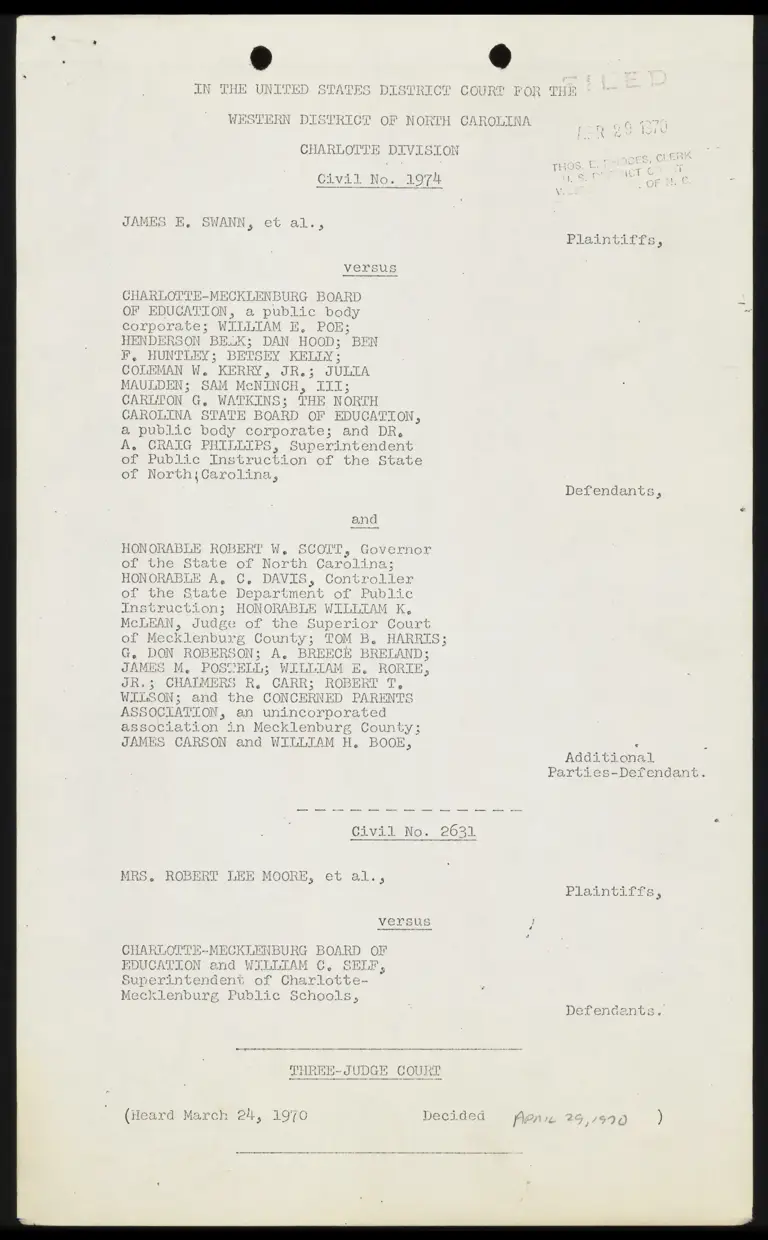
     [||064e462c-5efc-4814-9055-02c55cee574a||] STATES DISTRI (XT TT
CU pe


r
m


~
-—

| _
—


fo
r
e
d


~
y


LZ
 -

—~


fo
e rh —f


WESTERN DISTRICT OF NORTH CAROLINA

CHARLOTTE DIVISION

Civil No. 1974

CHARLOI'TE-MECKLENBUR
OF EDUCATION, ee Si
RO, Ph i E. PCE;
HENDERSON BE.K; DAN HOOD; BE
¥., HUNTLEY; BETSEY KELIY ;
COT.EMAN W. KERRY, JR.; JULIA
MAULDEN:; SAM MCN IN ICH, LIX;
CARLTON G, WATKINS; THE, NORTH
Gam [NA STATE BOARD OF EDUCATION,

» public body corporate; and DR,
A. CRAIG PHILLIPS, Superintendent
of Public Instruction of the State
of NorthjiCarolina,

and

HONORABLE ROBERT W.,
Of the 3tate of North Carolina;

HONORABLE A, C, DAVIS, Controller
ol the State Department of Public
Instruction; HONORABLE WILLIAM K,

McLEAN, Judge of the Superior Court

of Mechignburs County; TOM B, Ei 313;
G. DON ROBERSON; A. BREECE BRI AND:

JAMES M, POSTELL; WILLIAM E. ill
JR. ; CHAIMERS Re. CARR; ROBERT T,
WILSON; and the CONCERNED PARENTS
ASTON, an unincorporated
BSC iation in Mecklenburg County ;

JAMES \RSON and WILLIAM H, BOOE,

SCOTT, Governor

Gane Gem ae Se Nn een Sea Saar en Gen ee

¢ivil No 263 31.

MRS. ROBERT IEE MOORE, et al.,

versus

T PTE CHART MECKLENBURG BOARD OF

EDUCATION end WII Sd AM C, SELF,

Superintendent of Charlotte-

Mecklenburg Public Schools,

  oe ED eA A ee FA. SR Rh Bt ——

THREE-JUDGE COURT

- - ', - . “

(Heard March 24 Decided

Plaintiffs,

Def'en a


On


&h


in


1% US 5

[4

Additional

Parties-Defendan:

Plaintiffs,

!
|
Vo.


1

Before CRAVEN and BUTZNER, Circuit Judges, ard McMILLAN,
District Judge.


Mr. J. LeVonne Chambers (Chambers, Stein, Ferguson & Lanning )
and James M. Nabrit, JII, for Plaintiffs in I 1974; Mr.
William J. Waggoner (Wei nstein, Waggoner, Stur 2eS Odom &
3igger) and Mr. Benjamin Horack, for Defendants in No. 197k;
Mr. Ralph Moody, Deputy Attorney General, and Mr. Andrew A.

Vanore, Jr., Assistant Attorney General, for State Defendant
and Additional Parties-Defendant in No. 1974; and Mr. Willia
H. Booe and Mr. Whiteford S. Blakeney; for other Additional
Parties-Defendant in No. 1974.

=


FA

7


.

S

Tn

Mr. William H. Booe and Mr. Whiterord S. Blakeney for Plaintiffs
4 SGD A. oh Loh J ” ~ - 7 nt PN .

in No. 2031; and Mr. William J. Waggoner (Weinstein, Waggoner,
Sturges, odor & Bigger) for Defendants in No. 2631.


CRAVEN, Circuit Judge:

This three-judge district court was convened pursuant to

28 Ue8.0. 28 2281, ot goq. (1906! +), to consider a single aspect

of the above-captioned case: the constitutionality and impact

of a state statute, N. C. Gen. Stat. § 115-3761 (Sepp. 1969),

known as the antibussing law, on this suit brought to desegregate

the a school system. We hold a portion of

" N. c. Gen. Stat. § 115-176.1 unconstitutional because it may

interfere with the school board's performance of its affirmative

constitutional duty under the equal protection clause of the

Fourteenth Amendment.

I.

}

On February 5, 1970, the district court entered an order

requiring the Charlotte-Mecklenburg School Board to desegregate

its school system according to a court-approved plan. Implemen-

~

tation of the plan conld require that 13,300 additional children

1 ; . " : -
be bussed. This, in turn, could require up to 138 additional

school buses.”

Prior to the February 5 order, certain parties filed a sult 3 i S

entitled Tom B. Harris, G. Don Roberson, et al. v. William C.


self, Superintendent of Charlotte-Mecklenburg Schoo anc


Charlotte~Mecklenburg Board of Education, in the Superior Court


of Mecklenburg County, a court of general jurisdiction of the

State of North Carolina. Part of the relief sought was an order


i

On March 5, 1970, the Fourth Circult Court .of Appe als stayed
that portion of the district courtt!s order requiring nh i of
students pending appeal to the higher court.

2.
There 1s a dispute between the parties as to the additional

number of children who will be bussed and as to the number of
additional buses that will be needed. For our purposes, it is

immaterial whose figures are correct. The figures quoted are

taken from the district judge's supplemental findings of fact,
filed March 21, 1970. pi

—


;
A

©

enjoining the expenditure of public funds to purchase, rent

or operate any motor vehicle for the purpose of transporting

students pursuant to a desegregation plan. A temporary restrain-

ing order granting this relief was entered by the state court,

and, in response, the Swann plaintiffs moved the district court

to add the state plaintiffs as additional parties defendant in

the federal suit, to dissolve the state restraining order, and

to ai Lrect all parties to cease interfering with the federal eg

court mandates. Because it appeared that the constitutionality

of N.C. Gen. Stat. § 115-176.1 (Supp. 1969) would be in question,

pe

the district court requested designation of this three-judge

court on February 19, 1970. On February 25, 1970, the district RE

judge granted the motion to add additional parties. Meanwhile,

on Februaky 22, 1970, another state suit, styled Mrs. Robert

Lee Moore, et al. v. Charlotte-Mecklenburg Board of Education


and William C. Self, Superintendent of Charlotte-Mecklenburg


Schools, was begun. In this second state suit. the plaintiffs

also requested an order enjoining the school board and superin-

tendent from implementing the plan ordered by the di istrict court

on February 5. The state court judge issued a temporary re-

4. mn

training order embodying the relief requested, and on February a
wr

26, 1970, the Swann plaintiffs moved to add Mrs. Moore, et al., :

as additional parties defendant in the federal sult. On the

same day, The state defendants filed a petition for removal of

the Moore sult to federal court. On Maych 23, 1070, the district

judge requested a three-judge court in the removed Moore case,


o£

and this panel was designated to hear the matter. All the cases

were consolidated for hearing, and the court heard argument by

all parties on March 24, 1970.

IX.

MN. 0. Gen. Stat. § 11 15-176. % gin. 1969) reads:
- = -

Assignment of pupils based-on race, creed,
color or national origin prohibited.--No person
shall be refused admission into or be excluded


from any public school in this State on account
of race, creed, color or national origin. No
school attendance district or zone shall be drawn
for the purpose of segregating persons of various
races, creeds, colors or national origins from J : Pe

<<

the community.

Where administrative units have divided the
geographic area into attendance districts or
zones, pupils shall be assigned to schools with-
in such attendance districts; provided, however,
that the board of education of an administrative
unit may assign any pupil to a school outside of
such attendance district or zone in order that ~ such pupil may attend a school of a specialized
kind including but not limited to a vocational
school or school operated for, or operating
programs for, pupils mentally or physically
‘handicapped, or for any other reason which the
board of education in its sole discretion deems
sufficient. No student shall be assigned or ji compelled to attend any school on account of
race, creed, color or national origin, or for
the purpose of creating a balance or ratio of
race, religion or national origins. Involuntary
bussing of students in contravention of this
article is prohibited, and public funds shall
not be used for any such bussine.

The provisions of this article shall not
apply to a temporary assignment due to the un-
suitability of a school for its intended purpose
nor to any assignment or transfer necessitated by
overcrowded conditions or other circumstances
which, in the sole discretion of the school board,
require assignment or reassignment.

The provisions of this article shall not
apply to an application for the assignment or re-
assignment by the parent, guardian or person : .
standing in loco parentis of any pupil or to any
assignment made pursuant to a choice made by any
pupil who is eligible to make such choice pur-
suant to the provisions of a freedom of choice
Plan voluntarily adopted by the board of educa-
tion of an administrative unit.

Lt is urged upon us that the statute is far from clear and

may reasonably be interpreted several different Way s .

(A) Plaintiffs read the statute to mean that

the school board is prevented from complying with its

duty under the Fourteenth Amendment to establish a

unitary school system. See, e.g., Green v. County

al a a ~ 3 By ry y School. Bd. of New Kent County, 3°11 U.s8. 430, 439


1968). In support of .this contention, plaintiffs 5
. 4

argue that the North. Carolina General Assembly passed

8 115-176.1 in response to an April 23, 1909, dis-
LS]

h trict court order, which required the school board

will


prs


pa
pi


ni
gh


ns


ip

vis
a

to submit a plan to desegregate the Charlotte schools

for the 1969-70 school year. Under Pp. aint ers! in-

terpretation of the statute, the board is denied all

desegregation tools except nongerrymandered geo-

graphic zoning and freedom of choice. pid eit in

this, of course, 1s the suggestion that zoning and

freedom of cholce wlll Ve ineffective in the Charlotte

context to disestablish the asserted duality of the

present system.

(B) The North Carolina Attorney General argues

that the statute was passed to preserve the neAciBore

hood school concept. Under his interpretation, the

statute prohibits assignment and bussing incon- ;

sistent with the neighborhood school concept. Thus,

to disestablish a dual system the district court

could, consistent with the statute, only order the

board to geographically zone the attendance areas so

“hh as nearly as possible, each student would be

SsAgnec to the school nearest his home regardless

of his race. Implicit in this argument is that any

‘school system ls per se unitary if 1% ls zoned ac-

cording to neighborhood patterns that are not the

result of officially sanctioned racial discriminéa-

tion. Although the Attorney General emphasizes the

expres ssion of state policy by the Legislature in

favor of the neighborhood school concept, he

recognizes, of course, that the statute also per-

mits freedom of choice if a school board volun- | 3
.

tarily sdopts such a plan. Thus, the plaintifls

and the Attorney General read the statute in much

the same way: that it limits lawful methods of

accomplishing desegregation to nongerrymandered

geographic zoning and freedom of choice.


Ww


(C) The school board's interpretation of the

statute is more ingenious. The board concedes that

the statute prohibits assignment according to race,

assignment to achieve racial balance, and involuntary

bussing for either of these purposes, but contends

that the facial prohibitions of the statute only

apply to prevent a school board from doling more

than necessary to attain a unitary system. The

argument is that since the statute only begins to

operate once a unitary system has been established,

it in no way interferes with the board!s constitu-

tional duty to desegregate the schools. Counsel

goes on to insist that Charlotte-Mecklenburg present-

ly h&s a unitary system and, therefore, that the state

court constitutionally applied the statute to prevent

further unnecessary racial balancing.

(D) Plaintiffs in the Harris suit contend (1)


that in 42 U.S.C. §§ 2000c(b)

Congress expressly prohibited assignment and bussing

to achieve racial balance, (2) that to compel a child

to attend a school on account of his yace or to com-

pel him to be lavelmia ly bussed to achieve a racilal

balance violates the principle of Brown v. Bd. of Ed.


Topeka, 347 U.S. 483 (1954), and (3) that N. C.
J é


As used in this subchapter -

(b)  "Desegregation" means the assignment of
students to public schools and within such schools
without regard to thelr race, Color, reli gion, or
national origin, but "deseg eregation shall not mean

A assignment of students to public schools in order

to overcome racial imbalance.

2000c~6 (a):

(2) [P]lrovided thal nothing herein shall em-

power any official or court of the United States to

issue any order seeking to achieve a racial balance

in any school. by requiring the transportation of

pupils or students from one school to another or one
school district to another in order to achieve such
racial balance, or otherwise enlarge the existing

power of the court to insure compliance with con-
stitutional standards.

6.

and 2000¢-6(a) (2) (1964)3

o>


Gen. Stat. § 115-176.1 merely embodies the principle


of the neighborhood school in accordance with Brown

and the Civil Rights Act of 1964 We may dispose of

the first contention at once. The statute "cannot

be interpreted to frustrate the constitutional pro-

hibition [against segregated schools]." United

States v. School Dist. 15 of Cook Co., hol ».24


1125, 1130 {7th Civ. 10568),

(E) Plaintiffs in the Moore suit argue that

the district court order of February 5, 1970, was

in contravention of Brown and, therefore, that the

state court order in their suit was justified. How-

ever, the Moore plaintiffs also argue that certain

pargs of the second and third paragraphs in the

state statute are unconstitutional because they

give the school board the authority to assign

children to SOLE for whatever reasong the board

deems necessary or sufficient. The Moore plaintiffs

interpret these portions of the statute as per-

mitting assignment and bussing on the bagis of

race contrary to Brown and the Fourteenth Amend-

ment. w : ,

EY

Federal courts are reluctant, as a matter of comity and

\ respect for n tate legislative judgment and discretion, to

strike down state statutes as unconstitutional, and will not

do so if the statute reasonably can be interpreted so as not

to conflict with the federal Constitution. Bub to read the


statute as innocuously as the school board


suggests would, we

think, distort and twist the legislative intent. We agree with

plaintiffs and the Attorney General that the statute limits

the remedies otherwise avallable 40 school boards to desegre- er

gate the schools. The harder question is whether the limita-

tion is valid or conflicts with the Fourteenth Amendment. We

think the question is not so easy, and the statute not so

obviously unconstitutional, that the question may lawfully be

answered by a single federal judge, see Turner v. City of


Memphis, 369 U.S. 350 (1962); Bailey v. Patterson, 369 U.S.


31 (1962), and we reject plaintiffs! attack upon our juris-

diction. Swift & Co. v. Wickham, 382 v.85. 111 (1965);


Wright, Law of Federal Courts § 50 at 190 (2d ed. 1970).

IniGreen v. County School Bd. of New Kent Co., 391 U.S.


430 (1968), the Supreme Court declared that a school board

must take effective action to establish a unitary, nonracial

system, if it is not already operating such a system. The

Court neither prohibited nor prescribed specific types of

plans, but, rather, emphasized that it would Judge each plan

by its ultimate effectiveness in achieving desegregation. In

Green itself, the Court held a freedom-of-choice plan insuf-

ficient because the plan left the school system segregated,

but stated that, under the circumstances existing in New Kent

County, it appeared that the school board could achieve a

unitary system either by simple geographical zoning or by

consolidating the two schools involved in the case. S301 U.S.

at 442, n. 6. Under Green and subsequent decisions, it is

clear that school boards must implement plans that work to

LE

achieve unitary systems. Northcross v. Bd. of Ed. of the


L.%W. 4219 (0970); 8

Alexander v. Holmes Co. Bd. of Ed., 396 U.S. 19 (1969).

Memphis City Schools, U.S. yD

  —————————

Plans that do not produce a unitary system are unacceptable.


L :
The reach of the Court's mandate is not yet clear:

[Als soon as possible . . . We ought to resolve

: some of the basin practical problems when they are

"a


We. think the enunciation of policy by the legislature of -

the State of North Carolina is entitled to great respect.

Federalism requires that whenever it is possible to achieve

a unitary system within a framework of neighborhood schools,

a federal court ought not to require other remedies in dero-

gation of state policy. But if in a given fact context the Vv"

statel!s expressed preference for the neighborhood school cannot

be honored without preventing a unitary system, it is the

former policy which must yield under the Supremacy Clause.

Stated differently, a statute favoring the neighborhood

school concept, freedom-of-choice plans, or both can validly

limit a school boardl!s choice of remedy only if the policy

favored will not prevent the operation of a unitary Sheba -

That it may or may not depends upon the facts in a particular

school system. The flaw in this legislation ls 1ts rigidity.

Ag an expression of state policy, it lz valid. To the extent

that it may interfere with the boardts performance of its

affirmative Gonstitutional duty to establish a unitary system,

The North Carolina statute, analyzed in light of these

principles, is unconstitutional in part. The first paragraph

of the statute reads:

No person shall be refused admission into or
be excluded from any public ano] in this State

on accounk of "race, creed, color or nat} onal origin.
No school attendance district or Ah sha 11 be drawn
for the purpose of segregating persons of various

races, creeds, colors ox natlonel aio from the
community.


Tr. (continued)

appropriately presented including whether, as a consti-
tutional matter, any particular racial valonce must be

achieved in the’ schools; to what extent school districts
and zones may or must be altered as a constliuvional
matter; to what extent transportation may or must be

provided to achieve the ends sought by prior holdings

of the Court.


Northcross v. Bd. of Ed. of the Memphis City Schools, US.
> 38 L.W. at 4220 (1970) (Chief Justice Burger, concurring).

For our purposes, it is sufficient to say that the mandate
applies to require ‘reas onable" or "Justifial le” solutions.
See generally Fiss, Raclal Imbalance in the Public Schools:
The Constitutional Concepts, 78 Harv. L. Rev. 560 1365).


There is nothing unconstitutional in this paragraph. It is

merely a restatement of the principle announced in Brown v.

Bd. of Ed. of Topeka, 347 U.S. 483 (1954) (Brown I).


-

The third paragraph of the statute reads:

The provisions of this article shall not
apply to a temporary Hn ten due to the un-
suitability of a school for its intended purpose
nor to any assignment or transfer necessitated
by overcrowded conditions or other circumstances
which, in the sole discretion of the school board,
require assignment or reassignment.

- This paragraph merely allows the school board noninvidious dis-

cretion to assign students to schools for valid administrative

reasons. As We read 1, lt does not relate to race at all and,

so read, is constitutional.

The fourth paragraph provides:

vs The provisions of this article shall not

apply to an application for the assignment or
reass signment by the parent, guardian or person
standing in loco parentis of any pupil or to any

assignment made pursuant to a choice made by any
pupil who is eligible to make such choice pur-
suant to the provisions of a freedom of choice
plan voluntarily adopted by the board of educa-
tion of an administrative unit.

This paragraph relieves school boards from compliance with the
, 5 A

pro JN statute where they are implementing voluntarily adopted freedom-

of-choice plans within their systems. It does not require the

boards to adopt freedom of choice in any particular situation,

but leaves them free to comply with their constitutional duty

by any effective means avallable, including, where it is ap-

-

propriate, freedom of choice. So interpreted, the paragraph

is constitutional.

The second paragraph of the statute contains the consti-

tutional infirmity. It reads:

Where administrative units have divided the
geographic area into attendance districts or zones,
pupils shall be assigned to schools within such
attendance districts; provided, however, that the
board of education of an administrative unit may

assign any pupil to a school outside of such
attendance district or zone in order that such
pupil may attend a school of a specialized kind

including but not limited to a yosaiuonay school
OY. 8chool operated for, ox Opersuing pre grams for,
pupils mentally or phy 51 cally handicapped, or-for
any other reason which the board of 0. he in
its sole discretion deems sufficient. oo student


10:


shall be assigned or compelled to attend any
school on account of race, creed, color or nation-
al origin, or To¥ the purpose of creating a
bal Lance or ratio of race, religion or national
oF igins. Involuntary bussing of students in
ontravention of this article is prohibited, and
win funds shall not be used. for any such
bussing.

The first sentence of the paragraph presents no greater con-

stitutional problem than the third and fourth paragraphs of

the statute, discussed above. It allows school boards to

establish a geographically zoned neighborhood school system,

but it does not require them to do so. Consequently, thie -

sentence does not prevent the boards from complying with their

constitutional duty in circumstances where zoning and neighbor-

hood school plans may not result in a unitary system. The

clause in the first sentence permitting assignment for "any

other reason" in the boardls "sole discretion” we read as mean-

ing simply that the school boards may assign outside the

neighborhood schon zone for noninvidious adil istrative

reasons. So read, it presents no difficulty. The second and

third sentences are unconstitutional. They plainly prohibit

school boards from assigning, compe 11ling, or involuntarily

bussing students on account of race, or in order to racially

"balance" the school system. Green v. School Bd. of New Kent


Co., 391 U.S. 430 (1968), Brown v. Bd. of Ed. of Topeka, 349


U.S. 294 (1955) (Brown II), and Brown v. Bd. of Ed. of Topeka,


347 U.S. 483 (1c 954) (Bro rown I), quire school boards to con-

sider race for the purpose of disestablishing dual systems.

The Constitution is not color-biind with respect to the

affirmative duty to establish and operate a unitary school

system. To say that it is would make the Sonstianaions LL prin-

ciple of Brown I and II an abstract principle instead of an

operative one. A flat prohibition against assignment by race

would, as a practical matter, prevent school boards from alter-

ing existing dual systems. Consequently, the statute clearly

NE rAvVaTYaE: Ee CIT Taine wivE ia At vacticr Shad Hine pda bette an contravenes the Supreme Courtls direction that boards must take

steps adequate to abolish dual systems. See Green V. School Bd.


of Ne ew K Cl } Eb Co * 391 U ® S ° 430 5 | B37 (196 8) © A 5 far i S the P Io

hibition against racial “balance” is concerned, a school board,

in taking affirmative steps to desegregate its system, must

always engage in some degree of balancing. The degree of

2 eo npr $d es a racial "balance" necessary to establish a unitary system under

given circumstances is not yet clear, see Northecross v. Bd. of


Ed. of the Memphis City Schools, UeBe 0 vy 38 L.W.. at 4220


(1970) (Chief Justice Burger concurring), but because any method

of school desegregation involves selection of zones and trans Per

and assignment of pupils by race, a flat prohibition against

racial "balance" violates the equal protection clause of the

Fourteenth Amendment. Iinally, the statutel!s prohibition

against "involuntary bussing" also violates the equal protec-
r

[] 4

tion clause. Bussing may not be necessary to eliminate a dual

system and es tablish a unitary one in a given case, but we think

the Legislature went too far when it undertook to prohibit its

use in all factual contexts. To say that bussing shall not be

resorted to unless unavoidable ls 8 valid expression of state

policy, but Co flatly prohinit it regardless of cost, extent

and all other factors--including Miri of a school board

to experiment--contravenes, we think, the implicit pandebe of

Green that all reasonable methods be available to implement a
rec a p———

unitary system.

Although we hold these statutory prohibitions unconstitu-

od-

tional as violative of equal protection, it does not follow that

Muss: sng” will be an appropriate remedy. in any particular school

desegregation case. On thls lssue we express no opinion, for

the question is now on appeal to the United States Court of

Appea] 8 for the Fourth Circult and is not for us to decide.

IT is lots that each case must be analyzed on its own

facts. See Green v. School Bd. of New Kent Co., 391 U.S. 430

(1968). The legitimacy of the solutions proposed and ordered

in each case must be judged against the facts

school system. We merely hold today that North Carolina may

i


i

i

H

i
i }

i
i
i

Splaintif

? 9
not validly enact laws that prevent the utilization of any

reasonable method otherwise available to establish unitary

school systems. Its effort to do so is struck down by the

equal protection clause of the Fourteenth Amendment and the

3

Supremacy Clause (Article VI, clause 2 of the Constitution).

Vv

As we have no cause to doubt the sincerity of the various

defendants, the plaintiffs! motion to hold. them in contemnt for

interference with the district courts orders and their request

: for an injunction against enforcement of the statute will be

denied. We believe the defendants, including the state court

v

fs, will, pending appeal, respect this courtl!s judgment,

which applies statewide with respect to the constitutionality

of the statute.

Several of the parties have moved to be dismissed from

the case, alleging various grounds in support of their motions.

Because of the view we take of this sult and the limited relief

©

we grant, the motions to dismiss become immaterial. The school

board is undeniably a proper party before the court on the con-

stitutional issue, since it is a party to the desegregation

]

sult. We can, therefore, consider sndaijudge the-validity of

4. .8 the statute, regardless of the position of the other parties.

That we consider the substantive arguments of all the parties

in no way harms those who have moved to be dismissed.

An appropriate judgment will be entered in accordance with

this opinion. [||064e462c-5efc-4814-9055-02c55cee574a||]