Memorandum on Issues with Desegregation Plan

Public Court Documents
June 22, 1971

Memorandum on Issues with Desegregation Plan preview

7 pages

Cite this item

  • Case Files, Swann v. Charlotte-Mecklenburg Hardbacks. Memorandum on Issues with Desegregation Plan, 1971. 3d9487da-2e34-f111-88b4-7c1e526962fd. LDF Archives, Thurgood Marshall Institute. https://ldfrecollection.org/archives/archives-search/archives-item/61c8e570-8f0e-47c3-8652-7a0b85666a98/memorandum-on-issues-with-desegregation-plan. Accessed June 02, 2026.

    Copied!

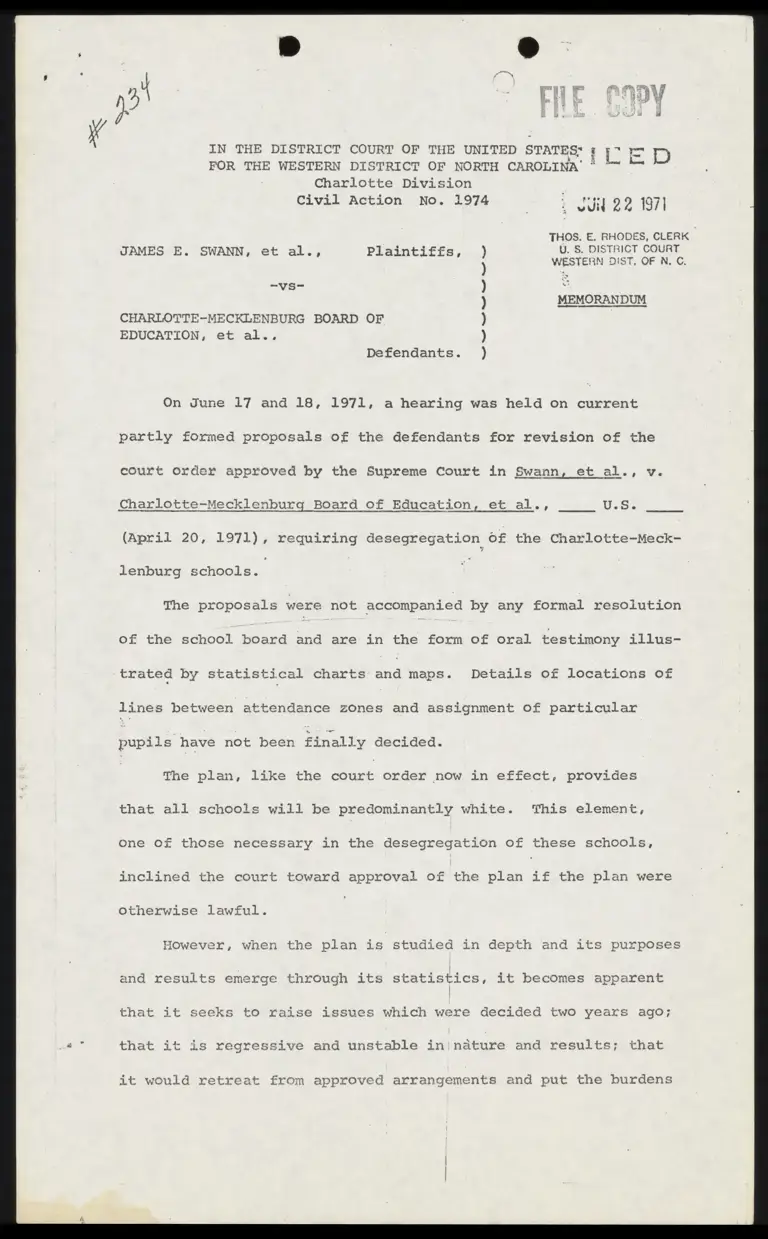
     [||791fa607-9e6e-4bb3-af25-2ae0085dadc0||] } IN THE DISTRICT COURT OF THE UNITED STATES: § j~ I= D 

FOR THE WESTERN DISTRICT OF NORTH CAROLINA' * vy Boma 

Charlotte Division 
. . . 0 Lb] : 2 gr — 

Civil Action No. 1974 Lai 22 BH 

THOS. E. RHODES, CLERK 
JAMES E. SWANN, et al., Plaintiffs, 1. S. DISTRICT COURT 

WESTERN DIST. OF N. C. 


CHARIOTTE-MECKLENBURG BOARD OF 

\ 
' 

) y 
) Hie 

) MEMORANDUM 

) 
EDUCATION, et al.. ) 

) Defendants. 

On June 17 and 18, 1971, a hearing was held on current 

partly formed proposals of the defendants for revision of the 

court order approved by the Supreme Court in Swann, et al., v. 
  

Charlotte-Mecklenburqg Board of Education, et al., U.S. 
  

(April 20, 1971), requiring desegregation OF the Charlotte-Meck- 

lenburg SThOOLS.. 

The proposals were not accompanied by any formal resolution 

of the school Sots and are in the form of oral testimony illus- 

trated by statistical charts sna maps. Details of locations of 

lines between attendance zones and assignment of particular 

pupils have not been finally decided. 

The plan, like the cont order now in effect, provides 

that all schools will be predominantly white. This element, 

one of those necessary in the desegregation of these schools, 

inclined the court toward approval of the plan if the plan were 

otherwise lawful. 

However, when the plan is studied in depth and its purposes 

and results emerge through its statistics, it becomes apparent 

that it seeks to raise issues which were decided two years ago; 

va that it is regressive and unstable in nature and results; that 

it would retreat from approved arrangements and put the burdens 


of desegregation primarily upon the black race; that it would 

unlawfully discriminate against black children: that its methods 

are discriminatory; and that it should nct be approved. 

The board's proposals, according to the Eon einony; would 

include the following: 

l. Close two "black" schools — Double Oaks Elementary 

and Northwest Junior High Schools, which have a combined ; 

capacity of more than 1,620 pupils. 

2. Reduce West Charlotte High School, formerly "black" 

with pupil capacity of 1,603, to an assigned student body of 

940, leaving at least 663 empty classroom seats. By contrast, 

other high schools are heavily loaded: Myers Park, for example, 

with a capacity of 1,676, would be sevigned 2,330 students. 

3. De-populate fifteen other "bladd” or predominantly 

"black" elementary schools from their current capacity of 

8,694 pupils to an assigned student population of 4,645, thus 

leaving 47% of their classroom seats empty. 

4. Convert nine of those fifteen elementary schools 

(Bruns Avenue; Amay James; University Park; Druid Hills; 

Oaklawn; Villa Heights; Marie Davis; First Ward and Lincoln 

Heights) from schools serving grades five and six to schools 

serving grade six only. These nine schools would be reduced 

in total student population to 2,755 students, which Lat
 

n v 

- 
little over 51% of their 1970-71 population of 5,362 students. 

5. The black elementary students thus assigned out of 

the closed and partly closed schools would be transported in 

Rr x 

a one-way bussing or "satellite program to outlying "white" 

schools. 


N 3 

6. The only Teross-bussiis proposed for white elementary, 

students would appear to be the white sixth graders who might 

be assigned go’ the one-grade inner-city schools. 

7. Unused classroom spaces in the closed and partly 

closed schools above described by count would be 6,342. 

8. In addition, there will continue to be approximately 

2,000 vacant classroom spaces in the buildings formerly 

occupied by Myers Street Me Second Ward High and 

Irwin Avenue (old Harding High) SChOOLS. 

9. Space for the black children thus transferred from 

these 8,000 or so inner-city classroom spaces would be provided 

in outlying white schools, many of which would be severely 

overcrowded, as shown by the following illustrative table: 


Excess 

Over 

Capacity Assigned Capacity 

Sharon ; 486 675 189 

Carmel Junior High 606 1,050 444 

South High 1 ,5301 2,075 545 

Montclaire . 648 900 252 

Paw Creek Annex 270 425 155 

Hidden Valley 648 1,100 452 

Garinger High 1,870 2,430 560 

Myers Park High 1,676 2,330 Lc ong 

Totals: 7.734 10,985 3,251 

10. Shutting down the two schools and reducing the popula- 

students, plus those already needed tc be bussed to correct the 

West Boulevard over-crowding. 

11. Distances of travel required of many elementary children 

would be sharply increased —— for example, first graders from 

\ 

: 

Double Oaks community in northwest Charlotte would be assigned 

to Bain School near the east edge of the county, a distance of 

. i Sal 
twelve or more air line miles. 


lle 

12. No reason except "white flight" was advanced to 

support the creation of that unusual organization, the school 

for sixth graders only. 

13. Nothing is revealed about plans for the future, but 

based on past experience it may be reasonable tO wonder if a 

move to close additional "black" schools might be in the offing 

for next year. 

l4. Space is proposed to be provided at the overcrowded 

schools by purchasing 172 new mobile classroom units for 25 

children each. These are not on hand: the delivery schedule 

for such units a year ago when the board bought a group of 10 

such units was ten weeks after the decision to buy was made. 

It is now less than Lon wees until the opening day of school. 

15. The cost to taxpayers of this program, which would 

restore discrimination rather than promote constitutional 

rights, is many millions of dollars. The last batch of 

schools that were closed in 1969 (Second Ward High and 

several other schools) were valued by the board at that 

time at more than $3,000,000. Exclusive of library books, 

evidence in the record shows property value of Northwest 

Junior High is $723,647.65; of Double Oaks, $883,626.65; 

of West Charlotte High, proposed to be used at less than 

60% capacity, $2,980,209.23; the value of thirteen of the 

fifteen elementary schools which are to be de-populated to a 

little more than one-half of their capacity is $6,349,679.53. 

If Bruns Avenue and First Ward, the other two schools, both 

relatively new, are as valuable as their older counterparts 

of similar size, this adds another $1,800,000 to the figure.  


Lb] a Ee : kk 

16. The minimum cost of the 172 mobile units, assuming 

they can be had and assuming that the price has not gone up 

in the past year, is $8,300 each, or $1,427,600, exclusive of seats 
  

and other classroom equipment. : 

v 

17. cost to the taxpayers, even in terms like these, is 
, 7 

(J 

not for the courts to control; but the fact that it is proposed 

to spend money and abandon property in such wholesale fashion 


to preserve discrimination is in stark, contrast to ‘the previous 
| 

reluctance of the board to spend money’ to eliminate discrimination. 
  

18. Apart from other considerations, the surchase and 

location of 172 mobile units for 25 students each is a sizeable: 

program of school location and construption of facilities for 

at least 4,300 students, and under the Supreme Court decision 

in Swann, district courts are required to review such programs 

and not to approve of them if they are discriminatory in result. 

In the order of August 15, 199, approving as a one-shot 

temporary proposition the one-way transport of consenting black 

children from closed inner-city schools, the court said: 

"It is not the intention soithis court to endorse 

or approve any future plan which puts the burden of 

desegregation primarily upon one race.” 

%* Bk % 

"k¥%%* One-way bussing plans for the years after 

1969-70 will not be acceptable.” 


"Certainly, if the means selected by the district 

to accomplish its purported purpose themselves involve 

substantial elements of racial discrimination, its 

entire plan becomes suspect concerning whether it is 

really a geod faith reasonably adequate implementa= 

tion of these principles." Brice v. Landis, 314 F.Supp. 

974 (N.D. Calif., 1969). 


§ : wi 

The closing of a black school and the transfer of its 

pupils to a school without adequate facilities to receive 

them in the absence of valid eincational reasons and without 

any similar burden non White students or Soachens has been 

held "inherently discriminatory and therefore invalid." 


Smith v. St. Tammany Parish School Board, 302 F.Supp. 106 

(E.D. La., 1969). | 

Where black schools are closed and the principal burden 

of transportation placed upon black Studaritas 

"¥*%% there is a heavy burden on the school board #**%* 
to explain the closing of facilities formerly used for 

the instruction of black students." Haney v. Sevier 

County, 429 F.2d 364, 372 (8th Cir., 1970). 

As late as June 10, 1971, the Fourth Circuit Court of 

Appeals affirmed an order eniteuad by Judge Ted Dalton in 

Rounds, Virginia, disapproving the closing of a black high 

school without adequate educational reason and transporting 

its pupils to an overcrowded "white" school. Green v. Roanoke, 

No. 15,030 (4th Cir., June 10, 1970). 

"White flight” was advanced as the chief reason for the 

board's proposals. The facts advanced will not support a finding 

that nyhite flight" is a serious threat to the public schools 

of Mecklenburg. The same cry has been raised before, here and 

elsewhere; and [with all due deference to the right of people 

to send their children to the best schools they can afford] the 

answer must be what it has always been: Public displeasure is 

no excuse for unconstitutional discrimination. ‘As the Supreme 

  
Court said in Monroe v. Commissioners, 391 U.S. 450 at 459 (1968): 

AMEN \ 


-F = 

"We are frankly told in the Brief that without 

the transfer option it is apprehended that white 

students will flee the system altogether. 'But it 

should go without saying that the vitality of these 

constitutional principles cannot be allowed ‘to yield 

simply because of disagreement with them.' “Brown II, 

gt 300." 

CONCLUSION 
  

In apparent recognition of the considerations outlined 

above, the defendants during the hearing withdrew their 

original proposals, and are now preparing for consideration 

a revised version of their proposals. The court has also 

requested defendants to prepare and submll . fox comparison 

a revision of the plan already in effect, adjusted to correct 

the deficiencies, mostly involving west side areas, which 

were referred to in the over of October 5, 1970. 
in : 

This the _« od day of June, 1971. 


(land A 4 Alb. 
James B. McMillan 

United States District Judge [||791fa607-9e6e-4bb3-af25-2ae0085dadc0||] 

Copyright notice

© NAACP Legal Defense and Educational Fund, Inc.

This collection and the tools to navigate it (the “Collection”) are available to the public for general educational and research purposes, as well as to preserve and contextualize the history of the content and materials it contains (the “Materials”). Like other archival collections, such as those found in libraries, LDF owns the physical source Materials that have been digitized for the Collection; however, LDF does not own the underlying copyright or other rights in all items and there are limits on how you can use the Materials. By accessing and using the Material, you acknowledge your agreement to the Terms. If you do not agree, please do not use the Materials.


Additional info

To the extent that LDF includes information about the Materials’ origins or ownership or provides summaries or transcripts of original source Materials, LDF does not warrant or guarantee the accuracy of such information, transcripts or summaries, and shall not be responsible for any inaccuracies.