Joint Appendix Volume I
Public Court Documents
1981
303 pages
-
Case Files, Garner Working Files. Joint Appendix Volume I, 1981. 6f5d43d6-35a8-f011-bbd3-000d3a53d084. LDF Archives, Thurgood Marshall Institute. https://ldfrecollection.org/archives/archives-search/archives-item/6320e43b-ff74-44c4-83d4-5b75142db204/joint-appendix-volume-i. Accessed September 26, 2026.
Copied!
w
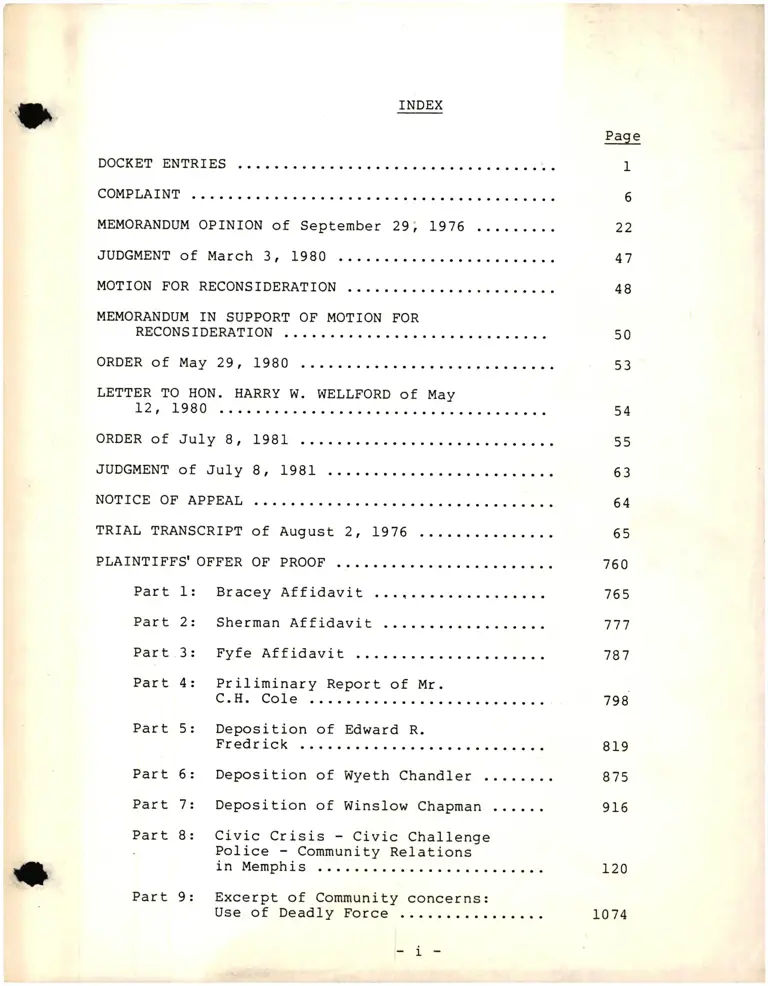
INDEX
DOCKET ENTRIES ........................
COMPLAINT ..............................
MEMORANDUM OPINION of September 29, 1976
JUDGMENT of March 3, 1980 .............
MOTION FOR RECONSIDERATION ............ .
MEMORANDUM IN SUPPORT OF MOTION FOR
RECONSIDERATION .............. .
ORDER of May 29, 1980
LETTER TO HON. HARRY W. WELLFORD of May
12, 1980 .........................
ORDER of July 8, 1981 ...........
JUDGMENT of July 8, 1981 ........
NOTICE OF APPEAL ................
TRIAL TRANSCRIPT of August 2, 1976
PLAINTIFFS' OFFER OF PROOF.......
Part 1
Part 2
Par t 3
Part 4
Part 5
Part 6
Part 7
Part 8
Part 9:
Bracey Affidavit ,
Sherman Affidavit
Fyfe Affidavit ..,
Priliminary Report of Mr.
C.H. Cole ..............
Deposition of Edward R.
Fredrick .............
Deposition of Wyeth Chandler .
Deposition of Winslow Chapman
Civic Crisis - Civic Challenge
Police - Community Relations
in Memphis .................. .
Excerpt of Community concerns:
Use of Deadly Force .........
Page
1
6
22
47
48
50
53
54
55
63
64
65
760
765
777
787
798
819
875
916
120
1074
- 1 -
Page
Part 10 : Compilation of Municipal
Deadly Force Policies ............. 1108
Part 11: New York City Police Department
Training Materials ................ 1369
Part 12 : Raw Data Arrest by Memphis
Police Department 1963-1974 ....... 1409
Part 13 : Incidents Memphis Use of Deadly
Force Against Property Crime Suspects
and Boston Deadly Force Policy
(Wiley Appendices) ................ 1458
Part 14 : Excerts Trial Record Wiley v.
Memphis Police Department ......... 1477
- 11 -
sr
.0 u c - w '
'.-. v ^ ' q ' Z i '
i~l/2 ■ '■: -̂-v) I no3 1 ill
r'',
3AK.Tî , Cl£.u,'r̂!2, ;'"-t.;-r -'.o:;! .ri' kin,
o;' l-\?»r3L~, i -ir.cr
u c F £ i\ C A j 7 S
H. ?clice crrice c:- ctr,2
; , v\ ••* {:j L i-J i- “
f y.i:iz'.'Sz
CAL'Sc
Ac-.i-:; ;';r -.-rcr.ieiV;'. ur-dor ~2 ‘:2Z l?i;, lj85, d";6 ar.d 1333 :'rê
•.■icliticr. c:' t;-.-; c:' t;;" iece^Jcd ur.dir V. 3. Ccnstt'uticr., I'idjril lav: sr.d
--.d-T liv3 c;' rrvT.iiC?-;, vhll; lodir.^ 'ir-dir Oder of lav.
ATTOhNE rs
I'.er ."all'y, ,'r. d
::i :oao:;o : ilolei
• :-M o - v i ; -
ii't-■ . .'i_i'.'.:.
■dT ’.** ! ■ I .V . . L.. V ' - i ro r
r ' - ’ ’ i: ;ol_-J:w. ;lr;l<:
:'r--vor.'., ;:r»- ;cr;<
- ^ . . ,
Stirvcn L. d'lntiT
2030 - 10 Coluabus Circle
Nev 'forli. N. I’. 10019( 21 2) 596-r?97
Ardd-jr 5d?a
Acdodor.d City .■.dtcrr.ov
:id;.- :-:aii
125 loro'r. I'air. ddresd—’> d'-'S 523-25d
lleoicais, 2r.. 3 :12 3
523-2363
r'
rlLl.'.G f t£3 ̂ AID
Cy'j-'^;>Cci_____
1.IM t( •, <.r.\u , i,t .r»- iCT LOwH J tiOJKi i
: & r v ^_22did_J?iL_.
j:
4
li-S-75
--e-75 \ J j
!*-£-75 ^
U-22-75
h.zz-75
'■i-22-73
1-22-73
^-22-73
5-1-75. ^
rc5-23-75 o ::c
-23-"5
-:-s--5
£ -i :- '5
z-lz-23
10-17-75
i :-i :-7 5
io -i:-"5
ii-ir-75ii-i:-~=ii-ir-~=
,1-14-75
' . ■ C.“r-
l-l'-’6
i-a;--c
1-1---6
3-A-76
Order iUc.-ir.; g'-I.* to Le Oiled on Taujer's Oath
Ccrrlaiht
locued Ou=ton£ a--.d handed attorney.
VarGhal'a retarn on simons for E. R. ;!jnton exec, u-il-7^.
Vars'nal's'reforn on conaons for Jac/ W. Huhbard exec. -;-l̂ -75.
••arshal's refarn on S'oraons for V,'yeth Chandler exec. U-11-7... ^
’•arshal's return on Sc t c .cs for !'.e=?his rolice Departmer.u exec. ---ll-,5.
r’.axahai's return cn furao.na for Me.tphis, City of, exec. 4-11-7^.
Ctifulation extendi.n,j time vithin vhich defendants raao’ nove or plead.
cn to Discios in Behalf of Eefendants
yenrorandun in Support of Motion to Dismiss
E.rten:icn cf Tine To Respond To Motion, plairtiff allowed 15 days id addition to
those permitted i.nlocal R'ule 9 in vhich tc respo.nd to deft, motian to dismiss.
Copy Jui?e, Bailey, Greenher.;, .‘Hein and Shea.
Rlii'ntiff’s I'.enorand'un in Oipositicn To Motion to Disniss of Defendants, Memphis
~ Roli'ce'separtnent, City of Memphis, Wyeth Chandler, Jay W. Hubbard and E. .R. Kymon.
rt on ’'cticn to Dismiss - Defendants' motion to dismiss is overr'iled, reluota.ntly
^'•o th- ''ir.'cf Memphis and the Police Departme.nt on the "1331 j'urisdicational
bas<”'. Copy handed Judge Wellfcrd a.nd railed ■■.'.slter Lee Eailey, Jr., Jach Cree.-.bern
7
!C
n
Arthur Shea .and Henry L. I-Heir.
A.-.sver of DefendiPts
Plaintiff's First Hecuest Fcr Producticn of Docu-ments.
Plaintiff's Interrogatories, to deft. 'Wyeth Chandler.
Ilaintiff's Interrogatories to deft. E. P. Hi’iscn.
/DL Plaintiff's Interrogatories to deft. Jay W. Hubbard
r^otice to Tale Deposition of Cloa-rntree Car.ner
/—
/S
/ r
}?
/ 9Dio ^ /
z z .X-2
'.71.0.-A
--it-7e
2.9
•3 c
- 31
Ictice to Taxs Deposition of Jay V,'. Mustard.
'r.sver cf Defendant, E. R. Hicscr. to .-Islntiff's interrogatories.
Answer to Plaintiff's First Interrogatories.
Defendant's response a.nd objection to Plai.ntiff's First Rec-jc-t for production of
Dcc'utents.
'.rder cf Reference to .'-ivistrate: CH.7.', Ccpy ha-tded I'agistrate; espies mailed to
A_-tu-_r Shea, Heru-y L. rHein, 'W-liter L D'.'urty Bailey ar.d Jach Greenberp fir.t.
.-.ts-.-er tc Plaintiff's First Pnterrcgatcries - of 3ef. Jay W . Hubbard; ThlT.-:
plaintiff's .'hticn fcr Enlargement of Time •.:ithin 'v.'hich to Ccs-.plete Discovery
::sti'cn*fcr A:. Cr-der Compelling More Complete Ans-.-ers to D.nterrogatcries Pursuant sc
p2e StU V s ) a-tc (3) c’.R.C.P. - filed by plaintiff
Plaintiff's Metier, to Compel Preduction cf Documents .̂ -.ursuant to Rule 3‘' ( n / F.R.C.r
Mcmcrar.d-u= of Points and Authorities in Suppert cf Plaintiff's .Motion to Compel
Production cf Decunents .Crci*r ro l's r r l-i^ ir.otl.on Cct c o r .p € l l ln c ir.cre ccrr.p—c t s ansv-'ers wO
to '* i . '. t e r r c p a t c r le s a-ma fo.'- p re d u ct io n c f coc'Uh.fents, copy r.a-tded Jugs
ir.el, yj.cLr., B a ile y and G reenbert
Qc^tiflcate pursuant to Local Rule lG(c)
Report on reference concerning discovery -granting some parts of plaintiff^
motion and denying others (recommendations) - copies to Bailey, Greenberg, Shea
and Klein
■ejection tc Musglstrate' s Report on Becerenov Por.cernir.r Discovery
- iefs.hav* objected to request fcr pro'iuctior. relating tc doc'um.e:'.ts relatin
;o*l»t.hai fc.-ce; unless persuaded by pltf to cc.-.trary, Co"urt will limit the reques
vithsut reo-i-ring production of all official invest!gaticr. reports, etc; defs. wil
prcduce disciplinau-y proceedings instituted aralnst officers i;'.volved re lethal fc
cepies to Messrs. Bailey, Greenberg, S'r.ea u Klein
Mctice cf iepositicn of E. P. Hitson and 1. B. '.■.'right
Motice of deposition of R. T. Montgemer;-, 'W G. Bell a.-,d C. A. Russell
Hotice of depcoition cf T. H. Jmith. mad 3. L. Chambers
L’otice of dctoslticn of Custodia-n Recor-is rel.ati.n,7 to Citir.ens Com.plair.Es of
............................ ... ...... .... — — --------------------------------------------------------
2
1 ; ’■ tu }
■ ■' ‘V.*̂
S.-i.
•VIL O O C K t T C O N T I N U A T I O N i H t E T
P L A l N T l f f - . t F c N O A N T
D O C K E T NO '
Cle.amtce lamer Nemchis Tolice Tent., et ni
P A u E _ _ _ _ 0 - t'A j C J
D A T E 1 N B . 1 PROC££OlN»CS
i - lO - 'o i <3~S I ::c* ice o;' Ir.cen'. cs ta /.e le p o c itlo r . a:' •'. A. ColeCPa
" I
,7£ p , : - i y.er.o, o f n o i n t s a n d a u t n o r i t i e s
1 . '
1 o 6 i :to iler, fo r C ntpection o.nd View - by Garner
:-"c 1 3 ' / ! .“.'.’trier'IT. i'-c: •5f : - . i r . t3 o-nd .A u th c ritie s cf ? l a i
\ 3 2 Gepy" c f y.emcrand'ua c f rc i . '. ts o.nd
17-c-
I- .
iirr.er
"•-iC-'-; :-3‘? repoii". l;r. o:' -;;i.Tzan i. Ji.aciera
' 1^0 :e 'p ?:l:ia r. i:' Z)r.z~i.z :•;. 3:ciVr:
' ’ -Z2-~ t : •<'// ; r-rociclor. cf George Z. Joriar.
Zs-pooitlon o:' ■'. J. WheI'icicr
T-TD.-e 1 7i-.o i Deposition i
7-22-Tb i Deposition -
7-22-76 ' -/-iTi Deposition i
7-22-~6 1 1 Ire-Discove
i V7l Depos 1 t'.cn
; "// De-csltion
5-f3-"6 1 '^V Dei* endants'
?<?«i
£-3r-'’-3 I rialr.ni:':'* c Prcpoce^ rtr.iir.?;̂ o:' r*\c*. ir.i Cor.cluricr.n of Law
n5"/ Critr :r. y.otlona for Llr»?c*ed Vtriict - t.'.at ncoions for iirectei veroi:o as
I toar
1
! 9-25-"6 |~”-3 i .7-:3o ”:?.. Juag=sr.c ir. :'ivor o:' aXl de:'-in'ixr.tj re.-.iered, copy to Bailey, i-reer.barg,I ' ;deln, 33 and dudga
, o V d.dgzer.t on dectclon by th* Court - iiorJ.33ir.̂ case : CKJti, C2, copies to
lialter salley, D'Arriiy Bailey, Cack Greenberg, .Art Shea and He.nry Klein
lC-l:-T':i , TectiJtc.ny of Coletti, Dr. ."rancioco^c.n _^g.^,3 _i -57o(2 Vo ŝ.̂ ) ̂ Hli
yeth Chandler xtd Ca;/ Hubbard ane granted and case A-t 2-zt
idants; CnJlV, copies to Bailey, Grcenberg, Shea 1 ;'C1:Sir.
by the Cour* - mat the motions for dirscted verdi' 1 .A
Chanil-:-r ^̂ .d r:^tZ3^'d 'oe and ire granted and the ea.7 0
: iefen.lants; c:|-:. copies to attorr.oys of record
IC-S'-T'i ;;otice of Appeal - of plaintiff
12-->--6 i ^ ■ / . Consent Crder Kxtcndi.-.g Tine - to 50 days fron 12-6-76 in -.ihich to perfect
' ' \ appeal; C;iCV, lynn Dudley; copies to Hailey, Creenbei-g, Shea and Klein
i-iC-te I r> J,'' Court reporter's Transcript of Trial - Six (6) volus:e3 - Orig. i Cler'.t's copy
Cn. T̂ITTED FZC'ED .’-'jAIlZD TO COUBT C? dJFZAlS - 7 vols of transcript fc of uhich
uere trial'; 9 iepos
MAdfD.VTE .A.N'D OPINION' FP.OM COUBT OF .APPZ.ALS, C,VSE REVERSED A.VD REMiiXDED FOR
FVRrrfER PROCEEDISCS .AS TO THE CITY OF ME.MPHIS. AFFIR-'ED AS TO INDIVIDU.MS.
CERTIFIED RECORD ALSO ENCLOSED
8-13-79 ■ *ORDER (P.irtles Invited «/ln 40 days to submit memo as to whether further hearing
I'— ^ I f, trial necessary and/or whether questions n-ay be resolved on Che record with
opportunity for submission of briefs & memo and argument) CHJtl; mailed .\ccys
1-17--’7 1
7-19-79 K ?
9-11-79
9-17-79
Bailey i Bailey; Croenberg & Ralston; Klein; and Pierce
61 ..'dOTION FOR .UN E.KTENSION OF TINE ( Pitts move for additional 30 days to submit memo
■ called for in Order of 8-13-79) CHJW
62 'order (Pltf granted 20 days from today to respond to Court's .August 10 order)
I QUV, Bailey, 'winter. Shea and Klein.I
I D C - I I I A lR«v. 1/751
3
7'“ ■-
C I V I L D O C K E T C O V T I N U A T I C S S H E E T
"LAiNTif f 1 ----.NL-AM
nncKFTNr. 75-145CLEAMTEE GARNER MEMPHIS POLICE DEPARTMENT, et al
! 3PAGE ___OF ____ PAGES
P R O C E E D IN G S
9-21-79 1(63
10-10-79 <
10-16-79.
io-:;-79
10-24-79
12-14-79
(64,
66
67
>1E>!0RA.VDUM SUBMITTED BY DETEKDA.NTS (Deft's position is that no further hearing
6 trial necessary 4 that reoaining questions Involved may be resolved on the
record) CHJW
PLTF'S MEMO IK SUPPORT OF NECESSITY FOR FU'RTHER HEARINGS CHJW
ORDER (As parties have taken opposing positions, oral hearing set 11-30-79,10 AM)
CHJW. JIM 4 MARY; nailed Attys Bailey 4 Bailey; Winter; Shea and Klein
MOTION FOR CONTINUANCE (pltf noves for continuance of hearing set 11-30-79) CHJW
ORDER (Above motion GRANTED - hearing reset for 10 AM, Friday, 12-14-79) CHXW,
JIM 4 MARY; nailed Bailey 4 Bailey: Winter; Shea; and Klein
MINUTES: HEARING ON QUESTION OF WHETHER FURTHER HE.-\RINC AND TRIAL NECESSARY:
Steven L. Winter 4 Walter Bailey for pltf; Henry Klein, Art Shea 4 Charles
Holnes for defts. Crt gave attys 30 days to submit what specific proof may be
needed to be introduced and 10 days to respond - T,\XEN U'N'DER ADVISEMENT AT THI!
TIME
12-31-79 68 NOTICE OF APPEAR^iNCE OF COUNSEL (Steven L. Winter to also represent pltf) CHJW
1-15-80 69 MEMORANDUM (of pltf per hearing on 12-14-79: suggests he be allowed to formulat
4 tender offer of proof as to what would have been presented at trial; concurr
w/thls. pltf would submit a full brief on legal 4 factual issues in case 4 pit
would REQUEST FULL ORAL ARGUMENT AFTER submission of above; pltf estimates thi
will require until 7-1-80; if Crt requests, pltf will give updated estimate of
time necessary after his last pre-trial on 2-11-80) CHJW
1-24-30 i;70' SLTPLEMENTAL ME-MORANDLU SUBMITTED BY DEFTS CHJW
PLTF'S RESPONSE TO SUTPELMENTAL MEMO SUBMITTED BY DEFTS
-24-30 i’70-w
2-7-80 (71/
3-3-30 : 0
1
3-3-80 ©
1
l-U-80 (3‘
CHJW
ORDER (Crt concludes further evidentiary proceedings inappropriate; pltf has no
new "cause of action" as result of decision in Monell 4 is bound by previous
Judgment holding City 4 Police Dept. DID NOT VIOLATE CONSTITUTION; Crt believe
each specific questions posed on remand previously been addressed 4 answered i
Crt's prior MEMO OPINION, but has carefully re-examined the record, its notes,
4 circumstances of prior trial in light of remand and Monell; CRT CONCLUDES TH.
JUDGMENT SHOULD ISSUE FOR DEFTS. INCLUDING CITi' 4 POLICE DEPT. IN LIGHT OF
MONELL) CHJW. OB 4 JIM; nailed Attys bailey 4 Bailey; Winter; Shea 4 Klein
DEFTS; CASE DISMISSED) CHJW, OB 4 JIM; mailed Attys Bailey 4 Bailey; Winter;
Shea; and Klein
3-11-80 (ji ‘ MOTION FOR RECONSIDERATION W/MEMO IN SUPPORT ATTACHED (of pltf) CHJW
m
OC WlAl«#». I ?»»
C I V J L O O C K E T C O N T I N U A T I O N S H E E T
'CLZA-MTEE GARNER
;,'E“i:NOANT
'.'lEMPKIS POLICE DEPT., ET AL
SOCKET NO 7 5-145
P A G E _ 4 _ C r ___ ^ ? A 3 £ - -
OATC N« P R O C E E D I N G S
14/29/80 "75.I ORDER - Judgement; for defendant: suspended pending further consider
ation in light of contention that plaintiff was not given full
opportunity to brief & argue merits - plaintiff granted 45 days
drom date of this order to submit further briefs h . memoranda on
issues asserted to be "open" for proof - defendants allowed 20 days
to respond after receipt of plaintiff's submission - CHJ, BAILEY,
SHEA i KLEIN
16-5-30 MIN'nZS: Arty Vjltar Salley nppeared 6 aoved for extension of cine to file
orlef - CRT JR-UNTED 10 DAYS .VDDITION'AL TO 4 5 DAYS ,U.RE.ADT GR.V;TED
r-6-24-30 ; '5'
6-21-80
7-30-90
7-3-31 79.
7-13-31 30.
3-7-31 31
M T I Z W U (of Janes J. FYFE, Ph.D on behalf of plcf) CHJW
P'-aINTIF?'S MEMORA.NDUM OF LAM M/IS ATTACHMENTS FURNISHED W/ORIGIMAL ONTY
(NOTE: NENO 6 ATTACHMENTS FILED IN SEPARATE FOLDERS -2)
DEFT'S RESPONSE TO PLTF'S MEN.O 1177 CHJW
ORDER - judgnenc Is renderedfor City of Menphis. Copy Judge, Bailey. Winter,
Shea and Klein, Ctra. Dpty 6 03.
JLDCyENT ON DECISION BY THE COLTiT.- Copy Judge, Bailey-Bailey, Winter, Shea
Klein and 03.
NOTICE OF APPE.U, - Copy Judge, Winter, Bailey, Shea, and Cc. Reporter and
Cc. of Appeals.
3-7-31
3-21-81,
MAILED TRANS.MISSI0N FOR.M TO COURT OF APPEALS - w/copy of docket sheet, notice
of appeal, order dated 7-8-91 and Judgment dated 7-13-81.
MAILED CERTIFIED RECORD TO COURT OF APPEjVLS - 1 vol pleadings. Copy of docket
Sheet mailed to Bailey Winter, Shea and Klein.
\
IN THE UNITED STATES DISTRICT COURI
FOR THE WESTERN DISTRICT OF TE1D.'ES__
WESTERN DIVISION
j CLEAKTEE GARNER, father and next of
: kin of EDWARD EUGENE GARNER,
a deceased minor.
Plaintiff,
I MEMPHIS POLICE DEPARTMENT; CITY OF
I MEMPHIS, Tennessee; VfYETH CHANDLER,
|l Mayor of Memphis; JAY W. HUBBARD,
j Director of Police of Memphis; and
E.R, HYU-ION, Police Officer of the
City of Memphis,
Defendants.
CIVIL ACTION
No.
COMPLAINT
1- On October 3, 1974, Edward Euge.ne Garner, a 15 year old
black citizen of the United States and of the State of Tennessee,
residing in the City of Memphis, Shelby County, Tennessee, was
shot and killed by an officer of the Memphis, Tennessee Police
Department, At the time the officer shot and killed Garner, r.e
was acting under color of the statutes, ordinances, regulations,
customs and usages of the State of Tennessee, County of She],by,
and City of Memphis.
JURISDICTION
2- This is an action for damages brought pursua.nt to 4 2
U.S.C. §§ 1981, 19S3, 1935, 1986 and 1933 to redress the depriva
tion of the rights, privileges and immunities of Plaintiff's
deceased son, Edward Eugene Garner, secured by the Fourth, Fifth,
Sixth, Eighth and Fourteenth Amendments to the United States
! ' I ■,
B
r
,.i -
i!
Constitiution. Jurxsdictiion is conferred on this Court by 28 !
U.S.C. § 1343(3) and 23 U.S.C. § 1331. The matter in controversy .
exceeds the sum or value of $10,000,00, exclusive of interests
and costs. i
The shooting and hxlling of Edward Eugene Garner by a
police officer of the City of Memphis also deprived the deceased '
of rights, privileges and immunities secured hi.m by the Constitu
tion and laws of the State of Tennessee. This actio.n, therefore,
seeks damages for wrongful death and survival a.nd also with
respect to violations of the deceased's state-conferred rights
through exercise of this Court's pendant jurisdiction.
Parties
4. Plaintiff Cleamtee Garner is a.n adult black citizen of
the United States and the State of Tennessee, residing in Memphis,
Shelby County, Tennessee. Plaintiff is father and next of kin of
Edward Eugene Garner, deceased minor, who died on October 3, 1974 ‘
as a result of defendants' policies, practices, customs and '
usages complained of herein. At the tim.e of his death, Edward
Eugene Garner, resided with plaintiff and was fifteen years old.
5. All of the individual defendants are citizens of the
United States and the State of Ten.nessee, residing i.n Memphis,
Shelby County, Tennessee. The defenda.nts are as follows:
(a) The Memphis Police Departm.ent is a department or
agency of the City of Memphis and is charged by law wich the :
law enforceme.nt responsibilities of the City of Memphis. The '
Departme.nt has a duty to operate in a lawful manner so as to
preserve to the citizens of Memphis the rights, privileges
and immunities guaranteed and secured to them by the
Constitution and laws of the United States.
(b) The City of Memphis is a municipal corporation
- 2 -
V.
, .1
organized and existing under rhe laws of the State of i
i
Tennessee. The City, pursuant tO'law, operates the defendant
Memphis Police Department, which the City has the dutv to !
operate in conform.ity with the Co.nstitution and laws of the
United States. •
(c) Wyeth Chandler is Mayor of the City and, as such,
is the City's chief executive officer. . Defendant Chandler
is respo.nsible for all policies and practices a.nd actions
or omissions of the Department and its, members and has the
duty to preserve to all citizens the rights, privileges and
immu.nities secured by t'ne Constitution and laws of the
United States. Prior to becoming Mayor, on January 1, 1972, ̂
defendant Chandler was a member of the Memphis City Council, ■
the City's legislative body. j
(d) Jay W. Hubbard is and was, at all times relevant
herein. Director of Police of Memphis. In that capacitv as
chief executive officer of the Memphis Police Department, i
he is responsible for establishi.ng general practices, pro
cedures and policies with respect to the operation of that
Departm.ent. Pursuant to that authority he has promulgated
regulations relating to the use of lethal force by Memphis
offj-cers and has authorized the use of weaponry and amm.uni— '
I
tion by police officers both of which acts are complained of
herei.n. Defendant Hubbard is sued individually a.nd in his
official capacity with the Departm.ent.
(s) Defendant E.R. Kymon is sued individually and in
his official capacity. At all times relevant, he was an
officer of the City of ."-lemphis Police Departm.e.nt. He is a
citizen of the United States and of the State of Tennessee,
residing in the City of Me.mphis.
- 3 -
iB
1 i
a
il
il
deceased in the bach of the head with a Remington 125 grain
jacketed hollow-point bullet fro.t. his service revolver.
15. Edward Eugene Garner expired at the scene of the
snooting shortly after sustaining the gun-shot wound to the back
of his head.
I 16. On information and belief, the deceased. Garner, was
! unarmed at the ti.te he was mortally wounded by defendant hy.ron.
17. _ In using his service revolver armed with "Du.ti-Dum" type
bullets, defenda.nt E.R. Kymon k.new or should have k.nown that his
apprehension of Edward Eugene Garner woulcJ be effected only at
the cost of severely v;ounding, maiming or killing the fleeing
youtn and 'would prevent, under normal circttastances,
Garner's bei.tg siioTected to the due process protections of being
formally charged, tried by a court or jury, and, if guilty,
punished by incarceration or probation. Defenda.nt E.R. Hyir.on
k.new or should have k.no’wn, that his shooting of Garner would
inflict s’um-mary capital punish.me.nt, a penalty which even a court
of law could .not impose consonant with the Eighth and Fourteenth
Amendments at the time the incident in questio.n occurred. i
18. The woundi.ng and killing of the deceased. Garner, by
defendant, .Hymen, constituted a wanton, willful, malicious antyor'
neglige.nt violation of the deceased's right not to be subjected '
to summary punishment a.nd death at the ha.nds of a law e.nforce-
ment orficer, b’ut rather to be charged and tried before a court
of lav; and convicted, if guilty, for any crimes he allegedly
committed as guaranteed by the Fifth, Six'th, and Fourteenth
A.mendments to the United States Constinucion, specifically by
the Due Process Clauses of the Fifth and Fourteenth Amendments.
19. The wounding and killing of the deceased. Garner, by
defe.ndant, Kitnon, constituted a wanton, willful, m.alicious anchor
negligent violation of the deceased's right not to be subjected
- 6 -
8
11.
Secoiid Claim for Relief
23. Plaintiff reasserts and realleges paragraphs 6 through
22 above.
24. The wounding and hilling of the deceased. Garner, by
I defenda.nt, Kyr.on, in violation of the deceased's rights guaran
teed by the Fourth, Fifth, Sixth, Eighth and Fourteenth teendnients
to the United States Constitution, was a direct and proximate
result of the defendant, Memphis .°olice Department's hiring of
j| defendant, Hymon, despite the fact that it knew or should have
known that defendant, Kvmon, was unsuited to perform the duties
of a law enforceme.nt officer and 'chat his employm.cnt in that
|| capacity would result in his causing grievous bodily injury or
j death to persons in the City of Memphis.
25. The wounding and killi.ng of the deceased. Garner, by
defendant, Hymon, in violation of the deceased's rights guaran
teed by the Fourth, Fifth, Sixth, Eighth and Fourteenth Amendments
to the U.nited States Constitution was a direct and proximate
result of the defendant, Memphis Police Department's hiring
! defendant, Hymon, as a law enforcement officer with the authority
and capacity to cause grievous bodily injury to persons in the
City of Memphis without providing him with adequate training in
the use of weapons generally and in the proper use of non-lethal
and lethal rorce in making apprehe.nsions.
26. The wounding and killing of the deceased. Garner, by
defendant, Hymon, in violation of the deceased's rights guaranteed
by the Fourth, Fifth, Sixth, Eighth and Fourteenth Amendir.cnts to
the United States Constitution was a direct and proximate result
of the defendant, Memphis Police Department's hiring defendant,
Hymon, as a law enforcement officer with the authority and capa- |
city to cause death or grievous bodily harm to persons in the ;
- 8
10
13
Third CIai::i for Relief i
Plaintiff reasserts and realleges paragraphs 6 through
• ' ' . I
22 above.
The wounding and killing of the deceased. Garner, by i
defendant, Hyrr.on, in violation of the deceased's rights guaranteed
the Fourth, Fiftn, Sixth, Eighth and Fourteenth Amendinents to
the United States Constitution was a direct and proximate result
of the defendant. Jay V7, Hubbard's hiring of defendant, Hymon,
tj
despite the fact that defendant, Hubbard, kn'SW or should hove
!j known that defendant, Hymon, was unsuited to perform the duties
I
j of a law enforcement officer and that his employment in that
j| capacity v;ould result in his causing grievous bodily injurv or
jj death to persons in the City of Memphis. '
[I
\\ The wounding and killing of the deceased, Garner, by :
defen*-*an«„, Hymon, in violation of the deceased's rights guaranteed
by the Fourth, Fifth, Sixth, Eighth and Fourteenth Amendments to
the United States Constitution was a direct result of defendant.
Jay W. Hubbard's hiring defendant, PIyr.cn, as a law enforcemenc
j officer with the authority and capacity to cause death or grievous
I bodily injury to persons in the City of Memphis without providing '
i him with adequate training in the use of weapons generally and in
j I
j the proper use of non—lethal and lethal force in mâ -cing aopre—
1 hensions. 1
j 32. The wounding and l^illing of the deceased. Garner, by
j defendant, Hymon, in violation of the deceased’s rights guaranteed
i
jby the Fourth, Fifth, Sixth, Eighth and Fourteenth Amendments to
the United States Constitution was a direct and proximate result
of defendant. Jay W. Hubbard’s hiring defendant, Hymon, as a
enforcement officer with the authority and capacity to cause '
death or grievous bodily harm to persons i.n the City of Memphis
i . ' :
! without providing him with adequate training in the use of weapons
i
- 10 -
12
15.
Fourth Clain for Relief
Plaintiff reasserts and realleges paragraphs 6 through
22 above.
36. The wounding and killing of the deceased. Garner, by
|j defendant, Hyroon, in violation or the deceased's rights guaran
teed by the Fourth, Fifth, Sixth, Eighth and Fourteenth An-.end-
j ments wO the United States Constitution v/as a direct and proxirnate
;j result of the defendant. City of Mem.phis' hiring of defendant
I Hymon, despite the fact that defendant City' of Memphis knev/
jj or should have known that defendant, Kymo-n, was unsuited to
|l
ii perform the duties of a lavj e.nforcerr.e.nt officer and that his
li 1 • uIi employment xn that capacxty would result in his causing grievous
i'l
|| bodily injury or death to persons in the Citv of Me-mohis
i! ■ ■ ‘ 'Ii 37. The wounding and killing of the deceased. Garner bv
!i defendant, Hymon, in violation of the deceased's rights guaran
teed by the Fourth, Fifth, Sixth, Eighth and Fourteenth
! Amendments to the United States Constitution was a direct result
I
jj of defendant City of Mem.phis' hiring defendant Hymon as a law
i enforcement officer v/ith the authority and capacity to cause
j death or grievous bodily injury to persons in the City of Memphis
without providing him with adequate training in the use of
weapons generally and in tlie proper use of non-lethal force in
making apprahensio.ns.
38. The wounding and killing of the deceased. Garner, by
defendant, Hymon, in viblatio.n of the deceased's rights guaran
teed by the Fourth, Fifth, Sixth, Eighth and Fourteenth
Amendments to the United States Co.nstitutipn was a direct and
proximate result of defendant. City of Memphis' hiring defendan'c
Hymon as a law onforcem.ent officer with the authority a.nd
12 -
14
T7
capacity to causa death or grievous bodily harm to persons in
the City of Memphis without providing him with adequate training
in the use of weapons generally and in the proper use of non-
lethal and lethal force in making apprehensions and. in reckless
and negligent disregard for his lack of training, issuing him
"Dum-Dum" type bullets for his use on duty, the use of which j could result only in death or grievous bodilv injurv.
I 39. • The wounding and killing of the deceased Garner, by
jj defendant, Hymon, in violation of the deceased's rights guaran-
ij teed by the Fourth, Fifth, Sixth, Eighth and Fourteenth Amend-
H
Ij ments to the United States Constitution was a direct result of
[Ijj defendant City of Memphis' (a) providing authorization to officers
I such as defendant Hymon to shoot to nrevent the escane of nersop= ■
I ‘ ‘ '
I suspected to coimmitting certain non-violent felonies but who
I :
i pose no threat to the life or physical safety of the officer
I or of third persons and (b) arming such officers v;ith "Dum-Dum"
II typo bullets that assure that the alleaed felon will bei!;i
grievously
li wounded or killed instantly obviating any possibility that the
ii
suspect will be brought to justice in accordance with acceptc
I notions of due process. In so doing, the defendant. City of
jMemphis, authorized the imposition of summary punishment not
i
the apprehension of criminal suspects for disposition bv the
legal process.
40. As a consequence of the reckless and neglige.nt conduct
of the defendant. City of .Memphis, as set forth in paragraphs
j 36 to 39, the defendant Hymon resorted to the use of lethal
force where non-lcthal force was appropriate, mortally woundijig
the deceased. Garner.
13 -
15
1 V.'.:
Fifth Claim for Rolief •'
41. Plaintiff reasserts and realleges paragraphs 5 through
22 above.
42. The wounding and killing of the deceased. Garner, by
ji defendant, Kymon, in violation of the deceased's rights guaran-jj teed by the Fourth, Fifth, Si.xth, Eighth and Fourteenth !•
|| Amenctoents to the Constitution was a direct and proximate result
I of defendant Ivyeth Chandler's publicly c.xprcssed support for and
jj approval of, as a member of the City Council and since becoming
jj Mayor or tne City Cou.ncil, shooting by officers of the Me.mphis
j Police Department to prevent the escape of persons suspected of
I committing certain non-violent felonies but who pose no threat
l| to the life or physical safety of the officer or of third persons
I despite the fact that he knew or should have known that: (a) The '
Memphis Police Department was hiring persons as police officers ■
who wore unsuited to perform the duties of law enforcement '
i
officers and x>̂ hose hiring would result in their improperly causing
grievous bodily injury or death to pcrcons in the City of .Memphis:'
(b) The .Memphis Police Department was hiring persons as police
officers with the authority and capacity to cause death or griev- ;
ous bodily injury to persons in the City of Memphis without
providi.ng them with adequate training in the use of weapons
generally and in the proper use of non-lethal and lethal force
in .making apprehensions; (c) The Memphis Police Departr.;ent was
arming police officers with "Dum-Dum" type bullets, the use of
whicn could result only in death or grievous bodily injury, there
by preventing any disposition of an alleged felon in accordance
v/iuli sccGDtGci notions of due process,
43. In publicly supporting the shooting by police officers
of the Memphis Police Department to prevent the escape of persons
- 14 -
16
~am n
and reasonable hospital, medical, funeral expenses and exoenses ̂
of administration necessitated by reason of injuries causing '
ideath to the deceased. Garner. j
O '
48. Plaintiff also requests that this Court grant declaratory'
relief pursuant to 28 U.S.C. §§ 2201 and 2202 declaring that the I
use of "Du.Ti-Du.m'' type bullets by .'Memphis Police officers to j
i
apprehend parsons fleeing from the alleged commissio.n of non- ;
violent felonies who pose no threat to the life or physical j
safety to officers or of third persons violates the Fourth,
Fifth, Sixth, Eighth and Fourteenth Amendments to the Constitu
tion and federal laws enacted pursuant to^those Amendments.
i
49. Plaintiff respectfully requests that costs and counsel
fees be awarded and that such other, further and additional '
relief as may appear to the Court to be just and equitable be '
granted.
j
Respectfully submitted,! Dated:
VJAL'FER LEE BAILEY, JR.
D'AR.MY HAILEY
Suite 901, Tenoke Building
161 Jefferson -Ave.nue
Memphis, Tennessee 38103
JACK GREENBERG
CliARLES STEPHEN RALSTON
DREV; S. D.AYS, III
10 Columbus Circle
New York, New York 10019
Attorneys for Plaintiff
16 -
21
IS
IN THE UNITED STATES DISTRICT COURT
FOR THE WESTERN DISTRICT OF TENNESSEE
__________WESTERN DIVISION________
CLEAMTEE GARNER, father and
next of kin of Eugene
Garner, a deceased minor.
Plaintiff,
V.
MEMPHIS POLICE DEPARTMENT,
et al..
Defendants.
NO. C-75-145
MEMORANDUM OPINION
This is a civil rights action filed in April, 1975,
by Cleamtee Garner to recover for the shooting death of his
son, Edward Eugene Garner, on October 3, 1974. Named as
defendants were the Memphis Police Department, the City of
Memphis, Tennessee; Wyeth Chandler, Mayor of Memphis; and E. R.
Hymon, Police Officer of the City of Memphis. Defendant Hymon
was sued for having fired the shot that caused Garner's death;
the other defendants were sued on the grounds that their
failure to exercise due care in the hiring, training and
supervision of defendant Hymon made them responsible for
Gamer’s death.
Jurisdiction was founded upon 28 U.S.C. §§ 1343(3)
and 1331, since plaintiff alleged that the death of his son
worked a deprivation of rights accorded Edward Eugene Garner
by the Constitution and laws of the United States. Plaintiff
cited specifically in this regard the Fourth Amendment right to
be free of unreasonable seizure of the body, the Fifth
150
Amendment right to due process of law, the Sixth Amendment right
to a jury trial and the Eighth Amendment right to be spared
cruel and unusual punishment, all such rights incorporated into
the due process clause of the Fourteenth Amendment and made
applicable to the States. 42 U.S.C. §§ 1981, 1983, 1985, 1986
and 1988 were also alleged to have been violated in respect to
the cause of action asserted. A pendent claim against the same
defendants under the Tennessee Constitution and laws was also
alleged with respect to violation of rights and duties created
1/by Tenn. Code Ann. § 40-808.
By order of August 18, 1975, this Court ruled that
no cause of action could lie against the Memphis Police
Department, or the City of Memphis under 42 D.S.C. § 1983 and
28 U.S.C. § 1343(3) since they were not "persons" within the
meaning of that statute. City of Kenosha v. Bruno, 412 U.S. 507
(1973) and Monroe v. Pape, 365 U.S. 167 (1961). Jurisdiction of
the Court over these defendants was found to have been invoked,
however, under 28 U.S.C. § 1331. Bivens v. Six Unknown Named
Agents, 403 U.S. 388 (1971).
FINDINGS OF FACT
1. On the evening of October 3, 1974, Edward Eugene
Garner broke into the Lidell Anderson home at 739 Vollintine,
nearby Ward 128 manned by defendant Hymon and Patrolman Leslie
Wright was directed to proceed to 737 Vollintine on the prowler
call. Upon arriving at 737 Vollintine, the Memphis Police
officers saw Statts standing on her porch pointing to the house
next door. Defendant Hymon questioned her about the situation
and was advised of the next door break-in; in fact, Mrs. Statts
said, “they are breaking in" (emphasis added). Hymon then
returned to the squad car, grabbed his flashlight, advised his
partner what was happening, and then proceeded south along the
west side of the house at 739 Vollintine, which faced north.
2. Patrolman Wright then moved the squad car to the
curb, called the Police dispatcher to advise they were on the
scene, picked up his flashlight, and moved toward the east side
of the house. Hymon became aware that there was a light on
inside the house as he proceeded down the west side towards the
rear. As he approached the southwest corner of the house
Hymon heard the back screen door slam and reaching the corner
of the Anderson house', he saw a figure running from the back of
the house to the back of the lot where a cyclone fence extended
across the south boundary of the property. The backyard of
739 Vollintine was completely encircled by fencing.
3. There was a three to four foot chicken wire fence
supported by boards which ran in a north to south direction
along the west side of the backyard and was situated between
Hymon and the cyclone fence, which appeared to Hymon in the
ydarkness to be approximately six or seven feet high. As
defendant Hymon was standing at a point near the southwest
corner of the'house he could also observe that a garbage can
had been placed under a window on the back side of the house
^ Actual height was about 6 feet high with pointed wire
extending across the top.
- 3 -
■ j
and the glass was broken out of the window in the rear; he could
also make out a clothesline and the outline of objects in the
backyard between him and the fleeing subject. Defendant Hymon
shined his flashlight along the fence and spotted Edward Eugene
Garner in a stooped position next to the cyclone fence near the
southwest corner of an outbuilding located in the southeast
comer of the yard some thirty to forth feet away. He did not
appear to be armed, but Hymon could not be ceirtain of this at
the moment.
4. Defendant Hymon immediately shouted "halt" and
identified himself; Garner paused momentarily and then as
defendant Hymon started in his direction and toward the chicken
wire fence. Garner sprang to the top of the cyclone fence
extending half of his body and his head over the fence when
Hymon fired his service revolver hitting Garner in the right
side of the head. The area to the south beyond the fence was
in darkness and there was poor illumination in the Anderson
backyard. Hymon was not familiar with this particular
location or neighborhood, having lost his way in proceeding
to the site.
5. Patrolman Wright, in the meantime, had proceeded
along a picket fence on the other side of the house and heard
defendant Hymon yell "halt" in a loud voice, following which
there was a pause. As Patrolman Wright approached the south
east corner of the house, he heard a shot; defendant Hymon then
called for assistance, at which time Wright also flashed his
flashlight along the fence until he picked up Garner whose
body was then draped on the fence, the top over the southside and
the lower half on the nort still on the Anderson side. Wright
apparently d-d not hear Hymon*s earlier instruction to get Garner
153
. I
when he had first located him with his flashlight as Garner
paused. An ambulance was called and Garner's body was removed
from the fence mortally wounded. Garner was transported to the
hospital where he expired shortly after his arrival, having
never fully gained consciousness after being shot by Hymon.
Garner was unarmed at the time he was shot.
6. It was later determined that after breaking into
the Anderson house. Garner ransacked the bedrooms and removed
a ring and wallet containing a small amount of cash.
7. Less than two months prior to October 3, 1974,
young Gamer, then only 15 years old, was placed on probation
by the Juvenile Court in Memphis in connection with an
adjudication of Juvenile Delinquency stemming from a charge of
burglary which his parents had investigated and reported.
Previously, Garner was placed on probation by Juvenile court
on November 1, 1971, in connection with a lesser charge of
burglary, and he had also been charged with violation of curfew
set by the Juvenile Court. Mr. Garner, the plaintiff, admitted
that his son, Eugene, was somewhat a problem for him, particularly
since he worked at night.
At the time of his death, the alcohol content in the
blood of Edward Eugene Garner was .09 which is just under the
standard for adults established by Tennessee Law of a presumption
that one is acting under the influence of an intoxicant. He was
only about 5’4" tall and weighed probably in the neighborhood of
y100 to 110 pounds at death. The blood alcohol content was
sufficient to slow his reactions.
8. Officer Hymon, also a black as was deceased
Garner, is a native Memphian, attended public schools in Monphis
2/ Hymon, however, stated that in the circumstances of visibility
Garner appeared to him to be a "black male" about 5'5" tall and
about 17 or 18 years old.
154
and received a B.S. degree in English from Tennessee State
College, participated in athletics, worked in the Tennessee
prison system, and is 6'4" tall. As a part of his police
training, after joining the Memphis Police Department in 1973,
he was given instruction in physical combat — use of night
stick and judo — and required to do physical conditioning.
9. Defendant Hymon at the time he was attempting to
apprehend Garner could not be certain whether there was an
accomplice in the house, or in the area, and whether the
accomplice might be armed. The area by the cyclone fence in
the back of the yard was not illuminated, and the area south
of the fence was very dark at the time defendant Hymon was
trying to apprehend Garner. He could detect only traces of
tall underbrush and trees on the other side of the cyclone
fence. He did not know the lay of the land in this area which
was only a few blocks from the Garner home.
10. After a full investigation of the incident of
October 3, 1974, and a review of same by the Memphis Police
Firearm's Review Board, no disciplinary action was taken against
Hymon, nor was any action taken by the Shelby County Grand Jury
although the matter was presented ot it. There is nothing in
the record to indicate that defendant Hymon had any propensity
toward precipitous or reckless use of firearms as a police
officer or otherwise.
11. The training methods used and the subject matter
taught at the Memphis Police Department Training Academy in
the area of the use of firearms and deadly force, are generally
consistent with those used by other police departments and the
FBI Academy. Memphis Police instructors received training at
the FBI Academy. They taught police to fire at the largest
I -6- 15o
target present, usually the trunk or torso area, the "center
mass". Police were given instruction also by legal advisors
on the Tennessee law with respect to the use of lethal force.
Regulations published by the Memphis Police Department
in connection with the "Use of Firearms and Deadly Force"
effective at the time were somewhat more restrictive than
TCA 40-808, which deals with lawful means by which a fleeing
felon may be apprehended. A three judge court has ruled this
statute constitutional. Cunningham v. Ellington. 323 F.Supn.
1072 (W.D. Tenn. 1971). See Beech v. Melancon. 465 F.2d 425
(6th Cir. 1972).
12. Prior to this tragic incident, the Memphis Police
Department decided to make a study of various types of ammunition
following complaints by officers that the "round noee" type
ammunition they were issued for their service revolvers was not
sufficiently effective in stopping or neutralizing individuals
with whom they were confronted in dangerous situations. This
followed an episode in which a police officer was killed (and
a Federal Probation Officer wounded) by an apparently beserk
man firing at random at others. Tests were conducted by the
Firearms' Section of the Memphis Police Department under the
auspicies of Captain John Coletta who recommended a change to a
"hollow point" projectile or bullet as more effective in
"neutralizing" or incapacitating an individual and less likely
to penetrate through a target and thus continue in flight to the
possible harm of others.
During the term of Police Director Hubbard, the
Memphis Police Department thereafter, following consideration
of the Coletta recommendation, changed to use of "hollow point"
ammunition, specifically ,38 Special Caliber Remington 125 Grain
28 -7- 15G
semi-jacketed hollow point. Hubbard also established a
Firearms Review Board to investigate instances wherein police
employed a firearm.
13. "Hollow point" ammunition is used by many other
police departments throughout the United States and by the FBI,
although it is more lethal in its effect. A key factor in the
injury producing effect of a bullet is the part of the body they
strike, the point of entry. The particular type of ammunition
used by the Memphis Police had a greater wound producing
potential with greater velocity than was formerly utilized, and
was more accurate. "Hollow point" ammunition produces more
injury than round nose ammunition, all other factors being
equal, but State and Local medical examiner and County
Coroner Francisco could not state that the type of ammunition
used in this particular episode would have made any difference
in bringing about Garner's death in light of the place where
the bullet struck and the point of entry.
14. Various persons with police experience were
permitted to testify as to whether or not under assumed
circumstances it was, or not, reasonable for Hymon to fire his
pistol at the fleeing Gamer. The substance of such testimony
was to the effect that Hymon should first have exhausted
reasonable alternatives such as giving chase and determining
whether he had a reasonable opportunity to apprehend him in same
other fashion before firing his weapon. A training film was
shown in evidence which was used in training Memphis Police
Officers, such as Hymon, as to circumstances in which lethal
force might properly be used.
15. There was no evidence introduced tending to
indicate any personal involvement whatsoever by Director Hubbard
29 -8- 15 i
or Mayor Chandler in the episode in controversy; or in any
failure on their part with respect to police hiring procedures
regarding the employment of Hyraon as a police officer.. There
was evidence to the effect that Hyraon was, prior to this episode,
a corapetent police officer, indeed, that he was the type person
who was a desirable police recruit by reason of his education,
4/background, ability and his race. There was no evidence
indicating insufficient or inadequate police hiring methods or
standards.
CONCLUSIONS
I. Since plaintiff failed to present any significant
evidence bearing upon the personal liability of defendants
Hubbard and Chandler, they were entitled to be dismissed at the
end of plaintiff’s case in chief.
II. Since plaintiff failed to present any significant
evidence as to deficient hiring procedures, claims in that
respect as to the City of Memphis and its Police Department
should be dismissed.
III. Jurisdiction of this Court over defendant Hyraon
is established by 28 D.S.C. § 1343(3) and by 42 U.S.C. §§ 1983
and 1988. Monroe v. Pape, 365 U.S. 167 (1961). Jurisdiction
of this Court over defendants Memphis Police Department and the
City of Memphis is established by 28 U.S.C. § 1331 amd the
Fourteenth Amendment.
IV. Under TCA 40-808 and under regulations of the
Memphis Police Department issued thereunder lethal force may
be used by police officers to apprehend persons fleeing from the
commission of certain felonies. Reneau v. State. 70 Tenn. 720,
^ There have been previous civil rights cases filed in this Court
by the law firms representing this plaintiff charging the City of
Memphis and its Police Department with failure to hire enough black
police officers and charging police bias towards blacks.
8 0 15S
- 9 -
31 Am. Rep. 626 (1879); Love v. Bass. 145 Tenn. 522, 238 S.W.
94 (1921) ; Cunningham v. Ellington, supra; Beech v. Melancon.
supra. Burglary of a residence is one of the felonies covered
under this statute and under Tennessee law, TCA 39-901. Lethal
force may be resorted to in order to apprehend a person fleeinc
from the commission of a burglary such as that in which deceased
Garner was involved, "only after all other reasonable means to
apprehend ... have been exhausted." Reneau. suora; Scarborouch
V. Statef 76 S.W. 2d 106 (1934); Cunningham, supra; and Beech,
supra.
V. The real and principal issue in this case, then,
is whether defendant Hymon was justified in using his weapon to
apprehend Edward Eugene Garner as the only reasonable and
practicable means of apprehending him or preventing his escape.
Garner was clearly a felon and Hymon could not be sure that he
was only a juvenile. After having been ordered to halt and
knowing that he was confronted by a police officer. Garner
recklessly and heedlessly attempted to vault over the fence to
escape, thereby assuming the risk of being fired upon. Under
the circumstances Garner was knowingly,directly and proximatelv
contributing to his own injury and death, taking into account
®11 factors present. There was very little opportunity of
identification of Garner for purposes of future arrest if he
escaped.
VI. Hymon realized there v;ere several obstacles
between him and Garner at the moment Garner made what evolved
into a fatal effort to scale the chain link fence. He was
uncertain about the time required for him to reach the area
from which Garner made his desperate leap, and he was reasonably
concerned about the remote prospects of locating Garner once he
31 -10- 15ij
disappeared into the brush and undergrowth out in the reaches
of darkness and in an area unfamiliar and unknown to Hymon.
Hymon (and his partner), up until the moment of firing,
had followed good police procedures in investigating an apparent
burglary in progress by a person or persons unknown, who may or
may not have been armed. In a split second, Hymon was called
upon to make a fateful and difficult decision in the face of what
reasonably appeared to be a successful effort to flee from
arrest or apprehension from a felony scene. Hymon did not know
whether Gamer had committed only a so-called "property crime"
or whether persons in the home which he had forceably entered
might be or have been endangered. The Court concludes that
Hymon was justified in thinking that once Garner scaled that
fence, he would escape and that he, therefore, acted in
compliance with lawful requirements in the use of potentially
lethal force to prevent the escape of a fleeing felon. See
Beech v. Melancon, supra. There was no reasonable alternative
apparent if he were to prevent the escape or to effect the
arrest.
VII- One particularly difficult aspect of this case
was the age and size of young Garner. Hymon was called upon in
making a reasonable decision to weigh the factor, together with
the potentiality of inflicting a fatal wound,in making an
arrest, in preventing an escape, under these circumstances.
This factor, together with the eventual (but not then realized)
fact that Garner was unarmed, made Hymon's decision to fire both
difficult and agonizing. The Court has taken these considerations
into account in concluding, nevertheless, that Hymon acted
within his responsibility as a reasonable police officer. He
-11-
32 IGU
He certainly acted without any malice, predisposition, or
racial animus towards Garner. He also acted within general
guidelines afforded him as a Memphis Policeman, and the policy
has been one essentially established by the Tennessee legislature,
which has been determined to be a constitutionally acceptable
one.
VIII. The policies of the Memphis Police Department
which authorize the use of firearms to apprehend fleeing felons
come within the general ambit of the Tennessee statute (TCA
40-808). The training program of the Memphis Police Department
which incorporates some of the methods, practices and procedures
used by other police departments was at least adequate in
respect to apprehension of resisting or fleeing felons. The
City of Memphis and the Memphis Police Department are not liable
to plaintiff on this basis asserted.
IX. The choice by the Memphis Police Department to
utilize the particular type of ammunition for service revolvers
at the time in question was undertaken after consideration and
study. There were plausible reasons for its conclusion that a
more effective type might be utilized for the protection of the
police officers and in the general welfare, even though there
was involved a greater potential for serious injury, severe
wounding, or even death to an intended target in connection
with its use. Perhaps a different type euamunition with less
"wound producing potential", as Dr. Francisco described it,
would be preferable if this Court were called upon to make this
decision; but this is not the issue to be decided. Plaintiff's
counsel concedes in his memorandum and proposed conclusions that
the Court must rather determine whether the Memphis Police
Department's decision to utilize the "hollow point" bullet with
u O -12- IGi
a high velocity is such conduct as to "shock the conscience
of the Court", citing Rochin v. California, 343 U.S. 165 (1952),
the "stomach pumping" case. Interestingly, Justice Douglas, a
renowned civil libertarian, in a concurring opinion observed
"Yet the Court now say s the rule that a
majority of states have fashioned (to
admit such evidence of narcotics pumped
from the stomach) violates the 'decencies
of civilized conduct' to that I cannot
agree." 432 U.S- 178. (See also the
concurring opinion of Justice Black).
The other two cases cited by plaintiff in support of
his contention in this respect appear inapposite as pertainingVonly to police mistreatment of a prisoner in custody. The
Memphis Police Department's conduct in selecting ammunition
in question does not violate standards of civilized conduct so
as to shock the conscience of the Court; it is similar to
policies in use and established by many other jurisdictions
and was not adopted merely for purposes of inflicting excessive
6/punishment or denying due process. Rather, it was
considered action with a policy toward minimizing hazards to
the police and to citizens in situations of resisting or
fleeing felons subject to lawful apprehension, or in situations
were the life or safety of a policy officer or an assaulted
citizen might even be at stake.
X, In this case, moreover, plaintiff has not shown
a proximate and direct relationship between the police choice
as to type of ammunition used and the particular effect on
See plaintiff's proposed conclusion No. 6, citing
Rosenberg v. Martin, 473 F.2d 520 (2nd Cir- 1972) and Johnson
v. Click, 431 F.2d 1028 (2nd Cir. 1973).
This conclusion is reached even if the Hague Declaration
of 1899 may imply a contrary standard.
-13- 1G2
filed
Fe b Z3 4 3i PH 'RO
' L COURT "‘̂C'=r,N:;ST.CF tern.
IN THE UNITED STATES DISTRICT COURT
FOR THE WESTERN DISTRICT OF TENNESSEE
WESTERN DIVISION. _____
CLEAMTEE GARNER, etc.,
Plaintiff,
MEMPHIS POLICE DEPARTMENT,
et a l . ,
Defendants.
NO. C-75-145
,9 (9) “
dooiei in
compliance ,1th Kule 58 and/or
O R D E R
Plaintiff brought this civil rights action in
April of 1975 seeking damages for the shooting death of his
son, who was killed by the police officer while attempting
to flee from arrest. Named as defendants were the Memphis
Police Department; the City of Memphis; Wyeth Chandler,
Mayor of Memphis; and E. R. Hymon, the Memphis police
officer who fired the shot that caused young Garner's death.
The defendants other than Officer Hymon were sued on the
grounds that they filed to exercise due care in the hiring,
training, and supervision of officers and also on the grounds
that their policies authorizing the use of deadly force
against nonviolent felony suspects and the use of hollow
point bullets were unconstitutional. In addition, plaintiff
asserted that lethal force would not have been employed had
his son been white.
Plaintiff's complaint purported to assert an
action for damages under 42 USC §§ 1981, 1983, 1985, and 1988
2 ( y
to redress alleged deprivations of rights secured by the
Fourth, Fifth, Sixth, Eighth and Fourteenth Amendments to
the United States Constitution.
By Order of August 18, 1975, this Court ruled that
plaintiff could not utilize 42 USC § 1983 and 28 USC § 1343
to assert claims against the City of Memphis or the Memphis
Police Department since at that time, prior to the decision
in Monell v. Department of Social Services, 436 U.S. 658
(1978), those entities were not "persons" within the meaning
of § 1983. See Monroe v. Pape, 365 U.S. 165 (1961). The
Court nevertheless invoked jurisdiction over both of these
defendants under 28 USC § 1331, relying on Bivens v. Six
Unknown Named Agents, 403 U.S. 388 (1971).
Following a bench trial, the Court held that the
training programs and guidelines of the Police Department
regarding the use of lethal force were adequate and that
neither the City nor the Police Department could be found
negligent on that basis. See Memorandum Opinion, November 29,
1/1976. The Court further held that the use of hollow point
bullets, based on the proof and evidence presented, was not
implemented merely for the Infliction of excessive punishment
and did not violate standards of civilized conduct or "shock
the conscience." See Rochin v. California, 343 U.S. 165
(1952).
Police Department officials testified that the
department became concerned when the type of bullets
previously used proved ineffective at stopping assailants
1/ It is noteworthy that although plaintiff in this case failed to
establish negligence on the part of defendants, even a showing of
negligence nay be insufficient to establish liability under § 1983.
See Gomez v. Toledo, 602 F.2d 1018 (1st Cir. 1979). The decision in
GomezTi^d that a § 1983 plaintiff must establish malice or recklessness.
B0TT.2d at 1020.
- 2 - 37
and resulted in the death of a Memphis policeman. After
conducting comparative tests, the department found the
hollow point bullets more effective in this regard and also
less likely to ricochet and injure innocent bystanders. There
was also evidence that other police departments and the FBI
used such ammunition. See Trial Transcript, Vol. III.
Finally, the evidence showed that, under the circumstances
of the wounding of Garner, death would have occurred
regardless of the type bullet used, thus preventing any
claim for compensatory damages under this particular theory
of liability.
The Court additionally noted that the
constitutionality of Tenn. Code Ann. § 40-808, permitting a
city to authorize its officers to use deadly force against
fleeing felons, had been upheld previously in Cunningham v.
Ellington, 323 F .Supp. 1072 (W.D. Tenn. 1971) (three-judge
court. Chief Judge Phillips participating).
Cunningham v. Ellington, supra, upheld the use of
lethal force against fleeing felons, armed or otherwise, when
no other effective alternatives were available to effect
arrest and to prevent escape. Subsequent Sixth Circuit
decisions have noted this holding with approval. For example,
the Sixth Circuit panel in Wiley v. Memphis Police Department,
548 F.2d 1247, 1251, cert, denied, 434 U.S. 822 (1977),
expressly stated that the decision in Beech v. Melancon, 465
F.2d 425 (6th Cir. 1972), cert, denied, 409 U.S. 1114 (1973),
had held the Tennessee statute to be constitutional. Under
these circumstances, this Court declined to reconsider further
the constitutionality of the use of deadly force by the Memphis
Police Department per se, rather considering the adequacy of
its policies and regulations in safeguarding previously
delineated constitutional rights.
-3 -
Intervening decisions in this Circuit and elsewhere
provide little justification for re-examining the facial
validity of the Tennessee statute. The only decision noted
which held the use of dealy force against fleeing felons to
be unconstitutional was vacated by the Supreme Court. See
Mattis V . Schnarr, 547 F.2d 1007 (8th Cir.), vacated as
advisory opinion sub nom., Ashcroft v. Mattis, 431 U.S. 171
(1977) . This decision was strongly criticized by the Sixth
Circuit in Wiley v. Memphis Police Department, 548 F .2d 1247,
1252-53 (1977), cert, denied, 434 U.S. 822 (1977).
In addition, the Second Circuit in Jones v. Marshall,
528 F.2d 132 (2d Cir. 1975), held constitutional a
Connecticut law affording a privilege to police officers to
use deadly force when they reasonably believe that a felony
has been committed and that force is necessary to effect
arrest, a law virtually identical to that in Tennessee. In
Marshall, the fleeing felon was suspected of auto theft and
there was no threat of deadly force by the suspect. The
Second Circuit refused to impose a federal constitutional
requirement that deadly force be employed by officers only
when the crime suspected involves a threat to death or bodily
injury, holding that the state must be given some leeway in
legislating in this sensitive and contested area. W . at
139-42.
Finally, it should be noted that although the evidence
presented at trial in this case suggested that Garner appeared
unarmed, the officers could not have known this with certainty,
nor could they have known whether the crime he had apparently
committed was against persons or against property only. This
recurring dilemma exposes the difficulty with any statute that
attempts to restrict the use of deadly force only to
- 4 -
3D
particular types of offenses or in which the fleeing felon is
armed.
Finally, the Court found that in view of all
surrounding circumstances, Officer Hymon had acted without
malice and within his responsibilities as a police officer
under the guidelines and policies of the Memphis Police
2/
Department.
On appeal, the Sixth Circuit upheld this Court's
holding as to Officer Hymon, but remanded the case against the
City for "reconsideration" in light of Monell v. Department of
Social Services, supra, which, as noted before, reversed
Monroe v. Pape, supra, in holding that a city or municipal
agency may be held liable as persons in damages under § 1983
for constitutional deprivations that result from a "policy or
custom" followed by the City. 436 U.S. at 694, n. 66. The
remand noted that a qualified immunity insulated the officers
and officials in the case from personal liability, but asserted
that the following questions remain open under Monell:
"1. Does a municipality have a similar qualified
iimunity or privilege based on good faith under
Pbnell?
2. If not, is a municipality's use of deadly force
under Tennessee law to capture allegedly non-
dangerous felons fleeing from nonviolent crimes
constitutionally permissible under the fourth,
sixth, eighth, and fourteenth amendments?
3. Is the municipality's use of hollow point bullets
constitutionally permissible under these
provisions of the Constitution?
4. If the mmicipal conduct in any of these respects
violates the constitution, did the conduct flow
from a 'policy or custom' for which the City is
liable in damages under Monell?"
600 F.2d 52, 55 (6th Cir. 1979).
2/ The Court further noted that Hymon had a conpetent record as a police
officer and that he was the type person who was a desirable police recruit
because of his education, back^ound, ability, and race.
-5 -
40
After carefully reviewing the earlier proceedings
in this case as well as subsequent submissions by both parties,
and after hearing further arg-ument by their counsel, this
Court has difficulty in determining how the decision in Monell
has any effect on this Court's prior decision and it is concluded
that further evidentiary proceedings are inappropriate under
all of the circumstances.
I. SCOPE OF INITIAL TRIAL AND HOLDING
Plaintiff's broad complaint in this case alleged that
the killing of his son violated the latter's constitutional
rights and was the direct and proximate result of the following
alleged actions of the City and Police Department: 1) hiring
an individual unqualified for the job, 2) allowing the use
of deadly force against suspects without providing adequate
training; 3) allowing the use of hollow point bullets;
and 4) authorizing the use of deadly force against "nonviolent"
felony suspects. Plaintiff further asserted that his son
would not have been shot had he been white.
Although rejecting plaintiff's pre-Monell attempt to
invoke the Court's jurisdiction under 42 USC § 1983 and 28 USC
§ 1343(3) with respect to the City and Police Department, the
Court held that jurisdiction over both these defendants was
properly invoked under the Fourteenth Amendment and the general
federal question statute, 28 USC § 1331. See Bivens v. Six
Unknown Named Agents, 403 U.S. 388 (1971) ("federal courts do
have the power to award damages for violation of 'constitutionally
protected interest'"); see also Bosely v. City of Euclid, 496
F.2d 193 (6th Cir. 1974).
Thus, as a result of the Court’s exercise of
jurisdiction under § 1331, the City of Memphis was potentially
- 6 - 41
liable in damages for each and all the constitutional
violations asserted by plaintiffs under 42 USC § 1983, who
had full opportunity to develop proof and evidence on each
3/of the issues raised.
At trial, which lasted several days, plaintiff
submitted substantial evidence concerning the policies,
practices, and training programs of the City and Police
Department with respect to the use of lethal force, including
testimony regarding the use of such force against suspects
who, upon investigation, were, in fact, unarmed. In addition,
considerable evidence was introduced concerning the
utilization of hollow point ammunition.
Following presentation of proof, counsel for
defendant noted that plaintiff had presented no evidence to
substantiate the assertion that his son had been denied equal
protection on the basis of race. After counsel for plaintiff
expressed no desire to pursue this facet of the case further,
5/
the Court disposed of the issue summarily.
3/ Plaintiff's very conpetent counsel is now a h i ^ ranking member of
the United States Department of Justice.
4/ Ihe Court has reviewed the full record carefully in light of the
ranand in this respect, as well as others considered.
5/ This Court did have occasion to consider an equal protection challenge
1X1 an earlier, somewhat similar case, Wiley v. Memphis Police Department,
No. C-73-8 Ĝ .D. Term. June 30, 1975) ,~afFd., 548'F.2d 1247 (6th Cir.),
cert, denied, 434 U.S. 822 (1977). This Court found that plaintiff in
Wiley failed to establish discriminatory intent on the part of defendant
was affirmed on appeal. Ihe reference by the circuit panel in this
case to statistics introduced in Wiley leaves this Court scmewhat
puzzled as to their relevance here. In any event, plaintiff in the
present action offered no evidence whatsoever to support his claim of
racial discrimination; in Wiley, as the Court recalls it, there were
assertions that the white police officers involved would not have fired
at the fleeing suspect had he been white instead of black. There were
distinct racial overtones in that case not pursued by able counsel here
despite the opportunity to do so.
-7- 41’
As noted above, the Court considered all claims
against all defendants (except for the dismissed equal
protection claim) and the evidence presented on each claim in
its Opinion of November 29. 1975. Finding that plaintiff had
failed to establish any constitutional violations, the Court
ordered judgment in favor of all defendants.
II. EFFECT OF MONELL V. DEPARTMENT OF SOCIAL SERVICES
To discern the effect of Monell on the instant case,
42 use § 1983 creates no independent rights or protections, but
merely provides a federal cause of action for violations of
rights conferred by the Constitution and perhaps by other
federal statutes. As the Supreme Court recently stated:
"one cannot go into court and claim a 'violation of § 1983' --
for § 1983 by itself does not protect anyone against anything."
Chapman v. Houston Welfare Rights Organization, 441 U.S. 600,
617 (1979).
The decision in Monell therefore simply makes
municipalities liable under § 1983 if and when they violate
rights conferred by the Constitution, provided the deprivation
results from municipal policy or custom. In the earlier
proceeding in this case, as a result of the Court's recognition
of a direct action under the Fourteenth Amendment and juris
diction premised on 28 USC § 1331, the City was potentially
liable for all the constitutional violations then and now
6/alleged by plaintiff. This potential liability would have
been no greater, no different, had the Court exercised
6/ A1 thmigh some of the constitutional provisions relied upon by
plaintiff are of qtiestionable application to this case, pertinent state
actions as to these claims are incorporated throu^ Fourteenth Amendment
application. See Sibron v. New York, 392 U.S. 40 (1958); Gideon v.
Wainwright, 372 U.S. 335 (1963); Robinson v. California, 370 U.S. 560 (1962).
- 8 - 43
IJ
jurisdiction under § 1983 and 28 USC § 1343. Since
plaintiff's constitutional claims received full and careful
consideration under § 1331, reconsideration under Monell with
additional evidentiary hearings would be inappropriate.
Plaintiff has no new "cause of action" as a result of the
decision in Monell and is bound by the previous judgment
which we reiterate holding that the City and Police Department
8/did not violate the Constitution. The present effort by
plaintiff to reopen the case and introduce additional
evidence on issues already decided is barred by established
principles of res judicata.
There is pending before the Supreme Court at present
one case which dealt with similar issues in an action
involving 42 USC § 1983 charges against a municipality, in
which Bivens v. Six Unknown Named Agents, supra, rationale had
been applied prior to Monell. In that case, Owen v. City of
Independence, supra, the Supreme Court remanded to the Court
of Appeals "for further consideration in light of Monell,"
supra, a decision rendered in 550 F.2d 925 (8th Cir. 1977).
That Court held, as did this Judge, that 28 USC § 1331
authorized an action for damages for alleged constitutional
7/ Potential municipal liability could conceivably be less extensive
imder § 1983 because of the necessity of "policy or custom" prescribed in
Monell. Compare Leite v. City of Providence, 463 F.Supp. 385 (D.R.I.
1978) (since Congress in fact provided an adequate retnedy under § 1983, no
reason exists to imply a cause of action under § 1331).
8/ Since defendants were found not to have violated the Constitution in
m y respect and since the Court deemed the facial validity of the
Tennessee law to have been previously decided, the availability of a
qualified imumnity for nunicipalities need not now be considered. In the
absence of any actions that may result in a finding of liability, the question
of imiunity is imnaterial.
Nevertheless, the absence of any evidence of bad faith in this case would
probably immunize defendants from liability 'under the qualified municipal
immunity in § 1983 actions recognized by an increasing number of courts. See
Sala V . County of Suffolk, 604 F.2d 207 (2d Cir. 1979); (Ven v. City of
iHaipendence,' 589 F.2d 335 (8th Cir. 1978) (Supreme Court Appeal Pending);
Morgan V . Sharon, Pa. Board of Education, 472 F.Supp. 1157 (W.D. Pa. 1979).
-9 -
violations against a city whether or not it was a "person"
subject to suit under 42 USC § 1983. On remand, interpreting
Monell, 435 U.S. at 695, 701, 707-08, 712-13, the Court of
Appeals stated:
... We inply from the Court's discussion of
imnonity that local governing bodies may assert
a limited imnunity defense to actions brou^t
against them under section 1983.
Owens, supra, 589 F.2d 337.
That Court expressly recognized prior to 1978, a
good faith defense available to the municipality to a claim
for damages for an alleged constitutional violation. Applying
Monell, it held that "a limited immunity will apply to claims
for equitable relief against municipalities." 589 F.2d 338.
Applying the Owen rationale, under the evidence
presented to this Court, the City of Memphis has established
a good faith defense. The City of Memphis also was entitled
to claim a limited immunity in light of the evidence presented
on plaintiff's constitutional allegations against it and
other defendants in the trial of this cause. The very
allegations made by plaintiff in this case against the City,
and as to which he was afforded an opportunity to present
evidence, related to policies and procedures allegedly established
or utilized by the City and the Memphis Police Department,
including its hiring and training practices.
In summation, then, the Court believes that each
of the specific questions posed on remand have previously been
addressed and answered in the Court's prior Memorandum Opinion,
but this Judge has carefully re-examined the record, its notes,
and the circtimstances of the prior trial in light of the remand
and Monell, supra.
The answer to question No. 1 is "yes" based upon
Owen, supra, and cases cited. Whether or not the City has
- 1 0 -
43
such immunity, however, plaintiff has failed to make out a
prima facie case of any claimed constitutional violation.
The answer to question No. 2 would also seem clearly
to be "yes" in light of prior authorities cited, particularly
Cunningham v. Ellington, supra, which held squarely on similar
facts that Tenn. Code Annot. 40-808 met federal constitutional
standards on its face and that it was "not unconstitutional"
in the face of similar attacks made by the same counsel
involved in this case. 323 F.Supp.l076. (Two of the present
Judges of the Sixth Circuit Court of Appeals participated in
that decision as well as the present Chief Judge of this
Court.)
The answer to question No. 3 was answered "yes" in
light of the evidence presented and the opportunity to
present any pertinent proof relating to a constitutional
challenge to this policy and practice. Absent further
persuasive proof and evidence in another factual context,
this Court would still answer "yes" to this inquiry.
As to question No. 4, any answer would be purely
speculative and conditional since municipal conduct referred
to in prior questions was not determined in these respects to
violate the Constitution.
The Court concludes therefore that judgment should
issue for defendants, including the City of Memphis and the
Memphis Police Department in light of Monell v. Department
of Social Services, supra.
r O i
It is so ORDERED this day of February,
1980.
HARRY W. j^ElLFORD, JUDGE/,
UNITED StATis DISTRICT COTRT
- 1 1 -
40
CIV 32
(7/63)
JUDGMENT ON DECISION BY THE COURT
^taf^a Distrirt. Cmirt
F O R T H E
WESTERN DISTRICT OF TENNESSEE
WESTERN DIVISION
CIVIL ACTION FILE NO. C -75-145
CLEAMTEE GARNER, father and next of kin of
Edward Eugene Gamer, a deceased minor
MEMPHIS POLICE DEPARTMENT; CITY OF MEMPHIS, TENNESSEE;
WYETH CHANDLER, Mayor of Memphis; JAY W. HUBBARD,
Director of Police of Memphis; and E. R. HYMON, Police
Officer of the City of Memphis
JUDGMENT
This action came on for ijtxwi (hearing) before the Court, Honorable HARRY W. WELLFORD
, United States District Judge, presiding, and the issues having been duly kDignt
(heard) and a decision having been duly rendered, on the remand from the Sixth Circuit,
It is Ordered and Adjudged that in accordance with the Order entered by the Court
on March 3, 1980, judgment is hereby entered for defendants, including the City of
Memphis and the Memphis Police Department in light of Monell.
APPROVED:
*m — I*
, entered on docket eh
document
79 (a) TdC?
,e t in compii^i""®
,U h llu le 58 and /or
Dated at
March
Memphis, Tennessee
, 19 80 .
47
, this 3rd day
IN THE UNITED STATES DISTRICT COURT
FOR THE WESTERN DISTRICT OF TENNESSEE
WESTERN DIVISON
CLEAMTEE GARNER, father and next of kin
of Edward Eugene Garner, a deceased
minor.
Plaintiff,
MEMPHIS POLICE DEPARTMENT, CITY OF
MEMPHIS, TENNESSEE; WYETH CHANDLER,
Mayor of Memphis; and JAY W. HUBBARD,
Director of Memphis Police,
| i Defendants.
CIVIL ACTION
No. C-75-145
MOTION FOR RECONSIDERATION I
Plaintiff respectfully moves this Court to set aside its
order of February 29, 1980, and the judgment entered herein on
March 3, 1980, and to grant plaintiff a rehearing for the
following reasons:
1. The Court erred in ruling that plaintiff should not be I
afforded the opportunity to adduce additions! evidence, or in the :I
alternative, to make an offer of proof before decision in this j
case.
2. The Court erred in deciding the ultimate questions of
1law posed on remand without affording the plaintiff the oppor- |
tunity to fully brief and argue the merits. |
I3. The Court erred in upholding the constitutionality of Iithe policies and customs of the Memphis Police Department regard- ;
ing use of deadly force by Memphis police officers.
Wherefore, plaintiff respectfully moves this Court for
Ireconsideration and for an extention of ninety (90) days after '
the granting of this Motion for Reconsideration in which to file
a full brief on the merits and an offer of proof to be followed byl
4 S’
r
oral argument.
Dated: March 1980
Respectfully submitted.
STEVEN L. WINTER
Suite 2030
10 Columbus Circle
New York, New York 10019
WALTER LEE BAILEY, JR.
161 Jefferson Avenue
Suite 901, Tenoke Building Memphis, Tennessee 38103
Attorneys for Plaintiff
43 - 2 -
IN THE UNITED STATES DISTRICT COURT
FOR THE WESTERN DISTRICT OF TENNESSEE
WESTERN DIVISION
CLEAMTEE GARNER, father and next of kin of
Edward Eugene Garner, a deceased minor.
Plaintiff,
vs.
MEMPHIS POLICE DEPARTMENT, City of Memphis
Tennessee; WYETH CHANDLER, Mayor of
Memphis; and JAY W. HUBBARD, Director
of Memphis Police,
Defendants.
CIVIL ACTION
No. C-75-145
MEMORANDUM IN SUPPORT OF
MOTION FOR RECONSIDERATION
On February 29, 1980, this Court entered an order conclud
ing that further evidentiary proceedings were inappropriate under j
the circumstances. It further ordered that the decision in '
Monell V . Department of Social Services, 436 U.S. 558 (1978),
i
did not require reconsideration of this Court's previous opinion, |
idespite the remand for reconsideration by the Sixth Circuit in |
Garner v. Memphis Police Department, 600 F.2d 52 (5th Cir. 1979).!
Finally, the Court perfunctorily answered the four questions posed!
i
by the Sixth Circuit for determination on remand, and subsequently
on March 3, 1980, entered judgment in favor of the defendants.
Plaintiff respectfully moves this Court pursuant to Fed. R.
Civ. P. 59(3) to reconsider and vacate the judgment.
"[A] motion which asks the court to vacate
and reconsider, or even to reverse its prior
holding, may properly be treated under Rule 59(e)
as a motion to alter or amend the judgment."
Smith V . Hudson, 600 F.2d 60 (6th Cir. 1979).
This Court erred in holding that plaintiff was barred from
adducing additional evidence "by established principles or res
50
judicata." Memorandum Op. at 9. Only the judgment for the indi
vidual defendant Hymon was affirmed by the Sixth Circuit. The
judgment in favor of the City was specifically remanded by the
Sixth Circuit for redetermination by this Court. Plainly then,
the principles of res judicata do not apply because there was no
binding judgment on that issue in this case.
Having ruled against the plaintiff on whether there should |
be further hearings in this case, the Court further erred in
proceeding to determine the merits without affording the plaintiff
a full opportunity to argue and be heard. jtIA fundamental requirement of due process is "the |
opportunity to be heard." Grannis v. Ordean,
234 U.S. 385. It is an opportunity which must jbe granted at a meaningful time in a meaningful .manner. j
Armstrong v. Manzo. 380 U.S. 545, 552 (1965). "Nor is there any j
1doubt that notice and hearing are prerequisite to due process |
in civil proceedings." Joint Anti-Fascist Refugee Committee v. j
McGrath, 341 U.S. 123, 164 (1951)(Fran)tfurter, J., concurring). '
Here, plaintiff never had the opportunity to argue or brief the I
merits of the issues posed on remand. While it is true that j
I
plaintiff filed memoranda and that oral argument was heard on I
December 14, 1979, all of these memoranda and arguments addressed :
only the issue of whether further hearings should be held. The '
merits were discussed only incidentally, if at all. Indeed, dur- '
ing oral argument on December 14, 1979, this Court specifically
asked plaintiff's counsel what procedures would be necessary for
determination if the Court were to deny a hearing. In plaintiffb
memoranda of January 14, 1980, submitted pursuant to the Court's
specific request, plaintiff requested that; he be allowed to
formulate and tender an offer of proof as to what would have been
presented at trial; he be allowed to submit a full brief on the
legal and factual issues of the case; and that there be a full I
oral argument after the submission of the brief and the proffer.
51 - 2 -
Anything less would be a denial of the opportunity to be heard |
! iI "at a meaningful time and in a meaningful manner." Armstrong, i
supra. i
Accordingly, plaintiff respectfully moves this Court for
reconsideration of its judgment and order and that he be given ;
ninety (90) days from the time of the granting of this Motion
for Reconsideration in which to file a full brief on the merits |
I
and an offer of proof. Plaintiff further requests oral argument be
fore this Court after the submission of the brief and the proffer. •
Respectfully submitted,
STEVEN L. WINTER
10 Columbus Circle
Suite 2030
New York, New York 10019
WALTER LEE BAILEY, JR.
161 Jefferson Avenue
Suite 901, Tenoke Building
Memphis, Tennessee 38103
Attorneys fo Plaintiff i
i
i
iCERTIFICATE OF SERVICE |
II hereby certify that a copy of the foregoing Motion for
Reconsideration and Memorandum in Support of Motion for Recon- !
isideration have been served by United States mail, postage prepaid
to Henry L. Klein, Esg., 100 No. Main Building, Suite 3500,
Memphis Tennessee 38103, this ___ day of March, 1980.
Steven L. Winter
J - 3 -
FILED
Af r ZS Su^.iH’Pn
-f,.
WESTERS UlST. OF TENN.
IN THE UNITED STATES DISTRICT COURT
FOR THE WESTERN DISTRICT OF TENNESSEE
WESTERN DIVISION
CLEAMTEE GARNER,etc.,
Plaintiff,
V .
MEMPHIS POLICE DEPARTMENT,
et a l .,
Defendants.
NO. C-75-145
O R D E R
After entry of an Order in this cause, concluding
after remand that plaintiff, as a matter of law, was not
entitled to reopen.the case by way of a new trial on issues
already decided, plaintiff's counsel has moved for
reconsideration. The plaintiff is hereby granted forty-five
(45) days from the date of this Order to submit further
briefs and memoranda on the issues asserted to be "open” for
proof in light of Monell v. Department of Social Services,
436 U.S. 658 (1978). The Court will consider further the
questions raised, including any offer of proof, after allowing
defendants twenty (20) days to respond after receipt of
plaintiff's submission.
It is so ORDERED this ^ day of
t f
1980. Judgment for defendant will be suspended pending such
further consideration in light of the contention that plaintiff
was not given full opportunity to brief and argue the merits.
; , 7 t i n ^ c = p l i a . n o e Kith R..Ua 58 and/oi
53 ‘
May 12, 1980
Hon. Harry W. Wellford
United States District Court
Western Division
957 Federal Building
Memphis, Tennessee 38103
Re: Gamer v. Memphis Police Dept.
Civ. No. C-75-145___________
Dear Judge Wellford:
By order dated April 29, 1980, the Court granted
plaintiff's Motion for Reconsideration filed
March. 10, 1980. Because of an oversight, I did
not receive a copy of the Court's April 29th
order granting reconsideration. i first learned
of this order this afternoon during a telephone
conversation with local counsel in Memphis.- Be
cause of this failure of notice, I shall be at a
significant disadvantage in complying with the
time period set by the Court's order. Nonetheless,
I shall endeavor to comply with the deadline set
by this Court. I would expect that I shall be able
to complete my brief within the 45 days. The offer
of proof, however, may create a problem. Accord
ingly, I am writing to inform the Court of what has
transpired and to explain why it may become neces
sary at a later date to request an extension of time,
I am providing a copy of this letter to the Clerk
so that this situation can be avoided in the future.
Thank you for your attention to this matter.
Sincerely,
.,. -r- -
Steven L. Wintercc: Henry L. Klein, Esq.
J. Franklin Reid, Clerk
1 0 C O L U M B U S C I R C L E 5 8 6 - 8 3 9 7 N E W Y O R K , N . Y . 1 0 0 1 9
M .
V', ' f - \ ' . ' . '■ • / , r ■ I , .' /■ t •, (■ - h v . : . .
IN THE UNITED STATES DISTRICT COURT
FOR THE WESTERN DISTRICT OF TENNESSEE
WESTERN DIVISION
CLEAMTEE GARNER, etc. ,
Plaintiff,
V.
MEMPHIS POLICE DEPARTMENT,
et al.,
Defendants.
NO. C-75-145
— — Ln
o L iL
mo
O R D E R = 5 —
The Cotirt has entered an Order for reconsideration
of its February 29, 1980 Order in light of further contentions
of c o m s e l for plaintiff in this cause. There has been submission
or tender of further proof by plaintiff in light of plaintiff's
position that the remand from the Court of Appeals entitles
it, to go forward with further proof in the cause. Both parties
have indicated that the matter is now submitted for decision
on the difficult issues presented in this controversy.
The effect of plaintiff's submission of further
proof by affidavit is that a professor and former New York
City policeman, James J. Fyfe, believes and expresses the
opinion based on his study and experience, that use of deadly
force to apprehend fleeing non-violent suspects is "inconsistent
with the concern for life characteristic of the operations
of the rest of the criminal justice system;" that it does
not deter criminal behavior nor increase "law enforcement
effectiveness." He found the incidence of use of firearms
in Memphis prior to the episode in question by police was
5r5
il'H-O 59 a n d /01
* oT-tered on,dooi.ei;
This ^ / u I f ? / -— ■■
79 la) rocp oa
y ; ^ J ^ \ 4 ' v5 -X * . ; . * , X' w-* *.. , . - ^ . ^ v i > . . /• \. j . .‘.* >4« ►/ % ■< w i -.-i i i *< » .^''s — ■/.»* . * »^ •. * ' p*
considerably higher than in New York City, and that this
- yrate applied particularly to so-called "property crimes."
Professor Fyfe found that although only comprising
about 40Z of the population, about 80Z of "property crime
suspect's" shot at by Memphis Police were black. He did not,
however, specify the actual n m b e r of blacks arrested and/or
convicted for alleged "property crimes" as compared to whites
during this period. Presmably burglary of residences or
robbery of victims by use of a weapon or placing the victim
in fear of his own life may be a "property crime" in the
Fyfe definition. Whether or not a higher ratio of blacks
shot at than the ratio of blacks to the total number of persons
arrested, indicted, or convicted for criminal conduct was
not definitely established by statistical evidence. That
Fyfe's statistical analysis showed a higher proportion of
blacks involved in or arrested for so-called "property crimes"
being fired xipon than whites is not,in this Coxirt's view,
determinative of any racial selectivity, particularly since
plaintiff's affiant concedes elsewhere that there is also
2 /
"differential racial involvement in police shootings."
Neither does Fyfe's finding that the rate of blacks being
wotmded or killed by police as higher than whites necessarily
indicate any racial animus or selectivity if more blacks
were proportionately involved than whites in the felonious
conduct being analyzed. This data does not indicate racial
proportions as to resisting arrest, being armed, or whether
V Professor Fyfe adnitted his ccmparison was not "precise" in respect
to "prcperty crimes" ccmparison.
2/ fyfe states such differential in New York City is accounted for
^ "different racial involvement in the types of activities likely
to precipitate shootings."
5 B
A ' ] , y > f y > . > ^rv);/;/^v&) > > ' ) 'a '̂
^ - •̂- - > ' * ̂ * 1 \ ' ‘ * *• f . • .<•-• ^ ■< • .-V > .^ ^ -i JI . ̂ .-» ^ K 4 y v > V '. • <̂ N \ s / * .'J < 1 ■
3/
the suspect was tmder the influence of drugs or alcohol,
for example, or whether there were multiple offenders involved
at the time of a shooting.
The thrust of the Fyfe affidavit is that there
should be a policy against allowing police to fire at fleeing
felons or those reasonably suspected to have been involved
in so-called "property crimes," because this would eliminate
much of the alleged racial discrepancy in statistical evidence
above noted. Obviously, if there were a policy or rule adopted
by a proper authority limiting the use of deadly weapons,
there woiild be a reduction in woundings or deaths, and particularly
as to those in the delineated and restricted category placed
"off limits" to police. Plaintiff's expert a s s m e s that
"property crimes" do not involve danger to police or citizens,"
and that, therefore, as a matter of policy, suspects so involved
should not be placed in fear of being shot. This assxjmption,
however, is not so easily drawn - how does a police officer
responding to a home binrglary call, for example, know whether
there has been,or may be in connection therewith,an act of
violence committed to a home occiipant, or that a homeowner
or property owner may not have felt justified in using violence
to respond to an assault upon his home or property?
The Court does not adopt Professor Fyfe's conclusions
that Memphis Police were, at the time in question, more likely
to shoot "unthreatening" blacks than "unthreatening" whites.
Such conclusion cannot reasonably be drawn from the type
of statistics referred to in the record; nor is it clear
what "unthreatening" means -- if the suspect assaulted a
victim, or placed in jeopardy a property owner's life, but
y See paragraph #13 of his affidavit to this effect.
57
-3-
• - . . , [ < > i / -^S^ • / • - ' t ' . : - ̂ . / i h s^^Jt • * . # . , > j fc < /% ' / , ' ^ , ' , V . y ’ y i »C. ^ .• w ->4 . '»î . •> >
not the police, is he defined as "unthreatening?" Furthermore,
as was indicated in considering the facts of the instant
case, a police office simply cannot clearly determine at
night or in darkness whether a suspect is armed or has been
armed with a deadly weapon when involved in the suspected
felony. The bias of plaintiff's expert is apparent in his
last conclusion, "it was very wrong that the officer had
been told to do what he did," (a conclusion drawn not from
the record in this case, but from a brief account of facts
A/in an appellate decision) and that G a m e r was dead "because
of policy and training which authorized the s^mmary shooting
of non-dangerous suspects on the basis of suspicion or probable
cause."
This Court does not believe that the additional
tender by plaintiff shoxild properly be taken into accovmt
for the reasons set forth in the Court's Order (and Opinion)
dated February 29, 1980, but even giving it ftill consideration,
the conclusion heretofore reached is not changed. The facts
of this case did not indicate to Officer Hymon that G a m e r
was "non-dangerous."
The City cannot be held liable in this case absent
a showing of direct responsibility for its improper action.
Wilson V . Beebe, ____ F. 2d ____ (5th Cir. 1980). No improper
action by Officer Hymon has been demonstrated for the reasons
heretofore stated. The very question involved in this case
was recently decided by Chief Judge McRae of this District
in Campbell v. City of Memphis, No. 79-2508 (March 25, 1981),
who held:
The Mgnphis Police Department's deadly force policy,
inter aUa, authorized police after having made known their
V The Sixth Circuit decision, dated June 18, 1979, made no factual
reference to practices of the City except to indicate Hymon fired
at the t:pper part of the body of the fleeing suspect, "as he was trained
to do."
58 - 4 -
identity and p-urpose, to use deadly force:
To apprehend a fleeing person, after exhaiL<;ting
has
reasonable cause to believe the suspect has
cannitted a felony which is either a burglary
in the first, seccnd, or third degree, or a
felony involving an actual or threatened attack
which the officer has reasonable cause to
believe could result, or has resiiLted, in death
or serious bodily injury.
As plantiffs stress, this motion does not question the
use of deadly force by police officers against suspects who
forcibly resist arrest, who pose a threat to the life or
bodily security of the arresting officers or other persons,
or the use of deadly force to apprehend persons suspected of
felonies involving violence. Instead, "[t]he only issue
presented here in the constitutionality of'using'deadly
force against a property crime suspect, who has not engaged
in violenc."
Plaintiffs contend that the deadly force policy of
the Menphis Police Department is ■unconstitutional on
several grounds. First, they argue that use of deadly
force against a non-violent property crime suspect is
cruel and unusual punishiient. Second, they argue that this
policy violates the equal protection clause of the Fourteenth
Amendment. Ihird, th^ contend that the use of deadly force
against a non-violent property crime suspect violates the
due process clause of the Fourteenth Anendment. Fo'urth,
they argue that tjse of deadly force to arrest a non
violent property crime suspect is an mreasonafale
seizure.
.... In accordance with Cunningham, this Coxart holds
that the deadly force policy of rha Mpmphis Police
Department does not ■violate the equal protection clause
of the Fourteenth Amendment because of not allowing deadly
force to be used against fleeing misdemeanants.
The definition of the goal to be served by the deadly
force policy beccmes inportant. Clearly, a goal to be
served by the deadly force policy of the Msaphis Police
Department is the prevention of all future felcnies. As
such, the deadly force policy is not overinclusive. See
discussion in Cannent, Deadly Force to Arrest: Triggering
Constitutional Review, 11 Harv. C.R. - C.L.L.Rev. 361.375-380 (1976) . --------------
The dissenting judges in Mattis (v. Schnarr, 547 F.2d
1007 (8th Cir. 1976)), criticized the majority for failing
to identify the interests of the state which shoiiLd be
balanced against the felon's ri^t to life. The dissent
-5-
- i - > k. V y* • .jr *,' . f;- \ V / i « « ' < » . • V / , % s’ « t V ‘ i , ‘ «'•- J /\ '■ > •s * . f ’ *. *- s ■••«•*♦ • «•. ̂*• < h .
said these state interests "include effective law enforce
ment, the c^rehension of criminals, the preventinn of crine
and the protection of manbers of the general populace who,
like fleeing felons, also possess a ri^t to life." Id.
1023. ---
The dissenting judges in Mattis also criticized the
majority for a "single-minded focus on the seemingly
absoltite right of an individual to life." Id., 1022.
After noting that life is filled with contraHlctions and
obstacles, the dissent noted, in a statement quoted by the
Sixth Circuit in Wiley at 1253:
There is no constitutional ri^t to commit .
felonious offenses and to escape the consequences
of those offenses. There is no constitutional
rigjht to flee from officers lawfully exercising
their authority in apprehending fleeing felons.
Mattis. 1023.
■nie dissent in Mattis. with which the Sixth Circuit agreed
in Wiley, points out that the interests of the state in
effect!^ 1®7 enforcement, the apprehension of criminals,
and the prevention of crime outweigh the interests of the
fleeing felon in this matter. As noted earlier, deadly
force may be used only after the officer has warned tie
fleeing felon to halt, and only if the officer reasonably
believes that no lesser means will prevent the escape of
the fleeing felon.
"No court has ever specifically found force necessary
to effect arrest to be unreasonable under the fourth
amendment." Deadly Force to Arrest: Triggering
Constitutional Review, supra. 384. 385.
Judge McRae concluded (after citing the Sixth Circuit cases
noted in this Court's prior Orders) that similar constitutional
attacks made by plaintiff in Campbell to those made on behalf
of G a m e r were meritless.
This Judge recognizes that the common law rule
adopted in Tennessee as to use of deadly force on fleeing
felons may in some circumstances be deemed harsh or disagreeable
to other jurisdictions and to some judges, but the policy
determination should be a legislative decision not a judicial
one. See Alaska v. Sundberg. 611 P.2d 41 (1980) and Landrum
V . Moates, 576 F .2d 1320 (8th Cir. 1978). Jurisdictions
may have strongly differing views on imposition of or abolition
of the death penalty in any particular felony situation. Again,
■6-
V,/ —V ;< > -, j '. V . V> - Cy < ; " ^ -J ; ; / '-. *> . a ■̂' *r / - ‘^ . . .v J v ,• t . ./ / ' J /, '.v
those.views should be expressed legislatively as a matter
of policy, not by a trial judge attempting to apply his view
of the law to a given set of facts. See Davis v. Balson,
467 F.Supp. 842 (N.D.Ohio 1978), and Wolfer v. Thaler, 525
5/
F.2d 977 (5th Cir. 1976).
The answer to the first question posed by the appellate
court in remand is in some doubt. The answer may now, in
light of subsequent appellate interpretations, be "no" -
a city may not claim a good faith immunity in a 1983 action.
See Shuman v. City of Philadelphia, 47 U.S.L.W. 2720 (E.D.Pa.
1979), and Bertot v. School District, 47 U.S.L.W. 2336 (10th
Cir. 1978). Even if the answer were "no," however, this
response would not impose liability upon the City in the
circumstances of this case. The City may not claim immunity
from liability simply because of the good faith action of
its agent. Officer Hymon. Owen v. Independence, 445 U.S.
622, 48 U.S.L.W. 4389 (1980). The answer is in doubt, however,
despite Owen, supra, because the City itself was apparently
relying upon the Tennessee law as it had been interpreted
by the Federal as well as State courts concerned. Compare
City of Newport v. Fact Concerts, U.S. , 49 U.S.L.W.
■ 6/
4860 (1981).~
The use of deadly force xmder Tennessee law m d e r
the circtnnstances of this case where the officer was attempting
to apprehend a burglary suspect, whom he did not definitely
know was unarmed, and when he did not know if some violent
offense had been committed in the cotirse of a burglary, was
permissible and constitutional in this Court's view.
5/ A particular state's view of the validity of the death penalty
may, of course, effect its view of the issues involved in this case.
_67 No punitive damage could be awarded against the City.
fu
- 7 -
The question of use of hollowpoint bullets does
not require a constitutional determination under the facts
of this case; it had no causative relation in this case,
because whatever kind of ammunition had been used, the result
would have been the same. If required to answer the question,
however, the answer would be "yes" as previously determined.
Since the answers to questions one through three
are as indicated, the action taken would not render the City
of Memphis liable for the conduct of its Police Officer,
Hymon, in this case. There was demonstrated no constitutionally
impermissible "custom or practice" in the record.
The Court has attempted to deal with the difficult
and even painful issues involved in this case in light of
the remand. Upon reconsideration, judgment is rendered for
the City of Memphis, primarily because of previous decisions
by the Co\xrt of Appeals in Wiley v. Memphis Police Department.
548 F.2d 1274 (6th Cir.), cert, denied, 434 U.S. 822 (1977);
and Beech v. Melancon, 465 F.2d 425 (6th Cir. 1972), and
the persuasive reasoning in Cunningham v. Ellington. 323
F.Supp. 1072 (W.D.Tenn. 1971), and Campbell v. City of Memphis.
supra.
It is so ORDERED this S T h day of '/, /y
1981.
g:
-8-
CIV 32
(7/63)
JUDGMENT ON DECISION BY THE COURT Filed
Stairs Diatrirl CCourt d 5- ?'f 'P<
F O R T H E
WESTERN DISTRICT OF TENNESSEE
WESTERN DIVISION
■ i h n.
CLEAMTEE GARNER, etc..
Plaintiff,
vs.
Civil Action File n o . c - 75- 1̂ 5
J U D G M E N T
ME!iPHIS POLICE DEPARE-iENT,
at al.,
Defendants.
consideration
This action came on f o r / b e f o r e the Court, Honorable Harry W. Wellford
, United States District Judge, presiding, and the issues having been duly ;t3bed
(heard) and a decision having been duly rendered,
It is Ordered and Adjudged that in accordance with the Order entered by the Court on
July 8, 1981, judgment is rendered for the City of Memphis.
OVED:
m i E D Ŝ ftflES DISTRICT JISDGE
//
Dated at
of July
Memphis, Tennessee
, 1981 •
, this 8th
Clerk of Court
day
This dcsur.ent entered on docket snest in cone_lar.es r._i.e .
79 (L) FEC? o n--- ---- 1.1̂ :-----
UNITED STATES DISTRICT COURT
FOR THE WESTERN DISTRICT OF TENNESSEE
Civil Action File Number
C-75-145
NOTICE OF APPEAL
CLEAMTEE GARNER, father and next
of kin of EUGENE GARNER, a
deceased minor. Plaintiff,
V.
MEMPHIS POLICE DEPARTMENT, CITY
OF MEMPHIS, TENNESSEE and
JAY W. HUBBARD in his official
capacity, Defendants.
Notice is hereby given that Cleamtee Garner, Plaintiff
above named, hereby appeals to the United States Court of Appeals
for the Sixth Circuit from the final judgment entered in this
action on the 13th day of July, 1981.
August 5, 1981.
STEVEN L. WINTER
Suite 2030
10 Columbus Circle
New York, New York 10019
WALTER L. BAILEY
161 Jefferson Building
Suite 901
Memphis, Tennessee 38103
Attorneys for Cleamtee Garner
61
■?
1
2
3
4
5
6
7
8
9
10
11
12
13
14
15
16
17
18
19
20
21
22
23
24
.-I 2
m
IN THE UNITED STATES DISTRICT COURT
FOR THE l̂ ESTERN DISTRICT OF TENNESSEE
WESTERN DIVISION
CLEAMTEE GARNER, Father and
Next of Kin, EDWARD EUGENE
GARNER, Deceased, A Minor,
Plaintiffs,
VS No. C-75-1^5
MEMPHIS POLICE DEPARTlvIENT,
CITY OF MEMPHIS, WTETH
CHANDLER, Mayor of Memphis,
J . W . HUBBARD, Director of
Police of Memphis, E. R.
HYMON, Police Officer of the
City of Memphis,
Defendants. )
Be it remembered that the above-styled case came
on to be heard on this date, Monday, August 2nd, et seq.,
1 9 76, at Memphis, Tennessee, before the Honorable Harry
\'J. Wellford, Judge, presiding, when and where evidence
was introduced and proceedings had as follows:
65
7 i " ‘ i
± ' J C
C A R Y E L I Z A B E T H M IL L E R
S UITE ^10
FIRST AMERICAN BANK BLOG.
MEMPHIS. T E N N E S S E E 38103
i /
'.4^'
1
2
3
4
5
6
7
8
9
10
n
12
13
14
15
16
17
18
19
20
21
22
23
24
APPEARANCES:
For the PIaintiff
For the Defendant
MR. DREW S. DAYS, III, ESQ.
Attorney at Law
10 Columbus Circle
New Yorit, N. Y. 10019
MR. WALTER BAILEY, ESQ.
Attorney at Law
l6l Jefferson
Suite 901
Memphis, Tennessee
MR. HENRY KLEIN, ESQ.
Attorney at Law
Rickey, Shankman, Blanchard,
Agee S: Harpster
100 North Main Bldg.
Memphis, Tennessee
IGr
1
7
8
9
10
11
12
13
14
15
16
17
18
19
20
21
22
22
24
2 WITNESS DIRECT CROSS r/d f7 c
3 Cleamtee Garner 8 27
Talton Douglas Enoch 46 55 63 6B
4 David Michael Cordero 71 80
Ann Stepp 86 91
5 Leedell Anderson 93 100 1 1 3
I N D E X
NUMBER
#1
# 2
# 3
# 5
# 6
fr7
#Q
# 9
#11
#12
7#13 a
#13. B
7#1^
# 1 5
E X H I B I T S
6 7
MilRKED
^7
4 3
4 8
4 9
4 9
D O
65
65
67
5 0
116
117
l l S
119
120
121
165
-4-
1
3
4
5
6
7
8
9
10
11
12
13
14
15
16
17
18
19
20
21
22
23
24
2
MORNING SESSION
AUGUST 2. 1Q76
THE COURT: Gentlemen^ are we
ready to proceed in the matter of Cleamtee
Garner versus Memphis Police Department
and Hymon and others?
MR. KLEIN: YeSj sir.
MR. BAILEY: YeSj Your Honor.
THE COURT: Gentlemen, I have
read the memorandum that each of you have
filed together with the interrogatories
that have been filed and the statements
that have been filed, your statement of
issues, and it's very helpful to the
Court that these memoranda and full
positions, setting forth your respective
views of the issues in the case and the
matters that the Court will be called
upon to decide.
We are ready to hear from you,
and in light of the fact that the Court is
familiar with your points and authorities
and statement, you may either proceed to
an opening statement on each side if you
^ - IGO
2
3
4
5
6
7
3
9
10
n
12
13
14
15
16
17
18
19
20
21
22
23
24
1 vjistij or you raay proceed v?ith tlie
presentation oi prooi and evidence as
you desire.
MR. BAIL5Y: Your Honor^ two
things — cnej I wish to apologize for
our briei delay. Lt. Lee's funeral sort
of interrupted —
THE COURT: (Interposing) All
right. Lee's funeral hasn't already taken
place?
MR. BAILEY: No, sir. No, sir.
I have been niinistering to his daughter.
THE COUHT: I see. I see.
MR. BAILEY: Secondly, I wish
to introduce co-counsel, Mr. Draw Bays,
who is a itember of the New York Bar and I
know it's Sixth Circuit and I thini-i the
Supreme Court and some other Circuits.
THE COURT; He're happy to have
Mr. Days appear i.n this matter.
I was shocked to read about
that matter this mor.ning, Mr. Bailey, a.nd
in the press. There hasn't been very many
like him in our part. I don't know v.’hether
G9
170
-o-
1
2
3
4
5
6
7
3
9
10
n
12
13
14
15
16
17
18
19
20
21
22
23
24
there will aver ba another one like Lt. Lee
Are we ready to proceed as far
as you're concerned, Mr. Klein?
MR. KLEIN: Yes, sir. Mr.
Charles Holmes, who I'm sura Your Honor
Imows, .is going to work with me in this
case.
THE COURT; All right. We are
glad to have you, Mr. Holmes.
All right, as I say, on either
side, I'm prepared to hear from you by
openin.̂ statement if you like, but again,
as I say, I am familiar thoroughly with
what you have already submitted and the
Court appreciates the full position that
each of you have set out in your memoranda.
Mr. Bailey, you may either
proceed with opening statement or proceed
with your proof, whichever you desire.
MR, BAILEY: Your Honor, we
waive opening statement and are ready to
proceed with our first witness, Mr. Garner,
THE COURT: All right, sir.
Mr. Klein, is it agreeable with you that
70 1 ’■’i 1 i ±
2
3
4
5
6
7
8
9
10
n
12
13
14
15
16
17
18
19
20
21
22
23
24
1 the opening statement be waived and we go
ahead with the proof?
MR. KLEIN; Yes, Your Honor. I
am going to ask Mr. Hymon, who is one of
the Defendants, to sit behind me at the
counsel table.
THE COURT: All right, sir.
MR. KLEIN: He will remain in
the Courtroom.
THE COURT: All right, sir. He
Is entitled to be present.
You may call your witness, and
gentlemen, in this non-jury type of pro
ceeding, for the benefit of each of you,
I don’t plan to have the marshal in the
Courtroom. He will be attending the jury
that is out, so if either of you have
matters that you wish to present to a
witness, you are free to approach the
witness and present that to him. Mr.
Clerk, will you call the first witness
if he is —
ilR. DAYS: (Interposing)
Your Honor, we would like to call as our
71 172
-b-
4 -
1
2
3
4
5
6
7
8
9
10
11
12
13
14
15
16
17
18
19
20
21
22
23
24
first witness the Plaintiff in this case,
Mr. Cleamtee Garner.
THE COURT; All right.
Whereupon,
CLEAiMTES GARITSR.
after first being duly sworn, was examined and testified as
follows:
DIRECT EXAIIIHATION
BY MR. DAYS:
Q. Mr. Garner, would you state your full name and
address for the record, please?
A. Stand or sit?
THE COURT: Ho, you may sit,
Mr. Garner.
A. (By the witness) My name is Cleamtee Garner. You
want my address?
Q. That is right.
A. I live at 928 Tully, Memphis.
Q. And hov; long have you lived at that
A. About 11 years.
Q. Are you the Plaintiff in this case.
A. Sir?
Q. Are you the Plaintiff in this case?
A. plaintiff, plaintiff. yes, sir.
7 0
173
-i7-
&
]
2
3
4
5
6
7
8
9
10
11
12
13
14
15
16
17
18
19
20
21
22
23
24
Mr. Garner, co’rld you indicate what your -educa-
t ional background is?
A. About six grade level
Q. And where are you ori
A. Mississippi, Til^atob
Q. How long have you res
Since 19^5.
Q. Since 19^5?
A- Since 19^5*
Q. Are you employed?
A> I am employed at the ?
Q. And how long have you
About, since 1952, ab(
‘0(,. And what is your job (
A. Wo material packer.
Q. And have you been in ■
A. I haven't been in tlial
been in that job about 12 years.
Q. I see. At what level
employment?
A. I started out in laboi
Is it correct to say i
original level to your present pc
Correct.
I L 174
1
2
3
4
5
6
7
8
9
10
11
12
13
14
15
16
17
18
19
20
21
22
23
24
-10-
2o you have any history of service in the military,
Mr. Garner?
A. I stayed four years and four months in the Armed
Forces, the Army.
0- And your present address, how long have you been at
that address?
A. About 11 years.
*5* 2o you reside in a private home or do you reside in
some type of apartment complex?
A* I guess what you would call an apartment complex.
I would suppose Just like a residential house.
Q.
A.
Q.
A.
Q.
A-
Q.
A.
Q.
A.
Q.
A.
Q.
A residential house?
Yeah.
And do you rent or are you buying a house?
I'm buying.
Are you married, Mr. Garner?
I'm married.
And hov; long have you been married?
I have been married since 1946.
And is your wife still alive?
She is still alive.
Do you have any children?
I have five children.
And could you name those cnildren and their
74 175
-11-
1
2
3
4
5
6
7
8
9
10
11
12
13
14
15
16
17
18
19
20
21
22
23
24
relative ages?
A- Curtis Garner, twenty-two, Charles Garner, twenty,
and Larry, nineteen, and Edward would have been, if he had
been living he would have been seventeen, Linda, sixteen, and
Diane, thirteen, I believe she'll be fourteen her birthday.
Now, could you indicate something about the educa
tional background of your children? Are any of your children,
who are presently living, high school graduates?
A- Yes, I have tv̂ o high school graduates, Charles
Garner and Larry Garner.
Q- And are Linda and Diane in school?
A. They are still in school.
Q- Do you know whether they intend to complete their
course of study?
A- They intend to finish. They like school very much.
I think they will finish. At least, I hope they will.
Q* Is it fair to say that you expect that they will
complete their course of study and graduate?
A. I believe they will complete.
Q- Are any of your children presently employed?
A. Yes. Charles, he runs a body shop, and Larry, he
runs a grocery.
Q> And what about Curtis, the oldest son?
A. Well, he helps out with the grocery and the body
176
c
1
2
3
4
5
6
7
8
9
10
11
12
13
14
15
16
17
18
19
20
21
22
23
24
“ 1 2 -
shop .
Q- Doss he engage in any other hind of eoiploynent?
A. Wellj he did work in the grocery. He was working
in the grocery a while, but his back — he had trouble with
his back and he stopped v/ork because he got operated on for
his back.
Q- So the reason why he stopped working was because of
an illness?
A. He was still having back trouble, you linow, from
the operation.
Q* Now, in terms of the children that you have .just
mentioned, the children who are presently living, do you
recall having any problems with these children in terms of
their educational situation, that is, any school problems that
they might have had while they v/ere growing up?
A. Well, speaking from Curtis, I didn't have any
trouble with him too much. Charles and Larry, well, I think
Charles failed one year and I think Larry failed one year.
Other than that, I didn't have no problem with them in school.
Q- But Charles and Larry did ultimately graduate from
high school?
A. They did finish. Yeah, they graduated.
Q. I see. And did you have any problems with the
girls in terms —
J . V -V
T R
1
2
3
4
5
6
7
8
9
10
11
12
13
14
15
16
17
18
19
20
21
22
23
24
-13-
A, (Interposing) I don't have no trouble with the
girls. They seem to like school.
Q. Have these other children had any problems with
the police authorities, to your knowledge?
A. Kot to my knowledge.
Q. So that the children that you have just mentioned
earlier have not, to your knowledge, had any difficulty with
the police authority?
A. Not to my knovirledge.
Q. Have you had any problems ever with the police
department in terms of your personal life?
A. VJell, I was picked up a couple times for being
drunk. You see, I was drunk a couple times, about the only
problem that I had.
Q. And was that a recent occurrence?
A. One time, when I first got out of the service,
would be about 30 something years ago and I think about maybe
two years later than that. That was about the last time I had
trouble with them.
Q. So at least for 30 years you haven't had any per
sonal involvment with the police department?
A. I haven't had any trouble with them.
Q. Has your wife had any problems with the police
department? JL7b
77
/ T " -
1
3
4
5
6
7
8
9
10
11,
12
13
14
15
16
17
18
19
20
21
22
23
24
2
-14-
A. She hasn't had any problem with the police.
Q* I want to turn to your son, Edward Eugene Garner.
Is it correct that he is deceased?
A. That is correct.
Q- Now, could you describe in terms of physical
appearance, your son, Edward Eugene Garner, at the time of his
death?
A. Yes, he was kind of a small type person, slander.
Q« How tall would you say he v;as?
A. I would say he was about five feet two inches or
three inches.
Q* And do you have any recollection of his weight?
A. I believe he would v/eigh between a hundred and
maybe eighty-five or ninety. He didn't weigh over a hundred,
I don't believe.
Q.
A.
Q.
But you don't recall?
I don't recall the exact weight.
— the exact weight. And how old was he at the
time of his death, if you recall?
A. Fifteen.
Q- Was he enrolled in school at the time of his death?
A. He was .
Q* Now, in considering Edward Eugene- in comparison to
your other children, v;ould you say that he had more or less
̂ I7D 7H
2
3
4
5
6
7
8
9
10
11
12
13
14
15
16
17
18
19
20
21
22
23
24
1
-15-
trouble in terms of school situations?
A. Well, I would say he had more trouble in school
situations. Well, he had a little more problem in school it
seemed.
Q- Could you give some indication of vfhat, if any,
problems he had?
A. Well, I believe he failed twice and then he had
some trouble, you know, I think he skipped some classes or
something like that.
Q. Were you informed of this fact by school
authorities?
A. That is right, I was.
Q- Did you take any action in response to this infor
mation from school authorities about Edward Eugene's diffi
culties?
A. I talked with the principal and I talked with some
of his teachers.
Q- Why did you take that action, Mr. Garner, if you
can indicate?
A. Because I was concerned about him doing well in
school. I thought he should be corrected and what I could do
to correct him, I v/ould try to do it, because I was working
with the teachers, the principal.
Q- Again, comparing your son, Edward, with your other
18 0
' ' * ^ Ko
2
3
4
5
6
7
8
9
10
11
12
13
14
15
16
17
18
19
20
21
22
23
24
1
- 1 6 -
caildrerij did he have more cr less problesi with police
authorities than the other children?
A. Well, he might have had more perhaps. I'ra quite
sure he did, yes.
Q- Could you indicate what, if anything, you recall
about his having problems with the police authorities prior to
his death?
THE COURT: Excuse ms Just a
minute, Mr. Days, if I may. Excuse me,
Mr. Garner.
(Discussion off the record.)
THE COURT: Excuse me, sir.
MR. DAYS: That is quite ail
right. Your Honor.
THE COURT: You may proceed.
MR. DA.YS: I'm not intimately
familiar with the Judicial calendar in
Memphis, but I have some idea what that
matter related to.
Q- (By Mr. Days) Mr. Garner, at the time the Court
had to turn to another matter, I was ashing you whether Edward
Eugene had any problems v;ith the police authorities as com
pared to experiences you had had with your other children, and
you v/ere about to describe to the best of your recollection thi
p n ISi
/
3
4
5
6
7
8
9
10
11
12
13
14
15
16
17
18
19
20
21
22
23
24
2
-17-
nature of problems that he had had. Could you continue your
answer in that respect?
A- He did have some problems. I guess you would call
them problems. I don't ioio-w if you would call them problems.
He was picked up, and you know, taken to Juvenile on a couple
of occasions, you know.
Q- Could you be more specific, if you're able to?
What, to the best of your recollection, was the nature of
Eugene's first problem with the police authorities?
A- I believe it was third degree burglary. I believe
he was charged with third degree burglary.
Q- And could you describe, to the best of your know
ledge, what circumstances produced that charge of third degree
burglary?
A- Well, he was placed on probation for a year and
after that he was taken off the probation.
But what was he alleged to have done that produced
those charges?
A- They said he had entered a building, you know, and
I wanted to know what happened.
He said really they picked him up at school because
I don't know what happened — so they taken him to Juvenile
from school, so I wanted to Icnow what happened. When I got a
report — that v;as a report that I got that they had him on
81 1Ŝ ~
8
1
2
3
4
5
6
7
8
9
10
11
12
13
14
15
16
17
18
19
20
21
22
23
24
-IS-
third degree burglary, you know.
That is when I went in and talked with one of the
counselors , i believe, and they put hin on probation for a
year.
talked to a councilman or to a counselor?
^ counselor. I believe it was Mr. Rogers, if i>rn
not mistaken. I'm not sure.
Q- And you say as a result of these charges, your son
was put on one year's probation?
A- Probation, that is correct.
Q- AS a result of these charges having been brought
against your son and his being put on probation, did you tahe
any action with respect to Eugene's behavior, Edward Eugene's
behavior after that time?
right. I counseled with him and I chas-
tlsed him and gave him certain hours to be home, you iinow,
during the day and at nighttime, and different things.
Q- What were the conditions of his probation, if jou
recall?
A* What was the —
Q- (Interposing) Conditions of his probation. Were
there any requirements that he had to meat to satisfy —
Restrictions. He had certain times
of night he would have to be at home. Somebody would have to
183
>
2
3
4
5
6
7
8
9
10
n
12
13
14
15
16
17
18
19
20
21
22
23
24
1
-19-
know where he was at all times.
Q* And who in your family, if anyone, assumed the
responsibility of overseeing that he complied with those
requirements?
A. I would, when I would be at home, and my wife was
supposed to when I would be away from home. Of course, his
other brothers and his older brother, he was concerned about
him and they would keep check on him as near as they could.
Q* I believe you indicated that you were away from
home?
A. Yes, I worked the second shift, evening shift, and
I‘m supposed to be at work from four o'clock to 12:30 o'clock.
Q* And is that the regular shift you had?
A- That is the regular shift I had.
Q- And you continue to work that shift?
A. I still work that shift.
Q» So does that mean that you were away from your
home from four o'clock in the afternoon until twelve o'clock
midnight?
A. I get off at twelve o'clock but I usually get home
about one o'clock if I don't stop no place. Sometimes I stop
at the store, at Fred Montesi's. But if I don't stop, I get
home about one o'clock.
Q- Can you recall what, if any, proolems Edward Eugene
S3 18i
-20-
2
3
4
5
6
7
8
9
10
n
12
13
14
15
16
17
18
19
20
21
22
23
24
1
had with the police authorities after this third degree bur
glary charge?
A. Wellj after this third degree burglary, well, then
he was picked up once — I believe on a curfew charge, I
believe, and he was taken to Juvenile Court, being out after
hours,
Q. Did you have any knowledge of the circunstances
surrounding this alleged curfew violation?
A. No. He was working at a little sundry at the time
on the corner. I don't know. He said he saw some people
being aurested or something and he watching or looking on.
Him and some more children or something v;as looking
on and he was ordered by the police or a policeman to go back
inside the place, and I think he refused to go and he was
taken to Juvenile Court.
Q. You say that Edward was working in a store at that
time?
A. He was v̂ orking in a little sundry when he would be
off duty, anyway be out of school on a holiday and his off
days.
Q. Do you have any idea what he did in the store?
A. I thinic he was to clean up and empty trash and
stuff like that.
Q. And he would do that after school?
ISo
: 4 r ^
1
2
3
4
5
6
7
8
9
10
11
12
13
14
15
16
17
18
19
20
21
22
23
24
- 2 1 -
A. After school hours and on holidays.
Q. vJould he do it on -.'('eehends?
A. YeSj sir, weekends, yes.
Q. Do you know how long he had that particular job?
A. He didn't really — sometinies there was a lady.
She would send for hisi to come in and, you -know, he didn't
really work too steady at it. 'ihenevar she needed somebody,
she would call for him to come in to work.
Q. I see. Did Edward have any other types of employ
ment?
A. He used to throw a paper called the Consumer Times^
I believe. He used to throw that once a week.
Q. And do you recall how long he had that particular
job?
A. I believe, if I can remember good, I think he threw
it for about two years :aaybe, more or less.
ME. KLEIN: I'm sorry. I
didn't understand what he said.
THE COUET: The Court under
stood him to say that he threw papers for
a time, approximately two years.
THE WITHESS: Consumer Times
was the paper, name oi the paper.
THE COUET: Consumer Times.
sn . ISG
2
3
4
5
6
7
8
9
10
n
12
13
14
15
16
17
18
19
20
21
22
23
24
1
-22-
quent to the curfew violation that you just described?
A. After, you mean?
Q. That is right.
A. He did have trouble because really — one particu
lar time, particular occasion, you know, I give him a two
dollar bill, or my wife, one, gave him two dollars and he had
to have two dollars for someohing. I didn't know what reason,
but I gave it to him.
And then later on, v;ell, he turned up with a let
of pennies, you know. I don't know where he got the pennies
from. My son, one of my sons, was telling me v/here he had,
you knov/, a lot of pennies.
So I talked with him about it, and he said he got
those two dollars changed into pennies. And so I begin to
believe it. Then my son said he had more than two dollars
worth of pennies.
Q. Your son told you that he had more than two dollars
worth of pennies? Are you referring to Edward or are you
referring to the other son?
A. My other son was the one who told me that Gene had
more than two dollars worth of pennies.
Q. So these were ocher sons of yours who informed you
that Eugene —
Q. (By Mx". Days) Did Sdv;ara have any probisnis subse
. IS
i L .
1
2
3
4
5
6
7
8
9
10
11
12
13
14
15
16
17
18
19
20
21
22
23
24
A. (Interposing) Gene had more pennies. Yeah, that
is right.
Q. I see.
A. But I questioned him further where did he come up
v/ith the pennies, and then I was questioning him about where
did he get them from, and later on he told me v/here he got
them from.
It was ;just about time for me to go to work at the
time. You know, it was at evening time. So I told him to
show — I told him take them back to where he got them and
also my oldest son v;as at home, and I told my oldest son to go
with him and see where he got them and take them back, you ■
know, to the place.
And so, he taken them back. And the lady — I
forget her name — she didn’t want to call the police, you
know. Well, see, I think my oldest son insisted on calling
and she said since somebody had been into her place and since
a person the size of Edward couldn't have done it by himself,
it would take more than it would have to be a larger
person to move the stuff around that had been moved around.
Q. Nov;, why did you make Edward Eugene Garner take the
pennies back?
A. Because I thought that would teach him not to
bother things that didn't concern him and, you know, I felt
-23-
188
2
3
4
5
6
7
8
9
10
n
12
13
14
15
16
17
18
19
20
21
22
23
24
1
-24-
that it wo\ild correct hini some and that he would be ashamed
to do something lilce that again. I thought that would hslo
him some by making him take them back^ and facing up to it,
you know, and tell the lady what he had did. I thought that
would help him.
And I believe you indicated that, you were
informed of this penny situation by your other boys?
A. Yes, Charles.
Q- Was that unusual for them to bring to your atten
tion something that Edward might have done?
A. No. Any time when one of those children — the
oldest children sees one doing something they don't think is
right, and he v;on't listen to them, then he brings it to my
attention or either their mother's' attention.
Q- And this was something that happened from time to
time, rarely, frequently? How 'would you describe it?
A. You mean, what? Bringing things — any time that
he thought that Edv/ard or someone v/as doing something he
shouldn't do, they would tell me about it or tell my wife
about it, bring it to our attention.
Q- In September of 197^ was Ed'ward Eugene enrolled in
school?
A.
Q.
He was.
And 'When did he die, if you recall?
88 183
• r■ \
t t
\
1
2
3
4
5
6
7
8
9
10
11
12
13
14
15
16
17
18
19
20
21
22
23
24
- p q -
A- I believe October — I believe on the 3rd or 4th
of October, 1974.
Q* And so at the time that he died, he was enrolled in
school?
A.
Q.
A.
That is correct. West Side.
What school was that?
West Side Junhr High, I believe it was, out in
Frayser. I believe it was junior high or high school.
Mr. Garner, if you had to sum up in a few v;ords
what your son Edward Eugene Garner was like, what would you
say?
A- Well, he was a very easy person to get along with.
He wasn't a violent type person. I mean, most anybody could
talk with him. He could make friends quick, and he was a nice
person, I mean, as far as I'm concerned.
How would you describe him in terms of his intelli
gence? Was he a slow person or was he quick-witted? How
would you describe him?
A* He was quick to catch on. He wasn't very slow.
He was quick to catch on, very easy to catch on.
Mr. Garner, if your son had not died in October of
1975j do you have â -y thoughts about what would have happened
to him?
MR. KLEIN; Your Honor, I'm going
8!)— . I J O
-26-
■ r'
4 ^
1
2
3
4
5
6
7
8
9
10
11
12
13
14
15
16
17
18
19
20
21
22
23
24
to object to that.
THE COURT: Well, in these
types of things, Mr. IO.ein, I thinic
some latitude is appropriate. This
may involve speculation and it may
involve opinion, but I'm going to
permit it under these circumstances.
You may proceed.
Q- (3y Mr. Days) Do you recall the question, Mr.
Garner? If he had not died in 197^> do you have any
thoughts about vrhat would have become of your son?
A. I believe he could have been corrected. I believe
he would have changed and been a different perso.n.
Q. Well, v/hat is your basis for thinking that, Mr.
Garner?
A. Well, because I 'was planning on retiring, you
imow, shortly before that happened, and I was goLng to have a
chance to be v;ith him more where I could correct him direct
myself more, and I think that would have helped a whole lot.
Q- So you would have no longer been on that four to
twelve shift?
A. That's right. I was planning on retiring the next
year, that following year after, but see, after this happened
that made me have to work on longer.
191
-27-
o
1
2
3
4
5
6
7
8
9
10
11
12
13
14
15
16
17
18
19
20
21
22
23
24
MR. DAYS; Just one moment.
Your Honor.
THE COURT; Yes, sir.
MR. DAYS: ;Je have no further
questions. Your Honor.
THE COURT; You may cross-
examine .
CROSS EX.y.miATION
BY MR. KLEIN:
Mr. Garner, you said you had hov/ many sons?
A. How many sons I have?
Q- Just the number of them, not the names.
A. I have three sons.
Q* Three sons. All ri^ht, and was Larry Eugene Garner
is he a son of yours?
A. ^̂ ho?
Q* Larry Eugene Garner.
A. That is right.
Q* All right. How, I think Mr. Days, your attorney,
asked you a minute ago if any of your other sons had been in
any trouble and I think you said, no, that they had not?
A. To my luiowledge, that is right.
Q- VJell, now, wasn’t your son, Larry Eugene Garner,
didn't he have some trouble 'with the Juvenile authorities back
91 192
-23-
■i r
—s
U
1
2
3
4
5
6
7
8
9
10
11
12
13
14
15
16
17
18
19
20
21
22
23
24
in 1970 and 1 9 7 1?
A* Not to my knowledge. I don't remember it.
Nell, wasn't he picked up on an assault and
battery charge back in 1970 and turned over to the Juvenile
authorities?
A. Not to my knowledge.
You don't know anything about that? Is that what
you're saying?
A' I said I don't Imov; anything about that.
Jhat about truancy? Do you know what truancy is?
A- I said, to my knowledge, I said I didn't know any
thing about it.
Q- Well, now, what about another charge of truancy?
Jas he having any problems about going to school or were you
having any trouble keeping him in school back then?
A- Keeping Larry in school?
Q- Yes.
A* Larry stayed in school until he finished school.
Well, do you know whether or not he was ever
picked up by the Juvenile authorities and charged with
truancy?
A. Not to my knowledge.
Q* You don't remember that either?
A. No.
92 > 193
o
/■
I
3
4
5
6
7
8
9
10
n
12
13
14
15
16
17
18
19
20
21
22
23
24
1
2
ilo'.vj as far as Edward. Eugene Garner, your sen who
died in October 197^^ I think you have mentioned tv/o instances
where he was held by the Juvenile autlioritiss for burglary?
Is that correct?
A. That is correct.
Q- All right, and you described to us what each one
was involved, I believe. In one instance he had stolen a jar
of pennies or stolen something out of a house, is that correct
A. I don't ioiow whether those pennies was in a jar or
what it was in. I mean, I Icnow when I saw them, they v/as in aj
bag.
Q. You saw them in a bag?
A. I believe they was in a plastic bag, I believe.
Q- All right. Now, hov; did you find out about that?
A. One of my sons was telling me about it. Charles
was telling me about it.
Q* Charles was telling you about that?
A. That's right.
Q. And what did you do?
A. Nell, I questioned him about those pennies. He saiji
it was — I think it was two dollars worth. Either I gave him
two dollars or his mother gave him two dollars. He said he
got it changed into pennies.
And after Charles was telling me that it was more
93 194
o
f
1
2
3
4
5
6
7
8
9
10
11
12
13
14
15
16
17
18
19
20
21
22
23
24
-30-
thaui two dollars v;orth of penniss that he had, then I chscksd
into it further, and he come up with the pennies and then I
asked him where did he get them from, and then finally he told
me where he got them.
Q. Where did he tell you he got them?
A. Some lady's house down the street.
Q. Did you know the lady?
A. Uo, I don't know the lady, no.
Q. Did you go down and talk to the lady about it?
A. I sent my oldest son dov;n because it was time for
me to go to work, vThen I found out, it was about work time.
Q. So you sent the oldest hoy. How old is your
oldest boy, or how old was he back then?
A. Well, Curtis was about twenty years old back then.
Q. That 'would be back in 197^ when this happened, is
that right?
A. He would be about twenty years ch.
Q. All right. And then he was handled by the Juvenile
authorities and then placed on what? Probation?
A. Probation.
Q. For a year?
A. At least, he 'wasn't — the officer didn't arrest
him. If he had arrested him, they would have made a notation
of it. He had to go to Juvenile Court to see a Judge and they
19o
■JJ.*
■; (
1
3
4
5
6
7
3
9
10
11
12
13
14
15
16
17
18
19
20
21
22
23
24
2
put hiia on probation for a year.
In tiic tine before^ „?nicn v̂ culd have been bacit in
1971, I beiievs, ha was charged with burglary again^ and do
you knov/ wiiat iiappened on that occasion or where the place
was that wac supposedly burgiarized?
A. I thinit it was over on Manassas near Chelsea socie
place. I thinic they told me — I think I did have a report
from the Juvenile Court. I haa a latter, a copy or it. It
was some placs on Ivlanassas near Chelsea.
Q* All ri,Jit. And what happened to him on that
charge?
A. Ke was placed on a year's probation,
Q» 'das ho still on probation when he was charged in
1 9 7 4 ?
/u Kot for that, but he was on probation for his
penny deal.
Q. Eo was on probation for the penny deal?
A. Yeah, when he got killed.
Q. ilnd then you mentioned another violation, the
curfew. Is that correct?
A. That was before the penny deal.
Q. All right, and on October 3hd of 1971, that
evening, ware you working that uay?
A. I was working that nic;ht.
9r3
19b
:
1
2
3
4
5
6
7
8
9
10
11
12
13
14
15
16
17
18
19
20
21
22
23
24
-3 2 -
Q* You worked that night, and what was your shift at
that time?
A. The same, from four o'clock to 12:30.
Q- Four o'clock to 12:30. So in other words, it would
be four o'clock in the afternoon —
A. (Interposing) Until 12:30.
Q. Until 12:30 at night?
A. That is right.
Q* — or early in the morning. All right, now, did
your son go to school that day?
A. He didn't go to school that day. In other words,
he was being bussed and his bus didn't run or he missed the
bus for some reason.
Q. So he didn't go at all that day?
A. No, he didn't go.
Q. Well, now, who would be at home? If you were
v/orking the evening shift, who was at home with the children?
A. My wife.
Q. Was she there all the time?
A. She was supposed to be there all the time.
Q« All right, and he was on probation at that time,
v;as he not?
A.
Q.
At that time.
All right, was there any condition of his probation
9H 19?
-33-
G
/
]
2
3
4
5
6
7
8
9
10
n
12
13
14
15
16
17
18
19
20
21
22
23
24
about the hours that he would keep or was supposed to keep?
A. I think they kind of left it up to his parents
because, you know, they could be knowing what he did i the
time, while his probation officer would be here to check on
him. He should have a certain time to getting back home, to
be at home.
Q. Well, what hours did ya'll establish for your son?
A. Well, my hours was supposed to be back home around
9 :3 0 or no later than ten.
Q. 9:30 or no later than ten. Was he working at that
time, back in October of 197^?
A. He used to clean up for this here lady v̂ hat run
that sundry sometimes.
Q. He would do what no:'f?
A. He would clean up for her, clean up in the sundry.
Q. Well, how long would that take him?
A. It ’wouldn't take him — I don't know how long it
would take him because I think he would go down sometimes and
clean up and I don't kno’w hovx long he would stay dovrn there.
It was mostly holidays and weekends. That is when he worked
mostly.
Q. Holidays and weekends. How, October 3rd of 197^^
that was during the week, was it not?
A. That was during the v/eek.
97 19 ̂o
1
2
3
4
5
6
7
8
9
10
n
12
13
14
15
16
17
18
19
20
21
22
23
24
-34-
0,. Do you remember what day of the v/eek that was?
A. I don't remember whether it was a Thursday or
VJednesday. I believe it was a Thursday.
Q. All right. But in any event, it was during — he
was supposed to be in. Based on the requirements that you had
of him, he was supposed to be in by 9 :3 0 or.no later than
ten o’clock, is that correct?
A. About ten o'clock.
Q. All right, and you said he didn't go to school
that day. Was your wife home with him that day or do you
know?
A.
Q.
A.
See, I was home until I went to work that day.
Until four o'clock?
Until about 3:15* I would leave about three
o'clock or 3 :1 5 *
Q. All right. What did he do that day while you were
there?
A. Well, I had him cleaning the back, raking the
leaves in the back yard and he was — I left going to work,
he was laying dovm in the bed.
Q. Well, now, you say he missed his bus and that is
the reason he didn't go to school.
A. That's right.
Q. Hovf far is the school from where you live?
98 199
1
2
3
4
5
6
7
8
9
10
n
12
13
14
15
16
17
13
19
20
21
22
23
24
-35-
A. He be bussed though. They would bus him to Hest
Side in Frayser. See^ they had to bus him.
Q* I see. Did you have a car at that time?
A. I did.
Q- Did you give any thought to taking him to school
that day?
A- «̂7hen I found out he didn’t go to school, it 'was
already after school. It was late when he came back.
Q* You mean he missed his bus and didn't come back
for a long time?
A. I guess he stayed around waiting for the bus.
Sometimes when children be bussed to school and sometimes
those buses be late. They don't run on time all the time.
Q- What time does the bus usually come by to pick him
up?
A. I don't remember exactly the time. I don't really
have a — I don't remember what time because it had different
times. I had —
Q* (Interposing) Well, it 'would be reasonably early
in the morning, wouldn't it?
A. Now, some of those buses go seven something and
some go later because they pick up t'wo different groups of
children.
Q- All right. So when he finally came home, you say
9̂) 200
u
1
2
3
4
5
6
7
8
9
10
11
12
13
14
15
16
17
18
19
20
21
22
23
24
- i o -
it was too late for you to take him to school?
A. It was too late. It was after school. School
had been taken in because — I'm quite sure it had been taken
in at that time.
Q- So you left before four o'clock to go to your
Job, and who 'was at home with him when you -left?
A.
Q.
A.
Q.
A.
Q.
A.
Q.
that —
A.
Q.
A.
My wife.
Anybody else?
Some more of the children was home.
All right. And then you came home at what time?
I guess about 1:30 perhaps.
1:30. That would be October 4th then?
Correct.
All right, and he, of course, wasn't at home at
(Interposing) Later on.
All right. Did you inquire as to his 'whereabouts?
That is what I usually do. When I was home I 'woulc:
check to see if all the children 'was home, and he wasn't home
And they told me he had left home about ten o'clock to go get
a drink. I believe that is what my wife said, and he hadn't
gotten back home.
Q- Left at ten o'clock at night to go get a drink?
A. To go get a drink.
100 2 0 ±
-37-
1
2
3
4
5
6
7
8
9
10
11
12
13
14
15
16
17
18
19
20
21
22
23
24
Q. All right. Nov;, when did you first find out, Mr.
Garner, that anything or that something had happened to your
son?
A. I don't believe — it v;as about two o'clock or
maybe a little bit later. I don't know the hour. I had
somebody called and wanted to speak to Edward.
And I told him he v/asn't home and then he wanted
to know what kind of clothes does he have on and, you knov;,
I don't remember what kind of clothes he had on because I
wasn't there when he left, but anyvT’ay somebody told me they
would be out there later on to talk with me and finally two
gentlemen came out.
Q.
A.
Q.
A.
Q.
All right, came out that morning.
That morning.
Now, we're still talking about October 4th?
Correct.
All right. Do you knov; who the two gentlemen
were that came out to see you?
A.
Q.
I don't remember their names.
VJere they police officers?
MR. DAYS: Objection, Your Honor.
We have heard part of this line of inquiry
and it's our position that this goes beyond
the scope of direct examination.
20ti
101
-38-
r
2
3
4
5
6
7
8
9
10
n
12
13
14
15
16
17
18
19
20
21
22
23
24
1 THE COURT: Mr. Klein,
normally my ruling in that respect is
that if you go beyond the scope, to the
extent that you do you make the witness
your witness in that respect.
If you understand that ruling,
if you go beyond the scope of the direct
examination and cross examination, to
that extent the witness is your witness,
and in that event, Mr. Days, .you would be
entitled to examine the witness further
in respect of that area.
MR. KLEUI: Your Honor, I don't
have any —
THE COURT: (Interposing) What
is the relation, Mr. Klein, in respect to
anything that this witness may have stated
in any conversation with any representatives
of the Defendant?
MR. KLEIN: VJell, I'm getting to
that. Your Honor.
THE COURT: Well, I'm asking —
I'm assuming that it must relate to some
conversation or discussion.
20 o
102
-39-
c
2
3
4
5
6
7
8
9
10
n
12
13
14
15
16
17
18
19
20
21
22
23
24
1 What is the relevancy or
materiality of any conversation or
discussion on the pajrt of the Plaintiff
with the police officers following the
episode that is in question?
MR. KLEIN: Well, it was a
characterization by this gentleman to
the police officer of vihat he was
expecting to happen to his son.
Now, I can tell you exactly
what I*m going to ask. before I ask it,
if you want me to.
THE COURT: All right. Will
you wish to be heard further in that
respect?
MR. DAYS: No, Your Honor.
We don’t want to be heard.
THE COURT: All right. You may
proceed.
MR. KLEIN: Your Honor, again,
as I say, I have no quarrel with making
him my witness in that tnis wasn t gone
into on direct examination, but this gets,
I think, to the heart of inquiry and this
1G3 20^1
-4 0 -
: o
2
3
4
5
6
7
8
9
10
n
12
13
14
15
16
17
18
19
20
21
22
23
24
1 is the reason I '31 proceeding.
I'm trying to follow a chain
of events that occurred and this is just,
to my way of thinking, this is a part of
that chain of events.
THE COURT: Well, you may
proceed.
MR. KLEIN: All right.
MR. DAYS: Your Honor, we v/ould
have no objection. We have some sense of
what Mr. Klein is after and if he would
just ask the questions directly and get
the correct answer, v;e have no objection.
THE COURT: All right, sir.
Q* (By Mr. Klein) All right. Did you talk to two
gentlemen or two police officers who came out to your home
at 928 Tully, is that correct?
A. That is correct.
Q* All right. Did these men ask you if you would go
down to identify a person that they had at the morgue to see
if it was or was not your son?
A. They did ask me that.
Q* All right, and what was your response to that
request?
104 205
-4 1 -
1
2
3
4
5
6
7
8
9
10
n
12
13
14
15
16
17
18
19
20
21
22
23
24
A. At the time I was really heavy and I didn't say
anything for a few moments, and finally I let my oldest son
go with them to check, to see was it my son.
Q. All right, you don't remember the names of the two
officers?
A. We did have a card. I don't remember the names.
Q. Would one of them be named Wheeler and one of them
be named Chambers?
A. They could have been. I don't remember.
Q. All right. And you told them that you didn't feel
like going down. You were going to send your son to go down,
is that correct?
A. That is correct.
Q. Did you make a comment to them at the time that
even though you weren't for sure, that you felt that the body
at the morgue 'was your son and that you had been expecting
something like this for some time?
A. rio, I think I told — I asked what type of person
'was it. I asked was it a kid 'with a clean face? He said he
did have a small face.
Q. But you didn't make the comment that I just asked
you about?
A. I don't remember ma.king no comment.
Q. You don't remember making it?
105 201)
V.
1
2
3
4
5
6
7
8
9
10
11
12
13
14
15
16
17
18
19
20
21
22
23
24
A.
Q.
it?
-4 2 -
NOj I don't.
You're not saying î'or certain that you did not maki
A* I don't remember malcing such a comment.
Q- Nowj you were talking about jobs that your son
held. You mentioned the sundry store job, and then I think
you said something about throwing papers.
A. He used to throw a little old paper, a sale paoer.
Consumer Times. I think they come out once a week. People
would sell them. They have advertisements and stuff for
different sales.
It wasn't like the Commercial Appeal or nothing
like that. It was just mostly for advertising.
Q* All right. Well, now, you remember my asking you
on your deposition, which I took on November 19th in my
office — you know what a deposition is? Do you remember when
you came to my office with your lawyer, Mr. Bailey, and we
asked you some questions before a court reporter and you gave
me some answers under oath? Do you recall that?
A. I remember.
Q* Now, I think I asked you at that time if he had
had any other jobs other than the one at the sundry store and
your answer to me was, no, that he had had no other jobs. Do
you know of any other Jobs that he has had other than the job
lOG 20
3
4
5
6
7
8
9
10
n
12
13
14
15
16
17
18
19
20
21
22
23
24
1
2
-43-
at the sundry store? Now, you have mentioned the one about
the —
A- (Interposing) I remember he had this little job
throwing the paper. Really, I wouldn't consider that really
as a job but it vms something to keep some of his time
occupied, and you know, those paper jobs, you know how
children keep them. They keep them a while and they let them
go. It's not a job that you would be employed at, that you
would have to go to every day.
Q* And you were characterizing your son a moment ago
by saying that you believe that if he had lived he might have
been a different person, and that you were due to retire soon
and you were going to spend more time with him. Is that what
you are saying?
A. What I meant by spending more time, I would have a
chance to be at home more at night thani would just be at home
in the daytLme.
Q- You're still working, are you not?
A. I'm still working, correct.
Q- When are you scheduled to retire?
A- I was thinking about it pretty strong, you know,
during the time that that happened, before it happened. I
don't know when I'll retire. Maybe sometime in the near
future.
10' 20S
r
K
3
4
5
6
7
8
9
10
11
12
13
14
15
16
17
18
19
20
21
22
23
24
2
Q. All riglit. You also mentioned the fact thatj I
thinlv you were again characterising your son, you said he was
quick to catch on and not very slow. Was that v;hat you said?
A. Well, -just like he — what I meant by quick to
catch on, if you were trying to explain something to him, he
would catch it real quick. You Itnow, he vjasn't a slow type,
hard to learn.
Q. Well, he did have trouble though, as I thinlv you
mentioned earlier, in school he failed at least two ti:n.es,
did he not?
A.
Q.
school?
A.
Right.
And he was having difficulty with something in
He was having some problem in school, yes.
Q_. Do you Icnow vfhat the problems were that he was
having in school?
A. I don't really know. I talked with some of the
teachers, and one teacher told me that he 'was, seemed to be
something more like an entertainer, you knew, because 'when she
v.'ould go out of the school room, lots of times the children,
when she came back in the room, the children 'would be listen
ing to him, you kno’w. He would be the center of atrenrion.
Q. Did he ever have any special tutoring or anything
to help him catch up for having failed two grades?
l O S
200
-45-
L,
1
2
3
4
5
6
7
8
9
10
11
12
13
14
15
16
17
18
19
20
21
22
23
24
NOj he never did go to sunmer school or nothing
like that.
All right. What grade was he in at the tine of
his death?
A. Eighth grade.
Q- He was In the eighth grade, and what school again
was that?
A.
Q.
A.
Q.
A.
VJest Side High.
That is the one in Frayser?
Frayser, I believe.
Well, he was in the eighth grade at that tine?
That is right.
I'iR. liLSDI: All right. Your
Honor, excuse me just one minute.
THE COURT: Yes, sir.
MR. KLEIN: That is all I
have. Your Honor.
THE COURT: Any further
examlTEtion of Mr. Garner?
MR, DAYS: Just a moment.
Your Honor.
No, we have no further questions
of this witness.
THE COURT: All right, so you may
ion 210
-4 6 -
1
2
3
4
5
6
7
8
9
10
n
12
13
14
15
16
17
18
19
20
21
22
23
24
step down, Mr. Garner.
You may call your next witness.
I'lR. BAILEY: Your Honor, at this
time we wish to call -- may I peep in the
jury room to see who is in there?
THE COURT: Yes, sir.
Whereupon,
TALTON DOUGLAS EHOCH,
having been duly svvorn, was examined and testified as follows
DIRECT EXAMINATION
BY MR. BAILEY:
Q. State your full name to the Court, please.
A. Talton Douglas Enoch.
Q. And Mr. Enoch, your occupation?
A. Architect.
Q. With what firnn?
A. Gassner, Nathan and partners.
Q. And did I not engage you to go out to 739 Vollen-
tine in order to view am alleged scene involved in the law
suit in question?
A. Yes, sir, you did.
Q. All right. While out there, did you happen to
view the scene?
A. Yes, sir, I did.
110 211
-il7 -
. /
1
2
3
4
5
6
7
8
9
10
n
12
13
14
15
16
17
18
19
20
21
22
23
24
Q.
A.
Q.
The residence, 739 Vollentine?
Yes, sir.
I hand you four photographs and ask you —
MR. KLEUT: Let me see those,
Walter.
(By Mr. Bailey) I hand you a photograph and ask
you can you identify it?
A.
Q.
A.
Q.
A.
Yes, sir.
And what does that photograph depict?
Well, it shows the back of the house.
Of 739?
Of 739.
MR. BAILEY: Your Honor, we
woiild like to have that marked as
Exhibit A.
TEE COURT: All right, sir.
That can be introduced as — have you
pre-marked it, Mr. Clerk?
THE CLERK: No, sir.
THE COURT: All right. Let it
be introduced as Exhibit 1.
('Whereupon, the said document
was marked as Exhibit 1.)
MR. KLEIN: Your Honor, may I
111 212
-48-
o
2
3
4
5
6
7
8
9
10
n
12
13
14
15
16
17
18
19
20
21
22
23
24
1
Q.
Inquire as to whether he made those photo
graphs or someone else made them?
THE COURT: You may inquire.
MR. BAILEY: I made them.
THE COURT: You may proceed.
(By lir.' Bailey) All right. I hand you another
photograph and ask you can you identify it?
A.
Q.
Q.
A.
Q.
Q.
A.
Yes, sir. It's the back of the same residence.
All right. Can we have that marked as Exhibit B?
THE COURT: . Yes, sir.
Let it be introduced as Exhibit No. 2.
MR. BAILEY: 2.
(Whereupon, the said document
was marked as Exhibit 2.)
(By Mr. Bailey) A third photograph.
Right. The same residence.
Could_we have that marked as Exhibit 3?
THE COURT: Yes, sir.
Exhibit No. 3.
(Whereupon, the document was
marked as Exhibit 3.)
(By Mr. Bailey) Fourth photograph.
Same residence. Just farther back from the rear.
MR. BAILEY: All right.
11 2 l J
-4 9 -
n -.
1
3
4
5
6
7
8
9
10
11
12
13
14
15
16
17
18
19
20
21
22
23
24
2
Q.
Q.
Exhibit 4, Your Honor.
THE COUET; Let it be
introduced as E:diibit No. 4.
(Vlhereupon, said document
was marked as Exhibit 4.)
(By Mr. Bailey) And a final photograph.
Yes, sir. The same, again, the same residence.
Could we have that as Exhibit 5?
THE COURT: Yes, sir.
Exhibit No. 5.
(VThereupon, the said document
was marked as Exhibit 5.)
MR. BAILEY: Your Honor,
at this time we wish to tender these
photographs for the Court’s view.
THE COURT: All right, sir.
(Whereupon, the said documents
were passed to the Court.)
(By Mr. Bailey) Mr. Enoch, did you also, pursuant
to my Instructions, make measurements of the back of the
residence, 739 Vollentine and do an illustration, a diagram?
A. Yes, sir.
Q* A scale model?
A. In the form of a scale model, yes, sir.
113 '
Q.
o
2
3
4
5
6
7
8
9
10
11
12
13
14
15
16
17
18
19
20
21
22
23
24
1
-50-
can you identify that?
A. Yes, sir. This is the same residence on Vollentine
Q* And is that the scale model you did?
A. Yes, sir. This is at a quarter inch scale with
some of the measurements showing the back yard area there.
Q- I see. And did you make your own measurements?
A. Yes, sir, I did.
MR. BAILEY: All right. I
ask you. Your Honor, for the benefit of
all of us can we —
THE COURT: (Interposing)
Yes, sir. Mr. Clerk, would you —
MR. BAILEY: (Interposing)
Mr. Enoch —
THE COURT: (Interposing)
All right, sir. You may approach if you
wish, Mr. Klein.
MR. KLEra: Thank you. Your
Honor.
Q- (By Mr. Bailey) I hand you a pointer and ask you
to show the various models on your scale model.
A. Okay. This is the main part of the residence,
right here, where the family lives. This appears to be some
U 4
Q* A ll r ig h t. I hand you this scale model and ask you
21a
w
3
4
5
6
7
8
9
10
11
12
13
14
15
16
17
18
19
20
21
22
23
24
1
2
-51-
sort of small apartment or Just a small storage room. As I
recall, it's about ten by nine or something like that, and
then this is Just the back door and then a bathroom window,
I believe, and a bedroom window, and then there is Just a
concrete stoop at the back door.
The only other thing that we show here — this is
like a this is a chain linl̂ . fence with aJLuminum supports
and then the top of it is rather sharp and has pointed edges,
and I believe that is six feet high, and there is a small
chicken wire fence or something like that at this end that
probably Just contains some sort of small animal or something,
but it's not very sturdy. And this is five feet high here,
this fence, and then there is a wooden fence along this side
of the property with a wooden stop at this side and then it
was open through here. Just a — but it's less than two feet
behind this building and the fence.
And then there was another smaller fence back
behind this fence and then another fence back behind that.
Q- You mentioned the — is that chain link five feet
or six feet?
A- Five feet. I guess it's five — it's five and a
half feet.
Q- Five and a half feet.
A. Five and a half, right.
115 2 i i
-5 2 -
c
2
3
4
5
6
7
8
9
10
11
12
13
14
15
16
17
18
19
20
21
22
23
24
1
there, would you again point to it?
Q. A ll r ig h t. The chicken v;ire fence you nientioned
Okay. It's right here.
And how high is that chicke.n wire fence? Hov; tall
A.
Q.
is that?
A. Three feet, as I recall. Yes, it's three feet.
Q. All right, and is there any, between the storage
house and the residence, was there any enclosure or obstacle
in there?
A. There v;as no enclosure here.
Q. All right. Now, I do believe you v/ent completely
around the storage?
A. Right, but there was a lot of, you know, debris,
sort of like, in here, in that area.
Q. And is that area fully enclosed or is it not?
A. Well, it's enclosed at this end, so you couldn't
get out through there, but I mean unless you could Jump over
it but it's very tight. I think that is just l8 inches right
there. That is only l8 inches on this side and like I said,
two feet on this side. So it's very tight.
Q. I see. So now, one other thing. Is there a
drivev̂ ay on —
A. (Interposing) There is a driveway here, right
Q. Now, I notice on your model there are items behind
110
2 1 ,
2
3
4
5
6
7
8
9
10
n
12
13
14
15
16
17
18
19
20
21
22
23
24
1
-53-
the main chain linii fence, and would you explain those?
A. Okay. These are the dimensions of this area, and
it's shown in five feet increments, so where you see a "five’’
indicates five feet and then ten, 15j 20 and then this entire
distance from this small building here to this chicken wire
fence is 32 feet and nine inches.
And then the same device was used from here. This
is 15 feet arid three inches from the back of the house to this
chain link fence.
Q. All right, and going behind "the on the other side
of that chain link fence, what are those items sho'wn?
A. What, in here?
Q. Yes.
A. This is a low fence again, almost a chicken wire
fence. It was not as tall as the chain link fence, but then
this was another chain link fence in here, and this looked
like it was used as a garden area.
At the time I was there, which was in the winter,
it was, you know, sort of grov/n up though. But that is what
it looked like it was used for. There were no buildings or
anything in here, but you could see, you know, through back
there.
Q. I also notice you have a fence running dov/n the
side there.
117 218
-541
C
f
2
3
4
5
6
7
8
9
10
11
12
13
14
15
16
17
18
19
20
21
22
23
24
1
then runs along the — it looks to be a property line fence
all along here.
Q. I see. And did you make the measurements relative
to the other fences?
A. Yes, sir.
Q. And what are those measurements?
A- Let's see. I didn't put these on here. I9 feet
from this fence to — from this chain link fence to this
chicken wire fence, and then lo feet to this other chain link
fence.
Q. I see. All right, and just for the record, I take
it the shrubbery looking item is a tree?
A. Are trees, two trees.
Q. Two trees, all right.
A. That is really all the vegetation you could say —
I mean, that was back there. In other words, it wasn't
covered in trees or anything.. There were only two trees back
there.
Q. And that chicken v;ire fence you mentioned, you saw
in the photograph, do the photographs show exactly what you
saw when you were out there?
A. Yes, sir. That is the same. It was not what you
would say in good repair. It was, you know, falling dovm in
A. Right. I t connects at this point right here and
ll'S 213
o
1
2
3
4
5
6
7
8
9
10
n
12
13
14
15
16
17
18
19
20
21
22
23
24
some parts of it.
Q.
A.
Q.
Q.
Enoch?
But that is the same chicken wire fence?
It's the same chicken wire fence^ right.
MR. BAILEY: You may re sume
the stand.
Your Honor, at this time we
wish to introduce the scale model as,
I believe, it's Exhibit 6.
THE COURT: Let it be intro
duced .
(Whereupon, the said document
v;as marked as Exhibit 6.)
MR. BAILEY: V7e have no further
questions.
THE COURT: You may cross-
examine .
CROSS EXAI.miATION
BY MR. KLEIN:
May I see those photographs, please, sir?
THE COURT: Yes, sir.
(IVhereupon, the said documents
were passed to Mr. Klein.)
(By Mr. Klein) What 'was your first name, Mr,
lin 220
V:../
1
3
4
5
6
7
8
9
10
n
12
13
14
15
16
17
18
19
20
21
22
23
24
2
A.
Q-
A.
Q-*
sir?
ijO u.g,
Douglas?
Riglit
All right, How long have you been an architect^
Let's see. Three years.
Q. Three yeai'S?
A. Right.
Q* Are you licensed as such?
A. Yes, sir, for three years.
Q* Yhen did you go out to take the — or view the
site in order to make your model?
A. Well, like I said, I believe it 'was in the v?inter.
I just recall tliat it 'was cold and rainy.
Q- Do you remember what month it was and -what year?
A. Well, it vjas either late last year or early this
year. That is all I —
Q- (Interposing) So it 'would be either 1975, late
1975 or early 1975?
A. 19 75 or 1 9 7 6, yes, sir.
Q- Nov;, when you went out, were you given these
pictures to take with you? Had you seen these pictures when
you 'went cut to malce your vis'w?
A. No, sir. I don't believe I had the pictures then.
120 - 221
o
2
3
4
5
6
7
8
9
10
11
12
13
14
15
16
17
18
19
20
21
22
23
24
1
-57-
did you ascertain who lived at the property?
A. No.
Q. I assume you had permission of whomever lived
there?
A. Yes. Mr. Bailey went up to the door and told them
what we were there for.
Q. Mr. Bailey took you out there?
A. Right.
Q. Okay. Did you ascertain where the property lines
were?
A. Not officially, no, sir.
Q. Well, for example, you have shown here the back
fence, which you have referred to as a chain link fence,
which you initially said w&s five feet and then you corrected
yourself to say it was five and a half feet tall. Do you
know whether that was the back property line of this residency
on Vollentine?
A. When I say, ’’Officially", I don’t — I mean by,
you know, through a legal, in a legal way, we did not check
that out. I did not check that out.
There is a house — I mean that appears to be the
back yards of other houses that front on another street.
Q. What appears to be the back yard?
Q. A ll r ig h t. Now, when you got out to the scene,
2 2 2
• o
1
2
3
4
5
6
7
8
9
10
11
12
13
14
15
16
17
18
19
20
21
22
23
24
-58-
A. Those other fenced areas.
Q* In other words, the two fenced areas behind this
five and a half feet chain link fence appears to be the back
yards of other houses? Is that 'what you're saying?
A. Right. I mean it just appears to be the property
line.
Q« And you said that it appeared to you also that
they possibly used this back area for gardening. For garden
ing, and there v;as gro'wth or vegetation?
A. Some, you know, just overgrown weeds like you have
in the winter.
Q. All right. VJell, let me show you Exhibit 4 and
ask you if that —
A. (Interposing) Right. That is taken from that
axea looking back at the back of the house.
Q. All right. Now, do you know whether there are
any exit ways in this back area? Do you know what I'm talk
ing about, "the back area"? I'm talking about the area
behind 739 Vollentine.
Do you know whether there are any gates, any exit
ways or vjhatever?
A. In these other instances, I do not know. I mean,
there is no — there are no gates anyvjhere that I saw, I mean,
as far as, you kncv;, a gate.
125) 223
-59-
2
3
4
5
6
7
8
9
10
n
12
13
14
15
16
17
18
19
20
21
22
23
24
1
A. I really don't know. I would think it's north.
I don't know. Do you know? Is it — I don't know.
Q. You don't know which direction is which?
A. I do not know.
Q. All right. Well, I'm pointing here down to the
bottom of your exhibit. Do you know whether there was a
driveway on that side of the house?
A. I don't recall that there vias. I know there vras a
driveway on the other side that serviced that particular
residence, but on the other side it seems to me there was a
house very close and there v;as no drivev>fay on that side.
Q. Nox*̂ which side are you talking about?
A. Well, let's see. If that's the north, that ^̂ /ould
be on the west side.
If the houses faces north, then this would be on
this side right here. There v;as no driveway. There was a
drivevmy on that side.
Q. All right. In other words, you're saying there
was a driveviay that goes to this little garage-like house?
A. I don't think it was ever a garage. It's not
large enough for a garage.
Q. All right. And your scale is wfe t now?
A. One-quarter inch.
Q. A ll r ig h t. Now, v/hich way does th is house face?
121
224
-6o-
u
1
2
3
4
5
6
7
8
9
10
11
12
13
14
15
16
17
18
19
20
21
22
23
24
Q. One-quarter inch represents v:hat?
A- One foot.
Q* One-quarter inch represents one foot.
A. Right.
Q- All right. Co you know how far it would be from--
let's call this the southwest corner of the house — over to
this far corner, which would be the southeast corner of that
little outhouse?
A.
Q.
I don't know. I could measure it.
Measure it and tell me.
MR. BAILEY: Your Honor,
for the record, Mr. Klein, can we
agree on the directions?
THE COURT: That would be
helpful to the Court if you gentlemen
would orient me as to which direction
is north on that scale model.
Q- (By Mr. Klein) Would you put arrows on there
showing the directions?
A. It's 37 feet approximately, 37 feet.
MR. BAILEY: You had better
put it up where the Court can see it.
MR. KLEIN: Mark, if you would
for me, please, sir, this direction and
/Z4 iLu
-Oj.-
c:
1
2
3
4
5
6
7
8
9
10
n
12
13
14
15
16
17
18
19
20
21
22
23
24
tiiat direction.
THE V/I'THESS: Okay. You v;ant
me to just —
MR. DAYS: In fact, mark in
all four directions. That would be helpful.
A. (3y the witness) This would be the east side.
This would be the west, and this would be the south.
Q- All right. Now, that measurement that you gave me
just a moment ago where I asxed you from this point —
A. (Interposing) From this corner is where I made
the measurement.
Q- All right, I want you to go just outside of this
corner on the other side of this fence and then make the
measurement all the way over to this corner of the garage or
the outhouse.
A. It would be just about — would that be approxi
mately the point you want it --
Q- (Interposing) Just on the other side of this
chicken wire fence just mark a point there and a point there,
if you would for me, please.
A.
Q.
A.
Q.
You just want a point here?
Yes.
And then a point right here?
Right, just on this side of the outside, and then
22
-6 2 -
1
2
3
4
5
6
7
8
9
10
n
12
13
14
15
16
17
18
19
20
21
22
23
24
tell me wliat the distance —
A. (Interposing) That is 37 feet six inches.
Q. 37 feet six inches.
A. Right.
Q. When you were out there, Mr. Ehoch — and 1*11
refer to it as a chicken wire fence running along the west
side of the house — was it up or down when you were there?
A. Partially up and down. The area nearest the
house was up and then the part nearest the chain link fence
was down.
Q. All right. Do you know — of course, you
wouldn't know what the condition of it was back in October
1974?
A- I wouldn't have any idea.
Q. You wouldn't have any idea. And that chicken
wire fence was how tall, did you say?
A. Three feet.
MR. KLEIN: Three feet.
That is all I have. Your Honor.
THE COURT: Anything further
of Mr. Enoch?
MR. BAILEY: Just one other
question. Your Honor.
1 91', 227
-63-
3
4
5
6
7
8
9
10
n
12
13
14
15
16
17
18
19
20
21
22
23
24
1
2
RE-DIRECT EICAI-IINATION
BY MR. BAILEY:
Q- Does Exhibit 2 show pretty auch the condition of
the fence when you were out there, the chicken wire fence?
A- Yes, sir. That is what I would -- it was up, you
know, it was erect' on the side nearest the residence and
then falling down or sagging near the chain link fence.
MR. BAILEY: All right.
That is all. Your Honor.
THE COURT: All right, sir.
You may step down, sir. Thank you.
Gentlemen, why don't we take
a brief reoess now before you call your
next witness and we'll be ready to
proceed. About ten minutes.
(Recess.)
THE COURT: Are you ready with
your next witness?
MR. BAILEY: Yes, sir, Mr.
Enoch, would you resume .the stand again,
please?
There v/ere three photographs.
Your Honor, I neglected to get testimony
on.
228
\ Z 1
-OH-
1
3
4
5
6
7
8
9
10
11
12
13
14
15
16
17
18
19
20
21
22
23
24
2
THE COURT: All rie,ht, sir.
Q. (3y Mr. Bailey) Can you identify this photograph?
A. Yes. This is the area directly in back of the
small shed, looking toward east, nov; that we have the direc
tions established.
Q. And what is this —
A. (Interposing) That is the beginning of that fence
that goes along the side of the entire shed.
Q. On which side of the shed?
A. On the east side of the shed. It does not coruiect
at the corner. This photograph is a little bit misleading.
It doesn't connect at the corner of that fence. It starts
at the corner of the chain link fence and then continuss past
that really.
THE COURT: Mr. Bailey, would
you put your finger at the point that I
think he discussed?
MR. BAILEY: Here?
THE COURT: Yes, sir. Thank you.
THE WITNESS: Right.
ME. BAILEY: Could 'we have this
marked as Exhibit 7?
THE COURT: Yes, sir. Let it be
marked as the next exhibit number.
V>‘.) 4
G
1
2
3
4
5
6
7
8
9
10
11
12
13
14
15
16
17
18
19
20
21
22
23
24
THE CLEHl̂ : No. 7-
(V/hereupoHj the said dccument
was marked as Exhibit J.)
Q. (3y Mr. Bailey) I hand you another photograph
and ask you what does it shcv;?
A. Okay. This is the enclosure at the end of the
shed. Well, at the north end of the — at the northeast
corner of that small shed. This wooden fence continues past
the shed on do'wn that assumed property line several feet, and
then this is the enclosure from that corner over to that
fence
Q. VJould you use your pointer and indicate?
THE COURT: Thank you.
A. (By the witness) It's at tnis point right here.
The photograph is actually naade from back here looking
through that area to that iiotle fence right there.
MR. BAILEY: And finally. Your
Honor, may we have this marked as 8?
THE COURT: Yes, sir. Let it
be marked Exhibit Ho. 8.
(Whereupon, the said documerat
was marked as Exnib it 8.)
THE COURT: I'm going to suggest
when we complete, if you will, Mr. Bailey,
1 9 n o ^ n
o
2
3
4
5
6
7
8
9
10
11
12
13
14
15
16
17
18
19
20
21
22
23
24
1
-oo-
if you'll marii. on the chart there where
Exhibit 7 and No. 6, for the record, will
show on your scale aiodel. Tie in these
exhibits to the scale model for the
purpose of the record.
You have pointed it out and
I can see it clearly, but I think the
record should also make that clear.
MR. BAILEY: Very well. Your
Honor.
Q- (By Mr. Bailey) I hand you another photograph and
ask you can you identify that?
A. Yes, sir. This is made in that back lot behind thi
main house and it's made looking east down this, almost on
top of this small chicken wire fence along in hers, and you
can see in the picture where there was a garden on this side.
You can still see some tomato stakes or something
in that area.
Q- And does that reasonably depict the conditions
when you.were out there?
A. Yes, sir. It shows those two trees, too, that we
have shown here.
Q- Can we have that marked as 9?
THE COURT: Yes, sir.
23i
-o 7 -
o
3
4
5
6
7
8
9
10
11
12
13
14
15
16
17
18
19
20
21
22
23
24
1
2
(vrnsre'aporij tiie said document
was mariced as Exhibit u.)
Q- (By Mr. Bailey) Mr. Enocnj would you mark on the
model, correlate the photographs?
A. The photographs .
THE COURT: Let him have
these photographs.
THE WITHESS; Just these three?
THE COURT: Yes, sir.
THE WITHESS: You want me to
just mark them where they were made from
and what direction they are looking —
THE COURT: (Interposing)
Yes, sir. That would be fine. Thank you.
Q* (By Mr. Bailey) l7ould you also mark an X on the
chicken wire fence on the photograph and I guess you had
better mark — would you make a mark on the photograph show
ing the chicken wire fence and the chain link fence that you
have testified to?
A. I probably need a.nother pen. Just with an arro'w,
just denote the two different —
MR. BAILEY: (Interposing)
li you will put an X on the chicken wire
and maybe a Y on the chain link showi.ni- the —
131 232
o
-6 b -
1 all right. Thank you. I have no —
2 MR. KLEIil: (Interposing)
3 Your Honor, may I see those, please?
4 THE COURT: Yes, sir.
5 Just a minute, Mr. Enoch. We'll see if
6 there are any further questions..
7 RE-CROSS EXAI-UNATION
8 BY MR. KLEIH:
9 Q. Mr. Enoch, you again didn't make these photographs
10 I take it?
n A. No, sir. I did not.
12 Q. I'm talking about now Exhibits 7, 8, and 9?
13 A. No, sir. I made none of the photographs.
14 Q. All right. Then did you have them with you when
15 you v;ent out to visit the scene?
16 A. No, sir.
17 Q. You had not seen them at that time either?
18 A. I had not seen them, no, sir.
19 Q. All right. So it's subsequent to that that you
20 have seen these photographs?
21 A. Right.
22 Q. I take it Mr. Bailey showed them to you, is that
23 correct?
24 A. Right.
233
132
u
1
3
4
5
6
7
8
9
10
11
12
13
14
15
16
17
18
19
20
21
22
23
24
2
Q. And again, what is depicted on your model is, oi
course, as you sav/ it in the latter part oi 19 75 oi* early
part of 1 9 7 6. You don't have any idea what it was like back
in October of 197^?
A. No.
Q. Of course, I guess it goes without saying that
whether or not this three foot chicken wire fence had
extended all the way across, you wouldn't —
A. (Interposing) Well, I mean, you can see from the
photograph that it was all the way across at one time, that
it was sagging in one portion.
MR. BAILEY: We'll stipulate
to that, Mr. ILLein. I think we're pretty
much in agreement.
Your Honor, we'll stipulate
that that chicken wire fence went all
the way across.
THE COURT: All right. As is
reflected on the scale model, as a matter
of fact?
MR. BAILEY: Yes, sir.
THE WITNESS: Right.
THE COURT: All right, anything
further of this witness?
' 234
133
-7 0 -
c
1
3
4
5
6
7
8
9
10
11
12
13
14
15
16
17
18
19
20
21
22
23
24
2
MR . BAILiiY : No .
THE COURT: Thank you, sir.
You may call your next witness.
MR, BAILEY ; Mr. Cordero.
Your Honor, Mr. Cordero is being taken
out of turn. He is suffering with an
illness and I assured him we would get
him in and get him out so he could make
his doctors visit.
THE COURT: All right.
MR. KLEIN: Your Honor,
excuse me. I don't know what the
gentleman is going to testify to. I do
notice he was sitting in the Courtroom
while the other witness was testifying.
THE COURT: Nell, the Court
noted that he was there just in the last
series of questions, and unless there is
some unusual problem, there is no problem
as far as the Court is concerned under
that circumstance.
MR. BAILEY: He is the ambulance
attendant.
THE COURT: Proceed, Mr. Bailey.
134 233
(■>
...... ^
-7 1
1 MR. BAILEY: Thank you.
2 Whereupon,
3 DAVID MICHAEL CORDERO.
4 after first being duly sworn, was exainiined auid testified as
5 follows:
6 DIRECT EXAMIilATION
7 BY I-IR. BAILEY:
8 Q. State your full name for the benefit of the Court,
9 please.
10 A. David Michael Cordero .
n Q. And your residence, please?
12 A. 1265 Vinton Avenue.
13 Q. Here in the ity of Memphis?
14 A- Right.
15 Q. And your age?
16 A. Twenty-seven.
17 Q. Occupation?
18 A. Paxamedic with the Fire Department.
19 Q. And married?
20 A. Right.
21 Q. All right. Calling your attention to the date in
22 question which was October 3rd of 19?4, did you and a Mr.
23 Williams ride as companions?
24 A. Yes, sir.
135 ̂ 23 0
-721
1
2
5
6
7
8
9
10
n
12
13
14
15
16
17
18
19
20
21
22
23
24
Q' Providing ambulance services?
A- Yes, sir.
Q- And vjhere were you stationea?
Engine house 15. iz v;as on — I don't icnow. It
was either on 3ieedlo\Ae or Faxon. They have moved the nev?
engine house. I don't know 'whether that day — I can't recal
if we had moved into the new engine house by that time. It
was emergency unit 11.
Q* I see. And what sort of call did you ŝt?
A. Ref err Lag to —
(Interposing) The gun matter, the call you made.
A* Okay. These calls like this usually come in,
A shooting, meet the police at such and such addresŝ ' or
something like that.
Q- I see.
A* I think the police — this particular call came
through the police dispatcher.
All right. I see. And how long die it oake you
to get to the scene?
A- I don't know. That could be — just a short time,
you know. Less than five minutes.
Q* I see.
A- Less than five minutes. I would think less than
five minutes and that probably could be checked with the alarm
13G
r) o -1
-75-
O
3
4
5
6
7
8
9
10
11
12
13
14
15
16
17
18
19
20
21
22
23
24
1
2
office out there. They keep a record^ time out of quarters
and arriving on the scene and all of this.
Q* But to your best recollection, it was less than
five minutes?
A. Right.
Q- And upon arriving on the scene, just exactly —
would you describe in detail exactly what you saw and what
you heard?
A- Well, we didn't hear much of anything except this
boy, the young boy that was shot was shot in the head, and he
was hollering, you know, from the pain.
Q- Do you recall his utterances?
A- Nothing that you could understand. You know, just
hollering. He wasn't saying anything that I can recall, you
know, anything — I don't believe he was saying anything.
The officer was really upset on the scene.
Q' Bid you overhear any remarks on the part of the
officer?
MR, KLEIN: What officer are
we talking about?
A* (By the witness) The officer that was at the
scene when v/e arrived.
Q- Was he black or white?
A. This was a black officer.
. 238137
: c y
1
2
3
4
5
6
7
8
9
10
11
12
13
14
15
16
17
18
19
20
21
22
23
24
-7 4 -
Q* And I ask you to lock at the gentleman sitting
behind counsel and do you recall v/hether or not that is the —
A. (Interposing) I don't recall.
Q- How many black officers were on the scene?
A. I believe, tv/o. I believe, two. You know, I
didn’t really pay that dose attention to this. I do Icnow that
it was a black officer and he seemed to really be upset, you
know, that the fellow that got shot was such a young fellow,
and that is pretty much it. You know, he just really seemed
to be real upset about what had happened.
Q- And what did he say? Did he say anything, this
officer?
A. I think we probably asked him what, you know, what
had happened here or what, you know, what did happen and I
think the officer — I think it was stated that the fellow was
running away from a house or trying to go over a fence and
they hollered for the man to stop, and he didn't and so, you
know, they shot.
Q- Did he say, indicate what steps he had taken to
try to apprehend him?
A- I can't recall. You know, like he was describing
a chase to me or something like this?
Q. Y e s, s ir.
A. I don't recall. I mean, I'm sure he probably did
138 233
■"s\
2
3
4
5
6
7
8
9
10
n
12
13
14
15
16
17
18
19
20
21
22
23
24
1
-T5”
chase the fellow^ you icnowj and holler at hin to stop, and I
have seen this happen before and, I aean, I didn't see it
happen In this case, but I mean, that's usually
Q. (Interposinji) You have seen officers chase?
ĵ ight, and before they usually shoot, I mean, they
have always hollered and tellins the people to stop, Fut up
your hands. You're under arrest" or "Stop. This is tne
police.''
Q, And chase them?
A. Right.
Q, Did you hear any remarks about a boy, about the
victim being described as a boy?
MR. KLEHl: I'm going to have
to object to this unless it comes from
the Defendant. I don't know who he is
asking about or who is supposed to have
said, "Boy," but I'll object to it unless
it's further identified, as being hearsay.
Q. (By Mr. Bailey) All right. Now, the officer you
saw upset, did he Indicate he was the officer who had shot th2
boy?
A. I don't know. I don't recall if he was the one,
you know.
Q. T̂Tas any other officers as upset as tnis one you
i. (J • 1 240
c:
2
3
4
5
6
7
8
9
10
11
12
13
14
15
16
17
18
19
20
21
22
23
24
1
-70-
describsd?
A. IIo, no. You know, I guess I would assums that he,
you know, would have been the officer that fired the shot, but
he might have said that — about, :,̂ u know, this fel_ow being
so young.
I thinli that was what, you know,-he was really
upset about, you Imovr, because the fellow that did get shot
was such a young — you know, he was young. I don't recall
exactly -- I don’t think he 'was but about fourteen or fifteen
years old, or something like this. He was a big boy, yu knew,
big for his age, but he was I think he was — I can
remember about five feet six, five feet seven.
Q. All right.
A. — maybe in height.
Q. All right. No'w, one other question. VJhat -was the
position of the body of the victim -when you saw him?
A. Hell, he was laying dovm and he v/as rolling, kind
of rolling a little bit, but it was close to, I think, a
wooden fence, as best I can remember.
Q. Do you recall whether or not he tried to get up or
move other than rolling?
A. No. He was Just, you know, really hollering. The
child was in a state of shock I'm sure from all that
happening.
140 241
c
3
4
5
6
7
8
9
10
n
12
13
14.
15
16
17
18
19
20
21
22
23
24
1
2
-77-
To the best I can rememberj I think he was holding
his head and just thrashing about on the ground and rolling
around.
Q.
A.
Q.
A.
don't know.
Anybody try to restrain him?
My partner and I.
I mean 'before ya'll took charge?
I don't — I don't know. I don't think so.
Q- Vlhat about the black officer? You say there were
two black officers on the scene?
A. I think. I don't really recall. I do remember
there was one black officer there that was terribly upset.
And I don't recall if it was — I don't remember.
I'm not one for faces anyway, and I don't
remember if it was this officer or not. You know, I don't
know. I do know that there was a black officer there and he
was upset, you know.
Q- Do you know whether he tried to administer treat
ment or anything of this sort?
A. Well, I couldn't tell. I mean, I'm sure, you
know, he would have tried to do something for the fellow, but
there was really nothing, you know, he couldn't have done too
much for him, I don't think, other than just try to calm him
down and keep him from hurting himself any further, you know.
141 242
o
c
1
2
3
4
5
6
7
8
9
10
11
12
13
14
15
16
17
18
19
20
21
22
23
24
-7a-
by moving around on the ground.
0.* But you didn't see him. doing that?
A* No, not when we got up. He — I thintc that is wher,
I remember, you know, he was upset and that is when we — we
weren't on the scene very long at all, I don't believe.
We just stayed — all this happened Just, say, in
a matter of a couple of minutes, two and a half, maybe three
minutes at the most of us getting to the scene, you know,
trying to find out what, you Icnow, a short instance of what
had happened and getting the fellow on the stretcher and on
the way to the hospital.
Q- I ask you, to the best of your recollection, would
you use the pointer and try to point out where you saw the
body of the victim when you arrived on the scene?
A. Weil, I think it was, you know, right close to the
fenced area here. I don't know how close the fence was in
relation to the house or anything, but it was this close to
the fence.
Q. Back fence?
A. Right. Well, what are you talking aoout? Like
this one? Which way was the street running?
Q- Okay. This is 7b9 facing north. This is the back
Ox bhe house, and ohis is tns fence directly behind the house.
A. Well, I believe that is the fence where he was.
u ̂ t-*
-79-
: C
1
2
3
4
5
6
7
8
9
10
11
12
13
14
15
16
17
18
19
20
21
22
23
24
Q.
roughly?
A.
the most.
Q.
A.
Q.
All right. Do you icnow how far from the fence
Just a couple of feet, just two or three feet at
Which side of the fence was his body?
On the side that the house was on.
All right. Now, in transportin^, young Garner to
the hospital, do you remember him constantly yelling and
hollering?
He hollered pretty much all the way to the hospital
Lihe I said, I believe I was driving,. I wasn't in the bach
with the young fellow. I oelieve Williams was riding in the
bach with him and I was driving that night.
I thinic, you hnow, he'probably hollered some, I'm
sure, and he 'was still hollerinj^ — he hollered some when he
got to the hospital, I thinh.
Q. He did?
A* When we notified -- we were carrying him to John
Gaston and 'we notii'ied them to stand by to be ready for us, to
have the resuscitation room ready, you hnow. We radioed
ahead, so they would be prepared for us.
Q- Would you again mark on che scale where the body
was, to the best of your recollection, wne.n you got on the
scene or where young Garner, I should say, was lying and
U 3 244
: C
1
2
3
4
5
6
7
8
9
10
11
12
13
14
15
16
17
18
19
20
21
22
23
24
-80-
rolling? I believe you're going to need a pen.
A. I ohink rouglily, you loicw, maybe here like that.
He wasn't really far from the fence.
Q. I see.
A. I don't know —
MR. DAYS: (Interposing)
Your Honorj would it help the record
if the witness just initialed that spot
on the exhibit?
THE COURT: Yes, it would be
helpful if the witness initialed. Thank
you;
MR. BAILEY: Your Honor, we
pass the witness.
THE COURT: A-lI right. You
may cross-examine.
CROSS EX.W1IIIATION
BY MR. KLEIN:
Q. Mr. Cordero, while you're down, if you'll just look
at the point where you initialed. You say that is the best of
your recollection as to where the body was. Do you know
whether the body had been moved or not?
A. Well, there was really no way for us to tell,
because he was, like I said, he v;as rolling around. I didn t
’41 213
; G
1
2
3
4
5
6
7
8
9
10
11
12
13
14
15
16
17
18
19
20
21
22
23
24
-81-
notice any —
THE COURT: (Ini:erposins,)
Can t h e reporter near ail rl̂ tit?
Q. (3y Mr. Klein) IT you'll just face zhe reporter
while you taiic.
Okay. I didn't notice, you know, diun't notice
he had been moved any distance, you lusow, other than just
maybe a two or three foot area. Just around where he was.
Q. 3 Ld you see any blood on cne ground?
Just, you know, ri^ht where he was.
Q. Right wnere he was.
At the time. Right, it v;as dark. I ohink it wa^
pretty late at night, 1 1 :3 0 or twelve o'clock,
q, Vias there much light in tne back yard area, that
you recall?
A. No, sir.
Q. 'was there not?
A. No, sir.
Q. jiow, again, this is to the best of your recollec
tion, it could have been a little bit one way or the other,
as far as you kno'w?
It could have been on this fence here, as far as I
know. I Just remember a fence. Ycu 'mow, we just — we reali
didn't pay tnat does attention to the details to it. He was
1-13 2 4 G
o
c
3
4
5
6
7
3
9
10
11
12
13
14
15
16
17
18
19
20
21
22
23
24
1
2
-8 2 -
very close to a fence, and it was a wooden fence. I believe
it was a wooden fence.
Q- Could it have been a chain link fence?
A* I think it was wood at the time. I bdieve it was
wood.
'5- Be that as it may, that is not your job to go out
and investigate the scene, is it? You're mors interested in
administering first aid to v/homever is hurt?
A. Right. First aid.
All right, sir. When you got there, this was
pursuant to a call that you received at your station, at your
fire station, is that correct?
A. Yes, sir.
Q- All right, and you are a part of the Memphis Fire
Department, is that correct?
A. Yes, sir.
Q* You may sit down. And you had a partner with you,
is that correct, too?
A. Right, a fellow T. L. Williams.
Q- All right, and hov; far were you from this scene,
in other words, your station?
A. Well, at that time I think the station had moved —
I don't know for sure, but I think we had moved into the new
engine house on Breedlove. That was at 688 Breedlove and what
l-lii
24’;
o
.G
2
3
4
5
6
7
8
9
10
11
12
13
14
15
16
17
18
19
20
21
22
23
24
1
-83-
was the address?
Q. Vollentine.
A. Vollentine. Okay. That is just — that is the
first big intersection heading north from the engine house,
so we weren't — like I said, it was inside of five minutes.
It could have possibly been less than that.
Q. All right. You don't know who made the caJ.1 or how
the call came out, do you?
A. That could be checked with the fire alarm office.
I don't know. I would think, just assuming, because I have
made calls similar to this before, you know, a shooting where
the police were involved or -whatever. Usually the police or
the officers there on the scene would call for an ambulance.
That is usually the practice, ana that's probably — I think
that might have been the way this one came in. All this
stuff is on taoe out at the alarm office.
Q.
A.
I understand.
And these calls come in like, "Meet the police at
such and such address on Vollentine, a shooting caU.." I
don't know for a fact but, I mean, it could be checked.
Q. Do you make a report or a record of each call that
you —
A- (Interposing) Just a little ticket for the city's
records, you know, for the billing records. It's just a name
117 245
o
1
3
4
5
6
7
3
9
10
11
12
13
14
15
16
17
18
19
20
21
22
23
24
2
-84-
and an address like this.
Ail right. And so when you got to the scene, I
think Mr. Bailey asked you how many officers were present.
Do you remember how many, or he asked you if one
was black or you indicated you thought there might be two
black officers. Do you remember how many officers were there
at the scene when you arrived?
A- No. I remember some arriving. As we were leaving,
some more were coming up as we were leaving.
Q. I see.
A. But all I can recall — really I think there were
just t'WO .
Q* Just two when you got there? Were there any other
people around?
A. No one in back. I think there were some people out
front, just some neighbors or whatever, people on the street
who stopped — any time an ambulance or a police car drive up,
you have got a crowd.
Q- All right. How long were you actually there on the
scene before you took the subject —
A. (Interposing) Again, we didn't spend much time on
the scene, probably three minutes or just — I wouldn't say
four minutes. Two and a half, three minutes, something like
that, probably not any longer.
. 249
148
-â)-
' O
ii-.'
1
2
3
4
5
6
7
8
9
10
11
12
13
14
15
16
17
18
19
20
21
22
23
24
Q- So you were mostly concerned with administering to
the wounded subject?
A- Right. He was breathing on his own when we got
there.
Q. All right.
THE COURT:
MR. KLEDI:
Anything further?
That is all I have.
Your Honor.
MR. BAILEY: That is all. Your
Honor.
THE COURT: Mr. Cordero, if you
were not in your new station on Breedlove
and you were at your former station on
Faccon, is that the station that is —
THE WITNESS: (Interposing)
On the corner of Faxon and Decatur.
THE COURT: Three or four
blocks from the old v;ater works?
THE WITNESS: 'Yes, sir. It's
right behind the Pic Pac Store at Jackson
and Decatur.
THE COURT: All right. Anything
further?
MR. KLEIN: No, sir,
1 4 H
2oi)
-86 -
i G
C , .
1
2
3
4
5
6
7
8
9
10
11
12
13
14
15
16
17
18
19
20
21
22
23
24
THE COURT: Thajak you.
THE WITNESS: Yss, sir.
MR. HAILEY: Your Honor, again,
we are going to tales a couple of other
witnesses out of turn.
THE COURT: All right, sir.
MR. BAILEY: would you asie Mr.
Anderson?
THE COURT: Any reason why Mr.
Cordero can't be excused?
MR. BAILî jY : Ho, sxr.
THE COURT: Thank you.
MR. BAILEY: Your Honor, I really
wanted the Anderson from the hospital. This
is another Ahdersen.
THE COURT: All right. We'll
call you later, Mr. Anderson. .
Whereupon,
Aim STEPP,
after first being duly sworn, was examined and testified as
f ollo'ws:
DIRECT EXiiMIHATIOH
BY MR. BAILEY:
Q. State your name, please.
150 251
o
1
2
3
4
5
6
7
8
9
10
11
12
13
14
15
16
17
18
19
20
21
22
23
24
A.
Q.
A.
Q.
A.
Q.
A.
Q.
-87-
Ann Stepp.
S-t-e-p?
Two p's.
Miss Stepp, your employment?
I work for the City of Memphis Hospital.
In 'What capacity?
Assistant director of the medical record department
And are you familiar v/ith the books and records oi
the medical record department?
A. Yes, I am.
Q- And are they kept in the normal course of business?
A. Yes, sir.
Q. In recording medical records?
A. Yes, sir.
Q. And do you ha'/e the medical records on Robert
Eugene Garner?
A. Yes, I do. On Edward Garner?
Q. Edward Garner, I'm sorry.
A. Yes, sir.
Q. And were those records also kept within the normal
course of business?
IS Yes, they -were.
Q. Did you bring those records with you?
A. Yes, I did.
151 9 ̂^
I__
c
V .
2
3
4
5
6
7
8
9
10
11
12
13
14
15
16
17
18
19
20
21
22
23
24
1
-8 8 -
Q- And would you read those records in reference to
his admission of October 3 and his discharge?
A. Ohay. You want his diagnoses? I have several
things here.
Q. Yes, the doccors — the observation, his diagnoses,
his history, his —
A. (Interposing) You want me to read the discharge
summary, that includes a final dia;gnosis?
Q. All right. Read the discharge summary.
A. Oltay. "This young blade male was brought to John
Gaston Hospital emergency room the eveninb of 10-3~7^> with
a history that he had .been shot in head by the police in
circumstances which were unl-enowTa to me.
"When I first saw this young man, he was lying in
the emergency room with a gunshot wound on the bade of the
head. There v;as a lot of blood on the sheet. He was moaning
some, lying on the bed.
"He was bilaterally decerebrate. The pupils were
mid position and fixed. Head movements appear to be intact bi
laterally. His respirations were approximately ten per minute
and quite shallow. His pulse was about 6o and regular.
"The X-ray showed a gunshot wound on the back of
the head that appeared to be transcerebral. I thought on the
pre-operative X-ray examination there might be a superior
1 mX U t-j 253
t . .
•
C)
3
4
5
6
7
8
9
10
11
12
13
14
15
16
17
18
19
20
21
22
23
24
1
2
-89-
saggifcal sinus injury in addition. The patient was taken to
surgery in a very critical condition.
''We attempted to do a craniotomy and repair the
gunshot wound to the head. However, he expired on the table
soon after we got surgery started. At surgery, we did find an
extensive skull injury on the back of the head, and in addi
tion, a transected superior saggi^al sinus.
"Admission diagnosis v;as gunshot wound to the head.
Discharge diagnosis, same with extensive cortical injury and
superior sag tal sinus transection. Operative and special
procedures, attempted repair of g'unshot wound to head through
craniotomy."
Q- Okay. Ivill you identify that docume.nt you have
just read from?
A.
Q.
A.
Q.
A.
Q.
A.
Q-
us?
A.
This is the discharge summary.
By whom?
By Dr. Howard Morgan.
Was he the attending pĥ ŝician?
He was the resident at the case.
Does it have a form number?
It’s form number "rOA.
Do you have an extra copy that you could provide
VJellj not with me. This is
153 254
-90-
n
: G
1
3
4
5
6
7
8
9
10
11
12
13
14
15
16
17
18
19
20
21
22
23
24
2
THE COURT: (Interposing)
Well, the Clerh can make a photostatic
copy so that Miss Stepp may retain her
permanent record, but the ClerK may make
a photostatic copy a.nd the copy may oe
marked as an exhibit in this cause.
MR. BAILEY: Very well. Would
Your Honor have the copy marked as the
next exhibit?
THE COUR.T: Yes, sir.
THj:< CLiiiRh: lu ' s Ho . 10 .
(Whereupon, the said document
was marked as Exhibit 10.)
MR. KLEIil: Your Honor, I
realize these are ousiness records. I
v/ould make an objection on the theory
that it was a doctor who v/as giving this
report, and ol course, I don't have an
opportunity to cross-examine that doctor,
as sucn.
So granted it is part of her
business records, but for the reason that
I can't cross-exa*;ixne the doctor's statement
or his diagnosis, then I v;ould object to the
I j i 25o
c
/'■
1
2
3
4
5
6
7
8
9
10
11
12
13
14
15
16
17
18
19
20
21
22
23
24
-91-
admission.
THE COURT: Objection will be
overruled and the exhibit will be introduced.
MR. BAILEY: Ue have no further
questions of this lady.
THE COURT: You may cross-examine,
Mr. Klein.
CROSS EXAMI^IATION
BY MR. KLEIN:
Q. Miss Stepp, you were reading from the discharge
summary, is that correct?
A. Yes.
Q. Now, this was prepared and signed by Dr. Howard
Morgan, is that correct?
A. Right.
Q. You, of course, had nothing to do with that and
were not present and know nothing about it, is that correct?
A. No, I did not.
Q. Are you familiar with any of the terms that are
used in this report?
A. As to their meaning, not really.
Q. Okay. Again, I was referring to the discharge
diagnosis v/here it says it's the same as the admission
diagnosis, vmich is gunshot wound to the head and then it goes
155 25(
r
3
4
5
6
7
8
9
10
11
12
13
14
15
16
17
18
19
20
21
22
23
24
1
2
-9 2 -
on to say that there v;as extensive cortical injury and superior
saggital sinus transection. Do you knov̂ what that means?
A. No, I really don't.
MR. KLEIN: I have no further
questions.
MR. BAILSY: Your Honor, I
might observe that we plan to call Dr.
Francisco, who can define that termino-
THE COURT: In any event, this
record is admitted and Miss Stepp, cifter
the next witness is called, the Clerk
will have an opportunity to go with you
to the Clerk's office and .rake a copy
so that you can retain your record and
the photostat will be introduced as the
next exhibit number.
You may call your next witness.
I4R. BAILSY: Mr. Anderson.
Whereupon,
LE7DF.LL A?IDERS0N.
after first being duly sworn, v;as examined and testified as
follows;
156
,u
-93-
G
3
4
5
6
7
8
9
10
11
12
13
14
15
16
17
18
19
20
21
22
23
24
1
2
DIRECT EXAMINATION
BY m . BAILEY:
Q- state your name to the Court, please.
A. Leedell Anderson.
Q- Mr. Ajaderson, where do you reside? Where do you
live?
A. 739 Vollentine.
Q. And your age?
A. Fifty-four.
Q. Married?
A. Yes.
0.’ All right. Is 739 Vollentine where you reside the
site or the place v;here young Garner was shot by the police?
A. Yes. Yes, sir.
Q* All right, and v/ere you present at the — you
weren't present at the actual shooting, were you?
A. No, sir.
Q- You got home a little later after the shooting?
A. Right.
Q. All right, and after you got there, did you get a
chance to see the young boy who was shot?
A. They v.'as fixing to put him in the ambulance when I
rolled up.
0.- I see. And your house had been burglarized, had it
157 25S
G
2
3
4
5
6
7
8
9
10
11
12
13
14
15
16
17
18
19
20
21
22
23
24
1
-9 4 -
not?
Right.
Q* As a matter of factj v;as there evidence that some
body had gained forceful entry into the home?
A. Right.
Q* What kind of evidence v/ac there?-
A. Wellj the window was broken cut and the door
hadn't been broken in̂ so somebody had to go through the
window to open the door.
Q* You say the door had been broken in?
A. The door hadn't been broken in.
Q. Had not been broken in.
A. The latch v/as still on it, but when I went in
there it v;as open, so I assumed somebody opened the door from
the inside.
Q.
Qoor?
A.
Q.
’Was there no sign of any instruments used on the
Ho.
And the door was completely intact?
A. Right.
Q- What about your window that you — which window are
we talking about?
A. The back window ae:ct to the bedroom was broken out
Q. All right. I ask you to step down just a second, i
250
G
1
2
3
4
5
6
7
8
9
10
n
12
13
14
15
16
17
18
19
20
21
22
23
24
-95-
you would. Would you stand over here where the Court can see?
Wait a minute. I guess you do have to stand on
that side so we can see the window and all.
Now, assuming that this represents your house, that
this is 739 Vollentine where you live —
A. (Interposing) Right.
Q. (Continuing) — what would this object be, this
building?
A. That VTOUld be facing Vollentine and the back would
be back that away.
Q. All right. I understand that. Now, what is this
building, I suppose, is really what I'm asking you, that small
building on your premises?
A. Right. That woiold be —
Q. (Interposing) îHiat do you use it for?
A. The outer house.
Q. Okay.
A. Right.
Q. And on the night of October 3rd of 197^^ aid yoa
have a wire mesh chicken v/ire fence across there?
A. Right. Three foot high.
Q. Three foot high, and would you point to it?
A. That would be — the fence would be hers
(indicating).
151) . 200
i,,
, Q
-yt-
1 Q. All right.
2 MR. KLSIIT: Can vie get him to
3 mark that?
4 MR. BAILEY: Your Honor^ for
5 the benefit of the record, we're referring
6 to the model Exhibit 8 -- I mean. Exhibit 6,
7 I'm sorry.
8 THE COURT: Exhibit 6 scale model.
9 Q. (By Mr. Bailey) Would you put your initial right
10 by that chicken wire fence that you mentioned?
11 All right. That is good enough. Okay.
12 MR. BAILEY: Would Your Honor
13 have the record show he has put his
14 initials by —
15 THE COURT: (Interposing) Yes, sir.
16 Q. (By Mr. Bailey) Now, did you have a light on your
17 back porch that night?
18 A. It wasn't on.
19 Q. Do you know anything about the lighting conditions?
20 A. The light would be on the kitchen, on the back door,
21 Q. You leave any other lights on in the house?
22 A. No. It was day when I left. V/e was supposed to go
23 right back but my car quit on me.
24 Q. I see. And of course, there is a driveway down
u i n ̂ 2(}i
2
3
4
5
6
7
8
9
10
n
12
13
14
15
16
17
18
19
20
21
22
23
24
1
- 9 1 -
here?
A. There is a driveway and that is the outer house.
Q. All right. What is this?
A. That is a wooden fence.
Q. All right,
A. It‘s about that high.
Q* All right. And what is this?
A. That is —
Q- (Interposing) Is that the chicken wire fence that
runs the length of the back of the house?
A. That is an ordinary big fence. I think it was
about eight feet, I think.
Q* You never measured it?
A. No, I never measured it. It comes through by the
other property back of the house. It was about eight foot.
Q.
A.
Q.
A.
Q.
That is Miss Sarah's —
(Interposing) Miss Sarah, right.
(Continuing) — property?
Right.
MR. KLEIN: It's whose property?
MR. BAILEY: Sarah Jackson.
THE WITNESS: Miss Jackson.
(By Mr. Bailey) And that is her — the front of
her home faces Woodlawn, does it not?
161 2G:
c
1
2
3
4
5
6
7
8
9
10
11
12
13
14
15
16
17
18
19
20
21
22
23
24
A.
Q.
A.
Q.
-93-
Right.
And Woodlawn intersects vrith VcRentine?
Right.
All right. And she ov;ns all of that property all
the way —
A- (Interposing) All the way back to —
Q* (Interposing) Woodlav/n?
A- To the house on the other side of mine.
Q. And does that fence run all the way back down to
Woodlawn?
A.
Q.
A.
Q.
Ail the way back.
I see.
— from VJoodlav-;n on back down to —
(Interposing) Do you recall whether there was any
small grass or large grass, and what the condition of the
area was right behind the fence? Behind your back yard? Well
that is — is there a garden back there?
A. There is a garden back there and pecan trees and
apple trees, and a pear tree back there growing in her garden.
She has a garden.
Q. Is it kind of clear back there or is it brushy?
A. It's kind of brushy.
Q. How much brush is it?
A. Well, the trees, you know. It's mostly shady back
11 o
2G3
-99-
G
2
3
4
5
6
7
8
9
10
n
12
13
14
15
16
17
18
19
20
21
22
23
24
1 there.
Q. Small brush or lar̂ ê brush or what?
A. Just small trees.
Q. How about the brush? Small brush?
MR. KLEIN: I'm going to
object to the leading questions. Your
Honor.
A. (By the witness) I don't recall no brush.
Q. You don't recall about the brush?
A. I don't recall no brush. Trees are back there.
Q. All right, now, doss that model pretty much —
does that accurately show the condition of your premises at
the time of the shooting on October 3rd?
A. Right.
Q. It shows all of the fences?
A. Right.
Q. Even shows that little area running down the side
of the storage house?
A. Right.
Q, And it even shows the little area on the side over
in here, I'm asking?
A. Right, That is right. This is another house
sitting back over on that side ''f the fence.
Q. And I ask you, direct your attention to the front
163 2 64
.1___
-J.00-
c
2
3
4
5
6
7
8
9
10
11
12
13
14
15
16
17
18
19
20
21
22
23
24
1 of this storage house on the model v;here we have got a little
small fence here.
A. Right here. Right in between here. Yes, right.
Q- So is there any way out or any gates or anything
all the way in this enclosure at all?
A. No, not unless you go over that fence.
Q. That is the only way out?
I asked you to bring the chicken wire fence. Is
it weak or strong wire?
A. It's little old chicken wire. It's weak. It's
weak wire.
MR. BAILEY: I trust Your
Honor can take judicial notice of
chicken wire and I don't have to
bring it? Very 'well. I have no
further questions.
THE COURT: You may examine.
Mr. Anderson, if you v;ill resume the
stand up there, please, sir. All right,
Mr. Klein.
CROSS EXAMINATION
BY MR. KLEIN:
Q. Mr. Anderson, what is your first name again,
please, sir?
2G5
-101-
G
2
3
4
5
6
7
8
9
10
11
12
13
14
15
16
17
18
19
20
21
22
23
24
1 A.
Q.
A.
Q.
A.
Q.
Leedell Anderson.
How do you spell that first name?
L-e-e-d-e-l-i.
Okay, and what is your wife's name, please?
Louvinia Anderson.
Louvinia. And ya'll were both living there back
in October of 197^, is that correct?
A.
Q.
A.
Q.
A.
Q.
A.
Q.
A.
Q.
Yes, sir.
All right, and that is 739 Vollsntine?
Yes, sir.
All right, and do you know a Daisybell Statts?
Daisybell?
Yes.
Daisy stays next to me.
Right. That is a neighbor of yours?
Yes, sir.
Do you know a lady by the name of Haywood, I
think, Ruth Ann Haywood?
A. Yes. She stays right across in front of me.
across the street,
Q.
A.
Q.
A.
Ail right. Is she still there, or do you know?
No. She has been away from there.
Does Mrs. Statts still live in the neighborhood?
Yes.
165 266
o
2
3
4
5
6
7
8
9
10
11
12
13
14
15
16
17
18
19
20
21
22
23
24
1
-102-
one of there lives right nextdoor to you?
A. That is Daisy.
Q* Miss Statts lives right nextdoor to you. And Mrs.
Haywood lived across the street, 'vould that be —
A. (Interposing) Right.
Q* Now, you said you had been away from the house
that day, is that correct?
A. Yes, sir.
You and your wife?
Yes, sir.
What time did you leave the house that day, do you
Q* She s t i l l liv e s there. A ll righ t, nov; which one —
Q.
A.
Q.
recall?
A. About three o'cloclc, something like that.
Q. In the afternoon?
A. Right.
Q. Ail right. Doss anyone else live there besides you
and your wife?
A. No, sir.
Q. All right, and so ya'll left and you got back
about what time? Do you remember?
A. Well, it was turned dark. I imagine it was around
seven somethin;̂ , because is 'was —
Q. (Interposing) Well, now, I think you said a minute
ISG 2G7
: O
1
2
3
4
5
6
7
8
9
10
n
12
13
14
15
16
17
18
19
20
21
22
23
24
-103-
ago that vjhen you got there they viere taking —
A. (Interposing) They was putting him in the
auLDUlaJice .
Q. Putting Mr. Garner in the ambulance, is that
correct?
A. Right.
/■
Q. All right. Do you remember whether there were any
policemen around there when you got home?
A. Yes.
Q. Bo you remember hov; many policemen were there?
A. It was about three in the house and it vras one
standing back there by the outer house, and it was one in
front, front of the house to keep anybody from going in there.
Q. All right. Did you go through your house .just as
soon as you got home?
A. No, sir. It was about — it was near about £in
hour before they let me in.
Q. Well, there were police out there investigating
your house?
A.
Q.
A.
there.
Q.
They let my wife in.
They let her in?
Let her in when we got there, directly after we got
Hell, now, when you get in, was the —
1G7 26
c
1
2
3
4
5
6
7
8
9
10
11
12
13
14
15
16
17
18
19
20
21
22
23
24
- L d h -
(Interposing) Thsy didn't let her in when we first
^ot to —
Q- (Interposing) They let your wife in when she
first —
A- (Interposing) No, sir. They didn't let her in
when we first got there.
Q- All right. But she vjent in before you did, is
that right?
A. She was in about uQ minutes before I —
Q- (Interposing) All right. Was it you just didn't
want to go in or they wouldn't let you in?
A. They wouldn't let me.
Q" I see. But how long was it before they let your
’W i f e i n the house?
A. I iiiiagine about 20 minutes, some’where like that,
before she —
Q- (Interposing) All right. Nhat did you notice
about the house when you -went inside?
A. All the stuff ’was out on the floors, ail the
drawers was pulled out, and stuff was scattered all over.
That is all I remember.
Q- All right. Well, it was oovious somebody had been
in there and ransacked the house, would that be ivhat happened?
A. w ha t hap p e ne d.
V I H 2GG
c
1
2
3
4
5
6
7
8
9
10
n
12
13
14
15
16
17
18
19
20
21
22
23
24
-105H
Q. All right. Hcv7 .nany rooms were upset, so to speak,
or where there had been drawers out or soaiethino had been done
to the house?
A. One that I paid any attention to, and that was niy
wife's room.
Q. All right. No other room was disturbed as far as
you remember?
A. No, sir. The first I had some old coins in there
and when they did let me in, I went to them. They were still
there.
Q. The old coins were still there. Was there anything
missing that you Icnow of in the house?
A. Well, my wife's rings 'was missing and she said she
had a little old purse in there, a pocketbook or something or
other. She had two five dollar bills in it.
Q.
A.
Q.
A.
Q.
All right. Was that missing?
Yes, sir.
Anything else that you know of that is missing?
Not that I know of.
Did you later recover the ring or the purse vfith
the two five dollar bills in it, or did your wife?
A. They never did recover the ring. So they give her
the ten dollars up here some’where.
Q. I see. What about the purse that was — aid she
16H 270
r " " )
1
2
3
4
5
6
7
8
9
10
11
12
13
14
15
16
17
18
19
20
21
22
23
24
-106-
ever get the purse bacit?
A. I don't know. She just told m.e about, she said she
got her ten dollars back.
Q. All right. How, how long have you lived at that
house on Vollentine, Mr. Anderson?
A. About seven years.
Q. Seven years. Has this back fence — and I'll call
it a chain link fence that I'm pointing to — was that there
when you bought the house?
A. Yes, sir.
Q. All right, now, hov; tall would you say that fence
is?
A. I think it’s about eight foot.
Q. Ho'w tall are you?
A. About six feet.
Q. Well, now, can you stand up to the fence? Is it
taller than you are?
A.
Q.
A.
Q.
Yes, sir.
How much taller is it than you?
I imagine it's about two feet.
Are you sure about that?
A. Right at it. I didn't pay too much attention to
it, ho'w tall, but I imagine it was eight feet wide, it looked
like to me.
170 * 271
i ____
c
1
2
3
4
5
6
7
8
9
10
11
12
13
14
15
16
17
18
19
20
21
22
23
24
-107-
Q. You didn't pay much attention to it. All right.
Now, this property behind, you said that belonged to — what
is the lady's name?
Miss Sarah Jackson.
Miss Sarah Jackson. And her house laces what
A.
Q.
street? ^
A. It faces Wocdlawn.
Q. Ail right, now, which direction is Woodlawn? Would
that be down here west of here or would it be —
A.■ (Interposing) It would be east — I mean, west of
my house.
Q. Be west of your house?
A. Right.
Q. All right, and so you say this is her. Now does
s.ne raise a garden back there? Is that what she does in the
summer?
A. Yes, sir.
Q. All right. Now, which part of the back yard does
she raise the garden in? Would it be this section, which is
the section right next to the chain link fence which separates
your house from —
A. (Interposing) That's right.
0,. Ail right. What about the second section? Do you
know what she raises back there, or if she raises anything?
171 Q’7 t
i c
1
2
3
4
5
6
7
8
9
10
n
12
13
14
15
16
17
18
19
20
21
22
23
24
-108-
A. It's some pear trees right in the next section from
the garden, pear tress and apple trees.
Q- Was anything left from the garden when this shoot
ing tooh place? In other words, were there any growth back
there from the garden in October of 197^?
A. No, sir. .1 never heard her saying anything about
it.
Q- When I say like, you know, how corn stalks will
stay in the garden or how you mitsht have some beans or peas
or something. Sven after you have already picked them, there
would still be some brush or — was some of that still back
there in the back in October?
A. Yes, sir. It was collards and things back there.
Q* All right. Do you ever have any occasion to go
back in her back yard?
A.
Q.
A.
Q.
thing?
A.
Q.
No, sir.
Are you friendly with her?
Yes, sir.
But you don't have any reason to go back for any-
No, sir.
Okay.
MR. KLEIN; Your Honor, excuse me.
I think that is all, but let me check.
̂ 2 7 , i172
1
2
3
4
5
6
7
8
9
10
n
12
13
14
15
16
17
18
19
20
21
22
23
24
-109-
Q- (By Mr. Klein) Mr. Anderson, you were talking
about one of the v.’indows being broken and I think you said
the back door — v;as it the back door that was open or un
locked?
A.
Q.
door̂
Yes, it v;as —
(interposing) VJas it daiaaged in' any way, the back
A. No, sir.
Q. You can open it from the inside, I guess, without
a key,■is that correct?
A. It looked somebody had took a little job and broke
that glass on the inside, and I say that because glass was on
the outside.
Q. I see. So then whoever did whatever they did, they
used some object to do it v/ith? In other words, it's not a
matter of just turning a knob or a latch and unlocking —
MR. BAILEY: (Interposing)
Your Honor, now I'm going to object to
that. This cauLls for speculation on the
part of the witness.
THE COURT: I'm going to
overrule the objection. You may examine
him as to the basis of his conclusion, if
any,
173 274-
2
3
4
5
6
7
8
9
10
11
12
13
14
15
16
17
18
19
20
21
22
23
24
1
-110-
The witness stated that he
observed the glass on the outside, and
he drsvr a deduction frcni thatj and you
oiay cross-examine him in that regard.
Q- (By Mr. Klein) All rights and your deduction was
that somebody had taken something and broken the glass or
pried the back door? Is that what you're sayi.ng?
A. No, sir. Couldn't nobody get their hands through
the door, but the glass was — it looked like it was
shattered from the inside and laying over into the other glass
from the inside and on the outside.
Had the door been pried open?
No, sir.
How was it opened? Could you tell how it was
It was opened by the latch from the latch on the
Q.
A.
Q.
opened?
A.
inside.
Q. I see. I see. Nov<, the v/indows, were any of the
windows — I'm not talking about the door now. I'm talking
about any of the other windows in the house. Were any of the
other windows broken, and if so, where were they?
A. The one in my bedroom.
Q. If you would, please, sir, step down here and just
show us where your bedroom is and where that window would be.'
174: 27o
; C
V , ,
-Ill-
1 A. Right there.
2 Q. Al-b right. The back part ol the house over on the-
3 A. (Interposing) This window up here was the one that
4 was Droke out.
5 Q. All right, chat would be over on the west side of
6 ttie —
7 • A. (Interposing) Next to the cop window.
8 Q. Ail right. Is that a cedroom back —
9 A. (Interposing) There's four parts to that window.
10 Q. Four parts to that window?
n A. Yes.
12 Q. All right. That is your bedroom, is that right?
13 A. Yes, sir.
14 Q. All right. And what part of the window was broken
15 out?
16 n. That one right there, and the one next to the top.
17 Q. Co you have a top half and a bottom half of the
18 window? Is tliat —
19 rtA* (Interposing) Yes. It's the top pare and the \
20 bottom part slide up. It's got two short pieces and —
21 Q. (Interposing) I see. Do you have any sort of
22 grill or anything on tne outside of that window?
23 Yes, sir. It Just covers naif of it.
24 Q. Just covers the bottom half, is tnat right?
1 -rrr 2 / a / .)
o
1
2
3
4
5
6
7
8
9
10
11
12
13
14
15
16
17
18
19
20
21
22
23
24
-112-
A- Yes.
Q. So if soaiebody oroke in, he would have to come
through the topj is that righs? i'as that window unlatched or
could you tell whether the window had been moved out or palled
down in any way?
A. No, sir. It hadn't been pulled down.
Q. All right. Was it big enough for somebody to get
through where it was broken?
A. They would have to be mighty small to get through
there.
Q. All right. Were any ether windows broken in the
house?
A.
Q.
A#
No, sir.
Just the one by your —
(Interposing) Just the one in my bedroom and the
one at the door.
Q. The one at the door. Okay. How many rooms have
you got in that house?
A.
Q.
house?
A.
Q.
Four rooms.
Four rooms. Okay. Where is the kitchen in the
Right there.
All right. Are you pointing to the back of the.
house now, over on the east‘s
170 2 T <
1....
c
1
3
4
5
6
7
8
9
10
n
12
13
14
15
16
17
18
19
20
21
22
23
24
2
-113-
A. The Icitchen is on tns back.
Q. On zr,e Dac-c over bcv;ara the east side.
MR. IvLRIil: Ohay. That is all
I have .
THE COURT: Any further
questions?
MR. BAILEY; Yes^ sir. Your Honor.
THE COURT: v.'ould you please
resume the stands Mr. Anderson? Thanh you.
RE-BIP.ECT EXAl'i: nation
BY MR. BAILEY:
Q. Mr. Anderson, I shov; you Exhibit 2 and ash you,
is this the chichen wire fence that was tnere?
A. That is it.
Q. Is that the exact — I mean, that is the same v;ire,
same fence?
A. That' s the same .
Q-
A.
Q.
But it came all the way across?
It come on across there.
Ohay. Was it weah wire or strong wire or what?
A. It was a bad part of it riĝ ht there. That is the
reason I taken it down, because dogs was jumping, over this.
Q. Dogs -were jumping over the —
rt. (Interpcsingj Over this here part rijit here, ne.xt
177
o
1
2
3
4
5
6
7
8
9
10
11
12
13
14
15
16
17
18
19
20
21
22
23
24
-114-
to the fence.
Q-
A.
Q*
A.
Q.
there?
Was it sagged li^e that on. the —
(Interposing) It was sagging in there.
V;as it sagged liice chat on October 3rd?
Right.
It came all the way across but it was sagging right
A. It was sagging in there.
Q. And was this pretty much the exact condition it v/as
on October 3rd that is shown in Exhibit 2?
Right.
Did you ever go back and forth over this fence
H.
Q.
yourself?
A.
Q.
fence.
NOj sir.
You never did? I’m talking about the chicken wire
A. Ko, I never did go.
Q. Your wife?
A. Not as I know of.
Q. Your neigjhbors?
A. Neighbors might be coming over there. They used to
hako out clothes over there sometimeused to.
Q. I believe you subsequently have taken this whole
fence down^ haven't you?
178 273
! O
1
2
3
4
5
6
7
8
9
10
n
12
13
14
15
16
17
18
19
20
21
22
23
24
-115-
A. Correct.
Q. And put another one ucj a wood fence?
A. Right. It's about five feet high.
MR. BAILEY: I have no further
questions.
THE COURT: Anything further?
MR. KLEIH: Your Honor, this
is something that really v/culdn't be
re-direct. It's something I omitted, if
Your Honor would let me ask him about it?
THE COURT; All right, sir.
Q. (By Mr. Klein) Mr. Anderson, I'm going to show you
some photographs which depict the inside of your house and ask
you if you can identify these as being the inside of your
house, and the first one I'm going to show you is a picture
with a window and it shows — may I approach him. Your Honor?
THE COURT: Yes, sir.
Q. (By Mr. Klein and continuing) — window broken and
I'll ask you 'if you can identify that?
A. Yes, sir.
Q. Is that your house?
A. Yes, sir.
Q. Is that the way the
A. Right.
I T H
2SO
-il6-
n
2
3
4
5
6
7
8
9
10
11
12
13
14
15
16
17
18
19
20
21
22
23
24
1
A.
Q.
Q. All right. What room, is that, Mr. Anderson?
That is my room. That is the bach room.
Is that the back, room ohat is over on the rear.
toward the west side of the house?
A. Right.
MR. KLSII-I: Your Honor, I'm
going to ask that thac be made am exhibit
to his testimony.
THE COURT: Ail right. Let it
be marked the next exhibit number.
THE CLERK: It’s No. 11.
(Whereupon, said document was
marked as Exhioit No. 11.)
Q- (By Mr. iLLein) I'm going to hand you another one
and ask you if you can identify that, please, sir?
A*
Q.
A.
Q.
bedroom on?
A.
room.
Yes, sir.
vihat is that?
That is my wife's bedroom.
Loes she have a separate bedroom from yours?
All right. What sice of the house is your wife's
t
That is in the front room, west, next to the front
No'w, 'Would that be up in the front of the house?
ISO 2Si
I ..
2
3
4
5
6
7
8
9
10
11
12
13
14
15
16
17
18
19
20
21
22
23
24
1
-117-
That would be the —
A. (Interposing) Yes, that is right.
Q- Or would it be toward the east side or toward the
west side?
A. It would be in the west side.
Q« On the same side of the house as-your back bedroom?
A. Right.
Q* All right. Is that the way her bedroom looked
when you came home?
A. Yes.
MR. KLEIK: Your Honor, I'll
ask that that be marked an exhibit.
THE COURT: All right. Let it
be introduced as Exhibit lio. 12, I believe,
Mr. Clerk.
(Whereupon, said document was
marked as Exhibit No. 12.)
(By Mr. Klein) I hand you another one and ask you
can identify that, Mr. Anderson?
This is the same room.
Is that the same room?
Q.
if you
A.
Q-
A.
Q.
night?
Yes.
Is that the way it looked when you came in that
181 282
-iid-
r"^
o
1
2
3
4
5
6
7
8
9
10
11
12
13
14
15
16
17
18
19
20
21
22
23
24
A. Rignt.
MR. KLEI2i: All right. I'll
aslc that te marhed an exhibit. Your Honor.
THH COURT: That v;ill be
introduced as Exhibit No. 13.
(Whereupon, the said document
was marked as Exhibit No. 13.)
Q- (3y Mr. Klein) And I'll hand you another one and
ask you if you can ioentiiy that, please, sir?
A. That is the same room.
Q- You keep saying, "the same room". You're talking
aoout your wife's bedroom, is that right?
A. Yes.
Q- Is that the way it appeared when you came home on
the evening of October 3j 1574?
I'll ask that that ce made an exhibit, too,
THE COURT: This is the same
room as in the previous exhibits but
different?
MR. KLEIN: It's the same room.
It just shows a little different —
THE COURT: (Interposing) All
right. Let it be marked, uhe prior one,
13A and this one, 13B, Mr'j Clerk, please.
IS 28 S
-119-
o
2
3
4
5
6
7
8
9
10
n
12
13
14
15
16
17
18
19
20
21
22
23
24
1 (Whereupon, the said documents
were marked respectively as Exhibits 13A
and Exhibit 133.)
Q. (3y Xr. Klein) I ask you if you can identify this
one, Mr. Anderson?
A. This is the kitchen.
Q. Is that the kitchen?
A. Yes, sir.
Q, Now, is that the inside or the outside of the
kitchen?
A. This is the inside.
Q. That is the inside?
A, No, this is the outside. This is the outside.
Q. But that is the door that — is that in the back
of the house?
A. Right.
Q. And if you open that door, you walk into the
kitchen, is that correct?
A. Right.
Q. All rignt.
A. If I open it, it opens back yonder.
Q. All right. Ija other v:ords, open it, of course,
goes into the inside of the house, as you open it, is that
correct'
1S3 28‘1
I.........
-120-
C
1
2
3
4
5
6
7
8
9
10
11
12
13
14
15
16
17
18
19
20
21
22
23
24
A- Right,
Q. Is that z'ae way Lz would have appeared on
October 3j 197^?
A.
Q.
Q.
Yes.
All right. I ash that that oe made an exhibit.
TEE COURT: Let it be
introduced.
THE CLERIC: It's No. Id.
THE COURT: YeSj sir.
(Whereupon, the said document
was marhed Exhibit No. 14.)
(Hy Mr. Klein) I'm going to hand you one more, Mr,
Andersen, and ash you if you can identify it?
A.
Q.
A.
Q.
A.
Q.
This is my bedroom.
That is the windov; to your bedroom?
Yes, sir.
Is that the inside or outside of the house?
It would be the outside.
All right, and there is a screen that has been
tahen off.
A. The screen 'was tahen off.
Q. That screen 'was tahen off, is that correct, sir?
A. Yes.
Q. All right. So that is tne way ib would have
28::
IS'l.
o
1
2
3
4
5
6
7
8
9
10
11
12
13
14
15
16
17
18
19
20
21
22
23
24
-121-
appeared on October 3> 197^? Is that correct, sir?
A. Weil, the cans and the garbage cans were over here
somewhere when the picture was taken.
Q. But there is a garbage can that sits underneath
that window?
A. Yes, right over there somewhere.
Q. Ail right, sir. I'll ask that that be made the
next exhibit.
THE COURT: Let it be marked
as Exhibit No. 15.
(Whereupon, the said document
was marked as Exhibit No. 15.)
MR. KLEIN: Your Honor, that
is all I have. I would ask they be passed
for the Court's viewing.
THE COURT: Is there further
examination in iighe of this last line of
inquiry, Mr. Bailey?
MR. BAILEY: Your Honor, one
omitted question.
THE COURT: Ail right,
Q. (By Mr. Bailey) I shov; you Exhibit Mr. Anderson
and ask you does that in any sort of way resemble the condi
tions of the yard back behind your house on October 3rd of
1S5 2SG
e
2
3
4
5
6
7
8
9
10
11
12
13
14
15
16
17
18
19
20
21
22
23
24
1
-122-
197^?
A. That is ri^ht.
Q. Is that pretty much the way it Icohed bach there
on October 3rd?
You're shaAine your head. You have to —
A. (Interposing) Yes^ sir . That ,is right.
MR. BAILEY: I have no further
questions.
THE COURT: All rie,ht. Any-
thing further? Thanh youj Mr. Anderson. -
You may step down, sir.
Excuse me. Mr. Anderson, let
me ash you one question . Hov/ far is
Tully from your house on Volientine?
THE WITIIESS: Tully?
THE C0UP.T: Tully Street.
THE WIT1JE33: Cne block and
a half .
THE COUF.T: Thanh you. You
may step down.
MiU BAILEY: Your Honor, may
I looh in the Jury Room and see —
THE COURT: (Interposing) Yes,
sir. Mr. Bailey, vje have planned to go for
ISG 28/
2
3
4
5
6
7
8
9
10
11
12
13
14
15
16
17
18
19
20
21
22
23
24
1
-122-
about ten or fifteen minutes, so you can
plan on that with regard to whether you
can complete your examination of the next
witness or not. I'll interrupt if we don't.
MH. 3AILEY: Very well.
Your Honor, it seems as if we
have run out of witnesses.
THE COUHT: All right, sir.
We'll take a break at this time ratner
than later.
Gentlemen, I note that — and
we'll excuse you all. We have the lawyers
here on this other matter and ask please
that you return so that vie can resume at
1 :30 .
We'll stand recessed in this
matter until 1:30, and I don't know any
reason why you can't feel that your things
on the table will be safe without having to
remove them.
MR. EAILEY: Very well.
(Whereupon, at 12:10 o'clock
p.m., the Court was recessed for lunch.)
_LSZ 258
-126-
%
2
3
4
5
6
7
8
9
10
'
12
13
14
15
16
17
18
19
20
21
22
23
24
1 AFTERNOON SESSION
THE COUIiT: Arc we ready to
proceed, Mr. Bailey and Mr. Bays?
MR. BAILEY: Your Honor, we
have one rriinor pro'olen:i tr.at has arisen.
VJe filed our subpoenas on Tuesday and the
marshal apparently has had some difficulty
êttin;̂ all of our foll:s served, and I have
Ececial concern about the failure of Captain
Coletta, who” has apparently not been served,
and we planned to’ forward with the
deposition at this time, but we had plajined
to put him on immediately afterward, and
had ordered him, at least requested of him,
to brine certain photographic equipment and
slide equipment, a.nd I have looked out there
and I haven't seen him, and I don't lenovj
what the state of affairs is relative to his
appearance .
THE COURT: Boos the Defendant
have any information?
MK. iCLEIN: Your Honor, I do knov;
this. I have got him under subpoena also.
He is out at the training center, at Armour
1 S 8 28j
-1127-
■ . m
1
2
3
4
5
6
7
8
9
10
11
12
13
14
15
16
17
18
19
20
21
22
23
24
Acader^.
I laiow that he was out of town
forj I thinks one or possibly tv;o weeks,
and I had issued o, subpoena for him >and I
called and talked to his secretary to have
her to be sure and tell him that I v/anted
him here. I had subpoenaed him for tomorrovi.
Now, I did not loiow Mr. Bailey had
subyoeas.ed him. I'll certainly cooperate in
any way I can to Get him here because whoever
puts him on, I think the Court is Going to
have the benefit of his testimony, and that
is the way we want it, and I don't see any
problem.
I
As I say, I had him lined up for
tomorrow. I haven't ta.lkcd to him since he
came back. I understand he would be back
today and whether he got Mr. Bailey's
subpoena or not, I do not Imsow.
THE COURT: All right. Well,
if Mr. Holmes would be in a position, while
we proceed, to see If Mr. Coletta can be
present, then perhaps you could proceed
vjitti another witness or witnesses and then
isn 2 ; i U
-128-
■: r
; (
3
4
5
6
7
8
9
10
11
12
13,
14
15
16
17
18
19
20
21
22
23
24
1
2
put him on if he can be alerted to b-e
present this afternoon.
MR. KLEiri: Your Honor, I think
Mr. Bailey wants hj.m to brin̂ , with him some,
I think certain fil.m.
MR. BAILEY: Film and slides.
MR. liLEIN: Do you have a copy
of your subpoena? I'll oivs i-t Mi'-
Holmes so he can be si;a'‘o and have it, and
I take it, you want him here this afternoon?
Your Honor, 1 don't Icnow whether
he made a.ny plans. I don't have any idea.
I Inow he shouiid ha.vc sciieduled tomorrow,
but I 'Will do everything we can to get him.
THE COURT: All right, sir.
MR. DAYS: Your Honor, at this
point in our case we would like to read
into tiie record portions of the deposition
of the Defendant in this case, Mr. E. R.
Hymon.
THE COURT: All right, sir.
MR. DAiYS: V/ould the Court like
for me to take the stand and read from there?
THE COURT: You may do so from the
190 29i
n
■ o
1
2
3
4
5
6
7
8
9
10
n
12
13
14
15
16
17
18
19
20
21
22
23
24
-129-
coionsel table if that is more convenient.
MR. DAYS: Fine. I am reading
into the record portions of — my co-counsel
has cu-gested that I take the witness stand.
THE COURT: All right, sir.
MR. BAILEY: Your Honor, while
Mr. Days is reading, may I indulge or request
the Court's indulgence to check on come other
witnesses?
THE COURT: Yes, sir,
MR. DAYS: I am reading into the
record irom the deposition o£ Elton Richard
Hymon, a Defendant in this cause, taken on
the 26th day of April, 19 7 6. I begin
reading from the deposition at page four,
lines si:c to nine :
Q. (Mr. Days reading) V'ould you give your full name
once again for the record, and your address?
A- Elton Richard Hymen; at the time, 901 Woodland,
Memphis, T>:’nnessee.
(I'ir. Days then reading from linos 19 to 2k on page k:)
Q. Can you indicate to me your educational background,
Mr. Hicmon?
Yes. Uhore v;ould you .11're me to start?
191 29.4̂4
rr^
i r ^
’ /
• n
1
2
3
4
5
6
7
8
9
10
n
12
13
14
15
16
17
18
19
20
21
22
23
24
-130-
Q- Wellj you can start with whether you- are a native
of MeciDhiŝ and where you attenaed primary and secondary
EChoOj-Sj and vincther you had any post secondary education.
A. Yes. I am a native Memphian. I attended primary
and secondary school at Jeter Schooij 46^9 Horn Lake
Road, Memphis. I f^raduatsd in i9 6 0.
.(Turning, to pa^e 5 of the deposition;)
h. And in deptemder of 196b I eiirolled in the Tennessee
Ltote University, Nasliville, Tennessee; I graduated in 1970,
in June of 1970, with a B.S. Degree in English.
(Moving to lines 11 to 24 on page 5:)
O- ' ..'cre you involved in o.ny extra curricular
activities v;iiiis. you were at Temiessee State? V.’ere you
involved in any clubs or any ^roups or anything like that?
A. Yes. Basically, I guess; I don't recall the names
of the clubs. But sometning like the literary guild and
sports.
Ivhat kind of sports did you play?
Basketball, softball.
But not any varsity level atkiietics, is that right?
Bo you mean for the school?
For the school, that's right.
Yes.
Q.
B..
Q.
u. Did you play any athletics when you 'were in high
192 ̂ 292
-131-
n
r>
1
2
3
4
5
6
7
8
9
10
n
12
13
14
15
16
17
18
19
20
21
22
23
24
school?
A.
Q.
A.
Q.
(Turning to page 6 of the deposition;)
Yes.
What sports were you involved in?
Basketball and softball.
Did you receive any letters for your participation
in those sports?
A. In basketball.
Q. How many years did you receive it?
A. One year.
Q- Kow tall are you, Mr. Hyaion?
A. Si:c-four.
(Tui’ning to page 23 of the deposition, starting at
line one;)
Q. Did you have any instruction in physical combat
when you were out there at the Academy?
A. Yes. We had some instructions in physical combat.
Q. Can you describe, to the best of your recollection,
what that instruction entailed?
A. V;cll, I might start by saying it entailed an
excessive amount of running. You know, we had to run some two
or three miles a day while we were in training. Vie also had a
little training in the use of tlic ni,_,ht stick, and also, some
training in the use of, I guess you would call it Judo.
193
----------- . 2 9 4
n
I T
1
2
3
4
5
6
7
8
9
10
11
12
13
14
15
16
17
18
19
20
21
22
23
24
Q.
Judo?
-132-
Well, how much training did you have.in the use of
A. I only had a rainii.ial amount. It wasn't that much,
you hnow. Just a few grappling techniques with the hands, and
how to get a defendant down so that you could cuff him.
Q- How riiony hours would you say was involved in
instruction in Judo?
During the entire time?
Q. ies.
A. yjell, I can't really narrow it down to Just Judo,
■%but I would say that we went to the — we went to the gym and
received this type of training on a daily basis.
Q. i : :• ‘iCW .many hours a day?
(Turning to page 2d, line one:)
It v.’as something like an hour a day.
And this v:as over a three week period?
No. It was over a two month period, I believe.
Eight weeks?
Yes.
A.
A.
Q.
A.
Q- In the running that you had to do, was there any
sprinting? Did you have to do wind sprints?
A. V;e had to do some of everything.
Q- Were you graded on things like how far you could
run and hov/ fast you could run?
19-1 20d
n
€ T
1
2
3
4
5
6
7
8
9
10
11
12
13
14
15
16
17
18
19
20
21
22
23
24
-133-
A.
Q.
A.
How fastj yes
How fact?
Yes. la a given aiTiOunt of time, yes.
wnat distance did you have to run^ eind if you
recalij what rniiiiiTiain did people who wanted to be police
officers have to make?
A* I think the distance was roughly two miles or two
and a lialf miles; I'm not sure. In something like 15
minuceSj I believe.
bOj it was really endurance as opposed to speed,
«
is that right?
It was a combination of both. It wasn't a situa
tion where you could’ run a few lainutes, and walk, and make it
in that length of time.
(Turning to pâ jC 30 of the deposition, beginning
at line 2 2;)
Q' , Were you given any instruction with respect to
dealing with persons v;ho are fleeing from what may have been
the coKunission of a felony, who are unarmed, in terms of
resort to lethal icrce?
(Turning to page 31:)
A- 'would you run that by me again?
Q- I will restructure the question.
\fters you ever, during training, presented with a
29G
2
3
4
5
6
7
8
9
10
11
12
13
14
15
16
17
18
19
20
21
22
23
24
1
-1 3 4 -
hypothetical situation where a person is fleeing from what
appears to be tne cominission of a felony^ but is unarniedj
and the oxfxcer is aware of the fact that that person fleeing
is unarmed, was such a hypothetical ever presented to you
during training?
1 don't think so, but we v̂ ere given some instances
where we 'would —•* I think most of the instances 'where we use
lethal force, it was up to our discretion period. They never
said, "in this situation, you will use legal force." It was
a discretionary situation. But some minor felonies, I guess,
liice larceny, you Icnow, if it v/as Just a minor larceny or
something of this nature, then vie were instructed that it
wouldn't be a wise decision to use legal force.
(Turning to page 33 of the deposition, starting at
line 1 9 :)
MR. DAYS: Will you mark this
for identification?
(VJhereupon, said document
"Agility test" was marked Exhibit 2 for
identification to the deposition of the
Viitness.)
Q- (By Mr. Days) Mr. Hymon, directing your attention
to Exhibit 2 for identification, it's a three-page document.
I want to ask you whether you can identify the nature of that
19G 29/
i f
1
3
4
5
6
7
8
9
10
11
12
13
14
15
16
17
18
19
20
21
22
23
24
2
-135-
docuaent?
It soc-ms to uu tl'c ability teot that I had
to take prior to ay corning on the force. It seems to be the
score lor that test.
.you ccscr.'.l'c ihu iiatuic ol the a;_jility test
that you h;:.d to ta!:c.?
fcs. It v;as a cô r.biac.tion cl various agile move
ments, basic.aily; you kjiov.', situ.o , ciiinups, jumps, run.
And can you indicate, id you recall, what a perfect
score would be on the c.gility test?
A. I don't recall v;hat it v;as.
Q- Cn p'C.ac tv.’o ol Exhibit E, in one coitunn there is
indicated, is there not, a list ol the events tiiat form part
of the agility test?
A. Yes.
And in the column nc:;t to that, on the right hand
side, there is a score indicated. Is that correct?
A. Yes.
Q- Nov;, lor example, in nuMb:r one, under "Agility
Jump" being the event, a score of .si:: is indicated. Can you
indicate v;'nat that six repi’escnts, v.lj.'it scale il, was mai'ked
on? Six cut of ten? Gix out ol tv.'cnty?
(Turnin._, +-o prs-.,c o5:)
A. gix out ol ten.
197 293
n
1
2
3
4
5
6
7
8
9
10
11
12
13
14
15
16
17
18
19
20
21
22
23
24
-136-
Q.
A.
Q.
Six out of ten?
Yes.
So that the higher score was ten?
I assume^ yes. I don't know if that was coherent
all the way dov;n the line.
Q- Well, let's go dov;n the list. Number two is
"Back stretch" and you have a score of nine. Is that nine out
of ten?
A. Right, I think so.
Q’ And "Broad Jump", nuir.ber three, you have a score of
eight. Is that eight out of'ten?
A. I think so.
Q- And "Dips" — what are dips? Don't do it, but if
you can, describe it.
A- I was Just trying to recall exactly what they were.
Q- Well, it's not critical. The point is that you did
very well, did you not, on it? You got a ten?
A.
Q.
A.
Q.
were,
A.
Right.
Is that ten out of ten?
I assLime that it is.
You did so well in it, you've forgotten what they
(Turning to page 3 6 :)
On soruo of them.
13S 29J
> I
n
m
3
4
5
6
7
8
9
10
11
12
13
14
15
16
17
18
19
20
21
22
23
24
1
2
-137-
On the balance beam you got a score of three. Now,
is tnat a goou score or a bad score, if you know?
It wus three out of ten, I would assume that it's
a bad score.
0- Now, si;c is Hand walk, parallel bars" and there
is, if I read it correctly,.a zero under the score.
Nov:, I don't lenow ij.’ tliat's a zero, or a circle
end a line through, indicating that I didn't do them at all.
0- A j-1 right. Well, without going down the rest of
the list, do you have any reason to doubt that the highest
score in each of these categories was ten?
A- No, I don't have any reason to.
Q' And there are ten categories, are there not?
A. Eight.
Q* And, so, a perfect score, if the assumption I aun
making is correct, would be 100?
A- If your assumption is correct, yes.
Q- And the total score that you made was 75?
A. Right.
(Turning to page h'( of the deposition, starting at
line 2 1 ;)
Q* All right. I would like to direct your attention,
Mr. Hymon, to zhe date of Octoi;er 3j 197^j and ask you vihether
you were on duty at that time?
19!) 3QU
- 138-
.* J 1 I'tR. KLEIK: May I take a break
2 ior juGt a minute? It looks like we are
3 getting, into a new area.
■ \
\\
4 (Turning to pa^e -̂18:)
I 5 MK. DAYS: Certainly.
1 ^ 6 RSCEGS
\
1
1
•1
7 MR. DAYS; (Addressing Court
8 Reporter) Please .read tiie last question
•9 asked.
10 (Whereuponj the Court Reporter
11 complies with the request of counsel.)
n
12 A. Yes .
j
13 Q . Can you indicate what shift you were 'working that
]
Jj 14 day?
15 A. Yes. I was working 1600 to 2400 hour shift. 4:00
•ii
1
!
16 to 1 2 :0 0.
!
1 i
17 Q- And can you indicate whether you were on a walking
18 patrol or a motor patrol?
19 A. Motor patrol.
11
1
20 Q. In what area were yuii assi.picd during that time.
i
4
)
21 ix you v;ere assigned an area?
1
j
i
22 A. I was assigned to V7ard 128.
1
23
Q - And can you indicate v;hat the geographic boundaries
24 are of that V/ard?
200 GOj.
(
1
2
3
4
5
6
7
8
9
10
11
12
13
14
15
16
17
18
19
20
21
22
23
24
-139-
A. Yes. I believe it was Evergreen on the east,
Bellevue cn the west, and I thinic it was Jackson on the south,
and Chelsea — I think it was Chelsea on the north. I'm not
sure.
(Moving over to page -!-9:)
Q- Were you in the police car alone, or were you with
another officer?
A.
Q-
A.
Q.
rode?
I was with another officer.
And v.'hat is the name of that officer?
His name is Leslie VJright.
Was Mr. Wright the person with whom you generaJfLy
A. Yes, I believe so.
Q- How long would you say you and he had been riding
together in the patrol car?
A. I really don't know.
Q. You can't describe it in terms of the number of
months you have been on duty together?
A. Ho, not really, because some times I would be put
with a different partner. I don't recall him being a regular
partner of mine.
Q- Well, who was your regular partner at that time?
A. I really don't recall having one because, you know,
sometimes we'd change. This day we might have somebody, he
201 302
•d
n
1
2
3
4
5
6
7
8
9
10
n
12
13
14
15
16
17
18
19
20
21
22
23
24
-140-
may be sick, and they'll put somebody else with'you. I really
don't recall exactly v/ho it was.
Q. Well, ii' you had to rank officers with whom you
worked during 1974 in terms of the length of time you worked
with each, which officer v/ould be number one; that is, the
officer with whom you spent.most time during 1974, on patrol?
(Turning to page 50:)
A. I really couldn't say because I don't remember all
the various officers that I rode with.
Q. I see. Did you have occasion, on October 3» 1974,
•%
to go to an address on Vollentine Street?
A. Yes.
Q. And can you indicate how you happened to be called
to that scene?
A. I couldn't tell you definitely. I could tell you
what was related to me, because I was in the fire house at
the time we received the call. Officer Wright v/as listening
to the radio and came in and informed me that we had received
a burglary in progress call through the dispatcher.
Q. Now, when you talk about a burglary in progress
call, the dispatcher says, "Car such and so, burglary in
progress at -- " Is that the nature of the communications?
A. Usually, if it's in progress, he will say whatever
the na.ture is, burglary in progress at whatever the location
202 3 0 3
. MV
n
2
3
4
5
6
7
8
9
10
n
12
13
14
15
16
17
18
19
20
21
22
23
24
1
-141-
is.
Q- Does the dispatcher ever give details of the nature
of the burglary?
(Turning to page 51;)
A- No. He just — in some cases he gives the Com
plainant's name but no details^ unless the Complainant is
relaying details to him over the phone or something.
Q- I see. Soj you were not present when a call
allegedly came over the radio that there v/as a burglary in
progress?
A. No.
Q- But you were told that by your partner at the
«>
time — Mr. Ivright?
A. Right.
Q- Now, can you indicate v/hy you were in the fire
house at the time this call arrived?
A. Yes, I can. I was in the fire house using the
restroom. $
Q- And the call with respect to a burglary in progress
was received by your car at approximately what time?
A. (No response.)
Q- I'm not asking for the specific minute. If you can
tell me generally the time of night, whether it was early in
the evening, early tn the afternoon?
2 3 2
304
« n
1
2
3
4
5
6
7
8
9.
10
11
12
13
14
15
16
17
18
19
20
21
22
23
24
-142-
Okay. I think it was somewhere in the neighborhood
of 10;40 or 1 0 :5 0 ̂ somewhere in that neighborhood.
Q- And you were on duty at that time until midnight^
is that right?
(Turning to page 52;)
A. Yes.
Nowj do you recall being called to the area of 7 3 7
Vollentine?
A.
Q.
A.
Q-,
Yes.
And is 737 Vollentine in VJard 128?
•%
No, it's not.
VJell, why was it that your car received a call to-
report to that particular address?
A- The cars in that area — I'm assuming the cars in
that area were out of service. I had no way of knowing that.
Q* . Is it normal, to the best of your knowledge, for a
car from Nard 128 to be asked to go into another Ward?
A.
Q.
A.
Q.
A.
Q.
Sure.
What Ward is 737 Vollentine?
I believe at the time it was in 129.
129?
Yes.
In terms of the nature of the calls that come over
the car radio is there a difference between a report that a
-204 30o
; k’r .f
n
n
1
2
3
4
5
6
7
8
9
10
11
12
13
14
15
16
17
18
19
20
21
22
23
24
-143-
prowler is inside a building and a report that there's a
burglary in progress?
A- Yes, I think there is a difference.
Q. Well, what is the difference?
(Ansv.’cr on page 53:)
A. There's a minor difference. I think we assume
basically that when one says that there's a prowler inside,
then we assume that he's inside for the purpose of burglaria*
ing. Now that you brought that out, I believe the call vias
prowler inside ratte than burglary in progress.%
Q- 'Well, do you proceed in any different fashion vihen
you receive a prov/ler inside notice asroposed to the way you
would proceed if you received a burglary in progress call?
A. No.
Q. The same situation?
A. Right. It's the same for me.
Q. 'Well, is there any distinction in the way the
Police Department operates betv/een those two types of direc
tions?
A. I would say it is the same basically for everyone.
But you know, say where I might use a light and siren, some
body else may just use the light, or somebody may use the
spotlight. But it's usually a call that we try and proceed
rapidly to.
30b
1 n1 '
n
1
2
3
4
5
6
7
3
9
10
11
12
13
14
15
16
17
18
19
20
21
22
23
24
-144-
Q- When you were told by your partner that you had bee
asked to go to 737 Vollentine, v;as there any indication of how
the dispatcher received the report that there was a prowler
inside?
(Turning to page 5̂ +:)
A. The dispatcher relayed it, I believe, as a prowler
Inside. I think that's the way — well. I'm assuming that's
the way he received it since that's the way he lelajed it.
Q. Can you indicate how far the fire house is from
737 Vollentine? That is, the fire house where you were
>%
located?
A. You mean in miles,. I assume?
Q- In miles, if you can, and also in terms of the time
that it would take you, driving rapidly from the fire house to
737 Vollentine.
A. Okay. Roughly, I would say that the fire house is
possibly, I would say over a mile. If you are going in a
direct route, I would say a mile and a half, probably.
Q. Let's be specific. How long do you recall it took
your car to move from the fire house to 737 Vollentine?
A. Okay. I believe we received the call at about
2250 or -53> something like that. And we arrived on the scene
at 2 3 0 3, I believe, or somewhere around there. So, we are
talking about eight minutes or more, something like that.
z:}r> 30?
, V
o
1
2
3
4
5
6
7
8
9
10
11
12
13
14
15
16
17
18
19
20
21
22
23
24
-1^5“
Q.
A.
Q.
Where is the fire house located?
It's located at Stonewall and Chelsea.
And upon arriving at 737 Vollentine would you
describe what you observed and what you did?
(Page 55:)
Yes. When we arrived, the — a lady was standing
in the door at 737 Vollentine, and she was pointing towards
739 Vollentine, and she was, you Icnow, just making a gesture
with her finger, pointing in that direction. And I asked her
what she was saying, and she made another gesture, make some
type of gesture with her mouth, and I couldn't understand her,
so I went up to the porch and asked her what she was saying.
Roughly I recall her saying, "They are breaking in inside.”
And at this time I went back to the car and got my flashlight
and informed my partner of what she said, and told him to go
arovind to the other side.
Q. you used the term ”They are breaking in." Did you
understand her to be saying that there were several people
inside the house?
X don't really think she knew. . I think that she
I think she might have mentioned that she had heard some
glass breaking or something, and she knew that somebody was
breaking in. I don't think the plural form had any indicatior.
of her knowing.
207 . 305
1 n
m
1
2
3
4
5
6
7
8
9
10
n
12
13
14
15
16
17
18
19
20
21
22
23
24
Q.
A.
Q.
-1^6-
But you recall her oayins something about "They"?
"They are breaking in inside."
And after you notified your partner what you under
stood the woman on the porch to have said, did you or your
partner mo.kc any effort to radio that information to the
dispatcher, to other units in the area?
gloving over to page 5 6:)
A. I didn't make any indication. I don't know what
he did from the time that he moved the squad car over until
the time he got around to the side of the house.
Q. Vj'ell, can you indicate what proper police
procedure is, to the best of your knowledge, under such
circumstances? Is it appropriate for you, once you've
received inforination with respect to a crime being in progress
to radio that information to the dispatcher?
A. '.'iell, the first appropriate thing is to investigate
to see that that's actually what's happening. Once we see that
that is actually w'hat's happening, -we informed the dispatcher
of our findings.
Q. I see. So, it's not incumbent upon you to communi
cate the information that you receive upon arriving on the
scene to the dispatcher?
A- ITo. ?Ie had already received that information.
Q. VJhen you were talking to the woman on the porch,
. 3 o y
V ».:.,-v̂ r:''-j-
/\
m
1
2
3
4
5
6
7
8
9
10
11
12
13
14
15
16
17
18
19
20
21
22
23
24
-147-
were you in any position to see anything with respect to the
house at 739 Vollentine?
A. Yes. I saw the house and I saw the lights on in th^
house,
Q. VJhere were the lights on^ if y:u recall?
A. I think it was the kitchen and —
(Going over to page 57:)
Q. Well, you didn't know it was the kitchen at that
time, did you?
A. No, no. Later on.
Q. Okay. Can you describe where you saw the lights
in terms of —
A. (Interposing) I believe there was a light in the
first room in the northwest corner of the house.
Q. All right. For purposes of further discussion
and questions, can you indicate the directions of the house
in terras of which direction the front of the house faced and
which direction the back of the house faced, and the sides?
A. The front of the house faced the north, back to
south, and the sides are east and west.
Q. So, 737 Vollentine is located on what side of 739
Vollentine?
A. It was located on the west side.
Q. All right. So, you saw lights where? In the front
1 2 1 1 . 3 L 0
Q
n
1
2
3
4
5
6
7
8
9
10
11
12
13
14
15
16
17
18
19
20
21
22
23
24
-148-
of th. house, on the north side, or v/here exactly?
A. In the front of the house on the north side, yes.
Q. And v;here else did you see lights?
A. I believe on the east side, the southeast side of
the house.
Q. Well, how could you see lights on the southeast
side if you v/ere standing on the west side at 737 Vollentine?
(Going over to page 5^:)
A. Weil, if I recall correctly, the room on the west
side had a reflection of a light, but I think, the light was
coning from the room adjacent to that.
Q. I see. So, you assumed that there was some
reflected light on the east side, coming through on the west
side?
A. I'm reasonable sure that's what it was.
Q. Do you remember if there v;ere any windows along the
v:est side of the house at 7 3 9’
A- I believe there are tvro windows.
Q. Two viindows. And in terms of their location, could
you say where they were located, whether they were toward the
north, that is, the front, or to'ward the south, which is the
back of the house?
A. I stand corrected, but I believe one is on the
north, towards the front. I don't recall the exact position I
211 31i
-• - -fir liVr'r ■Ui'fi -' i.rtwrit
o
#>
1
2
3
4
5
6
7
3
9
10
n
12
13
14
15
16
17
18
19
20
21
22
23
24
-149-
was st-ajadln.̂ .
Q. And you say there vjas another window somewhere else
on the west side?
A. I'm not sure. I'm assuming that it was.
Q. How would you describe the size of the window that
you recall on that west side? Was it a large window? A small
window?
A. I don't really recall. I don't think it. was small
to the sense of being minute, but to the best of my recollec
tion, average size.
Q, Ts'ell, what would be average size in your terms?
A. vrell, I would think large enough for me to get
through would be termed average, without any problem.
Q. ivell, do you recall 'whether it had a top and bottom
pane?
A. I believe it had both.
Q. And when you say large enough for you to get
through do you mean if both panes 'were removed, or do you mear
if the bottom half were raised or the top half lowered you
could climb through?
A, If the bottom half were raised or the top half was
lowered.
Q.
ground?
Do you recall how nigh the window was from the
? i l 31
n
n
f
•!>
V.1
i-J
1
2
3
4
5
6
7
8
9
10
n
12
13
14
15
16
17
18
19
20
21
22
23
24
-150-
A. Ho. I do not.
Q- You don't recall v;hether it was in a position where
you could pull yourself into the house?
A.
Q-
right?
’.'ell, it was lov; enough for me to get in.
All right, sir. But you are six-four, is that
A, Right.
(Turnin.g to page 6o :)
Q- i)o you recall whether it would have been h under
for somebody under six feet to climb into such a window?«
A. I don't think it would; the houses weren't tall.
Q- I see. How high vjould you say the house was from
the ground to the roof?
A. That's a good question. I really couldn't say.
0,. Do you recall what kind of night it was in terms
of the weather, Mr. Hymon?
A.
Q.
A.
Q;
A.
Q.
A-
0.
To the best of my ability, the weather was fair.
Fair?
Yes.
Do you recall whether tliere was a moon?
No, I do not.
Do you recall what the temperature was, rou.ghly?
No, I do not.
But you don't recall It being cloudy?
O 1 o ' 3 1 o
..J
■ J
■1 ■ 1
J
■ 'i
1
2
3
4
5
6
7
8
9
10
11
12
13
14
15
16
17
18
19
20
21
22
23
24
-151-
i\. : ; o .
Q.- You doa't recall it beui^ rainy?
A. Ho.
Q- All ric'nt. After you went baclv and spoke to your
partner and coauvjriicated to hi;p. v;hat you gaU-iereu from speak
ing to the -woman on the porch, v;hat did you do?
A. I got :ny flashlight out of the car and proceeded to
the rear of the house.
(Turning to page 6l:)
Q- • And how did you move from the front of the house to
the back of the house? Vlas there some wa.y of passing between
737 and 739 to get from the front to the back?
A. Yes. I recall going between two houses, to the
rear.
Q- And what side of the house were you on at that
time?
A. I should have been on the west side of 739 and the
east side of 7 3 7 -
Q. IIov;, between 739 î-îd 737.- can you describe what, if
anything, separated the two hourx’s?
A. no, I cannot.
Q. Was there a drivev'ay that went the length of 739,
from the front of the house to the back of the house?
I don't have any idea
213
314
- 152-
i#^
I#-
« P
1
2
3
4
5
. 6
7
8
9
10
11
12
13
14
15
16
17
18
19
20
21
22
23
24
Q-
A.
Do you recall anything about a driveway in 737?
Ko.
Q- Do you recall whether there v;ere any automobiles
parked between 7 3 7 end 739'?
A- Hot to my recollection.
Q. What type of flashlight do you ,use, Mr. Hymon, or
vjere you usin^ at the time of this incident occurring?
H- I really don't know. ■ I assame that I was using
kel-liijht. I had had another flashlight prior to that time;
1 don't remember whether it was tha.t kind or not.
%
(Turning to page 62:)
t’. And what is that, exactly?
Kel-light?
Yes.
That's an unbreakable flashlight.
And is that something that's issued by the
Q.
A.
department?
A.
Q.
A.
Q.
A.
Q.
A.
No. Flasiilights arc not department issue
So, you purchased that yourself?
Yes.
Do you recall hov; much you paid for it?
I think it was about :|;17.00.
(;1 7 .00?
Roughly.
214
3 i o
( ,.
- 4 T
1
2
3
4
5
6
7
8
9
10
11
12
13
14
15
16
17
18
19
20
21
22
23
24
-153-
Q- Do you remember where you purchased it?
A. At whatever place wo were getting our uniforms at
that time. I don't know if that was Southern or Shapiro or
what.
Q. Southern or —
A. (Interposing) Shapiro. I think it's S-a-p-
something.
Q. How many batteries docs that flashlight carry?
A- Five.
Q. Five batteries?
A. Yes.
(On to page 6 3:)
Q. And v/hat types of batteries are they? C? D?
ii. I believe they are C ' s .
Q. At the time that you were moving alongside the
residence at —
A- (Interposing) I think it was D cell.
Q. D cell?
A. Whichever is larger.
Q. I would have to ask my co-counsel.
MR. BAILEY: D.
Q. (By Mr. Days) As you were moving along the west
sidCj between 737 5-nd 739^ did you see your partner do
anything?
n 1 '■r ̂ 31G
n
v:
1
2
3
4
5
6
7
8
9
10
11
12
13
14
15
16
17
18
19
20
21
22
23
24
-154-
As I was moving along the side?
-ellj at any tLme after you spoke to him about what
you had learned irom the woman on the porchj did he take any
action?
• I asked !iim to (_,o around to the other side
of the house, and he proceeded around to the other side.
Q- Did he proceed in the car, or did he proceed on
foot?
A- I really don't know.
Well, where was your car parked in relationship to
737 and 739 Vollentine?
A- I think it was right at the end of 737, right at
the easo end oi 737* It wasn't — it couldn't possibly have
been, you Icnov;, even with the east corner.
(Going on to page 64:)
How was it parked, if you recall?
I think it v:as just normally pulled up to the curb.
Alongthe curb?
Yes.
Parallel to the curb?
Q.
A.
A.
Q.
A. Yes.
Does your patrol car, or patrol car you were in on
October 3rd have a floodlight or a spotlight?
I don't recall whether it did or not.A.
21G 31
-155 i
. ' ■ i
n
/•
i. '
1#^
1
2
3
4
5
6
7
8
9
10
n
12
13
14
15
16
17
18
19
20
21
22
23
24
Wellj are there patrol cars that don't have spot-Q.
li(3hts?
Most of them have them, but sometimes the spot
light has ina 1-functioned and we may have turned it in to get
it fixed, and we may be out of a spotlight at that particular
time.
Well, assuming that a patrol car has a working spot
light, and an officer is investigating a burglary, that is,
some type of breaking and entering, I assume it's in the
nighttime. Is there a police procedure that one is required
to follow in using the spotlight for any purpose?
Well, it's not a police procedure, but it would be.
coiamon sense not to use the spotlight and shine it in the
house if you suspect that there is a felon inside,
1 believe you said it would be common sense not to
shine the spotlight in?
A. Right.
Q* Did you mean to say it would be common sense to
shine the spotli.ght in?
No. No. It wouldn't be using common sense to
shine the spotlight inside the home.
Q- Why ivould not it be?
A- Because if the felon is inside, then he would see
the lignt and possibly get out before you could get around to
9 1 7iU 1 / o r -)------- . J x o
'̂ r-- 1-V -■'
n
C '
1
2
3
4
5
6
7
8
9
10
n
12
12
14
15
16
17
18
19
20
21
22
23
24
-1 5 6-
him to apprehend him.
Q* Wall, do you think it vjould be common sense to
shine the spotlight in the direction of the possible line of
escape of a person v;ho was inside a house at ni-iht?
A- It v/ould be common sense then, if you were in the
car, and if you Icnew the house and the means of escape of the
house.
Q* Well, did you at any point indicate to your partner
that he should be ready to shine his spotlight from the car in
the direction of the back of the house in case the person
inside tried to escape?
A- No. It would have been logical for him to stay in
the car in front of the house and shine the spotlight when
the — he was supposed to come around the other side, you know
Icome to the rear of the house?
(Going .over to page 6 6:)
Q- Is there any police technique recommended with
respect to using cars as shields when you are in the process
of investigating a situation where a suspect may be armed?
A. VJell, yes, I — you mean, you said "procedure”?
Q- Yes.
A. Okay. We were told if there are no other forms of
cover in an armed situatj.on, you know, v;here a party is armed,
then, you knov;, that the car would be a feasible form; not
2 1 S 31c)
"h
• n
1
2
3
4
5
6
7
8
9
10
11
12
13
14
15
16
17
18
19
20
21
22
23
24
-157-
necessarily the best^ but it would be one form of cover.
place your patrol car in a position where
it miĵ ht be resorted to for cover in case the person inside
were armed?
A.
Q.
A.
r\
No, we did not.
Did you consider doing that at all?
No, we did not.
Why didn't you?
Well, because we had no indication that the person
was armed. And for one thing, vjhen I got to the rear of the
■ %
house and I saw the subject running from the rear door, sind I
still had no indication that he was armed, and if I had then
it wouldn't have been a position where we could get the car in
and use it as a form of cover.
(Page 67;)
Getting bach to the woman on the porch, did that
person indicate anything about the nature of the person in the
house? Male? Female?
A. No, she didn't.
Did she indicate whether she had seen the person in-'
side the house?
A. No, she didn't.
Was there only one person on the porch at that time?
A- Yes. That's ail I ever did see.
2V.) 320
\
•I
1
2
3
4
5
6
7
8
9
10
11
12
13
14
15
16
17
18
19
20
21
22
23
24
-15£3t
Q. Only one v;oman?
A. Right.
Q. And there were no other people around, to your
knov/ledge?
A. Not to my lmov;ledge c’-.fter we arrived.
Q. All right. So, your patrol car was parked
parallel to the curb, approximately in front of 737 Vollentine
is that right?
A.
scene.
Q.
A.
Q.
As best as I can recall, 'when we pulled up on the
And it was pointed in 'what direction?
It was pointed in an eastwardly direction.
All right. And I believe you indicated that you
told your partner to go around the east side of 739 Vollentine|
Is that right?
A- Right. • •
Q. And what did you do?
A. I went to the west corner.
Q.
A.
Q.
Nhen you got to the —
(Interposing) Southwest corner.
(Continuing) — southwest corner, what, if anything
did you observe?
A. Okay. I observed, when I got to the southwest
corner, just as I was getting to the corner of the house.
220 32i.
jhi-iiy iir
1
2
3
4
5
6
7
8
9
10
11
12
13
14
15
16
17
18
19
20
21
22
23
24
-159-
peeked around the corner of the house and saw what appeared tc
be a male — well, a figure, rather, running from the door.
And I heard the door slam and I sav; a movement across a streak
of light, and then I heard noise on the fence, and I shined
the flashlight and saw vfhat appeared to be a male black on the
fence.
Q- Now, you Just mentioned that you saw a streak of
light. Can you explain that?
A- Yes. As I got to the corner, the southwest corner
of the house, possibly a little before I got there, the lady
at 737 turned her rear porch' light on.
Q- And how would you describe that porch light in
terms of wattage?
A. I really didn't look at the light itself. I Just
recall seeing the light flick on.
(Going on to page 6 9:)
Q- Well, at the time that the light flicked on, could
you describe the extent to which it illuminated the area
beyond which you v/ere able to see with your flashlight? Were
there things that you did not sec with your flashlight that
became visible when the light went on at 7 3 7 Vollentine?
A. Well, that particular light didn't illuminate the
back portion of — didn't seem to, well, it didn't cast any
light, not too much light, really, on the rear portion of 7 3 9*
90 1 K. X . 9 9O I
n
1
2
3
4
5
6
7
8
9
10
11
12
13
14
15
16
17
18
19
20
21
22
23
24
-l6o-
It v;as still dark, you know, where you had to use a flash-
lie.ht to idcntixy someone. It did seen:'to cast a better —
■ vjell, a slij:;ht ray of liL,ht across the rear of 739.
have any reason to thinls: that the woman
from 7oT Volicntjne was on the bad; porch at that time?
A.
Q.
Ko.
You didn't sec. anybody or hear anybody in that
'.•■cll, 1 didn't really look.
And yoi: say you sav: a black male heading towards
ttio fence?
hell, X riidn't I’dalJ.y know v;here lie 'was heading
alter I he;u‘d the uoor slam a,n<.i a.i tei‘ I saw him come from the
door area and heara the door slam, because I saw — like I
} 1 jdst sa'w the streak and then I had to find him to see
exactly 'where he 'went after I heard a noise on the fence.
Q- And could you describe what you recall of the back
yard of 7o9 Vokluntine at the time you shined your flashlight
around? ,
A. Well, I think I crossed a building, -what seemed to
be either.a garage or an outer l.cuse, you know, trying to find
the subject. Ke -was back on the fence In the rear of the
house.
Q.' How, v;as it possible, j.'rcm where you 'were standing
323
1
2
3
4
5
6
7
8
9
10
n
12
13
14
15
16
17
18
19
20
21
22
23
24
“l6l-
at the southwest corner, to see from one side of the yard to
the southeast corner?
A. Not the furthermost corner because the building was
blocking that area betvjeen the outer house and the fence;
there v;as an area bach in tlicrc that I couldn't see around in.
Q- V.’ait a minute. IT you were standing at the south
west cornel' and you looked in a direct line across to the soutl}i
east corner, could you see past the house, past the southeast
corner?
A- Yes.
Q- And could you indicate what, if anything, you saw
beyond the southeast corner of the house?
A. Eeyond the southeast corner, at the time that I was
standing there?
Q. Yes.
A- Okay. At the time that I was standing there I
couldn't indicate what I saw because my attention was focused
on where the individual went tha.t left the door area, the reau:
door area.
Q. Eut was your flashlight of sufficient power for you
to be able to see what was beyond the southeast corner of the
house?
A.
Q.
Yes.
Could you see was there a fence, or was there
223 324
£ '
3
4
5
6
7
3
9
10
11
12
13
14
15
16
17
18
19
20
21
22
23
24
1
2
-162-.
brush, or v;as there anything beyond the house that separated
739 from the next house?
A. The next house goinc east?
Q- That's right.
A. It seems to me I recall a driveway being over
there, I don't know about anything.beyond that. I know that
there was a space for my partner to come down, because I
recall going down that space.
Q- Ycu recall going down that space at sometime
subsequent?
A. Right.
Q- Now, at the time you vicre at the southwest corner,
where vjas your partner? As you arrived at the southwest cornê :
of the house did you have any knowledge where your partner was
at that time?
A. No. I don't knov; if he was moving the car around
to the other side,, or if he had gotten out and walked around,
but I Imow he v;as in the process of coming around to the other
side. • .
Q. Vlell, I don't understand your reference to "moving
the car around". Nas it your understanding that after you tolii
him to go around the east side of the house that he was to move
the car before he did that?
A. Nell, it would have been up to him. I don't recall
224 o «) •;
1
2
3
4
5
6
7
8
9
10
n
12
13
14
15
16
17
18
19
20
21
22
23
24
-1 6 3-
exactly whether he actually moved the car from -its original
position -when -we arrived on the scene. Vaguely, seemingly, he
did.
-.hat would be the purpose of moving the patrol car
under those circumstances?
It v%’ould depend upon where the car was located.
Well, is there ai\y police procedure that dictates
that upon arriving upon a scene where there is a burglary in
pro-̂ rcss that once the officers iiave learned where this is
goin;_, on, they should, rather than leaving their car, move
their car to some- other position before going to investigate
further?
There is no pi'ocedurc dictated on it, but it may
have been a situation where he might have been getting into
pOoition to use the spotlight in case, if v;e had had a soot”
light, to use the spotlight in case the guy tried to come
around, or in case the guy ran, or in another area he might
have been able to drive the squad car and try to keep up with
him.
DI*-! h‘0 say to you, to .your recollection, "I'm going
to move the car before I back you up"?
A. Ko, he didn't.
Q- Did you expect to have the full cooperation of your
po.rtner in investigating this burgla>oy?
225 . 32u
■ 1 I
1
2
3
4
5
6
7
8
9
10
11
12
13
14
15.
16
17
18
19
20
21
22
23
24
-164-1
A. Yes.
Q* Was it your expectation that your partner would
move the car after you asked him to around the other side
of the house?
A- I really had no thouĵ ihts about it, and I really
don't knov/ whether he moved it or not.
Q* Have you ever investij^ated any other burglaries in
progress with Mr. Wright?
A. In the course of tirae vjc have ridden together,
however long it had been, it's a possibility.
Q. Do you recall any situations where you've gone
around one side of the house and he’s gone around the other?
A. Dure. That's normal procedure.
Q- Do you recall any situations in which, prior to
his going around the other side,* he moved the automobile?
A. Well, if he didn't, I might have done, it if I had
been driving, just depending upon v̂ ho was driving, because I
might have dropped him off at one corner and cruised around to
the other side.
0,. Well, assuming that you followed such a procedure
on other occasions, do you recall why, after your partner
went around one side of the house, you decided to move the
car before going to the other side of the house?
A. Certainly. It might have been a situation where
22f) 0 ‘> T /
rV
1
2
3
4
5
6
7
8
9
10
11
12
13
14
15
16
17
18
19
20
21
22
23
24
- 165-
the building was large and it v/ould have been faster to drive
around rather than to walk around.
Q- yo, is it fair to say that on this particular
eveningj when you asked your partner to go around to the other
sidGj you do not lonow whether you.i; partner went to the other
side itmnedLatelyj or in fact, took some time to move the car?
A. I think that would be fair.
Q- L'eH, later in the evening did you have any
occasion to re-enter Car 128?
A.
Q.
Q.
After?
Later in the evening?
Later in the evcniiiij when?
Ah any point.
Are you talking about after this call?
Yes.
Yes .A.
Q- Do you reca.ll whether the patrol car was in the
same position it v;as when you left it to go around the west
side of the house^ or whether it was in some other position?
A. I don't recall<
Q- VJhat else were you able to see when you were stand
ing at the southwest corner of the house, looking toward the
east?
A. Okay. Starting off, I guess, after I finally
r)p7
. 3 2 S
■
1
2
3
4
5
6
7
8
9
10
11
12
13
14
15
16
17
18
19
20
21
22
23
24
-l66-
piched up the subject on the fence, I was able to see the
brol:cen viindow on the southwest corner, I believe It is, the
garbage can under the window, the door — well, not the entire
door, but you know, the facing where the door was going
across.
Q. And you were standing at the southwest corner,
looking east, and you were able to see a door that was built
into the back oi the house and could see what condition it was
in?
A. No. I said I was able to see the facing where the
door was, which would indica’te that this was a door, I knew
that it was a door, because I had seen the screen door slam.
That' s why I Icnev/ the door was there.
Q. Nell, is it your testimony that you could see a
window in the back of the house when you were standing at the
southwest corner, looking in an eastwardly direction?
A. I was looking at an angle, not directly east. My
peripheral vision, you know, would cover a reasonable portion
of the area.
Q- Well, is it fair to say that you were not standing
directly at the southwest corner of the house, that, in fact,
you were farther south-from the corner?
A. Not too much farther south. Far enough to see, you
know, to see what v;ould be coning from the east and to see wha
22 H
1
Ij
'4
. I-i
1
2
3
4
5
6
7
8
9
10
11
12
13
14
15
16
17
18
19
20
21
22
23
24
-167-
was in that area.
Viere you in a position whereby you could looic from
an angle, bach to the south portion of the house, that is,
the rear of the house?
A. Yes .
bo, you weren’t standing in a position where your
vision would be parallel to the back of the house? That is,
ix you were soanuing parallel to tiie back of the house on the
south side, it vjould be very hard, v;ould it not, to see what
was in the lace oi the back of the house, a door or a window?
A. Right.
Isn't that correct?
A. Right.
is it fair to say that you were farther south
than at the very ccz'ner?
A. Blight.
O.̂ ay. Did you notice any buildings in the back of
the house?
A- Yes. I noticed some type of buildings. I stated
before, I don't knov/ if it was a garage or outer house or what
it was .
Now, was there any space between the back of the
house on the east side, and this building that you identified?
A. Yes.
OOf2:) 3 3 U
n
1
2
3
4
5
6
7
8
9
10
n
12
13
14
15
16
17
18
19
20
21
22
23
24
-168-
much space will you say, what was the
distance that that building ran in terms of its length, going
north to south? I assume its length would be north-south.
I really couldn't say.
right. Can you just describe the length of the
buildinti, that portion of it you sav;, in terms of its distance
from north to south?
really, because all I hnow it was a building;
my attention -was not focused on it at all.
VJere you able to see whether the building extended
■%
to the very bach of the yard behind the house?
To the best of my knowledge, it did not extend to
the very back.
the best ox your knowledge, what do you recall
to be the placement of this building in the back of the house?
Seemingly it was over to the — what I would say,
somewhere parallel to 'the east side; just looking south you
could see the building, as if a garage would be, and it was
off the fence, I would say a couple I'eet fx'om the rear fence.
Q* Now, at the very rear of the yard what, if anything
dia you see?
A- At the very rear of the yard was a chain linkf
fence, I would say approximately five and a half or six feet
tail. Beyond that was a bunch of weeds.
230 33.1
n
1
2
3
4
5
6
7
8
9
10
11
12
13
14
15
16
17
18'
19
20
21
22
23
24
-16 9-
Now, can you recall wlni the approximate distance
was irom the back ol the house to that chain link fence?
A. No, I can't.
Q* the chain link fence run beyond the point where
you were standing? That is, you were standing at some point
south of the ivest corner of the house, but not exactly in the
corner, is that right?
A* Couth of the west corner, but not exactly at the
corner, yes, I would say that's right.
Q- Okay. Now, did the fence run as far west as where
you were standing?
A- To the best ox my knowledge — I take that back. I
really don't know. I really don't remember just how long the
fence was.
VJeli, did you see any break in the fence between
the^point where you were standing and where the building was
located? That is, the building in the back of the house.
A.
Q.
A.
Q.
fence?
A.
Q-
From where I was standing, going east?
Yes.
No, 1 didn't.
Was it your recollection that it was a continuous
From where I was standing, roughly eastward.
And you don't have an̂ ’ recollection of the
231 332
•'.i
r >
2
3
4
5
6
7
8
9
10
n
12
13
14
15
16
17
18
19
20
21
22
23
24
1
- 170 -
approximate distance between the back of the house to the
chain linU fence?
A- I'lOj I don't.
-Oo you recall whether the fence was new or old?
really didn't look brand new, but it didn't look
you know, rusty.
Would you say the fence was in good condition?
Roughly, 1 would.
fence, riun down to the ground, or was there
any space underneath the fence?
A- far as I can reme.Tiber, it ran ail the way to the
ground.
Now, you indicated that you saw some weeds beyond
that fence, is that right?
A. Yes.
Q- Can you describe those weeds?
A- As far as I can remember, I believe it was Johnson
grass or regular grass, just tall grass.
Q* How tall would you say the grass was?
A. Well, I would think that it came up just roughly —
I think that it came up to almost the height of the fence.
Q- It was almost six feet high?
A- It was rather high. I am not sure that the fence
was six foot, but I'd say almost, or maybe half the height of
2 a > 2 333
1
2
3
4
5
6
7
8
9
10
11
12
13
14
15
16
17
18
19
20
21
22
23
24
-171-
the fence, but it was tall.
Could you sec beyond the weeds?
No, because it was a dark area.
VJell, could you see how deep the ^rass was with ‘
your flashli>_,ht?
I wasn't really paying any attention to it, as much
as I was the subject.
Well, is it fair to say that based upon what you
were able to see, the grass could have been tall one foot
beyond the fence and not tall after that?
A- It could have been tall one foot beyond the fence?
Q- Yes.
A* No, I wouldn't think so. From watching him in the
grass, and I v;atched him in the area around, I just don't
recall exactly hov; it was, but to the best of my ability, I
was recalling that he was over the fence, then he was gone
because the grass was — to me it was that tall.
What, if anything else, did you observe about the
back of the house? You described the fence, the grass, the
building. Were there any clotheslines in the back yard, to
your knowledge?
A- I guess roughly it was. I think I remember seeing
a clothesline.
Q- Ycu also described seeing a garbage can. Can you
233— — . 33i
1
2
3
4
5
6
7
8
9
10
11
12
13
14
15
16
17
18
19
20
21
22
23
24
-I72i
indicate more specifically what that was about?-
A. The garbage can was under the window, the window at
the corner of the south ~ on the south side of the house, and
the glass was broken out, the window glass was broken out. •
îrne you were in the back of the house,
were the lights still on in the building?
A" Inside the house, yes.
there a light on, viould you say, toward the
back of the house?
Right. I think we later found out that there was a
kitchen light on.
And was there a light on in what you later deter
mined was the kitchen?
A. Yes.
there any light reflected out from the kitchen
into the back yard?
a-t the door, you know, where the
light from the kitchen goes through the glass in the door, and
I don't really think that was the case, because I believe
there might have been some curtains.
What about the window that was broken open?
A- That was not in the kitchen.
That was not in the kitchen?
A- No. That was in the bedroora.
"V 233 335
■;y
n
2
3
4
5
6
7
8
9
10
n
12
13
14
15
16
17
18
19
20
21
22
23
24
1
-173-
Q* I sea. All right. After you arrived —
A. (Interposing) I take that oack. Which window are
you talking about that was broken?
Q- Well, you described the door in the back and you-
also descrioed the v/indow that I believe was over above the
garbage can?
A.
Q.
A.
Q.
A.
bedroom.
Right.
Is that right?
Right.
Where was that window?
*That window was not in the kitchen. It was in the
Q- Was there another window in the back of the house
that was broken?
A- We later on discovered the window.
Q- And where was that located? Was that located on the
east side of the back, that is, that southeast side?
A. Yes, the southeast side.
Q- On the other side of the door?
A. No. It was the door. The window was in the door.
Q- I see. And there was no other window beyond the
door in the back of the house?
A. I don't think so.
Q- So, you are in the back of the house, the light
2 3 $ ’ . 3 3 G
i n
]
2
3
4
5
6
7
8
9
10
n
12
13
14
15
16
17
18
19
20
21
22
23
24
-17^-
comes on at 737 Vollentine, you see a figure rush tov/ard the
fence. Is that right?
A- Right. From the door.
Q* At the time that you ss.v; this figure, could you
identify anything about the character of that figure?
A. Other than it seenicu to be a male black.
Q. A male black?
A. Right.
Q- Hov.' did you knov.' that?
A. V/ell, from the reflection, you Icnow, of the little
light I mentioned that was coming across the door, coming from
somewhere, I don't Icnow v;herc-
Q- Now, did the figure move from the door prior to
your shining your flashlight in that area?
A. Yes. Yes.
Q- Well, where were you shining your flashlight when
this figure rushed from the back of the house, if you recall?
A- VJell, as I recall, I wasn't shining it at aJ.l,
because as I got to the corner, this is when the figure came
from the door.
Q- You didn’t even have your flashlight on?
A. I may have had it on, but I don't recall shining
it, unless I was shining it directly at the fence, in the area
in front of it, -which is probably where Ivas shining it. But
2 3 S
33
1
2
3
4
5
6
7
8
9
10
11
12
13
14
15
16
17
18
19
20
21
22
23
24
-175-
this is what attracted my attention, the noise- coming from
the door.
You had. no expectation that somebody might try to
come out the back door?
A. None vjliatsoevsr.
Q- So, you shined your light at the fence rather than
at the back of the house?
A- No. I didn't say I definitely aid. I said this is
probably where I shined it.
Q* All right. So, this figure rushed out of the door.
You didn't have your flashlight directed in that area. And
then vfnat happened?
A. After I heard the door slam, and someone streaked
across, that's when I started trying to find whoever it was,
from the point of where I heard the door slam to the fenced
area where I finally located him.
Q- Now, at the time that you were shining your flash
light either a.t the fence, or certainly not at the door, did
you have your revolver drav;n?
A. Yes, I believe I did.
Q- When did you draw your revolver from your holster?
A. I'm assuming that it was right before I got within
viev; from the south side of the house.
Q* All right. So, by the time you arrived at the
i s n
338
3
4
5
6
7
8
9
10
11
12
13
14
15
16
17
18
19
20
21
22
23
24
1
2
-176-
southwest corner, is it fair to say that you hail your revolver
drawn?
A.
Q.
A.
I think that's a fair assumption.
You ax-e left handed, is that rijiht?
Ri£,ht.
So, you had your revolver in your, left hand and
your flashlight in your right hand?
A. Right.
Q* Ana alter this figure streaked, as you say, from
the back, you heard the door slam,, what did you do?
■%
A- Shined my flastxlight and found whoever — well,
found the fellow on the fence.
Q* 'Now, at the time you were able to locate this
person with your flashlight, the person was on the fence, is
Chat right?
A. Right.
Q* And what did you do then?
A. I advised him to halt and identified myself.
Q- Did you use those words, "I aavise you to halt"?
V.'hat did you say?
A* Well, I said, "Halt. Police officer. Halt."
Something like that. "Police; halt." Something like that.
Q* Could you see the person you were telling to halt
at the tLme that you issued that direction?
Q nr-I ' 3 J d
T;.*; ■
mUrnm,
1
2
3
4
5
6
7
8
9
10
n
12
13
14
15
16
17
18
19
20
21
22
23
24
-177-
A. I saw — I couldn't plainly see hinij - but I saw, you
know, I knew it was an individual; and again, I knew it was a
black male.
Q- Was this person's face turned toward you at any •
point?
A. I believe he looked in my direction, yes.
Q- Do you recall the position of his feet at the time
that you shined the light?.
A. Ko, 1 do not.
Q- Do you recall the position of his hands at the time
•*you shined your light?
A- Yes. I believe his hands were grasping the fence,
and 1 believe Lie was in a stooped position.
Q. And after you cried ''halt" did you keep your flash
light on this individual?
A. Yes, I did.
Q. And what happened after that?
A. My partner, sometime beiore that, had made it to
the edge of — to the corner of the house, the southeast
corner of the house, and the individual stopped and I told him
my partner, that he was around behind the building, you luiow,
on the fence. Ajsd told him to come around and get him.
Q. All right. Now, your partner had arrived at the
southeast corner of the house, is that right?
23̂ ? . 340
r s
1
2
3
4
5
6
7
8
9
10
11
12
13
14
15
16
17
18
19
20
21
22
23
24
-178-
A. Right. .
Q- And could you see hi:ri?
A. Right.
Q- V'cll, hev; could you cce hi:a at that point?
A. "Him" v;ho?
Q* Your partner?
A. He v;as across in i’ront ol me. He v;as at the east
corner and I v;as at the west corner.
Q- Aid yeu chine your L'lcchiight in hie direction?
A. Ho.
■»Q- There was sufricient light for you to ®e your
partnei- at the southeast corner?
A. Yes.
Q- Did he have Lis flashlight?
A. I don't recall.
Q- And what did you ca.y to your partner?
A. I said tliat "He's on one fence, on the side of the
house, on the siec of the outer house,’’ or something to that
effect, or the garage.
Q.
A.
Q.
r
Q.
And vihat did you tell your partner to do?
To come around ana got him.
By "get him" what did you mean?
Apprehend him.
Using h^s hands or o'.cin_, his billy crub? What did
’3 9 a _
'T-»' .>'» li ;■ 'rv: 7
34i
. )
1
2
3
4
5
6
7
8
9
10
11
12
13
.14
15
16
17
18
19
20
21
22
23
24
-179-
you intend by telling your partner that, if you recall?
A- VJell, Qiy intentions v;ere not based on his, but my
intentions were lor him to apprehend him with whatever was
necessary. I mean, if it took the club, the club. If it
didn't, just use the cuffs.
Q* Was he closer to this individual than you were?
A. Yes. )
Q- How far would you say he v/as from the individual?
A- Well, I wouldn't -- I couldn't estimate in terms
of feet, but he was at the southeast corner and the individual
was around behind the house,'on the fence.
Now, when you say ‘'around behind the house, on the
fence", do you mean that in relationship to you, he v/as behind
that outhouse or building, away from the wall of the building
that was closest to you?
A. No. He wasn't behind —
Q* (Interposing) In other words, you weren't saying
by your testimony you didn't mean to indicate that he was at
the south of that building?
A. No, I didn't.
Q- Where was he located in terms of that building?
A. To the best of my lcnov;ledĝ he was right at the
corner of the — excuse me — the southwest corner of that
outside building.
. 3 4 2
2 4 0
*-11 II
-180-
1
2
3
4
5
6
7
8
9
10
11
12
13
14
15
16
17
18
19
20
21
22
23
24
Q.
A.
Q.
He was out the southwest corner?
On the 'west side.
ITo'w, In terms of that building, was your partner
at the — let's say northeast corner of that building? That
is, toward the front, but the iar side of that out building?
Or was your partner at the northv.'est corner of that building?
A- I think he was closer to the northeast corner.
Q- So, he -was on the other side, if you will, the
other corner of tne building from where this individual was?
I wouldn't say definitely, but I'm saying somewhere
perhaps the middle of the building.
Q- Okay. But somewhere in this relationship, your
partner was at the northeast corner, and this individual was
at the southwest corner. Is that fair?
No. I would say that niy partner was directly at
the northeast corner.
Q* You would say that he was closer to —
A. (Interposing) I would say that he v/as at the
corner of the house, not in respect to the building, but
rather closer to the corner of the house.
0.- All right. Can you describe for me the relation
ship betv.'een the west v/all of this out building and the south
east corner of the house? Or maybe this -would be easier:
V.'as the east wall of that out building parallel to the east
9 A 1jJ-L ̂ 343
K ‘ .' .Vd; I I
, i
n
1
2
3
4
5
6
7
8
9
10
11
12
13
14
15
16
17
18
19
20
21
22
23
24
-181-
wall of the house, to your knowledge?
A* - No. I think the building is setting more or less
like in ohe driveway, on the side of the house. You know, as
if you vjoula turn on the east side of the house and go dovn
to the building, I woulu think that the building was like that
But my partner wasn't situated in relationship to the building
and house v.'here ho could look directly across and see the
Defendant, or see the victim.
Oid you say anything else to your partner at that
t ime?
I think I had to tell him that twice, well, I had
to tell him where he ims twice, because he didn't know where
1 was talking about.
you have your light shining on the individual
all this time, v;hile you were giving your partner instructions
twice?
A. Yes, I did.
Q- And wioat whs this individual doing at that time?
A* The first time, he was doing as I had ordered; he
had stopped. But when my partner asked me the second time, he
said "lihere? " and I told him, at timt time, this is when the
individual started over the fence.
Q- By star-ting over the fence do you mean that this
upindividus.1 was at the top of the fence, or -was midvjay the
344
o 1“-1' -»
1
2
3
4
5
6
7
8
9
10
11
12
13
14
15
16
17
18
19
20
21
22
23
24
-132-
fence j or just about to climb onto the fence?
A. . No. He was on the fence and about to go over the
fence, so he v;as well — well up at the top of the fence,
Q- So, 'While you were giving your partner instructions
you, in fact, watched this Individual climb up the fence
toiward the top?
A. 'Well, it wasn't a climb, it 'was a Jump. You know.
Just as if he were trying to spring over, spring over the
fence.
Q- Did you make any attempt to move toward this
Individual at the time you were telling your- partner to appre
hend this invidivual?
A. I might have taken a couple of steps forward, but
I couldn't get — I couldn't get directly to the individual.
Q. VJhy not?
A. Well, there was a fence separating me from him.
In other 'words, there wa.s a fence on the southv/est corner,
running north and south.
Q- It was running north. and south?
A. Right.
Q- And could you describe the nature of this fence?
A. As far as I can recall, the fence was a —
seemingly — I think it appeared to me to be a chicken wire
fence- You kno'w, about three and a half to four feet tall.
O 1 7-I 34ii
-1 8 3 -
k r
r
V
1
2
3
4
5
6
7
8
9
10
11
12
13
14
15
16
17
18
19
20
21
22
23
24
A chicken v/ire fence?
Eight
Q.
A.
Q* Hov; v/as it supported, if you recall?
I don't really recall. I think roughly, though, .it
was probably two by fours, or something of this nature.
Q.
A.
Q,.
A.
Q-
that time?
Tv70 by fours?
Yes.
And was it an upright fence?
Straight up? Yes.
vihat will you say the condition of the fence was at
I vrould say that it was in good condition.
And it's your recollection that that fence went
from the southw'est corner of the house to the chain link fence'
A. Right.
Q- There v:as no break in it that you could see?
A- Well, I wouldn't swear to it because my mind vjasn't
focused on the fence at the time. Later on I think we found
out, but I don't remember what we found out.
Q- You weren't considerin.g at that time how you could
get to the person wlio was trying to climb over the fence?
A. Right. And in that consideration I would say that
I considered that he was to the fence, or sav; that he was to
the fence. I just don't remember exactly what I sav; at the
244 340
1
2
3
4
5
6
7
8
9
10
11
12
13
14
15
16
17
18
19
20
21
22
23
24
-184-
time j or exactly wha,t I determined at the time
Did you. consider, ac that time, trying to hop over
that fence?
A.
Q.
No, I didn't.
Wh.y not?
«'iell, irom. the time that I had told my partner,
since ray partner was there, from the time that I had told him
and from tne time, tha.t the £ab.-_,ect made the attempt to go over
the fence, if I had hooped over the fence, I still couldn't
have caught him because I'm not qu.ite that fast.
‘̂ave any reservations about your ability at
that ti.me to Jump over the fence?
No. No. I'm sure I —
(Interposing) To vault over the fence?
No. I'm sure I could have jumped over it. I could
have stepped over the fence.
Q- You could have stepped over the fence?
A. R ight.
But you didn't feci that stepping over the fence
would have ^iven you enough time to catch this individual?
■■Jell, I'm sure it wouldn't have.
Q* Nhy are you sure that it wouldn't have?
Nell, as 7 stated, well, I didn't state it, but
v.’hcn the individual jumped, lie ■>;an already at the top of the
2 A 3 347
(
o
1
2
3
4
5
6
7
8
9
10
n
12
13
14
15
16
17
18
19
20
21
22
23
24
-185-
fence; and before I could have made a step to get over the
fence, he v;ould have been already over the fence. I mean, it
was just that quick.
3id you at any point instruct your partner to try
to circle around the other side of the fence, if possible, to
head him off?
A. It happened too fast.
Q- You didn't think about that?
A- I'Jell, I would have thought about it, you know, had
it been a slow process. But like I said, when I told my
%partner and he started in that direction, then the individual
was already up at the top of the fence. And as far as I can
recall, there was no way tha.t he could have gone around and
circled.
Q* Did you indicate anything to your partner about
whether this individual was armed?
A* I don't recall us discussing that. I'm sure that
the — excuse me. I'm reasonably sure that the individual was
not armed, because had he been armed, I assume that he would
have attempted to show that by firing a weapon, or I assume
that he would have thrown it down, or I assume that I would
have seen it.
V/ell, if you had had any questions about whether
this person was armed, would it have been your responsibility ■
o 34S
-186-
k r
n
f\
1
2
3
4
5
6
7
8
9
10
11
12
13.
14
15
16
17
18
19
20
21
22
23
24
to notify your partner of that fact?
A. Definitely.
Q" And what would have been the normal way you would
have gone about notifying your partner of that fact?
‘.'.’eil, I would have -- the thin.g I would have said,
I guess, is that '‘He has a weapon ' or "He has a gun" and I
would have taken more cover than what I had.
Q- Did you have a riot ;;ua in your car that evening?
A. Yes, I sure did.
Q- During the course of this deposition I have been
using the tenn "individual" and so have you. Is this indivi
dual we've been discussing Edward Eugene Garner?
A. xe£
Q- You later determined that this person was Edward
Eugene Garner?
A. Right.
Q- Did you tell your partner to shoot Ed'ward Garner
at the time you told him where he was located, tliat is, where
Garner was located?
A. No.
Q- Tell me again what you recall saying to your
partner. «
A. I recall telling him that he was on the fence, on
the side, of the house, or in back of the house.
2 ^ 7 34j
Tit ~ ■■•traairrtrî'
- I
r- ,
1
2
3
4
5
6
7
8
9
10
n
12
13
14
15
16
17
18
19
20
21
22
23
24
-187-
Q.
A.
Q.
Did your partner have a flashlight?
I don't recall.
And then what happened, after you notified your
partner several times of the location of Garner?
He sta.rted — to the best of my ability, he
started, perhaps a, little hesitantly, around where I was talk
ing about, and Garner started over the fence.
Q* And what did you do then?
g,ot to the top Ox’ the fence I fired one shot
from my service revolver, after —— you knov/ well, we've
already went through the hal’t situation and identification
situation.
I don't Icnov; what that means, but v;e'll hold off
on that.
When you fired at Garner, v;hat v;as your intention?
Well, I will state that in a roundabout way, but
we are instructed that v/hen v̂e fire our 'weapons that we are to
shoot for the largest portion of the body.
Q- And the largest portion of the body is what?
The t ho raw:?
A. The chest area.
The chest area. Well, his chest wasn't toward you
at this time, v:as it?
A* I'lo. I guess his bach v.'ould have been tov;ard me at
3o0
(
n
1
2
3
4
5
6
7
8
9
10
11
12
13
14
15
16
17
18
19
20
21
22
23
24
-188-
that time. It wasn't exactly toward me; his whole body was at
an an<j,le.
Hio 'Whole body was at an angle, meaning exactly
what? Could you see part of his lace at the time that he was
climbing over?
A
Q
A.
Q.
A,
Q.
A.
Q-
A.
Just the side.
You could see the side of his face?
Yes.
Could you see part of his chest?
No. Kis chest would have been in front.
Could you see his hands at all times?
I'm reasonably sure I could.
Did you aim your gun at that point?
No. It v<;as a point shoulder position. It was not
aimed I loae'w that I had the revolver on him, but it wasn't
aimed at any certain portion other than the widest portion of
the body.
Q- Under tiiose circumstances were you following the
correct procedure in firing your gun? Let me clarify it a
little bit more.
Was t’ae way in which you fired the gun according to
proper police procedure, the stance that you took, the way you
pointed your gun, and the way you fired it?
A. I couldn't elaborate on the stance because I don't
P A 3 351
(
\
2
3
4
5
6
7
8
9
10
11
12
13
14
15
16
17
18
19
20
21
22
23
24
1
-18 9-
remember exactly how my feet were at the time. But the way
that I pointed it, or the way that I fired it and the position
that I was to hold the revolver in, I would say that it was
correct —
(Interposing) Did you fire with one hand?
A. Yes.
You diddt steady your hand with the other hand?
No.
Is there any police procedure that suggests that
you steady your shooting hand with the other hand?
A* NOj not when you have a flashlight in the other
hand.
I see. They don't require you to drop the flash
light under those circumstances?
A. No.
Q* Can you indicate v/hat service revolver you were
using that evening?
A- Yes. I was using a 3^ caliber revolver. Model 10,
Smith and Wesson, four inch barrel.
Q.
A.
Q.
Q-
A.
Q.
A.
Q-
What kind of ammunition did you have in your gun?
38 special.
Was your gun fully loaded at that time?
Yes, it was.
Did you fire more than one shot?
250 - 332
('
1
2
3
4
5
6
7
8
9
10
11
12
13
14
15
16
17
18
19
20
21
22
23
24
-19 0-
A- No.
After you fired, what took place?/
After I fired, x-ny partner came around where the
individual was goin̂ j across the ience, and said that he was
bleeding badly from what seemed likeihe read,I think he said.
He was slumped over the fence.
Your partner yelled this information to you, or
stated this inforiiction to you?
A. He stated it to me.
Q* And then what did you do?
A- I proceeded over to Garner. V7e got him off the
fence, and I advised my partner to call for the lieutenant
and ambulance and Crime Scene —
(Interposing) How did you proceed over to the
fence?
By stepping across the — what appeared to be the
chicken wir e fence.
So, you stepped over the fence, that is, the chicken
wire fence?
A. Yes.
Q* fuid vjenb to the chain link fence vAiere Garner's
body was draped?
A. Right.
Q- And did you remove his body from the fence?
?T5l 353
K
1
2
3
4
5
6
7
8
9
10
n
12
13
14
15
16
17
18
19
20
21
22
23
24
-191i
A.
Q.
A.
Yes.
Did you do tOat by yourself?
I don't recall. See:nine,ly, we both removed it
from the fence.
me backtrack just briefly for a moment.
At the time you saw Garner at the fence, can you
indicate v/hat the relationship of his body was to the fence,
how much fence was above his head at the point he was standing
at the fence? ^̂ as there any fence remaining above his head?
A- I vjould think that in the stooped position, he was
probably about halfway the height of the fence.
Q* So, he was somev;hat stooped at the time?
A- Rightj in a jumping position.
Q- I see.
You are speaking of before the shot Vvas fired?
A. That's right.
(Turning to page 107 of the deposition:)
Q- , At the time that this Incident occurred on
October 3rd, who v/as in charge? Vfere you in charge, or was
your partner in charge? By "in charge" I mean who had the
superior rank?
A. I did.
Q- So, you were in charge, is that right?
A. Right.
n qf) 854
I'lfi
r
]
2
3
4
5
6
7
8
9
10
n
12
13
14
15
16
17
18
19
20
21
22
23
24
-192-
••'■‘sn you first perceived a flrurc inovlni I'rcrr. the
bach 01 the hcacs to the fence, -..'hat svas your i.Tipression of
the size of that person?
A- In relation to what? Rai£ht? Weight?
Q- Height and weight.
tell, I really didn't have an opportunity to get
a vivid iiaprcssicn. He looked — looked like an adult, I mear
by you knov/j by face, by the look, well, I couldn't tell
really iroin the door to the x̂ cnce, but once I shined the
light on the lonce, as far as I could see, considering the
lighting factor, hs looked to be about seventeen or eighteen
years old.
well, v;hat sense did you get of his size v.hen he
was at the fe.nce £uid you could see his face?
He wasn't short, you Icnov:, which would indicate
that he wasn't necessarily that young, and he wasn't real
tall. I would G<ay he was in the neighborliood of five-five or
five-seven, and I would say maybe a little larger weight, a
hundred and -anybe thirty pounds, just rougiily.
2o you recall whether Garner v;as wearing a coat
that evening?
I don't think he was. I'm not sure.
Houlci it be fair to say that -what you saw, his
physical appearan.ee, would not h-ave been distorted by any
355
; -J
-195-
Q- you at any point, Juriny the tinic tint Garner
was at the fence, before you fired at him, turn away froia his
direction, ioolc in another direction?
A. Ho, I did not.
'/cu did not?
No. .
You didn't loolc. at your partner at any point?
No. I could see him, you Icnow, moving out of the,
you nijjht say side of peripheral vision, but I didn't
focus on him.
A-
Q.
A.
‘'•i* You never tooh your eyes off Garner?
Q- You sav; him every moment?
A. Risht.
Q- Between the time that he Qot to the fence and the
time that you shot him?
A. From the time he got to the fence to the time he
was shot, yes.
Q- And durints that time, v.’hile you were loolcincj at him
every moment, you didn't move toward him?
A. If I did it wasn't — it 'wasn't, you know, far
enough to make a difference. It might have been, you Know,
might have stepped up a couple of feet or something, moved
closer to the fence as I was -waiting for him.
2 m '
•V
1
2
3
4
5
6
7
8
9
10
11
12
13
14
15
16
17
18
19
20
21
22
23
24
-196-1
Q- VJhat distance were you roughly from Garner vihen he
was on the fence?
I gncDs frora. the corner of the house to that area
was 30 — probably 30 or 4o feet, soaiethlno like that.
Q. 30 to 40 feet?
At an angle. That's just roughly guessing.
Q- Could you have climbed over the fence and kept your
eye on Garner while he was climbing the fence?
A. I wouldn't say that.
Q- You don’t thirds: that you could have stepped over
the fence, 'which you testified earlier you felt you v;ere able
I
to do_, and yet keep your eye on C-<arnar?
A. i-7ell, because I didn't Icnov̂ v;hat I v;ao stepping on
vrould have been the thing. I would have had to look down to
see what was directly on the other side of the fence, you know
step and vjatch him at the same tine, which 'would have been
almost impossible.
Q- You decided that that would have been impossible?
A. Right. To risk stepping over; that's what I had my
partner for.
Q* Do you recall the condition of the chain link fence
tJiat Garner 'was climbing over in terms of 'what it looked like
at the top? vras it rounded on the top? Was it pointed on the
top? Do you have any recollection?
257 355
n
1
2
3
4
5
6
7
8
9
10
11
12
13
14
15
16
17
18
19
20
21
22
23
24
-197-
A. To the best of my !cnov;iedfe, I would say it was
like any other storm fence that had the little wires sticking
up at the ton.
Q- So, is it fair to say that if someone grabbed the
top of the fence viith a certain amount of force, it might
damage the hand?
A,. With a certain amount of force, I would say so.
Just roughly trying to remember.
Q- ITovr, at the time that you shot Garner, could you
describe the position of his body on the fence?
A. It v;as draped over, I believe it was draped over
from the waist portion, hanging over the fence.
Q. So, his legs were hanging on the north side of the
fence?
A.
Q.
Bide?
Correct.
And his toro essentially was hanging on the south
A.. Correct. And arms.
Q. And arms. Did you encounter any difficulty in
removing his body from the fence?
A. It seems to mo as though his clothes might have
gotten hung in the v;lre and might have been sticking up. I
don't remember exactly.
Q. Can you describe how Garner v;ent about getting over
:5S . 3110
r ;
\ f T
1
2
3
4
5
6
7
8
9
10
11
12
13
14
15
16
17
18
19
20
21
22
23
24
_T U
the fence? Wae he climoinc? Wee he leaping,? 'How would you
describe v;hat he was doint,?
̂v.'cuid describe it ac leaping from a stooned.
position; spring, where you ^rab and pull and spring at the
same time and you plunge over the fence.
’dell, did you observe him at the fence, not
climoing up the fence, but spring up and grab the top of the
fence? Is t:iat what you savj him do?
’Will, now, that particular movement happened
rather fast, and I wouldn't vrant to swear to say that he
sprung up and grabbed the top; but I didi't observe him climb
him, oO the best of my lenowledge, it vjas a leaping.
Q.
A,
Did Garner say anything to you?
nothing.
(Turning to page 114:)
MR. DAYG: Please mark this
the next exhibit for identification.
(Whereupon, said PHOTOGRAPH
'was marked EXHIBIT a* for identification
to the deposition of the witness.)
* ii.'/'-’-on, 1 want to hand you what has been marked
r.xaibit 5 for identification and see if you can identify it.
(Passed to witness.)
Yco, ohau seems to be a picture of me, roughly from
2 5 ^ >
■-------- - 3 f i i
/̂j
• H
l O
1
2
3
4
5
6
7
8
9
10
n
12
13
14
15
16
17
18
19
20
21
22
23
24
-1 9 9 -
behlnd. I v;oaldn‘t swear to it.
(Turning to page 115:)
1*0 y<3u have any knowledge of when that photograph
was taken?
Judging from the picture I would say that it v;as
me, and I aosuaie that it was taken v;hen Crime Scene arrived.
the best of your recollection, was that photo
graph taken on the evening of October 3rd, I974?
A. Yes. ,
MR, DAYS: That is the end
of the portion of" the deposition that
we wish to read.
THE COURT: All right, sir.
He will take a recess before you call
your next witness.
(Recess,)
THE COURT: You may call your
next v;itness.
Whereupon,
DAN L. JONES..
the witness, having been first duly sworn, was examined and
testified as follows:
2 R 0 o no b o
n
1
2
3
4
5
6
7
8
9
10
11
12
13
14
15
16
17
18
19
20
21
22
23
24
- 2 0 0 - t
Q.
A.
Q.
DIRECT EXMINATION
BY MR. BAILEY:
State your full name lor the record, please.
Dan L . Jones.
And are you not Chiel of Detectives with the
Shelby County Sheriff's Department?
A. I am, sir.
Q- How lonji have you been v/ith the Shelby County
Sheriff's Department, Chief Jones?
A. 21 years.
Q- And I suppose in your 21 year period you probably
have run the fiamut in terms of departments of which you have
served, is that a fair statement?
A. Right.
Q* Have you had the opportunity over your history with
the Sheriff's Department to be involved in police field work?
A. I have.
Q- You were a patrolman for many years, I take it?
A. I was.
Q. And while serving as patrolman, I take it, that you
had the responsibility of apprehending suspects? Is that not
correct?
A. That is correct.
Q. iiven fleeing felonious suspects?
:6i GG3
m
',1
1
2
3
4
5
6
7
8
9
10
n
12
13
14
15
16
17
18
19
20
21
22
23
24
A.
Q.
A.
Q-
- 201-
j
I beg your pardon?
Fleeing felony suspects even?
Yesj sir.
And how long have you been Chief of Detectives with
the Sheriff's Department?
A. Since January 1, 1576.
0,. And how many are under your control?
A. 3 8 .
Q- How many men are employed by the Shelby County
Sheriff's Department?
A. 4 7 5.
Q. I see. And prior to becoming Chief of Detectives,
what was your primary responsibility?
A. Supervising the Detective Bureau, Fugitive Squad,
all the detective functions.
Q. I see. And for the record, what do the detective
functions entail?
A. Mostly investigative work.
Q. I see. And does that range all the way from
assault and battery to murder?
A. It does, sir.
Q. All right. Did you have the occasion to be a field
supervisor of patrolmen?
A. I did, sir.
26"^ 3G4
r
'V ,
1
2
3
4
5
6
7
8
9
10
11
12
13
14
15
16
17
18
19
20
21
22
23
24
-202H
Q. And how ionej did you swerve as a field supervisor
of patroimen?
A. About four years, if nny memory is correct.
Q- And hovj iOn,̂ a^o v/us that?
lyoo tiirough '67-
Q- And Chiei' Jones, in your many years of law enforce
ment have you liad the occasion to ĵO off to many seminars and
workshops cad conventions and tnat sort of thint:?
î. Yes, six. I have.
Q- All ri^ht. Now, and I take it you have had the
occasion to lecture to recruits on police apprehension of
suspects?
Many o c c a s1o n s.
Q- And nave you partaken in co-authoring manuals and
other guidelines and sending out mcaioranda regarding the
apprehension of suspects?
A. I hadn't sent out a.ny memoranda, but I am fajuiliar
vjith all the -- I ttiink I am faaiiliar with all aspects of
the metnod of arrest.
X see. And are you xC-iiiliar pretty much with the
standard, ,_eneral standard of apprehending suspects in this
community?
I believe s :.
Now, incidentally, have you lectured and taught
a.
2G3 3B3
(
1
2
3
4
5
6
7
8
9
10
11
12
13
14
15
16
17
18
19
20
21
22
23
24
-203-
recruits regarding the use oi firearms?
A. I ijve.
Q- And when it's proper to use firearms and when it's
not proper to use firearms?
A. That is correct.
Q* And have you not also lectured and taught recruits
as to various alternatives to the use of firearms in trying to
apprehend suspects?
A. I havej sir.
Q. Now, incidentally, regarding the standard of appre-
hens ion, is the standard in this community such tl^t one
exhausts all methods prior to using firearms in apprehension
of a fleeing suspect, felonious suspect?
MR. KLRIII: I am going to
oDject to that question. Row, we're
getting into a field, and I think I
linow where we're headed, but I can't
object overall.
I would have objected to
this man's testimony in the beginning,
because I think I know what he is going
to testify to, but I know Your Honor
'would be in no position to rule on it
until we have heard what he had to say.
264 > 3Gb
71'
f - ' .
>•:
ij
-.•.,
j-:
X’
>.;■
'■[. ■7:-
:-.x .
1
2
3
4
5
6
7
8
9
10
n
12
13
14
15
16
17
18
19
20
21
22
23
24
-204-
But what the standard in this
community is I think has nothin̂ ̂to do
with it. I think there is a statute
which controls the situation 'which we
have here and I taink each case has to
fall on its own, and I believe there
isn't any standard which prevails in the
com.munity which would be controlling or
have liny effect or should have any
influence on the Court in its decision
in this case.
So for that reason. I'm going
to object to what he lo.bels as the standard
or custom in the community about when and
when you don't use firearms or how you go
about apprehending, I assume a fleeing
felon, if that is what your question is
directed to.
THE COUET; Mr. Bailey.
MK. BAILEY: Your Honor, our
position is the.t there is a standard in
this section of tlie country. Just like in
all sections of the country, regarding
poor police work as opposed to good police
265 367
o
M ’
1
2
3
4
5
6
7
8
9
10
11
12
13
14
15
16
17
18
19
20
21
22
23
24
-205-
work with the statute, of course, being in
mind, and operating, and of course, good
police and poor police vjork being determi
native in reference to how either of the
other is done in accordance with the law,
and that is the thrust of our questions^
is he not familiar with such a standard in
this section of the community.
THE COURT: I'm going to permit
the question to be asked. I am not ruling
on the Defendant's objection as to whether
or not the witness's response, if he does
so respond that there is such a standard.
I am not ruling at this time that the
Defendant's objection is or is not well
taken or v;hether it's material or whether
it's relevant to the issues that may apply
here on the question as to whether there is
a legal standard that is or is not to apply
here, and whether or not, of course, the
actions in this individual case comply
with the legal standard remains for us to
hear all the proof in evidence.
MR- BAILEY: Very well.
%
o r n
3G3
r
1
2
3
4
5
6
7
3
9
10
11
12
13
14
15
16
17
18
19
20
21
22
23
24
Q-
■ -206-
TllE COURT: But I will pei-mit
you to ask. the question of the witness, if
he understands and has a response, to make
his response subject to the objection made
b y t h c: Dei e n ci an t.
(By iir. Bailey) Chief Jones, is there not a
stajadard of conduct e:cpected out of officers in this
coiiLTiunioy oased on your experience and exposure regarding
proper aiethods Ox' apprehension of suspects?
I don't understand what you're getting at.
■%
MR. 3AILLY: All right. May I
rephrase the questioii?
•THE COURT: Yes, sir.
(By Mr. Bailey) Is there not a standard of conduct
that oificers are expected to follow regarding the apprehen
sion ol fleeing felons, or any suspect for that matter?
My only response is that an officer is trained
durin̂ j his rntcrim period as s.n oificer and receives training
throughout his career in this regard and all other aspects of
law enforcement.
And is it not arilleu within him proper methods
of apprehension of suspects?
Viell, again, the officers are trained in the appre
hension ox fleeing felons and the apprehension of suspects.
167 3G9
r r r —
'-■T1
C
(
1
2
3
4
5
6
7
8
9
lO
n
12
13
14
15
16
17
18
19
20
21
22
23
24
-ro7-
- see. Nowj whe.t is the training, th.-e standard of
training around in this area regarding the apprehension of
fleeing felonious suspects, or felony suspects?
A- Viall, here again, they e.re trained to protect
themselves and that a fleeing felon is a fleeing felon and to
make the arrest.
I see. JIow, at what point are they taught when to
shoot and not shoot?
A- This is included in the training and primarily they
are taught to protect themselves.
Q- I see.
A- And to apprehend the suspect.
Q- I sae. Now, in reference to the apprehension of
suspects, are they taught when it's better to — at least, when
it's proper or at what point it's better to use a weapon as
opposed to not using a v/eapon?
MR. KLEIN: I think my objection
is a continuing,, one.
THE COURT; M l right, sir. It
may be treated as a continuing objection and
you may proceed.
MR. BAILEY: Very well, thank you.
i
A. (By the witness) Would you ask the question again?
Q- Are officers taught what conditions they ought to
2G8 370
( :
i T
1
2
3
4
5
6
7
8
9
10
11
12
13
14
15
16
17
18
19
20
21
22
23
24
-208-
use their firearm in trying to apprehend a fleeing felony
suspect?
A. Yes, they are.
Q- I see. And is that sort of the standard? That ■
teachinf' and training, is that based on a general understand
ing of v;ha,t a sta,ndard is?
A. I think so .
Q- All ri ;,ht. And of course, you are familiar with
that standard in tlie Memphis area, are you not?
A. I think. I am.
Q. I take it you consort with police officers as well
as — and work hand in glove with police officers and under
stand their basic training, and I take it the standards are
pretty much the same, is that not correct?
A. I think that is correct.
Q. Very well. How, assuming. Chief Jones, that — ’
MR- BAILEY: Your Honor, may I
approach the diagram?
THE COURT: Yes, sir.
Q- (By Mr. Bailey) Assuming that this home is the
GUb.ject of a burglary, facing northwardly, and that there is a
vrooden fence some six feet or five and a half feet running
along the east side of this honied assuming further that there
is a rear chain link fence some five and a half feet in
2GH 371
ri
J
i T
1
2
3
4
5
6
7
8
9
10
11
12
13
14
15
16
17
18
19
20
21
22
23
24
-209-
height and a small chicken wire fence some thre,e feet in
heightj and that this area from the chicken wire fence aTi the
way around is fully enclosed, assuming those facts; assuming
further ““ incidentally, at my request I believe you went out
and looked at this?
A.
Q.
A.
Q.
A.
Q.
A.
Q.
A.
Q.
I did, sir.
All right. At 739 Vollentine?
That is correct.
And you recall seeing the chicken wire fence?
Very v;ell.
The wooden fence on the side?
I do, sir.
And v;as this not a fully enclosed area?
It is, sir.
All right. Now, assuming those facts, and assuming
further thaf we have an officer who is six foot four, the size
of the Defendant, Mr. Hyraon —
MR. BAILEY: (Interposing)
Your Honor, could we have Mr. Ilymon stand?
THE COURT: All right. Mr.
Ilymon will stand.
(Whereupon, Mr. Hymon complied
with the request of the Court.)
(By Mr. Dailey) The size of Mr. Hymon.
2 7 0 3'7 0
l (
1
2
3
4
5
6
7
8
9
10
11
12
13
14
15
16
17
18
19
20
21
22
23
24
-210-
THE COURT; You may be seated.
(B-i Mr. Bailey) Assuming further that such an
officer would receive a call that a burglary, or at least a
strong notion that a burglary is in process and that he
appeared with nis partner and left the vehicle in front of the
home, and that he approached the home from the rear and
/
stopped at the -- regained — I mean, made his position at the
southwest corner, right here where the chicken wire fence
connects v.’ith the home; and assuming further that some 30 to
^ feet away that he observed a burglary suspect flee from
the home and he had every reason to believe that a burglary
v/as in progress, that a burglary had, in fact, been commited,
and that tne perpetrator of the burglary is a teenager,
seventeen or eighteen years of age, v/eighing anywhere between
five and — I mean, I'm sorry — weighing somewhere a;^und
130 pounds, and that the burglary suspect is from a height of
five feet five to five feet seven, and that is unarmed,
obviously unarmed and in a stooped position after being told
to halt after running from the home that was burglarized; and
assuming further that the officer had had his flashlight, that
he is left handed and had his flashlight in his right hand,
and his 3S service revolver in his left hand; and assuming
further that he assumed that his partner, or at least saw his
partner, or thought he saw his partner approach the rear of
O 71 373
o
K
1
2
3
4
5
6
7
8
9
10
n
12
13
14
15
16
17
18
19
20
21
22
23
24
-211-
the house from the east side of the victimized homej or the
site of the aiie.sed burglary; and a.ssu:ninii further that the ~
and stop me at any point you feel desirous of stopping me and
repeat:in;_, and assuming furtlier fnaxt the teenagerj seventeen
or cL̂ h-tccn year old by appearaaac co the oxficerj turned and
looked at the officer and the officer had his spotlight on
him, after telling him to-halt, that he did halu and remained
tiicre j.'or some several minutes, vjoulci tixe — and again, that
ti.'.c: ufr.i.ci-i- is fuj.ly av.are tliat -- he lias no reason to believe
tliat the suspect is armed and had seen his hands, has no
reason Lo believe that taere is anymore than one suspect,
v.ouia the officer have acted properly when the suspect stopped
in the rear of the home in not proceedin^^ to advance toward
the suspect in making the apprehension?
MR. liELIiT: Your Honor, I object.
THE COURT: All right. Vihat is
tnc basis of your objection?
MR. Klihlll: Your Honor, number
one, he is assuming a lot of facts that
aren't in the record and that aren't
correct. I know v;e b.avc read into Ltie
record the deposit io... oi Mr. Ilymon. We
haven't read all of it in and I would
at my proper time I can read
assume shat
374
n *r
4 ^
. i
i
1 c
n
1
2
3
4
5
6
7
3
9
10
n
12
13
14
15
16
17
18
19
20
21
22
23
24
-212-
Other parts of it into the record. •
Furthermore, he is askin̂ i him
to pass on a hypothetical question, and I
presume, give an e:cpert opinion which
really is what this lawsuit is all about,
and what I think is left for Your Honor to
decide.
And I don't think that it's
proper to let him — again, I don't say
this in a disparaging ivay, but as a so-
called expert testify what the man
should or shouldn't have done under
those circumstances, because again, as
I say, that is the issue in this lawsuit.
And I don't think it can be treated with
an expert witness.
THE COURT: Hell, under the
new Federal rules, is it not so that where
the former objection obtained that it was
invading the province of the Jury or
invading the province of the prior fact
that that is no longer a basis for sustain
ing an objection to an expert's opinion or
conclusion relating to matters that may be
0-773 375
-213-
i C
1
2
3
4
5
6
7
8
9
10
n
12
13
14
15
16
17
18
19
20
21
22
23
24
forthcoming and further, in respect to
just about every product liability case
that comes up before the Court, the
Plaintiff, before I get through with
the Flal-ntiff’s proci, has aslced an
expert or experts, assuming such and
such and such and such, would it or not
have been a proper course of conduct for
the Defendant mcLnui’c.cturer to have put
this guard on here or to have done this
or done that, which is the ultimate fact
that the tryer of fact has got to deter
mine, whether or not they produced an
unreasonably defective piece of machinery,
whether it was unreasonably dangerous, an
exoert is called upon to render his opinion
on that subject.
Merely because It bears upon
the ultimate issue, is that a basis ior
your objection as to an-expert's opinion?
MR. KLEII'I: That is part of it.
Your Honor, and the other part is as I say,
he is assuming facts that are not correct
and only time and the rest of tne prooi will
n “774 37 b
o
1
2
3
4
5
6
7
8
9
10
11
12
13
14
15
16
17
18
19
20
21
22
23
24
-214-
. Show what the facts are^ or there may be
some facts that are in dispute and as I
sayj the facts that he has posed to this
.^entleman at this point are not really
what I submit to the Court the facts are
going to ultimately be.
THE COURT: Well, I'm going to,
at this point at least, to overrule your
objection to the witness's response to the
Question as put. Whether or not it includes
all the actual facts that are involved,
whether or not there may be other factors
and other elements that ought to be taken
into account with regard to that matter,
remains for further proof, but I will
overrule it as being addressed to the
ultimate issue in this proceeding.
MR. ICLEIK: All right. Your
Honor, one other point, are we considering —
as I say I am not belittling the qualifica
tions of this man at all — we are consider
ing him as an expert at this time, because
that is the only vjay I Imow that he would be
entitled to give such an opinion?
^ r- ^
-i
(
r '
( :
1
2
3
4
5
6
7
8
9
10
11
12
13
14
15
16
17
V
18
19
20
21
22
23
24
-2l5i
THE COURT: Mr. Ballsy? •
MR. BAILEY: Your Hcnorj of
course, we tender Lira to the Court as an
c:;pert in the iieid oi‘ apprehension oi'
suspects and there is no question Chief
Jones is second to none in terais oi* /
qualifications and credentials and
experience ana training, and has himself
icctai’cd and taû ĥt recruits rejiaruins
the methods of appi'eheasion of suspects
of all sorts, includn^ fleeing felon
suspects and the proper use of firearms
under such circuins tances .
THE COURT: VJell, I'm going
to overrule the objection on the basis
that has been stated tiiat he may testify
, if he vinderstanus the question that has
been asked.
Q. (By Mr. Bailey) Chiaf Jones, assuming all of
those facts that I have Just told you are true, would the
officer v?ho '■.•culd have been stand in", soma 30 feet away right
on the corner, at the southwest corner of this chicken wire
fence, who incidentally, could have stepped over the chicken
vrire fence, was tall cnô tgh and vho felt he could have stepped
27G 378
rn
.(
1
2
3
4
5
6
7
3
9
10
11
12
13
14
15
16
17
18
19
20
21
22
23
24
-i.l6-
ovcr itj '.'.'oaj.a ht nave actea rjrcrcrli; .uncl accoraln?^ to a
proper standard o. conduct in net steepInt, ever the lencc and
goinf; toward the suspect where the suspect had stopped and
loohed at hisi lox' acnie several ednutes or seconds?
"cry^ very hard to answer because I was not
on the sĉ ,ne and was not familiar with what happened and lenow
noi-hing about it except what I have been told. I did <2,0 cut
and locK at tiic property and spent some time walicini' around
tie house anu aooiiin̂ at it myscli in the daytime, and I'm
assuming, that by use of his ilashli£,ht this cccur-red at night?
Q*’ IcG, Sir.
- want to be sure tho;t 1 understood you right
when you asked rc, told me ratasr, that the officer had a
flashlight in nis hand and -well knew that the Defendant was
not armed?
Q- Yes, sir, sav; his hand grasping the fence.
fn rsuDonse uo ohat question, I can only say
that I woulu not have shot the suspect 'cyseiX .
fiH. iXLSIII: 1 object. Your Honor.
Nothing has been said about shooting the
suspect.
THE COUP.:!; I'll sustain the
object Lon to the response under the circum
stances .
277 37 u
•:\r
'• ■ 'V 'i-'-
%
9
t
I V
1
2
3
4
5
6
7
3
9
10
11
12
13
14
15
16
17
18
19
20
21
22
23
24
-217-
(By Mr. Bailey) My question is really, would the
officer have acted properly in not movine toward the suspect
but resnaininr, there on the other side of the fence and malting
no advancement?
1 tiiim; the officer shculd ha'.'e moved over the
fence and apprehended him.
Q- New, asEuminG further that the officer felt that
his partner was cn the other sice, vdiether he was or not,
vculd you still reintain the san'c opinion that he should liave
advanced toward the suspect and tried to apprehend him?
A. I would.
And '.'.■culd you say the failure to do so was not in
accordance v/ith proper standards as you understand them?
MR. fQjEUi; Your Honor, my
objection is a continuing one.
THE COURT: Yes, sir.
A- (3y the witness) Let me say acain, Mr. Bailey,
that I was not there --
Q- (Intcrposin^j) I understand that.
A. And I’m not familiar .■.•itli any aspect of the case
at all, and I Itnow.as you knew and the Court knows that every
case is different and stands on its own merit. So I can only
scy, or answer you tne way I C;.e it, the v;ay I think I would
have done.
. 380
} . j <
Pf.- .•»—
,. v'«v .■■'■:'.i'-- •■■:. a / v - : - - ■
( '
”1
•-••r
1
2
3
4
5
6
7
8
9
10
11
12
13
14
15
16
17
18
19
20
21
22
23
24
-2l8f
Q* But in your opinion, based on your training and
experience and understanding of the standards of apprehension
of fleeing felon suspects, you would have advanced tov/ard the
suspect?
A. I certainly 'would have.
Q. Even if your partner was on the other side of the
house?
A. I would have.
0,. ACGarr.in:,- you could have stepped over the fence?
A. Yes, I -would have,
Q. V.'ould you have hesitated at any — would hasteness
ana movemeat towax’d the suspect been Important in that kind of
situation, or is it ioioortant?
A. Yes, it is.
V And although the officer is telling his partner,
•'There he is over there by the fence. Go over and get hin,"
w'ith his flashlight beamed on him, did he still have the
responsibility of stepping over the fence and moving very
quickly himself?
A. I would think so.
Q. Instead of relyin,_, on his officer?
A.. I think that is correct, yes, sir.
MR. BAILEY; Your witness.
THE COURT: You may cross-examine
2 7 ! ) 3 8 i
m
(
i(
1
2
3
4
5
6
7
3
9
10
11
12
13
14
15
16
17
18
19
20
21
22
23
24
-2 1 9 -
v/ithout waiving the objection that has
ureviouGly been ouide.
CROSS E>lUiIIlATION
3Y ilR. KL£IR;
ti. Do you leaow Captain Co.ietta oi the Memphis Police
Department?
A. ■ Very v;ell.
Q* Have you ever attended any oi the seminars that
they ijLve cut there at the Training /.ca.demy?
Yes, sir.
Have yau gone through their Training Academy?
Ro, sir.
Q- Do you imow what thry teach out there at the
Training Academy?
A. I pritiariiy iuiow what they teach, yes, sir.
Q- Do you all have a separate Training Academy your-
seii, members ol' the Shorin’'s Patrol?
A*
Q.
A.
Q.
A.
Q.
i‘i £ G O •
Have you ever instructed at tiiat Academy?
Yes, sir.
’v.'hat did you instruct at that training session?
Laws of arrests primarily.
Laws. Ail right. Are you iarniliar with the
Tennessee Statute on the apprelvsnsion and arrest of a fleeing
280
''i u ?O ij
( ••
I S '
1
2
3
4
5
6
7
8
9
10
11
12
13
14
15
16
17
18
19
20
21
22
23
24
- 220-
I'elon?
A.
Q.
A.
Q.
felons.
I think so.
And what does that statute say, just in summary?
The Tennessee Statute on arrests?
Yes, sir. I'm taikini_, atout apprehending fleeing
A. Well, I have been involved with it for 21 years.
I can't cite it to you, but —
Q- (li'iLorposini;) I'm not asking you verbatim because
I probably couldn't do it myself, but just what in essence
•%does it say?
A. That an officer is to apprehend a fleeing felon.
Q- All right, foes it say by what force or by what
means he can apprehend a fleeing felon?
A. Yes, it says, but 1 don't recall the exact wording
of it *
Q. well, can an officer use legal force to apprehend
a fleeing felon?
A.
Q.
A.
Q.
A.
Q.
Yes, sir.
Whether he is armed or unarmed?
That's right.
It doesn't make any difference, does it?
That is correct.
All ri:̂ ht. And it's reaxly up to the officer to
. 383
281
%
c
w
2
3
4
5
6
7
8
9
10
n
12
13
14
15
16
17
18
19
20
21
22
23
24
1
-221-
act, and usually when an officer is confronted lie has got to
act in a split second or on a secend's notice, is that correctV
A. That is correct.
Q- And he iias to think quickly and do v;hat he thinks
is z'ight in that split second's tiins? Is that correct?
A. That's correct.
Q" All right. Now, you said you went cut to this
scene where tViis shooting occurrea?
A. I did, sir.
Q- V/hen did you go out to the scene?
A. Probably three weeks ago.
Q- Ail right. At Mr. Bailey's request?
A. Yes, sir.
Q- Ail right. And for the purpose of what?
ia.Tiil lari zing yourself with the scene so you could come up
here and testify, is that correct?
A.. Yes, sir.
Q. Are you under subpoena?
A. Yes, sir.
Q. Ail ri,.;.,ht. Now, as you pointed out, you don't know
what the circumstances were the niglit that this shooting took
place, is that' right?
A. I icnow nothing about it ,at all.
Q- Ail right. Now, Ij. Mr. Bailey pointed out to you
̂ 3S4
( :
s
1
2
3
4
5
6
7
8
9
10
11
12
13
14
15
16
17
18
19
20
21
22
23
24
-222-
that you wero to assume certain things and that the officer
in question vjas coming around the west side of the house, and
he comes to this small fence, v/hich you say is still out
there and intact, is that right?
A» That is correct.
Q* How high is that fence?
A. It's four feet high. I didn't measure it, and I’m
assu/r.ing, it's four feet high.
Q* All right. And you're lojiiiliar with this bach
lence tliat runs along the bach line of the property line?
A. Chain link.
Q- How toJLl is that fence?
A. I didn't measure it, but 1 would guess it's slsc
feet.
Q* You would guess it s six feet?
A. That is vjhat I assumed when I saw it.
Q* Ai.1 right. How, again, assuming that the suspect
was shot over in this far corner, 'which is the far corner of
the fence where it comes ciose to this little outhouse, you
know vjhat I'm talking about there?
Right, yes, sir.
Q- Ro you liave any idea ho'w far distance-wise it v;ould
be from the, say, southwest corner of this house or Just beyonî
tne soutnv;est corner of this house, over to the corner of the
283 3<S3
i
n
1
2
3
4
5
6
7
8
9
10
11
12
13
14
15
16
17
18
19
20
21
22
23
24
-223-
outhouce?
A. I diUn' t know until today v/here the incident
occurred as iar ao the fence v;as concerned, but to answer your
question, I v.'oulo: gucsg 50 feet
I r,ee. I sea. Aii risht. Kovj, you said that when
you ’were basinf̂ your opinion upon — you said in your opinion
the officer should have nioved to'ward the felon to apprehend
him?
Q- Were you assumins t'nat the felon or the suspect was
still on the -round, or v;ere you assu-ninti he was attempting to
climb the fence?
A. I was r.sEurninG the suspect was still on the ground.
Q- Still on the ground. So if he remained on the
ground — in other words, the officer comes up, he has got a
flashlight in his right hand, he has got his service revolver
in his left hand, and he shines his flashlight over to that
far corner, and he sees the suspect over in that far corner
by that chain link fence and let's say he is in a squatting
position —
A. (Interposing) All ri{_,ht.
Q* And at that point that is when you say he should
have moved tov.-ard the suspect to apprehend him regardless of
whs.t his partner may have been doing, assuming his partner was
3SG
■2S1
.̂ v
‘■i.'
v:
(
• 'J
m
1
2
3
4
5
6
7
8
9
10
n
12
13
14
15
16
17
18
19
20
21
22
23
24
-224-
coaiing around the east side of the house?
A. Yes, sir. That ts the v/ay I see it, yes, sir.
And that is what you're predicatin^i your testimony
on, is that rî iht? The fact tiiat that suspect was still
squattin^^ dov/n by tliat ience and that the officer had his
flashli;*ht on him?
A- ' As I said, I didn't ienovi v;here the suspect was
bei'ore you ^ot up, but if thatSwhat you're saying, you're
ashing me if I feel the officer siiould have pursued him at
this poinc squatting down?
Q- Yes, sir,
A. I thiniv he should have.
Q* A.11 right. You said you didn't know where the
suspect was prior to my'’ interrogating^ you?
id As far as the fence —
MB. BAILEY: Your Eonor, I
wish Mr. iG-ein would not argue with the
witness, and give him an opportunity to
respond thoroughly to his questions.
THE COUiiT: Well, if the
witness has not load a lull opportunity
to respond, he certainly will have a
full opportunity to respond before
couiisel proceeds to the next question.
38/
' . ■ ^ . - . -y ~
.■'(
f
1
2
3
4
5
6
7
8
9
10
11
12
13
14
15
16
17
18
19
20
21
22
23
24
-225-
Q* (By Mr. Klein) Mr. Jones, don't let -me cut you
oix in uny vicvy nnci I don't intcxid —— I don't mean to be
arguing with you.
A. Fine, I Icnow that.
I i/hiiih you 'undcrotana tlxat. But aiy cius stion to
you is that when you gave yoLir opinion in i;esponse to Mr,
Bailey's question, you said that that was based upon the
Eusnect being over in the i'ar corner oi the yard, but that
you didn't, knev; anything accut hir. being on the fence until
I started interrogating you, is tiiat ■.•;hat you're saying?
A. '-̂hat is rny understanding, the way I took it,
Q- Ail right, nil ri;./.it, ho as far as you're concernec
in ^Ivin^ your opinion, thn suspect was doing nothing but
remaining in a squatting position?
MB. DAILEY: Your Honor, I
don't believe Mr. Klein is correctly
restating my assumption of facts. I
also indicated that cac suspect had
grasped the fence v:ith his hands.
THE COUIVT; V.cli, he may
croE£-c:ca;aine and ii counsel is incorrectly
stating any of these matters, you may pursue
it.
MR. DAILLY: Very well.
;86
388
■](
•j
rs
, i
-M
■ \■ 1
si
1
2
3
4
5
6
7
8
9
10
11
12
13
14
15
16
17
18
19
20
21
22
23
24
-226-
(By Klein) If I cay something OTongj you
correct As 1 say, I W'ant to ue sure I understand w'nat
your opinion is tased upon. That is really what I'm driving
at, Mr » <j on̂ ̂o .
A. I Wf under tĥ
ing at or near ti:ie lence.
Q- All r i■Kht.
A. 7"' . 4 .k.7 W4 W j. iinve no J
ucceased sitting on the ground or o.s you called it, leaning
over.
'i* All right. Avll right, has your opinion based upon
the suspect navin^ nis hands on she i'ence or touching the
lencc in any u'uy?
A. I don’t believe that v;ould have changed my opinion.
''I- All rlfjht. V/hat ii tiie suspect was climbing over
the i'ence?
A. I thinit it would have.
Q. You think that wooi(. cuatige your opinion?
A. 1 do.
Q. . Jiii right, 'uiiat wouiu .'youv opinion be if the
suspect v;as climbing over ti:c xcnco?
A. i\nd 1 iiad toid nir.i to ■halt, police ?
Q. Yes, sir.
On one occasion or ;iLorc?
2 8 7
3 8 0
' ';
1
2
3
4
5
6
7
8
9
10
11
12
13
14
15
16
17
18
19
20
21
22
23
24
-227-
Q* Yea, sir.
A. Well, I 'Chink cue first thin̂ , I wouiu have consi
dered was the si:;e oi the suspect, and probably tried to
consider the oi the suspect in this short period of time
that you call a split decision which is a hurried decision,
and I just don’t inow what I would have done,
Q* All ri..;ht, sir.
A- 1 never have snot anyone and I hope I never have
to shoot anyone.
V.’ell, it goes without ŝ iying, I don't think any
■»
good responsible law officer cherishes the thought of having
to shoot anyone. That is true, isn't it?
A. That is right.
Q- iuil right. But you're frankly saying you don't
know what you would have done, is that correct?
A. That is right, if the suspect was climbing the six
ioot chain link fence.
Q- All ri;jht. And let's assume that the officer is
not in a position to really tell what is on the other side of
that six foot chain link lence except that he believes that
there is brush or undergrowth or such as that on the other
side, which would maice it difficult for him to maneuver or to
find the so-called fleeing suspect. Is that another factor
that would enter into the officer's judgment?
. 3902S8
i #
1
2
3
4
5
6
7
8
9
10
n
12
13
14
15
16
17
18
19
20
21
22
23
24
n
A.
Q.
A.
-2 2 S -
A. Vfella here again, I would only have to assume that
tiie officer probably didn't tenew what was behind the fence at
that time, as we Icnow today it was a ditch behind the fence,
Q. Hiere was a ditch behind the fence?
A. Thera was.
Q, ifiiere is the ditch behind the fence?
A. Just to the other side.
Now, we're taliiin: about this ctiin link fence?
That is right, the chain link fence.
How deep a ditch is behind that?
I couldn't get that close to see the size of it,
but there is a ditch, a draina..̂ e ditch there.
Q. All right. And you actually savf that when you
were out there?
A. That is vihat I took it to be, yes, a ditch.
Q. v;as it something that you could negotiate, the
ditch? In other words, was it a real deep ditch or are we
talking, about a shallow —
A. (Interposing) This j;ara has dogs in it and I
aidn't get that close to it, but I saw that there was a ditch
there.
Q. I see. VJeli, quite likely at night the officer
v/ouidn't be able to see that ditch, would he?
A. I v:-oaicln' t think so.
391
c
' i f
1
2
3
4
5
6
7
8
9
10
11
12
13
14
15
16
17
18
19
20
21
22
23
24
-229-
Q* All right, £0 again, assuming. I'm asking you to
assume that the officer in this brief iroment when he looked
back there — of course, only with the aid of his flashlight,
and lec'c assume o.lso that there '•.■as a porch light that had
been turned on ner.tdoor, at trie house to the rvest of this
house, but that it didn't really illuminate all of the back
yard, it v.’asn't particularly illuminatin:' as far as this back
fence is concemau, but in the o.'fleer's mind, or at least he
thougnt he sav; brush and undergreuth and it was sort of some
what of a thiclr.ct bach there, that would be another factor
that 'would enter into his —
A- (int'erposing) I think so, yes.
Q' Tho.t mi^ht be a factor that he ’would consider in
whether or not he exercised tlie use of lethal force or used
liis firearm, would it not?
A. "Je're still going on the assumption that the
Defendant v:as climbing the fence?
Q. Yes, sir.
A. I 'would think that is right, yes, sir.
Q. It could well be that in the offlcer'-s mind that
once the suspect ;..o't over the fence, that he would quite
possibly be unable to apprehend him, not knowing altogether
what is back in that arcs an the other side of the fence?
A. That is quite posslijlo.
290 O (1 '■>\J\J l~>
C '
2
3
4
5
6
7
8
. 9
10
11
12
13
14
15
16
17
18
19
20
21
22
23
24
1
-230-
Q- And that if he didn't resort to the use of lethal
force, then the suspect znay ^et av/ay?
A- That is correct.
Q- And If the suspect aiay ;et away or there is a chanc^
or an officer '■nay fninlc. in his o’\'n -nind that the suspect may
£,st away and the officer is convinced that he is a fleeing
felon, then under State lav; he would be Justified in using his
firearm, v.'ould he not?
A. Under five lav;, he would.
MR. KLEUT; Tha.t is all I have.
THE COURT: Excuse me before
you start, Mr. Bailey.
Gentlcnven, 1 asked counsel to
come in on the case. Uc Inave a communica
tion from the Jury and we're awaiting Mr«
Earv;all and I would like to advise with
you o.s soon as Mr. Harwell appears. All
right, '̂ou may proceed.
RE-DIRECT L-XAMINATIOK
BY MR. BAILEY:
Chief Jones, for purposes of clarity, assuming
again that the officer is 'at the southwest corner at the
chicken wire fence, suspect being some 30 feet awayj assuming
further that the suspect has stopped in heed of the officer's
393
291
o
r '
2
3
4
5
6
7
8
9
10
11
12
13
14
15
16
17
18
19
20
21
22
23
24
1
-231-
command to halt and has turned toward him and looked at him
xor soma lapse oi time, vjould your testimony be changed any
that the officer should loave — if he could have stepped over
the fence by his own admission, assuming that he would have
been Justified in remaining tiiere and not advancing tovjard
the suspect?
A. ilo. I think he should have gone to the suspect.
Q- IJou’, assuming further that the suspect was in the
process 01 scaling the fence and liad completely stopped in
obedience to the officer's demand to halt, and he stopped on
the fence, would the officer have been proper or should he
have under those circumstances, since the suspect had stepped,
moved tovjard the suspect in order to secure his prisoner?
A- I believe that I would have continued to move towar
the suspect, especially if I ienew and had seen that he was not
armed.
Q* fJdd it wouldn't luve made any difference what
portion of the fence he was on as long as he had stopped in
obedience to the officer's demand to halt?
A. Here again, I just v;ant to say that I was not on
the scene and it -would probably be different had I been, but
I would have pursued the suspect.
Q. And I do believe you said hastsness was of the
essence in a situation like tha.t?
394
9 Q O
1'
n
1
2
3
4
5
6
7
8
9
10
11
12
13
14
15
16
17
18
19
20
21
22
23
24
-232-
A. V/ellj it's like Mr. Klein said, here is a decision
that is :tiade instantly, which most of them are.
Q* 7ihen a suspect halts, isn't hasteness and quickness
of the essence in moviOî ijrmiedlately toward the suspect to
secure him, knowin.̂ that he isn't armed?
A. That would be the procedure I would have followed.
MR. -BAILEY: Very well.
Thank you.
THE COURT : Anything, further?
MR. BAILEY: One.iarther
question. Excuse m.e. Your Honor.
Q- (By Mr. Bailey) I believe I mentioned or used the
concept "Cerimunity standard" and v;hat I have reference to Is
what is reasonable under the circumstajuces. I believe vie both
understood that to be the mcani.ny of community standards, is
that not correct?
A. Correct
MR. B/\1LLI: Mr. Klein.
RE-CHOSS lECrdliriATlON
BY MiU ItLEIH:
Q. Mr. Jones, again, now vie're talking about assuming
certain things, but again let's assume tliat vihen that officer
gets around to the corner of the house, the officer who has
get the flaslilight and the firearm in his hand, and that he
293 399
n
#
2
3
4
5
6
7
3
9
10
11
12
13
14
15
16
17
18
19
20
21
22
23
24
1
-233-
calls out, las secs the man runninc; out the back- doer ,and head
ing for the back fence, and he calls out for that man to halt,
and that man doss pause momentarily — we're talking about
seconds now. We're not talking about minutes. Let's assume
we're talking about seconds.
A. R ight.
— because you and I both Imow that these things
don't happen in a matter of minutes.
MR. BAILEY: Your }Ionor, is this
a commentary or is he asking him a question?
•%
THE COURT; I'll sustain your
objection to the comment.
(By Mr. Klein) And then assume further that after
he l^lts before attempting to scale the fence and before the
officer has had a chance to cross over the little fence, the
three to four foot fence, then the suspect starts to leap over
the fence, is halfway over the fence.
How, are you still saying that you would move
toward him or -would you do whatever is necessary to apprehend
the Bee ins felon even if that means using firearms?
A- I would have moved tovjard the suspect.
Q* Even after he has already started to go over the
fence?
A' Even after he has started over the fence.
%
m
1
2
3
4
5
6
7
8
9
10
n
12
13
14
15
16
17
18
19
20
21
22
23
24
-2 3 4 -
Q* Ilovij you said in your estimate it was 6o feet,
A. VJellj that is my estimate.
Q- Do you thinlc you could have caught him? You could
have apprehended —
MR. 3AILLY; (laterposini^)
Your Honor, this- is argument.
THE COURT: I'll sustain the
objection.
MR, ICLEIH; '.-Jell, novj. Your
Honor, he is saying v;hat he would have
■»
done under the circumstances and we're
calling about a 60 foot difference and
I v;ant to Knovj if in his opinion whether
he thinks that he, the officer, could
have apprehended him 60 feet avvay where
the man is already —
THE COURT: (Interposing)
I'm not prohibiting you from asking
’Whether he thinks under the assumed
circumstances he could or could not
liavG apprehended him.
MR. ICLEUi: All right. That
is irgf question.
(By i>ir. ivloin) Do you biiink tiiat the officer couldr\'f
/
2RS 39;'
--i,A-- .■■?g\..-vlrr.-.ig;;a*-̂ ;;i>:A- ;^ ;
r '
i\ \
1
2
3
4
5
6
7
8
9
10
11
12
13
14
15
16
17
18
19
20
21
22
23
24
-235-
havs anprehendsd him some, ar. to say, 60 feet away ?jhere the
officer is still on the other side of the chichen wire fence
and the suspect is in the process of leaping over, vaulting
over the vxlre fence?
A- I don’t know whether he could have apprehended him
or not, but I’ll put it this way, he could have been a lot
closer to the suspect. 60 feet Is no great distance in the
first place, and the fence would have been very easy to get
over, the three or four feet hogwire fence, is wnat it is,
for that officer or me either, because we’re both tall, but
«
all I can say is that he would have been closer to the suspect
In getting closer to the suspect, the suspect, I believe
you're saying that he is climbing the fence at this tins.
Q- Right. Assume he is climbing the fence before the
officer has even stepped over the chicken wire fence.
A. I thiiak he could have been much closer to the
suspect because It takes the suspect time to climb the chain
link fence and, of course, it takes the officer time to climb
over the hogwire fence.
Q. Eight.
A. ivhat I’m trying to say is that I think the officer
could have been closer to him than at the fence where he -was
at the corner of the house.
iGll, but isn't it likely, Mr. Jenss, taac by the
29G
-23o -
m
n
w
1
2
3
4
5
6
7
8
9
10
n
12
13
14
15
16
17
18
19
20
21
22
23
24
ti;ne what the oj-Ticer over tho chicken wire fences the
suspect is already over the si:: loot chain link i'oncs?
MR, BAILEY: Your Honor^ I'm
coins to object to that. V/e'rc ssttinc
into an area that Is hi.jhly speculative.
He said — Mr. Jones l.ndicated that the
officer would have been closer^ and It
seems to me to go beyond that, to try to
speculate v;hat the suspect would have done,
wile the-r he v/ould have kept movinc forward
or tryinc to escape apprehension or whether
he would iiave stopped because of the offi
cer's beinc closer, is a matter of great
speculation and I think improper.
•THE COURT: I'm Going to
overrule the objection, Mr. Bailey. I
agree v;ith you in what you say, but this
v:noie area is hlrhly difficult, as the
witness has testified here. The witness
is being called upon ss an e:-:pert to
testify at 11 o'clock at night what he
would have done in the darkness after he
goes cut sometime later to examine cn the
scene as to what a oollce officer should
39S
o
JU j 3 1
O
1
2
3
4
5
6
7
8
9
10
n
12
13
14
15
16
17
18
19
20
21
22
23
24
-S37-
or sVioulcl not do, and I oerrnittcd him to
testify and give his opinion over objection.
Counsel can cross-examine him as
to all the other possibilities or probabili
ties that may have existed at the time,
vfacthcr the standard a-dmittedly — was the
officer acting reasonably under the
ctrcar.stancGG . You may ash.
Q* (-by Mr. iflsin) Ail rijnt. ''rnat I’m saying is —
do you recall my question?
A. Ardc ? ■ p 1 n . n ̂ p
Q- All rl_,iit. hha.t I'm saying is that if the suspect
has begin to cli:.ib over the fence, and let's say he is halfway
over the fence — that is, that his mid section is doubled
over the fence and he is in the process of climbing over —
before the officer has even begun to step over the chichen
wire fence, anu xicv.' we're taliiing about probabilities, isn't
it likely that by the time the oiiicrx’ could step over that
chicken wire fence the suspect has already scaled the six
foot fence and ir fleeing through the brush in the adjacent
yard?
A. I can only assume that that is possible.
Q- Aiil right. Then vdiat are the prospects of appre
hending that fleeing felon?
298 399
■ 1
1 ^
(
f.
\
1
2
3
4
5
6
7
8
9
10
11
12
13
14
15
16
17
18
19
20
21
22
23
24
iutk-L ^
-233-'
I can only ansv:er as to what I would' have clone.
v.’hat are the prospects of apprehending that
fleeing felon at that particular point?
Tice law says you should apprehend him.
•̂* The law also says you can use firearms to apprehend
hirnj toOj doesn't it?
A.
Q-
A.
That is correct.
£o you don't Itnow v:hat fnc prospects —
(Interposing) I don’t know.
MR. KLEIII: All right. That
is all.
THE COURT; Any further questions?
Gentlemen, if it's going to be
any more extended back and forth now, I'm
sorry. I thought we vrould complete this
witness. I have called these others in.
Uo you have any further questions you want
to go into with this viitness?
MR, BAILEY: Your Honor, I thinic
we have no I'urtlier questions. I think his
testimony is quite clear.
THE COURT: All ri^ht. You ;say
steo dov;n.
Gentlemen, if you'll vacate the
400
o o