Correspondence Related to Research on Dum-Dum Ammunition
Correspondence
October 28, 1974 - October 30, 1974
-
Case Files, Garner Working Files. Correspondence Related to Research on Dum-Dum Ammunition, 1974. 9d3f0dfd-32a8-f011-bbd3-000d3a53d084. LDF Archives, Thurgood Marshall Institute. https://ldfrecollection.org/archives/archives-search/archives-item/63e1bbf2-cd5f-4943-9a5f-a911dfe40fcd/correspondence-related-to-research-on-dum-dum-ammunition. Accessed October 25, 2026.
Copied!
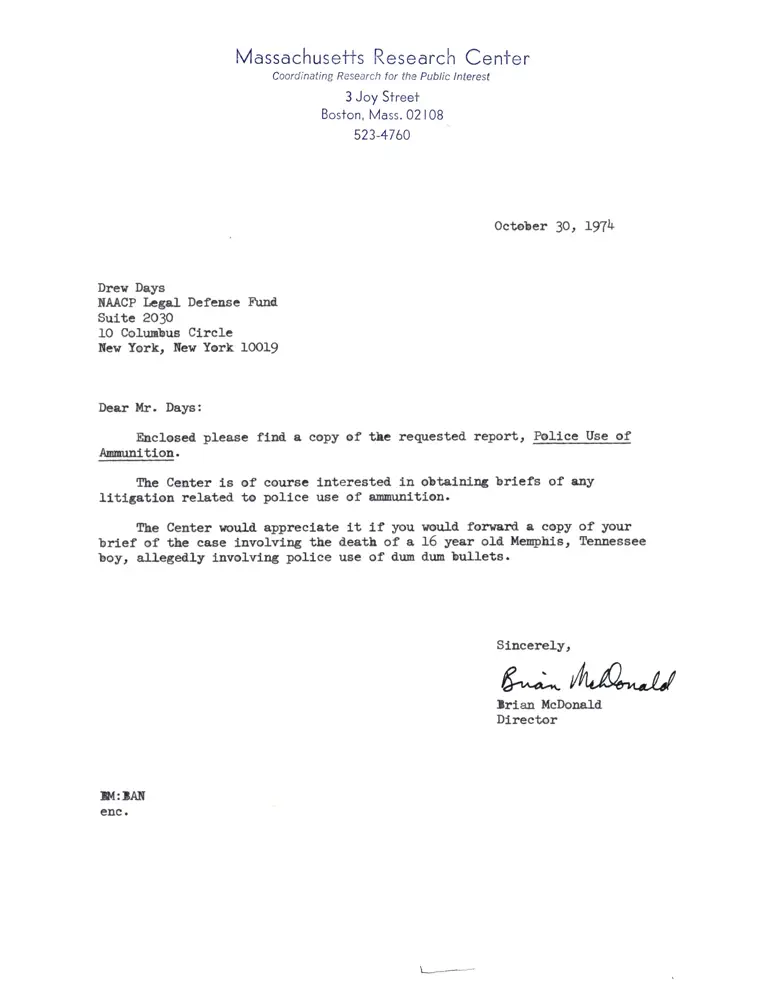
    Massachusetts Research Center
Coordinating Research for the Public Interest

3 Joy Street
Boston, Mass. 02 108

523-4760

October 30  ̂197^

Drew Days
NAACP Legal Defense Fund
Suite 2030
10 Coliifflbus Circle
New York, New York IOOI9

Dear Mr. Days:
Enclosed please find a copy of tke requested report. Police Use of

Aggnunition.
The Center is of course interested in obtaining briefs of any

litigation related to police use of ammunition.
The Center would appreciate it if you would forward a copy of your

brief of the case involving the death of a I6 year old Memphis, Tennessee
boy, allegedly Involving police use of dum diun bullets.

Sincerely,

Jrian McDonald
Director

»4:1AN
enc.


1’
. Jordan J. Paust

Towne House Rd
Hamden, CT. 06514
Oct. 28, 1974

Attorney David E. Kendall
NAACP Legal Defense and Educational Fund
10 Columbus Circle
New York, N.Y. 10019

Dear David Kendall:
Thank you for the brief on Beech v. Malancon. I have used some
of the cases for additions to the footnotes in my law review
article, especially Furman v. Georgia. It seems to me that
Scheuer v. Rhodes, 416 U.S. (1974) is now relevant to
the position taken in your brief regarding the "color of
state law" issue. See also footnotes 123-126, my law review
article on the dum-dums.
On the dum-dum issue, it should be noted that no state legislation
or voter approval specifically justifies use of magnums or
hollow-point bullets. Moreover, since they are clearly banned
under international law precisely because of their cruel,
inhumane and excessive effects within the human body, it is
evident that no police officer can rely upon any such state
legislation or voter approval for a presumption of legality
even if such legislation or voter approval existed. See the
attached additions to my law review article.
The additions to the article should meet the concern in Furman
V. Georgia about arbitrary measures, and they should handle
the problems encountered in Beech v. Malancon. It seems certain
that the decision of a police commissioner to adopt these bullets
in no way presents the policy question of state legislative will--
especially when no public hearings were made and we have an
admission here that no inquiry at all was made into medical
and ballistics effects within the human body.
If you think that the additions to the article do not sufficiently
handle the problems, please advise.
Thank you again. With kind regards.

Sipcetely,

cc: William Olds, CCLU
(for the CCLU trial attorneys)

Jordan Jk Paust
/