Pitts v. City of Memphis Memorandum Decision and Order Granting Motion to Dismiss
Public Court Documents
December 16, 1974
8 pages
-
Case Files, Garner Working Files. Pitts v. City of Memphis Memorandum Decision and Order Granting Motion to Dismiss, 1974. ae4d7063-33a8-f011-bbd3-000d3a53d084. LDF Archives, Thurgood Marshall Institute. https://ldfrecollection.org/archives/archives-search/archives-item/65647eb0-22e3-4a8f-879c-3b4ec1169fcb/pitts-v-city-of-memphis-memorandum-decision-and-order-granting-motion-to-dismiss. Accessed October 03, 2026.
Copied!
o
IN THE UNITED STATES DISTRICT COURT
FOR THE WESTERN DISTRICT OF TENNESSEE
WESTERN DIVISION _______
JOHNNY LEE PITTS,
Plaintiff
/• '.-X
‘ ‘ (■'./ ' ;-y
'"A A
WYETH CHAI^DLER, individually and
as Mayor of the City of Memphis,
Tennessee;
JAY W. HUBBARD, individually, and
as Director of the Memphis Police
Divisbn;
BILL S. PPvICE, individually and
as Chief of Police of the City of
Mo-mphis;
and
CITY OF MEMPHIS, TENNESSEE, a
municipal corporation of the State
of Tennessee,
Defendants
i
i
I
CIVIL NO. C-74-306
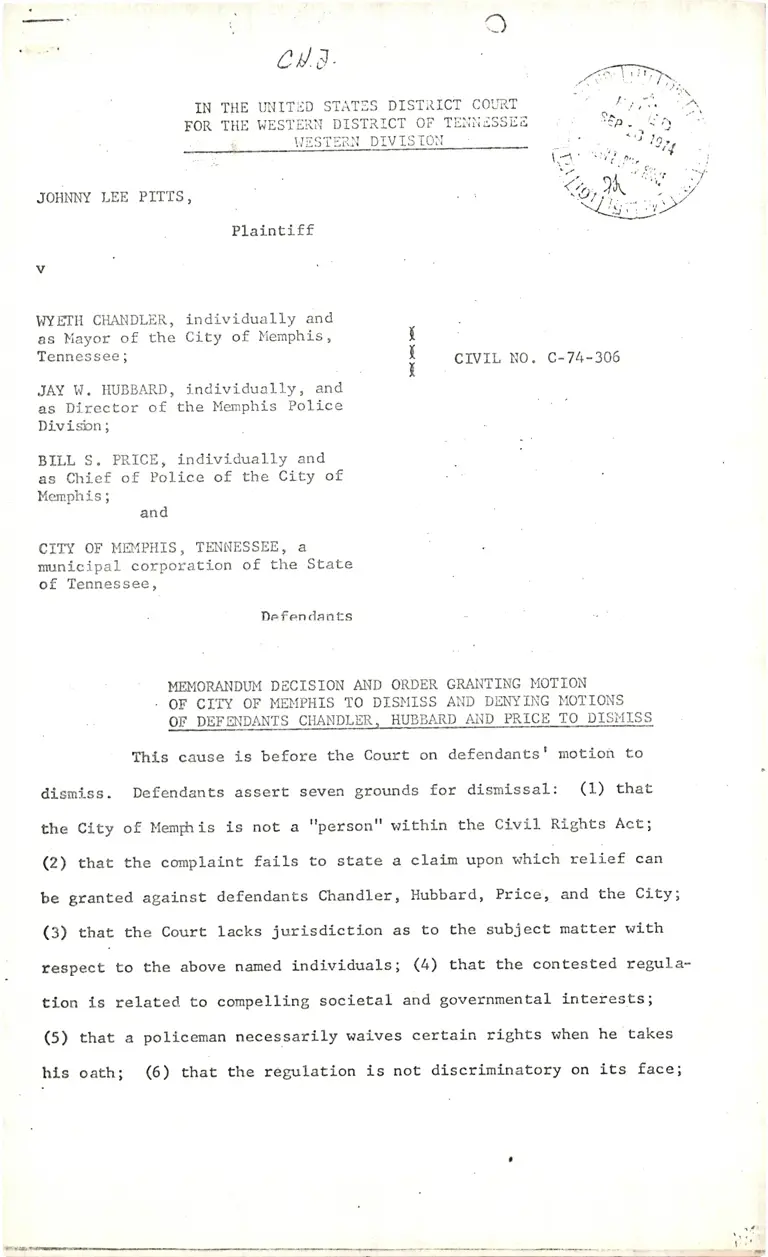
MEMORANDUM DECISION AND ORDER GRANTING MOTION
• OF CITY OF MEMPHIS TO DISMISS AND DENYING MOTIONS
OF DEFENDANTS CI14NDLER, HUBBARD A.ND PRICE TO DISMISS
This cause is before the Court on defendants' motion to
dismiss. Defendants assert seven grounds for dismissal: (1) that
the City of Memphis is not a "person" within the Civil Rights Act;
(2) that the complaint fails to state a claim upon which relief can
be granted against defendants Chandler, Hubbard, Price, and the City;
(3) that the Court lacks jurisdiction as to the subject matter with
respect to the above named individuals; (4) that the contested regula
tion is related to compelling societal and governmental interests;
(5) that a policeman necessarily waives certain rights when he takes
his oath; (6) that the regulation is not discriminatory on its face;
and (7) that the regulation does not violate any of the plaintiff's
constitutional rights. These seven grounds contain two basis proposi
tions that must be dealt with in defendants motion to dismiss. (1)
that the Court has no jurisdiction of the subject matter, and (2)
plaintiff has failed to state a claim upon, which relief can be granted.
The facts as alleged appear to be as follows: On l.arch 1,
1974, Police Chief Bill Price issued General Order 10-74 setting out
certain "maximum limits for haircuts, sideburns, and moustache styles
for male commissioned officers." Plaintiff was notified that he would
have to comply with General Order 10-74 by April .1, 1974, or face
suspension or discharge. On April 3, 1974, plaintiff x̂ âs suspended
for failure to comply with the General Order. Plaintiff obtained a
haircut on April 4, 1974, whereupon his suspension was terminated and
he was returned to active duty’. Plaintiff attacks the constitutionality
of the police haircut regulations, arguing that the regulation invidiously
discriminates against male police officers, that there is no rational
relationship bet\‘7een thelaircut regulation and any legitimate state
interest, that the regula:ion deprives the plaintiff of the fundamental
constitutional rights of free speech and expression, that the
regulation interferes with plaintiff's right of privacy, and that
the regulation is arbitrary and capricious and merely reflects the
personal preferences of the defendants.
Plaintiff asserts jurisdiction under 28 U.S.C. § 1343 (3), (4);
28 U.S.C. § 1331; 28 U.S.C. §§ 2201, 2202; and 42 U.S.C. § 1983.
Defendants argue that these statutes do not provide jurisdiction in the
instant case. To determine whether there is jurisdiction, the Court
will consider each asserted basis.
The Declaratory Judgment Act, 28 U.S.C. §§ 2201, 2202, can
be dealt with quickly. It is simply not a jurisdictional statute.
Tlie Act provides a particular remedy only and jurisdiction must be
found in other statutes conferring jurisdiction. Chandler v •,
A45 F.2d 1045 (10th Cir. 1971), cert, denied, 405 U.S. 964, rehearing
denied, 405 U.S. 1049; American Airlines, Inc, v. Louisville__&_
Jefferson County Air Bd., 269 F.2d 811 (6th Cir. 1959).
The Civil Rights Act of 1871 (28 U.S.C. § 1343, 42 U.S.C.
§ 1983) gives a federal district court jurisdiction as to individual
city officials but not as to municipal corporations. Monroe v.,.i!ap_e>
365 U.S. 167 (1961) (the action was dismissed as to the City of Chicago,
but not as to city officials named as defendants) ; Harper
6 FEP Cases 880, 883 (4th Cir. 1973). The recent case of City of K e n o ^
v. Bruno, 412 U.S. 507 (1973) does not modify the holding in Monroe
that section 1343 provides jurisdiction over city officials. Bruno ̂
merely reinforces and explains the Supreme Court s determination in
Monroe that Congress did not intend to include municipalities v?ithin
I
the definition of persons under the Civil Rights Act of 1871 (28 U.S.C.
§ 1343; 42 U.S.C. § 1983). See Moor v. County of Alameda, 411 U.S.
693 (1973). Accordingly, we conclude that this Court has jurisdiction
with respect to the individual defendants but not as to the City under
§§ 1343 and 1983. The remaining jurisdictional question is, then,
whether the Court has jurisdiction as to the City under § 1331.
General federal question jurisdiction under § 1331 has been
successfully asserted in a number of suits against municipalities.
North American Cold Storage Co. v. City of Chicago,_Gt__al, 211 U.S. 195
(1908) (allowing a suit for recovery of allegedly improperly condemned
frozen poultry); Foster v. City of Detroit, 405 F.2d 138 (6th Cir. 1968)
(§ 1331 provides federal jurisdiction to vindicate plaintiffs'
constitutional right not to be depriv’̂ed of property without due process
of law); Foster v. Herley. 330 F.2d 87 (6th Cir. 196A); Dupree v .
City of Chattanooga, 362 F.Supp. 1136 (£.D. Tenn. 1973) (§ 1331 provides
jurisdiction for suit alleging discrimination in municipal services);
Greater Fremont, Inc, v. City of Fremont. 302 F.Supp. 652 (N.D. Ohio
1968) (§ 1331 provides jurisdiction where CATV systems operators claim
that city ordinances denied them due process and equal protection of
laws). See Cuyahoga River Power Co. v. City of Akron, 240 U.S. 452
(1916). Contra Note, 2 Fordham Urban L.J. 109, 121 (1973). \'7hile
the Supreme Court has, in Bruno and Monroe, pointed out that the
question of the application of § 1331 to municipalities was not before
it, there is no indication in those opinions that general federal
jurisdiction is not available. City of Kenosha v. Bruno, 412 U.S. 507,
514 (1973); Monroe v. Pape. 365 U.S. 167, 168 (1961). In fact, an
examination of the Bruno decision tends to support the proposition
that section 1331 is available to provide jurisdiction over municipalities
Justices Brennan and Marshall state in their concurrence that if the
plaintiffs "can prove their allegation that at least $10,000 is in
controversy, then § 1331 jurisdiction is available . . . ." 412 U.S.
at 516. The majority opinion by Justice Rehnquist, while disclaiming
deciding the question of section 1331 jurisdiction in that case,
discussed the requirement of the $10,000 jurisdictional amount aid
cites Hague v. CIO, 307 U.S. 496, 507-08 (1939). The specific portion
of the Hague opinion that the Court refers to deals with the determina
tion of jurisdictional amount under section 1331 where damages are
sought and where declaratory or injunctory relief is sought. Thus it
appears that the majority was primarily concerned with making it clear
m
that - at least in suits seeking injunctive relief, as distinguished
from money damages, against a city - there must be "substantial proof"
justifying the conclusion that the suit involved the requisite
jurisdictional sum, Hague v, CIO, 307 U.S. 496, 508 (1939); City of
Kenosha v. Bruno, 412 U.S. 507, 514 (1973). Therefore it is the
opinion of this Court that the weight of authority is that a suit
can be maintained against a municipality under § 1331, provided, of
course, that the conditions set out under that section are met.
Those conditions have remained basically the same, except
for changes in the jurisdictional amoiint, since Congress granted federal
district courts general original jurisdiction in 1875. 28 U.S.C. § 1331
(1966); s ^ C. Wright, FEDEIU^L COURTS, (Hornbook) § 17 (1970).
Section 1331 provides that
(a) The district courts shall have original'jurisdiction
sll civil actions wherein the matter in controversy
exceeds the sum of value or $10,000, exclusive of interest
and costs, and arises under the Constitution, laws, nr
treaties of the United States.
There are, therefore, two clear prerequisites that must be met before
a federal district court can exercise jurisdiction over a civil case
under section 1331: (1) the matter in controversy must exceed $10,000
in value; and (2) the controversy must arise under the laws of the
United States.
To determine whether the jurisdictional amount has been met
in a suit for damages, the courts apply a "legal certainty" test.
"fU]nless the law gives a different rule, the sum claimed by the plaintiff
controls if the claim is apparently made in good faith. It must appear
to a legal certainty that the claim is really for less than the
jurisdictional amount to justify dismissal." St. Paul Mercury Indemnity
Co. V. Red Cab Co., 303 U.S. 283, 288 (1938); C. Wright, FEDERAL COURTS
(Hornbook.) § 33 at 112 (1970). We have already shown that, in suits for
declaratory or injunctive relief, plaintiff must meet the more stringent
test of "substantial proof" of the presence of jurisdictional amount.
If the plaintiff can meet the amount in controversy test, then he must
satisfy the Court that this is a case arising under the laws of the
United States.
The proper test for determining what "arises under the
Constitution, laws, or treaties of the United States" has been the
subject of considerable debate. See C. Wright, FEDERAL COURTS
(Hornbook) § 17 (1970); 1 MOORE'S FED. PRAC. 11 Q.60[8.-3] at 627
et seq. Also see Gully v. First National Bank, 299 U.S. 109 (1936).
In Gully v. First National Bank, supra, the Supreme Court, while
discussing several tests as to federal question jurisdiction, restated
the test used in Puerto Rico v. Russell & Co.. 288 U.S. 476 (1933),
pointing out that "The federal nature of the right to be established
is decisive -- not the source of the authority to establish it."
299 U.S. at 116 quoting 288 U.S. at 483. Mr. Justice Cardozo, in Gullv
went on to state that "What is needed is something of that coinraonrsense
accommodation of judgment to kaleidescopic situations which characterizes
the law in its treatment of problems of causation." 299 U.S. at 117.
Failure to follow a common-sense approach in determining federal
question jurisdiction would result in "countless claims" which have
only a collateral -- as opposed to a primary -- basis in federal statutes
or the Constitution. 299 U.S. at 118. The guidelines for determining
federal question jurisdiction set out in Gully include the following;
(1) a right or immunity created under the la\̂ ?s of the United States
must be an essential element of the plaintiff's cause of action;
(2) the right or immunity must be such that it will be supported if
the Constitution or laws are given one construction and defeated if
they are given another; (3) there must be a genuine and present
controversy,not just a hypothetical one; and (4) the controversy
must be disclosed on the face of the complaint. 299 U.S. at 112-13.
This approach has been concisely stated byline Sixth Circuit in
Foster v. Herley, 330 F.2d 87, 91 (6th Cir. 1964). In Foster the
court held that "it is not enough that the plaintiff seeks to enforce
a right which has its origin in the Constitution or a law of the United
States, but . . . it must be shown by the complaint that the right will
be supported if the Constitution or law is given one construction and
will be defeated if given a different construction." 330 F.2d at 91;
see Shelby County, Tennessee v. Fain-^ay Homes, 285 F.2d 617, 619
(6th Cir. 1961) (dismissing suit for lack of federal question juris
diction) .
of his constitutional rights of privacy and equal protection. He
urges this court to treat sex as a suspect classification and to
require the city to meet the compelling state interest test in order
to sustain General Order 10-74. If the Court accepts this construction
of the Equal Protection Clause, the plaintiff would probably prevail.
Plaintiff has therefore satisfied the federal question requirement for
jurisdiction under § 1331.
Plaintiff has not, however, alleged that the amount in
controversy with respect to the City exceeds $10,000. Moreover,
plaintiff expressly does not make a claim against the City for money
damages. Tbacefore, the jurisdictional amount is not present so far
as the City is concerned.
As to those claims with respect to which this Court has
jurisdiction, counsel for the defendants contend, in effect, that the
complaint should be dismissed for failure to state a claim upon which
relief can be granted. The test for granting such a motion is a
strict one. A complaint should not be dismissed for failure to state
a claim "unless it appears to a certainty that plaintiff is entitled
to no relief under any state of facts which could be proved in support
of the claim." 2A MOORE'S FEDERAL PRAC. 12.08 (1974); Azar v. Conley,
456 F.2d 1382, 1384 & n. 1 (6th Cir. 1972). See EK-;en v. Barry,
483 F.2d 1126 (2nd Cir. 1973). V7e believe that there are possible
sets of facts upon which relief could be granted and, therefore,
dismissal as to defendants Chandler, Hubbard and Price is inappropriate
at this time.
Therefore it is ORDERED that defendants' motion to dismiss
is granted as to the City of Memphis and is denied as to defendants
r'V\ n r\ /̂1 T-TiiKK V* r? anri Pv'ir'<=»
ENTER this / d day of September, 1974.
8