NYPD Firearms and Tactics Recruit Manual
Annotated Secondary Research
November, 1979
-
Case Files, Garner Hardbacks. NYPD Firearms and Tactics Recruit Manual, 1979. dc1470e3-26a8-f011-bbd3-000d3a53d084. LDF Archives, Thurgood Marshall Institute. https://ldfrecollection.org/archives/archives-search/archives-item/662ca022-17fa-4c44-9c35-6aa7beec8b75/nypd-firearms-and-tactics-recruit-manual. Accessed October 19, 2026.
Copied!
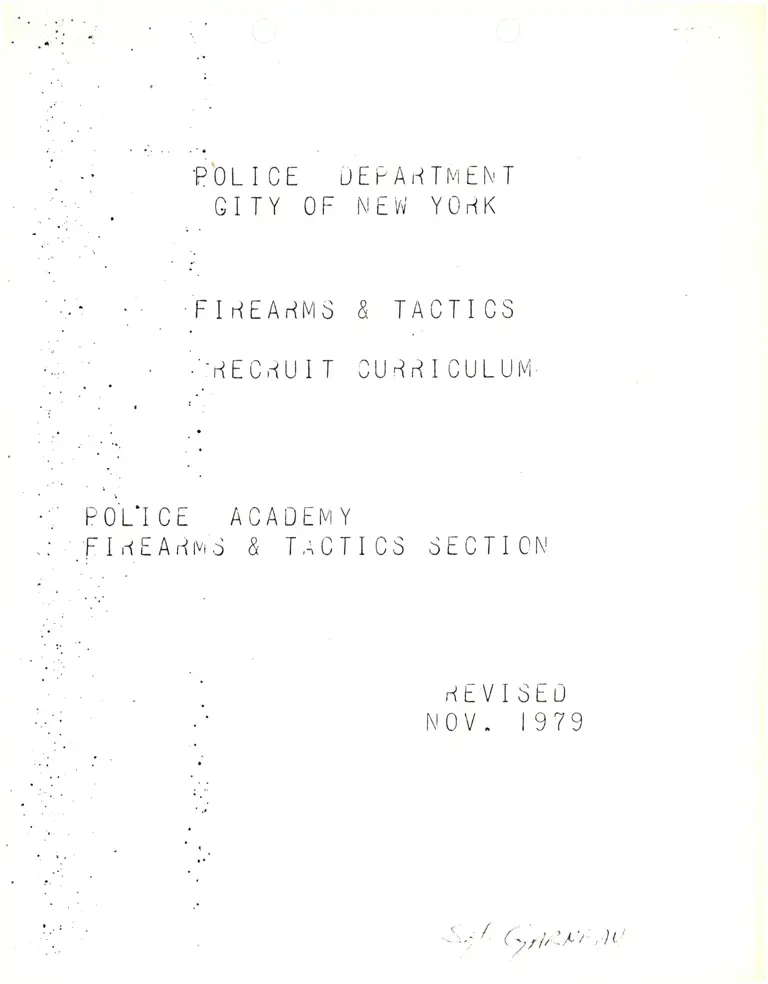
■P'OLICE UEPAPTMEM
G I T Y OF NEW Y0 riK
FlriEAriMS & TACTICS
■HECAUIT CUPS I CULUM
POL' ICE ACADEMY
f l sEAP i v i o & t a c t i c s SECTION
P E V I S E 0
N O V . 1 9 7 9
(1)
PROGIUM NOTES
Firearms Instructors are charged with the
significant responsibility of teaching police
recruits how to use their firearm:
a) ’- proficiently and safely (including
proper safeguarding and securing).
b) judiciously, both legally and morally
in accordance with Department policy
tactically
■ The revolver is one of an officers most important
protective -tools and requires his special attention
during his entire tenure as a police officer.
.'/♦ before .receiving permission to carry revol
vers, new recruits must fully comprehend the lav;,
,■ Department policy, and their moral responsibilities
relating to the use of deadly physical force.
During the remainder of their firearms training
these and other subjects will be constantly re
viewed. In addition, recruits will be exposed to
purposeful situational type training (judgment
filmg, role pl^aying situations, etc.), to enhance
their., abilities to make prompt and sound judge
ments' under circumstances involving the possible
use *of deadly physical force. It is only after
■ recruits fully understand their duties, respon
sibilities and limitations in such situations
that they are prepared to learn to use their
revolver proficiently, safely and tactically.
It is not sufficient that firearms are
mechanically perfect or that cartridges function
efficiently. Police officers must knov; how to
‘ properly employ both to attain marksmanship pro
ficiency, otherwise the service expected of fire
arms and ammunition during emergency situations
will not be rendered. There are no short cut
methods of attaining proficiency. It can only be
/acquired by study, practice and mental discipline-
The unskilled or tactically incorrect employment
of firearms during deadly confrontations, or the
; failure to heed, safety rules (on or off-duty or at
home), may very likely result in tragedy.
Firearms .'Instructors, by imparting their
. skills, knowledge, good judgement and res]'>ect for
firearms, can nhs'till in their students confidence
in their abili.ty to perform professionally in stress
situations. It will also enable the students to
carry their firearms safely v;ithout endangering
themselves, their families or other innocent persons,
'/'This is an aweS'ome responsibility and requires max
imum effort oh-the part of instructors as well as
students.
(2)
PROGRMl NOTES
GEI-ITPAL I^OGRAIl
The Recruit Firearms Curriculum is based on a study
.of Firearm? Dispharge/Assault cases reported since
1970 under the authority of Standard Operating Ihro-
cedure No.9, series •1969-
'The program consists of A2 hours of classroom in-
.;struc*tion and, range exercises. Five consecutive
.seven hour days are devoted to indoor instruction
and one seven hour day, just prior to graduation
is cbnducted at the Outdoor Range.
■A qualification standard of at least seventy-five
(75) percent must be attained for each session be-
.fore pnogressing to the succeeding session.
The basic and advanced combat silhouette targets
utilised,' will be scored as follows:• •
Two (2) ■•points will be credited for each
hit within the shaded area. One (1) point
• will be.bredited for each hit ^̂ îtVain the
• ’‘'outline, of the silhouette, but outside the
. 'shaded area. No credit will be allov;ed for
a hit outside the silhouette outline.
During dll recruit training sessions the following
shall be adhered to:
a) At the start of each session, firearms
• : , instructors shall report any absentees
• ■ • to the Officer in Charge, Recruit Train
ing Section, at the Police Academy.
They will also notify the Firearms and
Tac/tics Section, Records Unit of the
number of recruits present.
■ b) In addition to all other subject matter,
each ‘session v/ill include firearms safety
■ • . and a review of at least half of the
following subjects:
d. Legal Ure of Deadly Physical Force
2. Judgement And Moral Responsibility
•' ' In the Use of Deadly Physical Force
3- Depar-tment Firearms Policy
■ , . ■̂I-. Tactics
5- Safeguarding and Securing of Firearms
«
Subjects will be alternated on succeeding
• sessions so as'.to insure equal coverage of all,
c) Revolver Manual -and Loitering Hammer on
Live Round will be practiced during firing
rang^ exercises.
( ? )
•PROGi;An NOTES
d)
e)
f)
s)
h)
i)
o)
Protective coggleo and ear protection
MUST be worn be all students during
range exercises. No recruit will be
perrtitted on the range without both of
these devices.
Prior to each range exercise, recruits
will dry fire the prescribed course of
fire.
At- the start of each firing exercise,
on.command of the Range Control Officer,
the recruit will draw and combat load
his' service revolver-v/ith six (6) rounds.
He.then will come to the standing ready
position with his finger outside the_
trigger guard and remain in that position
further commands. The only ex
rule will occur xMien the
the kneeling position,
first v/ill assume the
to this
assumes
case he
ponding
ception
recuiiit
In such ___ -- - - -
position, and then draw and combat load
his revolver.
Upos completion of each range exercise,
firearms instructors will analyze targets
and critique each recruits' performance.
Qualifying scores must be attained for ̂
each session and recorded on the recruits'
score sheet.
Upon termination of tlie day's firing
exorcises, recruits will be instructed
to return their revolvers to the boxes
from which they were issued. Recruits
are NOT permitted to wear their uniforms
or to carry their revolvers until ordered
to do so by the Commanding Officer, Police
Academy. Ammunition will not be issued
for other than training at the range.
Recruits will be instructed IffiVER to
purchase any service ammunition from
outside sources. Sufficient ammunition
for^their needs will be issued free of
change by the Department.
Recruits v;ill police the range and class
room areas at the end of each training
ses,sion.
RECRUIT FIIffiARHS GURRICULUTl
Session
(^0
NOTES
■ * CLASSROOM
This seven (7) -hour session is devoted primarily to Fire-
arms Safety and the Legal and Moral Use of Deadly Physical
. Force. Prior to'being armed, each recruit must have a
comprehensive knowledge of juristictional law and Dep^t-
' ment policy relating to the use of fire^ms. In addition,
he c^ust evince a sense of moral responsibility and proper
■ judgement lik'ely to result in desireable responses during
potentially deadly situations. Instructors will conduct
.\in-depth classes covering all facets of this subject.
Advise class "that a forty—five (^5) minute written exam
ination, will be given at the end of Session No. ‘i, and
will include le'cture material covered during sessions
’’ Np. .1 through 4 inclusive.
•; Indoctrination - Apprise recruits of the rules and regu-
latipns of the. range and the location of facilities.
Instruct them to fit their gun belts, containing related
leather goods, snugly about the body at waist level.
Cite'- reasons 'for the strong liand side holster position
and-the firmly affixed gun belt. Caution recruits_
agairi-st» the use of a clip-on, shoulder, ankle or gim
mick type holster.
Forms - Prepare score sheet - check for completeness
and accuracy.
‘ Safety - Present firearms safety lectures, emphasizing
range safety, in accordance with Firearms & Tactics
■ Section lesson plans.
Basic Knowledge of Guns and Ammunition - Enumerate the
• ■ major parts of the service revolver and explain how it
■ operates. Point out the direction of the cylinder
■ rotation on each authorized model, and the disadvantages
•• of non-regulation stocks, triggers, etc.
■ . Bullet Potential - Describe the Caliber .58 Special car-
• trid^. the fujiction of each component, and the bullet's
. potential upon discharge, including maximum range, effec
tive range, penetration, ricochet potential and the need
for concern regarding innocent bystanders. Explain why
the characteristics of this cartridge make it suitable
• for employmerlt in an urban area. Caution the recruit
against the us«. of unauthorized ammunition.
(5)
NOTES
Revolver Nanual - Practice each command of the revolver
"manual, ujitil tlje movements are perfected.
Slnp;le and Double Action Shootinp; - Describe in detail
proper grip, stance, sight alignment, trigger manipu
lation and point .of aim in the police crouch position.
• Give * instruction on the supported position with and
‘without the use of sights. Explain the reason for using
the silhouette target, and inform the recruit of the
firing procedtire ahd scoring method for qualification.
Session #2
' CLASSROOM
; Conduct'class’on range safety. Review Legal and Moral
Use of Deadly |daysical Force, and Department policy
regarding use" of firearms (P.G, 10h - including reasons
for-each sub-division). Review double action firing,
emphasizing cocjbat positions and the sight picture to
•■•be- ejiployed at varying distances. Emphasize utiliza->
tion of ̂ the police crouch position, preferably suppor-
ted. Note that most police confrontations involving
• firearms occur within seven (7) yards. Finally, accent
• the need for stroking the trigger nmoothly and rapidly.
Instruct in the kneeling, double action, combat posi
tion. Emphasize that the drawing and loading of revol-
. vers must be done in the prescribed safe manner at all
tiinds. Discuss tactical advantages of taking cover
.behind a store counter, trash can, automobile, etc.
. FIRING RA.NGE AREA
Per Appendix "A” - Session #2
;Firearms instrucrtors will analyze the targets and
..critique the common faults after each string of fire,
Score and Recobd results.
A score of 75% or more must be attained and recorded
■for qualification.
CLASSROOM
.Critique the da^/'s firing exercises.
(6)
NOTES
Session #5
CLASSROOII
Firearms Safety.
Critique sessions î '\ and //2. Briefly review combat
■ -positions and double action shooting. Discuss com-
ponents of N'.T.P.D. Practical Revolver Course and
the reasons f.or each (S.O.P. 9 - Analysis of Police
Combat Situations).
Describe and illustrate strong and weak hand barricade
. positions. Show how the transfer of the revolver from
one hand to the other is always done in front of the
barricade and how the cylinder must be opened before the
weapon is borught back for combat unloading. Have
shooter place heals together, elbow at his side, with
revolver pointed down range and assume the barricade
positiqn in three (5) steps as follows:
1. E:jctend shooting hand ONIjY beyond the
. h, barricade.
2. Place foot opposite shooting hand forward.
3« Lastly, bring into position the barricade
■ .. ■ supporting hand.
Repeat ‘this safety procedure for the barricade posi
tion.
FIRING R/VNGE AREA
Per-Appendix "A" - Session #3
Evaluate the target after each firing stage, score
and record.
CLASSROOM
Critique the day's firing exercises. Lecture on safe
handling of automatic pistols. Demonstrate common
errors involving automatic pistols.
Session
■ • CLASSROOM
. .Fire^ms SafetV-- Review safety procedures with par-
ticulax emphasis on hazards encountered under dimly
lit conditions’. Include safeguarding firearms, es
pecially while, off-duty.
(7)
Dim Lip;ht Firing; Course - Review double action shooting
end combat positions. Instruct Re the techniques em
ployed-in firing this course; necessity for proficiency
under darkened renditions without the use of sights;
absolute need for positive identification of target.
iPractical Revolver Course - Describe and demonstrate
each of the positions fired during the PRC course.
Emphasize that; the contents of this course are based
on a study of*combat situations (SOP 9) in which
members of the service have been injured or killed by
apmed adversaries.
Written Test - A minimum score of 75% is required.
Peview results' v;ith recruits, with particular emphasis
on most common mistakes.
FIRING RANGE AREA
Per-Appendix "A" - Session #4
NOTES
Session #5
CLASSROOM
Review Firearms'Safety at home, at work and on the
range. Review Legal & Moral Use of Force and De
partment Policy regarding use of firearms.
.Review Analysis of Police Combat Situations.
Instruct recruits Re safeguarding and security of fire-
.arms and reiterate the intrinsic dangers of clip-on type
'holsters and tho'se lacking security devices. Bring out
'that many unnegessary injuries have occurred because of
worn and defective off-duty holsters. Describe and show
examples of acceptable and unacceptable off-duty holsters.
Mention that the Equipment Section meets the needs for
Police Officers'', leather equipment.
Discufls tactics to be employed to minimize potential
’■ '.injuries during*-a stress situation. Relate in chron*-
/'ological order',the response and the job of the first
'. and subsequent members of the service at the scene of
• situations wheroin firearms are likely to be used
, .(sudden attacks, hostage situations, barricaded persons,
'etc'.). Discuss role of specialized commands such as
(8)
NOTES
Emergency Service, Bomb Squad, Hostage Negotiators,
• etc.
Care and Cleaning of the Rnvolver - Demonstrate the
entire procedxire. Explain why oil should be lightly
• applied and the special care required when using
‘ spray type gun lubricants. Mention the benefits of
the occasional use of a Silicon cloth.
FIRING RANGE AREA
As per Appendix "A" - Session #5
(Recruits must attain a score of 75% out of a
possible d00%-in both Practical Revolver Courses).
Session ^6
Conducted at ."the Outdoor Range prior to graduation.
Tra’iillng program includes PRC qualifications, moving
targets, cover and concealment, response tactics,
firearms safety, legal and moral use of force, Depart
ment -.policy regarding use of firearms. Time permitting,
members* v;ill fire the Multiple Target, Exertion, and
Close Combat Courses.
Thirty-six (36) rounds of regulation ammunition will
be issued to each recruit.
REFERENCES
Legal & Moral Use of Deadly Physical Force
Care and Cleaning of the Revolver
N.y.P.D. Practical Revolver Course
Film "Moment of Decision
Knowledge of Guns and Ammunition
Dim Light Firing Course
Safe Handling.of Semi-Auto Pistols
Raids Against JBarricaded Persons
N.i?.A. Police. Firearms Instructors Manual
Sniper Incidents - Weapons and Tactics
Analysis of Pol-ice Combat Situations
Firearms Safety -
Revolver Manual
Single Action Shooting
Double Action Shooting
Close Combat Course
Tactics
N.Y.S. Penal Law(Art35)
Patrol Guide 10^-1
Sgt. Thomas M. McTernan
Ti'aining Officer
Firearms & Tactics Section
A V • /,
firp:a r m s aito t a c t i c s s e c t i o n I I
RECORD OF RECRUIT FIREAI^TIS AND TACTICS TIUINING;
I M T W m U M W F } FII^ST NAIliiCPklN'iT HT" TAX NUI-lfeto'
SHiELTlT"
,SVR. REV.: MAKE
■ u m r a r r
MODEL
DATE OE ■ATTOINWn-TW
CAL. 0^8 SERIAL #
Abovo' described service revolver hns been obtained
by me from_
Signature” Date
DATE
SESSION
a. Orientation
b. Preparation of P'orns
c. Legal 8c Moral Use of Deadly Physical
Force
d. Firearms Safety
'• ,e. Knowledge of Firearms 8c Ammunition
f. Bullet Potential
g. Nomenclature of Revolver
h. Revolver Manual
i. Leather Equipment
J. Single Action Shooting
k. Double Action Shooting
SESSION ^ 2
a. Firearms Safety on the Range
b. Practice Revolver Manual on range
c. Single Action-Basic Silhouette Target
7 yds. - supported
7 ydp. - unsupported
15 yds. - supported
d. Double Action-Basic Silhouette Target
7 yd's-Combat Crouch-supported
7 yds-Corabat Grouch-unsupported
15 yds-Point Shoulder-supported
15 yde-Point Shoulder-unsupported
e. Re.ceive safety instruction and
actually lower hammer on live round.
F.I. Initials
— i m ~
ISSUED
10
10
10
50
20
50
20
s g o m :
■̂ 7
,)<
DATE' -n-
SESSION ^5 (Service Revolver) ]
a. Firearms Safetyb. Double Action-Basic Silhouette Target
7 yds»-Combat Crouch-supported
7;yds-Combat Crouch-unsupported
-15 yds-Point Shoulder-supported
15 yds-Point Shoulder-unsupported
15 -yds-Kneeling-supported
25 yds-Point Shoulder-supported
25. yds-Point Shoulder-unsupported
25 yds-Strong Hand Barricade
25 -yds-Weak Hand Barricade
c. P.R.C. Advanced Silhouette Target
SESSION (Off-Duty Revolver)&(Service)
Firearms Safety
Doi^ble Action-Advanced Silhouette
Off-Duty Revolver
7 yds-Combat Crouch-supported
7'yrs-Combat Crouch-unsupported
15 yds-Point Shoulder-supported
15 yds-Point Shoulder-unsupported
, P.R.C. - Off-Duty Revolver
, Dim-Light Firing Service Revolver
Dim-Light Firing Off-Duty Revolver
, Written Test
a ,
b,
c .
d,
SESSION #5
a. Firearms Safety
b. P.R.C. Serivee Revolver
c. P.R.C. Off-Duty Revolver
d. P.R.C. Service Revolver TEST
e. P.R.C. Off-Duty Revolver TEST
■ f. Dim Light - Service Revolver
Off-Duty Revolver
FINAL AVERAGE - SERVICE Hl^VOLVER
FINAL AVERAGE - OFF-DUTY REVOLVER
Firparms Instructor
Signature
SESSION - OUTDOOR RANGE
V U I ;■ V - •
V,- ( I * I •
r i \ y ~
i s s u e d ! SCORE
V
2/4-
12
12
6
2/4-
2A
12
24
12
50
18
12
128
50
50
20
50
50
50
50
50
20
%
%
%
%
%
%
%