Order on Motion to Dismiss
Public Court Documents
August 18, 1975
7 pages
-
Case Files, Garner Working Files. Order on Motion to Dismiss, 1975. 6cc630ee-33a8-f011-bbd3-000d3a53d084. LDF Archives, Thurgood Marshall Institute. https://ldfrecollection.org/archives/archives-search/archives-item/6835a352-a157-4824-bf11-6c2dac10ab47/order-on-motion-to-dismiss. Accessed September 27, 2026.
Copied!
dttlK
IN THE UNITED STATES DISTRICT COURT
FOR THE WESTERN DISTRICT OF TENNESSEE
WESTERN DIVISION
CLEAMTEE GARNER,
Plaintiff,
vs.
MEMPHIS POLICE DEPARTMENT,
et al,
Defendants.
ORDER ON
MOTION TO DISMISS
NO. C-75-145
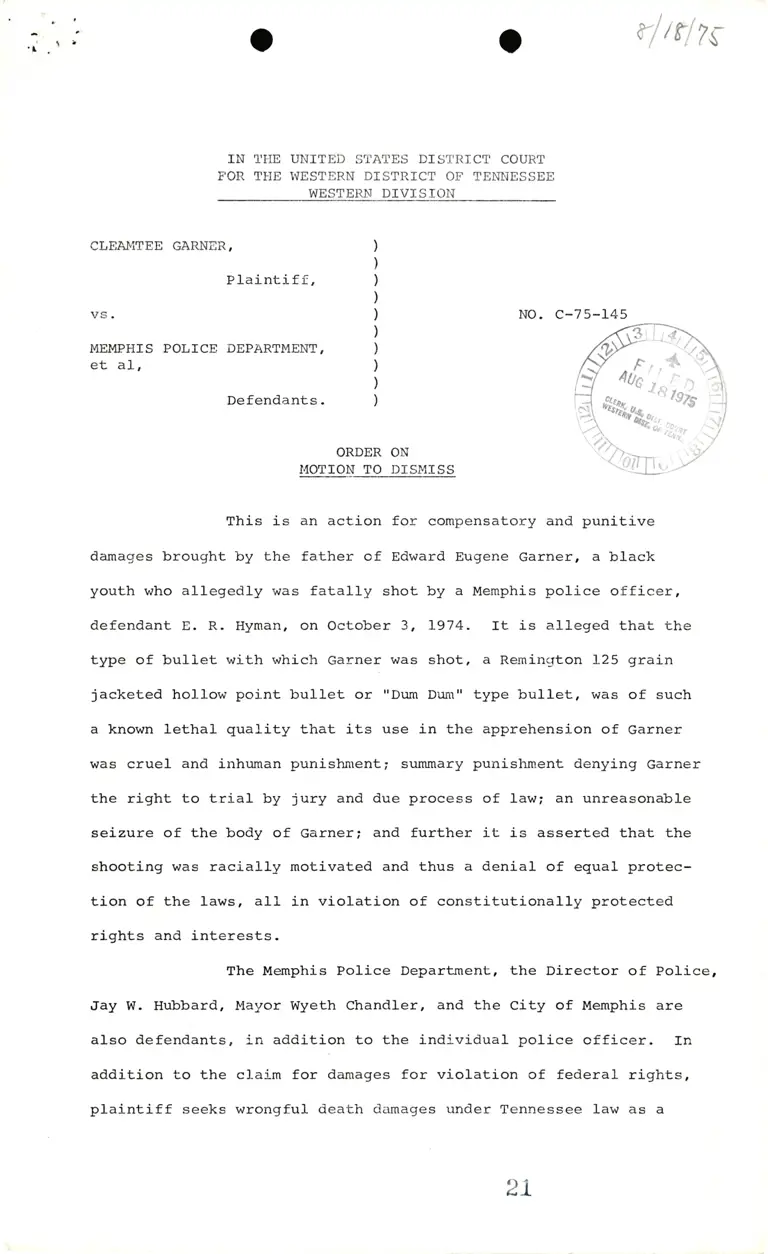
This is an action for compensatory and punitive
damages brought by the father of Edward Eugene Garner, a black
youth who allegedly was fatally shot by a Memphis police officer,
defendant E. R. Hyman, on October 3, 1974. It is alleged that the
type of bullet with which Garner was shot, a Remington 125 grain
jacketed hollow point bullet or "Dum Dum" type bullet, was of such
a known lethal quality that its use in the apprehension of Garner
was cruel and inhuman punishment; summary punishment denying Garner
the right to trial by jury and due process of law; an unreasonable
seizure of the body of Garner; and further it is asserted that the
shooting was racially motivated and thus a denial of equal protec
tion of the laws, all in violation of constitutionally protected
rights and interests.
The Memphis Police Department, the Director of Police,
Jay W. Hubbard, Mayor Wyeth Chandler, and the City of Memphis are
also defendants, in addition to the individual police officer. In
addition to the claim for damages for violation of federal rights,
plaintiff seeks wrongful death damages under Tennessee law as a
21
pendent claim and a declaratory judgment that use of the "Dum. Dum"
type biallets by police officers to apprehend suspected fleeing
felons is unconstitutional.
The action is presently before the Court on the
defendants' jointmotion to dismiss. Numerous grounds are assigned
in the defendants' motion: (1) failure to state a claim upon which
relief can be granted; (2) the City and the Police Department are
not "persons" within the meaning of the Civil Rights Act of 1871; (3)
the City is not a "person" under the Civil Rights Act and is not sub
ject to the equitable relief plaintiff seeks; (4) the doctrine of
respondeat superior is not applicable to the City and Police Depart
ment under the Civil Rights Act and the law of Tennessee; (5) the
City is protected by the doctrine of governmental immunity, (6) the
doctrine of respondeat superior is not applicable to the Mayor and
Director of Police acting in their official, supervisory capacities,
and (7) denial of liability for the pendent state law claim.
For present purposes, the various grounds stated in
the motion fall into two categories, those essentially coming within
Fed. R.Civ.P. 12(b)(6) - "failure to state a claim upon which relief
can be granted" - and those falling within Fed.R.Civ.P. 12(b)(2) -
"lack of jurisdiction over the person."
The Court is satisfied that the Rule 12(b)(6) element
of defendants' motion must fail. A complaint should not be dismissed
for failure to state a claim "unless it appears to a certainty that
plaintiff is entitled to no relief under any state of facts which
could be proved in support of the claim." 2a Moore's Federal Practice,
H12.08 (1974). See Azar v. Conley, 456 F.2d 1382, 1384 and n. 1 (6th
Cir. 1972). Construed liberally and in a reasonable light, as it must
be, the complaint in this action sets out at least justiciable claims
22
- 2
against each of the defendants.
The jurisdictional issues are not so easily resolved.
The complaint asserts that the action is brought pursuant to 42
U. S.C. §§1981, 1982, 1983, 1985, 1986 and 1988 to redress the depri
vation of rights, privileges and immunities secured by the Fourth,
Fifth, Sixth, Eighth, and Fourteenth Amendments. Jurisdiction is
said to be conferred by 28 U.S.C. §1343(3) and 28 U.S.C. §1331.
Jurisdiction is properly conferred by 28 U.S.C.
§1343 as to all defendants except the City of Memphis and the Memphis
Police Department. Insofar as plaintiff asserts a claim for relief
under 42 U.S.C. §§1981, 1982, and 1988, this Court has jurisdiction
over the City and the Police Department as well as over the other
defendants. However, it is well established, and conceded by the
plaintiff, that the City and the Police Department are not "persons"
within the meaning of 42 U.S.C. §§1983, 1985 and 1986, and this
Court has no jurisdiction under 28 U.S.C. §1343 as to claims under
those sections against the City and Police Department. Monroe v.
Pape, 365 U.S. 167 (1961); City of Kenosha v. Bruno, 412 U.S. 507
(1973).
The plaintiff contends, however, that general federal
question jurisdiction under 28 U.S.C. §1331 exists for the very
claims against the City and Police Department which cannot be based
on 28 U.S.C. §1343. Barred from a claim under 42 U.S.C. §§1983, 1985
and 1986, because of the "municipal immunity' recognized in Monroe
V, Pape, supra, plaintiff would cast his claim against the City and
Police Department as based not on the Civil Rights Act of 1871, but
rather, on the Constitution itself. Thus, plaintiff contends his
claim is for violation of constitutionally recognized rights, his
claim therefore "arises under the Constitution," and the alleged
matter in controversy exceeding $10,000, general federal question
23
- 3 -
jurisdiction is proper.
Faced with the issue whether municipal immunity was
applicable to §1331, the district court in Dahl v. City of Palo Alto,
372 F.Supp. 647, 650 (N.D. Calif. 1974) stated:
If jurisdiction will lie under
§1331 in a case such as this one, the
application of the Monroe bar on suits
against municipalities is limited to
those cases where less than $10,000 is
in controversy. What appears to be the
broad substantive significance of Monroe
is then reduced, in many cases, to a
mere pleading rule.
Nonetheless, the court in Dahl, supra, held that a
municipality is suable under §1331 if the federal question is shown
and the required jurisdictional amount is in controversy. That con
clusion was found to be required under the implied holding of City
of Kenosha v. Bruno, supra. The court in Dahl further concluded
that "Examination of the legislative histories of §§1983 and 1331
suggests that the bar against suing a municipality under §1983 should
not be read into §1331." 372 F.Supp. at 650. Section 1331 was first
enacted in 1875 and was "the culmination of efforts dating back to
the first Congress to give general federal question jurisdiction to
the federal judiciary." Id. at 651.
Although not clearly stated, the implication of
Justice Rehnquist's opinion for the court in City of Kenosha v.
Bruno, supra, is that §1331 may be an available jurisdictional al
ternative to a plaintiff with a claim against a municipality which
is barred under the Civil Rights Act of 1871. On remand, the district
court was instructed to consider whether the requisite $10,000 amount
in controversy was present so as to confer §1331 jurisdiction. 412
U.S. at 513-14. The opinion implies that §1331 may be an available
alternative to §1343 if the amount in controversy element is present.
24
- 4
The concurring opinion of Justice Brennan, joined by Justice Marshall,
indicates his understanding that the court was holding that §1331 is
an independent alternative to §1343. at 516. For this propo
sition, Justice Brennan cites Bell v. Hood, 327 U.S. 678 (1946) and
Bivens v. Six Unknown Fed. Narcotics Agents, 403 U.S. 388 (1971).
Bell and Bivens both involved actions for damages
brought against federal law enforcement officers for alleged viola
tions of constitutional rights in the manner in which the plaintiffs
had been arrested and subjected to searches. In Bell, the Supreme
Court held that where alleged violations of the Constitution con
stituted "the sole basis of the relief sought" and decision on the
merits of the plaintiffs' claims necessitated "a determination of
the scope of the Fourth and Fifth Amendments' protection from un
reasonable searches and deprivations of liberty without due process
of law," federal jurisdiction existed.
In Bivens, the court held, in the words of Justice
ilarlan in his scholarly concurrence: " . . . federal courts do have
the power to award damages for violation of 'constitutionally pro
tected interests' and . . . a traditional remedy such as damages is
appropriate to the vindication of the personal interests protected
by the Fourth Amendment." 403 U.S. at 399.
Bell and Bivens, however, are distinguishable from
the case at bar in that they both were actions against federal officers,
not state or local offi.cers, and in the absence of a remedy provided
by federal statutory law, the plaintiffs successfully argued that
their claims of constitutional rights violations conferred general
federal question jurisdiction on the district court. Where, however,
the alleged violation of constitutional rights was committed by state
officers. Congress has provided a statutory remedy in the Civil Rights
- 5 -
2o
Act of 1871. It seems logical that a plaintiff whose claim other
wise is squarely within the compass of 42 U.S.C. §§1983, 1985 and
1985 except for the municipal immunity recognized in Monroe v. Pape,
supra, ought not be allowed to evade the clear import of Monroe
through use of 28 U.S.C. §1331. Where Congress has provided spe
cific remedial statutes exactly applicable to a plaintiff's cause
of action, it is not unreasonable to say that the plaintiff must
fall within the confines of that statutory scheme and its judicial
limitations.
Despite the implications of City of Kenosha v. Bruno,
supra, this Court feels that §1331 is not an available alternative
to §1343 where the latter is impermissable because a municipality is
sued under the Civil Rights Act of 1871. The defendant* motion to
dismiss might be ordinarily granted as to the City and the Police
^ Department except for the substantial weight of authority to the
contrary. See, e.g., Pitts v. Chandler, Civil No. C-74-306 (W.D.
Tenn., Memorandum Decision and Order, filed Sept. 16, 1974, Judge
Bailey Brown); Dupree v. City of Chattanooga, Tenn., 362 F.Supp.
1135 (E.D. Tenn. 1973), Judge Frank W. Wilson); Dahl v. City of Palo
Alto, supra; Cardinale v. Washington Technical Institute, 500 F.2d
791, 795 at fn. 4 (D.C. Cir. 1974); United Farmworkers of Fla. Housing
Project, Inc, v. City of Delray Beach, 493 F.2d 799, 801-802 (5th Cir.
1974); Traylor v. City of Amarillo, Texas, 492 F.2d 1155, 1157 at fn.
2 (5th Cir. 1974); Jorden v. Metropolitan Utilities District, 498
F.2d 514 (8th Cir. 1974).
The Sixth Circuit case of Bosely v. City of Euclid,
496 F.2d 193 (6th Cir. 1974) also indicates that a city might be
subject to a civil rights claim under Sec. 1331 jurisdiction. This
Court feels that logically the City and its Police Department should
- 6 -
be exempt or immune from this type of claim under a 42 U.S.C.
§1983 et seq. cause of action whether jurisdiction is asserted under
§1343 or §1331 under Monroe v. Pape, supra, rationale. By inference,
however, as indicated, appellate courts have indicated to the contrary,
Defendants' motion to dismiss is overruled^ reluctantly
as to the City of Memphis and the Police Department, on the §1331
jurisdictional basis.
This ________ day of August, 197 5.
) /
4 0 i- Q
UNITED STATES DISTRICT COURT JUDGE
( J
c
27
- 1 -