Defendants-Appellees' Suggestion for Rehearing En Banc
Public Court Documents
April 13, 1988
23 pages
-
Case Files, Perschall v. Louisiana Hardbacks. Defendants-Appellees' Suggestion for Rehearing En Banc, 1988. 090aa71f-f211-ef11-9f8a-6045bddc4804. LDF Archives, Thurgood Marshall Institute. https://ldfrecollection.org/archives/archives-search/archives-item/692bdd8f-4e90-4d65-9a0f-ef361840aac8/defendants-appellees-suggestion-for-rehearing-en-banc. Accessed September 16, 2026.
Copied!
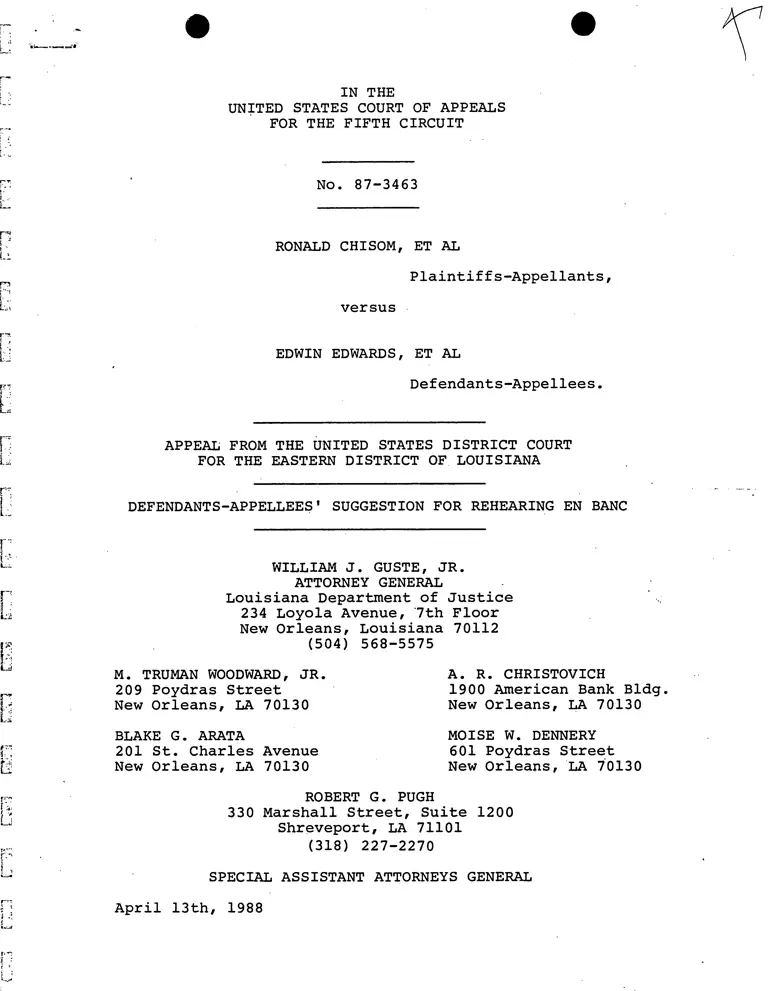
    IN THE
UNITED STATES COURT OF APPEALS

FOR THE FIFTH CIRCUIT

No. 87-3463

RONALD CHISOM, ET AL

Plaintiffs-Appellants,

versus

EDWIN EDWARDS, ET AL

Defendants-Appellees.

APPEAL FROM THE UNITED STATES DISTRICT COURT
FOR THE EASTERN DISTRICT OF LOUISIANA

DEFENDANTS-APPELLEES' SUGGESTION FOR REHEARING EN BANC

WILLIAM J. GUSTE, JR.
ATTORNEY GENERAL

Louisiana Department of Justice
234 Loyola Avenue, 7th Floor
New Orleans, Louisiana 70112

(504) 568-5575

M. TRUMAN WOODWARD, JR.
209 Poydras Street
New Orleans, LA 70130

BLAKE G. ARATA
201 St. Charles Avenue
New Orleans, LA 70130

A. R. CHRISTOVICH
1900 American Bank Bldg.
New Orleans, LA 70130

MOISE W. DENNERY
601 Poydras Street
New Orleans, LA 70130

ROBERT G. PUGH
330 Marshall Street, Suite 1200

Shreveport, LA 71101

(318) 227-2270

SPECIAL ASSISTANT ATTORNEYS GENERAL

April 13th, 1988


•

-

CERTIFICATE OF INTERESTED PERSONS

The undersigned counsel of record certifies

that the following listed persons have an interest in

the outcome of this case. These representations are

made in order that Judges of this Court may evaluate

possible disaualification or recusal.

Plaintiffs:

Defendants:

Attorneys
for
Plaintiffs:

Ronald Chisom

Marie Brookman

Walter Willard

Marc Morial

Louisiana Voter
Registration/Education Crusade

Henry A. Dillon, III

There are no nongovernmental
defendants

Julius L. Chambers

Charles Stephen Ralston

C. Lani Guinier

Pamela S. Karlan

NAACP Legal Defense and Educational
Fund, Inc.

William P. Quigley

Ron Wilson


•

Roy Rodney

Attorneys William J. Guste, Jr.
for
Defendants: M. Truman Woodward, Jr.

Blake G. Arata

A. R. Christovich

Noise M. Dennery

Robert G. Pugh

• Rob rt/G. Pugh
Le ld Counsel for
Defendants-Appellees


•

STATEMENT OF COUNSEL

I express a belief, based on a reasoned and

studied professional judgment, that this appeal

involves one or more questions of exceptional

importance:

The decision of this Court effectively sweeps

away the statutes of approximately two-thirds of the

states where two or more members of the judiciary may

be elected to office from the same geographic area,

without considering a full record based upon a factual

development concerning the applicability of the

"results test" as to judicial elections.

R4ert G. Pugh
Lad Counsel for
Defendants-Appellees


•

- iv -

TABLE OF CONTENTS AND CITATIONS

Page,

CERTIFICATE OF INTERESTED PERSONS . • ..

STATEMENT OF COUNSEL 00 00 00 00 00

TABLE OF CONTENTS AND CITATIONS • • • • • • iv

STATEMENT OF THE ISSUE 00 00 00 00 00 vi

STATEMENT OF THE COURSE OF PROCEEDINGS
AND DISPOSITION OF THE CASE.. .. 00 00 O0

STATEMENT OF ANY NECESSARY FACTS • • . • • • 3

ARGUMENT AND AUTHORITIES .. • • • • • • . • 4

CONCLUSION 00 00 00 00 00 00 .. 12

CERTIFICATE OF SERVICE

Cases

Bhandari v. First National Bank of Commerce,
829 F.2d 1343 (5th Cir. 1987),
writs applied for (87-1293, filed
February 2nd, 1988, 56 LW 3542)

Campos v. City of Baytown, Texas,
87-2359, April 1, 1988,
Slip Opinion 2547, 2553

Citizens for a Better Gretna
v. City of Gretna,

834 F.2d 496 (5th Cir. 1987)

••

0•

• .

• • 00

0 0 O•

6

8

Clark v. Edwards,
Civil Action No. 867-435-A
(D.C. M.D. La.) 00 00 00 00 00 5, 7

Eccles v. Peoples Bank,
333 U.S. 426 (1948) .. • 00 00 00 13


- v -

Guerra V. Manchester Termination Cor
498 F.2d 641 (5th Cir. 1974) .

Kenned v. Silas Mason, Co.,
334 U.S. 249 (1948) ..

•

• •

Martin V. Allain,
658 F.Supp. 1183 (S.D. Miss. 1987)

Mobile v. Bolden,
446 U.S. 55, 100 S.Ct. 1490,
64 L.Ed.2d 47 (1980)

ThornbUrg v. Gin les,
478 U.S. 30, 92 L.Ed.2d 25,

106 S.Ct. 2752

White v. Re ester,

412 U.S. 755, 93 S.Ct. 2332,
37 L.Ed.2d 314 (1973) 0 •

United States Statutes

42 U.S.C. t11973

42 U.S.C. ,1983

United States Rules

Rule 12.(b)(6) • ..

Louisiana Constitution

Louisiana Constitution Article V,
Sections 22 and 24

The Senate Report No. 97-417

• • • •

0 •

O 0

0 •

• •

• 0

O 0

• •

O 0

0 •

O 0 01 •

• •

O 0

• • . .

U.S. Code Congressional & Administrative

News, 1982 pp. 206-207 . •
• •

• •

• •

6

13

5

10

7

2

2

Passim

10


• •

fl

- v -

Page

Guerra V. Manchester Termination Cor.,
498 F.2d 641 (5th Cir. 1974) . • .. • • 6

Kennedy.V. Silas Mason, Co.,
334 U.S. 249 (1948) .. .. • • .. .. 13

Martin V. Allain,
658 F.Supp. 1183 (S.D. Miss. 1987) .. • • 5

Mobile v. Bolden,
446 U.S. 55, 100 S.Ct. 1490,
64 L.Ed.2d 47 (1980) • •

ThornbUrg v. Gin
478 U.S. 30, 92 L.Ed.2d 25,

106 S.Ct. 2752

White v. Re ester,

412 U.S. 755, 93 S.Ct. 2332,
37 L.Ed.2d 314 (1973)

0 •

10

7

f' United States Statutes

L. 42 U.S.C. 6,119 73 •• •• 2

42 U.S.C. ,1983 •• •• •. 2

[;
United States Rules

L4 Rule 12 (b) (6) .• Passim

Louisiana Constitution

Louisiana Constitution Article V,
Sections 22 and 24 10

Lf.ai_s_iLLKt_111-EaEY

The Senate Report No. 97-417

U.S. Code Congressional & Administrative

News, 1982 pp. 206-20 7 . •

• •


•

- vi -

STATEMENT OF THE ISSUE

Once having made a determination that Section

2 of the Voting Rights Act, 42 U.S.C. §1973, applies to

judicial elections, should there have been a remand by

the Court to permit the parties to develop a full

factual record as to the applicability of the "results

test" to judicial elections?


•

IN THE
UNITED STATES COURT OF APPEALS

FOR THE FIFTH CIRCUIT

No. 87-3463

RONALD CHISOM, ET AL

Plaintiffs-Appellants,

versus

EDWIN EDWARDS, ET AL

Defendants-Appellees,

APPEAL FROM THE UNITED STATES DISTRICT COURT
FOR THE EASTERN DISTRICT OF LOUISIANA

DEFENDANTS-APPELLEES' SUGGESTION FOR PEHEARING EN BANC

STATEMENT OF THE COURSE OF PROCEEDINGS
AND DISPOSITION OF THE CASE

The original Complaint was lodged on

September 19th, 1986 and the First Amended Complaint

was filed on September 30th, 1986. The Complaint,

which was styled a class action brought on behalf of

all blacks registered to vote in Orleans Parish, sought

a three-judge panel. The suit challenged the process


- 2 -

of electing Louisiana Supreme Court Justices from the

First District of the Louisiana Supreme Court.

The First District is made up of four

parishes from which two justices are elected at-large.

•The plaintiffs alleged that the election system

impermissibly dilutes, minimizes and cancels the voting

strength of blacks who are registered to vote in

Orleans Parish in violation of the 1965 Voting Rights

Act, 42 U.S.C. § 1973, the Fourteenth and Fifteenth

Amendments to the United States Federal Constitution,

and 42 U.S.C. § 1983.

The plaintiffs' request for a three-judge

panel was denied and the case was docketed before a

single judge by an order entered November 14th, 1986.

The defendants filed a motion to dismiss

pursuant to Rule 12(b)(6) on March 18th, 1987. The

opinion of the trial

motion was entered May

a notice of appeal on

dismissed on May 26th,

court granting the defendants'

1st, 1987. The plaintiffs filed

May 7th, 1987; the appeal was

1987.

Judgment was entered dismissing the

plaintiffs' complaint on June 8th, 1987, and the

plaintiffs filed a notice of appeal on June 17th, 1987.


3

By order dated July 10th, 1987, the case was

remanded to the District Court for the limited purpose

of amending its written opinion; an Order Amending

Opinion was entered on the 10th day of July, 1987.

The decision of this Court was rendered on

February 29th, 1988. Subsequent thereto an Order was

issued extending the time period for the filing of an

application for rehearing (and thus, also, this

suggestion for rehearing en banc) to and including

April 13th, 1911•8.

STATEMENT OF ANY FACTS NECESSARY
TO THE ARGUMENT OF THE ISSUE

The only facts before the Court are those set

forth in the complaint, as amended. Issue was not

joined. The District Court sustained a Rule 12(b)(6)

motion. Of course, many of the allegations in the

complaint were merely legal conclusions.


•
- 4

ARGUMENT AND AUTHORITIES

The Panel's Opinion Is So OverBroad
That It Reaches Issues Not Properly Before It

And Implies A Result The Court May Not Pave Intended

The essence of the Panel's opinion is found

at Page 2306 of the slip opinion:

"We conclude today that section 2, as amended
in 1982, provides protection commensurate
with the fourteenth and fifteenth amendments;
therefore, in accordance with this Court's
decision in Voter Information, section 2
necessarily embraces judicial elections
within its scope. Any other construction of
section 2 would be wholly inconsistent with
the plain language of the Act and the express
purpose which Congress sought to attain in
amending section 2; that is, to expand the
protection of the Act."

Having concluded that Section 2 from its

inception in 1964 was co-extensive with Constitutional

protections, the Court need not have gone further, for

the case involved purely a motion to dismiss.

Unfortunately, Sections B through D of the Panel's

r.7

opinion continues in obiter dicta to analyze the 1982

legislative history. While the Court determined that

the 1982 legislative history showed no intent to limit

the original scope of Section 2, the Panel's broad

statements contain terminology that is unnecessary at

this point in the proceeding and which may cause lower

courts to make evidentiary rulings on issues that have


yet to be addressed'by this Court on a record developed

after a full and complete trial.

As the Court was aware, there are two cases

in district courts involving Section 2 and judicial

elections, cases that undoubtedly will be appealed to

the Court: Martin V. Allain, 658 F.Supp. 1183 (S.D.

Miss. 1987); and Clark v. Edwards, Civil Action No.

86-435-A (D.C. M.D. La.). Martin involves the county,

chancery, and circuit courts in Mississippi, and a full

trial has been held, although a final order apparently

has not yet been issued. Clark involves a

class-action, state-wide challenge to the method by

which Louisiana district court and court of appeal

judges are selected in multi-member districts; trial

is set for July 12, 1988.

It was clear that the Court had to address

whether the word "representative" in Section 2(b) of

1/ the Act was a limitation on the entire Act's —

applicability to judicial elections, for that was one

of the points relied upon by the State in opposition to

the plaintiffs' appeal; however, having determined

that Section 2 as it existed prior to 1982 covered

judicial elections, and having found no Congressional

1/
Both of Section 2(a) and 2(b).


6

intent in 1982 to limit the scope of the Act, there was

no need for the court to indicate that the term

"representative" is a synonym for "candidate." 21

2/
It may be that, with the full record before it in

both Martin and Chisom, this or another Court may reach
the same conclusion. It is also possible, however,
that an entirely different conclusion could be reached,
one that treats the 1982 amendments as an expansion of
the Act while at the same time recognizing that
different words used in the same statute are to be
accorded different meanings. As was noted in Bhandari
v. First National Bank of Commerce, 829 F.2d 1343 at
1345 (5th Cir. 1987), writs applied for (87-1293, filed
February 2nd, 1988, 56 LW 3542), a case in which the
Court rejected the finding of Congressional intent in
Guerra v. Manchester Termination Corp., 498 F.2d 641
(5th Cir. 1974):

It has• been said that there is no greater
injustice than to treat unequal things equally,
and we are not disposed to do so...unless the
Congress has clearly demanded it': (Emphasis
supplied).

In a case properly before it, this Court may
well hold that Congress indeed meant something
different when it used the word "representative" rather
than "candidate," in light of the sparse legislative
history of the meaning of the term "representative,"
and in light of the differences in terminology between
different sections of the Act (the term "candidate"
appears elsewhere in Section 11 and Section 14). This
would allow words to be accorded "their natural
meaning" in. a context where words have an
"ascertainable meaning." 829 F.2d at 1349, 1350.

Therefore, the Court may well conclude, on
the basis of a complete record, rather than one based
on the perfunctory record that results from a Motion to
Dismiss, that Congress intended to expand the holding

(Footnote Continued)


7

For example, if a trial were to be held in

Clark, 2/ would the dicta in Chisom be taken by the

trial court as an imprimatur to apply the same

evidentiary standards as in legislative elections? If

"representative" and "candidate" mean the same thing,

is the same "results test" applicable to legislative

and judicial elections? These are not a mere

rhetorical questions, for the plaintiffs in Clark have

already filed objections to proposed evidence and

exhibits in reliance on statements in Citizens for a

Better Gretna v. City of Gretna, 834 F.2d 496 (5th Cir.

of White v. Regester, 412 U.S. 755, 93 S.Ct. 2332, 37
L.Ed.2d 314 (1973), a case that involved only
legislative positions. By using the term
"representative," the Court may find that Section 2(b)
now extends to the executive as well as legislative
branch of government, but that the "results test" which
was added cannot be used in -judicial elections.

Whether this is the conclusion that will be
reached by this or another panel remains to be seen.
What should be clear, however, is that the discussion
in which this Court engaged about the identity of the
words "representative" and "candidate" was not
necessary.

3/
Settlement discussions in Clark are ongoing, as a

result of which the original trial date of April 12,
1988 has been moved to July 12, 1988.


- 8 -

1987), tboth a petition for a panel rehearing, and

suggestion for rehearing en banc were filed on January

6th, 1988. These are pending, see Fifth Circuit

Reporter April, 1988 Vol 5, No. 6 p.4291, a case

involving legislative elections. 1/

The "results test" under Section 2(b) is not

a static, hard, and unyielding construct but is rather

. 5/
a fluid and flexible analysis. — Inflexible data

/ Cited, Campos v. City of Baytown, Texas, 87-2359,
April 1, 1988, Slip Opinion 2547, 2553.

5/ The Supreme Court's opinion in Gingles, in the
majority portion of the opinion, specifically relies
upon the Senate Report which accompanied the 1982
amendments concerning the requirements to prove a
Section 2 violation. Gingles, 106 S.Ct. at 2763,
Footnote 7. The Senate Report No. 97-417 at 28, 29,
U.S. Code Congressional & Administrative News, 1982 pp.
206-20 1; quoted at 106 S.Ct 2759, 2760:

"1. the extent of any history of official
discrimination in the state or political
subdivision that touched the right of the
members of the minority group to register, to
vote, or otherwise to participate in the
democratic process;

2. •the extent to which voting in the
elections of the state or political
subdivision is racially polarized;

3. the extent to which the state or
political subdivision has used unusually
large election districts, majority vote
reauirements, anti-single shot provisions, or
other voting practices or procedures that may
enhance the opportunity for discrimination
against the minority group;

(Footnote Continued)


9

from this Court, however may convert the "results test"

in judicial elections to a Procrustean bed. Judges,

unlike all members of the legislative branch, and

unlike all but elected district attorneys in the

4. if there is a candidate slating process,
whether the members of the minority group
have been denied access to that process;

5. the extent to which members of the
minority group in the state or political
subdivision bear the effects of
discrimination in such areas as education,
employment and health, which hinder their
ability to participate effectively in the
political process;

6. whether political campaigns have been
characterized by overt or subtle racial
appeals;

7. the extent to which meMbers of the
minority group have been elected to public
office in the jurisdiction.

Additional factors that in some cases have
had probative value as part of plaintiffs'
evidence to establish a violation, are:

whether there is a significant lack of
responsiveness on the part of elected
officials to the particularized needs of the
members of the minority group.

whether the policy underlying the state
or political subdivision's use of such voting
qualification, prerequisite to voting, or
standard, practice or procedure is tenuous.

As the Supreme Court noted, the Senate
Report's list of factors is "neither comprehensive
nor exclusive. While the enumerated factors will
often be pertinent to certain types of Section 2


•
- 10 -

executive branch, must meet special qualifications.

Unlike any other elected official, judges must be

attorneys, must have practiced law for a minimum of

five years, and must not have been previously appointed

to the position for which they are campaigning. !/

For the Court to reject as "untenable" (slip

opinion at Page 2307) any distinction between judicial

and non-judicial officials prior to the creation of a

full record is premature. For the Court to equate

statutes passed with an intent to discriminate with

statutes that may or may not pass the "results test" is

provocative but unnecessary. 21

violations, particularly to vote dilution claims,
other factors may also be relevant and may be
considered." 106 S.Ct. at 2764.

6/
Louisiana Constitution Article V, Sections 22 and

24.

7/
The whole purpose of Section 2(b) was to overrule

the intentional discrimination test required in Mobile
v. Bolden, 446 U.S. 55, 100 S.Ct. 1490, 64 L.Ed.2d 47
(1980). What is now Section 2(a) was essentially old
Section 2 of the Act; it was the addition of Section
2(b) that added the criteria for the "results test," a
test expressly applicable only to election of
"representatives." Therefore, it is submitted that the
following statement by the Court shows that it was
perhaps inadvertently intermingling the "results test"
of Section 2(b) with intentional discrimination, a
practice that the Court (and Mobile as well as Voter
Information) found always had been covered by both the
Constitution and old Section 2:

(Footnote Continued)


•

In essence, the sole issue before the

District Court was whether to grant a motion to

dismiss. The Court can hold that Section 2 (as it

existed prior to 1982) applies to judicial elections.

Thus, the District Court's opinion will be reversed and

the case remanded. Since there was no evidence on

whether the "results test" applies, since no

statistical evidence was offered whatsoever before the

District Court, and since that issue was not before the

Court, the Court was overbroad in its statements. The

Court can hold that Section 2 has always applied to the

judiciary and leave the question of the "results test"

to another day, after a factual development of the

issue in the District Court. It is hornbook law that a

court should decide a case on as narrow a ground as

"To hold, as the State asserts, that such an
egregious statute would not be subject to the
requirements of Section 2 as well would lead
to the incongruous result that, while,
Louisiana could not adopt such a statute in

1988, if that statute were in effect
prior to 1982, minorities could only
challenge the statute under the
Constitution and not under the Voting
Rights Act. Such a result would he
totally inconsistent with the broad
remedial purposes of the Act.

The issue should not have been whether such an
"egregious statute" would violate Section 2, but father
whether a judicial election statute enacted with no

(Footnote Continued)


- 12 -

• possible and should not give a broad opinion unless

absolutely necessary. It is not necessary to reach the

"results test" in this case and the panel should abjure

any attempt to be expansive in its dicta.

CONCLUSION

The Court has reached a theoretically

impossible result by effectively rendering a judgment

on the merits for the plaintiff based on a 12 (b)(6)

motion. Indeed a 12(b)(6) motion is an inappropriate

vehicle for assessing issues of great importance,

particularly those which reach constitutional

dimensions.

The Supreme Court has recognized that

summary-type judgments are seldom proper in cases

involving large public concerns.

Judgments on issues of public moment based on
such evidence raffidavitsl, not subject to
probing by judges and opposing counsel, is
apt to be treacherous. Caution is
appropriate against the subtle tendency to
decide public issues free from the safeguards
of critical scrutiny of the facts, through
use of a declaratory summary judgment.

discriminatory intent could be attached under the
"results test" of Section 2(b). This
overstatement by the Court shows the necessity of
tempering the breadth of the opinion pending the
development of a full record.


•

- 13 -

Eccles v. Peoples Bank, 333 U.S. 426, 434 (1948).

These sentiments were repeated in Kennedy v. Silas

Mason Co., 334 U.S. 249 (1948), a case dealing with an

attempt by summary judgment motion to secure a

determination that the parties were not covered by the

Fair Labor Standards Act.

In rejecting that attempt and in

requiring that a full factual record be developed,

the Court observed that "summary procedures,

however salutary where issues are clear-cut and

simple, present a treacherous record for deciding

issues of far-flung import, on which this Court

should draw inferences with caution from

complicated courses of legislation, contracting

and practice." 334 U.S. at 256-57.

All of the above and foregoing is thus

respectfully submitted.

• WILLIAM J. GUSTE, JR.
ATTORNEY GENERAL

Louisiana Department of
234 Loyola Avenue, 7th
New Orleans, Louisiana

(504) 568-5575

M. TRUMAN WOODWARD, JR.
209 Poydras Street
New Orleans, LA 70130
(504) 581-3333

Justice
Floor
70112

A. R. CHRISTOVICH
1900 American Bank Bldg.
New Orleans, LA 70130
(504) 561-5700


- 14

• BLAKE G. ARATA
201 St. Charles Avenue
New Orleans, LA 70130
(504) 582-1111

By:
//

ROBERT G. PUGH
Lead Counsel

330 Marshall Street, Suite 1200
Shreveport, LA 71101

(318) 227-2270

MOISE W. DENNERY
601 Poydras Street
New Orleans, LA 70130
(504) 586-1241

SPECIAL ASSISTANT ATTORNEYS GENERAL


CERTIFICATE

I HEREBY CERTIFY that a copy of the above and

foregoing Defendants-Appellee's Suggestion for Panel

Rehearing En Banc has this day been served upon the

plaintiffs through their counsel of record:

William P. Quigley, Esquire
631 St. Charles Avenue
New Orleans, Louisiana 70130

Julius L. Chambers, Esquire
Charles Stephen Ralston, Esquire
C. Lani Guinier, Esquire
Ms. Pamela S. Karlan
99 Hudson Street
16th Floor
New York, New York 10013

Roy Rodney, Esquire
643 Camp Street
New Orleans, Louisiana 70130

Ron Wilson, Esquire
Richards Building, Suite 310
837 Gravier Street
New Orleans, Louisiana 70112

by depositing the same in the United States Mail,

postage prepaid, properly addressed.

All parties required to be served have been

served.

Shreveport, Caddo Parish, Louisiana, this the

13th day of April, 1988.

Robe t GL Pugh,
Lead Counsel