Order to Enter Judgment
Public Court Documents
March 3, 1980
12 pages
-
Case Files, Garner Hardbacks. Order to Enter Judgment, 1980. c10778fb-26a8-f011-bbd3-000d3a53d084. LDF Archives, Thurgood Marshall Institute. https://ldfrecollection.org/archives/archives-search/archives-item/69e87f18-2647-46a0-a919-db03e9783309/order-to-enter-judgment. Accessed September 26, 2026.
Copied!
filed
Feb e3 4 31 PH 'BO
wrc — COURTitr.N dist. gf tern.
IN THE UNITED STATES DISTRICT COURT
FOR THE WESTERN DISTRICT OF TENNESSEE
WESTERN DIVISION _______
CLEAMTEE GARNER, e tc . ,
P l a i n t i f f ,
V .
MEMPHIS POLICE DEPARTMENT,
et a l .,
Defendants.
docket sheet
in compliance
NO. C-75-145
with Kuie 58 and/or
This document en
79 (a ) FRCP on O R D E R
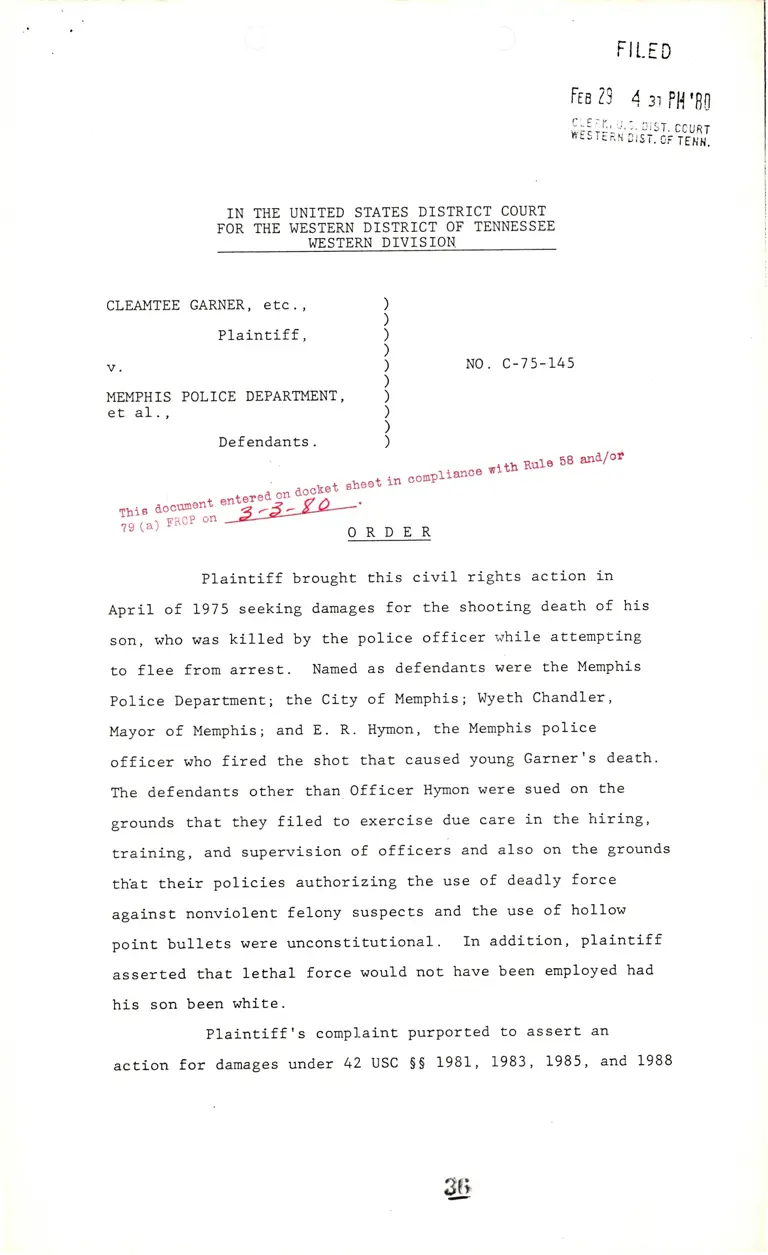
P la in t i f f brought this c i v i l r ights action in
A p r i l o f 1975 seeking damages for the shooting death of his
son, who was k i l le d by the po lice o f f ic e r while attempting
to f le e from arrest . Named as defendants were the Memphis
Police Department; the City o f Memphis; Wyeth Chandler,
Mayor o f Memphis; and E. R. Hymon, the Memphis po lice
o f f ic e r who f ire d the shot that caused young Garner's death.
The defendants other than O ffice r Hymon were sued on the
grounds that they f i l e d to exercise due care in the h iring ,
tra in ing , and supervision of o f f ic e r s and also on the grounds
that the ir p o lic ie s authorizing the use of deadly force
against nonviolent felony suspects and the use o f hollow
point b u l le t s were unconstitutional. In addition, p la in t i f f
asserted that le tha l force would not have been employed had
his son been white.
P l a i n t i f f ' s complaint purported to assert an
action fo r damages under 42 USC §§ 1981, 1983, 1985, and 1988
2 Vy
to redress a lleged deprivations of r ights secured by the
Fourth, F ifth , Sixth, Eighth and Fourteenth Amendments to
the United States Constitution.
By Order o f August 18, 1975, this Court ruled that
p la in t i f f could not u t i l i z e 42 USC § 1983 and 28 USC § 1343
to assert claims against the City of Memphis or the Memphis
Po lice Department since at that time, p r io r to the decision
in Monell v. Department of Social Serv ices , 436 U.S. 658
(1978) , those en t it ie s were not "persons" within the meaning
of § 1983. See Monroe v. Pape, 365 U.S. 165 (1961). The
Court nevertheless invoked ju r isd ic t io n over both of these
defendants under 28 USC § 1331, re ly ing on Bivens v. Six
Unknown Named Agents, 403 U.S. 388 (1971).
Following a bench t r i a l , the Court held that the
tra in ing programs and guidelines of the Po lice Department
regarding the use of le th a l force were adequate and that
neither the City nor the Po lice Department could be found
negligent on that ba s is . See Memorandum Opinion, November 29,
1/
1976. The Court further held that the use of hollow point
b u l le t s , based on the proof and evidence presented, was not
implemented merely fo r the in f l ic t io n of excessive punishment
and did not v io la te standards of c iv i l iz e d conduct or "shock
the conscience." See Rochin v. C a l i fo rn ia , 343 U.S. 165
(1952).
Po lice Department o f f i c i a l s t e s t i f ie d that the
department became concerned when the type of bu lle ts
previously used proved in e ffec t ive at stopping assa ilants
1/ It is noteworthy that although plaintiff in this case failed to
establish negligence on the part of defendants, even a showing of
negligence my be insufficient to establish liability under § 1983.
See Gomez v. Toledo, 602 F.2d 1018 (1st Cir. 1979). The decision in
Gomez held that a § 1983 plaintiff must establish malice or recklessness.
W T T .ld at 1020.
■2- 37
and resu lted in the death of a Memphis policeman. A fter
conducting comparative tests , the department found the
hollow point bu l le t s more e ffec t ive in this regard and also
less l ik e ly to ricochet and in jure innocent bystanders. There
was also evidence that other po lice departments and the FBI
used such ammunition. See T r ia l Transcript, V o l . I I I .
F ina lly , the evidence showed that, under the circumstances
of the wounding of Garner, death would have occurred
regard less of the type bu l le t used, thus preventing any
claim fo r compensatory damages under this part icu la r theory
of l i a b i l i t y .
The Court add it iona lly noted that the
con stitu t iona lity o f Tenn. Code Ann. § 40-808, permitting a
c ity to authorize i t s o f f ic e rs to use deadly force against
f le e in g fe lons, had been upheld previously in Cunningham v.
E ll in g to n , 323 F.Supp. 1072 (W.D. Tenn. 1971) (three-judge
court. Chief Judge P h i l l ip s p a r t ic ip a t in g ).
Cunningham v. E ll in g ton , supra, upheld the use of
le tha l force against f lee ing fe lons, armed or otherwise, when
no other e f fe c t iv e a lternatives were ava ilab le to e ffec t
a rrest and to prevent escape. Subsequent Sixth C ircu it
decisions have noted this holding with approval. For example,
the Sixth C ircu it panel in Wiley v. Memphis Po lice Department,
548 F.2d 1247, 1251, cert , denied, 434 U.S. 822 (1977),
expressly stated that the decision in Beech v. Melancon, 465
F.2d 425 (6th C ir. 1972), cert, denied, 409 U.S. 1114 (1973),
had held the Tennessee statute to be constitu tiona l. Under
these circumstances, this Court declined to reconsider further
the con st itu t ion a lity of the use of deadly force by the Memphis
Police Department per s e , rather considering the adequacy of
it s p o l ic ie s and regulations in safeguarding previously
delineated constitutional r igh ts .
-3-
38
Intervening decisions in this C ircu it and elsewhere
provide l i t t l e ju s t i f i c a t io n for re-examining the fa c ia l
v a l id i t y of the Tennessee statute. The only decision noted
which held the use of dealy force against f lee in g felons to
be unconstitutional was vacated by the Supreme Court. See
Mattis V. Schnarr, 547 F.2d 1007 (8th C i r . ) , vacated as
advisory opinion sub nom., Ashcroft v. M att is , 431 U.S. 171
(1977) . This decision was strongly c r it ic iz e d by the Sixth
C ircu it in Wiley v. Memphis Po lice Department, 548 F.2d 1247,
1252-53 (1977), cert, denied, 434 U.S. 822 (1977).
In addition, the Second C ircu it in Jones v. M arsha ll,
528 F.2d 132 (2d C ir. 1975), held constitutional a
Connecticut law a ffo rd ing a p r iv i le g e to police o f f ic e rs to
use deadly force when they reasonably be lieve that a felony
has been committed and that force is necessary to e ffec t
a rre s t , a law v i r tu a l ly identica l to that in Tennessee. In
Marshall, the f le e in g felon was suspected of auto theft and
there was no threat of deadly force by the suspect. The
Second C ircu it refused to impose a federa l constitutional
requirement that deadly force be employed by o f f ic e rs only
when the crime suspected involves a threat to death or bodily
in ju ry , holding that the state must be given some leeway in
l e g is la t in g in this sensitive and contested area. W . at
139-42.
F in a lly , i t should be noted that although the evidence
presented at t r i a l in this case suggested that Garner appeared
unarmed, the o f f ic e r s could not have known this with certainty,
nor could they have known whether the crime he had apparently
committed was against persons or against property only. This
recurring dilemma exposes the d i f f i c u l t y with any statute that
attempts to r e s t r ic t the use of deadly force only to
-4-
part icu la r types of offenses or in which the f le e in g felon is
armed.
F ina lly , the Court found that in view of a l l
surrounding circumstances, O ff ic e r Hymon had acted without
malice and within his r e sp o n s ib i l i t ie s as a po lice o f f ic e r
under the guidelines and p o lic ie s of the Memphis Police
2 /
Department.
On appeal, the Sixth C ircu it upheld this Court's
holding as to O ffice r H5nnon, but remanded the case against the
City fo r "reconsideration” in l igh t of Monell v. Department of
Social Services, supra, which, as noted before, reversed
Monroe v. Pape, supra, in holding that a c ity or municipal
agency may be held l i a b le as persons in damages under § 1983
fo r constitutional deprivations that re su lt from a "po licy or
custom" followed by the City. 436 U.S. at 694, n. 66. The
remand noted that a q u a l i f ie d immunity insulated the o f f ic e rs
and o f f i c i a l s in the case from personal l i a b i l i t y , but asserted
that the fo llow ing questions remain open under M onell:
"1. Does a municipality have a similar qualified
immunity or privilege based on good faith under
I'fonell?
2. I f not, is a municipality's use of deadly force
under Tennessee law to capture allegedly non-
dangerous felons fleeing from nonviolent crimes
constitutionally permissible mder the fourth,
sixth, eighth, and fourteenth amendments?
3. Is the municipality's use of hollow point bullets
constitutionally permissible under these
provisions of the Constitution?
4. I f the municipal conduct in any of these respects
violates the constitution, did the conduct flow
from a 'policy or custom' for vhich the City is
liable in damages under Monell?"
600 F.2d 52, 55 (6th C ir. 1979).
2/ The Court further noted that Hymon had a competent record as a police
officer and that he was the type person who was a desirable police recruit
because of his education, background, ability, and race.
-5-
40
A fter c a re fu l ly reviewing the e a r l ie r proceedings
in this case as w e ll as subsequent submissions by both parties ,
and a fte r hearing further argument by their counsel, this
Court has d i f f i c u l t y in determining how the decision in Monell
has any e f fe c t on this Court's p r io r decision and i t is concluded
that further evidentiary proceedings are inappropriate under
a l l of the circumstances.
I . SCOPE OF INITIAL TRIAL AND HOLDING
P l a i n t i f f ' s broad complaint in this case alleged that
the k i l l in g of his son v io la ted the l a t t e r 's constitutional
rights and was the d irect and proximate re su lt of the fo llow ing
a lleged actions of the City and Po lice Department: 1) h iring
an ind iv idual unqualified for the job , 2) a llowing the use
of deadly force against suspects without providing adequate
tra in ing ; 3) a llowing the use of hollow point b u lle t s ;
and 4) authorizing the use of deadly force against "nonviolent"
felony suspects. P l a in t i f f further asserted that his son
would not have been shot had he been white.
Although re jec t in g p l a i n t i f f ' s p re -Monell attempt to
invoke the Court's ju r isd ic t io n under 42 USC § 1983 and 28 USC
§ 1343(3) with respect to the City and Police Department, the
Court held that ju r isd ic t io n over both these defendants was
properly invoked under the Fourteenth Amendment and the general
federa l question statute, 28 USC § 1331. Bivens v. Six
Unknown Named Agents, 403 U.S. 388 (1971) ( " fe d e ra l courts do
have the power to award damages fo r v io la t ion of 'constitu tiona lly
protected in t e r e s t ' " ) ; see also Bosely v. City of Euclid , 496
F.2d 193 (6th C i r . 1974).
Thus, as a re su lt of the Court's exercise of
ju r isd ic t io n under § 1331, the City of Memphis was potentia lly
-6- 41
l i a b le in damages for each and a l l the constitutional
v io la t ion s asserted by p la in t i f f s under 42 USC § 1983, who
had f u l l opportunity to develop proof and evidence on each
3/
of the issues ra ised .
At t r i a l , which lasted several days, p la in t i f f
submitted substantia l evidence concerning the p o l ic ie s ,
practices, and tra in ing programs of the City and Police
Department with respect to the use of le tha l force, including
testimony regarding the use o f such force against suspects
who, upon investigation , were, in fac t , unarmed. In addition,
considerable evidence was introduced concerning the
u t i l i z a t io n of hollow point ammunition.
Following presentation o f proof, counsel for
defendant noted that p l a in t i f f had presented no evidence to
substantiate the assertion that his son had been denied equal
protection on the basis of race. A fte r counsel for p l a in t i f f
expressed no desire to pursue this facet o f the case further,
5/
the Court disposed of the issue summarily.
3/ Plaintiff 's very ccnpetent counsel is now a high ranking member of
^ e United States Department of Justice.
4/ The Court has reviewed the full record carefully in light of the
remand in this respect, as well as others considered.
5/ This Court did have occasion to consider an equal protection challenge
in an earlier, somewhat similar case, Wiley v. Manphis Police Department,
No. C-73-8 (W.D. Tern. June 30, 1975), a f fM . , 548 F.2d 1247 (6th Cin.),
cert, denied, 434 U.S. 822 (1977). This Court found that plaimtiff in
Wiley failed to establish discriminatory intent on the part of defendant
was affirmed on appeal. The reference by the circuit panel in this
case to statistics introduced in Wiley leaves this Court scxnewhat
puzzled as to their relevance here. In any event, plaintiff in ^ e
present action offered no evidence whatsoever to support his claim of
racial discrimination; in Wiley, as the Coiirt recalls it, there were
assertions that the white police officers involved would not have fired
at the fleeing suspect had he been white instead of black. There were
distinct racial overtones in that case not pursued by able counsel here
despite the opportunity to do so.
-7- 4:.)
As noted above, the Court considered a l l claims
against a l l defendants (except for the dismissed equal
protection claim) and the evidence presented on each claim in
i t s Opinion of November 29, 1976. Finding that p l a in t i f f had
f a i le d to estab lish any constitutional v io la t io n s , the Court
ordered judgment in favor of a l l defendants.
I I . EFFECT OF MONELL V. DEPARTMENT OF SOCIAL SERVICES
To discern the e f fe c t of Monell on the instant case,
42 use § 1983 creates no independent rights or protections, but
merely provides a fede ra l cause of action for v io la t ion s of
righ ts conferred by the Constitution and perhaps by other
federa l statutes. As the Supreme Court recently stated:
"one cannot go into court and claim a 'v io la t io n of § 1983' - -
for § 1983 by i t s e l f does not protect anyone against anything."
Chapman v. Houston Welfare Rights Organization, 441 U.S. 600,
617 (1979).
The decision in Monell therefore simply makes
m unicipalities l i a b le under § 1983 i f and when they v io la te
r igh ts conferred by the Constitution, provided the deprivation
re su lts from municipal po licy or custom. In the e a r l ie r
proceeding in this case, as a re su lt of the Court's recognition
of a d irect action under the Fourteenth Amendment and ju r i s
d iction premised on 28 USC § 1331, the City was po ten tia lly
l i a b le fo r a l l the constitutional v io la tions then and now
6/
a lleged by p l a in t i f f . This potentia l l i a b i l i t y would have
been no greater, no d i f fe re n t , had the Court exercised
6/ Although some of the constitutional provisions relied upon by
plaintiff are of questionable application to this case, pertinent state
actions as to these claims are incorporated through Fourteenth Amendment
application. See Sibron v. New York, 392 U.S. 40 (1968); Gideon v.
Wainwright, 372 U.S. 335 (1963); Robinson v. California, 370 U.S. 660 (1962)
-8- 43
ju r isd ic t io n under § 1983 and 28 USC § 1343. Since
p l a i n t i f f ' s constitutional claims received f u l l and carefu l
consideration under § 1331, reconsideration under Monell with
additional evidentiary hearings would be inappropriate.
P l a in t i f f has no new "cause of action" as a re su lt of the
decision in Monell and is bound by the previous judgment
which we re ite ra te holding that the City and Police Department
8/
did not v io la te the Constitution. The present e f fo r t by
p la in t i f f to reopen the case and introduce additional
evidence on issues already decided is barred by established
princ ip les o f res ju d ic a ta .
There is pending before the Supreme Court at present
one case which dea lt with sim ilar issues in an action
involving 42 USC § 1983 charges against a municipality, in
which Bivens v. Six Unknown Named Agents, supra, ra tiona le had
been applied p rio r to M onell. In that case, Owen v. City of
Independence, supra, the Supreme Court remanded to the Court
of Appeals " fo r further consideration in l ig h t of Monell,"
supra, a decision rendered in 550 F .2d 925 (8th C i r . 1977).
That Court held, as did this Judge, that 28 USC § 1331
authorized an action for damages for a lleged constitutional
7/
7/ Potential municipal liability could conceivably be less extensive
mder § 1983 because of the necessity of "policy or custom" prescribed in
Monell. Compare Leite v. City of Providence, 453 F.Supp. 385 (D.R.I.
1978) (since Congress in fact provided an adequate remedy under § 1983, no
reason exists to inply a cause of action under § 1331).
8/ Since defendants were found not to have violated the Constitution in
any respect and since the Court deemed the facial validity of the
Tennessee law to have been previously decided, the availability of a
qualified immunity for municipalities need not now be considered. In the
absence of any actions that may result in a finding of liability, the question
of immunity is imnaterial.
Nevertheless, the absence of any evidence of bad faitn in this case would
probably immunize defendants from liability under the qualified municipal
inmunity in § 1983 actions recognized by an increasing number of courts. See
Sala V. County of Suffolk, 504 F.2d 207 (2d Cir. 1979); Owen v. City of
^dependence, 589 F.2d 335 (8th Cir. 1978) (Supreme Court Appeal Pend^g) ;
Mprgan v. Sharon, Pa. Board of Education, 472 F.Supp. 1157 (W.D. Pa. 1979).
-9-
v io la t ion s against a c ity whether or not i t was a "person”
subject to su it under 42 USC § 1983. On remand, interpreting
Monell, 436 U.S. at 695, 701, 707-08, 712-13, the Court of
Appeals stated;
... We inply from the Court's discussion of
immunity that local governing bodies may assert
a limited inmunity defense to actions brought
against them under section 1983.
Owens, supra, 589 F.2d 337.
That Court expressly recognized p rio r to 1978, a
good fa ith defense ava ilab le to the municipality to a claim
for damages for an a lleged constitutional v io la t io n . Applying
Monell, i t held that "a limited immunity w i l l apply to claims
for equitab le r e l i e f against m u n ic ip a l it ie s ." 589 F.2d 338.
Applying the Owen ra t iona le , under the evidence
presented to this Court, the City o f Memphis has established
a good fa ith defense. The City of Memphis a lso was entit led
to claim a lim ited immunity in l ig h t of the evidence presented
on p l a i n t i f f ' s constitutional a llegat ions against i t and
other defendants in the t r i a l of this cause. The very
a llega t ion s made by p l a in t i f f in this case against the City,
and as to which he was afforded an opportunity to present
evidence, re la ted to po lic ie s and procedures a lleged ly established
or u t i l i z e d by the City and the Memphis Police Department,
including it s h ir in g and train ing practices.
In summation, then, the Court be lieves that each
of the sp ec if ic questions posed on remand have previously been
addressed and answered in the Court's p rio r Memorandum Opinion,
but this Judge has c a re fu lly re-examined the record, i t s notes,
and the circumstances of the prior t r i a l in l igh t of the remand
and M onell, supra .
The answer to question No. 1 is "yes" based upon
Owen, supra , and cases cited. Whether or not the City has
10-
45
such immunity, however, p l a in t i f f has fa i le d to make out a
prima fac ie case of any claimed constitutional v io la t ion .
The answer to question No. 2 would a lso seem c lea r ly
to be "yes" in l ig h t of p rio r authorities cited, p a rt icu la r ly
Cunningham v. E l l in g to n , supra, which held squarely on sim ilar
facts that Tenn. Code Annot. 40-808 met federa l constitutional
standards on it s face and that i t was "not unconstitutional”
in the face of sim ilar attacks made by the same counsel
involved in this case. 323 F.Supp.l076. (Two of the present
Judges of the Sixth C ircu it Court of Appeals partic ipated in
that decision as w e ll as the present Chief Judge of this
Court.)
The answer to question No. 3 was answered "yes” in
l ig h t of the evidence presented and the opportunity to
present any pertinent proof re la t in g to a constitutional
challenge to this policy and practice . Absent further
persuasive proof and evidence in another factual context,
this Court would s t i l l answer "yes” to this inquiry.
As to question No. 4, any answer would be purely
specu lative and conditional since municipal conduct re fe rred
to in p r io r questions was not determined in these respects to
v io la te the Constitution.
The Court concludes therefore that judgment should
issue fo r defendants, including the City of Memphis and the
Memphis Po lice Department in l ig h t of Monell v. Department
of Socia l Serv ices , supra. .-sz:
I t is so ORDERED this day of February,
1980.
HARRY W. UEILFORD, JUDGE
UNITED StATES DISTRICT C URT
-11-
Gvie
CIV 32
(7/63)
JUDGMENT ON DECISION BY THE COURT
g>tatFB Ststrirt, (Enurt
FOR THE
WESTERN DISTRICT OF TENNESSEE
WESTERN DIVISION
C IV I L A c t i o n f i l e N o . c-75-145
CLEAMTEE GARNER, fa th er and next of kin of
Edward Eugene Gam er, a deceased minor
us.
MEMPHIS POLICE DEPARTMENT; CITY OF MEMPHIS, TENNESSEE;
WYETH CHANDLER, Mayor of Memphis; JAY W. HUBBARD,
D irector of P o lic e of Memphis; and E. R. HYMON, P o lic e
O ffic e r of the C ity of Memphis
JUDGMENT
This action Came on for (hearing) before the Court, Honorable HARRY W. WELLFORD
, United States District Judge, presiding, and the issues having been duly boiKi
(heard) and a decision having been duly rendered, on the remand from the Sixth C ircu it ,
It is Ordered and Adjudged that in accordance w ith the Order entered by the Court
on March 3, 1980, judgment is hereby entered fo r defendants, including the C ity of
Memphis and the Memphis P o lic e Department in l ig h t of M onell.
APPROVED:
m r~CO ̂
m .' :t> ••
e-
iy' - m
o
docket 3̂ 6®’̂
compliance with Kule 58 and/or
Thic
79 Ca) on
Dated at
0 ̂ March
Memphis, Tennessee
, 19 80 .
47
, this 3rd day