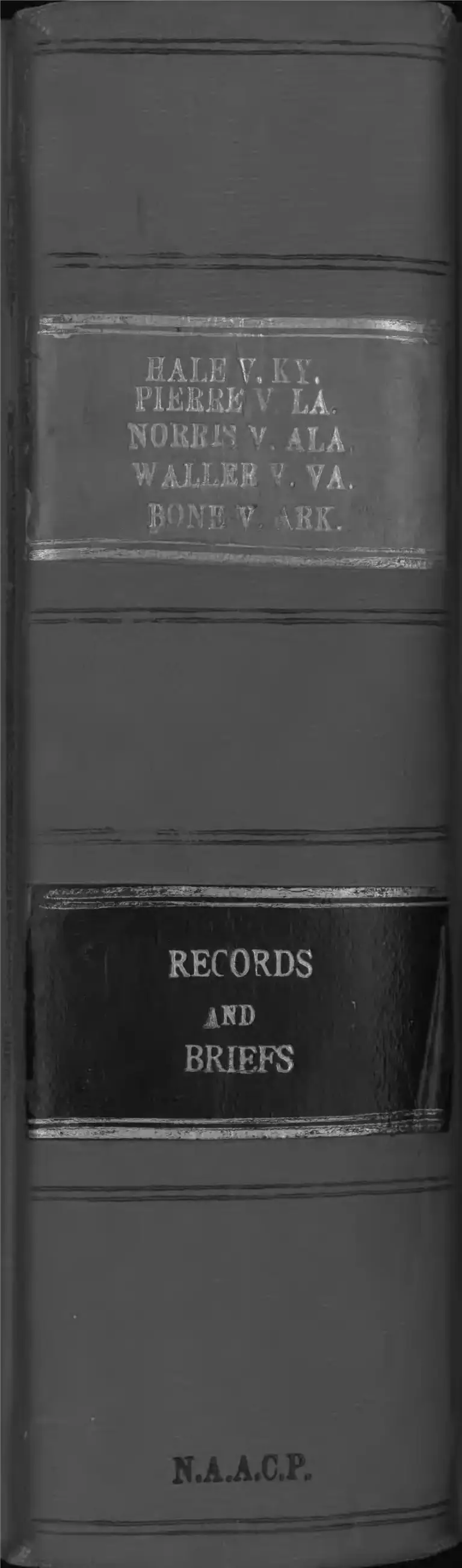
Hale v. Kentucky and Other Criminal Justice Cases Records and Briefs
Public Court Documents
January 1, 1934 - January 1, 1941
-
Brief Collection, LDF Court Filings. Hale v. Kentucky and Other Criminal Justice Cases Records and Briefs, 1934. eb364047-ca9a-ee11-be36-6045bdeb8873. LDF Archives, Thurgood Marshall Institute. https://ldfrecollection.org/archives/archives-search/archives-item/69f1c992-48f8-40c1-8350-8710cd21af21/hale-v-kentucky-and-other-criminal-justice-cases-records-and-briefs. Accessed September 22, 2026.
Copied!
HALE \T, EX
M J S B R K >' LA.
m i m n v . a l a
VALISE VA
B-WJ?V vl?X
i "irirai T r r a a a i
R E C O R D S
/
*
TRANSCRIPT OF RECORD
Supreme Court o f the United States
OCTOBER TERM, 1937
No. 680
JOE HALE, PETITIONER,
vs.
COMMONWEALTH OF KENTUCKY
ON WHIT OF CERTIORARI TO THE COURT OF APPEALS OF THE COM
MONWEALTH OF KENTUCKY
PETITION FOR CERTIORARI FILED JANUARY 8, 1938.
CERTIORARI GRANTED JANUARY 31, 1938.
SUPREME COURT OF THE UNITED STATES
OCTOBER TERM, 1937
No. 680
JOE HALE, PETITIONER,
vs.
COMMONWEALTH OF KENTUCKY
ON WRIT OF CERTIORARI TO THE COURT OF APPEALS OF THE COM
M ONWEALTH OF KENTUCKY
INDEX.
Proceedings in Court of Appeals of Kentucky............................
Caption .....................................................(omitted in printing)..
Record from Circuit Court of McCracken County.....................
Indictment ....................................................................................
Order setting case for trial.......................................................
Order to deliver defendant for trial......................................
Order overruling motion to set aside indictment...............
Order overruling demurrer to indictment............................
Order granting defendant, Joe Hale, a separate trial___
Plea of not guilty ........................................................................
Empanelling of jury....................................................................
Order overruling motion to discharge panel.......................
Minute entries of trial................................................................
Affidavit supporting motion to set aside indictment.........
Supplemental affidavit and stipulation..................................
Motion to discharge panel.........................................................
Order allowing witness fees.....................................................
Order on instructions..................................................................
Verdict ...........................................................................................
Instruction “A”, refund..............................................................
Instructions to jury ....................................................................
Original Print
1 1
1
2 1
2 1
5 3
5 3
6 3
6 4
0 4
7 4
7 4
8 5
8 5
9 6
21 14
22 15
23 16
23 16
24 17
25 17
25 17
Judd & Detweiler (I nc.) , Printers, Washington, D. C„ February 4, 193&
—3814
11 INDEX
Record from Circuit Court of McCracken County— Continued.
Motion for new trial...................................................................
Judgment .......................................... ............................................
Order overruling motion for new trial and granting ap
peal ............................................................................................
Motion to proceed in forma pauperis and order thereon.
Order approving bill of exceptions........................................
Clerk’s certificate........................... (omitted in printing)..
Bill of exception No. 1 ...............................................................
Testimony of Dr. Leon Higdon........................................
Ed Kirk .......................................................
J. E. Linn.....................................................
Terrell Toon ..............................................
Buddy Mercer ..........................................
Leo Poat .....................................................
Eugenia Hamilton....................................
Lindsey Mae Hamilton...........................
Mrs. Mamma J. Eggester.......................
Prince William Thorpe.........................
Edward Lee Boyd....................................
Terrell Toon (recalled).........................
James Powell ..........................................
Novella Nailing ........................................
Bertie Mae Bradfort................................
Reporter’s certificate...........(omitted in printing)..
Judgment ...............................................................................................
Opinion, Morris, C................................................................................
Order extending time to file rehearing..........................................
Petition for rehearing........................................................................
Order denying rehearing....................................................................
Petition for appeal and order staying execution (omitted
in printing) .......................................................................................
Assignment of errors..............................(omitted in printing)..
Affidavit and motion to proceed in forma pauperis (omitted
in printing) .......................................................................................
Order allowing appeal........................... (omitted in printing). .
Citation and service................................(omitted in printing)..
Pneeipe for record..................................(omitted in printing). .
Clerk’s certificate ..................................(omitted in printing)..
Order dismissing appeal and staying mandate to permit ap
plication for a writ of certiorari (omitted in printing)-----
Stipulation and addition to record.................................................
Motion to set aside indictment.................................................
Affidavit of clerk..........................................................................
Order allowing certiorari ..................................................................
Original Print
28 20
30 21
30 22
30 22
32 23
32
33 23
33 23
36 26
38 27
41 30
45 33
47 34
50 36
59 43
66 48
68 50
75 56
76 57
77 58
79 60
81 62
82
83 63
84 63
99 71
100 72
104 74
105
107
110
117
120
121
122
123
127 74
128 75
130 76
131 77
1
sTb
[fol. 1] [Caption omitted]
[fol. 2]
IN CIRCUIT COURT OF McCRACKEN COUNTY
Commonwealth oe K entucky, Plaintiff,
vs.
Joe Hale, Prince W illiam T horpe, and James Gilbert
Martin, Alias Junkiiead, Defendants
Pleas Begun, Had and Ended under the Hon. Joe L. Price,
Judge McCracken Circuit Court, and the Hon. Joe L.
Price at All Times Presiding
Be it remembered that on the 4th day of the September
Term, and on the 1st day of October, 1936, the following or
der was entered herein, v iz :
This day the Grand Jury, in the presence of the entire
body, by and through its foreman, in open court, returned 14
indictments, which were received by the Clerk from the
Judge, each was endorsed A True Bill, and signed E. H.
Seaton, Foreman; bail was endorsed thereon, and each was
ordered filed, bench warrants awarded and ordered to issue
on each indictment as follows:
One against Joe Hall, Prince William Thorpe, and James
Gilbert Martin, alias Junkhead, charged with the offense of
“ Wilful Murder” , no bail endorsed. No. 3432.
The indictment, filed pursuant to the above court order,
is in words and figures as follows, to w it:
[fol. 3] Indictment
T he Commonwealth op K entucky
against
Joe H ale, Prince W illiam T horpe, and James Gilbert
Martin, alias Junkhead
M cCracken :
The Grand Jurors of the County of McCracken in the
name and by the authority of the Commonwealth of Ken
tucky accuse Joe Hale, Prince William Thorpe, and James
Gilbert Martin, alias Junkhead, of the offense of wilful mur
der, committed in manner and form as follows, to-wit: The
1—680
2
said Joe Hale, Prince William Thorpe, and James Gilbert
Martin, alias Junkhead, in the said county of McCracken on
the'1st, day of "October, 1936 and with — years before 'find
ing tins indictment, dicTwillfuliy and unlawfully and ma-
IiciousIV~and feloniouslv~ancl of tneir malice aforethought,
hill, slay and murder W. Jtc. Toon by cutting, thrusting, stab
bing, and wounding said W. R. Toon in and upon the head,
body, arms, limbs and person with a knife, a sharp-edged
and pointed instrument, a deadly weapon, from which cut
ting, thrusting, stabbing and wounding, said W. R. Toon
did shortly thereafter, and within a year and day and in the
Commonwealth of Kentucky die, contrary to the form of the
Statute in such cases made and provided, and against the
peace and dignity of the Commonwealth of Kentucky.
Second Count
The Grand Jurors of the County of McCracken, in the
name and by the authority of the Commonwealth of Ken
tucky accuse Joe Hale, Prince William Thorpe, and James
Gilbert Martin, alias Junkhead, of the offense of wilful mur
der, committed in manner and form as follows, to-wit: The
[fol. 4] said Joe Hale, in the said county of McCracken, and
on the 1st day of October, 1936, and before the finding of this
indictment, did willfully and unlawfully and maliciously and
feloniously, and of his malice aforethought, kill, slay, and
murder W. R. Toon by cutting, thrusting, stabbing, and
wounding said W. R. Toon in and upon the head, body,
arms, limbs and person of said W. R. Toon with a knife, a
sharp-edged and pointed instrument, a deadly weapon, from
which cutting, thrusting, stabbing and wounding said W. R.
Toon did shortly thereafter, and within a year and a day,
and in the Commonwealth of Kentucky, d id : ------
and the said Prince William Thorpe and James Gilbert Mar
tin, alias Junkhead, were present at the time and near
enough so to do, and did wilfully and feloniously and unlaw
fully, and maliciously, and of their malice aforethought, aid,
assist abet, counsel, encourage, and command, thn-said Joe
“Gale tcTso cut, thrust, stab, and wound and kill and murder
fhe smxTwTK Toon at the time he, the said Joe Hale, did so
so ; contrary to the form of the Statute in such cases made
and provided, and against the peace and dignity of Com
monwealth of Kentucky.
HOLLAND G. BRYAN,
Corn. Atty., Second Judicial Dist.
3
[fol. 5] I n Circuit Court of McCracken County
[Title omitted]
Order Setting Case for Trial— October 2, 1936
On Motion of Commonwealth Attorney, it is ordered that
this prosecution be placed upon the docket; and by agree
ment of parties, said prosecution is set for trial on October
12, 1936.
I n Circuit Court of McCracken County
[Title omitted]
Order to Deliver Defendant for Trial— October 10, 1936
The above styled prosecution having heretofore on Octo
ber 2, 1936, been set for trial on October 12th, 1936, as to
the defendant, Joe Hale, he being now for safe keeping in
the State Penitentiary at Eddyville, Kentucky, it is now
ordered that the Warden of said Penitentiary deliver said
defendant, Joe Hale, into the custody of Cliff Shemwell,
Sheriff of McCracken County, or his deputy or deputies, for
the purpose of transporting said defendant, Joe Hale, to
the above mentioned Court for trial on said date of October
12, 1936.
[fol. 6] I n Circuit Court of McCracken County
[Title omitted]
Order Overruling Motion to Set A side I ndictment__Octo
ber 12, 1936
Came defendant, Joe Hale, by attorney, and filed motion
and moved the Court to set aside the indictment in the above
staled prosecution, and in support of said motion to set
aside, filed his own affidavit and his supplemental affidavit,
and paities hereto also filed stipulation, which stipulation
is set out at the foot of said supplemental affidavit and said
motion to set aside being submitted to the Court, and the
court being sufficiently advised, overrules said motion to set
aside, to which ruling of the Court the defendant excepts.
4
Order Overruling D emurrer jtjiJusumctment—October 12,
1936
Came defendant, Joe Hale, by attorney, and entered de
murrer to the indictment herein, which demurrer being sub
mitted to the Court, and the Court being sufficiently advised
overruled said demurrer, to which ruling of the Court the
defendant excepts.
Order Granting Separate Trial— October 12, 1936
Came defendant by attorney, and entered motion and
moved the Court for a separate trial, and said motion being
submitted to the Court, and the Court being advised, sus
tained said motion, it is therefore ordered that the defend
ant, Joe Hale, have a separate trial. Whereupon the Com
monwealth by attorney, elected to try the defendant, Joe
Hale, first.
[fol. 7] Pee a of Not Guilty—October 12, 1936
Came parties to the above styled prosecution and an
nounced ready for trial.
On motion of Commonwealth Attorney, it is ordered that
Marshall Jones, this Court’s Official Reporter, report the
trial of this Prosecution. The defendant, Joe Hale, being-
present in open court, in person and by attorneyt acknowl
edged the identity of person, waived the formality of ar
raignment, and entered a plea of not guilty to the charge of
“ wilful murder.”
E mpanelling of Jury— October 12, 1936
The regular panel of jurors being tested for the jury in
this prosecution, and four (4) having been accepted and
Five (5) others having been called but not yet accepted,
and it appearing to the satisfaction of the Court, that the
regular panel has been eshausted, deputy sheriffs, Herman
Englert, Clyde Shemwell, Barkley Graham, J. R. Waller
and Helen Bohannon, having been duly sworn, took charge
of the above mentioned Nine (9) jurors until One o ’clock
P. M. and by agreement of parties, said deputies were
ordered and directed to go out into the City and County,
5
and into the parts thereof where men would not be likely to
be disqualified as jurors in this prosecution, and summon
50 men as jurors to complete the jury in this prosecution.
One o ’clock P. M. having arrived, the sheriff turned into
court the names of Kelly Warford, Court Neal, Fayettee
Trewalla, John C. Kipley, Jesse Carneal and M. V. Miller,
from among the above mentioned 50 summoned by the
sheriff, who together with Jim Polk, Jim Travis, Fred Babb,
Amos Rickman, A. J. Harris, and John Wyatt, from the
regular panel, were duly tested, accepted and sworn as the
jury herein. Then at the direction of the Court to turn in
a name from among the above mentioned 50 as the 13th
[fol. 8] juror, the sheriff turned into Court the name of
R. L. Bailey, who was duly tested, accepted and sworn as
the 13th juror in this prosecution, and who took his place
with the other 12 regular jurors as above mentioned.
Order Overruling Motion to Discharge Panel— October
12, 1936
Then came defendant, by attorney, and filed motion and
moved the Court to discharge the whole panel of the jury
in this prosecution for cause, he having exercised his 15
peremptory challenges as allowed T)y law, and in support
of said motion referred to and made a part hereof the affi
davit of the defendant, this day filed in support of hi a mn-
tion to set aside the indictment herein. And said motion to
discharge coming on to be heard, and the court being suffi
ciently advised, overruled said motion to discharge, to
which ruling of the Court the defendant excepts.
Minute E ntries of Trial— October 12, 1936
At the conclusion of a part of Commonwealth’s evidence,
the defendant, Prince William Thorpe, being unwilling to
testify, it is thereupon ordered, on motion of Common
wealth by its Attorney, that the indictment herein as to said
defendant, Prince Willaim Thorpe, be dismissed absolutely,
reasons endorsed thereon. Thereupon said Prince William
Thorpe was called to the witness chair by Commonwealth
Attorney, and said witness refused to give his testimony,
whereupon said Prince William Thorpe was ordered to the
jail of McCracken County in custody of the jailer. The jury
6
was then admonished by the Court and permitted to depart,
in custody of Deputy Sheriffs, Herman Englert, J. R.
Waller and Barkley Graham, they having first been duly
sworn, until tomorrow morning at 8 :00 o ’clock.
[fol.9] I n Cibctxit Court of M cCracken County
[Title omitted]
A ffidavit Supporting Motion to Set A side I ndictment—•
Filed October 12, 1936
The defendant and affiant, Joe Hale, in support of his
motion to set aside the indictment against him herein,
states that the population of McCracken County, Kentucky,
is approximately 48,000 of which approximately 8,000 are
colored people, ox negroes; he states that the qualification
of jurors prescribed by the Kentucky Statutes, section
2241, are as follows:
“ The commissioners shall take the last returned Asses
sor’s book for the county and from it shall carefully select
from the intelligent, sober, discreet, and impartial citizens,
O § resident housekeepers in different portions of the county,
over twenty-one years of age the following numbers of
names of such persons, to-wit: * * * Counties having a
population of twenty thousand and not exceeding fifty
thousand, not less than five hundred nor more than six
5 C®? | hundred. ’ ’
Affiant now states that there now appears on the last
returned Assessor’s Book for the County the names of
approximately 6,000 white persons and 700 negroes quali
fied for such jury service under the above requisite.
He states that he can prove this fact by C. C. Cates, the
Assessor or Tax Commissioner for McCracken County at
■ the present time.
r~ He states that in December, 1935, by order of the Judge
of the McCracken Circuit Court, Boyce Berryman, J. JI.
Hodges, and W. C. Seaton, were duly and regularly ap-
[fol. 10] pointed Jury Commissioners and filled the wheel
jjb >5 I with_names for jury service for the year 1936, to the extent
of between 500 and 600; that he can prove by the three
g above named commissioners that they did not place the
h _ 4 ro
3 V
name of one negro in the wheel but that the whole number
selected were of white citizens; that they did not exclude
the name of any negro from said wheel because he was not
an intelligent, sober, discreet and impartial citizen, resi
dent housekeeper of this county or twenty-one years of age.
He "states "that it is further prescribed by the Kentucky
’ Statutes, Section 2243, that the “ Judge, in open Court,
shall draw from said drum or wheel case a sufficient number
of names to procure the names of twenty-four persons qual
ified as hereinafter prelffinbedyfo act as Grand Jurors * * *
“ The qualification as such Grand Jurors, Section 2248 of
Ky. Statutes, namely: “ No person shall be qualified to
serve as a Grand Juryman unless he be a citizen and a
housekeeper of the county in which he may be called to
serve and over the age of twenty-one years. No civil offi
cer, (except trustees of schools) no surveyor of a highway,
tavern-keeper, vender of ardent spirits by license, or per
son who is under indictment, or who has been convicted of
a felony and not pardoned, shall be competent to serve as
a grand juror * * *
He now says that he can prove by the Hon. Joe L. Price,
Judge of the McCracken Circuit Court, that the names of
the grand jurors for the present term of court, at which
this indictment was returned, was drawn by him from the
drum or wheel as above prescribed; that he did not draw
the name of one negro citizen from said wheel, and that
he did not exclude any negro’s name from the said list of
[fol. 11] grand jurors so drawn because “ he was not” “ a
i citizen and a housekeeper of the county in which he was
called to serve; because he was not twenty-one years of age;
because he was a civil officer (except trustee of school)
because he was a surveyor of a highway; because he was
a tavern-keeper; because he was a vendor of ardent spirits
by license; because he was under indictment; nor because
Jie had been convicted of a felony and not pardoned.
# # # # # # #
/ —
The affiant now states, that he can prove by John W.
Ogilvie that he was sheriff of McCracken County, Ken
tucky, during the years 1906 to 1910; that he attended every
term of the criminal court for said McCracken Circuit
Court during that time; that he and his deputies sum
moned the jurors for the grand jury and petit jury service
8
°o
*O T
i
during that tenure, and that not one negro was summoned
to serve or served on any Grand Jury or petit jury during
said time; nor were the name of any negro placed in his
hands to be summoned for such service.
He says that he can prove by Geo. Houser that he was
the sheriff of McCracken County, Kentucky, from 1910 to
1914; that he attended every term of the criminal,court for
the said McCracken Circuit Court during that time; that
he and his deputirs summoned the jurors for the grand
jury and petit jury service during that tenure, and that
not one negro was summoned to serve or served on any
grand jury or petit jury during said time; nor were the
name of any negro placed in his hands to be summoned for
such service.
[fol. 12] He says that he can prove by George Allen that
1 he was sheriff of McCracken County, Kentucky, during the
years from 1914 to 1918; that he attended every term of the
criminal court for the said McCracken Circuit Court during
that time; that he and his deputies summoned the jurors
for the grand and petit jury service during that tenure,
and that not one negro was summoned to serve or served
on any grand jury or petit jury during said time; nor were
the names of one negro placed in his hands to be sunl
it moned for such service.
r He says that he can prove by George L. Alliston that
he was sheriff of McCracken County during the years 1918
to 1922; that as such he attended every term of the crim
inal court held in said county for the McCracken Circuit
Court during that time; that he and his deputies summoned
the jurors for the grand jury and petit jury service during
that tenure, and that not one negro was summoned to serve
or served on any grand jury or petit jury during said time;
nor were the name of any negro placed in his hands to be
summoned for such service.
p Tie says he can prove by Roy Stewart that he was sheriff
of McCracken County, Kentucky during the years ^922 to
1926; that as such he attended every term of the criminal
court held in said county for the McCracken Circuit Court
during that time; that he and his deputies summoned the
jurors for the grand jury and petit jury service during that
tenure, and that not one negro was summoned to serve or
served on any grand jury or petit jury during said time ;
nor was the name of any negro placed in his hands to be
summoned for such service.
9
He says he can prove by Claud Graham that he was
sheriff of McCracken County during the years 1926 to 1930;
that as such he attended every# term of the criminal court
[fol. 13] in said county for the McCracken Circuit Court
during said time; that he and his deputies summoned the
jurors for the grand jury and petit jury service during
that tenure, and that not one negro was summoned to serve
or served on any grand jury or petit jury during said time.;
nor was the name of any negro placed in his hands to be
summoned for such service,
I He saysTthat lie can prove by Herman Englert that he
was deputy-sheriff under EmmeiH.olLXxhicaaa&d) who was
sheriff of McCracken County during the years 1930 to 1934;
that as such he attended every term of the criminal court
held in and for the McCracken Circuit Court during that
time; that he and other deputies summoned the jurors for
the grand jury and petit jury service during said time, and
that not one negro was summoned to serve or served on
any grand jury or petit jury during said time; nor was the
name of any negro placed in his hands to be summoned for
such service.
He says that he can prove by Cliff Shemwell that he has
been since 1931 and is now the present sheriff of McCracken
County, Kentucky; that as such he has attended several
terms of the criminal court in and for the McCracken Cir
cuit Courc; that he and his deputies summoned the jurors
for the grand jury and petit jury service for the past two
years and that not one negro was summoned to serve or
1 served on any grand fury or petit jury during said time:
nor was the name of any negro placed in his hands to be
summoned for such service.
— He says that he can prove by all of the above named
ex-sheriffs that they never saw a negro sit on either a grand
jury or petit jury in the McCracken Circuit Court for the
I past thirty years.
I r a n i ] He says he can also prove by Geo. L. Alliston
that he was deputy U. S. Marshal stationed at Paducah,
McCracken County, Ky. for eight years consecutively im
mediately preceding the year 1935: that he is a citizen and
resident of Paducah, Kentucky and has been for twenty
years or more, that he is well acquainted with the negro
l ln| population of Paducah and McCracken County, Kentucky
rj and will state that there is now and has been for the pas£.
— twenty years negro' citizens in said county that meet all
the requirements of the law relating to jurors and are qual-
] ified for jury service to the extent of five hundred or more;
that during that time several negro citizens from this
county have been summoned, met the qualifications, and
y served as jurors in the U. S. Court in Paducah, Ky.
He says he can prove by Walter Blackburn that he was
clerk of the U. S. Court at Paducah, Ky. for twelve years
immediately preceding the year 1936; that he is wellZ ac
quainted with the negro citizenship of McCracken County
and has been during said time; that he will state that there
are five hundred or more negro citizens in this county that
meet every qualification under the law for jury service; that
during his tenure of office several negro citizens have served
on the juries in the U. S. Court at Paducah; that he has
never seen a negro serve on a petit or grand jury in the
UMcCracken Circuit Court. "
T He says Tie can prove by Wayne C. Seaton that he was
clerk of the McCracken Circuit Court for twelve years im
mediately preceding the year, 1928; that he attended every
term of the McCracken Circuit Court during his tenure of
office, that he never saw a negro set on either grand jury
or petit jury during his tenure of office; he will also state
that he is a resident and citizen of McCracken County,
[fol. 15] Kentucky, and well acquainted with the negro citi
zenship thereof; that he will state there are several hun
dred negroes in said county that meet all requirements of
t the law as to qualifications for jurors—
He says he can prove by J. W. Trevathen that he was
deputy circuit court clerk under Frances Allem during the
I years 1928 to 1934; that as such he attended every term of
the McCracken Circuit Court during that time, and that
he never saw a negro serve on a jury in the McCracken Cir_-
■ c-uit Court during that time.
He says he can prove by F. P. Feezor that he is now the
! clerk of the McCracken Circuit Com t and has been such for
the past two years; that he has attended every term of the
McCracken Circuit Court during said time, and that he has-
never seen a negro sit on a jury in the McCracken Circuit
Court during that time; that he is well acquainted with the
negro population of this county and will state that there
are several hundred negro citizens in said county who meet
every requirement of the law as to qualification for jury
service.
He says he can pi’ove by C. B. Crossland, Sr. that he
was Court reporter for the McCracken Circuit Court dur
ing the years 1909 to 1914; that as such he attended every
term of the McCracken Circuit Court; that since_said time
he has been a practicing lawyer at the McCracken County
Bar and has attended-every term of the McCracken Circuit
Court for twenty-seven years, and that during said time
he has never seen a negro set on a jury in McCracken Cir
cuit Court; that he has been Police Judge of Paducah, and
is well acquainted with the negro citizenship of McCracken
County, Ky. and will state that there is now and has been
for several years past,^several hundred negroes that meet
every requirement under the law as to qualification for jury
service.
” [fol. 16] He says that he can prove by Marshall Jones
that he is now the Court "Reporter J or the McCracken Cir
cuit Court and has been such since January 1.1914, and has
attended every term of the McCracken Circuit Court during
that time, and that he has never seen a negro set on a jury
in the McCracken Circuit Court during said time.
He says that he can prove by Professor D. H. Anderson
; that he is principal of the Western Kentucky Industrial
; College, a negro school located in Paducah, McCracken
County, Kentucky and has been such for twenty years; that
he is a negro educator, and is well acquainted with the
negro citizenship of McCracken County, Kentucky, and
will state that there is now and has been for the past twenty
years more than five hundred negroes that meet every re
quirement of the law for qualification for jury service, and
that during this time he has never seen nor heard of a
- negro serving on any jury in the McCracken Circuit Court.
- He says that he can prove by I. N. Boyd that he is a,
negro undertaker in the City of Paducah and lias been such
for the past twenty years, and that he has been a resident
| of Paducah for Forty vearsu that he is well acquainted with
the negro citizenship of McCracken County and will state
that he knows^several hundred negroes in said county that
meet every requirement of the law as ^qualification for
jury service, and that he never saw or heard of a negro
serving on a jury in the McCracken Circuit Court.
[fob 17] lie states that he can prove by K. G. Terrell, a
wholesale grocer of Paducah, that he is 88 years of age,jand
has resided in McCracken County all of his life; that there
,is now and has been during the past fifty years several hun-
12
dred negroes residing in McCracken County who meet every
requirement of the law as to qualificationfor jury service,
and that during the past fifty years he never saw nor heard
of a negro serving either on a Grand or Petit jury in the
McCracken Circuit Court.
P He states that John Counts, 65 years of age, business man,
has resided in McCracken County for the past thirty years ;
that he can prove by him that there are now and have -been
during the time of his residence here ^several hundred
negroes residing in McCracken county who meet every re
quirement of the law as to qualification for jury service, and
that during the past thirty years he never saw nor heard of
a negro serving either on a Grand or Petit Jury in the Mc
Cracken Circuit
He states that he can prove by Henry Houser, ex-jailer
of McCracken county. 75 years of agtn that he- has lived in
McCracken county all of his life ; that there is now and has
been during the past fifty ..years several hundred negroes
residing in McCracken County who meet every requirement
of the law as to qualification for jury service, and that dur-
1 ing the past fifty years he never saw nor heard nr a. negro
serving either on a Grand or Petit jury in the McCracken
| Circuit Court.
f[fo l. 18] He states that he can prove by J^D. Mocquot, at-
\tornev at law. 70 years of age, that he nas lived in" Mc-
Cracken county all of his life ; that there is now and has been
during the past fifty years several hundred negroes resid
ing in McCracken county who meet every requirement of the
law as to qualification for .jury service: that he. the said
Mocquot, has been practicing law in the McCracken Circuit
Court for approximately fifty~years, and that he has at
tended approximately every session of the McCracken Cir
cuit Court during that time, and that he has never seen nor
heard of a negro serving either on a Grand or Petit iurv
in the McCracken Circuit Court.
r He states that E. J. Paxton. 65 years of age, is the owner
and publisher of the Paducah Sun-Democrat, a daily news-
[paper in the city of Paducah, and has resided in McCracken
- county all of his life, and that he can prove by him that there
is now and has been during the past 45 years several hun
dred negroes residing in McCracken county who meet every,
requirement of the law as to qualification for jury service,
* land that during the past forty-five years he never saw nor
13
s
H i -
r e c .
J-
heard of a negro serving either on a Grand or Petit Jury in
the McCracken Circuit Court.
He states that he can prove by Jacob R. Wallerstein, 80
years of age, a Paducah business man for more than fifty
yeais, that there are several hundred negroes residing in
McCracken countv and have been during the past fifty years.
who" meet every requirement of the law as to qualification
for jury service, and that during the past fifty years he
never heard of nor saw a negro serve on a jury either
Grand or Petit, in the McCracken Circuit Court.
[fol. 19] He states that he can prove by M. Marks, a
Paducah business man for over fifty years, that there are
now and have been during that time several hundred negroes
residing in McCracken county who meet e v e r y requirement
for qualification for jury service, and that during said time
Ihe has never seen nor heard of a negro sitting on either a
Grand or Petit jury in the McCracken Circuit Court.
He states that he can prove by Col. Robert Noble, 78 years
of age, capitalist, retired, that there are now and have been
\ during the past fifty years several hundred negroes resid-
ing in McCracken county who meet every requirement for
I qualification for jury service and that during all of said
l time ne nas never seen nor heard of a negro sitting either on
j a Grand or Petit jury in the McCracken Uircuit court..
He states that he can prove by R. L. Reeves, President of
the Peoples National Bank, attorney at law, ex-city at
torney, about 75 years of age, that there is now and has been
for the past fifty years several hundred negroes residing
in McCracken county who meet every requirement for
qualification for jury service, and that during the past fifty
years he has never seen nor heard of a negro sitting on
either a Grand or Petit jury in the McCracken Circuit Court.
He states that he can prove by Jack E, Fisher; attorney at
law, that he was Commonwealth Attorney of the McCracken
Circuit Court for the twelve years immediately preceding
the year of 1928; that he attended every term of the Mc
Cracken ClrcrnlTCourt during that time and that he has
never seen nor heard of a negro sitting on either a Grand or
Petit jury in the McCracken Circuit Court.
:Lfol. 2d] Affiant states that each and all of the foregoing
witnesses are residents of McCracken County, Kentucky, and
within the jurisdiction of this court; that most of said wit
nesses are actually in court to-day, and that if given the op-
| portunity all of the witnesses to the above facts can be pro-
14
cured to give their testimony orally in court in the course
of two hours; that they will testify as indicated herein; that
same is true and will be true when proven; that this motion
and affidavit is not made for delay hut that justice may be
[ done.
Affiant states that the foregoing facts when proved show
; a long continued, unvarying and wholesale exclusion of
negroes from jury service in this county on account of their
race and color; that it has been systematic and arbitrary on
the part of the officers and commissioners who select the
names for jury service for a period of fifty years or longer;
that it is prejudicial to his substantial rights and in violation
of the Constitution of the United States. He therefore asks
the Court to hear the proof upon his motion to set aside the
indictment.
Joe W. Hale.
Subscribed and sworn to before me by Joe Hale this
the 12th day of Oct. 1936. F. P. Feezor, Clerk, Mc
Cracken Circuit Court.
[File endorsement omitted.]
[fol. 21] In Circuit Court op McCracken County
[Title omitted]
Supplemental A ffidavit and Stipulation—Filed October
12,1936
Affiant and defendant Joe Hale, states that since the
preparation of the original affidavit in support of motion to
set aside the indictment in this case, he has learned that in
the April, 1921, term of the McCracken Circuit Court, upon
the trial of a negro in said court upon a minor felony,
charge, the Hon. Wm. Reed, Judge of said court instructed
the sheriff of McCracken to summon from bystanders a
rieg’ro jury to try said case, which was done.
He further states that the names of these negro jurors
were not drawn from the rurv wheel or drum, never having
been placed therein by the jury commissioners, but was a
pick-up jury ordered by the court for this special case, and
that said negro jurors were not regular members of the petit
jury panel for that term of court.
Joe W. Hale.
Subscribed and sworn to before me by Joe Hale this
the 12th day of October, 1936. F. P. Feezor, Clerk,
McCracken Circuit Court.
It is stipulated that this and the original affidavit shall be
considered as evidence.and that the witnesses named therein
would testify as set forth therein.
[fol. 22] It is further stipulated that the Judge of the Mc
Cracken Circuit Court has never at any time Instructed the
Jury Commissioners to exclude the names of negroes from
the Jury lists and Jury drum; and that said Judge is now
serving his 15th year as such Judge. Oct. 12th, 1936.
Holland G. Bryan, Com. Atty. Crossland & Cross
land, Atty. For Deft.
[File endorsement omitted.]
15
In Circuit Court of M cCracken County
[Title omitted]
Motion to Discharge Panel— Filed October 12, 1936
Now comes the defendant, Joe Hale, by attorney, and chal
lenges the entire panel of the jury in this case for cause, and
in support of said motion he refers to and asks to be made a
part hereof the affidavit this day filed on the motion herein
to set aside the indictment.,
Joe Hale, by Crossland & Crossland, Attorneys for
Defendant.
[File endorsement omitted.]
16
[fol. 23] In Cikcuit Court of McCracken County
[Title omitted]
Order A llowing W itness F ees—October 12, 1936
This day the following named persons appeared in open
court and claimed their attendance as witnesses for the Com-
monweath, in the above styled prosecution. Said claims
were allowed as follows:
Ed Kortz .................................................. 1 day $1.00
J. E. L y n n ................................................ 1 “ 1.00
W. E. Bryant ........................................... 1 “ 1.00
Kelly Franklin ......................................... 1 “ 1.00
In Circuit Court of McCracken County
[Title omitted]
Order on I nstructions— October 13,1936
Came the same jury heretofore empaneled herein, and
resumed the trial of this prosecution. At the conclusion^ of
P1aintifF,g flgjdfiBca, the defendant by attorney, offered in-
stmctLoiL-tLA!.’ to find for defendant, and moved the Court
to give same to the jury, to the giving of which the Com-
[fol. 24] monwealth by Attorney, objected, and said objec
tions being submitted to the Court, and the Court being
advised, sustained said objections, and refused to give In
struction “ A ” to the jury, to which ruling of the Court, the
defendant excepts.^/Ai Thmciuiclnsion ..of- abLeyjdenee, de
fendant re-offered Instruction “ A ” and moved the Court to
give same to the Jury, to the giving of which the Common
wealth, by its attorney, objected, and said objections being
submitted to the Court, and the Court being advised, again
sustained said objections, and refused to give Instruction
“ A ” to the jury, to which ruling of the Court the defendant
except^/ The Court then gave to the jury, Instructions Nos.
1 to 9, inclusive, to the giving of each and all of which the
defendant objects and excepts and moved the Court to give
the whole law in the case, and the Court being of the opinion
that he had so instructed, declined to instruct further, to
which the defendant excepts. It is ordered that all of said
Instructions both given and refused by the Court, be filed
and made a part of the record herein.
17
V erdict—October 13, 1936
After argument by counsel, the sheriff was sworn to take
charge of the jury which retired to its room for deliberation
and returned into court the following verdict: “ We, the
jury, find Joe Hale, the defendant, guilty of the first degree
of murder, fix his penalty death in t.he electric chair ”
A. W. Rickman, one of the jury. On motion of defendant by
attorney, the jury was polled, and each juror answered that
it was his verdict.
\ Came defendant by attorney, and filed motion and reasons
1 for a new trial.
The defendant in person and by attorney, waived the
three day stay in jail prior to his sentence.
[fol. 25] In Circuit Court of McCracken County
[Title omitted]
Defendant’s Requested Instruction—Filed October 13,
1936
Instruction “ A ”
The Court instructs the jury to find the defendant not
guilty.
Refused.
[File endorsement omitted.]
In Circuit Court of McCracken County
[Title omitted]
Instructions to Jury— Filed October 13, 1936
Instruction No. 1
Gentlemen of the Jury:
If you shall believe from the evidence in this case, to the
exclusion of a reasonable doubt, that in McCracken County,
2—680
18
Kentucky, and before the finding of the indictment herein,
to-wit, the 1st day of October, 1936, the defendant Joe Hale,
either by himself or together with Prince William Thorpe
and James Gilbert Martin, alias Junkhead, did willfully,
unlawfully, maliciously and feloniously and of his malice
aforethought kill, slay and murder W. R. Toon, by cutting,
thrusting, stabbing and wounding the said W. R. Toon in
and upon the head, body, arms, limbs and person, -with a
knife, a sharp-edged and pointed instrument, a deadly
weapon, from which cutting, thrusting, stabbing and
[fol. 26] wounding the said W. R. Toon did shortly there
after, and within a year and a day and in the Commonwealth
of Kentucky, die, then you will find the defendant guilty and
fix his punishment at death, or by confinement in the peni
tentiary for life, in your reasonable discretion.
Given.
Instruction No. 2
If you shall not believe from the evidence, beyond a rea
sonable doubt, that the defendant Joe Hale has been proven
guilty of murder, as defined in instruction No. 1 above, but
shall believe from the evidence beyond a reasonable doubt
that he did in McCracken County, Kentucky and before the
finding of the indictment herein, to-wit the 1st day of Octo
ber, 1936, without previous malice and not in his necessary
or reasonably apparent necessary self-defense, but in a sud
den affray, or in sudden heat and passion, upon a provoca
tion reasonably calculated to excite his passions beyond the
power of his control, cut, thrust, stab, and kill W. R. Toon,
you shall in that event find him guilty of voluntary man
slaughter and fix his punishment at confinement in the state
penitentiary for a period of not less than two years and not
more than twenty-one years, in your reasonable discretion.
Given.
Instruction No. 3
If you shall believe from the evidence in this case to the
exclusion of a reasonable doubt that the defendant has been
proven guilty, but shall have a reasonable doubt whether
proven guilty as defined in instruction No. 1 or as defined in
instruction No. 2 you will find him guilty of the lesser offense
as defined in instruction No. 2.
Given.
19
Instruction No. 4
If you shall believe from the evidence that at the time
[fol. 27] the defendant Joe Hale, cut, thrust, stabbed and
killed W. R. Toon, if he did do so, he believed and had rea
sonable grounds to believe that he was then and there in
imminent danger of death or infliction of some great bodily
harm at the hands of W. R. Toon, and that it was necessary
or was believed by the defendant, in the exercise of a reason
able judgment to be necessary to so cut, thrust, stab and kill
the deceased in order to avert that danger, real or to the
defendant apparent, then you ought to acquit the defendant
upon the ground of self-defense or apparent necessity
therefor.
Given.
Instruction No. 5
The words “ with malice aforethought” as used in the
indictment and instructions herein, mean a predetermina
tion to do the act of killing without lawful excuse, and it is
immaterial how recently or suddenly before the killing such
predetermination was formed.
Given.
Instruction No. 6
The words “ willful” and “ willfully” as used in the in
dictment and instructions herein, mean “ intentional” not
“ accidental” or “ involuntary” . The word “ feloniously”
as used in the indictment and the instructions herein mean
proceeding from an evil heart or purpose, done with the
deliberate intention to commit a crime.
Given.
Instruction No. 7
The law presumes the defendant to be innocent of any
offense until proven guilty to the exclusion of a reasonable
doubt, and if upon the whole case you shall have a reason
able doubt of the defendant having been proven guilty, or
[fol. 28] as to any material fact necessary to establish his
guilt, you will find him not guilty.
Given.
20
Instruction No. 8
A conviction cannot be had upon the testimony of an ac
complice or accomplices, unless corroborated by other evi
dence tending to connect the defendant with the commission
of the offense, and the corroboration is not sufficient if it
merely show that the offense was committed, and the circum
stances thereof.
Given.
Instruction No. 9
An “ accomplice” within the meaning of these instruc
tions, is one who has been concerned in the commission of
the crime charged, and has either performed some act or
taken some part in its commission, or who, owing some duty
to the person against whom the crime was committed to
prevent the commission thereof, has failed to perform or to
endeavor to perform such duty.
Given.
[File endorsement omitted.]
I n C ir c u it C o u r t of M c C r a c k e n C o u n t y
[Title omitted]
M o t io n a n d R e a s o n s for N e w T r ia l — Filed October 13,1936
Now comes the defendant, Joe Hale, by attorney and
[fol. 29] moves the Court to set aside the verdict of the jury
herein for the following reasons, to-wit:
First. Because the Court erred in overruling defendant’s
motion to set aside the indictment herein.
Second. Because the Court erred in overruling defend
ant’s motion to challenge the entire panel of the petit jury
empaneled in this case.
Third. Because the Court erred in overruling the defend
ant ’s demurrer to the indictment herein.
Fourth. Because the court erred in excluding from the
jury important and material evidence in his behalf.
21
Fifth. Because the Court erred in allowing the Common
wealth to introduce before the jury incompetent, immaterial
and irrelevant evidence.
Sixth. Because the Court erred in refusing to give in
struction “ A ” offered by defendant at the conclusion of the
evidence for the Commonwealth.
Seventh. Because the verdict of the jury is contrary to the
law and evidence herein.
Eighth. Because the Court erred in giving to the jury in
structions 1, 2, 3, 4, 5, 6, 7, 8, & 9, and in refusing to give the
whole law of the case.
To all of which the defendant objected and excepted at
the time, and each and all of which were prejudicial to the
substantial rights of the defendant, and upon this he asks
the judgment of the Court.
Crossland & Crossland, Attorneys.
[File endorsement omitted.]
[fol. 30] lx C ie c u it C o u r t of M c C r a c k e n C o u n t y
[Title omitted]
J u d g m e n t — October 13, 1936
The defendant this day being in open court and being in
formed of the nature of the indictment on the charge of
“ Wilful Murder’ ’, plea and verdict, was asked if he had any
legal cause to show why judgment should not be pronounced
against him; and none being shown, it is therefore adjudged
by the Court that the defendant, Joe Hale, be taken by the
Sheriff and Jailer of McCracken County as expeditiously,
privately and safely as may be, to the State Penitentiary at
Eddyville, Kentucky, where he will be safely kept until the
18th day of December, 1936, on which day the Warden of
said Penitentiary or his Deputy will cause him to be electro
cuted by causing to pass through his body a current of elec
tricity of sufficient intensity to produce death as quickly as
possible and continue the application of such current until
he is dead.
22
Order Overruling Motion for New Trial and Granting
A ppeal— October 13, 1936
Defendant’s motion and reasons for a new trial, hereto
fore filed herein on this date, coming on to be heard, and
the Court being sufficiently advised, overruled said motion
and reasons for a new trial, to which ruling of the Court,
the defendant objects and excepts, and prays an appeal j o
the Court of Appeals which is granted. and~defendanl is
given 60 days in which to prepare and filed his bill of Ex
ceptions and Transcript of Evidence.
Motion to Proceed in F orma Pauperis and Order T hereon
Then came defendant by attorney, and entered motion and
[fol. 31] moved the Court to permit him to prosecute this
Appeal, in forma pauperis, and in support of said motion
filed his own affidavit; and said motion being submitted to
the Court and the Court being sufficiently advised, sustained
same, and it is ordered that he be permitted to appeal this
prosecution in forma pauperis, and the Clerk of this Court
is directed to prepare the record, and the Official Stenog
rapher to transcribe the evidence heard upon the trial of the
case, to be used by him for the purpose of appeal, the same to
be paid for by McCracken County in accordance with Ken
tucky Statutes.
The affidavit filed in the above and foregoing order is as
follows, to-wit:
Affidavit
The defendant, Joe Hale, states that he is a poor person
without money or property and is unable to pay the fees to
the Clerk and official stenographer of this Court for tran
scripts of the record and evidence herein to be used on his
appeal to the Court of Appeals of Kentucky and is unable
to obtain the money to pay said feeds.
He, therefore, asks the court to direct the Clerk of this
Court to make up the record, and the Official Stenographer
to transcribe the evidence heard upon the trial of the case,
to be used by him for the purpose above stated, the same to
23
be paid for by McCracken County in accordance with Ken
tucky Statutes.
Joe W. Hale.
Subscribed and sworn to before me by Joe Hale this
the 12th day of October, 1936. David R. Reed,
Notary Public McCracken County, Kentucky. My
Commission expire- July 31, 1940.
[File endorsement omitted.]
[fol. 32] In Circuit Court of McCracken County
[Title omitted]
O r d e r A p p r o v in g B i l l o f E x c e p t i o n s —November 10, 1936
This day came defendant, by attorney, and tendered Bill
of Exceptions and Transcript of Evidence herein, and en
tered motion and moved the Court to approve and sign same,
and the Court having examined said Bill of Exceptions and
Transcript of Evidence and finding same correct, sustained
said motion, approved and signed same, and it is ordered
that same be filed in duplicate and made a part of the record
herein without being spread upon the Order Book; the origi
nal to be taken to the Court of Appeals, and the carbon copy
to remain on file in the office of the Clerk of this Court.
Clerk’s certificate to foregoing transcript omitted in print
ing.
[fol. 33] In Circuit Court of M cCracken County
Bill of Exception No. 1
Be it remembered that upon the trial of this case the
Commonwealth introduced and had sworn Dr. L eon H igdon,
who testified as follows:
Examined by Hon. Holland G. Bryan:
Q. What is your business or profession?
A. Physician.
Q. Did you know W. R. Toon during his life time?
24
A. Yes sir.
Q. Is he now living or dead?
A. He is dead.
Q. When did he die?
A. I don’t recall the date.
Q. You remember the occasion of his being stabbed?
A. Yes sir.
Q. How long from that time did he live?
A. He lived approximately one hour from the time I
first saw him. He had been in the hospital about fifteen
minutes when I got out there.
Q. Do you know what time you got out there?
A. It was shortly after midnight.
Q. What was the cause of his death?
[fol. 34] A. He died because of hemorrhage; from the loss
of blood from the stab wound in the left arm.
Q. Did you examine his body in the hospital?
A. Yes sir.
Q. Will you describe the wounds he had and the nature
of them?
A. He had three wounds. One wound in the left thigh;
there was a little wound in his left thigh about that broad
(indicating) and about four inches long. We took a groove
director and followed it up. He had a small wound on his
chest, his left chest about the nipped That was not over %
of an inch and it went just to the rib. We could not trace
it into the chest wall. He had one wound on his left arm,
not over % inch wide, and in tracing that it went up this
way (indicating) and when we opened it we found the
Avound had gone through the big axillary artery. This
wound had cut through the axillary artery and had almost
cut it in two. There Avas a little blood clot around the
wound but he had lost considerable blood before he came
to the hospital.
Q. Neither of those A vounds were very large?
A. In our first examination Ave did not think he was badly
injured, but when Ave took this groove director we could tell
the axillary artery Avas almost entirely severed. All three
of the wounds were on the left side of his body.
25
Cross-examined.
By Hon. C. B. Crossland:
Q. How old was Mr. Toon, if you know?
A. I don’t know exactly, he was past 40 years I am sure.
Q. Do you know about his height ?
A. He was about five feet six inches.
Q. Do you know about his weight?
A. I would say he weighed about 160 pounds.
Q. What was the color of his hair?
A. I am not sure of that, I don’t know.
[fol. 35] Q. Did he have light sandy hair?
A. He was a little darker I think, I am not positive about
that.
Q. Did he have his clothes on when you examined him ?
A. Yes sir.
Q. How was he dressed?
A. He had his shirt on when I saw him, his trousers had
been removed in the operating room. He had on his shirt
and underwear.
Q. What kind of shirt did he have on?
A. A light colored shirt.
Q. Did you see his trousers?
A. Yes sir.
Q. What color were they?
A. They were grey looking trousers.
Q. Where they light or dark?
A. I don’t know whether they were light or dark. I recall
seeing the trousers because I helped to examine them.
Q. Was he ever conscious after you reached there?
A. He had one or two periods where I think perhaps he
recognized the members of his family and myself, he called
me “ Doctor.”
Redirection.
By Hon. Holland G. Bryan:
A. Did you notice the cut places in his clothes to see
whether or not they corresponded with his wounds ?
A. We examined them carefully and they corresponded
exactly with his wounds.
Q. The holes in his shirt and trousers ?
A. Yes sir, they were all stained with blood.
26
[fol. 36] Be it remembered that upon the trial of this case
the Commonwealth introduced and had sworn Ed K irk,
who testified as follows:
Examined by Hon. Holland G. Bryan:
Q. Where do you live, Mr. Kirk?
A. 3220 Kentucky Avenue.
Q. What is your business?
A. Mail Carrier.
Q. How long have you been a mail carrier ?
A. About 17 years.
Q. Did you know W. R. Toon during his life time ?
A. Yes sir.
Q. How long had you known him?
A. Ten or twelve years.
Q. Do you remember the occasion of his being stabbed to
death?
A. I remember it.
Q. Was any kind of gathering being held anywhere in
Paducah that night?
A. Yes sir.
Q. What was it ?
A. A K. C. picnic.
Q. Where was that held?
A. At 28th and Kentucky Avenue.
Q. Are you a member of the K. C. (Knights of Colum
bus)
A. I am not, but I was working out there.
Q. You say you were working out there at this picnic?
A. Yes sir.
Q. What kind of work did you do out there ?
A. I had a bottle rack.
Q. I believe you say you knew Mr. Toon?
A. I did.
Q. Was he out there that night?
A. He was.
[fol. 37] Q. Do you know what time he came out there.
When did you first see him?
A. I don’t — when was the first time I saw him, I know
when was the last time I saw him.
Q. When was that?
A. I checked out of my stand ten minutes after ten and
I carried my things over to my car, and then I went over
27
to the meat stand to get some meat, and he was standing
there and I spoke to him.
Q. You closed your stand ten minutes after ten?
A. Yes sir.
—. Then you went over to the stand to get some meat
and Mr. Toon was there?
A. Yes sir, and I spoke to him.
Q. Do you know whether or not he left there?
A. I don’t know, he was still standing there when I got
my meat and left.
Q. Did you see him around there at this gathering that
night ?
A. I saw him two or three times that night.
Cross-examined.
By Hon. C. B. Crossland:
Q. You have known Mr. Toon for ten or twelve years?
A. Something like that.
Q. What was his height ?
A. About as high as his brother, about the same height
or build, maybe a little heavier set.
Q. About how much would he weigh?
A. I don’t know, I am not very much of a judge of a
man’s weight.
Q. He would weigh about 180 or 190 pounds ?
A. I don’t know his weight, I am not very much of a
judge of a man’s weight.
Q. What was the color of his hair?
A. He was slightly bald-headed.
[fol. 38] Q. How was he dressed?
A. He only had on a light shirt, no coat.
Q. And light pants?
A. I never paid any attention to his pants.
Q. Was he bare headed?
A. He was bare headed when I saw him.
Be it remembered that upon the trial of this case the Com
monwealth introduced and had sworn J. E. L inn , who tes
tified as follows:
Examined by Hon. Halland G. Bryan:
Q. Where do you live, Mr. Linn?
A. At 25th and Kentucky Avenue.
28
Q. What is your business or profession?
A. I work on the rip track, am car repairer and inspector.
Q. Did you know W. R. Toon in his life time?
A. I have known him around sixteen years.
Q. Do you remember the night he was killed?
A. Yes sir.
Q. Where were you that night about eleven o ’clock?
A. I was working with him about that time.
Q. You mean you was working on him at the hospital?
A. No sir.
Q. Where did you first get in company with him that
night ?
A. He passed me before I got to Tenth Street, and when
he got to Tenth Street where he should have stopped he
did not stop but went on through.
Q. How were you traveling?
A. I was on a bicycle.
Q. On what street?
A. On Kentucky Avenue.
Q. Between 9th and Tenth Streets?
A. Yes sir, about the length of this building before I got
[fol. 39] to 10th street.
Q. You were between W ater’s restaurant and 10th
street?
A. Yes sir.
Q. Which way were you going?
A. I was going the same way he was going.
Q. He overtook you and passed you?
A. Yes sir.
Q. At what speed was he traveling?
A. At an ordinary speed.
Q. In his automobile?
A. Yes sir.
Q. What attracted your attention to him?
A. He was supposed to stop at 10th street, hut he did
not stop, he went on through.
Q. Did you notice that it was Mr. Toon?
A. No sir, I did not know who it was.
Q. What time of night was that?
A. It was about five, six or seven, possibly ten minutes
to eleven o ’clock.
Q. Five or ten minutes before eleven o ’clock?
A. Yes sir.
29
Q. When he headed on through this boulevard at 10th
and Kentucky Avenue what happened?
A. His car kept on bearing over to the left when he should
have stayed on his side of the street, and it went on and
hit this pole and went between this pole and the building
out there.
[fol. 40] Q. Between this warehouse and the laundry?
A. Yes sir.
Q. Did you go on up there ?
A. I stopped and watched it.
Q. What did you do after his car hit this building ?
A. I stood there a few minutes and a big negro came
along and I hallowed to him and said “ Let’s go over and see
if that fellow is drunk or hurt” . We went over there and I
walked up near the car and said, “ Mister can I be of any
help” and nobody replied and I called the second time and
nobody replied, and I said to this negro, “ That is a hunch
of drunks, let’s go up and see how badly they are hurt,” and
Toon was in the car in this position (indicating stooped over
the steering wheel) and the engine was still running. I
straightened him up and said “ Toon—Toon is this you”
and he said “ Yes” and he had some kind of stuff on his face
where he had thrown up, and that excited me, and I took my
finger and wiped it off of his face, and I said, “ You have
hurt yourself” I never knew him to drink and — not think
about him being drunk------
Objection by Attorney for Commonwealth.
Objection sustained by the Court.
Exception by Attorney for Defendant.
A. Well, I straightened him up and the blood just gushed
out of his left arm or side, and then some police came up
there and I told them to call the law and they did, and when
they flashed their light on him his shirt was all bloody and
I said, “ Go and get Terrell” , and he said he did not know
where he lived, and I said, “ I will go get him” and we
rushed out to Terrell’s house and he was in bed and I told
him about it and he put on some clothes and his shoes and
we lit out down there and somebody had already taken him
to the hospital, and when I got out there Toon was in a room
and they was trying to sew him up as best they could.
30
[fol. 41] Cross-examined.
By Hon. C. B. Crossland:
Q. You was going west on Kentucky Avenue?
A. We were both traveling in the same direction.
Q. That was after he had passed 10th street that he ran
into this pole ?
A. Yes sir.
Q. Between 10th and 11th street?
A. Yes sir.
Be it remembered that upon the trial of this case the
Commonwealth introduced and had sworn Terrell Toon,
who testified as follows:
Examined by Hon. Holland G. Bryan:
Q. You are Mr. Terrell Toon?
A. Yes sir.
Q. Where do you live ?
A. 435 South 19th Street.
Q. How long have you lived in Paducah?
A. Eighteen years.
Q. Before that time where did you live?
A. Out in McCracken County on the Contest Road.
Q. Out near St. John?
A. I was born at Fancy Farm and moved out there near
St. John.
Q. What relation was W. R. Toon to you?
A. Brother.
Q. What was his age ?
A. 48 years old.
Q. What family did he have?
A. A wife, two daughters and two small sons.
Q. Where did he live?
A. 2022 Kentucky Avenue.
Q. Where did he work?
[fol. 42] A. For the Illinois Central Railroad Company.
Q. What kind of position did he have ?
A. He was lead man over the switchengine department.
Q. Did he have anybody working under him by the name
of Powell ?
A. A colored switchman who worked with the crew by the
name of Jim Powell.
31
Q. Do you know what kind of car Jim Powell drove?
A. A big Hupmobile.
Q. Do you remember the time your brother was killed?
A. Yes sir.
Q. What day of the month was that?
A. A ugust 18th.
Q. Your brother was a member of the Catholic Church?
A. Yes sir.
Q. How long had he belonged to it ?
A. All of his life.
Q. Did the Knights of Columbus have a picnic that night?
A. Yes sir.
Q. Do you know how long your brother was out there?
A. I was out there early but I went home before 7 :30.
Q. Was anything else going on that night by which you
can fix the time ?
A. The reason I came home at that time was in order to
get Joe Louis-Sharkey fight, which was to be at 8 o ’clock.
Q. You heard the Joe Louis fight that night?
A. Yes sir.
Q. What time of the night did you learn of your brother’s
condition ?
A. We had company that night listening to the fight with
us. After we had retired a few minutes after ten o ’clock,
[fol. 43] we were in bed and somebody came up on the porch
and knocked on the door and asked if I was there------
Objection by Attorney for Defendant.
Q. Just about what time was that ?
A. At that time it was around 10:30 or later, because we
had gone to bed. Our company stayed until ten o ’clock.
Q. After you received that information where did you go?
A. I went with Mr. Kirk, they said his name Avas, back to
the wreck and when we got there they told me they had
taken him over to the hospital, so this man carried me over
to the hospital.
Q. Your brother Avas there when you got over there?
A. Yes sir.
Q. Did he ever regain consciousness sufficient to tell you
Avhat happened?
A. No sir.
Q. How long did he live?
A. He died at tAvo o ’clock, sometime after tAvo o ’clock.
32
Q. Mr. Toon what kind of automobile was your brother
driving?
A. A 1934 model Chevrolet.
Q. Did you look in this car that night or the next day?
A. Yes sir that night and also the next day.
Q. Describe the inside of that car to the jury?
A. The front seat of the car, on the left hand side, where
he sat was all clotted with blood, and the bloJd was about
[fol. 44] three inches high up here (indicating). The blood
had run down in the car. It had run clear across the floor
mat off on the fender and dripped on the ground. There
was blood spattered on the wind shield, the dash of the car
and on the door post and on the side of the door of the car.
Q. You say blood had dripped out on the ground from
the car?
A. Yes sir.
Q. That was at 10th and Kentucky Avenue ?
A. About 60 feet the other side of 10th and Kentucky
Avenue.
Q. Was there any blood on the outside of the fender?
A. No sir.
Q. Was there any blood on the outside of the door or any
where else except what had run out there from the inside of
the car?
A. No sir.
Q. Did you examine your brother’s body?
A. Yes sir.
Q. Tell the jury where the wounds were ?
A. The wound was up in here, that was the fatal wound,
so the Doctor said——
Objection by Attorney for the Defendant.
By the Court: The Doctor has described the wounds.
Q. You heard the Doctor describe those wounds, is that
correct?
[fol. 45] A. Yes sir.
Q. Just stab wounds?
A. Yes sir.
Cross-examined.
By Hon. C. B. Crossland:
Q. How high was your brother?
A. Five feet seven inches, or something like that.
33
Q. Do you know how much he would weigh?
A. About 168 or 170 pounds.
Q. What was the color of his hair?
A. Well it was black mingled with gray.
Q. Did you see his clothes that night?
A. I helped to take them off of him.
Q. What clothes did he have on?
A. A light shirt and a pair of gray summer weight
trousers.
Q. Did he have on a hat?
A. No hat.
Be it remembered that upon the trial of this case the Com
monwealth introduced and had sworn Buddy Mercer, who
testified as follows:
Examined by Hon. Holland G. Bryan:
Q. Mr. Mercer, you are a member of the Paducah Police
Department ?
A. Yes sir.
[fol. 46] Q. And were you such on the night of August
18th?
A. Yes sir.
Q. Were you riding in one of the patrol cars ?
A. Yes sir, Mr. Green and I.
Q. Did you know W. R. Toon in his life time?
A. No sir.
Q. Were you one of the officers who came up to the scene
of this accident ?
A. Yes sir.
Q. Tell the jury what you discovered when you arrived on
the scene?
A. When we got there the car was up against this tele
phone pole, and I asked somebody if it was a drunk and they
did not seem to know. I looked in the car and he was stooped
over the steering-wheel. I threw my flash light in the car
and then walked around to the side where he was and opened
the door and threw my light in again and I saw that blood
was running out of his arm and it was all over his clothes. I
then telephoned in for the ambulance and it got out there in
five or six minutes and they took him to the hospital.
3—680
34
Q. Do you know what time it was when you got out there ?
A. About ten minutes after eleven o ’clock. We were
down at 9th and Kentucky Avenue, and got some water and
sat there a minute or two and then we got this call.
Q. You drove from 9th Street down to 10th street?
A. Yes sir.
[fol. 47] Be it remembered that upon the trial of this case
the Commonwealth introduced and had sworn Leo Poat,
who testified as follows:
Examined by Hon. Holland G. Bryan:
Q. Where do you li/e, Mr. Poat?
A. At 2008 Broadway.
Q. What is your business ?
A. Traveling Salesman.
Q. Were you any relation to W. R. Toon?
A. By marriage, he was my brother in law.
Q. Do you remember the occasion of his death, the night
he was killed?
A. I do.
Q. Were you out at this picnic that night?
A. No sir I was not out there.
Q. When did you first receive information that anything
had happened to your brother-in-law ?
A. About four o ’clock the next morning, I was down at
Ripley, Tennessee.
Q. Did you immediately come up here then?
A. Yes sir, I got here about noon.
Q. Did you then take possession of Mr. Toon’s clothes?
A. I did.
Q. Do you have them now?
A. Yes sir.
Q. Has there been any changes made in them since that
time?
A. There has not been.
Q. Will you show those clothes to the jury?
A. Well here are his shoes and socks.
[fol. 48] Q. Just pass them to the jury, one at a time and
let them see them.
A. There is no blood on either of them. This is his shirt,
it is as bloody now as it was then. It shows the stab wounds.
35
His shirt was cut off of him at the hospital, but under his
arm there is a hole showing where the knife went in. I have
his trousers here and they show that no blood run below his
knees, all of the blood run down into his lap. There is one
stabbed place in his trousers. This is his underwear and it
is all bloody. (Showing the jury his clothes.)
Q. How old was your brother-in-law?
A. I think he was 44 years old.
Q. He was between 40 and 50 years old?
A. Yes sir.
Q. Do you know whether or not he lived in McCracken
County and in Paducah all of his life ?
A. He was born in Graves County and came to Mc
Cracken County a number of years ago.
Q. What kind of work did he do?
A. He worked for the Illinois Central Railroad Company
in the yards, he had charge of the switch engine and switch
ing crew.
Q. Do you know who his employes were. Do you know
whether or not he had a colored man working for him by the
name of Powell?
A. Yes sir, Jim Powell.
Q. Do you know where Jim Powell lived?
A. I did not until this took place. I know where he lives
now.
[fol. 49] Q. Where does he live now?
A. At 8th & Ohio streets, I believe. I did not know where
he lived until after this took place. His brother and I were
trying to trace his movements and it was a thought of his
that he had probably gone to see this colored man------
Objection by attorney for defendant.
Objection sustained by the court.
Exception by attorney for commonwealth.
Q. In trying to trace his movements you located this
colored man?
A. Yes sir.
Q. And he lived where?
A. I believe it was at 8th & Jones street.
Q. How close is that to 7th and Ohio streets?
A. It would be a short distance of about three blocks, if I
am not mistaken.
36
Cross-examined.
By Hon. C. B. Crossland:
Q. Do you know how long Jim Powell worked for him?
A. No I do not, I have heard him speak of Jim several
times.
Q. From 7th and Jackson streets to 8th & Jones streets
would be four blocks, wouldn’t it?
A. Probably so.
Q. Mr. Terrell Toon, I will ask you, how long did Jim
Powell work for your brother W. R. Toon?
A. For four or five years.
[fol. 50] By Mr. Bryan: I want to introduce these clothes
as a part of the evidence in this case.
By the Court: All right.
(Clothes above referred to, viz, shoes, socks, shirt, pants
and underwear are herewith filed as a part of the evidence
in this case and are marked for identification “ Common
wealth’s Exhibits No. 1).
Be it remembered that upon the trial of this case the Com
monwealth introduced and had sworn E u g e n i a H a m i l t o n ,
who testified as follows:
Examined by Hon. Holland G. Bryan:
Q. Your name is Eugenia Hamilton?
A. Yes sir.
Q. Where do you live?
A. At 727 Jackson street.
Q. That is on Jackson street between 7th and 8th streets?
A. Yes sir.
Q. On which side of the street, towards Broadway or on
the other side of the street?
A. On the side towards Broadway.
Q. Who lives there with you?
A. My sister.
Q. What is her name?
A. Lindsey Mae Hamilton.
Q. How old is she?
A. Sixteen.
37
[fol. 51] Q. Where do your parents live ?
A. In the bottoms up about Unionville, 111.
Q. Do you know Joe Hale?
A. Yes sir.
Q. How long have you known him?
A. I have known him for four or five months.
Q. Had Joe Hale been coming to see your sister?
A. Yes sir.
Q. For how long ?
A. Ever since she came back over here to stay. Off and
on I would say around two or three months.
Q. Do you remember the night that Mr. Toon was stabbed
up there?
A. I remember it was the night of the Joe Louis fight in
August.
Q. That was the night this man got stabbed?
A. Yes sir.
Q. What time did Joe Hale come to your house?
A. Between 7 :30 and 8 :00 o ’clock.
Q. Did you leave there at any time?
A. Yes sir.
Q. "What time was that?
A. I left home about ten or fifteen minutes to eight
o ’clock.
Q. Where did you go ?
A. I went across the street to Huey Nailing’s house.
Q. Did you leave Joe Hale and your sister there?
A. I left them at home.
Q. Did you listen to the fight over the radio ?
[fol. 52] A. Yes sir, over at Nailing’s house.
Q. How long was it before you came back home?
A. Between 10:00 and 10:30.
Q. I believe you played cards over there for a while and
came home ?
A. Yes sir.
Q. When you got back home was Joe Hale there?
A. He and my sister.
Q. Was anybody else there?
A. Willie Hughes.
Q. He is the boy you keep company with?
A. Yes sir.
Q. How long did you stay until you left again?
A. Maybe ten or fifteen minutes. I started over to Dolley
38
Shelbey’s house. I heard her across the street and I holloed
and told her I wanted a drink of ice water.
Q. Where does she live?
A. There is just one house between her house and mine.
Q. You heard her across the street and you holloed to her?
A. Yes sir.
Q. What did she do ?
A. She came across the street and asked me what I
wanted, and I told her I wanted a drink of ice water.
Q. Then did you start doAvn to her house?
A. Yes sir.
Q. What time was that if you know ?
A. I would say between 10:00 and 10:30.
[fol. 53] Q. You started over to Dolley Shelbey’s house.
Did you see anybody then ?
A. Yes sir.
Q. Who was it, if you know?
A. I don’t know.
Q. White or colored?
A. White.
Q. Man or woman?
A. A man.
Q. You say you did not know him?
A. I did not.
Q. Could you identify him if you were to see him?
A. No sir.
Q. What kind of looking man was he ?
A. He was a man of medium height, about five feet—eight
inches, he was not fat, I judge he would weigh about 150
or 160 pounds, and he looked to me like he had short curley
hair, and he had on a white shirt.
Q. How was he dressed?
A. He had on a light shirt, I don’t know what color his
trousers were, he was bare-headed and in his shirt sleeves.
Q. Which way was he going?
A. ToAvards 8th street.
Q. From 7th street?
A. Yes sir.
Q. As he passed you did he say anything?
A. He said “ Howdy” .
Q. Did he say anything else ?
A. No sir.
[fol. 54] Q. Did he stop?
A. No sir.
39
Q. Just walked on by?
A. Yes sir.
Q. Where did you go?
A. I went to Dolley Shelbey’s and got a drink of ice water.
Q. How long were you over there ?
A. Not over five minutes.
Q. Then did you start back to your house?
A. Yes sir, back through the yard like I had gone over
there.
Q. Did you see this man again?
A. I met him again.
Q. What way was he going?
A. Back towards 7th street.
Q. Did he say anything to you that time?
A. He just said “ Howdy” .
Q. Did he say anything else ?
A. No sir.
Q. And he walked on by you?
A. Yes sir.
Q. Then what did you do ?
A. I went on home and sat down on the steps and re
marked to my sister and Joe Hale “ I wonder who he is ” .
Q. Where were they when you got back home?
A. Sitting on the door step.
Q. Do you have a porch to your house ?
A. No sir.
Q. How close is your house to the sidewalk?
[fol. 55] A. It is right out to the sidewalk.
Q. You all were sitting there on the door step?
A. Yes sir.
Q. What was it you said to them?
A. I said, “ I wonder who he is, he spoke to me twice.”
Q. Then what happened ?
A. The man went on up towards 7th street. Wre sat there
and looked at him, and he stood on the corner a few minutes
and then he opened the car and got in and Joe Hale said,
‘ ‘ That is the man who has been stopping colored women and
asking them to get in his car.” I said, “ Do you reckon he
is ” and he said, “ Yes, I know his car,” and then a colored
woman came by there and got within six or eight feet of his
car, and then she went on down the street. This man came
on down Jackson street to 8th and turned down 8th street,
and was gone about long enough to go around the block and
40
he came back again and parked. He did not stay there very
long and then he drove off again and I don’t remember
which way he went. After this man drove off Joe Hale got
up and went up the street and I went up the street behind
him. I went up the street and he went down 7th street. I
went up the street to where Skeeter was watching some
people dancing, and I spoke to Big Hurley and asked him
if he had seen Skeeter and he------
Objection by Attorney for Defendant.
Objection sustained by the Court.
Exception by Attorney for Commonwealth.
A. Well, I stood there and talked to Hurley a few minutes,
and then I talked to Willie Hughes and said, “ Come on
and let’s go home.” We went up 7th street to Jackson and
doAvn Jackson to my house and Joe Hale was there, and he
said, ‘ ‘ That man went up on Ohio street and parked in the
dark and I digged him a time or two and told him to quit
stopping these colored women.” And I said, “ Did you
hurt him” and he said “ No I just gigged him a little.” I
asked him on Thursday night when he came back up there
[fol. 56] if he had hurt this man and he said, “ No I just
gigged him a little.”
Q. When you went up there behind Joe Hale, did he have
any weapon in his hand?
A. I saw a knife.
Q. What kind of a knife was it ?
A. I just saw the knife in his hand.
Q. Was it open?
A. Yes sir, I just saw the blade.
Q. How big a knife was it?
A. I just saw the blade.
Q. He had it out in his hand ?
A. Yes sir.
Q. Did you say anything to him about the knife ?
A. I told him to close it up and put it in his pocket, and
he did.
Q. This man never said anything to you except ‘ ‘ Howdy. ’ ’
A. He said “ Howdy” twice.
Q. He never said anything else to anybody that you
know of?
A. No sir.
Q. When this colored woman came by did he get out of his
car?
41
A. No sir, he was sitting in his car.
Q. Could you hear anything that was said?
A. No sir.
Q. Then the man drove off ?
A. She went on down 7th street and he came down Jack-
son street to 8th and was gone long enough to go around the
block.
Q. At 7th and Jackson street where the car was stopped,
what kind of a building is down there ?
A. There is a great big brick building there that has 7 or
8, or maybe 10 departments in it and it takes up nearly 1/3
of a block.
Q. Mr. Libel has a grocery in it?
[fol. 57] A. Yes sir.
Q. Is that w-ere this car was parked along there by
Libel’s Grocery?
A. Yes sir.
Q. Was there any gathering of colored people down there
that night?
A. Not that I saw.
Q. Where did you listen over the radio to the fight?
A. They had a radio at A lf Strass’ pool room and res
taurant.
Q. That was across 7th street from where this car was
parked.
A. The car was on 7th and Jackson and Alf Strass’ is
on 7th and Adams street.
Q. This man you met you say you did not know him?
A. No sir.
Q. And you would not know him now if you saw him ?
A. No sir.
Q. Had you ever seen him or anybody who looked like
him up there before ?
A. I never paid any attention to him.
Cross-examined.
By Hon. C. B. Crossland:
Q. He had on a light shirt and was bare-headed ?
A. Yes sir.
Q. When you first met him were you going after some ice
water ?
A. Yes sir.
Q. Which way was he going?
42
A. Towards 8th street.
Q. Going west on Jackson street?
A. Yes sir.
Q. You met him and he said, “ Howdy” .
A. Yes sir.
Q. How long did you stay over there?
A. Not over five minutes.
Q. Then you started back home?
[fol. 58] A. Yes sir.
Q. And you met him again?
A. Going towards 7th street.
Q. And he said “ Howdy” again?
A. Yes sir.
Q. That is all he said to you?
A. That is all he said to me.
Q. He did not inquire for anybody?
A. No sir, he just said “ Howdy” .
Q. Why was it you was wondering who he was ?
A. Because he spoke to me going and coming back and
1 did not know who he was.
Q. White people don’t have a habit of speaking to colored
women at that time of night, do they?
Objection by Attorney for Commonwealth.
Objection sustained by the Court.
Exception by Attorney for Defendant.
Q. 7th and Jackson, 8th and Jackson and 7th and Adams
is all a negro community, isn’t it?
A. Most colored.
Q. After he had said “ Howdy” to you twice you saw
him talking to another colored woman?
A. After he got in his car.
Q. Where was his car then?
A. At 7th and Jackson.
Q. He got in his car and talked to her?
A. He got in his car and then I saw her and she stopped
within 6 or 8 feet of his car.
Q. And they talked awhile?
A. I don’t know.
Q. How long did they talk?
[fol. 59] A. Not over five minutes.
Q. Then he drove around the block?
A. Yes sir.
Q. And came back up there again?
43
A. Yes sir.
Q. And stopped again?
A. Yes sir.
Q. Where?
A. At the same place.
Q. That was about 11:00 o ’clock at night?
A. Between 10:00 and 10:30.
Q. Then he moved up again?
A. He drove on off.
Q. Is that the last time you saw him?
A. Yes sir.
Q. Joe Hale went where?
A. He went up 7th street towards Ohio street?
Q. Then came back towards Adams st.?
A. Yes sir.
Redirect by Hon. Holland G. Bryan:
Q. On Jackson street between your house and 8th street
is there any barbecue stand there?
A. Between my house and 8th street?
Q. Back up that way?
A. Not that I know anything about.
Be it remembered that upon the trial of this case the
Commonwealth introduced and had sworn L indsey Mae
Hamilton, who testified as follows:
Examined by Hon. Holland G. Bryan:
Q. Your name is Lindsey Mae Hamilton?
A. Yes sir.
Q. How old are you?
A. Sixteen.
[fol. 60] Q. Talk out a little louder. Where is your home?
A. At Metropolis, 111.
Q. Your parents live over there close to Brookport, 111.
A. Yes sir.
Q. Where have you been staying over here ?
A. At 727 Jackson street with my sister.
Q. That is Eugenia Hamilton?
A. Yes sir.
Q. Did anybody else live there with you all?
44
A. No sir.
Q. Do you know Joe Hale?
A. Sure I do.
Q. Have you been keeping company with Joe Hale?
A. He has been my boy friend since I have been over
here?
Q. Do you remember the night this man got stabbed up
there ?
A. Yes I remember it.
Q. Do you know what day of the month it was?
A. No I just remember the night, it was the night of the
Joe Louis fight.
Q. What time did Joe Hale come over to your house that
night ?
A. About eight o ’clock, between 7:00 and 8:00 o ’clock.
Q. Did your sister go over to Huey Nailing’s house to
hear the fight?
A. Yes sir and Joe Hale and I went down to Mr. Daw
son ’s to hear the fight and then came back home.
Q. After you heard the fight you came back home?
A. Yes sir.
Q. How long had you been there when your sister came
back home?
A. Not very long.
Q. What time do you suppose your sister got back from
across the street?
A. We had been there a good while when sister came
back from across the street. After we heard the fight we
came home.
[fol. 61] Q. The fight was very short and you came back
home ?
A. Yes sir.
Q. Did she leave home again?
A. She went to get a drink of ice water.
Q. Where?
A. Over at Dolley Shelbey’s house.
Q. Where did she live?
A. The second door from us.
Q. Back towards 7th street, is that right?
A. Towards Smith’s drug store.
Q. How long was she gone down there?
A. She was not gone so long, it did not take her long to
get a drink of ice water.
45
Q. From the time she left until she got hack' where were
you and Joe Hale?
A. We was in the house.
Q. In the back part or the front part of the house?
A. In the front room.
Q. Did you see anybody pass there?
A. Yes sir.
Q. Where were you when they passed there?
A. I was laying across the bed looking out the window
when this man passed there.
Q. Do you know who he was ?
A. No sir.
Q. Was he white or colored?
A. He was a white man.
Q. Had you ever seen him before ?
A. I don’t know that I had.
Q. Would you know him if you were to see him?
A. No sir.
Q. Did this man say anything?
[fol. 62] A. Not that I know of.
Q. Did you go back out in front then ?
A. Joe and I went and sat out on the door steps.
Q. On the sidewalk?
A. Yes sir.
Q. Did this man come back?
A. The same one.
Q. How long was it from the time he went up towards 8th
street until he came hack ?
A. It was not very long, long enough to go around the
block and then he came back and went down towards Smith’s
drug store, and then across l.oke he was going to Smith’s
drug store, and then he came back to a big mail box that was
sitting out there, and directly a colored woman appeared,
she was a tall dark brown skinned woman and her hair was
sticking up this way (indicating) and him and her talked,
I don’t know what they said, but anyway they had a little
conversation and then she went on down down towards Ed
die Hudson’s.
Q. Which way was that ?
A. You know where Alf Strass’ place is?
Q. That is on 7th and Adams street?
A. Yes sir.
Q. Is that the way this woman went?
46
A. Yes sir and this man comes by our house on Jackson
street and went down to the other block and then he came
back and parked in the same place and stayed there a little
while and then he went up to Ohio street.
Q. Do you know that this man was talking to this colored
woman, could you hear anything they said !
A. No sir.
[fol. 63] Q. That was % block from you!
A. Yes sir.
Q. Did he get out of his car ?
A. I don’t know whether he was out or not. The car was
parked there near a mail box and I don’t know whether he
was out of the car or not.
Q. You saw this woman come across the street and stop!
A. Yes sir, right after.he came to his car.
Q. How long did she stay there!
A. I never looked at my watch to see.
Q. Could you say whether or not she stood there a few
minutes ?
A. Yes sir.
Q. He was not around her, was he!
A. She was from here to you from the car. She came
across the street and the car was parked in the street.
Q. The car was parked at the corner by this street light!
A. Yes sir.
Q. After this woman went away this man started up his
car and drove to 8th street!
A. Yes sir.
Q. Which way did he turn on 8th street!
A. I don’t know after he came by Jackson street and went
down towards Mr. Massey’s.
Q. Did he turn to the right or the left after he got to 8th
street!
A. He turned straight on around.
Q. Back towards Broadway!
A. I guess so.
Q. He went around the block and came back and stopped!
A. Yes sir.
Q. Was that the same car!
[fol. 64] A. Yes sir, I knew it was the same car.
Q. How long did the car stay down there!
A. It did not stay very long and then it went on.
Q. Was Joe Hale still at your house when this car pulled
away the second time!
47
A. When the car started up towards Tennessee street I
gets up and goes in the house and leaves sister and Joe Hale
sitting out on the door step.
Q. What did you do in there?
A. I went in the house and got a drink and started to eat
supper, but I did not eat. I stayed in there awhile and then
came back out there and both Joe Hale and Eugenia had
gone. In a few minutes Joe came back.
Q. Did he say what had happened?
A. He said he saw this man parked up there in the dark
and he gigged him a few times for stopping these colored
women, and I asked him if he hurt him and he laughed and
said he did not believe he hurt him.
Q. Did you talk about it after that?
A. No sir, he would not talk about it and neither did I
because he was sorry he gigged him.
Q. Did you see him with a knife ?
A. No sir, but I heard him say a week before that of find
ing a knife.
Q. Did he say what kind of a knife it was ?
A. Yes sir.
Q. What kind was it?
A. It seems to me like it was a fish knife.
Q. After he came back and said he had gigged this man
a few times, did he say anything about his knife?
A. Not to me.
Q. Did he have the knife there with him?
[fol. 65] A. I never noticed it.
Q. You don’t know what he did with this knife?
A. I don’t know what he did with it.
Q. Did this man say anything to you either in going by or
coming back?
A. I f he did I never heard him.
Q. You was within one foot of him on the sidewalk?
A. Yes sir.
Q. I f he said a word you never heard it?
A. No sir.
Cross-examined.
By Hon. C. B. Crossland:
Q. When this man first passed there where was your sis
ter, Eugenia Hamilton?
48
A. When he first passed I was in the house, she might
have been over at Nailing’s playing cards.
Q. How long had she been gone when he passed the first
time?
A. I don’t know.
Q. Don’t you know how long it was?
A. While we were at another place listening to the fight
she was at another place listening to the fight.
Q. Do you know whether she had been gone 15 minutes or
30 minutes or an hour ?
A. She left before me and Joe left.
Q. Where did you and Joe Hale go ?
A. We went down to Mr. Dawson’s to listen to the fight.
Q. How long did you stay down there ?
A. Long enough to listen to the fight and------
Q. Which way was he going when you saw him the first
time?
A. He was going down towards Mr. Massey’s.
Q. How long until he came back?
A. He just went down the block and came back, I don’t
know how long it was.
[fol. 66] Q. How long until your sister Eugenia Hamilton
came in?
A. She was over there getting a drink of ice water and
she came back and sat down on the door step by me and Joe
Hale, I don’t know how long it was.
Be it remembered that upon the trial of this case the Com
monwealth introduced and had sworn M r s . M a m m a J. E g-
g e s t e r , who testified as follows:
Examined by Hon. Holland G. Bryan:
Q. What is your name ?
A. Mammie J. Eggester.
Q. Your husband was John Eggester, who was a colored
lawyer ?
A. That is right.
Q. What do you do ?
A. I teach at the West Kentucky Industrial College.
Q. Where do you live ?
A. At 615 Ohio Street.
Q. Between 6th and 7th streets on Ohio?
A. Yes sir.
49
Q. Do you r-member the night when Mr. Toon was stab
bed?
A. I remember reading about it the next morning in the
paper.
Q. The night before you read it the next morning, did you
see any commotion up there by your house ?
A. I did after this fight of Joe Louis and Sharkey (or
Schmeling) I was sitting next door, at my neighbors, dis
cussing the fight and I presume it was between 10:00 and
10:30. I know it was after 10:00 because the lights at the
ice station were out, and they go out at 10:00 o ’clock. A car
came into Ohio street from towards 8th street. I recognized
it because the lights shone in my face, and just about the
time it drove up by the side of Allen’s grocery on the south
west corner and stopped the lights went out; and in a few
minutes after the lights went out I heard a man’s voice—I
saw the car but did not see any individuals. This man’s
[fol. 67] voice said, “ My God, don’t do that, don’t do that” ,
and then an oath passed, and then immediately the car
started up and went at a very rapid speed towards the
boulevard, without ever stopping for the boulevard and
turned north on 6th street.
Q. This car stopped by the side of Allen’s grocery?
A. It did.
Q. On which corner is that?
A. It is on the south west corner.
Q. Of 7th and Ohio Streets?
A. Yes.
Q. You live farther down in the block?
A. I live in the middle of the block.
Q. Could you see anybody moving around the car?
A. After he halloed several people came to the corner.
I did not leave the porch. I stood up when I heard the hollo
and several people came to the corner. I never saw any
body get in or out of tl\e car, I don’t know whether they
were white or colored people.
Q. You heard this voice hollo “ My God, don’t do that,
don’t do that?” and then the car drove away?
A. Yes sir.
Q. Who was the other woman with you?
A. Allie Durrett.
4— 680
50
Cross-examined.
By Hon. C. B. Crossland:
Q. That grocery store was closed?
A. Yes it was.
Q. Up in that neighborhood around where you live and at
7th and Jackson, 8th and Ohio and 7th and Adams is a
colored community.
A. Largely so, a few white people are scattered around
there.
[fol. 68] Be it remembered that upon the trial of this case
the Commonwealth introduced and had sworn P r i n c e W il
l i a m T h o r p e , who testified as follows:
Examined by Hon. Holland G. Bryan:
Q. Your name is Prince William Thorpe?
A. Yes sir.
Q. Do they call you Prince or William?
A. Prince.
Q. How old are you?
A. Nineteen.
Q. Where do you live?
A. At 720 Jackson street.
Q. Who do you live with?
A. My father.
Q. Do you know Joe Hale?
A. Yes sir.
Q. Do you know this other boy, “ Junkhead. ” ?
A. Yes sir.
Q. What is his right name ?
A. James Gilbert Martin.
Q. Do you remember the night that Mr. Toon was stabbed
to death up there in your part of town?
By the Court: Prince William you can testify or you
don’t have to testify, but if you do testify whatever you say
might be used against you.
A. (No answer.)
By Mr. Crossland: Tell the court whether or not you
want to testify?
51
A. I refuse to testify because I will incriminate myself.
Q. Who told you to say that ?
By the Court: You cannot compel him to testify.
By Mr. Bryan: The Commonwealth will dismiss the in-
[fol. 69] dictment against Prince William Thorpe for
reasons endorsed.
By the Court: All right, now you can testify. The indict
ment has been dismissed against you and you can testify
now, and the court will require you to testify.
Q. Do you remember the night this man was killed up
there ?
A. Yes sir.
Q. That was the night of the Joe Louis fight?
A. It was.
Q. Do you know Joe Hale?
A. Yes, sir.
Q. Where did you see him?
A. At 7th and Jackson streets.
Q. About what time did you see him?
A. I don’t recall.
Q. Was it before or after the fight?
A. I refuse to testify.
By the Court: You will have to testify now. You cannot
ask to be excused from testifying, the indictment has been
dismissed against you. You go ahead and testify and tell
the truth.
Q. What time was it? What is the matter with you?
A. Not anything.
Q. "What time was it?
A. I refuse to testify.
Q. The Court has told you that you have to testify now.
By the Court: You cannot be prosecuted in this case now.
You go ahead and testify.
Q. Are you going to testify or are you going to refuse to
testify?
A. I refuse to testify.
By the Court: 'Why are you refusing to testify?
A. It might incriminate myself.
By the Court: There is no chance of incriminating your-
[fol. 70] self now. The indictment has been dismissed
52
against you. Now you go ahead and testify and tell the truth
about it.
Q. Was it before or after the Joe Louis fight when you
saw him up there ?
A. (No answer.)
By the Court: Go ahead and answer his question.
A. I refuse to testify.
By the Court: You will testify or I will keep you in jail
until you do testify. Go ahead and answer his question
now.
Q. Was it before or after this fight that you saw him
there on the corner. Are you going to answer that question
or not?
A. No sir.
By the Court: Look around here. Who told you not to
testify since the indictment has been dismissed against you,
has anybody told you not to testify?
A. My lawyer.
By the Court. You don’t need a lawyer now, you are
not being prosecuted. You go ahead and testify now.
Q. Are you going to testify now or not?
A. No sir.
By the Court: Take him back over to the jail.
(The hour of adjournment having arrived, the court per
mitted the jury to go until tomorrow morning at 8 :00 A. M.
after giving them the usual admonition not to discuss the
case, etc.)
(Met pursuant to adjournment this the 13th day of Oc
tober, 1936, and proceeded with the examination of this
witness Prince William Thorpe.)
Q. Are you willing to testify this morning in this case?
A. Yes sir.
Q. On the night of the Joe Louis fight, August 18th, 1936,
did you come up around 7th and Jackson streets?
[fol. 71] A. Yes sir.
Q. About what time was that?
A. Between a quarter to eleven and eleven o ’clock.
Q. At night.
A. Yes sir.
53
Q. Do you know Joe Hale?
A. Yes sir.
Q. Do you know Junkkead?
A. Yes sir.
Q. What is his right name?
A. James Gilbert Martin?
Q. Did you see them anywhere?
A. When I first went up there I did not.
Q. Was anybody there at the corner?
A. Yes sir.
Q. Did you see an automobile there?
A. An automobile drove up there after I got up in front
of Chas. White at 7th and Jackson and parked?
Q. Were you up at the corner ?
A. I had passed the corner.
Q. And had started where?
A. Home.
Q. Did that car stay there for any length of time. How
long did that car stay there?
A. About five minutes.
Q. Then when it left which way did it go ?
A. It backed up a little bit and then went down 7th street
towards Adams.
Q. Did you know who was in this car?
A. I know there was just one person in it.
Q. Was it a man or a woman?
A. When at 7th and Jackson streets I don’t know whether
it was a man or woman.
[fob 72] Q. Could you tell who was in it?
A. I just saw the figure of one person.
Q. Could you tell whether this person was white or
colored ?
A. No sir.
Q. Was Joe Hale and Junkhead there at that time?
Objection by Attorney for Defendant.
By the Court: Who else was there, if anybody?
Exception by Attorney for Commonwealth.
A. Who else was there in the crowd?
Q. Yes?
A. I was talking to Will Durrell at this time.
Q. Was anybody else there?
54
A. Dolley Skelbey, and Pearl Bowland was at the door
of her house on the proch.
Q. How far from 7th and Jackson streets?
A. The second door.
Q. What did you do?
A. I saw Junkhead and Joe Hale running up the street
towards 7th and Ohio.
Q. What did you do?
A. I went on up there behind them.
Q. How far did you go?
A. We went all the way to 7th and Ohio streets.
Q. What happened when you got up there?
A. When I got up there Junkhead said, “ I wonder what
he wants up in this neighborhood” and I said, Is that the
car that was down at 7th and Jackson street” and he said,
“ Yes,” and then I walks up to the car ans asked him if he
was looking for someone, and he said, “ Yes, I am looking
for a man with a big car.” and I asked him if he knew his
name, and he said, “ Jim Powell” and I said, “ He lives at
7th and Jones Street” and about that time Joe Hale walks
[fol. 73] up on the other side of his car and said, “ I seen
you on the other corner awhile ago talking to a colored
woman,” and this man said, “ Yes, I was asking for some
information” and then Joe Hale opened the car door and
began cutting him.
Q. Did this man ever get out of his car ?
A. I never seen him.
Q. Do you know how many times Joe cut him?
A. No sir.
Q. What did this man say or do?
A. He hallowed and then he drove his car towards 6th
street and turned left on 6th street towards town.
Q. Then what did you do ?
A. I run back down to the corner of 7th and Jackson
street.
Q. How long did you stay in Paducah before you left?
A. Until Friday.
Q. When you left here where did you go ?
A. I went to Paris, Tenn.
Q. How long did you stay down there?
A. Three weeks.
Q. Then where did you go ?
A. to Louisville.
55
Q. How long did you stay in Louisville?
A. I went up there and------
Objection by Attorney for Defendant.
By the Court. This is a witness and it is not material
where he went.
Exception by Attorney for Commonwealth.
[fol. 74] Cross-examined.
By Hon. C. B. Crossland:
Q. Prince, you have been hid in the Commonwealth’s At
torney’s office for the last V2 hour or more, haven’t you?
A. Yes sir.
Q. They have been talking to you about this case ?
A. No sir, they never said anything about this case.
Q. Have not said anything to you about this case at all?
A. No sir.
Q. Have not said anything to you about it at all ?
A. They just asked me was I willing to testify.
Q. A colored girl came in there and talked to you?
A. She was in there but never said anything to me.
Q. What did they have her in there for?
A. She was in there when I got there.
Q. Is that your girl?
A. Yes sir.
Q. These officers went out and told her to try and get you
to change your testimony?
Objection by Attorney for Commonwealth.
By the Court. He would not know about that.
Exception by Attorney for Defendant.
Q. She was in there when you came in there?
A. Yes sir.
Q. You was indicted with Joe Hale and charged with
murder ?
A. Yes sir.
Q. And this indictment was dismissed against you ?
A. Yes sir.
Redirect by Hon. Holland G. Bryan:
Q. Didn’t you send word over here that you wanted to
come over here this morning and testify?
A. Yes sir, I sent word that I wanted to come over here.
56
[fol. 75] Be it remembered that upon the trial of this case
the Commonwealth introduced and had sworn E dward L ee
B oyd, who testified as follows:
Examined by Hon. Holland G. Bryan:
Q. Where do you live?
A. At 417 North 13th Street.
Q. How long have you lived in Paducah?
A. Seven years.
Q. How old are you?
A. Eighteen.
Q. Do you remember the night of August 18th, when this
man was stabbed, and said to have been stabbed up in the
south part of town, the night of the Joe Louis fight?
A. I remember the night of the fight.
Q. You remember when this was supposed to have hap
pened?
A. Yes sir.
Q. Do you know Joe Hale?
A. Yes, sir.
Q. How long have you known him?
A. For about a year.
Q. Did you see Joe Hale the next morning after this
stabbing occurred?
A. Yes, sir.
Q. Did he have any knife with him?
Objection by Attorney for Defendant.
Objection overruled by the Court.
Exception by Attorney for Defendant.
A. Yes, sir.
Q. Did he say anything about that knife to you?
A. No sir he never said anything about the knife.
Q. Did he show you the knife the next morning?
A. Yes, sir, I saw the knife.
Q. What kind of knife was it?
A. A long knife.
[fol. 76] Q. Was it one of these fish knives?
A. Yes sir.
Q. Did that knife have any bood on it?
Q. Did that knife have any blood on it?
A. No sir, I don’t think so.
Q. Did not have any blood on it?
A. No sir.
57
Q. Did he tell you anything he had done with this knife ?
A. Yes sir.
Q. What did he say?
A. He said he cut a man with it.
Be it remembered that upon the trial of this case the
Commonwealth recalled T errell T oon, who testified as fol
lows :
Examined by Hon. Holland G. Bryan:
Q. I believe you said you examined your brother’s car
that night ?
A. Yes sir.
Q. Tell the jury whether or not there was anything in the
car?
A. There was a package of barbecue, I judge 4 or 5
pounds of it in the car. It was still hot, it was in my broth
er ’s car.
Cross-examined.
By Hon. C. B. Crossland:
Q. He would not have been hunting a barbecue stand up
on 8th Street to get some barbecue ?
A. How is that?
Q. I f he had this barbecue in his car, he would not have
been hunting a barbecue stand on south 8th street, would
he?
A. I don’t know.
Redirect by Hon. Holland G. Bryan:
Q. You said this man Jim Powell worked under your
brother ?
A. Yes sir.
Q. Do you know whether or not Jim Powell had been
sick. Had he been off from his work sick?
A. Yes sir, for something like a month.
Recross by Hon. C. B. Crossland.
Q. Is barbecue good for a sick negro ?
[fol. 77] Objection by Attorney for Commonwealth.
58
By the Court: Let’s don’t have any of that foolishness.
By Mr. Crossland: I don’t think that is foolishness.
By the Court: I think it is.
Exception by Attorney for Defendant.
Be it remember- that upon the trial of this case the De
fendant introduced and had sworn James Powell, who tes
tified as follows:
Examined by Hon. C. B. Crossland:
Q. Tell the jury your name ?
A. James Powell.
Q. Are you the same James Powell who worked for the
Illinois Central Railroad Company?
A. Yes sir, I am connected with the crew.
Q. Where do you live?
A. At 9th and Jones street.
Q. How far is that from 7th and Jackson street?
A. About five squares.
Q. State whether or not Mr. W. R. Toon knew where
you lived?
A. Mr. Toon knew where I lived.
Q. State whether or not he had passed there and seen
you at your home and waved at you on ditferent occasions ?
A. He passed there several times and waved at me.
Q. Did you have any engagement with Mr. Toon on that
night ?
A. No sir.
Q. Did he ever visit your home before ?
A. No sir, he never has been to the house.
Cross-examined.
By Hon. Holland G. Bryan:
Q. You have been sick for sometime and off from your
work?
A. I have been sick ever since July 31st, that is the last
[fol. 78] day I seen Mr. Toon.
Q. You drive a big car, don’t you?
A. Yes sir.
Q. You say that Mr. Toon knew where you lived?
A. Yes sir.
59
Q. Do you remember talking to Mr. Terrell Toon last
Sunday.
A. Yes sir.
Q. Didn’t you tell Mr. Terrell Toon that you could not
say whether W. R. Toon knew where you lived?
A. No sir, I never told him that I could not say whether
Mr. W. R. Toon knew where I lived. I said that Mr. Toon
passed there. I told him I had seen him pass there several
times in his car going south on 9th street.
Q. W. R. Toon looked very much like his brother Ter
rell?
A. Yes sir.
Q. Didn’t you tell Terrell Toon that they looked so much
alike that you did not know which one it was ?
A. I said they looked very much alike, but I did know
one from the other.
Q. How do you know that W. R. Toon knew where you
lived, he has never been to your house ?
A. I spoke to him several times while on the job with
him and told him that I seen him pass my house, and he
said, “ Yes.” He would wave at me every time he passed.
Q. Did you tell Terrell Toon anything like that ?
A. Yes sir.
Q. Didn’t Terrell Toon say, “ I have been passed your
house several times, we both have the same washerwoman,
and I have waved at you too. ’ ’
A. Yes sir.
Q. Didn- you tell Terrell Toon that W. R. Toon waved
at you?
A. Yes sir.
Q. Didn’t you tell Terrel- Toon that you could not tell
one from the other?
[fol. 79] A. I said they both looked very much alike but
I could tell one from the other.
Redirect by Hon. C. B. Crossland:
Q. You have been working for Mr. Toon for four or five
years ?
A. I have been working on the same job, off and on, for
that length of time.
Q. How long had you been sick at this time?
A. Ever since July 31st.
Q. State whether or not W. R. Toon knew you was sick?
6 0
A. Yes, he knew I was off sick.
Q. At that time, in your physical condition being sick,
were you in any condition physically to eat barbecue?
A. No sir, I never ate any barbecue all Summer.
Be it r-membered that upon the trial of this case the
Defendant introduced and had sworn Novella Nailing, who
testified as follows:
Examined by Hon. C. B. Crossland:
Q. Where do you live?
A. At 718 Jackson street.
Q. I will ask you to state whether or not before this
killing, a white man stopped you on the street or followed
you up there in this neighborhood?
Objection by Attorney for Commonwealth.
By the Court: I will hear what she has to say.
Exception by Attorney for Commonwealth.
A. Yes sir.
Q. You did not know that man?
A. No sir, I did not know him.
Q. Where did he stop you?
A. I was at my club, I was coming from my club, and
just as I got to 9th street------
Objection by Attorney for Commonwealth.
[fol. 80] By the Court: Fix the time and the date.
Exception by Attorney for Commonwealth.
Q. When was that, as near as you can remember?
A. I don’t remember the time, it was in the Winter, it
was cold.
Q. Look at this man and state whether or not the man
who stopped you resembled him, and was about his size?
(Pointing to Terrell Toon.)
A. He looked like he was about his size. I don’t remem
ber just how he looked, he had on a hat and he looked like
he might have been in his shirt sleeves, he was in a nice
looking black car.
61
Q. Do you know what kind of car it was ?
A. I don’t know the name of it.
Q. What did this man say to you ?
A. Every time he passed me he would say “ Hello girlie,
let’s go riding.”
Q. What time of night was this?
A. About 11 o ’clock.
Q. The store was closed up at that time?
A. Yes sir.
Cross-examined.
By Hon. Holland G. Bryan:
Q. This was along in the Winter?
A. Yes sir.
Q. And this man was in his shirt sleeves?
A. Yes sir.
Q. At 11:00 o ’clock at night?
A. About that time.
Q. You was walking along the street?
A. Yes sir.
Q. By yourself?
A. Twice I was by myself.
Q. Was this same man in the habit of driving by you
in his shirt sleeves?
[fol. 81] A. I don’t know whether it was the same man
or not.
Q. What part of town was that?
A. I was over at Mrs. Gardner’s house on 9th street.
A. South or north?
A. South.
Q. How far up is that?
A. Between Ohio and Clark streets.
By the Court: You say that was in the Winter time?
A. It had just begun to get warm.
By the Court: I will exclude that from the jury. You
will not consider that for any purpose.
Exception by Attorney for Defendant.
62
Be it remembered that upon the trial of this case the
Defendant introduced and had sworn Bertie Mae Bradfort,
who testified as follows:
Examined by Hon. C. B. Crossland:
Q. Where do you live?
A. At 710 Jackson street.
Q. Do you remember when this cutting took place on Au
gust 18th, 1936?
A. No sir.
Q. You remember hearing of it?
A. Yes sir.
Q. A short time before that, state, whether or not some
white man stopped you and tried to get you into his auto
mobile ?
A. He did.
Q. Look at this second man over there and say whether
or not he resembles him or was about his size? (Indicating
Terrell Toon).
A. I don’t know how he looked, he had a nice looking
black car.
Q. What did he say to you ?
A. He said, “ Come here” and I kept on walking, he
[fol. 82] stopped and I kept on walking. He was going slow
behind me until I got to Mrs. Nailing’s and then he turned
south at 11th street.
Q. What time of night was that?
A. Quarter to eleven o ’clock.
Cross-examined by Hon. Holland G. Bryan:
Q. You don’t know who that man was?
A. No sir.
By the Court: I will exclude that from the jury. You
will not consider that for any purpose.
Exception by Attorney for Defendant.
Commonwealth and defendant close.
Reporter’s certificate to foregoing transcript omitted
in printing.
63
[fol. 83] I n Court of A ppeals of K entucky
Joe H ale, Appellant,
vs.
Commonwealth of K entucky, Appellee
Appeal from the McCracken Circuit Court
Judgment—May 21, 1937
The Court being sufficiently advised, it seems to them
there is no error in the judgment herein.
It is therefore considered that said judgment be affirmed,
and same shall be carried into execution as provided by law
on the fifth Friday following the date of the issuaZ of this
mandate; which is ordered to he certified to the Warden of
the Kentucky Penitentiary at Eddyville, Kentucky. Whole
Court sitting. Judges Clay, Rees and Stites dissenting.
It is further considered that the appellee recover of the
appellant, its costs herein expended.
[fol. 84] I n Court of A ppeals of K entucky
[Title omitted]
Opinion of the Court by Commissioner Morris—Decided
May 21, 1937, Modified October 8, 1937
The appellant, Joe Hale, a negro, upon separate trial
under an indictment charging him and others of murdering
W. R. Toon, was convicted, the jury by its verdict fixing
his punishment at death. His motion for a new trial was
overruled, and from that order and the judgment pro
nounced and entered upon the verdict, he appeals, urging
through his counsel a number of grounds as prejudicial
errors, of sufficient materiality as is claimed to authorize a
reversal of the judgment, each of which will be disposed
of as the opinion proceeds. Perhaps the most substantial
one, and which appears at the threshold of the case, is the
[fol. 85] alleged error of the court in overruling appellant’s
motion (which motion is not in the record), made before
64
u4 o | | u J A w i } '
T$Zp
ilSbjjj^>
the trial was begun, to quash the indictment against him,
and in overruling a motion (which is in the record) to dis
charge the qualified panel of petit jurors after they were
selected to pass on the issue of his guilt or innocence, which
was made immediately after such qualification, the latter
being based upon the same ground urged for the quashing
of the indictment. That ground is a right claimed bv ap
pellant as one guaranteed to him bv the provisions of the
Fourteenth Amendment to the Constitution of the United
States as interpreted and applied by the Supreme Court
of the United States in the case of Norris v. Ala., 294 U. S.
587, 79 L. Ed. 1074, and others cited in that opinion, and
followed in Patterson v. Ala., 294 U. S. 600, 79 L. Ed. 1082.
The constitutional guaranty invoked in those cases, and
which appellant attempted to invoke here, is formulated by
the Supreme Court of the United States in the case of
Carter v. Texas, 177 U. S. 442, 44 L. Ed. 839, 20 S. Ct. 687,
thus:
“ Whenever by any action of a State, whether through
its legislature, through its courts, or through its executive
or administrative officers, all persons of the African race
are excluded, solely because of their race or color, from
serving as grand jurors in the criminal prosecution of a
[fol. 86] person of the African race, the equal protection
of the laws is denied to him contrary to tlnTFourteenth
Amendment of the Constitution of the United States.’ ”
The inserted excerpt from that (Carter) case was quoted
and approved by the Supreme Court in the opinion in the
Norris case as being a correct statement of the constitu
tional principle therein involved, being the same, as we
have stated, invoked by appellant in this case. It will be
noticed that before the federal constitutional provision and
guaranty is violated so as to mature the right of one to
rely upon it, the exclusion of negroes from serving on either
grand or petit juries in the enforcement of the criminal
laws of a state, must not only have been by a state, through
its legislature or its courts, or its executive or administra
tive officers, but must have been made solely because of their
race or color; but when so done, “ the equal protection of
the laws is denied to a member of that race who stands ac
cused of violating the criminal laws. ’ ’ It therefore follows
that before the principle may be successfully invoked, the
65
accused, seeking shelter thereunder, much charge as a fact
that members of his race were so excluded in some of the
ways pointed out, and in addition thereto that it was done
solely “ because of their race or color” . W hen such a mo
tion is made, setting forth the outlined ground, and the
charge is proven, then an occasion is created for the ap-
ifiication of the principle enunciated in the Norris and cited
cases.
[fol. 87] It is stated in the Norris opinion, and others
therein referred to and herein cited, in substance, that the
charge or motion itself specifically set forth the elements
necessary for the application of the principle, as we have
pointed them out and as contained in the excerpt from the
Carter opinion, supra, and that such charges or expressly
stated grounds were proven and established by the evi
dence heard on the trial of the motion. We construe those
opinions to require not merely proof of the facts necessary
to create the charge, but that such proof must be preceded
by a like statement of the facts creating the right to invoke
the principle, and which latter is analogous to the universal
requirement of a pleading that it set forth the facts relied
on, before evidence to prove the facts can become effective,
although sufficient to establish the necessary ground if facts
had been stated in the motion, or in some affidavit or other
supporting document.
To begin with, it is not stated in this case either in the
motion which appears in the record or in appellant’s affi
davit in support thereof, or elsewhere in the entire appli-
cation procedure that appellant was a member of the
African race, although the court no doubt by observation
knew that fact to be true. That omission, however, a tech
nical one, upon which we would not be inclined to hinge **
our opinion even were we authorized to do so.//But a more
serious defect m the application, noticeable in the two mo-
[fol. 88] tions to obtain the relief by each of them sought,
is the failure of appellant in the motion or charges ..filed,
or in his affidavit filed in support thereof, to state or make
the specific grounds the basis or foundation for his motion.
He set forth in his affidavit that he could prove by the pres
ent sheriff, and a number of his predecessors, going back
as far as 1906, that during the entire period no member
of the African race had been summoned or served on a
5— 680
66
grand or a petit jury in McCracken County. He also stated
therein that he could prove the same facts by all of the cir
cuit clerks of the McCracken circuit court throughout the
same period. He likewise named a number of witnesses,
consisting of attorneys at the bar, court stenographers and
others, whose professional duties called them into intimate
relation with the proceedings of the McCracken circuit
court, including the judge presiding at the trial, and stated
that all of them would make similar statements.
It can, therefore, not be denied or questioned hut that
Isuch proof, uncontradicted, would tend to establish all of
the elements calling for the application of the invoked prin
ciple, and which character of proof is expressly approved
in the Norris opinion; for in that case almost identical proof
in support of the motion of the accused was adduced.
[fob 89] After naming the witnesses by whom such facts
could be established, appellant further stated that such tes
timony, “ is true and will be true when proven” . But it
will be perceived that the quoted statement is only a veri
fication of the truth of the testimony by which appellant
proposed to establish the grounds of his motion, provided
it sufficiently charged those grounds to allow the receiption
of that testimony. Further along in his affidavit appellant
says that, “ the foregoing facts, when proved, shoiv a long-
continued, unvarying and wholesale exclusion of negroes
from jury service in this county on account of their race
and color; that it has been systematic and arbitrary on
the part of the officers and commissioners who select the
names for jury service, for a period of fifty years or
longer.” That excerpt is clearly but an appraisement of
the weight to be given testimony that appellant intended
to introduce in support of his motions. In other words it
was in effect a statement by him that “ when I shall have
introduced that testimony it will be sufficient to show the
facts” , which he should have but did not set forth in his
motion. When we examine that motion we find that all that
it contains is this: “ Came defendant, Joe Hale, by attor
ney, and filed motion and moved the court to set aside the
indictment in the above styled prosecution, and in support
of said motion to set aside, filed his own affidavit and his
supplemental affidavit.” The order then recited that the
parties filed their stipulation to the effect that the wit
nesses named in appellant’s affidavits, would testify to the
[fol. 90] matters and things which they stated in said affi-
67
davits. The court overruled the motion to quash the indict
ment and later overruled the one to discharge the trial
panel, based upon the same affidavit.
Looking to the affidavit as supplementing the motion as
above inserted, it will be found that it nowhere states the
necessary elements for the application of the invoked prin
ciple, in that there is an entire failure to charge therein
as grounds therefor, that such exclusion of members of the
African race from service on juries was superinduced and
joccurred ‘ ‘ solely because they were members’ ’ of that race.
We therefore have a case where the proof might be re- V
garded as sufficient to sustain the ground upon which the
motion was evidently made, but there is wanting in the
record a sufficient statement of those grounds to permit the,
introduction of that proof. The failure so pointed out is
'analogous, as we conclude, to a case where there is proof
without pleading, and the rule is that “ pleading without
proof or proof without pleading” are each unavailable.
Suppose that were dealing with a motion for change of
venue instead of one to quash the indictment or to dis
charge the trial panel, the two latter accomplishments being
the objectives sought in this case, the movant for such
change must set forth in his motion the statutory grounds
entitling him to that relief, and before he can obtain it he
[fol. 91] must support those charges by sufficient proof. It
certainly could not be held sufficient for him to embody in
his motion something like this: “ The defendant moves for
a change of venue of this prosecution to some other
county” , and no more. He is required, before he is even
permitted to introduce proof, to make a prior charge of
facts entitling him to a change of venue. We think no one
would dispute the correctness of our illustration with refer
ence to a removal of the trial to another court, and we are
unable to see any distinction between what is required in
such a motion and what should be required in motions like
these under consideration. Other persuasive and confirma
tory illustrations might be made, but which we deem un
necessary.
We could attach a long list of cases from both federal
and state courts approving the declared principle as stated
in the Carter opinion, supra, and reaffirmed in the Norris
opinion by the same court, if it were necessary; but, since
the principle as so declared is admitted and adhered to by
68
all courts, we deem it unnecessary to lengthen this opinion
by an additional list of pertinent cases.
We therefore conclude, for the reasons stated, that the
court properly overruled both the motion to quash the in
dictment and the one to discharge the trial panel, and for
[fol. 92] which reason this ground is disallowed, and which
brings us to the consideration of the other grounds relied
on relating to the merits of the case.
The homicide occurred in Paducah around 11:00 p. m.,
August 18, 1935. The deceased, an employe of a railroad
company, was forty years of age. He had attended a picnic
at 28th and Kentucky Avenue in Paducah on the night in
question, and was seen at the grounds as late as ten o ’clock.
About eleven o ’clock a car was observed to strike a tele
phone pole at 10th and Kentucky streets. Persons making
investigation (one of them a fellow-employe) found de
ceased slumped under his steering wheel, semi-conscious
and bleeding profusely. Police aid was promptly secured,
and the injured man was hurriedly removed to a hospital.
Examination by a physician developed that he had received
three definite stab wounds, one in his left thigh, one in the
chest, the third in the left arm, the latter almost severing
an artery. A physician says that the thrust in the arm,
causing excessive hemorrhage, was the fatal wound. The
injured man died within an hour and a half after the
wounds had been inflicted.
On the night of the homicide appellant had been visiting
a friend, Mae Hamilton, at the home of her sister Eugenia,
at 727 Jackson Street. While there a white man was seen
to pass the house. Later Eugenia came to the porch where
appellant and her sister were sitting, and related that on
[fol. 93] the way to a neighbor’s and on her return, a white
man had spoken to her. She remarked “ I wonder who he
is, he spoke to me twice. ’ ’ The man who had spoken to her
went to the corner, stood a few minutes, got into a car and
spoke to another colored woman. Appellant then re
marked, “ That is the man who has been stopping colored
women and asking them to get in his car; I know his car. ’ ’
The occupant of the car then came down Jackson to 8th
and turned into that street, disappearing from view just
long enough to drive around the block, came back again,
parked at the corner for a few moments and again drove out
of sight of the parties at Eugenia’s home. After the car
69
had disappeared the second time appellant got up and went
up Jackson Street to 7th, and turned down that street. In a
short time he came back to Eugenia’s home and said: “ That
man went up on Ohio Street and parked in the dark and I
gigged him a time or two and told him to quit stopping these
colored women.” Eugenia asked, “ Did you hurt him” , and
he said, “ No, I just gigged him a little.”
Thorpe, a witness, relates that on the night in question
he saw a car parked near 7th and Jackson, where it re
mained a few moments and then went toward Adams Street.
Appellant and James Martin came hurriedly up Jackson
toward 7th. Witness followed, overtaking them at 7th and
Ohio. Martin said: “ Is that the car that was down at 7th
[fol. 94] and Jackson?” and witness answered, “ yes” .
Thorpe walked up to the car parked near the corner, asked
the driver if he was looking for some one, and the driver
replied, “ I am looking for Jim Powell” . He was told by
witness that Powell lived at 7th and Jones Streets. Just
at this time appellant went to the other side of the car and
said, “ I seen you on the corner a while ago talking to a
colored woman, and this man answered, ‘ Yes, I was asking
for some information’, and then Joe Hale opened the car
door and began cutting him.” The driver of the car
“ hollered” and started his car toward 6th Street, finally
driving to Kentucky Avenue, thence near to 10th, where his
failure to observe a stop light and his continued driving to
the left side of the street, attracted the attention of persons
who saw the car run into a telephone pole. What then
occurred has been related.
The appellant did not testify, nor was there any effective
testimony introduced in his behalf; such as it was it neither
undertook to, nor did it in any wise overcome the proof that
appellant had stabbed and fatally wounded deceased.
On this appeal the grounds presented in support of appel-
[fol. 95] lant’s contention that a reversal should be ordered,
in addition to the one above discussed, are:
(1) The venue of the offense, though properly laid in the
indictment was not fixed by proof, there being no evidence
showing that the act of injury was committed in McCracken
County.
(2) Material and competent evidence offered by appellant
and rejected by the court’s erroneous ruling.
70
Taking up ground No. 1, we observe from the proof that
it is not stated by any witness in so many words, that the
stabbing occurred in McCracken County. There is an
abundance of evidence establishing the fact that the act
occurred in Paducah. Section 18 of the Criminal Code limits
the jurisdiction of circuit courts of trials in criminal cases
to offenses committed in the respective counties in which
they are held. It is necessary to bring to the court and the
jury such facts as will justify the court and the jury in con
cluding that the offense was local. In this case the deceased
was seen at a picnic in Paducah on the night of the injury
a short time before he was fatally stabbed. Deceased had
been working in the railroad shops, and lived “ all his life” ,
in Paducah. City policemen testified, as did others, as to
points, places and occurrences of the night, all in Paducah.
He was attended by a Paducah physician in a Paducah
hospital, where he died.
[fol. 96] Counsel is of the impression that because the wit
ness, who saw the stabbing, localized it at “ Seventh and
Ohio” , there is failure of jurisdictional proof. We can not
agree with this contention, in view of the fact that we have
so frequently held that a failure to name the county is not
necessarily a failure to prove the locus, if there be sufficient
proof of facts and circumstances from which the jurisdic
tion may be reasonably inferred. In this case the trial
court could and no doubt did, take judicial knowledge that
Paducah was and is the county seat of McCracken County.
While the jury might not be presumed to know the location
of “ Seventh and Ohio” , from the proof introduced, they,
being reasonably intelligent, had no difficulty in concluding
that the occurrence took place in Paducah, and with some
attributable knowledge of local geography, knew that
Paducah was in McCracken County.
Counsel relies on Wilkey v. Com., 104 Ky. 325, 47 S. W.
219, where the sole jurisdictional proof was that the crime
was committed in “ Rhea’s wheat field about 400 yards dis
tant from the residence of Joe Tyree” . That case, and
others, reversed for lack of proof on this particular point,
are viewed and distinguished in the more recent case of
Nelson v. Com., 232 Ky. 568, 24 S. W. (2) 276. A casual
reading of the Nelson case, which cites a number of others
to like effect, clearly demonstrate that in the case at bar the
71
[fol. 97] proof was fully sufficient to take the case to the
jury, and we might add as being conclusive, Stubblefield v.
Com., 197 Ky. 218, 246 S. W. 444; Fletcher v. Com., 210 Ky.
71, 275 S. W. 22; Slone v. Com., 246 Ky. 853, 55 S. W. (2)
1113.
Appellant introduced two colored women who lived in the
neighborhood of 718 Jackson Street, one of whom stated
that a man whom she did not know, but who looked to be
about the size of the brother of deceased, had accosted her
on the street several times. The other witness said that
some time prior to the homicide “ some man” who had a
nice looking car, called to her. The court properly excluded
the foregoing offered testimony, manifestly because it did
not in any wise identify deceased as being the man who had
accosted them or either of them. It was not shown that ap
pellant knew of these detailed circumstances, or either of
them. The proof was neither competent nor relevant. The
court did not err in its exclusion.
We are presented with a case where the accused was
clearly proven guilty of the crime of murder, as charged
in the indictment. The proof was clear and convincing. No
excuse for the crime is shown. The appellant did not tes
tify; he offered nothing in the way of proof which served
to excuse his offense. The court was careful to give every
instruction which should rightfully have been given. His
rulings in every respect were fair. We have given the
record the closest scrutiny, and finding no error prejudicial
[fol. 98] to the substantial rights of the accused we conclude
the judgment must be and it is affirmed.
The Avhole court sitting. Judges Clay, Rees and Stites
dissenting.
[fol. 99] lx Court of A ppeals of K entucky
Order E xtending T ime to F ile Rehearing— June 22, 1937
Came appellant, by counsel, and filed notice and motion
for ten (10) days extension of time to July 6th, 1937, to file
petition for rehearing; which motion is sustained, and time
granted.
[fol. 100] In Court of A ppeals of K entucky
[Title omitted]
Petition for Rehearing— Filed September 20, 1937
M ay it Please the Court :
Through inadvertence, no doubt, the Court in its opinion
says first:
“ To begin with, it is not stated in this case either in the
motion or in Appellant’s affidavit in support thereof, or else
where in the entire application procedure, that appellant
was a member of the African race.”
[fol. 101] I respectfully call the Court’s attention to Ap
pellant’s motion to set aside the indictment, as follows:
“ He states that he is a negro boy nineteen years of age.
etc.”
I have always understood that a negro was a member of
the African race. But, for fear of any doubt about the
matter I investigated Webster’s International Dictionary,
which gives the following definition:
“ Negro: A person belonging to the black race, especially
to the typical African branch of that race. (Law:) A per
son of African descent. (C) A person of any of the black
or negroid races of Africa.”
Second, The Court says:
When we examine that motion we find that all it contains
is this:
“ Came defendant Joe Hale by Attorney, and filed his
motion and moved the Court to set aside the indictment in
the above styled prosecution, and in support of said motion
to set aside filed his own affidavit and his supplemental
affidavit. ’ ’
I respectfully call the attention of the Court to the motion
to set aside the indictment, as follows:
“ Comes the defendant, Joe Hale, by Attorney, and moves
the Court to set aside the indictment against him herein be
cause of substantial error in the summoning and formation
72
73
[fol. 102] of the grand jury that returned the indictment as
follows: He states that he is a negro boy nineteen years of
age, being indicted for murder by killing W. R. Toon, a
white man, in Paducah, Kentucky, on August 18, 1936, and
that the grand jury that indicted him was composed of white
persons only, and that the jury commissioners excluded
from the list from which members of the grand jury were
drawn, all persons of African descent because of their race
and color, thereby denying him the equal protection of the
law, prejudicial to his substantial rights, and in violation
of the constitution of the United States. Upon this motion
he asks that proof be heard, and in support hereof files
his affidavit as part hereof.”
In view of the foregoing I am constrained to wonder if
the writer of the opinion in this case did not inadvert
ently overlook this motion in reading the record.
If Appellant is to be held to the strict rules of pleadings
that obtain in civil actions, we feel the above motion meets
the requirement. To go farther would be but to plead the
evidence, which has been condemned in civil proceedure.
But, if required to plead the evidence, we direct the Court’s
attention to the motion to discharge the panel as follows:
“ Now comes the defendant, Joe Hale, by Attorney, and
[fol. 103] challenges the entire panel of the jury in this case
for cause, and in support of said motion, he refers to and
asks to be made a part hereof the affidavit this day filed
on the motion herein to set aside the indictment.”
In other words, appellant makes the entire affidavit a
part of his motion. I charge in the motion that the jury
commissioners excluded from the list from which the grand
jury were drawn all persons of African descent. Why?
because of their race and color. That was the sole reason or
cause charged for the exclusion by the appellant, and no
other reason was suggested or offered by the common
wealth. Having so charged it, and giving only that rea
son, and the facts set forth in the affidavit having been ad
mitted as true by the commonwealth, that this was so done,
we feel that the requirements have been met and substanti
ally observed.
The Supreme Court of the United States in its opinion
in the Norris case, has established the law of the land, and
74
I do not believe—cannot believe, and do not want to be
lieve—that this Honorable Court would desire to evade or
subvert the broad principles therein laid down, by reason
of a hair-splitting technicality, and especially when a human
life is at stake.
We respectfully ask a rehearing and a reversal.
C. B. Crossland, Attorney for Appellant.
[fols. 104-121] I n Court of A ppeals of K entucky
[Title omitted]
Order Denying Rehearing— October 8, 1937
The Court being sufficiently advised, the opinion delivered
herein is modified on its face, and it is considered that the
petition of appellant for a rehearing, be and the same is
hereby overruled.
[fols. 122-126] Clerk’s certificate to foregoing transcript
paper omitted in printing.
[fol. 127] I n the Supreme Court of the U nited States,
October T erm, 1937
No. 680
Stipulation and A ddition to Record— Filed January 11,
1938
It is hereby stipulated and agreed by and between counsel
for the respective parties hereto that the Motion to Set
Aside the Indictment, filed by petitioner in the trial court,
was omitted from the record before the Court of Appeals of
the Commonwealth of Kentucky through inadvertence and
mistake, as appears from the affidavit of the Clerk of the
McCracken Circuit Court of McCracken County, Kentucky,
attached hereto, and that the certified copy of said Motion to
Set Aside the Indictment, attached hereto and filed here
with, may be read and considered by tfiis Court as a proper
75
part of the record before this Court on petitioner’s applica
tion for a writ of certiorari.
January 6, 1938.
Charles H. Houston, Leon Ransom, Attorney for
Petitioner. Hubert Meredith, Atty. Gen. of Kv., hv
A. E. Funk, Asst. Atty. Gen. of Ky., Attorney for
Respondent.
[fol. 128] I n Circuit Court of M cCracken County
[Title omitted]
M otion to Set A side I ndictment—Filed October 12, 1936
Comes the defendant, Joe Hale, by attorney, and moves
the Court to set aside the indictment against him herein, be
cause of substantial error in the summoning and formation
of the Grand Jury that returned the indictment, as follows :
He states that he is a negro boy nineteen years of age, be
ing indicted for murder by killing W. R. Toon, a white man
in Paducah, Kentucky, on August 18, 1936, and that the
Grand Jury that indicted him was composed of white per
sons only, and that the jury commissioners excluded from
the list from which the members of the Grand Jury were
drawn, all persons of African descent because of their race
and color thereby denying him the equal protection of the
law, prejudicial to his substantial rights, and in violation
of the Constitution of the United States.
Upon this motion he asks that proof be heard, and in sup
port hereof files his affidavit as part hereof.
Joe Hale, By Crossland & Crossland, Attorney.
[File endorsement omitted.]
[fol. 129] State of K entucky,
County of McCracken, ss :
I, F. P. Feezor, Clerk of McCracken Circuit Court, hereby
certify that the foregoing is a true and correct copy of the
“ Motion to set aside indictment” which was filed in the
prosecution of Commonwealth of Kentucky Ys. Joe Hale,
76
Indictment No. 3432, on October 12th, 1936, as appears of
record in Order Book No. 5, page 464.
Given under my hand and official seal of office, this the
19th day of November, 1937.
F. P. Feezor, Clerk McCracken Circuit Court. (Seal
McCracken Circuit Court, Kentucky.)
[ fo l . 130] M c C r a c k e n C ir c u it C o u r t
C o m m o n w e a l t h o f K e n t u c k y , Plaintiff,
vs.
J oe H a l e , Defendant
Affidavit
The affiant, F. P. Feezor, Clerk of McCracken Circuit
Court, McCracken County, Kentucky, states that on the 12th
day of October, 1936, just prior to the beginning of the trial
of the defendant, in the above styled prosecution, Attorney,
C. B. Crossland, Sr., one of the Attorneys for said defend
ant, filed in open court Motion to set aside the Indictment, in
the above styled prosecution, and that on said date of Octo
ber 12th, 1936, said Clerk placed of record in Order Book 5,
page 464, an order filing said Motion to set aside the Indict
ment, that said Clerk placed of record, immediately follow
ing the filing order of said motion, an order overruling said
motion to set aside, that this motion to set aside the indict
ment is in the record of the above styled prosecution, and
should be in the copy of the record which went to the Court
of Appeals of Kentucky, and by mistake or oversight, a copy
of said motion to set aside, was inadvertantly omitted from
the copy of said record to said Court of Appeals.
F. P. Feezor, Clerk, McCracken Circuit Court.
Subscribed and sworn to before me by F. P. Feezor,
this the 19th day of November, 1937. Henrietta
Talmage, Notary Public, McCracken Co. Ky. My
Commission expires June 28,1941. (Seal.)
77
[fol. 131] S u p r e m e C o u r t of t h e U n it e d S t a t e s
O rder A l l o w in g C e r t io r a r i—Filed January 31, 1938
The petition herein for a writ of certiorari to the Court of
Appeals of the Commonwealth of Kentucky is granted and
the case is assigned for argument on Monday, February 28,
next.
And it is further ordered that the duly certified copy of
the transcript of the proceedings below which accompanied
the petition shall be treated as though filed in response to
such writ.
Endorsed on cover: In forma pauperis. File No. 42,161.
Kentucky Court of Appeals. Term No. 680. Joe Hale, peti
tioner, vs. Commonwealth of Kentucky. Petition for a writ
of certiorari and exhibit thereto. Filed January 8, 1938.
Term No. 680, 0. T., 1937.
(3814)
SUPREME COURT OF THE UNITED STATES
OCTOBER TERM, 1937
0
No. 680
JOE HALE,
VS.
Petitioner,
COMMONWEALTH OF KENTUCKY.
PETITION FOR WRIT OF CERTIORARI TO THE
COURT OF APPEALS OF THE COMMONWEALTH
OF K E N T U C K Y AND B R I E F IN SUPPORT
THEREOF.
L e o n A. R a n s o m ,
C h a r l e s H . H o u s t o n ,
Covmsel f or Petitioner.
T h u r g o o d M a r s h a l l ,
E d w a r d P. L o v e t t ,
Of Counsel.
INDEX.
S u b j e c t I n d e x .
Page
Petition for writ of certiorari...................................... 1
Summary statement of matter involved............. 1
1. Present status of case............................... 1
2. Salient facts .............................................. 2
Eeasons relied on for the allowance of the writ.. 4
Prayer for w r i t ...................................................... 5
Brief in support of petition.......................................... 7
Opinion of the court below..................................... 7
Jurisdiction ............................................................ 7
Statement of the case............................................. 9
Prior court proceedings......................................... 10
Errors below relied on here (summary of argu
ment) .................................................................. 10
Argument ................................................................ 11
Conclusion .............................................................. 16
Exhibit A—Notice to publishers modifying origi
nal opinion .......................................................... 4,18
Exhibit B—Opinion ............................................... 4,18
T a b l e of C a s e s C it e d .
Ancient Egyptian Order v. Michaux, 279 U. S. 737... 9
Boyd v. Weeks, 6 Hill (N. Y.) 71................................... 12
Brown v. Mississippi, 297 U. S. 278, 80 L. Ed. 682. . . . 16
Carter v. Texas, 177 U. S. 442....................................... 11
Creswill v. Knights of Pythias, 225 U. S. 246............. 9
Ellis v. Jones, 6 How. Pr. (N. Y.) 296......................... 12
Felt City Townsite Co. v. Felt City Inv. Co., 50 Utah
364 ................................................................................. 12
Fiske v. Kansas, 274 U. S. 380....................................... 9
Lee v. State, 163 Md. 56,161 Atl. 284........................... 15
Neal v. Delaware, 103 U. S. 370..................................... 9,11
Norris v. Alabama, 294 U. S. 587................................. 9,11
Rogers v. Alabama, 192 U. S. 226................................. 9
—3864
11 INDEX
Page
Strauder v. West Virginia, 100 U. S. 303..................... 9
Tarrance v. Florida, 188 U. S. 519................................ 11
Virginia v. Rives, 100 U. S. 313.................................... 11
Wilson v. Wetmore, 1 Hill (N. Y.) 216......................... 12
S t a t u t e s C it e d .
Constitution of the United States, Fourteenth
Amendment .................................................. 4, 8,11,13,14
Judicial Code, Sec. 237(b), as amended by Act of
February 13, 1925, 43 Stat. 937................................. 7
Kentucky Statutes, Sections 2241, 2248, 2253, 2253a-l,
2253a-2 ........................................................................ 11
SUPREME COURT OF THE UNITED STATES
OCTOBER TERM, 1937
No. 680
JOE HALE,
vs.
Petitioner,
COMMONWEALTH OF KENTUCKY.
PETITION FOR WRIT OF CERTIORARI.
To the Honorable the Supreme Court of the United States:
Your petitioner, Joe Hale, respectfully shows:
A.
Summary Statement of Matter Involved.
1. Present Status of Case.
Petitioner is now confined in the State Penitentiary at
Eddyville, Kentucky, under sentence of death for murder.
Date of execution was set for November 12, 1937, by the
Court of Appeals of the Commonwealth of Kentucky. On
November 8, 1937, a stay of execution was issued and an
appeal allowed to this Court in forma pauperis by the
lo
2
Court of Appeals of the Commonwealth of Kentucky as pro
vided by law.*
2. Salient Facts.
Petitioner, an illiterate, destitute Negro was convicted
of murder of a white man in the McCracken Circuit Court
of McCracken County, Kentucky, and sentenced to death.
He was indicted by an all-white grand jury, and tried and
convicted by an all-white petit jury, from both of which all
qualified Negroes were excluded solely on account of race
or color. In all proceedings in the Kentucky State courts
as hereinafter set forth petitioner was represented by coun
sel obtained and paid by interested citizens of Paducah,
Kentucky, as a matter of charity, who felt that a miscarriage
of justice was about to be perpetrated against petitioner.
Petitioner had no choice in the selection of said counsel,
and no control over the conduct of his case.
Before trial petitioner through counsel made his motion,
supported by affidavit and supplemental affidavit, to set aside
the indictment returned against him for the reason it had
been found and returned by an all-white grand jury from
which all qualified members of the Negro race had been ex
cluded because of their race or color (R. 3, 6-14). In the
affidavits proffers of testimony proving said unconstitu
tional racial exclusion were submitted, and the Common
wealth Attorney stipulated that the witnesses named in the
affidavits and proffer of proof would testify as stated (R.
14-15). No controdictory testimony was produced on behalf
of the Commonwealth. The motion to set aside the indict
ment was overruled, to which petitioner by counsel duly
excepted (R. 3).
Petitioner by counsel thereupon challenged the entire
array which was white, on the ground that all qualified
* Clerk’ s Note.—The order allowing appeal was vacated prior to the
filing of this petition.
3
Negro citizens had been excluded therefrom solely because
of race or color, and in support of said challenge referred
to and incorporated by reference the affidavit and proffer
of proof above (R. 5, 15). The challenge was overruled,
to which petitioner duly excepted (R. 5).
On appeal the conviction was affirmed by four-to-three
vote May 21, 1937, by the Court of Appeals of the Common
wealth of Kentucky, which by State law is the court of law
resort in appeals in criminal cases. In its opinion filed the
same day the Court of Appeals (three Justices dissenting)
stated there was proof sufficient to establish the unconstitu
tional exclusion of Negroes from jury service in this case,
but the Court affirmed the sentence of the trial court for
the reason that although the record on appeal showed a
notation that motion to set aside the indictment had been
duly made in the trial court, yet the motion itself did not
appear, and the Court ruled that there was no assignment
of grounds to which the aforesaid proof of exclusion
could be addressed (R. 65-67). Petitioner admits that
the motion itself did not appear in the record before the
Court of Appeals, but the motion to set aside the indict
ment and challenge to the array, with assignment of grounds,
had been duly made and filed in the trial court as aforesaid.
The Clerk of the trial court, however, through inadvertence,
omitted to include said motion in the record which was for
warded by him to the Court of Appeals, and upon which said
court affirmed the sentence below. As evidence that the
omission was due to the inadvertence of the Clerk, petitioner
submits herewith and prays that they be read as a part
hereof: (1) his Suggestion of Diminution of the Record and
Motion for a Writ of Certiorari; (2) the Affidavit of the
Clerk of the McCracken Circuit Court of McCracken County,
Kentucky, dated November 19, 1937, setting forth that said
motion had been made October 12, 1937, filed, but inad
vertently omitted from the copy of the: record forwarded to
4
the Court of Appeals; (3) a Certified Copy of said Motion;
and (4) a Stipulation by the Attorney General for the
Commonwealth of Kentucky that such omitted motion may
be made a part of the record and considered by this Court in
the dispostion of this cause.
The challenge to the array (Motion to Discharge Panel)
with supporting affidavit incorporated by reference was in
the record before the Court of Appeals (R. 5, 6-14, 15), was
considered by the court and found insufficient because it did
not charge that all qualified Negroes were excluded from
the jury panel solely because of their race or color (R. 64,
67; see Affidavit R. 14).
Timely application was made for a rehearing, considered
and denied October 8, 1937 (R. 71-74). On the same day
the Court of Appeals modified its opinion filed May 21, 1937,
by interpolation in two places:
(a) by inserting after the word “ motion” (R. 63) the
characters and words “ (which motion is not in the record) ” ;
(b) by inserting after the word “ motion” (R. 64) the
characters and words “ (which is in the ercord) ” ;
and refiled the opinion as modified (R. 63). A copy of the
Court of Appeals’ “ Note to Publishers” modifying the
original opinion is attached hereto as Exhibit “ A ” . A copy
of the original opinion filed May 21,1937, is attached hereto
as Exhibit “ B ” .
B.
Reasons Relied on for the Allowance of the Writ.
1. Petitioner was denied the equal protection of the laws
guaranteed to him by the Fourteenth Amendment to the
Constitution of the United States in that all qualified Negro
citizens were excluded from the grand jury which returned
the indictment against him and from the trial panel which
5
convicted him solely on account of race and color pursuant
to established custom and practice in McCracken County,
Kentucky, in which county petitioner was indicted and
tried.
Both the Motion to Dismiss the Indictment and the Chal
lenge to the Array, based on the above grounds, were made
before trial and evidence was offered to establish such
discrimination as a long continued practice on the part of
State officials charged by statute with the duty of summon
ing grand and petit jurors, and therefore on the part of
the Commonwealth of Kentucky. The Commonwealth
stipulated that this evidence might he considered as true
and the Court of Appeals found it to he sufficient to prove
the exclusion.
In support of the foregoing grounds of application your
petitioner submits the accompanying brief setting forth in
detail the precise facts and arguments applicable thereto.
Petitioner further states that this application is not filed
for purposes of delay.
W h e r e f o r e your petitioner prays that this Court, pursu
ant to United States Judicial Code, Section 237b, as amended
by Act of February 13, 1925, 43 Stat. 973, issue a Writ of
Certiorari to revise the judgment of the Court of Appeals
of the Commonwealth of Kentucky affirming your peti
tioner ’s conviction for murder, as aforesaid.
All of which is herewith respectfully submitted this —
day of December, 1937.
J oe H a l e ,
Petitioner,
By L e o n A. R a n s o m a n d
C h a r l e s H . H o u s t o n .
T h u r g o o d M a r s h a l l ,
E d w a r d P. L o v e t t ,
Of Comisel.
SUPREM E COURT OF THE UNITED STATES
OCTOBER TERM, 1937
No. 680
JOE HALE,
vs. Petitioner,
COMMONWEALTH OF KENTUCKY.
BRIEF IN SUPPORT OF PETITION FOR WRIT OF
CERTIORARI.
1 .
Opinion of the Court of Appeals.
The opinion has not been officially reported. It is found
in 108 S. AY. (2d) 716, and in the Record, pages 63-71. In
both instances only the opinion as modified is given. An
application for rehearing was denied without opinion
(R. 74).
II.
Jurisdiction.
1.
The statutory provision is United States Judicial Code,
Section 237b, as amended by Act of February 13, 1925, 43
Stat. 937.
2.
The date of the judgment is May 21, 1937, on which date
the Court of Appeals of the Commonwealth of Kentucky
by four-to-three vote affirmed (R. 63). A petition for re
hearing was duly filed on September 20, 1937 (R. 72), and
denied on October 8, 1937 (R. 74).
8
3.
That the nature of the case and the rulings below bring
the case within the jurisdictional provisions of Section
237b supra, appears from the following:
A.
The claim of Federal constitutional rights is specifically-
raised in the motion to set aside (dismiss) the indictment
and supporting affidavits (R. 3, 6-14; see also the sugges
tion of diminution of record and motion for writ of cer
tiorari, affidavit, certified copy and consent to inclusion, at
tached hereto and filed herewith) (R. 74-76). The claim of
Federal right is also raised in the challenge to the entire ar
ray (motion to discharge the entire panel), with' supporting
affidavit incorporated (R. 5, 6-15). The Commonwealth At
torney stipulated that the original and supplemental
supporting affidavits should be considered as evidence and
that the witnesses named therein would testify as set forth
therein (R. 14-15). The trial court expressly considered
and overruled the motion to set aside the indictment and
the challenge to the array (R. 3, 5), to each of which rulings
petitioner duly excepted (R. 3, 5). The Federal question
was specifically passed upon by the Court of Appeals of
the Commonwealth of Kentucky in its opinion, and the
claim of Federal right denied (R. 63-68).
The claim so made and denied is that the exclusion of
qualified Negro citizens from the list of grand jurors and
from the trial panel (solely) on account of race, pursuant
to established custom in McCracken County, Kentucky, in
which County petitioner was indicted and tried, was in viola
tion of the equal protection clause of the Fourteenth Amend
ment to the Constitution of the United States.
4.
The following cases, among others, sustain the jurisdic
tion:
9
Strauder v. West Virginia, 100 U. S. 303, 309 (1879); Neal
v. Delaivare, 103 U. S. 370, 397 (1880); Rogers v. Alabama,
192 U. S. 226, 231 (1904); and Norris v. Alabama, 294 U. S.
587, 589 (1935) establish that the exclusion of Negroes from
jury service solely on the ground of their race or color is in
violation of the equal protection clause of the Fourteenth
Amendment to the Constitution of the United States. Cres-
will v. Knights of Pythias, 225 U. S. 246, 261 (1912); Fiske
v. Kansas, 274 U. S. 380, 385-6 (1927); and Ancient Egyptian
Order v. Michanx, 279 U. S. 737, 745 (1929), establish that
it is the province of this Court to determine whether there
has been a sufficient assertion and denial of a Federal right,
and whether the Federal right has been denied in substance
and effect by interposing a non-Federal ground of decision
having no fair support.
III.
Statement of the Case.
Petitioner, an illiterate, destitute Negro, was indicted
October 1, 1936, and charged with the wilful murder of a
white man in McCracken County, Kentucky (R. 1). The
record shows that deceased died on or about the night of
August 18, 1936 (R. 31, 34, 52, 62), at a hospital as
the result of knife wounds (R. 24); that he was first seen
in a wounded condition at Tenth and Kentucky Streets
about eleven o ’clock on the night prior to his death
(R. 28-29). The only evidence adduced by the Common
wealth incriminating to petitioner was an alleged statement
by petitioner that he had “ gigged” an unidentified white
man at Seventh and Ohio Streets for accosting Negro
women (R. 38, 39, 44, 47, 49, 54, 57), and a statement by a
witness who had been indicted for the same offense but dis
charged from the indictment to compel him to testify (R. 1,
5, 50-52), that he had seen petitioner cut an unidentified
man (R. 54).
2o
10
IV.
Prior Court Proceedings.
Petitioner’s case was called for trial October 12, 1936, in
the McCracken Circuit Court of McCracken County, Ken
tucky (R. 3, et seq.). He immediately filed a motion to set
aside (dismiss) the indictment, with supporting affidavits
(R. 3, 6-15); see also suggestion of diminution of record and
motion for writ of certiorari, affidavit, certified copy of
motion and consent to inclusion supra), which was overruled
and exception duly taken (R. 3). Thereupon petitioner
entered a plea of not guilty (R. 4). Thereafter he filed his
challenge to the entire array (motion to discharge the en
tire panel) with supporting affidavit incorporated (R. 5,
6-15), which was overruled and exception duly taken (R. 5).
He was found guilty of murder and the death penalty affixed
by the verdict (R. 17). Sentence of death was pronounced
upon him October 13, 1936 (R. 21). On the same day and
date he filed a motion for a new trial which was denied, and
exception duly taken (R, 22). He then moved for an ap
peal to the Court of Appeals of the Commonwealth of Ken
tucky, which was allowed in forma pauperis (R. 22).
The Court of Appeals affirmed the conviction on May 21,
1937 (R. 63). Rehearing was denied October 8, 1937 (R.
74), as above stated.
The facts concerning the exclusion of Negroes from the
grand and petit juries, and the mistake or inadvertence of
the Clerk of the trial court in omitting an essential part of
the record on appeal are discussed in the argument infra.
V.
Errors Below Relied on Here.
Summary of Argument.
Petitioner relies on the following points :
1. The trial and conviction of a Negro by a jury of whites,
upon an indictment found and returned by a grand jury of
11
white persons, from both of which said juries all qualified
Negroes had been excluded solely on account of race or color,
pursuant to established practice, is a denial of the equal
protection of the law as guaranteed by the Fourteenth
Amendment to the Constitution of the United States.
2. The court denied petitioner’s rights to equal protection
of the laws under the Fourteenth Amendment to the Consti
tution of the United States in overruling his motion to set
aside (dismiss) the indictment and his challenge to the
array (motion to discharge the entire panel) on the
grounds that all qualified Negroes had been excluded from
the jury panels (solely) on account of race or color.
ARGUMENT.
The trial and conviction of a Negro by a jury of whites,
upon an indictment found and returned by a grand jury of
white persons, from both of which said juries all qualified
Negroes have been excluded solely on account of race or
color, pursuant to established practice, is a denial of the
equal protection of the law as guaranteed by the Fourteenth
Amendment to the Constitution of the United States.
The general principle of law is so well established that only
the citation of a few leading cases decided by this Court need
appear:
Neal v. Delaivare, 103 U. S. 370, 397 (1880);
Carter v. Texas, 177 U. S. 442, 447 (1900);
Tarrance v. Florida, 188 U. S. 519, 520 (1903);
Norris v. Alabama, 294 U. S. 587, 589 (1936).
In Kentucky the statutes (Kentucky Statutes, Sections
2241, 2248, 2253, 2253a-l, 2253a-2; Exhibit “ C ” attached
hereto) do not in terms provide for the exclusion of Negroes
from grand and petit juries, but the evidence adduced
disclosed an exclusion by administrative officials as uniform
and effective as if provided for by State law.
Virginia v. Rives, 100 U. S. 313, 316 (1879);
Norris v. Alabama, supra, at 589.
12
The Court of Appeals did not attempt to deny this prin
ciple; indeed, it was expressly affirmed (R. 67-68). But the
court failed to apply the principle by making the word
“ solely” a word of art, and ruling that there was “ proof
without pleading” (R. 67), in that the record did not set
forth the fact that petitioner based his motion on the ex
clusion of all qualified Negroes from the grand and petit
juries solely on account of race or color (R. 65, 67; and see
Affidavit, R. 14).
Although there was no formal statement of the grounds in
the motion to set aside (dismiss) the indictment, as said
motion appeared in the record before the Court of Appeals
(R. 3), nevertheless when said motion and supporting affi
davits as they appeared on the face of the record (R. 3,
6-15) are read together, they show that the only possible
grounds for the motion were necessarily the exclusion of
Negroes from the grand jury returning the indictment
herein solely because of race or color. The requirement as
to certainty in the motion is met if certainty is provided
by either the motion or the supporting affidavits.
Wilson v. Wetmore, 1 Hill (N. Y.) 216 (1841);
Boyd v. Weeks, 6 Hill (N. Y.) 71 (1843);
Ellis v. Jones, 6 How. Pr. (N. Y.) 296 (1851) ;
Felt City Townsite Co. v. Felt City Inv. Co., 50 Utah
364.
But any possible ambiguity in the pleadings was removed
by the petition of the counsel for a rehearing filed September
20, 1937 (R. 72-74). In said petition counsel recited the
motion to set aside (dismiss) the indictment in full to the
court (R. 72-73), and pointed out in detail the true grounds
relied upon in said motion and specifically called the atten
tion of the court to the fact that the motion incorporated
by reference the supporting affidavit itself (R. 73). The
13
Court of Appeals modified its original opinion, then de
nied rehearing without disposing of the points raised in
the petition (R. 74).
For the purposes of this application the Attorney General
of the Commonwealth of Kentucky has stipulated upon peti
tioner’s suggestion of diminution of record and motion for
writ of certiorari, that the certified copy of the original
motion to set aside (dismiss) the indictment be considered
a part of the record before this Court.
The Court of Appeals erroneously assumed in its opinion
that the record before it was full and complete, and that
the trial court had had nothing before it other than what
appeared of record on appeal. The trial court assigned no
reasons for its rulings.
Therefore, because the trial court in overruling petition
er’s motion to set aside (dismiss) the indictment and chal
lenge to the entire array (motion to discharge the entire
panel) denied petitioner the equal protection of the laws
guaranteed him by the Fourteenth Amendment to the Con
stitution of the United States; and because the Court of
Appeals by its affirmance of the sentence sanctioned said
denial, and petitioner is without redress except at the hands
of this Court, he asks that the writ of certiorari be granted,
and the conviction and sentence be reversed and set aside,
and the cause remanded for further proceedings not incon
sistent with his constitutional rights.
14
2.
The Court denied petitioner’s rights to equal protection
of the laws under the Fourteenth Amendment to the Con
stitution of the United States in overruling his motion to
set aside (dismiss) the indictment and his challenge to the
array (motion to discharge the entire panel) on the grounds
that all qualified Negroes had been excluded from the jury
panels (solely) on account of race or color.
Proof of Exclusion.
The following facts appear of record:
1. The population of McCracken County is 48,000, ap
proximately 16.7% (8,000) being Negroes (R. 6). About
6,000 white persons and 700 Negroes at the times material
herein were qualified for jury service (R. 6, 10-12).
2. That no Negro has been called or served upon a grand
or petit jury in McCracken County for more than fifty years
(R. 11-13), with this exception: It is alleged that in 1921 a
special jury of talesmen, consisting entirely of Negroes, was
summoned by a judge to try a Negro for a minor charge.
The names of these Negro jurymen were not a part of the
regular panel and were not drawn from the jury drum;
they served in no other case (R. 14-15).
3. Neither the jury commissioners (R. 6, 7) nor any
sheriff has ever selected or summoned a Negro for jury
service, except possibly as noted above, within the memory
of any of the proffered witnesses (R. 7-9), which witnesses
included the jury commissioners and sheriffs who have
served since 1909 (R. 7-9).
4. No Negroes have been excluded from any grand or
petit juries in McCracken County for any of the statutory
reasons disqualifying citizens for jury service (R. 6, 7).
15
5. Petitioner made affidavit that this long continued prac
tice of exclusion of Negroes from the juries in McCracken
County on the part of officers and commissioners of the
County was on account of their race and color and offered
proof thereof (R. 14).
6. The Commonwealth Attorney stipulated that the mat
ters asserted above might be considered as evidence and
that the witnesses would testify to that effect (R. 14-15).
7. No testimony to rebut this evidence was offered by the
Commonwealth.
Standing alone, petitioner’s evidence presented a clear
prima facie case of discrimination and denial of equal pro
tection of the laws.
Neal v. Delaware, supra, at 397;
Lee v. State, 163 Md. 56, 161 A. 284 (1932);
Norris v. Alabama, supra, at 591, 596, 599.
While the trial court overruled the motion and challenge
without comment on the evidence (R. 3, 5), the Court of
Appeals in its opinion said:
“ It can therefore, not be denied or questioned hut
that such proof, uncontradicted, would tend to establish
all of the elements calling for the application of the in
voked principle, and which character of proof is ex
pressly approved in the Norris opinion, for in that case
almost identical proof in support of the motion of the
accused was adduced” (108 S. W. (2d), at 718; R. 66).
The argument that the record on appeal did show enough
grounds in the pleadings to which the proof might be ad
dressed has already been made with respect to the motion
to set aside (dismiss) the indictment when read with its
supporting affidavits. (See Argument 1, supra.)
16
But it is respectfully submitted that the action of the
Court of Appeals affirming' the trial court’s overruling- the
challenge to the entire array (motion to discharge the entire
panel) goes beyond mere error and shows a captious atti
tude which cannot be defended. The challenge to the array
incorporated the supporting affidavit (R. 5, 6-15) which set
forth in detail the proof of exclusion of all qualified Negroes
from jury service in McCracken County, Kentucky, and
expressly stated that such exclusion was “ on account of
their race and color.” The only departure from the classic
form of claiming unconstitutional exclusion was the omis
sion of the word “ solely.” Making the word “ solely” a
word of art in this respect and forfeiting the life of a citizen
on such a flimsy technicality is to make a travesty of jus
tice. The Court of Appeals having admitted that the proof
established a denial of petitioner’s right to equal protection
(R. 66 supra), if it had then been as diligent to maintain
petitioner’s constitutional rights as it was to search for
some technicality upon which it might at the same time peg
an affirmance of the sentence below and evade the necessity
of according petitioner real equality of law, this case would
not now be before this Court for review.
‘ ‘ The duty of maintaining the constitutional rights of
a person on trial for his life rises above mere rules of
procedure, and whenever the court is clearly satisfied
that such violations exist, it will refuse to sanction such
violations and will apply the corrective.”
Brown v. Mississippi, 297 U. S. 278, 287, 80 L. Ed.
682 (1936).
Conclusion.
Standards of justice must be the same for all men, all
races and all sections of the country. Constitutional guar
anties must be respected for the most humble and defense
less. The dignity and humanity of the law must never be
17
degraded by forfeiting the life of a citizen as if it were a
mere pawn on a legal chessboard, sacrificed to preserve
some alleged consistency of formal procedure.
It is respectfully submitted that the very ignorance and
poverty of petitioner make this a case of grave public con
cern, calling for the exercise by this Court of its supervisory
powers to the end that rights guaranteed under the Consti
tution of the United States shall be preserved.
L e o n A. R a n s o m ,
C h a r l e s H . H o u s t o n ,
Attorneys for Petitioner.
T h u r g o o d M a r s h a l l ,
E d w a r d P. L o v e t t ,
Of Counsel.
18
EXHIBIT “ A ” .
COURT OF APPEALS OF KENTUCKY.
Decided May 21,1937.
Modified October 8, 1937.
J oe Hale, Appellant,
v .
C o m m o n w e a l t h of K e n t u c k y , Appellee.
Appeal from McCracken Circuit Court,
Opinion of the Court by Commissioner Morris.
A f f i r m in g .
Note to Publisher:
On page 2, line three, after the word “ motion” , insert
the following: “ (which motion is not in the record)” and
in line five on same page, after the word “ motion” insert
the following “ (which is in the record)” and on page 5,
line 2, after the word “ motion” insert the following:
“ which appears in the record” .
Attorneys for Appellant: Crossland & Crossland, Pa
ducah, Kentucky.
Attorneys for Appellee: B. M. Vincent, Attorney Gen
eral; J. J. Leary, Asst. Attorney General.
JC. __________
EXHIBIT “ B” .
COURT OF APPEALS OF KENTUCKY.
M a|y 21, 1937.
J oe Hale, Appellant,
v.
C o m m o n w e a l t h o f K e n t u c k y , Appellee.
Appeal from McCracken Circuit Court.
Opinion of the Court by Commissioner Morris.
A f f i r m in g .
The appellant, Joe Hale,, a negro, upon separate trial
under an indictment charging him and others of mur
19
dering W. R. Toon, was convicted, the jury by its ver
dict fixing his punishment at death. His motion for a new
trial was overruled, and from that order and the judgment
pronounced and entered upon the verdict, he appeals urg
ing through his counsel a number of grounds as prejudicial
errors, of sufficient materiality as is claimed to authorize
a reversal of the judgment, each of which will be disposed
of as the opinion proceeds. Perhaps the most substantial
one, and which appears at the threshold of the case, is the
alleged error of the court in overruling appellant’s motion,
made before the trial was begun, to quash the indictment
against him, and in overruling a similar motion to discharge
the qualified panel of petit jurors after they were selected
to pass on the issue of his guilt or innocence, which was
made immediately after such qualification, the latter being
based upon the same ground urged for the quashing of the
indictment. That ground is a right claimed by appellant
as one guaranteed to him by the provisions of the Four
teenth Amendment to the Constitution of the United States
as interpreted and applied by the Supreme Court of the
United States in the case of Norris v. Ala., 294 U. S. 587, 79
L. Ed. 1074, and others cited in that opinion, and followed in
Patterson v. Ala., 294 U. S. 600, 79 L. Ed. 1082.
The constitutional guaranty invoked in those cases, and
which appellant attempted to invoke here, is formulated
by the Supreme Court of the United States in the case of
Carter v. Texas, 177 U. S. 442, 44 L. Ed. 839, 20 S. Ct. 687,
thus:
“ Whenever by any action of a State, whether through
its legislature, through its courts, or through its executive
or administrative officers, all persons of the African race
are excluded, solely because of their race or color, from
serving as grand jurors in the criminal prosecution of a
person of the African race, the equal protection of the laws
is denied to him, contrary to the Fourteenth Amendment of
the Constitution of the United States.”
The inserted excerpt from that (Carter) case was quoted
and approved by the Supreme Court in the opinion in the
Norris case as being a correct statement of the constitutional
principle therein involved, being the same, as we have stated,
invoked by appellant in this case. It will be noticed that
20
before the federal constitutional provision and guaranty is
violated so as to mature the right of one to rely upon it,
the exclusion of negroes from serving on either grand or
petit juries in the enforcement of the criminal laws of a
state, must not only have been by a state through its legis
lature or its courts, or its executive or administrative offi
cers, but must have been made solely because of their race
or color; but when so done, “ the equal protection of the
laws is denied to a member of that race who stands accused
of violating the criminal laws” . It therefore follows that
before the principal may be successfully invoked, the ac
cused seeking shelter thereunder, must charge as a fact
that members of his race were so excluded in some of the
ways pointed out, a/nd in addition thereto that it was done
solely “ because of their race or color” . When such a motion
is made, setting forth the outline ground, and the charge is
proven, then an occasion is created for the application of
the principle enunciated in the Norris and cited cases.
It is stated in the Norris opinion, and others therein
referred to and herein cited, in substance, that the charge
or motion itself specifically set forth the elements necessary
for the application of the principle as we have pointed them
out and as contained in the excerpt from the Carter opinion,
supra, and that such charges or expressly stated grounds,
were proven and established by the evidence heard on the
trial of the motion. We construe those opinions to require
not merely proof of the facts necessary to create the charge,
but that such proof must be preceded by a like statement
of the facts creating the right to invoke the principle, and
which latter is analogous to the universal requirement of
a pleading that it set forth the facts relied on, before evi
dence to prove the facts can become effective, although
sufficient to establish the necessary ground if facts had
been stated in the motion, or in some affidavit or other
supporting document.
To begin with, it is not stated in this case either in the
motion or in appellant’s affidavit in support thereof, or
elsewhere in the entire application procedure that appel
lant was a member of the African race, although the court
no doubt by observation knew that fact to be true. That
omission is, however, a technical one, upon which we would
21
not be inclined to hinge our opinion even were we authorized
to do so. But a more serious defect in the application,
noticeable in the two motions to obtain the relief by each
of them sought, is the failure of appellant in the motion or
charges filed, or in his affidavit filed in support thereof, to
state or make the specific grounds the basis or foundation
for his motion. He set forth in his affidavit that he could
prove by the present sheriff, and a number of his predeces
sors, going back as far as 1906, that during the entire period
no member of the African race had been summoned or
served on a grand or a petit jury in McCracken County.
He also stated therein that he could prove the same facts
by all of the circuit clerks of the McCracken circuit court
throughout the same period. He likewise named a number
of witnesses, consisting of attorneys at the bar, court
stenographers and others, whose professional duties called
them into intimate relation with the proceedings of the
McCracken circuit court, including the judge presiding at
the trial, and stated that all of them would make similar
statements.
It can, therefore, not be denied or questioned but that
such proof, uncontradicted, would tend to establish all of
the elements calling for the application of the invoked prin
ciple, and which character of proof is expressly approved
in the Norris opinion; for in that case almost identical
proof in support of the motion of the accused was adduced.
After naming the witnesses by whom such facts could
be established, appellant further stated that such testimony,
“ is true and will be true when proven” . But it will be per
ceived that the quoted statement is only a verification of
the truth of the testimony by which appellant proposed to
establish the grounds of his motion, provided it sufficiently
charged those grounds to allow the reception of that testi
mony. Further along in his affidavit appellant says that,
“ the foregoing facts, when proved, show a long continued
unvarying and wholesale exclusion of negroes from jury
service in this county on account of their race and color;
that it has been systematic and arbitrary on the part of the
officers and commissioners who select the names for jury
service, for a period of fifty years or longer.” That excerpt
is clearly but an appraisement of the weight to be given
22
testimony that appellant intended to introduce in support
of his motions. In other words it was in effect a statement
by him that “ when I shall have introduced that testimony
it will be sufficient to show the facts” , which he should
have but did not set forth in his motion. When we examine
that motion we find that all that it contains in this: ‘ ‘ Came
defendant, Joe Iiale, by attorney, and filed motion and
moved the court to set aside the indictment in the above
styled prosecution, and in support of said motion to set
aside, filed his own affidavit and his supplemental affidavit” .
The order then recited that the parties filed their stipula
tion to the effect that the witnesses named in appellant’s
affidavits, would testify to the matters and things which
they stated in said affidavits. The court overruled the mo
tion to quash the indictment and later overruled the one
to discharge the trial panel, based upon the same affidavit.
Looking to the affidavit as supplementing the motion as
above inserted, it will be found that it nowhere states the
necessary elements for the application of the invoked
principle, in that there is an entire failure to charge therein
as grounds therefor, that such exclusion of members of the
African race from service on juries was superinduced and
occurred “ solely because they were members” of that race.
We therefore have a case where the proof might be re
garded as sufficient to sustain the ground upon which the
motion was evidently made, but there is wanting in the
record a sufficient statement of those grounds to permit
the introduction of that proof. The failure so pointed out
is analogous, as we conclude, to a case where there is proof
without pleading, and the rule is that “ pleading without
proof or proof without pleading” are each unavailable.
Suppose that were dealing with a motion for change of
venue instead of one to quash the indictment or to dis
charge the trial panel, the two latter accomplishments be
ing the objectives sought in this case, the movant for
such change must set forth in his motion the statutory
grounds entitling him to that relief, and before he can
obtain it he must support those charges by sufficient proof.
It certainly could not be held sufficient for him to embody
in his motion something like this; ‘ ‘ The defendant moves
23
for a change of venue of this prosecution to some other
county” , and no more. He is required, before he is even
permitted to introduce proof, to make a prior charge of
facts entitling him to a change of venue. We think no
one would dispute the correctness of our illustration with
reference to a removal of the trial to another court, and
we are unable to see any distinction between what is re
quired in such a motion and what should be required in
motions like these under consideration. Other persuasive
and confirmatory illustrations might be made, but which
we deem unnecessary.
We could attach a long list of cases from both federal
and state courts approving the declared principle as stated
in the Carter opinion, supra, and reaffirmed in the Norris
opinion by the same court, if it were necessary; but, since
the principle as so declared is admitted and adhered to by
all courts, we deem it unnecessary to lengthen this opinion
by an additional list of pertinent cases.
We therefore conclude, for the reasons stated, that the
court properly overruled both the motion to quash the in
dictment and the one to discharge the trial panel, and for
which reason this ground is disallowed, and which brings
us to the consideration of the other grounds relied on re
lating to the merits of the case.
The homicide occurred in Paducah around 11:00 p. m.,
August 18, 1935. The deceased, an employe of a railroad
company, was forty years of age. He had attended a pic
nic at 28th and Kentucky Avenue in Paducah on the night
in question, and was seen at the grounds as late as ten
o ’clock. About eleven o ’clock a car was observed to strike
a telephone pole at 10th and Kentucky Streets. Persons
making investigation (one of them a fellow-employe) found
deceased slumped under his steering wheel, semi-conscious
and bleeding profusely. Police aid was promptly secured,
and the injured man was hurriedly removed to a hospital.
Examination by a physician developed that he had received
three definite stab wounds, one in his left thigh, one in the
chest, the third in the left arm, the latter almost severing
an artery. A physician says that the thrust in the arm,
causing excessive hemorrhage, was the fatal wound. The
24
injured man died within an hour and a half after the
wounds had been inflicted.
On the night of the homicide appellant had been visiting
a friend, Mae Hamilton, at the home of her sister Eugenia,
at 727 Jackson Street. While there a white man was seen
to pass the house. Later Eugenia came to the porch where
appellant and her sister were sitting, and related that on
the way to a neighbor’s and on her return, a white man had
spoken to her. She remarked, “ I wonder who he is, he
spoke to me twice” . The man who had spoken to her went
to the corner, stood a few minutes, got into a car and spoke
to another colored woman. Appellant then remarked,
‘ ‘ That is the man who has been stopping colored women and
asking them to get in his car; I know his car. ’ ’
The occupant of the car then came down Jackson to
8th and turned into that street, disappearing from view
just long enough to drive around the block, came back
again, parked at the corner for a few moments and again
drove out of sight of the parties at Eugenia’s home. After
the car had disappeared the second time appellant got up
and went up Jackson Street to 7th, and turned down that
Street. In a short time he came back to Eugenia’s home
and said: ‘ ‘ That man went up on Ohio Street and parked
in the dark and I gigged him a time or two and told him
to quit stopping these colored women” . Eugenia asked,
“ Did you hurt him” , and he said, “ no, I just gigged him
a little” .
Thorpe, a witness, relates that on the night in question
he saw a car parked near 7th and Jackson, where it re
mained a few moments and then went toward Adams Street.
Appellant and James Martin came hurriedly up Jack-
son toward 7th. Witness followed, overtaking them at 7th
and Ohio. Martin said: “ Is that the car that was down at
7th and Jackson?” and witness answered, “ yes” . Thorpe
walked up to the car parked near the corner, asked the
driver if he was looking for someone, and the driver re
plied, “ I am looking for Jim Powell” . He was told by
witness that Powell lived at 7th and Jones Streets. Just
at this time appellant went to the other side of the car
and said, “ I seen you on the corner awhile ago talking to
25
a colored woman, and this man answered, ‘Yes, I was ask
ing for some information’, and then Joe Hale opened the
car door and began cutting him” . The driver of the car
“ hollered” and started his car toward 6th Street, finally-
driving to Kentucky Avenue, thence near to 10th, where
his failure to observe a stop light and his continued driv
ing to the left side of the street, attracted the attention of
persons who saw the car run into a telephone pole. What
then occurred has been related.
The appellant did not testify, nor was there any effective
testimony introduced in his behalf; such as it neither un
dertook to, nor did it in any wise overcome the proof
that appellant had stabbed and fatally wounded deceased.
On this appeal the grounds presented in support of ap
pellant’s contention that a reversal should be ordered, in
addition to the one above discussed, are:
(1) The venue of the offense, though properly laid in
the indictment was not fixed by proof, there being no evi
dence showing that the act of injury was committed in Mc
Cracken County.
(2) Material and competent evidence offered by appel
lant and rejected by the court’s erroneous ruling.
Taking up ground No. 1, we observe from the proof that
it is not stated by any witness in so many words, that the
stabbing occurred in McCracken County. There is an abund
ance of evidence establishing the fact that the act occurred
in Paducah. Section 18 of the Criminal Code limits the
jurisdiction of circuit courts of trials in criminal cases to
offenses committed in the respective counties in which they
are held. It is necessary to bring to the court and the jury
such facts as will justify the court and the jury in con
cluding that the offense was local. In this case the de
ceased was seen at a picnic in Paducah on the night of
the injury a short time before he was fatally stabbed. De
ceased had been working in the railroad shops, and lived
“ all his life” , in Paducah. City policemen testified, as did
others, as to points, places, and occurrences of the night,
all in Paducah. He was attended by a Paducah physician
in a Paducah hospital, where he died.
26
Counsel is of the impression that because the witness,
who saw the stabbing, localized it at “ seventh and Ohio” ,
there is failure of jurisdictional proof. We can not agree
with this contention, in view of the fact that we have so
frequently held that a failure to name the county is not
necessarily a failure to prove the locus, if there be suf
ficient proof of facts and circumstances from which the
jurisdiction may be reasonably inferred. In this case the
trial court could and no doubt did, take judicial knowledge
that Paducah was and is the county-seat of McCracken
County. While the jury might not be presumed to know
the location of “ Seventh and Ohio” , from the proof in
troduced, they, being reasonably intelligent, had no dif
ficulty in concluding that the occurence took place in Pa
ducah, and with some attributable knowledge of local ge
ography, knew that Paducah was in McCracken County.
Counsel relies on Wilkey v- Com., 104 Ky. 325, 4f S. W.
219, where the sole jurisdictional proof was that the crime
was committed in “ Rhea’s wheat field about 400 yards
distant from the residence of Joe Tyree.” That case, and
others, reversed for lack of proof on this particular point,
are reviewed and distinguished in the more recent case
of Nelson v. Com., 232 Ky. 568, 24 S. W. (2) 276. A casual
reading of the Nelson case, which cites a number of others
to like effect, clearly demonstrates that in the case at
bar the proof was fully sufficient to take the case to the
jury, and we might add as being conclusive, Stubblefield v.
Com., 197 Ky. 218, 246 S. W. 444; Fletcher v. Com., 210
Ky. 71, 275 S. W. 22; Slone v. Com., 246 Ky. 853, 55 S. W.
(2) 1113.
Appellant introduced two colored women who lived in
the neighborhood of 718 Jackson Street, one of whom stated
that a man whom she did not know but who looked to be
about the size of the brother of deceased, had accosted
her on the street several times. The other witness said that
some time prior to the homicide “ some man” who had a
nice looking car, called to her. The court properly ex
cluded the foregoing offered testimony, manifestly be
cause it did not in any wise identify deceased as being the
man who had accosted them or either of them. It was not
27
shown that appellant knew of these detailed circumstances,
or either of them. The proof was neither competent nor
relevant. The court did not err in its exclusion.
We are presented with a case where the accused was
clearly proven guilty of the crime of murder, as charged
in the indictment. The proof was clear and convincing. No
excuse for the crime is shown. The appellant did not
testify; he offered nothing in the way of proof which served
to excuse his offense. The court was careful to give every
instruction which should rightfully have been given. His
rulings in every respect were fair. We have given the
record the closest scrutiny, and finding no error prejudicial
to the substantial rights of the accused we conclude the
judgment must be and it is affirmed.
The whole court sitting. Judges Clay, Rees and Stites
dissenting.
Attorneys for Appellant: Crossland & Crossland, Padu
cah, Kentucky.
Attorneys for Appellee: B. M. Vincent, Attorney Gen
eral ; J. J. Leary, Asst. Attorney General.
J. C.
EXHIBIT “ C” .
Kentucky Statutes.
“ Chapter 74. Article I. Grand and Petit Jurors; How
Obtained.
“ Sec. 2241. Commissioner to select; manner of selection;
number to be selected; qualification; Jefferson circuit
court; duty of circuit clerk; penalty.—
“ The circuit judge of each county shall at the first
regular term of circuit court therein, after this act takes
effect, and annually thereafter, appoint three intelligent
and discreet housekeepers of the county over twenty-one
years of age, resident in different portions of the county,
and having no action in court requiring the intervention
28
of a jury, as jury commissioners for one year, who shall
be sworn in open court, to faithfully discharge their duty.
They shall hold their meetings in some room designated
by the judge;* * *
“ They shall take the last returned assessor’s book for
the county and from it shall carefully select from the in
telligent, sober, discreet and impartial citizens, resident
housekeepers in different portions of the county, over
twenty-one years of age, the following number of names
of such persons, to-wit: # * *
“ * * * in counties having a population exceeding
twenty thousand and not exceeding fifty thousand, not less
than five hundred, nor more than six hundred; * * *
‘ ‘ They shall write each name * * * in plain handwriting,
on a small slip of paper, each slip being as near the same
size and appearance as practicable; and each slip with
the name, * * * shall be by them enclosed in a small case
made of paper or other material and deposited, unsealed,
in the revolving drum or wheel case hereinafter provided
for; * * *. When said slips have been deposited in said
drum or wheel case, it shall be locked and revolved, or so
shaken as to thoroughly mix said slips; then it shall be
unlocked and they shall draw therefrom a sufficient num
ber of names to procure twenty-four persons, qualified as
hereinafter provided to act as grand jurors; * * *. Said
names shall be drawn one by one, and only the names of
those qualified shall be recorded on paper until the twenty-
four are secured; and said lists shall be certified, signed
and enclosed by them in an envelope made of good paper,
and it shall be sealed, and their names written across the
seal thereof, and directed to the judge of the circuit court,
* * * and endorsed, “ A list of the grand jury for the * * *
circuit court to be held in the month of * * * in the year
* * * ” , * * *. After completing the list of grand jurors,
they shall lock said drum or wheel case and revolve or shake
it so as to thoroughly mix the slips remaining therein, and
then unlock the same and draw therefrom, one by one, the
names of not less than thirty nor more than thirty-six per
sons, as the judge of the court may direct, and record the
same upon paper as drawn, which, in like manner, shall
29
be certified, signed and inclosed by them in an envelope
made of good paper, and it shall be sealed, and their names
written across the seal thereof, and directed to the judge
of the circuit court, * * * and endorsed: “ A list of the
petit jury for the * # # year * * * * \ The slips of
paper upon which are written the names of persons placed
by said commissioners upon the lists of grand and petit
jurors shall be destroyed by the commissioners as soon as
the names are recorded on said list. * *
“ Article II.
“ Grand Jurors; Qualifications and Pay of
“ Section 2248. Twelve persons constitute; qualifications;
indictments, when not invalid.—
“ A grand jury shall consist of twelve persons and no
person shall be qualified to serve as a grand juryman un
less he be a citizen and a housekeeper of the county in which
he may be called to serve, and over the age of twenty-one
years. No civil officer (except trustees of schools), no sur
veyor of a highway, tavern-keeper, vender of ardent spirits
by license, or person who is under indictment, or who has
been convicted of a felony and not pardoned, shall be com
petent to serve as a grand juror; but the fact that a person
not qualified or competent served on a grand jury shall
not be cause for setting aside indictments found by such
grand jury.”
“ Article III. Petit Jurors; Qualification and Pay of
“ Section 2253. Qualifications; when verdict not invalid;
exception to juror.—
“ No person shall be a competent juryman for the trial
of criminal, penal or civil cases in any court unless he
be a citizen, at least twenty-one years of age, a housekeeper,
sober, temperate, discreet and of good demeanor. No civil
officer, except notaries public and trustees of schools; no
transient person, physician, surgeon, practicing attorney
or minister of any religious society, cashier or teller of a
30
bank, or those who may be supplying their places for the
time, or attending at an asylum, or retail druggist, pharma
ceutist, undertaker, depot agent of a railroad, or any per
son more than sixty years of age shall be compelled to serve
on a petit jury; * *
“ Section 2253a-l. Members boards of education exempt.—
‘ ‘ Members of boards of education now or hereafter estab
lished in any city of this Commonwealth, and members of
county boards of education shall be exempt from service
on any grand-or petit jury.”
“ Section 2253a-2. Teachers, school officers and employes
exempt.—
“ That the executive officers, the superintendents, prin
cipals, teachers and other employes of boards of education
of the cities and counties of this Commonwealth shall be
exempt from service on any grand or petit jury while the
common schools are in session.”
(3864)
OCTOBER TERM, 1937
SUPREME COURT OF THE UNITED STATES
No. 680
JOE HALE,
vs.
Petitioner,
COMMONWEALTH OF KENTUCKY.
ON WRIT OF CERTIORARI TO THE COURT OF APPEALS OF THE
COMMONWEALTH OF KEN TU CKY.
PETITIONER’S BRIEF ON ARGUMENT.
Leon A. Ransom,
Charles H. Houston,
Counsel for Petitioner.
Thurgood Marshall,
Edward P. Lovett,
Of Counsel.
'
INDEX.
S u b j e c t I n d e x .
Page
Points .............................................................................. 1
Argument ........................................................................ 2
T a b l e o f C a se s C it e d .
Barnard Leas Mfg. Co. v. Washburn, 99 S. W. 664. .. 4
Bryant v. Hamblin, 183 Ky. 716, 210 S. W. 786........... 3
C. & 0. Ry. Co. v. Keley’s Adm’x, 160 Ky. 660, 171
S. W. 182................................................... 4
Carter v. Texas, 177 U. S. 442....................................... 2
Clevinger v. Nunnery, 140 Ky. 592,131 S. W. 519 . . . 3
Commonwealth v. Wright, 79 Ky. 22........................... 2
Grubbs v. Fish, 97 S. W. 358, 29 R. 129......................... 3
Harper v. Harper, 10 Bush 447..................................... 4
Hollins v. Oklahoma, 295 U. S. 394............................... 2
McAllister v. Conn. Mutual Life Ins. Co., 78 Ky
531 ............................................................................. 4
Neal v. Delaware, 103 U. S. 370..................................... 2
Norris v. Alabama, 294 U. S. 587................................. 2
Rutherford v. Commonwealth, 78 Ky. 639 ................. 6
Strauder v. West Virginia, 100 U. S. 303..................... 2
White’s Adm’x, v. White et al., 148 Ky. 492 146
S. W. 1 1 0 1 ................................................ ‘ ........ . . . . 3
S t a t u t e s C it e d .
Carroll’s Kentucky Codes— Baldwin’s Revision, 1938 5
Civil Code, Section 737 ( l a ) ....................................... 7
Section 743 (2 ) ................................... 7
Criminal Code Practice, Section 340............. 5
C o u r t R u l e s C it e d .
Rules of the Kentucky Court of Appeals, Rule III,
(14) ............................................................................ ’ 3,8
—4675
OCTOBER TERM, 1937
SUPREME COURT OF THE UNITED STATES
No. 680
JOE HALE,
vs. Petitioner,
COMMONWEALTH OF KENTUCKY.
PETITIONER’S BRIEF ON ARGUMENT.
M a y i t p l e a s e t h e C o u r t :
This brief addresses itself to two points:
I.
W h e n it is e s t a b l i s h e d t h a t a l l q u a l i f i e d n e g r o e s w e r e
EXCLUDED FROM THE GRAND JURY W H IC H INDICTED A NEGRO FOR
W ILFUL MURDER AND FROM THE PETIT JURY W H IC H TRIED AND
CONVICTED H IM THEREOF, SOLELY ON ACCOUNT OF RACE, PREJU
DICE IS PRESUMED AS A MATTER OF LAW .
II.
F a i l u r e o f t h e c l e r k o f t h e t r i a l c o u r t t o f o r w a r d t o
t h e K e n t u c k y C o u r t o f A p p e a l s t h e c o m p l e t e r e c o r d i n
t h e i n s t a n t c a s e c a n n o t b e a s c r ib e d t o p e t i t i o n e r , n o r
prejudice h i s r i g h t s .
2
ARGUMENT.
I.
When it is established that all qualified Negroes were ex
cluded from the grand jury which indicted a Negro for wil
ful murder and from the petit jury which tried and con
victed him thereof, solely on account of race, prejudice is
presumed as a matter of law.
Where prejudice is claimed as to an individual juror,
prejudice must be proved in fact; but where prejudice is
claimed as to an entire class of eligible jurors, prejudice
is presumed as a matter of law.
Strauder v. West Virginia, 100 U. S. 303 (1879);
Commonwealth v. Wright, 79 Ky. 22 (1880).
Furthermore, challenges to the entire grand jury and the
petit jury panel must be made in limine not for disqualifi
cations of individual jurors but for vice in the composition
of the jury itself. No case before this Court raising the
question of the unconstitutional exclusion of qualified Ne
groes from juries solely on account of race has been found
in which this Court has required the petitioner to prove
not only such unconstitutional exclusion but also prejudice
in fact.
E.g.,
Neal v. Delaware, 103 U. S. 370 (1880);
Carter v. Texas, 177 U. S. 442 (1900) ;
Norris v. Alabama, 294 U. S. 587 (1936);
Hollins v. Oklahoma, 295 U. S. 394 (1936).
3
Failure of the clerk of the trial court to forward to the
Kentucky Court of Appeals the complete record in the in
stant case cannot be ascribed to petitioner, nor prejudice his
rights.
Under Kentucky law (Carroll’s Kentucky Codes—Bald
win’s Revision, 1938, Civil Code, Section 737 ( l a ) ; see Ap
pendix “ A ” hereto) the clerk of the trial court is required
to prepare the entire record, unless the parties call for a
partial record by filing a schedule.
Grubbs v. Fisli, 97 S. W. 358, 29 R. 129 (Ky. 1906).
Counsel for appellant before the Kentucky Court of Ap
peals (petitioner here) had a right to rely on the proper
performance of this duty by the clerk.
If the record is incomplete, and a schedule has been filed,
the Court of Appeals will conclusively presume the record
at hand is complete for purposes of appeal.
Rules of the Court of Appeals of Kentucky, Rule III
(14). (See Appendix “ B ” hereto).
The uniform course of decision is that the above rule
applies only to partial records designated by a schedule
as provided in Section 737(la), supra.
Clevmger v. Nunnery, 140 Ky. 592, 131 S. W 519
(1910);
White’s Adm’x v. White et al., 148 Ky. 492, 146 S W
1101 (1912);
Bryant v. Hamblin, 183 Ky. 716, 210 S. W. 786 (1919).
Even in this situation the Court of Appeals has relaxed
the rule to avoid a miscarriage of justice. In a civil action
for damages, where the clerk of the trial court through
error or oversight had failed to incorporate a supersedeas
II.
4
bond and a supersedeas into the record on appeal, the
Court of Appeals stayed its mandate, after the cause had
been argued and affirmed, to permit said additions to the
record to be made. The Court said:
“ Now, should the appellee be defeated in her right
to these damages by the oversight or mistake of the
clerk in failing to incorporate in the record the bond?
We think not. ’ ’
C. & 0. Ry. Co. v. Kelley’s Adm’x., 161 Ky. 660,
665, 171 S. W. 182 (1914).
In the present case no schedule was filed. The clerk of
the trial court was duty bound to prepare the entire record.
Grubbs v. Fish, supra.
Through mistake or oversight the clerk omitted to in
corporate into the record on appeal petitioner’s motion to
set aside the indictment, filed, presented to and ruled on by
the trial court (R. 76; 74-75; 3; 63-64). Petitioner had dis
charged his obligation regarding the formation of the record
when he filed his motion and grounds therefor, obtained a
ruling from the trial court and saved his exception. It
Avould have been improper for him to have included said mo
tion and grounds in his bill of exceptions.
McAllister v. Connecticut Mutual Life Ins. Co., 78 Ky.
531, 536 (1879);
Harper v. Harper, 10 Bush. 447 (Ky., 1874).
“ It is not necessary, nor indeed proper, to embody in
a bill of exceptions, pleadings, written motions, or or
ders that appear from the record to have been filed or
made in open court. ’ ’
Barnard Leas Mfg. Co. v. Washburn, 99 S. W.
664, 665 (Ky., 1907).
It is respectfully submitted that the fact that the record
before the Court of Appeals from the outset contained peti
5
tioner’s “ Affidavit Support-Motion to Set Aside Indict
ment” (R. 6-15), to which the Court of Appeals specifically
adverted in its original opinion (R. 65), put the Court on in
quiry that the record was patently incomplete. In the in
terest of justice the Court should have exercised its inherent
power to inquire into the completeness of the record. The
Kentucky statutes provide a simple, direct, speedy and in
expensive method of completing the record by the Court of
Appeals issuing a subpoena duces tecum to the clerk of the
trial court to bring the original record before it.
Carroll’s Kentucky Codes—Baldwin’s Revision, 1938.
Civil Code, Section 743(2). (See Appendix “ A ”
hereto.)
When the petition for rehearing was filed and presented to
the Court of Appeals, in which the motion to set aside the
indictment was copied in extenso (R, 72-74), the Court was
no longer merely on inquiry but was inescapably put on no
tice that it had decided a capital case and affirmed the death
sentence of an illiterate, destitute Negro on a record in
complete in a most vital aspect (see Petition for Certiorari
and Brief in Support thereof, Exhibit “ A ” , p. 18). Yet the
Court refused to complete the record.
The refusal of the Court to complete the record in the in
stant cause furnishes a sad contrast with its zeal to complete
the record in the civil case, C. & 0. Ry. Co. v. Kelley’s
Adm’x., supra.
A Kentucky statute provides that a judgment of convic
tion shall be reversed for error of law appearing on the rec
ord when upon consideration of the whole case, the Court is
satisfied that the substantial rights of the accused have been
prejudiced thereby.
Carroll’s Kentucky Codes—Baldwin’s Revision, 1938.
Criminal Code of Practice, Section 340. (See Ap
pendix “ A ” hereto.)
6
The interpretation placed on the statute by the Kentucky
courts is that when there has been a departure from the
fundamental rules of criminal procedure in a case, the
Court of Appeals should reverse unless it affirmatively ap
pear from the record that the error complained of was not
prejudicial.
Rutherford v. Commonwealth, 78 Ky. 639 (1880).
It is respectfully submitted that the failure of the Court
of Appeals to complete the record in a capital case such as
this, and then decide the case on the record so completed,
was not an exercise of discretion, but an arbitrary abuse
of discretion and a miscarriage of justice which this Court
will not endure.
Respectfully submitted,
L e o n A. R a n s o m ,
C h a r l e s H . H o u s t o n ,
Coumel for Petitioner.
T h u r g o o d M a r s h a l l ,
E d w a r d P. L o v e t t ,
Of Counsel.
7
APPENDIX “ A ” .
Kentucky Statutes Cited.
Carroll’s Kentucky Codes—Baldwin’s Revision, 1938.
Civil Code.
S e c t i o n 737(la ). “ The clerk of the court which renders a
judgment shall copy the entire record, or parts thereof, ac
cording to the directions of the judge of the court, or of
the parties to the appeal; and the filing of a schedule, as
hereinafter authorized, shall be deemed a direction to copy
the parts of the record therein mentioned. ’ ’
S e c t i o n 743(2). “ The Court of Appeals, if satisfied that
a view of any part of a record may be important to a cor
rect decision of an appeal; or that the copying of any part
of a record would cause great and unnecessary cost or de
lay, may, by a writ of subpoena duces tecum directed to the
clerk of such inferior court, cause him to transmit such part
of the record to the clerk of the Court of Appeals * * *.”
Carroll’s Kentucky Codes—Baldwin’s Revision, 1938.
Criminal Code of Practice.
S e c t i o n 340. “ A judgment of conviction shall be re
versed for any error of law [appearing on the record, when,
upon consideration of the whole case, the court is satisfied
that the substantial rights of the defendant have been
prejudiced thereby]. (Words in brackets added bv Act of
1880, c. 360, p. 42.)’ ’
8
APPENDIX " B " .
Rules o f Court Cited.
Rules and Docket of the Court of Appeals of Kentucky.
Winter Term, 1938. Rules of the Court of Appeals.
Adopted November 27, 1925.
Rule III. Records. * * * 14. Presumption as to com
pleteness of record.— “ The Court will conclusively pre
sume, after submission, that a record brought up to this
Court on schedule filed in the clerk’s office of the inferior
court, as prescribed by Section 737 of the Code of Practice, is
the complete record, and that all parties interested have con
sented to try the appeal on such record. Before submission
the Court will, in its, discretion, allow a transcript of other
parts of the record to be filed when deemed necessary in fur
therance of justice. ’ ’
(4675)
Supreme Court of the United States
OCTOBER TER M , 1937
No. 680
JOE HALE, ................................................... Petitioner,
versus
C O M M O N W E A L T H OF KENTU CKY, . Respondent.
BRIEF FOR THE RESPONDENT
For Respondent:
H U B E R T M E R E D IT H ,
Attorney General of Kentucky,
and
A. E. FUNK ,
Assistant Attorney General of
Kentucky,
Frankfort, Kentucky.
TABLE OF CONTENTS
Page
Preliminary Statement.............................................. 1
Statement of Case .................................................... 1
Summary of Argument ............................................ 2
Argument...................................................................... 3
P o in t O n e
Discussion of errors assigned iby petitioner on
writ of certiorari.......................................... 4
P o in t T w o
Rule and principle of law should be modified
so as to require a showing by the accused
that the jury which indicted and tried the
accused was partial and prejudiced......... 5
P o in t T h r e e
The accused cannot complain if he still had an
impartial jury to try the case. He can
demand no m ore .......................................... 7
P o in t F o u r
The due process of the law and equal protec
tion of law under the Fourteenth Amend
ment to the Constitution of the United
States should not apply to the accused in
the selection of the jury which indicted
or tried him any more than it should
apply to the selection of other officers of
the Court ......................................................
P o i n t F iv e
The opinion of the Court of Appeals of Ken
tucky ..............................................................
Conclusion ....................................................................
A l p h a b e t i c a l T a b l e o f C a s e s C it e d
Baldridge v. Commonwealth, 28 K. L. R. 33...........
Buckles v. Commonwealth, 133 Ky. 799 ...............
Cheek v. Commonwealth, 162 Ky. 5 6 .....................
Commonwealth v. Thompson, 122 Ky. 501............
Hayes v. Missouri, 120 U. S. Reports 7 1 .................
Northern Pacific Railroad v. Herbert, 116 U. S.
642 .........................................................................
Virginia v. Rives, 100 U. S. 313...............................
S t a t u t e s C it e d
Kentucky Statutes, Sections 2241, 2248, 2253,
2253a-l and 2253a-2, Carroll’s 1936 edition...
C o n s t i t u t i o n o f t h e U n i t e d S t a t e s
Fifth Amendment to the Constitution of the United
States ....................................................................
C a s e s D i s t i n g u i s h e d
Carter v. Texas, 177 U. S. 442 ..............
Neale v. Delaware, 103 U. S. 370 ..........
Norris v. Alabama, 294 U. S. 587 ..........
Tarrence v. Florida, 188 U. S. 519........
Supreme Court of the United States
OCTOBER T E R M , 1937
No. 680
J o e H a l e .......................................................Petitioner,
versus
C o m m o n w e a l t h o f K e n t u c k y . . . . Respondent.
BRIEF FOR RESPONDENT
May It Please the Court:
I.
PRELIM INARY STATEM EN T
Petitioner was indicted, charged with the murder of
W. R. Toon in an indictment found by the grand jurors
of McCracken County, State of Kentucky, which indict
ment was copied in full in the printed record, page one,
herein.
II.
STATEM EN T OF CASE
The petitioner was tried before the Hon. Joe L.
Price, Judge of the McCracken Circuit Court, by a jury
selected and properly sworn. The evidence offered by
the Commonwealth was heard by the jury and at the
2
close of the Commonwealth’s evidence the defendant
declined to testify and introduced three witnesses.
At the close of the defendant’s testimony the Court
instructed the jury and they returned a verdict finding
the petitioner guilty as charged in the indictment and
fixing his punishment at death. Petitioner filed his
motion and grounds for a new trial which were overruled
by the Court and an appeal granted to the Court of Ap
peals of Kentucky. This appeal was prosecuted in the
Court of Appeals of Kentucky which affirmed the judg
ment of conviction in the McCracken Circuit Court.
Petitioner filed petition for rehearing and the opinion of
the Court of Appeals of Kentucky was modified and the
petition for rehearing overruled, whereupon the peti
tioner filed his petition for a writ of certiorari. All of
the procedure is shown in the printed transcript of
record in this Court.
III.
S U M M A R Y OF A R G U M E N T
1.
Errors relied upon by petitioner.
2.
The rule and principle of law should be modified and
extended so as to require a showing by accused that the
jury which indicted and tried the accused was partial
and prejudiced.
3.
The accused cannot complain if he still had a fair
and impartial jury to try the cause. He can demand
no more.
3
4.
The due process of law and the equal protection of
the law under the Fourteenth Amendment to the Con
stitution of the United States should not apply to the
accused in the selection of the jury which indicted or
tried the accused any more than it should apply to the
selection of other officers of the Court.
5.
The opinion of the Court of Appeals of Kentucky.
IV.
A R G U M E N T
Point 1
The petitioner in his petition for a writ of certiorari
assigned as error the following points:
(1) The trial and conviction of a negro by a jury
of whites, upon an indictment found and returned by a
grand jury of white persons, from both of which said
juries all qualified negroes had been excluded solely on
account of race or color, pursuant to established prac
tice, is a denial of the equal protection of the law as guar
anteed by the Fourteenth Amendment to the Constitution
of the United States.
(2) The Court denied petitioner’s rights to equal
protection of the laws under the Fourteenth Amendment
to the Constitution of the United States in overruling
his motion to set aside (dismiss) the indictment and his
challenge to the array (motion to discharge the entire
panel) on the grounds that all qualified negroes had been
excluded from the jury panels solely on account of race
or color.
4
The petitioner has elected to stand upon the brief
filed in support of his writ of certiorari and the writer of
this brief has been informed by the Clerk of the Supreme
Court that the petitioner will not file a brief upon the
merits of the case. In the brief filed by petitioner in sup
port of his petition for a write of certiorari he cites and
relies upon the cases of
Neale v. Delaware,
103 U. S. 370.
Carter v. Texas,
177 U. S. 442.
Tarrance v. Florida,
188 U. S. 519.
Norris v. Alabama,
294 U. S. 587.
These cases hold in substance that the trial and con
viction of a negro by a jury of whites upon an indictment
found and returned by a grand jury of white persons,
from both of which said juries all qualified negroes had
been excluded solely on account of race or color, pursuant
to established practice, is a denial of the equal protec
tion of the law as guaranteed by the Fourteenth Amend
ment to the Constitution of the United States.
We must admit the record shows that no negro or
person of the African race had been summoned for jury
service either on the grand or petit jury in McCracken
County, Kentucky, for a period of at least fifty years.
The laws of Kentucky do not exclude negroes or persons
of the African race from jury service.
Kentucky Statutes, Sections 2241, 2248, 2253,
2253a-l and 2253a-2, Carroll’s 1936 Edition.
5
Point 2
The Rule and Principle of Law Should Be Modified so
as to Require a Showing by the Accused that the
Jury which Indicted and Tried the Accused was
Partial and Prejudiced.
The petitioner in the case at bar was indicted by a
jury composed wholly of white persons and the panel
from which the grand jury was selected was summoned
from the jury wheel which contained only the names of
white persons who resided in McCracken County, Ken
tucky. The petit jury selected to try the accused upon
the charge found by the grand jury was composed wholly
and entirely of white persons and the panel summoned
from the jury wheel by the Sheriff of the county con
tained only the names of white persons and the names of
no negroes or persons of the African race were included
in the list of names selected by the jury commissioners
of qualified persons for jury service either on the grand
or petit jury in McCracken County.
No names of negroes or persons of the African race
had been selected for jury service for a period of fifty
years or more.
It will be noted from the printed record that the
accused did not take the stand to testify. He offered little
or no evidence in his behalf which would establish or
tend to establish his innocence of the charge contained in
the indictment. There was no evidence offered in his
behalf that would tend to mitigate the charge contained
in the indictment. No showing is made by the accused
that he was in danger of mob violence. There was no
public sentiment aroused that influenced the jury in the
verdict they returned in this case. So far as this record
is concerned and the showing made by the petitioner, he
had a fair and impartial trial „at the hands of an im
6
partial jury (unless it can be said that the trial was
unfair and the jury was partial because negroes had not
been summoned or served upon either the grand or petit
jury in McCracken County at the term in which he was
indicted and tried and for several years prior thereto).
Due process of law and equal protection of the law
as guaranteed under the Fourteenth Amendment of the
Constitution of the United States do not guarantee to
the accused the right of trial by a jury composed wholly
or partly of persons of his own race or color.
In the case of Virginia v. Rives, 100 U. S. 313, at
page 322, the Supreme Court used this language:
“ Nor did the refusal of the court and of the
counsel for the prosecution to allow a modification
of the venire, by which one-third of the jury, or any
portion of it, should be composed of persons of the
petitioner’s own race, amount to any denial of a right
secured to them by any law providing for the equal
civil rights of citizens of the United States. The
privilege for which they moved, and which they also
asked from the prosecution, was not a right given
or secured to them, or to any person, by the law of
the State, or by any Act of Congress, or by the Four
teenth Amendment of the Constitution. It is a right
to which every colored man is entitled, that, in the
selection of jurors to pass upon his life, liberty or
property, there shall be no exclusion of his race,
and no discrimination against them because of their
color. But this is a different thing from the right
which it is asserted was denied to the petitioner by
the State court, viz. a right to have the jury com
posed in part of colored men. A mixed jury in a
particular case is not essential to the equal protec
tion of the laws and the right to it is not given by any
law of Virginia, or by any Federal statute. It is
not, therefore, guaranteed by the Fourteenth Amend
ment, or within the purview of Section 641. ’ ’
7
The petitioner in the case at bar was not entitled
under the Fourteenth Amendment to have a jury com
posed of members of his own race or even partly com
posed of such members to pass upon the indictment and
to try him upon the charge contained in the indictment.
Again we insist that all the petitioner was entitled to was
a fair and impartial jury to indict him and to try the
charge in the indictment and when this is afforded him
the provisions of the Fourteenth Amendment are not
violated.
Point 3
The Accused Cannot Complain if He Still Had an Im
partial Jury to Try the Cause. He can Demand No
More.
In the motion and grounds for a new trial in the
McCracken Circuit Court the petitioner filed and assigned
eight reasons why he should be granted a new trial. None
of these grounds allege that the petitioner was tried by
a prejudiced or partial jury. Neither does it assign as
a reason therefor that he did not receive a fair and im
partial trial, unless it can be said that the first and
second grounds set out in the motion and grounds for a
new trial are broad enough to include these grounds.
The first reason assigned in his motion and grounds for
a new trial is as follows:
“ (1) Because the Court erred in overruling the
defendant’s motion to set aside the indictment
herein.
“ (2) Because the Court erred in overruling
defendant’s motion to challenge the entire panel of
the petit jury impaneled in this case.”
8
The error complained of in these two grounds, if it
was error, was committed by the Court prior to the intro
duction of testimony and we insist the grounds are not
broad enough to include by implication the grounds that
the jury which tried the accused was prejudiced and
partial.
In the case of Hayes v. Missouri, 120 U. S. Reports,
at page 71, the Court used this language:
“ In this country the power of the legislature of a
state to prescribe the number of peremptory chal
lenges is limited only by the necessity of having an
impartial jury. In our large cities there is such a
tendency of the criminal classes to resort to them,
and such an unfortunate disposition on the part of
business men to escape from jury duty, that it
requires special care on the part of the government
to secure there competent and impartial jurors. And
to that end it may be a wise proceeding on the part
of the legislature to enlarge the number of per
emptory challenges in criminal cases tried in those
cities. The accused cannot complain if he is still tried
by an impartial jury. He can demand nothing more.
Northern Pacific Railroad v. Herbert, 116 U. S. 642.
The right to challenge is the right to reject, not to
select a juror. If from those who remain, an im
partial jury is obtained, the constitutional right of
the accused is maintained. In this case it is not even
suggested that the jury by which the accused was
tried was not a competent and impartial one.”
(Italics ours.)
In the case at bar, the accused does not charge or
even suggest that the grand jury which indicted him was
not an impartial one. Neither does he charge or even
(suggest that the petit jury which tried him was not an
impartial one. If the accused had a fair and impartial
trial (even though all the jurors were white) he cannot
complain and we insist that his Constitutional rights as
9
f
guaranteed under the Fourteenth Amendment were not
violated.
Since the accused did not expressly contend in his
motion and grounds for a new trial that the jury which
indicted him and the jury which tried him were partial
and prejudiced, under the rules of practice in the Courts
of the Commonwealth of Kentucky, he could not raise
that question on an appeal to the Court of Appeals. • .
Baldridge v. Commonwealth,
28 Ky. L. B. 33.— S.+f./oJL
\ T\>j Cheek v. Commonwealth,
'162 Ky. 56. - 7 /
\J \£ >
\ajq
j&j- , Buckles v. Commonwealth,
- 1 3 3 S.w, SoSi
. *■ t Commonwealth v\Thompson,j
122 K y- 501 • ? / 5 ^ 7 a / ^
Point 4
The Due Process of Law and the Equal Protection of the
Law under the Fourteenth Amendment to the Con
stitution of the United States Should Not Apply to
the Accused in the Selection of the Jury Which)
Indicted or Tried Him A ny More than It Should
Apply to the Selection of Other Officers of the Court.
It is a well settled and primary rule of law that
jurors when selected and impaneled are officers of the
Court. If the rule and principle of law as laid down in
the cases of Neale v. Delaware, supra; Tarrance v.
Florida, supra; Carter v. Texas, supra; and Norris v.
Alabama, supra, is adhered to, as we see it, nothing would
prevent the Court from extending the rule so as to include
any other officer appointed or selected by the Court if
he failed to select a person of the African or negro race.
10
Would it appear to this Court to apply to the Jury Com
missioner appointed by the Court? Would it apply to
the deputy sheriffs appointed by the sheriff, who some
times summon jurors for petit jury service? Would it
apply to a Court composed of more than one judge
because none of its members was a negro or a person of
the African race?
Due process of law as contained in the Fourteenth
Amendment does not apply except to states but the Fifth
Amendment to the Constitution of the United States con
tains the following language:
“ * * * Nor shall be compelled in any criminal
case to be a witness against himself nor be deprived
of life, liberty, or property, without due process of
law * *
This amendment includes the United States as well
as the individual states. Could it be said that the prin
ciple of due process of law could or should extend so far
as to disqualify the judge of a federal district court, or
the judges of the circuit court of appeals, or even to the
judges of the Supreme Court of the United States in
every case where negroes were accused in their courts
of a crime because the President of the United States had
failed or refused to nominate, and the Senate of the
United States to confirm the appointment of, negro
judges for said Court, when for a period of considerable
time there resided in the district or in the country quali
fied negro lawyers who could have been nominated, con
firmed and appointed judges for said courts?
We do not believe that this Court intended to extend
the principle of law laid down in the cases relied upon
by petitioner so as to invoke the provisions of the Four
teenth Amendment or the Fifth Amendment, unless the
accused or the petitioner could show and did show that
11
his substantial rights were prejudiced by the actions of
the Court and its officers and that he did not receive a
fair and impartial trial at the hands of an unprejudiced
and impartial jury, and in this case we call the Court’s
attention to the fact that no proof was introduced by the
defendant that would have changed the verdict of the
jury even though it had been composed of negroes who
were honest, discreet, sober housekeepers and citizens
of the county as required under Kentucky Statutes,
supra.
Point 5
The Opinion of the Court of Appeals of Kentucky
The opinion of the Court of Appeals of Kentucky
in affirming the judgment of conviction in the McCracken
Circuit Court held that the principle of law as laid down
in the cases of Carter v. Texas, Tarrance v. Florida,
Norris v. Alabama, and Neale v. Delaware, supra, could
not be applied to the case at bar because the proof in
this case did not establish that negroes and persons of
the African race were excluded from the jury panels
solely because of their race and color. The Court reached
this conclusion after considering the motion and affidavit
filed by the petitioner in the McCracken Circuit Court
and distinguished the case at bar from the cases relied
upon by petitioner hereby pointing out the following
distinctions:
First: That the statement and the affidavit made
by petitioner as to what each witness named in the said
affidavit would state if called and interrogated as a wit
ness in regard to the exclusion of negroes or persons of
the African race from the jury panel, did not necessarily
state or imply that the negroes or persons of African
race were excluded solely because of their race and color.
12
Second: That to admit, which was done by the Com
monwealth’s Attorney, that the witnesses would testify
as set out in the affidavit, did not prove that the said
negroes or persons of African race were excluded solely
because of their race and color.
We insist that the Court of Appeals of Kentucky
was correct in its opinion. The affidavit only stated what
each witness would testify if called as a witness. The
Commonwealth’s Attorney stipulated that the witnesses
would so testify. We may consider the affidavit as the
testimony of the witnesses named therein and giving this
testimony its broadest application, it would only show
that no negroes or persons of the African race had served
upon juries, either grand or petit, in the McCracken Cir
cuit Court for the past several years and perhaps for a
period of more than fifty years. This testimony, how
ever, does not establish as a fact that negroes or persons
of the African race were excluded from the jury solely,
because of their race or color. We insist that the Court
of Appeals of Kentucky did not err in drawing the dis
tinction between the facts in this case and the facts which
were considered by the Supreme Court in the cases cited
and relied upon by petitioner and the rule and principle
of law laid down in the cases cited by the petitioner is
not applicable to the case at bar.
CONCLUSION
In conclusion, we wish to state that the record in
this case discloses without any doubt that the petitioner
is guilty of the crime charged, without a showing that he
was tried by a jury which was partial and prejudiced,
but on the other hand he was tried and convicted by an
impartial jury. No other verdict could have been ren
dered under the evidence introduced by any jury if they
applied the law to the facts introduced in the trial of
13
this action. The constitutional rights of the petitioner
were not violated if he was tried and convicted by an
impartial jury. There is nothing in the record to the
contrary. We insist the judgment and conviction in the
Courts of Kentucky should be affirmed.
Respectfully submitted,
H u b e r t M e r e d it h ,
Attorney General of Kentucky;
A. E. F uhk,
Assistant Attorney General of Kentucky;
Attorneys for Respondent
Commonwealth of Kentucky.
TH E STATE J O U R N A L C O M P A N Y
Printers te t i t Commonwealth
F r an k fo r t , Kentucky
SUPREM E COURT OF THE UNITED STATES
OCTOBER TERM, 1938
No. 142
HUGH PIERRE,
vs.
Petitioner,
STATE OF LOUISIANA.
PETITION FOR WRIT OF CERTIORARI TO THE
SUPREME COURT OF THE STATE OF LOUISIANA
AND BRIEF IN SUPPORT THEREOF.
M a u r ic e R. W o u l f e ,
Counsel for Petitioner.
'{ ,
'
J - f ■ . . -
4-
■, ; . •
f-
■ s
' ' f-. , ;>■ -
* V. . •
, . - /- /■.
■■■■}■'’ - X . r ' -
*
• V v
, ■ >. . r v .. ■ •' ' w a
INDEX.
S u b j e c t I n d e x .
Page
Petition for writ of certiorari....................................... 1
Summary statement of the matter involved........ 1
Reasons relied on for the allowance of the writ.. 2
Prayer for w rit............................................... 3
Affidavit of petitioner...................................... 4
Brief in support of petition......................................... 5
Statement of the case................................ 5
Specification of errors................................ 9
Argument ................................................................ 40
T a b l e o r C a s e s C it e d .
Carter v. Texas, 177 U. S. 442, 44 L. Ed. 839............ 9,10 11
Hale v. Kentucky, 303 U. S. 613.....................................’ ’ io
Norris v. Alabama, 294 U. S. 587, 79 L. Ed. 1074, 55
Sup. Ct. 579........................................................... 3,9,10,11
State v. Pierre, Yol. 180, So. Rep. No. 4, May 26,1938,
p. 630 ........................................................... . n
S t a t u t e s C it e d .
Constitution of the United States, 14th Amendment. . 2
Judicial Code, Section 237(b) as amended......... 3
—8131
SUPREME COURT OF THE UNITED STATES
OCTOBER TERM, 1938
No. 142
HUGH PIERRE,
vs.
STATE OF LOUISIANA.
Petitioner,
PETITION FOR WRIT OF CERTIORARI.
To the Supreme Court of the United States:
Your petitioner, Hugh Pierre, respectfully alleges:
A.
Summary Statement of the Matter Involved.
Petitioner, a member of the colored race, is now confined
in the Parish Prison in the City of New Orleans, State of
Louisiana, under sentence of death for the alleged crime of
murder. He was convicted at a trial held in St. John the
Baptist Parish, Louisiana, before the Honorable Robert L.
Rivard and a jury. An appeal was taken from that convic
tion and sentence to the Supreme Court of Louisiana, which
is the highest Court of the State of Louisiana. The convic
tion and sentence was affirmed by that Court on Monday,
March 7, 1938. A timely application for a rehearing was
2
made on March 18,1938, which application was received and
considered by the Court. The application for a rehearing
was denied on April 4, 1938.
Before trial petitioner duly filed a motion to quash the
indictment against him on the ground and for the reason
that the Grand Jury which returned the indictment in St.
John the Baptist Parish had been drawn from jury rolls
and had been selected in such a manner, in that negroes had
been excluded therefrom and discriminated against, because
of their race and color. Petitioner also moved to quash the
general venire and panel from which the grand jury, which
returned the indictment against him, and from which the
petit jury panel was drawn, on the ground and reason that
negroes had been illegally and unlawfully excluded from the
venire and grand jury and petit jury panels on account of
their race and color, in violation of defendant’s constitu
tional rights guaranteed him under the Constitution of the
State of Louisiana and of the 14th Amendment of the Con
stitution of the United States. The motion to quash was
entertained, and the evidence introduced in support thereof
established such discrimination; the Court, after hearing
the evidence in support thereof, quashed the petit jury panel
and venire, but refused to quash the indictment and grand
jury venire and panel, although the petit jury panel and
venire was a part of the grand jury general venire.
B.
Reasons Relied on for the Allowance of the Writ.
1. Petitioner was denied the equal protection of the laws
guaranteed him by the 14th Amendment of the Constitution
of the United States, in that negroes were excluded from the
venire and panel and from jury service in St. John the
Baptist Parish, Louisiana, in which parish was found the
indictment against him, and that such exclusion was by rea
son of their race and color.
3
2. A motion to quash was made by your petitioner before
trial to quash the indictment on these grounds. The motion
was heard, and the evidence introduced in support thereof
established such discrimination, the trial judge quashing
half of the venire which made up the petit jury panel, hold
ing that defendant was discriminated against, and that
negroes were excluded from the general venire on account
of their race and color, but refusing to quash the indictment
and that part of the general venire which composed the
grand jury, which returned the indictment against peti
tioner, for the reason as given by the Court that an indict
ment was simply a formal method of charging a person and,
therefore, did no harm to the defendant. The claim of Fed
eral right was considered both by the trial court and by the
Supreme Court of the State.
3. Your petitioner was on numerous occasions, both with
reference to the motion to quash the indictment, and with
reference to motions to quash the venire, and in the refusing
to maintain the motion in arrest of judgment, illegally dis
criminated against, illegally indicted by an illegally consti
tuted grand jury and was denied the equal protection of the
laws, as guaranteed him under the 14tli Amendment of the
Constitution of the United States, both by the trial court’s
judgment, and the Supreme Court of Louisiana’s judgment
in refusing to follow the decision of this Court, as laid out in
the case of Norris v. State of Alabama, 294 U. S. 587, L. Ed.
1074, 55 S. Ct. 579.
In support of the foregoing grounds of application, your
petitioner submits the accompanying brief setting forth in
detail the precise facts and arguments applicable thereto.
W h e r e f o r e your petitioner prays that this Court, pursu
ant to United States Judicial Code, Section 237 B, as
amended by Act of February 13, 1925, 43 Statutes 937, and
4
also Act of March 8,1934, issue a writ of certiorari to review
the judgment of the Supreme Court of Louisiana for the con
viction for murder as aforesaid. All of which is herewith
respectfully submitted this 15th day of June, 1938.
M a u b ic e R . W o u l f e ,
Attorney for Petitioner.
U n it e d S t a t e s of A m e r ic a ,
State of Louisiana,
Parish of Orleans:
Personally came and appeared, before me, the under
signed authority, Hugh Pierre, who being duly sworn, de
poses and says: That he is the petitioner named in the above
and foregoing petition for writ of certiorari; that he has
read same; and that all the facts and allegations herein con
tained are true and correct.
H u g h P ie r r e ,
Petitioner.
Sworn to and subscribed before me this 15th day of June,
1938.
T h e o d o r e H. M cG i e h a n ,
[ s e a l .] Notary Public.
SUPREME COURT OF THE UNITED STATES
OCTOBER TERM, 1938
No. 142
HUGH PIERRE,
vs. Petitioner,
STATE OF LOUISIANA.
BRIEF IN SUPPORT OF PETITION FOR WRIT OF
CERTIORARI.
Statement of the Case.
Petitioner and defendant, Hugh Pierre, was charged in
bill of indictment for murder. Was tried and convicted be
fore the Hon. Robert L. Rivarde, Judge of the 24th Judi
cial District Court, Parish of St. John the Baptist, Louisi
ana, and was sentenced to be “ hanged by the neck until
dead” . From this conviction and sentence he appealed to
the Supreme Court of Louisiana, which Court affirmed the
verdict and sentence of the trial court, and from which final
judgment and decree of the Supreme Court of Louisiana,
petitioner now seeks relief through the writ of certiorari to
this Honorable Court. Petitioner is a negro and was
charged with murdering one Ignace Roussel, a white man.
The indictment was returned into court on January 18,
1937. Before trial, he filed a motion to quash the indict-
6
ment and the general venire and grand jury panel and petit
jury panel, on the ground and for the reason that negroes
and persons of color were deliberately and systematically
excluded therefrom, on account of their race and color in
violation of the 14th Amendment of the Constitution of the
United States (R. 2-3).
After hearing evidence upon said motion to quash, the
Court handed down its judgment on January 27,1937, main
taining in part the motion to quash filed on behalf of peti
tioner and defendant, ordering the petit jury venire and
panel (which was part of the general venire) quashed and
set aside, assigning his reasons for so doing, that the evi
dence showed discrimination against negroes, in violation
of the 14th Amendment of the Constitution of the United
States, but refused to quash the indictment and the grand
jury venire and panel, which returned said indictment, and
which formed part of the venire (which the Court ordered
quashed and set aside) giving as his reasons for his re
fusal to quash the indictment and grand jury venire, that
an indictment was simply a formal method of charging a
person, and, therefore, no injury could be assigned by one,
account of an illegal indictment (R. 4-5).
A bill of exception was properly reserved to the refusal
of the trial court to grant the motion to quash the indict
ment and the grand jury venire. A motion for change of
venue was filed and overruled, as petitioner was unable to
offer sufficient evidence upon said motion for change of
venue, although the public feeling was such against him that
he was unable to receive a fair trial in said parish, or to
secure a fair and impartial jury therein, and it was neces
sary for the authorities to confine him from the day of his
arrest in custody of the criminal sheriff for the Parish of
Orleans at the Parish Prison in New Orleans, for safekeep
ing. He was tried on July 19, 1937, and convicted on July
20,1937. On July 29, 1937, he filed his motion for new trial
7
(Certified transcript p. 25) which was overruled, and excep
tion reserved. A motion in arrest of judgment was filed
and overruled; then petitioner filed his appeal to the Su
preme Court of Louisiana. On Monday, March 7, 1938,
having passed upon the Federal question and Federal right
raised on behalf of petitioner, the Supreme Court affirmed
the judgment to the lower court, the Chief Justice of the
Supreme Court of Louisiana dissenting and handing down
a separate dissenting opinion (R. 67-75, inclusive). A peti
tion for rehearing was duly filed and considered (R. 75-80,
inclusive). The Court refused the petition for rehearing
filed on behalf of petitioner and defendant on April 4, 1938.
He immediately on that day applied to the Chief Justice
of the Supreme Court of Louisiana for a stay of execution
and delay to apply for writs of certiorari, review, or Appeal
to the Supreme Court of the United States (R. 80-82,
inclusive).
The facts of this case, as disclosed by this record attached
to the motion for new trial, are these: Hugh Pierce, a crip
pled negro, residing with his mother and family at Lucy,
Louisiana, in the Parish of St. John the Baptist, Louisiana,
was engaged in working on a truck in the rear yard of his
farm on the afternoon of the 20th day of October, 1936,
when a white man by the name of Leopold Ory came into
Pierre’s yard and accused him of stealing a plow six years
before that, which he claimed to have been left behind the
levee of the Mississippi River. Upon Pierre’s denial of
the accusation, Ory struck him and knocked him down, and
during the argument, defendant struck Ory with a piece
of stick he had in his hand, after which Ory, on leaving the
yard, threatened Pierre that he would return later on and
get him. Later on that night two of Ory’s sons, Michael
Ory and Alfred Ory, together with another and the de
ceased, Ignace Roussel, who was a constable, returned to
Pierre’s home. The deceased, according to the testimony,
8
drawing a gun, threatened and struck petitioner with a
night stick, while his companions surrounded the house,
telling petitioner that he was going “ to take him with him” .
Upon being asked if he had a warrant for his arrest, de
ceased refused to show same, stating he did not need any
warrant to arrest the accused, or words to that effect (Certi
fied transcript p. 194). Petitioner, fearing for his life, and
that great bodily harm was to come to him, tried to escape
out the back way and found that his escape was blocked by
the companions of the deceased, and fearing for his life
when the deceased broke open the front door with his gun
in hand, petitioner fired one shot in the direction of the front
door, killing the deceased. After the shot, he escaped into
St. Charles Parish, where he was arrested by parish officers,
and immediately conveyed by them for safekeeping to the
parish prison in the City of New Orleans, where he is still
being held, pending this appeal. We believe that the entire
evidence and circumstances of this case are that the arrest,
if arrest it can be called, was unlawful, and that petitioner
and defendant simply defended his life and took the life of
the deceased in self-defense; that this country jury in less
than five minutes returned a verdict of ‘ ‘ Guilty, as Charged ’ ’
(Motion for New Trial, certified transcript p. 25). We re
spectfully submit that had this been the case of a white man
killing another white man under like circumstances as
brought out in this case, this defendant would have been
promptly acquitted, or probably never prosecuted. The evi
dence showed that Pierre and his family were respected,
law-abiding and industrious negroes who had resided all
their lives in the Parish of St. John the Baptist, Louisiana,
who worked for themselves and bore the respect of all in the
community; that the defendant himself was a hopeless crip
ple in arm and leg, and an inoffensive negro who had never
been in any trouble before in his life. The evidence offered
on the motion to quash is contained in (R. 22-56, inclusive),
9
together with the list of jurors on the venire which returned
the indictment herein.
Specification of Errors.
(1) That the trial court erred in refusing the motion to
quash the indictment and grand jury panel, from which the
grand jury that found the indictment was drawn, as such
ruling and judgment, that although negroes were excluded
from the list of jurors drawn, on account of their race and
color; an indictment was a mere presentment and formal
method of charging an accused, and no injury could be sus
tained by the return of an illegal indictment, such as in this
case, was in direct conflict with the ruling of this Court in
the case of Carter v. Texas, 177 U. S. 442, 447, 44 L. Ed.
839, 841, and the case of Norris v. Alabama, 294 U. S. 587,
79 L. Ed. 1074.
(2) That the Supreme Court of Louisiana in affirming the
judgment of the trial court, erred in its judgment in requir
ing petitioner to a rule and degree of proof, of discrimina
tion and exclusion, contrary to that held in the decision of
this Honorable Court handed down in the case of Norris v.
Alabama, 294 U. S. 587. The degree of proof necessary
under the ruling of this Honorable Court in the above case
was that it was incumbent upon petitioner to make a prima
facie showing of discrimination and exclusion, and not by a
preponderance of the evidence, as stated in the Supreme
Court of Louisiana’s decision. Further, the finding of fact
by the Supreme Court of Louisiana was clearly erroneous
and not sustained in fact by the proof offered on the motion
to quash.
(3) That both the rulings of the trial court and the Su
preme Court of Louisiana in sustaining the indictment and
grand jury venire, were a direct denial of petitioner’s rights
of the equal protection of the laws, as guaranteed him under
10
the 14th Amendment of the Constitution of the United
States.
Argument.
The trial court, after hearing the evidence on the motion
to quash (R. 22-56, inclusive), together with judicial knowl
edge of the listed persons on the venire of the jury that re
turned the indictment against petitioner, and its judicial
knowledge of the fact that at no time during its incumbency
upon the bench had a negro, a person of color, ever been
selected for jury service in St. John the Baptist Parish; in
addition to that, the Court’s knowledge of the tremendous
handicap that petitioner labored under to draw out from
the witnesses the proof and evidence of exclusion and dis
crimination, and the Court’s actual determination of that
question of fact, that there was discrimination, and that
negroes were excluded on account of their race and color,
we respectfully submit was conclusive on the Supreme Court
of Louisiana. The trial court was in error in deciding that
an indictment was a mere presentment, and not evidence of
guilt, and that no harm could be assigned, or constitutional
right violated by the return and finding of an illegal indict
ment, This ruling of the trial court was in direct conflict
with the decisions of this Court, in the cases of Carter v.
Texas, 177 U. S. 442, 447, 44 L. Ed. 839, 841, and Norris v.
Alabama, 294 U. S. 587, 79 L. Ed. 1074, and Hale v. Ken
tucky, 303 U. S. 613, Supreme Court Advanced Opinions,
Vol. 82 #14, Pg. 744. The Supreme Court of Louisiana’s
decision was erroneous, although admitting the constitu
tional rights involved, and although acknowledging the de
cision of this Honorable Court in the case of Norris v. Ala
bama, above referred to, the grounds upon which the Su
preme Court of Louisiana ruled on, and were the same
grounds upon which the Supreme Court of Alabama denied
the constitutional rights of the defendant and was merely
11
an indirect method and way to circumvent the decisions of
this Honorable Court, in the case of Norris v. Alabama, 294
U. S. 587, 79 L. Ed. 1074, and the case of Carter v. Texas,
177 U. S. 442 (see decision of this matter in State v. Pierre,
Yol. 180, So. Rep. No. 4, May 26,1938, Pg. 630).
In the petition for rehearing before the Supreme Court of
Louisiana (R. 75-80, inclusive) we clearly briefed the de
cisions of the Supreme Court of Louisiana on the question
of a negro’s right of representation on juries down to the
last case decided by that court, and it is a significant fact
that the Supreme Court of Louisiana has without exception
avoided and nullified this Honorable Court’s decisions on
this question herein involved, in every case coming before
it. We respectfully submit that a strong prima facie case
of discrimination and exclusion of negroes from juries in St.
John the Baptist Parish, Louisiana, was met by the proof
and evidence offered in conformity to the ruling of this Hon
orable Court, in the case of Norris v. Alabama, 294 U. S. 587,
79 L. Ed. 1074, and that the rulings of both the trial court
and the Supreme Court of Louisiana are erroneous and in
direct conflict with this Court’s rulings in the above cases
cited, and should be set aside, and that the writ of certiorari
should issue herein, as prayed for, and according to law, and
for all other relief as may be necessary.
Respectfully submitted,
M a u r ic e R. W o u l f e ,
Attorney for Petitioner.
(8131)
f
. Suprfl-y# Csurt, U S
* ' ' V XD
DcC i 1333
CHARLES ELMORE CROPLEY
SUPREME COURT OF THE U M T E ® ~ S ¥ A T g g i^ I _
OCTOBER TERM, 1938
No. 142
HUGH PIERRE,
VS.
Petitioner,
THE STATE OF LOUISIANA.
BRIEF ON BEHALF OF THE STATE OF LOUISIANA
G a s t o n L. P o r t e r ie ,
Attorney General;
J a m e s O ’C o n n o r ,
Asst. Attorney General;
J o h n E . F l e u r y ,
District Attorney;
E r n e s t M. C o n z e l m a n n ,
Asst. District Attorney,
Counsel for the State of Louisiana.
INDEX.
S u b j e c t I n d e x .
Page
Statement of the ease.................................................... 1
The motion to quash ...................................................... 2
Motion for a change of venue....................................... 4
Evidence on motion to quash......................................... 5
Argument and the la w .................................................. 9
Conclusion........................................................................ 17
T a b l e of C a se s C it e d .
Carter v. Texas, 177 U. S. 442, 44 L. Ed. 8 3 9 . . . 9,11,16,18
Franklin v. South Carolina, 218 U. S. 161, 54 L. Ed.
981-985 .......................................................................... 11
Martin v. Texas, 200 U. S. 316, 50 L. Ed. 497. . . ■ 9,11,18
Murray v. Louisiana, 163 U. S. 101-108, 41 L. Ed.
87-90 .............................................................................. 11
Norris v. State of Alabama, 294 U. S. 587, 79 L. Ed.
1074............................................................................. 9,14,18
Rogers v. Alabama, 192 U. S. 226, 48 L. Ed. 417.......... 11
Re Shibuya Jugiro, 140 U. S. 297-298, 35 L. Ed. 513... 11
State v. Gonsoulin, 38 La. Ann. 459............................... 11
State v. Casey, 44 La. Ann. 969, 11 So. 583................. 10
State v. Joseph, 45 La. Ann. 903,12 So. 934................. 10,11
State v. Murray, 47 La. Ann. 1424,17 So. 832............. 10,11
State v. Johnson, 47 La. Ann. 1092............................... 11
State v. Shaw, 47 La. Ann. 1094..................................... 11
State v. Baptiste, 105 La. 661, 30 So. 147..................... 10
State v. West, 116 La. 626, 40 So. 920........................... 10,11
State v. Lawrence, 124 La. 378, 50 So. 406................... ' 10
State v. Turner, 133 La. 555, 63 So. 169............... 10
State v. Gill, 186 La. 339, 172 So. 412........................... 10
State v. Pierre, 189 La. 764,180 So. 630....................... 13,14
S t a t u t e s C it e d .
Act 135 of 1898, p. 216.................................................... 10
Article 172, Code of Criminal Procedure of Louisiana 13
Article 439, Code of Criminal Procedure of Louisiana 10
—8657
.
SUPREME COURT OF THE UNITED STATES
OCTOBER TERM, 1938
No. 142
HUGH PIERRE,
vs.
Petitioner,
THE STATE OF LOUISIANA.
BRIEF ON BEHALF OF THE STATE OF LOUISIANA
M a y it p l e a s e t h e C o u r t :
Statement of the Case.
The facts as we glean them from the record made up
in the court below are that one Leopold Ory made an
affidavit against Hugh Pierre, the petitioner, on October
20, 1936, before the Justice of the Peace of the First Ward
of the Parish of St. John the Baptist, for assault with a
dangerous weapon, with intent to kill.
Ignace Roussel was the duly elected and qualified con
stable of that ward and he was given the warrant and com
mitment for Pierre. Roussel was an officer of the law, dis
interested in the controversy between Ory and Pierre.
11
2
Upon receipt of the warrant and commitment, Roussel
went to the home of Pierre, the petitioner. The house was
closed and he called the petitioner by name. Pierre’s
mother came out and Roussel informed her he had come
to get Pierre to put him in jail because a charge had been
made against him, and she replied: “ No, you are not taking
Hugh to jail tonight.” They exchanged a few woi’ds, and
suddenly the door opened, and Hugh Pierre, the petitioner,
stepped out and fired two shots from a shotgun, killing
Roussel instantly.
Roussel had no chance to say anything to Pierre, and
Pierre then escaped through the rear of the house, fled to the
adjoining Parish of St. Charles, where he was subsequently
captured several days later and charged with the murder
of Roussel.
The preponderance of the evidence does not bear out the
statement contained in the brief of the petitioner that Rous
sel drew a gun and threatened and struck Pierre with a
night-stick while his companions surrounded the house, or
that he refused to show the warrant for Pierre’s arrest, nor
does it substantiate the statement that Pierre found his
escape blocked, and fearing for his life, when Roussel
broke open the front door with his gun in hand, he fired,
killing Roussel. But the evidence in the court below showed
that Roussel at no time spoke to Pierre, had never ex
changed a word, and without any warning at all, was shot
down and killed with two blasts from a double-barreled
shotgun whilst he was in the act of talking to Pierre’s
mother.
The Motion to Quash.
Hugh Pierre was indicted by the Grand Jury of the
Parish of St. John the Baptist for the crime of murder,
on January 18, 1937 (R. 1).
Before trial, he filed a motion to quash the indictment
as well as the entire grand and petit jury venires on the
3
ground that he is a member of the negro race, and that
the general venire box
“ did not contain the names of any negro at the time
the panel for the Grand Jury was drawn, which re
turned the Indictment herein against mover; that the
officers of the law in charge of said matter not only
failed to place in said venire box the names of any
negroes qualified to serve as Grand or Petit Jurors,
but deliberately excluded therefrom the names of any
negroes qualified to serve as Grand or Petit Jurors,
which action on the part of said officers is a denial of
due process of law, and is a violation of mover’s con
stitutional rights as granted him by law by the Con
stitution of the State of Louisiana of 1921, and specially
the 14th Amendment of the Constitution of the United
States of America.”
He further averred,
“ that there has not been a negro on the Grand Jury or
Petit Jury of said Parish for at least twenty years;
that the officers of said Parish have systematically,
unlawfully and unconstitutionally excluded negroes
from the Grand or Petit Jury in said Parish during
this period of time; that this exclusion of negroes as
Jurors in this Parish is done sole- and only because of
their race and color and results in a denial to mover
of due process of law and the equal protection of the
law guaranteed him under the Constitution of the State
of Louisiana of 1921, and the Constitution of the United
States of America” (R. 2-3).
After hearing evidence, the Judge of the trial court re
fused to quash the indictment and the grand jury venire,
holding, among other things, that in its opinion:
“ * * * the Constitutional rights of the defendant
is not affected by reason of the fact that persons of the
colored or African race are not placed on the Grand
Jury * * * the mere presentment of an indictment
4
is not evidence of guilt. In other words, it simply in
forms the court of the commission of a crime and bring-
the accused before the court for prosecution” (R. 4).
However, the trial judge did grant the motion to quash
the petit jury venire, being of the opinion that the Jury
Commissioners failed to place a sufficient number of names
of colored persons in the jury box from which the jury was
drawn, in proportion to the colored population of the parish
(R. 4-5).
Motion for a Change of Venue.
Petitioner also filed a motion for a change of venue, which
was overruled without the presentation of any evidence
in his behalf, and while he states in his brief that he
“ was unable to offer sufficient evidence upon said mo
tion for change of venue, although the public feeling
was such against him that he was unable to receive a
fair trial in said parish, or to secure a fair and im
partial jury therein, and it was necessary for the au
thorities to confine him, from the day of his arrest, in
custody of the Criminal Sheriff for the Parish of Or
leans, at the parish prison in New Orleans for safe
keeping” (His Brief, p. 6).
as a matter of fact, there is nothing in the original or
printed record, nor was there any evidence adduced in the
trial court below, to substantiate this contention, and the
reason for his incarceration in the Parish Prison at New
Orleans was not for safekeeping, but because of the fact
that the local jail in the Parish of St. John the Baptist,
had been condemned by the State Health authorities as
unfit for further use as a parish prison.
He offered no evidence whatever on the trial of the
motion for a change of venue, and he produced no witnesses
to show that feeling was running high against him, or that
5
he was unable to receive a fair trial or to secure a fair and
impartial jury.
The motion for a change of venue was taken up and the
judgment of the lower court was to the effect that no evi
dence was offered by the accused or his counsel; that coun
sel for the accused informed the court he did not desire
to press the motion, and submitted the same to the court
without any evidence whatsoever, after which the motion
for a change of venue was denied, and no bill of exception
was reserved to the ruling of the court.
Evidence on Motion to Quash.
In support of the allegations of his motion to quash, the
petitioner called to the stand twelve witnesses, both white
and negro, including the Clerk of Court who is ex-officio
Chairman of the Jury Commission, the Sheriff, the Super
intendent of Education, a member of the bar, the editor of
a local newspaper, a former clerk of the District Court, two
white citizens, and four negro citizens. It is significant at
this time to call this Court’s attention to the fact that he
did not call as witnesses the five Jury Commissioners, en
trusted with the duty and responsibility of getting up the
list of three hundred names of citizens, possessing the neces
sary qualifications to serve as jurors, from which the Grand
and Petit jury venires are selected and drawn.
Their testimony is, in substance, as follows:
H. R. Martin (R. 23), Clerk of Court, and by law ex-
officio jury commissioner, testified that the names on the
general venire list were placed in the box by the jury com
missioners in his presence; is under impression that there
are two, three or possibly four names of negroes on the gen
eral venire list, but he would have to go over it with some
one who is more familiar with the names than he is, to be
positive; does not know every man from each individual
6
ward. He is familiar with names on grand jury panel, that
returned indictment, and they are all white. The petit jury
panel that was drawn on December 29th (1936), contains
the name of one negro whom he knows of, Ernest Martin, a
resident of the Fifth Ward (R. 10, No. 30 for week of Janu
ary 25,1937). Witness has no idea of population of Parish,
or what percentage of negroes.
W illiam Duhe, sheriff since 1928 (R. 27), not familiar
with all names on general venire list, but most of them; was
handed the general venire list (R. 56) and picked out the
name of No. 33, F. N. Dinvaut, from the First Ward, and
No. 174, Arthur Voisin, from the Fifth Ward. Those are
the only ones he sees now. The present grand jury panel
does not contain the name of a negro; he does not know the
population of the Parish of St. John the Baptist, and can
not approximate the percentage of whites.
J. 0. Montegut, Superintendent of Schools (R. 30), thinks
entire population of parish is about 14,000, of which 3,000
are negroes—males and females; can’t approximate the
number of males, but would guess one-half of the 3,000 to
be males, and out of this number, about 25 or 50, over twenty-
one years of age, would be eligible for jury service— all of
which is merely a guess on his part.
Lucien Troxler, a member of the bar (R. 34), can’t esti
mate the population of the parish, and doesn’t know what
proportion there is of white and negroes.
O. J. Becnel, a citizen sixty years of age (R. 35), doesn’t
know population of parish, nor the population of whites and
blacks in the parish.
F. N. Dinvuat, a colored man (R. 35), has no idea how
many colored people he knows in parish, but it seems that
7
population is half white and half black—is not positive—
‘ ‘ that is just my mind. ’ ’ He has not the least idea how many
negroes above the age of 21 can read and write, and are
residents of the parish—it would be more than ten—he
thinks so—he believes there are more than three hundred
and fifty.
On cross-examination, he testified that he is just guessing
all around. He can read and write. He thinks he knows
H. P. Williams at Garyville, a colored man, an undertaker;
he also thinks he knows George Courou; knows Albert
Washington, Augustus Reed, all colored over 21 years of
age; knows Washington and Reed can read and write, but
don’t know about the rest; he knows ten or twelve negroes
around his store, above the age of 21, who can read and
write their name, but can’t say how qualified they are.
Charles deRoncelet, a colored man, 67 years of age (R.
40), can read and write a little; knows a few negroes above
21 years of age, who can read and write— about 12 or 15—
but he is simply guessing; he doesn’t know the population of
St. John Parish, nor the percentage of colored people to
white people, but believes it is less than half; he couldn’t
be exactly sure “ I am simply guessing at these questions.”
He served on jury in his young days, before 1896, but not
since. He can’t name any of those who can read and write.
T. J. Nagel, a citizen 59 years of age (R. 43), can’t tell the
negro population of the Parish, would not approximate the
number of negroes in parish above 21 years, who can read
and write.
Clarence Soraparu, 31 years, a colored man (R. 44). He
can read and write, has never been called to serve on a
ju ry ; knows a few colored men above twenty-one who can
read and write, approximately, maybe a hundred and fifty;
could not say what is percentage of negroes in the parish;
8
then he says probably 20 per cent—he doesn’t know about
that—this is according to his opinion.
On cross-examination, he testified he knows probably a
dozen who can read and write—he knows one in LaPlace,
Professor Reed Augustus, but can’t tell his age. He knows
his three brothers and four sisters can read and write, his
brothers are above twenty-one years of age. He knows
P. N. Dinvaut and his son, Newton Dinvaut, can read and
write; he named six negroes who could read and write.
A. L. Brou, formerly Clerk of Court, 46 years old (E. 47),
testified population of St. John Parish about 12 or 15 thou
sand, only guesswork; could not say what percentage ai'e
negroes, but fixes it about 30 per cent, which includes men,
women and children; about 2 per cent of the 30 per cent are
qualified to serve as petit jurors. He doubts if it would go
to 100, in numbers.
Ignace H illaire, colored man, 48 years (E. 49), can read
and write a little bit, can read some portions of a newspaper;
never been a juror in this parish. He knows about fifteen
negroes above twenty-one years of age, who can read and
write, in the parish. He named the following negroes as be
ing able to read and write: Charley Hillaire, his brother,
Eomero Hillaire, also a brother, Artrey Simon, James Gau
tier, Sam Johnson, Eufert Dinvaut, a son of F. N. Dinvaut,
and John Ory. He is unable to state how old these people
are, but they are all over twenty-one years of age.
John D. B e y n a u d , age 50, editor of local newspaper (E.
54), had two negro subscribers to his paper in the parish.
Was a United States census enumerator, and that the popu
lation of the parish, about thirteen or fourteen thousand,
about three thousand negroes; about twelve hundred negro
males above the age of twenty-one years—very few of these
9
can read and write—he wouldn’t put it at more than about
seventy-five, hut intelligently, he would put it at fifty.
H. R. Maktin, clerk of court, recalled (R. 55), testified
the jury commissioners, in selecting the three hundred
names for the general venire, would take them “ off-hand” .
The jury commissioners handed in the names, but he don’t
know where they got the names from—he was present.
Argument and the Law.
Petitioner relies upon the decision of this Court rendered
in the case of Norris v. State of Alabama, 294 U. S. 587, 55
Sup. Ct. Rep. 579, 79 L. Ed. 1074, re-affirming its ruling in
the earlier cases of Carter v. Texas, 177 U. S. 442, 20 Sup.
Ct. Rep. 687, 44 L. Ed. 839, and Martin v. Texas, 200 IT. S.
316, 26 Supt. Ct. Rep. 338, 50 L. Ed. 497, where it was said:
“ Whenever by any action of a State, whether through
its legislature, through its courts, or through its execu
tive or administrative officers, all persons of the A fri
can race are excluded, solely because of their race or
color, from serving as grand jurors in the criminal
prosecution of a person of the African race, the equal
protection of the laws is denied to him, contrary to the
Fourteenth Amendment of the Constitution of the
United States.”
In the Norris case, the court said:
“ And although the state statute defining the qualifi
cations of jurors may be fair on its face, the constitu
tional provision affords protection against action of the
state through its administrative officers in effecting the
prohibited discrimination.”
There is no controversy in this case as to the constitu
tional principle involved, and the Supreme Court of the
1 0
State of Louisiana has always recognized that principle, as
shown by the following cases:
State v. Casey, 44 La. Ann. 969, 11 So. 583;
State v. Joseph, 45 La. Ann. 903, 12 So. 934;
State v. Murray, 47 La. Ann. 1424, 17 So. 832;
State v. Baptiste, 105 La. 661, 30 So. 147;
State v. West, 116 La. 626, 40 So. 920;
State v. Lawrence, 124 La. 378, 50 So. 406;
State v. Turner, 133 La. 555, 63 So. 169;
State v. Gill, 186 La. 339, 172 So. 412.
As a matter of fact, Act 135 of 1898, p. 216 of the Act of
the Louisiana Legislature, provides that in the drawing of
grand and petit jurors to serve in civil and criminal cases
“ there shall be no distinction made on account of race, color
or previous condition.”
Since the petitioner has based his motion to quash the
indictment on the ground that the general venire box did not
contain the name of any negro at the time the panel for the
grand jury was drawn which returned the indictment
against him, and that the officers in charge of drawing the
jury deliberately excluded the names of negroes qualified to
serve as grand or petit jurors, the burden of proof was upon
him to prove the facts alleged.
We unhesitatingly state that if members of the negro or
African race possessing the necessary qualifications to
serve as jurors have been systematically and deliberately
excluded from such service, solely because of their race and
color, both the indictment and the grand jury panel should
have been quashed.
“ The burden of proof is upon him alleging the ex
istence of a fact.”
Article 439, Criminal Code of Procedure of Louisiana.
It is a well-established principle of law in the State of
1 1
Louisiana that a motion to quash the indictment and the
jury venire on the ground of discrimination, in order to
avail the defendant, it must be established that all the names
in the general venire box were of white people and that
negroes were discriminated against on account of race or
color.
State v. Joseph, 45 La. Ann. 903, 12 So. 934;
State v. Murray, 47 La. Ann. 1424,17 So. 832;
Murray v. Louisiana, 163 U. S. 101-108, 41 L. Ed. 87-90;
State v. West, 116 La. 626, 40 So. 920.
“ Courts are to presume that the members of the Jury
Commission, in the absence of testimony to the con
trary, perform the duties imposed upon them by law,
and he who asserts that the jury is not legally com
posed, assumes the burden of proof.”
State v. Gonsoulin, 38 La. Ann. 459;
State v. Johnson, 47 La. Ann. 1092;
State v. Sliaw, 47 La. Ann. 1094.
And this Court, in passing upon a similar question, in the
case of Franklin v. South Carolina, 218 U. S. 161, 54 L. Ed.
981-985, said:
“ In this class of cases, when the real objection is that
a grand jury is so made up as to exclude persons of the
race of the accused from serving in that capacity, it is
essential to aver and prove such facts as establish the
contention.”
Citing: Martin v. Texas, 200 U. S. 316, 50 L. Ed.
497.
See also:
Carter v. Texas, 177 U. S. 442, 44 L. Ed. 839;
Rogers v. Alabama, 192 U. S. 226, 48 L. Ed. 417;
Re Shibuya Jugiro, 140 U. S. 297-298, 35 L. Ed. 513.
The degree of proof required in this case, of the peti
tioner, was no different than that required in the decided
1 2
cases above referred to, and the petitioner absolutely failed
to even make a prima facie showing of discrimination and
exclusion of negroes from jury service, by reason of their
color and race, and the finding of fact by the Supreme Court
of Louisiana was correct and is fully sustained by the proof
offered on the motion to quash.
The evidence shows, and the Supreme Court of Louisiana
found as a matter of fact, that:
“ Not only did he fail to prove that there was discrim
ination against colored citizens of the parish because
of their race or color at the time the grand jury which
returned the indictment and the petit jury for that
term of court were drawn, but he failed to prove that,
as a matter of fact, the names of colored people were
not included among the 300 names in the jury box. In
fact, the testimony shows that, at the time the grand
and petit juries were drawn, the names of at least four
colored people were included in the list of 300 from
which the grand jury was selected and the petit jury
for that term of court was drawn. Mr. Martin, the
clerk of court, said, on examining the general venire
list, that there were two, three or four names of col
ored people included, and the sheriff of the parish tes
tified that he recognized the names of two or three
negroes on the list and that there might be more. Both
the clerk of court and the sheriff testified that they were
not personally acquainted with all of the male citizens
of the parish and especially the colored citizens, and
that, with more time to check the list, they might find
more names than those already pointed out. Mr. Mar
tin, the clerk of court, testified that the name of at least
one negro was drawn to serve on the petit jury drawn
at the same time that the grand jury sought to be
quashed was selected. He and the sheriff both said they
did not remember whether negroes had served on juries
in that parish in former years or not. A colored man
named Soraparu testified that he knew a few negroes
who had served on juries in that parish. Another col
13
ored man named Dinvaut testified that he himself had
served on a jury in that parish in his ‘ young days’,
something like 30 years ago” (R. 70-71).
State v. Hugh Pierre, 189 La. 764, 180 So. 630.
Under the law of Louisiana, the qualifications for serv
ice as grand or petit jurors are the following:
“ To be a citizen of this State, not less than twenty-
one years of age, a bona fide resident of the parish in
and for which the court is holden, for one year next
preceding such service, able to read and write the
English language, not under interdiction or charged
with any offense, or convicted at any time of any felony,
provided that there shall he no distinction made on ac
count of race, color or previous condition of servitude;
and provided further, that the District Judge shall
have discretion to decide upon the competency of jurors
in particular cases where from physical infirmity or
from relationship, or other causes, the person may be,
in the opinion of the judge, incompetent to sit upon
the trial of any particular case.
“ In addition to the foregoing qualifications, jurors
shall be persons of well-known good character and
standing in the community.”
Article 172, Code of Criminal Procedure of Louisiana.
Furthermore, there is no set standard or rule which fixes
the number of whites and blacks that must be on the general
venire list, from which grand and petit jury venires are
drawn, and as long as there is no deliberate or systematic
exclusion of negroes from jury service, a negro charged
with a crime, triable by a jury, cannot complain, and there
is no denial of his constitutional rights, as long as a fair
proportion of negroes, as compared to whites, are on the
venire list from which the grand and petit juries are to be
drawn, and the Supreme Court of Louisiana so held.
The Supreme Court of the State of Louisiana, having
found as a fact, that there were four and possibly more
14
names of colored citizens on the jury roll of three hundred,
from which the grand and petit juries were drawn, in dis
cussing whether the number of names of negroes in the box
was out of proportion to the number of whites, reached the
following conclusion:
“ I f there are no more than 75 or 100 colored males
between the ages of 21 and 65 in the parish who can
read and write—and when wTe consider that some of
these may have been disqualified from jury service on
one or more of the grounds stipulated in the act of the
legislature—the names of four negroes out of 300 names
on the jury roll does not seem disproportionate to the
number of whites, and does not, we think, indicate that
there was discrimination against the colored race” (R.
67-74, at p. 72).
State v. Pierre, 189 La. 764,180 So. 630.
In the Scottsboro case (Norris v. Alabama, 294 U. S.
598, 79 L. Ed. 1074), the evidence showed that for a gen
eration or longer, no negro had been called for service
on any jury in Jackson County, and that no names of ne
groes were placed on the jury roll, and for that reason,
this Court held that there was a denial of the constitutional
rights of the accused, and that the indictment should have
been quashed upon that ground.
But no such situation exists with respect to the case at
bar, because the evidence does show that there were names
of negroes on the general venire list, and that as a matter
of fact, negroes were actually drawn for jury service on
the petit jury panel; and there has not been proven in this
case, any deliberate or systematic exclusion of negroes from
jury service in the Parish of St. John the Baptist, and for
this reason, the ruling in the Scottsboro case does not apply
to the case at bar.
The evidence in this case further shows that the petitioner
failed to prove that there was discrimination against col
15
ored citizens of the parish because of their race or color at
the time the grand jury which returned the indictment and
the petit juries for that term were drawn, and he failed to
prove, as a matter of fact that the names of colored people
were not included among the 300 names in the jury box.
We call the court’s attention to the fact that the petitioner
was actually tried by a jury of twelve, obtained from a
regular petit jury panel of thirty names, of which twenty-
eight responded for service, and a tales jury panel of fifty
names, of which thirty-two responded—a total of sixty
names among both panels. There were four negroes called
for service—the first negro juror stated that he did not
think he would understand the proceedings sufficiently well
to pass intelligently upon the issues involved. The second
negro was challenged by the State, and the two others who
were called each were excused for cause, because both were
opposed to capital punishment.
This is substantiated by the per curiam attached to the
Bill of Exception No. 1, reserved to the refusal of the Court
to quash the indictment and the grand jury venire (R. 6).
In the Norris case, in connection with the motion to quash
the trial venire, the evidence showed that in Morgan County,
no negro had ever served on a jury in that county, or been
called for jury service, within the memory of witnesses who
were long resident there. There was an abundance of evi
dence to show that there were a large number of negroes in
that county who were qualified for jury service.
The Sheriff of the county, called as a witness in that case,
scanned the jury roll, and after looking over every single
name from “ A ” to “ Z ” , was unable to point out any single
negro at all. This Court found that there was no justifica
tion for this long-continued, unvarying and wholesale exclu
sion of negroes from jury service, inconsistent with the con
stitutional mandate, and accordingly, the judgment of con
viction was reversed and the cause remanded for further
16
proceedings. But in the case at bar, no such condition
exists.
The petitioner in his brief refers to the dissenting opinion
of the Chief Justice of the Supreme Court of Louisiana, and
lays considerable emphasis on the judgment of the trial
court on the motion to quash. The trial judge maintained
the motion in part and denied the motion in part. He
quashed the petit jury venire, but refused to quash the in
dictment or the grand jury venire.
The Chief Justice of the Supreme Court of Louisiana
dissented from the majority opinion, in that the distinc
tion which the trial judge drew between the petit jury panel
and the grand jury panel was contrary to the ruling of this
Court in Carter v. Texas, 177 U. S. 442, 20 Sup. Ct. Rep. 687,
44 L. Ed. 839, and the other decisions there cited, and noted
the fact that the grand jury panel in this case was taken
from the same general venire list and general venire box
that the petit jury panel was taken from, and he reasoned
that when the trial judge quashed the petit jury panel
because of the invalidity in the selection of the names that
were placed in the general venire box and on the general
venire list, his ruling had the effect of annulling the grand
jury panel which was drawn from the same list of names
in the general venire box.
We agree with the Chief Justice, if the evidence sub
stantiated this position, but our contention is that both the
trial judge and the Chief Justice were in error. The judge
of the trial court, in quashing the petit jury venire, did so
when as a matter of fact and as the evidence showed, there
were names of negroes in the jury box from which the grand
jury and the petit jury panels were drawn, for the reason
that he had before him the evidence of the Clerk of Court
and ex-officio Chairman of the Jury Commission, to the ef
fect that there were two, three or possibly four names of
negroes on the general venire list, and the Sheriff, as a wit
17
ness, in testifying for the petitioner, when handed the gen
eral venire list, picked out the names of F. N. Dinvaut and
Arthur Voisin, and it was from the list containing the names
of Dinvaut, Voisin, and Martin that the grand jury was
selected and the petit jury panels drawn for the Janu
ary 1937 criminal term of court. (See Nos. 33, 173 and 174,
R. 58, 61.)
It is clear from the testimony of both the Clerk and the
Sheriff that when the Grand Jury, which indicted the peti
tioner, was selected, the jury box, with its three hundred
names, contained the names of negro citizens qualified to
serve on grand and petit juries, which certainly showed,
if anything that there was clearly no discrimination or sys
tematic exclusion of negroes from jury service in the Parish
of St. John the Baptist, on account of their race or color,
and when the judge of the trial court quashed the petit jury
panel, he committed an error, although the error did not
work to the prejudice of the petitioner, because he was not
tried until July, 1937, by an entirely different petit jury;
and as the record shows, his error was committed in quash
ing the petit jury panel, when there were actually negroes
on the venire list, and the Chief Justice, in his dissenting
opinion, committed the same error as did the trial judge.
Therefore, in the absence of any evidence to the contrary,
we believe, in the face of the facts, that it can be correctly
assumed that there were more names of negroes on the gen
eral venire list from which the grand and petit jury venires
were drawn, than the three whose names have been men
tioned.
Conclusion.
It is, therefore, respectfully submitted that the record,
and the evidence adduced on the trial of this case show that
there was no discrimination and exclusion of negroes from
service on the grand or petit juries in the Parish of St. John
21
18
the Baptist, solely because of their race or color, neither
does it show that negroes were systematically and deliber
ately excluded from service, and that the decision of the Su
preme Court of Louisiana is not in conflict with the ruling
of this Court in the case of Norris v. Alabama, 294 U. S.
598, 79 L. Ed. 1074, re-affirming its ruling in the earlier cases
of Carter v. Texas, 177 U. S. 442, 44 L. Ed. 839, and Martin
v. Texas, 200 U. S. 316, 50 L. Ed. 497, for the reason that
these cases are not applicable to the case at bar.
We also respectfully submit that the petitioner has failed
to prove that there was discrimination against negro citi
zens of the Parish of St. John the Baptist because of their
race or color at the time the grand jury which returned the
indictment and the petit juries for that term of court were
drawn; that the petitioner was not denied any of his consti
tutional or statutory rights in the trial of his case, or due
process of law, under the constitution of the United States
and of the State of Louisiana; that the writ of certiorari
heretofore granted should be recalled and set aside; and the
conviction and sentence of petitioner, and the judgment of
the trial court and the Supreme Court of the State of Louisi
ana should be affirmed.
Respectfully Submitted:
Gaston L. Porterie,
Attorney General;
J ames O ’Connor,
Asst. Attorney General;
John E. F eeury,
District Attorney;
E rnest M. Conzeeman,
Asst. District Attorney,
Counsel for The State of Louisiana.
(8657)
f
SUPREME COURT OF THE UNITED STATES.
M r. Justice B l a c k delivered the opinion of the Court.
Indicted for murder, petitioner, a member of the negro race,
was convicted and sentenced to death in a State court of the Parish
of St. John the Baptist, Louisiana. The Louisiana Supreme Court
affirmed.1 His petition for certiorari to review the Louisiana Su
preme Court’s judgment rested upon the grave claim— earnestly,
but unsuccessfully urged in both State courts— that because of his
race he had not been accorded the equal protection of the laws guar
anteed to all races in all the States by the Fourteenth Amendment
to the Federal Constitution. For this reason, we granted certiorari.2
The indictment against petitioner was returned January 18, 1937.
He made timely motion to quash the indictment and the general
venire from which had been drawn both the Grand Jury that re
turned the indictment and the Petit Jury for the week of his trial.
His motion also prayed that the Grand Jury Panel and the Petit
Jury Panel be quashed. This sworn motion alleged that petitioner
was a negro and had been indicted for murder of a white man;
that at least one-third of the population of the Parish from which
the Grand and Petit Juries were drawn were members of the negro
race, but the general venire had contained no names of negroes
when the Grand Jury that indicted petitioner was drawn; that the
State officers charged by law with the duty of providing names for
the general venire had “ deliberately excluded therefrom the names
of any negroes qualified to serve as Grand or Petit Jurors, . . . ”
and had “ systematically, unlawfully and unconstitutionally ex
cluded negroes from the Grand or Petit Jury in said Parish” for at
1 189 La. 764.
2— IT. S. — .
No. 142.— O ctober T erm , 1938.
Hugh Pierre, Petitioner,
v s .
State of Louisiana.
[February 27, 1939.]
2
least twenty years “ solely and only because of their race and
color” ; and that petitioner had thus been denied the equal pro
tection of the laws guaranteed him by the Constitution of Louisiana
and the Fourteenth Amendment to the Constitution of the United
States.
No pleadings denying these allegations appear in the record, and
the State offered no witnesses on the motion. Petitioner offered
twelve witnesses who were questioned by his counsel, the State’s As
sistant District Attorney, and the court. On the basis of this
evidence, the trial judge sustained the motion to quash the
Petit Jury Panel and venire and subsequently ordered the box
containing the general venire (from which both Grand and Petit
Juries had been drawn) emptied, purged and refilled. This was
done; a new Petit Jury Panel composed of both whites and negroes
was subsequently drawn from the refilled Jury box and from this
Panel a Petit Jury was selected which tried and convicted pe
titioner. Although the Grand Jury that indicted petitioner and the
quashed Petit Jury Panel had been selected from the same original
general venire3 the trial judge overruled that part of petitioner’s
motion seeking to quash the Grand Jury Panel and the indictment.
F ir s t . The reason assigned by the trial judge for refusing to
quash the Grand Jury Panel and indictment was that “ the Consti
tutional rights of the defendant [are] . . not affected by reason
of the fact that persons of the Colored or African race are not placed
on the Grand Jury, because . . . the mere presentment of an
indictment is not evidence of guilt . . . it simply informs the
Court of a commission of a crime and brings the accused before the
court for prosecution. ’ ’ But the bill of rights of the Louisiana
Constitution (Dart, 1932, Art. 1, § 9) provides that “ no person
shall be held to answer for capital crime unless on a presentment or
indictment by a grand jury, . . . . ” And the State concedes
3 Under Louisiana practice the District Judge orders the Jury Commission
to select three hundred qualified jurors in a given Parish, who compose the
general venire list, to be kept complete and supplemented from time to time.
These names are placed in the “ General Venire Box.” Prom the general
venire list, the Commission selects twenty persons qualified as grand jurors,
to serve six months, who compose the ‘ ‘ List of Grand Jurors. ’ The Judge
selects a foreman from the ‘ ‘ List of Grand Jurors * ’ and_ the sheriff craws
eleven more who, with the foreman, constitute the Grand Jury Panel. After
selection of the “ List of Grand Jurors” the Commission draws thirty names
from the “ General Venire Box” to serve as Petit Jurors, who are designated a
“ List of Jurors” and this “ List of Jurors” is kept in the “ Jury Box.
Louisiana Code of Criminal Procedure (Dart, 1932) Title X V III, c. 2.
Pierre vs. State of Louisiana.
3
here, as the Supreme Court of Louisiana pointed out in its opinion
in this ease, that “ . . . it is specially provided in the [Louisiana]
law prescribing the method of drawing grand and petit jurors to
serve in both civil and criminal cases that ‘ there shall be no distinc
tion made on account of race, color, or previous condition of servi
tude’ ’ ’ and “ If . . . [qualified] members of the Negro . . . race
. . . have been systematically excluded from . . . service in
the Parish of St. John, . . . solely because of their race or
color, the indictment should have been quashed . . . . ” Ex
clusion from Grand or Petit Jury service on account of race is
forbidden by the Fourteenth Amendment.4 5 In addition to the
safeguards of the Fourteenth Amendment, Congress has provided
that “ No citizen possessing all other qualifications . . . shall
be disqualified for service as grand or petit juror in any court of
the United States, or of any State on account of race, color or
previous condition of servitude; . . . . ” 3 Petitioner does not
here contend that Louisiana laws required an unconstitutional ex
clusion of negroes from the Grand Jury which indicted him. His
evidence was offered to show that Louisiana— acting through its ad
ministrative officers— had deliberately and systematically excluded
negroes from jury service because of race, in violation of the laws
and Constitutions of Louisiana and the United States.6
If petitioner’s evidence of such systematic exclusion of negroes
from the general venire was sufficient to support the trial court’s
action in quashing the Petit Jury drawn from that general venire,
it necessarily follows that the indictment returned by a Grand
Jury, selected from the same general venire, should also have been
quashed.
S econ d . But the State insists, and the Louisiana Supreme Court
held (the Chief Justice dissenting), that this evidence failed to
establish that members of the negro race were excluded from the
Grand Jury venire on account of race, and that the trial court’s
finding of discrimination was erroneous. Our decision and judg
ment must therefore turn upon these disputed questions of fact.
In our consideration of the facts the conclusions reached by the
Supreme Court of Louisiana are entitled to great respect. Yet,
4 Strauder v . West Va., 100 U. 8. 303, 308, 309; Carter v. Texas, 177 U. S.
442, 447; Martin v. Texas, 200 U. S. 316, 319.
5 U. S. C. Title 8, § 44.
6 Of., Norris v. Alabama, 294 1J. S. 587, 589; Neal v . Delaware, 103 IT. S.
370, 397; Carter v. Texas, supra, at 447; Hale v. K y . , 303 IT. S. 613, 616.
Pierre vs. State of Louisiana.
4
when a claim is properly asserted— as in this ease— that a citizen
whose life is at stake has been denied the equal protection of his
country’s laws on account of his race, it becomes our solemn duty
to make independent inquiry and determination of the disputed
facts7— for equal protection to all is the basic principle upon which
justice under law rests. Indictment by Grand Jury and trial by
jury cease to harmonize with our traditional concepts of justice
at the very moment particular groups, classes or races— otherwise
qualified to serve as jurors in a community— are excluded as such
from jury service.8 The Fourteenth Amendment intrusts those
who because of race are denied equal protection of the laws in a
State first “ to the revisory power of the higher courts of the State,
and ultimately to the review of this court. ’ ’9
Petitioner’s witnesses on the motion were the Clerk of the court-—
ex-officio a member of the Jury Commision; the Sheriff of the Par
ish; the Superintendent of Schools who had served the Parish for
eleven years; and other residents of the Parish, both white and
colored. The testimony of petitioner’s witnesses (the State offered
no witnesses) showed that from 1896 to 1936 no negro had served
on the Grand or Petit Juries in the Parish; that a venire of
three hundred in December, 1936, contained the names of three
negroes, one of whom was then dead, one of whom (D. N. Dinbaut)
was listed on the venire as F. N. Dinfant; the third— called for
Petit Jury service in January, 1937— was the only negro who had
ever been called for jury service within the memory of the Clerk
of the court, the Sheriff, or any other witnesses who testified; and
that there were many negro citizens of the Parish qualified under
the laws of Louisiana to serve as Grand or Petit Jurors. Ac
cording to the testimony, negroes constituted 25 to 50 per cent
of a total Parish population of twelve to fifteen thousand. The
report of the United States Department of Commerce, Bureau of
the Census, for 1930, shows that the total Parish population was
fourteen thousand and seventy-eight, 49.7 per cent native white,
and 49.3 per cent negro. In a total negro population (ten years
old and over) of five thousand two hundred and ninety, 29.9 per
cent were classified by the census as illiterate.
The Louisiana Supreme Court found— contrary to the trial
judge— that negroes had not been excluded from jury service on ac
7 Norris v. Alabama, 294 U. S. 587, 590.
8 Cf. Strauder v. West Va., supra, 308, 309.
9 Virginia v. Bives, 100 U. S. 313, 319.
Pierre vs. State of Louisiana.
5
count of race, but that their exclusion was the result of a bona fid.e
compliance by the Jury Commission with State laws prescribing
jury qualifiieations. With this conclusion we cannot agree. Louisi
ana law requires the Commissioners to select names for the general
venire from persons qualified to serve without distinction as to race
or color. In order to be qualified a person must be:
(a) A citizen of the State, over twenty-one years of age with two
years’ residence in the Parish,
(b) Able to read and write the English language,
(c) Not charged with any offense or convicted of a felony,
(d) Of well known good character and standing in the com
munity.10
The fact that approximately one-half of the Parish’s population
were negroes demonstrates that there could have been no lack of
colored residents over twenty-one years of age.
It appears from the 1930 census that 70 per cent of the negro
population of the Parish was literate, and the County Superin
tendent of Schools testified that fully two thousand five hundred
(83 per cent), of the Parish’s negro population estimated by him
at only three thousand, were able to read and write. Petitioner’s
evidence established beyond question that the majority of the negro
population could read and write, and, in this respect, were eligible
under the statute for selection as jurymen.
There is no evidence on which even an inference can be based
that any appreciable number of the otherwise qualified negroes in
the Parish were disqualified for selection because of bad character
or criminal records.
We conclude that the exclusion of negroes from jury service was
not due to their failure to possess the statutory qualifications.
The general venire box for the Parish in which petitioner was
tried was required11— under Louisiana law— to contain a list of
three hundred names selected by Jury Commissioners appointed by
the District Judge, and this list had to be supplemented from time
to time so as to maintain the required three hundred names. Al
though Petit Jurors are drawn from the general venire box after
the names have been well mixed,12 the law provides13 that ‘ ‘ the com-
10 Louisiana Code of Criminal Procedure, supra, Title XV III, c. 1.
n See note 3, supra.
12 Louisiana Code of Criminal Procedure, supra, Title XV III, e. 2, Art. 181.
13 Id ., Art. 180.
Pierre vs. State o f Louisiana.
6
mission shall select . . . [from the general venire list] the
names of twenty citizens, possessing the qualifications of grand
jurors, . . (Italics supplied.) The twenty names out of which
the challenged Grand Jury of twelve was drawn, actually were the
first twenty names on a new list of fifty names supplied— on the day
the Grand Jury List was selected— by the Jury Commission as a
“ supplement” to the general venire of three hundred. Thus, if
colored citizens had been named on the general venire, they ap
parently were not considered, because the Commission went no
further than the first twenty names on the supplemental list which
itself contained no names of negroes. Furthermore, the uncontra
dicted evidence on the motion to quash showed that no negro had
ever been selected for Grand Jury service in the Parish within the
memory of any of the witnesses who testified on that point.
The testimony introduced by petitioner on his motion to quash
created a strong p rim a fa cie showing that negroes had been sys
tematically excluded— because of race— from the Grand Jury and
the venire from which it was selected. Such an exclusion is a denial
of equal protection of the laws, contrary to the Federal Constitution
— the supreme law of the land.14 * ‘ 1 The fact that the testimony
. . . was not challenged by evidence appropriately direct,
cannot be brushed aside. ’ ’l0 Had there been evidence obtainable to
contradict and disprove the testimony offered by petitioner, it
cannot be assumed that the State would have refrained from intro
ducing it. The Jury Commissioners, appointed by the District
Judge, were not produced as witnesses by the State. The trial
judge, who had appointed the Commission, listening to the evidence
and aided by a familiarity with conditions in the Parish of many
years’ standing, as judge, prosecutor and practicing attorney, con
cluded that negroes had been excluded from Jury service because of
their race, and ordered the venire quashed and the box purged and
refilled. Our examination of the evidence convinces us that the
bill of exceptions which he signed correctly stated that petitioner
“ did prove at the trial of said motion to Quash that negroes as
persons of color had been purposely excluded from the Grand Jury
Venire and Panel which returned said indictment against . . .
[petitioner] on account of their color and race, . .
14 Neal v. Delaware, supra, 397; Norris v . Alabama, supra, 591; Hale v.
Ky., supra, 616.
ib Norris v. Alabama, supra, 594, 595.
Pierre vs. State of Louisiana.
7
Principles which forbid discrimination in the selection of Petit
Juries also govern the selection of Grand Juries. “ It is a right
to which every colored man is entitled, that, in the selection of
Jurors to pass upon his life, liberty, or property, there shall be no
exclusion of his race, and no discrimination against them because of
their color.” 16 This record requires the holding that the court
below was in error both in affirming the conviction of petitioner and
in failing to hold that the indictment against him should have been
quashed. The cause is reversed and remanded to the Supreme
Court of Louisiana.
R ev ersed .
Pierre vs. State of Louisiana.
A true copy.
Test:
Clerk, Supreme Court, U. S.
16 Virginia v . Rives, supra, 322-3.
1Dftei OowV U .1 1
r t t . i c 'd
N O V 1 7 1 9 3 4
0UU*
§>upmttr Okmrt nf tli? Uniteb Stairs
OCTOBER TERM, 1934.
No .S 3 V
CLARENCE NORRIS,
Petitioner,
against
«•
STATE OF ALABAMA.
PETITION AND BRIEF IN SUPPORT OF
APPLICATION FOR CERTIORARI.
W ALTER H. POLLAK,
OSMOND K. FRAENKEL,
Attorneys for Petitioner.
QALLO & ACKERMAN, lac., 142 Liberty Street, Telephones— Rector 2-5356-7
S U B J E C T I N D E X .
PETITION.
PAGE
Summary statement of the matter involved------------— 1
Reasons relied on for the allowance of the w r it -------- 2
BRIEF.
Opinion of the Court below ........ .....................
Jurisdiction......... ...... .......... ...........-.................
Statement of the case .................... — ......—
The motion to quash the indictment __
The motion to quash the venire...... .........
Errors below relied upon here. Summary of argument...
Point I. The indictment of members of the negro race
and their conviction by juries from which negroes
are systematically excluded is a denial of the
equal protection of the la w ......... ...................... ......
Point II. The Court denied petitioner’s constitutional
rights in refusing to quash the indictment by the
grand jury in Jackson County where negroes had
for years been excluded from jury service .... .....
Point III. The Court denied petitioner’s constitutional
rights in refusing to quash the venire of the petit
jury in Morgan County where negroes had for
years been excluded from jury service..... .............
Point IV. The Court denied petitioner’s constitutional
rights in refusing to permit the petitioner full op
portunity to prove the systematic exclusion of
negroes __________ :.....................................................
Conclusion ................................. ..................................
4
4
6
7
7
8
9
10
21
25
28
Appendix:
Alabama Code Sections ________________________ 29
Index to Record ...... ................................. ................. 31
11
TABLE OF CASES.
PAGES
Ancient Egyptian Order v. Micliaux
Beidler v. Tax Commission ........ ~...
Bonaparte v. State..............................
Bush v. Kentucky .......................... ...
Carter v. Texas ........................ -.......
Creswill v. Knights of Pythias ..........
Estes v. Commonwealth ...................
Fiske v. Kansas —............ —............. -
Lee v. Maryland_______________ __-
Martin v. Texas........ .....................-...
Neal v. Delaware ... ............ ...............
Patterson v. State ....................... ......
Powell, et ah, v. State---------- ---------
Powell, et ah, v. Alabama.................
Roberson v. State .............................
Rogers v. Alabama............................
Strauder v. West V irginia...............
Thomas v. Texas...................... -.........
Weems, et ah, v. State.....................
Whitney v. State.. .............................
________ 6
________ 6
____ 23, 25, 28
......... 9
...........6, 9, 28
............... 6
............... 23
________ 6
.............. 23
............... 9
.5, 9,11,12, 28
.............. 6
________ 6
................. 6
................ lOn
..........5, 9, l ln
.........._..5, 9, 28
............. 24
................ 6
CONSTITUTIONAL PROVISIONS AND STATUTES.
Alabama Code,
Sec. 3258 .......................... ................. ............
“ 6433 .............. -........................................
“ 6434 ........ -..............................................
“ 6670 ........................................................
............... 29
_______ ... 29
............ . 29
............... 30
“ 8603 ................................................................. 9,11, 30
“ 8606 ....................................................... ........12,18, 30
“ 9459 ....................................................... ............ ...... 31
United States Constitution, 14th Amendment
United States Judicial Code, Section 237-b.....
............... 2
... ............ 4
fbuyttm (Enurt nf tifp Inttph
OCTOBER TERM, 1934.
Clarence Norris,
vs.
Petitioner,
State of Alabama.
PETITION FOR WRIT OF CERTIORARI.
To the Supreme Court of the United States:
Your petitioner, Clarence Norris, respectfully alleges:
A.
Summary statement of the matter involved.
Petitioner is now confined in Kilby Prison in the City
of Montgomery, State of Alabama, under sentence of death
for the alleged crime of rape. His execution is set for
February 8, 1935. He was convicted at a trial held in
Morgan County, Alabama, before Judge Callahan and a
jury. An appeal was taken from that conviction to the
Supreme Court of Alabama, which is the highest court
of the State of Alabama. The conviction was affirmed by
that Court on June 28, 1934. A timely application was
made on July 9, 1934 for a rehearing, which application
was received and considered by the Court. The application
for a rehearing was denied on October 4, 1934.
2
At the outset of the case petitioner moved to quash the
indictment on the ground that the grand jury which
brought in the indictment in Jackson County had been
drawn from jury rolls from which negroes had been ex
cluded because of race or color. Petitioner also moved
to quash the venire of the petit jury in Morgan County
where the action had been brought on for trial on the
ground that negroes had been excluded because of race
or color from jury service in that county. The Court,
refused to permit petitioner to introduce evidence which
petitioner deemed necessary to support the claim of ex
clusion.
B.
Reasons relied on for the allowance of the writ.
1. Petitioner was denied the equal protection of the
laws guaranteed to him by the Fourteenth Amendment of
the Constitution of the United States in that negroes were
excluded from jury service in Jackson County, Alabama,
in which county was found the indictment against him,
and that such exclusion was by reason of their color.
A motion was made by your petitioner before the com
mencement of the trial to quash the indictment on these
grounds. The motion was entertained and evidence intro
duced in support thereof which established such discrimi
nation. The claim of federal right was considered both
by the trial court and by the Supreme Court of the state.
2. Petitioner was denied the equal protection of the
laws guaranteed to him by the Fourteenth Amendment of
the Constitution of the United States in that negroes were
excluded from jury service in Morgan County, Alabama,
the county in which the case was tried, and that such
exclusion was by reason of their color.
3
A motion was made by your petitioner before the com
mencement of the trial to quash the venire on these
grounds. The motion was entertained and evidence intro
duced in support thereof which established such discrim
ination. The claim of federal right was considered both
by the trial court and by the Supreme Court of the state.
3. Your petitioner was on numerous occasions, both
with reference to the motion to quash the indictment and
with reference to motions to quash the venire, deprived
of an opportunity of offering material proof in support of
his contention that discrimination had been practiced.
In support of the foregoing grounds of application your
petitioner submits the accompanying brief setting forth
in detail the precise facts and arguments applicable thereto.
WHEREFORE your petitioner prays that this Court,
pursuant to United States Judicial Code, Section 237 b, as
amended by Act of February 13,1925, 43 Statutes 973, issue
a writ of certiorari to review the judgment of the Supreme
Court of the State of Alabama affirming your petitioner’s
conviction for rape, as aforesaid.
All of which is herewith respectfully submitted this
17th day of November, 1934.
CLARENCE NORRIS, Petitioner,
By W a l t e r H. P o l l a k ,
O s m o n d K. F r a e n k e l ,
Attorneys.
4
SUPREME COURT OF THE UNITED STATES,
OCTOBER TERM, 1934.
C l a r e n c e N o rris ,
against
S t a t e op A l a b a m a .
Petitioner,
BRIEF IN SUPPORT OF PETITION FOR
WRIT OF CERTIORARI.
I .
Opinion of the Court below.
The opinion has not yet been reported officially. It
appears in 156 So. 556 and at pages 676-695 of the record.*
An application for rehearing was denied without opinion
(705-706).
I I .
Jurisdiction.
1.
The statutory provision is Judicial Code, § 237b as
amended by Act of February 13, 1925, 43 Stat. 937.
♦All references are to the Norris record except where we specifically refer
to the companion record in the Patterson case. Because o f the somewhat
confused condition o f the record, an index to it is printed in the Appendix
to this brief.
5
2.
The date of the judgment is June 28, 1934 on which
date the Alabama Supreme Court affirmed (699). A peti
tion for rehearing was filed on July 9, 1934 (702). The
application was denied on October 4, 1934 (704-705).
3.
That the nature of the case and the rulings below bring
the case within the jurisdictional provisions of § 237b,
supra, appears from the following:
The claim of federal constitutional rights is specifically
made in the motion to quash the indictment (49) and the
motion to quash the venire (424). The questions were ex
pressly considered and the rights ruled against by the trial
court (163, 495). Exceptions were noted to each ruling
(167, 497). The questions were specifically passed upon
by the Alabama Supreme Court in its opinion (676-684,
685, 689).
The claims so made and denied are that the systematic
exclusion of negroes because of race or color for service
on grand and petit juries in Jackson County where the
grand jury was drawn (48-49) and in Morgan County where
the petit jury was drawn (423-424) was in violation of the
Constitution and laws of the United States. Incidental to
these claims is the further contention that the Court erred
in excluding further evidence offered by petitioner to prove
discrimination and exclusion (see infra, pp. 25-28).
4.
The following cases among others sustain the jurisdic
tion:
Strauder v. West Virginia, 100 U. S. 303, 309; Neal v.
Delaware, 103 U. S. 370, 397 and Rogers v. Alabama, 192
U. S. 226, 231, establish that the exclusion of negroes from
grand and petit juries solely on the ground of their race
6
or color is in violation of the Constitution. Carter v. Texas,
177 U. S. 442, 448, 449, holds that the refusal to give the
defendant a full opportunity to prove his claim of discrim
ination is a denial of the federal constitutional rights.
Beidler v. Tax Commission, 282 U. S. 1, 8; Fiske v. Kansas,
274 U. S. 380, 385-6; Creswill v. Knights of Pythias, 225
U. S. 246, 261 and Ancient Egyptian Order v. Michaux, 279
U. S. 737, 745, decide that where a federal right has been
asserted and denied, it is the province of this Court to
ascertain whether the conclusion of the state court has
adequate support in the evidence.
III.
Statement of the case.
Petitioner is one of nine negro boys charged with raping
two white girls, Victoria Price and Ruby Bates, on a freight
train proceeding through Alabama.
As to one of the boys, a mistrial was declared. The
other eight were found guilty and sentenced to death after
a trial at Scottsboro during April, 1931.
The Supreme Court of Alabama reversed the conviction
as to one of the boys and affirmed as to seven, including
this defendant (Weems, et al., v. State, 224 Ala. 524) and
the defendant Patterson (Patterson v. State, 224 Ala. 531;
see also Powell, et al., v. State, 224 Ala. 540). These
judgments were subsequently reversed by this Court
(Powell, et al., v. Alabama, 287 U. S. 45). Thereafter by
order filed March 20, 1933, the venue was changed from
Jackson to Morgan County (6).
Patterson, one of the seven, was subsequently brought
to trial before Judge Horton in Morgan County and was
convicted. The verdict of conviction was set aside. The
opinion of Judge Horton is printed in the Appendix to the
brief on the Patterson application for certiorari.
7
The motion to quash the indictment*
When the Patterson case came up for trial for the third
time— this time before Judge Callahan—the motion was
made on behalf of the seven defendants (50) to quash the
indictment because of exclusion of negroes from juries in
Jackson County. The motion had theretofore been made
before Judge Horton, but since he set aside the conviction,
his rulings never became subject to review. Part of the
evidence before Judge Horton was read into the record
before Judge Callahan (89’-148) and this, in addition to
new testimony before Judge Callahan (57-88, 149-61), con
stitutes the record on the motion to quash. Judge Callahan
denied the motion with an opinion (163-167). Exception
was taken to the denial of the motion (167).
The motion to quash the venire.*
On November 21, 1933 Patterson moved to quash the trial
venire (418-425) on the ground of exclusion of negroes from
the juries in Morgan County. That motion was likewise
denied by Judge Callahan with an opinion (495-498).
Again the record includes evidence taken before Judge
Horton (429-491) and new matter introduced before Judge
Callahan (491-494). Exception was taken to the denial of
the motion to quash the venire (497).
Patterson was brought to trial for the third time and
was found guilty on December 1, 1933 (Patterson, 19).
Norris was tried for the second time and found guilty on
December 6, 1933 (22). Both defendants were on Decem
ber 6th sentenced to death. (A continuance has been
granted to the other five negroes and they have not yet
been tried. The cases of the two juveniles have been sent
to the Probate Court for consideration.)
♦By stipulation the proceedings in the Patterson case on the motion to
quash the indictment and to quash the venire are made applicable to the
defendant Norris (42a), and accordingly the motions, testimony and rulings
are set forth in full in the present record (43-167, 418-498).
8
Appeals were taken to the Supreme Court of Alabama
(Patterson R., 786, Norris R., 674).* After affirmance by
the Court an application for a rehearing was made (702)
and denied (705) as stated above.
The facts concerning the exclusion of negroes from jury
service are discussed infra (pp. 10-24).
IV.
Errors below relied upon here. Summary of argument.
The points we urge are in summary form as follows:
1. The indictment of a member of the negro race and his
conviction by juries from which negroes are systematically
excluded is a denial of the equal protection of the law.
2. The Court denied petitioner’s constitutional rights in
refusing to quash the indictment by the grand jury in
Jackson County where negroes had for years been excluded
from jury service.
3. The Court denied petitioner’s constitutional rights
in refusing to quash the venire of the petit jury in Morgan
County where negroes had for years been excluded from
jury service.
4. The Court denied petitioner’s constitutional rights in
refusing to permit the petitioner full opportunity to prove
that negroes were systematically excluded.
♦Before the appeal to the Supreme Court motions for a new trial were
made in each case (Patterson R., 24, Norris R., 23). Upon application by
the State each motion was stricken on the ground that it was made after
the term. Applications for a rehearing were made pointing out that the trial
court with the knowledge o f the Attorney General o f Alabama had extended
the time o f the defendants to make their motions beyond the term, and that
the defendants relied on the court’s statement that their time to make the
motion extended to dates which were subsequently decided to have been beyond
the date o f the expiration o f the term (33-35). The matter has no relevancy
to the petitioner Norris’s application for certiorari except as bearing upon the
attitude in this case o f the court and o f the officers charged with the admin
istration o f justice in Alabama. Because o f its possible relevance, however,
to the Patterson application it is discussed in the Patterson brief.
9
POINT I.
The indictment of members of the negro race and their
conviction by juries from which negroes are systematically
excluded is a denial of the equal protection of the law.
The principle applies whether the action is by virtue of
a statute (Strauder v. W. Va., 100 U. S. 303, 309; Bush v.
Kentucky, 107 U. S. 110, 122) or by the action of the admin
istrative officers (Neal v. Delaware, 103 U. S. 370, 397;
Carter v. Texas, 177 U. S. 442; Rogers v. Alabama, 192
U. S. 226, 229; Martin v. Texas, 200 U. S. 316, 319), and
whether the exclusion is from service on petit juries (Strau
der v. W. Va., supra, at pp. 304-309; Neal v. Delaware, supra,
at p. 396), or grand juries (Carter v. Texas, supra, at p.
444; Rogers v. Alabama, supra, at p. 229).
In Alabama, the statute (Code, §8603, Appendix, p. 30)
does not in terms provide for the exclusion, but the evi
dence discloses an exclusion or discrimination by adminis
trative officials as uniform as if provided for by statute.
The Alabama Supreme Court, while recognizing the prin
ciples referred to (678, 679), failed, as we shall show, to
apply them to the facts of this case, and by reason of such
failure it denied petitioner his constitutional rights.
1 0
POINT n.
The court denied petitioner’s constitutional rights in re
fusing to quash the indictment by the grand jury in Jack-
son County where negroes had for years been excluded
from jury service.
Proof of Exclusion.
A. The population of Jackson County in 1930 was
36,881 (89). The male population over 21 was 8,801, of
which 666 were negroes (92).
B. That there was actual exclusion, that white men
served on juries in Jackson County, and that negroes did
not and had not for upwards of fifty years, is established
and uncontradicted. No negro was called on this grand
jury (61). No negro had served on any grand or petit
jury in Jackson County in the memory of any man, and
men white and colored testified,—men who had lived in
Jackson County all their lives, many of them over fifty
years of age (119, 127, 137, 140, 144, 145, 146). No
negro was ever called for jury duty in the memory of
men who had lived forty to fifty years in the county (135,
119). The testimony of the negroes was confirmed by the
following white officials:
Two jury commissioners (58, 78); the clerk of the Cir
cuit Court (60); the clerk of the jury commission (69); the
court reporter for the Ninth Judicial Circuit (76).
A 76-year old negro testified:
“ It is a matter of custom in Jackson County that
no negro can sit on a jury, that has been a custom for
sixty years” (147).*
^Compare the statement in the charge o f the trial court referred to in
Roberson v. State, 18 Ala. App. 634, in the case o f a white man indicted for
the killing of a negro:
( Footnote continued on next page.)
11
Further, except for six names shown, infra, by irrefuta
ble evidence to have been forgeries, no negro’s name ap
peared on any jury roll from which grand and petit juries
alike (61) were drawn.
C. This evidence, uncontradicted and undisputed, pre
sents, without more, a prima facie case of denial of equal
protection (Neal v. Delaware, supra, 103 U. S., at p. 397).
But the evidence does not rest here.
D. That there were qualified negroes in the county
is beyond debate. The qualifications for jurors are
stated in the Alabama Code, § 8603 (Appendix, p. 30).
Witnesses testified by name to at least 37 negroes who
they said had these qualifications. Included in these
names were negroes who were members of school boards
of colored schools appointed by the white Superintendent
of Education (126-127); trustees of colored schools who had
been elected by the negroes who were qualified voters (127-
128-129-133); property owners and householders (128,
129). Negroes from the county had sat on the Federal jury
(119, 120). The trial court assumed that negroes in the
county were qualified for jury duty (164). Indeed Judge
Callahan rested his refusal to quash the indictment solely
on the ground— mistaken as we shall show—that names of
negroes appeared on the jury roll.
E. The Supreme Court, while it did not hold that there
were no negroes in the county fit for jury duty, expressed
( Footnote continued from previous page.)
“ Now, gentlemen, there has been an effort to inject into this case
race prejudice. The colored man is in this country, and he has been
deprived in a large measure o f the right to vote, he has been de
prived entirely of the right to sit on the juries of this country, and
the enforcement o f the laws o f this country is in the hands o f the
white people, and it should be enforced with equal justice and equal
right to the white man and the colored man alike” (pp. 635-6).
It should be stated that this case did not come up from Jackson County.
Compare also Rogers v. Alabama, 192 U. S. 226.
1 2
some doubt upon this point (683), especially referring to
the testimony of Benson, the editor of the local newspaper.
Benson had said that while he knew “ some good negroes,
with good reputations” he “ would not be willing to say
that there were any that possessed the necessary qualifi
cations for jury service;” that “ those he knew lacked that
sound judgment that should characterize a juror” (683).
Fifty years ago, this Court dismissed a like general con
clusion of negroes’ unfitness for jury service—uttered not
by a witness but by the Chief Justice of the court of last
resort of the state— as a “ violent assumption” (Neal v.
Delaware, supra, 103 U. S., at p. 397).*
And an examination of Benson’s testimony confirms that
his conclusions are based solely upon his prejudice against
negroes and his attitude of superiority.
Apart from this, however, the evidence showed that
many negroes were qualified, and although Benson pur
ported to testify that some were not qualified, neither he
nor anyone else testified that every one of the negroes
named was unqualified. The testimony that there were
negroes qualified for jury duty in Jackson County, there
fore, remains undisputed and under the law every one of
these should have been selected (Code, §8606, Appendix,
p. 30).
Attempts to explain or justify the exclusion.
We have already called attention to the inconsistent posi
tions taken by the Trial and the Supreme Court. Judge
Callahan, as we have seen, held that there were qualified
negroes in Jackson County—that negroes appeared on the
♦What the Delaware Chief Justice had said w as:
“ ‘that none but white men were selected is in nowise remarkable in
view o f the fact—too notorious to be ignored—-that the great body o f
black men residing in this State are utterly unqualified by want of
intelligence, experience or moral integrity to sit on juries’ ” (103 U. S.,
at pp. 393-4).
13
jury rolls. The Supreme Court, on the other hand, ex
pressed doubts whether there were any qualified negroes
and refused to pass on the question whether the names
of negroes appeared on the rolls. We examine separately
the explanations accepted by each court.
The explanation accepted by the Trial Court.
Judge Callahan rested his denial upon the ground that
the names of negroes appeared upon the jury roll. A brief
recital of the facts concerning the make-up of the jury roll
will facilitate an understanding of the evidence.
The commissioners who prepared the rolls from which
the grand jury was drawn consisted of Stewart, who tes
tified, Winn, who did not testify, and Jenkins, who was
present in court but did not testify (69). Kelly Morgan,
the clerk of this commission, also testified (69). The Stew
art Commission went out of office in March, 1931 when the
new jury commission was appointed (57). The new com
mission made up a new list which is only incidentally here
involved. The making up of the jury roll is in three stages:
(1) Names were obtained by the clerk—the voting list, a list
from the tax hooks and “ probably” a telephone directory
(75). (2) From these a temporary list was made up.
The clerk testified that this temporary list contained male
citizens of the county without regard to race or color (75).
He testified (75) that it contained all male citizens, but on
the same page said he did not know whether this was the
case. (3) From the temporary list prepared by the clerk,
the commission directed what names were to go on the
roll. The clerk thereupon posted these names on the roll*
and on the cards that went into the jury box (70). From
the box are drawn both grand and petit jurors (61).
The important point in this process is the method by
which the names on the list get on the jury roll. The list
*The original books constituting the jury rolls in question will be handed
up to the Court in connection with this application.
14
contains the names of persons both “ qualified and unquali
fied” (110). The commission then calls in men from the
different precincts of the county and they check the names
of men in their precinct “ where they are supposed to know
all of these parties” (110). As the commissioner put it:
“ We take those people’s word for it, the men who come
in, the law gives us that right” (109).
There is no testimony what principles these men who
were called in applied; there is no testimony that they
were sworn or performed any official duty; there is noth
ing to show that they did anything more than continue the
age long process of exclusion.
Judge Callahan rested his decision that negro names
appeared upon the rolls on two grounds: (a) that there
had been “ emphatic” , “ positive” testimony before Judge
Horton that there had been negroes on the roll (164); (b)
that the defendants themselves had pointed out by their
witnesses that there were several negro names on the jury
roll. On these two bases his decision rests,—each without
foundation:
(a) Not only was there no emphatic or positive testi
mony to this effect before Judge Horton, there was nothing
from which the defense might have drawn the inference
that the state would ever claim that negroes appeared on
the jury. The only possible testimony to which Judge
Callahan might have referred was that of Commissioner
Stewart. If his testimony is carefully read it becomes
apparent that when he was talking about negroes being on
lists he was talking not of the permanent jury roll but
of the preliminary lists from which it was drawn (109-111).
He was unable to give the name of any negro whose name
might be on the jury roll (111). Finally, when asked before
Judge Callahan “ whether or not names of colored persons
were on the jury roll” , he answered, “ No, sir, I don’t know
whether there is or not” (84).
(b) We have disposed of the “ positive” testimony, the
“ emphatic” testimony relied upon by Judge Callahan. We
15
now turn to the six names which he contends witnesses
called by the defense showed were on the jury rolls.
The State in the hearing before Judge Horton made no
attempt to show that the names of any negroes appeared
on the rolls. Indeed, the State threw obstacles in the way
of obtaining the rolls, the Attorney General objecting be
fore Judge Horton to their production (668, 669).
When the rolls were finally produced before Judge
Callahan, the defense asked several white officials to ex
amine them and point out the names of colored people.
The rolls were gone through, page by page, and six names
were found. They are as follows:
Precinct No. 1 Mark Taylor (64)
“ “ 3 Cam Rudder (65)
“ “ 10 K. D. Snodgrass (60)
“ “ 14 Pleas Larkin (67)
“ “ 21 Travis Moseley (67)
“ “ 21 Hugh Sanford’ (62)
If it be assumed that these six entries in a list of many
thousands were genuine, they would not be sufficient to
rebut the evidence of a half century of exclusion.
But the inescapable fact is that these names were not
on the old jury rolls while they were current, but were
written in after those rolls had become obsolete and a
new jury commission had been drawn. This is the in
evitable conclusion from the following undisputed facts:
1. The rolls from which the Grand Jury were selected
that brought the indictment in this case were those pre
pared by the Stewart Commission (57, 58, 78). The Stew
art Commission went out and the new commissioners came
in in March, 1931 (57). The new commissioners were
required to empty the jury box and to make up a new
list (65).
16
2. As a preliminary the new commissioner Moody di
rected the new clerk J. D. Snodgrass, Jr., to draw lines
after the old names (63). The lines were drawn by the
new clerk.* Except for the lines drawn in blue ink under
letter A and letter B names in precinct 1, the lines
drawn were all red lines (63). Whatever the new clerk
wrote in the book was below these red lines (63). The old
jury names were above the red lines— “ It is the names
above the red lines that constituted the jury roll from
which this Grand Jury was drawn” (57). The red lines,
it is undisputed, were drawn by the clerk of the new com
mission in the presence of Mr. Moody (63), although
Moody did not see him draw all of the red lines through
out the book (66).
3. The clerk of the old commission (Morgan) testified
that he had not put in the red lines; that when he finished
with those books there were no red lines that he knew
of (74).
4. The only names on the jury roll that were testified
to as being the names of negroes—the six above referred
to— appeared in each instance immediately above the red
lines. And no negro’s name appears in any other position.
5. An expert examiner of questioned documents of dis
tinguished reputation (149) testified that the ink used in
writing each one of these names (152-161) is superimposed
upon the red lines and therefore must have been written
after the red lines were drawn. The expert was not cross
examined. His testimony is uncontradicted.
*M oody testified that it was customary when drawing these lines to leave
a line blank after the names which had been written by the old board (64-
65). The books show that except in a few instances this was generally
done. Opportunity, therefore, existed for the insertion o f names above the
red lines so that it might appear that they had formed a part o f the old
jury roll.
17
The conclusion is inescapable that the books were
tampered with and that the six names all appearing in
the same position were written in after the new jury com
mission came in and after the red lines drawn there to
distinguish the old jury list from the new had been placed
in the book.* Judge Callahan admitted that the matter
was suspicious and that he would have been in grave doubt
(165) had it not been for the following reasons, which, how
ever, cannot in any sense support his conclusion.
a) Judge Callahan refers (164) to the fact that the wit
ness “ right at the beginning of his testimony’ ’ mentioned
a date, presumably 3/20/31 (154), as written under the
red line, but dates written under the red lines are of no
significance and especially irrelevant is it whether the new
clerk may have written the date on which the new jury
commission took office before drawing the red line or after
drawing the red line. The relevant fact is that every
negro name supposed to have been on the old jury rolls
was superimposed upon the red lines and that the red
lines were drawn after the new commissioners came in.
b) Judge Callahan refers also (166) to an entry dated
in March, 1929, which he said appeared to be under the
red lines. The record shows no such entry. But in any
event the significance of the argument is difficult to grasp.
A forgery is shown only when an entry purporting to be
part of the old jury roll is written over lines that were
drawn after the new jury commission came into office.
c) Finally, Judge Callahan thought that he would not
be authorized to presume that someone committed a crime
*This Court can see this fact for itself from an examination o f the
original books. The expert also called attention to the difference between
the kind of ink used in writing these six names and that used in writing
the other names (153-159).
18
or to cast a reflection on the officers whose duty it was to
keep the books (166-167). But whatever may be the impli
cations the fact is that the evidence is uncontradicted and
unexplained that names were written into an old jury roll
after new commissioners came in.
The Supreme Court expressly declined to pass on the
question whether the names were “ fraudulently placed
there” (683). They said: “ This charge in no manner in
volves any member of this jury board” (683). The Supreme
Court having rested their decision upon other grounds held
that a consideration of this matter is “ wholly immaterial,
and we pass it by without any expression of opinion
thereon” (684).
The explanations accepted by the Alabama Supreme Court.
The grounds upon which the Supreme Court based their
denial of the motion to quash likewise find no real support
in the evidence:
(1) They say that more white male citizens of proper
age qualification were excluded than negroes (681). But
this is no answer to the contention that no negro was ever
called to serve and that no negro name appeared on the
jury rolls. Especially is this the case in a community where
under the statute all qualified males were required to be
placed on the jury rolls (Code, § 8606, Appendix, p. 30).
(2) They indicate doubts whether there were any quali
fied negroes (683). But they do not state this as a finding
or suggest that the evidence would warrant any such find
ing. And as we have seen, supra, such a finding would
not be supported by the evidence.
(3) They rest their judgment on the testimony of the
commissioner which they state was to the effect that the
19
matter of race or color “ never entered into their discussion
or consideration in selecting those to go upon the jury
roll, and they did not know, and, therefore, could not say
whether any of the negro race was on the roll or not”
(681) and further, that the jury commission did not “ auto
matically or systematically exclude anybody” and that the
question of race or color was not mentioned and no one
excluded on account thereof (681).
There are to be sure, general statements in the record
to that effect. Commissioner Stewart testified that they
never discussed race or color (84, 111, 112, 113, 115), that
“ we didn’t automatically or systematically exclude any
body” (85). But the detailed testimony gives no facts to
support the conclusion that there was no discrimination.
The commissioners presented temporary lists to various
unidentified persons in the different precincts and had
them check off from those lists the names deemed by
them to be qualified. The commissioners took the selec
tion of these unknown persons.* Consequently the selec
tion was made by those persons. There is nothing to in
dicate that they did not intentionally exclude negroes. The
presumption of discrimination from the continued exclu
sion of negroes has, therefore, in no way been overcome
since the actual selectors did not testify. The bare pro
testations of Stewart are without meaning in these cir
cumstances.
The general statement that race or color was not dis
cussed must be considered in connection with testimony
overlooked by the Supreme Court that on the lists, before
the rolls were finally made up, there appeared after the
♦The Supreme Court in discussing this phase o f the case misread the
record. They refer to the commission as “ calling in people from different
precincts” and “ questioning them” (681). The evidence is that the un
named persons made the actual selection, “ they checked off the names o f
the qualified jurors” (109). The commission took “ their word for it” (109).
There is not the slightest evidence that they were in any way questioned
by the commission.
2 0
names of colored people the word “ col.” (109).* It was
not necessary for any one to discuss race or color. Exclu
sion, under these circumstances, could be perfect without
a single word being spoken.
* * * * *
Finally, the matter of discrimination is put beyond ques
tion by the testimony of the commissioner himself. The
lists contained the names of negroes. The rolls, on the
other hand except for the spurious six, contained the names
of none. Negroes were, therefore, rejected either because
they were not qualified or arbitrarily. We have seen that
there is a total absence of evidence of any witness who
testified, except in general terms, to the exclusion of ne
groes because they lacked qualifications. What was not
commented on by either the lower or higher Alabama Court
was that the commissioner himself, in a series of questions,
specifically denied that he had ever excluded any negro
because of his age, because he was not a person esteemed
in the community, because he was lacking in judgment or
had a disease affecting his mentality, or had been con
victed of a crime involving moral turpitude, or because,
not being able to read he was not a freeholder or house
holder (112); that he had never had occasion to exclude any
negro by reason of any of the disqualifying provisions
(113).
Clearly, there can be no basis for the assumption that
the exclusion of negroes in Jackson County rested on any
principle other than race.
♦The commissioner himself testified not that he did not know whether he
was passing on negroes or whites, but that “ he didn’t know them all” (113-
114).
2 1
POINT III.
The court denied petitioner’s constitutional rights in
refusing to quash the venire of the petit jury in Morgan
County where negroes had for years been excluded from
jury service.
1) Nearly twenty per cent, of the population of Morgan
County in 1930 was colored (478)*,— 37,865 whites, 8,311
colored..
2) Intelligent witnesses (431, 437, 439, 447, 452, 456,
459, 461, 467, 468) named nearly 200 negroes who they said
complied with the qualifications necessary for jury duty.
The names included college graduates (431, 437, 456, 459,
465), physicians (468), dentists (431, 465), preachers (451,
453), business men (453), real estate owners (465, 470), a
notary public designated by the governor as of good moral
character (454), teachers (449, 453), a school principal
licensed by the State of Alabama after an investigation as
to mentality, academic qualifications and moral standing
and “ certified as the type of person to teach the citizens
of Alabama” (456), Masons (458, 467) and members of
other lodges (467, 469), war veterans (445, 461), a first
lieutenant in the World War (467). Many were voters
(431, 437, 439, 452, 465).* Some had been summoned for
duty on federal juries (455, 437).
Dr. N. M. Sykes, a colored physician of standing (468,
469) with the commission of a lieutenant in the medical
corps of the United States Army (470) testified that there
were many others that could be added to the lists of negroes
♦The U. S. census figures show that the percentage o f colored to
white persons in this county was even higher from 1890 to 1920, running
to nearly 25%.
♦♦The defense was not permitted to show that before a colored man was
allowed to vote, he was examined as to his qualifications and required not
only to recite sections o f the Constitution but to interpret them (432, 438,
439-441, 465).
2 2
qualified for jury service (453). The defense counsel stated
that he was prepared to furnish proof from about 400 com
petent, reputable witnesses to substantiate the allegations
of the petition pertaining to the qualifications of negroes
in Morgan County (472), but the Court limited him to two
additional witnesses (464) holding that the evidence was
cumulative (473).
The Trial Court implied (495-496) that there was no
doubt of the existence of qualified negro jurors in Morgan
County. It had indeed excluded further evidence to show
the existence of qualified negroes as “ cumulative” (473).
The Supreme Court, on the other hand, said there was a
conflict of evidence (685).
The only testimony that even squints in this direction
is the testimony of the Jury Commissioner Tidwell, but
he did not testify that there were no negroes in Morgan
County who were qualified for jury service, merely that
he knew of no negroes so qualified (484). He did not pre
tend to know all the negroes in Morgan County and the
record names many of those testified to as qualified whom
he admitted he did not know (483, 487).
3) We have, then, a colored community consisting of
one-fifth of the population of the county, among whom
are many individuals concededly qualified for jury duty.
No negro in the memory of men fifty years of age and
over had ever served on a jury (434, 441, 442, 448, 452,
453, 457, 459, 463, 464, 466, 469, 470) or ever been called
for jury duty (434, 437, 441, 442, 448, 452, 457, 459,
462,466,469). The testimony is uncontradicted. Even the
white clerk Green, who had called about 2,500 jurors, stated
that not one of them was of the colored race (429). A
resident of Morgan County for about thirty years, he
did not remember ever seeing a single colored person
serve on the jury (430).
There is no showing that negroes were unwilling to
serve. On the contrary, such evidence as there is, is that
they were willing (452, 470).
23
4) The State made no attempt to show that there were
any negro names on the jury roll.
The witnesses for the state questioned by the defense on
cross examination were unable to point out any negro
names (475, 477). The Court refused to permit the defense
to inquire into prior jury rolls (476).*
To overcome evidence so potent there must be a con
vincing factual showing that the exclusion was not based
upon race or color,— a factual demonstration that there was
a conscientious attempt to weigh the qualifications of
negroes for jury duty. Generalities—conclusions by the
officials that there was no exclusion—are of no avail against
the stark fact of exclusion continued for half a century
(Lee v. Maryland, 163 Md. 56, 66; Bonaparte v. State, 65
Fla. 287, 291**; compare Estes v. Commonwealth, 229 Ky.
617, 619, 620).
The attempts to explain or justify the exclusion.
Both courts (496, 686) relied upon the presumption that
the officials performed their duty and upon the unsup
ported statements by the officials themselves that they
never distinguished between white and colored,—that they
never discriminated (497, 686).
*And yet the Trial Court pointed out that if the exclusion ran over a
long period o f years, it might be sufficient to show an illegal discrimination
(496).
**In the Bonaparte case the Court said:
“ It would be beyond the ken o f the judicial or any other mind to
appreciate how a deputy sheriff in a county containing more negroes
than whites could through a series o f eight years in selecting jurors
for all the courts o f the county abstain from selecting a single negro
for jury service during all those years, and then come up afterwards
and truthfully testify that he had not discriminated against the negro
race in the selection o f a panel o f jurors all o f whom still belonged
to the white race” (p. 291).
In both the Lee and the Bonaparte cases the court of last resort o f the state
reversed convictions on the precise ground o f the exclusion o f negroes.
24
The Supreme Court of Alabama referred to Thomas v.
Texas (212 U. S. 278) to justify its conclusion that the facts
of the case at bar showed no discrimination by the com
missioners, but rather an honest exercise of judgment. How
ever, the court disregarded the fact that in Thomas v. Texas
this court sustained the action of the state officials because
a negro was on the grand jury which brought the indict
ment and negroes were on the venire from which the trial
jury was drawn (212 U. S., at p. 283).*
The opinions stress that the jury commissioners talked
with various persons. But what information they got is not
disclosed. Whether they talked with colored persons is
uncertain. The one commissioner who testified** leaves it
in doubt (475, 482, 483). He said that “ to the best of
my recollection” (481) the Commission had passed upon
the names of the negroes testified to as being qualified. The
names on one of the lists “ looks familiar” (481). He was
not certain and he could not have been certain because he
did not know many of the negroes on the lists (483, 484)
and the names, as he finally said, “ don’t amount to noth
ing to me” (490).
But if it be taken for granted that the commission did
consult unnamed people, did receive unspecified information
and then passed upon the names of all the negroes in the
community, these things would be no answer to fifty years
of exclusion. Lip service is not sufficient nor compliance
with forms, when the substance is withheld.
^Indeed, the opinion o f the state court, approved by this Court, showed
that the officials had regularly drawn a member o f the colored race for
service on the grand jury and had drawn from one to three negroes each
week for service on the petit jury (96 S. W . 1069, 1073).
**Affidavits in general terms and identical language were furnished by the
other two commissioners (492, 493). They recited that inquiry was made
“ wherever practical” as to the qualification o f those persons whose names
appeared on the list submitted to them by the jury clerk.
25
POINT IV.
The Court denied petitioner’s constitutional rights in re
fusing to permit the petitioner full opportunity to prove the
systematic exclusion of negroes.
The following rulings, all excepted to, hampered the de
fense in its attempt to show discrimination.
1) Stewart, the Jackson County Commissioner who tes
tified that race or color was never discussed, was not per
mitted to be cross-examined to show why it was never dis
cussed, why it never had to be discussed (86-87, 114).
The Supreme Court recognized the inquiry as material,—
for in its opinion it stressed the fact that race or color
never entered into the discussion or consideration of the
jury commissioners (681).
2) Petitioner was not permitted to show that no negro
name appeared on the jury roll of the Moody commission
(102, 106-107),—the juiy roll subsequent to the one in con
troversy.
The rulings were clearly erroneous both because the pro
posed evidence bore on the existence of a deliberate custom
and because the fact that there were no negroes on the
subsequent lists would have been strong corroboration of
the fact that the six negroes’ names were forgeries (com
pare Bonaparte v. State, 65 Fla. 287, 290).
A similar error appears in the refusal to permit inquiry
into the prior jury rolls of Morgan County (476).
The materiality of the error is emphasized by the state
ment of Judge Callahan (496):
“ I think if it ran over a long period it might be
[sufficient] because I think one would be warranted in
saying there must have been something that does not
appear from the evidence” .
26
3) Judge Callahan assumed—wrongly, as we have seen
(supra, p. 17)—that there was testimony that there were
names of negroes on the jury roll. Especially in view of
this assumption it was error to exclude evidence offered
by the defense to show that there was no negro name on
the jury roll (161).
The reasons given by Judge Callahan cannot stand
analysis. He said that counsel should have been prepared
with the proof because from the testimony before Judge
Horton the previous spring it had appeared that there were
negroes on the jury roll (162). But the Court was in error,
even in believing there was any such evidence.*
4) Commissioner Tidwell was asked about the qualifi
cations of J. J. Sykes, a colored man who had served on
the federal jury (455), whose testimony (451, 452) showed
him to be an honorable citizen with a clear understanding
of the duties of jurors and of their qualifications.
Tidwell, on the hearing before Judge Horton, knew noth
ing against the integrity of Sykes (484). Counsel there
upon attempted (486) to inquire into the reasons why
Sykes had not been included on the rolls. The Attorney
General objected that the discretion of the jury commission
could not be impeached by cross examination as to the
qualifications of a particular person (485). The objection
was sustained (486). Judge Callahan later ruled that one
of the questions so excluded should have been admitted
(491).
Tidwell thereupon answered that Sykes had been barred
because he was badly crippled (491) and because “ we had
other information which we thought might affect his char
acter” (491).
This answer was inconsistent with Tidwell’s earlier tes
timony that he knew nothing against Syke’s character
♦Counsel had in vain tried to have the jury rolls produced (116, 132,
668, 669). The Attorney General had explicitly objected to the production
of the rolls (669).
27
(484). Counsel accordingly sought to delve further. The
Court refused this saying “ That’s all you asked fo r” (491).
5) Since both courts (496, 685) expressly referred to
the testimony of Commissioner Tidwell, that the jury com
mission had in their deliberations considered the names
of the colored persons testified to as qualified for jury duty,
it was material error to prevent cross examination by the
defense (489, 490, 491) to probe whether he could truth
fully swear that they had considered each of the names
and further, if they did consider the names, just what tests
they had applied in considering them.
6) The Alabama Supreme Court assumed—improperly
as we have shown, supra, page 22—that there was some
conflict of evidence whether there were negroes qualified
for jury service in Morgan County (685).
Especially upon that assumption it was manifest error
to reject the offer of the defense to call numerous wit
nesses to show that there were any number of negroes
eligible for jury service (472, 473).
7) Where discrimination is the issue, it is of the utmost
importance that inquiry be unhampered. But when Benson,
the newspaper editor, testified that he didn’t think negroes
had the sound judgment required by the statute (94) be
cause they hadn’t made any study of jury duty (94, 96),
the defense was not permitted to inquire to what extent
white men met these qualifications (96, 98).*
The witness whose cross examination was thus curtailed
is a witness to whose testimony on direct examination the
Alabama Supreme Court made specific allusion (683).
*In order to show just how qualified Benson was to express the opinion
o f the incapacity o f negroes for jury service, announced over the defense’s
objection (93, 94), the defense asked him the meaning o f “ esteemed” (99).
The Court ruled out the inquiry (99) but the Attorney General was
allowed to ask several o f the negroes their understanding o f the meaning
o f this word (123, 130, 139, 141, 144, 146) over the objection o f counsel
that the Court had excluded the very question when he put it to the editor
(123).
28
• * *
The inherent difficulty of establishing race discrimina
tion is only too obvious. Error in excluding evidence con
cerning the fact that is the predicate of the Federal con
stitutional right is a denial of that right. The point is
established by decision of this Court in this very field
(Carter v. Texas, 177 U. S. 442, 448). By the same deci
sion of this Court it is established— as by decisions of
state courts too it is established (Bonaparte v. State, 65
Fla. 287, 291; Whitney v. State, 42 Tex. Crim. 283, 285)—
that error there was in the rulings we have listed,—
material, repeated, gravely damaging.
# * #
CONCLUSION.
Neal v. Delaware and Strauder v. West Virginia become
meaningless if communities that have raised themselves to
the level of the communities here are not to receive the
protection of the constitutional provision enacted for their
benefit. Jurisdiction must be taken of this application lest
a great principle be nullified.
It is therefore respectfully submitted that this case is one
calling for the exercise by this court of its supervisory powers
to the end that rights under the Constitution of the United
States should be preserved, and accordingly a writ of certiorari
should be granted and the Court should review and reverse the
decision of the Supreme Court of Alabama.
W ALTER H. POLLAK,
OSMOND K. FRAENKEL,
Attorneys for Petitioner.
W a l t e r H. P o l i a k ,
O s m o n d K. F r a e n k e l ,
C a r l S . S t e r n ,
of Counsel.
29
ALABAMA CODE.
S e c t i o n 3258. (6264) (4333) (4509) (4990) Assignment
or joinder of error unnecessary; duty of court.—In cases
taken to the supreme court or court of appeals under the
provisions of this chapter, no assignment of errors or
joinder in errors is necessary; but the court must consider
all questions apparent on the record or reserved by bill
of exceptions, and must render such judgment as the law
demands. But the judgment of conviction must not be
reversed because of error in the record, when the court is
satisfied that no injury resulted therefrom to the defendant.
S e c t i o n 6433. (3019) (616-620) (2761) (3113) (2760)
(2358) When bill signed.— Bills of exceptions may be pre
sented to the judge or clerk at any time within ninety days
from the day on which the judgment is entered, and not
afterwards; and all general, local, or special laws or rules
of court in conflict with this section are repealed, abrogated
and annulled. The judge or clerk must indorse thereon
and as a part of the bill the true date of presenting, and
the bill of exceptions must, if correct, be signed by the
judge within sixty days thereafter. When the bill of excep
tions is presented to the clerk, it shall be his duty forthwith
to deliver or forward it to the judge. Presentation of the
bill of exceptions within ninety days after the granting or
refusing of a motion for a new trial shall be sufficient to
preserve for review the rulings of the trial court on the
trial of the original cause, as well as the ruling of the
court on the motion for a new trial.
S e c t i o n 6434. (3020) Striking bills of exceptions, and
declining to consider them because not signed within time
required.— The appellate court may strike a bill of excep
tions from the record or file because not presented or
signed within the time required by law, but shall not do
so ex mero motu, but only on motion of a party to the
30
record of his attorney; the object and effect of this statute
being to allow parties to waive or consent for the time of
signing bills of exceptions.
S e c t i o n 6670. Executions on judgments; new trial must
be asked in thirty days.—After the lapse of ten days from
the rendition of a judgment or decree, the plaintiff may
have execution issued thereon, and after the lapse of thirty
days from the date on which a judgment or decree was
rendered, the court shall lose all power over it, as com
pletely as if the end of the term had been on that day,
unless a motion to set aside the judgment or decree, or
grant a new trial has been filed and called to the attention
of the court, and an order entered, continuing it for hearing
to a future day. (1915, p. 707, Sec. 3.)
S e c t i o n 8603. (7247) Qualifications of persons placed on
jury roll and in jury box.— The jury commission shall place
on the jury roll and in the jury box the names of all male
citizens of the county who are generally reputed to be
honest and intelligent men, and are esteemed in the com
munity for their integrity, good character and sound judg
ment, but no person must be selected who is under twenty-
one or over sixty-five years of age, or, who is an habitual
drunkard, or who, being afflicted with a permanent disease
or physical weakness is unfit to discharge the duties of a
juror, or who cannot read English, or who has ever been
convicted of any offense involving moral turpitude. If a
person cannot read English, and has all the other qualifi
cations prescribed herein and is a freeholder or house
holder, his name may be placed on the jury roll and in the
jury box. (1909, p. 305, Sec. 11.)
S e c t i o n 8606. Jury commission must place name of
every qualified person on jury roll: Use of initials alone
not allowed.— The jury commission shall see that the name
of every person possessing the qualifications prescribed by
31
this chapter to serve as a juror shall be placed on the jury
roll and in the jury box, and they may summon and cause
to attend before them any person residing within the county
and examine him on oath, touching the name, residence,
occupation and qualification of any person residing in the
county. The commission must not allow initials only to
be used for a juror’s name, but one full Christian name
or given name, shall in every case be used, and in case
there are two or more persons of the same or similar name,
the name by which he is commonly distinguished from the
other persons of the same or similar name, shall also be
entered as well as his true name. (1909, p. 305, Sec. 14.)
S e c t i o n 9459. Motions made in writing, on appeal, be
come part of record.—All motions which are made in writ
ing in any circuit court, or any court of like jurisdiction
in any cause or proceeding at law, shall, upon an appeal
become a part of the record, and the ruling of the court
thereon shall also be made a part of the record, and it
shall not be necessary for an exception to be reserved to
any ruling of the court upon any such motion; and it
shall constitute a part of the record proper on appeal.
(1915, p. 598, Sec. 1.)
Norris v. Alabama.
INDEX TO RECORD.
D o c k e t E n t r i e s i n C i r c u i t C o u r t :
Organization of Court .—............................. .............. 1
Order Fixing Date for Special Session Grand Jury
(Jackson County) .............. ...................... —....... 1
Clerk’s Order to Sheriff to Summons Grand Jury
(Jackson County) .................................................. 2
Order Fixing Date for Special Session of Circuit
Court (Jackson County) .............. .................... . 4
32
Order for Removal --------- ------- -------- -------------------
Indictment ----------------------------------------------------------
Writ of Arrest __________________________________
Order for Special Session Circuit C ourt_________
Organization of C ourt--------------- --------------------------
Drawing of Jurors for Special Session___________
Arraignment ------------- ----------------- ----- -----------------
Motion for Change of Venue..... .... ... ............... .........
Judgment on Motion for Change of Venue________
Motion to Quash Venire of Petit Jurors... ...............
Judgment on Motion to Quash Venire of Petit
Jurors __ _____________________ _____________
Motion to Quash Indictment........................ _..........
Judgment on Motion to Quash Indictment________
Organization of Court, November 27, 1933 .............
Talesmen ________-....... ..... .............. ..................... .....
Court’s Oral Charge ...... ......... .......... .......................
Judgment and Sentence ...... ............................ ...........
Motion for New Trial ..................................................
Motion to Strike Motion for New T ria l.....................
Judgment on Motion .... ................................................
Application for Rehearing of Motions for New Trial
Judgment on Application for Rehearing on Motions
for New Trial .................... ................ ............... .
5
6
8
9
9
10
10
12
12
13
13
14
14
15
19
21
21
23
24
25
26
43
H e a r i n g o n M o t i o n t o Q u a s h I n d i c t m e n t :
Motion to Quash Indictment _____________________
Testimony Before Judge Horton:
Benson, J. S___________
Cole, L. C. ________ _____
Finley, C. S........ .......... ...
Larkin, P leas.............—
Moody, J. E ....................
Morgan, K e lly _________
44
91
137
127
140
100
116
33
Moseley, Travis........................................
Owen, Marie B. (Affidavit) ...... ............
Sanford, John ..................................... ....
Stapler, Joh n__ ________ ____ ______ __
Stapler, L. C...............................................
Stewart, J. H........................ ....................
Taylor, Mark .......... ......... ................... .......
Watkins, Will ...... -.................... ........—
135
89
119
142
146
109
133
144
Testimony Before Judge Callahan:
Caldwell, Hamlin
Haring, J. V ........
Moody, J. E ........
Morgan, K e lly ....
Stewart, J. H......
Wann, C. A ..........
76
149
.57, 62, 76
69
78
.60, 68, 75
Opinion 163
Hearing on Motion for Change of Venue:
Motion for Change of Venue...................................... 168
Statement of Judge Horton Annexed to M otion___ 199
Affidavits in Support of M otion................................ _ 202
Editorials in Support of M otion......... ....................... 268
Pamphlet: A Reply to Southern Slanders____ ___„ 273
Testimony Before Judge Callahan:
Blackwell, A. S..........
Brodsky, Joseph R. .
Cagle, Mrs. Grady ....
Davidson, W. V ........
Kitchens, H. C..........
Leonard, Mrs. Mary
Roberts, T. F ............
384
332
412
399
402
404
401
34
Schriftman, David ....
Sewell, J. Q-------------
Stone, J. H. -----------
Willoughby, W. T....
...333, 382
400
402
382
Affidavits Submitted by State................... — ............336, 409
Opinion ........................................................... ............. 413
H e a r in g o n M o t io n to Q u a s h V e n i r e :
Motion to Quash Venire 418
Testimony Before Judge Horton:
Banks, H. J .................. - ...... -............ .......... ......... 439
Bridgeforth, R obert.............................................. 461
Burleson, Capt. J o e ......... -................................. .. 475
Cashin, Dr. N. E ...................................................... 437
Davis, Bud ................................................... -....... - 477
Green, J. H..... ......................................................... 429
Owen, Mary J. (Affidavit) .................................. 478
Pickett, J. E ........................— ......... -....... -........ . 459
Reynolds, George H............................................... 462
Sykes, Dr. Frank ............ -.................................... 430
Sykes, J. J ........................... 451
Sykes, Dr. N. M................. - ........-......................... 468
Tidwell. J. A .......................... ................................473. 480
Womack, L. R.................. -................... .................. 447
Wilson, W. .T.............................. 456
Wood, Dr. W. J.................................... -.... ............ 465
Testimony Before Judge Callahan:
Tidwell, J. A. 491
Affidavits Submitted by State
Opinion .....................................
.492, 493
495
35
P r o c e e d in g s a x t h e T r i a l :
Examination of Jurors __ .'.__________ ___________ 498
Testimony:
Adams, Lee _____________________
Bates, Ruby (Deposition) _______
Brannum, W. E ................................
Bridges, Dr. R. R .......... ........ ..........
Carter, Lester --------------------- ------
Dobbins, Tom ___________________
Gilley, Orville ..................................
Hill, W. H.........................................
Mitchell, Sam ......... .............— ........
Morris, Luther..................................
Price, V ictoria .............. ...................
Ricks, P ercy ......................................
Rousseau, Tom Taylor ...................
Schwartzbart, Elias M...................
Simmons, C. F ...................................
Sullivan, W. A ...................................
Turner, R. S......................................
Woodall, J. Arthur..........................
547
585
,548, 623
563
607
558
.568, 612
538
559
617
513
541
545
623
555
620
560
552
The Court’s Charge ........... ................ ......... ..............
Motion for New Trial ..................................................
Motion to Strike...... ................. ........................ ..........
Certification of Bill of Exceptions ................ — .....
Certificate of A ppeal........................................ ...........
Certificate of Transcript....................... ...... ...............
P r o c e e d in g s i n S u p r e m e C o u r t of A l a b a m a :
625
643
672
673
674
675
Opinion of Court...... .......................—..... ................... 676
Order Sending up Jury Rolls .................................. 695
Petition with Respect to Jury R olls .......................... 696
36
Judgment of Affirmance ............................ 699
Petition for Stay of Execution---------- -------------------- 700
Application for Rehearing............................... 702
Decision on Application for Rehearing---------------- 704
Application for Praecipe ------------------------------------- 705
Certificate of Clerk of Supreme Court------------ ---— 706
Suprem e C o u rt o f the U n ited S tates
OCTOBER TERM, 1934
No. 534
CLARENCE NORRIS
against
STATE OF ALABAM A.
B r ie f in O p p o s it io n to P e t it io n for W rit
of C ertiorari
THOMAS E. KNIGHT, Jr.
Attorney General of the
State of Alabama,
THOS. SEAY LAWSON,
Assistant Attorney General
of the State of Alabama,
Counsel for Respondent.
SUBJECT INDEX
B r ie f in O p p o s it io n to P e t it io n for W rit of
Certiorari
page
Opinion below .......................................................... 1
Statement of the Case............................................. 1
Questions presented: ............................................. 3
Review by the Supreme Court of the United
States ................................................................. 4
Point I. Motion to Quash Indictment....... 8
Point II. Motion to Quash Trial Venire. .. 14
Conclusion ................................................................ 18
Appendix ................................................................... 19
Alabama Statutes ................................................. 19
TABLE OF CASES
PAGE
Carter v. T ex a s ........................................................ 6
Franklin v. So. Carolina ...................................... 5
Green v. State ........................................................... 17
Martin v. Texas .......................................................6, 9
Neal v. Delaware...................................................... 6
Northern Pacific R. R. v. North Dakota............ 8
Patterson v. S ta te .................................................... 2
Powell, et al v. State ...... ...................................... 2
Smiley v. Kansas .................................................... 7
Strauder v. West Virginia ............... -----.....-...... 6
Tarrance v. Florida .............................................10, H
Thomas v. Texas .................................................... 6, 7
Weems, et al v. S ta te ............................................. 2
upreme C o u rt o f the U n ited States
OCTOBER TERM, 1934
CLARENCE NORRIS,
Petitioner,
against
STATE OF ALABAMA,
BRIEF IN OPPOSITION TO PETITION FOR
WRITS OF CERTIORARI
I
OPINION OF THE COURT BELOW
The opinion has not yet been officially reported.
It appears in the Southern Reporter advance sheets
of October 25, 1934, 156 Southern 556 and at pages
676-695 of the record. An application for rehear
ing was denied without opinion (705-706).
II
STATEMENT OF THE CASE
Petitioner is one of nine Negro boys who is charged
with having raped two white girls Victoria Price
and Ruby Bates. The crime is alleged to have been
committed while the parties were riding on a freight
train through Jackson County, Alabama on March
25, 1931.
The nine defendants were tried in Jackson Coun
ty, Alabama in the Spring of 1931 and all of them
2
were found guilty of the crime of rape and their
punishment fixed at death with the exception of
one, Roy Wright, in whose case the jury were unable
to agree and a mistrial was ordered by the court.
Appeals were taken to the Supreme Court of Ala
bama which Court affirmed the decision of the lower
court as to all of the defendants except one, Eugene
Williams, (Patterson vs. State, 224 Ala. 531, 141
So. 1955; Powell et al vs. State, 224 Ala. 540, 141 So.
201; Weems et al vs. State, 224 Ala. 524, 141 So. 215)
Thereafter the defendants appealed to the Supreme
Court of the United States which Court reversed the
decision of the Supreme Court of Alabama on the
theory of inadequate representation by counsel
(Powell et al vs. State of Alabama, 287 U. S. 45).
The petitioner in the instant case was originally tried
jointly with one, Charlie Weems. The circumstances
of that case are reported in the Weems case, supra.
After the cases had been remanded to the Circuit
Court of Jackson County for retrial, a motion for
change of venue was filed on behalf of the defendants
which motion was granted and the cases transferred
to the Circuit Court of Morgan County, Alabama.
Heywood Patterson, one of the nine defendants,
was put to trial in Morgan County, Alabama in the
spring of 1933 and was convicted. Judgment of
conviction was subsequently set aside by the trial
judge.
There was a motion filed on behalf of all of the
defendants to quash the indictment as well as the
trial venire when the cases were called for trial be
fore Judge Callahan in the Circuit Court of Mor-
3
gan County, Alabama in November of 1933. (50)
(418) The State denied each and every allegation of
the motion to quash the indictment as well as the mo
tion to quash the venire. (57) (429) The ground
on which the defendants based their claim that the
indictment and the trial venire should be quashed
was that Negroes had been arbitrarily and systema
tically excluded from the juries in Jackson County
wherein the indictments were found and in Morgan
County wherein the cases were tried. Many wit
nesses were called and much testimony placed before
the trial judge who denied both motions. (163-167)
(491-494).
The defendant was found guilty on December 6,
1933 and was sentenced to death on the same date.
He appealed to the Supreme Court of Alabama which
Court affirmed the decision of the lower court.
ill
QUESTIONS PRESENTED
On page 8 of the brief filed in this Court by coun
sel for petitioner are set out the rulings of the court
below which petitioner urges are erroneous. They
are three in number and are as follows: (1 ) That
the Court denied petitioner’s constitutional rights in
refusing to quash the indictment by the grand jury
in Jackson County; (2 ) The Court denied petition
er’s constitutional rights in refusing to quash the
venire of the petit jury in Morgan County; (3 ) The
Court denied petitioner’s constitutional rights in re
fusing to permit petitioner full opportunity to prove
that Negroes were systematically excluded.
4
The State of Alabama recognizes the principle
as stated by counsel for petitioner in their
brief wherein they state that the indictment of a
member of he Negro Race and his conviction by a
jury from which Negroes are systematically exclud
ed is a denial of equal protection of the law. How
ever, the evidence presented to the trial judge in this
case and afterwards reviewed by the Suprme Court
of Alabama does not disclose that Negroes were sys
tematically and arbitrarily excluded from the juries
of Jackson County because of their race or color in
controvention of the Fourteenth Amendment to the
Constitution of the United Staes.
IV
REVIEW BY THE SUPREME COURT OF
THE UNITED STATES
Whether or not discrimination against Negroes
because of their race or color was practiced by the
Jury Commissioners in the selection of grand or petit
jurors is a question of fact, the decision of ivhich by
the State Court is conclusive on the Federal Supreme
Court unless so grossly wrong as to amount to an
infraction of the Federal Constitution.
The petitioner’s sole hope for relief before this
Honorable Court is based on his contention that the
petitioner was denied those constitutional rights
guaranteed him by the equal protection clause of the
Fourteenth Amendment to the Constitution of the
United States.
Petitioner admits in his brief, filed in support of
his petition, that Section 14 of Act No. 47, H. B. 70,
approved February 20, 1931 (General Acts 1931,
page 55) which prescribes the qualifications of
jurors and the method by which their names are
placed in the jury boxes of the State of Alabama is
constitutional. Said section is practically identical
with Section 8603, Code of Alabama, 1923.
This Honorable Court, in the case of Franklin vs.
South Carolina, 218 U. S. 161, 54 L. Ed. 980, held
that a state law fixing the qualifications of jurors
which qualifications were practically the same as the
Alabama statutes now under consideration, was con
stitutional. Petitioner contends, however, that al
though the statute of Alabama providing for the
selection of those persons to sit on the juries is con
stitutional that the Jury Commissioners have not
complied with the law and have arbitrarily excluded
Negroes because of their race or color.
The State of Alabama in the trial of this case did
not file demurrers to the motions to quash nor did it
in any way admit the truthfulness of the allegations
contained in petitioner’s motions nor did the State in
any way prevent or attempt to prevent the petitioner
from legally proving the truthfulness of the allega
tions contained in said motion.
The State denied the allegations of the motion
thus putting the burden of proof on the petitioner to
prove the truthfulness of his allegations and we
respectfully submit that the proof offered in support
of the motion wholly failed to establish the fact that
the members of the Jury Commission or Jury
Board of the counties of Jackson and Morgan sys
tematically and arbitrarily excluded from the jury
6
rolls of their respective counties the names of mem
bers of the African race purely because of race or
color.
We fully recognize the principle as laid down in
Strauder vs. West Virginia, 100 U. S. 303; Neal vs.
Delaware, 103 U. S. 370; Carter vs. Texas, 177 U. S.
442; Martin vs. Texas, 200 U. S. 316, but we respect
fully submit that those cases do not in any way
decide the question presented in this case.
The cases above cited not only state the general
principle that statutes which prohibit members of
the African race from serving as jurors because of
their race or color are unconstitutional but also pro
vide that where a member of a person of the African
race is indicted or tried by a jury from which the
members of his race have been arbitrarily and syste
matically excluded, that he is denied equal protection
of the law as guaranteed him by the Constitution of
the United States.
The instant case differs from most of the other
cases which have been before this Court on the ques
tion of exclusion of Negroes from serving as jurors
because of their race or color in that the State of Ala
bama has merely denied the allegations of the peti
tioner’s motions to quash, thus placing upon him the
burden of sustaining the allegations. The only case
which the writers of this brief have been able to find
which deals in any way with the questions presented
in this case is Thomas vs. Texas, 212 U. S. 295 Sup.
Ct. 393, 53 L. Ed. 512, which case we will later dis
cuss.
7
In other words, the question presented at this time
and at this stage of the proceedings is whether or not
the Supreme Court of the United States will review a
finding of fact made not only by a nisi prius court
of the State of Alabama but by the Supreme Court
of that State.
The Supreme Court of Alabama, in its opinion in
this case, fully discusses the question as to whether
or not the evidence presented in support of petition
er’s motion was such as to render the judgment or
decision made by he trial court erroneous.
This Court, in the case of Thomas vs. Texas, 212
U. S. 278, held as follows:
Where neither the constitutionality of a state
statute nor the interpretation of the state court
is assailed, but the contention is that Negroes
were excluded from the juries because of their
race or color, the question is one of fact and the
decision of the state court is not reviewable by
this court under Section 709, Rev. Stat. in the
absence of such gross abuse as to amount to
denial of due process of law.
The rule is settled that the decision of a state court
upon a question of fact ordinarily cannot be made
the subject of inquiry in the Supreme Court of the
United States. (Smiley vs. Kansas, 196 U. S. 447).
To this general rule there are two equally settled
exceptions: (1 ) Where a Federal right has been
denied as the resuit of a finding shown by the
record to be without evidence to support it; (2)
Where a conclusion of law as to a Federal right and
8
findings of fact are so entangled as to make it neces
sary in order to pass upon the Federal question to
analyze the facts.
Northern Pacific R. R. vs. North Dakota, 35
Sup. Ct. 429, 236 U. S. 585.
We respectfully insist that the evidence presented
to the trial court in support of petitioner’s motions
to quash was totally insufficient to sustain the allega-
ions of petitioner’s motions and that the judgment
or decision of the trial court, as well as that of the
Supreme Court of Alabama, is completely justified
by the evidence or lack of evidence presented and
that the evidence is not such as to bring this case
within the exceptions to the rule that the decision of
a state court upon a question of fact cannot be made
a subject of inquiry in the Supreme Court of the
United States.
POINT I
MOTION TO QUASH INDICTMENT
The Jury Commissioners of Jackson County, Ala
bama were charged with the duty of placing on the
jury rolls of Jackson County the names of all male
citizens of the county who were generally reputed
to be honest and dependable men and who were es
teemed in their community for their integrity, good
character and sound judgment provided that no per
son could be selected who was under the age of
twenty-one or over the age of sixty-five years or who
was an habitual drunkard or who was afflicted with
a permanent disease or physicial weakness if such
would render him unable to discharge the duties of
9
a juror or one who could not read English or who
had ever been convicted of any offense involving
moral turpitude. However, if a person could not
read English and had all the other qualifications and
was a freeholder or householder, his name could be
placed on the jury roll and in the jury box.
A casual reading of that provision of the law
which provides the method by which the jury
commissioners are to fill the jury boxes of
their respective counties immediately discloses
that there is vested in those men an irrevisible
discretion. They are charged with the duty of plac
ing on the jury rolls of their counties men who in
their opinion possess the qualifications prescribed
by statute. They could not put in the jury boxes or
on the jury rolls of Jackson County, Alabama the
name of a member of the African Race if they did
not truthfully and honestly believe that that man
possessed the qualifications prescribed by the stat
utes even though it might be expedient for the pur
pose of saving and preventing such litigation as this
The State having denied the allegations in the mo
tions to quash filed by petitioner, we respectfully
submit that the burden to establish the truthfulness
of the allegations was upon the petitioner. This
court held in Martin vs. Texas, 200 U. S. 316, as
follows :
While an accused person of African descent
on trial in a state court is entitled under the
Constitution of the United States to demand
that in organizing the grand jury and empanel
ing a petit jury there shall be no exclusion of
his race on account of race or color, such dis
10
crimination cannot be established by _ merely
proving that no one of his race was on either of
the juries and motions to quash based on alleged
discriminations of that nature must be sup
ported by evidence introduced or by an actual
offer of proof in regard thereto.
and in Tam^ance vs. Florida, 188 U. S. 519.
An actual discrimination by the officers
charged with the administration of statutes
unobjectionable in themselves against the race
of a Negro on trial for a crime by purposely
excluding Negroes from the grand and petit
juries of the county will not be pressumed but
must be proved.
The motion to quash the indictment appears on
pages 44-50 of the printed record. Petitioner and
his codefendants made oath that the facts as alleged
in the petition were true to the best of their knowl
edge and belief. Attached to the petition were Ex
hibits A, B, and C (51) (54) (56 ). These exhibits
are in the form or nature of affidavits to the effect
that the affiant is familiar with certain members of
the Negro Race resident in Jackson County, Ala
bama and that said Negroes are, in the opinion of the
affiant, possessed of all the qualifications prescribed
by the laws of Alabama for serving on juries in the
State of Alabama. It is passing strange that all of
these exhibits or affidavits were made by parties or
persons resident in Chattanooga, Tennessee. It is
also strange that two of the affidavits were made
before G. M. Chamblee, Jr., a Notary Public of Ham
ilton County, Tennessee, who is a son of one of the
attorneys who represented the petitioner in the trial
court.
11
It is definitely settled that the burden of proving
that there was an actual discrimination against Ne
groes because they are Negroes, is upon the petit
ioner.
Tarrance vs. Florida, supra.
The fact that no one remembered seeing a Negro
serve on the juries of Jackson County for a period
of years is not conclusive proof that names of Ne
groes were not on the jury rolls and in the jury box
from which were drawn the names of those individ
uals who ̂comprised the grand jury which indicted
the petitioner. Petitioner had several of his wit
nesses examine the jury rolls of Jackson County and
it appeared that the names of several Negroes were
on that roll. Although the Supreme Court of Ala
bama did not base its decision on that point, we re
spectfully insist that the evidence affirmatively
shows the names of Negroes to be on the jury rolls.
The evidence most certainly does not show that the
names of Negroes were not on the rolls.
Admitting for the purpose of argument, however,
that there were no names of Negroes on the Jack-
son County jury roll at the time the indictment
against petitioner was found, we still insist that
the pi’oof utterly fails to show that they were not
there because the Jury Commissioners systematically
m d arbitrarily exclude them therefrom solely be
cause of the fact that their skin was black or because
they were members of the African Race.
The Jury Commissioners will have to be branded
as liars and presumptions will have to take prece
dence over positive statements of fact in order to
12
reach the conclusion that Negroes were excluded
from the jury rolls of Jackson County because of
race or color. Mr. Stewart, one of the Jury Commis
sioners, made the positive statement that the Jury
Commission did not automatically or systematically
exclude anybody. (85) Mr. Stewart also testified
that the Jury Commission considered every man
whose name was on the list presented to them by
their clerk, Mr. Morgan. (85) (86) Mr. Morgan
testified that he was clerk of the Jury Commission
and that he compiled a list of the male citizens of
Jackson County between the ages of twenty-one and
sixty-five years without regard to their status or
qualifications, and that the list contained the names
of all the male citizens of the county. (74) (75).
The Circuit Court of Morgan County, Alabama
saw the witnesses and heard their testimony. He
heard the Jury Commissioner make the positive
statement that the Jury Commission had not dis
criminated against any man because of race or color.
The court heard the testimony given by the several
colored witnesses in support of the motions to quash.
He was in a position to pass on their ability to judge
the qualifications of jurors. There was not presented
to the trial judge one iota of testimony that defi
nitely determined that there were no Negroes’ names
on the jury rolls. There was testimony to the effect
that the names of several of them were on there. He
•saw and heard all the witnesses and was in a posi
tion to determine the interest of each in the case.
The Supreme Court of Alabama saw no reason to
upset his decision on the finding of fact.
13
We respectfully submit that the trial judge did not
arbitrarily and unjustifiably deny petitioner’s mo
tion to quash but that on the other hand the over
whelming weight of the evidence is in support of
his ruling.
This Honorable Court will not under the evidence
in this case attempt to go into a county in the State
of Alabama and say to the officials of that county
who are charged with the duty of passing upon the
qualifications of those persons who are to serve as
jurors that there are Negroes whose names should
be on the jury roll. Especially is this true where a
trial court and the Supreme Court of a Sovereign
State have positively stated that the evidence does
not disclose that the petitioner was denied any con-
situtional right.
The evidence shows that the male population of
Jackson County over the age of twenty-one and
under the age of sixty-five was 8,801, and that of
this number only 666 were Negroes. In other words,
93 per cent o f the male population between the ages
of twenty-one and sixty-five were members of the
white race (92 ). It is also strange that of these
666 Negroes the colored witnesses used by the petit
ioner in support of his motion named only 37 who
in their opinion possessed the qualifications neces
sary to service as a juror, which number is less than
one-half of one per cent of the male population of
the county between the ages of twenty-one and sixty-
five and less than six per cent of the Negro popu
lation between the ages o f twenty-one and sixty-five.
14
We respectfully submit that this Honorable Court
will not disturb the decision of the lower court for
the following reasons:
(1 ) That the petitioner’s own witnesses tes
tify that the names of Negroes were on the jury
roll;
(2 ) That the petitioner has failed to prove
that there has been an actual discrimination of
members of his race because of race and color;
(3 ) That the decision of this case is based
not on a question of law but on a question of
fact and that this Honorable Court will not re
view a finding of fact by a State Court in the
absence of a showing of such gross abuse as to
amount to a denial of due process of law.
POINT II
MOTION TO QUASH VENIRE
The same procedure was followed in connection
with the motion to quash the venire as transpired
on the motion to quash the indictment. The state
denied the allegations of the motion. The petitioner
then introduced the evidence taken on this phase of
the case in a former trial before Judge Horton held
in the Spring of 1933.
The petitioner called a number of colored men
who testified that in their opinion there were a large
number of men of the colored race between the ages
of twenty-one and sixty-five who possessed the
qualifications required by law of those persons who
are to serve as jurors. Several of the witnesses pro
duced long lists of colored men whom they claimed
possessed the requisite qualifications. (431-473)
15
The petitioner also produced several witnesses who
testified that they had never seen a Negro serve on
a grand jury or on a petit jury in Morgan County,
Alabama.
There is no positive testimony to the effect that
the jury rolls of Morgan County do not contain the
names of members of the colored race. The burden
is not on the state to prove that they are there but
on the contrary it is on the movant to show not only
that they are not on the jury rolls but their absence
is due to the fact that the Jury Board arbitrarily
and systematically excluded members of his race
because of their race and color.
If the members of the Jury Commission are to be
believed, no such discrimination was shown. On the
contrary, it is imphatically disproved. These o ffi
cers are clearly without personal interest in this case,
and we submit that there is nothing in the record to
justify the conclusion that they have deliberately
testified falsely. The petitioner’s contention cannot
avail except that the conclusion be reached that the
members of the Jury Board of Morgan County com
mitted perjury.
Mr. J. A. Tidwell, a member of the Jury Board of
Morgan County, testified that the Board selected
the jury roll from a list of all the male citizens of the
County between twenty-one and sixty-five years of
age, irrespective of race or color. That inquire was
made among various citizens, including some of the
colored race, and that neither race nor color was
considered by the Board in making up this roll. The
16
witness was shown the lists of names offered by de
fendant’s witnesses as possessing proper qualifica
tions, and stated that to the best of his recollection
the Board considered the names of persons on those
lists, sitting officially in their deliberations. (474,
480-491).
On page 491 of the record appears a statement of
Mr. Tidwell’s which positively discloses that mem
bers of the Negro Race were considered by the Jury
Board. In answer to a question as to why the name
of J. J. Sykes does not appear on the jury roll of
Morgan County Mr. Tidwell said, “ He is very badly
crippled and when we were discussing his case, his
fitness for jury service, we thought that his condi
tion was such that he wasn’t physically able for jury
duty and we had other information which we
thought might affect his character so as to bar him
from the jury.”
The remaining members of the Jury Board of
Morgan County made affidavits containing the fol
lowing statements, (492) (494).
“ That the clerk of the jury board, in pursu
ance to law, submitted to the jury board of
which affiant is a member, a list containing the
name of every male citizen of Morgan County,
Alabama, between the ages of twenty-one and
sixty-five years of age, which list, so far as
affiant knows or can ascertain, was complete
and correct. That from this list, the jury board
selected those persons who, in their opinion,
possessed the qualifications prescribed by law.
That in the selection of those persons whose
names appear on the jury roll and in the jury
17
box, the members of the jury board did not ex
clude any person because of race or color, but
considered every man whose name was placed
on the list submitted to them by the clerk of the
jury board, and only excluded those persons
who, in their judgment, did not possess the
qualifications prescribed by statute and further
states that their judgment was not arbitrarily
arrived at, an inquiry being made whenever
practical as to the qualifications of those per
sons whose names appeared on the list submit
ted to them by the jury clerk. A ffiant further
states that he cannot definitely state whether
or not the names of colored men appear on the
jury roll or in the jury box o f Morgan County,
inasmuch as it is impossible for him to know
each person personally.”
Sworn officers of the law, men possessing qualifi
cations sufficient to cause them to be selected by the
Governor of Alabama as the three men out of the en
tire population of Morgan County to serve in one of
the most important capacities in the county have
made two positive statements: (1 ) That they did not
exclude Negroes from the jury rolls of Morgan
County because of their race or color; (2 ) That they
did consider members of the Negro Race when they
were engaged in preparing said jury rolls. There is
not one scintilla of evidence in the record in contra
diction of these statements.
We especially call to the attention of this Court
the case of Green vs. State, 73 Ala. 26, not that it
could have any binding effect on this Court’s decis
ion but because it contains a most vivid and lucid dis
cussion of the question at hand.
18
In view of the fact that the undisputed evidence in
this case is to the effect that the Jury Board of Mor
gan County considered members of the Negro Race
for jury duty and that none of that race was excluded
because of race or color, we respectfully submit that
the trial court could have come to no other conclusion
than that reached.
CONCLUSION
The Supreme Court of Alabama has upheld the
finding of fact made by a trial court of the State of
Alabama. This Honorable Court will not review
that finding in view of the fact that there was ample
evidence upon which the ruling of the lower court
was founded.
We respectfully submit that this Honorable Court
will not upset the decision of a state court such as
in this case where the evidence actually fails to show
that petitioner has been denied any of his constitu
tional rights.
THOMAS E. KNIGHT, Jr.,
Attorney General of Alabama.
THOS. SEAY LAWSON,
Assistant Attorney General
of Alabama.
Attorney for the State of Alabama.
19
: APPENDIX
A l a b a m a S t a t u t e s
Act No. 47, H. B. 70, General Acts 1931, page 55
(Section 11).
Section 11. The clerk of the Jury Board shall,
under the direction of the Jury Board, obtain the
name of every male citizen of the county over
twenty-one and under sixty-five years of age and
their occupation, place of residence and place of
business, and shall perform all such other duties
required of him by law under the direction of the
Jury Board.
Act No. 47, H. B. 70, General Acts 1931, page 55
(Section 14) which is identical with Section 8603,
Code of Alabama, 1923.
Section 14. The jury commission shall place on
the jury roll and in the jury box the names of all
male citizens of the county who are generally reputed
to be honest and intelligent men, and are esteemed in
the community for their integrity, good character
and sound judgment, but no person must be selected
who is under twenty-one or over sixty-five years of
age, or, wTho is an habitual drunkard, or who, being
afflicted with a permanent disease or physical weak
ness is unfit to discharge the duties of a juror, or
who cannot read English, or who has ever been con
victed of any offense involving moral turpitude. If
a person cannot read English and has all the other
qualifications prescribed herein and is a freeholder
or householder, his name may be placed on the jury
roll and in the jury box.
Supreme Court of The United
States
October Term, 1934
No. 554
HAYWOOD PATTERSON,
Petitioner,
against
STATE OF ALABAM A,
Respondent.
BRIEF IN OPPOSITION TO PETITION FOR
W RIT OF CERTIORARI
THOMAS E. KNIGHT, JR.,
Attorney General of the
State of Alabama,
THOS. SEAY LAWSON,
Assistant Attorney General
o f the State of Alabama.
Counsel for Respondent.
W etumpka Printing Co., W etumpka, Ala.
SUBJECT INDEX
BRIEF
Page
Opinion Below............................................................... 1
Statement of the Case................................................. 1
Basis of Lower Court’s Decision................................ 4
Jurisdiction ....................................................................n
Conclusion ......................................................................18
Appendix ........................................................................19
TABLE OF CASES
Page
Baker vs. Central of Georgia Ry. Co........................ 10
Box vs. Southern Ry. Co.............................................. 10
Chappell Chemical, etc. Co. vs. Virginia Sulphur
Mines Co.................................................................... 17
Chesapeake & Ohio Ry. Co. vs. McDonald, Adm. 14-15
Cleveland and Pittsburgh R. R. Co. vs. City of
Cleveland, Ohio ..................................................... ...14
Crowell vs. Randall...................................................... 12
Ex parte Boxeman.................... .................... ....... ...... 8
Ex parte Brickell........................ -................................ 8
Ex parte H. A. & B. R. Co............................................ 7
Ex parte Hill.................................................. ..............10
Ex parte Margaret............................. ....... ....... ........ . 7
Ex parte Schoel............................................................ 7
French vs. Hopkins................. .......... ....................... 14
Gibson vs. Mississippi............................................... 15
Harding vs. Illinois.................. .................................. 16
Kyser vs. American Surety Company....................... 7
Lewis vs. Martin........................................................ 7-10
Lewis vs. State...............................................................10
Loeber vs. Schroeder....................................................15
McCord vs. Rumsey...................................................... 8
McNulty vs. California................................................15
Mathison vs. The Branch Bank of the State of
A labam a......................................................................15
Monroe County Growers Ex. vs. Harper................. 8
Morris vs. Corona Coal and Iron Co........................ 6
Mt. Vernon Woobury Mills vs. Judge........................ 7
Newman vs. Gates............................................ 16
Northern Pacific R. R. Co. vs. Patterson...................15
O’Neil vs. Vermont..................................................... .14
Patterson vs. State........................................................ 2
Powell vs. State............................................................ 2
Russell vs. State............................................................ 10
Sayward vs. Denny...................................................... 14
Shipp vs. Shelton.......................................................... 7
Southern Ry. Co. vs. Griffith...................................... 7
Stover vs. State...............................................................10
Thorington vs. Montgomery.......................................15
Tripp vs. Santa Rosa St. R. Co................................... 14
Weems vs. State............................................................ 2
Western Union Telegraph Co. vs. Wilson.................14
Williams vs. Oliver........................................................ 14
Wood vs. Brady.............................................................18
STATUTES AND RULES OF COURT
Page
Alabama Code of 1923:
Section 6433.............................................:................19
Section 6434...............................................................19
Section 6667...............................................................19
Section 6670.............................. ..20
Circuit Court Rule 22................................................... 20
United States Supreme Court Rule 7,
Paragraph 3...............................................................20
Supreme Court of The United
States
October Term, 1934
HAYWOOD PATTERSON,
Petitioner,
against
STATE OF ALABAM A,
Respondent.
BRIEF IN OPPOSITION TO PETITION
FOR W RIT OF CERTIORARI
I
O p in io n of t h e Co u rt B e l o w
The opinion has not yet been officially reports
ed. It appears in the Southern Reporter advance
sheet of October 25, 1934, 156 Southern 567 and
at pages 788-794 of the record. An application for
rehearing was denied without opinion (806).
II
S t a t e m e n t of t h e Ca se
Petitioner is one of nine Negro boys who is
charged with having raped two white girls, Victo
ria Price and Ruby Bates. The crime is alleged to
2
have been committed while the parties were riding
on a freight train through Jackson County, Ala
bama, on March 25, 1931.
The nine defendants were tried in Jackson
County, Alabama, in the Spring of 1931 and all of
them were found guilty of the crime of rape and
their punishment fixed at death with the exception
of one, Roy Wright, in whose case the jury was un
able to agree and a mistrial was ordered by the
court. Appeals were taken to the Supreme Court
of Alabama which court affirmed the decision of
the lower court as to all of the defendants except
one, Eugene Williams (Patterson vs. State, 224 Ala.
531,141 So. 201; Weems et al vs. State, 224 Ala. 524,
141 So. 215). Thereafter the defendants appealed to
the Supreme Court of the United States which Court
reversed the decision of the Supreme Court of Ala
bama on the theory of inadequate representation by
counsel (Powell et al vs. State of Alabama, 287 U.
S. 45).
After the cases had been remanded to the Cir
cuit Court of Jackson County for retrial, a motion
for change o f venue was filed on behalf of the de
fendants which motion was granted a'nd the cases
transferred to the Circuit Court of Morgan Coun
ty, Alabama.
The petitioner was tried in Morgan County in
the spring o f 1933 and was convicted and sentenced
to death. Judgment of conviction was subsequent
ly set aside by the trial judge.
3
There was a motion filed on behalf o f all of the
defendants to quash the indictment as well as the
trial venire when the cases were called for trial be
fore Judge Callahan in the Circuit Court of Mor
gan County, Alabama, in November of 1933. The
State denied each and every allegation of the motion
to quash the indictment as well as the motion to
quash the venire. The ground on which the defend
ants based their claim that the indictment and the
trial venire should be quashed was that Negroes had
been arbitrarily and systematically excluded from
the juries in Jackson County wherein the indict
ments were found and in Morgan County wherein
the cases were tried. Many witnesses were called
and much testimony placed before the trial judge
who denied both motions.
The petitioner was found guilty on December 1,
1933 and on December 6, 1933 was sentenced to
death. On December 29, 1933 petitioner filed in the
office of the Clerk of the Circuit Court of Morgan
County motions for a new trial (23, 26). On Jan
uary 1, 1934 the Court without waiver or prejudice
to the parties, continued the motions to January 26,
1934 (25 ). A similar order was entered by the
Court on January 26, 1934 continuing the hearing
on the motions until February 24, 1934 (25). On
February 24, 1934 the State filed in open court a
motion to strike the petitioner’s motions for a new
trial (24). On the same date the State’s motion to
strike the motions of petitioner for a new trial was
granted (25). On March 5, 1934 the petitioner pre
sented to the trial court the proposed bill of excep-
4
tions which was signed by the Court on May 2, 1934
(785). The cases were argued before the Supreme
Court of Alabama on May 25, 1934 at which time
the State filed a motion in that Court to strike the
bill o f exceptions or that which purported to be a
bill of exceptions.
The Supreme Court of Alabama on the 28th
day of June, 1934, rendered its decision in this case
granting the State’s motion to strike the bill of ex
ceptions, this being the only point decided by the
Supreme Court of Alabama.
I ll
B a sis op L o w e r Co u r t ’ s D e c isio n
The decision of the Supreme Court of Alabama
is based entirely on a question of State appellate
procedure. No Federal question is involved. The
decision of the lower Court follows rules that have
been laid down by that Court for many years. In
order that we might more effectively present our
contention in regard to the decision of said Court,
it is best that we deal with the State’s motion to
strike the petitioner’s motions for a new trial which
motion was filed in the Circuit Court of Morgan
County on February 24, 1934 and which was grant
ed by that court on the same date.
On page 19 o f the Record, it affirmatively ap
pears that the petitioner was adjudged guilty of the
crime of rape, on December 1, 1933. Section 6667,
Code of Alabama, 1923 specifies the terms of the Cir-
5
cuit Courts of the several counties of Alabama. The
terms of Court in Alabama run from first Monday in
January to and including the last Saturday of June
of every year and from the first Monday after July
4th to and including the last Saturday before Christ
mas day of every year. Under the above provision of
law this Court judicially knows that the 1933 Fall
term of the Circuit Court of Morgan County, Ala
bama expired on December 23, 1933. The petitioner’s
motions for a new trial were filed in the office of
the Clerk of the Circuit Court on December 29, 1933
(21 ,23 ).
Section 6670, Code of Alabama, 1923 deals
with the time in which a motion for a new trial must
be filed and provides as follow s:
6670. After the lapse of ten days from the
rendition of a judgment or decree, the plaintiff
may have execution issue thereon, and after the
lapse of thirty days from the date on which a
judgment or decree was rendered, the court
shall lose all power over it, as completely as if
the end of the term had been on that day, un
less a motion to set aside the judgment or de
cree, or grant a new trial has been filed and
called to the attention of the court, and an or
der entered continuing it for hearing to a future
day.
On February 24, 1934, the date on which the
petitioner’s motions for a new trial were to be heard,
the attorneys representing the State of Alabama
filed the aforementioned motion to strike petition
er’s motions for a new trial on the ground that the
6
motions came too late in that the Circuit Court of
Morgan County had lost jurisdiction over the case
because of the fact that the term of court during
which the judgment was rendered had expired.
The State’s position was based on Sections 6667
and 6670, supra, and on decisions of the Supreme
Court of Alabama construing those sections in
cases practically identical with the one at hand.
We hereafter set out a quotation from the case
of Morris vs. Corona Coal & Iron Co. 215 Ala. 47,109
So. 278 which case we respectfully insist is direct
authority for the position that in Alabama a motion
for a new trial, even if filed within thirty days from
the date of the judgment, is filed too late if the term
of Court during which the judgment is rendered has
expired by operation of law.
The verdict and judgment was of date, Dec
ember 19, 1924, the acceptance of service of mo
tion for new trial was of date December 27,
1924, and the motion was called to the atten
tion of the Court on that date and duly passed
to January 5, 1925, for hearing. On that date:
‘The case was called for hearing on the motion
when defendant appeared and objected to any
action being taken by the court on the motion,
on the ground, among others, that the same was
not filed until after the expiration of the term
in which the cause was tried and verdict re
turned and judgment rendered. The case was
then taken under advisement by the court and
passed to January 12, 1925. And now on this
day after consideration, the court is of the opin
ion that the objection interposed by defendant
7
to action on the motion is well taken and that
this court is without jurisdiction to hear and
pass upon plaintiff’s motion for a new trial.
Accordingly, it is the order and judgment of
the Court that said motion for a new trial is
null and void, and that the same be and it is
hereby stricken from the files in this cause.
This January 12, 1925.’
“ We judicially know that the term of the
court at which the case was tried expired by
operation of law on the last Saturday before
Christmas of the year 1924 and that the next
term began on the first Monday in January,
1925. Code 1923, Sec. 6667; Lewis v. Martin,
210 Ala. 401, 98 So. 635; Kyser vs. American
Surety Company, 213 Ala. 614, 105 So. 689.
The motion was made and called to the atten
tion o f the court during the recess thereof or
after expiration of the term at which the judg
ment was rendered. Had the motion been filed
before or on the date of the general order of
continuance by the court of pending causes, it
would not have kept alive the motion for new
trial or rehearing. It follows from the statute
or the circuit court rule, and constructions
thereof, that the action of the trial court was
without error. Circuit Court Rule 22, Code
1923, Vol. 4, Page 901; Lewis v. Martin 210
Ala. 401, 98 So. 635; Mt. Vernon Woodbury
Mills v. Judge, 200 Ala. 168, 75 So. 916; Shipp
v. Shelton, 193 Ala. 658, 69 So. 102; Ex parte
Schoel, 205, Ala. 248, 87 So. 801; Ex parte Mar
garet, 207 Ala. 604, 93 So. 505 ^Southern Ry Co.
v. Griffith, 177 Ala. 364, 58 So. 425; Ex parte
H. A. & B. R. Co., 105 Ala. 221, 17 So. 182. The
statute provides that after the lapse of thirty
days from the date on which the judgment or
8
decree was rendered the court shall lose all pow
er over it as completely as if the end of the term
had been on that day; and, we add, unless the
motion therefor was filed, called to the atten
tion of and passed by, the court before the ad
journment of the term, and before the finality
of the judgement or decree as provided by the
statute after a lapse of thirty days from the
date of its rendition. The provision o f the stat
ute for the lapse of thirty days as to such motion
did not extend the term of the court as fixed by
law, though the thirty days from rendition of a
valid judgment or decree had not expired. See
Ex parte Bozeman, 213 Ala. 223, 104 So. 402;
Ex parte Brickell, Judge, 204 Ala. 441, 86 So. 1;
McCord vs. Rumsey, 19 Ala. App. 62, 95 So. 168.
Monroe County Growers Ex. v. Harper, 20 Ala.
App. 532, 103 So. 600.”
Section 6433, Code of Alabama, 1923 provides
that bills of exceptions may be presented to the judge
or the clerk at any time within ninety days from the
day on which the judgment is entered and not after
wards; .... presentation o f bill of exceptions within
ninety days after granting or refusing of the motion
for a new trial shall be sufficient to preserve for re
view the rulings of the trial court on the trial of the
original cause as well as the ruling of the court on
the motion for a new trial.
Inasmuch as the motions for a new trial had
been filed too late, they did not invoke the jurisdic
tion of the court and consequently the last part of
Section 6433, above referred to, could have no appli
cation to this case. This is, of course, based on the
assumption that the trial court’s action in striking
9
the motions for a new trial was correct. Therefore,
the date on which the statutory period of ninety
days began to run was the date on which the judg
ment was rendered which date was December 1,
1933 (19 ). This Court judicially knows that ninety
days from December 1, 1933, was March 1, 1934,
which day was the last day on which the petitioner
could present to the trial judge or to the clerk of the
Circuit Court of Morgan County his bill of excep
tions.
Section 6434, Code of Alabama, 1923 provides
that an appellate court may strike a bill of exceptions
because not presented or signed within the time re
quired by law but that the court cannot do so ex
mero motu but only on motion of the party to the
record or his attorney.
On page 785 of the printed record, it affirm a
tively appears that the bill of exceptions or that
whicn purports to be a bill o f exceptions was presen
ted by the petitioner to the trial judge on March 5,
1934 which was the ninety-fourth day since the date
the judgment in this case was entered. The State
of Alabama, under authority of Section 6434, supra,
on the day the case was set for argument before the
Supreme Court of Alabama and prior to the sub
mission of the case moved that the bill o f exceptions
be stricken from the record in view of the fact that
it had not been presented to the trial court within
the time required by law (797-798).
It is on this motion that the opinion or decision
of the lower court is based entirely. This was not
a case of first impression as the decision o f the Ala-
10
bama court contains a citation of numerous authori
ties in support of its ruling.
In construing Section 6433, supra,, it was held
in the case of Lewis vs. State, 194 Ala. 1, 69 So. 913,
that the time within which a bill of exceptions must
be presented to the trial judge runs from the date
when the judgment was rendered and entered and
not from the date of sentence. Likewise, it has been
held that the date on which the verdict is brought
into court is not necessarily the day on which the
ninety day statute begins to run but the day on which
the judgment is entered.— Lewis vs. Martin, 210 Ala.
401, 98 So. 635; Russell vs. State, 202 Ala. 21, 79
So. 359.
The Supreme Court of Alabama, under a long
line of decisions, is vested with no discretion in con
nection with the refusal or granting of a motion to
strike a bill of exceptions where the motion is prop
erly made and where it seasonably invokes the juris
diction o f the court.— Baker vs. Central of Ga. Ry.
Co., 165 Ala. 466, 51 So. 796; Box vs. Southern Ry.
Co. 184 Ala. 598, 64 So. 69; Ex parte Hill, 205 Ala.
631, 89 So. 58.
Petitioner refers to the case of Stover vs. State,
204 Ala. 311 wherein is discussed Section 9459, Code
o f Alabama, 1923. This case is cited by him in con
nection with the statement that the Supreme Court
of Alabama should have considered the evidence of
fered in connection with the motions to quash the
venire and the indictment even though the bill o f ex
ceptions was stricken. We quote from that case:
. . . But we did not there hold, and do not
now hold, that the exceptions to the ruling upon
motion in writing, or the rulings thereupon,
must be shown by the bill of exceptions though
we may now say it would perhaps be necessary
to set out the evidence in support of same by a
bill of exceptions.”
The decision of the Court of Appeals of Mary
land in the case of Lee vs. State, 163 Md. 56 is cited by
petitioner as authority for the position that the Ala
bama Court erred in not passing on the federal ques
tion even though the bill of exceptions was stricken
because of the fact that the bill of exceptions is not-'*
the evidence in the case in the nisi prius court. With
the decision o f the learned Chief Justice of the Mary
land Court, we have no complaint; we do submit, how
ever, that the decision of a court o f a sister state
dealing with questions o f state practice and proce
dure and construing statutory regulations can have
no binding effect on a Supreme Court of another
state who is also dealing with matters o f state prac
tice and procedure and statutory enactments.
IV
J u r isd ic t io n
Jurisdiction to review the decisions of the high
est Courts of a State is conferred on the Supreme
Court of the United States by Section 237 (B ) as
amended by Act of February 13, 1925, 43 Stat. 937.
The decisions of this Court are uniform in holding
that said section of the Judicial Code does not confer
11
th
e
ex
cl
us
iv
e
m
ea
ns
o
f
pr
es
en
tin
g
to
t
he
a
pp
el
la
te
c
ou
rt
12
upon it jurisdiction to review the decision of the high
est court of a State where the decision is based on a
non-federal question, 'particularly on a question of
appellate procedure.
If we understand paragraph 3 of rule 7 of this
Court, a respondent can no longer move to dismiss a
petition for a writ of certiorari because of want of
jurisdiction, but the question of jurisdiction of this
Court must be dealt with in the brief in opposition to
the granting of the writ. We, therefore, in this brief
insist that this Honoranble Court is without jurisdic
tion to review the decision of the Supreme Court of
Alabama in this case because of the fact that the de
cision is based upon a question of State practice
and procedure and there is no federal question in
volved.
The present statute dealing with the jurisdic
tion of this Court over the decisions of the Courts of
the several states is practically the same as the origi
nal or first statutory enactment on the subject the
twenty-fifth section of the Judiciary Act of 1789.
In the case of Crowell vs. Randell, 10 Peters 398,
Mr. Justice Story reviewed all of the cases which this
Court had previously decided in which the above sec
tion was construed and said:
“ that to bring a case within the twenty-fifth
section of the judiciary act, it must appear upon
the face o f the record: 1st. That some one of
the questions stated in that section did arise in
the State Court. 2nd. That the question was
decided by the State Court, is required in the
13
same section. 3rd. That it is not necessary that
the question should appear on the record to have
been raised, and the decision made in direct and
positive terms, ipsissimis verbis; but that it is
sufficient if it appears by clear and necessary
intendment that the qu estion must have been
raised, and must have been decided in order to
have induced the judgment. 4th. That it is not
sufficient to show that a question might have
arisen or been applicable to the case; unless it
is further shown, on the record, that it did arise,
and was applied by the State Court to the case.”
We most respectfully submit that this Honor
able Court after examining the decision of the
Supreme Court of Alabama will come to the same
conclusion as was reached in the Crowell case, supra,
and will say as Justice Story said:
“If with these principles in view we examine
the record before us, it is very clear that this
Court has no appellate jurisdiction. No ques
tion appears to be raised or discussion made by
the State Court within the purview of the twen
ty-fifth section.”
This Honorable Court in numerous cases has
laid down the principle that to give the Supreme
Court of the United States jurisdiction over a de
cision of the highest Court of a State, it must appear
affirmatively not only that the federal question was
presented for decision but that its decision was neces
sary to a determination of the cause, and that it was
actually decided, or that the judgment could not have
been given without deciding it.
14
Cleveland and Pittsburgh R. R. Co. vs. City of
Cleveland, Ohio, 235 U. S. 50.
Chesapeake and Ohio Ry. Co. vs. McDonald Ad
ministrator, 214 U. S. 191.
Western Union Telegraph Co. vs. Wilson, 213
U. S. 52.
Sayward vs. Denny, 158 U. S. 180.
In Williams vs. Oliver, 53 U. S. (12 How) 111,
it is said:
“ In order to give this Court jurisdiction on
writ of error to the highest Court of a State in
which a decision could be had, it must appear
affirmatively not only that a Federal question
was presented for decision by the highest Court
of the State having jurisdiction but that its de
cision was necessar yto the determination of the
cause, that it was actually decided or that the
judgment so rendered could not have been given
without deciding it, and where the decision com
plained of rests on independent grounds not in
volving a federal question and broad enough to
maintain the judgment, the writ of error will be
dismissed by this Court without considering any
federal question that may also have been pre
sented.”
Likewise a number of cases definitely settle the
proposition that a decision o f a State Court resting
on grounds of State procedure does not present a
Federal question.
French vs. Hopkins, 124 U. S. 524.
O’Neil vs. Vermont, 144 U. S. 323.
Tripp vs. Santa Rosa St. R. Co. 144 U. S. 126.
15
Thorington vs. Montgomery, 147 U. S. 490.
Loeber vs. Schroeder, 149 U. S. 580.
McNulty vs. California, 149 U. S. 645.
Wood vs. Brady, 150 U. S. 18.
Northern Pacific R. R. Co. vs. Patterson, 154
U. S. 130.
Gibson vs. Mississippi, 162 U. S. 565.
The case of Maria Mathison et als vs. The
Branch Bank of the State of Alabama, 7 Howard
260, we most respectfully submit is direct authority
for the contention of the State of Alabama that this
Honorable Court will not review the decision of the
Supreme Court of Alabama in this case. Mr. Justice
Taney delivering the opinion of the Court in the
Mathison case, supra, wherein it appeared that the
Supreme Court of Alabama had dismissed the appeal
on the grounds that the transcript of the record in
the Circuit Court had not been filed in the Supreme
Court, said:
“ This cause came on to be heard on the tran
script of the record from the Supreme Court of
th the State of Alabama, and was argued by
counsel. On consideration whereof and it ap
pearing to the Court upon an inspection of the
said transcript that there is nothing in the
record which this Court is authorized to review,
it is thereupon now here ordered and adjudged
by this Court, that this cause be and the same is
hereby dismissed, for want o f jurisdiction.”
In the case of Chesapeake and Ohio Ry. Co. vs.
McDonald, Administrator, 214 U. S. 191, this Court
held:
16
“ Where the State statute provides that an
appeal from an order refusing to remove a cause
to f the Federal Court must be taken within two
years, and no appeal is taken, and the highest
Court of the State decides that an appeal from
the judgment in the case taken more than two
years after entry of the order refusing to re
move does not bring up that order for review,
the Federal question has not been properly pre
served and this Court has no jurisdiction.”
We would also like to call to the Court’s atten
tion tb the case of Harding vs. Illinois, 196 U. S. 78,
wherein it is held:
“ This Court has no general power to review
or correct the decisions of the highest State
Court and in cases of this kind exercises a statu
tory jurisdiction to protect alleged violations,
in State decisions, of certain rights arising
under Federal authority; and if the question is
not properly reserved in the State Court the
deficiency cannot be supplied in either petition
for rehearing after judgment or the assign
ment of error in this Court, or by the certifica
tion of the briefs which are not a part of the
record by the clerk of the State Supreme Court.
“ This Court will not reverse the judgment of
a State Court holding an alleged Federal con
stitutional objection waived when the record
discloses that no authority was cited or argu
ment advanced in its support and it is clear that
the decision was based upon other than Federal
grounds and the constitutional question was not
decided.”
In the case of Jacob Newman et al vs. Harry B.
Gates, 204 U. S. 89, the following principle is stated:
17
“ There has been no decision of the Federal
question in the highest Court of the State in
which a decision in the suit could be had, which
is essential to sustain a writ of error from the
Supreme Court of the United States, where the
highest State Court dismissed an appeal in the
suit because of a defect in the parties to such
appeal.”
In Chappell Chemical, etc. Co. Virginia Sulphur
Mines Co., 172 U. S. 472, it was held that no Federal
question was disposed of by a decision of the Court
of Appeals of Maryland, the language of that Court
being as follow s:
“ The appeal in this case having been prema
turely taken, the motion to dismiss it must pre
vail. The defendant, long after the time fixed
by the rule of the Court, demanded a jury trial,
and without waiting for the action of the Court
upon his motion, and indeed before there was
any trial of the case upon its merits and before
any judgment final or otherwise, was rendered,
this appeal was taken from what the order of
appeal calls the order of Court of the 6th of
February, 1896, denying the defendant the
right of a jury trial; but no such order appears
to have been passed. On the day mentioned in
the order of appeal there was an order passed
by the Court below fixing the case for trial, but
there was no action taken in pursuance of such
order until subsequent to this appeal. There is
another appeal pending here from the orders
which were ultimately passed. Appeal dis
missed.”
We have carefully examined the cases cited by
petitioner in his brief heretofore filed in this Court
18
and we respectfully submit that none of those cases
is authority for the proposition that this Court will
review a decision of the Supreme Court of a State in
a case where the decision is based purely on a non-
federal ground and particularly in a case where the
Supreme Court of the State, under the statutes and
former decisions of the Court, had no discretion in
the matter on which the ruling was based.
CONCLUSION
It is, therefore, submitted that this Court is
without jurisdiction to review the decision of the
Supreme Court of Alabama in this case. Decisions
of this Court are uniform in holding that the
Supreme Court of the United States will not review
a decision of a State Court based on a question of
State practice and procedure.
Respectfully submitted,
THOMAS E. KNIGHT, JR.,
Attorney General of Alabama.
THOS. SEAY LAWSON,
Assistant Attorney General of
Alabama,
Attorneys for Respondent.
19
APPEN DIX
6433. Bills of exceptions may be presented to
the judge or clerk at any time within ninety days
from the day on which the judgment is entered, and
not afterwards; and all general, local, or special laws
or rules of Court in conflict with this section are re
pealed, abrogated and annulled. The judge or clerk
must indorse thereon and as a part of the bill the true
date of presenting, and the bill of exceptions must, if
correct, be signed by the judge wtihin sixty days
thereafter. When the bill of exceptions is presented
to the clerk, it shall be his duty forthwith to deliver
or forward it to the judge. Presentation of the bill
of exceptions within ninety days after the granting
or refusing of a motion for a new trial shall be suf
ficient to preserve for review the rulings of the trial
Court on the trial of the original cause, as well as the
ruling of the Court on the motion for a new trial.
6434. The appellate Court may strike a bill of
exceptions from the record or file because not pre
sented or signed within the time required by law, but
shall not do so ex mero motu, but only on motion of
a party to the record or his attorney; the object and
effect of this statute being to allow parties to waive
or consent for the time of signing bills of exceptions.
6667. The Circuit Courts of the several coun
ties of the State shall be open for the transaction of
any and all business, or judicial proceedings of every
kind, from the first Monday in January to and in
cluding the last Saturday of June of every year; and
from the first Monday after the fourth of July too,
20
and including, the last Saturday before Christmas
day of every year.
6670. A fter the lapse of ten days from the
rendition of a judgment or decree, the plaintiff may
have execution issued thereon, and after the lapse of
thirty days from the date on which a judgment or
decree was rendered, the Court shall lose all power
over it, as completely as if the end of the term had
been on that day, unless a motion to set aside the
judgment or decree, or grant a new trial has been
filed and called to the attention of the Court, and an
order entered continuing it for hearing to a future
day.
Rule 22. Reasons in arrest of judgment, and
reasons for new trial, and the affidavits in support
thereof if any are relied on, shall be filed with the
clerk, and notice thereof be given to the adverse
party, one day before the argument. If the cause is
tried on the last day of the term, the notice shall be
given when the motion is entered. The party mak
ing such motion is entitled to the opening and con
clusion of the argument. All such motions not acted
on, or continued by order of the Court, are to be con
sidered as discharged of course on the last day of
the term.
Rule 7— (Par. 3) No motion by respondent
to dismiss a petition for writ of certiorari will be re
received. Objections to the jurisdiction of the Court
to grant writs of certiorari may be included in briefs
in opposition to petitions therefor.
IN THE
^ u p r e m ? (Enurt o f A p p e a ls o f H irgtttta
R e c o r d N o. 2442
ODELL WALLER
v.
COMMONWEALTH OF VIRGINIA
REPLY BRIEF FOR PLAINTIFF IN ERROR
SUBJECT INDEX
PAGE
T he F acts---------------------------------------------------------------------- 1
A rgument on the F acts:
I__ _______________________________________ 2
II. Trial Court’s refusal to quash indictment
of venire facias---------------------------------------- 3
III. The action of the Trial Judge in refusing
to disqualify himself or to discharge the
jury panel because of remarks made to re
porter and to counsel.................................... 7
IV. Change of venue--------------------------------------- 8
V. The overruling of defendant’s challenge to
various jurors on account of their occupa
tions ____________________ 11
VI. Defendant’s challenge to the juror Farson... 12
VII. The alleged dying declaration of the de
ceased ------------------------------------------------------ 12
VIII. On the refusal of the Court to eliminate all
the instructions on homicide............................. 13
Conclusion ............................................ 14
TABLE OF CASES
PAGE
Booth’s case, 16 Grat. (57 Va.) 519-------------------------- 4
Craft case (65 Va. 602)-------------- ------- ------------------4, 5, 6
Livingston case, 14 Grat. 55 Va. (592)....................... 13
Smith v. Texas, 61 Sup. Ct. 164.................................... 11
TABLE OF STATUTES
Code of 1887:
Chapter 152, Section 3139.................... ......... ... — 6
Chapter 195, Section 3976...................................... 6
Section 5984---------------------------------------------------- 7
Code of Virginia, Section 2........................................ 4
Constitution of Virginia (o ld ):
Article 3, Section 1................................................ 4
Section 3 ................................ -.................................. 5
Constitution of Virginia (new) :
Section 18.................-............................................... 5
Munford’s Code of 1873 :
Title 3, Chapter 7, Section 1............................ — 5
IN THE
S u p r e m e OInurt o f A p p e a ls o f H irgittta
Record No. 2442
ODELL WALLER
v.
COMMONWEALTH OF VIRGINIA
REPLY BRIEF FOR PLAINTIFF IN ERROR
The Facts
There is no important difference in the state of facts
as respectively presented by the plaintiff in error and
the Commonwealth. However, for the sake of strict ac
curacy, the Court’s attention should be called to some
details. On page ---- of the Commonwealth’s brief the
statement is made that the deceased’s pocket was actu
ally empty. This is in error. Not only did the accused
testify that there was a bulge in his pocket but Mrs.
Oscar Davis likewise testified that the deceased had a
wallet in his pocket, and that she thought it was in his
right pocket (R. 9S-99).
It should also be noted that there is no testimony at
all, but that of Henry Davis, in the record to the effect
that the deceased was first shot in the back. As a matter
of fact, the physician introduced by the Commonwealth
testified (R. 95), “ from where the point of entrance of
the wounds I couldn’t tell exactly where they had lodged” .
9
ARGUMENT
I
It is true the medical testimony shows that there were
two wounds in the back. It also shows that he had one
wound on the right side of the head and one in the arm.
Taking the Commonwealth’s evidence, including the al
leged dying declaration, at its very best, and admitting
for the sake of argument that the remaining testimony
is credible, it still remains that the only reasonable de
duction from all the testimony and the physical facts is
that Waller first shot Davis while Davis was facing him,
hitting him in the right side of the head and in the arm;
that either the shock of these bullets whirled Davis
around, or Davis turned in attempting to escape, and
was then shot twice in the back. The only testimony
that Waller first fired at Oscar Davis when Davis’ back
was turned is the testimony of the only eyewitness, an
eighteen-year-old colored boy, Henry Davis, then em
ployed by Oscar Davis and still employed by his family,
who, prior to the trial, refused to talk to the defense at
all (R. 87). Plaintiff in error reiterates that the testi
mony of this witness is absolutely incredible and gives
every appearance of being coached.
It is not the contention of the accused, as suggested
by the Commonwealth, that inhuman crimes are never
committed. It is distinctly the contention of the plain
tiff in error that to believe the story of Henry Davis is
to believe that Odell Waller was absolutely insane. This
point has been referred to in plaintiff in error’s opening
argument (R. 19), and does not need repetition.
3
Trial Court’ s refusal to quash indictment of
venire facias.
We should first of all like to call attention to the fact
that the Commonwealth has overlooked the offer of evi
dence on the part of Odell Waller by his counsel as to
his own non-payment of poll taxes. This is contained
in the following colloquy between the Court and one of
the attorneys for the accused (R. 60):
“ The Court: Mr. Stone, what is the basis of your
motion in this case? What has the qualification or
otherwise to do with this defendant?
Mr. Stone: Persons who are unable to pay their
poll tax are excluded and the accused is in the same
general social and economic category.
The Court: I selected the jury myself and don’t
know whether they are qualified or not. I am always
glad to see a person pay his poll tax. I think people
ought to qualify and take an interest in their gov
ernment, but I don’t know whether they are quali
fied. Motion overruled.”
This is pointed out purely for the sake of accuracy,
since the Commonwealth itself argues mainly on the
basis that there has been no such discrimination against
non-poll tax payers. In this argument, let it be pointed
out at the outset that it specifically is the contention of
the plaintiff in error that if non-poll tax payers are
barred from the jury as a matter of law, that is all that
is necessary for the plaintiff in error to establish. As
the Commonwealth seems to recognize, if non-poll tax
payers are barred by law, but nevertheless in fact served,
the jury was still illegal. So, plaintiff in error and the
Commonwealth are plainly at issue on the question of
whether non-poll tax payers were barred as a matter of
law.
I I
4
The reference to Booth’s case, 1G Grat. (57 Va.) 519,
in the Commonwealth’s brief is not at all in point. In
the first place it has nothing to do with the instant ques
tion with regard to the interpretation of the phrase “ in
other respects a qualified voter” . Secondly, as a reading
of the case will show, it deals with the Code of 18-49, and
naturally is not applicable to either the Constitution and
Code in effect in 1873 or the Constitution and legislative
session of 1902, which are in point in this case. Thirdly,
if one desired to be technical, the case itself as quoted
by the Commonwealth, is entirely against their conten
tion. I f aliens, minors, or villeins cannot be jurors, and
if a strict interpretation of Section 2 of the Code of
Virginia, making the common law of England the law
of Virginia, be adopted, then by analogy non-poll tax
payers and share croppers, corresponding socially to the
villeins of the middle ages, would be excluded.
This is merely a reductio ad absurdum of the conten
tion of the Commonwealth. But the historical approach
adopted already by the plaintiff in error in his opening
brief, and attempted to be pursued by the Common
wealth, undoubtedly provides the solution for this
problem.
It should be remembered that the Craft case (65 Va.
602) was considered by this Court on the basis of the
Constitution and Code in existence in 1873. The Com
monwealth has failed to notice that the requirement of
registration about which there was argument in the Craft
case was, at that time, based solely upon statute, and not
upon the Constitution. In the then existing Constitution,
Article 3, Section 1, reads as follows:
“ Every male citizen of the U. S. 21 years old, who
shall have been a resident of this state 12 months,
and of the county, city, or town in which he shall
offer to vote three months next preceding any elec
tion, shall be entitled to vote upon all questions sub
mitted to the people at such election.”
It will be noticed that there is no reference to registra
tion as a prerequisite to voting in this constitutional
section.
Section 3 reads:
“All persons entitled to vote and hold office, and
none others, shall be eligible to sit as jurors.”
There is no constitutional provision at all for registra
tion and such provision only appears in the Code itself,
at page 146 of Munford’s Code of 1873, Title 3, Chapter
7, Section 1, as follows:
“ Every male citizen of the United States, twenty-
one years old, who shall have been a resident of
this state for twelve months, and of the county, city,
or town in which he shall offer to vote, three months
next preceding any election, and who is a regis
tered voter in, and a resident of, the election dis
trict in which he offers to vote, shall be entitled to
vote upon all questions submitted to the people at
such election; * *
It will thus be seen that the Court decided this phase
of the Craft case upon an interpretation of the Consti
tution, but ignored the statutory qualifications of regis
tration. The pertinence of this becomes apparent, so
far as the instant case is concerned, when we turn to the
present Constitution of Virginia, adopted in 1902. Sec
tion 18 of our Constitution makes registration a constitu
tional prerequisite for voting. There can be no doubt,
by all the canons of construction, that the constitutional
convention had the Craft case in mind when it adopted
this section of the Constitution and to the extent that
the present Constitution makes registration a part of
this section, to that extent it abrogates the distinction
in the Craft case.
Now, what is the significance of this with regard to
the instant question? It will be seen, as shown above
that according to the Constitution of 1873 only persons
entitled to vote were eligible to sit as jurors. In the
6
Code of 1887 on page 750, Chapter 152, Section 3139, we
find the following:
“ W ho l ia b l e to se r v e a s j u r o r s—all male citizens,
twenty-one years of age and not over sixty, Avho are
entitled to vote and hold office under the constitu
tion and laws of this state, shall be liable to serve as
jurors except as hereinafter provided.”
On page 932, Chapter 195, Section 397G, reads as fol
lows :
“ The judge of the said courts (county, corpora
tion and Hustings Court, T. H. S.) shall annually,
in the month of August, select from the qualified
voters, etc.” (Italics supplied.)
So far we traced the question of jurors right up to the
constitutional convention of 1902, and we find that there
was no question about the fact that a juror had to pos
sess all the qualifications of a voter.
Following the historical method we come to inquire,
why was the constitutional convention of 1902 called?
The reason lias already been quoted (R. 8 and 9) in the
words of the Delegate Carter Glass. The circumstances
must be remembered. It certainly was the intention of
the constitutional convention to disfranchise the Negroes,
and since that could not be done by a frontal attack, the
method of the poll tax was resorted to. It would cer
tainly appear that an intention to deprive non-poll tax
payers of the vote for the reasons enunciated by Delegate
Glass, would also apply, and with still greater force, to
excluding them from juries. But we do not have to be
left in doubt on this. When we take into account that
registration, the subject of dispute in the Craft case, was
elevated from a statutory to a constitutional provision,
and when we further take into account the fact as already
stated that the Legislature in the sessions of 1902, 1903
and 1901 was meeting immediately after the constitu
tional convention, it becomes obvious what the phrases
in dispute here mean. The phrase, “ competent in other
(
respects” , obviously lias no reference to the exceptions
which follow. Such an interpretation would not only
he tautological, but even meaningless, and when we come
to the second phrase “shall remain and be liable to serve
as jurors” (italics supplied), the conclusion is inescapable
that the competency referred to is that which had been
in existence ever since 1873 and that the “ remaining”
was a reference to the same condition. Obviously there
cannot be anything remaining from a non-existent condi
tion. This construction of Section 5984 is reinforced
when we take into account that after the words “ compe
tent in other respects” , there follows the phrase, “ except
as hereinafter provided” . To adopt the construction of
the Commonwealth would mean not only a tautology and
meaninglessness, but a triple tautology and meaningless
ness. This is not only contrary to all known canons of
construction but is contrary to elementary common sense.
There can be no doubt that the constitutional convention
of 1902 and the legislative session following it meant to
and did impose the same restrictions on jury service as
they did on voters, and that this was done in as open a
manner as was possible under the then existing historical
and constitutional circumstances.
So particularly statewide a question as is here pre
sented calls for an authoritative determination by this
Court, the one Court which speaks for the whole State.
I l l
The action o f the Trial Judge in refusing to dis
qualify himself or to discharge the jury panel be
cause of remarks made to reporter and to counsel.
In order to properly argue on this point we deem
it necessary to call this Honorable Court’s attention to
the exact language used:
“ The Court, to the Attorneys: I am telling you
this: A man charged with a criminal offense has
8
no right to await the action of the Grand Jury. He
should anticipate that he may be indicted. I.must
state that since I have been on the bench, this is the
first case in which there has been any question on
this point. Judge Saunders, one of the ablest Judges
who ever presided over this Court, laid down this
rule, following Sec. 4893 of the Code of Virginia,
and this Court has always followed it.
Mr. Hopkins: I would like to make this state
ment, that for the accused to anticipate the de
fendant will be indicted is a denial of equal pro
tection in that it presumes the defendant may be
guilty rather than the fact of there being a pre
sumption of innocence” (R. 58).
As already stated in the opening brief, the vice of
this is that it was made in the presence of the jury
panel. This Court has recognized on numerous occa
sions that jurors are anxious to seize upon any indica
tion of opinion by the Presiding Judge. A remark which
would be harmless if made by a Judge trying a case
without a jury has grave potentialities of danger when
the contrary is the case. The criterion of error in such
cases is not what a lawyer would think of them, but
what the average juror would think, and in a case in
volving the life and death of a person, certainly no
chances can be taken. The right to an absolutely fair
trial for an accused is more important than the con
venience of either the Court or a specific jury panel.
I V
Change of venue.
The plaintiff in error would first of all call the atten
tion of this Court to the fact that there has not been
a complete statement of the law by the Commonwealth
in its reference to this question. Motions for change
of venue are addressed to the sound discretion of the
Trial Judge, not his arbitrary discretion. We feel
9
quite sure there will be no disagreement by the Com
monwealth on this point, but we also feel that it is in
cumbent upon us not to agree with their original state
ment.
With reference to the testimony of the Commonwealth,
and at the risk of repetition, plaintiff in error would
again respectfully call the attention of the Court to
the fact that the testimony of the Commonwealth’s wit
nesses, except the Sheriff (E. 67, 68, 69, 72), was opinion
evidence, lacking foundation, and not shown to be based
upon anything except the witnesses’ unfounded opinion.
The questions of the Commonwealth attorney to all his
witnesses show this. In each case they were practically
the same. We shall give a characteristic example in
the case of Mr. Henry Lee Cooper (R. 69):
“By Mr. Whitehead.
Q. This is Mr. Henry Lee Cooper? A. Yes.
Q. You have heard the remarks made by Mr.
Campion about Odell Waller getting a fair trial?
A. Yes.
Q. Do you know of any reason why Odell Wal
ler should not get a fair and impartial trial? A.
No.
Q. Have you heard any remarks by anyone in this
county that Odell Waller could not get a fair and
impartial trial? A. No.”
Surely such testimony could not refute the uncontra
dicted testimony of Mr. Edmund Campion (R. 64-66)
to the effect that almost up to the very hour of the trial
there had been threats in the immediate vicinity to lynch
the accused and his attorneys.
Taken by itself, and uncontroverted as it was, the
testimony of Mr. Campion would have been sufficient
to require a change of venue. But this becomes im
measurably strengthened when we turn to the testi
mony of Sheriff A. H. Overby (R. 71-72):
“ The Court: I want to ask you this: Have
you at any time heard threats of an intention of
lynching?
10
The Witness: Yes.
The Court: AVhen?
The Witness: A few days after we came hack
from Ohio some citizens told me somebody was
coming here after Odell Waller, that crowds were
coming here to get him out of jail to lynch him.
The same day I heard a crowd of Negroes were
coming to free him.
The Court: Did anything like that ever ma
terialize either way?
The Witness: No, sir.
The Court: Was there any violence?
The Witness: None whatever. Very little in
terest or curiosity was shown in the case. I have
seen no signs of feeling about it.
The Court: Have you ever heard any expres
sion or have any information coming from citizens
of the county that he couldn’t get a fair trial?
The Witness: No, sir, I have not.
By Mr. Stone.
Q. Mr. Overby, for the sake of the record, what
was the date Odell Waller was brought back—ap
proximately? A. He was brought back here, I
think—we got in Chatham the 7th day of August
about 1 A. M.
Q. So it would be some time between that and the
14th—I am not trying to pin you down to an exact
date—that you received word of these threats? A.
Yes, sir.
Q. From whom did you receive these words? A.
Mr. State Policeman Webb received a telephone
message from Halifax County—it was very remote
and said he did not want to tell the person’s name,
but that crowds were coming armed in automobiles.
The Court: You say that was State Officer
Webb?
The Witness: Yes, sir.
By Mr. Stone.
Q. Upon receiving that message you took the nec
essary precautions both for the safety of the county
and Odell Waller? A. Yes, sir.
1 1
Q. Then you did consider the message of sufficient
importance to take these precautions? A. I didn’t
think there was anything to it, hut didn’t want to
take any chances either with a mob that wanted to
free him or a mob trying to get him to lynch him.”
V
The overruling of defendant’ s challenge to various
jurors on account of their occupations.
In the first place, the Commonwealth is radically in
error on its law. In Smith v. Texas, Cl Sup. Ct. 164,
Mr. Justice Black, speaking for the whole Court, said:
“ That a conviction based upon an indictment by
a jury so selected is a denial of equal protection is
well settled. * * * It is part of the established
tradition in the use of juries as instruments of pub
lic justice that a jury be a body truly representative
of a community—the Fourteenth Amendment re
quires that equal protection must be given to all,
not merely promised.”
In its argument the Commonwealth maintains two
monstrous legal theses. First, that it constitutes a fair
trial to exclude from the jury the whole section of the
community to which the accused belongs and then to
place upon the jury an overwhelming majority of the
group to which the deceased belonged. To use a current
analogy, it would he the contention of the Commonwealth
that in the trial of a Jewish person, firstly, all Jews
should be excluded from the jury, and then there should
he placed on the jury panel an overwhelming majority
of Nazis. This contention refutes itself.
The second contention, to the effect that laws can only
be established by the legislature, is so clearly contrary
to our traditional mode of judicial interpretation of law
that it needs no further attention.
1 2
V I
Defendant’ s challenge to the juror Farson.
We shall be very brief in this. The Commonwealth
in its brief has given the whole statement of the juror
on his voir dire. Even a cursory examination of this
would disclose that a fair interpretation of the juror’s
answer is that he had a mental reservation or doubt in
his own mind. It is so elementary that such a person
should not be allowed on a jury panel that we do not
deem it necessary to discuss this further.
V I I
The alleged dying declaration of the deceased.
Again the Commonwealth has failed to clearly grasp
the point of distinction. The point is not whether the
deceased believed himself to be in articulo mortis, or
whether Dr. Risher’s favorable view as to his physical
situation were communicated to him. The whole point
of plaintiff in error’s contention is that the deceased was
not in articido mortis at the time of the alleged dying
declaration. Two things must be distinguished. It is
conceded, of course, that if the Commonwealth had shown
the admissibility of this evidence, it would have been a
purely jury question as to weight. But the first burden
was upon the Commonwealth to show its admissibility.
This burden was not sustained when the medical expert
of the Commonwealth, put on the stand by it and vouched
for by it, negatived the conclusion that deceased was in
extremis at the time.
13
On the refusal of the Court to eliminate all the
instructions on homicide.
In its argument on the Livingston case, 14 Grat. 55
Ya. (592), the Commonwealth, by quoting the paragraph
it did, has refuted its own case. It will be noticed that
this Court said in that case that “ if a man receives a
wound not mortal, and through neglect or failure to use
the proper application it ( the wound—T. II. S.) turns
to a gangrene or fever which causes the death, then the
wound, being the cause of the gangrene or fever, is re
garded as the causa causati, and the party inflicting the
wound may be held responsible for the death” . This is
a correct expression of the law, but has no application
to the facts in the present ease. There is no testimony
that the wound turned to anything. The wound had
cleared up. It was not the cause of the pulmonary col
lapse. It is significant that the Commonwealth made no
attempt by a single question to prove, by Dr. Risher,
any causal connection between the wound and the death.
Such connection, as stated in the case already cited, must
not be remote or speculative, but must be direct. The
burden rests upon the Commonwealth to bring forward
some proof of this, and in this it has utterly failed. We
think it proper argument to state that this assignment
of error, which the Commonwealth calls plainly ground
less, gave a great deal of concern to the eminent and
learned judge of the Trial Court.
V I I I
1 4
CONCLUSION
The whole record shows that the plaintiff in error did
not have a fair trial from his indictment to his sentence,
and this is true whether the assignments of error be
considered individually or, as they must and should be
in a case of this kind, cumulatively. We submit that
the judgment of the Trial Court should be reversed and
remanded.
Respectfully submitted,
T homas H. Stone,
H oward H. Davis,
John F. F inerty,
and
M orris Shapiro, on the brief.
-'SSi*-139
S u p r e m e GJmirt o f tht S t a t e s
October Term 1941
No. 1097
Odell W aller,
against
Petitioner,
Rice M. Y ouell, Superintendent op the State
Penitentiary, Richmond, V irginia,
Respondent.
PETITION FOR REHEARING OF THE DENIAL
OF CERTIORARI TO THE SUPREME COURT
OF APPEALS OF VIRGINIA
J o h n F . F in e r t y ,
M o rris S h a p ir o ,
Cov/nsel for Petitioner.
Thomas H. Stone,
Martin A. Martin,
Ernest F leischman,
Of Counsel.
INDEX
Exceptional reason for granting rehearing.................. 1-3
Specific grounds for granting rehearing, and there
upon, either issuing certiorari or recognizing
petitioner’s right to a writ of habeas corpus from
this Court or from a lower Federal co u r t ............ 3-5
Discussion of specific grounds:
I It would seem that consistently with Waley v.
Jolmston, supra, and Bowen v. Johnston, supra,
this Court should grant certiorari herein and
thereupon require the Supreme Court of Ap
peals of Virginia to issue its writ of habeas
corpus or, consistently with Moore v. Dempsey,
supra and Hale v. Crawford, supra, this Court
should expressly recognize the right of peti
tioner either to obtain a writ of habeas corpus
from the United States District Court for the
Eastern District of Virginia or to obtain from
this Court its own original writ of habeas corpus.
Wood v. Brush and Andrews v. Swartz, supra,
distinguished .......................................................... 7
II Under Moore v. Dempsey, 261 U. S. 86, even
should this Court finally deny certiorari here,
this would not constitute a bar to petitioner’s
right to a writ of habeas corpus from the United
States District Court for the Eastern District
of Virginia, even though the petition for such
writ of habeas corpus were to be based on
exactly the same grounds here presented to this
Court by the petition for certiorari ................. 14
III Assuming that petitioner might have waived his
constitutional right to indictment and trial by
juries from which his economic peers have not
been systematically excluded, this court should
hold that, consistently with the principles of
Patton v. United States, 281 U. S. 276 and
PAGE
11 TABLE OF CASES CITED
■Johnson v. Zerhst, 304 U. S. 458, such waiver
could only be by petitioner’s “ express and in
telligent consent,” and that no mere error of
petitioner’s counsel could constitute such waiver 17
IV It would appear that this Court could not have
denied certiorari on the ground that the equal
protection clause of the 14th Amendment is lim
ited to denials solely because of race or color,
in view of its decisions, not heretofore cited, in
which this Court has held that clause to extend
to inanimate corporations, of no race and no
c o lo r .......................................................................... 19
V The denial of certiorari without opinion leaves
the future administration of criminal law in the
State of Virginia in hopeless and unnecessary
confusion, and, unless this court at least states
the grounds of such denial, this court will un
doubtedly be burdened with appeals for review,
in future cases, which must prove either futile
PAGE
or unnecessary ....................................................... 21
Conclusion........................................................................... 22
Certificate............................................................................ 24
Table of Cases Cited
American Sugar Refining Co. v. Louisiana, 179 U. S.
89 .................................................................................. 20
Andrews v. Swartz, 156 U. S. 272 ....................... 4, 7,11,12
Bell’s Gap R. Co. v. Pennsylvania, 134 U. S. 232........5,19
Bowen v. Johnston, 306 U. S. 1 9 ..................3, 4, 7, 9,10,13
Carruthers v. Reed, 102 Fed. 933 .................................... 17
Covington & L. Turnp. Road Co. v. Sanford, 164 U. S.
579 .................................................................................5,19
Ex Parte Lange, 18 Wallace 1 6 3 ..................................... 8
TABLE OF CASES CITED 111
Ex Parte Neilson, 131 U. S. 176 ................................... 8
Glasser v. U. S., 86 Law Ed. 405 ................................... 18
Hale v. Crawford, 65 Fed. (2d) 739 ............4,6,7,9,11,13
Johnson v. Zerbst, 304 U. S. 458 ........................... 5,17,18
Kentucky Finance Corp. v. Paramount Auto Exchange
Corp., 262 U. S. 544 .................................................. 5,20
Minneapolis & St. L. E. Co. v. Beckwith, 129 U. S.
26 ..................................................................................5,19
Mooney v. Holohan, 294 U. S. 1 0 3 ................................. 16
Moore v. Dempsey, 261 LT. S. 8 6 ................. 4, 6, 7,13,14,15
Patton v. U. S., 281 U. S. 276 ..................................5,17,18
Pierre v. Louisiana, 306 U. S. 354 ................................. 22
Power Mfg. Co. v. Saunders, 274 U. S. 490 ................5,20
Smith v. Texas, 311 U. S. 1 2 8 ......................................... 22
Waley v. Johnston, 86 L. Ed. 932 ........................... 3, 4, 7, 9
Wood v. Brush, 140 U. S. 278 ............................... 4, 7,11,12
Table of Statutes Cited
U. S. C. A., Title 28, Sec. 345 ....................................... 16
U. S. C. A., Title 28, Sec. 347 ....................................... 16
U. S. C. A., Title 28, Sec. 466 ....................................... 16
PAGE
.
.
Supreme (four! of tit? States
October Term 1941
Odell W aller,
against
Petitioner,
Rice M. Yotjell, Superintendent of the State
Penitentiary, Richmond, Virginia,
Respondent.
----------------------------------- +.-----------------------------------
PETITIO N FO R R E H E A R IN G OF T H E D EN IAL
OF C E R TIO R A R I T O T H E SUPREM E C O U R T
OF A P P E A LS OF V IR G IN IA
To the Honorable the Supreme Court of the United States:
Exceptional reasons, it is respectfully submitted, exist
for the granting of rehearing herein.
The Governor of Virginia, following denial by this Court
on May 4, 19f/2 of certiorari herein without opinion, has
postponed petitioner’s execution from May 19 to June 19,
1942, expressly for the purpose of permitting a petition
for rehearing of such denial to be filed.
The present Governor and his predecessors have con
sidered the constitutional questions presented by peti
tioner of sufficient importance that, with courageous and
humane disregard of any political considerations, they
thus have gone to the unusual length of granting peti
tioner four stays of execution in order that he might'
obtain answers to those questions from this Court.
The denial of certiorari without opinion affords no an
swer to those questions.
2
j In determining whether those questions are entitled to
specific answer, it is respectfully submitted that this Court
may also properly consider the fact that it has only been
possible to bring those questions before this Court as a
“ test case” by reason of the aid of public spirited citi
zens and of volunteer counsel, whose sole interest has
been to determine whether protection exists against the
violation of the apparent constitutional rights of an entire
economic class of citizens who, because of their economic
and political disabilities, are themselves powerless to pro
tect those rights.
The constitutional and procedural questions left unan
swered by the mere denial of certiorari without opinion
are the following:
Was certiorari denied because:
1. The equal protection clause of the Fourteenth
Amendment is limited to systematic exclusion from grand
and petit juries solely because of race or color?
2. Even if not so limited, and even though that clause
would extend to systematic exclusion because of religion,
politics or nativity, it nevertheless does not extend to
such exclusion, because of its economic disabilities, of
petitioner’s entire class?
3. Even though the equal protection clause would other
wise extend to such systematic exclusion of petitioner’s
entire economic class from grand and petit juries, no
remedy is available by habeas corpus or otherwise, and
petitioner must die, solely because of the error of his trial
counsel as to the procedure necessary to establish the
undenied and undeniable facts of such exclusion?
Counsel most respectfully submit that petitioner, being
under sentence of death, is peculiarly entitled to an an
swer to these questions, and to have them answered only
after the fullest presentation and consideration; that
neither full presentation or consideration is possible
under the limitations prescribed by the rules of this Court
both upon briefs in support of petitions for certiorari and
upon petitions for rehearing; that unless this Court does
answer these constitutional and procedural questions, the
future administration of criminal law in the State of Vir
ginia will be left in hopeless and unnecessary confusion,
and this Court will be burdened with further appeals for
review which must prove either unnecessary or futile.
Finally, counsel most respectfully submit that if rehear
ing is granted, it is their profound conviction that, on the
following grounds, this Court, on further and mature con
sideration of the questions here involved, must conclude
that petitioner’s constitutional rights have clearly been
violated; that habeas corpus affords a clear and proper
remedy for such violation; and therefore either that cer
tiorari should issue to review the judgment of the Su
preme Court of Appeals of Virginia denying habeas cor
pus, or that this Court should issue to petitioner its own
original writ of habeas corpus or expressly recognize the
right of a lower Federal court to issue that writ.
The following are specific grounds on which it is sub
mitted rehearing should be granted, and that thereupon
either certiorari should issue, or this Court should ex
pressly recognize petitioner’s right to a writ of habeas
corpus, either from this Court or from a lower Federal
court.
1. The denial of certiorari here would seem in necessary
conflict with the recent decisions of this Court in Waley v.
Johnston, ------ U. S. ------ , 86 L. Ed. 932, and Bowen v.
Johnston, 306 U. S. 19,* holding that a judgment of con
viction, even though not void for want of jurisdiction of
the trial court, is properly revieivable on habeas corpus,
* Counsel regret that they failed in their brief in support of the
petition for certiorari to call the attention of this Court to the rele
vance of certain decisions now cited for the first time in this petition.
4
(a) If, as here, such conviction was in disregard of peti
tioner’s constitutional rights;
(h) If, as here, the facts relied on to shoiv such viola
tion are dehors the record and their effect on the
judgment of conviction ivas not open to considera
tion and review on appeal, and
(c) If, as here, the writ of habeas corpus is the onl$
effective means of preserving petitioner’s constitu
tional rights.
2. The decisions in Waley v. Johnston, supra, and
Bowen v. Johnston, supra, though directed to judgments
of conviction in Federal courts, would seem no less ap
plicable to petitioner’s conviction in a State court where,
as here, all state remedies have been exhausted, Hale v.
Crawford, 65 Fed. (2d) 739, 747 (certiorari denied 290
U. S. 674).
3. Even should this Court finally deny certiorari here,
this would not, under Moore v. Dempsey, 261 U. S. 86,
constitute a bar to petitioner’s right to a writ of habeas
corpus from the United States District Court for the East
ern District of Virginia, even though the petition for such
writ of habeas corpus were to be based on exactly the
same. grounds here presented to this Court by the petition
for certiorari.
4. The decisions in Wood v. Brush, 140 U. S. 278 and
Andrews v. Swartz, 156 U. S. 272, cited in respondent’s
brief in opposition, are clearly inapplicable to petitioner s
case. In those cases, habeas corpus was held not to afford
a proper remedy to review the judgments of conviction in
the state courts there involved, (a) because, before apply
ing to a Federal court for habeas corpus, the accused had
not resorted to direct review by this Court, available
there, but not here, as a matter, of right; (b) because
there, upon direct review, the question of violation of con
5
stitutional rights could have been determined, since there.,
unlike here, the facts constituting such violation appeared
of record in the trial court.
5. Assuming that petitioner might have waived his con
stitutional right to indictment and trial by juries from
which his economic peers had not been systematically ex
cluded, it would seem that, consistently with Patton v.
U. S., 281 U. S. 276, and Johnson v. Zerbst, 304 U. S. 458,
there could be no such waiver except by petitioner’s “ ex
press and intelligent consent” , and that no mere error of
petitioner’s counsel as to the procedure necessary to es
tablish violation of such constitutional rights could con
stitute such waiver.
6. It would appear that this Court could not hold that
the equal protection clause of the Fourteenth Amend
ment is limited to denial because of race or color, in view
of its decisions, not heretofore cited, in which this Court
has expressly held that clause to extend to inanimate cor
porations, of no race, and no color.
Minneapolis & St. L. B. Co. v. Beckwith, 129
U. S. 26;
Bell’s Gap E. Co. v. Pennsylvania, 134 U. S. 232;
Covington & L. Turnp. Eoad Co. v. Sanford,
164 IT. S. 579;
Kentucky Finance Corp. v. Paramount Auto Ex
change Corp., 262 U. S. 544;
Power Mfg. Co. v. Saunders, 274 U. S. 490.
7. Exclusion of non-payers of poll taxes from jury ser
vice is in reality a means of indirect exclusion because
of race and color, since, as alleged in the petition for cer
tiorari, p. 9, negroes constitute a large proportion of the
persons so barred. Moreover it has the advantage of
avoiding the recognized illegality of direct exclusion on
account of race and color, with the added advantage of also
excluding poor whites as well as negroes.
G
8. Finally, the denial here of certiorari, without opinion,
(a) Leaves the future administration of criminal law
in the State of Virginia in hopeless and unnecessary
confusion;
(b) May well burden this Court with appeals for review
in future cases, which must prove either futile or
unnecessary ;
(c) Constitutes a practical bar to a remedy otherwise
clearly available under the decisions in Moore v.
Dempsey, supra, and Hale v. Crawford, supra, that
is, a petition for habeas corpus to the United States
District Court for the Eastern District of Virginia.
(d) Most important to petitioner, it leaves petitioner’s
counsel tcithout any basis for forming an intelligent
judgment as to whether petitioner has the Constitu
tional rights here claimed; whether those rights have
been violated; whether remedy exists for their viola
tion under Moore v. Dempsey, supra, and Hale v.
Crawford, supra; and, if so, what is the proper pro
cedure to obtain such remedy.
Counsel trust that in view of the importance of the
questions presented by the foregoing grounds, this Court
will not consider a further brief exposition of certain of
those grounds to exceed the limits placed by its rules on
petitions for rehearing.
<
It would seem that consistently with Waley v.
Johnston, supra, and Bowen v. Johnston, supra, this
Court should grant certiorari herein and thereupon
require the Supreme Court of Appeals of Virginia to
issue its writ of habeas corpus or, consistently with
Moore v. Dempsey, supra and Hale v. Crawford,
supra, this Court should expressly recognize the right
of petitioner either to obtain a writ of habeas corpus
from the United States District Court for the Eastern
District of Virginia or to obtain from this Court its
own original writ of habeas corpus.
Wood v. Brush and Andrews v. Swartz, supra, dis
tinguished.
It has long been contended, and the respondent so con
tends in his brief in opposition, that a conviction cannot be
reviewed by habeas corpus unless the judgment of convic
tion be void for want of jurisdiction of the trial court to
render it. Prior language of this court, taken out of its
context, has lent color to such contentions. The recent deci
sions of this court, however, in Waley v. Johnston, supra,
and Bowen v. Johnston, supra, make such contentions no
longer tenable.
Those decisions make it clear that while want of jurisdic
tion of the trial court to render a judgment of conviction
affords one ground for habeas corpus, it is not the solei
ground.
On the contrary, it is clear from those cases that viola
tion of constitutional rights in the conviction of an ac
cused, in itself affords proper ground for habeas corpus,
even though the judgment of conviction is not void for
want of jurisdiction:*
* Indeed, this is no new doctrine. The limitations imposed by the
rules of this Court, on petitions for rehearing, do not permit of an
adequate discussion of former decisions of this Court to substan
tially this same effect. Attention, however, is directed to the lan
guage of this Court in this respect in two of its early decisions.
(Footnote continued on next page)
I
8
(a) if the facts relied on to show such violation are
dehors the record;
(b) if the effect of those facts on the judgment of
conviction was not open to consideration and re
view on appeal; and
(c) if the writ of habeas corpus is the only effective
means of preserving such constitutional rights.
In E x P arte L an ge, 18 Wall. 163, this Court, in discharging the
petitioner there, upon this Court’-s original writ of habeas corpus,
said, pages 175-176:
“But it has been said that, conceding all this, the judgment
under which the prisoner is now held is erroneous, but not
void; and as this court cannot review that judgment for error,
it can discharge the prisoner only when it is void.
But we do not concede the major premise in this argument.
A judgment may be erroneous and not void and it may be er
roneous because it is void. The distinctions between void and
merely voidable judgments are very nice and they may fall
under the one class or the other as they are regarded for differ
ent purposes.”
In E x P arte N eilson , 131 U. S. 176, this Court, in reversing de
nial of habeas corpus by a district court, said, page 182:
"The objection to the remedy of habeas corpus, of course,
would be that there was in force a regular judgment of con
viction, which could not be questioned collaterally, as it would
have to be on habeas corpus. But there are exceptions to this
rule which have more than once been acted upon by this court.
It is firmly established that if the court which renders a judg
ment has not jurisdiction to render it, either because the pro
ceedings or the law under which they are taken are unconsti
tutional, or for any other reason, the judgment is void and may
be questioned collaterally, and a defendant who is imprisoned
under and by virtue of it may be discharged from custody on
habeas corpus. This was so decided in the cases of E x Parte
Lange, 85 U. S. 18 Wall. 163 and E x P arte S ie old, 100 U. S.
371 and in several other cases referred to therein.”
At pages 183-184, this Court further said:
“It is difficult to see why a conviction and punishment under
an unconstitutional law is more violative of a person's consti
tutional rights, than an unconstitutional conviction and punish
ment under a valid law. In the first case, it is true, the court
has no authority to take cognizance of the case; but, in the
other, it has no authority to render judgment against the de
fendant.”
9
Furthermore, Mr. Chief Justice Hughes, in Bowen v.
Johnston, made it clear that while this court ordinarily will
not review by habeas corpus a judgment of conviction even
of a Federal court, where the right to direct review by this
court exists, and has not been exhausted, this has not been
because of any question of power to make such review by
habeas corpus, but a question of the appropriate exercise
of such power.
Finally, it is pointed out in Hale v. Crawford, supra, that
the ordinary rule that habeas corpus may not be used to
review a judgment of conviction in a State court, even
though such judgment violates constitutional rights, unless
not only State remedies but any right to direct review by
this court of their denial have been exhausted, was a rule
of procedure which grew up prior to the amendment of the
Judiciary Act of 1925, when direct review by this court
under a writ of error was a matter of right; that since
that amendment changed review by this court to a matter
of discretion under certiorari, a Federal court now can re
view such judgment by habeas corpus, even after this
court has denied review by certiorari. (See in this latter
respect subsequent discussion under Point II of Moore v.
Dempsey, 261 U. S. 86.)
For the convenience of this Court, brief quotation will
accordingly be made from the foregoing cases.
In Waley v. Johnston, supra, this Court said, page 934:
“ The issue here was appropriately raised by the
habeas corpus petition. The facts relied on are dehors
the record and their effect on the judgment was not
open to consideration and review on appeal. In such
circumstances the use of the writ in the federal courts
to test the constitutional validity of a conviction for
crime is not restricted to those cases where the judg
ment of conviction is void for want of jurisdiction of
the trial court to render it. It extends also to those
exceptional cases inhere the conviction has been in
disregard of the constitutional rights of the accused,
10
and where the writ is the only effective means of pre
serving his rights. Moore v. Dempsey, 261 U. S. 86;
Mooney v. Holohan, 294 U. S. 103, Bowen v. Johnston,
306 U. S. 19.”
In Bowen v. Johnston, supra, Chief Justice Hughes said,
pages 23-24:
“ The scope of review on habeas corpus is limited
to the examination of the jurisdiction of the court
whose judgment of conviction is challenged. (Citing
decisions.) But if it be found that the court had no
jurisdiction to try the petitioner, or that in its pro
ceedings his constitutional rights have been denied,
the remedy of habeas corpus is available. Ex Parte
Lange, 18 Wall. 163; Ex parte Crow Dog, 109 U. S.
556; Re Snow, 120 U. S. 274; Re Coy, 127 U. S. 751;
Re Nielsen, 131 U. S. 176; Re Bonner, 151 U. S. 242;
Moore v. Dempsey, 271 IT. S. 86; Johnson v. Zerbst,
304 U. S. 458.”
The Chief Justice further said, pages 26-27:
“ It must never he forgotten that the writ of habeas
corpus is the precious safeguard of personal liberty
and there is no higher duty than to maintain it unim
paired. Ex parte Lange, 18 Wall. 163, supra. The
ride requiring resort to appellate procedure when the
trial court has determined its own jurisdiction of an
offense is not a rule denying the power to issue a writ
of habeas corpus when it appears that nevertheless
the trial court was without jurisdiction. The ride is
not one defining power but one which relates to the
appropriate exercise of power. It has special applica
tion where there are essential questions of fact de
terminable by the trial court. Rodman v. Pothier, 264
U. S. 399, supra. It is applicable also to the de
termination in ordinary cases of disputed matters of
law whether they relate to the sufficiency of the in
dictment or to the validity of the statute on which
the charge is based. Ibid; Glasgow v. Moyer, 225
IT. S. 420, supra; Henry v. Henkel, 235 U. S. 219,
supra. But it is equally true that the rule is not so
11
inflexible that it may not yield to exceptional circum
stances where the need for the remedy afforded by
the writ of habeas corpus is apparent.”
In Hale v. Crawford, supra, the Circuit Court of Ap
peals for the First Circuit said, page 747 of its decision,
in referring, among other cases, to Andrews v. Swartz,
and Wood v. Brush, supra:
“ Counsel for Crawford contend that these cases
are not applicable for, if he were remitted to Vir
ginia and seasonably and properly raised the question
here under consideration and the question was de
cided against him, at the present time and under the
Judiciary Act of 1925, he could not, as of right,
prosecute a writ of error from the Supreme Court of
the United States to the highest court of the state
of Virginia to which the case could be taken. It is
true that his right of review by writ of error from
the Supreme Court of the United States on the facts
of this case ivas taken away by the act of 1925, for
under the law as it now stands no writ of error lies
from the Supreme Court in this case, as the grand
jury was not drawn under a statute of the state of
Virginia which violated the Constitution of the United
States. 43 Stat. 936, 937, e. 229, § 237 (28 USCA
§ 344). He is, however, permitted by that act to apply
to that court for certiorari, a discretionary writ.
South Carolina v. Bailey, supra. If revieiv on such
application is not granted he undoubtedly, at that
stage of the proceeding, could have the matter re
viewed on habeas corpus in the proper federal court,
being without review in the Supreme Court on writ of
error as of right. In re Royall, 117 U. S. 241, 252,
253, 6 S. Ct. 734, 29 L. Ed. 868; In re Wood, supra,
140 U. S. at pages 289, 290, 11 S. Ct. 738, 35 L. Ed.
505. It would not then be an endeavor by habeas
corpus to intervene before trial or to review what
ordinarily can be reexamined only on writ of error;
and the federal court applied to coidd not, under such
circumstances, properly refuse review on habeas
corpus.”
12
Petitioner’s case, it is submitted, meets every condition
which, under the principles of the foregoing decisions,
would make habeas corpus a proper remedy to review
petitioner’s conviction. Moreover, it is submitted, peti
tioner’s ease is clearly distinguishable from Andrews v.
Swartz, supra, and Wood v. Brush, supra, where, on the
record in those cases, resort to habeas corpus was held
improper.
In Andrews v. Swartz, supra, and Wood v. Brush,
resort to habeas corpus w7as held improper on two
grounds: First, because although state remedies had been
exhausted, the accused, before applying to a Federal court
for habeas corpus, had not resorted to the direct review
of the judgment of the State court there available from
this Court as a matter of right by writ of error. Second,
because there, upon direct review, the question of violation
of constitutional rights could have been determined, since
the facts constituting such violation appeared of record in
the trial court.
Here, on the contrary, while State remedies have un
questionably been exhausted, no right of direct review
by this Court of the judgment of the State court was ever
available as a matter of right by writ of error, but only
as a matter of discretion by certiorari.
Here, moreover, the facts relied on to show violation of
petitioner’s constitutional rights are dehors the record,
and, therefore, those facts and their effect on the judg
ment of conviction would not have been open to considera
tion and review by this Court on direct review by cer
tiorari of the judgment of conviction.
Here, therefore, the Avrit of habeas corpus is and at all
times has been the only effective means on this record of
preserving petitioner’s constitutional rights.
13
It would seem, therefore, that, under the eases cited,
and in particular under Bowen v. Johnston, supra, taken
in connection with Hale v. Crawford, supra, the petitioner
is entitled to obtain by some means a writ of habeas
corpus to review his judgment of conviction.
In this connection, the decision of this Court in Moore
v. Dempsey, supra, makes it clear that, even if this Court
should finally deny certiorari here, this would constitute
no legal bar to an application to the United States Dis
trict Court for the Eastern District of Virginia for a
writ of habeas corpus, even though such application were
based on the same grounds presented to this Court by the
petition for certiorari. In all probability, however, should
this Court persist in its refusal to state its grounds for
denial of certiorari, the District Court would deny the
writ, on the assumption that such denial means either
that petitioner’s constitutional rights have not been vio
lated, or that, if they have, petitioner is without rem
edy because of the error of his trial counsel in failing to
prove in the trial court the facts of such violation. How
ever, in such event, it would seem that, under Moore v.
Dempsey, this Court should nevertheless require the Dis
trict Court to issue habeas corpus.
Since Moore v. Dempsey would seem thus to be of com
pelling significance here, that decision will be briefly dis
cussed.
u
I I
Under M o o r e v. D e m p s e y , 261 U. S. 86, even should
this Court finally deny certiorari here, this would not
constitute a bar to petitioner’s right to a writ of
habeas corpus from the United States District Court
for the Eastern District of Virginia, even though the
petition for such writ of habeas corpus were to be
based on exactly the same grounds here presented to
this Court by the petition for certiorari.
In Moore v. Dempsey, supra, this Court, although it had
previously denied certiorari to review on constitutional
grounds the judgment of conviction in the state court,
and had also denied a writ of error to review a later
denial of habeas corpus by the state court, held habeas
corpus nevertheless available from the appropriate Fed
eral district court, even though the grounds alleged for
habeas corpus were identical with the grounds presented
by the petitions for certiorari and for writ of error, pre
viously denied by this Court.
In Moore v. Dempsey, this Court, on appeal, reversed
an order of the District Court for the Eastern District
of Arkansas, dismissing a writ of habeas corpus, and
thereupon required the District Court to issue the writ.
Moreover, this Court, speaking through Mr. Justice
Holmes, required the issuance of habeas corpus by the
District Court, in spite of the following facts pointed out
in the dissenting opinion of Mr. Justice McReyonlds,
joined in by Mr. Justice Sutherland.
It there appears, page 98:
“ A petition for certiorari, filed in this court May
24, 1920, with the record of proceedings in the state
courts, set forth in detail the very grounds of com
plaint now before us. It was presented October 5th,
denied October 11th, 1920.
1 5
April 29, 1921, the governor directed execution of
the defendants on June 10th. June 8th the chancery
court of Pulaski county granted them a writ of habeas
corpus; on June 20th the state supreme court held
that the chancery court lacked jurisdiction and pro
hibited further proceedings. State v. Martineau, 149
Ark- 237, 232 S. D. 609. August 4th a justice of this
court denied writ of error. Thereupon, the governor
fixed September 23rd, for execution. On September
21st the present habeas corpus proceeding began, and
since then the matter has been in the courts.”
It is also significant to note that it appears from the
same page of the opinion that one of the grounds alleged,
not only for habeas corpus, but previously for certiorari
and for writ of error, was the systematic exclusion of
negroes from grand and petit juries in the State of
Arkansas.
It would seem not unreasonable to assume from this
statement of the record in Moore v. Dempsey that one of
the grounds for the dismissal of the writ of habeas corpus
by the District Court may well have been the fact that this
Court, had denied, without opinion, both the prior peti
tion for certiorari and the prior application for writ of
error. Nor, as has already been suggested, is it unreason
able to assume that were petitioner here to make applica
tion for habeas corpus to the District Court for the East
ern District of Virginia, that Court, in the face of a denial
of certiorari by this Court without opinion, would likewise
deny habeas corpus.
In such event, petitioner, due to the amendments of
1925 to the Judiciary Act, could not have, as had the peti
tioners in Moore v. Dempsey, review by this Court of such
denial as a matter of right, or even review as of right by
the Circuit Court of Appeals. On the contrary, petitioner
could not even have appeal to the Circuit Court of Appeals
except on a certificate of probable cause either by that
1G
Court or by the District Court, (Title 28, Sec. 466, U. S.
C. A.). Furthermore, should both the District Court and
the Circuit Court of Appeals refuse such certificate, no
appeal would lie to this Court (Title 28, Sec. 345, U. S.
C. A.), and this Court would be without jurisdiction even
to grant certiorari (Title 28, Sec. 347, U. S. C. A.). There
fore, should the right to appeal to the Circuit Court of
Appeals be denied, petitioner’s only recourse would be an
application to this Court for an original writ of habeas
corpus.
This, indeed, was the very situation which arose in
Mooney v. Holohan, 294 U. S. 103. In that case, prior to
the application to this Court for an original writ of habeas
corpus, a certificate of probable cause for appeal to the
Circuit Court of Appeals from the denial of the writ by
the District Court, had been refused both by the District
Court and by the Circuit Court of Appeals. On represen
tation of these facts to this Court in the petition to it in
the Mooney case for an original writ of habeas corpus, this
Court thereupon recognized the right to apply to this
Court for such original writ. Presumably, petitioner,
under similar circumstances, here would have a similar
right.
The question remains whether this Court, therefore,
should put petitioner, who is under sentence of death and
in indigent circumstances, to the circuity of action which
would be involved in a petition to the United States Dis
trict Court for the Eastern District of Virginia for habeas
corpus, should this Court here finally deny certiorari.
Counsel most respectfully submit that the more appro
priate and orderly procedure would be for this Court to
grant rehearing herein, and thereupon to require the Su
preme Court of Appeals of Virginia to accord petitioner
its writ of habeas corpus. Should this Court fail to do
this, petitioner’s only practical remedy would seem to be
an application direct to this Court for its own original
writ of habeas corpus.
17
I I I
Assuming that petitioner might have waived his
constitutional right to indictment and trial by juries
from which his economic peers have not been sys
tematically excluded, this court should hold that, con
sistently with the principles of P a tton v. U n ited S ta tes ,
281 U. S. 276 and J oh n son v. Z e r b s t , 304 U . S. 458,
such waiver could only be by petitioners “ express and
intelligent consent,” and that no mere error of peti
tioner’s counsel could constitute such waiver.
In Carruthers v. Reed, 102 Fed. 933, the Court said, in
connection with the systematic exclusion of negroes from
grand and petit juries, page 939:
“ The right to challenge the panel (for systematic
exclusion of negroes) is a right that may be waived
and is waived if not seasonably presented.”
There the Court noted, page 938, however, that the rec
ord expressly showed that counsel for accused had de
liberately waived the right to make such challenge, con
cluding after mature consideration, first, that to raise the
question might prejudice his client’s interests, and, second,
that the jury panel was a favorable one or, as he ex
pressed it, “ a very good jury” .
The record here shows no such waiver before the trial
court, even by petitioner’s counsel. On the contrary, it
shows that petitioner’s counsel specifically moved to quash
both the grand and petit juries, as violating petitioner’s
right to equal protection of the laws by reason of the sys
tematic exclusion therefrom of non-payers of poll taxes,
constituting petitioner’s entire economic class (R. 18-19,
Ex. 1, pp. 31-32). Moreover, it shows that petitioner’s
trial counsel did not offer evidence of the facts of such
exclusion, first, because of their erroneous belief that the
Constitution and laws of Virginia required such exclusion
as a matter of law (R. 18-19, Ex. 1, pp. 59-60) and second,
IS
because of their failure to take the precaution of proving
the facts of such exclusion, lest the Supreme Court of
Appeals of Virginia should, as it subsequently did, speci
fically hold that such exclusion vas not required by law.
Moreover, the record shows that, on the writ of error to
the Supreme Court of Appeals to review petitioner’s con
viction (R. 18-19, Ex. 1, pp. 5-10), petitioner’s counsel
again specifically alleged unconstitutional exclusion, still,
however, on the assumption that it was required by the
Constitution and laws of Virginia, a point not theretofore
specifically decided by that Court.
It would seem clear that neither the error of petitioner’s
counsel, in assuming that the Constitution and laws of
Virginia required such exclusion, nor their error as to the
necessity of proof of the facts of such exclusion, could
constitute a waiver of petitioner’s constitutional rights
against such exclusion.
On the contrary, it Avould seem that this Court should
hold that, consistently with the principles declared by this
Court in Patton v. United States, supra, and Johnson v.
Zerbst, supra, as to the safeguards against the waiving
of constitutional rights, petitioner’s constitutional rights
could not here have been waived except by petitioner’s
own “ express and intelligent consent” .
It is true that in Patton v. United States, supra, waiver
of the constitutional right there involved was the right to
trial by jury at all, while, in Johnson v. Zerbst, supra, it
was the right to protection of counsel.
It would seem that no reason can be advanced, how
ever, why like safeguards should not attend any waiver
of petitioner’s right to indictment and trial by a constitu
tional jury. On the contrary, this Court has recently said
in the case of Glasser v. United States, ------ U. S. ------ ,
86 Law Ed. 405, 412:
1 9
“ To preserve the protection of the Bill of Rights
for hard pressed defendants, we indulge every rea
sonable presumption against the waiver of funda
mental rights.”
On this record, it is clear that there was no “ express
and intelligent consent” by petitioner to any waiver of
his constitutional rights to trial by a jury from which
his economic peers had not been systematically excluded.
On the contrary, it must be assumed that petitioner in
tended to insist on those rights and relied, as he had a
right to do, upon his counsel for their adequate protec
tion. The error of his counsel as to what procedure was
necessary adequately to protect those rights certainly
should not be held the equivalent of “ express and intelli
gent consent” to the waiver of them by petitioner.
I V
It would appear that this Court could not have de
nied certiorari on the ground that the equal protection
clause of the 14th Amendment is limited to denials
solely because of race or color, in view of its deci
sions, not heretofore cited, in which this Court has
held that clause to extend to inanimate corporations,
of no race and no color.
Counsel in their brief in support of the petition for
certiorari failed to call the attention of this Court to the
following decisions in which it has directly held that the
equal protection clause of the' 14th Amendment extends to
corporations:
Minneapolis & St. L. R. Co. v. Beckwith, 129
U. S. 26;
Bell’s Gap R. Co. v. Pennsylvania, 134 U. S. 232;
Covington & L. Tump. Road Co. v. Sandford, 164
U. S. 579;
20
Kentucky Finance Cory. v. Paramount Auto Ex
change Cory., 262 U. S. 544;
Power Mfg. Co. v. Saunders, 274 U. S. 490.
Moreover, counsel failed to make clear the real sig
nificance of the decision of this Court in American Sugar
Refining Comyany v. Louisiana, 179 U. S. 89, referred to
at page 9 of that brief. While, in that case, this Court
held that the State license tax there in question did not
arbitrarily discriminate against the corporation there af
fected, this Court implicitly recognized that, had such tax
done so, the provisions of the equal protection clause of
the 14th Amendment would have applied to the corpora
tion.
Furthermore the language quoted, from that case, and
from other cases at pages 4 to 14 of the brief in support
of the petition for certiorari, would seem to make clear
that, since the equal protection clause of the 14th Amend
ment is not limited to denials because of race or color, it
must extend not only to denials because of politics, reli
gion and nativity, but to denials because of economic
disabilities of a particular class, or to any other arbitrary
class discrimination.
Finally, on this point, as shown at p. 9 of the petition
for certiorari, and at pp. 14-22 of the brief in support of
that petition, poll taxes in Virginia are, in reality, a
means of indirect exclusion because of race or color, since
negroes constitute a large proportion of those unable to
pay poll taxes on account of their economic disabilities;
that, as such, poll taxes avoid the patent illegality of
direct exclusion on account of race or color, and have the
added advantage of killing two birds with one stone, in
that they exclude poor whites as well as negroes.
■21
V
The denial of certiorari without opinion leaves the
future administration of criminal law in the State of
Virginia in hopeless and unnecessary confusion, and,
unless this court at least states the grounds of such
denial, this court will undoubtedly be burdened with
appeals for review, in future cases, which must prove
either futile or unnecessary.
It is respectfully submitted that this Court should keep
in mind that the sworn facts presented by the petition for
habeas corpus to the Supreme Court of Appeals of Vir
ginia, showing the systematic exclusion of non-payers of
poll taxes from grand and petit jury service, stand un
denied on this record. Moreover, counsel submit, those
facts cannot be denied.
It must be clear, therefore, that, until this Court ex
pressly states' whether certiorari was here denied because
the 14th Amendment does not extend to such systematic
exclusion of petitioner’s entire economic class, or was de
nied because of the error of petitioner’s trial counsel in
failing to prove the facts of such exclusion on the record
before the trial court, the State of Virginia may well con
tinue to practice such exclusion, and its courts may and
undoubtedly will reject or disregard proof of such exclu
sion, if such proof be made or offered.
On the other hand, counsel for defendants in future
cases cannot know whether grand or petit juries are open
to challenge because of such systematic exclusion, and
whether, therefore, it will be futile to offer proof of such
exclusion or, should such proof be made and the courts
of Virginia reject or disregard it, whether appeal to this
Court for review will be warranted or will be wholly
futile.
90
Most important to petitioner, however, is the fact that
denial of certiorari without opinion leaves petitioner’s
counsel without any basis for forming an intelligent judg
ment as to whether petitioner has the constitutional rights
here claimed; whether those rights have been violated;
whether remedy exists for their violation under Moore v.
Dempsey and Hale v. Crawford, supra, and, if so, what is
the proper procedure to obtain such remedy.
Conclusion
In Pierre v. Louisiana, 306 U. S. 354, this Court said,
page 358:
“ Indictment by a Grand Jury and trial by a jury
cease to harmonize with our traditional concepts of
justice at the very moment particular groups, classes
or races— otherwise qualified to serve as juries in a
community—are excluded from such jury service.”
In Smith v. Texas, 311 U. S. 128, this Court said, page
130:
“ It is part of the established tradition in the use of
juries as instruments of public justice that the jury
be a body truly representative of the community. For
racial discrimination to result in the exclusion from
jury service of otherwise qualified groups not only vio
lates our Constitution and the laws under it but is at
war with our basic concepts of a democratic society
and a representative government.”
Though both those cases specifically involved only the
exclusion of negroes from jury service, it would seem im
probable that this Court would now hold that the princi
ples there announced were intended to be confined solely
to exclusion solely because of race or color. The express
language, particularly in Pierre v. Louisiana, would seem
to preclude any such limitation.
23
Furthermore, it seems incredible that this Court could
hold that the fundamental rights recognized by those
principles can be protected only if the facts of their viola
tion can be presented to this Court on certiorari to review
a judgment of conviction obtained in violation of those
rights, and that such rights cannot be protected where, as
here, the undenied facts of violation can only be presented
on habeas corpus, because of absence of proof of them in
the record before the trial court. So to hold would make
the protection of constitutional rights depend, not upon
the undenied facts of their violation, but upon the pro
cedure by which those facts are shown to this Court.
Finally, counsel here feel a heavy responsibility to this
Court and to the petitioner in having failed in their brief
in support of the petition for certiorari to present to this
Court certain of the foregoing matters which now, for the
first time, are called to its attention by this petition for
rehearing.
Counsel most earnestly submit, however, that neither
such failure on the part of counsel here, nor any error of
trial counsel as to the procedure necessary to bring before
this Court the undenied and undeniable facts of violation
of petitioner’s constitutional rights, should now prevent
further and more mature consideration of the questions
here presented, and certainly could not justify permitting
the execution of petitioner in violation of his constitutional
rights.
It is therefore respectfully submitted that this Court
should grant rehearing herein and that, upon such re
hearing, this Court should either
(a) Issue its writ of certiorari to the Supreme Court
of Appeals of Virginia requiring that Court to issue a
writ of habeas corpus; or
2 4
(b) Expressly recognize petitioner’s right to obtain a
writ of habeas corpus either from the United States Dis
trict Court for the Eastern District of Virginia or from
this Court itself.
For the reasons already given the first procedure would
seem the more appropriate and orderly.
Respectfully submitted,
J o h n F . F in e r t y ,
M orris S h a p ir o ,
Counsel for Petitioner.
T h o m a s H . S t o n e ,
M a r t in A. M a r t in ,
E r n e s t F l e i s c h m a n ,
of Counsel.
Certificate
I hereby certify that the foregoing petition for rehear
ing is presented in good faith and not for delay.
J o h n F . F in e r t y ,
Counsel for Petitioner.
S u p re m e (H our! o f tlrr H nitefr S ta te s
O c to ber T e e m , 1941
No. 1097
ODELL WALLER,
against
RICE M. YOUELL, Superintendent of
Penitentiary, Richmond, Va.,
Petitioner,
the State
Respondent.
M O T I O N F O R L E A V E T O F I L E B R I E F A S A M I C I C U R I A E ,
I N S U P P O R T O F P E T I T I O N F O R R E H E A R I N G .
B R I E F O F A M I C I C U R I A E IN S U P P O R T O F T H E
P E T I T I O N F O R R E H E A R I N G .
Joseph A. Padway
Lee Pressman
O f Counsel
N ational A ssociation for the A dvancement of
Colored People
N ational Urban League
A merican Civil Liberties U nion
U nion for Democratic A ction
W orkers Defense League
Brotherhood of Sleeping Car Porters
N egro L abor Committee
U nited T ransport Service E mployees of A merica
Southern T enant Farmers U nion
Citizens Committee:
Bruce Bltven
V a n W yck Brooks
H enry Sloane Coffin
John Dewey
H arry E merson Fosdick
Frank P. Graham
John H aynes H olmes
Freda K irch wey
Francis J. M cConnell
O swald Garrison V illard
By: A rthur Garfield H ays,
T hurgood M arshall,
Counsel
(fnurt of the Ilnitfb States
O c to ber T e r m , 1941
No. 1097
------------------------ >------------------------
ODELL WALLER,
Petitioner,
against
RICE M. YOUELL, Superintendent of the State
Penitentiary, Richmond, Va.,
Respondent.
-------------------------+-------------------------
M O T I O N F O R L E A V E T O F I L E B R I E F A S A M I C I C U R I A E ,
IN S U P P O R T O F P E T I T I O N F O R R E H E A R I N G .
Motion is hereby respectfully made, on behalf of all the
organization and individuals signing the subjoined brief,
for leave to file such brief, as amici curiae, in support of
the petition for rehearing herein.
A r t h u r G a r f ie l d H a y s ,
T h u r g o o d M a r s h a l l ,
Counsel.
J o se p h A . P a d w a y ,
L ee P r e s s m a n ,
Of Counsel.
SUPREME COURT OF THE UNITED STATES
Octobeb Term, 1941
No. 1097
—--------------------- ♦-----------------------
ODELL WALLER,
Petitioner,
against
RICE M. YOUELL, Superintendent of the State
Penitentiary, Richmond, Va.,
Respondent.
----------------------- f-----------------------
B R I E F O F A M I C I C U R I A E IN S U P P O R T O F T H E
P E T I T I O N F O R R E H E A R I N G .
We, the amici curiae, who submit this brief in support
of the petition for a rehearing, do so because we consider
the issues of this case, to be of the greatest significance
since
“ the proper functioning of the jury system, and in
deed our democracy itself, requires that the jury be a
‘ body truly representative of the community’, and not
the organ of any special group or class.” Glasser v.
U. S., decided January 19, 1942, 86 L. Ed. 405, 420.
From our examination of all the facts as set forth in the
record, we cannot but conclude that the petitioner was con
victed of murder in the first degree and condemned to
death by a jury from which all persons, who were in the
same economic class as the petitioner, were systematically
2
3
excluded, and that petitioner’s rights, guaranteed by the
Fourteenth Amendment of the Constitution of the United
States, were thereby violated. It would seem that the jury
which convicted petitioner, and from which all non-payers
of poll taxes had been systematically excluded, could not
have been unbiased. Such a jury by its very composition
must have had ingrained biases and prejudices.
“ It is well known that prejudices often exist against
particular classes in the community, which sway the
judgment of jurors, and which, therefore operate in
some cases to deny to persons of those classes the full
enjoyment of that protection which others enjoy.”
Strauder v. West Virginia, 100 U. S. 303, 309: 25 L.
Ed. 664, 666.
We, who have followed this case, know the long, tedious
and expensive procedure, the petitioner and his friends
were put to, in order to assert those rights guaranteed by
the Constitution, and when all State remedies were ex
hausted and the petition for a writ of certiorari was pre
sented to this Court, we hoped for the granting of the
same. The Court, by its order of May 5, 1942, neverthe
less denied the petition without opinion.
The Court’s denial of the petition without opinion leaves
important constitutional questions unanswered.
Two possible reasons may be advanced for the denial
of the petition for certiorari. One, that it is constitutional
to exclude systematically from a jury, persons of the same
economic class as the petitioner; and the other, that even
if this be unconstitutional, the procedural error made by
the attorneys for the petitioner can never be corrected and
the petitioner must die solely for his attorneys’ error.
If the Court will expressly indicate that the Fourteenth
Amendment cannot be used by the petitioner to prevent
the exclusion of 80 per cent of the otherwise eligible fellow
citizens of his community to sit in judgment at his trial,
4
because they did not and could not pay a poll tax, then
Odell Waller, his counsel and the State of Virginia will
at least have certainty of the law. If, on the other hand
the Court will expressly indicate that systematic exclusion
of non-poll tax-payers is a violation of the Fourteenth
Amendment, but that the failure of petitioner’s attorney,
to offer proof before trial of the specific facts of such sys
tematic exclusion, was a fatal, uncorrectible error, again
certainty of the law should at least tend to protect others
against such uncorrectible errors, and relieve this Court
of the burden of futile appeals for their correction.
It can be readily seen that the denial of the petition has
placed a tremendous burden not only on the petitioner,
and those public minded persons who have interested them
selves in this case, but has also affected the State of Vir
ginia and all future defendants in criminal trials who shall
ask for a jury composed of a cross section of the commu
nity and from which the economic depressed will not be
excluded. To have denied the petition without opinion was
to aggravate the situation by leaving wholly undecided the
questions whether such constitutional rights even exist,
and if so, what is the appropriate remedy for their viola
tion.
In conclusion, we are joining in this petition for a re
hearing, because
1. We cannot believe that this Court is impotent not
only to safeguard the petitioner’s constitutional rights,
but also to indicate how this right of trial by an impartial
jury may be concretely sought for in the State and Fed
eral courts. We believe that to secure the rights given
Odell Waller under the Fourteenth Amendment, the funda
mental fairness essential to the very concept of justice
demands that where constitutional issues of importance
are raised and recognized by trial and appellate courts,
mere technical errors of procedure by counsel, should be
disregarded.
5
2. We believe that the rights which were denied Odell
Waller are intrinsically bound up with our democracy, and
that as this Court stated in the case of Glasser v. U. S.,
supra, at page 420,
“ But even as jury trial, which was a privilege at com
mon law has become a right -with us, so also, whatever
limitations were inherent in the historic common law
concept of the jury as a body of one’s peers do not
prevail in this country. Our notions of what a proper
jury is, have developed in harmony with our basic
concepts of democratic society and a representative
government. For ‘ it is part of the established tradi
tion in the use of juries as instruments of public jus
tice, that the jury be a body truly representative of
the community. ’ 1 ’ Smith v. Texas, 311 U. S. 128, 130;
61 S. Ct. 164, 165.
It is respectfully submitted, therefore, that the petition
for rehearing prayed for be granted.
Joseph A. P adyvay
Lee Pressman
O f Counsel
N ational A ssociation for the A dvancement of
Colored People
National Urban L eague
A merican Civil L iberties U nion
U nion for Democratic A ction
W orkers Defense League
Brotherhood of Sleeping Car Porters
Negro L abor Committee
U nited T ransport Service E mployees of A merica
Southern T enant Farmers U nion
Citizens Committee:
Bruce Bliven
V an W yck Brooks
H enry Sloane Coffin
John Dewey
H arry E merson Fosdick
Frank P. Graham
John H aynes H olmes
Freda K irch wey
Francis J. McConnell
O swald Garrison V illard
B y: A rthur Garfield H ays,
T hurgood M arshall,
Counsel
SUPREME COURT OF THE UNITED STATES
October Term, 1941
No. 1097
ODELL WALLER,
Petitioner,
against
RICE M. YOVELL, Superintendent of the
State Penitentiary, Richmond,
Respondent.
PETITION FOR WRIT OF CERTIORARI TO THE
SUPREME COURT OF VIRGINIA
BRIEF OF AMERICAN CIVIL LIBERTIES UNION,
A M I C U S C U R I A E
Thurgood Marshall,
Counsel for American Civil Liberties Union.
APPSAXi PRINTING C O ., IN C ., 130 CEDAR B T ., NEW YORK, WO 2-3242
SUPREME COURT OF THE UNITED STATES
October Term, 1941
No. 1097
Odell W aller,
Petitioner,
against
Rice M. Y ovell, Superintendent of the
State Penitentiary, Richmond,
Respondent.
---------- ■■ i ■ -----------
PETITION FOR WRIT OF CERTIORARI TO THE
SUPREME COURT OF VIRGINIA
BRIEF OF AMERICAN CIVIL LIBERTIES UNION,
A M I C U S C U R I A E
Tlie American Civil Liberties Union is submitting
a brief herein as amicus curiae because of its interest in
the question of class discrimination raised in this case.
The American Civil Liberties Union is an organization
devoted to the furtherance and protection of the civil
rights guaranteed by the Constitution of the United States.
It has for niany years supported individuals and groups
whose basic rights were threatened. It believes that it is
essential to the preservation of democracy in this country
that no state shall be permitted to discriminate against
any of its residents because of their economic status and
that the Fourteenth Amendment to the United States
2
Constitution must be so interpreted. Believing that this
case presents an issue of importance in this field, we beg
leave to submit the following discussion:
In this case, petitioner, a Negro sharecropper, con
tends that he has been denied due process and equal pro
tection of the laws because the Constitution and laws
of Virginia are so designed and administered as to operate
to exclude systematically from grand and petit jury ser
vice, and specifically from the grand and petit juries by
which petitioner was indicted and convicted, a numerous
and widespread class of citizens (to which class petitioner
belongs) otherwise qualified who, because of the economic
disabilities common to the members of their class, have
been unable to and have not paid poll taxes as required
by such Constitution and laws.
It is submitted that although the present Constitution
and laws of Virginia do not specifically and in terms
prescribe the payment of poll taxes as a qualification for
grand and petit jury service, said Constitution and laws
have not only been administered so as to make payment
of poll taxes a qualification in fact for grand and petit
jurors, but such Constitution and laws have been designed
to permit them to be so administered.
This Court, in Strauder v. West Virginia, 100 IT. S.
303, said, at pages 308-309:
“ The right to a trial by jury is guaranteed to
every citizen of West Virginia by the Constitution
of that State, and the constitution of juries is a
very essential part of the protection such a mode
of trial is intended to secure. The very idea of a
jury is a tody of men composed of the peers or
equals of the person whose rights it is selected or
summoned to determine; that is, of his neighbors,
fellows, associates, persons having the same legal
status in society as that which he holds. Black-
3
stone, in his Commentaries, says: ‘ The right of
trial by jury, or the country, is a trial by the peers
of every Englishman, and is the grand bulwark of
his liberties, and is secured to him by the Great
Charter.’ It is also guarded by statutory enact
ments intended to make impossible, what Mr.
Bentham called ‘ packing juries’. ”
In Smith v. Texas, 311 U. S. 128, t % Court said,
page 130:
‘ ‘ It is part of the established tradition in the
use of juries as instruments of public justice that
the jury be a body truly representative of the com
munity. For racial discrimination to result in the
exclusion from jury service of otherwise qualified
groups not only violates our Constitution and the
laws enacted under it but is at war with our basic
concepts of a democratic society and a representa
tive government.”
In Pierre v. Louisiana, 306 U. S. 354, this Court said,
page 358:
“ Indictment by Grand Jury and trial by jury
cease to harmonise with our traditional concepts of
justice at the very moment particular groups, classes
or races— otherwise qualified to serve as jurors in
a community—are excluded as such from jury
service.”
Thus, the extensions of the prohibitions of the Four
teenth Amendment against denial of equal protection of
the laws, paiticularly in cases involving the exclusion
of groups or classes from jury service, are not limited to
denials because of race or color, but extend as well to
denials based on politics, nativity, religion, economic
status, or any other class discrimination.
4
In the instant ease, the petitioner offered evidence
that in Pittsylvania County, Virginia, wherein he was
indicted and tried, the population of persons over twenty
years of age was approximately 30,000 in 1940, and of this
number only about 6,000 had paid poll taxes. Under these
circumstances, “ chance and accident” alone could hardly
have brought about the listing for grand and petit jury
service of no non-payers of poll taxes. See Smith v.
Texas, 311 U. S. 128, infra. Nor can it be said that a jury
from which so numerous and widespread a class of citi
zens is excluded can be “ truly representative” of the
community.
Petitioner is a Negro, and as such, a member of that
economically, politically and otherwise disadvantaged
group which the provisions of the Constitution and codes
of Virginia for the payment of poll taxes, and making such
payment a qualification for voting, were not only avowedly
adopted for the purpose of disfranchising but for the un
avowed purpose of barring the vast majority of the class
from grand and petit jury service.
That it was the avowed purpose of the Constitutional
Convention in Virginia which adopted the Constitution
of 1902, to amend the suffrage clause of the then existing
Constitution so as to deprive, inter alia, Negroes of the
right to vote, is obvious from the following statement
made in such Convention by Delegate Carter Glass:
“ The chief purpose of this Convention is to
amend the suffrage clause of the existing Consti
tution. It does not require much prescience to fore
tell that the alterations which we shall make will
not apply to ‘ all persons and classes without dis
tinction’. We were sent here to make distinctions.
We expect to make distinctions. We will make
distinctions.” (Proe. Const. Conv. p. 14)
“ I declared then (referring to the beginning of
the convention and the debate on the oath) that no
body of Virginia gentlemen could frame a consti
tution so obnoxious to my sense of right and
morality that I would be willing to submit its fate
to 146,000 ignorant negro voters (great applause)
whose capacity for self-government wTe have been
challenging for thirty years past.” (idem. p. 3257)
That it was the unavowed purpose in adopting the
provisions of the Constitution and codes of Virginia in
prescribing the payment of poll taxes, to bar the vast
majority of the class to which petitioner belongs from
grand and petit jury service, or at least the present prac
tical application of these provisions effects this end, is
obvious from the allegations of fact, made by petitioner
herein, to wit:
That, of the seven persons serving on the special grand
jury by which petitioner was indicted, all had paid poll
taxes, and all except one had paid such taxes for the years
1938 to 1940, both inclusive. Such one, though apparently
in default for those years, had paid poll taxes for the year
1937 (Tr. 7, 8).
In Smith v. Texas, 311 U. S. 128, the Court said:
“ The fact that the written words of a state’s
laws hold out a promise that no such discrimination
will be practiced is not enough. The Fourteenth
Amendment requires that equal protection to all
must be given—not merely promised.
“ Here, the Texas statutory scheme is not in
itself unfair; it is capable of being carried out with
no raeial discrimination whatsoever. But by reason
of the wide discretion permissible in the various
steps of the plan, it is equally capable of being
applied' in such a manner, as practically to pro
scribe any group thought by the law’s adminis
trators to be undesirable. And from the record
6
before us the conclusion is inescapable that it is
the latter application that has prevailed in Harris
County. Chance and accident alone could hardly
have brought about the listing for grand jury ser
vice of so few Negroes from among the thousands
shown by the undisputed evidence to possess the
legal qualifications for jury service
This Court has recognized the fact that:
“ It is well known that prejudices often exist
against particular classes in the community, which
sway the judgment of jurors, and which, therefore,
operate in some cases to deny to persons of those
classes the full enjoyment of that protection which
others enjoy.” Strauder v. West Virginia, supra,
p. 308. See also Rawlins v. Georgia, 207 U. S. 638,
640.
and that the nature of the community from which this
case arises is such as to give reasonable basis for the
assumption that prejudice against the class to which peti
tioner belongs and which because of its inability to pay
poll taxes is, in fact, excluded from service on grand and
petit juries, would exist in the minds of the members of
the more fortunate economic class.
We maintain, therefore, that the prohibitions of the
Fourteenth Amendment extend to the practice revealed
herein whereby members of the economic class to which
petitioner belongs are excluded from grand and petit jury
service in Pittsylvania County, Virginia.
It is respectfully submitted, therefore, that the
writ of certiorari prayed for be granted.
Respectfully submitted,
Thurgood Marshall,
Attorney for American Civil Liberties Union,
Amicus Curiae.
Al’PEAE l’KIM'ING CO., INC., 130 CEDAR ST., NEW YORK, WO 3 -3 2 4 2 ' T ^ g § ^ > 1 7
(4580)
Supreme Court of thr ftnttrft î tatro
October Term 1941
Odell W aller,
Petitioner,
against
Rice M. Y ouell, Superintendent of the State
Penitentiary, Richmond, V irginia,
Respondent.
NOTICE OF MOTION FOR LEAVE TO FILE
ORIGINAL PETITION FOR WRIT OF
HABEAS CORPUS
PETITION FOR WRIT OF HABEAS CORPUS
John F. F inerty,
M orris Shapiro,
Counsel for Petitioner.
Martin A. Martin,
Thomas H. Stone,
Of Counsel.
INDEX
PAGE
Motion for Leave to File Petition for an Original
Writ of Habeas Corpus ........................................... 1
Petition for Writ of Habeas C orpu s............................ 3
Exhibit 1 ........................................................................... 15
Exhibit 2 ........................................................................... 15
Exhibit 3 ........................................................................... 16
Exhibit 4 ........................................................................... 19
Exhibit 5 ........................................................................... 22
Exhibit 6 ........................................................................... 24
Exhibit 7 ............................................. 27
I
Batpmtte (Court of tltr llutfrii States
October Term 1941
---------- -♦-----------
Odell W aller,
against
Petitioner,
E ice M. Y ouell, Superintendent of the State
Penitentiary, E ichmond, V irginia,
Respondent.
------------------------->-------------------------
Motion for Leave to File Petition for an Original
Writ of Habeas Corpus
To the H onorable Supreme Court of the U nited States:
Your petitioner, Odell W aller, under sentence to die
June 19, 1942, respectfully moves this Court that leave be
granted him to file the attached petition for an original
writ of habeas corpus.
Your petitioner further respectfully moves this Court
that the petition for rehearing heretofore filed in Waller
v. Youell, No. 1097 of this term, stand as a brief in sup
port of the attached petition for an original writ of habeas
corpus.
For the convenience of this Court in passing upon this
motion, its attention is respectfully called to the fact that
the attached petition for habeas corpus is substantially
identical with the petition for habeas corpus heretofore
filed with and dismissed by the Supreme Court of Appeals
of Virginia, certiorari to review such dismissal having
been denied by this Court on May 4th, 1942 by its order
in No. 1097. The only changes have been in the folloiving
respects:
1. There has been deleted from the petition all allega
tions with reference to the intent and pattern of the Con
stitution and laws of Virginia, and only those allegations
have been retained which involve the administration in
fact of such laws.
2. There has been added:
(a) An allegation, supported by affidavit of petitioner,
that he Avas not asked either by his trial counsel or by the
trial court to Avaive his constitutional rights, and neither
intended to, nor did expressly and intelligently consent to
Avaive such rights, but relied on his counsel for adequate
protection thereof.
(b) Affidavits of petitioner’s trial counsel that they
neither intended to Avaive, nor A\rere they authorized to
Avaive, petitioner’s constitutional rights or any jurisdic
tional questions thereby involved, and at all times intended
and endeavored to protect such rights and questions.
(c) Affidavit of Eleanor Bontecou, based on a survey of
the poll tax states conducted under the auspices of the
William C. Whitney Fund, and the Neiv School for Social
Research to determine the effect of poll taxes upon the
exercise of the rights of franchise and jury service, with
particular reference to the economic disabilities prevent
ing payment of poll taxes by sharecroppers and Negroes.
Odell W aller,
Petitioner.
By John F. F inerty,
Morris Shapiro,
Counsel for Petitioner.
Martin A. Martin,
T homas H. Stone,
Of Counsel.
SUPREME COURT OF THE UNITED STATES
October Term 1941
Odell W aller,
against
Petitioner,
Rice M. Y ouell, Superintendent of the State
Penitentiary, Richmond, V irginia,
Respondent.
Petition for Writ of Habeas Corpus
To the Honorable the Supreme Court of the United States:
The petition of Odell W aller respectfully shows:
1. Petitioner is a citizen of the United States and of the
State of Virginia, and, prior to his detention, was a resi
dent of Pittsylvania County, Virginia.
2. Petitioner is now unjustly and unlawfully imprisoned
and restrained of his liberty and detained under sentence
of death in the custody of Rice M. Youell, Superintendent
of the State Penitentiary, Richmond, Virginia.
3. The sole color of authority by which said Rice M.
Youell, Superintendent of said penitentiary, so restrains
and detains petitioner is a commitment of the Circuit
Court of Pittsylvania County, Virginia.
4. Petitioner alleges that said commitment and the pro
ceedings upon which it is based are wholly null and void
and without authority in law, and are violative of the
4
Constitution of the United States, in the following re
spects and by reason of the following facts:
I.
Said commitment is based upon:
1. An indictment by a special grand jury of said Pitt
sylvania County, charging petitioner with the murder in
the first degree in said county on July 15, 1940 of one
Oscar Davis.
2. Petitioner’s plea of not guilty to such indictment.
3. A trial before the Circuit Court of said county and a
petit jury thereof.
4. A verdict against petitioner by said jury of murder
in the first degree and fixing petitioner’s punishment at
death.
5. Sentence by said Court on such verdict that peti
tioner be, on December 27, 1940, electrocuted until dead,
and commitment of petitioner to the State Penitentiary
at Richmond, Virginia, pending his execution.
6. On March 4, 1941, the Supreme Court of Appeals of
Virginia granted a writ of error and supersedeas to re
view said judgment and sentence of the Circuit Court of
Pittsylvania County.
7. On October 13, 1941, the Supreme Court of Appeals
of Virginia affirmed the judgment and sentence of said
Circuit Court.
A copy of the record before said Court on writ of error
is attached to petition for certiorari heretofore filed in
this Honorable Court at the October 1941 term No. 1097
made part of this petition, marked Exhibit 1.* Said rec
ord contains a copy of said indictment (R. 31-32), a state
ment of petitioner’s plea of not guilty (R. 23), a tran
script of the evidence upon trial of petitioner before said
Circuit Court (R. 85-127), the verdict of the jury and
judgment of the Court, and commitment (R. 23-24).
8. On November 3, 1941, said Court resentenced peti
tioner to be electrocuted until dead on December 12, 1941.
A copy of the order of said Court so resentencing peti
tioner is attached hereto and made part hereof marked
Exhibit 2. That the Governor of the State of Virginia
granted a stay of execution from December 9, 1941 to
March 20, 1942 in order to permit the petitioner to apply
to the Supreme Court of Appeals of Virginia for a writ
of habeas corpus.
9. A petition for writ of habeas corpus was heretofore
submitted to the Supreme Court of Appeals of the State
of Virginia, which said Court, on January 22, 1942, issued
its order dismissing the said petition. That the Governor
of the State of Virginia granted a further stay of execu
tion to May 19, 1942 in order to permit the petitioner to
apply to this Court for certiorari.
10. A petition to this Court for certiorari to review the
dismissal of the petition for writ of habeas corpus by the
Supreme Court of Appeals of the State of Virginia was
denied by order entered on May 4, 1942. That the Gov
ernor of the State of Virginia granted a further stay of
execution to June 19, 1942 in order to permit the peti
tioner to file in this Court a petition for rehearing, and
this petition for an original writ of habeas corpus.
* The record o f petitioner’s trial before the Circuit Court o f Pittsylvania
County is not reprinted here for the reason that such cost is beyond peti
tioner’s means, and the funds available for these proceedings contributed by
interested citizens, are inadequate to meet such additional costs.
G
11. A petition for rehearing of the order denying cer
tiorari is being filed in this Court on May 25, 1942, and
this petition is contingent upon action to be taken by the
Court thereon.
II.
The record before the Supreme Court of Appeals of
Virginia on petitioner’s writ of error shows the following:
1. That upon petitioner’s case being called for trial in
the Circuit Court of Pittsylvania County, petitioner, by
his attorneys, moved the Court to quash the indictment
“ on the ground that said indictment had been re
turned by a grand jury selected from the poll Tax
payers of Pittsylvania County and that such mode
of selection deprived the accused of his right to a
trial by a jury of his peers and denied him due
process of law and equal protection of the laws in
contravention of the 8th Section of the Virginia Bill
of Rights and the 14th Amendment to the Constitu
tion of the United States” (R. 31).*
The record then shows that no evidence was offered to
support such motion, that the motion was overruled by
the Court, and that petitioner’s counsel duly excepted
(R. 31).
2. That thereupon, petitioner, by his counsel
“ moved the Court to quash the venire facias on the
ground that said venire facias had been selected from
a list of poll taxpayers of the County of Pittsylvania
and that such manner of selection denied him his
right to a trial by jury of his peers and deprived
him of due process of law and equal protection of the
laws, in contravention of the 8th Section of the
Virginia Bill of Right(s) and the 14th Amendment to
the Constitution of the United States” (R. 32).
* Record references in this petition are as previously stated to Record be
fore this Court on certiorari in No. 1097, October 10, 1941.
The record further shows that no evidence was offered in
support of this motion, that the motion was overruled by
the Court, and that petitioner’s counsel duly excepted (R.
32).
3. That although said motions to quash the indictment
and the venire facias were made upon the ground that the
grand jury indicting petitioner and the venire facias from
which was drawn the petit jury trying him were selected
from poll tax payers of Pittsylvania County, nevertheless,
the Supreme Court of Appeals of Virginia, upon writ of
error from the judgment of conviction, specifically con-
sti'ued such motions as based on the systematic exclusion
of non-poll tax payers. Waller v. Commonwealth, 178 Va.
294.
4. Thus, upon the calling of his cause for trial in the
Circuit Court of Pittsylvania County, and before such
trial was entered upon, petitioner’s counsel seasonably
moved to quash the indictment and to quash the venire
facias upon the ground that persons unable to pay their
poll taxes were systematically excluded from grand and
petit juries in such County, and had been so excluded from
the grand jury indicting petitioner, and from the venire
facias from which was drawn the jury before whom peti
tioner was subsequently tried.
5. That, at the time the foregoing motions were made,
petitioner’s counsel specifically stated that petitioner was
of the same general social and economic category as those
persons so barred from grand and petit jury service be
cause unable to pay their poll taxes but no evidence was
offered in support of this statement (R. 18-19, Exhibit 1,
p. 60).
6. That petitioner’s counsel in support of such motions,
did not offer evidence of such systematic exclusion, being
8
then of the opinion as shown by their statements of rec
ord before the said Circuit Court of Pittsylvania County,
and by their affidavits hereto annexed as Exhibits 3 and
4 that the Constitution and statutes of Virginia made the
payment of poll taxes a prerequisite to both grand and
petit jury service, and while the question had never been
expressly decided by the Supreme Court of Appeals of
Virginia, counsel believed, as likewise shown by their
statements of record to the said Court that their con
struction of the law was sustained by the decision in Craft
v. Commonwealth, 65 Va. 602.
7. That in failing to offer evidence of such actual ex
clusion, counsel did not intend to waive the constitutional
and jurisdictional questions thereby presented, and were
neither asked nor authorized by petitioner to make such
waiver; on the contrary, as shown by the petition for writ
of error to the Supreme Court of Appeals of Virginia,
counsel continued to be of the foregoing opinion as to the
law of the State of Virginia, and urged it upon the said
Court until, in affirming petitioner’s conviction, that Court
for the first time expressly held to the contrary.
8. That petitioner’s counsel failed to mak,e such proof
of exclusion before the Circuit Court of Pittsylvania
County due to a bona fide misapprehension as to the law
of the State of Virginia and a bona fide mistake there
fore as to the procedure necessary to establish the juris
dictional and constitutional questions there raised on be
half of your petitioner.
III.
1. Petitioner alleges that, on the record before the Su
preme Court of Appeals of Virginia upon petitioner’s
writ of error, no question therefore was presented to said
Court as to whether non-payers of poll tax were in fact
o
systematically barred from grand and petit jury service
in Pittsylvania County, or were in fact so barred from
the grand jury indicting petitioner, or from the petit jury
trying petitioner, or from the venire facias or petit jury
list from which such petit jury was drawn.
2. Petitioner further alleges that the opinion of said
Court on the writ of error affirming petitioner’s convic
tion, consequently did not pass on the question whether
non-payers of poll tax were barred in fact from jury
service in the respects alleged in the preceding paragraph,
but held merely that, under the Constitution and laws of
Virginia, non-payers of poll tax were not barred in law
from either grand or petit jury service. Waller v. Com
monwealth, supra.
3. Said opinion further shows that said Court held that,
on the record before it upon such writ of error, there was
no evidence that petitioner had or had not paid a poll tax,
and that, therefore, petitioner was in no position to com
plain of any discrimination, had any discrimination
existed. Waller v. Commonwealth, supra.
IV.
That petitioner has exhausted all remedies available to
him in the courts of the State of Virginia, first, by ap
plication to the Supreme Court of Appeals of that State
for a writ of error to review petitioner’s judgment of
conviction and second, by application to that Court for a
writ of habeas corpus following affirmance of petitioner’s
conviction upon such writ of error. That application to
this Court for certiorari to review the affirmance of peti
tioner’s conviction upon writ of error to the Supreme
Court of Virginia would have been useless, since the facts
of exclusion, constituting denial of petitioner’s constitu
tional rights, did not ajopear of record upon such writ of
10
error to the Supreme Court of Appeals of Virginia and,
therefore, would not have appeared of record upon peti
tion for certiorari to this Court.
V.
Petitioner alleges that he is a negro and that at the
time of his trial he was twenty-three years of age, and
had been for several years preceding, a sharecropper;
that, as such, his economic circumstances prevented him
from paying a poll tax, and that he had not in fact at any
time paid a poll tax and at all times was unable to do so.
Petitioner’s affidavit in this respect is attached to and
made part of this petition, marked Exhibit 5.
VI.
1. Petitioner alleges that persons otherwise eligible for
grand and petit jury service under the laws of Virginia,
who have not paid poll taxes, are, in fact, systematically
barred in Pittsylvania County, Virginia, from serving
either as grand or petit jurors, and were, in fact, so
barred from the grand jury indicting petitioner and
from the petit jury before which petitioner was tried.
2. Petitioner alleges that, of the seven persons serving
on the special grand jury by which petitioner was in
dicted, all had paid poll taxes, and all except one had
paid poll taxes for the years 1938, 1939 and 1940, which
such one, though apparently in default in his poll taxes
for said years, had paid poll taxes for the year 1937.
3. Petitioner alleges that all persons on the petit jury
before whom defendant was tried and all persons upon
the venire facias from which said petit jury was drawn,
had paid their poll taxes in full for the years 1938, 1939
and 1940.
1 1
4. Petitioner further alleges that the persons sum
moned by said venire facias were taken from a jury list
compiled by the jury commissioners of Pittsylvania
County in purported compliance with Section 4895 of the
Code of Virginia; that said jury list contained the name
of no person who had not paid a poll tax; that all names
appearing on said jury list were names of persons ap
pearing on the poll tax list of Pittsylvania County and
no others; that said poll tax list contained the names of
all persons who had paid poll tax for the year 1940 and
within a period of two years preceding 1940, and of no
other persons; that such poll tax lists were the exclusive
source from which said jury commissioners drew the
names appearing on said jury list; and that jury lists in
Pittsylvania County are habitually so compiled, and there
by non-payers of poll taxes are habitually and sys
tematically excluded from juries in said County.
Petitioner further alleges that, for the purpose of ob
taining like information as to the jury list of Pittsylvania
County for 1939, counsel for petitioner attempted to ex
amine the list compiled by the jury commissioners of
Pittsylvania County for said year, which, petitioner is in
formed and believes, is in the custody of the Clerk of the
Circuit Court of Pittsylvania County; that said Clerk re
fused counsel access to such jury list, stating that he so
refused by direction of the judge of said Circuit Court,
the Honorable J. T. Clement.
5. The affidavit of Martin A. Martin, setting forth the
facts alleged in this section of the petition, is attached to
and made a part hereof marked Exhibit 6.
VII.
1. Petitioner alleges that the Constitution and laws of
Virginia, although construed by the Supreme Court of
Appeals of that State not in law to require such exclusion,
1 2
have been administered in fact to exclude systematically
from service as grand and petit jurors, a numerous and
wide-spread class of citizens otherwise qualified, who, be
cause of the disabilities common to the economic status
of their class, have been unable to and have not paid poll
taxes as required by such Constitution and laws.
2. Petitioner alleges that, while negroes and share
croppers are not, as such, so barred from service as grand
and petit jurors, they, because of their similar economic
status, constitute a large proportion of the class of per
sons so barred as grand and petit jurors, and that peti
tioner himself is of such economic class so barred.
3. Petitioner alleges that such economic class who are
unable and do not pay poll taxes and who are thereby
barred from serving as grand and petit jurors, is so
numerous and widespread that, in Pittsylvania County,
Virginia, with a population for the year 1940 of approx
imately 30,000 persons over 20 years of age, only ap
proximately 0,000 were able to pay and did pay their poll
taxes, and were thereby eligible in law to vote, and in fact
to serve and grand and petit jurors. That of the remain
ing 24,000 persons, non-payment of poll taxes Avas due
principally and primarily to the economic status of such
persons.
4. See affidavit of Martin A. Martin, setting forth the
facts alleged in this section of the petition, attached to
and made part hereof marked Exhibit 6. (See also affi-
davit of Eleanor Bontecou, attached to and made part of
this petition marked Exhibit 7.)
VIII.
Petitioner alleges that, by reason of all the foregoing
facts and circumstances, petitioner’s commitment and the
proceedings upon which it is based are Avholly null and
13
void and without authority in law, and are violative of
the Constitution of the United States in the following
respects:
1. In violation of the Fourteenth Amendment of the
Constitution of the United States in that petitioner has
been deprived of his liberty, and would be deprived of
his life, without due process of law and without equal pro
tection of the laws in the following respects:
(a) By reason of the fact that there were unlawfully
and systematically excluded from the grand jury indict
ing petitioner a numerous and widespread class of citizens
of Virginia and residents of Pittsylvania County, other
wise qualified, solely because of their non-payment of poll
taxes, such non-payment arising out of the disabilities
common to the economic status of their class, of which
class petitioner is one.
(b) By reason of the fact that there were unlawfully
and systematically excluded from the petit jury trying
petitioner a numerous and widespread class of citizens of
Virginia and residents of Pittsylvania County, otherwise
qualified, solely because of their non-payment of poll
taxes, such non-payment arising out of the disabilities
common to the economic status of their class, of which
class petitioner is one.
W h e r e f o r e , by reason of the foregoing allegations, your
petitioner prays that a writ of habeas corpus issue from
this Honorable Court, to be directed to Rice M. Youell,
Superintendent of the State Penitentiary, Richmond, Vir
ginia, aforesaid, and whomever may hold your petitioner
in custody, commanding him and them to have the body
of your petitioner before this Honorable Court on a date
to be fixed by said Court, for the purpose of inquiring
into the cause of the commitment and detention of your
14
petitioner, and to do and abide such order as this Court
may make in the premises.
Your petitioner further prays this Court that there
upon your petitioner should be granted a discharge from
such custody.
O d e l l W a l l e r ,
Petitioner.
By J o h n F . F in e r t y ,
M orris S h a p ir o ,
Counsel for Petitioner.
M a r t in A. M a r t in ,
T h o m a s H . S t o n e ,
Of Counsel.
15
(Refer to footnote on page 5.)
Exhibit 1.
Exhibit 2.
V i r g i n i a :
I n the Supreme Court o f A ppeals held at the Court
L ibrary Building in the City of Richmond on
T hursday the 22nd day of January, 1942.
This day cama Odell Waller, by counsel, and presented
to the court his petition that a writ of habeas corpus issue
directed to Rice M. Youell, Superintendent of the State
Penitentiary, and whomever may hold said petitioner in
custody, commanding him and them to have the body of
petitioner before this court for the purpose of inquiring
into the cause of the commitment and detention of said
petitioner, with which petition were filed certain exhibits,
to-wit: the record of the trial and conviction of petitioner
in the Circuit Court of Pittsylvania county, the judgment
in which was affirmed by this court on the 13th day of
October, 1941; copy of order of the Circuit Court of Pitt
sylvania county, dated the lltli day of November, 1941,
resentencing the petitioner; affidavit of petitioner dated
the 3rd day of December, 1941; and affidavit of Martin A.
Martin, dated the 3rd day of December, 1941; and the
court having maturely considered the said petition and
exhibits therewith, is of opinion that the said writ of
habeas corpus should not issue as prayed. It is therefore
considered that the said petition be dismissed.
A copy, Teste:
(Signed) M. B. Watts Clerk
16
----------------------- 1-----------------------
O d e l l W a l l e r ,
Petitioner,
against
R ic e M. Y o u e l l , S u p e r in t e n d e n t o r t h e S t a t e
P e n it e n t ia r y , R ic h m o n d , V ir g in ia ,
Respondent.
----------------------- 1-----------------------
Exhibit 3.
SU P R E M E COURT O F T H E U N IT E D S T A T E S
October T erm 1941
S t a t e of V ir g in ia 1 .
C it y of R ic h m o n d J
T h o m a s H. S t o n e , being duly sworn, deposes and says:
That your deponent is an attorney-at-law, duly licensed
to practice in the State of Virginia and that he maintains
an office and resides at Richmond, Virginia.
That your deponent has read the annexed petition and
affidavit of Odell Waller and verily believes the same to be
true and correct in all respects.
That your deponent, together with J. Byron Hopkins,
Esq., also an attorney duly admitted to practice in the
State of Virginia, acted as counsel for said Odell Waller
at the time of his indictment and trial in the Circuit Court
of Pittsylvania County, State of Virginia.
That, upon calling of the cause for trial and before such
trial was entered upon, such counsel seasonably moved to
quash the indictment and to quash the venire facias upon
17
the grounds that persons unable to pay their poll taxes
were systematically excluded from grand and petit juries
in such county, and had been so excluded from the grand
jury indicting petitioner, and from the venire facias from
which was drawn the jury before whom the petitioner
was subsequently tried; that petitioner himself was of the
same general social and economic category as those ex
cluded and similarly unable to pay his poll taxes; that
thereby petitioner would be denied equal protection of the
law and due process of law, in violation of the 14th
Amendment to the Constitution of the United States.
That counsel, however, in support of such motions, did
not offer evidence of such systematic exclusion, being
then of the opinion, as shown by their statements of rec
ord before said Court, that the Constitution and statutes
of Virginia made the payment of poll taxes a prerequisite
to both grand and petit jury service; that, while the ques
tion had never been expressly decided by the Supreme
Court of Appeals of Virginia, counsel believed, as likewise
shown by their statements of record to said Court, that
their construction of the law was sustained by the deci
sion in Craft v. Commonwealth, 65 Va. 602.
That, neither in failing to offer evidence of such actual
exclusion nor otherwise, did counsel intend to waive the
constitutional and jurisdictional questions thereby pre
sented, and were neither asked nor were authorized by
said Waller to make such waiver.
That, on the contrary, as shown by the petition for writ
of error to the Supreme Court of Appeals of Virginia,
counsel continued to be of the foregoing opinion as to the
law of Virginia, and urged it upon said Court, until, in
affirming petitioner’s conviction, that Court expressly and,
for the first time, held to the contrary.
Exhibit 3.
1 8
Exhibit 3.
That, therefore, counsel failed to make such proof of
exclusion before the Circuit Court of Pittsylvania County,
due to a bona fide mistake as to the law of Virginia and to
a bona fide mistake as to the procedure necessary to estab
lish the constitutional and jurisdictional questions there
raised on behalf of petitioner.
Sworn to before me this
22nd day of May, 1942.
V. M. Steeling, Notary Public.
My Commission expires
January 21, 1945
Thomas H. Stone
(Seal)
19
Exhibit 4.
SU P R E M E COURT OF T H E U N IT E D S T A T E S
October T erm 1941
-----------1-----------
Odell Waller,
against
Petitioner,
Rice M. Youell, Superintendent of the State
Penitentiary, Richmond, Virginia,
Respondent.
- f -
State of Virginia
County of Henrico
J. Byron Hopkins, being duly sworn, deposes and says:
That your deponent is an attorney-at-law, duly licensed
to practice in the State of Virginia and that he maintains
an office and resides at Richmond, Virginia.
That your deponent has read the annexed petition and
affidavit of Odell Waller and verily believes the same to
be true and correct in all respects.
That your deponent, together with Thomas H. Stone,
Esq., also an attorney duly admitted to practice in the
State of Virginia, acted as counsel for said Odell Waller
at the time of his indictment and trial in the Circuit Court
of Pittsylvania County, State of Virginia.
That, upon calling of the cause for trial and before such
trial was entered upon, such counsel seasonably moved to
quash the indictment and to quash the venire facias upon
20
the grounds that persons unable to pay their poll taxes
were systematically excluded from grand and petit juries
in such county, and had been so excluded from the grand
jury indicting petitioner, and from the venire facias from
which was drawn the jury before whom the petitioner
was subsequently tried; that petitioner himself was of the
same general social and economic category as those ex
cluded and similarly unable to pay his poll taxes; that
thereby Waller would be denied equal protection of the
law and due process of law, in violation of the 14th
Amendment to the Constitution of the United States.
That counsel, however, in support of such motions, did
not offer evidence of such systematic exclusion, being then
of the opinion, as shown by their statements of record
before said Court, that the Constitution and Statutes of
Virginia made the payment of poll taxes a prerequisite to
both grand and petit jury service; that, while the question
had never been expressly decided by the Supreme Court
of Appeals of Virginia, counsel believed, as likewise shown
by their statement of record to said Court, that their con
struction of the law was sustained by the decision in
Craft v. Commonwealth, 65 Va. 602.
That, neither in failing to offer evidence of such actual
exclusion or otherwise, did counsel intend to waive the
constitutional and jurisdictional questions thereby pre
sented and were neither asked nor were authorized by said
Waller to make such waiver.
That, on the contrary, as shown by the petition for writ
of error to the Supreme Court of Appeals of Virginia,
counsel continued to be of the foregoing opinion as to the
law of Virginia, and urged it upon said Court, until, in
affirming petitioner’s conviction, that Court expressly and,
for the first time, held to the contrary.
Exhibit If.
2 1
That, therefore, counsel failed to make such proof of
exclusion before the Circuit Court of Pittsylvania County,
due to a bona fide mistake as to the law of Virginia and to
a bona fide mistake as to the procedure necessary to estab
lish the constitutional and jurisdictional questions there
raised on behalf of petitioner.
Exhibit
J. Byron Hopkins
Sworn to before me this
22nd day of May, 1942.
B. A. Cepnas, Notary Public.
My Commission expires August 7, 1943
(Seal)
Exhibit 5.
SU P R E M E COURT OF T H E U N IT E D S T A T E S
October T erm 1941
------------------ 4-------------------
Odell Waller,
against
Petitioner,
Rice M. Youell, Superintendent of the State
Penitentiary, Richmond, Virginia,
Respondent.
State of Virginia 1
County of Henrico j
Odell Waller, being duly sworn, deposes and says as
follows:
That lie is a citizen of the United States and of the
State of Virginia, and prior to his detention, was a resi
dent of Pittsylvania County, State of Virginia. That your
deponent is now imprisoned and detained under sentence
of death, in the custody of R ice M. Youell, Superintend
ent of the State Penitentiary, Richmond, Virginia. That
your deponent is a Negro. That prior to his detention, his
occupation was that of a sharecropper. That at the time
of his indictment and trial, your deponent was upwards
of twenty-three years of age. That your deponent has not
now or at any time heretofore, paid his poll taxes, and has
been unable so to do by reason of his economic status.
23
That, at the time petitioner’s counsel moved before the
Circuit Court of Pittsylvania County to quash petitioner’s
indictment and to quash the venire facias from which was
drawn the jury before whom deponent was subsequently
tried, deponent was not asked either by his counsel or by
the Court to waive the constitutional and jurisdictional
questions presented by such motions, nor did he authorize
such waiver, nor intend that any such waiver should be
made, but, at all times, desired and intended that all of his
constitutional rights should be fully protected, including
any jurisdictional questions thereby involved.
Odell Waller
Exhibit 5.
Sworn to before me this
22nd day of May, 1942.
W illiam J. Bryan
Notary Public,
City of Richmond, Va.
My Commission expires Oct. 25, 1942.
(Seal)
24
Exhibit 6.
In t h e
SUPREME COURT OF APPEALS OF VIRGINIA
---------- >--------—
Odell W a l l e k ,
against
Petitioner,
Rice M. Youell, Superintendent of the State
Penitentiary, Richmond, Virginia,
Respondent.
-f-
State of V irginia i
SS. ICounty of Henrico
Martin A. Martin, being duly sworn, deposes and says
as follows:
That your deponent is an attorney at law, duly licensed
to practice in the State of Virginia, and maintains an office
and resides at Danville, Virginia. That your deponent has
read the annexed petition of Odell Waller, and verily
believes the same to be true and correct in all respects.
That your deponent examined the records in the office
of the Clerk of the Circuit Court of Pittsylvania County,
with respect to the payment of poll taxes by the grand
and petit jurors who indicted and tried the petitioner
herein. That such examination disclosed that of the seven
persons serving on the special grand jury by which peti
tioner was indicted, all had paid poll taxes, and all except
one had paid poll taxes for the years 1938, 1939 and 1940,
while such one, though apparently in default for his poll
Exhibit 6.
taxes for said years, had paid his poll tax for the year
1937. That such examination further disclosed that all
persons on the petit jury before whom the defendant was
tried, and all persons upon the venire facias from which
the said petit jury was drawn, had paid their poll taxes
in full for the years 1938, 1939 and 1940. That the per
sons summoned upon the said venire facias were taken
from a jury list compiled by the Jury Commissioners of
Pittsylvania County; that said jury list contained the name
of no person who had not paid a poll tax; that all names
appearing on said jury list were names of persons appear
ing on the poll tax list of Pittsylvania County, and no
others; that the said poll tax list contained the names of
all persons who had paid poll tax for the year 1940, and
within a period of two years preceding, and no other per
sons; and upon information and belief that such poll tax
list was the exclusive source from which the said Jury
Commissioners drew the names appearing on said jury
list, and such jury lists in Pittsylvania County are habitu
ally and regularly so compiled.
That for the purpose of obtaining like information as
to the jury list of Pittsylvania County for the year 1939,
your deponent attempted to examine the list compiled by
the Jury Commissioners of the said County, which depo
nent is informed and verily believes is in the custody of
the Clerk of the Circuit Court of Pittsylvania County;
that said Clerk refused your deponent access to such jury
list, stating that he so refused by direction of the Judge
of said Circuit Court, the Honorable J. T. Clement.
That your deponent further examined the records in the
office of the Treasurer of Virginia and in the branch office
of the United States Bureau of Census at Richmond, Vir
ginia, and ascertained therefrom that in Pittsylvania
26
Exhibit 6.
County, with a population for the year 1940 of 28,989 per
sons over twenty years of age, only 5,929 persons were
able to and did pay their poll taxes and were thereby
eligible in law to vote.
Martin A. Martin
Sworn to before me this
22nd day of May, 1942.
B. A. Cepnas, Notary Public.
My Commission expires August 7, 1943
(Seal)
27
Exhibit 7.
City of Washington -|
District of Columbia SS"
Eleanor Bontecou, being duly sworn, deposes and says:
That for the past two years she has been engaged in a
study of the operation of the suffrage laws in the South
ern states. This research was financed by the William C.
Whitney Fund and conducted under the auspices of the
Few School for Social Research of New York City. The
field work in this study was planned and carried on in co
operation with the Carnegie Foundation which was con
ducting a study of the Negro in America.
Particular attention was paid to the operation of the
poll tax laws in the eight states where the tax is made a
prerequisite to the right to vote. Statistics show that in
poll tax states only about 20 per cent of the adult popula
tion vote, as against about 70 per cent in adjoining non
poll tax states. In this connection all available written
data was consulted relating to wages and income of
share-croppers and agricultural laborers in those states
in order to determine the extent to which the poll tax
operates as an economic as well as a political bur
den upon these groups. The field worker for the study,
who travelled for six months in the poll tax states was
also requested to collect all possible data as to current
rates of wages and income levels in the counties visited.
To this end he interrogated county officials and local rep
resentatives of the Federal Department of Agriculture and
of the Works Progress Administration, and also ques
tioned members of the groups, selected at random.
Deponent further states that in the present affidavit she
relies principally upon the following for the statistical
data presented: The United States Census of Population
of 1930, the United States Census of Agriculture for 1935,
the reports of the National Resources Committee of the
28
Federal Government on Consumer Incomes in the United
States, and Consumer Expenditures in the United States,
and the testimony submitted by the United States Depart
ment of Agriculture to the Senate Committee on Educa
tion and Labor at Washington, in May 1940. No other
statistical reports have been found which contradict or
radically differ from the above.
Deponent further states the following, upon information
and belief:
All statistical studies reveal that income in the poll tax
states, whether measured by per capita or family receipts,
is far below the average for the United States. Further
analysis of the more general studies indicates that these
low income averages are due in large part to the extreme
poverty of certain groups who constitute a large part of
the population in these states; that is, the share-croppers
and agricultural laborers.
In the South white families with less than $750 annual
income and Negro families with less than $500 annually
have usually had to spend more than their incomes upon
the necessities of living. 47.5% of all farm families in the
South and 53.1% of all Negro families in Southern rural
communities have received less annual income than the
amount found to be required for solvency.
The range of income of share-croppers and agricultural
wage laborers is as follows:
Share-croppers received in the years 1932 to 1937 inclu
sive from $193 income annually to $608. This high figure
was received in only one area, the South Carolina coastal
Plain. Cash income for this group varied in the same
period from $119 annually for each family to $367.
Wage laborers in the same areas in those years received
family income of from $193 to $405 annually. Cash in
come for this group was from $126 to $292 a family.
Exhibit 7.
29
In 1935 there were at least 1,035,921 share-croppers and
agricultural wage laborers in the poll tax states. In many
of the counties where the plantation system still prevails
these groups constitute a large majority of the popula
tion. The large majority of negroes are unable to pay
poll taxes, and a large proportion of non-poll tax payers
are negroes.
The reports of the field worker referred to above cor
roborated and supplemented the generalities of statistical
data. In many of the counties visited agricultural wages
were found to be from 50 to 75 cents a day for a ten hour
day. Work was not available at all times of the year. In
a number of the counties the number of families receiving
an income of less than $400 a year was reported to be
from 1000 to 3000. Examination of voters lists and other
county records showed that very few share-croppers or
wage laborers had in fact paid the poll tax, and interviews
with individuals confirmed the statistical data which in
dicated that in many cases such payment was a financial
impossibility or could be made only by the sacrifice of
some need of decent living. Where the poll tax was cumu
lative many of the members of these groups found them
selves permanently barred not only from voting but from
participation in local government, including the right to
serve on juries, since either by statute or administrative
practice poll tax payment is made the prerequisite to par
ticipation in these activities.
Eleanor Bontecou
Subscribed and sworn to before me at
Washington, D. C., on May 21st, 1942.
Geo. B. Earnshaw
Notary Public, D. C.
My Commission Expires Sept. 17, 1943.
(Seal)
Exhibit 7 .
IN THE
^m tE K Court of Arkansas
ROME BONE and MOSE B O N E ,......Appellants
vs. No. 4123
TH E STATE OF A R K A N S A S ,.............. Appellee
APPEAL FROM PULASKI CIRCUIT COURT
— FIRST DIVISION—
* * * * *
HON. GUS FULK, Circuit Judge
BRIEF OF APPELLANTS
F. W. A. EIERM ANN,
SCIPIO A. JONES,
W ALLACE L. PURIFOY, Jr.,
ELMER SCROGGENS,
LEON B. RANSOM,
Attorneys for Appellants.
IN THE
Supreme Court of Ar k u s
ROME BONE and MOSE BONE,........Appellants
vs. No. 4123
THE STATE OF ARKANSAS,................ Appellee
APPEAL FROM PULASKI CIRCUIT COURT
— FIRST DIVISION—
* * *
HON. GUS FULK, Circuit Judge
BRIEF OF APPELLANTS
INTRODUCTION
In presenting to the Honorable Court the
Brief in this appeal of Rome Bone and Moses Bone
vs. the State of Arkansas, the attorneys are con-
2
scious o f the fact that there may here and there
be some overlapping owing to the fact that the two
attorneys worked independently in the prepara
tion o f the Brief.
We have also deviated somewhat from cus
tom by submitting “ Abstract of Testimony” and
under the caption “ Brief” we submit a condensa
tion of the large volume of testimony for the con
venience of the Court.
ABSTRACT OF TESTIMONY
STATE’S TESTIMONY
DR. JOHN ROBERTS testifies on direct ex
amination.
He is deputy coroner and as such made an in
vestigation of the shooting in Rose City on Septem
ber 8, 1938, of Mrs. John Deaver.
Located bullet wound, no powder burns, bul
let entering 2y2 inches below the lower end of the
breast bone, and half inch to the left of the midline.
Bullet, after it had entered the interior wall of the
stomach had a slight tendency to range down. The
puncture of the stomach was about an inch from
the lower end of the stomach, went through there
and ruptured the big blood vessel coming from the
3
heart, the large blood vessel that supplies the low
er body. (Tr. 35).
Under cross examination Dr. Roberts testi
fied that the bullet entered straight. Mrs. Deaver
was a very heavy woman.
Q. Assuming that Mrs. Deaver had bent
over at the time the bullet entered the
body, would that cause the course of the
bullet into the body, would that control
it?
A. That might have caused the range of the
bullet downward.
Under re-direct examination witness stated:
“ Mrs. Deaver was a rather large woman, she had a
rather protuberant abdomen, that is her stomach
fell out a bit. I felt if she was in a bending posi
tion it would explain why the wound was straight
in other than wounded at an angle. (Tr. 35).
The point of entry was a straight wound.
(Tr. 39).
Re-Cross Examination: Bullet ranged
slightly down. (Tr. 39).
JOHN DEAVER, a witness for State lives
near Kerr at present. In September he lived on
Miller plantation, which he was renting. His wife
was killed on September 8th. Had 65 acres in cot-
4
ton, employed on that day about 130 or 135 cotton
pickers. His wife was in the field to do the book
keeping. (Tr. 40-41).
Had two wagons and a truck. These defend
ants were working for him. W ife was shot about
3 p. m. (Tr. 42).
A sack of bad cotton came in, with burrs and
green bolls and some green leaves. Gave orders
this had to “ quit.” — About that time the payroll
was delivered. About $250.00 (Tr. 44). Kept the
money in a fishing tackle box. Had a 32 automatic
savage pistol, to protect payroll,— for no other
purpose.
The money was on the ground in the box, the
gun was lying on the table next to the adding ma
chine, the money was on the right hand side of my
wife against her leg, the gun was lying on the
table next to the adding machine. (Tr. 45).
The yellow boy (Roma Bone) came in with a
sack of cotton, I climbed on top to watch him
empty it, it was trashy and dirty. I said, boy I
cannot have cotton picked like that and he said,
that is the way I have picked cotton all of the time.
I said, you know better than that, you have been
picking a lot o f cotton for me, good cotton. He
said, this is the only way I have picked it, I said,
5
the best thing for you to do is to go to the field and
get your force and bring them in. He said all
right, and he went back to the field and I suppose
it was 30 minutes before he came back in with
three sacks of cotton and it was weighed and I
climbed on the truck to watch it emptied. The
dark boy (Mose Bone) climbed up to empty it, the
yellow one stood by the wagon. The cotton was
very trashy, green bolls and green leaves and some
burrs. I called my wife, called the sack numbers
(Tr. 46) and said to dock each sack three pounds
for trashy cotton. I watched all the sacks emptied
and turned like I was going to step o ff the truck,
and this yellow negro said, no white son-of-a-
bitch is going to dock me that much and get by
with it. When he said that I jumped o ff the back
of the truck, and when I jumped off, he broke for
the table. I was after him, but before I could
catch him, some one hit me in the back, knocked
me down. I fell by his feet, thro wed my right arm
around his leg but he reached and got the gun, and
the black one got o ff of me and grabbed a pair of
scales, something, I don’t know what it was. The
yellow negro struck at me with the gun and my
wife screamed, don’t do that. She jumped up and
started around the table. About that time I was
hit in the head, knocked me down, I still had the
negro around the leg and there was some scuffling
6
and hollering going on. I don’t know what all was
said by my wife, she came around, and I tried to
reach for the gun and the gun fired over my head,
and I was hit in the head again and knocked down.
The yellow negro kicked me in the breast and
stomped me in the throat. I still held the leg, and
the black one had the scales working on me. I
don’t know whether he intended to shoot me or
what, he throwed the gun down toward my head
and I grabbed his arm and was scuffling there,
and my wife fell back, I seen her when she fell
back.
I reached and got his hand with the gun in it.
A t that time both negroes were on me. (Tr. 47).
I throwed my left arm up and grabbed it, and
when I got hold o f the barrel of the gun the yellow
negro told him to break my arm loose, that is when
he went to working on my arm. (Tr. 48).
Had double compound fracture o f the arm.
Q. You spoke a moment ago about the negro
with the gun throwing it down.
A. I don’t know whether or not he intended
to hit me on the head or to shoot me but
his arm thrown down till it was in reach
of my arm.
Q. That is when you grabbed it?
A. Yes, sir.
7
Q. Up till that time had you ever gotten on
your knees?
A. No, sir. (Tr. 49).
Does not remember whether black negro,
jumping o ff the truck, knocking him down, was
ever on top of him.
Never got up in a standing position or on his
knees. (Tr. 50).
He saw yellow negro shoot his wife. Witness
was in the cotton middle on his back.
We were about three and a half feet from my
wife when the difficulty started.— Between there
and the wagon tongue and the table.— My wife
jumped up from the table and said “ Don’t do
that.” — Could not have been talking to me I was
not doing anything but trying to get loose.”
Q. Did she ever get to the negro that shot
her?
A. No, sir.
Q. She just started?
A. Looked to me like she got about three feet
as well as I can remember, as well as I
could judge.
Q. How did the negro shoot her, how did
Rome Bone fire the pistol?
A. Throwed it down and fired it like that.
Q. Deliberate aim?
8
A. Yes, sir.
Q. I believe you say the shot went over your
head?
A. Yes, sir.
Q. You were on your knees at the time?
A. Not on my knees, I was trying to climb
up as far as I could. (Tr. 51).
Q. And your w ife’s position, was she stand
ing straight or was she bent over?
A. She was standing straight.
Leslie Crosnoe was there. I didn’t see him
during the fight. Homer Crosnoe was there.
Don’t know what he was doing. I turned the gun
loose. The yellow negro took the gun when they
left. I f the yellow negro had any other weapon, I
never saw it. (Tr. 52).
A fter the negroes left, he was conscious and
knew what he was doing. Was bleeding profuse
ly. Arm broken on three places. My wife was
about four feet from where I was laying. She
was not conscious. He did not stay till the ambu
lance came. (Tr. 53).
Q. Now at the time the actual shot was fired
killing your wife, did you have hold of the
gun or any part of it?
A. No, sir.
Q. Did you have hold of the hand of the
9
negro that shot your wife?
A. No, sir.
Q. It was not till after he fired that you
caught hold of his hand?
A. No, sir.
Q. Had you succeeded in getting hold of his
hand before that time?
A. No, sir, I had not. (Tr. 55).
When the difference started the black negro
was on the truck emptying the cotton. Witness
on back of the truck, about the length of the wagon
tongue. Draws sketch o f the wagon, the truck and
the table where wife was sitting. (Tr. 56).
The fight took place between the wagon ton
gue and the table. It is about six feet across there.
Introduces the gun. Does not know why the gun
was not fired the second time. Does not know
whether he tried to shoot him. (Tr. 57).
Record of ledger book with records of sacks,
etc. introduced over objection by the defense and
exceptions saved. (Tr. 58).
CROSS EXAM INATION OF JOHN D E A V E R :
Lives at Kerr since October. Was there about
ten days. Doctor sent me South. Health was bad.
Went to Corpus Christi. Did not know that case
10
had been set for November 29th. Sister might
have sent word to prosecution, saying he could not
be present. (Tr. 59). Was at the hospital from
the 8th to the 11th of November. Had no communi
cation about the case being set for trial here.
Formerly lived at Brushy Island. Son-in-law
of John Lee. (Tr. 60).
Was in the bootlegging business. Convicted
o f possessing whiskey.
Defendants were good cotton pickers. Rome
Bone took the gun from the table, it was laying
open for any one to see it, it was not covered up.
Had seen it three or four minutes before. (Tr.
61-62).
Q. Now as a matter of fact you picked up
that gun?
A. I didn’t.
Q. Is it a fact or is it not that you cursed the
negro and told him you had killed 25 or
30 negroes yourself?
A. I do not cuss my hands and I did not cuss
them.
Q. Did you or did you not attack Mose when
he was on the truck?
A. No, sir.
Q. Is it a fact or is it not that you came to
the truck and stood there and threatened
11
Mose with that revolver?
A. No, sir.
Q. Is it a fact or is it not that Mose jumped
o ff the truck and got hold of you and
thereby both of you fell to the ground?
A. No, sir.
Q. Nothing true?
A. Nothing you have stated.
Q. Now is it not a fact you have stated to
representatives of the press that the gun
went o ff during a scuffle?
A. I don’t remember if I did.
Q. But you don’t deny it?
A. Not as I remember it, no, sir. (Tr. 62).
Did not see Rome (the yellow negro) get the
scales. Did not see Crosnoe get the singletree.
Went on the truck where Mose was emptying
sacks. Did not get into argument on the truck.
Did not rush from the truck to get the gun, and did
not rush back to the truck to threaten Mose.
The gun was not in his hands during struggle.
I caught the barrel of the gun after my wife was
killed.— Did not have possession of the gun at the
time the shot was fired.
Q. Then after all this thing in the truck,
then why were you tussling to get hold of
12
the gun, what were you tussling for?
(Tr. 63).
He had possession of the gun.
Q. So you say Mose had possession o f the
gun?
A. I said the yellow negro had possession of
the gun.
Q. Then the yellow negro was on the ground
with you?
A. The yellow negro was on the ground and
the black negro was on the truck.
Q. Now you say Rome had the gun?
A. Yes, sir.
Q. And you were tussling on the ground
with the gun?
A. With Rome.
Q. With Rome?
A. Yes, sir.
Q. When was it the weighboss came with the
single tree and hit Rome?
A. I don’t know.
Q. Where were you?
A. I was on the ground. (Tr. 64).
Q. But Rome got the scales, not Rome?
A. Rome is the one that had the gun.
Q. Did you or did you not testify that Rome
13
had used the scales on you?
A. I didn’t.
Q. There where Mose and you were lying on
the ground fighting each other?
A. No, sir.
Q. Where was Rome then?
A. He was standing astraddle of me with
me on the ground.
Q. Now assuming that to be true, where was
he before he got straddle of you?
A. He was standing in front of the wagon
before he made a lunge for the gun. A f
ter he got the gun he was 2 y2 or 3 feet
from the wagon, between the table and
the wagon tongue.
Q. How did you get on the ground?
A. Mose knocked me down, he jumped from
the wagon or truck.
Q. Mose knocked you down?
A. Yes, sir.
Q. And you and Mose tussled together?
A. No, sir.
Q. Well, after you were on the ground who
did you tussle with?
A. Rome was standing over me, Mose knock
ed me down, he didn’t get on top o f me
or hold me down, he knocked me down
and Rome straddled me with the gun in
hand.
14
Q. What happened to Mose after he knock-
you down?
A. Don’t know.
Q. You know that Mose fell with you at the
time?
A. I don’t know whether or not he did, but
he was not on me. (Tr. 65).
Q. Now when the shot was fired, which way
were you, were you standing?
A. No, sir.
Q. Where were you?
A. Laying on the ground. (Tr. 66).
Q. Then which direction did the shot take?
A. The shot was fired in easterly direction,
I was laying with my head to the east and
feet to the west. The cotton middles were
running east and west, cotton rows.
Q. The shot went directly over your head?
A. Yes, sir.
Q. How close did it go to your head?
A. I would say a foot or 18 inches, some
thing like that.
Q. Your wife was how far away?
A. Looked to me like three or four feet, as
well as I can remember.
Q. And that shot was about a foot or 18
inches over your head and you were lying
down?
15
A. I was on my elbow.
Q. About 18 inches about like that?
A. No.
Q. About 18 inches over your head.
A. Not the way you measure it, it was more
than 18 inches o ff of the ground, I was
on my elbow.
Q. This boy was standing upright?
Q. And you were reclining?
A. On my left arm.
Q. Was your head away from your wife or
toward her?
A. My head was turned like this in this di
rection.
The face was turned toward the wife. (Tr.
67). The bullet went about four feet o ff of the
ground. The shot was fired about two feet over
my head. W ife was about 3 or 3y2 feet from his
head, Rome was about 3 feet from the wife.
(Tr. 68). Then he shot. No tussling on the ground.
Q. What were you doing on the ground if
you were not tussling?
A. You have a man standing astraddle of
you and him with a gun in his hand—
Q. How about the other fellow.
A. Don’t know what Mose was doing. (Tr.
9).
1G
Never had the butt of the gun in his hand.
(Tr. 70). Was lying with his head toward the
East, lying on the side. At times in different po
sition. Denies that he had hold of the revolver
several times.— Does not know anything about the
singletree. (Tr. 71).
Q. Did you try to shoot that gun?
A. I could not try when I didn’t have it in
my hand.
Q. Is it a fact or not that the gun jammed on
you?
A. No, it did not jam on me because I didn’t
have possession of it.
Q. Then how did the prosecution get the in
formation the gun jammed?
A. I don’t know. (Tr. 72).
«
JOHN D EAVER— RE-DIRECT EXAM I
N ATIO N :
Q. What size woman was your wife?
A. She weighed around 185 pounds.
RE-CROSS EXAM INATION
Q. Your wife had a rather protruding abdo
men.
A. No extra amount, she was a fleshy wo
man. You know fleshy women generally
have terribly large stomachs. (Tr. 73).
17
LESLIE CROSNOE (Witness for the S tate):
DIRECT EXAM INATION
Age 24, was working for John Deaver on Sep
tember 8th at Rose City.
Was weighing cotton at the end of the tongue
on the wagon. There was also the truck and the
wagon where Mrs. Deaver was sitting. Knows the
defendants when he sees them. (Tr. 75). The
two and their sister sent bad cotton about 3 p. m.
I called Mr. Deaver and he went on the truck where
the cotton was being emptied. George Walls, a col
ored boy, emptied it. Mose was on the truck. Mr.
Deaver was standing on the tail guard looking up
in there where the cotton was. Mr. Deaver told
Mrs. Deaver to dock them three pounds. Rome
said, no white son-of-a-bitch can do that way and
get by with it. “ He was standing between the back
end of the truck and the table, and he started
walking toward the table. Well, Mr. Deaver had
about somewhere around $300.00 in a cash box
at the table.”
Q. What else was on the table?
A. Well there was a gun there he had in
order to protect his money. When this
negro said no white son-of-a-bitch can do
that and get by with it he went to walk
ing toward the table, and Mr. Deaver
18
seen it he was making for the gun.
MR. E IE R M A N N : I object to what Mr.
Deaver saw.
Q. What did Mr. Deaver do?
A. He jumped down and started toward the
table too, then Moses, (Tr. 77) sailed o ff
the back end of the truck on to Mr.
Deaver.
Q. Did he light on his back?
A. Partly on his back.
Q. What happened then?
A. The other one, Rome, started on, went on
and got the gun. I saw that, and he was
standing there with the gun and the other
one had the scales.
Q. You say he was standing with the gun?
A. Rome had turned around with the gun
and came back to him.
Q. How close was he to Mr. Deaver?
A. He was about four or five feet.
Q. You mean when he got the gun?
A. When he got the gun.
Q. Go ahead?
A. And I saw they were beating him up, this
other one had the scales beating on him
with the scales, and the singletree was
laying there. I attempted to keep them
from killing Mr. Deaver, but when I
started to go in to protect him, this Mose,
I believe it was, struck me with the
scales and after that I could not tell you
what happened.
19
Q. Did you ever strike either of them?
A. I struck at Rome I believe it was, but
whether or not I hit him I could not tell
you.
Q. Did you ever hit Mr. Deaver?
A. No, sir. (Tr. 78).
Had not heard Mr. Deaver curse the negroes.
Did not see the shot fired.
CROSS EXAM INATION
When the trouble started witness was toler
ably close to the back o f the truck, between the
wagon and the truck. The truck was facing west,
the wagon was on the southside of the truck. The
distance between the wagon and the truck was
about four or five feet. Rome was out toward the
end of the tongue and I was up close to the wagon.
(Tr. 79).
Mr. Deaver was on the back of the truck. He
was about 6 or 8 or 10 feet from Rome.
Q. From the place where Rome stood how
far did he have to go to the table where
Mrs. Deaver was?
A. I guess it would be 12 or 13 feet, may be
a little further. Mr. Deaver had about
15 or 18 feet. (Tr. 80).
The water barrel was back west of the truck.
20
Does not know who was at the water barrel, could
not see the water barrel. (Tr. 81).
George Walls was on the truck emptying sacks.
(Tr. 82). Did not hear any argument between
Deaver and Rome. Mose jumped o ff the truck on
Mr. Deaver, 6 feet away. (Tr. 83).
Q. And Mr. Deaver had the gun in his hand
pointed toward Mose (on the truck) ?
A. No.
Q. Bear in mind you are under oath.
A. I realize that.
Q. Rome and Mr. Deaver went for the gun?
A. And at that time they were going toward
the table.
Q. But who had, all through the examination
you have testified that just as soon as
Rome called Mr. Deaver a son-of-a-bitch
he turned and took hold of that gun, they
were that near the table then. Now then
did he get that gun twice? (Tr. 83).
A. No, sir.
Q. Why do you testify that at two different
times he got the gun? Did he get it
twice? All right now when Mose jumped
o ff the truck, what happened?
CO U RT: It is the Court’s duty to protect the
witness.
Q. Now you testified here according to what
21
the stenographer read now that he got the
gun when he walked away from the
table, prior to that you have testified it
was when Rome made this derogatory
remark. Now then I will ask you when
did Rome get the scales.
A. He didn’t get the scales.
Mose got the scales after he had knocked Mr.
Deaver down.
Q. They were on the ground? (Tr. 84).
A. I didn’t say they were on the ground.—
Had gotten the singletree before Mose
hit him. Rome was standing near by Mr.
Deaver.
Q. Don’t you know that you struck Mr.
Deaver on the arm when you hit at
Rome?
A. I know he was struck with the scales
about the time I swung. (Tr. 85).
Witness had testified that there were about
$300.00 in the box. Defense attempted to bring
out that he had obtained the information from Mr.
Deaver, as indeed defense contends that this wit
ness was trained and coached by Mr. Deaver in his
testimony. The Court did not allow defense to im
peach the veracity of the witness, to which defense
took exceptions.
MR. E IE R M A N N : Save my exceptions.
(Tr. 87).
22
Q. Now then that gun, do you know how it
was lying there?
A. Nothing more than it was lying on the
table.
Q. Did you see it?
A. Well at that time I was not paying at
tention to the gun.
Q. You didn’t see that gun there at all?
A. Not at the time, I didn’t.
Q. Did you see it before?
A. Well I know the gun was there.
Q. How long have you been working for Mr.
Deaver?
A. I guess a week or week and a half.
Q. That is all? Now then after you were
hit with the scales what did you do?
A. I don’t know.
Q. Now is it not a fact that you went o ff to
get a gun, you said you were going to get
a gun and come back?
A. I don’t think I would be able to get a gun.
Q. You went away?
A. I don’t know. (Tr. 87).
LESTER CONW AY— Witness for the State.
DIRECT EXAM INATION
15 years old, lives at Levy.
23
Was working at Rose City September 8th for
Mr. Deaver. My brother Charles was with me.
He is 13 years old. (Tr. 89).
Was down there when Mrs. Deaver was shot,
was about 20 or 30 steps from the wagon.— Was
watching them. Was first attracted when my
brother looked up and he told me they were fight
ing. (Tr. 90). I looked around and this blackest
negro hit Mr. Deaver. Both got on him then and
Mose went and got the cotton scales and com
menced beating on Mr. Deaver, and Mr. Deaver
told them not to kill his wife, she run in to help
him and Rome shot Mrs. Deaver. Mose was on
Mr. Deaver. He was holding Mr. Deaver and
kinda fighting. (Tr. 91).
Rome and Mr. Deaver were close together.
Mr. Deaver was lying on the ground. Mose had
Mr. Deaver down.— I saw the shooting.
Q. What did you see when the shot fired?
A. Well, the lightest negro (Rome) when
Mrs. Deaver tried to pull him off, he
turned and shot her, then he got on Mr.
Deaver and the other one got the cotton
scales and he commenced beating Mr.
Deaver with them.
Q. Now let’s see, when you looked around
there you say you saw Mr. Deaver on the
ground and Mose, the black one, was on
24
top of him?
A. Kinda to the side of him.
Q. Down on the ground?
A. Yes, sir.
Q. Did you see him with the cotton scales
then?
A. No, sir, he had not gotten the cotton
scales when I looked around. (Tr. 92).
Q. Was Mrs. Deaver shot before Moses got
the cotton scales or after.
A. Before.
Being led by the prosecution, in evident dis
may, the prosecution asking:
Q. You are positive about that, if you are not
positive about anything, don’t say so.
A. I am not sure about that.
Is positive that Rome shot Mrs. Deaver once,
did not try to shoot any more.
Q. Only tried to shoot her one time, was she
holding him?
A. No, sir, he slung her off.
Q. How did she have hold of him?
A. Kinda like this trying to pull him o ff of
Mr. Deaver.
Q. On his hip?
A. Yes, sir.
25
Q. Was she standing in front or in back of
him?
A. In back of him. (Tr. 93).
CROSS EXAM INATION
Was standing Northeast from the wagon.
(Tr. 94). When I first looked around Rome was
fighting Mr. Deaver, on the ground. Mose was
on the ground, too. Both were kinda scuffling with
Mr. Deaver.— And the darkest one got the scales
and was beating Mr. Deaver, then Mrs. Deaver
came and tried to pull one of them o ff and he
slung her o ff and shot her.— The light one (R om e).
(Tr. 96).
She had gotten on the light one, pulled him
off. She was shot while she and Rome were facing
each other. They were right close at each other.
(Tr. 97). About 3 feet. (Tr. 98).
CHARLES CONW AY (Witness for the
S ta te):
DIRECT EXAM INATION
Age 13 years. Was picking cotton right be
hind his brother. (Tr. 99) First thing he heard
a negro cursing and saw Mr. Deaver and Rome
fighting. (Tr. 100). The black negro jumped o ff
o f the wagon down on Mr. Deaver’s back and
26
knocked him down, then he got the cotton scales
and went to beating Mr. Deaver, and the yellow
negro held him, I didn’t see the gun before the shot
was fired, when the shot was fired I seen it, he
whirled and shot Mrs. Deaver.
The yellow negro (Rome) whirled and shot
Mrs. Deaver. (Tr. 101). Stayed till the ambu
lance came.
When the negroes started o ff the yellow negro
held it up and said, see there is your gun, then they
walked behind the wagon and stood there a little
bit, then walked across the field. The yellow
(Rome) negro stuck the gun down his belt.
Q. You are sure the light colored boy shot
Mrs. Deaver?
A. Yes, sir, it was no stray shot either. (Tr.
102).
Saw Leslie Crosnoe there with a singletree.
They hit him with the cotton scales, the black
one. He was knocked unconscious and he kinda
turned around and walked off. He saw Mr. Deaver.
He got in the truck and went to his house. He
drove the truck to the house.
CROSS EXAM INATION
His father is K. H. Conway, working for the
W. P. A.
When the fight first started the yellow negro
and Mr. Deaver were fighting, I heard him curs
ing is how come to look around.
Q. When the cursing and the fussing was
going on who had the gun?
A. I don’t know who had the gun, didn’t see
the gun till he whirled and shot Mrs.
Deaver.
Did not know the names of the boys and did
not read the newspapers about the event even
though he had been there and saw the trouble.
A t beginning of fight, Rome and Deaver were
in front of the wagon, just a step or two from the
wagon. (Tr. 104).
Q. What was the first thing you saw?
A. Mr. Deaver and the yellow negro fight
ing.
Q. They were on the ground?
A. I didn’t see the gun.
Q. They were lying on the ground?
A. No, sir, they were on foot then.
Q. They were fighting standing on their
feet?
A. Yes, sir.
Q. How were they fighting?
A. Fist fighting.
28
Q. Fist fighting?
A. Yes, sir.
Q. Then what happened?
A. The black negro jumped o ff of the
wagon, he had been in the front end of
the wagon, it was loaded with cotton, and
was up on top emptying his cotton. He
jumped o ff on Mr. Deaver’s back and
knocked him down, then he got the cotton
scales and went to beating Mr. Deaver
with them.
Q. A fter he had fallen down with Mr.
Deaver he jumped up?
A. He just knocked Mr. Deaver down, then
he run and got the cotton scales and went
to beating him and the yellow negro held
him down.
Q. Where did Rome, that is the yellow
negro, come from?
A. He was fighting Mr. Deaver on the
ground.
Q. A fter Mose got away, did Rome jump on
Mr. Deaver?
A. He was beating him with the cotton
scales and went to beating him. Then
Mrs. Deaver tried to pull him off. (Tr.
106) .
Q. Mrs. Deaver was trying to pull him o ff?
A. Yes, sir.
Q. They were on the ground?
29
A. Yes, sir.
Q. Then what happened?
A. He whirled. I don’t know whether or
not he had the gun or if Mr. Deaver had
the gun. I never did see it before he
whirled and shot, she was trying to pull
him o ff and he whirled and shot her. She
was about 18 inches from him. (Tr.
107).
DEFEN DAN TS’ TESTIMONY
ROME BONE, witness for himself.
DIRECT EXAM INATION
Lives at 816 Pine Street, North Little Rock,
this is where my father lives. I came there Tues
day, September 5, 1938. This trouble happened
on the following Thursday. Entered employment
of Mr. Deaver on Wednesday, September 7th. He
is 24 years old. (Tr. 109). The story of de
fendant down to his employment by Tom Fleming
who is a salesman for Lockwood Hosiery Mills, a
cripple. (Tr. 110-111). His employment was to rub
him, bathe him and dress him morning and night.
He learned it at Mayo Bros, Rochester, at Indian
apolis and Johns Hopkins Hospital, Baltimore,
Md. Chiropractic work.
Q. You have heard the testimony saying
you fired the shot that killed Mrs.
Deaver, is it true?
30
A. No, sir.
Giving location of objects in the field.— The
table was sitting back East from the truck. Mrs.
Deaver was sitting at the table, facing west. The
wagon was facing east. (Tr. 112). She was fac
ing the back end of the truck. The table was
about 10 or 12 feet from the truck. The wagon
was south of the truck facing east. Tells in his
own words what happened. Did not make disre
spectful remark to Mr. Deaver, did not call him
ugly name.
On the 8th of September we picked cotton for
Mr. Deaver. I picked that Wednesday and went
out again that Thursday morning. Along about
12 o’clock we went in for lunch and my sister, I
didn’t see her sack. We weighed our sacks during
the meal hour. I had about 35 or 40 pounds in my
sack and we decided to go get a drink of water.
She said, Rome take my sack and we did. I picked
it up and toted it to the wagon, and the weighboss,
I don’t know who he was, weighed it. I had a book
and pencil. Mr. Deaver said who is that picking
this bad cotton, he said, I don’t want it. He told
him it (Tr. 113) was the Bone girl and he said,
God damn, I have got a good mind to kick her
naked. He got down like he was going to her and
I said, Captain, don’t kick her. You pay us and
31
we will go home, and he said, get your sacks. My
brother and I went down in the field and got the
sacks, got the other three sacks, and Mr. Deaver
said, I have a good mind to kick her naked. We
brought our sacks back and Mose got up on the
truck to empty the sacks, I was getting the sacks
weighed, and Mr. Deaver went to the back of the
truck and got on the truck. Said something to
Mose, what he said to Mose, I don’t know, then he
got o ff the truck and headed for the table, said
you black son-of-a-bitch don’t get smart with me
or I will kill 25 or 30 of you niggers. He went to
the table and opened the box to get the gun out
and stepped back where Mose was. I walked back
with the book and pencil in my hands, said don’t
kill that boy, we will get away and go home. He
turned to me and put the gun in my jaw and said,
don’t get smart with me or I will blow your damn
brains out, and I commenced backing back, backed
about six feet and Mose jumped on him. The
weighboss was standing at the wheel. When he
jumped down he grabbed hold of the gun, and they
went around and around with the gun. Then the
weighboss grabbed the singletree o ff the wagon
and the only thing I could see to get was the scales.
I rushed to get the scales. The weighboss run there
and drawed back and he missed Mose and hit Mr.
Deaver somewhere behind the head, and Mrs.
32
Deaver got up (Tr. 114) and started over there
and said, wait a minute. I run across there and
then the gun fired and she fell back and said, Oh
John, quit, you have done shot me, and we passed
a couple of licks around there with the single tree
and the scales, me and the weighboss, we passed a
couple of licks and he broke and run and said, stay
there till I get back, he said stay here and he left
running. I went (Tr. 114) back to where Mr.
Deaver and Mose were “ wrassling,” tussling over
the gun. I went back and laid the scales down and
caught hold of the gun. I got Mr. Deaver’s arm up
my leg, and he said, boys quit, I have done shot my
wife, I have got to get a doctor, and I said, give me
the gun and he said, if I give you the gun, will you
quit, and I said, yes, and he handed me the gun
and I took the gun. I got up and I said, this is
your gun, you will own it when the sheriff gets
here, and he said, yes. He got up and went to
where Mrs. Deaver was laying and then got the
money and put it in the truck, and as we were
walking away from there, Mr. Deaver come by us
in the truck and which way he went, I don’t know.
We come on up to the railroad and walked on up
to about the 2100 block on East 3rd Street. Went
to Maple’s place where they were selling tires, my
brother knows him. I said, have you got a phone?
And he said, no, ask Dr. Van at the drug store
33
there. I walked in and asked permission to use the
phone and the lady said yes. I walked back and
picked up the phone. The lady said Central, I be
lieve. I said, will you ring police headquarters,
she said 0. K. and she rung them and another lady
answered, good afternoon, North Little Rock. I
said, can I speak to the chief and she said, he is not
in. As I was coming out of the drug store two or
three carloads of police were going to Rose City,
they went on down and come back and I noticed a
carload coming out from North Little Rock going
to Rose City. I flagged them down and they pull
ed to a stop. I throwed up my hands and walked
o u t . They brought us into North Little Rock and
brought us from there over here.” (Tr. 115).
Q. Now Rome, you didn’t say anything
about the trouble with your sister Erne
stine, what happened there?
A. Well, in her cotton, I didn’t see her cot
ton, but where she (Tr. 115) was picking
was some tall rank cotton. I don’t know
whether or not she had any leaves. All
I asked him to do was not to kick the little
girl. Mr. Deaver called from the truck
to dock her 10 pounds. I said to pay us
and we would go home. He did not fire
us, I never got on the truck, Mose was on
the truck.
I was not tussling on the ground with Mr.
Deaver, I never got on the ground.
84
Mose and Mr. Deaver were on the ground
with the gun. Mose had hold of the barrel of the
gun and Mr. Deaver had the gun this way. They
were tussling with the gun around and around
and the weighboss got the singletree and I looked
and seen the scales, that was the only thing I could
get, he was fighting for life and death. (Tr. 116).
Mose and Mr. Deaver were down on the
ground with the gun. I grabbed the scales from
the wagon and the weighboss had the singletree
trying to hit Mose, and every time he tried to hit
Mose, why he would swing Mr. Deaver around
and he would hit Mr. Deaver, and Mrs. Deaver
got up and said, let me get there. I run in front
of Mrs. Deaver and about that time the gun shot.
Mrs. Deaver didn’t get a hold of me and pull
me back, she didn’t put her hands on me. I didn’t
shoot. Never got my hands on the gun till after
the fight and all was over. A fter I got hold o f the
gun, I didn’t shoot at any one or anything. I held
the gun up and asked Mr. Deaver, said Captain is
this your gun? And he said, yes. I said, will you
own it when the sheriff gets here and he said yes.
— Did not try to shoot the gun and therefore don’t
know whether it jammed.
There were two white people there with the
exception of Mr. Deaver, a bunch of colored people
35
were standing outside the wagon.
I was fighting the weighboss with the scales
to keep him from getting down on my brother.
(Tr. 118).
Never hit Mr. Deaver. Does not know how
Mr. Deaver had his arm broken.— Did not stand on
his neck I did not get on him no way at all. Mose
didn’t stand on his neck.
Mose did not get the scales, did not get up till
after the gun shot. When Mrs. Deaver was shot
she said, Oh John, quit, you have done shot me.
She fell right there.— Mr. Deaver said, Stop boys,
I have done shot my wife, I have got to get a doctor
and then surrendered possession of the gun.
Q. I don’t know whether or not you made
that clear, you said Mr. Deaver got the
gun out of the box?
A. Yes, sir. (Tr. 118).
Q. What is the first thing he did after he got
the gun out of the box?
A. He started to the truck where Mose was.
Q. Did he try to use the gun on him?
A. He turned the gun on me, said you black
son-of-a-bitch don’t get smart or I will
blow your damn brains out, said he would
kill 25 or 30 of you.
Q. Did he attempt to shoot any one?
36
A. No more than he turned the gun toward
Mose.
Q. And when you spoke to him he turned the
gun on you?
A. Turned it on me and slapped the gun in
my jaw.
Q. Did Mrs. Deaver make any remark about
you, say anything about you when the
argument started?
A. Yes, sir, Mrs. Deaver said, John let them
alone, them are the best pickers we have
got.
Never had possession of the gun until after
the fight. Mr. Deaver had possession of the gun.—
I had not a bit o f ill feeling against Mrs. Deaver.
— No reason why I should shoot her. I didn’t know
nothing about either of them, I was just picking
cotton, I didn’t know who I was picking cotton for
till I was arrested and put in jail.— Had never
known of the gun before, had not seen it. Saw Mr.
Deaver take it out of the box. (Tr. 119-120).
CROSS EXAM INATION
Going over his life history. (Tr. 121-122)
routine.
Had a table in the field where Mrs. Deaver
was, a little adding machine. I don’t know that
the money was there, I knew it was there on Wed-
37
nesday.— Was not convicted of a felony. (Tr. 124-
125).
A t 2 p. m. he and Mose and Ernestine, carry
ing the girl’s sack. We went to get a drink of
water. A t that time Mr. Deaver said he didn’t
want that kind of cotton, that he had a great mind
to get down and kick her naked. She is 12 or 13
years old. (Tr. 126). Mr. Deaver said to dock
her 10 pounds.— I said captain don’t kick her, pay
us o ff and we will go home.
Q. Where was he then?
A. Down on the ground. (Tr. 127).
I told him there were three more sacks down
there, and he said go get your sacks and I will pay
you. I went down, me and Mose and the other
little boy, get the sacks and come back, and
what he said to Mose I don’t know.— I was at the
wagon tongue figuring the weights. He (Mr.
Deaver) is the one that went to the table and got
the pistol.— He said you black son-of-a-bitches
don’t get smart, or I will kill about 25 or 30 of
you.— I thought he was going to do that.
Q. How far did he walk from the wagon to
where the gun was?
A. He walked from the truck to the table.
Q. How far?
38
A. 10 or 15 feet.
Q. Then he started back to Mose?
A. Yes, sir.
Q. Mose was on the wagon?
A. Mose was on the truck.
Q. In plain sight, plain view?
A. No, another fellow was on the truck, a
colored fellow. I don’t know who he was.
Mose was on the front of the truck and
the other fellow was on the back of the
truck.
Mr. Deaver was standing at the back of the
truck when he made the remark.— That statement
was made before he got the gun.— Then he went
to the table and got the gun and came back. He
came back to the truck and drawed the gun. I
walked across to him and said, don’t kill that boy,
we will quit picking and go home. He said, you
black son-of-a-bitch, don’t get smart or I will blow
your brains out. (Tr. 129).
Q. He walked over there to kill Mose?
A. Yes, sir.
Q. Although Mose was not over 15 feet from
him?
A. He was on the truck.
Q. There was not anything to keep him from
shooting?
39
A. He could not hit him that way.
Q. He was getting around to get a better
shot?
A. Yes, sir.
Q. Mose was on the truck?
A. Yes, sir.
Q. He was going to kill Mose?
A. Yes, sir.
Q. But you interceded and he turned his
back on Mose and started punching you
in the face with the pistol?
A. Yes, sir.
Q. That is when Mose jumped o ff of the top
of the truck on him?
A. Yes, sir.
They went down on the ground.— I used the
scales only on the weighboss, (Crosnoe).— never
hit Mr. Deaver. (Tr. 130).
When Mr. Deaver surrendered the gun, I had
hold of his hand. Mose and Mr. Deaver were on
the ground holding on to the gun. I did not have
a hold of the gun. I tried to wring it out of his
hand.— Mose was laying there. Mose had hold of
the barrel of the gun, Mr. Deaver had hold o f the
gun this way.
Q. How did you get blood all over your
40
trousers from the knees down?
A. I went over and got hold of Mr. Deaver’s
hand and tried to get the gun, he had
blood all over his hands.
Q. Where did he get that from?
A. I don’t know where he had it.
Q. You don’t know anything about who hit
him?
A. I know the weighboss hit him, he hit at
Mose and missed Mose and hit Mr.
Deaver on the arm.
Q. Do you know how many times Mr.
Deaver was hit?
A. No, sir.
Q. You do know that every time the weigh
boss would hit at Mose, he would miss
him and hit Mr. Deaver.
A. It seemed like that. (Tr. 131).
Q. Did he ever hit Mose?
A. Hit him on the arm.
I got the scales and was hit by him.— Had
sparring match, I would hit him and he would
run back and hit me and I would run back. Got
the scales at the wagon tongue 10 or 12 feet long.
(Tr. 132).
Q. Why didn’t you give him the pistol back?
A. I was keeping it till the sheriff got there.
41
Q. He didn’t appear to be mad at you?
A. I know he was not feeling so good.
Q. You speak as if everything he had to say
was a kind voice, as if you had not had
any trouble at all, is that the impression
you want to leave ?
A. He just said, if I give you the gun, is the
fight all over with? I told him yes. (Tr.
133).
Up to that time they were unable to wrench
the gun from Deaver.
Q. Don’t you know his arm was broken all
to pieces then?
A. No, sir.
Q. Did anybody hit him after that?
A. We left after he gave up the gun.
He was bleeding profusely around the head.
— Didn’t seem to be bleeding so bad. Got some
blood on me.
Mose never had hold of the scales.— Positive
he never hit Mr. Deaver with scales. I hit the
other fellow. (Tr. 134).
Mose and Mr. Deaver were down on the
ground when the shot was fired. Mrs. Deaver
came around the table.
Q. What position was she in?
42
A. She was bending over. (On behest of
prosecution, demonstrates). (Tr. 135).
RE-DIRECT EXAM INATION
The fight had been desperate.
Q. Mr. Robinson also asked you about the
position Mrs. Deaver was in and you said
you took good notice of that, as a matter
o f fact, you testified she passed right in
front of you?
A. No, I passed in front of her.
Q. And you could notice how she was com
ing. “
A. Yes, sir.
RE-CROSS EXAM INATION
Q. As counsel puts it, you had whipped him
into line at the time you got the pistol?
A. I was whipping him into line.
Q. That is the reason he gave up the pistol?
A. No, sir. (Tr. 137).
RE-DIRECT EXAM INATION
ROMA BONE recalled as witness for himself.
Q. There is one question I failed to ask you
before. It occurred to me afterward.
You did hit Mr. Crosnoe with the scales?
A. Yes, sir.
Q. A fter he was hit, what did he do?
A. He said, Stay here till I get back with my
gun.
43
RE-CROSS EXAM INATION
Q. You had struck him across the head with
the scales introduced in evidence yester
day?
A. Yes, sir.
Q. He had not hit you?
A. Yes, sir, he hit me.
Q. Where?
A. On the hip. (Tr. 138).
ERNESTINE BONE, witness for defend
ants.
DIRECT EXAM INATION
Lives at 816 Pine Street, North Little Rock.
Was in the cotton field of Mr. Deaver Sep
tember 8th.
Q. State to the jury anything and every
thing you have seen or heard of the fight
and shooting as between Mose, Rome and
Mr. Deaver.
A. First I heard Rome tell Mr. Deaver they
had three more sacks and they would get
them and weigh them, and if he would
pay them o ff we would go home. They
emptied the sacks and Mose was on the
truck.
44
I did not hear what was said but Mr. Deaver
got down o ff the truck and went to the desk and
got his pistol and started back to the truck at
Mose. Rome was on the ground and he said,
White folks there is no use shooting, pay us o ff and
we will go home, so Mr. Deaver turned and hit
him in the side of the head with the flat of the pis
tol. (Tr. 139). About that time Mose hopped
from the truck on him and that throwed Mr.
Deaver on the ground, and Mose and Mr. Deaver
were on the ground tussling over the pistol. The
weighboss grabbed the singletree and hit at Mose
and Rome grabbed the scales and was hitting at
the weighboss. But when the weighboss went away
Rome went to help Mose to take the gun from
Mr. Deaver. By the time Rome got there Mrs.
Deaver was up and said, let me get around there.
She came running up and by the time Mrs. Deaver
got around there, the pistol fired. She said, Oh
John, I told you to quit, you have done shot me.
And Mr. Deaver said, Let me up, boys, I have shot
my wife, and he said, I ’ll give you the pistol. He
got up and turned his wife over and then went to
the desk and got the money box and put it in the
truck and drove off.
Q. Do you know anything about the scales,
who got the scales?
A. Rome got the scales.
45
Q. Did you see Rome striking anybody with
them?
A. He hit the weighboss.
Q. Did he strike Mr. Deaver with the scales?
A. I don’t know.
Q. You did not see that?
A. No.
CROSS EXAM INATION
Q. Ernestine, you were right there by the
truck?
A. By the water barrel at the side o f the
truck.
Q. Where was Rome?
A. He was up there by the wagon and the
truck.
Q. Were you closer than he was?
A. No, sir. (Tr. 140).
About 15 feet from the truck. Rome was be
tween the truck and the wagon, he was not out to
ward the end where the scales were. Mose was on
the truck, Mr. Deaver was up there. Witness was
getting a drink of water. Several people were
there. It was about 3 o’clock. (Tr. 41).
Didn’t hear Mr. Deaver say anything.— They
went back down to get the sacks, Rome and Mose
did. Rome weighed them.
46
Her little brother also stayed by the water
barrel. The weighboss weighed the sacks.
Q. Mose was on top of the truck?
A. Yes, sir.
Q. He jumped o ff the truck on to Mr.
Deaver?
A. Yes, sir.
Q. Now you say Rome is the one that got the
scales?
A. Yes, sir. (Tr. 142).
Q. He was hitting the weighboss with the
scales?
Does not know how many times. She was
watching them, the weighboss was standing
there hitting at Mose on the ground. Mr.
Deaver was on the ground. The weighboss used a
singletree.
Q. How long did he stand hitting at Mose?
A. Till Rome hit him, then he left.
Does not know how long. (Tr. 143).
Q. What position was Mose in when the
weighboss was hitting at him?
A. Him and Mr. Deaver were on the ground
tussling.
Mose was on top of Mr. Deaver and the weigh
boss was hitting at Mose. Does not know how the
weighboss hit Mr. Deaver. Moses and Mr. Deaver
47
were still tussling on the ground when the shot was
fired, tussling over the pistol.
Q. Down on the ground?
A. Yes, sir.
Q. Where was Rome?
A. He went to help Mose take the pistol.
(Tr. 144).
Rome was not on the ground, he was bent
over. Mrs. Deaver was sitting at the table, she
hopped up and come running around Behind Rome,
I don’t know whether she was fixing to hit Rome
or pull him off. (Tr. 145).
RE-DIRECT EXAM INATION
Q. Did you notice how Mrs. Deaver was
standing? Straight or bending, or what
was she doing?
A. She was coming up and she was bent over
like that.
RE-CROSS EXAM INATION
Q. What position was Rome in?
A. He had hold of Mr. Deaver’s arm, he was
not on the ground, he was bent over.
Q. What position was Mose in?
A. He had his knees on the ground he was
partly bent over, he was not laying down.
Q. What position was Mr. Deaver in?
A. He was laying down. (Tr. 146).
48
LAW RENCE WESTON, witness for defend
ants.
DIRECT EXAM INATION
10 years old.— Examined by the Court. (Tr.
147).
The Court holds he is competent. (Tr. 147a).
Picking cotton at Mr. Deaver’s on September
8th.
Does not know how the trouble first started.
When he went around to the water barrel and got
back, Mose and Mr. Deaver were tussling over the
pistol and Rome was trying to help Mose get the
pistol, and Mrs. Deaver said, Let me get up there,
and about the time she got up there the pistol
fired. This is all he knows. (Tr. 148).
CROSS EXAM INATION
No questions.
AM AN DA MOODY, witness for defendants.
Lives on Redwood Street, North Little Rock.
Was in the Deaver field on September 8th,
picking cotton. Had gone to the water keg to get
some water behind the truck or aside o f it.
They got there in a tussle down on the
ground, and I heard Mrs. Deaver say, John, I told
4!)
you to put that thing up, now you have done shot
me. When she said she was shot I broke and run.
(Tr. 150-151). Mr. Deaver and one of the boys
were on the ground. Did not see the gun. Does
not know who got the gun first. Didn’t begin to
see it until they were on the ground. One of the
boys jumped o ff the wagon.
CROSS EXAM INATION
Was standing at the water keg. (Tr. 151).
Did not see either of defendants with the cotton
scales.
Q. Do you know who fired the shot?
A. In tussling the gun went off. (Tr. 151-
152).
GERALDINE SIMS, witness for defendants.
Lives at 1804 E. 3rd Street, North Little
Rock. Was in Deaver’s cotton field on September
8th, picking cotton. I was on the scene of the
fight. I saw Mrs. Deaver when she went there and
she said, Oh John, quit, you have done shot me.
Then she hollered again, Oh John, then she keeled
over. Did not see the fight.
Q. Do you know how many white men were
around there at the time? (Tr. 153).
A. Well, Mr. Deaver was there and the
weighboss was too, and there was a man
in a truck. I don’t know who he was, but
60
he left when the gun fired, he left out of
the field when the gun fired. I saw the
weighboss running down in the field and
got the riding boss, the man that was
riding over the field, got the mule he was
on and rode out of the field. He came
back, him and Homer and another man.
Mr. Deaver drove out of the field.
Q. Did they have anything with them?
Homer had a pistol and one of the others had
a shotgun. When they came back, the body of Mrs.
Deaver was still there. Mr. Deaver, when he got
up, first went to his wife, then he went over in
front of the wagon somewhere, then he went to the
truck and got in the truck and drove the truck out
of the field.
NO QUESTIONS IN CROSS EXAM INATION
(Tr. 154)
GEORGE W ALLS, witness for defendants.
Lives in Dixie Addition. Works now in the
same field where the trouble was September 8th.
Mr. Oliphant is manager here now. Worked for
Mr. Deaver from March 14 up till September. Was
at the scene of trouble September 8th. (Tr. 155).
Was working on the truck emptying sacks,
the darkest boy ( Mose) was on the truck, the other
boy was on the ground and I was emptying a sack
61
on the truck. Mr. Deaver began looking at his
cotton as he was emptying it on the truck. He ask
ed him, if that was the way his daddy taught him
to pick cotton, and he said that was the way he had
picked it all his days, and Mr. Deaver said, well
you won’t pick any for me. He said, that is what
I know. I am quitting already as fast as I can.
I have got one more sack to be weighed and I am
going after that. You give me my money. What
else they said I didn’t understand that. Anyway
Mr. Deaver got o ff of the back end of the truck and
walked over to kinda of a little desk out there,
where they had the figures and things at. When he
turned he had the gun in his hand, where he had
picked it up from I could not say. When he start
ed back to the truck, toward the boy on the truck
with me, the other boy, the bright one on the
ground (Rome) told him, don’t do that. Then he
turned around and what he said to him I don’t
know. They had words but I was not close enough
to listen directly to what they were saying to one
another. I know they got into it on the ground.
When he turned to the other boy on the ground
(Rom e), the brother on the truck (Mose) jumped
from the truck and grabbed Mr. Deaver and held
him by the arms, held the gun from him, then they
got to scuffling and they fell on down by the
wagon. The other brother had walked back, and
52
Crosnoe, one of the weighbosses, he got a double
tree or a single tree later and began to hit the dark
boy, then the other brother got the pair of scales to
help protect him. Then him and the weighboss
were facing each other backwards and forwards,
and while they were scuffling Mrs. Deaver came
up, come around in front of them while they were
scuffling. When she stepped up there to where
they were scuffling, the gun discharged. I could
not say who pulled the trigger, the gun was dis
charged in the scuffle.
Q. When Mr. Deaver got the gun originally,
what did he do with the gun?
A. Pointed it toward the truck.
After the shot was fired I left from the truck.
The bright boy (Rome) got the scales.
Q. You say prior to that, previous to that or
before that the weighboss was hitting
with that singletree down on Mose and
Mr. Deaver?
A. The dark boy (M ose), yes, sir. (Tr. 157).
CROSS EXAM INATION
Does not know how long these boys have been
working there. His duty was emptying sacks.
The first I saw was when Mr. Deaver was
feeling through the cotton. He left the truck a f
ter he felt through the cotton. The brighter negro,
63
Rome Bone, was on the ground while the discussion
was going on between Mr. Deaver and Mose Bone.
Mr. Deaver walked over and got the gun. Rome
Bone was still standing there. (Tr. 158).
Mose Bone was still on the truck when Mr.
Deaver came back, near the middle of the truck.
The sidewalls of the truck were about 4
feet.
Mr. Deaver got into an argument with
Rome. The darker boy was still on the truck.
He jumped out of the back end which is lower
than the sides. Does not know how low the
back end is.
He was standing where he could be seen off
the ground without trouble, in plain view of Mr.
Deaver. The back of the truck struck Mose
about his knees. Mr. Deaver could have shot
him then. Mose jumped on his (Deaver’s) back
and they fell. Rome did not do anything till the
weighboss came up and then he got the scales,
and began hitting with it. (Tr. 160). Then
he hit the weighboss once. He hit Mr. Deaver,
but I could not tell how many times. That was
before the shot was fired. I was on the ground
when the shot was fired. Does not know who
fired the shot. After the shot was fired they
64
still kept tussling. After the shot was fired
they continued scuffling and the boys asked Mr.
Deaver to turn the gun loose. Rome got the gun
after the shot was fired. He asked him to turn
the gun loose and Mr. Deaver said, will you
quit, my wife is shot, let me take her to a doc
tor, and I will pay you. Mrs. Deaver was stand
ing when the shot was fired. (Tr. 162). Mr.
Deaver was down on the ground scuffling. He
was kinda down on his knees, still holding the
gun. Heard Mrs. Deaver say, I am shot. (Tr.
163).
JULIA WIGGINS: (Witness for Defend
ants.
Lives at 1704 E. 3rd Street, North Little
Rock. Was in Mr. Deaver’s cotton field on
September 8th— saw the fight.
I was picking cotton. They had a mule to
carry the women’s cotton ujp to the scales.
When they carried my sack up they had weigh
ed it when I got there. I walked around where
Mrs. Deaver was keeping the records and asked
her how much I did have. She said 45, and I said
I will get my 200 all right. I go behind the wagon
where the water was to get some water, and I
met Rome and asked him how much he had
65
picked and he told me. I said I wish I could pick
cotton like you. I walked around, and I heard
them arguing and scrapping and walked fast
to see what was happening. Mr. Deaver and
the boys was in an argument. (Tr. 164).
They got together in such a hurry until it
taken two eyes to see and some more. I was
looking all I could look, all I could see. Mr.
Deaver was on the ground and the boy was on
top of him. I said, they are fighting; at that
time the people began drawing near. They were
fighting and fighting about the cotton, I guess,
I don’t know what else they could be fighting
about. I said, Lord have mercy. At that time
Mrs. Deaver got up and started around there
and before she got around she was shot. When
she fell, I ran about two yards and laid down in
the field. When I looked through the cotton
stalks I see her. Everybody went to running
and goings on so I looked up to see if this woman
was really shot, she had one hand back there,
said, Oh I am shot, I said, sure she is shot. Does
not know who fired the shot.
Q. Did you notice in which direction the
shot came?
A. No, sir, I didn’t, like they were tussling
I could not tell you what direction.
56
They were tussling all around.
Q. Did you see any one standing firing the
shot, or did the shot come from the
ground?
A. The shot come out of the bunch there
the way they were clustered together.
(Tr. 165).
CROSS EXAMINATION
Met the Bone boys, Mose and Rome, that
day.
Others there when she was at the water
barrel, were the weighboss, Mr. Deaver, Mrs.
Deaver, those two boys and some more people.
I don’t know who they was. When the shot was
fired they were struggling on the ground. (Tr.
167).
The shot came out of the group.
Q. When did Mrs. Deaver say, Oh, I am
shot?
A. When the gun fired. (Tr. 169).
JOE WIRGES: (Witness for Defendants).
Lives at Sylvan Hills. Reporter and pho
tographer for the Gazette. Reported part of
the Deaver-Bone matter. Took a picture of the
scene. Was present a't the Infirmary when Mr.
67
Deaver made statement to Deputy Sheriff Har
ris. (Tr. 170).
Identifies picture. (Exhibit C).
Reported the interview in the Gazette.
Q. Did Mr. Deaver at tha)t time make a
statement as to who fired the shot?
MR. PACE: We object, no proper founda
tion has been laid.
JOHN DEAVER recalled:
Thinks he made a statement at the Infirm
ary. Does not remember what he said. Was
half unconscious and in great jpain. Would not
be positive.
COURT: You still have not laid any foun
dation, there is nothing to impeach.
MR. EIERMANN: Of course if he cannot
remember that is as far as we can go.
Under the circumstances I think Mr.
Wirges should be allowed 'to testify to
what he heard. (Tr. 171).
MR. PACE: I object.
COURT: Objection sustained.
MR. EIERMANN: Save my exceptions.
MOSE BONE, witness for himself:
Lives at 816 Pine Street about 3 months.
Worked for Mr. Deaver two days. Was in-
58
volved in the fight.
Stating in his own words:
On the 8th of September my brother Rome
and sister and I were picking cotton for Mr.
Deaver near Rose City. Rome and I started to
get a drink of water and my sister asked Rome
to carry her sack and weigh it, and he carried
my sister’s sack up there and weighed it and
Mr. Deaver asked who was picking ‘that bad cot
ton. I think the weighboss told him it belonged
to the Bone girl, and he said he did not want it
picked that way, and he told his wife to dock 10
pounds and he said, I have a good mind to kick
her naked. Rome told him to pay us off and we
would go home, he said he would get the other
sacks and Rome and I went down the field to
get the (Tr. 174) other three sacks. Went
down and got the other three sacks and come
back and weighed them, and Rome was keeping
the weights and I was emptying the sacks. I
climbed on the truck to empty the sacks and
Rome emjptied his sack first. Then he put mine
up there and I empties mine, and George Walls
was emptying Lawrence’s sack for me. Mr.
Deaver climbed on the back of the truck, I was
about center ways. He said, is that the way you
69
pick cotton. I don’t want that kind of cotton pick
ing, I don’t want it picked that way. I told him
that is the only way I pick cotton, I have picked
cotton that way all my life, and he said, you
won’t pick it for me that way. I said, well as
soon as you pay us off we will go home, and he
got off of the back of the truck and said, don’t
get smart with me, I will kill 25 or 30 of you
mean negroes. He got off the truck and walk
ed over to the table and got his gun and walked
half way from the table to the truck and held
the gun on me, and Rome said, don’t kill us and
he turned and jabbed it into Rome and said,
don’t open your mouth, you black son-of-a-
bitch, I will blow your brains out. He was fix
ing to shoot my brother Rome and I jumped off
of the truck and grabbed him and we went
tussling over the gun. The weighboss was
standing there. Mr. Deaver and I were tussling
there and the weighboss grabbed the singletree
and hit me on the elbow about three times, once
on the elbow and twice on the shoulder, me and
Mr. Deaver were down in the cotton middles,
he was hitting one another of us, I didn't know
who he was hitting at. I did not see who got
the scales. The weighboss was standing there
before I jumped off of the truck. I remember
60
he hit at me with the singletree, hit at me and
hit Mr. Deaver. Hit me once on the elbow
and twice on the shoulder. At that time I heard
Mrs. Deaver. I could not see her. Mr. Deaver
had one hand on the gun and I had hold of the
gun, the barrel of 'the gun, I could not see what
was going on or coming up. (Tr. 175).
I heard Mrs. Deaver say, let me get around
there, and about that time the gun went off. I
don’t know who shot the gun, me and Mr. Deav
er had the gun, tussling over the gun. I was
trying to 'take it away from him and he was
trying to keep me from taking it away from him.
Then Mrs. Deaver said, Oh John, you have shot
me, and Deaver said, boys, I shot my wife, quit,
I have got to> get a doctor. We told him to turn
loose and we wouldn’t bother him. He said, if I
turn the gun loose, you won’t bother me, and I
said no. Then he turned the gun loose and went
over to his wife, and called to her, but I never did
hear her say anything, then he walked over to
the table and got the money box and started for
the truck. Rome said, say, this is your gun, and
held the gun up to the crowd. Rome said, I want
to see if you are going to own it when I give it to
the sheriff, so we four left and walked up by the
Rock Island viaduct and the Buckeye Oil Mill
61
and turned out on 3rd, then up to Maple’s
place in the 2200 block and asked for a phone
and he said to go to Dr. Van’s Drug Store across
the street and Rome went over and asked per
mission to use the phone, and the lady told him
to go in the back, the phone was in the back. He
went there and called police headquarters and
asked for the chief but he was out and then he
went back to Maple’s place and two or three
carloads of police came by and we flagged at
one of them and they stopped and picked us up.
We held up our hands and they picked us up
and took us to the city hall in North Little Rock
and transferred us to the county jail.
Q. Now you say you were on the truck?
A. I was on the truck. (Tr. 167).
Emptying my sack. While I was there Mr.
Deaver climbed on the truck and the argument
started.
He got off the truck and said, don’t get
smart, I will kill 25 or 30 of you negroes. Then
he walked to the table and got his gun and
walked half the distance back from the table
and held the gun on me. Rome spoke, there is
no use killing the boy, pay us off and we will go
home.
62
George Walls was on the truck . . . When
Rome spoke he (Deaver) iput the gun on Rome
and said, shut up your mouth or I will blow your
brains out. I saw he was fixing to shoot and I
jumped off of the truck and grabbed him before
he could pull the trigger, and he and I began a
tussle for the gun . . . Rome did not tussle with
him. (Tr. 177).
I was on the ground and know nothing
about the scales, I was busy trying to hold the
gun.
When the shot was fired Mr. Deaver
and I both held the gun. Mr. Deaver had hold
of the but-t end of the gun. (Tr. 178).
CROSS EXAMINATION
When witness was on the truck Mr.
Deaver also came. Mr. Deaver s a i d to
dock 10 pounds each sack. H e started
cussing. The only thing he (the witness) said,
to pay us off and we’ll go home. Mr. Deaver
went to the table. Rome was over at the wagon
tongue with the back of the book laying on the
wagon tongue, figuring.
The wagon was South of the truck, the
front end of the truck was west and the back
end east . . . was figuring in a cotton weight
63
book. Mr. Deaver got the gun, I was on the
truck. He walked half-way back and held the
gun up.
Q. Before he got to Rome, was there any
thing to have kept him from shooting
you, if he wanted to?
A. I don’t imagine there was.
Q. So Rome must have been mistaken,
Rome walked up to him? (Tr. 180).
A. That is when he hit Rome four or five
times with the barrel of the gun and
that is when I jumped off of the truck
and grabbed him, he was punching
Rome in the jaw.
We both went down on the ground ?s I
grabbed him. He (Deaver) did not drop the
gun. I grabbed the barrel of the gun. I was hit
three times from the singletree, once there (on
the head) and twice on the shoulder. (Tr. 181).
Q. Did you see Rome hit him with those
scales?
A. I didn’t see it because he didn’t.
We were up and down. I heard Mrs. Deav
er, could not see her. Does not know how close
she came. She did not get close enough to get
hold of the gun.
Q. I will ask you, if you said this (at the
64
jail), I had hold of the barrel of the
gun. His wife came up and grabbed
the gun. We tussled with the gun and
he fired the gun? . (Tr. 182).
A. I never did say his wife come up be
cause I never did see her because I was
at the time on the ground.
Q. You say you were bloody, that was off
of Mr. Deaver?
A. Some of it was off of me and some of it
was off of him.
Q. Where did it come off of you?
A. Off of my arm where it was bleeding
on the elbow.
Rome did not tussle. He never got up there
till after the gun fired and the weighboss was
gone.
Q. How do you know he was gone ?
A. I heard him say, wait till I get back.
Did not see him go off but heard him and
after the fight I didn’t see him there.
Q. How long did you tussle after the shot
was fired?
A. I could not say exactly, but not very
long.
Q. Mr. Deaver said, I have done shot my
wife, let me up?
65
A. Shortly after. (Tr. 183).
A fter Mr. Deaver gave up the gun, Rome got
it and held it up to the crowd.— He never pointed
it at Mr. Deaver.— Never squeezed it. Mr. Deaver
and I did all the fighting on the ground.— Nobody
else was down but me with Mr. Deaver tussling.
(Tr. 184).
STATE’S REBU TTAL TESTIMONY
GEORGE W ALLS, witness for defendants,
recalled by the State.
Q. You said, I believe that Mr. Deaver gave
that gun to Rome?
A. A fter the fight was over.
Never said that he pointed the gun and
squeezed it like a lemon squeezer.
Denies that he made such a statement at the
jail.
Q. Tell me did you make the statement, “ Q.
— You mean they kept tussling?
A. They hadn’t ever quit. The bright boy
must have known how to shoot the gun,
he kept holding it in his hand and kept
saying, God damn, are you going to pay
me.
Q. Was his hand working like that?
A. He was just squeezing the handle
66
like a lemon squeezer.
Q. Where was it pointed?
A. Back at Mr. Deaver.”
A. No, sir, the answer I made was, the boy
asked him if he was going to pay him.—
Denies the statement as cited above com
pletely. (Tr. 185 and 186).
JOHN WILLIAMS, witness for the State.
Deputy prosecuting attorney— Took state
ment of George Walls on September 8th.
Proceeds to testify as to the above statement.
MR. E IE R M A N N : “ I f it please the Court
I think the whole statement should be
read.”
CO U RT: That would be true if it were the
defendant, i f you want the statement in
I will permit you to examine it. (Tr.
188).
CROSS EXAM INATION
Witness states that this was the original copy,
he made the transcript from the original notes.
MR. E IR M A N N : May I examine this whole
thing?
COURT: Yes, sir, proceed. Let me call
your attention to what the Court con
ceives your privilege to be. It appears
you would be entitled to examine that to
67
discover if there any matters contained
in there, answers to questions subject to
impeachment, and that only.
BRIEF
DR. JOHN ROBERTS, Deputy Coroner, wit
ness for State, testifies that he has examined the
body of Mrs. John Deaver who was killed in cotton
field at Rose City. There was one bullet wound,
no powder burns, 2 y2 inches below lower end of
breastbone. The bullet, after it had entered the
stomach, had a slight tendency to range down.
Bullet had entered straight. Mrs. Deaver was a
very heavy woman, with protuberant abdomen. If
she bent over at the time the bullet entered the
body, that might have caused the range of the bul
let downward, if the bullet was fired from the
ground. (Tr. 38). The point of entry was a
straight wound. (Tr. 39).
JOHN D EAVER (Witness for the State),
testifies:
On September 8,1938, he had employed 130 or
135 cotton pickers on 65-acre field at Rose City.
W ife was shot about 3 p. m. He had a payroll of
about $250.00. Kept money in a fishing tackle
box. Had a 32 automatic savage pistol to protect
payroll,— for no other purpose. Money on the
68
ground, gun lying on the table next to adding ma
chine. Wife was there at the table under parasol,
keeping books. (Tr. 45).
The yellow boy (Roma Bone) came in with a
sack of cotton, I climbed on top to watch him emp
ty it, it was trashy and dirty. I said, Boy I cannot
have cotton picked like that and he said, that is the
way I have picked cotton, all of the time.— I said,
the best thing for you to do is to go to the field and
get your force and bring them in. He came back
in about 30 minutes with three sacks of cotton and
it was weighed, the dark boy (Moses Bone) climb
ed up to empty it, the yellow one stood by the
wagon. The cotton was very trashy, green bolls
and green leaves and some burrs. I called my
wife to dock each sack three pounds. When I
turned to get off the truck, this yellow negro said,
no white son-of-a-bitch is going to dock me that
much and get by with it. I jumped off the back of
the truck and he broke for the table. I was after
him, but before I could catch him, some one hit me
in the back, knocked me down.— “I fell by his feet,
throwed my right arm around his leg, but he
reached and got the gun,” and the black one got
off me and grabbed a pair of scales, something, I
don’t know what it was. The yellow negro struck
at me with the gun and my wife screamed, don’t do
69
that. She jumped and started around the table.
About that time I was hit in the head, knocked me
down, I still had the negro around the leg and there
was some scuffling and hollering going on. I
don’t know what all was said by my wife, she came
around and I tried to reach for the gun and the
gun fired over my head, and I was hit in the head
again and knocked down. The yellow negro kick
ed me in the breast and stomped me in the throat.
I still held the leg, and the black one had the scales
working on me. I don’t know whether he intended
to shoot me or what, he throwed the gun down to
ward my head and I grabbed his arm and was
scuffling there, and my wife fell back, I seen her
when she fell back. I reached and got his hand
with the gun in it. A t that time both negroes
were on me. (Tr. 47).
Then they began working on my arm. (Tr.
48). Had compound fractures. Until that time
he had never gotten on his knees. (Tr. 49). Had
never gotten in a standing position or on his knees.
(Tr. 50).
Was about 3y2 feet from his wife when the
difficulty started. Between there and the wagon
tongue.— She never got to the negro that shot her.
She just started. Looked to me like she got about
three feet. Rome Bone “ throwed” the pistol down
70
and fired with deliberate aim.— The shot went over
his (Deaver’s) head. (Tr. 51).
I turned the gun loose. The yellow negro took
the gun and they left. (Tr. 52).
A fter the negroes had gone, witness did not
stay until the ambulance came. (Tr. 53). The
fight took place between the wagon tongue and the
table. It is about six feet across there. (Tr. 57).
CROSS EXAM INATION OF JOHN D EAVER
Lives at Kerr since October. Was there about
ten days, then left for Corpus Christi, Texas, on
advice of doctor. Did not know the case had been
set for November 29. Sister might have sent word
to the prosecution that he could not be present.
(Tr. 59). Was at the hospital from the 8th to the
11th of November. Had no communication about
the case being set for trial.
Formerly lived at Brushy Island. Son-in-law
of John Lee. (Tr. 60). Was in the bootlegging
business. Convicted of possessing whiskey. De
fendants were good cotton pickers.— Rome Bone
took the gun from the table, it was laying open for
any one to see it, it was not covered up. Had seen
it three or four minutes before. (Tr. 61-62). I did
not pick up the gun.— Did not attack Mose when he
71
was on the truck.— Did not come to the truck and
threaten Mose with the revolver.— Mose did not
not jump o ff the truck and get a hold of him and
both fell to the ground.
Q. Now is it not a fact you have stated to
representatives of the press that the gun
went o ff during a scuffle?
A. I don’t remember if I did.
Q. But you don’t deny it?
A. Not as I remember it, no sir. (Tr. 62).
Did not see Rome (the yellow negro) get the
scales, or Crosnoe get the singletree.— Did not
have possession of the gun at the time the shot was
fired. (Tr. 63).
Was tussling on the ground with Rome.
Q. When was it the weighboss came with
the singletree and hit Rome.
A. I don’t know.
Q. Where were you?
A. On the ground. (Tr. 64).
Q. But Rome got the scales, not Mose?
A. Rome is the one that had the gun.
Q. When Mose and you were lying on the
ground fighting each other, where was
Rome then?
A. He was standing astraddle of me with me
72
on the ground.
Q. Where was he before he got astraddle of
you?
A. He was standing in front of the wagon
before he made a lunge for the gun. A f
ter he got the gun he was 2y2 or 3 feet
from the wagon, between the table and
the wagon tongue.
Q. How did you get to the ground?
A. Mose knocked me down, he jumped from
the wagon or truck.
Did not tussle with Mose.— Does not know
what happened to Mose after he knocked him
down. (Tr. 65).
When the shot was fired he was lying on the
ground. (Tr. 66). The shot was fired in an
Easterly direction. I was laying with my head to
the East and the feet to the West. The cotton mid
dles were running East and West. The shot went
over his head a foot or 18 inches. W ife was about
three or four feet away.— I was on my elbow. The
bullet went about four feet o ff of the ground. The
shot was fired about two feet over my head.
W ife was about 3 or 3y2 feet from his head.
Rome was about 3 feet from his wife. (Tr. 68).
No tussling on the ground. Does not know
what the other negro was doing. (Tr. 69).
73
Never had the butt of the gun in his hand.
(Tr. 70).
Was lying with his head toward the East.
Does not know anything about the singletree. (Tr.
71).
Does not know how the prosecution got the in
formation the gun jammed. (Tr. 72).
Under re-direct examination he testifies that
his wife weighed around 185 pounds.
Under re-cross examination he testified: “ She
was a fleshy woman. You know fleshy women
generally have terribly large stomachs. (Tr. 73).
LESLIE CROSNOE (Witness for State).
DIRECT EXAM INATION
Weighed cotton at the end of the tongue of the
wagon. (Tr. 75). The two (Rome and Mose Bone)
and their sister had bad cotton about 3 p. m. Sacks
were being emptied on truck by George Walls, a
colored boy. Mr. Deaver on the truck told Mrs.
Deaver to dock them three pounds.
Rome said, no white son-of-a-bitch can do that
and get by with it. He (Rome) was standing be
tween the back end of the truck and the table, and
he started walking toward the table, where Mr.
74
Deaver had about $300.00 in a box at the table.
There was a gun there to protect the money.
When Mr. Deaver seen it, he was making for the
gun (Tr. 77), he jumped down and started toward
the table (Tr. 77), then Moses sailed o ff the back
end of the truck on Mr. Deaver. He lighted part
ly on his back.
Then Rome started on, went on and got the
gun. I saw that, he was standing there with the
gun and the other one had the scales. He was about
four or five feet from Mr. Deaver when he got the
gun.
And I saw they were beating him up, this
other one had the scales beating on him with the
scales and the singletree was laying there. I at
tempted to keep them from killing Mr. Deaver, but
when I started to go in to protect him, this Mose,
I believe it was, struck me with the scales and after
that I could not tell you what happened. Believes
he struck Rome, but never struck Mr. Deaver. (Tr.
78).
CROSS EXAM INATION OF
LESLIE CROSNOE
When the trouble started witness was tolera
bly close to the back of the truck, between the wag-
7 5
on and the truck. The truck was facing west, the
wagon on the southside of the truck. The distance
between the wagon and the truck was about four
or five feet. Roma was toward the end of the ton
gue and I was up close to the wagon. (Tr. 79).
Mr. Deaver was about 6 or 8 or 10 feet from
Rome. Rome would be 12 or 13 feet maybe a little
further from where he was to go to the table. Mr.
Deaver about 15 or 18 feet from the table. (Tr.
80).
George Walls was on the truck emptying
sacks. (Tr. 82). Mr. Deaver did not point the
gun at Mose on the truck.
Denies that he testified as to two different
times Mose got the gun. Mose got the scales after
he had knocked Mr. Deaver down. (Tr. 84). Had
gotten the singletree before Mose hit him.
Does not know that he struck Mr. Deaver, but
knows that he was struck with the scales about the
time I swung. (Tr. 85).
Witness had testified that there were $300.-
00 in the box. Defense attempted to bring out that
he had obtained the information from Mr. Deaver,
as indeed defense contends that this witness was
76
trained and coached by Mr. Deaver in his testi
mony.
The Court did not allow defense to impeach
the veracity of the witness, to which defense took
exceptions. (Tr. 87).
Did not see the gun lying on the table.— Did
not see it before, but knew it was there. Had been
working there a week or week and a half.— Does
not know what he did after he was hit with the
scales. Denies that he said he would return with
gun, as he walked off. (Tr. 87).
LESTER CONWAY, (Witness for State).
DIRECT EXAM INATION
White, 15 years old. Was picking cotton at
scene o f murder, September 8, 1938. (Tr. 89).
Was watching the fight.— Saw the blackest
nigger (Mose) hit Mr. Deaver. Both got on him
then and Mose went and got the cotton scales and
commenced beating on Mr. Deaver, and Mr. Dea
ver told them not to kill his wife, she run in to
help him and Rome shot Mrs. Deaver. Mose was
on Mr. Deaver. He was holding Mr. Deaver and
kinda fighting. (Tr. 91).
Rome and Mr. Deaver were close together.
77
Mr. Deaver was lying on the ground. Mose had
Mr. Deaver down. I saw the shooting.
Q. What did you see when the shot was
fired?
A. Well, the lightest negro (Rome) when
Mrs. Deaver tried to pull him off, he
turned and shot her, then he got on Mr.
Deaver and the other one got the cotton
scales and he commenced beating Mr.
Deaver with them.
Q. Now let’s see, when you looked around
there you say, you saw Mr. Deaver on the
ground and Mose, the black one, was on
top of him?
A. Kinda to the side of him.
Q. Down on the ground?
A. Yes, sir.
Q. Did you see him with the cotton scales
then?
A. No, sir, he had not gotten the cotton
scales when I looked around. (Tr. 92).
Q. Was Mrs. Deaver shot before Mose got
the cotton scales or after?
A. Before.
Being led by the prosecution in evident dis
may, the prosecution asking?
Q. You are positive about that, if you are not
positive about anything, don’t say so.
78
A. I am not sure about that.
Is positive Rome did not try to shoot again.
Mrs. Deaver had tried to pull Rome off, pulling
around his hips. She was in back o f him. He slung
her off. (Tr. 94).
CROSS EXAM INATION
When I first looked around both Rome and
Mose were scuffling on the ground with Mr. Dea
ver.— She was shot while she and Rome were fac
ing each other.
CHARLES CONWAY, (Witness for the
State).
DIRECT EXAM INATION
Age 13.— Was picking cotton right behind his
brother. (Tr. 99). First thing he hears a negro
cursing and saw Mr. Deaver and Rome fighting.
(Tr. 100).
Didn’t see the gun before the shot was fired.
When the shot was fired I seen it, he whirled and
shot Mrs. Deaver. (Tr. 101).
Q. You are sure the light colored boy shot
Mrs. Deaver?
79
A. Yes, sir, it was no stray shot either. (Tr.
102).
He saw Mr. Deaver leave in his truck and go
to the house.
CROSS EXAM INATION
Didn’t see the gun.
Q. They were lying on the ground?
A. No, sir, they were on foot then.
Q. They were fighting standing on their
feet?
A. Yes, sir.
They were fist fighting.
Q. Then what happened?
A. The black negro jumped o ff of the wag
on, he had been in the front end of the
wagon, it was loaded with cotton. He
jumped o ff on Mr. Deaver’s back and
knocked him down, then he got the cotton
scales and went to beating Mr. Deaver
with them.
Q. A fter Mose got away, did Rome jump on
Mr. Deaver?
A. He was beating him with the cotton
scales and went to beating him. Then
Mrs. Deaver tried to pull him off. (Tr.
106).
80
Q. Then what happened?
A. He whirled. I don’t know whether or not
he had the gun or if Mr. Deaver had the
gun. She was about 18 inches from him.
(Tr. 107).
DEFEN DAN TS’ TESTIMONY
ROMA BONE, Witness for himself.
Lives with his father at 816 Pine Street,
North Little Rock. Arrived there Tuesday prior
to Thursday, September. 8. (Tr. 109). The story
o f his life (Tr. 110-111) reveals that he traveled a
good deal. His last employment was with Mr. Tom
Fleming, a salesman for Lockwood Hosiery Mills, a
cripple, whom he rubbed, bathed and dressed. Had
learned it at Mayo Brothers, Rochester, Minn., at
Indianapolis and Johns Hopkins Hospital, Balti
more, Md.
Denies that he fired shot.— Describes the lo
cation of objects in Deaver’s field.— The table was
sitting back East from the truck, where Mrs. Dea
ver sat. Wagon was facing East. (Tr. 112). She
was facing back end of truck. Wagon was South
of the truck.
Tells in his own words what happened. Did
not make disrespectful remark to Mr. Deaver. Did
81
not call him ugly name— son-of-a-bitch.
Vide for full statement in Abstract of the tes
timony.
Did not see his sister’s (Ernestine) cotton.
All I asked him not to kick the little girl. Mr. Dea-
ver called to dock her ten pounds. I said, pay us
and we’ll go home.— Mose was on the truck. I
was not tussling on the ground. I never got on
the ground.— Mose and Deaver were on the ground
with the gun. Mose had hold of the barrel of the
gun and Mr. Deaver had the gun this way. I
grabbed the scales from the wagon and the weigh-
boss had the singletree. He would swing the
singletree at Mose and hit Mr. Deaver.
Mrs. Deaver did not get a hold of me and pull
me back, she didn’t put her hands on me. I never
got a hold of the gun until after the fight was over
and Mr. Deaver surrendered it to me. (Tr. 118).
Never hit Mr. Deaver. Mose did not get the scales.
When Mrs. Deaver was shot she said, Oh
John, quit, you have done shot me. She fell right
there. Mr. Deaver said, “ Stop boys, I have done
shot my wife, I have got to get a doctor” and then
surrendered possession of the gun.
I had no ill will against Mrs. Deaver. No
82
reason why I should shoot her. I didn’t know
nothing about either of them. I was just picking
cotton for them. Had never known the gun before,
— had not seen it. Saw Mr. Deaver take it out of
the box. (Tr. 119-120).
CROSS EXAM INATION
Was never convicted of a felony. It was 2 p.
m., when Ernestine’s sack came up, and when Mr.
Deaver said he had a great mind to get down and
kick her naked.
Thereafter we went and got the other sacks.
Don’t know what Mr. Deaver said to Mose on the
truck. I was at the wagon tongue figuring the
weights. Mr. Deaver went to the table and got the
pistol.
He said, you black son-of-a-bitches, don’t get
smart, or I will kill 25 or 30 of you. He walked to
the truck about 10 or 15 feet.
Another colored fellow was on the truck. Mr.
Deaver drawed the gun on Mose. I walked across
to him and said, Don’t kill that boy, we’ll go home.
(Tr. 129).
When he interceded Mose jumped o ff the
truck on Deaver. Went down on the ground. Used
83
the scales only on the weighboss, never hit Mr.
Deaver. (Tr. 130).
When Mr. Deaver surrendered the gun, I had
hold of his hand.
I know the weighboss hit him (D eaver); he
hit at Mose and missed him and hit Mr. Deaver.
(Tr. 131).
Mose and Mr. Deaver were down on the
ground when the shot was fired.— When Mrs.
Deaver came she was bending over, (Demonstrates
at behest of prosecution). (Tr. 135).
RE-DIRECT EXAM INATION
When Mrs. Deaver came, I passed in front of
her. (Tr. 137). Admits he hit Crosnoe with the
scales. After that he (Crosnoe) said, “ Stay here
till I get back with my gun.”
RE-CROSS EXAM INATION
Crosnoe had hit him with singletree on the
hip. (Tr. 138).
ERNESTINE BONE, witness for defend
ants.
84
DIRECT EXAM INATION
Was in the cotton field of Mr. Deaver Sep
tember 8th.
Q. State to the jury anything and every
thing you have seen or heard of the fight
and shooting as between Mose, Rome and
Mr. Deaver?
A. First— I heard Rome tell Mr. Deaver
they had three more sacks and they would
get them and weigh them, and if he would
pay them o ff we would go home. They
emptied the sacks and Mose was on the
truck. I did not hear what was said but
Mr. Deaver got down o ff the truck and
went to the desk and got his pistol and
started back to the truck at Mose. Rome
was on the ground and he said, White
folks there is no use shooting, pay us o ff
and we will go home, so Mr. Deaver turn
ed and hit him in the side of the head
with the flat of the pistol, (Tr. 139).
About that time Mose hopped from the
truck on him and that throwed Mr. Dea
ver on the ground, and Mose and Mr.
Deaver were on the ground tussling over
the pistol. The weighboss grabbed the
singletree and hit at Mose, and Rome
grabbed the scales and was hitting at the
weighboss. But when the weighboss
went away, Rome went to take the gun
from Mr. Deaver. By the time Rome got
there, Mrs. Deaver was up and said, let
me get around there. She came running
up and by the time Mrs. Deaver got
85
around there, the pistol fired. She said,
Oh John, I told you to quit, you have done
shot me. And Mr. Deaver said, Let me
up, boys, I have shot my wife, and he
said, I ’ll give you the pistol. He got up
and turned his wife over and then went
to the desk and got the money box
and put it in the truck and drove off.
(Tr. 140).
CROSS EXAM INATION
Mose and Mr. Deaver were still tussling on
the ground when the shot was fired,— tussling over
the pistol. (Tr. 144).
RE-DIRECT EXAM INATION
Mrs. Deaver was coming up and she was bent
like that. (Demonstrates).
RE-CROSS EXAM INATION
Q. What position was Rome in?
A. He had hold of Mr. Deaver’s arm ; he was
not on the ground, he was bent over.
Q. What position was Mose in?
A. He had his knees on the ground, he was
partly bent over, he was not laying
down.
86
Q. What position was Mr. Deaver in?
A. He was laying down. (Tr. 146).
LAW RENCE WESTON, Witness for de
fendants.
DIRECT EXAM INATION
10 years old. Examined by the Court. (Tr.
147).
The Court holds he is competent. (Tr. 147 a).
Picking cotton at Mr. Deavers on September
8th. Does not kjnow how the trouble started.
When he went around to the water barrel and got
back, Mose and Mr. Deaver were tussling over the
pistol and Rome was trying to help Mose get the
pistol, and Mrs. Deaver said, Let me get up there
and about the time she got up there, the pistol
fired. This is all he knows. (Tr. 148).
CROSS EXAM INATION
No questions.
AM AN DA MOODY, Witness for the defend
ants.
DIRECT EXAM IN ATIO N
Was in Deaver field on September 8th, pick-
87
ing cotton. Had gone to water keg behind truck
for water. Saw them tussling on the ground.
Heard Mrs. Deaver say, “ John, I told you to put
that thing up, now you have done shot me.” When
she said, she was shot, I broke and run. (Tr. 150-
151). Did not see the gun.
CROSS EXAM INATION
Q. Do you know who fired the shot?
A. In tussling the gun went off. (Tr. 151-
152).
GERALDINE SIMS, Witness for defend
ants.
DIRECT EXAM INATION
Was at the scene of the fight September 8th.
I saw Mrs. Deaver when she went there and she
said, “ Oh John, quit, you have done shot me.”
Then she hollered again, “ Oh John” and keeled
over. Did not see the fight.— White people around
there were Mr. Deaver, the weighboss and a man
on a truck, but he left out of the field when the
gun fired.
I saw the weighboss running down in the field
and got the riding boss, got the mule he was on and
rode out of the field. He came back, him and
88
Homer (Crosnoe) and another man. Mr. Deaver
drove out of the field. Homer had a pistol and one
o f the others had a shotgun.— When they came
back, the body of Mrs. Deaver was still there. Mr.
Deaver, when he got up, first went to his wife,
then went over in front of the wagon somewhere,
then he went to the truck and got in the truck and
drove the truck out of the field. (Tr. 154).
CROSS EXAM INATION
No questions.
GEORGE W ALLS, Witness for defendants.
DIRECT EXAM INATION
Works on same field now on which he work
ed when Mrs. Deaver was killed, now working for
Mr. Oliphant, the manager. (Tr. 155).
Was at scene of the trouble September 8,
1938. Was working on truck, emptying sacks.
Reference is made to the full statement as
printed in Abstract of Testimony.
On further examination witness testified that
when Mr. Deaver had got the gun originally, he
pointed it toward the truck. After the shot was
8 9
fired I left from the truck. The bright boy, (Rome)
got the scales.— Prior to that the weighboss had
been hitting with the singletree down on Mose and
Mr. Deaver. (Tr. 157).
CROSS EXAM INATION
The first he saw was when Mr. Deaver was
feeling through the cotton. A fter that he left the
truck. Rome was on the ground during the dis
cussion between Mr. Deaver and Mose.
Mr. Deaver walked over and got the gun.
Rome was still standing there. (Tr. 158).
When Mr. Deaver came back with the gun
Mose was still standing on the truck. He could be
seen o ff the ground without trouble. Mr. Deaver
could have shot him then. Mose jumped on Mr.
Deaver’s back. Rome did not do anything till the
weighboss came up with the singletree, then he got
the scales. (Tr. 160). He hit Mr. Deaver but
that was before the shot was fired. A fter the shot
was fired they continued tussling and scuffling
and the boys asked Mr. Deaver to turn the gun
loose. (Tr. 162). Mr. Deaver was down on the
ground, he was kinda on his knees, still holding
the gun. Heard Mrs. Deaver say, I am shot.
(Tr. 163).
90
JULIA WIGGINS, Witness for defendants.
DIRECT EXAM INATION
Saw the fight. Was picking cotton. Refer
ence is made to full statement in Abstract o f Tes
timony. (Tr. 164).
Saw no one standing firing the shot. The shot
come out of the bunch there, the way they were
clustered together. (Tr. 165).
CROSS EXAM INATION
Met the Bone boys, Mose and Rome, that day.
When the shot was fired they were struggling on
the ground. (Tr. 167).
JOE WIRGES, Witness for defendants.
Reporter and photographer for the Gazette.
Reported part of the Deaver-Bone matter, took
picture of the scene. (Tr. 170).
Was present at the Infirmary when Mr.
Deaver made statement to Deputy Sheriff, Harris.
(Tr. 170).
Identifies picture (Exhibit C ).
Mr. Deaver at that time made statement as to
who fired the shot, which was reported in the
91
Gazette.
Objected to by prosecution on ground that no
proper foundation was laid.
JOHN D EAVER recalled.
Thinks he made statement at the Infirmary.
Does not remember what he said.
COURT: You still have not laid any foun
dation, there is nothing to impeach.
MR. E IE R M A N N : Of course if he cannot
remember that is as far as we can go.
Under the circumstances I think Mr.
Wirges should be allowed to testify to
what he heard. (Tr. 171).
MR. PACE: I object.
COURT: Objection sustained.
MR. E IE R M A N N : Save my exceptions.
MOSE BONE, Witness for himself.
DIRECT EXAM INATION
Worked for Mr. Deaver two days. Was in
volved in the fight. (Tr. 174).
Reference is made to the full statement, re
printed in the Abstract o f Testimony.
9 2
Further testifying:
Was on the truck emptying his sacks.— Mr.
Deaver threatened to kill 25 or 30 o f you negroes.
Then he walked to the table and got his gun and
walked half the distance back from the table and
held the gun on me. Rome spoke there is no use
killing the boy, pay us o ff and we’ll go home.
George Walls was on the truck When Rome
spoke Mr. Deaver put gun on him. He was fixing
to shoot and I jumped o ff the truck and grabbed
him before he could pull the trigger, and he and I
began to tussle for the gun.— Rome did not tussle
with him. (Tr. 177).
CROSS EXAM INATION
When witness was on the truck Mr. Deaver
also came and cussing docked each sack 10 pounds.
The only thing I said was to pay us o ff and we’ll
go home. Mr. Deaver went to the table. Rome
was over at the wagon tongue with the back o f the
book laying on the wagon tongue, figuring, was
figuring cotton weight. Rome walked up to him.
(Tr. 180). Mr. Deaver hit Mose with the gun four
or five times, that is when I jumped o ff the truck.
We both went down on the ground as I grabbed
him. He (Deaver) did not drop the gun. I grab-
93
bed the barrel o f the gun. I was hit three times
from the singletree. (Tr. 181). We were up and
down. I heard Mrs. Deaver, could not see her.— I
was bloody, some o f it was of me and some of it was
o ff of him.— Rome did not tussle. Could not have
been long the tussle continued after the shot was
fired.
After Mr. Deaver gave up the gun, Rome got
it and held it up to the crowd. He never pointed
it at Mr. Deaver.— Never squeezed it. Mr. Deaver
and I did all the fighting on the ground. Nobody
else was down but me with Mr. Deaver tussling.
(Tr. 184).
STATE’S REBUTTAL
GEORGE W ALLS, witness for defendants,
recalled by the State.
Denies that he ever said, Rome, after receiv
ing the gun from Mr. Deaver, pointed it and
squeezed it like a lemon squeezer. (Tr. 186).
JOHN W ILLIAM S, witness for the State.
Deputy prosecuting attorney. Took state
ment of George Walls on September 8.— Proceeds
to testify as to above statement.
MR. E IE R M A N N : “ I f it please the Court,
94
I think the whole statement should be
read.”
COU RT: That would be true if it were the
defendant, if you want the statement in
I will permit you to examine it. (Tr.
188) .
CROSS EXAM INATION
Witness states this was the original copy. He
made the transcript from the original notes.
I N S T R U C T I O N S
The Court gave the following instructions:
Gentlemen of the Jury: You have heard the
evidence. The instructions I am giving are to
be considered together as constituting the law
of the case.
1
The defendants are accused of murder in
the first degree. The information is as follows:
“In the Pulaski Circuit Court, First Division,
State of Arkansas, plaintiff, vs. Moses Bone
(B.M.) and Rome Bone (R.M.), defendants. Fel
ony information. Comes Fred A. Donham, Pros
ecuting Attorney within and for Pulaski County,
Arkansas, and in the name, by the authority,
95
and on behalf of the State of Arkansas informa
tion gives accusing Moses Bone and Rome
Bone, of the crime of murder in the first degree
committed as follows to wit: The said Moses
Bone and Rome Bone, in the County and State
aforesaid, on the 8th day of September, A. D.,
1938, unlawfully and feloniously, wilfully, and
with malice aforethought, and after premedita
tion and deliberation did assault, kill and mur
der Mrs. John Deaver by then and there shoot
ing her, the said Mrs. John Deaver, with a pistol,
then and there loaded with gunpowder and
leaden bullets, and then and there had and held
in the hands of them, the said Moses Bone and
Rome Bone, and with an unlawful and felonious
intent then and there, her, the said Mrs. John
Deaver, wilfully and maliciously to kill and mur
der, against the peace and dignity of the State
of Arkansas. Fred A. Donham, Prosecuting At
torney, by John T. Williams.
To the giving of which instruction to the
jury the defendants, at the time, objected,
which said objections were by the Court over
ruled, to which ruling of the Court the defend
ants, at the time, excepted and caused their
said exceptions to be noted of record.
96
2
Under this information or indictment, it is
com petent for you, if you think the evidence jus
tifies it, to convict the defendants, or either o f
them, o f murder in the first degree, murder in
the second degree, or of manslaughter, or to ac
quit him or them outright.
To the giving of which instruction to the
jury the defendants, at the time, objected,
which said objections were by the Court over
ruled, to which ruling of the Court the defend
ants, at the time, excepted and caused their
said exceptions to be noted of record. Defend
ants further excepted to the giving o f said in
struction for the reason that both defendants
are charged jointly with both having the gun
in their hands and both firing the shot and
therefore both would have to have hold o f the
gun and both would have had to fire the shot
to commit the murder and defendants’ excep
tions were accordingly noted o f record.
3
The defendants start out in the beginning
o f the trial with presumption of innocence in
their favor. This is a presumption that begins
with the trial of the case and continues through
out the trial, or until the evidence convinces you
o f their guilt beyond a reasonable doubt. You
97
pass on the guilt or innocence of the defend
ants, and decide, according to the law and the
evidence, if the defendants, or either of them,
are guilty and what he or they are guilty of, and
what his or their punishment should be, if guilty.
The effect o f the presumption o f innocence is to
put upon the State the burden of proving to
your satisfaction, beyond a reasonable doubt,
every material allegation in the information.
To the giving o f which instruction to the
jury the defendants, at the time, objected,
which said objection was by the Court over
ruled, to which ruling o f the Court the defend
ants, at the time, excepted and caused their
said exceptions to be noted o f record.
4
The Court does not have anything to do
with the evidence. It is the province o f the
Court to declare to you the law applicable to any
phase o f the case and the testimony and to re
turn a verdict in accordance with both the law
and the testimony. You are to exercise your
judgment, your com m on sense, your experience,
none o f which you are to leave behind you when
you go into the jury room to deliberate on the
case.
To the giving o f which instruction to the
jury the defendants, at the time, objected,
98
which said objection was by the Court over
ruled, to which ruling o f the Court the defend
ants, at the time, excepted and caused their
said exceptions to be noted of record.
5
You may judge o f the credibility of a witness
by the manner in which he gives his testimony,
his demeanor upon the stand, the reasonable
ness or unreasonableness of his testimony, his
means of knowledge as to the facts about which
he testifies, the consistency or inconsistency
with itself or the other testimony in the case,
his interest in the case, the feeling he may have
for or against the defendant, his bias for or prej
udice against the defendant, or any other fact
or circumstance tending to shed light upon the
truth or falsity of such testimony, and it is for
you at last to say what weight you will give to
the testimony of any and all witnesses.
To the giving o f which instruction to the
jury the defendants, at the time, objected,
which said objection was by the Court over
ruled, to which ruling o f the Court the defend
ants, at the time, excepted and caused their
said exceptions to be noted o f record.
6
I will now give you the law defining the dif-
99
ferent degrees of homicide included in the
charge in this information, without reference to
the law of self-defense. I will speak of that
hereafter.
To the giving o f which instruction to the
jury the defendants, at the time, objected,
which said objection was by the Court over
ruled, to which ruling of the Court the defend
ants, at the time, excepted and caused their
said exceptions to be noted of record.
7
Murder is the unlawful killing of a human
being, in the peace o f the State, with malice
aforethought, either expressed or implied.
To the giving of which instruction to the
jury the defendants, at the time, objected,
which said objection was by the Court over
ruled, to which ruling o f the Court the defend
ants, at the time, excepted and caused their
said exceptions to be noted o f record.
8
The manner o f the killing is not material,
further than it m ay show the disposition o f mind
or the intent with which the act was committed.
To the giving o f which instruction to the
jury the defendants, at the time, objected,
which said objections were by the Court over
ruled, to which ruling o f the Court the defend-
100
ants, at the time, excepted and caused their
said exceptions to be noted o f record.
9
Express malice is that deliberate intention
o f mind unlawfully to take away the life o f a hu
man being, which is manifested by external cir
cum stances capable o f proof.
To the giving o f which instruction to the
jury the defendants, at the time, objected,
which said objection was by the Court over
ruled, to which ruling of the Court the defend
ants, at the time, excepted and caused their
said exceptions to be noted o f record.
10
Malice shall be implied when no considera
ble provocation appears, or where all o f the cir
cumstances of the killing m anifest an abandon
ed and wicked disposition.
To the giving o f which instruction to the
jury the defendants, at the time, objected,
which said objections were by the Court over
ruled, to which ruling o f the Court the defend
ants, at the time, excepted and caused their
said exceptions to be noted o f record.
11
The killing being proved, the burden of
proving circumstances o f mitigation that justify
101
or excuse the homicide shall devolve on the ac
cused, unless by proof on the part of the State it
is sufficiently manifest that the offense amount
ed only to manslaughter or that the accused
was justified or excused in committing the hom
icide.
To the giving of which instruction to the
jury the defendants, at the time, objected,
which said objection was by the Court over
ruled, to which ruling of the Court the defend
ants, at the time, excepted and caused their
said exceptions to be noted of record.
12
All murder which shall be perpetrated by
means of poison, or by laying in wait, or by any
other kind of wilful, deliberate, malicious and
premeditated, or which shall be committed in
the perpetration of, or in the attempt to perpe
trate arson, rape, robbery, burglary or larceny,
shall be deemed murder in the first degree.
To the giving of which instruction to the
jury the defendants, at the time, objected,
which said objection was by the Court over
ruled, to which ruling of the Court the defend
ants, at the time, excepted and caused their
said exceptions to be noted of record.
13
All other murder shall be deemed murder in
102
the second degree.
To the giving of which instruction to the
jury the defendants, at the time, objected,
which said objection was by the Court over
ruled, to which ruling of the Court the defend
ants, at the time, excepted and caused their
said exceptions to be noted of record.
14
You will observe from this that in order to
constitute murder in the second degree, it is
necessary to show that the killing was unlawful
and done with malice aforethought. It is imma
terial for how long the malice existed, that it
existed and preceded and caused the homicide.
No deliberation is necessary in murder in the
second degree. To raise it to murder in the first
degree, there must not only be malice afore
thought, but the specific intent to kill and pre
meditation and deliberation. Premeditation
means thought of beforehand. Deliberation
means a weighing in the mind of the conse
quences of a course of conduct, as distinguished
from acting upon a sudden impulse without the
exercise of the reasoning powers; but irresisti
ble impulse is no defense. It is immaterial for
how long the premeditation and deliberation ex-
103
isted, so that they did exist and precede the
homicide.
To the giving of which instruction to the
jury the defendants, at the time, objected,
which said objections were by the Court over
ruled, to which ruling of the Court the defend
ants, at the time, excepted and caused their
said exceptions to be noted of record.
15
To make it clear to you, if the killing is un
lawful and done with malice aforethought, and
nothing more is proved, it is murder in the sec
ond degree. If in addition to that, there was the
specific intention to kill and premeditation and
deliberation, it would be murder in the first de
gree. There can be no murder without malice.
To the giving of which instruction to the
jury the defendants, at the time, objected,
which said objections were by the Court over
ruled, to which ruling of the Court the defend
ants, at the time, excepted and caused their
said exceptions to be noted of record.
16
Manslaughter is the unlawful killing of the
human being, without malice, express or im
plied, and without deliberation. It may be either
voluntary or involuntary.
104
To the giving of which instruction to the
jury the defendants, at the time, objected,
which said objections were by the Court over
ruled, to which ruling of the Court the defend
ants, at the time, excepted and caused their
said exceptions to be noted of record.
17
Voluntary manslaughter is a killing upon a
sudden heat of passion, caused by a provocation
apparently sufficient to make the passion irre
sistible. That is what voluntary manslaughter
means. But words alone do not justify an as
sault. Killing upon a sudden passion caused by
mere words and without a mutual combat and
not in self-defense, is murder, not manslaugh
ter.
To the giving of which instruction to the
jury the defendants, at the time, objected,
which said objections were by the Court over
ruled, to which ruling of the Court the defend
ants, at the time, excepted and caused their
said exceptions to be noted of record.
18
If the killing be in the commission of an un
lawful act, and without malice, and without the
means calculated to produce death, or in the
prosecution of a lawful act, done without cau-
105
tion and circumspection, it is involuntary man
slaughter.
To the giving of which instruction to the
jury the defendants, at the time, objected,
which said objections were by the Court over
ruled, to which ruling of the Court the defend
ants, at the time, excepted and caused their
said exceptions to be noted of record.
19
In this connection, I will state that if you
have a reasonable doubt as to the degree of the
offense, you must give each defendant the ben
efit of the doubt and find him guilty only of the
lower degree. In other words, if he is guilty and
you have a reasonable doubt as to whether it
is murder in the first degree or murder in the
second degree, you must convict him only of
murder in the second degree. If you have a
reasonable doubt as to whether it is murder in
the second degree or voluntary manslaughter,
you should convict him only of voluntary man
slaughter. If you have a reasonable doubt as
to whether it is voluntary or involuntary man
slaughter, you should convict him only of invol
untary manslaughter. If you have a reasona
ble doubt of his guilt upon the testimony in the
whole case, it is youir duty to acquit him. What
106
I have just said applies separately to each de
fendant.
To the giving of which instruction to the
jury the defendants, at the time, objected,
which said objections were by the Court over
ruled, to which ruling of the Court the defend
ants, at the time, excepted and caused their
said exceptions to be noted of record.
20
As I have stated to you, the burden of proof
is upon the State to prove all the material al
legations, in the information, and that beyond
a reasonable doubt, but as I said before, the
killing being proved, the burden of proving cir
cumstances of mitigation that justify or excuse
the homicide devolve upon the defendants, un
less by proof on the part of the State, it is suf
ficiently manifest that the offense amounted
only to manslaughter, or that the accused was
or were justified or excused in committing the
homicide. You are further instructed, however,
that upon the whole case the burden is upon the
State to establish each defendant’s guilt beyond
a reasonable doubt.
To the giving of which instruction to the
jury the defendants, at the time, objected,
which said objections were by the Court over
ruled, to which ruling of the Court the defend-
107
ants, at the time, excepted and caused their
said exceptions to be noted of record.
21
Now as to the law of self-defense. The
Court instructs the jury as follows:
Justifiable homicide is the killing of a hu
man being in necessary self-defense, or in the
defense of habitation, person or property,
against one who manifestly intends or endeav
ors, by violence or surprise, to commit a felony.
If the homicide with which any person shall be
charged shall appear upon the trial to be justi
fiable or excusable, such person shall be fully
acquitted and discharged.
So you see if either or both defendants were
justified upon the ground of self-defense, he or
both are entitled to a discharge and acquittal.
To the giving of which instruction to the
jury the defendants, at the time, objected,
which said objections were by the Court over
ruled, to which ruling of the Court the defend
ants, at the time, excepted and caused their
said exceptions to be noted of record.
22
The bare fear of these offenses, to prevent
which the homicide is alleged to have been com-
108
mitted, shall not be sufficient to justify the
killing. It must appear that t h e circum
stances were sufficient to excite the fears of a
reasonable person, and that the party killing
really acted under their influence and not in a
spirit of revenge.
To the giving of which instruction to the
jury the defendants, at the time, objected,
which said objections were by the Court over
ruled, to which ruling of the Court the defend
ants, at the time, excepted and caused their
said exceptions to be noted of record.
23
In ordinary cases of one person killing an
other in self-defense, it must appear that the
danger was so urgent and pressing that in order
to save his own life, or to prevent his receiving
great bodily injury, the killing of the other was
necessary, and it must also appear that the per
son killed was the assailant, or that the slayer
had really in good faith, endeavored to decline
any further contest before the mortal blow or
injury was given.
To the giving of which instruction to the
jury the defendants, at the time, objected,
which said objections were by the Court over
ruled, to which ruling of the Court the defend
ants, at the time, excepted and caused their
1 0 9
said exceptions to be noted of record.
24
You have been told that in ordinary cases
of one person killing another in self-defense, it
must appear that the danger was so urgent and
pressing, that in order to save his own life, or to
prevent his receiving great bodily injury, the kill
ing of the other was necessary, but to whom
must it appear that the danger was urgent and
pressing? It must appear to the defendant. To be
justified, however, in acting upon the facts as
they appear to him, he must honestly believe,
without fault or carelessness on his part, that
the danger is so urgent and pressing that it is
necessary to kill the assailant in order to save
his own life, or to prevent his receiving great
bodily injury. He must act with due circumspec
tion. If there was no danger, and his belief in
the existence thereof is imputable to negligence,
he is not excused, however honest the belief
may be.
To the giving of which instruction to the
jury the defendants, at the time, objected,
which said objections were by the Court over
ruled, to which ruling of the Court the defend
ants, at the time, excepted and caused their
said exceptions to be noted of record.
110
25
No one resisting an assault made upon him
in the course of a sudden brawl or quarrel, or
upon a sudden encounter, or from anger sud
denly aroused at the time it was made, is justi
fied in taking the life of his assailant, unless he
is so endangered by such assault as to make it
necessary to kill the assailant to save his own
life, or to prevent his receiving great bodily in
jury, and he must employ all the means in his
power, consistent with safety, to avoid the dan
ger and avert the necessity of killing. The dan
ger must apparently be imminent, irremediable
and actual, and he must exhaust all the means
in his power, consistent with his safety, to pro
tect himself without killing his adversary, and
then the killing must be necessary to avoid the
danger. If however, the assault is so fierce as
to make it, apparently, as dangerous for him to
retreat as to stand his ground, it is not his duty
to retreat, but he may stand his ground, and, if
necessary to save his own life, or to prevent his
receiving great bodily injury, slay his assailant.
So long as the danger continues he may pursue
the other party and relieve himself of the im
pending danger by the use of such force as may
reasonably appear to him to be necessary to
Il l
save his own life or to prevent great bodily harm
to himself, provided the danger actually con
tinues to exist or his belief in its existence is not
a negligent belief on his own part.
To the giving of which instruction to the
jury the defendants, at the time, objected,
which said objections were by the Court over
ruled, to which ruling of the Court the defend
ants, at the time, excepted and caused their
said exceptions to be noted of record.
26
You are instructed that if you find from the
evidence that the defendants, by his or their
own words or conduct, provoked or invited the
deceased to make an attack upon him or them
and thus brought on a combat between the de
fendants or either of them, and the deceased,
then the defendants or either of them, was not
justified in killing the deceased for the purpose
of saving his or their own lives, or preventing a
great bodily injury to him or them, until he or
they had, in good faith, withdrawn from the
combat, or made a bona fide effort to withdraw
from the combat and had done all in his or their
power to avoid the danger and avert the neces
sity of killing the deceased. In other words, a
person cannot provoke an assault, or voluntarily
112
bring on himself a combat, and then kill his as
sailant and claim the benefit o f self-defense,
until he has in good faith, withdrawn from the
combat, or made a bona fide effort to withdraw
from the combat, and done all in his power to
avoid the danger and; avert the necessity o f kill
ing.
To the giving o f which instruction to the
jury the defendants, at the time, objected,
which said objections were by the Court over
ruled, to which ruling o f the Court the defend
ants, at the time, excepted and caused their
said exceptions to be noted o f record.
27
You have been told that you should give the
defendants the benefit o f a reasonable doubt.
Reasonable doubt is said not to be any possible
or imaginary doubt for all things that depend up
on human testimony are susceptible o f some
possible or imaginary doubt. To be convinced be
yond a reasonable doubt is where after an entire
consideration and comparison of all the testi
m ony the minds of the jurors are left in that
condition where they have an abiding faith to a
moiral certainty o f the truth o f the charge. A
moral certainty I think is defined as such a cer
tainty as a juror would be willing to act upon in
113
the important affairs of his own life.
To the giving o f which instruction to the
jury the defendants, at the time, objected,
which said objections were by the Court over
ruled, to which ruling o f the Court the defend
ants, at the time, excepted and caused their
said exceptions to be noted o f record.
28
If you find the defendants guilty, and you
are satisfied o f that beyond a reasonable doubt,
then it is your duty to convict them of the crime
that you find them guilty of. If you find that
they are not guilty, or if you have a reasonable
doubt o f their guilt, it is your duty to acquit
them. This question you alone can decide.
Exercise your reason, your judgment, your com
mon sense and experience, and give to the tes
timony of any and all witnesses such weight as
you think such testimony is entitled to. You
may convict one defendant and acquit the other,
or you may convict both or acquit both, as the
law and the evidence justifies. Declare in your
verdict as to each defendant, whether he is
guilty or not guilty, and if guilty state what o f
fense he is guilty of.
To the giving o f which instruction to the
jury the defendants, at the time, objected,
114
which said objection was by the Court over
ruled, to which ruling of the Court the defend
ants, at the time, excepted and caused their
said exceptions to be noted o f record.
29
The punishment for murder in the first de
gree is death or life imprisonment. The punish
ment for murder in the second degree is impris
onment in the State penitentiary for not less
than five nor more than twenty-one years. The
punishment for voluntary manslaughter is im
prisonment in the penitentiary for not less than
two nor more than seven years. The punish
ment for involuntary manslaughter is imprison
ment in the penitentiary for a period not ex
ceeding one year.
To the giving o f which instruction to the
jury the defendants, at the time, objected,
which said objection was by the Court over
ruled, to which ruling of the Court the defend
ants, at the time, excepted and caused their
said exceptions to be noted o f record.
30
If you find the defendants, or either of
them, guilty o f murder in the first degree and
desire to inflict the death penalty, you will say:
“ We, the jury, find the defendant guilty of mur-
115
der in the first degree as charged in the infor
mation.” If you return that verdict, then the
law fixes the punishment as death.
If you find the defendants, or either of them,
guilty of murder in the first degree and want to
fix the punishment at life imprisonment, then
your verdict will b e : “ We, the jury, find the de
fendant guilty of murder in the first degree and
fix his punishment at life imprisonment in the
State penitentiary.”
If you find the defendants, or either o f them,
guilty o f murder in the second degree you will
say: “ We, the jury, find the defendant guilty of
murder in the second degree and fix his punish
ment at a term not less than five nor more than
twenty-one years.”
If you find the defendants, or either o f them,
guilty of voluntary manslaughter, you will say:
“ We, the jury, find the defendant guilty o f vol
untary manslaughter, and fix his punishment at
not less than two, nor more than seven years.”
If you find the defendants, or either o f them,
guilty of involuntary manslaughter, you will say:
“ We, the jury, find the defendant guilty of in
voluntary manslaughter and fix the punishment
not to exceed one year.”
116
If you find the defendants, or either o f them,
guilty of any degree less than murder in the
first degree, and cannot agree on the punish
ment, then you will so state, in which event the
Court will fix the punishment within the limits
the same as you could have done in the first in
stance.
If you find the defendants, or either o f them,
not guilty, or if you have a reasonable doubt of
his or their guilt, then you will say: “ We, the
jury, find the defendant not guilty.”
In either event you will sign your verdict by
one o f your members as foreman.
To the giving o f which instruction to the
jury the defendants, at the time, objected,
which said objection was by the Court over
ruled, to which ruling o f the Court the defend
ants, at the time, excepted and caused their
said exceptions to be noted o f record.
SCIPIO JONES: Your Honor, we object to
that portion o f the closing argument on the part
of the State wherein the Assistant Prosecuting
Attorney is urging a verdict o f conviction of the
defendants and emphasizes that Mr. Deaver,
the husband of the deceased, had his arm
broken in two places by the defendant and that
117
another white man was knocked unconscious,
and defendants request the Court to instruct
the jury that they could not convict defendants
for having knocked one o f the witnesses uncon
scious and breaking another witness’ arm in
two places.
COURT: There was no testimony intro
duced; to that effect. This testimony related to
facts constituting a part o f the res gestae. The
Prosecuting Attorney therefore has a right to
discuss it. The Court, in view of the absence of
the jury, states however, that the Court
doesn’t understand that the Prosecuting Attor
ney intended for the jury to consider that he
was asking for a conviction of murder based on
these facts. He was asking the conviction bas
ed on the shooting o f Mrs. Deaver, and was de
tailing to the jury what he considered to be ag
gravating circumstances, which might help
them to determine the degree of murder. I
think the general instructions given by the
Court were sufficient to protect the substantial
rights o f the defendants. The motion to admon
ish the Prosecuting Attorney or the jury in this
connection is denied for the further reason that
it would cause the Court to single out and give
118
prominence to a portion o f the evidence.
SCIPIO JONES: Save my exceptions:
II.
IN THE PULASKI COUNTY CIRCUIT COURT
— FIRST D IV IS IO N -
STATE OF ARKANSAS, ........................... Plaintiff
vs.
ROME BONE and MOSES BONE,....Defendants
MOTION FOR NEW TRIAL
Now come Rom e Bone and Moses Bone,
defendants herein, and respectfully move the
Court to set aside the verdict o f the jury hereto
fore entered in this cause and to grant to your
defendants a new trial for the following rea
sons:
1. The verdict of the jury should be set
aside for the reason that the verdict o f guilty
rendered by the jury did not reflect a calm, de
liberate and dispassionate consideration o f the
evidence, but was based on prejudice and pas
sion and against the evidence.
119
2. The verdict of the jury should be set
aside because it is contrary to the evidence ad
duced at the trial.
3. The verdict o f the jury should be set
aside because it is contrary to the law and evi
dence because the state failed to prove the
necessary essential elements contained in the
information filed herein beyond a reasonable
doubt as is required by law.
4. The verdict o f the jury is contrary to
both the law and the evidence.
5. The verdict o f the jury should be vacat
ed and a new trial granted for the reason that
'the defendants were not tried by men of their
peer as provided in both State and Federal Con
stitutions.
6. The verdict o f the jury should be vacat
ed for the reason that the Court admitted into
evidence improper testimony prejudicial to the
defendants and permitted witnesses offered in
behalf o f the State to testify as to opinions and
conclusions.
7. The verdict o f the jury should be va
cated for the reason that the Court excluded
important testimony offered in behalf o f the de-
120
fendants.
8. The verdict o f the jury should be set
aside for the reason that the guilty verdict here
tofore entered in this cause obviously m anifest
ed hatred and prejudice against the defendants
on the part of the jury sworn to deliberate on
the guilt or innocence o f the defendants fairly
and impartially.
9. The verdict o f the jury should be vacat
ed and a new trial granted for the further rea
son that the Court improperly instructed the
jury as to the law applicable to the case at bar.
10. The verdict o f the jury should be set
aside for the reason that the Court erred in
overruling defendants’ motion to quash the in
form ation filed herein.
11. The verdict o f the jury should be set
aside for the reason that the Court erred in
overruling defendants’ motion for a peremptory
challenge of the jury panel.
12. The verdict o f the jury and the judg
ment o f the court should be set aside and a new
trial granted because the court erred in over
ruling the defendants’ motion to quash jury
panel before hearing testimony defendants of-
121
fered to prove the allegations in said motion to
quash, not only as to the regular panel originally
drawn, but that this defect was not cured by
(placing three N egroes’ names on the list of
Petit Jurors the morning o f the trial, as this was
contrary to the Statutes.
13. The verdict o f the jury should be set
aside and a new trial granted for the reason
that the State’s Attorney committed a fatal er
ror in making certain prejudicial statements
against the defendants which incited prejudice
and hatred against the defendants on the part
o f the jurors.
14. The verdict of the jury should be set
aside and a new trial granted for the reason
that the Court, over objection o f defendants,
permitted the State’s Attorney to argue a sepa
rate and distinct cause o f action relating to the
mutilating or fracturing of the arm of a certain
Mr. Deaver, the husband of the deceased!, which
was foreign to the issue for which the defend
ants were on trial.
15. The verdict o f the jury should be set
aside and a new trial granted for the reason that
the Court permitted the State’s Attorney to ar
gue emphatically and at length on a question
122
foreign to the issue and for which the defend
ants were not on trial relating to the defend
ants, either or both of them, knocking a certain
white man unconscious.
16. The verdict o f the jury should be set
aside and a new trial granted on account of the
multiplicity o f errors appearing in the record
which so prejudiced the minds o f the jurors to
the extent that a verdict o f death was voted
against Rom e Bone.
17. The Court erred in refusing to in
struct the jury emphatically to disregard; any re
mark made by the State’s Attorney in his clos
ing argument relating to the fracture of the arm
o f a certain Mr. Deaver, the husband of the de
ceased, by the defendants.
18. The Court erred in refusing to instruct
the jury to disregard any remark made by the
State’s Special Attorney relating to the defend
ants’ knocking a certain white man uncon
scious.
19. That the Court erred in permitting
Dick Alnut, a member of the trial jury in this
cause, to serve as such juror on account of him
having served as a member o f the regular jury
panel at the March Term, 1938, which is con-
123
trary to the Statutes.
20. The Court erred in permitting D. H.
Anderson, another member o f the trial jury in
this cause, to serve as such juror on account of
him having having served as a member of the
regular jury panel at the March Term, 1937.
21. The Court erred in permitting J. N.
Vanderporten, another member of the trial jury
in this cause to serve as such juror on account
of him having served as a member o f the regu
lar jury panel at the March Term, 1937.
22. The Court erred in permitting Ira An
drews and H. V. Holloway to serve as members
o f the trial jury for the reason that their names
do not appear on the official list o f electors of
Pulaski County.
23. The said jury mingled freely with
other persons in the Clerk’s Office and in the
hall-ways during recess and conversed with
them.
24. It is specifically stated by F. W. A.
Eiermann, that on Tuesday, December 20, being
the second day of the trial, he saw at the begin
ning o f the noon recess, Dick Alnutt, one o f the
trial jurors, in confidential conversation with
124
one, whom he is informed and believes to be a
Chief o f Police, Wilbanks, o f England, Arkansas.
Therefore, the jury was not kept separate and
apart from the people as required by law during
the trial. He is also informed and believes and
so states it as a fact, that the said Wilbanks
was antagonistic to these defendants and
friendly with the prosecuting witness, John
Deavers, and relatives to the deceased.
25. Defendants also state that during the
course o f the trial Charles Roberts, Sr., a
wealthy planter, father o f the arresting officer,
and close friend o f John Deaver, was seated
with the Court, on the Judge’s bench, during the
entire trial and during recess in the presence of
the jury, he would mingle and converse freely
with the relatives and friends o f the deceased,
all of which tended to be prejudicial to the de
fendants. In support o f the Motion for New
Trial, affidavit o f F. W. A. Eiermann is hereto
attached and made a part of this Motion.
26. The Court erred in refusing the chal
lenge to the array o f the panel.
27. The Court erred in denying instruc
tion No. 2, as being inconsistent with the infor
mation in which both defendants were charged
125
with holding and firing the gun causing the
death of the said Mrs. John Deaver.
28. The Court erred' in denying the last in
struction requested by the defense.
29. The Court erred in permitting the
State to introduce into evidence Exhibit “ B”
(John Deaver’s record book— introduced by
John Deaver).
30. The Court erred in not requiring State’s
witness, Leslie Crosnoe, on cross examination,
to answer the following question, “ I am not ask
ing that, I am asking whether or not there might
have been four or five hundred dollars there?”
31. The Court erred in not permitting Joe
W irges to be put on the stand as a witness for
the defendant and detail whatever statement
was made by John Deaver in the infirmary, a f
ter John Deaver had testified that he did not re
member positively what he had stated at that
place.
32. The judgment of the Court should be
set aside for the reason that after the regular
panel o f Petit Jurors had been exhausted, the
Court on its own motion, directed the Sheriff
twice to summons special jurors and in summon-
126
ing about twenty-five special jurors, the Sheriff
summoned only white persons and excluded
about fifty (50) Negroes who were in and
around the Courthouse who were qualified to
serve as jurors for the reason that they were
Negroes and for no other reason.
33. The verdict o f the jury and the judg
ment of the Court should be set aside because o f
the incidents devolved in the trial and those
cited in the motion for new trial and the feeling
growing out of 'them that no fair trial was had,
or could have been had and that the trial did not
therefore constitute due process of law.
34. The verdict is shocking to public con
science and contrary to evidence; the State’s
evidence being inconceivably repugnant and of
no probative force in tha't, if the State’s evi
dence were true, the bullet fired from said gun
would have had to take a circuitous route.
35. The Court erred in not declaring a
mistrial and setting the cause for a hearing de
novo on account o f the many errors committed
by the State’s Attorney during the trial o f the
defendants.
WHEREFORE, your defendants pray that
this Honorable Court will enter an order vacat-
127
ing the verdict o f the jury and setting the
trial for hearing de novo for the reasons and
grounds hereinabove set forth.
Respectfully submitted,
F. W. A. EIERMANN,
SCIPIO A. JONES,
Attorneys for Defendants.
AFFIDAVIT
STATE OF ARKANSAS, )
)
COUNTY OF PULASKI. )
Before me, O. D. Longstreth. a Notary Pub
lic, in and for the County and State aforesaid,
this day personally appeared, F.W.A. Eiermann,
who, being by me duly sworn, upon oath says:
During the trial o f the State of Arkansas vs.
Rom a Bone and Moses Bone, I had occasion to
observe that during recesses the members of
the jury mingled freely with other people in and
about the Clerk’s office, and on the second day
o f the trial, on December 20, 1938, I observed
that juror R. R. (Dick) Allnut. at noon of said
day, was engaged in conversation with one.
who, according to my information and belief,
128
was Chief of Police Willbanks of England, Ar
kansas, and was so absorbed in the conversa
tion that all other jurors had filed out of the
Clerk’s office through the ante-room into the
hallway, when he finally fell in behind them.
F. W. A. EIERMANN.
Subscribed and sworn to before me this 9th
day of January, 1939.
O. D. LONGSTRETH,
My Commission Expires: Notary Public.
March 25, 1939.
BRIEF AND ARGUMENT
Appellant Moses Bone was convicted of sec
ond-degree murder and received a sentence of
twenty-one (21) years in the penitentiary and
Rome Bone was convicted of murder in the first
degree and sentenced to death. Both were tried
on information charging them jointly with the
murder of Mrs. John Deavers. She came to her
death by reason of a gun-shot wound from a pistol
belonging to her husband during an altercation
between her husband and appellants. The tragedy
occurred in a cotton field where the defendants
with more than one hundred other negroes, were
picking cotton for John Deavers, husband of the
129
deceased. Mrs. Deavers had a desk or table at the
place of weighing, and was engaged in keeping a
record of the amounts due the cotton pickers. She
also had a box on this desk containing some $300
to pay o ff the cotton pickers. There was a gun on
the table, either in this box or on the top of the
table, at the time of the altercation between Deav
ers and the defendants. The deceased was not en
gaged in the altercation and there is a dispute as
to whether it was precipitated by Deavers or the
defendants.
From these judgments the defendants have
appealed to this court and respectfully urge that
they are entitled to a reversal in both cases for the
following reasons:
(1 ) . The evidence does not sustain the ver
dict.
( 2 ) . The court erred in instructing the jury
to the prejudice of the defendants.
(3 ) . The court erred in permitting prejudi
cial argument of the prosecuting attor
ney without admonition to the jury.
(4 ) . The court erred in not granting a new
trial because of misconduct of the jury.
(5 ) . The court erred in overruling the mo
tion to quash the venire.
We shall discuss these in the order named.
130
I.
THE EVIDENCE DOES NOT SUSTAIN
THE VERDICT.
When given its highest probative value the
evidence of the state fails to show that the plain
tiffs or either of them are guilty of murder. The
evidence of Deavers, husband of the deceased,
shows that he was scuffling with Rome Bone over
the possession of the gun. He testified that Rome
had kicked him and threatened him with the gun
and that Moses had struck him with the scales.
As to the shot, he testified, “ I don’t know whether
he (Rome) intended to shoot me or what, he draw-
ed the gun down toward my face and I grabbed his
arm and was scuffling there and my wife fell back,
I seen her when she fell back.” He testified fur
ther that he caught Rome’s hand with the gun in
it, and further:
Q. “ You were trying to get up all the time?”
A. “ Trying to grab the barrel of the gun.
When I drawed the gun down toward me
I snatched hold of it, and I drawed my
left arm up and grabbed it and when I
got hold of the barrel of the gun the yel
low negro told him to break my arm loose,
that is when he went to working on my
arm.” (Tr. 47-48).
It is true that the witness testified at another
131
point (Tr. 51) that Rome Bone deliberately fired
at the deceased; yet, the evidence is entirely lack
ing of premeditation and deliberation sufficient
to constitute murder, even as to Rome Bone. The
evidence is undisputed that there had been no con
troversy between the deceased and either of the
defendants and there could have been no motive
for either of them to seek to kill her. Apparently
the state tried the case on the theory that the kill
ing of Mrs. Deavers was premeditated and the evi
dence fails to support this theory.
While the law presumes that a person intends
the necessary and natural consequences of his acts,
and when death results as a consequence, the pre
sumption is that there was an intention to kill,
yet there is no presumption of law that such kill
ing is murder. Tiner v. State, 115 Ark. 1*91*.
Something more is required to justify a ver
dict of murder in the first degree, than merely
that the deceased was killed through an alterca
tion between her husband and the defendants. The
case of Easterly v. State, 69 Ark. 789, presented
a similar situation. This court held that where
the defendant and several negroes were engaged
in a game of craps, and on emerging from the
building a dispute arose over a trivial matter and
immediately the defendant and another negro drew
132
their pistols and began firing at the deceased and
it was doubtful which of them fired the fatal shot,
the evidence was not sufficient to sustain a con
viction of murder in the first degree.
In the case of Ranson v. State, 18k Ark. 257,
this court held that even where the defendant ad
mitted killing deceased, the fact that co-defendants
were defendant’s companions and were at the
scene of the homicide was not sufficient to justify
a conviction. In the case of Burris v. State, 38
Ark. 221, it is held that even evidence that accused
killed the deceased would not, of itself, make out
a case of murder in the first degree under the stat
utes.
This case follows the early and leading case
of Bivens v. State, 11 Ark. k55. The question be
fore the court in the Bivens case was whether or
not a judgment of conviction of first degree mur
der could be sustained without evidence of premed
itation. This court held, quoting Syllabi:
“ When a case of malicious homicide is not
one of the particular cases enumerated in the
statutes the proof must show that the actual
death of the party slain was the ultimate re
sult sought by the concurring will, delibera
tion, malice, and premeditation of the party
accused.”
“ The premeditation to kill must exist as a
133
course deliberately fixed upon before the act
of killing and not formed by provocation re
ceived at the time of the act or so recently be
fore as not to afford time for reflection.”
Certainly there is nothing in the evidence in
this case that would indicate any premeditated in
tention to kill the deceased by either of the defend
ants. In fact, the evidence on the part of the state
shows not only that there was no such intention,
but that there was no motive or provocation for
such intention. According to the evidence of the
state, the only part the deceased took in the alter
cation at all was to try to separate her husband
and the defendants. Even if this could be con
sidered provocation it must surely be said that it
was “ received at the time of the act or so recently
before as not to afford time for reflection.”
The rule is stated in the Bivens case, supra,
as follows:
“ Where there is a homicide with a deadly
weapon and no circumstances of mitigation,
justification or excuse appear, the law im
plies malice. But a killing with a deadly wea
pon with nothing more would not make out
an offense of murder in the first degree.”
The Supreme Court reversed this case for the
reason that the evidence failed to show any pre
meditation on the part of the accused.
134
In a great many cases this court has recog
nized the rule that a conviction of murder in the
first degree cannot stand without proof of premed
itation, and has in many instances reduced the
conviction from first degree murder to murder in
the second degree, or remanded with instructions
to the trial court to do so. Where the evidence of
premeditation is lacking, there is no evidence suf
ficient to support a verdict of conviction of mur
der in the first degree.
Some of these cases are:
Easterly v. State, 69 Ark. 189;
Levy v. State, 70 Ark. 610.
In the same way and by the same reasoning,
the court in the following cases modified the judg
ments so as to sustain convictions of manslaughter
instead of second degree murder, the evidence fail
ing to show malice.
Noble v. State, 75 Ark. 21+6;
Darden v. State, 73 Ark. 315.
Somewhat analogous to such cases are Davis
v. State, 155 Ark. 21+5, and Smith v. State, 191+ Ark.
101+, wherein this court reduced the death penalty
inflicted by the trial court to life imprisonment on
account of the failure of the evidence to sustain
verdicts inflicting the extreme penalty.
135
In Hogan v. State, 191 Ark. 437, this court,
by the same reasoning, reduced a sentence of death
to life imprisonment on account of prejudicial re
marks of the prosecuting attorney. Under the au
thorities of these and many other decisions of this
court, and the general rules of law, the convictions
of murder in these cases cannot stand.
For conviction of murder in the first degree
the jury must be satisfied beyond reasonable doubt
that the killing was willful, deliberate, malicious
and premeditated.
How could the jury have been so satisfied in
the case of Rome Bone when there was no evidence
at all that the killing was willful, deliberate, ma
licious or premeditated?
As to the conviction of Moses Bone of murder
in the second degree, there is no evidence that he
fired the gun or that he had it in his hands in a
position to fire it. There is no evidence that he
had anything to do with the death of Mrs. Deavers
other than the fact that he was there and in con
troversy with her husband. No facts are shown
and no evidence adduced which would in the slight
est degree sustain any inference of malice suffi
cient to raise his degree of guilt above manslaught
er if, indeed, he is guilty of any grade of homicide
at all.
136
In this connection we would also call the
Court’s attention to the very recent case McClen
don vs. State, determined April 3, 1939, in which
the Court held that during conflict a man having
been killed without malice or premeditation was
not murder in the first degree, but voluntary man
slaughter. In the case at bar, the killing was
clearly accidental.
II.
THE COURT ERRED IN INSTRUCTING THE
JURY TO THE PREJUDICE OF THE
DEFENDANTS.
A statement of the instructions of the court
to the jury shows that over the objections of the
appellants, instructions were given which were
highly prejudicial. By instruction No. 2, the jury
is charged that they may convict “ the defendants,
or either of them of murder in the first degree,
murder in the second degree or to acquit him or
them outright.” As there was no evidence of pre
meditation it was error to give this instruction
permitting a conviction of murder in the first de
gree. There being no evidence of malice, the court
should not have instructed the jury so as to permit
a finding of guilty of murder in the second de
gree, the highest offense of which either of the
137
defendants could be guilty under the evidence, be
ing manslaughter.
The general instruction on first degree mur
der (No. 12, Tr. 195), was prejudicial because it
permitted the jury to return a verdict of murder
in the first degree without any evidence to sus
tain such a verdict. It was further prejudicial in
that, being an abstract definition of murder in the
first degree, it told the jury that “ murder commit
ted in the perpetration of, or in the attempt to per
petrate, arson, rape, robbery, burglary, or larceny,
shall be deemed murder in the first degree.” The
particular vice of giving this instruction in this
case is that, by it, the jury is allowed to speculate
on whether or not the defendants were in the act of
attempting to rob the deceased or the witness
Deaver or to steal the money which the testimony
shows was on the table at which Mrs. Deavers sat.
This testimony was injected by the state, but there
is no evidence of any attempt to rob or steal. The
undisputed evidence shows that this was an acci
dent resulting in death from a fight and scuffle
between the husband of the deceased and appel
lants. On account of the evidence of money on the
table, the giving of this abstract instruction was
138
peculiarly prejudicial.
The leading case, and one that has been con
sistently followed throughout the years, is that
of Rayburn v. State, 69 Ark. 177. In this case
there was an indictment, which, like the informa
tion here, charged a premeditated murder. There
was neither charge nor proof that the killing was
done in perpetration of or in the attempted perpe
tration of robbery, and yet the court charged the
jury that, “ I f you find from the evidence beyond
a reasonable doubt that defendant in the perpetra
tion of, or in the attempt to perpetrate the robbery
of A. T. Carpenter, shot and killed Carpenter,
then the defendant is guilty of murder in the first
degree; and you will so find.” In the first opin
ion the Supreme Court held the instructions cor
rect and affirmed a conviction. On re-hearing,
however, the court, by Chief Justice Bunn, dis
cussed at length the distinction between murder
committed in the attempt to rob and to commit
other felonies there named, and other premeditat
ed murder. A fter pointing out the distinction,
the court held that such murder, while of the same
degree, required different charges and different
proof in order to sustain convictions. There being
no evidence that the killing was done in the perpe-
139
tration of or in the attempted perpetration of rob
bery, it was held that the giving of the instruction
quoted above was error prejudicial to the defend
ant, such as to call for a reversal of the judgment
of conviction. In the same way in this case, the
court erred in the giving of instruction No. 12 and
the defendants were prejudiced thereby.
Instructions Nos. 20, 21, 22, 23, 24, 25 and
26, embodying in an abstract way the general law
of self defense, are inapplicable, abstract, unsup
ported by any evidence, and the giving of them was
prejudicial error. There was no theory of self
defense in this case to require such instructions.
Self defense is a defense advanced by the defend
ant to excuse or justify the killing. Neither of
these defendants attempted to justify the killing
of Mrs. Deavers on this ground, nor is there any
evidence from which they could have justified the
adoption of such a theory. The giving of all these
instructions, therefore, was bound to be mislead
ing. By them the jury could very well have been
led to believe that in the absence of evidence of self
defense (there being none) they would be justified
in finding the defendants guilty of murder, when,
as a matter of fact, the evidence would not sustain
a higher degree of homicide than manslaughter.
140
I I I .
THE COURT ERRED IN PERM ITTING PREJ
UDICIAL ARGUMENT OF THE PROSE
CUTING ATTORN EY W ITHOUT AD
MONITION TO THE JURY.
In his closing argument to the jury the prose
cuting attorney urged a verdict of conviction of the
defendants and emphasized by way of argument
that Mr. Deavers, the husband of the deceased,
had his arm broken in two places by the defend
ants and that another white man was knocked un
conscious. Counsel for appellants objected and
requested the court to instruct the jury to disre
gard this argument and that they “ could not con
vict the defendants for having knocked one witness
unconscious and breaking another witness’ arm in
two places.” (Tr. 205A).
The court overruled this objection and prayer
for instruction and appellants were thereby prej
udiced. They, as pointed out to the court by ap
pellant’s counsel, should not have been convicted
in this case because of any assault they may have
made on witnesses. The argument was calculated
to, and doubtless did, inflame the minds of the
jury against appellants. Perhaps the best
evidence that it would have this effect is the fact
that they were convicted as they were without evi-
141
dence to sustain the verdict as rendered. In the
recent case of Hogan v. State, 191 Ark. h37, Jus
tice McHaney discusses at length the effect of such
prejudicial remarks on the part of the prosecuting
attorney and holds that in many instances even an
admonition of the court is not sufficient to remove
the prejudice. Solely because of the prejudicial
remarks of the prosecuting attorney the court re
duced a sentence of death to life imprisonment.
IV.
THE COURT ERRED IN NOT GRANTING A
NEW TRIAL BECAUSE OF MISCON
DUCT OF THE JURY.
One of the grounds for a new trial in the mo
tion of appellants is that the jury was not kept
separate and apart from the audience in the court
room as required by law and that one of the jurors
was seen in confidential conversation with an
other person. Also it is set out in the motion for
a new trial that the jury mingled freely with other
persons in the clerk’s office and in the hallway
during recess and conversed with other persons.
This allegation in the motion for a new trial was
supported by the affidavit of F. W. A. Eierman,
counsel for defendants. (Tr. 22). By this a ffi
davit it is shown that although the direction of the
1 4 2
court was that the jury should be kept together
and separate and apart from others, they were per
mitted to mingle freely with other people and en
gage in conversation with others. It shows furthel
that one of the jurors was at one time entirely sep
arated from the other members of the jury and en
gaged in serious and absorbing conversation with
a spectator in the court room.
This affidavit is undisputed. The state o f
fers no evidence to contradict it.
Under the well settled law of practice in this
state, where it is shown that the jury has been
separated and that any member of it has conversed
with outsiders, the burden is on the state to prove
that no improper influence was exercised; in other
words, the burden of establishing the purity of
the jury when allowed to separate is on the state.
Sutherland v. State, 76 Ark. U87; Vaughn v. State,
57 Ark. 1. This assignment of error is peculiarly
important in this case because of the intense feel
ing manifested against these defendants. They
are negroes and were charged with the murder of
a white woman, charges which arouse a great deal
of passion and prejudice of white people generally.
They were being tried in a white man’s court by
white officers and white jurors. It is of particu
lar importance that these jurors be kept as nearly
143
as possible from the influence of the antagonistic
feeling which doubtless permeated the entire body
of white spectators attending the trial. In view
of the finding of the jury on the nature of evi
dence introduced, it certainly cannot be said that
no prejudice resulted from this permitting the
jurors to mix and mingle with hostile, prejudiced
spectators.
V.
THE COURT ERRED IN OVERRULING THE
MOTION TO QUASH THE VENIRE.
The defendants in this case are negroes. Re
alizing that the uniform practice is, was, and has
been for many years, to select only white jurors
for the trial of criminal cases in Pulaski County,
and to exclude from jury service, solely because of
race, all negroes, and that the panel selected by
the jury commissioners for the term of court at
which this trial was to be had was so selected, coun
sel for appellants, on the calling of the case against
them on the 19th day of December, 1938, present
ed to the court the following m otion:
144
“ MOTION TO QUASH THE PRESENT
VENIRE OF PETIT JURORS.
BEFORE IN A N Y W A Y PLEADING TO THE
CHARGES CONTAINED IN THE INFOR
MATION I N T H E ABOVE STYLED
CAUSE.
Come Rome Bone and Mose Bone, defend
ants herein, and move the Court to quash the pres
ent panel of Petit Jurors from which venire it is
now proposed to draw the Petit Jury which is to
try Petitioners on the indictment of information
in the above entitled cause and aver, as follow s:
THAT said petit jury is composed exclusive
ly of white persons and that ah persons of color,
or of African descent, known as negroes, were ex
cluded from said jury solely on account of their
race and color and for no other reason.
THAT the total population of Pulaski Coun
ty, Arkansas is 137,727, divided in the following
proportion: White, 97,212; Negro, 40,215; and
out of said population, there are approximately
11,347 legal electors, 1,500 of whom are Negroes
of African descent, qualified to serve as Grand
and Petit Jurors.
THAT the negro population is about one-
145
fifth (1 /5 ) of the total population of said County
and about one-eleventh (1 /11 ) of the total legal
electors of said County are persons of color of A f
rican descent, known as negroes and were excluded
in the selection of said Petit Jury on account of
their race and color and for no other reason.
In the selection and formation of the pres
ent panel o f Petit Jurors, negroes were excluded
for no other purpose or reason, except that they
are negroes.
YOUR Petitioners further state that while
white electors are regularly elected to serve as
Grand and Petit Jurors at each term of the Pu
laski Circuit Courts, no negroes have been select
ed and that said Negro electors have been system
atically excluded from serving as Grand and Petit
Jurors in said Pulaski County for more than forty
(40) years solely because they are negroes, which
is a discrimination against those defendants who
are negroes and such discrimination is a denial to
them of equal protection of the laws of the United
States as guaranteed by Section One of the Four
teenth Amendment to the Constitution of the Unit
ed States of America. Petitioners further allege
that due process of law is being denied them by the
State of Arkansas, through its Administrative
Officers, and pray that the present venire o f Petit
146
Jurors be quashed.
SCIPIO A. JONES,
Attorney for Defendants.
Rome Bone and Moses Bone, Petitioners here
in, on oath state that they have read over the fore
going allegations in this petition, and that they are
true to the best of their knowledge and belief.
ROME BONE,
MOSES BONE,
Defendants herein.
Subscribed and sworn to before me, a Notary
Public, this 19th day of December, 1938.
LILLIAN L. SPIVEY,
Notary Public.
( S E A L ) . My Commission expires 11/27/40.
“ Endorsed.”
Filed this 19th day of December, 1938.
J. R. GLADDEN, Clerk;
By H. E. CAPE, D. C. (Tr. 7-8).
By this motion, appellants challenged the
manner in which the venire was selected by the
jury commissioners in that qualified negro elec
tors had been systematically excluded from serv
ing as Grand and Petit Jurors solely because of
their race and color, thereby denying appellants
147
due process of law and discriminating against
them on account of their race and color so as to
deny them equal protection of the law under the
constitution of the United States.
It will be seen from the motion, that it was
presented before in any way pleading to the
charges against the appellants contained in the
information and was a challenge to the jury panel
selected by the jury commissioners in the custom
ary manner. Before counsel for defendants had
finished reading the said motion and before he
had an opportunity to place on the stand witnesses
subpoenaed to testify to the truth of the allegations
of said motion, the same was by the court over
ruled. The recital of the record is that the motion
is by the court denied, “ for the reason that there
has been three colored men placed on the panel
before motion herein, was filed.” (Tr. 6). Ap
pellants duly saved their exceptions.
The recital of the proceedings (Tr. 4) shows
that the regular panel of twenty-four (24) was
called and “ upon roll call all twenty-four jurors
answered present.” This panel was of white jur
ors selected by the jury commissioners. We quote
further from the record as follow s:
“ Thereupon J. H. Hollis, Louis Hart and Har
ry Lytle ask leave to be excused from the panel,
148
which is by the court granted, and comes W. H.
Smith, E. S. Scott and J. H. Cowan, who are duly
summoned by the sheriff, being colored electors o f
Pulaski County, and found to be qualified elec
tors, and are duly sworn as Petit Jurors and plac
ed on the regular panel which is designated as
Panel No. 1 of this term of court.”
Thus it will be seen that the court realized
and appreciated the truth of the allegation of ap
pellants’ motion to quash the venire, and that he
sought to cure the error of the jury commissioners
by excusing three jurors of their selection and
substituting on the panel three negroes selected
by the sheriff. Thus the learned trial judge con
cedes the truth of the allegations of the motion.
His action of overruling the motion without the
hearing of testimony was equivalent to sustaining
a demurrer to the motion, thereby admitting the
truth of the allegations contained in it. His ac
tion in having three negro electors called to replace
three regular jurors excused by him for no reason
at all, goes even further than this. It is an ad
mission on the part o f the court that the appellants
had been deprived of their constitutional rights in
the manner in which the panel had been selected
and is an effort on his part to correct this error
without the necessity of granting the motion, purg-
149
ing the roll of jurors and requiring that the jury
commissioners select a panel without discrimina
tion.
The trial and conviction of a negro by a jury
composed of white persons upon information filed
by a white person from which jury all negroes
were excluded, solely on account of race or color
pursuant to established practice of a white jury
commission, is a denial of equal protection of the
law guaranteed by the Hth Amendment to the
Constitution of the United States.
This rule of law has been settled beyond ques
tion by many decisions of the Supreme Court of
the United States and is uniformly recognized by
the appellate courts of the several states. It is
not contended that appellants in this case were dis
criminated against and denied equal protection of
the law by reason of any statute of the state. In
fact the Constitution of the State of Arkansas
guarantees to them the same protection. Art. 2,
Sec. 10 of the Constitution of Arkansas of 1874
provides that “ the accused shall enjoy the right
to a speedy and public trial by an impartial jury.”
The spirit of this Constitutional protection re
quires that the defendants have presented a full
panel selected by jury commissioners. The legis
lature has gone to great lengths in the enactment
150
of laws which, properly enforced, would guarantee
this “ impartial jury” without discrimination.
Sec. 8306, Pope’s Digest, provides that, “ jur
ors in both civil and criminal cases shall be se
lected as follows: The Circuit Courts at their
several terms shall select three Jury Commission
ers, possessing the qualifications of Petit Jurors,
etc.”
Section 8314, Pope’s Digest, requires these
commissioners to select “ from the electors of said
county lists of petit jurymen, having the qualifi
cations of grand jurors, viz: ‘Of good character,
of approved integrity, sound judgment and reas
onable information.’ ”
Sec. 8315 of Pope’s Digest requires them to
select separate panels for each four weeks of the
term, where the term extends more than four
weeks and a separate panel for each two weeks
and fraction thereof, where the term is of
greater duration than two weeks and not more
than four. It is also provided by this section that
the commissioners shall select with each panel a
list of alternates to be used in completing the reg
ular panel of twenty-four jurors in the event any
of those on the regular panel are excused.
Sec. 8316 provides for the selection, by the
151
commissioners, of a special panel of not less than
twenty-five, “ for the use of said court in all cases
when the regular panel may have been exhausted
in impaneling any jury, said list to be drawn in
lieu of summoning by-standers.”
By Sec. 8317, the legislature fixes the man
ner of drawing from this special panel and pro
vides that, “ whenever the regular panel shall be
exhausted as provided in the foregoing section the
court, instead of summoning by-standers, shall di
rect the clerk to draw from said box a sufficient
number of names to complete the jury being im
paneled, and shall hand the same to the sheriff,
who shall forthioith proceed to summon said par
ties for service on said jury. Provided, if said
list so drawn from said box shall be exhausted,
the court shall order the sheriff to summon by
standers as provided by law.”
Secs. 3979 and 3980, Pope’s Digest, provide
the manner of the selection of jurors in felony
cases and the circumstances under which by
standers may be summoned. Sec. 3980 is as fol
lows:
“ When the panel is exhausted the court
shall order the sheriff to summon by-standers
to at least twice the number necessary to com
plete the jury, whose names shall be placed in
152
the box and drawn, and such jurors shall be
sworn, examined, and disposed of in the same
manner as is provided by drawing, examin
ing, and disposing of the regular panel. If
the jury is still incomplete, by-standers shall
again be summoned to twice the number ne
cessary to complete the jury, who shall, in like
manner, be drawn, sworn and disposed of,
and the mode herein provided shall be con
tinued until the jury is completed.”
Thus it will be seen that no provision is made
for the calling o f by-standers for filling out the
regular panel. It is only when a jury is being se
lected from a regular panel, legal in name, by the
jury commissioners and this panel has been ex
hausted that by-standers may be called at all, and
then to serve only in the particular case. It will
be noted too, that the law requires twice the num
ber of by-standers to be called as are necessary
to complete the jury.
Thus has the legislature safe-guarded the
rights of accused defendants to the protection af
forded them by the Constitution and statutes of the
United States. Amendment 14 to the Constitution
o f the United States provides that “ no state shall
make or enforce any law which shall abridge the
privileges or immunities of citizens of the United
States, nor shall any state deprive any person
of life, liberty, or the pursuit of happiness with-
out due process of law; nor deny to any person
within its jurisdiction the equal protection o f the
law.” By the authority of this amendment, Con
gress has enacted the following statutes: “ No
citizen possessing all other qualifications shall be
disqualified for service as a Grand or Petit Juror
in any court of the United States or of any state
on account of race, color or previous condition of
servitude.” 8USCA Sec. 44.
Amendment 6 of the Federal Constitution
provides in part: “ In all criminal prosecutions,
the accused shall enjoy the right to a speedy and
public trial, by an impartial jury.” This is iden
tical with the guaranty of the State Constitution.
THE DISCRIMINATION AGAINST DEFEN D
ANTS W AS THE RESULT OF THE AC
TION OF THE STATE’S ADM INIS
TRATIVE OFFICER.
In the case of Carter vs. Texas, 177 U. S.,
lt.22, Uk. L. Ed. 839, in announcing the rule applic
able, the Supreme Court of the United States said:
“ Whenever by any action by any State,
whether through its legislature, through its
courts, or through its executive administra
tive officers, all persons of African Race are
excluded, solely because of race or color, from
serving as petit jurors or grand jurors in the
154
criminal prosecution of a person of the A fr i
can race, the equal protection of the law is
denied to him, contrary to the Fourteenth
Amendment to the Constitution of the United
States.”
This doctrine has been consistently followed
by the United States Supreme Court and is recog
nized by the decisions of the courts of last resort
in the several states. It is recognized and follow
ed in:
Hale vs. Kentucky, 303 U. S. 613, 82 L. Ed.
1050, (Note 1053— collecting many cases
on the subject);
Norris vs. Alabama, 291* U. S. 587, 55 S. Ct.
579, 79 L. Ed. 107k;
Pierre vs. Louisiana, 83 L. Ed. 57U, — U. S.
_ , (decided Feb. 27, 1939).
It has been recognized by this Court in the
cases o f :
Ware vs. State, 1^6 Ark. 321;
Castleberry vs. State, 69 Ark. 3^6.
ACTION OF THE COURT IN OVERRULING
DEFEN DAN TS’ MOTION TO QUASH
THE VEN IRE CONSTITUTES DIS
CRIMINATION UNDER FEDER
AL CONSTITUTION.
According to the undisputed allegations of
155
the Motion to Quash the Venire, qualified colored
electors were excluded from the jury panel solely
on account of race and color. This constitutes a
discrimination calling for a reversal. The rule is
stated in 12 Corpus Juris, 1173:
“ The exclusion by any State of persons
from jury service on account of race and col
or, constitutes a violation of the equal pro
tection clause of the Fourteenth Amendment
to the Constitution of the United States.”
In citing among other cases, Martin vs. Tex
as, 200 U. S. 316, 50 L. Ed. h97.
As pointed out in a note in 52 ALR. 921, the
Fourteenth Amendment to the Constitution of the
United States does not require the jury commis
sioners to place Negroes on the jury list simply be
cause they are Negroes; Smith V8~-Siate,-Jr0kla.
Grim. App-,-328jlllP .960 ; but appellants are en
titled to a jury selected by the commissioners, from
the qualified electors of the county, without dis
crimination as to race or color. As said in the
Martin case, supra:
“ What an accused is entitled to demand,
under the Constitution of the United States,
is that in organizing the grand jury, as well
as in the impaneling of the petit jury, there
shall be no exclusion of his race and no dis-
156
crimination against them because of their
race or color.”
As said in the case of Montgomery vs. State
(Fla.) 45 So. 879:
“ The constitutional guaranty of equal pro
tection of the law does not give to any person
a right to a jury composed in whole or in part
of his own, or of any particular race; but ev
ery person being tried in a court of justice is
entitled to a jury selected and summoned
without discrimination of any character.
* * * * Illegal discrimination in selectinĝ per
sons to serve as jurors, affects the validity of
the panel or venire as an entirety, without ref
erence to the impartiality of individual jurors
on the panel. * * * * Every person has a right
to insist that officers of the law, in selecting
lists of names of persons to compose the jur
ies in the Courts, shall not, in such selection,
discriminate against any citizen subject to
jury duty because of his race, color or previ
ous condition of servitude; and if such o ffi
cers do so discriminate, they violate the Con
stitution of the United States and the entire
list of jurors so selected are vitiated and ille
gal.” (Italics ours).
The Florida Court then cites many cases sus
taining this doctrine, including Virginia vs. Rives,
100 U. S., 313, 25 L. Ed. 667.
In the case of Lewis vs. State, 1̂ 5 So. 360, the
Supreme Court of Mississippi held in that partic-
157
ular case that no discrimination was shown. Be
cause of the clear and forceful manner in which the
rule is stated by the court, however, we quote as
follow s:
“ A jury may be composed entirely of Ne
groes or it may be composed entirely of white
persons, or it may be composed of a mixture
of the two races, and, in either case, it is a
perfectly lawful jury, provided no one has
been excluded or discriminated against simply
because he belongs to one race or the others
(Italics ours).
In the instant case, according to the motion
conceded, all legal electors of African descent
were excluded from the selection of the petit jury
panel before which appellants were to be tried and
such exclusion was solely on account of race and
color and for no other reason.
THE ADM ITTED DISCRIMINATION WAS
NOT CURED BY THE CALLING OF
THREE BY-STANDERS TO FILL
OUT THE PANEL.
The record in this case shows beyond any
question that the Court realized that there had
been an unlawful discrimination in the selection
of the jury panel to the prejudice of these appel-
158
Jants. Realizing this, he, without permitting the
introduction of any testimony whatever in sup
port of the Motion, excused three of the regularly
selected white members of the panel and replaced
them with three by-standers, colored electors,
“ summoned by the Sheriff.” No reason is assigned
why these three jurors wished to be excused. It
is perfectly apparent that they were excused by
the request of the court so that the three Negro
by-standers could be called. This is not an un
reasonable deduction, nor is it intended in any way
to reflect on the learned trial judge. It is not
contended at all that he was not acting in the best
of faith. Our contention is that his action in call
ing the three by-standers, did not cure the admit
ted invalidity or illegality of the entire jury panel
as selected by the jury commission.
In the first place, “ The trial judge cannot ex
cuse a member of a regularly drawn and summon
ed jury unless he has some legal excuse.” Bedford
vs. State, 18 Ga. App. Ik; 88 SE 7^7.
In the second place, it is illegal discrimina
tion in selecting persons to serve as jurors by the
jury commissioners, which affects the validity of
the panel. As stated in Montgomery vs. State,
supra, such a discrimination “affects the validity
of the panel or venire as an entirety, without ref-
159
erence to the impartiality of individual jurors on
the panel,” and further, “if such officers (jury
commissioners) do so discmminate, they violate the
Constitution of the United States and the entire
list of jurors so selected is vitiated and illegal.”
Virginia vs. Rives, 100 U. S. 313, 25 L. Ed. 667.
(Italics ours).
The entire panel being of illegal and discrim
inatory selection, the condition could not be rec
tified or righted by excusing a part of the illegally
selected jurors and replacing them with by-stand-
ers, even if such by-standers had been legally call
ed. However,
THE LAW AS TO CALLING BY-STANDERS
W AS NOT COMPLIED W ITH IN CALL
ING THE THREE NEGRO ELECTORS.
As shown above, the statute, Sec. 3980, pro
vides the manner of calling by-standers “when the
panel is exhausted.” Now in this case, the three
were placed on the panel before the examination
of jurors on voir dire was begun. By-standers,
as such, may be legally called only when it is ne
cessary to make out a jury after the regular panel
has been exhausted. Then too, it is provided that
in calling by-standers, “at least twice the number
160
necessary to complete the jury” must be called. It
is further provided that after the examination of
these, if the jury is still incomplete, “ by-standers
shall again be summoned to twice the number ne
cessary to complete the jury, who shall, in like
manner, be drawn, sworn and disposed of, and the
mode herein provided shall be continued until the
jury is completed.” No such condition existed
here when the three Negro electors were called
and there was no occasion nor warrant in law to
call them as by-standers. In fact, there is no pro
vision in the law for the filling of a regular panel
by the calling of by-standers. It is specifically
provided by the statutes hereinabove referred to
that the regular panel of jurors shall be filled from
lists of regular alternates and special panel, se
lected by jury commissioners. This is the whole
spirit of the law. The provision for the calling of
by-standers applies only to the filling of a trial
panel for a particular case.
THE COURT SHOULD H AVE GRANTED
APPELLAN TS’ MOTION, PURGED THE
JU RY PAN EL AND CAUSED THE
SELECTION OF AN EN TIRELY
NEW PAN EL W ITHOUT
DISCRIMINATION.
This was the approved procedure adopted in
161
the case of Pierre vs. Louisiana,__U. S .___, 83 L.
Ed. 51f.O. In that case, challenge was made to the
trial venire and a motion made to quash the in
dictment on the ground of discrimination in the
selection of grand jurors. The trial court over
ruled the motion to quash the trial venire, and the
box containing the general venire was “ emptied,
purged and refilled” and an entirely new jury
composed of both whites and Negroes was drawn.
The Supreme Court of the United States reversed
this case on account of the error in overruling the
motion to quash the indictment, but approved the
action of the trial court in thus rectifying the dis
crimination of the jury commissioners in the first
instance.
In the case of Norris vs. Alabama, supra, the
jury rolls showed the addition of six Negroes to
the venire, which the evidence tended to show,
were added by the clerk and not by the jury com
missioners. It was there held that this did not
cure the discrimination of the jury commissioners
in the original selection of the panel.
The Supreme Court of Alabama in the case
o f Millhouse vs. the State, 161 Ala. 28k; 168 So.
665, reversed the judgment of conviction because
the counsel for the defendant was not permitted
to show that the calling of a few Negroes for jury
162
service was only colorable compliance with the
Constitution.
So, it will be seen that the Federal Constitu
tion and the statutory enactment pursuant there
to, as well as the Constitution of the State of A r
kansas with our own statutes, require that colored
defendants be not discriminated against in the se
lection of jurors from which the juries are select
ed to try them. This must certainly be true when
their very lives are in jeopardy. It is not the fact
that there were, or were not, Negroes finally pre
sented for examination or for jury service. The
controlling point is that in the selection of the panel
by the jury commission, which panel was present
ed for the trial of appellants, qualified electors of
his race were excluded from jury service solely
because of race and color. This could not be cured
by the adding of three Negro by-standers, all of
whom as shown by the record, were promptly ex
cused by the State. The action of the Court in
calling them did not and could not affect the sub
stantial rights of appellants. It simply reduced
by three the peremptory challenges of the state;
the state, evidently, excusing them on the theory
that they wouM be accepted by the defendants.
In the recent California case of People vs.
Hines, (decided August 8, 1938, 81 P. (2nd)
163
1048), the Court had before it a similar situation
to this. There was filed by the defendant a Mo
tion to Quash the venire from which it appears
that all Negroes were excluded from jury service
solely because of their race, although a large per
centage of the population was composed of Negroes
otherwise eligible for jury service. Just as in the
case at bar, the facts set out in the Motion were
not disputed by the State.
A fter stating the general principles involved,
the Court, in reversing the action of the trial
Court, in overruling Motion, says that the case is
ruled by the decision of the Supreme Court of the
United States in Norris vs. Alabama, supra, and
earlier decisions of that Court.
It is said that in the California case, as in
the Alabama case, the same uniform practice of
excluding all colored persons from jury service
without regard to qualification, had been follow
ed for a generation or more. The court then says:
“ The Norris case is decisive of this appeal.”
And then quotes from the Norris case, as follows:
“ Summing up precisely the effect of earlier
decisions this court thus stated the principle
in Carter vs. Texas, 177 U. S. Uh2-bU7; 20 S.
Ct. 687; kh L. Ed. 839, in relation to exclu
sion from service on grand juries: ‘When-
164
ever by any action of a state, whether through
its legislature, through its courts, or through
its executive or administrative officers, all
persons of the African Race are excluded,
solely because of their race or color, from
serving as grand jurors in the criminal prose
cution of a person of the African race, the
equal protection of the laws in denied to him,
contrary to the Fourteenth Amendment of the
Constitution of the United States. * * * The
principle is equally applicable to a similar ex
clusion of Negroes on petit juries. (Italics
ours). * * * * And although the state statute
defining the qualifications of jurors may be
fair on its face, the constitutional provision
affords protection against action of the state
through its administrative officers in effect
ing the prohibited discrimination.”
THE VERIFIED MOTION TO QUASH THE
VEN IRE, BEING OVERRULED W ITH
OUT TESTIMONY, AND BEING UN
DISPUTED BY THE STATE,
MUST BE TREATED AS
CONCEDED
The motion goes not to the proposition that
there were no negroes on the jury, but to the dis
criminatory manner in which the jury commis
sioners selected the panel by excluding negro elec
tors, solely because of race and color. The record
shows that when the case was called for trial there
165
was presented and ready to try the case a panel of
twenty-four jurors, illegally selected by the com
missioners. When the motion of the defendants to
quash the venire was presented, the state did not
contend that the point was not well taken. No re
sponse was filed by the state. The court merely
sought to correct the error of the commissioners by
excusing three jurors of their choice and impanel
ing three called by the sheriff.
The appellants did all thy could do, to secure
a trial by an “ impartial jury” as is guaranteed
them by the Federal and State Constitutions.
“ A challenge to the panel is not to be made
until the case is called for trial and a full jury has
appeared.” 36 C. J. 376. To the same effect is
the case of Ware v. State, lk6 Ark. 3217. In Neal
v. Delaware, 103 U. S. 370, 26 L. Ed. 567, the Su
preme Court of the United States held that a ver
ified motion to quash the panel is sufficient in the
absence of contradiction.
Where a motion to quash is filed, the refusal
of the court to hear evidence, not only concedes the
truth of the allegation of the motion, but, in itself,
constitutes a denial of the equal protection of the
law contrary to the Federal Constitution; Carter
vs. Texas, 177 U. S. hk2, kh E. Ed. 839; Castleber-
166
ry vs. State, 69 Ark., 31+6; Ware vs. State, 1U6
Ark., 321.
The colorable attempt of the trial court to ef
fect compliance with the statutes of Arkansas and
the Constitutions of Arkansas and the United
States, was no more than a subterfuge to evade the
effects of the defendants’ motion to quash the un
lawful selected venire of petit jurors and did not
rectify the constitutional defects of the panel of
grand jurors, which the subterfuge did not at
tempt to reach.
We do not wish to be in the attitude of criticis
ing the learned trial court. We concede that he
was endeavoring to correct the wrong done by the
jury commissioners. The point is that the calling
of three negroes from the street and placing them
on the panel cannot cure the unlawful discrimina
tion of the commissioners in the selection of the
entire panel.
Certainly in overruling this motion and in re
fusing to require the calling of a new jury without
discrimination, the court overlooked the ruling of
the Supreme Court of the United States in the
Norris case, supra, and many cases cited in that
opinion. Of course he did not have the benefit of
the case of Pierre vs. Louisiana, cited above, since
167
this case was not decided until after the trial of the
present case. We may safely assume that had the
court acted in the light of these decisions he would
have followed the clear mandate of the Supreme
Court of the United States, granted the motion
and refilled the jury panel from the list of quali
fied electors without discrimination. The failure
to do this is error calling for a reversal of the judg
ments of conviction. It will be noted that the mo
tion alleges discrimination, not only in the selec
tion of the petit jury but of the grand jury as well.
This allegation, along with the other, may be taken
as conceded. It is important in the consideration
of the appeal to show the systematic exclusion of
negroes from grand and petit juries in Pulaski
County, Arkansas, solely bcause of race and color.
In the case of Pierre vs. Louisiana, supra, the
trial court overruled the motion to quash the in
dictment, but sustained the motion to quash the
petit jury drawn from the same general venire.
The Supreme Court of the United States held that
the trial court was correct in quashing the venire
and discharging the illegally selected petit jury but
reversed the case for the failure to quash the in
dictment. Mr. Justice Black stated:
“ I f petitioner’s evidence of such systematic
exclusion of negroes from the general venire
was sufficient to support the trial court’s ac-
168
tion quashing the petit jury drawn from the
general venire, it necessarily follows that the
indictment returned by a grand jury, selected
from the same venire, should also have been
quashed.”
In the Norris case, supra, Chief Justice
Hughes, when faced with evidence tending to show
the addition of negro names to the jury list after
the panel had been made up, together with the evi
dence of the same systematic exclusion of negroes
from said jury list over a long period of time, said:
“ For this long-continued, unvarying and
wholesale exclusion o f negroes from jury
service, we find no justification consistent
with the constitutional m andate,.................. ”
“ We think that this evidence failed to re
but the strong prima facie case which defend
ant had made. That showing as to the long-
continued exclusion of negroes from jury
service, and as to the many negroes qualified
for that service, could not be met by mere gen
eralities, if, in the presence of such testimony
as defendant adduced, the mere general as
sertions by officials of their performance of
duty were to be accepted as an adequate justi-
cation for the complete exclusion of negroes
from jury service, the constitutional provi
sion..............adopted with special reference to
their protection ............. would be but a vain
and illusary requirement.”
In the case of State vs. Young, (W . Va.) 97
169
S. E. 134, a similar motion was filed. No response
was filed by the state and no proof offered, the mo
tion being simply overruled. The court held this
to be tantamount to sustaining a demurrer to the
motion, thereby conceding the truth of its allega
tions, and reversed the case, the allegations of the
motion being held to be sufficient to show a denial
o f the equal protection of the law contrary to the
Federal Constitution.
So, too, in Ferrow vs. State, (Miss.), 45 So.
618, a similar motion was filed and overruled
without the taking of testimony. The Supreme
Court of Mississippi, in reversing and remanding
the case, said:
“ It is certainly not necessary to do more
than read the grounds set out above in order
to show the fatal error committed by the
court in not sustaining the motion to quash
the indictment.”
In this case the trial court sustained the mo
tion to quash the trial venire but overruled the mo
tion to quash the indictment.
CONCLUSION
In presenting this discussion of these cases to
this court, we have passed over some errors in the
trial which would perhaps call for a reversal. By
170
this it is not meant to abandon those not discussed,
and we respectfully urge the court to consider the
entire record. We have sought to present only
matters which seemed clearly and beyond question
to entitle appellants to have these judgments of
conviction reversed and to have an opportunity to
have such a trial as is guaranteed them by the con
stitution and laws of the United States and the
State of Arkansas. Each of the errors pointed out
herein standing alone would justify reversals. Cer
tainly they do when taken together. Although a
great tragedy has occurred in the death o f this un
fortunate woman, it does not necessarily follow
that these appellants are responsible for it, nor
that they merit the punishment inflicted. True
they were at the scene o f the tragedy. They were
engaged in an altercation, a quarrel, and a fight
with the husband of the deceased. Neither of them
was engaged in a controversy with her. Neither of
them was having or had had any quarrel with her.
Nowhere in the record is there any evidence even
of ill feeling between the deceased and either o f the
appellants. The truth o f the matter, as shown by
all the evidence considered in the light of reason
and experience, is that the unfortunate shooting
of the deceased was the result o f the struggle be-
171
tween the husband of the deceased and appellants
over the gun belonging to her husband. The testi
mony is at variance as to whether the gun was first
in the hands of the husband of the deceased or in
the hands of appellant, Rome Bone. There is no
evidence it was ever in the hands of Moses Bone.
But, be that as it may, the evidence shows that
there was no more intention on the part of the ap
pellants to kill Mrs. Deavers than there was on the
part of her husband to do so. More is required by
the state to take the life or liberty of its citizens
than merely to show that someone was accidental
ly killed as a result of an altercation, in which such
deceased person was not involved.
In conclusion it is respectfully submitted that
in the preceding pages we have shown conclusively
that:
(1 ) . The evidence does not sustain the ver
dict, there being no evidence of either malice or
premeditation sufficient to justify verdicts of any
degree of homicide greater than manslaughter.
(2 ) . There was error in instructing the jury
to the prejudices of the defendants. The defend
ants are negroes, charged with the killing o f a
172
white woman. It is reasonable to assume that the
general feeling against them because of the charge
was at fever heat. Although appellants were not
charged with rape, burglary, or larceny, nor with
murder in connection with such crimes, yet the
court used these words in the charge No. 12 to the
jury. Taking into consideration the tenseness of
the situation the conclusion is inescapable that the
mere mention of the words “ rape,” “ burglary,” or
“ larceny,” in the instructions of the court to the
jury, wholly uncalled for as it was, tended to in
flame the minds of the jurors against these negroes
charged with killing a white woman. The mere
use of such words by the prosecuting attorney in
his argument would have been objectionable and
prejudicial; how much more so then from the lips
o f the court!
(3.) The argument o f the prosecuting at
torney without admonition to the jury calls for re
versal. The appellants were not being tried for as
sault on the husband of the deceased and another
white witness and the court should have instruct
ed the jury to disregard that portion o f the argu
ment of the prosecuting attorney.
(4). The undisputed misconduct of the jury
in separating and mingling with interested specta-
173
tors in the court room, unexplained and unexcused,
calls for reversals. Had this error been harmless
it would have been an easy matter to have so shown
on the motion for a new trial. No attempt was
made to do this. The fact that such extreme pen
alties were inflicted by the jury, on the evidence
shown in this record, is sufficient within itself to
raise an inference of prejudice and improper in
fluence in the jury box.
(5). Beyond question, these cases should be
reversed for the refusal of the court to quash the
trial venire and secure one selected according to
law. Under the record these defendants have not
been able to enjoy the trial at the hands of an im
partial jury guaranteed to them by both state and
federal constitutions. Since the trial court did not
quash the admittedly illegal venire this court
should reverse these cases to the end that the ap
pellants may be protected in their constitutional
rights. When the record in this case is measured
by the decisions of the Supreme Court of the Unit
ed States, by the decisions of this court, and other
courts of last resort in many other states where
this question has arisen, the conclusion is inescap
able that such rights have not been protected as re
quired by law.
174
ADDITIONAL BRIEF ON INSTRUCTIONS
The Court’s attention is particularly called to
Instruction 2, where the Court said:
“ Under this information or indictment, it is
competent for you, if you think the evidence justi
fies it, to convict the defendants, or either of them,
of murder in the first degree, murder in the second
degree, or of manslaughter, or to acquit him or
them outright.”
To the giving of which instruction to the jury
the defendants, at the time objected, which said ob
jections were by the Court overruled, to which
ruling of the Court the defendants at the
time, excepted and caused their exceptions
to be noted of record. Defendants further
excepted to the giving of said instruction for the
reason that both defendants are charged jointly
with both having the gun in their hands and both
firing the shot therefore both would have to hold
the gun and both would have had to fire the shot
to commit the murder, and defendants’ exceptions
were accordingly noted o f record.
Defendants maintain that the burden was on
the State to prove the information in its entirety
in the full meaning of the words o f said informa-
175
tion. And this the State has failed to do.
It was the duty of the State to ascertain which
one of the two defendants they could reasonably
charge with murder in the first degree, and if the
State had no evidence at the time it charged these
two defendants, it was an unconscionable and un
scrupulous act on the part of the State to put these
defendants in jeopardy, and afterward build up a
case.
Even then it devolved on the State to elect
which one of the defendants was to be charged with
murder.
The situation would be different, if the killing
had been committed in connection with the com
mission of some other felony, in which both defend
ants would have been participants, in compliance
with Paragraph 2969 (Pope’s Digest) “ All murder
which shall be perpetrated by means of poison, or
by lying in wait, or by any other kind of wilful,
deliberate, malicious and premeditated killing, or
which shall be committed in the perpetration of or
in the attempt to perpetrate arson, rape, robbery,
burglary or larceny, shall be deemed murder in the
first degree.”
176
Had these two defendants been charged with
one of the felonies herein mentioned, and some one
had lost his life as the result of such felony, and
the two defendants had perpetrated such felony,
then and in such event, they could have been joint
ly indicted for the murder, but never in the words
of the said “ Information” which presumes a phy
sical impossibility: “ That the said Mose Bone
and Rome Bone unlawfully and feloniously, wil
fully and with malice aforethought, and after pre
meditation and deliberation did assault, kill and
murder Mrs. John Deaver by then and there shoot
ing her, the said Mrs. John Deaver, with a pistol,
then and there loaded with gunpowder and leaden
bullets, and then and, there had and held in the
hands of them, the said Moses Bone and Rome
Bone, and with an unlawful and felonious intent
then and there, her, the said Mrs. John Deaver,
wilfully and maliciously to kill and murder,
against the peace and dignity of the State of A r
kansas.”
We maintain and urge upon the Honorable
Court that the State of Arkansas has utterly fail
ed to prove the charge contained in the “ Informa
tion.”
177
CONCLUDING ARGUMENT
In viewing the trial of the State of Arkansas
vs. Mose Bone and Rome Bone, in retrospect and
surveying same, we are reminded of a word of
Holy W rit: “ They sought false witness to put him
to death. But found none. Yea though many false
witnesses came, yet found they none. At last came
two false witnesses.” (Matthew 26:59).
“ For many bare false witness against him,
but their witness agreed not.”
* * * * *
We cannot conceive of a more flagrant in
stance of a miscarriage of justice than the case of
the State of Arkansas vs. Mose Bone and Rome
Bone, charged with murder in the first degree of
Mrs. John Deaver, and being found guilty, Mose
Bone sentenced to 21 years and Rome Bone to
death.
We shall state our reasons for the above state
ment and pray the Honorable Court to scrutinize
closely the events accompanying the procedure and
to examine carefully the testimony adduced at the
trial. We do not hesitate to say that the contra
dictions and incongruities of the State’s testimony
are as bold and shocking that the public conscience
must be shocked by the attempt to railroad inno-
178
cent people, even if they are of the colored race, to
imprisonment and death.
1. The State was in possession of the evi
dence in this case before the end of the 8th of Sep
tember, 1938, the day on which Mrs. Deaver was
shot. The various persons, witnesses to the fatal
shooting, were separately closeted with deputy
prosecuting attorneys, and we state without fear
o f contradiction that the overwhelmingly prepon
derate weight of evidence pointed to the fact that
the shot which killed Mrs. Deaver was fired during
the struggle between Mr. Deaver and Mose Bone,
for the possession of the pistol which Mr. Deaver
obtained from a box standing on the table in the
field, at which Mrs. Deaver was seated.
With this pistol or gun Mr. Deaver threaten
ed Mose Bone who was on the truck, emptying his
cotton from the sacks. When Rome Bone interced
ed for his brother, Mr. Deaver beat him with the
pistol, and Mose Bone, seeing Rome in danger,
jumped from the truck upon Mr. Deaver and both
fell to the ground and the struggle ensued, during
which Mose attempted to wrest the gun from Mr.
Deaver’s grasp.
The weigh-boss, Leslie Crosnoe, intending to
come to the rescue of Mr. Deaver wrestling there
179
on the ground with Mose Bone, obtained a single
tree from the wagon and beating down on the two
combatants, struck alternately at both of them
with the singletree, injuring Mose and breaking
the arm of Mr. Deaver.
It was during this three-cornered fight that
Rome Bone rushed for the scales, the only loose ob
ject around, struck the weigh-boss and put him out
of the fight, immediately walking away and leav
ing the field.
While Mr. Deaver and Mose were struggling,
clutching each other’s hands, wrists, arms and the
gun, the gun discharged killing Mrs. Deaver who
had rushed up to rescue her husband.
All of these facts and nothing or little more of
the essential facts, were in possession of the prose
cution on that fatal day of September 8, 1938.
The prosecution had Rome Bone, Mose Bone,
Ernestine Bone, Lawrence Weston, George Walls,
closeted separately, and under examination on that
very day. And we challenge the prosecution to
deny,— which they never did,— and which they
were anxious to keep out of the record,— that on
that self-same day John Deaver told them the same
story as he told to the press, that the gun discharg
ed accidentally.
180
And if there be any further proof needed for
our allegations, we point to the record, which
proves that the State was unable throughout the
trial, to impeach the testimony of these defendants
and other defense witnesses,— up to the fatal kill
ing of Mrs. Deaver.
These witnesses who had been closeted with
the prosecution told the same facts as on Septem
ber 8, at which time they could not possibly com
municate with each other and to build up a fake
story, for Rome Bone and Mose Bone immediately
called the police over the telephone to surrender.
And yet it was not until October 6th, 1938,
that the State filed information against these two
defendants. We cannot but deplore this new pow
er placed into the hands of prosecuting attorneys
to hold human beings on a murder charge without
presenting their evidence to a Grand Jury.
What had the State done until that time,— al
most a month? The “ Information” speaks elo
quently on this point.
2. The State of Arkansas, on October 6,
1938, was not in possession of “ testimony” (we ad
visedly do not call it “ evidence” ) at that time. The
defense had even then to force the hand of the State
by its suggestion of a habeas corpus,— to file some-
181
thing or else release the prisoners. Not knowing
whom John Deaver and the rich planters would
select to be branded as the “ murderer,” the State
followed the example of the weigh-boss, who had
struck at both combatants on the ground,— the
State made the ridiculous charge that both of them
“ with a pistol then and there had and held in the
hands of them, the said Mose Bone and Rome Bone,
and with an unlawful and felonious intent then
and there, her, the said Mrs. John Deaver, wilfully
and maliciously to kill and murder.”
Hence both of them would have had to hold in
their hands one pistol, both of them pulled the trig
ger, both of them fired the one shot.
3. These two negroes were deprived of their
constitutional rights to have a jury composed of
their peers, to try the charges against them. With
all due respect for Judge Fulk, whom the writer
regards very highly, we cannot bring ourselves to
believe that his action in excusing three white
members of the jury panel and substituting three
negroes, when the State had ten peremptory chal
lenges, complied with the constitutional require
ments. Arguments on this issue will be made by
co-counsel.
4. The planters flocked about the court
room and one of them, the father of the arresting
182
officer, occupied a seat of honor on the bench with
the presiding Judge, thus creating an atmosphere
detrimental and prejudicial to the defendants.
And add to these facts the other fact that the
jury mingled freely with these elements in the
ante-rooms of the court-room, and one of them,
Dick Allnut, was seen in confidential conversa
tion with a man, said to be Chief of Police Will-
banks of England Arkansas, and we have an intol
erable condition.
5. It was not until a late date, when John
Deaver had hatched his story, in which Rome Bone
was confused with and substituted for Mose Bone
in some of the events of that fatal day, in order
that he could fasten the shooting on Rome Bone;
but unfortunately for his story, he contradicted
himself and was contradicted by his own witnesses
who in turn contradicted each other and them
selves that we cannot see how any part of their
story is left to charge these defendants with any
wrong doing. The only open question would be:
Who is guilty of manslaughter? The man who got
the gun from the table or he who tried to wrest it
from the hands of the other?
We contend that John Deaver procured the
gun out of his box on the table, that Mose Bone
183
tried to wrest it from him, and that the gun dis
charged during the struggle, killing Mrs. Deaver.
* * * * *
Let us now turn to the evidence.
John Deaver testifies that he owned the 32
automatic savage pistol and had it there to pro
tect the payroll and for no other purpose. He says
the money was in a box on the ground, the gun ly
ing on the table next to the adding machine. What
would prevent any one from stepping up to that
table and grasp the gun and box at the same time?
Neither one of his three witnesses had ever
seen the gun. One of these was his weigh-boss, the
man who would constantly have business around
that table with the wife of John Deaver who was
doing the bookkeeping.
Rome Bone testified he had never seen the gun
and that Deaver obtained the gun out of the box.
John Deaver testified that Rome Bone “ reach
ed and got the gun,” when the latter according to
the State’s own evidence was 10 to 15 feet from
the table.
John Deaver is at first careful not to mention
the name of Mose Bone, when he says: “ I was af
ter him, but before I could reach him, some one
184
hit me in the back, knocked me down.” The undis
puted evidence is to the effect that Mose jumped
from the truck and knocked Deaver down, but for
him to say so, would have spoiled his story in the
claim that Mose Bone got the scales, (when in re
ality he was on the ground tussling with Deaver)
and he could not then claim that Rome obtained
the gun, who in fact had obtained the scales. John
Deaver would by all means keep the hands of Rome
free to get the gun. In almost the next breath
Deaver says, “ there was scuffling and hollering
going on.”
Throughout the trial there was no suggestion
of any scuffling on the ground except between
Deaver and Mose. Hence Mose could not have been
the one with the scales, and Leslie Crosnoe testifies
that after he got the singletree Rome Bone beat
him with the scales, which is exactly what the de
fendants always said.
John Deaver testifies: “ I tried to reach the
gun and the gun fired over my head.” “ The yellow
negro (Rome) kicked me in the breast and stomped
me in the throat.” But he said nothing as to what
happened to his throat as the result of such brutal
treatment.
At another time John Deaver denies there was
any scuffling going on, and then states: “ I grabbed
185
his arm and was scuffling there and my wife fell
back, I seen her fall back,” describing the firing of
the gun. “ I reached and got his hand with the
gun in it.”
Inadvertently John Deaver identifies the one
who jumped o ff the truck when he says “ he does
not remember whether the black negro— which is
Mose,— jumping o ff the truck, knocking him
down, was ever on top of him.” And then he tes
tifies that he himself never got up or in a standing
position. Why, if Mose got the scales, as soon as
he had knocked him down, running 15 feet, did he
not get up?
Deaver testifies he saw the yellow negro
(Rome) shoot his wife,— that she never got to the
negro,— she came to about three feet of him,— that
the negro “ fired with deliberate aim,” although he
had previously testified, “ I grabbed his arm and
was scuffing there and my wife fell back, I seen
her, when she fell back.”
Under cross examination John Deaver admits
that he is a bootlegger and has been convicted.—
He claims that he did not know during his stay at
Corpus Christ!, Texas, where he went soon after
the fatal day that the case had been set down for
trial on November 29, which was passed on ac
count of word received from there by the prosecu-
186
tion, that he was sick at a hospital. Admits that
he was at the hospital only from November 8th to
the 11th.
He calls the defendants good cotton-pickers
and then proceeds to tell how bad they were bring
ing in trashy cotton, which led to the trouble. He
denies everything as between him and Mose on the
truck and that Mose jumped on him, although he
had previously stated this to be the fact. He does
not remember and he does not deny that he made
the statement to representatives of the press that
the gun went o ff during the struggle. He did not
see Rome get the scales or Crosnoe get the single
tree. — Denies that he rushed for the gun. States
they were tussling on the ground for possession of
the gun, and it was Rome on the ground with him.
Does not know when the weigh-boss got the single
tree, because “ I was on the ground.”
Again Deaver answers the question, how he
got to the ground: “ Mose knocked me down, he
jumped from the wagon or truck.”
He testifies that he was lying on the ground
when the shot was fired. The shot took an Easter
ly direction. I was laying with my head to the
East. The shot went directly over my head, a foot
or 18 inches over my head. W ife was 3 or 4 feet
187
away, I was on my left elbow. The bullet went
about four feet o ff the ground,— about 2 feet over
my head. There was no tussling on the ground.
His wife weighed about 185 pounds, with terribly
large stomach.
We have listed some of the outstanding con
tradictions of John Deaver, a veritable jumble of
conflicting statements.
Now let us turn to his witness, Leslie Crosnoe.
He states there were about $300.00 in a box
at the table, and he is careful to add immediately
that “ there was a gun there in order to protect the
money,” which would indicate that this boy had
been drilled to say the same thing his boss Deaver
had said,— and then he quickly states that “ Rome
was walking toward the table,” and Mr. Deaver
“ seen he was making for the gun.” How does he
know what Mr. Deaver saw?
“ Mose sailed o ff the back end of the truck on
Mr. Deaver.” Nevertheless he saw “ Rome stand
ing with the gun and Mose with the scales.” “ I
saw they were beating him (Deaver) up and I got
the singletree. When he was hit by the scales he
left. Did not see the shot fired. Rome was about
12 or 13 feet from the table, maybe a little further.
Mr. Deaver about 15 or 18 feet.
188
Under cross examination Crosnoe testified
that he got the singletree before Mose hit him,
while under direct examination he had testified he
got the singletree when he saw they were beating
him up with the scales.
Defense was prevented to impeach the witness
on his testimony that $800.00 were there. It was
our purpose to show that witness was posted,
coached and drilled by Deaver, but the Court pre
vented us.
And we now urge the exceptions which we
saved at that time, maintaining and contending
that the opposing party has the right under cross
examination to impeach the veracity of the wit
ness.
Another instance indicating that witness had
been prompted in his testimony, was his statement
that he had not seen the gun, although he had
worked there a week or ten days, and as the weigh-
boss was obliged to do business at that table, where
Mrs. Deaver was keeping books, he should have
seen it, if the gun were lying openly on the table.
Yet he had not seen it. He finally said: “ All I
know the gun was there.”
And now we turn to two white boys, Lester
Conway, aged 15 and Charles Conway, aged 13,
189
who tell a totally different story of the shooting.
LESTER CONW AY testifies that his atten
tion, while picking cotton, was attracted by the
fighting. Mose hit Mr. Deav er. Both got on him
then and Mose went and got the cotton scales, and
Deaver told them, not to kill his wife and Rome
shot Mrs. Deaver. Mr. Deaver and Mose were
down on the ground.
In answer to the q u e s t i o n W h a t did you see
when the shot was fired?” he said: “ Well, the
lightest negro (Rome), when Mrs. Deaver tried to
pull him off, he turned and shot her,— then he got
on Mr. Deaver and the other one got the cotton
scales and he commenced beating Mr. Deaver with
them. He had not gotten the cotton scales when I
looked around. (It should be remembered that at
that time the weighboss, Leslie Crosnoe, had left,
who had told about the cotton scales and was hit
with them). Led by the prosecution, witness fin
ally said he was not positive, but he said he was
positive that Rome shot Mrs. Deaver once and did
not try to shoot any more. Mrs. Deaver had hold
of him around the hips to pull Rome o ff Mr. Deav
er, and that Rome ‘slung her o ff.’ She was stand
ing back of him. She was shot while he and Rome
were facing each other.”
190
CHARLES CONW AY testifies that he did
not see the gun before the shot was fired. “ When
the shot was fired I seen it, he whirled around and
shot Mrs. Deaver.”
And this boy of 13 years betrays his training
for the testimony which he was to give, with his
answer to the question: “ You are sure, the light
colored boy (Rome) shot Mrs. Deaver?” Yes, sir,
it was no stray shot either,” an apt pupil, anxious
not to forget any part of his lesson, even before be
ing asked.
Deaver had testified that his wife had not
come near the negro, she had just started toward
him, that the shot fired when he had hold of Rome’s
hand, that he himself was on the ground,— he saw
the shot, estimated at various times by him as 12
inches, 18 inches, 24 inches passing over his head,
four feet from the ground. Mrs. Deaver was 3 or
4 feet from Rome.
According to the Conway boys Rome was be
ing pulled o ff by Mrs. Deaver, but he slung her off,
deliberately aimed, fired and she fell dead. With a
bullet wound, according to the Coroner, in her low
er abdomen, a straight wound with a slight down
ward tendency after it had entered the stomach,—
not the abdomen,— and not until then.
191
But little Charles Conway goes a step farther.
He testifies he saw the fighting. The combatants
were standing on the ground,— fist fighting, (a
new story). And then again they were on the
ground when Mrs. Deaver tried to pull Rome off.
“ He whirled, I don’t know whether or not he
had the gun, or if Mr. Deaver had the gun. I never
did see it before, he whirled and shot, she was try
ing to pull him o ff and he whirled and shot her.
She was about 18 inches from him.” Yet there
were no powder burns or lacerations on garments
or body after firing at such close range,— a
straight wound, according to the Coroner, who tes
tified that if Mrs. Deaver bent over, as contended
by the defense, and supported by Lester and
Charles Conway who claim they saw her reach
down toward Mr. Deaver, and Mrs. Deaver’s pro
tuberant abdomen sagging down, it would explain
that the wound was straight and the bullet had a
slight tendency downward after it reached the
stomach, if the shot was fired from the ground.
Comparing the testimony of John Deaver and
the two Conway boys, according to Mr. Deaver he
was lying on the ground, reclining on his left arm,
with his head Eastward. His wife approached
about 3 or 4 feet away, from the East. He had
hold of the negro’s hand when the shot fired, ac-
192
cording to one of his versions, and according to the
other version the negro fired deliberately. In
either instance the bullet went over his head, 12,
18, 24 inches, or 4 feet from the ground.
According to the Conway boys, Mrs. Deaver
was behind Rome trying to pull him o ff from Mr.
Deaver. She was coming from the East, facing
West, she took a hold of Roma around the hips,
standing behind him. He “ slung her o ff,” then
whirled around facing Mrs. Deaver, thus looking
East and with his back turned to Mr. Deaver. He
aimed at Mrs. Deaver and fired deliberately. I f
Deaver and the Conway boys are telling the truth
the shot took a circuitous route, backfiring over
Mr. Deaver’s head without harming Rome, who is
presumed to hold that backfiring gun and after it
had passed over Mr. Deaver’s head, turned around
and shot Mrs. Deaver in the lower abdomen with a
straight wound.
The whole story is a preposterous, monstrous
falsehood, as must be evident to any intelligent
person and this fallacy was pointed out to the jury
in the argument for the defense by this writer.
And yet that jury returned with verdicts of guilty.
We have thus far dealt with the evidence of
the State. Let us now glance at the testimony of
193
the defendants and their witnesses.
We have cited our contention of the facts at
the outset of this argument and will not now repeat
it.
The statements of ROME BONE and MOSE
BONE correspond in every detail.
ERNESTINE BONE supports their state
ments, that Mr. Deaver “ got down o ff the truck
and went to the desk and got his pistol, and started
back to the truck at Mose, that Rome interceded for
his brother: “ White folks, there is no use shooting,
pay us o ff and we’ll go home,” so Mr. Deaver turn
ed and hit him in the side of the head with the flat
of the pistol.”
She supports the fact that Mose jumped o ff
the truck and he and Mr. Deaver fell, that they
tussled for the possession of the gun, that the
weighboss got the singletree and hit at Mose, and
Rome got the scales and hit the weighboss (Leslie
Crosnoe).
Mrs. Deaver rushed to- the rescue of her hus
band and the pistol fired during the struggle.—
Mrs. Deaver cried: “ Oh John, I told you to quit,
now you have done shot me. Mr. Deaver said, “ Let
me up, boys, I have shot my wife.— And he sur
rendered the pistol. He got the money box and put
it in the truck and drove off. Mrs. Deaver was
194
bent over when the shot fired.
LAW RENCE WESTON saw Mose and Mr.
Deaver tussling on the ground over the pistol and
Rome was trying to help Mose. Mrs. Deaver said:
“ Let me up there and about the time she got up
there the pistol fired.
AM AN DA MOODY saw them tussling on the
ground. She heard Mrs. Deaver say: “ John, I
told you to put that thing up, now you have done
shot me.” — I did not see the gun.
GERALDINE SIMS saw Mrs. Deaver when
she went there. Heard her say: “ Oh John quit,
you have done shot me.” — She hollered again, “ Oh
John” and keeled over.
The weighboss had left the field when the gun
fired.— Saw the weighboss running down the field
and got the riding boss, got the mule and rode out
of the field. He came back and Homer Crosnoe
and another man, when Mrs. Deaver’s body was
still there. Homer had a pistol and one of the
others a shotgun.— Mr. Deaver had left with the
truck.
GEORGE WALLS was emptying the sacks on
the truck. The argument between Mr. Deaver and
Mose started on the truck. Mr. Deaver got the gun
and pointed it at the truck, toward Mose. Rome
195
interceded. Mose jumped from the truck and held
Mr. Deaver’s arms and held the gun from him.
They got to scuffling, having fallen down by the
wagon.— The weighboss got the singletree and
Rome the scales.— When Mrs. Deaver stepped up
there where they were scuffling, the gun discharg
ed. I could not say who pulled the trigger, the gun
was discharged in the scuffle.— After that I left
from the truck.
JULIA WIGGINS heard them arguing and
scrapping and I walked fast to see what was hap
pening. “ At that time Mrs. Deaver got up and
started around there and before she got around
she was shot.” Heard her say: “ I am shot.”
Does not know who fired the shot. Did not see any
one standing firing the shot. “ The shot come out
of the bunch where they were clustered together.”
JOE WIRGES— Reporter and photographer
for the Arkansas Gazette was prevented from tes
tifying that John Deaver on the day of the tragedy
told Deputy Sheriff Harris in his presence that the
gun discharged accidentally.
Even though John Deaver said he did not re
member we contend that the ground was previous
ly laid for the interrogation, when John Deaver re
fused to deny that he had made the statement.
We saved our exceptions and urge upon this
196
Court to sustain us.
Thus the contention of the defendants that
they acted in self defense, in trying to wrest the
pistol from the grasp of John Deaver, and that the
shot was fired during the struggle accidentally, is
fully supported by the aforenamed witnesses. Not
one of the statements and testimony of the defense
has been impeached by the prosecution, while the
testimony of John Deaver and his three witnesses
stands forth as contradicted by and among them
selves.
‘ We know that usually the Supreme Court
does not pass upon facts in a case, but where there
is no probative force to testimony on which defend
ants have been convicted and such testimony is
shocking to conscience, public and private, this
Court has repeatedly examined the facts and re
versed judgments on aforesaid grounds.
And we earnestly pray that the Honorable
Court will examine the facts as well as the law in
the case at bar, and reverse the judgment.
Respectfully submitted,
F. W. A. EIERM ANN,
SCIPIO A. JONES,
W ALLACE L. PURIFOY, Jr.,
ELMER SCROGGENS,
LEON B. RANSOM,
Attorneys for Appellants.
* »