Annotated Execution Without Trial Paper by Lawrence W. Sherman
Unannotated Secondary Research
1979
31 pages
-
Case Files, Garner Hardbacks. Annotated Execution Without Trial Paper by Lawrence W. Sherman, 1979. e7f41c4b-27a8-f011-bbd3-000d3a53d084. LDF Archives, Thurgood Marshall Institute. https://ldfrecollection.org/archives/archives-search/archives-item/6a2dc9a3-df84-4a3a-88fd-9a41c3e68624/annotated-execution-without-trial-paper-by-lawrence-w-sherman. Accessed September 25, 2026.
Copied!
FNl’#»**WlFrs1NP»e ^ 2 3 S J g ^ S ^ ^ S iy i3 s i i^ ^
o ) . as:l
?!ly nev/
illowin; ̂
;!ex and
■î hi.s of
h3 Coda
aching a
niilaled.
■trustee
ity and
e of the
ii one of
ut inad-
it recov-
;very for
‘'th, this
id possi-
d —with
of com-
iV'ng the
pcssibil-
ting law
ihe old
,o renew
s view of
iclo Ivas
at elimi-
Code, it
•nsistent
i slio’dld
nt clari-
if Con-
that the
and un-
nded to
i if. lievoid
note 2, at
'a t"d that
[icaey ol' §
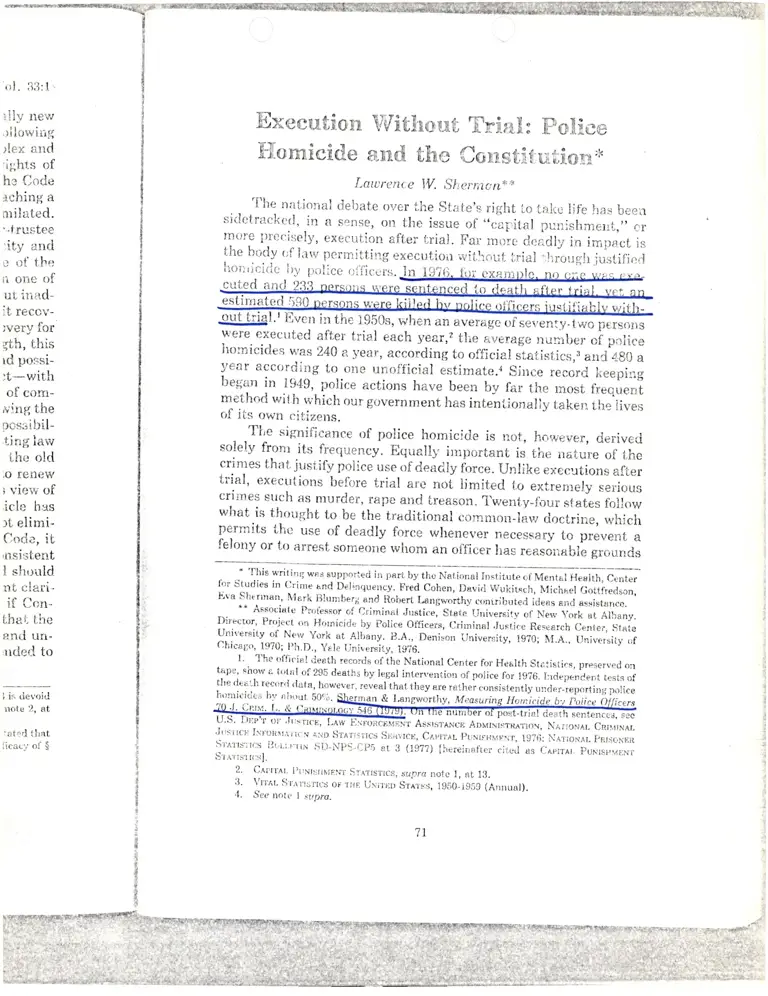
Execution Without Trial: Police
Homicide and the Constitution*
Lawrence W. Shermcn**
The national debate over the State’s right Lo take life lias been
sidetracked, in a sense, on the issue of “ capital punishment,” er
more precisely, execution after trial. Far more deadly in imnact is
the body of law permitting execution without trial dirough justified
iiouiiciae iiy police oiticcrs.Jn 1976. for examiale, no or.e v.'pr.
caled and WfT̂ ?<ihtepced to deatli after trial, vê . nn
^estimat^d >90j3£rsons were killed hv nolire otTirers iustifiahlv vaith.
,mit trial.' hven in the 1950s, when an average of seventy-t'wo persons
were executed after trial each year, ̂ the average number of police
homicides was 240 a year, according to official statistics,^ and 480 a
p a r according to one unofficial estimate.' Since record keeping
began in 1949, police actions have been by far the most frecuent
method with which our government has intentionally taken the'lives
of its own citizens.
The significance of police homicide is not, however, derived
solely from its frequency. Equally important is the nature of the
pmies that justify police use of deadly force. Unlike executions after
tiial, executions before trial are not limited to extremely serious
crimes such as murder, rape and treason. Twenty-four .states follow
what is thought to be the traditional common-law doctrine, which
permits the use of deadly force whenever necessary to prevent a
• elony or to arre.st someone whom an officer has reasonable grounds
supported in part by tho National Institute of Mental Health. Center
for studies in Crime and DeUnquency. Fred Cohen, David Wukitsch, Michael Gottfredson
Kva Mark Rhmiber,; and Robert Langworthy contributed ideas and assistance. ’
Criminal Justice, State University of New York ut .<\lbanv.
irector. Project on Homicide by Police Officers, Criminal .lustice Research Center State
University of New York at Albany. B .A ., Denison University, 1970; M .A ., University of
Cbicat'o, 19t0; Ph.D., Ytle University, 1976.
1. The official death records of tho National Center for Health Statistics, preserved on
tape snow t tola! of 295 deaths by legal intervention of police for 1976. Independent tests of
the death record ,luln, however, reveal that they are rather consistently under-reportiiu' nolice
& I.aiieworthy, Meamrini; Homicide by Poiice o kirfrx
u .s .
. C f;i,\!. I„
EH'.p’t Of ,Ii
CrtiMiN0i.nt;v ,A.
sricE, I.Aw F.n
.Il'SI ICF InKOHMVjU'N A.N'D StATISI
S'l'A'l■is; ICS Bm .i.i "iiN SD-NPS-C
2. CAriTAi, I’unishment .Srt
3. N'itai, S t.vnbncs of the
■1. See note 1 s'.ipra.
71
T'-' 'v.reitY';; Vj, "-"k-kk'-v'‘ ' "T ' k,.'."
' -■ - y ‘ . V' ■**•*-■ V ' 1- ■*' .* . -• . V. ;
■'i;' I 'i '
; 3,1 >AiKs?! (fe , I1 ;) :: f c : ! i I'I' ; ■! ’ i,'
’l l
■ ■ •■'•“H ‘ '3 ll-« ■ IJI
&v T
v:fl
■i
VANDERBILT LAW REVIEW IV ol. 33:71 1!)801
to believe has committed a felony*—any felony, including, in at
least one state, spitting on a policeman.® Eight states have adopted
the more restricted version of this common-law doctrine proposed
by the Model Penal Code;’ ten other states have adopted statutes
allowing police to use deadly force to arrest suspects ot “ violent or
“ forcible” felonies,* which in some states may include burglary.*
Even under these relatively recent restrictions, most police officers
are still legally empowered to shoot unarmed fleeing burglary sus
pects in the back.
The available evidence suggests that when the police do use
force, their targets are often suspects of less gprHn.s■deadly ..... t,v ------------------ -̂------ — -̂------
T^nrov;matelv Kalt' oi the people at wnom police shots were fired
t̂udipH h«ve not carrieu guns, anu the pi^-t^^
tion of those shot while fleeing is substantial.*' io be sure, many
5. Comment, Deadly Force to Arrest: Triggering Constitutional Review 11 Harv. C.R.-
C L L Rev. 361, 368 (1976); Note, Justifiable Use of Deadly Force by the Police: A Statutory
Survey, 12 Wm. & Mary L. Rev. 67 (1970). On the common law, see, e.g., 2 Kale’s P.C., 76-
6. Comment, Policeman’s Use of Deadly Force in Illinois, 48 Chi.-Kknt. L. Rev. 252,
252 (1971).
7. The Code provides, in part;
The use of deadly force is not justifiable under this Section unless:
(i) the arrest is for a felony; and
(ii) the person effecting the arrest is authorized to act as a peace officer or is
assisting a person whom he believes to be authorized to act as a peace officer;
fifi*) the actor believes that the force employed creates no substantial risk of
injury to innocent persons; and
(iv) the actor believes that: . ,
(1) the crime for which the arrest is made involved conduct mciudmg the
use or threatened use of deadly force; or
(2) there is a substantial risk that the person to be arrested will cause
death or serious bodily harm if his apprehension is delayed.
Model Pe.s'al Code, § 3.07(2)(b) (1962). ■ c r i t (
8. Sherman, Restricting the License to K ill-R ecen t Developments tn Police Use of
Deadly Force, 14 Crim. L. Bell. 577, 581 (19/8).
9. Comment, supra note 5, at .365 n..34. r , j ,
10 The following table is constructed from four empirical studies o* po'ice use of deadly
foice- (1) A study of the 32 persons killed by Philadelphia police officers in 19,50-1960^See
Robin, Justifiable Homicides by Police, 54 ,1. Crim. L.C. & P.S. 225 ^963). (- A study of
911 police killings reported in newspapeis around the country in 1965-69. S^e li ljVler, ĵ r e s
Jand in the Unitec.
' L ' l r a anTl9T4^inE!r^^ California; Portland, Oregon; Kansas
. . .T 1 __.,4 o I /\T 1 U / 4for IVIO ana ly/** m ..... --------------- r ' . ̂ n r
City, Missouri; Indianapolis, Indiana; and Washington, D .C ., and m Oetroit for all of 1973
and part of 1974, on 320 police firearms discharges in which a nullet wounded or killed
someone. .See C. M ilton. J. Hai.i.eck. ,). L aP.DNer- C. AhreCHT. Pnnrt IKl- ok Pl-APliY FORO^
H9771 fhereinaftcr cited as C. M ilton). (4) A study of 5,111 incidents in which Kew York
CRv Police UepdVLfflt'hl ollicers discharged their weapons, regardless of impact, during 1971-
1975 See .1 Fyfe Shots Fired: A Tyoological Examination of New York City Police hirearms
Discharges (1978) (unpublished Ph.D. dissertation, School of Criminal .Ju.stice, Stale Univer
sity cf New York at Albany).
pollCO
precisi
that 1
agamf
A
rule t
law a
clivig
and b
impni
Event
Distill
Far
Dis
Fig
A.ss
Robla
I Ii
Pu
Buv;:
III
Ll!
Pu
Traf
Pii
Vr
Offi>
Busi
Di
lb
Stal
Otlii
iding, in at
ive adopted
le proposed
ed statutes
‘violent” or
> burglary.*
lice officers
irglary sus-
lice do use
IS crimes.
were fired
he propor-
ure, many
1 H arv. C .R .-
: A Statutory
LE’s P .C., 76-
L. Rev. 252,
[V o l . 33:71
r or 13
fficer;
isk of
I’.e
jlice Use of
36 of deadly
1-1960. See
A study of
•r, Figures
'iS-1969, 31
ooled data
30; Kansas
all of 1973
i or killed
dly Force
New York
iring 1971-
3 Firearms
te Univer-
1980] POLICE HOMICIDE 73
police homicides occur in defense of life, although the data are not
precise enough to determine how many. There is no doubt, however,
that many executions without trial occur in response to crimes
again.st property without any defense justification.
A review' of the legal history of police homicide shows that the
rule that any felony warrants the use of deadly force is a common
law anachronism to which our courts and legislatures continue to
cling long after the Crown Courts have treated the doctrine as dead
and Parliament has laid it to rest through criminal law reform. More
important, an analysis of the constitutional status of the any-felony
rule shows that it should be held to violate the due process clause
E vents Preceding Police U se of D eadly Force
Flvent T ype
Robin, 1963
(N = 32)
S T U D Y F U N D IN G S ’’
Kobler, 1975b M ilton, et al, 1977 F yfe , 1978
(N = 911) (N = 320) ' ( N z z k l l l )
'/r
Di.sturbance C a lls :
F am ily Q uarrels
Disturbed Persons
F ights
A ssau lts
“ M an with a g u n ”
R ob bery:
In Progress
P ursuit o f Suspect
B u rg lary ;
In Pi ogress
I.arceny
T am p erin g with A uto
Pursuit o f Suspects
T ra ffic O ffe n se s :
Pursuits
Veliiclo Stops
O fficer Personal
B usiness:
Dispute
H orseplay
Accident
Stakeout/Dfccoy
Other
Rank
( 2 ) 17
Rank
( 1)
28 (3 )
.1 ( ( I )
(4)
20 (3 )
( 2 )
30”'* (1)
0 (5) (5)
’̂■‘ Percentages m ay not total 100 due to rounding
’’ •■ Includes other m isdem eanors not listed above
32
4
11
Rank
( 1 )
21 ( 2 )
20 (3 )
8 (5 )
4 (6 .5 )
(6 .5 )
(I)
25
Rank
( 2 )
39 (1 )
(4 )
12 (3)
7
6 (5)
i# '̂1
• ' » , I ; ;
I
■' '‘} ^ i Hi;;
'> • -• • "^ ^ 1 1
IT-'̂
4̂-m r-;; ,i
m
W.
’ j.i ii
i f e - s ^ a m
' ' ■■■' ‘ : i "Ilf j
, '• . J • «<̂ !'■
;H '.M 'Hi!' d 't’ i* •*'-■*1 ■ T( 1J
•? ii1
ŷ\ ■ . '■;•'•; !
.i‘'i ‘ ■ . '.'•'̂ !••• '{hi
■ - . . - • l K ' : i
k:i.
il'f
J <\-v ■‘v V >-V\4 ■ ]'
.a •' ’ ;'*> ':> . ' >' ’’V':. ■rv.̂ r̂
74
VANDERBILT LAW REVIEW [V o l. 33:71
that only the dcfanae-of-lifc doctnna . appropn-
ate to govern police use of deadly force.
1. T he Any-Felony R ule; A n H istokic Anachronism
ThP oririnal meaning of the c o m m o n - k .v v justification for horai-
meaamg. A .T . arose at a time when (U
a i i ^ S n e weapons avanable^^^^co^
kill at any distance, (2) t_he h anT(3)
" “ i ; : ’’L T e t " - i t n X r a n d c ry ;, during the
e a r ,y \ t r r „ ? t h e a „ y . r e . o n y r u , e w a ^
r ' i l i l r C d t 'j ^ u t r l t S d the crosshow to lords
--------------------- -------------■:------ T T ^ -------T 7 u r Z , , r 7 ~ K o M ^ ^ fou"d SOS'c of those shot by
11 . Of the studies cited 25% to have been coini.letely unarmed,
the police to have earned &n ■ ■ unarmed. Fyte, at lV-30,
^ t u d y . 46 S. Cal L. W.v z»a, defense-of-life standard, only 40% of the
Kobier. at iil5, also IdiltUl ! lUH, „f ,„«pects in Right or to
killings would f «t 279, found that 71.5% of the poUce firearms
prevent a nonviolent crime. In cent . - ^ life, „ finding consistent witli
incidents in his New Yora samp e «.ere^ Henartment Other cities arc quite different. A study
the tradition of relative restraint in tha^ i - approximately 45% of those
of Philadelphia police use ot deadly fome of the incidents the
i^SLg i r r b r ; ; :^ ^ a î r ; . . e d . s
” ■“ , ? " S l ' . l ‘ w °B r .™ ,T O «r . C o , , 80 HOT) (dtio8 W » S „ r « s „ o o . , T « . « .
" '" '“5 ,"'ll''S»k 'T» iWlOT, « 16 HOT).
fSHT ,
33:71
merit
)f the
. lines
ropri-
homi-
jrrent
before
en (1)
could
ily the
nd (3)
it offi-
of the
s, and
rig the
nives,
iduced
0 lords
shot by
nnrtned.
It lV-30,
iy found
lo tiave
mpirical
1% of the
•lit or to
firearms
,ent with
. A study
of those
lenta the
initment
re neeing
, 1019-20
T hkatise
1 robbers,
.0 join in
19801 POLICE HOMICIDE
, 1 16 bTpnrv VIII allowed noblemen and vreaithy
and large nuisket of Shakespeare’s time
p T mak" an e emy thoughtless enougli to stand farther than coula nor ’^̂ ach ai u y i.ap- London street brawl in
eighty or ninety ̂b^^d of constables, none
the reign of Henry VIII was ^ used in
of whom wero “" " f ” ^ " ‘'“P,„ol„,ical context, then, thehand to hand ;nnnhat la Una
practical mean.ng of . d ̂ A rtrugele, bnl it did
“ f m ^ n t r t V ; : 7 ; : S f S ^Ued hom a distance behind while
’ ’'‘’^ T a t nL"ning'changed in the nineteenth century with the in
vention of the revolver. Police officers ” '"^ e "^efor’e'Ihe
rv < ^ “ i : f a r w : 0 : « a n t o c a r r y r e ^
r.ak used re''olvers to shoot and kill their colleagues. ^
“ ' t h : „ s i L of army revolvers on
and did, shoot fleelne suspects who were posing no rramedmle threat
* ° of the revnlntinn in vgmon.y
exoaosion in the sc o i«c n e J g | ! ^ ^
-Tgggg^ n r l e r the
" ' r -
16.
17.
18.
19.
20 .
L. K F N N E T rirX A ndekson, T he G un in A merica 22 (1975).
r ' S he? hii.i., T he S atuhuay N ight S pecial 4 (1973).
.0. k k ™
04 (19G7); J. R ichaiideon, T u ’E N ew Y ork ^
U.oorht lh« me d re«olv„. ® ̂ Bisckstou. nols.l, "The Me" o<
“ . Vr ..d „ i , h , x ^ . , i ^
’ 7 ™ . s u.s°m s» -« < ™
;
VI .'
jj: '■ >
;» { }'■ ••;'
f
\ :.]•V: ; li
1
l i ; :?
i ^ ' i'l
h.; ‘
r ii
U
i!'
!*?• :i‘‘
% :■!'
’fl-1
. f ' •
76 \//V Nn K H BI I/r ]. A VV R E VIK VV
These chaa;,:es in the legal context of police homicide signilicantly
altered the meaning of the common-law any-felony doctrine
rreatlv expanded the number of situations in which thechanges ir
pn1i(-e CQpId kill wit.liout Inal
in prnnnrtion betw'een th<̂ ^ ŷpnt.y.
nnfl they cre-^"^ n rliffrrence
j if tha pnrt 1rinl
^pveritv of th ̂ penalty for nttfinnling to .>»a;arP auiasf-
While advances in weapon technology and changes in the crimi
nal law were expanding the scope and potency of the any-felony
rule, one of the primary reasons for its existence was fading. By the
late nineteenth century, the rise of bureaucratic police agencies with
the capacity to communicate information about suspects at large
was undermining the necessity for the use of deadly force m the
apprehension of felons. The escaping suspect of eleventh-century
England might establish a new life in another community with little
fear of eventual capture, and the^sacir^goal of retribution was thus
easily frustrated by a fleeing felon. By the eighteenth century, how
ever Justice'F i e r d i n g waTcrrculatbig descriptions of wanted crimi-
nals’outside of London,^" and by the early twentieth century Ameri
can detectives consulted their colleagues in other cities about var
ious thieves and their whereabouts.^’ The effect of the increasingly
sophisticated apprehension techniiiues meant that it was no longer
absolutely necessary to kill a suspect, if his identity were known, in
order to insure his eventual capture.
These changes in the scope and im.pact of the any-felony doc
trine did not escape public notice and criticism. ^ /Vew Ygrl ̂
. 1 * __ j ___ 4̂̂ TinUrfi cVinntinnc there.
sible future in wbi-'̂ i'* ■ ---------- , , n
~ i n his beat, with comolpi c newer of life.and death over SUarch, witnin nis ueat., witn vi ■....it-tf - —-------
wilhin bis ramro. and armed with revolvers to execute
on the instant, wiihout even the forms of trial or
luirt a Tiimre Itiat, to a ''pT’' oxtrnt has iie.t,------------------
^ liese changes did not escape tlie notice of the courts. As early
213.
27.
(1937).
28.
29.
P . P kINGLE, HUK AND C hY 133 (IGb.D. , r . tj c 1 1 119
T hk Pkofkssiona). T hief, iiy a Phofee.sional T hief (E .H . buthsr.and, fid.) 11
Quoted in L. Ki'..NNErr & J. Anderson, supra note 1.5, at loO.
Quoted in M ii.i.ek, supra note 21, at 146.
as 1888 th
inflation o'
tion of hii
property.”
deadly fon
f o r c e .Sê
law standi
noted, “ re
cases on t
meanor.” ‘
Mean
abandonei
bend feloj
test empk
The circt
the previ
only in t
serious V
means ni
to preuei
This prin
Criminal
common
vent criin
which it :
original (
East revc
right to k
such a K
reported
kill all ft
the restn
it;” and
would h;
30. t-t
31. £•
'I’ enri. 720 f
32. l’«
33. Hi
I.,A1VS OF F.>
nrevent Pi!,;
formulat'.or
L J. (.^u-tr
34. Q
33. tc
■ 'A.'Mk. •Aruj5t.-?V!«s»h' ̂ -!■ ., p ̂ 1,. • - ‘.A. __.'V
-VV'
:i:71
intly
The
the
ence
I the
imi-
lony
r the
with
arge
the
tury
ittle
thus
lOW-
•imi-
aeri-
var-
n g iy
nger
n, in
doc-
York
lere,
lysis
1 his
)ect,
iwift
ther
pos-
[lon-
r all
:rees
'any
>arly
) 112
1980] POLICE HOMICIDE i I
as 1888 the Supreme Court of Alabama, observing the legislative
inflation of crimes to felony status, pronounced that “ the preserva
tion of human life is of more importance than the protection of
property.” The court restricted the common-law rule by disallowing
deadly force in the prevention of secret felonies not accompanied by
force. '̂’ Several other decisions grappled v îth the obsolete common-
law standard,^' but generally the courts were, as one commentator
noted, “ reluctant to abandon a convenient pigeon-hole disposal of
cases on the basis of whether the crime was a felony or a misde
meanor.” '̂*
Meanwhile, the English common law had already effectively
abandoned the absolute right to kill to prevent felonies or appre
hend felons. It replaced the any-felony doctrine with a balancing
test emphasizing necessity and proportion:
The circumstances in which it can be considered reasonable to kill another in
the prevention of crime must be of an extreme kind; they could probably arise
only in the case of an attack again.st a person which is likely to cause death or
serious bodily injury and where killing the attacker is the only practicable
means of preventing the harm. It cannot be reasonable to kill another merely
to prevent a crime, which is directed only against property.
This principle was so well established in case law that by 1879 the
Criminal Code Rill Commission took it as a “ great principle of the
common law” that the “ mischief done by [the use of force to pre
vent crimes should not be] disproportioned to the injury or mischief
which it is intended to prevent.” ^̂ Moreover, a close reading of the
original common-law codifiers Foster, Blackstone, Hawkins, and
East reveals so many internal contradictions and exceptions to the
right to kill all felons ’̂ that one may question whether there ever was
such a rule. Thus, in 1965 the Criminal Law Revision Committee
reported to Parliament that despite “ old authority” for the right to
kill all felons, “ the matter is very obscure; . . . owing no doubt to
the restraint of the police there is a dearth of modern authority on
it;” and concluded that their central proposal to reclassify crimes
would have no effect on police powers since “ the likelihood that
so. Storey v. Stale, 71 Ala. 329, 340 (1882) (involving the theft of a horse).
31. E g., United States v. Clark, 31 F. 710, 713 (8th Cir. 1887); Reneau v. State, 70
'I'enn. 720 (1879). -----------------------------
32. Pearson. The Rieht tn Kill in Mahine Arre.sts. 28 M ich t. Rvw ova no'in)^
33. Regina v. McKay [1957] V.R. ,560, 572-73 (Smith, J., dissenting); 11 Halsbl'Ry’s
Laws of ILnoland § H 79 (4th ed. 197C) (emphasis added). The question of deadly force to
prevent flight is either implied in this formulation, or so far beyond the pale th.st the current
formulations make no mention of it. See also Lanham, Killing the Fleeing Offender, 1 Grim.
L.J. (Australia) 16, 17-18 (1977).
34. Quoted in Regina v. McKay, [1957] V.R. 560, 572-73 (Smith, J., dissenting).
35. Id. at 572.
• ' - ■• •-• '»- ■■ . ■*•' ̂.•.ri-- . _■ ' • ■ ,*Ĵ'7 ‘ ̂•
■•» : ■ -.Vi-.'
yr:';:: ■ ] : W
"':■* i!il!
:;ii
.;i!l
}
■* ;,i!!|
•1 '•''Jli'' i I'>Z !̂|i1 ;; Ife
f - { !=.f
H
ill
"..K .' '̂ ■ i'
i ‘‘ ' i '
'''■ 4 ^-,1
’■r-' ■ :i;i, ; f . i;
78 VANDERBILT LAW REVIEW IVol. 33:71
anything would turn nowadays on the distinction between felony
,T .fh“ ry: S e v ? ' t h e ’ use of the distinction rentained
anything but As t^ e .^ y as M
I r ^ X Trf tlennV frnm a harflw iir-tcic7
"TTothig tha“ ‘‘the iSgisiativc bodies have a '7
enacting laws to protect their own citizens against lelons ^
the statute “ merely embodied the
force for centuries and has been universally recognized (some
th^g that we have seen is clearly not the case m English comrnon
law) the court rejected a broad constitutional challenge to the stat-
utl An a?gumen^ that the statute violated the eighth amendment s
ban on cruel and — f ” " S a : the
Itatute violated due^proccss protections was rejected on the erou"ds
'that state interests served by P »«“
*u inr îvirliial’s right to trial before being killed by police.
WhUe“ recogni7dng that the Eighth Circuit had recently hisW Ibat a
M ar Missouri statute did violate fifth and
have been fired upon or shot by Memplns police. The Su
" ''™ h ?S ix\ h ltc^ ,irt1 u ^ ^ ^ ^ treatment of the threshold issue of
amendment arguments that all present police homicide statu
—-------------------- - " "Z ~ OY-.i.nvicrij FkI ONJKS AND M iSOEm EANOURSCriminal U w Rfaision Commitfee, Seventh Rei ouT^t .
18 P akliamkntary P arers (House of Commons and o', ,, o g22
W ilTv, Memphis Police Dep’t. 548 F.2d 1247 (6th Cir.), cert, demed 434 U.S.
Id. at 1252.
Id. at 1251.
Mattis v.'sehnarr, 547 t.Zd (6th Cir.), cert, denied 434
Wiley V. Memphis Police Dep’t, o48 r.2d 1247, 1252 5,i (btn
(1977).
Wiley V. Memphis Police Dep’t, 434 U .S. 822 (1977).
______.mil .■.nil -T -̂-T—
i. - liSa,— ̂ > .— - " . _
19801
and cas
ling.
A.
l^h
jurispn
tic phi
with di
or the
in Bell
to be c
that c(
ion of
tions f
consti
impos
incide
a sho
contii
purpe
assig!
alter
Mem
ject)
Men
time
41
4
( 1)
(2)
(3)
(4)
(51
ag
H. H
tion
istic
agai
Of T
.-.R a. • -
o l. H.'3:7l
■n felony
emained
upheld a
ad killed
e store.
terest in
and that
' been in
** (some-
common
the stat-
dment’s
grounds
that the
grovinds
iportant
police.'"’
d that a
mdment
decision
Circuit
n of the
ig felons
Fhe Su-
issue of
s hardly
irt stan-
n police
3 eighth
statutes
MKANOI.'RS
I U .S. 822
enied 434
1980] POLICE HOMICIDE
and case law arc constitutionally unsound are much more compel-
ling.
II. CoNSITfUTJONAL AnaI.YSIS
A. The Charactprizatiun of Police Homicide as Punishment
The often elusi've definition of punishment in philosophy and
jurisprudence has been a major obsession with the English linguis
tic philosophers of this century.” "’ The definitions vary sharply,
with distinctions focusing upon the intent of the putative punisher,'
or the purpose ot inllicting pain or suffering.-"’ As the recent ruling
in Bell V. Wolfish* ̂ reveals, the i.ssue of intent has likewise proved
to be divisive in the Supreme Court’s efforts to define deprivations
that constitute punishment. Justice Rehne^uist, delivering the opin
ion of the Court, held that in determining whether particular condi
tions accompanying pretrial detention amount to punishment in the
constitutional sense a “ court must decide whether the disability is
imposed for the purpose of punishment or whether it is but an
incident of some other legitimate governmental purpose.” ■'* “ Absent
a showing of an expressed intent to punish,” Justice Rehnquist
continued, “ that determination will turn on ‘whether an alternative
purpose to which [the restriction] may rationally be connected is
assignable for it, and whether it appears excessive in relation to the
alternative purpose assigned [to it],’ (quoting Kennedy u.
Mendoza-Martinez,-'’' apparently as the controlling case on the sub
ject). Justice Stevens, however, pointed out in his dissent that the
Mendoza Court also recognized that evidence of intent would some
times be “ unavailable or untrustworthy.” ” “ In such cases,” Justice
45. G. N kwman, T he I’ u.ni.shment Response 7 (1978).
46. Professor Hart, for example, suggests five defining characteristics of punishment:
(1) It must involve pain or other consequences normally considered unpleasant
(2) It must be for an offense against legal rules
(S) It must be imposed on an actual or supposed offender for his offense
(4) It must be intentionally administered by human beings other than the offender
(5) It must be imposed and administered by an authority constituted by a legal system
against which the offense is committed.
H. H aht, PUNI.SHMENT A.NU R espon.sihii.ity 4, 5 (1968).
Professor Paeker, in contrast, finds that definition insufficiently clear as to the distinc
tion between the purposes and effects of punishment, and proposes a sixth defining character
istic of punishment; "It must he imposed for the dominant purpose of preventing offense
against legal rules or of exacting retribution from offenders, or both.” H. Packer, T he Limits
OF THE Criminal .Sanction 21-23, 31 (1969).
47. 99 S. Ct. 1861 (1979).
id. at 1873.
Id. at 1873-74.
372 U.S. 144 (1963).
99 S. Ct. at 1899.
48.
49.
.60.
51.
jr- v;. j*' y7:, ■
^’v.'-.J Uk-''!
■■k--4 llvliii
et !;!
|;;v>».'>'■
- li
. . .
. -j
!i;r;
'•;.'l
■4
•; ■!|
80 VANDERBILT LAW REVIEV^ IVoi. 33:71
Stevens said “ the \M^ndoza\ Court stated that certain other
Wheria’ inust be applied ‘to the face’ of the official action to oeter-
inine if it is punitive.” -̂' Even Justice Rehnquist, whose opinion m
Bell V WolfNh reveals a very restrictive conception of what consti-
S L p 'm lin en t, cited the seven Mendocn en ter.
AHhouLdi he did not, as Justice Marshall pointed out, ^ake mu
CO o n Item he nonetheless refers to them as useml gmdeposts m
determining’ ’ what is punishment, calling them “ the tests tradRion-
ally applied to determine whether a governmental act is punitive in
""^'"with the original intent of the Gothic chieftains in establishing
the kill-to-arrest rule lost in history, and determination of the
subiective intent of police officers acting within the rule vulnerable
to “ hypoL sy and unconscious self-deception.” - it necessary to
urn to ^ e criteria used in Mendoza and apply them “ to the lace
„7poUce homicide to determine whether that action const.tutes
punishment. The decision offered seven criteria.
l 3 ! r ! ; " r ‘‘h r s ; . t o i ’'-n h r ^ ^ ^ ^
con eeced
fcrw h eltM ^ ap i^ rf excessive in rel.lion to the el.em.tivc purpose » -
signed. .
The Mendoza Court noted that all of these criteria are relevant to
?he inoiiry alihough they “ may often point in differing direc
tions ” ” All seven criteria, however, suggest that polite homici
constitutes punishment, as is clear when each criterion -
(1) Whether the sanction inuolaes an affirmatwe
rcsiroint Recent pronouncements by the Court leave no doubt that
T e s lc t io n oTpohee homicide constitutes “ an affirmative disabil
ity or restraint.” It is not only a deprivation of rights, but a depric a
lion of “ the right to have rights,” " not “
“ unique” sanction. As Justice Brennan stated, ' [i)n a society tl
s o r o n g ly affirms the sanctity of life, . . . the common view is that
52.
53.
,54,
55.
,56.
.57.
58.
Id.
Id. at 1887 (Marshall, J., dissenting).
M. t i I 'S '(S tev en s , ,1., dissenting); H, Packer, snpra note 45, at 33.
372 U.S. at 168-69.
" n l n V. Georgia, 408 U .S. 238, 290 (1972) (Brennan, J., concurring).
KesaBR
I
1980;
death
have
mciit
stalei
ent ii
defy
citiz(
actie
and
wha
The
tria
pun
cry,
m a
file
v.’if
im
He
of
wl
th
re
re
f.:
jc
0
c
V
. 33:71
. other
deter-
lion in
consti-
vringly.
ke full
osts in
dition-
tive in
iibhing
of the
erable
■ary to
: face”
Litutes
lish-
cted
as-
ant to
direc-
nicide
lined.
iity or
it that
isabil-
priva-
but a
y that
s that
1980! POLICE HOMICIDE 81
death is the ultimate sanction.” ''̂ Five members of the present Court
have “ expressly recognized that death is a diiferent kind ol punish
ment from any other which may be imposed in this country” and
stated that “ [flrom the point of view of the defendant, it is differ
ent in both its severity and finality. From the point of view of so
ciety, the action of the sovereign in taking the life of one of its
citizens also differs dramatically from any other legitimate state
action.” ''''’ The right to life has consistently been held fundamental
and preeminent."' Its deprivation has the same eitect no matter
what the expressed purpose may be.
(2) Whether it has historically been regarded as punishment.
The historical record clearly demonstrates that executions v/ithout
trial, including the kill-to-arrest doctrine, were generally viewed as
punishment. Thieves were often killed outright during the hue and
cry, even after they had been captured. “ Let all go forth where God
may direct them to go,” urged the tenth-century laws of Edgar; “ Let
them do justice on the thief.” "̂ Suspicion sufficed to convict thieves
without any trial at all, and “ execution in such cases often followed
immediately on arrest.” "'’ According to the preamble to Act 24 of
Henry VIII, it appears that the common law authorized the victims
of crimes and attempted crimes to kill the criminal, regardless of
whether it was necessary to prevent the felony." ̂In the twelfth and
thirteenth centuries “ outlaws could be beheaded by anyone, and a
reward was paid for their heads under Richard I.” "’ Abjurors of the
realm (felons who had escaped into religious sanctuary and agreed
to leave the country forever) who strayed from the highway on their
journey to the sea could also be beheaded by anyone."" In the context
of the times in which the kill-to-arrest doctrine evolved, it was
clearly linked to a philosophy of summary justice that can only be
viewed as punishment.
Modern commentators have taken the same view of the histori
cal status of the doctrine. Professor Perkins notes that “ as the felon
had forfeited his life by the perpetration of his crime, it was quite
59.
60.
61.
(1945):
(1886);
62.
63.
(1973).
64.
65.
GO.
Id. at 286.
Gardner v. Florida, 430 U .S. 349, 3.57-58 (1977) (Stevens, J., concurring).
Roe V. Wade, 410 U .S. 113, 157 (1973); Screws v. United States, 325 U .S. 91, 123
-Johnson v. Zerhst, 304 U.S. 458, 463 (1938); Yick Wo v. Hopkins, 118 U .S. 356, 370
Mattis V. Schnarr, 547 F.2d 1007, 1018 (1976).
Quoted in T . Chitchley, A History of Poucf, in England and W ales (2d ed. 1972).
J. Bellamy, Crime and Flelic Order in England in the Later M iddle Ages 134
Cited in Regina v. McKay, [1957] V.R. 560, 571-72 (Smith, J.
R. Huntsett, T he M edieval Coroner 67 (1961).
Id. at 49.
dissenting).
P I
vjl '
.̂.\\ * •‘ •'.‘■I
h'4. §
5i;
. * r '̂. M
• !
i MMI
V ■!
PV.H
■• 1 i
'■y'i ■■ '\ \- ^ i :■!
■ ' 0 i t's i
ti i
■ ■-■-v'̂ ̂ ? ;'i‘ \ i .1!
V A N D E R B I L T L A \V R E V I E W
[V o l. 33:71
OZ '
f i^orilv force Another commentator
logical to authorize the ubc o < _ ̂ extirpation [asj hut a pre-
on killioB neoing felons descnbed U.e exUtp
mature execution <>P,’’ ^ '''® ^ w u h the passing of that era, proma-
punishment for all felonies. „vere than the '‘ inevitable judg-
lure execution is of “ ' 7 = ' = T o L punishment,
ment.” The ^ f ^ ^ 0 10 disproportion between
however, is not airereu
pretrial and post Anal on n 0/ scienter. The
(3) Wdref/ier It comes mtop/ay ^̂ ‘^scienter” criterion
basis and parameters of the M support the relevance of
are unclear. Of the two in fact holds that
scienter to a punishment ̂regardless of scienter, appar-
penalties may constitute ^as cited. The holding
ently Î ny fine imposed on an import
stated that, regardless o .Up value of certain goods was still
merchant for underestimating th ^ J Mendoza
punishment and nothing els • ^on from a federal child
only mentions in passing r know that their workers are
labor “ lax” of e -P o^.^s who court in that
underage suggests that t associated with penalties, not with
irxea” - n' I iS cL actuali; holds that punishment is o.dy rm-
— - r s
Court has held that the general Regardless
scienter was a necessary e proceed from it to infer that
of criticisms of this usage, y someone is a felon
when an officer finds for killing him, the offiĉ er
and thus has met a requis T o , officer does not have probable
finds .scienter at the same tun . ̂ „ he does not have
cause to believe tl^ t̂ scienter is P ^
probable cause t« therefore historically presumes
S r ; a ^ " h e r - n t meaning of this Mendoza crite
rion of punishment. nromote traditional aims of pun-
67.
68 .
69.
70.
71.
72.
73.
SBssa^Ks™"-''”
E£e-E.’ “H :"See, e g., H- PtHKiNS, supra note 23, at 7 / .
582, 583 (1929).
19801
motes K
ment” i
Schnarr
any-fel
“ [t]her‘
to esca
“ conset
w:
proniol
may hi
eviden
tion is
feiv .sa
only 1
police
that 1
can 1
from
ment
pot.hi
Man
uphe
felor
on 0
cide
All
crlr
is.
ordt
to a
hiiv
ent
(19
11.3
tni
oil
cr
(S
ze
p:
1. 33:71
entator
L a pre-
capital
prema
le judg-
hment,
)etween
:er. The
riterion
ance of
ids that
appar-
holding
import
as “ still
tendoza
al child
leers are
; in that
lot with
inly im-
upreme
'as that
?ardless
fer that
a I'elon
e officer
irobable
ot have
g is not
resumes
za crite-
! of pun-
-dy pro-
'‘4
19801 POLICE HOMICIDE
m £
motes retribution, the first of the two “ traditional ainis
ment” named by the Mendoza Court. As the dissent in Mattie v.
Schnarr a recent Eighth Circuit decision, argued in suppoit ot the
miy-felony rule, which the court had found unconstitutional
‘4t]here is no constitutional right to commit felonious otfemses and
to escape the consequences of those offenses.^ ̂ In that contex ,
“ consequences” strongly implies “ just desserts, or
Whether police homicide, or indeed any punishment, actua, y
promotes deterrence, the second of the two traditional aims named
may be an impossible question to ansever.’ - If undisputed empirical
eviLnee of a deterrent effect is required to evaluate whether a sanc
tion is a punishment, then many social scientists would argue that
few sanctions qualify. If, on the other hand, a
only be hypothesized for the sanction to be a punishment then
poUce honLide passes the test. The assumption by legal scholars
Uiat police homicide has a deterrent effect is ^Aected in the Amen-
can Law Institute’s debates over the issue. The deterrence o ig
from arrest- and the deterrence of robbery- were both specitically
mentioned, albeit with differences of opinion. The ueterrence y
pothesis is also implied in recent federal cases, such as Jones u
Ifarshall/^ a Second Circuit opinion in which a three judge panel
upheld Connecticut’s common law permitting police to kill ileeing
felons observing that the states had the right to place a nigher value
on order than on the rights of suspects. The only way such a homi
cide could achieve order is through deterrence. ^
(5) Whether the behavior to which it applies is alreaay a crime.
All of the behavior to which police homicide applies is Îread̂ y a
crime or the officer rnust reasonably believe it to be a crime. I e
L, however, some question about i M c n m e p ^ ^ ^ ^
74. 547 F.2d 1007, 1023 (8tli Cir. 1976).
75. J. G .hhs, Ckimk, Punishment „ „e s t for all offenses in
76. Professor Waite argued for exten n g ‘You are foolish . . if you submit
order to deter flight, for otherwise “ we outrun him, outrun
to arrest. The officer dare not take God bless you.' I feel
him and you are safe. . . . If you are fas cnminnl.” 9 ALI Procekoings 195
" " T l u . , . U . ™ . H .,.d once —
that if you are able to shoot ® ^ ™ i a 'p o s s i b i figures at all in the commission of
prohlern of justification to use deadly force in general. Id. at 1015 n,17.
78. 528 F.2d 132, 142 (2d Cir. 1975).
¥
r
i ' i ’ ,
V'
■i' -
,' .;l
u
M
1
r\
r. i
1 » Jjt
i 1
r l
t i ;hi
hi
4 ! ■ W'
• i’l*.■ i
I’ i . J (
i
■!:
rfe
. t,
1
[ i*.*- i
h
ib
'!̂ i
1̂ I
84 VANDERBILT I.AW REVIEW I Veil. H.'V.Tl
punish)n{^ As Prolessor Mikell asked in his often quoted statejiient
to the American Law Institute:
l̂-ay I ask wliat we arc killing iUu> suspect | for when he steals an automobile
and runs oft with it? Are we killing him for stealing the automobile? . . . It
cannot be . . . that we allow the officer to kill him because he stole the
autoniobilc, because t he statute provides only three years in a penitentiary for
that. Is it then . . . for fleeing that we kill him? Fleeing from arrest . . . is
punishable by a light penalty, a penalty much less than tliat for stealing the
automobile. If we are not killing him for stealing the automobile and not killing
nim for Deeinj ,̂ wliat are we killing him for?'*'
No matter how little .sense it makes in relation to the post-trial
Itenalty, we are in fact killing the auto thief for the volatile combina
tion ot felony and llight, both of which are crimes.
(6) VVhether an alternatiue purpose to which it may rationally
be connected is assignable for it. The purposes of capture and crime
prevention, rather than punishment, may no doubt be rationally
connected to police homicide as alternatives to the purpose of pun
ishment. Just as the Wolfish Court held that overcrowding and
other disabilities im.posed on pretrial detainees in a federal jail did
not constitute punishment because they were merely an “ inherent
incident of the objective of insuring detainee’s presence at trial,**'’
it could be argued that death is merely an inherent incident to
insuring that felony suspects are captured and that felonies are
prevented. By this logic, death from police homicide is not a punish
ment if the expressed intent of the officers using deadly force is to
apprehend felony suspects.
An equally strong case, however, could be made that the pres
ence of multiple purposes in a governmental action does not auto
matically grant preeminence to the non-punitive purpose. One pur
pose of prison systems in some states is the manufacture of license
plates, but a penitentiary sentence could hardly be described as
merely an inhe’-ent incident of a legitimate state interest in manu
facturing license plates. Implicit in the Wolfish Court’s reasoning is
a judgment about the primary purpose of any governmental action
that has more than one purpose. Punishment rather than apprehen
sion can be judged the primary purpose of police homicide. As one
court once noted, “ ftjhe reason for . . . killing felons . . . in at
tempts to arrest them . . . is obvious . . . . [T]he safety and secu
rity of society require the speedy arrest and punishment of a
felon.” **'
79. A U P kockf.dings, 186-87, quoted in J. M ichafi. & H .\ vhch.sleh, supra note 76
SO. 99 ,S. Ct. a( 1873.
p jsu
Unlike t'r
fiod bv the .--i.
ble alternativ
wliat ihe prii
if it appear:- i
be defined a?
in his Wolpsl
disparity bev
dem oust rat tc
must be jus;
(7) Whe.
purpose assif.
and the purj.
is both signii
tion to those
cause, once j
is far more '
Iiosed upon s
except mure
prevention c
than the ev
because mos
of preventio
sanction the
chicken*’ ca
sive.
Each o{
use of deadl
punishment
on the use '
ment, howe
process reci
though a n
the added £
that review
’nave been s
guaranties
82. 99 S .I
83. StoiC'v
84. H'jgir.j
8.8. Ingrah
,-X
_ ^
IVol. 3:5;71
d statejnent
automobile
•ile? . . . It
e stole the
tentiary for
rest . . . is
stealing the
1 not killing
le poRt-trial
le combina-
’.y rationally
G and crime
e rationally
pose of pun-
owding and
eral jail did
n “ inherent
ce at trial/"
incident to
felonies are
ot a punish-
y force is to
at the pres-
js itot auto-
ie. One pur-
re of license
escribed as
st in manu-
reasoning is
sntal action
n apprehen-
cide. As one
* • • . in at-
secu-
i i i i l
1980] POLICE HOMICIDE 85
Unlike the other Mendoza criteria, this one is explicitly quali-
fied by the .succeeding criterion, which questions ;
ble allcrnalive purpose to punishment “ P P ® f , 1 / '
what the primary purpose of police homicide is judged <■<>/»;
it it appears excessive in relation to a noiipunitive purpose it must
be defined as punishment. As Justice Stevens interprets Mendoza
in his Wolfish dissent, “ when there is a significant
disparity between the severity of the harm to the individual and the
demonstrated importance of the regulatory objective, . ^courts
must be iustified in drawing an inference of punishment
(7) m oth er it appears excessive in relation to the alternative
purpose assigned to it. The disparity between the death ot a suspect
and the purposes of prevention (of nonviolent crimes) and capture
is both significant and unnecessary, and therefore excessive in rela
tion to those purposes. It is significant in the case of capture be
cause once again, the means used to prevent the suspect s escape
is far’more severe than the maximum penalty that wouM be im
posed upon sentencing for all crimes (depending on the jurisdiction)
L S t L rd e r , treason, and rape. It is significant in the case of
prevention of nonviolent crimes because the evil imposed î s greater
than the evil prevented. It is unnecessary in the case of capture
because most suspects can eventually be recaptured, and in tlm case
of prevention because nonlethal intervention is usually possible. A
iT o n that takes a life to prevent the theft o -
chicken^ ̂ cannot, in a society that values life, be other than exces
sive.Each of the Mendoza criteria point to the conclusion that the
use of deadly force to capture felons and prevent felonies constitutes
"unlhm ent! and is therefore subject to the
on the use of punishment. Even if it were ruled not to be punish
ment however, it is still a deprivation of rights subject to the due
proce’ss requirements of the fifth and fourteenth amendments Al
though a ruling that police homicide constitutes punishment hets
the added advantage of subjecting it to eighth amendment review
that review is generally reached only after due process guaranties
have been satisfied.In the case of police homicide, the due process
guaranties are anything but satisfied.
82. 99 S. Ct. at 1899 (Stevens, J., dissenting).
83. Storey v. State, 71 Ala. 329, 341 (1882).
84 Hegina v. McKav. [19.9/] V.R. o60.
85'. Ingraha.n v. Wright, 430 U .S. 651, 671-72, n.40 (1977).
t e f .V. K -<■.!« A..
i
86 VANDERBILT LAW REVIEW |Vol. 36:71
B. Due Process Requirements
Although police homicide raises serious due process questions
if viewed merely as a deprivation of rights, when recognized as pun
ishment its apparent violation of due process guaranties is striking.
The framers “ intended to safeguard the i)eople of this country from
punishment without trial by duly constituted courts, and under
the due process clause, a detainee may not be punished prior to an
adjudication of guilt in accordance with due process of law.” ’'' The
limitation on imposing death, under the fifth amendment, is partic
ularly strict. It requires that “ fnlo person shall be held to an.swer
for a capital, or otherwise infamous crime unless on a presentment
or indictment of a grand jury.” Indeed, the Righth Circuit observed
that a literal reading of the due process clause would mean that life
could never be taken without a trial.” “ And that is preci.sely what
it should mean, with respect to life taken under the authority exer
cised on behalf of the State. A less rigid standard, however, must
be applied when deadly force is used by an individual in accordance
with the self-defense doctrine.'*'’ In addition to personal defense, this
doctrine includes the defense of. “ another person against what is
reasonably perceived as an immediate danger of death or grievous
bodily harm to that person from his assailant.
The Eighth Circuit, the only circuit to hold that the any-felony
rule violates the fourteenth amendment, finds this interpretation
too extreme. “ Such a literal reading,” it stated, would tail to recog
nize the interests of the state in protecting the lives and safety of
its citizens,” and therefore the court held that the situations in
which the State can take a life v/ithout according a trial to the
person whose life is taken are to be determined by balancing so
ciety’s interest in public safety against the right to life of an individ
ual.*’ Irrespective of their conclusion, the use of the balancing test
is a fundamentally flawed procedure for determining whether the
right to a form of due process specified in the Constitution is appli
cable. The fifth amendment does not depend upon a showing that
it is in the community’s best interests that the procedures be ac
corded.* ̂ As Professor Dworkin has observed, ‘a right against tne
United States v. I.ovett, 328 U .S. 303, 317 (1946).
99 S. Ct. at 1872.
Mattis V. Sclinarr,' 547 F.2d 1007, 1018-19 (8th Cir. 1976).
Brown v. United States, 256 U.S. 335 (1921).
40 A m . Jur. 2d Iloinidde §§ 170-71, quoted in Mattis v. Schnarr, 547 I'.2d 1007,
1015 (1976).
91. Mattis V. .Schnarr, 5 l7 F.2d 1007, 1019 (1976).
92. Note, .Snecifyinfl the I^ocedures Required by Due l^ocess: 1 awards Limits on Jte
Use of Interest llalancinf;, 88 H.Mtv. L. Rtw. 1510, ,524 (197.)).
86 .
87.
88 . .
89.
90.
19801
Government mu
ity would be wor
worse off whence
the felon’s fiftli
before he is exe
The balanc
mining how mi
process applies,
and the relative
action is argual
should lead rea:
of executions v,
ments specifica
law, so there is
when to allow c
balance the ind
to be deprived
state’s interest,
narrow interest
individuals. W
than jiroperly,
or recidivistic,
follow' that the
is not compelli
of trial.
The state'
individuals is,
priate for a b
threat of grie-
would lead to
the other pers
process of a fr
ing test proce
in defense of
as individuak
police can kill
93. Dworkin,
Serifs 19731, quoit
94. Morrispcs
Union v. McElroy,
95. Note, sii;
96. See note
97. .SVePn'l-'
98. Note, -s'ui
71
ns
in-
^?,-
) m
ier
an
’he
ic -
,vcr
ent
ved
life
hat
lier-
lust
inco
this
it is
/ous
lony
tion
cog-
ty of
IS in
) tlie
g so-
ivid-
f test
r the
ippli-
: that
le ac-
d the
:i 1007,
19801
POLICE HOMICIDE
87
Government roust be a right to do is no doubt
My »„u ld bo worse » « '* t^ n e s but that should not alter
worse off whenever a ^ prand jury review and trial
the felon’s fifth amendment right to gran j
before he is executed. nrevailing method of deter-
The balancing lest that due
mining how severity of individual deprivation
process applies.* ̂ ^ of covornmental interest in summary
and the relative even a balancing procedure
action is arguably a more restrictive scope
should lead reasonable men m d^ fourteenth amend-
of executions without ^fe without due process of
ments specifically process is due. The issue of
law, so there is no question tha P
when to allow executions without ^ « ^^^the right not
balance the individual’s undament̂ ^̂ ^̂ , , ,
to be deprived of life general public safety, but its
state’s interest, not just the L and lives of other specific
narrov/ interest portant
individuals. We have long no matter how serious
than property, and that no proi offenses. It should
or recidivist 1C, in protecting the property of others
S c r p : m n t : n o u p r : : t w T 'l e c u U o n w H h ^
O' ‘ " r t stale’s inletesUn "
individuals is however, far mer^ immediate
priate for a balancing test wn balancing test
threat of grievous injury ^ state’s interest in protecting
would lead to the without the due
the other person allows it however, to adopt the balanc-
process of a trial. It is no " ̂ ‘ ^hat police officers may kill
ing test fg'^.if.defense doctrine gives them that power
in defense of life. The sell deien the state. The
as individuals irrespective i ^^f^jeat o f violence without
police can kill those p o s m g ^ m e d ia t e ^ -------
on the
» _______ ______ _______ ̂ ̂ J
SenoVlS73), ..oo -a r s ^ 7 g 4^U1973); Cafeteria & Ueataurant Workers
96. S e m i t T e i dupm and g P 937); Comment, .upra note .9, at 378.
97. See Palko v. Connecticut 302 U .S. 319.
98. Note, supra note 92, at lo.i8-2y.
\
r
a- :
88 VANDERBILT LAW REVIEW [Vol. 33:71
violating the fifth amendment rights of those killed, just as any
citizen can. The legitimate concern some courts have shown with
police officer’s safety” can, accordingly, be satisfied without a
fleeing-felon or any-felony rule. If a fleeing felon whom the officer
reasonably believes to be armed turns toward the pursuing officer,
with reasonably apparent intent to shoot the officer, the officer may
kill him under the self-defense doctrine. The fleeing-felon rule in no
way increases the officer’s safety beyond the safeguard of the self-
defense rule.
If a balancing test is used, however, the final and most difficult
problem is to assess the state’s interest in insuring public safety. An
escaped felony suspect is certainly free to commit other crimes, but
that should not be a compelling justification for the use of deadly
force. A released convict who has served a full penitentiary sentence
may be equally likely to commit more crimes, but that justifies
neither his execution nor his incarceration beyond the end of his
sentence. Far more compelling is the deterrence argument that the
failure to kill fleeing felons will encourage more felonies. No empiri
cal attempt to evaluate this argument has been made to date, but
let us assume, arguendo, that each police homicide prevents eight,
or even eighty, robberies. Are we to measure the value of life in such
utilitarian terms? Is it a lesser evil that a life be lost than several
hundred or thousands of dollars be stolen? In a society that punishes
million dollar white collar frauds with a four month prison term,'”
it seems difficult to answer that question affirmatively.
Our primary concern, however, is with the Constitution, and
not with the greatest good for the greatest number. Even if a balanc
ing test determined that the state’s interest in maintaining public
safety allowed it to execute fleeing and in-progress felons without
trial under the due process requirements of the fifth and fourteenth
amendments, those executions could still be ruled unconstitutional
as either cruel and unusual punishment under the eighth amend
ment, or a denial of equal protection under the fourteenth amend
ment.
C. Police Homicide as Cruel and Unusual Punishment
The lack of guidance on the framers’ intent in banning cruel
and unusual punishment makes that phrase difficult to define pre-
99. Wiley v. Memphis Police Dep’t, 548 K.2d 1247, 1251-52 (8th Cir. 1976), See also
Terry v. Ohio, 392 U .S. 1, 23 (1963).
100. For an example of such a sentence, see the case of nur.sinf> home operator Bernard
Bergman, reported in N .Y . Times, June 18, 1976, § A, at 1, col. 7.
"■iT,:• A;'/
19801
ci.sely."
ishmen
Georgic
penal! >
offense
(4) infl
ruled it
are spe
the Fu)
criteria
satisfie
( 1)
that dc
vious Cl
inflictii
trocutit
court V
suspect
Nonet h
ca.ses tl
receivei
not rec
101.
102.
103.
(1947); In i
104.
V. Vermon
105.
106.
107.
108.
,325 (1976)
(1976); Pr(
109.
(1878).
110.
111.
1,50-51 (19'
southern C
Force, Poi.
112.
jury, and t
Kohler, Pn
of deadly ‘
designated
referred fo:
(72ft) led
V o l. 33:71
,ist as any
tiown with
without a
the officer
ng officer,
(fficer may
I rule in no
the se!f-
st difficult
safety. An
rimes, but
! of deadly
y sentence
it justifies
end of his
it that the
No empiri-
) date, but
ents eight,
life in such
lan several
t punishes
on term,'®®
ution, and
f a balanc-
iing public
ns v/ithout
fourteenth
istitutional
th amend-
th amend-
iment
ining cruel
define pre-
976). See also
;iator Bernard
1980J POLICE HOMICIDE 89
cisely.'®' Nonetheless, four criteria forjudging whether a given pun
ishment is cruel and unusual can be clearly discerned in Furman v.
Georgia'' -̂ and its predecessor cases. The criteria are whether the
penalty is (1) inherently cruel,'"'* (2) disproportionately severe to the
offense it punishes,'®' (3) unacceptable to contemporary society,""' or
(4) inflicted arbitrarily.'"® None of the four seems to have been over
ruled in the death penalty cases since Furman, and all but the third
are specifically addressed in the opinion of the Court—a consensus
the Furman Court lacked—in Gregg u. Georgia.'*’' Any of the four
criteria can make a punishment cruel and unusual. Police homicide
satisfies at least three, and on occasion all four criteria.
(1) Inherent cruelty. The present Court has consistently held
that death is not, per se, an unconstitutional punishment.'"'' Pre
vious courts have, however, considered whether particular modes of
inflicting death are unconstitutionally cruel.'®® Shooting and elec
trocution have both withstood challenges, but it is doubtful that any
court would uphold death inflicted by a sustained beating after a
suspect has been subdued,"® or by a drowning or a choke-hold.'"
Nonetheless, police have used all three methods to kill suspects in
cases that have received widespread attention, and have sometimes
received light penalties for doing so. Yet most police homicides do
not receive much attention or reviev/."^ Under the present any-
101. Furman v. Georgia, 408 U.S. 2.88, 258 (1972) (Brennan, J., concurring).
102. 408 U..S. 238 (1972).
103. Robinson v. California. 370 U .S. 660 (1962); Louisiana v. Resweber, 329 U .S. 459
(1947); In re Kemmler, 136 U.S. 436 (1890); Willierson v. Utah, 99 U .S. 130 (1878).
104. Robinson v. California, 370 U .S. 660, 676 (1962) (Douglas, J., concurring); O ’Neil
V. Vermont, 144 U .S. 323, 339 (1892) (Field, J., dissenting).
105. Trop V. Dulles, 356 U .S. 86 (1958).
106. 408 U .S. at 256 (Douglas, J., dissenting).
107. 428 U .S. 153 (1976).
108. Id. at 169; see Coker v. Georgia, 433 U.S. 584 (1977); Roberta v. Louisiana, 428 U.S.
325 (1976); Woodson v. North Carolina, 428 U.S. 280 (197C); Jurek v. Texas, 428 U .S. 262
(1976); Proffitt v. Florida, 428 U .S. 242 (1976).
109. See I.x)uisiana v. Resweber, 329 U .S. 459 (1947); Wilkerson v. Utah, 99 U .S. 130
(1878).
110. See Screws v. United Slates, 325 U .S. 91 (1945).
111. See Sherman, The Breakdown of the Police Code of Silence, 14 Crim. L. B ull. 149,
150-51 (1978) (discussing the Joe Campos Torres beating and drowning case). At least four
southern Californian men died from police choke-holds in one recent year. See Cory, Deadly
Force, Police M agazine, Nov. 1978, at 5, 6.
112. One study found that police homicide cases are typically not referred to a grand
jury, and that only three cases in some 1,500 led to police officers being criminally punished.
Kohler, Police Homicide in a Democracy. 31 J. Sue. Issues 163 (1975). A study of police use
of deadly force in 49 Los Angeles county police agencic-.s found that of 18 incidents officially
designated as having been in violation of the department’s firearms policies, only one was
referred for criminal prosecution, only two led to dismissals, two led to suspensions, and 13
(72%) led to either a reprimand or no punishment at all. Uelman, Varieties of Police Policy:
90 VANDERBILT LAW REVIEW [V o !. 33:71
ijfi
^ .
II
. * V ill
felony rule, prosecutors are on firm ground for declining to prosecute
police officers who beat felony su.spects to death when the beating
is necessary to effect an arrest. Unless such action can be justified
by the self-defense doctrine, it would seem to be an inherently cruel
and unusual form of punishment.
(2) Disproportionate severity. The determination v.'hether a
punishment is proportionately severe to the crime it punishes is
essentially a moral judgment, not based on objective assessments of
the necessity or efficacy of the penalty imposed."^ V/hen judged in
accord with contemporary standards, police homicide is “ grossly out
of proportion to the severity” '*'* of most of the crimes it punishes."^
As a former Oakland, California police chief graphically explained
when restricting bis officers’ right to shoot fleeing burglars beyond
the state law’s limitations:
Considering that only 7.65 percent of all adult burglars arrested and only .28
percent of all juvenile burglars arrested are eventually incarcerated, it is diffi
cult to resist the conclusion that the use of deadly force to apprehend burglars
cannot conceivably be justified. For adults, the police would have to shoot 100
burglars in order to have captured the eight who would have gone to prison.
For juveniles, the police would have to shoot 1,000 burglars in order to have
captured the three who would have gone to the Youth Authority."®
Comparisons to actual punishments typically imposed after
trial would probably show that killing a fleeing suspect of any crime,
even murder, would impose a more severe punishment without trial
than could be expected after conviction. In the case of murder,
treason, and rape, a state’s decision to make available the death
penalty for post-trial punishment might mean that pretrial execu
tion would not be disproportionately severe. But murder and rape
do not even appear as categories in most studies of police use of
deadly force, since they comprise such a small percentage of all
crimes punished by police homicide. Under the proportional sever
ity test used for the past century in Elnglish law, which embodies
social values quite similar to our own, even fleeing murderers could
probably not be killed justifiably in order to arrest them once they
no longer posed an immediate threat of violence."'
A Study of Police Policy Regarding the Use of Deadly Force in Los Angeles County, 6 Loy.
L .A X . Rkv. 1, 40 (1973). A study of police records in six cities found that of the eight percent
of .shooting incidents judged improper by administrative reviews punishment “ generally con-
sisted of a reprimand rather than suspension or termination.” Milton, aupra note 10, at 28.
113. 408 U.S. at 394 (Burger, C.J., dissenting).
/d. at 393 (Burger,: C.J., dissenting).
See note 10 supra. - , ■
Milton, supra note 10, at 40.
The justification, however, is up to the jury to determine in light of all the circum-
114.
115.
116.
117.
s'! V stances of a particular case. See 11 Hai.sbury’s Laws, supra note 33, § 1180.
1980]
IS as
standi
is the
ern a\:
portar
tionat
Whctl
ity of
(3
police
ence'"'
preted
Three
admin
show £
cide ir
lags b:
accept
lative 1
cide ot
Ui
vague
changi
and K(
far bey
defens
mist.’'-
wake 0
minghi
tion sti
police
118.
119.
reasonabl'
even opmi
quoted in
120.
121.
122 .
123.
124.
125.
Birminghi
Myers, Pc
. 33:71
»secute
)eating
istified
y cruel
jther a
shes is
lents of
Iged in
,.-iy out
shes."*
plained
beyond
ly .23
dil’fi-
rglars
jt 100
rison.
have
;d after
̂crime,
)ut trial
murder,
e death
I execu-
nd rape
e use of
;e of all
il sever-
mbodies
rs could
ace they
ity, 6 L oy.
;ht percent
erally con-
; 10, at 28.
he circum-
1980] POLICE HOMICIDE 91
When analyzed from a utilitarian perspective, police homicide
is as disproportionately severe as it is when evaluated by moral
standards as a punishment.'"* Assuming that prevention of escape
is the utilitarian goal served by police homicide, the fact that mod
ern apprehension techniques have diminished considerably the im
portance of immediate capture leaves police homicide dispropor
tionately severe in relation to the utilitarian purposes it might serve.
Whether viewed as a punishment or a method of capture, the sever
ity of police homicide is disproportionate to its objective.
(3) Lack of acceptability in contemporary society. Although
police homicide in arresting serious felons did not shock the consci
ence"* of medieval England, the eighth amendment must be inter
preted in light of the evolving standards of a maturing society.
Three of four available objective indicators,'*' police department
administrative policies, scholarly opinion, and mass public protests,
show a considerable evolution in the attitudes toward police homi
cide in recent years. A fourth indicator, legislative authorization,
lags behind the others, but that alone does not demonstrate the
acceptability of police homicide to society. Moreover, even t.he legis
lative arena has markedly changed its approach toward police homi
cide over the past decade.
Until quite recently, police department policies were either
vague or silent on the use of deadly force,'** but that is rapidly
changing. Since 1977, police policies in Los Angeles, Birmingham,
and Houston, among others, have restricted the use of deadly force
far beyond the limits of state law. Los Angeles adopted a modified
defense-of-life policy after officers shot and killed a naked che
mist.'** Houston reportedly adopted a defense-of-life policy in the
wake of the beating and drowning of a young Chicano male.'*' Bir
mingham adopted a rhore restrictive policy after a Police Founda
tion study of seven cities showed Birmingham to have the highest
police shooting rate'**—the public outcry over which lends some
118. See 408 U .S. at 279-80 (Brennan, J., concurring).
119. “ [The Court], before it reduces a sentence as ‘cruel and unusual,’ must have
reasonably good assurances that the sentence offends the ‘common conscience,’ ’ ’ which not
even opinion polls can measure. United States v. Rosenberg, 195 F.2d 583, 608 (2d Cir. 1952),
quoted in Furman v. Georgia, 408 U .S. 2.38, 360 (1972) (Marshall, J., concurring).
Trop V. Dulles, 356 U .S. 86, UtO-01 (1958).
408 U .S. at 278 (Brennan, J., concurring).
Milton, supra note 10, at 45-49.
Gun Rules Tightened, L..A. Times, Sept. 9, 1977, at 1.
Cory, Police on Trial in Houston, Police M agazine, .July 1978, at 33, 40.
Findings of Police Deadly Force Study Spark Three-Way Controuersy in
Birmingham, I.AW Enf. N ews, .June 21, 1977, at 1, col. 1; Personal Communication with B.R.
Myers, Police Chief, Birmingham, Alabama. (November 1978).
120.
121 .
122.
123.
124.
125.
k.
k
reIp
Ht,:
4
-$
Y
IS
■-V-: s. _ , ■ r' .
, ' - j • ^ a- a . ' . J J . ' sr*
. v. ‘ .■ ■ '. . i-... ..' -7 ..... V .. ' ' "W- _ ■-■}■ .
,-v
.'7
92 VANDERBILT LAW REVIEW I Vol , 33:71
support to Justice Marshall’s hypothesis that the public is more
likely to find a punishment unacceptable when it knows the full
facts.
Police policies more restrictive than state law are lar from new,
however. A 1974 study by the Boston Police Department found that
the majority of the large cities surveyed permitted their officers to
use deadly force only to apprehend suspects who present a threat
of serious injury or death to someone.‘‘ ‘ In 1975 the California Peace
Officer’s Association and the California Police Chiefs’ Association
jointly adopted a similar p o l i c y . T h e policy of the Federal Bureau
of Investigation since at least 1972 has been “ that an agent is not
to shoot any person except, when necessary, in self-defense, that is,
when he reasonably believes that he or another is in danger of death
or grievous bodily harm.” '̂ *' The federal Bureau of Narcotics and
Dangerous Drugs, which operates one of the most hazardous types
of law enforcement program s,adopted a similar policy in 1971.' '̂
These policies were preceded by some fifty years of nearly unan
imous scholarly criticism of the any-felony rule. Law reviews,pro
fessional police publications,'” and a Presidential commission'” all
lobbied for a change in the rule. A more pow'erful force for change,
however, has been the long series of public protests—often vio-
126. See also Sarat and Vidmar, Public Opinion, The Death Penalty, and the Eighth
Amendment: Testing the Marshall Hypothesis, 1976 W is. L. Rkv. 171, 179.
127. Planning and Research Division, Boston Police Department, The U.se of Deadly
h'orce by Boston Police Personnel, (May 3, 1974), cited in Mattis v. Schnarr, 547 F.2d 1007,
1016 n .l9. Sec also Glance, Police Tell Firearm Policies, San Diego Union, Oct. 16,1975, (nine
of ten cities in San Diego County employ a defehse-of-life police firearms policy). Contra,
Leeds & Lowe, Survey Finds Few Rules on Police Use of Guns, Chicago Tribune, Dec. 6, 1977.
128. Baker, Model Firearms Policy for California Law Enforcement, 10 J. Cal. L.
Enb'ORCkment 5 (1975).
129. FBI, Memorandum 31-72 (Nov. 21, 1972), puoted in Mattis v. Schnarr, 547 F.2d
1007, 1015 (8th Cir. 1976). Policies more restrictive than state law are also reported in Com
ment, The Use of Deadly Force in Arizona by Police Officers, 1973 L. and See. Order 481.
130. In the 40 year history of federal narcotics enforcement, 17 agents have been killed
by assault in the line of duty, almost as many as in the FBI which has had at least four times
as many agents and a longer history. J. Wii-son, The In\T!STu;ators 48 (1978).
131. Mattis V. Schnarr, 547 F.2d 1007, 1015 (8th Cir. 1976). Even these policies, how
ever, may be ambiguous. The FBI policy reportedly goes on to allow the use of any force
necessary to effect an arrest. Personal communication with Dr. Charles Wellford, Office of
the United States Attorney General (Dec. 7, 1979).
132. See, e.g., Pearson, supra note 32; Safer, Deadly Weapons in the Hands of Police
Officers, On Duty and Off Duty, 49 J. Urb. L, 565 (1972); Note, supra note 68; Note, supra
note 5; Comment, supra note 24; Comment, supra note 6: Comment, supra note 23. Rut see
Miller, The Law Enforcement Officer's Use of Deadly Force: Two Approaches, 8 Am. Crim.
L.Q . 27 (1969).
133. See, e.g.. Police Policy on the Use of Firearms, T he Poi.tCE Chief, .July 1967, at
16.
134. Presidb;nt’s Co.mmission on Law Enforcement and .Administration of .1u.stice,
Task Force Report; The Police 189-90 (1967).
19801
lent—over
the 1960s, t
In the 1970
with less V
homicide. '
repeatedly
Southwest,
Carter’s coi
at federal
long as the
public outr<
Althou)
tests than j;
legislatures
lie sentimer
states'” hav
of deadly for
shootings be
ing purposes
lice policy, s
five actions,
executions v,
(4) Arbi
and police-ci
and with sue
be likened tc
guards for th
of death.'” E
135. For exh
1966. See id. ai IS
136. Killings
1; Houston Quiet /<
2,000 Assail Pvtice
1978, § B, at :1. c.I
13 col. 1.
137. Gihnar..
Nov. 1978, at 1.5. 1
i 138. Id. Mrt‘
^ Department pnw-n
itration. From 1970,
^rolice homicide
('ominuniratio:! frt.’j
November 3i/. ;S7j
\ 139. .''Vf .ViNF
140.
ll 141.
142.
.Min.n
Fu.ur.A.o <
Id. «: TT'.'
i.
' . - S ' . ' ' ’.' T . ' 0 J'*?-'' ' ; :L ■ j - ; - " " ■ ■■ ' ‘ ‘
K
- ' -.; v T' ; ■
? more
he full
n new,
d that
:ers to
threat
Peace
iation
'Ureau
is not
lat is,
death
s and
types
anan-
pro-
all
ange,
1 vio-
'iighth
)eadly
i 1007,
(nine
oritra,
1977.
AL. L.
' F.2d
Com -
481.
killed
times
how-
force
ce of
'olice
upra
t see
Ikim.
7, at
ricE,
. 33:71 19801
POLICE HOMICIOE
I
93
In the 1970s, police homicides have nrodn ̂ 1 shootings.'”
with less violence, but with a clear forn '^fk°''^ Protests
homicide. New York Houston T n / / ? Problem of police
repeatedly felt such promts thro «nd other cities
Southwest, m inority 'groupreverf r
Carter’s concern for the problem 07̂ 1 enlist President
at federal prosecution of^police for r . v f intensified effort
long as the any-felony r u i r t v i v t manv S 1 ^^t as
public outrage will remain legal and u that stir
Although state lem.lnf ^ prosecution.
tests than police chiefs and^mayorr^steL^'d to such pro
legislatures have nonetheless reflpof ’ a f f ^ growing number of
lie sentiment toward p o te T o m ^
states'” have adopted the eight
of deadly force to arrest. Minnesota W £ ^'^‘ tations on the use
shootings be reported to the state govern that all police
;ng purpo.ses.'” Taken in conlunetion
hce policy, scholarly opinion and DubP developments in po-
twe actions are c o n L t^ t wlirthê ĝ t̂ ^̂ ^̂ ^̂ ^̂
executions without trial as unacceptabTelo
and p o lice -cS S i hi «"ests
and with such arbitrariness as to he so rarely
be likened to a virtual S e r y v s L freakish.^u , J
guards for the capricious selection S «®l‘e-
of death.'” Even in p o lic e tp L n t h e punishment
-----^ ^ 7 -T ------------------- -------P ^ e ^ with comparatively restric-
1966. fd a r ^ ' ' ’ San Francisco.
1; (J, “ O ct 12, 1977, § A, at 17 col.
AOOO Assail Police at Black Rally Aa Off n, , Z / ’ 1978, at 22 col 1 •
* B . . . . . COM,
Nov. 1978, at 1^18^” A New Zeal for Prosecuting Police. Police M agazine,
I Department ProsecuUol''o^f 5,o1i« however. Justice
W au on From 1970 through 1976, the - d e r the Carter ^ d m ^ !
Vol.ee homic.de was four per year; in 1977 and 197r / ' Prosecutions for
U m n ni,cation from Daniel F. Ri.;zel. C i J i l h t s D w '': Personal
November 30, 1978). Division. U.S. Department of Justice\ 1.*̂n A If... ̂ . ‘̂ UOLU.e1 •"•/'.i ov/, w.o. i f̂epanm
. 139. See M i.nn. Stat. § 609.066 dOTm. r
. 140. M ln.n. Stat. § '626 .653 supra note 5, at 368-
\ 141. Furman v. Georgia, 408 U S 9TH qm .o .
,142. Id. at 293 (Brennan, J., concurring^ ’ “ """rr in g).
•69.
rf- I'
,>£•■■., -Tsisa
t̂ » ;i
j!:: :i
!ll' Im
M ;■)
H !
■K I
«•'
I !
%-. Iff. 'i!
ij'i’ ;[
f.;?- *•■' :l£'■' V i,f' II--- "̂. f ' -IT>-. •:■. ■■■ '■■ h
i
VANDERBILT LAW REVIEW 33:71
tive deadly force policies, the discretion that even those policies
allow officers in the use of deadly force is so uncontrolled that people
literally “ live or die, dependent on the whim of one man.” ''’ ̂ The
available evidence strongly suggests that police homicide is inflicted
in a trivial number of the cases in which it is legally available,
through procedures that give room for the play of racial and other
prejudices. Unlike convictions for capital offenses, there are no re
cords kept of the number of felony suspects whose actions make
them legally vulnerable to execution without trial. The fact, that the
rate of police homicide was only one per 6,822 Part I Index'̂ '* arrests
in 1975, however, provides a reasonable inference that the sanction
is rarely used even when it is available, since the rate of flight per
attempted arrest seems likely to be much larger. Moreover, the
extreme rarity of occurrence alone raises a strong inference of arbi
trariness.'^®
Despite the progressive policies of many police departments,
many other departments still allow their officers total discretion to
use their legal power to kill.'^" Even the departments with restrictive
policies typically say when officers may use their weapons, and not
when they must. Noninvocation of available legal penalities is the
common practice in American policing, as extensive research has
shown, and police homicide is no exception.''*^ As a Kansas City,
Missouri police officer recently said about the control of firearms
discretion in that department (one of the best managed police agen
cies in the country), “ they pretty much leave it up to your own
conscience to decide” whether or not to shoot someone v/hen their
restrictive policy allows it.'̂ * Many police officers are punished for
143. Id. at 253 (Douglas, J., concurring).
144. Computed from National Centkr for H ealth Statistics, P ublic Health Sfirvice,
D epartment of Health, E ducation and Welfare, V ital Statistics of the P'nitf.d States 1975
II Mortality Part A 1-168; FBI, C rime in the United States 1975-1979. Using tlie unofficial
estimated number of police homicides, the rate was one per 3,411 Part I Index arrests.
145. Goldberg and Dershowitz, Declarmf’ the Death Penalty Uncotintitutional, 83 Harv.
L. R ev. 1773, 1790 (1970), quoted in Furman v. Georgia, 4Q8 U.S. 238, 249 (1972) (Douglas,
J., concurring).
146. Until 1968, one large southwestern department employed the following policy on
the use of a firearm, quoted in its entirety: “ Never take me out in anger; never put me back
in disgrace.” M ilton, supra note 10, at 47. Other “ policies” have included “ Leave the gun in
the holster until you intend to use it,” and “ It is left to the discretion of each iiidividual officer
when and how to shoot.” Id. at 47-48.
147. K . Davis, Police D iscretion (1975); National Institute of Law Enforcement and
C riminal Justice, Police D iscretion: A Selected B ibliograhiy (1978); Black, The Social
Organization u[ Arrest, 23 Stan. L. R ev. 1087 (1971); Goldstein, Police Discretion Not to
Invoke the Criminal Process: Law Visibility Decisions in the Administration of Justice, 69
Yale L.J. 543 (1960).
148. Personal interview (January, 1979).
1. 33:71
policies
L people
’■« The
riflicted
ailable,
d other
J no re-
s make
hat the
arrests
motion
?ht per
er, the
)f arbi-
ments,
tion to
;rictive
nd not
I is the
ch has
3 City,
’earms
: agen-
ir own
1 their
led for
3EHVICK,
TES 1975
loff'icial
?sts.
3 Harv.
•ouglaa,
)licy on
le back
: gun in
1 officer
'NT AND
Social
Not to
‘icc, 69
using their guns when they should not have, but recent research'
has found no case in which an officer was punished for not using
force when he or she could have.
The inconsistency among police officers in deciding when to use
force is further dem.onstrated by a recent experimental study of
twenty-five randomly selected Connecticut police ollicers who were
given identical information about three arrest situations. VvTen
asked if they would be likely to use deadly force, their responses
were almost evenly split, even though they v.-ere all making deci
sions under Connecticut common law.''’"
In comparison to the vigorous controls on the post-trial death
penalty described and approved in Gregg v. Georgia,''"' the use of
deadly force by police is virtually uncontrolled. The trier of fact,
without any information from a record keeper about what the typi
cal police action has been in previous situations similar to an instant
case must also determine the sentence. If decision making without
access to that information is an unconstitutionally arbitrary way to
impose the death penalty after the careful finding of facts at trial,
then surely it must be so without a trial.
D. Police Homicide and Equal Protection
A final argum.ent against the use of deadly force to arrest is that
present practices deny equal protection to blacks. The argument is
not without its w'eaker points, for discrimination in the use of deadly
force is methodologically difficult to prove. Nonetheless, the ex
tremely disproportionate impact of executions without trial on
blacks compels consideration of the argument.
According to official statistics, blacks constituted forty-six per
cent of the people killed by official police action in 1975,'" ̂ while
they only constituted 11.5 percent of the population.'” The national
death rate from police homicide of black males over age ten in a
recent ten year period was nine to ten times higher than the rate for
149. I ’he Project on Homicide by Police Officers, Criminal Justice Research Center,
State University of New York at Albany, bas studied this area.
150. G. Hayden, Police Discretion in the Use of Deadly Force: An Empirical Study of
Information Usage in Deadly Force Decision Making (1979) (unpublished paper. University
of New Haven).
151. 428 U’.S. 153 (1976).
152. N ational Ce.nter for Health Statistics, supra note 144. The total figure for all
minority group members is probably somewhat higher, but no official statistics for other
nonwhites are reported.
153. B ureau of the C ensus, D epartment of Commerce, Statistical A bstract of the
United State.s 25 (1976).
1
¥
//, V. ;
]■{.■SSĵ y •
A
; Vi , •■• \ ' '. ;-
■ <5 *>., •. J, •
■; =i -:i
"niI
i»- ■ »■
-f>';
^':
. i;i
;■ '
'?•■ 1
ij .̂111T->r ]i . •'
in
S ; I ' I' V
t?'- ■ •
, .>̂r JJ5'-J. ■
4
1 :r
i a-
KVliiSiF..''-.'a - i i ;
•.Ml!. . . . I ,
96 VANDEA1B1LT LAW REVIEW [Vol. 3:3:71
white males."' Studies in specific cities have found even greater
racial disparities in the rate of police homicides."^ There have been
some attempts to explain the disparity using arrest rates for tBI
Part I Index crimes,"" but that approach has several limitations.
First, the power to use deadly force under the common-law rule is
not limited to arrests for “ index” crimes. Indeed, as the empirical
studies'-” show, most police shooting incidents arise out of situations
in which the initial criminal offense is clearly not an Index crime.
Second, in many police shooting situations there is no offense re
corded unless the police intervention precipitates more violence.
Many violent family fights, for example, are not reported as
crimes. I5Ralthough they are reported if a police officer is assaulted.
Third, the evidence of racial discrimination in arrests undermines
any use of arrest rates to show an absence of discrimination in police
homicide.'"®
Even if arrest rates by race were an appropriate means of show
ing that the disparity in police homicide rates is not discriminatory,
they do not always match the police homicide rates. In Philadelphia
from 1950 to 1960, for example, where eighty-seven percent of the
police homicide victims but only twenty-two percent of the city’s
population were black, only thirty-one percent of the arrest popula
tion was black.""’ More recently, a study of the Chicago police found
the police homicide rate per 10,000 arrests (for all charges) in 1969-
70 to be 1.00 for whites and 2.01 for blacks.'"' Nationally, in 1975
blacks accounted for forty-six percent of the police homicide victims
and only thirty-three percent of the Part I JBI Index offense
arrests.'”
154. P. Takagi, A Garrison State in a "Democratic" Society, in PoucB Community
Relations 358 (A. Cohn & E. Viano eds.).
155. See note 10 supra.
156 E g., M ilton, supra note 10, at 19; Burnham, 3 of 5 Slain by Police Here are
Black. Same as the Arrest Rate, N .Y . Times, Aug. 26, 1973, at 50, col. 3. See also The
Management of Police Killings, Crime & Soc. Just., Fall-Winter 1977, at 34; Goldkam;},
Minorities as Victims of Police Shootings: Interpretations of Racial Disproportionality and
Police Use of Deadly Force, 1 Just. Sys. J. 169 (1977).
157. See note 5 supra and accompanying text.
158. Parna.s, The Police Response to the Domestic Disturbance, 1967 Whs. L. R ev. 914.
1.59. See Black, supra note 147. The fact that the greater likelihood of police to arrest
black suspects can be largely attributed to (a) the greater tendency of blacks to be antagonis
tic to the police and (b) the greater tendency of black complainants— who do almost all of
the accusing of black suspect-s during street encounters with the police— to demand an arrest
does not remove discrimiiiation in a legal sense. Neither suspect’s attitudes nor a complain
ant’s preference constitute proper grounds for enforcement decisions. Id. at 1097-1107.
160. P^ibin, supra note 10. " '
16T R. Knoohuizen, R. Fahey, & U. Palmer, The Police and Their Use of Fatal Force
in Chicago 21 (1972) (unpublished study).
162. National Center for Health Statistics, supra note 144; FBI, supra note 144.
1980
be n.
tion
W'hit
po!i(
ers,
ing
systi
no r
coin
the
but
higl-
dibc
iikel
supi
to b
the
just
the
mei
imp
prot
is ti
con
cal!
poli
fire.
vatio
1971:
patrr
typic
Crusi
OF L
)1. 33:71
greater
ive been
for FBI
itations.
vv rule is
mpirical
ituations
!x crime,
fense re
violence,
lorted as
ssaulted.
dermines
. in police
5 of show-
ninatory,
ladelphia
;nt of the
the city’s
it popula-
lice found
i) in 1969-
y, in 1975
ie victims
X offense
•; Community
lice Here are
.Set’ also The
i; Goldkamp,
■tionality and
. L. R ev. 914.
olico to arrest
be antagonis-
) almost all of
rand an arrest
n a complain-
1097-1107.
of Fatal Force
ora note 144.
1980] POLICE HOMICIDE 97
The existence of racial discrimination in police homicides can
be neither proved nor disproved with the available evidence. Resolu
tion of the issue would require data on the number of blacks and
whites who committed acts that made them legally vulnerable to
police homicide: assaulting or threatening to assault police or oth
ers, fleeing from arrest for felonies, participating in a riot, or engag
ing in other specifically covered behavior.'® ̂ Short of a mammoth
systematic observation study'®* costing millions of dollars, there is
no reliable way to obtain such data. A sample of the narrative ac
counts found in arrest reports, somewhat less expensive, would be
the next best measure of legal vulnerability of whites and blacks,
but no such study has yet been done.
In the absence of more conclusive evidence, the demonstrably
higher rates of police homicide for blacks strongly suggests'*® racial
discrimination on a national basis. Although such patterns are quite
likely to vary from one city to the next, such a variation would
support the argument that present procedures allow police homicide
to be administered in a discriminatory fashion.
III. S ummary and Conclusion
This analysis of police homicide and the Constitution leads to
the conclusion that the present state laws are unconstitutional, not
just in the common-law states, but in the Model Penal Code and
“ forcible felony” states as well.'*® The present laws of every state in
the union deny police homicide victims fifth and fourteenth amend
ment rights to due process, allow the punishment of death to be
imposed in a cruel and unusual fashion, and appear to deny equal
protection to blacks. The only constitutional alternative apparent
is to remove police homicide from the realm of punishment and
confine justification for it to the self-defense doctrine, more properly
called a defense-of-life doctrine. In short, the conclusion is that the
police throughout the country should adopt the first section of the
firearms policy of the Federal Bureau of Investigation.'®’
163. Comment, supra note 5.
164. See, e.g., A.J. Reiss, T he Police and the Public (1971); Reiss, Systematic Obser
vation of Natural Social Phenomena, in Sociological M ethodology 3-33 (H . Costner, ed.
1971). Since police only draw their weapons once in every hundred citizen encounters (and
patrol cars in many large cities average no more than ten encounters in eight hours), it could
typically require two weeks of observation in order to capture one drawing of a weapon. See
Cruse & Rubin, Determinants of Police Behavior, in Project Report to N ational Institute
OF Law E nforcement 194 (1972).
16.5. Other equal protection arguments can be made in addition to those concerning
race. See Comment, supra note 5, at 375-80.
166. For a survey of the differing slate approaches, see materials cited in note 5 supra.
167. See notes 129 & 131 supra and accompanying text.
98 VANDERBILT LAW REVIEW [Vol. 33:71
The defense-of-life policy has the virtue of being both constitu
tional and highly practical. It is constitutional, first, because it
demonstrably does not constitute punishment. Since self-defense is
an individual action rather than a state action, it is not subject to
evaluation by the Mendoza criteria. The right to life is fundamental,
and so the right to defend life need not be granted by the State; it
IS, rather, something the State may not restrict. Police and other
citizens may kill under self defense on the same evidentiary
basis—eyewitnessing an immediate threat to life. If police were not
granted special powers, police killings in self defense could be dis
tinguished from punishment administered by the state. The adop-
tmn of such an approach would signal a return to the English tradi
tion of citizen-police officers, whose only special power is to arrest
on probable cause (as citizens could only do during the hue and cry),
and a rejection of the Continental tradition of soldier-police that we
, the police special powers to
kill. Police homicide in defense of life is nonpunitive by its very
nature. It is inherently preventive. It uses an overt act—such as
refusing to drop a gun on demand—as the evidentiary basis for
taxing preventive action. By preventing the consummation of a vio
lent crime threatened by an overt act, the defense-of-life killing
looks toward the offender’s behavior in the future. Present police
homicide rules all look primarily toward the offender’s past behav
ior, and therefore constitute punishment.
Moreover, the defense-of-life policy is constitutional because it
does not violate due process. As a solely individual action, police
.nlhngs in defense of life do not deprive citizens of rights on behalf
of the state, but merely on behalf of protecting their own rights.
Finally, the defense-of-life policy does not constitute cruel and unu
sual punishment. It is neither inherently cruel, nor disproportionate
to the conduct to which it responds, nor unacceptable to society, nor
imposed in an arbitrary and capricious manner. The defense-of-life
policy would still leave room, hypothetically, for racial discrimina
tion, but it seems most unlikely that police would grant preferential
treatment to whites who pose immediate threats to life and limb.
The defense-of-life policy would also be more practical to im
plement than any of the other attempts to create a policy more
restrictive than the common-law doctrine. The Model Penal Code
exemplifies the practical problems. As the dissent observed in
Ei'hopkan Polick
' " ') ,B a y ley , ̂he F ôlice and Political Development in Europe in '̂HV,ToK}A^~
ON OK National .Status in Wksteun Europe 328-79 (C. Tilly, ed. 1975).
1980]
Mattis
who th
against
quires ti
-This Ian
guage o
merely 1
to somei
a gun at
Predict!
possible
one. Sui
When p<
less ami
A s(
in allowi
used or t
this pro'
split-sec
of the su
the Mod
The
allowing
felonies,
Police D
merate s
from thr
them coi
of deadl
policy, ti
sider prii
observes
naling ai
It is
it const!
Rights C£
the right
169. S(
ing).
170.
171.
172.
P i
M
t :
nal Justice I
? -jw
.s ...
3:71
titu-
ie it
se is
ct to
ntal,
te; it
other
itiary
e not
e dis-
adop-
tradi-
arrest
Icry),
lat we
êrs to
,s very
ach as
sis for
f a vio-
killing
police
behav-
:ause it
, police
\ behalf
, rights,
nd unu-
rtionate
iety, nor
;e-of-life
^rimina-
ferential
\d limb.
al to im-
icy more
nal Code
ierved in
PEAN POUCE
T he F orma-
19801
POLICE HOMICIDE 99
Mattis u. S ch o rr , '- a policy that d l r t o r c e
w L n p e U com L t overt threatening acts, however, there is much
T s S e n s e policy avoids the Model Penal Code’s problems
“• s t s s r ;S i
felonies, the approach used m ten state . practical to enu-
Police Departoent P " 7 p o l i c e officers
t a f Ihre'T'New Yor"k state police departments found tĥ rt n on e jf
S T e a X ‘t r r u f ^ r N : r s ^ t t r S w "
policy, there he
veT ” ::s"ess I th e rso m e o n e is'^committing an overt act srg-
fhfright to life. The defense-of-lite rule is necessary tor the simp
169.
ing)-
170.
171.
172
P erkins, supra note 23, at 986.
-j
•fWTf
s..
• "'*V ■ • » A ' •
100 VANDERBII.T LAW REVIEW [Vol. 33:71
reason that anything else constitutes execution without trial, in
violation of the Constitution.
? a ii
t - ». > ■ '
Agen
Agenc
An inte
may try to
countervaili
cation and (
thus creates
underrepres
icy.In othei
solicit opini
them thoug
satisfied int
Becausi
with public
noritie.s, srri
zens concer
in the politi
making. If 1
nations fav
agency’s ex
lap.' Such
transitory. J
way to rna:
views will p
* Assistant
versity, 1S67; J.
Columbia bars,
the preparation
1, A relate
the juri.sdiction
transfer the Kct
new department
argued that the
resiionded that
sensitive to busi
N .Y . Times, I'c
Economic iJpuci
on Reorf^anizirii’
1. It is thus an
moving people i
Hamilton Jorda
\:Z*' -ir:' ■
,<!»-•
-'•■ ■ I" ‘•-'
V"' '.
>r- :< ;« ■'♦'V -, c • - » .̂ .. . - > ^
.--w -.> ■