Brief of Cross Petitioners
Public Court Documents
October 9, 1970
15 pages
-
Case Files, Swann v. Charlotte-Mecklenburg Hardbacks. Brief of Cross Petitioners, 1970. 0b4c8722-2e34-f111-88b4-0022482cdbbc. LDF Archives, Thurgood Marshall Institute. https://ldfrecollection.org/archives/archives-search/archives-item/6b06b894-65fb-4eca-9965-7c7994deaf86/brief-of-cross-petitioners. Accessed October 15, 2026.
Copied!
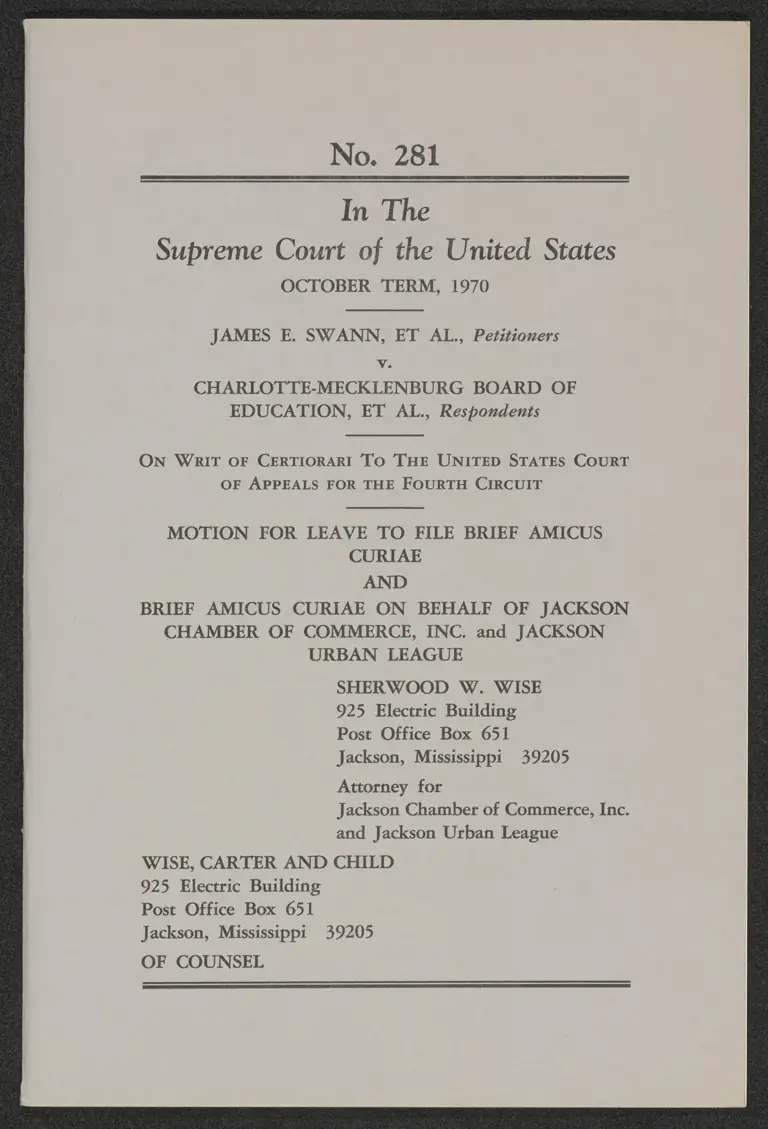
     [||84e57b23-fe77-437e-8a34-f96594014675||] No. 281

In The

Supreme Court of the United States
OCTOBER TERM, 1970


JAMES E. SWANN, ET AL., Petitioners

Vv.

CHARLOTTE-MECKLENBURG BOARD OF

EDUCATION, ET AL., Respondents

ON WRIT OF CERTIORARI To THE UNITED STATES COURT

OF APPEALS FOR THE FOURTH CIRCUIT

MOTION FOR LEAVE TO FILE BRIEF AMICUS

CURIAE

AND

BRIEF AMICUS CURIAE ON BEHALF OF JACKSON

CHAMBER OF COMMERCE, INC. and JACKSON

URBAN LEAGUE

SHERWOOD W. WISE

925 Electric Building

Post Office Box 651

Jackson, Mississippi 39205

Attorney for

Jackson Chamber of Commerce, Inc.

and Jackson Urban League

WISE, CARTER AND CHILD

925 Electric Building

Post Office Box 651

Jackson, Mississippi 39205

OF COUNSEL


INDEX

Page

MOTION FOR LEAVE TO FILE BRIEF

AMICUS CURIAE |... ...... .........0. I

BRIEF AMICUSCURIAE . . =...  .. . ....... 1

Questions Presented... . ... ...  ........ 1

Interest. of Amicus Cutie ..i....¢.t. civ ci thio 1

ArgUMEnt ow: ii ne Suis a Basing, SL BL EE 2

Conclusion... ... “00 7.0.) 7 7, 10


I.

No. 281


In The

Supreme Court of the United States
OCTOBER TERM, 1970

JAMES E. SWANN, ET AL., Petitioners

Vv.

CHARLOTTE-MECKLENBURG BOARD OF

EDUCATION, ET AL., Respondents

MOTION FOR LEAVE TO FILE BRIEF AMICUS
CURIAE ON BEHALF OF JACKSON CHAMBER
OF COMMERCE, INC. AND JACKSON URBAN

LEAGUE

NOW COMES Jackson Chamber of Commerce, Inc., a

non-profit corporation organized and existing under and

by virtue of the laws of the State of Mississippi, and Jackson

Urban League, a non-profit corporation organized and

existing under and by virtue of the laws of the State of

Mississippi, both having their domicile in Jackson, Hinds

County, Mississippi, by their attorney, and hereby respect-

fully move for leave to file the attached brief amicus curiae.

The consent of the attorneys for the petitioners and the

respondents has not been obtained.

These two entities, being both concerned with the wel-

fare of the community within which they principally operate,

and being particularly concerned with its economic growth

and development, find themselves in common accord on one

matter of particular and vital interest to their community,

that is — the continued survival and health of the public


II.

school system in the Jackson, Mississippi, area, and, there-

fore, are deeply concerned with the issues here presented.

The issues here have implications extending far beyond

the particular situation now before the Court. Accordingly,

these two entities desire the opportunity to present their

views on this matter to the Court.

We feel that our contribution should assist the Court

in setting the problems here presented in a broader context,

thus ensuring a readier grasp of the grave import its decision

may have for public school systems throughout the country.

For the foregoing reasons, the movants respectfully

request that this motion be granted.

Respectfully i

7A WV

SHERWOOD W. WISE
925 Electric Building
Post Office Box 651
Jackson, Mississippi 39205


WISE, CARTER AND CHILD Attorney for Jackson Chamber of
925 Electric Building Commerce, Inc. and Jackson Urban
Post Office Box 651 League
Jackson, Mississippi 39205

OF COUNSEL


No. 281

In The

Supreme Court of the United States
OCTOBER TERM, 1970

JAMES E. SWANN, ET AL., Petitioners

v.

CHARLOTTE-MECKLENBURG BOARD

OF EDUCATION, ET AL., Respondents

ON WRIT OF CERTIORARI TO THE UNITED STATES

COURT OF APPEALS FOR THE FOURTH CIRCUIT

BRIEF AMICUS CURIAE ON BEHALF OF JACKSON

CHAMBER OF COMMERCE, INC. AND JACKSON
URBAN LEAGUE

QUESTIONS PRESENTED

This case presents questions which go to the very heart

of the survival of the public school systems of this country.

The questions presented necessarily include the following:

1. Must a school district adopt a plan of integration

which demonstratively will result in resegregation?

THE INTEREST OF JACKSON CHAMBER OF

COMMERCE, INC. AND JACKSON URBAN LEAGUE.

The interest of Jackson Chamber of Commerce, Inc. and

Jackson Urban League, as amicus curiae is set forth on their

motion for leave to file this brief amicus, to which motion

this brief is annexed.


2

ARGUMENT

A. PRELIMINARY STATEMENT

These two entities, being both concerned with the wel-

fare of the community within which they principally operate,

and being particularly concerned with its economic growth

and development, find themselves in common accord on one

matter of particular and vital interest to their community,

that is — the continued survival and health of the public

school system in the Jackson, Mississippi area, and have

agreed to submit to this Honorable Court certain principles

which they believe if adhered to, would reverse the present

destructive trends which are taking place not only in the

Public School System of Jackson, Mississippi, but in all such

systems in the Nation, and for that reason and in that spirit

these two entities have come together for the sole purpose of

presenting to this Honorable Court for its consideration the

following facts and conclusions.

B. HISTORICAL REVIEW OF COURT DECISIONS

In September of 1969, one year ago, schools of this

district opened under what was basically a “freedom of

choice” plan. Enrollment showed 18,227 blacks and 20,966

whites. Today, one year and three court ordered plans later,

enrollment is 18,396 black and 12,095 white, — a 42.4 per

cent decrease in the number of whites. The first court order

last fall ordered a desegregation of staff at the beginning of

the second semester. On appeal by the NAACP Legal De-

fense Fund, counsel for the plaintiff, complete desegrega-

tion of pupils and staff was ordered at the beginning of the

second semester. The District Judge ordered into effect an

HEW plan for elementary schools and a plan of his own

devising for secondary schools. Plaintiffs appealed this order


3

as to the secondary plan only. In May the Fifth Circuit Court

of Appeals acted on this appeal, ordering into effect an

HEW plan for secondary schools. Although there had been

no appeal, the Fifth Circuit ordered the District Court to pre-

pare a new elementary plan and ordered the appointment

of a Bi-Racial Committee to help devise this plan. The Bi-

Racial Committee did devise a plan and, after hearings,

this plan was ordered into effect for September. Plaintiffs

appealed this order and in their brief made this statement: —

“the district court’s controlling responsibility is to evaluate

that plan, not in terms of its educational soundness, but in

terms of its ability to achieve integration.”

In August, acting on this appeal, the Fifth Circuit

ordered into effect a plan which basically consisted of the

pairing and grouping of approximately half the elementary

schools. The court stated that this was to be temporary and

the District Court was ordered to hold hearings and to pre-

pare a new elementary plan for the second semester, making

the fourth disruption in four semesters. The traditional

six grade structure for elementary schools has been destroyed

and we now have seven different grade-structured types of

elementary schools. The traditional 3-3 secondary structure

has been destroyed in favor of a 2-1-1-2 structure.

Under court plans presently in effect, 95% of the

children in this district will attend six different schools from

the first to the twelfth grade. In one extreme case, a small

group of children will go to seven schools in twelve years.

Or to look at it another way, it is possible for a family with

seven children to have them in seven different schools.

Our superintendent, who came to us one year ago from

a position as Assistant Superintendent in Atlanta, Georgia,


4

resigned a month ago, stating that his training, experience,

and conscience would not permit him to be responsible for

a system over which the court would allow him no control

and one which he felt had been made educationally and

administratively unsound. This man’s imagination and ded-

ication are demonstrated by the fact that this school sys-

tem was the first in the country to submit a comprehensive

plan of educational innovation and to receive a grant under

the 75 million dollar emergency fund appropriated this

summer. Under state law (dated prior to the Brown deci-

sion) and reinforced by an opinion from the Attorney

General of Mississippi, the local school board has no au-

thority (even if it had the money) to provide intra-city trans-

portation.

C. RECENT STATISTICS

The following statistics demonstrate forcefully and

without further argument precisely what is taking place in

the Public School System of Jackson, Mississippi at the

present time:

As of September 15, 1969, there were 18,227 black

students and 20,966 white students in the Public School

System of Jackson, Mississippi, or a total of 39,193 students

The percentage ratio at that time was 47% black and 53%

white.

On September 18, 1970, there were in the said school

system 18,396 black students and 12,095 white students, or

a total of 30,491 students. The percentage ratio at that time

was 60% black students and 409% white students.


5

Thus, it can be seen that with the various court orders

as set out in the historical review above, withdrawals of

white students have occurred so that from September 15,

1969, to September 18, 1970, the number of white students

attending said school system has dropped from 20,966 to

12,095, while over the same period the black students in

said system have increased from 18,227 to 18,396. The per-

centage change over said period of approximately one year

has been from 47% black students to 60% black students,

and from 53% white students to 409 white students.

Thus, it is self-evident that from September 15, 1969,

to September 18, 1970, a serious drift toward resegregation

has taken place in the Jackson public school system.

D. ECONOMIC IMPACT

A major concern which bears directly on Jackson’s edu-

cation problems is the slowdown which has occurred in the

city’s economic development. During the past decade the

increase in manufacturing employment has only been one

half of what was needed.

A critical problem confronting Jackson’s development

efforts is the school situation. The present instability is pre-

venting a major manufacturer from locating a badly needed

large plant in the Jackson area. Neither this company nor

many of the other firms which might otherwise come to

Jackson can be expected to move into the area.

Paradoxically, Jackson’s schools need to be strengthened

before it will be possible to attract many of the companies


6

needed to accelerate the area’s economic growth. The need

for strengthening the schools was recognized by the School

Board when they employed Dr. John Martin as superinten-

dent; his capabilities in the curriculum development field

were a major factor in his selection. And that strengthening

cannot occur unless economic growth takes place which pro-

duces the revenues required. Nor can many of the social

problems which confront the families in the lower economic

brackets be solved unless more economic development takes

place.

We come full circle then. The city’s schools cannot be

strengthened substantially without a doubling of the area’s

economic growth rate. The desired economic growth can-

not take place without significant improvement in the

quality of Jackson’s schools. Neither improvement of the

schools nor the desired economic development can take place

unless the present instability is eliminated and the basic

problems involved in the integration of the schools can

be worked out.

The importance of this impact is not confined to eco-

nomics alone. It is obvious that an adverse economic im-

pact on any community brings with it increased social prob-

lems and burdens. This community at this time is making

heroic efforts to solve social problems by providing better

jobs, better housing, and better living conditions for its

citizens who are in the lower economic echelons. This re-

quires expenditures of capital. Anything, including the situa-

tion we are now concerned with, which adversely affects

the economics of this community will adversely affect the

efforts now being made to upgrade the living standards of

those citizens in this community who are in the lower eco-

nomic brackets.


7

E. CERTAIN PRINCIPLES

We are persuaded that from the experiences of this

community, as well as the experiences of communities all

over the Nation, certain basic principles have emerged

which are worthy of serious consideration.

1

Prior to the court orders which changed the same, the

School System of Jackson, Mississippi, operated on what is

known as 6-3-3 plan. That is, in the district the elementary

schools consisted of the first six grades, the junior high

schools consisted of grades seven, eight and nine, and the

high schools consisted of grades ten, eleven and twelve.

This system worked well and served the needs of the people

in the community better than any other system which has

ever been devised. There were demonstrable educational

advantages, as the breaks which occurred between the three

divisions of the system were natural breaks based on age

and development of the children. There proved to be less

disruption in the life of the individual child. The possibili-

ties of major transportation problems were reduced. It is

our firm belief that a return to the 6-3-3 concept is essential.

2

It is our further conviction that if the integration which

the courts, by their various decisions and orders have de-

creed, is to be achieved, it must be done in an orderly man-

ner which will accomplish the courts’ purposes without

totally wrecking the public school system. In order to ac-

complish this, it is necessary that the outflow of whites from

the public schools be reversed or resegregation is certain to

result. It is probable that this trend can be reversed and


8

many whites who have fled the public schools will return

if certain self-evident facts are recognized and are dealt with

on a realistic basis.

Experience has shown that depending upon location of

the area involved when the ratio of black pupils to white

reaches a certain percentage, resegregation has resulted. For

each community the resegregation point varies, depending

upon the very nature of the community itself. Such conse-

quences have been experienced in numerous American com-

munities, including Washington, D. C., Philadelphia,

Pennsylvania, Cleveland, Ohio, and many others. The

Jackson statistics quoted above confirm the fact that this

trend is presently being experienced in the Jackson Public

Schools.

There are many and obvious deleterious by-products

of this trend. Support of the public schools is being re-

duced. As an example, in November of 1969, a bond issue

for capital expenditures for public schools in the City of

Jackson was defeated by both black and white votes. It is

doubtful if any public school bond issue could pass in this

area at this time.

Frustration exists in the families of both the black and

the white communities in the City, and this frustration is

resulting in further polarization of the races.

Once the trend begins of the flight of whites from the

public schools, it can normally be expected to accelerate.

This statement is based on the experience of this community

and others as set out above. In this community the private


9

schools which now exist, many of which have recently come

into being, are overloaded and are expanding their facilities.

3.

Should the principles set out above be adhered to, it

will then become incumbent upon this community to commit

itself unreservedly to an innovative system of superior pub-

lic education. The time gap which will exist between the

frustrations and disruptions mentioned above and some

eventual solution to this problem is all important. Steps

must be taken immediately which will have the effect of

compensating educationally for these frustrations and dis-

ruptions during this period.

This community has shown its commitment to these

principles in the past. This commitment must continue. In

fact, if the trend which is now taking place is to be re-

versed and the public school system of this area is to be

saved, this commitment must be strengthened and the edu-

cational processes in the public school system must be en-

hanced at all levels. There are many things which can be

done immediately and in the future to bring this about. We

believe that with a reasonable, sensible and workable ap-

proach to the overall problem, this community will respond

affirmatively in bringing about superior public education

for its children. It is our firm conviction that this should

be the primary consideration of all of the courts involved,

and of all the entities and individuals who are in any wise

affected by this overall problem.


10

CONCLUSION

We conclude that stability in the schools which will

permit them to continue to survive can only be achieved if

the principles set out herein are adhered to.

Respectfully submitted,

For The

JACKSON CHAMBER OF

COMMERCE, INC.

Ac dot ZI Cal ova
- Pogsident A


    Executive Secretary

For The

J CKSON URBAN LEAGUE

pan. ub. 1 Lnech rai | Ms
President

ti 24 AO 5% J

Executive Secretar


& es Directors


_SHERWOOD W. WisE, Attorney for
Jackson Chamber of Commerce, Inc.
and Jackson Urban League

925 Electric Building
Post Office Box 651
Jackson, Mississippi 39205

WiSE, CARTER AND CHILD

925 Electric Building
Post Office Box 651
Jackson, Mississippi 39205

October 9, 1970


1

CERTIFICATE OF SERVICE

I, Sherwood W. Wise, the attorney for Jackson Cham-

ber of Commerce, Inc. and Jackson Urban League, amicus

curiae herein, and a member of the Bar of the Supreme Court

of the United States, hereby certify that, on the day

of October, 1970, I served copies of the foregoing Motion

For Leave To File Brief Amicus Curiae and Brief Amicus

Curiae on the several parties thereto, as follows:


1. On the petitioners, James E. Swann, et al, by mail-

ing three copies in a duly addressed envelope, with

air mail postage prepaid, to their attorney, James

Nabrit, III, 10 Columbus Circle, New York, New

Yor: 10019,

2. On the respondent, Charlotte-Mecklenburg Board

of Education, et al, by mailing three copies in a duly

addressed envelope, with air mail postage prepaid,

to their attorneys, William J. Waggoner, Wein-

stein, Waggoner, Sturges & Odom, 1100 Barring

Office Tower, Charlotte, North Carolina and Ben-

jamin S. Horack, Ervin, Horack & McCartha, 806

East Trade Street, Charlotte, North Carolina.

3. On the United States of America, amicus curiae, by

mailing three copies in a duly addressed envelope,

with air mail postage prepaid, to its attorney, Erwin

Griswold, Esquire, Solicitor General, Department

of Justice, Washington, D. C.

It is further certified that al} parties required to be


served have been — g/ /

¢ y
_SHERWOOD W. WISE
Attorney for Jackson Chamber of Commerce,
Inc., and Jackson Urban League

925 Electric Building
Post Office Box 651
Jackson, Mississippi 39205 [||84e57b23-fe77-437e-8a34-f96594014675||]