Lewis Jr. v. City of Chicago Supplemental Brief for Respondent in Opposition
Public Court Documents
September 2, 2009
-
Brief Collection, LDF Court Filings. Lewis Jr. v. City of Chicago Supplemental Brief for Respondent in Opposition, 2009. 2e233724-bb9a-ee11-be36-6045bdeb8873. LDF Archives, Thurgood Marshall Institute. https://ldfrecollection.org/archives/archives-search/archives-item/6d2b2ffa-1762-4750-bbc3-b0546886a844/lewis-jr-v-city-of-chicago-supplemental-brief-for-respondent-in-opposition. Accessed October 06, 2026.
Copied!
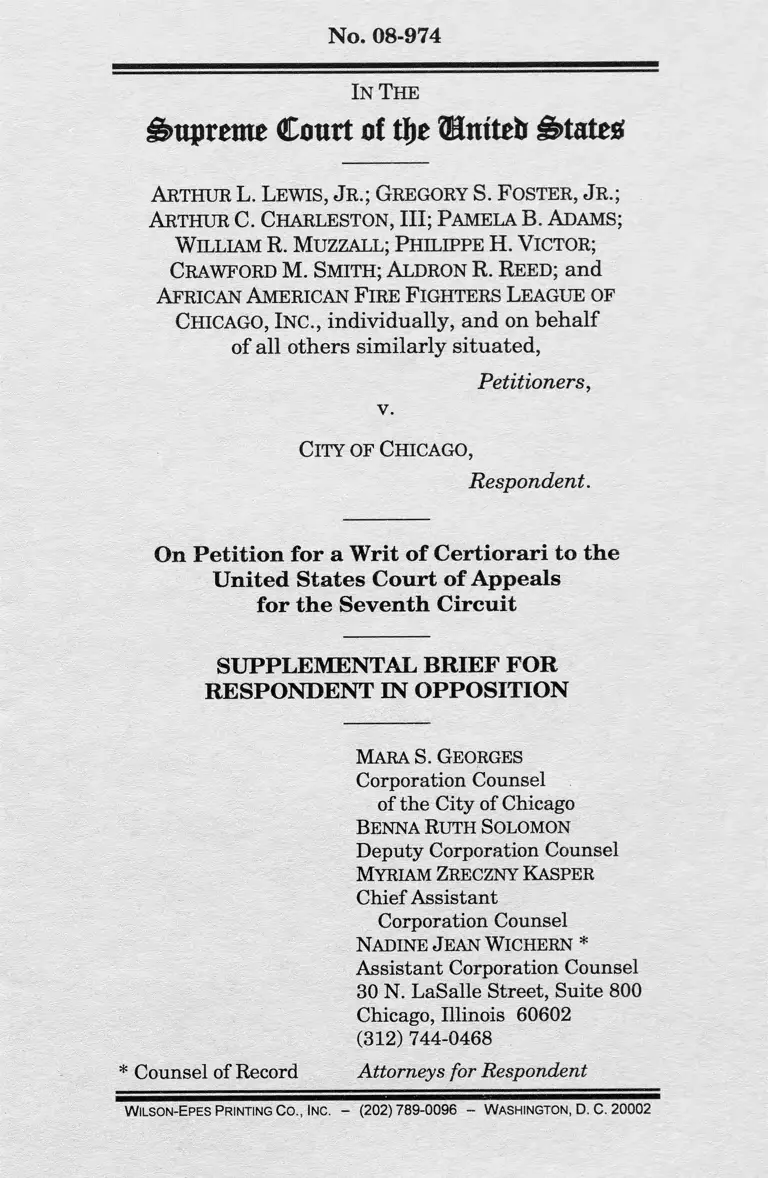
No. 08-974
In The
Supreme Court of tfje Untteb States?
Arthur L. Lewis, Jr .; Gregory S. Foster, Jr .;
Arthur C. Charleston, III; Pamela B. A dams;
William R. Muzzall; Philippe H. V ictor;
Crawford M. Smith; Aldron R. Reed; and
African American Fire Fighters League of
CHICAGO, INC., individually, and on behalf
of all others similarly situated,
Petitioners,
v.
City of Chicago,
Respondent.
On Petition for a Writ of Certiorari to the
United States Court of Appeals
for the Seventh Circuit
SUPPLEMENTAL BRIEF FOR
RESPONDENT IN OPPOSITION
Mara S. Georges
Corporation Counsel
of the City of Chicago
Benna Ruth Solomon
Deputy Corporation Counsel
Myriam Zreczny Kasper
Chief Assistant
Corporation Counsel
Nadine Jean W ichern *
Assistant Corporation Counsel
30 N. LaSalle Street, Suite 800
Chicago, Illinois 60602
(312) 744-0468
* Counsel of Record Attorneys for Respondent
W ilson-Epes Printing Co ., Inc. - (202)789-0096 - Washington, D. C. 20002
TABLE OF CONTENTS
Page
TABLE OF CONTENTS............................... i
TABLE OF AUTHORITIES................................. ii
ARGUMENT........................................................... 1
CONCLUSION.... .................................................. 12
( i )
11
TABLE OF AUTHORITIES
CASES Page
Anderson u. Zubieta,
180 F.3d 329 (D.C. Cir. 1999)....................... 4
Bazemore v. Friday,
478 U.S. 385 (1986)........................................ 3, 4
Beavers v. American Cast Iron Pipe Co.,
975 F.2d 792 (11th Cir. 1992)...................... 4
Bouman v. Block,
940 F.2d 1211 (9th Cir.), cert, denied, 502
U.S. 1005 (1991) ............................................ 4
Bronze Shields, Inc. v. New Jersey Department
o f Civil Service,
667 F.2d 1074 (3d Cir. 1981), cert, denied,
458 U.S. 1122 (1982)...................................... 2, 3
Chardon v. Fernandez,
454 U.S. 6 (1981)............................................ 3,11
Cox v. City o f Memphis,
230 F.3d 199 (6th Cir. 2000)......................... 3
Delaware State College v. Ricks,
449 U.S. 250 (1980)....................................... passim
Gonzalez v. Firestone Tire & Rubber Co.,
610 F.2d 241 (5th Cir. 1980)......................... 3, 5
Guardians Association v. Civil Service
Commission,
633 F.2d 232 (2d Cir. 1980), cert, denied,
463 U.S. 1228 (1983)...................................... 2, 3
Ledbetter v. Goodyear Tire & Rubber Co.,
550 U.S. 618 (2007).......................................passim
I l l
TABLE OF AUTHORITIES—Continued
Page
Lorance u. AT&T Technologies, Inc.,
490 U.S. 900 (1989).................................. 3, 6, 9, 11
National Railroad Passenger Corp. v. Morgan,
536 U.S. 101 (2002)........................................ 3
Ricci v. DeStefano,
129 S. Ct. 2658 (2009)....... ........................... 7
United Air Lines, Inc. v. Evans,
431 U.S. 553 (1977)........................................ 3 ,5 ,6
United States v. New York,
No. 07-2067, 2009 WL 212154 (E.D.N.Y.
Jan. 28, 2009).......................... 5
Wallace v. Kato,
549 U.S. 384 (2007)...................... ....... . 7
STATUTES
42 U.S.C. § 2000e-2(a)(2)............................... 8
42 U.S.C. § 2000e-2(k)(l)(A)(i)..................... 8
42 U.S.C. § 2000e-5(e)(l)........................... 6
In The
Supreme Court of tfje Untteb States
No. 08-974
Arthur L. Lewis, Jr .; Gregory S. Foster, Jr .;
Arthur C. Charleston, III; Pamela B. Adams;
William R. Muzzall; Philippe H. Victor;
Crawford M. Smith; Aldron R. Reed; and
African American Fire Fighters League of
Chicago, Inc., individually, and on behalf
of all others similarly situated,
Petitioners,
v.
City of Chicago,
Respondent.
On Petition for a Writ of Certiorari to the
United States Court of Appeals
for the Seventh Circuit
SUPPLEMENTAL BRIEF FOR
RESPONDENT IN OPPOSITION
ARGUMENT
The Solicitor General’s submission that review
should be granted disregards three crucial points.
First, the circuit split on which petitioners and the
2
Solicitor General rely is unusually stale, and the
issue very rarely arises. Br. in Opp. 21-32. Second,
the circuits with old decisions in conflict with the
decision below will have the opportunity, in any
future cases, to consult the Court’s consistent and
recent guidance on the issue and harmonize
themselves with the majority and modern view;
potential plaintiffs, too, are on notice to calculate
their EEOC-filing date under the more recent
decisions. Id. at 25-31. Third, although the Solicitor
General urges a different accrual rule in disparate-
impact cases, the rule that a fresh violation must
occur to trigger a new claim has nothing to do with
the plaintiffs method of proof. Certainly, the limi
tations period for disparate-impact claims should not
be longer than for disparate-treatment claims. Id. at
17-21. Further review is not needed just so this
Court can again reaffirm that a new statutory wrong
- not the present consequences of a past wrong — is
necessary to start a new limitations period under
Title VII.
1. The conflict on the question here - whether a
disparate-impact claim based on a facially race-
neutral examination and eligibility list created from
the examination results accrues only when the list is
adopted and announced, or also again thereafter,
each time there is hiring from the same list - is
extraordinarily stale. It surfaced almost 30 years
ago, in 1981, when the Third Circuit in Bronze
Shields, Inc. v. New Jersey Department o f Civil
Service, 667 F.2d 1074 (3d Cir. 1981), cert, denied,
458 U.S. 1122 (1982), declined to follow the Second
Circuit’s 1980 decision in Guardians Association v.
Civil Service Commission, 633 F.2d 232 (2d Cir.
1980), cert, denied, 463 U.S. 1228 (1983). Tellingly,
even at that time, this Court denied certiorari in both
Bronze Shields and Guardians.
Nothing since then supports a different result here.
While the Solicitor General asserts that the issue is
“recurring” (SG Br. 19), in fact it rarely arises. In
nearly three decades, only five cases have decided the
precise issue. Three of the cases - Gonzalez v.
Firestone Tire & Rubber Co., 610 F.2d 241 (5th Cir.
1980), Bronze Shields, and Guardians — were decided
in 1980 and 1981. After that, the issue did not
emerge again for 19 years, in Cox v. City o f Memphis,
230 F.3d 199 (6th Cir. 2000), and then not for most of
another decade, until the 2008 decision below.
Of those five cases, the two under which petitioners
would prevail are the oldest, decided after United Air
Lines, Inc. v. Evans, 431 U.S. 553 (1977), but before
the other six relevant decisions from this Court.
Since 1980, no circuit has accepted the position of
petitioners and the Solicitor General. That is
unsurprising, for the Court in the intervening years
has repeatedly rejected all attempts by late-filing
plaintiffs to date accrual not from when a statutory
wrong occurred, but from when the consequences of a
prior discriminatory practice were felt. See Ledbetter
v. Goodyear Tire & Rubber Co., 550 U.S. 618 (2007);
National Railroad Passenger Corp. v. Morgan, 536
U.S. 101 (2002); Lorance v. AT&T Technologies, Inc.,
490 U.S. 900 (1989); Chardon v. Fernandez, 454 U.S.
6 (1981) (per curiam); Delaware State College v.
Ricks, 449 U.S. 250 (1980). See also Bazemore v.
Friday, 478 U.S. 385 (1986) (discriminatory pay
pursuant to facially discriminatory pay structure
is current violation each time check is issued,
not merely carrying forward of a past act of
discrimination).
3
The Solicitor General contends the decision below
also conflicts with Bouman v. Block, 940 F.2d 1211
(9th Cir.), cert, denied, 502 U.S. 1005 (1991). SG Br.
16-17 & n.3.1 There, the court ruled that a claim
directed to an eligibility list did not accrue until the
list was taken down. See 940 F.2d at 1221. The
court did not decide the issue here - whether each
use of the list is a fresh violation. Moreover, the
Solicitor General does not address the Ninth Circuit’s
decisions moving away from Bouman. Br. in Opp. 31-
32. This Court also denied review in Bouman, when
the conflict arguably had greater currency. Bouman
thus provides no basis for further review.
2. The Solicitor General summarily states there is
“little reason” to think the circuits will align without
4
1 The Solicitor General rightly does not endorse petitioners’
view that the decision below conflicts with Anderson v. Zubieta,
180 F.3d 329 (D.C. Cir. 1999), and Beavers v. American Cast
Iron Pipe Co., 975 F.2d 792 (11th Cir. 1992), recognizing that
those cases arose “in other contexts.” SG Br. 17. As we explain
(Br. in Opp. 30), Anderson involved a policy of pay and benefits
discrimination based on race for which the limitations period
ran anew with each paycheck or benefits decision. See
Ledbetter, 550 U.S. at 633-47 (explaining Bazemore). Beavers
involved a policy of denying health coverage to dependents who
did not reside full time with the employee, which was also, at
least arguably (Pet. App. 5a), a facially discriminatory policy
(Br. in Opp. 29 & n.4). Application of an employment policy to
both current and future employees, as in those cases, is far
different from maintenance of an eligibility list. While new
employees are hired (or their positions change), and they
become subject to an employment policy on an ongoing basis, an
eligibility list applies to everyone to whom it will ever apply at
the outset; no one is newly affected only after the filing period
has passed. Whatever the correct approach in cases like
Anderson and Beavers, those cases do not bear on whether to
grant review in this case.
this Court’s immediate intervention, and that there
has been “no relevant change in the law” since the
1980 Second and Fifth Circuit decisions. SG Br. 19.
But after those decisions, the Court elaborated on
Evans, and from Ricks to Ledbetter just two Terms
ago, has developed a consistent body of case law
governing the Title VII limitations period. For that
reason, the more current decisions of the Third,
Sixth, and Seventh Circuits, which have had the
benefit of that entire line of cases, have been in
harmony. If future cases arise, the Second and Fifth
Circuits would also have the benefit of the interven
ing decisions of this Court and other circuits, and
would likely reverse their earlier, incorrect positions.
The Solicitor General ignores that this process may
already be underway. The district court in United
States v. New York, No. 07-2067, 2009 WL 212154
(E.D.N.Y. Jan. 28, 2009), rejected a limitations
defense. That issue may soon make its way to the
Second Circuit, which could will surely evaluate
Guardians against more modern decisions. Br. in
Opp. 27-29. The Fifth Circuit never offered any
analysis supporting its disposition. Id. at 25-26, 28-
29. If the issue arose there again, the same wealth of
well-reasoned, consistent decisions would reveal the
1980 ruling should not survive.
Morever, if (at worst) the early circuit decisions
create some “uncertainty” (SG Br. 19) about the
limitations period in a case like this, the three later
decisions unquestionably alert a careful plaintiff that
he should file an EEOC charge within 180 or 300
days of notice that he has been injured by an
eligibility examination and list. As petitioners
admitted, they knew of their injury from the start
and could have filed sooner, but did not think they
5
6
had to. Pet. App. 11a. Until the conflict resolves
itself, prudent plaintiffs even in the Second and Fifth
Circuits would likely file on time, since the rule there
is old, in the minority, and out of touch with this
Court’s consistent line of cases.
The paucity of cases involving the issue here, the
consistent case law from both this Court and the
three later circuits, and the ability of plaintiffs to
protect themselves, avoid the Solicitor General’s
concern that denying review would “undermin[e] the
uniform application of federal employment discrimina
tion law.” SG Br. 19. That concern, moreover, rings
hollow when the law has not been uniform since 1981
- except that every case decided since then has
uniformly rejected arguments like those petitioners
and the Solicitor General advance here.
3. On the merits, this Court, from Evans to Ledbet
ter, has made clear that Title VII claims accrue when
the unlawful act occurs, and that a new statutory
wrong - not merely the present consequences of a
prior act - is needed to trigger a new claim. The
plaintiff must file a charge (in States with
enforcement agencies) within 300 days of when the
unlawful employment practice occurred. See 42
U.S.C. § 2000e-5(e)(l). As the Solicitor General
agrees (SG Br. 13), petitioners were injured when
they were informed that the City would hire from a
group that did not include them. That “impact
[was] felt” (Lorance, 490 U.S. at 908) from the outset.
That started the limitations period. Petitioners’
ineligibility to be hired when the City subsequently
called candidates from the list was merely the
“delayed, but inevitable, consequence o f ’ (Ricks, 449
U.S. at 257-58) their not being on the eligibility list —
an “adverse effect [ ] resulting from the past discrimi
nation” (Ledbetter, 550 U.S. at 628). It was not a
fresh statutory wrong; by using the list, the City
committed no further act of discrimination (in treat
ment or in impact), and petitioners suffered no
additional injury. If anything, petitioners stood a
greater chance of being hired as the “well qualified”
pool was exhausted, and ultimately the City did call
applicants from the “qualified” pool.2 Thus, the later
rounds of hiring did not start the limitations clock
anew. Pet. App. 4a, 6a-7a. Further review to once
again reaffirm these governing principles is
unwarranted.
a. The Solicitor General adds that disparate-impact
claims have a different, and more liberal filing period
than disparate-treatment claims because “the
defining element of a disparate-impact claim is the
effect of an employment practice on members of a
protected group, rather than the employer’s intent in
adopting the practice.” SG Br. 12. But even in
disparate-treatment cases, an employer’s intent alone
will not support a claim. Rather, in both types of
cases, the claim accrues when the employer engages
in an employment practice that discriminates -
whether in treatment or in impact. In neither case
may the plaintiff wait for additional consequences of
the practice to be felt before filing a claim. Indeed,
disparate treatment and disparate impact are merely
7
2
That does not mean accrual is postponed to see whether the
employer eventually “hire[s] from among the ranks of those
adversely affected by the examination.” SG Br. 15. Issues of
damages calculation do not delay accrual. See, e.g., Wallace v.
Kato, 549 U.S. 384, 390-91 (2007). As for the possibility the
employer may never “use the results to select employees for hire
or promotion” (SG Br. 15), Ricci v. DeStefano, 129 S. Ct. 2658
(2009), sharply limits this option.
alternative methods of proving a Title VII claim, and
plaintiffs may pursue both claims. It would “creat[e]
uncertainty” (SG Br. 19) if the two claims accrued at
different times. And it would be perverse to extend
the filing period for disparate-impact claims, where
the proof “involves the use of circumstantial evidence
to create an inference of discrimination” (Pet. App.
5a), while continuing to enforce the tighter deadline
for disparate-treatment claims, for which there is
direct evidence of discrimination.
b. The Solicitor General further contends that the
statutory text forbidding an employer “to limit,
segregate, or classify . . . applicants for employment
in any way which would deprive or tend to deprive
any individual of employment opportunities . . .
because of such individual’s race . . .” supports
extending the limitations period. SG Br. 7-8 (citing
42 U.S.C. § 2000e-2(a)(2)). Here, the City’s eligibility
list was the limitation or classification. Use of the
list to call “well qualified” candidates in random
order for further processing did not segregate or
classify anyone, nor limit employment opportunities,
based on race. The burden of proof in disparate-
impact cases (id. at 7) does not fill this hole. That
provision allows a plaintiff to prevail if, among other
things, “a respondent uses a particular employment
practice that causes a disparate impact on the basis
of race.” 42 U.S.C. § 2000e-2(k)(l)(A)(i). Petitioners
here demonstrated that use of the test results to
create the eligibility list was such a practice but not
that the subsequent random calling of applicants on
the list had any further disparate impact.
c. The Solicitor General variously characterizes
the Seventh Circuit as having held that “an em
ployer’s use of an invalid employment examination
8
accrues only when the examination is scored and the
results announced” (SG Br. 7); that the analysis is
“altered by [the City’s] practice of preceding the
hiring decisions by sorting test-takers into groups of
‘qualified’ and ‘well qualified’ applicants” (id. at 13);
and that an employer is “immunized from liability
merely because” it takes that “intermediate step”
(ibid.). These arguments describe neither the
decision below nor our submission. Rather, as the
court held, the City used an unlawful employment
practice when it created a hiring eligibility list of
“well qualified” applicants from a test with disparate
impact, and gave notice to every applicant in the
“qualified” pool, including petitioners, that this list
would govern hiring over the next several years.
That is when “the discriminatory act occur [red]”
(Ledbetter, 550 U.S. at 621), and thus when
petitioners’ claim accrued. There was no further
“use” of the test “to hire” (SG Br. 7) after that.
In addition, to the extent the Solicitor General uses
“immunity” to describe the statute of limitations, the
assertion that the City was “not immunized” by the
“intermediate step” of classifying applicants cannot
be squared with this Court’s cases. (SG Br. 13)
Where the “intermediate step” is the actionable
wrong, and the belated claim merely another
challenge to that “raw resul[t]” (ibid.), the employer
certainly is “immunized” — or, more properly, the
claim is time barred. For example, the college in
Ricks was “immunized” by the “intermediate step” of
denying the plaintiff tenure; the employer in Lorance
by the “intermediate step” of adopting a
discriminatory seniority system; and the employer in
Ledbetter by the “intermediate step” of providing
discriminatory evaluations. These claims, like
petitioners’ here, were all untimely because, as this
9
Court has consistently ruled, the occurrence of
predictable consequences of a prior discriminatory act
does not restart the limitations period.3
d. The Solicitor General urges that the decision
below would encourage “premature charges” that
would “impos[e] substantial burdens on both the
EEOC and the courts” (SG Br. 20), and “could un
dermine enforcement of Title VII’s disparate-impact
provisions” (id. at 19). The circuits first disagreed on
this issue in 1981. The Solicitor General points to no
adverse effects on the EEOC, or enforcement of Title
VII, to date. Because the careful plaintiff pursues
claims in a timely fashion, and as the Solicitor
General urges, “candidates for employment or promo
tion have little incentive to delay unreasonably in
filing EEOC charges” (id. at 14), likely no such effects
have occurred.
Ultimately, the Solicitor General’s arguments for a
longer limitations period in disparate-impact cases,
simply disagree with Congress’s clear policy choices.
Congress obviously could have opted for a longer or
more flexible limitations period, emphasizing the
need for strict enforcement and compensation for
all injuries. But, as this Court has repeatedly
recognized, Congress made a purposeful judgment
that a short limitations period would encourage
victims of employment discrimination to file their
claims quickly, allowing agencies (and, if necessary,
1 0
2
Petitioners’ problem is not that they challenge a practice “in
some way connected to earlier violations.” SG Br. 11. It is,
rather, the nature of the “connection.” Where the later event is
the consequence of an earlier one, and no further act of
discrimination has occurred, the later event is not actionable.
Petitioners’ claim is untimely because no new statutory wrong
was committed after the list was adopted and announced.
the courts) to resolve such claims promptly. This
ensures that memories are clear; the harm is limited;
and reliance interests of employers and other
employees have not yet crystallized. Br. in Opp. 18-
20. Even if “the passage of time . . . does n o t . . . raise
the same concerns” as in disparate-treatment cases,
the most that can be said is that evidence in
disparate-impact cases may be “less likely to ‘fade
quickly with time.’” SG Br. 14-15 (quoting Ledbetter,
550 U.S. at 631). Still, the memories of those who
made decisions concerning the examination and the
eligibility list will fade, risking loss of that evidence
over time. A short and firm filing period protects the
interests in repose and reliance, which are especially
important in cases involving eligibility lists, which
can be used for several years.
More puzzling is the Solicitor General’s further
submission that the decision below “encourages -
indeed, requires - plaintiffs to file lawsuits before
they can be sure of the practical consequences of an
employer’s administration of an unlawful selection
device - and may poison the workplace with anticipa
tory litigation before facts have crystallized.” SG Br.
15. Those concerns, again, ignore Congress’s choice
of a short filing period, which necessarily pressures
plaintiffs to file earlier. Beyond that, if anything
should be clear from this Court’s cases (see, e.g.,
Lorance, 490 U.S. at 907 n.3; Chardon, 454 U.S. at 8;
Ricks, 449 U.S. at 260-61), it is that a Title VII
plaintiff cannot wait to be absolutely certain about
the consequences of an employment action. Rather,
the time to file runs from the unlawful act, even if
that is before all the consequences are known with
certainty or have taken effect.
1 1
12
CONCLUSION
The petition should be denied.
Respectfully submitted,
Mara S. Georges
Corporation Counsel
of the City of Chicago
Benna Ruth Solomon
Deputy Corporation Counsel
Myriam Zreczny Kasper
Chief Assistant
Corporation Counsel
Nadine Jean W ichern *
Assistant Corporation Counsel
30 N. LaSalle Street, Suite 800
Chicago, Illinois 60602
(312) 744-0468
* Counsel of Record Attorneys for Respondent
September 2, 2009