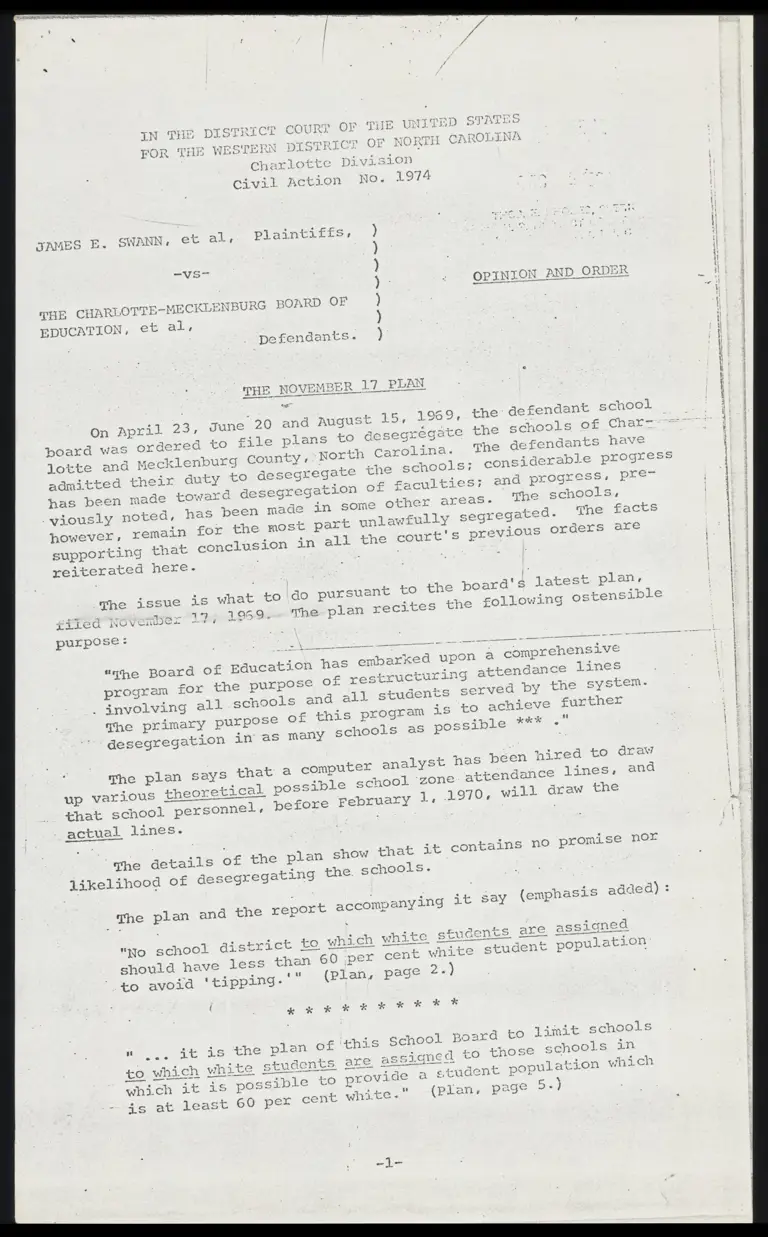
Opinion and Order for the November 17 Plan

Public Court Documents
December 1, 1969

Opinion and Order for the November 17 Plan preview

10 pages

Cite this item

  • Case Files, Swann v. Charlotte-Mecklenburg Working Files. Opinion and Order for the November 17 Plan, 1969. 481f7854-3234-f111-88b4-7c1e527f53b4. LDF Archives, Thurgood Marshall Institute. https://ldfrecollection.org/archives/archives-search/archives-item/6e825bbd-1192-4e62-a605-d45b6eecd9c2/opinion-and-order-for-the-november-17-plan. Accessed June 02, 2026.

    Copied!

     [||36b37750-6fe0-45c9-87e7-c216cc9ec598||] a ————., 


aT PY - CMT OM ~ANTTT! 1 ATTY  & 25 TTA ~mnmi C 

IN 1b DISTRICT COURT OF Til UNL LD STAT! 2 

Lon Tan | mI Ta", fa 8 “7 vm CTT 
ITY 6 ox * TAA DMIY 

3 0 By alli, oh Sg dl ) 

FOR triks WESTERN DISTRI Cr OF NOR CAROLINA 

Charlotte Division 

civil Action wo. 1974 

JAMES E. SWANN, et al, plaintiffs -~
 ) 

) 
) 
): : OPINION AND ORDER i 

THE CHARLOTTE MECKLENBU 
RG BOARD OF ) 

EDUCATION, et al. 
) 

Defendants. }: 

on April 23, June 50 and August 15. 19569, the defendant school 

poard was ordered tO file plans to desegrégate the schools of Char=— Cent sr 

lotte and Mecklenburg county, North carolina. The defendants have Ea 

admitted their duty tO desegregate the schools; considerable progress 

has been made toward desegregation 
of faculties; and progress, prev 

Q
 a 

po
 

: 

viously noted, has been made in SOME other areas. The schools, 

however, remain for the most par unlawfully segregated. The facts 

supporting that conclusion in all the court's previous orders are 

reiterated here. 
; : 

= 
} 

. 

The issue is what to do pursuant to the board's latest plan, 

gay “17-1969 The plan recites the following ostensible 

i Tx SCL an WRAY SITE LGEN 

ns
 
i


e
i
o
r
m
a
a
e
—
—
—
—
—
_
A
 

Si
 

to
d 

tt
 
t
o
n
 

LE
 

purpose: 

uqhe Board Of Education has embarked upon 4 comprehensive 

program for the purpose of restructuring 
attendance lines 

involving all schools and all students served by the system. 

The primary purpose of this program js to achieve further 

desegregation in as many schools as possible **¥ oy 


The plan Says that a computer analyst has heen hired to draw 

up various theoretical possible «chool zone attendance lines, and 

that school personnel, pefore February 1, 1970, will draw the 
| 

actual lines. 
: | : 

: 

qhe details of the plan show that it contains no promise nor 

likelihood of desegregating 
the. schools. 

The plan and the report accompanying it say (emphasis added) : 

"Jo school district Xo which white students arc assigned 

should have less than 60 per cent white student population 

to avoid ‘tipping. '" (plan, page 2.) 

{ SEE ERTL SL SL ay 

nll 44 1s The plan of this School poard tO 1ifait schools 

+o which white students are assigned tO those schools in 

which it is possible to provide a «tudent population which 

© 
I: 

. 

~ 
- 4 

“ 

- 4s at least 60 per cent white." (plan. page 5.) 


am PUI ITE | TE 

/ 


nin determ) ning the initial attendance lines, the 

ratio of black to white students will not exceed 60% I 

y x = a AN, hl: ye JILIN nTI CNT IANYT - C3 “Tr TAA 
—~ 1 

white 40% black WHERE TH SCHOO, IS DhioldisR LGATED. 

(Report, page 5.) 

“a majority of the Board of Education believes that 

the constitutional requir ements of desegregation will 

be achieved by the restructuring of attendance lines. 

the restricting freedom of transfer. and other pro- 

visions of this plan. The majority of the Board has, 

therefore, discarded further consideration of pairind, 

grouping, clustering and transporting." (Plan, page 5.) 

The strongest claim made in the plan with respect to the all 

black schools is that among 43 elementary schools in the densely 

populated areas Of Charlotte it is "theoretically [school board's 

emphasis] possible tO populate these schools with the following 

ratios of black students: ... SEVEN (7) schools in which the black 

student population is 100 per cent." (Plan, pages 3 and 4.) Since 

the 100% black elementary schools in the system (Billingsville, 

Marie Davis, Double Oaks, First Ward, Lincoln Heights. Oaklawn and 

University Park) number exactly seven, this language obviously pro- 

poses that these seven schools will remain all-black. 

. 

The plan contains no factual information nor estimate regarding 

plans for desegregation: of the 31 other elementary schools, the 20 

junior high schools, and the 10 senior high schools in the system. 

] 1 

L 

: 

i 

Concexning faculty desegregation the plan says: 

{ 
/ 

\ 

"puring the 1970-71) school year, the Board of ducation-—---- 

will staff each schol <0 that the faculty at each school 

will be predominantly white and. where practicable will 

reflect the ratio of white and black teachers employed in 

the total faculty of the school system." (Plan, page 7.) 

} 

With regard to the physical facilities, the court on august 15, 

"1969, ordered the defendants to produce by November: 17 "A detailed 

report showing, complete with figures and maps: the location and 

nature of each construction: project proposed OY under way. and the 

effect this project may reasonably be expected to have upon the 

program Of desegregating the schools." In Xesponse to that order. 

the plan lists the names of 21 out of 91 projects, expresses a few 

opinions and conclusions ‘about the building program. and promises 

a partial study by February 1, ‘1970 and a "general long range study" 

"by June of 1970," but it sheds no factual light on the effect Of 

any part of the pbuilding program On the segregation issue. Since 

the board has, in seven months. failed to produce a program fox 

desegregation, it is only natural that they can not predict the 

effect of any particular building project on such a program. The 

court has yet not received information necessary to appraise the 

effects of current pbuilding activity on the current unprogrammed 

course of desegregation. | 
r 

i 

When the plen is understood, it boils down to this: 

1. Tt proposes ©O re-draw school zone lines, and to 

restrict freedom of choice, which t+he court had already 

advised the board to eliminate except where jt would promote 

desegregation. 
It states no definable desegregation goals. 

pa 

. - of 

o
T
 

—
_
,


~ ir A Wipe nt THE on GH - lu - EE 
11. ~ SR. TT 

2. The "60-40" xatio 15 4 one-way street. The plan 

implies that +heore will be no ac rion Lo produce descgregation 

in schools with black populations above 40%. and that no 

white students arc to be assigned to such schools. 

3... Continued operation of 211 seven of the all-black 

elementary schools would be assurcd. The same would appear 

to be true for the entire group of 25 mostly “black” schools, 

mentioned in the court's November 7 order, which serve 16,197 

of -the 24.714 black students in the system. 

4. Transportation to aid children transferring out of 

segregated situations (which was ordered by the court on April 

23 as a condition of any freedom of transfer plan, and which 

was a part of this plan as advertised in the board's October 

29 report) has been eliminated from the plan as filed with 

the court. inevitable effects of this action would be to 

violate the court order and to leave the children recently 

reassigned from seven closed black spner-city schools with 

no way to reach the suburban schools they now attend: This 

is re-segregation. 
a 

hr Othey methods (pairing, grouping. clustering of 

schools) which could reduce or eliminate segregation--and 

which the board, on October 29 when it was asking for a time 

extension, promised tO consider--have now been expressly 

1eft out of the plan. : 

6. NO ime 18 set to complete the job of faculty and 

pupil desegregation. 
ren eas tn 

) 
Eo : : 

| : x 

2. In the written argument ("Report") filed with the plan. 

with the candor characteristic of excellent attorneys. the board's 

attorneys say: 
\ : 

A 
“gf is important that the Court does not construe the infox- 

mation submitted in the plan relating +o racial ratios of 

"elementary schools as being in the nature of a guarantee by 

the Board since it is anticipated the results of restructuring 

the attendance lines may produce a greater or lesser degree of 

desegregation, 
the extent of which cannot be determined at this 

tine." (Report. page 4; emphasis added.) 

The defendants have the burden to desegregate the schools and 

+o show that any plan they propose will desegregate the schools. 

They have not carried that burden. Re-drawing school zone lines 

won't eliminate segregation unless the decision to desegregate has 

first been made. -. \ 
: 

-- 

THE SCHOOLS ARE 6TTLL SEGREGATED 

The extent tO which the schools are still segregated was 

illustrated by the information set out in previous orders including 

the order of Novenbexr 7. 1969. Nearly 13,000 out of 24,714 black 

students still attend schools that are 98s to 100% black. over 

16 ,000 black students still attend predominantly black schools. 

Nine-tenths of the faculties] are still obviously “black” or "white." 

Over 45,000 out of 59,000 white students still sttend schools which 

are obviously white." 


| HE RESULT 15 UNEQUAL EDUCATION 

The following table fur ther 5.1] trates he ix | Gro In 

nd B show that sixth gradexs, in the scven:- 10075 blac ( 01s the 

1an would retain, perform at about fourth grade levels, while theix 

counterparts in the nine 100% white elementary schools perform at 

£ifth to scventh grade levels. Group C shows that sixth graders in 

parringer, which changed in three years ity 100% middle income whit 

+o 84% Negro, showed a performance eer of 1-1/2 to 2 years... Group 

D shows however that Randolph Road, 72% i e¢ and 28% Negro, has 

o> 
cighth grade performance results 

which is 96% white, and Randolph results 

ahead of all-black williams and Northwest. Until unlawful segregati 

is eliminated, it is idle to speculate whether some of this gap can 

be charged to racial differences ox tO "socio~- -economic-cultural® 

are approximately two years 

T£ the courts should accept the defendants' contention that all 

they have to do is re-draw 

of choice, two-thirds oY 

county would be relegated permanently 

unequal education. 

more of the black children in Mecklenburg 

to this kind of separate but 

AVERAGE ACHIEVEMENT TEST SCORES, GRADE 6, 

e 

approximately compar able to Eastway, 

on 

lag. 

w attendance lines and allow a type of freedom 

REPORTED 3 BN 
       GRADE EQUIVALENT, 1965-66/1968-69 
  

A - 100% Black 


Elementary WM i puyol 2p LANG ACM | ACN | AnPP SS j= sc! 
FTL CRTGL5]19e5 1505 [19ce 77 LS 10LR ITe S176 S| 5LS[/9LE 157511962156 ST /563\795 5] 176 A 

i oy Ie o wl pre ~t7 = AERA Dot “Tal A a ~o71- 4-47 

Billingsville 36/473 [43/45 367/371. 31/38 |41/44138/39] 15743137738) 

Marie Davis 12/43 42/44 49/48|39/41} 43/45 45/48|43/41 43/45139/40) 

Double Oaks 44/40142/40149/46135/36141./39145/44 141/37 44/40141/37] 

First Ward A43/40|42/41 |50/48]39/36i 40/39 144/46 |43/4] 48/44 142/40] 

Lincoln Hoights |45/44|44/44]52/49]44/42 45/43146/48143/41 147/46 42/41 
QCaklawn 44/44142/45|50/53142/47: 41/45 50/49|43/44141/49140/47 

University Park |44/44144/47 51/48 | 43/43] 40/44 46748141 /44 46/46 141/43) 

B ~ 100% White \ 

Elementary rEg \ 

Devonshire 52/59|54/72|57/60 57/64: 49/53]53/63155/59|57/64 57/65| 

Hidden Valley Jol 7hal  Z61l Jez: /B1i Jeol /89t Jo4 /67]| 

Merry Oaks 62/60166/66 166/67|66/71i53/54|59/65 67/64 |70/68(73/72] 

Montclaire 6G/67168/72169/70171/76158/60]61/67166/68 [70/71 176/71 

Pinewood 67/64168/68|71/68 71/711 58/61162/67|68/71 {72/71 73/70] 

Rama Road 68/67168/72170/71173/76:58/61164/67|70/70 72/73]76/78 

‘Shamrock Gardens|59/56 61/57 66/57164/62152/53|58/57163/57 65/61 62/61 

Thomashoro 58/55159/55 63/50159/58 32/3) 55/57 160/56 |63/59|64/61| 

Windsor Park 61/64163/68 61/6616 65/69 55/53[59/63]63/62 165/69 oler/12 

P ¢ - Barringer 61aé16 3748" 6475016674 # cad sdvad 6 dvadle Sratlesras 

*]1 00% white in 1965 : 

# 84% black in 1968- 69 
i) 

{ AVERAGE ACHIEVEMENT TEST SCORES, GRADE 8, REPORTED IN 

GRADE EQUIVALENT, 1.06 5:66/1 900-59 

UP D - Junior High pe | SP. LANG | ACM J. ACN | aarp | 28 - 8G. 

7902 55 xe /768[77% 2 2 1765 178 or UZ /7ES 7768 ALITTGS JTL5730.7 7 A 

of, 2 Tl ll G3) d= Uf, 691-65] 6 = 60 = ALARA 

Randolph Road (28% hlack) 7/80 a2 779] wT EL i 

Williams (100% black) rey 5/52 52/49 158/61 58/55 56/56 [55/5] 

Northwes st (100%. black) 159/58|73/71 59/56 | 54/5016 0/61158/56] 59/57 59/50 

Eastway (96% white ). lassez]85/06 aia] 9/82|81/75 [63/82 87/87 

i} Gr


Segregation in public schools was outlawed by the decisions 

of the Supremc Court in Brown v. Boar d of RFducation, 347 U. S. 483 | 

(1954) and 349 U. 5. 294 (1955). a | 

The first Brown opinion (Brown I) held that racial segregation, 

even though physical faciliities.and other tangible factors might 

be equal, deprives Negro Thildren of equal educational opportunities. 

The Court recalled prior decisions that segregation of graduate 

students was unlawful because it restricted the student's "ability 

to study, to engage in discussions and exchange views with other 

students, and, in general, to learn his profession." The Court 


salQ: |   | 

nguch considerations apply with added force to children : 

in grade and high schools. To separate them from others 

of similar age and gualifications solely because of 

their race ger +es a feeling of inferiority as to ' 

fheir status in the community that may affect their | 

i 

hearts and minds in a way unlikely ever to be undone." 

Quoting a lower court opinion, the Supreme Court continued: 

  
"i gegregation of white and colored children in public 

schools has a detrimental effect upon the colored children. : 

The impact is greater when it has the sanction of the law; | 

for the policy of separating the races is usually inter- 

preted as denoting the inferiority of the Negro group. A 

sense of ‘inferiority affects the motivation of a child to 

learn. Segregation wi+h the sanction of law, therefore, 

has a tendence to, [retard] the educational and mental 

development of Negro children and to deprive them of 

some Of the benefits they would receive in a racially] 

integrated school system.’ 


“Wwe conclude that in the field of public education the 

doctrine of 'separate but' equal' has no place. Separate 


educational facilities are inherently unequal. **% Moy 00 

(Emphasis added.) i : Sid + 

* % Hik Kk kk k *k % 

« %x%% Such segregation has long been a nationwide problem, 

not merely one Of sectional concern." (Emphasis added.) 


The selection of cases for the Brown decision demonstrates the 

nationwide reach of that concern; Brown lived in Kansas and the : 

defendant board of education was that of Topeka, Kansas; defendants 

in companion cases includdudischool guthorities in Delaware and 

the District of Columbia. Laters important cases have involved 

not just Southern schools, but also schools in New York, Chicago, 

Ohio, Denver, Oklahoma city. Kentucky, Connecticut, and other 

widely scattered places. 


Court decisions setting out the principles upon which the 

various orders of this court have been based include the followv- 

ing: | 

ait 


TH i 

    
= 

of 

7 . 

/ 

SUPREME COURT CLOSES L 

Alexander V. Holmes County (Mississippi). No. 632 (October 29, 1969). 

a (Kansas), 347 U. 8. 483 (1954), 

NYT YA SY Ol = an py mynd 7} PS + We ” 

prown v. Board of Education OIL Topek 
c 

345 0. 5. 294 (1933). 

Cooper, Memhors of the Board of Director? of the Little Rock (Arkansas) 

Independent School District v. Aaron, 358 U. §. 1 (1958) . 

green Vv. County School Board of New Kent County (virginia), 381.0. S. 

430 (1968). 
      

————————————
— 

ee 

criffin v. County School Board of Prince Edward county (Virginia). 

377 0. 5.218 (1964). 
er 

ie. 

Keyes V. Denver (Colorado) School District Number 1, Application for 

vacation of Stay (Justice Brennan, Supreme court, August 29, 1969) . 

Monroe V. Board of Commissioners of the City of Jackson (Tennessee) , | 

391.U. 8. 450 (1%68) . 
Re : 

    Raney Vv. Board of Education of the Gould School pistoict (Arkansas), 

391 U. S. 443 (1968) . 
pg 

United States v. Montgomery county (Alabama) Roard of Education, 

395-0. S. 225 (1969) . 

CTRCUIT COURT CASES Ly Sa 

| | Se | 

Brewer V. School Board of city of Norfolk (Virginia). 397. v.28 37 | 

{4th Cir., 1968) « 


Felder v. tarnett County |Nouth Carolina) poard of Education. £0 

F.2d 1070 (4th Cir., 1969) he 

      Wanner v. County school Board of Arlington county (Virginia). 357 

F.2d 452 (4th Cir... 1966) . : : 

Henry WV. Clarksdale (Mississippi) Municipal separate School pistrict. 

4090 F.2d 682 (5th Cir.. 1969) (petition for cert. filed. 38 U.S.L.W. 

3086) (U. S. 9/2/69) (Wo. 545). 
nt 

| 

United States Vv. Greenwood (Mississippi) Municipal Separate School 

‘pistrict, 406 F.2d 1086 (5th Cirx., 1969) (cert. denied, 395 U. S. 

907 (1969)). 
ci 


United States v. Hinds county School Board, Nos. 28030 and 28042 

A pi 

. (5th Ccir., July 3. 1969) . 

Clemons v. Board Of Educat yO 

{6th Cix., 1956) (cert. denied, 350.U. 8. 1008). 


cation of Hillsboro, Ohio
, 228 F.2d 853 


United States wv. School District 151 of COOX county, Illinois (Chicago) 
m—— 


404 F.2d 1125 (7th Cix.. 1968) (rehearing enied, January 27. 1969) . 


———————————————
———— 

o 

epe—— 


DISTRICT COURT CASES 

Eaton v. New Hanover county (North carolina) Board of Education. 

 ————— 

No. 1022 (E.D. N.C... July 14, 1969). 

Keyes V. school District Number onc, Denver (Colorado). 303 F. Supp- 

A 

289 (Dp. Colo... 1.969) . 

-5- 


   we TE TW 
RAED PE fre Bey Se RARER rn SG 

2M EY alr 35 mad ~v vit eves +, PARA dass, — Yn Y - fn, PRR "Ye | ep NE Ton . os 

SomQ O37 he Se “rancinl
es Will ch apply £0 the char loti

e-Meckle
n- 

purg situation are: 

1. Racial segregation in public schools 1s unlawful, Brown 1; 

Green V. New Kent County, Virginia Clemons V. 113. 11lsboxro, Ohio. 

such segregation is unlawful even though not required nor authorized 

by state statute, Clemons V. Hillsboro. acts of school boards 
ent t—————— 

perpetuating or restoring .separation of the races in schools are 

de jure. unlawful dis Cr ims TEgooper. Vv. Aaron: Keyes V. Denver. 

court of the United States TWO weeks later, Keyes V. Denver, U. Se. 

Supreme court, August 29. 1569 : 

Colorado School poard (August 14.1969), approved by the Supreme 

2. Drawing school zone lines, 1ike "freedom Of transfer,’ 

not an end in itself; and a plan of geographic zoning which perpetuates 

discriminatory segregation is wnlawiul, Keyes V. Denver: Brewer V. 

Norfolk: Clemons WV. Hillsboro: Henxty v. Clarksdale 
Miscissippi 

— edie 

His 

‘United states v. Hinds county: United States V. Greenwood. 

- 

3. No procedilre. plan. method or gimmick will legalize state 

maintained segregation. The constitutional 
test of a plan is whether 

it gets xid of segregation in public schools, and does it "now," 

Green Ve. New Kent County: Monroe V. Jackson; AlexandeX v. Holmes 

county. 
: | 

4. Good faith of the school authorities, if it exists, does 

not excuse failure +o desegregate the schools. " e-o The avail- 

ability to thé Board of other more promising courses of action 

may indicate a lack of good faith; and at the least iL places a 

heavy burden woon the Board to explain its preference for an 

apparently less effective method.” Green V. New Kent County. 

(Emphasis added.) 
hs | 

oh 
3) 

5. "Natural boundaries” fox school zones are not consti- 

tutionally controlling. If a zone encloses a black school in 

a district like this one where white students are in a heavy 

(71% white, 29% black) majority. the wnaturalness” 
of the 

boundary or the existence of reasons for the boundary unrelated 

+o segregation does not excuse the failure tO desegregate the 

school, Keyes V. Denver, Colorado; Henry Ve. Clarksdale; Clemons 

v. Hillsboro. 
  

B. IL 3s appropriate for courts to require that school 

faculties be gesegregated bY formula, if necessary, and by @a 

definite time or on a definite schedule, United States V. 

Montgomery . Faculty assignments SO that each school has 

approximately 
the sane ratio of black teachers as the ratio 

of black teachers in the school system at large are appropriate 

and necessary TO equalize the quality of instruction in this 

school system, United states V- Montgomery United States Vv. 

pe 

cook County; Eaton V. New Hanover County (North carolina) . 

1. Bus transportation 
as a means to eliminate segregation 

results of discrimination 
may validly be employed, Reyes v. Denver: 

‘United States V. Cook County. 1llinois, 404 F.2d 1125, 1130 (1969) . 

8g. Race may be considered in eliminating segregation in 

county, Virgin ia; United —— 

a school system, Wanner Vv. Arlington 

gtates v. COOK county: Green v. New Kent County. 

—"] 

—
—
—
—
—
—
—
—
 
A
—
—
—
—
 

AS
 

A
d
]
 

56


a
s
o
 
S
T
S
 

R
B
 

MTA
 
S
I
A
 

sa
h 

Si
a 

dois
 

a 
em
 

ek


Gi ile whatever pian is Jn ed will require evaluation 

diction until Ab: As 
LJ 

- 

- 
~~ ~ ny Va -~Y ~1 -} ~ - El wd «mn K —~ mr 4 - 

- ~~ 

in practice and tac court should xctall jure or ~ | 

removed." - 

- ~ i, PR I PCN = XEN 
IR RE : ” = % ~ "yy 3 " 

clear thac statc imposed segregatlon 
has been completely 

3 

Green Ve. New Kent county: Rancy V. poard Of pducation. 

RE ee a —— 

30. The alleged high cost OF desegregating 
schools (which 

the court does not find to be _ grt) would not be a valid legal 

School Board: United 

) 

| 

argument against desegregation, 
Griffin Vv. 

| 

gtates V- cook County. 11linois. 

| 

11. The fact that public ppinion may ppose desegregating
 

the schools 31s no valid argument against doing it. Cooper V. Aaron. = 

Green Ve. New Kent County: Monroe V. Jackson. | 

40. Fined ratios Of pupils in particular schools will not 

be set. If the board in one of its three tries had presented a 

plan for desegregation,
 the court would have sought ways tO 

| cigs. In default of any such 

approve variations 
In pup ratio 

plan from the school woard, the court will start with the thought. 

| 

| 
{ 

: 

| 

Hdvanced In the oxdexr of April 23. that efforts should: Cee 

re 

{ 
i 

| 
| 
{ 
i 

| 
i 

! 

originally 

be made TO reach a 71-29 ratio in the various schools so that 

there will be no basis for contending that one school 1s racially 

different 
from the others. bul TO understand 

that variations 
from 

that norm nay be unavoidable. 

13. School jocation and construction 
and renovation and 

enlargement 
affect desegregation

. courts may properly ~~ strain 

construction 
and other changes in location OX capacity of school 

properties until 2 showing 1S made that such change will promote 

desegregation
 rather than frustrate it, Felder V. Harnett county. 

i 
| | 

14. Where pupils rt
e cent VE. ALT 

ey 

assigned tO school, 1f sone othex approach is necessary in order 

+o eliminate racial segregation, 
Green Vv. New Kent county: Keyes 

Sh 

v. Denver: raton Ve. New Hanovel county, North carolina poard of 
| 

EAC 
ee
 

Education. 
; 

15. On the facts in this record and with this background 

ce Brown IL. fed 

' of de jure segregation 
extending full fifteen years sin 

this court is of the opinion rhat all the plack and predominantly
 | 

are illegally segregated, 
Green Vv. New : 

United crates v. Hinds county. 
em lrmm— 

black schools in the system 

Kent county; Henry V Clarksdale:
 

16. The school poard is endowed by Chapter 115. section 176 

of the General statutes of North Carolina with "full and complete" 

and “final” authority tO assign students to whatever schools the 

poard chooses to assign them. The board may not shift this statu- 

tory burden to others. In Green Vv. NEW Kent County. the Supreme 

Court said of "freedom of choice": 

foster the dismantling 
Of the dual system 

red simply tO burden children and their 

parents with a responsibili
ty which prown II placed squarely 

on the school Board. The Board must « fashion steps 

- pealisticaliy 
tO convert promptly to a 

a ‘white’ school and a ‘Negro’ school 

wRathexr than 

the plan has opera 

which promis 

system without 
« 

put just schools. 
3 


7 


/ 
/ 

3 EP pairing of grades has beon express] V approved by the 

appellate courts, Grech v- New Kent County: Felocr Vv. Hornetl 

county. pairing, grouping. clustering, and perhaps other methods 

may and will be considered and used if neccessary to descgregate 

he schools. 

| 

| 

18. Some 25,000 out of 84,000 children in this county ride schoo | 

busses each day, and the nutber eligible for transportation undex preseiil 

rules may be more than 30,000. A transportation system already this | 

massive may be adaptable to effective use in desegregating schools. | 

19. The school board has a duty TO promote acceptance of and 

compliance with the law. In a concurring opinion in Cooper Vv. Aaron, 

386 UJ. 8S. at 26 {1958), Justice Frankfurter sald: 

———t | rena 

democratic government is pot to reflect inflamed public are "That the responsibility of those who exercise power in a 

er —— | ———. Se—————r— 

| 

feeling but to help form its understanding, is especially 
SE  — | —————————— pt


true when they are confronted with a problem like a racially 

discriminating public school system. This is the lesson to 

be drawn from the heartening experience in ending enforced 

racial segregation in the public schools. in cities with 

Negxo populations of large proportions. compliance with 

decisions Of this Court, as the constitutional organ of 

the supreme IL,aw of the Land, has often, throughout our 

history. depended on active support by state and local 

authorities. It presupposes such support. To withhold 

it, and indeed to use political power to try tO paralyze 

the supreme Law, precludes the maintenance of cx federal 

system as we have Knowil and cherished it for ‘one hundred - 

and seventy years. ! - cep : 

: / 
| 

wlincoln's appeal to ‘the better angels of our n 

failed to avert a fratricidal war. But the compassionate 

wisdom of Lincoln's First and Second Inaugurals bequeathed 

to the Union, cemented with blood, a moral heritage which, 

when drawn upon in times of stress and strife, is sure EO 

find specific ways and means to surmount difficulties that 

ature’ 

a——— 

may appear to be insurmcuntable.” 
(Emphasis added.) 

Ee a | 

NNNNNNN) 
Lois 

So RDLE | 3 

Ip TS ORDERED, ADJUDGRED AND DECREED as follows: 

: 1. All facts found in this and previous orders, and all 

competent evidence including plans, reports and admissions in 

pleadings in the record are relied upon in support of this oxdex. 

: 2. The November 17 plan entitled “AMENDMENT TO PLAN FOR FURTRER 

DESEGREGATION OF SCHOOLS" is disapproved. 
a 

3. The defenclants are directed tO desegregate faculties in all 

the schools effective not later than septembel 1,-1970, sO that the 

ratio of black teachers +o white teachers in each school will be 

approximately 
the same as the ratio of black teachers to white 

teachers in the entire school system. 

i 

e
r
 
a
—
—
—
—
—
—
—
—
—
—
—
—
—
—
—
—
—
—
—
—
—
—
—
—
—
—
—
—
—
_
 

a 
——
 

A 
——
——


e
b
 

WH
A 

C
A
R
R
 
O
I
R
O
 

Re 
WR
 

4 
A 

b
d
 
A
A
 

LT
 

G
b
 

RA
 

ph 
v
i
 

A 
E
s


| 
{ 


4. A consultant will be designated by the court to prepare 

immediately plans and recommendations to the court for desegrega- 

ion of the schools. The legal and practical considerations oul- 

1ined in detail in earlier parts of this opinion and order arc for 

his guidance. 

5. The defendants axe directed to cooperate fully. with the | | 

consultant. This cooperation will include but not be limited to 

providing space at the headquarters of the board of education in 

which he may work: paying all of his fees and. expenses: providing 

stenographic assistance and the help of business machines, draftsmen 

and computers if requested, along 1 with telephone and other communi- 

cations services. He shall have full access tO maps. drawings, ” 

reports, stat istics, computer studies, and all information about 

all phases of the school system which may be necessary to prepare 

plans ox reports. He shall be supplied with any studies and plans 

ané partial plans for desegregation of the schools which the 

defendants may have. The defendants will provide this consultant 

with full professional, technical and other assil istance which he 

may need in familiarizing himself with the school system and the 

various problems to be solved in desegregating the schools. Any 

and all members of the board of education who wish to cooperate 

in the preparation of such a plan may do sO. The cooperation of 

the school administrators and staff will be requested and will be 

appreciated. 

6. Action on the motion of plentiffs for an order directing | 

immediate desegregation of ‘the entire system is deferred. | 

7. Further orders with reference to restraining construction 

and enlargement Of schools. are. defers 1. 


8. Motion has been) filed for a Fitation of the school board 

members for contempt of gourt. Litighnts are bound by court orders i 

and may be punished for disobedience of such orders even. though 

such orders may, nit imately be reversed on appeal, Walker v. Birmingha:- 

383 U. S. 307 {1%67)-: The evidence might very well support such 

citations. Nevertheless, this j's a changing field of law. Despite 

the peremptory warnings of New Kent County and Holmes County. strident 

voices, including those of school board members, still express doubt 

that the law of those cases applies to Mecklenburg County. This 

district court claims no infallibility. Contempt proceedings 

against uncompensated public servants will be avoided 5 possible. 

Action on the contempt citation is geferged, 

9. If the members Of the school one wish to develop plans 

of their own for desegregation of the schools without delaying OX 

interfering with the work of the consultant, they may proceed tO 

do so, and if they wish any guidance from the. court they will find 

their guidance in the previous opinions and orders of this court 

and in the court decisions and principles set out in this opinion 

and order. | : 
i : 2 

10. Jurisdiction is retained for further orders as may be 

appropriate. 
i) 

| 
This the lst day of Decembex 

SIN or Ai Shit hy Ei 
————————————————————— 


   ‘ James B RA McMillan
 

United States District Judge 

-10~- [||36b37750-6fe0-45c9-87e7-c216cc9ec598||] 

Copyright notice

© NAACP Legal Defense and Educational Fund, Inc.

This collection and the tools to navigate it (the “Collection”) are available to the public for general educational and research purposes, as well as to preserve and contextualize the history of the content and materials it contains (the “Materials”). Like other archival collections, such as those found in libraries, LDF owns the physical source Materials that have been digitized for the Collection; however, LDF does not own the underlying copyright or other rights in all items and there are limits on how you can use the Materials. By accessing and using the Material, you acknowledge your agreement to the Terms. If you do not agree, please do not use the Materials.


Additional info

To the extent that LDF includes information about the Materials’ origins or ownership or provides summaries or transcripts of original source Materials, LDF does not warrant or guarantee the accuracy of such information, transcripts or summaries, and shall not be responsible for any inaccuracies.