Submission Pursuant to Order of Court of Appeals for the Fourth Circuit
Public Court Documents
June 29, 1970
10 pages
-
Case Files, Swann v. Charlotte-Mecklenburg Hardbacks. Submission Pursuant to Order of Court of Appeals for the Fourth Circuit, 1970. 02e73e37-2e34-f111-88b4-7c1e526962fd. LDF Archives, Thurgood Marshall Institute. https://ldfrecollection.org/archives/archives-search/archives-item/6e93c99e-fdb0-41cf-a9c7-1e255a8db673/submission-pursuant-to-order-of-court-of-appeals-for-the-fourth-circuit. Accessed October 20, 2026.
Copied!
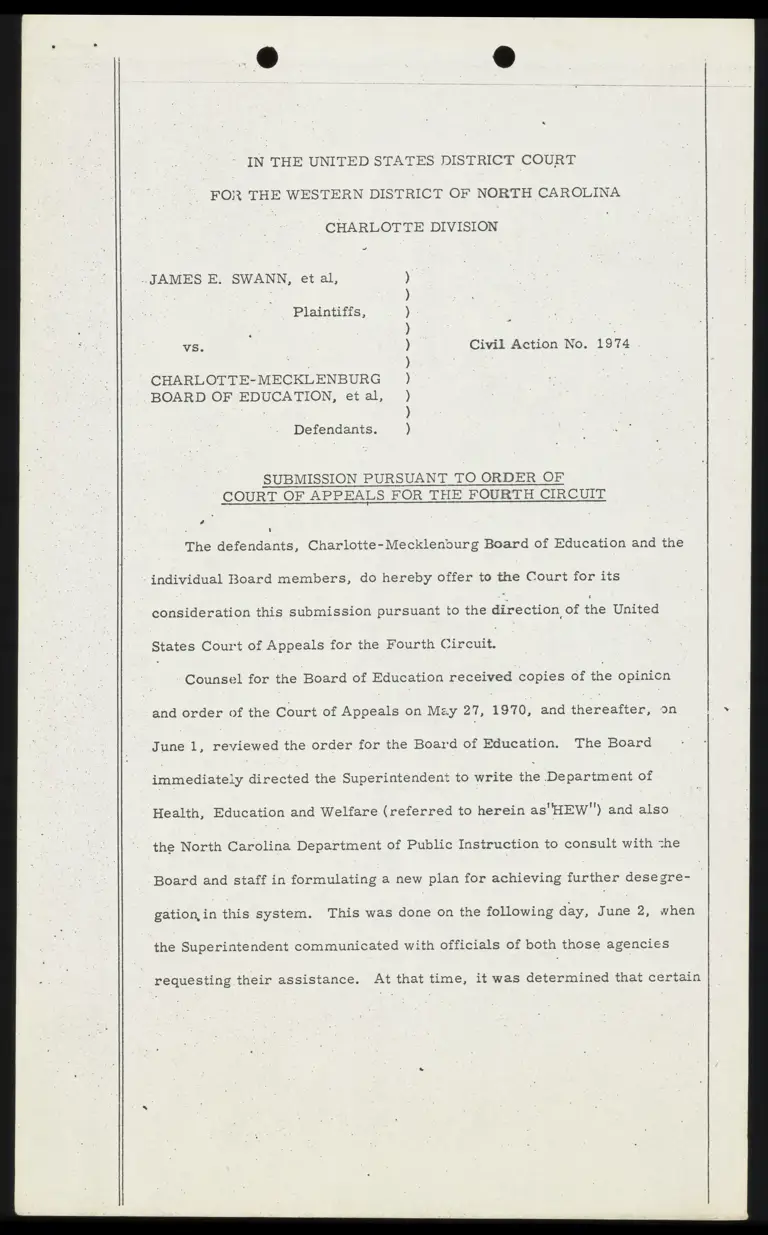
     [||529e26d8-73c8-4081-8d4e-4649bdc4a9e2||] IN THE UNITED STATES DISTRICT COURT

~ FOR THE WESTERN DISTRICT OF NORTH CAROLINA

CHARLOTTE DIVISION
-

JAMES E. SWANN, et al,

~ Plaintiffs,

vs. Civil Action No. 1974

CHARLOTTE- MECKLENBURG
"BOARD OF EDUCATION, et al,

N
r
”


N
p
?


a
’


n
u
”


N
u
”


N
u
”


N
u


u
r
”


u
t
”


w
r
”


Defendants.

SUBMISSION PURSUANT TO ORDER OF

COURT OF APPEALS FOR THY FOURTH CIRCUIT


Ld

\

The defendants, Charlotte-Mecklenburg Board of Education and the

. individual Board members, do hereby offer to the Court for its

consideration this submission pursuant to the direction of the United

States Court of Appeals for the Fourth Circult. |

- Counsel for the Board of Education received copies of the opinicn

-and order of the Court of Appeals on Mey 21, 1970, and thepealier, on

Sine 1, reviewed the order for the Board of Education. The Board

| immediately fipecied the Superintendent to write he Department of

Health, Education and Welfare (referred to herein as"HEW') and he

the North adoring Department of Public Instruction to consult with “he

Board and staff in formulating a new plan for achieving further desegre-

gation, in this system. This was done on the following day, Silas 2, when

the Superintendent communicated with officials of both those agencies

requesting their assistance. At that time, it was determined that certain


. information WAS degiped by HEW relating to maps, attendance zones,

- location and number of Pils. availability of mobile units and similar

: data, ‘which the school staff immediately began to assemble. Specifics

regarding the number of buses, bus Poulos, capital outlays, operation

costs and other transportation information were neither requested nor

: developed by HEW. |

; One wet later, on June 8, representatives of HEW arrived in

: : Charlotte for the first time and conferred at length with the Superintendent,

; Bord nat rine i Dood RAGE, At this iat contri the o

opinion of the Court of Apesls was reviewed by HEW and the school

staff to determine the nature and scope of their task. The Selo system

~ was advised that HEW proposed Sia the week of June 8 becoming

samitiar with the school system and gathering data and that the following

week would be devoted to preparation of alternate plans in HEW's Atlanta

office for presentation before an ad hoc committee in Washington on

© June 25. |

At the outset, the school staff urged HEW to afford opportunities
: aR '

for consultation regarding the tentative proposals of HEW as they 2volved.

: The staff was advised that these opportunities would be afforded on the

occasions of HEW's pentodle return visits to Charlotte.

; On June 1", the Superintendent, Board Chairman and Board Shtotneys

met with the representatives of HEW. The Superintendent and Assistant

Superintendent offered to go to the Atlanta office of HEW in order to Be

available for consultation and advice during the formulation of the HEW

 Eocommentations, a suggestion which was hts declined. Further,

HEW was requested to keep the staff and Board apprised of developments.

However, the contacts between HEW and the school staff were limited to

the furnishing of statistical data.


Yr.

On June 12, the HEW representatives loft the City and did

: > communicate further: or return until June 17, when they again Pe foany

‘additional information. During this Lis HEW officials gale failed to

discuss their plans with the staff. They departed Charlotte on Friday,

> Sura 19.

Although consultation with HEW representatives was repeatedly

“sought, it soon became apparent that the opportunities to confer and

consult with reference to Board SEptistnsiion in the development of any

plan were going to be disappointing. Accordingly, in furtherance of

prior Board instructions, the school staff, in Sstorail ele Bh with

‘members of the Board, explored and considered a number of possible

techniques for hia further desegregation. These efforts continued

contemporaneously with those of HEW. Both the staff pd the Board

would have We an opportunity to get the benefit of the thinking

and guidance. of HEW concerning the varions proposals under consideratio Ls

| On June 24, the Superintendent was informed by telephone that

3 Several Slternals plans had been presented to the ad hoc committez in

Washington and that the Atlanta office of HEW had been directed tc pre-

“pare and refine only one of those plans. Later that day, the HEW repre-.

sentative revealed the general nature of the plan without any sSpeciiics,

ow he did not oval the nature of the aiorniis plans which were!

A considered and discarded. |

On June 24, an executive session of the Board was held to consider

the fen current status of efforts to ~onsult with HEW before its

recommendations became finalized. At this meeting, the Board conducted

an in-depth review of the various techniques which had been under

consideration, independently of HEW.


On June 26, at 5:15 p.m., the final HEW plan, a copy of which

is attached, was delivered to the Superintendent at the When by a

Cepresdniative of HEW.

On the following morning, Saintes June 27, the Board of Education

met in Ss sative taduion to consider the tan submitted by HEW, a plan

| ocired by a minority of the Board and fue feasibility of other

desegregation techniques. The Board met again in executive and public

session on Monday IE Monday evening to Larue aislyss the

* HEW diag a implications -- along with a goiieral review ol ihe :

& x Minority plan and a detailed appraisal of the various teres methods :

a3 5 ‘of accomplishing further desegregation that had been considered during’ a

the ratios Soieral weeks. | |

wns noted that no transportation estimates were furnished and the

HEW report ti ocavied that the school staff develop the ATeDErishin,

figures in coniuliaiion with fnsir office using normal North Carolina

= procedures and furnish those to the Court by August 1.

The Board based that the plan offered by HEW completely

. disregards any educational organizational patterns for the various levels

of RAE, For instance, in lieu of the present 6-3-3 system,

i? zone #1 would substitute a 2-2-2-3-3 organization pattern and zone #2

~ would subsiitute a 3-i1-Hiss pattern. | Such an Se would

result in children attending five schools in zone #1 or six schools in

zone #2 during the course of their education. Such a pattern of

organization does not support sound educational principles. Further,
..

it places on the student an undue burden in adjusting to new schools,

classmates and teachers at frequent intervals. The organizational


: arrangement recommended by the HEW plan would act as a deterrent

to innovative practices such as ungraded casio thus limiting the

educators' ability to adapt school ara to the Batali needs of the

Satan: population.

Furthermore. families would find elementary children in attendance

at several schools, thereby seriously eroding the home-school ties

which it's susetiisl to building good shoal SoPramas; Experience has

shown that home-school ties are strongest at the elementary level.

Fragmentation of the elementary school pattern would tend to weaken

‘this at a most crucial time of the Hits devslopiont

In a GT of schools, the plan submitted by the Department of

‘Education ci darted disregard for capacity. In Sera I eas,

in the Sars Sotien some chbols were overpopulated while others

were underpopulated. Villa Heights, with a normal cael of

approximately 625 Students was assigned 1,309 students. The plan

indicated that the extra students would be redpranadshed by the location

of 23 portable units on the school grounds. In view of the limited

acreage in this school site, it is doubiful if these units could be

accommodated. Such a arrangement would also Sresity overtax tne

school's lanchroom. library, health room and restroom facilities. A

similar problem of overcrowding is to be found in ihe recommendation

ve gor ding Pinewood Rioenlins School. “Under-viilizesion of facilities

would exist at Shamrock Gardens, Plaza Road, Chantilly, First Waza

Sedgefield, Collinswood, Ashley Pari sad Lakeview, The total dambes

. + OF vacant ts in fone schools would be the equivalent of two full |

8 elementary schools. In view of the fact that the elemenary enrollment

of the school system is at present 12% over the existing capacity, the

system cannot afford such under-utilization.


. .indicated.

3 separate school districts within the system, Individual schools, and

=
[

Furthermore, it appears that many of the schools would be

approximately 50% black or nearly 50% black which at ot is a temporary

condition as experience of the Sysiem has shown that schools containing

such pitionioth blacks have rapidly become all-black schools. gis Repors

of the Hoard Suid November 1%, 1969, which discloses ten former

all-white Schools once they achieved a 40% ratio rapidly turned all

black. | i

The Board then considered a proposal for desegregation submitted

by Board members, Dr. Carlton G. Watkins, Mrs. Betsey Rely,

Mrs. Julia Maulden and Rev. Coleman Kerry, which is attached as

Exhibit "B".

It is ohearved that the plan utilizes the existing attendance zones

(1968-1970) and rediicds some of the long distance cross busing Prarie

by the Finger plan and eliminates the gerrymandered geographic zones.

Cost and other details have not been developed 2t this time. However,

a preliminary aarinad estimate of Dr. Watkins suggests that 17, 567

students would be ese assigned and that 12, 740 Sindonits would be

cross bused. It would require approximately 144 % 180 additional buses

to srovils the rioconadiy transportation. At the time of the hearing, it

1s believed that reliable estimates in this regard will be available.

In accordance with the directive of a Court of Appeals, without

the benefit of consultation with HEW, the Board of Education considered

a variety of alternatives and reached the observations and conalueions

‘With reference to school RETR it was concluded that this

techiigue referred to the consolidation of separate school systems,

: with various Srisanlaational REranseaents of ate evels, It was


further observed that with respect to consolidation of systems, this was

accomplished in 1960 by the consolidation of the Charlotte City Schools

' olin the Mecklenburg Conliv. Stole. With respect to separate toric]

“districts within the system, it was noted that this consolidation had

oS iried in 1965 with the abolition of separate school districts for black

: and white students. With respect to consolidation as it effects individual

: schools, it was noted that considerable activity had occurred in inte area

since 1965. More than twenty sehoats have been closed during this

period. Closings in the past pave resulted where schools were obsolete,

where enrollment was diminishing or because of encroachment of business,

industry or traffic arteries. The Sistriotd of the ansleciod schools have

been redrawn so as to include the districts of the dosed schools and the

Eade Soot the closed schools hive been assigned to the school

i serving the newly drawn zone. Constieriiion was given to the possibility

of further consolidation of individual schools. In view of the Substantial

| g overcrowding which exisis in the schools at this time, further school

closings cannot be seriously considered. With regard to sogsaligaiion

through a reorganization of the present ora structure it was observed

that such a move must, of necessity, be accompanied by a carefully ;

planned RI program. The system is now using a 6-3-3

‘organizational attin To change to a 224 pattern would require

: sizable additions to all junior and senior high schools or considerable

rerovation of surplus otoiianisiy facilities. In view of the fact that

‘junior and senior high schools are even more overcrowded than the

"elementary schools and in view of the fact that addition of another grade

3 level would lead to additional overcrowding by 33% at each secondary

+ school, use of this technique was rejected.


. The Board of Education then considered rezoning as follows.

; Traditional rezoning has embodied the concept of school lines which

| respected natural barriers and convenient distances from schools. This

concept was previously rejected by the District Court. In an examination

: of equidistant zoning, it was concluded that the use of this method would

result in lens desegregation than that accomplished by the gerrymandered

lines of the Board's present plan and accordingly, this approach was

: rejected as Being out of step with the directives of the Court of Appeals.

The previous Board plan sHilizon io the maximum extent gerrymandered

rezoning to produce desegregation. Therefore, further consideration to

this technitis was unnecessary.

Geographic zoning using Tatsltits districts as employed in the junior

and Senos high schools "as considered. It was observed that such |

busing out of blacks would not reduce the number of all blick schools.

| Pothorinda, it old eataoott very young children out of their neigh-

: borhoods which the Board regards as an unsound educational technique.

To crate satellite zones in the white areas and cross bis 10 the black

areas would, in effect, be a relnsitinilon of the Finger plan which was

iSaupioved by the Court of Appeals.

In an Stamat th achieve further desegregation, consideration was

given to the effect of removing the limitation of 40% nlaoy a a require-

ment in the Board's original plan. The Srosedure toliowhd was to extend

the attendance lines of schools near all-black residentail areas so as to

include more black students. It was thot necessary to reduce ihdue Sime

A Bushes lines in other A 56 as to adjust the new student population

to an inflexible school Copaatiy. The cumulative effect of these moves

"was to reduce the enrollment of black inner-city schools, increase the


x : be accomplished by this means without resorting to substantial disruptive

proportion of black students in perimeter schools, increase the |

| proportion of watie students in suburban schools, and over-populate the

suburban schools. For these reasons, the use of this technique was not

considered feasible. |

‘Pairing, grouping and clustering were jointly considered as they

‘are, in Soret. one technique. | It was concluded that one approach would

be to group the schools which Surround 3 "target" or all-black school.

-.. In this instance, the surrounding school disirtots would all be contigugus

.-to the district to be desegregated. A second approach to pairing,

| grouping and clustering WE, be to join together districts contiguous

with ons another but not having a single district line in common. Such

an arrangement might join Grim districts in a linear direction along

eonveient transportation arteries. A third approach to Saining grouping

-, and clustering would be to link together non-contiguous school districts

solely for the’ purpose of assignment pupils. | |

All of the various approaches to pairing, grouping and clustering

‘were considered by the Board and were rejected by a majority of the

Board as being unreasonable. It was cddelndad that while he first

approach had the effect of minimizing transportation, it tended t%

accelerate the growth of the solid black residential areas. At best,

“such grouping promises only a temporary solution to the problem, Where bi

: lamontasy schools are involved, the second and third approaches to

clustering foyolve substantial APenspoRLaion of very young children.

~ Upon examination, it was found that no substantial aetugedstion could

and expensive long-distance transportation in congested walilc areas.

For the foregoing reasons, the majority of the Board rejected the use

of pairing, grouping and clustering.


Full in-depth consideration having been given to all known techniques

in response to the directives of the Court of Appeals, the deliberation of

both the staff and the Board served on.y to reaffirm the District Court's

finding:

~ "(T)here is no way to desegregate the all-black schools
in Northwest Charlotte without providing {or continuing
to provide) bus or other transportation for thousands of

children. The plans and all variations of plans considered

for this purpose lead in one fashion or another to that

conclusion."

g Consideration of all methods required to make meaningful progress in

desegregating the all-black schools in the judgment of the Board points

unerringly to the fact that the means to the end are unreasonable.

As part of this submission, the following are attached:
;

‘L.” The HEW Plan (Exhibit "A").

"2. The Minority Plan (Exhibit "B").

3. Resolution adopted by the Board at its June 29, 1970, meeting
(Exhibit "EY oe

‘Respectfully submitted this 29h any of June, 1970.

ORS 5
rd ay

ee cr Ah
frm lAl"N
£.~

"Naw ew By


William J. on af
‘Weinstein, Waggoner, Sturges, Odom

| & Bigger

1100 Barrimger Office Tower

Charlotte, North Carolina

g
h


\
A ii , Y

Ry by Pp,
! < ™ be} Ld i 1 Lamy ™ IN

ARG EW a ok 100 Su! BWASN

‘Benjamin S. Horack 0
Erwin, Horack and McCartha

: 8 SEE el - 806 East Trade Street

a : ry ht SE ye Charlotte, North Carolina


Attorneys for Defendants

- [||529e26d8-73c8-4081-8d4e-4649bdc4a9e2||]