Moose Lodge No. 107 v. Irvis Motion for Leave to File and Brief Amicus Curiae
Public Court Documents
January 1, 1972
-
Brief Collection, LDF Court Filings. Moose Lodge No. 107 v. Irvis Motion for Leave to File and Brief Amicus Curiae, 1972. 24eca6c6-be9a-ee11-be36-6045bdeb8873. LDF Archives, Thurgood Marshall Institute. https://ldfrecollection.org/archives/archives-search/archives-item/6ec26b07-9376-42f4-8da6-feb474e75859/moose-lodge-no-107-v-irvis-motion-for-leave-to-file-and-brief-amicus-curiae. Accessed September 23, 2026.
Copied!
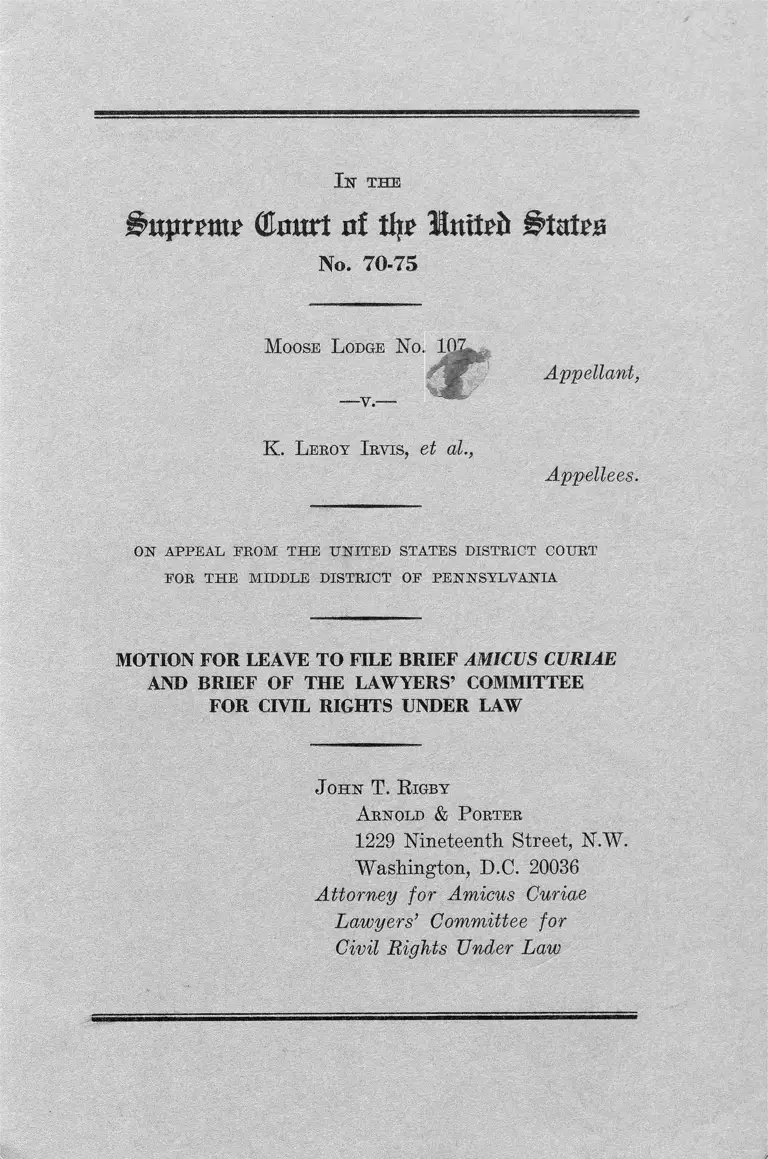
I n the
(Emtrt nf % Mnlttb States
No. 70-75
Appellant,
Appellees.
ON APPEAL FROM THE UNITED STATES DISTRICT COURT
FOR THE MIDDLE DISTRICT OF PENNSYLVANIA
MOTION FOR LEAVE TO FILE BRIEF AMICUS CURIAE
AND BRIEF OF THE LAWYERS’ COMMITTEE
FOR CIVIL RIGHTS UNDER LAW
J ohn T. B igby
A rnold & P orter
1229 Nineteenth Street, N W .
Washington, D.C. 20036
Attorney for Amicus Curiae
Lawyers’ Committee for
Civil Rights Under Law
M oose L odge N o.
K. L eroy I rvis, et al.,
In the
Bnpvmw (Emtrt of % Inttzb j&tatefl
No. 70-75
Moose L odge No. 107,
-v.
Appellant,
K. L eroy I evis, et al.,
Appellees.
o n a p p e a l p r o m t h e u n it e d s t a t e s d is t r ic t c o u r t
EOR THE MIDDLE DISTRICT OF PENNSYLVANIA
Motion for Leave to File Brief Amicus Curiae
The Lawyers’ Committee for Civil Rights Under Law
hereby respectfully moves for leave to file the attached
brief Amicus Curiae. The Committee supports affirmation
by the Court of the decision of the lower court that the
grant by the State of Pennsylvania to Moose Lodge No. 107
of a club liquor license was in violation of the Equal Pro
tection Clause of the Fourteenth Amendment.
The Lawyers’ Committee for Civil Rights Under Law
is organized as a not-for-profit corporation. Partly through
a paid staff, but primarily through the volunteer services
of members of the private bar, the Committee actively as
sists citizens in asserting and enforcing their civil rights.
The thrust of the Committee’s activities is to seek for these
citizens the full measure of the protection of the law against
racial discrimination.
The Committee maintains ten offices throughout the
United States as well as a national headquarters in Wash-
(i)
ington, D.C. A Board of Trustees of some one hundred
lawyers guides the national activities of the Committee,
with smaller boards or steering committees directing the lo
cal offices. The membership of the national Board of Trus
tees represents a cross-section of the American bar, as do
the hundreds of attorneys who have volunteered to handle
civil rights cases under the auspices of the Committee since
its inception in 1963. Participants in Committee activities
include single practitioners as well as the range from young-
associates to senior partners in law firms of all sizes.
The Committee numbers among its national and local mem
bers fifteen presidents of the American and National Bar
Associations, including both incumbents, and two former
Attorneys General of the United States.
The Committee has requested consent by Appellant and
Appellee to the filing of a brief Amicus Curiae. Appellee
has not consented. Appellant has declined to consent. The
Committee, therefore, moves pursuant to Buie 42(3) for
leave to file the annexed brief Amicus Curiae.
1. The interest of the Committee in this case arises from
its dedication to and interest in implementation of Consti
tutional guarantees of civil rights. As described above,
the Committee has for the past eight years been an active
participant in this nation’s effort to eradicate the stain
of racial discrimination.
2. The Committee proposes, in its brief Amicus Curiae,
to address itself to a matter of immediate and major in
terest to the Committee, that is, the Court’s standards for
determining whether the Equal Protection Clause of the
Fourteenth Amendment precludes a State from granting
a liquor license to an organization which engages in racial
discrimination. In the event that the Court accepts juris-
diction in this case, decision by the Court on the merits
will no doubt mark a major step in the evolution of the
law concerning the implications of State involvement in
private acts of racial discrimination.
3. The Committee believes that the decisional criteria
employed by the lowrnr court, and the thrust of Appellee’s
argument, would, if adopted by the Court, lead to an
unacceptably quantitative standard for ascertaining the ex
istence of State action prohibited by the Equal Protection
Clause. The Committee believes that its interests in the
outcome of this litigation can be adequately represented
only if the Court considers the argument that the Equal
Protection Clause of the Fourteenth Amendment prohibits
a State from taking action, other than to discharge a gov
ernmental responsibility owed to all of its citizens, that
has the effect of authorizing or enhancing private discrim
ination. The Committee understands that Appellee does
not propose to make this argument to the Court. Thus, the
interests of the Committee will not be adequately repre
sented unless the Committee is granted leave to file the
annexed brief.
Respectfully submitted,
J ohn T. R igby
A rnold & P orter
1229 Nineteenth Street, N.W.
Washington, D.C. 20036
Attorney for Amicus Curiae
Lawyers’ Committee for
Civil Rights Under Law
I N D E X
PAGE
Motion for Leave to File Brief Amicus Curiae ......... (i)
B r ie f :
Interest of Amicus .............................................................. 2
Statement .............„................................................. 2
A r g u m e n t :
The Equal Protection Clause of the Fourteenth
Amendment Prohibits a State From Taking Any
Action, Other Than to Discharge a Governmental
Responsibility Owed to All of Its Citizens, That
Has the Effect of Authorizing or Enhancing Pri
vate Discrimination ................................. 3
C o n c l u s io n ...................................................................... o
Cases:
T a b l e o f A u t h o r it ie s
Burton v. Wilmington Parking Authority, 365 U.S.
715 (1961) .2, 3, 4, 5
Civil Rights Cases, 109 U.S. 3 (1883)
Loving v. Virginia, 388 U.S. 1 (1966) ...........................
Nippert v. Richmond, 327 U.S. 416 (1946)
Palmer v. Thompson, ------ U.S. ------ , 91 S.Ct. 1940
(1971) ..........................................
3
7
4
5,7
PAGE
Reitman v. Mulkey, 387 U.S. 369 (1967) ................... 4
Joseph Seagram & Sons, Inc. v. Hostetler, 384 U.S. 35
(1966) ........................ ............................................. „ ...... 4
Shelley v. Kraemer, 334 U.S. 1 (1948) ........................... 3
Terry v. Adams, 345 U.S. 461 (1953) ........................... 2, 5
United States v. Frankfort Distilleries, Inc., 324 U.S.
293 (1945) ....................................................................... 4
United States v. Guest, 383 U.S. 745 (1966) .................. 5
Constitutional Provisions:
United States Constitution
First Amendment ....... 7
Fourteenth Amendment ........................................ passim
Twenty-first Amendment .......................................... 4, 6
11
I n the
Gkwrt at % Intuit States
No. 70-75
M oose L odge N o. 107,
K. L ekoy I rvis, et al.,
Appellant,
Appellees.
ON APPEAL FROM THE UNITED STATES DISTRICT COURT
FOR THE MIDDLE DISTRICT OF PENNSYLVANIA
BRIEF OF THE LAWYERS’ COMMITTEE
FOR CIVIL RIGHTS UNDER LAW
This brief is submitted by the Lawyers’ Committee for
Civil Rights Under Law as Amicus Curiae.
INTEREST OF AMICUS
The Lawyers’ Committee for Civil Rights Under Law is
organized as a not-for-profit corporation. Partly through
a paid staff, but primarily through the volunteer services
of members of the private bar, the Committee actively
assists citizens in asserting and enforcing their civil rights.
The thrust of the Committee’s activities is to seek for these
citizens the full measure of the protection of the law against
racial discrimination.
The Committee maintains ten offices throughout the
United States as well as a national headquarters in Wash
ington, D.C. A Board of Trustees of some one hundred
2
lawyers guides the national activities of the Committee,
with smaller hoards or steering committees directing the
local offices. The membership of the national Board of
Trustees represents a cross-section of the American bar,
as do the hundreds of attorneys who have volunteered
to handle civil rights cases under the auspices of the Com
mittee since its inception in 1963. Participants in Com
mittee activities include single practitioners as well as the
range from young associates to senior partners in law firms
of all sizes. The Committee numbers among its national
and local members fifteen presidents of the American and
National Bar Associations, including both incumbents, and
two former Attorneys General of the United States.
The interest of the Committee in this case arises from
its dedication to and interest in implementation of Con
stitutional guarantees of civil rights.
STATEMENT
Amicus agrees with the proposition, as stated in Burton
v. Wilmington Parking Authority, 365 U.S. 715, 722 (1961),
that “ to fashion and apply a precise formula for recogni
tion of state responsibility under the Equal Protection
Clause is an ‘impossible task.’ ” The potential range of
the Court’s inquiry for discerning state action in violation
of the Equal Protection Clause was described by Mr. Jus
tice Frankfurter in his separate opinion in Terry v. Adams,
345 U.S. 461, 473 (1953):
“The vital requirement is State responsibility—that
somewhere, somehow, to some extent, there be an in
fusion of conduct by officials, panoplied with State
power . . . .”
The unavailability of “ readily applicable formulae” has
led the Court, in assessing nonobvious involvement of the
3
State in private conduct, to engage in “sifting the facts and
weighing the circumstances” to determine whether the
Equal Protection Clause has been violated. Burton, supra,
365 U.S. at 722, 725. Amicus, in these terms, wishes to
address itself to the dimensions of the sieve and the scale
which may be employed in this process.
A R G U M E N T
The Equal Protection Clause of the Fourteenth
Amendment Prohibits a State From Taking Any Action,
Other Than to Discharge a Governmental Responsibility
Owed to All of Its Citizens, Thai Has the Effect of
Authorizing or Enhancing Private Discrimination.
I.
This case involves implementation of a State liquor
regulatory and licensing scheme which lias the effect of
sustaining a private fraternal organization which, in its
membership and guest policies, engages in racial discrimi
nation. The State of Pennsylvania consciously authorized
Moose Lodge No. 107, while reaping the economic benefits
of a valuable grant extended by the State, to make a dis
criminatory classification based on color.
The question before the Court is not whether the Moose
Lodge or its members may, individually or jointly, engage
in acts of racial discrimination.1 Nor, Amicus submits, is
the question merely whether the relevant activities of the
State of Pennsylvania, through its liquor licensing and
1 The Civil Rights Cases, 109 U.S. 3 (1883), “embedded in our
constitutional law” the principle that the Equal Protection Clause
“erects no shield against merely private conduct, however discrim
inatory or wrongful.” Shelley v. Kraemer, 334 U.S. 1, 13 (1948)
(emphasis added) ; Burton, supra, 365 U.S. at 721.
4
regulatory process, are sufficient in frequency and magni
tude, to make the State an unconscious partner or actual
participant in the discriminatory practices of the Moose
Lodge. Amicus suggests that the Equal Protection Clause
precludes a State from undertaking any affirmative action,
other than to discharge a governmental responsibility owed
to all of its citizens, that has the effect of authorizing or
enhancing private discrimination.
II.
There can be no question that we are here dealing with
“ state action” . The State has acted. It has enacted a
liquor code, under authority recognized by the Twenty-first
Amendment.2 In implementation of this enactment, the
State has extended to a private organization—racially
exclusionary in its membership and guest policies—the val
uable authority to sell liquor by the drink. The State itself
could not form and operate a club which discriminated
against individuals on the ground of their race. The ques
tion, of course, is whether the State’s action here was such
as to warrant attribution to the State of the private club’s
discriminatory practices. As in Burton v. Wilmington
Parking Authority, supra, 365 U.S. at 722, and Reitman
v. Mulkey, 387 U.S. 369, 378 (1967), this case presents an
instance of “ nonobvious involvement of the State in private
conduct.”
2 Under the Twenty-first Amendment, a State has “full authority
to determine the conditions upon which liquor can come into its
territory and what will be done with it after it goes there
United States v. Frankfort Distilleries, Inc., 324 U.S. 293, 299
(1945) ; Joseph Seagram & Sons, Inc. v. Hostetter, 384 U.S. 35, 42
(1966). The Court has described “ commerce in intoxicating liquors”
as commerce “over which the Twenty-first Amendment gives the
States the highest degree of control.” Nippert v. Richmond. 327
U.S. 416, 425 n. 15 (1946).
5
There is no requirement that the State involvement in
private action, to be violative of the Eqnal Protection
Clause, “be either exclusive or direct. In a variety of situa
tions the Court has found state action of a nature sufficient
to create rights under the Equal Protection Clause even
though the participation of the State was peripheral, or
its action was only one of several co-operative forces lead
ing to the constitutional violation.” United States v. Guest,
383 U.S. 745, 755-56 (1966) (citations omitted); Terry v.
Adams, supra. Nor is it necessary here to show that the
State enactment or action is itself racially motivated. As
stated in Palmer v. Thompson,-------U.S. — —, 91 S.Ct.
1940, 1945 (1971), the focus is properly “ on the actual
effects of the enactments.” Here, the effect of the enact
ment, as implemented by the State itself, was not only
to authorize private racial discrimination but, in fact,
to provide the economic underpinning for the discrimina
tion. (See Jurisdictional Statement, p. 18; A 19-20, 25)
III.
The court below utilized essentially quantitative measures
to determine whether equal protection of the laws has been
denied to Appellee Irvis by the State. The court relied
primarily on the “ all-pervasiveness” of the Pennsylvania
Liquor Code to conclude that the State, in the terms of
Burton, supra, has “ insinuated itself into a position of
interdependence” with its private club licensees. (A 34)
Because of the likely effect of this case on other litiga
tion now under way in State and Federal courts involving
State roles in aid of private acts of racial discrimination,3
3 As suggested by Mr. Justice Blackmun in his concurring opinion
in Palmer v. Thompson, supra, 91 S.Ct. at 1947: “ In isolation this
litigation may not be of great importance; however, it may have
significant implications.” Numerous examples of related litigation
6
Amicus urges tliat the Court take pains to avoid resting its
decision in this case on a primarily quantitative assessment
of the relevant State role or action. However “ pervasive”
may be the interaction of the State and the private roles
in the discriminatory scheme, it suffices that the State exer
cised its discretion to extend a valuable privilege in sup
port of what the State must have known to be racially
discriminatory acts.
The Twenty-first Amendment did not have the effect of
recognizing a right of individuals or organizations to dis
pense liquor for pay. Bather, the Twenty-first Amendment
restored to the States their comprehensive authority to reg
ulate intra-state liquor commerce as they deemed appro
priate. See n. 2, supra. A liquor license—particularly one
entailing the opportunity to profit from the sale of liquor—
is unquestionably a privilege, and not a right. Appellant
has stipulated in this case that “ the receipt and ownership
of such a license is a valuable privilege granted to a club”
by the State. (A 25, 4) Grant of such a privilege is an act
of discretion by the State.
Appellant has sought to reduce to an absurdity the
lower court’s application of Equal Protection prohibitions
to Pennsylvania’s extension of liquor dispensing privi
leges to the Moose Lodge. Appellant suggests, for example,
that the lower court’s ruling would require the recipient
of a marriage license to accept any person as a spouse,
regardless of race and regardless of the license recipient’s
choice. Appellant argues that it is no less prohibited “ state
action” to license a marriage in which the participants
engage in racial discrimination than it is to extend the
are set forth in Appellant’s Memorandum In Opposition to the
Motion to Affirm (pp. 3-4) and in the Amicus briefs filed in sup
port of Appellant.
7
privileges of liquor sales to a racially discriminating fra
ternal organization.
Appellant’s argument is but an extreme postulation of
the proposition: “ Is it prohibited state action to furnish
public utilities, or police and fire protection, which has the
effect of sustaining private racial discrimination?” The
answer lies in the distinction between State activities, in
the nature of grants or services, which by law or tradition
the State is bound to furnish to all citizens, and those
State grants which are in the nature of privileges.4 A
liquor license, under the Pennsylvania statute, falls in the
latter category.
There is no Constitutional or Federal statutory provi
sion imposing an affirmative duty on the State to authorize
private sales of liquor. Nor is the authorization of private
liquor sales a response to a duty under which, like the
furnishing of police and fire protection or a marriage li
cense, a State is required by law or tradition to furnish to
every one of its citizens.5 6 Thus, the State of Pennsylvania
would be required to permit a speaker, in exercise of his
First Amendment rights, to use a public hall even if that
speaker sought to advocate separation of the races. And
the State would be required to furnish police protection
to every individual or group regardless of their private
beliefs or predilections.
But the State is not required by law to authorize or pro
vide the economic support for an individual or group by per
mitting the sale of liquor. Amicus submits that the State
is precluded by the Equal Protection Clause from such an
authorization where its effect would be to sustain racial
discrimination.
4 The rationale of Palmer v. Thompson, supra, serves as a useful
analytical tool for recognizing this distinction.
6 See, e.g., Loving v. Virginia, 388 U.S. 1, 12 (1966).
8
CONCLUSION
The judgment of the District Court should b e affirmed.
The grant by the State of Pennsylvania to Moose Lodge
No. 107 of a club liquor license was in violation of the
Equal Protection Clause of the Fourteenth Amendment.
Respectfully submitted,
J ohn T. R igby
A rnold & P orter
1229 Nineteenth Street, N.W.
Washington, D.C. 20036
Attorney for Amicus Curiae
Lawyers’ Committee for
Civil Rights Under Law