Second Amended Complaint
Public Court Documents
March 3, 1975
19 pages
-
Case Files, Milliken Hardbacks. Second Amended Complaint, 1975. 0b099444-54e9-ef11-a730-7c1e5247dfc0. LDF Archives, Thurgood Marshall Institute. https://ldfrecollection.org/archives/archives-search/archives-item/6f0b73dc-3bb6-45ef-814d-e9332600db11/second-amended-complaint. Accessed October 05, 2026.
Copied!
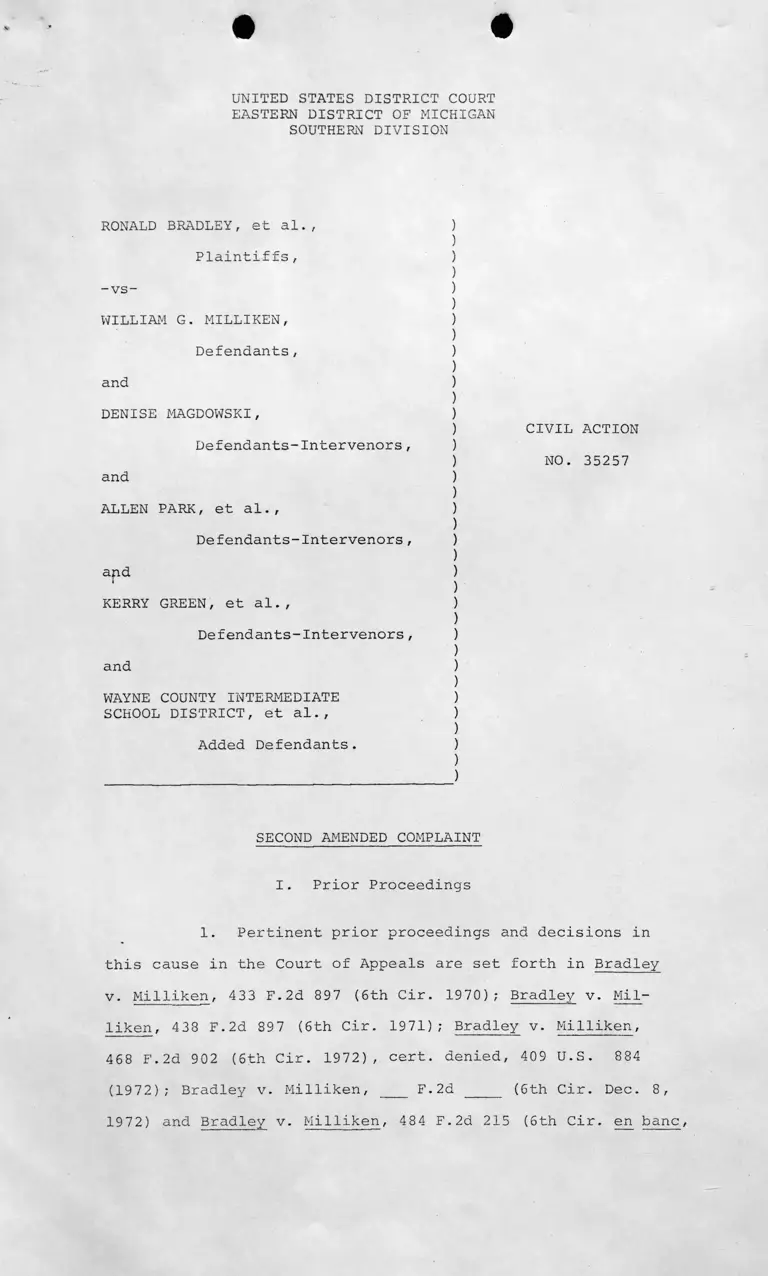
UNITED STATES DISTRICT COURT
EASTERN DISTRICT OF MICHIGAN
SOUTHERN DIVISION
RONALD BRADLEY, et al., )
)
Plaintiffs, )
)
-vs- )
)
WILLIAM G. MILLIKEN, )
)
Defendants, )
)
and )
)
DENISE MAGDOWSKI, )
)
Defendants-Intervenors, )
)
and )
)
ALLEN PARK, et al., )
)
Defendants-Intervenors, )
)
and )
)
KERRY GREEN, et al., )
)
Defendants-Intervenors, )
)
and )
)
WAYNE COUNTY INTERMEDIATE )
SCHOOL DISTRICT, et al., )
)
Added Defendants. )
)
) * 1
CIVIL ACTION
NO. 35257
SECOND AMENDED COMPLAINT
I . Prior Proceedings
1. Pertinent prior proceedings and decisions in
this cause in the Court of Appeals are set forth in Bradley
v. Milliken, 433 F.2d 897 (6th Cir. 1970); Bradley v. Mil
liken, 438 F.2d 897 (6th Cir. 1971); Bradley v. Milliken,
468 F .2d 902 (6th Cir. 1972), cert, denied, 409 U.S. 884
(1972); Bradley v. Milliken, ___ F.2d ____ (6th Cir. Dec. 8,
1972) and Bradley v. Milliken, 484 F.2a 215 (6th Cir. en banc
1973), and Milliken v. Bradley, 414 U.S. 1038 (1973). The
pertinent prior proceedings and decisions in this cause in
the District Court are set forth in the September 3, 1970
Ruling on Application for Preliminary Injunction, Motion
to Intervene, and Motion to Dismiss, aff * d in part and rev1d
in part, 433 F.2d 897 (1970); December 3, 1970 Ruling on
School Plans submitted, remanded with instructions, 438 F.2d
897 (1970); February 16, 1971 Rulings and Order on Class
Action and Standing; Ruling on Issue of Segregation, 338 F.
Supp. 582 (E.D. Mich. 1971) , aff * d en banc, 484 F.2d 215
(1973); Findings of Fact and Conclusions of Law on Detroit-
Only Plans of Desegregation, ____ F.Supp.____ (E.D. Mich.
March 28, 1972) , af f *d en banc, 484 F.2d 215 (6th Cir. 1973)
Ruling on Propriety of a Metropolitan Remedy to Accomplish
Desegregation of the Public Schools of the City of Detroit,
_ F.Supp. ___(E.D. Mich. June 12 , 1973) , af f * d en banc
in part, and vacated en banc as set forth in 484 F.2d 215
(6th Cir. 19 73) ; Ruling on Desegregation Area and Development
of Plan, Findings of Fact and Conclusions of Law in Support
Thereof, 345 F.Supp 914 (E.D. Mich. 1972), vacated en banc in
part and reinstated en banc in part as set forth in 484 F.2d
215 (6th Cir. 1973) ; Order for Acquisition of Transportation,
___ F.Supp. ____ (E.D. Mich. July 11, 1972) , vacated en banc
as set forth in 484 F.2d 215 (6th Cir. 1973), and Milliken v.
Bradley, 414 U.S. 1038 (1974), rev'd in part, aff'd in part.
2. The jurisdiction of this Court is invoked under
28 U.S.C. §1331 (a), 1343 (3) and (4), this suit being a suit to
redress the deprivation under color of Michigan law, statute,
regulation, custom and/or usage of rights, privileges and
immunities secured by the Thirteenth and Fourteenth Amend
ments to the Constitution of the United States, and/or by 42
U.S.C. §§1981, 1982, 1983 , 1988 and 2000e providing for the
equal rights of all citizens and persons and for the same
-2
N*
rights to the full and equal benefits of all laws and pro
ceedings for the security of persons and property as is
enjoyed by white citizens and persons. This is an action
for injunctive relief, and for declaratory and other relief
pursuant to 28 U.S.C. §§2201, 2202. The matter in contro
versy exceeds, exclusive of interest and costs, the sum or
vale of ten-thousand dollars ($10,000.00).
3. The pleadings and evidence alread of record
in this cause are now and have been on file in the District
Court and available for inspection and/or copying by any
interested party. Plaintiffs hereby incorporate by refer
ence the entirety of their original Complaint, in this
cause, filed August 18, 1970, as though set forth verbatim.
II. DEFENDANTS
4. The original Detroit School District Defen
dants are the Board of Education of the City of Detroit, its
Superintendent (now Charles Wolfe), and the members of the
Board of Education.
5. The original State Defendants are Governor
William J. Milliken, Attorney General Frank J. Kelley, the
Michigan State Board of Education and its Superintendent,
John W. Porter.
6. The intervening Detroit defendants are (a)
the Detroit Federation of Teachers Local 231, American Feder
ation of Teachers, AFL-CIO and (b) Denise Magdowski, et al.
7. The intervening suburban defendants are Allen
Park Public Schools, School District of the City of Berkeley,
Brandon Schools, Centerline Public Schools, Cherry Hill
School District, Chippewa Valley Public Schools, School
District of the City of Clawson, Crestwood School District,
Dearborn Public Schools, Dearborn Heights School District
No. 7, East Detroit Public Schools, School District of the
City of Ferndale, Flat Rock Community Schools, Garden City
Public Schools, Gibralter School District, School District
- 3-
• •
of the City of Harper Woods, School District of the City
of Hazel Park, Intermediate School District of the County
of Macomb, Lake Shore Public Schools, Lakeview Public
Schools, The Lamphere Schools, Lincoln Park Public Schools,
Madison District Public Schools, Melvindale-North Allen
Park School District, School District of North Dearborn
Heights, Novi Community School District, Oak Park School
District, Oxford Area Community Schools, Redford Union
School District No. 1, Richmond Community Schools, School
District of the City of River Rouge, Riverview Community
School District, Roseville Public Schools, South Lake
Schools, Taylor School District, Warren Consolidated
Schools, Warren Woods Public Schools, Wayne-Westland Com
munity Schools, Woodhaven School District, Wyandotte Public
Schools, Grosse Pointe Schools, Southfield Public Schools,
School District of the City of Royal Oak and Kerry Green,
et al.
8. The added state defendant is State Treasurer
Allison Green.
9. The added suburban defendants are (a) the
Wayne County Intermediate School District, the Oakland
County Intermediate School District, Fitzgerald Public
Schools, Fraser Public Schools, Van Dyke Public Schools,
Hamtramck School District, School District of the City of
Troy, Highland Park City School District, School District
of the City of Birmingham, Bloomfield Hills School District,
Farmington Public School District, Clarenceville School Dis
trict, West Bloomfield School District, Livonia Public School
District, South Redford School District, Romulus Township
School District, Inkster School District, Westwood Community
School District, Riverview Community School District, Ecorse
Public School District, Southgate Community School District,
Holly Area Schools, Huron Valley Schools, Lake Orion Com
munity School District, Rochester Community School, Walled
Lake Consolidated School District, Avondale School District
_ 4 _
Clarkston Community Schools, South Lyon Community Schools,
Waterford School District, Mt. Clemens Community School
District, Anchor Bay School District, Romeo Community
Schools, Clinton Dale Community Schools, L ’anse Creuse
Public Schools, South Lake Schools, Utica Community Schools,
Armada Area Schools, New Haven Community Schools, Plymouth
Community School District, Van Buren Public School District,
Grosse lie Township School District, Trenton Public School
District; (b) all other school districts, if any, in the
tri-county area except the School District of the City of
Pontiac; (c) the Boards of Education and Members of the Boards
of Education in each school district in the tri-county area
except the School District of the City of Pontiac; (d) the
Superintendents of each school district in the tri-county
area except the School District of the City of Pontiac.
III. ADDITIONAL ALLEGATIONS
10. Various actions by the original Detroit and
State defendants and their agents, in some instances supported
by or in conjunction with State laws have, wholly apart from
any actions of the suburban defendants or any of them, signif
icantly contributed to the containment of black children in
segregated, virtually all-black schools operated in the
City of Detroit. The pattern of official segregation and
containment has been an expanding one, as the black community
within Detroit has expanded, but with the consistent result
of establishing and maintaining racially identifiable black
Detroit schools surrounded by racially identifiable, vir
tually all-white schools throughout the tri-county area.
These actions have included, but are not limited to, new
school construction; discriminatory reimbursement of trans
portation funds; the validation and reimposition of the
boundaries of the Detroit School District, imposition of a
segregatory pupil assignment policy for the Detroit Public
Schools, creation of segregated school regional boundaries,
recision of steps toward desegregation, and the particular
carve-out of regional school governance units wholly within
the Detroit School District by Act 48 of the Public Acts of
1970; the transfer and/or transportation of students across
school districts and within school districts with the purpose
and/or effect of official school segregation; limitations on
operation of bonding authority; and the operation of state
aid and financial limitations; in conjunction with other
official actions of segregation which left the Detroit School
District virtually bankrupt and further identified it as a
black school district. This consistent and repeated discrim
ination by State officials and agencies, manifested by, among
others, the acts listed herein, is causally related in a
significant manner to the present, nearly total segregation
of black children within the tri-county area in virtually all
black public schools within the jurisdiction of the originalIs
Detroit defendants, their agents and successors. In carrying
out this pattern and practice of official segregation, the
State and its agencies have advantaged themselves of existing
school district lines and jurisdictional boundaries with the
effect of further entrenching the containment of black stud-
dents in black Detroit schools; without any reference to
any actions of suburban defendants, the prevailing pattern
of racially identifiable, virtually all-white schools in
the suburbs of Detroit is a result, in part, of the official
policies of containment and segregation of black children in
racially identifiable and virtually all-black schools within
.the City of Detroit, as described above.
11. State agencies control the instrumentalities
whose presence or cooperation is necessary to remedy the
current but expanding pattern of official, substantial racial
public school segregation described above. Suburban school
districts — like the Detroit School District, and like
intermediate, regional and indeed all local school districts —
are subordinate governmental entities created and fashioned by
6 -
• #
the State. Each is given varying powers to assist in carry
ing out the State responsibility for education; the size
or each varies and tne ooundaries of each are irregular/
little related to uhe boundaries of other governmental
units/ and are often crossed by school children or school
personnel in order to further various school programs.
The present school district boundaries serve no compelling
state inL.ej.es u. m e State Board of Education has consider
able authority and power — including, but not limited to,
distribution of funds, accreditation or other approval,
and general supervision and responsibility for public
education throughout Michigan — at its disposal to assist
in planning and implementing any desegregation plan for
the Detroit public schools which may extend beyond, or in
volve districts or schools located without, the present
geographic boundaries of the City of Detroit. The State
1
Board and Superintendent have the authority to require
the elimination of segregation among and within school dis
tricts in Michigan.
12. The Detroit metropolitan area has grown as
a series of interrelated and overlapping economic, recrea
tion, service, and governmental units with many persons
locating in the suburbs but working and enjoying services
in Detroit, and others living in Detroit but working and
enjoying services in the suburbs. The school and housing
opportunities for black citizens in the Detroit Metropolitan
Area, however, have been and reamin restricted by discrimina
tory governmental and private action, and distinct areas
within the City and a few other areas of historic racial
containment in the metropolitan area. School authorities
at all levels have built upon and advantaged themselves
of such racial discrimination to set up, maintain and
identify schools as white or black.
7
• •
13. Plaintiffs allege that by action and
inaction, the state defendants in concert with the suburban
defendants have engaged in a pattern and practice.of sys
tematic school site selection and approval of school con
struction, school construction bonds and programs with the
natural, probable and foreseeable purpose and effect of
fostering segregation throughout the Detroit metropolitan
area. Such segregation had and has a reciprocal effect on
the segregation of school children in the entire metropolitan
area including the Detroit School District.. The action and
inaction by the state defendants, in concert with the subur
ban defendants has had and continues to have a substantial
effect on the racial composition of the school population
outside of the Detroit School District as well as within the
Detroit School District itself.
14. The availability of financial assistance and
the operation of the state bonding and state aid formula en
ables suburban districts to make a larger per pupil expendi
ture despite less tax effort, than the Detroit School District
is able to do. The deliberate operation of this formula and
these policies affected and continues to affect the racial
characteristics of both city and suburban school districts
named defendants herein. Plaintiffs by this allegation, do
not address the issue of equality of financial assistance be
tween city and suburban districts addressed by the Supreme
Court in the Rodriguez case, but rather allege this violation
as an element in the chain of multiple causation affected by
racial discrimination which tends to identify schools as
black or white and create inequalities with substantial ra
cial effects.
15. The above racially discriminatory practices
of the state defendants, separately, and in concert with
local defendants as well as the segregatory action and inac
tion of the Detroit School District have been a substantial
contributing cause of inter-district segregation in the
tri-county area.
8
• •
16. State and suburban defendants have advantaged
themselves oi existing patterns of housing segregation in
the Detroit metropolitan area. Housing segregation has
itself been substantially affected and contributed to by
action and inaction on the part of state and federal govern
mental agencies. Plaintiffs specifically allege that the
residential patterns within Detroit and in the surrounding
tri—county area were and are to a significant measure con
tributed to and/or caused by governmental action and inaction
tending to segregate black and white persons in the Detroit
metropolitan area.
Plaintiffs allege that the pattern of suburban
exclusion of black persons, except for isolated pockets, is
the product of purposeful action by a variety of state and
suburban governmental units including the public schools,
-and including the purposeful, racially discriminatory use of
state housing or zoning laws. Each of the defendants has
built upon and advantaged itself of the existing racial dis
crimination in housing to maintain a pattern of segregated
schools which children are compelled to attend.
17. The state and suburban defendants and their
predecessors acting through sub-units of state governments
have engaged in acts, practices, customs and usages which
have had the natural, probable, foreseeable and actual effect
of incorporating public and private residential racial segre
gation and discrimination into the school systems serving the
tri-county area in violation of the rights of plaintiffs
under the Thirteenth and Fourteenth Amendments to the Consti
tution of the United States.
18. Through their various instrumentalities, in
cluding but not limited to zoning boards, planning commis
sions and departments, licensing agencies, state-approved
realtor organizations, public housing and urban renewal
- 9-
authorities, the defendants herein, and others, by various
methods, including but not limited to,State laws or local
ordinances prescribing minimum lot sizes and conditioning
the construction of publicly-assisted housing facilities,
the location of parks and highways, pursuant to a policy
of racial discrimination, the state and suburban defendants
have contributed to and/or caused to be established a pat
tern, practice, custom and usage of racial residential
segregation of blacks to prescribed residential areas, with
the effect the plaintiffs and their parents are restricted in
large measure to the city limits and schools of the City of
Detroit.
19. Through their various instrumentalities but
not limited to zoning boards, planning commissions and de
partments, licensing agencies, state-approved realtor
organizations, public housing and urban renewal authorities,I
the state and suburban defendants herein, and others, have
exploited the plaintiffs through a situation created by
governmental and socio-economic forces tainted by racial
residential segregation with the effect that the plaintiffs
are restricted to the city limits and schools of the City of
Detroit.
20. The state and suburban defendants have seized
upon and taken advantage of the opportunity created by
racial residential segregation to contain the plaintiffs to
the city limits and schools of the City of Detroit by their
policies and practices of drawing school attendance boundaries,
assignment practices of students, faculty and staff, school
construction, additions and financing with the result that the
patterns created by racial residential segregation have been
re-enforced in such a manner as to aggravate the existing
racially discriminatory actions, both public and private dis
criminatory policies, customs, practices and usages have
resulted in a dual public school system composed of predominately
10-
• •
minority group schools and predominately white schools within
the .tri-county area. This duality extends to staff and
faculty assignments as well.
21- The state and suburban defendants have acted
jointly in the following respects:
(a) To establish a suburban system of
white schools.
(b) To gerrymander school district lines
and school attendance lines in the Inkster School
District area to lock in a pocket of the black
population in the metropolitan area into segre
gated schools and school district.
(c) To segregate blacks in the River Rouge
and Ecorse School Districts to and within school
buildings in certain circumscribed geographic
• areas.
(d) The defendants operated segregated
schools in the Carver School District which were
subsequently merged with the Oak Park School
District. Students were transported from the
Carver School District into the Detroit School
District because of the refusal of suburban dis
tricts to accept the Carver students at the high
school level. The suburban districts were and
remain predominately white. This pattern and
practice had and continues to have a segregatory
effect on the school populations of the Detroit
School District and the Oak Park School District.
Said practice was known to State defendants and
financed by them.
(e) The defendants operate the Ferndale
School District with segregated attendance boun
daries. State defendants, despite repeated requests
by federal authorities, have refused to take any
- 11 -
effective action to require the Ferndale Dis
trict to cease operation of the.segregated
schools that remain and operate contiguous to
the boundary Detroit School District. The
State has continued to finance and support the
segregated public schools in both districts.
As a result of the state defendants1 refusal
to act, the federal government has threatened
to cut off $95,000 in federal assistance to the
State Board. In addition, the Ferndale Dis
trict has operated without federal assistance
because of its desire to continue, with the
assistance of the State Board, its deliberate
pattern and practice of racial segregation.
(f) The State Board is well aware of the
segregation in the Inkster School District, and
action and inaction in this area is illustrative
of the pattern of deliberate state segregation
policies. In 1969, a report on the Inkster
district was submitted to the State Board. The
report stated that Inkster was the only city in
western Wayne County with a high proportion of
Negro residents. The report described exten
sively the legislative gerrymandering of the
school districts in, and around, the City of
Inkster to keep black students segregated. The
report stated:
"The Inkster School District serves
less than half of the City of Inkster and
a small part of Westland. It is located in the
western portion of the City of Inkster. It is
bounded by Westwood School District on the
north, and Wayne Community School District on
the west, and the Romulus and Taylor School Dis
tricts on the south. The population of the
City of Inkster is approximately 35% black,
however, the school population is approximately
84% black, since portions of the city are served
by the surrounding school districts of Taylor,
-12
Cherry Hill, and Westwood (Dearborn No. 8).
Most white students attend schools in these
districts or non-public schools."
(g) In 19 64 , the Superintendent of Public
Instruction for the State of Michigan, pub
lished guidelines for achieving racial integra
tion in the schools in Michigan. Despite these
guidelines and reliance upon them by federal
agencies for funding of state activities, the
defendants have failed to actively and effec
tively seek the elimination of segregation from
the public schools of the State of Michigan,
and in particular, the tri-county area.
22. In September, 1967, the State Board of Educa
tion adopted a five-point action program to achieve desegre
gation and provide equal educational opportunity. The
*
piogram was designed to encourage schools to:
1. Integrate staff at all levels.
2. Redraw school district boundaries
to effectuate a greater degree of
integration. — —
3. Select instructional materials which
reflect the contribution of minority
groups in the total society.
4. Allocate human and financial re
sources so that programs designed to
eliminate and reduce educational
handicaps of minority group young
sters will be effective in achieving
a greater degree of equality of
educational opportunity.
5. Identify and examine other courses
which have been effective in their
communities.
23. The racial census reports and proposals submit-
i
ted to the federal government under Title VI of the Civil
Rights Act of 1964 demonstrate willful failure by the defen
dants to effectively implement these programs, and in fact,
- 13 -
• •
the state defendants have acquiesed to community hostility
and to opposition within the State Board to effective de
segregation. In October, 1967, the State Board of Educa
tion publicly recognized as a fact that education in the
racially isolated school is inferior education, and that
there existed in Michigan a segregated pattern of education.
24. In 1964, the State Board of Education, pur
suant to the 1963 Michigan Constitution, issed proposed
guidelines for school construction, directing that local
districts consider desegregation as a part of school plant
planning. It took no action to insure the effectiveness of
such policy declaration on its part. It continued to fund
a segregated pattern of school construction in the tri-county
area.
25. Ninety-five percent of all black children in
l
the tri-county area are segregated into three school dis
tricts: Highland Park, Inkster, and Detroit. Most of the
remaining districts are more than 95% white. The exceptions
to this general rule are Ferndale, Oak Park (Carver), Romu
lus and River Rouge, Ecorse, Hamtramck, and Westwood, which
have substantial percentages of black students although the
numbers are not great.
26. The suburban defendants generally discriminate
on the basis of race in the employment of black faculty and
staff. Of the 54 districts originally designated in the
district court desegregation area for pupil reassignment, 44
of those districts had a black pupil population of less than
5%. In those districts as of 1972, there were employed
17,893 teachers of which only 109 (or 0.6%) were black. As
of that date 21 of these 44 suburban districts maintained
100% white faculties. At the same time, Detroit employed
4,563 black teachers, or 46.5% of its faculty. Plaintiffs
allege that this systematic employment and assignment of
- 14 -
♦
white faculties to white schools in suburban districts is
part or the systematic pattern of racial discrimination in
the tri-county area. Such employment and assignment prac
tices identify schools as intended for whites and has a
reciprocal effect on other schools and school districts
within the metropolitan area. Such assignment and employ
ment tends to affect substantially the out-migration
in-migration of white families and works together with sys
tematic racial discrimination in housing, all of which have
been taken advantage of and built upon by the school authori
ties to the end that systematic racial segregation is
established and maintained.
27. In March, 1970, the State Department of
Education and State Superintendents submitted to the Depart
ment of Health, Education & Welfare a proposal under Title IV
of the Civil Rights Act of 1964, which stated as objectives
among other things, the "developing and implementing an
effective state plan for school desegregation." The same
proposal also called for the "development of state school
* '
desegregation standards for adoption by the State Legisla
ture. " No action was taken on either of these proposals by
the State defendants. In a recommendation made by officials
responsible for the equal educational opportunity activities
of the State Board, the Superintendent of Public Instruction
was advised as follows:
"Under present law the State Board of
education has the authority to qualify school
bonds for school construction by which pro
cess, the local district will be able to issue
bonds that have reduced interest rates. At
present the review process addresses itself
to such questions as need for the project
based upon current and probable future en
rollment and requires a determination if the
project will not hinder school district
reorganization.
It is recommended that this review shall
also include an evaluation of the probable
effects of the proposed construction on the
- 15 -
♦
racial composition of the attendance area
to be served by the proposed facility...."
Temph’asTs iupplied]
Despite such knowledge available to the State
Superintendent long before this recommendation,. State of
ficials continued to fund segregated patterns of school
construction as well as school construction which substan
tially hindered the possibility of school district reorgani
zation for the purpose of desegregation. For example, in
February, 1969, the Superintendent of Public Instruction, on
the advice of the Attorney General, qualified a bond issue
under Act 151, Public Acts 1955, for the Ferndale School
District, which district has been found by the Department of
Health, Education & Welfare to have intentionally segregated
its schools in violation of both the Construction of the
United States and Title VI of the Civil Rights Act of 1964.
The attitude of the State Board of Education, and indeed
other State officials can be characterized of one of
hostility to school desegregation efforts and hostility to
wards the rights of black children under the Federal Consti
tution as enuciated by the federal courts. The minutes of
the State Board of Education include a report from the State
Superintendent of Public Instruction claiming that suits by
black citizens to desegregate the schools had impeded the
progress of the Michigan Department of Education in attempting
to achieve desegregation. The report was critical of the
Federal courts for enforcing the Constitution in suits initi
ated in Benton Harbor, Pontiac, Detroit, Kalamazoo, Lansing
apd other cities.
28. In November, 1968, the Attorney General of
Michigan and the State Civil Rights Commission considered
resorting to anti-trust and trade restraining laws against
real estate brokers and broker organizations with regard to
their efforts to maintain racially segregated patterns and ex
clusions of black brokers from broker organizations. No such
actions were instituted.
-16
29. In September, 1972, the Attorney General
advised the Michigan Department of Licensing and Regulation
that the Department could adopt rules, if the Department
“chooses to move" in that direction, which would control dis
criminatory conduct of real estate brokers and salesmen.
30. On October 8, 1957, an Assistant Attorney
General, on behalf of the Attorney General of the State of
Michigan, advised the State Department of Public Instruction
as follows. Based on existing Michigan law:
"[I]t would appear that the authority
of the board [a local board] to estab
lish attendance areas on the basis of
racial discrimination could not be maintained.
Finally, Section 253 of the Act authori
zes the Superintendent of Public Instruction
to remove from office upon satisfactory proof
and proper notice any member of any board who
shall have persistently and without suffi
cient cause refused and neglected to discharge
any of the duties of his office....
Thus, it appears that the Superintendent
of Public Instruction may deal with the problem
in two ways.
First by seeking legal enforcement of
performance of duties by school boards and their
officers through proper court proceedings in
stituted under the direction of the Attorney
General."
The memo goes on to point out the decisions of the
Michigan Supreme Court made it clear that the Superintendent
of Schools has the authority to compel school officers to
perform duties prescribed by law relative to schools. The
advice continued.
"Secondly, in the event that any member
of any board shall persistently and without
sufficient cause refuse and neglect to dis
charge any of the duties of his office,
removal proceedings could be brought against
such a board member.
Certainly in the case of school board
members, the Superintendent of Public Instru-
tion has two remedies: a suit to compel
performance of duties or proper removal pro
ceedings. Relative to officers of boards of
education, the Superintendent has one remedy,
and that is to seek proper court enforcement
of their duties."
- 17-
All of this advice was given in the context of
the power of the Superintendent and his duty with respect
to activities by boards of education with respect to
separate school and departments on the basis of race or
color. In addition to the duty placed upon the State Super
intendent, the memo makes it clear that the Attorney General
of the State of Michigan has responsibility to act in this
field, but has failed to perform that duty.
WHEREFORE, plaintiffs respectfully pray that the
Court order a hearing of this action according to law and
the guidelines established by the Sixth Circuit and the United
States Supreme Court, and upon such hearing:
a. Enter a decree enjoining the segregation
found;
b. Enter a decree approving an effective
metropolitan plan of desegregation for the Detroit Metro
politan Area found to be affected in whole or in part by
racial discrimination affecting public schools. Such plan
should include the utilization of all reasonable and feasible
methods and tools of desegregation as set forth in the guide
lines established by the Sixth Circuit in its decision en
banc of June 12, 1973, and the controlling decisions of the
Supreme Court;
c. Award to plaintiffs* attorneys reasonable
counsel fees for services rendered and to be rendered inr
and reimbursement for all out-of-pocket expenses of, this
action;
d. Retain continuing jurisdiction of this
cause and grant such other and additional relief as may ap
pear to the Court to be equitable and just.
Respectfully submitted,
— - _____
LOUIS R. LUCAS
RATNER, SUGARMON, LUCAS & SALKY
525 Commerce Title Building
Memphis, Tennessee 38103
-18
J. HAROLD FLANNERY
PAUL DIMOND
WILLIAM E. CALDWELL
Lawyers' Committee For
Civil Rights Under Law
7 33 15th. Street,N.W.
Suite 520
Washington, D.C. 20005
JOHN A DZIAMBA
746 Main Street
Post Office Box D
Willimantic, Connecticut 062
ELLIOTT'S. HALL
2755 Guardian Building
500 Griswald Avenue
Detroit, Michigan
NATHANIEL JONES
General Counsel
N.A.A.C.P.
1790 Broadway
New York, New York 10019
CERTIFICATE OF SERVICE
This is to certify that a copy of the foregoing
Second Amended Complaint has been served on all counsel of
record by depositing same to them at their of Wyes by
United States mail, postage prepaid, this tJ T y d a y of March
1975.