Wright v. Georgia Brief for Respondents
Public Court Documents
October 1, 1962
-
Brief Collection, LDF Court Filings. Wright v. Georgia Brief for Respondents, 1962. 868ae68a-c99a-ee11-be36-6045bdeb8873. LDF Archives, Thurgood Marshall Institute. https://ldfrecollection.org/archives/archives-search/archives-item/6f357d3a-81eb-429e-a4fb-8bbe7eaac8d8/wright-v-georgia-brief-for-respondents. Accessed October 05, 2026.
Copied!
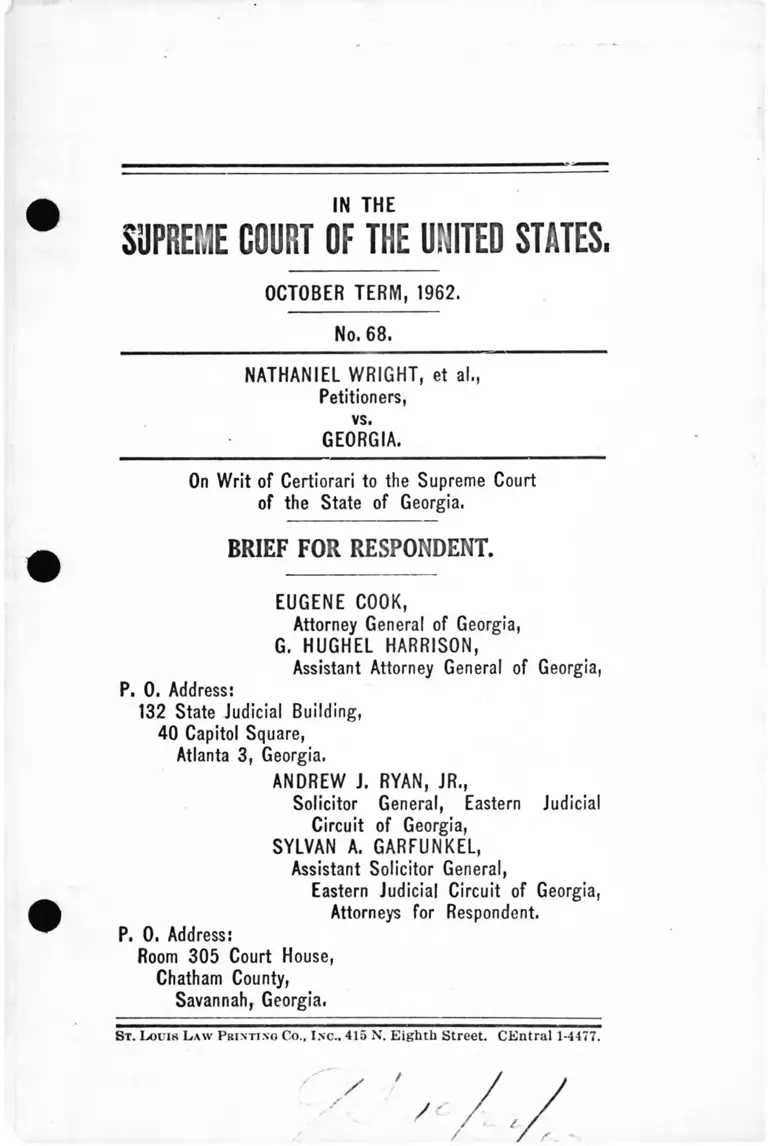
IN TH E
SUPREME COURT OF THE UNITED STATES,
OCTOBER TERM, 1962.
No. 68.
NATHANIEL WRIGHT, et al.,
Petitioners,
vs,
GEORGIA.
On Writ of Certiorari to the Supreme Court
of the State of Georgia.
BRIEF FOR RESPONDENT.
EUGENE COOK,
Attorney General of Georgia,
G. HUGHEL HARRISON,
Assistant Attorney General of Georgia,
P. 0. Address:
132 State Judicial Building,
40 Capitol Square,
Atlanta 3, Georgia.
ANDREW J. RYAN, JR.,
Solicitor General, Eastern Judicial
Circuit of Georgia,
SYLVAN A. GARFUNKEL,
Assistant Solicitor General,
Eastern Judicial Circuit of Georgia,
Attorneys for Respondent.
P. 0. Address:
Room 305 Court House,
Chatham County,
Savannah, Georgia,
S t . L o u is L aw P r in tin g Co., I n c .. 415 N. Eighth Street. CEntral 1-4477.
INDEX.
Pago
Questions presented ........................................................ 1
Statement ......................................................................... 2
Argument I ................................................................... 7
Petitioners argue that the statute under which they
were convicted was too vague and indefinite to
provide an ascertainable standard of guilt........... 7
Argument IT ..................................................................... 14
Petitioners further argue that the judgment below
does not rest upon adequate non-federal grounds
for decision............................................................... 14
Conclusion ........................................................................ 18
Cases Cited.
Chaplinskv v. New Hampshire, 315 IT. S. 568, 86 L. ed.
1031 ............................................................................... 9
Edelman v. California, 344 U. S. 357. . . . 1..................... 17
Fox v. The State of Washington, 236 U. S. 273, 59 L.
ed. 573 (1914) .............................................................. 9
Garner v. Louisiana, 368 IT. S. 157, 7 L. Ed. (2) 207.. .8, 11
Glasser v. United States, 315 IT. S. 60, 70..................... 15
Henderson v. Lott, 163 Ga. 326 (136 S. E. 403) ......... 15
Herdon v. Georgia, 295 IT. S. 441..................................... 17
Lawrence et al. v. State Tax Commission of Missis
sippi, 286 IT. S. 276...................................................... 17
Michel v. Louisiana, 350 U. S. 91........................ 17
11
National Labor Relations Board v. Fanstoel Metal
Corporation, 306 U. S. 240, 83 L. ed. 027................... 11
Parker v. Illinois, 333 U. S. 571.................................... 17
People v. Galpern, 259 N. Y. 279, 181 N. E. 572........... 9,13
Samuels v. State, 103 Ga. Appeals 60, 118 S. E. 2nd
231 (1901) ..................................................................... 7
Staub v. City of Baxley, 355 U. S. 313...................15,10,17
Terre Haute I. R. Co. v. Indiana, 194 U. S. 579, 589. .10, 17
Union P. R. Co. v. Publie Serviee Commission, 248
U. S. 07........................................................................... 10
IN TH E
SUPREME COURT OF THE UNITED STATES.
OCTOBER TERM, 1962.
No. 68.
NATHANIEL WRIGHT, et al.,
Petitioners,
vs.
GEORGIA.
On Writ of Certiorari to the Supreme Court
of the State of Georgia.
BRIEF FOR RESPONDENT.
QUESTIONS PRESENTED.
i
I.
Whether the conviction of petitioners for unlawful as
sembly denied them due process of law under the Four
teenth Amendment, when they were convicted on evidence
which showed that they were grown Negro men who took
over a playground in a predominantly white neighbor
hood at a time when the playground was reserved for
and was to be used by school children and they refused
to leave when requested by the police.
IT.
Whether the decision below asserts any adequate non-
federal grounds for limiting consideration of an aspect
of an important constitutional right where the court
below determined that such right had been abandoned.
STATEMENT.
Petitioners were convicted of violating Section 26-5301,
Georgia Code Annotated in that they did assemble in the
County of Chatham on January 23, 1961 at Daffin Park
for the purpose of disturbing the public peace and refus
ing to disburse (sic) on being commanded to do so by
Sheriff, Constable ai.d Peace Officer, to wit: W. H. Thomp
son and G. W. Hillis . . . (R. 8).
The State of Georgia introduced four witnesses, the first
witness, Officer G. H. Thompson stated:
When we arrived at this Basket Ball Court we
found around seven colored hoys playing basket hall
there . . . (R. 39).
They were pretty well dressed at that time; some
of them had on dress shirts, some of them had on
coats—not a dress coat, hut a jacket. I didn’t notice
what particular type shoes they had on, as far as I
know they didn’t have “ Tennis shoes” on. I am
familiar with the type of shoes that people wear
when they play basket hall, they didn’t have that
type of shoes on as well as I remember . . . (R. 39).
I think that these defendants ranged in age from
23 to 32 . . . (R. 39).
There is a school nearby this Basket Ball Court, it
is located at Washington Avenue and Bee Road, T
mean, at Washington Avenue and Waters. There is
another school on 44th Street—there are two schools
nearby; T believe that they are both “ grammar”
schools. T patrol that area and the children from
these schools play there, they come there every day
T believe, I believe they come there every afternoon
when they get out of school, and T believe they come
there during recess. The school, I believe, gets out
about 2:30 in the afternoon, and this was around 2:00
o ’clock . . . (R. 40).
— 3
When I came up to those defendants I asked them
to leave; I spoke to all of them as a group when I
drove up there, and I asked them to leave twice, but
they did not leave at that time. I gave them an op
portunity to leave. One of them, I don’t know which
one it was, came up and asked me who gave me orders
to come out there and by what authority I came
out there, and I told him that I didn’t need any
orders to come out there. The children from the
schools, would have been out there shortly after that.
The purpose of asking them to leave was to keep
down trouble, which looked like to me might start—
there were five or six cars driving around the park
at the time, white people. They left only after they
were put under arrest, they were put under arrest ap
proximately 5 to 10 minutes after I told them to
leave. It seemed like to me that they were welcom
ing the arrests, because all of them piled into tin*
car, Officer Hillis’s car, at the time, and he had to
stop them . . . (R. 4fi).
On cross-examination Officer Thompson further testi
fied:
Under ordinary circumstances I would not arrest
hoys for playing basketball in a public park. I have
never made previous arrests in Baffin Park because
people played basketball there . . . (R. 41).
On redirect he stated:
There have been colored children in Daffin Park,
hut I did not arrest those children, but I arrested
these people because we were afraid of what was
going to happen. Colored children have played in
Baffin Park, and they have fished there . . . (R. 4*2).
The next witness the State put up was Carl Hager,
Superintendent of the Recreational Department of the
City of Savannah. He stated:
— 4 —
As Superintendent I am over all of the playgrounds
in the City of Savannah, Chatham County, Georgia;
that includes Daffin Park and all the other parks that
have playgrounds. These playgrounds are mostly in
neighborhood areas. There are neighborhood areas
where colored families live, and neighborhood areas
where white people live, we try to establish them in
that manner, and, then there are certain areas where
they are mixed to a certain extent. We have a play
ground in the Park Extension, and that is a mixed
area for white and colored—a white ~ection and a
colored section—it is mostly white, but there are
several colored sections within several blocks. The
Daffin Park area, mostly around that area is mostly
white. It has occurred, from time to time, that colored
children would play in the Daffin Park area and in
the Park Extension area, but no action had been
taken, because it is legal, it is allowed, and nobody
has said anything about it. The playground areas
are basically for young children, say 15 to 16 and
under, along that age group, we give priority to the
playground to the younger children over the grown
ups, it made no difference as to whether they were
white or colored. Anytime that we requested anyone
to do something and they refused we would ask the
police to stop in, if we would ask them to leave and
they did not we would ask the police to step in. We
have had reports that colored children have played
in the Park Extension, but they were never arrested
or told to leave . . . (R. 42-43).
On cross-examination, Mr. Hager stated in answer to
questions:
I testified that if there was a conflict between the
younger people and the older people using the park
facilities the preference would be for the younger
o ---
people to use them, hut we have no objection to older
people using the facilities if there are no younger
people present or if they are not scheduled to be used
by the younger people . . . (R. 44).
It has been the custom to use the parks separately
for the different races. I couldn’t say whether or not
a permit would or would not be issued to a person
of color if that person came to the office the Recre
ational Department and requested a permit to play
on the courts, hut I am of the opinion that it would
have been, we have never refused one, the request
never has been made . . . (R. 45).
There is no minimum or maximum age limit for the
use of basket ball courts, however, at the present time
we have established a minimum-—a maximum age
limit of 16 years for any playground area.
On redirect Mr. Hager further explained:
On school days these courts and the playground
area at Daffin Park are available for only certain age
groups and they are only used at that time of day
by the schools in that vicinity, it is, more or less,
left available for them, that is the way we have our
recreation setup' . . . (R. 46).
I would like to say that normally we would not
schedule anything for that time of the day because
of the schools using the total area there. The schools
use the area during school hours. The Parochial
School uses it during recess and lunch periods and
also for sport, as also the Lutheran School, and the
public schools bring their students out there by bus
and at various times during school hours all day
long, we never know when they are coming, and they
use Cann Park the same way, I might add . . . (R. 47).
If it was compatible to our program we would
grant a permit for the use of the basketball court in
6 —
Daffin Park to anyone regardless of race, creed or
color, however, at that time of day it would not be
compatible to our program . . . (R. 47-48).
Officer Hillis, the next witness for the State, stated as
follows:
My name is G. W. Hillis. I am a police officer
of the Savannah Police Department, and I was a
member of and on duty with the Savannah Police
Department on or about the 23rd day of January of
this year; I was on duty then and I had on my police
uniform. When I arrived there I saw the defend
ants, they were playing basketball. Officer Thompson
talked to them first, and then I talked to them. I asked
them to leave, Officer Thompson had already asked
them, I heard him ask them. They did not leave, and
they did not stop playing until I told them they were
under arrest. We called the wagon (cruiser). Officer
Thompson told them that they would have to leave, he
told them that at first, and they did have an oppor
tunity to leave after he told them that. He asked
them to leave, and then T asked them to leave after
I saw they wasn’t going to stop playing, and when 1
asked them to 'eave one of them made a sarcastic
remark, saying: “ What did he say, I didn’t hear
him’ ’, he was trying to be sarcastic. When I told
them to leave there was one of them who was writing
with a pencil and looking at our badge numbers.
They all had an opportunity to leave before I arrested
them, plenty of time to have left, but I told them to
leave, they wouldn’t leave and T put them under arrest
. . . (R. 49-50).
I am familiar with the fact that there are schools
in that area, and that children would be out there
in about 15 minutes to play in that area . . . (R. 50).
ARGUMENT I.
Petitioners Argue That the Statute Under Which They
Were Convicted Was Too Vague and Indefinite to
Provide an Ascertainable Standard of Guilt.
In their argument on this point, Petitioners seek to lead
the court to believe that this statute is a statute that has
rarely been used and they base this on the fact that there
is a paucity of appellate decisions involving its construc
tion. As pointed out in the opinion of the Georgia Su
preme Court (R. page 52 at page 56) the crime of un
lawful assembly is itself of common law origin.
To determine whether breach of the peace statutes are
seldom used, I refer the court to the Uniform Crime Re
ports of 1961 printed by the United States Department of
Justice which on page 30 carries Breach of the Peace a>
disorderly conduct in their records. On page 93 the chart
shows that there were 468,071 arrests for disorderly con
duct (Breach of the Peace) made in the United States din
ing 1961. Other than the amount of people arrested for
drunkenness this was by far the most common charge1
placed against individuals. As to whether such a charge
was too vague and indefinite to warrant a conviction,
page 86 of the report shows that there were 62.6% find
ings of guilty against all people arrested for disorderly
conduct and 15.4% acquittals or dismissals. What is
most probably true is that due to the antiquity of the
crime “ Breach of the Peace” , it has rarely been chal
lenged in the Appellate Courts.
In their brief petitioners refer to the case of Samuels v.
State, 103 Ga. Appeals 66, 118 S. E. 2nd 231 (1961), as
being the only Georgia case in which there has been a
construction of this statute. In giving the court the facts
in the Samuels case in order to try and place it within
— 8 —
the bounds of Gamer v. Louisiana, 368 U. S. 157, 7 L. Ed.
(2) 207, Petitioners left out what was said on page 66
which came after the fact was shown that they had sat
down at the lunch counter that had been customarily re
served for white people only. “ The personnel of the
store informed the defendants that the lunch counter was
closed, the lights over the counter were extinguished and
the defendants were refused service. This action was
taken because they were Negroes.’ ’ In their opinion the
court said (page 66), “ Several witnesses testified that in
their opinion the presence of the defendants at the lunch
counter would tend to create a disturbance.’ ’ A reading
of the record in the Georgia Court of Appeals (Transcript
of Record, page 19) showed that the witnesses referred to
were the employees of the store, one of whom was a Mr.
Tyson, who stated, “ We had closed the counter and were
no longer serving at that lunch counter. Ordinarily we
would not have closed it up at that time of day. It would
have remained opened normally until 10:00 that night and
it was a result of the defendants being at the counter that
we closed it.’ ’ It was this witness’s opinion that the de
fendants were creating a disturbance. Mr. Kline, the
Manager, also stated that he wanted to keep the counter
closed as long as there was any disturbance and he con
sidered this a disturbance (Ga. Court of Appeals, Tran
script of Record, page 20).
It is significant that Samuels was represented by the
same attorneys who represent the Petitioners in this ac
tion and that they did not make any suggestion that the
statute was unconstitutional.
As the respondent understands the argument of the
petitioners, they are not arguing that the statute was un
constitutionally applied to them but that the statute itself
is unconstitutional as being too vague and indefinite.
— 9 —
We, therefore, cite to the court the case of Chaplinsky
v. New Hampshire, 315 IT. S. 568, 86 L. ed. 1031, which
involved a statute whose stated purpose was to preserve
the public peace. The court on page 573 stated “ The
statute, as construed, does no more than prohibit the face
to face words plainly likely to cause a breach of the peace
by the addressee.” The Petitioner in that case was claim
ing that the statute was limiting his freedom of speech.
This court held that such a statute was not so vague *>nd
indefinite as to contravene the Fourteenth Amendment.
The case of Fox v. The State of Washington, 236 lT. S.
273, 59 L. ed. 573 (1914), involved a violation of a Breach
of the Peace statute. The highest court in the state of
Washington held that the statute was not bad for uncer
tainty. This court, page 277, said, “ We understand the*
State Court by implication, at least, to have read the
statute as confined to encouraging an actual breach of
law. Therefore, the argument that this act is both an
unjustifiable restriction of liberty and too vague for a
criminal law must fail.”
We cite to the court a decision of the Court of Appeals
of New York, People v. Galpern, 259 X. Y. 279, 181 X. E.
572, in which that court held: “ The record shows that
the arrest arose out of a dispute, conducted on each side
quietly and without disorder, between a citizen, in this
ease a member of the bar, who asserted a right to stand
upon the sidewalk of a street in quiet orderly conversation
with a group of friends, and a police officer, who assorted
a right to direct, those who use the sidewalk to ‘ move on'
when in his opinion they were obstructing the sidewalk.”
The defendant was convicted of a Breach of the Peace for
failing to move on. The question involved is very much
similar to the question involved here. On page 573 the
court held “ Even if we should find that the police officer’s
interference was unnecessary, and, in the circumstances.
— 10 —
ill-advised, wo could not find that it was unauthorized.
The defendant, knowing the character and standing of
his group of friends and that they would not willingly
annoy or offend others, might conclude that ‘ he inter
ference was officious; the police officer without such knowl
edge might conclude that it was a useful precaution to
avoid possible disturbance. The law authorized the officer
to use his judgment. Friends may congregate on tin-
sidewalk in an orderly group for a short conversation,
without creating disorder or unduly offending or obstruct
ing others, but they must ‘ move on’ when a police officer
so directs for the purpose of avoiding possible disorder
which otherwise might ensue. The Legislature has pro
vided that failure to obey such direction in itself is dis
orderly conduct. That provision tends to preserve public-
order on the streets of a great city.”
Petitioners’ brief argues that the determination of a
purpose to disturb the public peace is left entirely to tin-
discretion of the police, the courts and the jury (Brief of
Petitioner, page 13). The question is now asked Peti
tioners: To whom would they suggest such a question
should be left if not to the police, the courts and the jury?
There are many cases where a jury and the courts must
determine questions of this character as, for instance,
“ intent” and “ malice” .
The Petitioners in their brief, page 14, further state.
“ If the statute is considered without the benefit of tin-
construction given it in the Samuels case, supra, it could
not be known whether the law covered peaceful and
orderly acts or merely outwardly disorderly conduct.”
This statement answers itself in that the petitioners recog
nize that the Samuels case had previously been decided
and had construed the act so that they are unable to state
that they were not aware of its construction.
— 11 —
This court has again recently held in the case of Gamer
v. Louisiana, 368 U. S. 157, 7 L. id. (2) 207, at 216, “ We
are aware that the Louisiana courts have the final au
thority to interpret and where they see fit, to reinterpret
that state’s legislation.” That case also involved the in
terpretation of a breach of the peace statute. This court
on page 215 said, “ WTe, of course, are bound by a state’s
interpretation of its own statute and will not substitute
our judgment for that of the state’s when it becomes
necessary to analyze the evidence for the purpose of
determining whether that evidence supports the findings
of a state court.”
The Petitioners have widened their argument from that
stated in its original heading to the further point that
the petitioners say that they were arrested solely because
they were Negroes. During the trial of the case and on
appeal below, petitioners consistently argued that they had
gone there merely to play basket ball; whereas, the State
of Georgia attacked the bona tides of this statement. At
last on page 15 of Petitioners’ Brief they admit that it
may be regarded as “ a profound, nonverbal expression
of the impropriety of racial segregation in public parks” .
They then argue that this demonstration was within the
range of freedom of speech as assured bv the Fourteenth
Amendment.
Surely taking over the playground does more than ex
press their views and is similar to the sit-down strikes.
The reasoning employed by the court in National Labor
Relations Board v. Fansteel Metal Corporation, 306 U. S.
240, 83 L. ed. 627, expresses the feeling that is applicable
to this case. At page 253 this Court said, “ The em
ployees had the right to strike but they had no license to
commit acts of violence or to seize their employer’s
plant.”
— 12 —
The State of Georgia is not denying the right of Peti
tioners to play upon public playgrounds. There is no
evidence to support a finding that if the children weren’t
assigned the playground, the Petitioners could not have
played. What Petitioners want this court to do is to over
look any and all other evidence in this case except that
they were Negroes and that they were arrested.
There is no evidence to support such a statement as a
“ white basket hall court’ ’. That would mean a basket
ball court reserved exclusively for whites. What the
testimony does show (R. page 44) is that there are play
grounds in white areas and playgrounds in colored areas
(R. page 44). Mr. Hager, Superintendent of the Recrea
tional Department, testified that they tried to establish
them in that manner, that there are two playgrounds that
are in mixed areas. One of them being in Park Exten
sion and the other in Wells Park (R. page 42). Mr.
Hager further testified, “ It has occurred, from time to
time, that colored children would play in the Baffin Park
area and in the Park Extension area, hut no action had
been taken because it is legal, it is allowed, and nobody
has said anything about it’ ’ (emphasis ours) (R. page 43).
I
Officer Hillis stated, “ There have been colored children
in Daffin Park, hut I did not arrest those children, hut I
arrested these people because we were afraid of what
was going to happen. Colored children have played in
Daffin Park and they have fished there” (R. page 42).
The Petitioners on cross-examination sought to develop
that one of the reasons the Petitioners were arrested was
because they were Negroes. This fact, in the policeman’s
eyes, added an additional reason for asking the Petition
ers to leave since they had taken over the childrens’
playground in an area surrounded by whites and there
was, therefore, more cause to recognize a possible dis-
turbanee. The Petitioners themselves now admit that
maybe they weren’t there to play basket ball but that
they were there to put on what they called a demonstra
tion.
The fault in the Petitioner’s reasoning is that they have
not shown that the park was segregated but the state on
its own volition went out of its way to show that it was
not segregated, as witnessed by the testimony of Mr.
Hager, the Superintendent of Playgrounds. In trying to
demonstrate their right to play, the Petitioners took away
the rights of those for whom the playground had been set
aside at that time.
The Petitioners have not shown that the exclusion of
adults from the playground during these hours was an
unreasonable exercise of discretion by the playground
authorities. Petitioners by their precipitate action which
they classify as a protest (Brief of Petitioners, page 22)
could easily have inflamed the public. This court has held
that park segregation is unlawful and rights of minorities
are to be protected but with a right goes a corresponding:
duty that is to obey all reasonable requests of a police
officer. As was said by Judge Lehman writing for the
New York Court of Appeals in People v. Galpern, 2.19
X. Y. 279, 181 N. E. 572, “ Failure, even though consci
entious, to obey directions of a police officer, not exceed
ing his authority, may interfere with the public order
and lead to a breach of the peace.”
- 1 4 -
ARGUMENT n .
Petitioners Further Argue That the Judgment Below
Does ITot Rest Upon Adequate Non-Federal
Grounds for Decision.
In their argument, Petitioners apparently expand this
point to include the same point that is included in and
argued under Argument I above. This is indicated by
their first statement under Argument II, in which they
state: “ Initially it should be emphasized that the court
below indisputably 1 consider and reject petitioners'
due process claim v. the Fourteenth Amendment . . .
by asserting: ‘ However, by applying the well-recognized
principles and applicable tests above-stated, we find no
deprivation of the defendants’ constitutional rights under
the Fourteenth Amendment of the United States Consti
tution’. ’ ’ A careful reading of the decision below shows
the statement attributed to the court below was in con
junction with their discussion relating to whether the
statute, under which the Petitioners were convicted, was
so vague the Defendants were not placed on notice as to
what criminal act they committed. As was stated above,
this point was covered in Argument I and for that reason
will not here be gone into again.
The Petitioners here present the question of whether
the court below followed its set rule in treating as aban
doned any assignments of error not insisted upon by
counsel in their briefs or otherwise. Here the discussion
deals with the two assignments of error treated by the
court below as abandoned. In the Petitioner’s bill of
exceptions to the court below these two assignments of
error were on the judgment sentencing each petitioner
(fourth ground) and on the denial of their motion for a
new trial (third ground). In reference to these two
— 13 —
grounds in the court below the Petitioners cited no au
thority, made no argument or even a statement that such
grounds were still relied upon. In view of the foregoing,
the court below applied the applicable rule as laid down
in Henderson v. Lott, 163 Ga. 326 (136 S. E. 403), and
other cases cited in their decision and therefore correctly
treated the questions as abandoned (R. 54).
We recognize that this Court will inquire into the ade
quacy of a decision on state procedural grounds to deter
mine whether the procedural application involved was
inconsistent with prior decided cases. Staub v. City of
Baxley, 355 U. S. 313. Even in the face of the above clear
rule the Petitioners have not cited to this Court one
Georgia case to show that the rule laid down in Henderson
V. Lott, supra, has been inconsistently applied.
Petitioners have apparently conceded that the above
Georgia procedural rule has been consistently followed
and therefore have attempted to show that the court be
low should he reversed for two reasons as follows:
1. “ The court below did not exercise due regard for
the general doctrine that every reasonable presumption
is to be indulged against the waiver of a constitutional
right.”
2. In certain cases this Court has found refusals to pass
upon federal issues to be unreasonable for reasons other
than inconsistent procedural application.
The only case Petitioners cite as supporting the first of
the above two reasons is Glasser v. United States, 315 U. S.
60, 70. The Glasser case in no way deals with the deter
mination of a procedural question by a state court, but
rather concerns itself in the referenced part with the ap
pointment of specific counsel to assist Defendant in U. S.
- 1 6 -
District Court over his objection to the appointment. The
holding of the case on this point is clearly stated on page
70. “ To preserve the protection of the Bill of Rights for
hard pressed defendants, we indulge every reasonable pre
sumption against the waiver of fundamental rights.’ ’
We again reiterate that such is not the case here as the
Petitioners had representation by counsel in the court
below, to which representation they had expressed no
objection.
The Petitioners next base their claim for reversal on
what they allege to be an unreasonable refusal to pass
upon federal issues.
We ask, is it unreasonable to be consistent? To ask the
question is to answer it in that inconsistency would lead
to uncertainty and to a lack of knowledge on how to pro
tect one’s rights.
Under the procedural rule involved all that is required
is an insistence on the position taken, that is, let the court
know what position is taken by argument on the question
or by covering the question in the brief or by stating the
assignment of error is insisted upon by counsel.
Petitioners say the above requirement is unreasonable
under the decisions of this court in Staub v. Baxley, 357)
IT. S. 313; Terre Haute I. R. Co. v. Indiana, 104 U. S. 570,
580; Union P. R. Co. v Public Service Commission, 248
IT. S. 67.
These cases are clearly distinguishable from the prin
ciple presented in this case. The Union Pacific Railroad
Company case dealt with the question of whether a consti
tutional right had been waived by complying with the un
constitutional statute. This court in taking jurisdiction
— 17
predicated its action in doing so on duress by the State,
which we submit is not an issue in the current case for
Petitioners w ere afforded every opportunity to present and
argue their case.
Terre Haute Railroad Co. also concerns a point not at
issue here, i. e., untenable construction of a charter granted
by the State and thus evading the Federal question.
In the Staub v. City of Baxley case this court found the
lion-federal grounds to be without any fair or substantial
support and plainly untenable in that the Georgia court did
not follow a long line of its own decisions in determining
the procedural matter. The converse is true in the present
case (R. 54).
Lawrence et al. v. State Tax Commission of Mississippi,
286 U. S. 276, cited by the Petitioners, simply held that
the purported noil-federal ground put forward by the state
court for its refusal to decide the constitutional question
was unsubstantial and illusory. Which is clearly not the
same as the case now before this court.
The decision in the court below does not impede the
assertion of federal rights, nor is it burdensome to require
insistence upon the grounds of appeal. Furthermore, it is
clearly shown that the rule of the court below to treat as
abandoned points not insisted upon has b^en consistently
applied.
It has been held many times by this court that a State
Court has the power to decide the proper method of pre
serving Federal questions and such determination will bind
this Court. Herdon v. Georgia, 295 U. S. 441; Parker v.
Illinois, 333 IT. S. 571; Edelman v. California, 344 U. S.
357; Michel v. Louisiana, 350 lT. S. 91. In all of these cases
this Court deferred to a state court’s determination of its
own procedural rules.
— 1 8 -
CONCLUSION.
For the foregoing reasons it is respectfully submitted
that the judgment below should be affirmed.
G. HUGHEL HARRISON,
Assistant Attorney General of Georgia.
P. O. Address:
132 State Judicial Building,
40 Capitol Square,
Atlanta 3, Georgia.
Respectfully submitted.
EUGENE COOK,
Attorney General of Georgia.
ANDREW ,J. RYAN, JR.,
Solicitor General, Eastern Judicial Cir
cuit of Georgia,
SYLVAN A. GARFUNKEL,
Assistant Solicitor General, Eastern
Judicial Circuit of Georgia,
Attorneys for Respondent.
I*. O. Address:
Room 305 Court House,
Chatham County,
Savannah, Georgia.