Swint v. Chambers County Commission Brief for Petitioners
Public Court Documents
October 3, 1994
-
Brief Collection, LDF Court Filings. Swint v. Chambers County Commission Brief for Petitioners, 1994. 865cbbaf-c59a-ee11-be37-00224827e97b. LDF Archives, Thurgood Marshall Institute. https://ldfrecollection.org/archives/archives-search/archives-item/6f52bf3f-83b2-437d-ab7e-80487a5f7d56/swint-v-chambers-county-commission-brief-for-petitioners. Accessed September 21, 2026.
Copied!
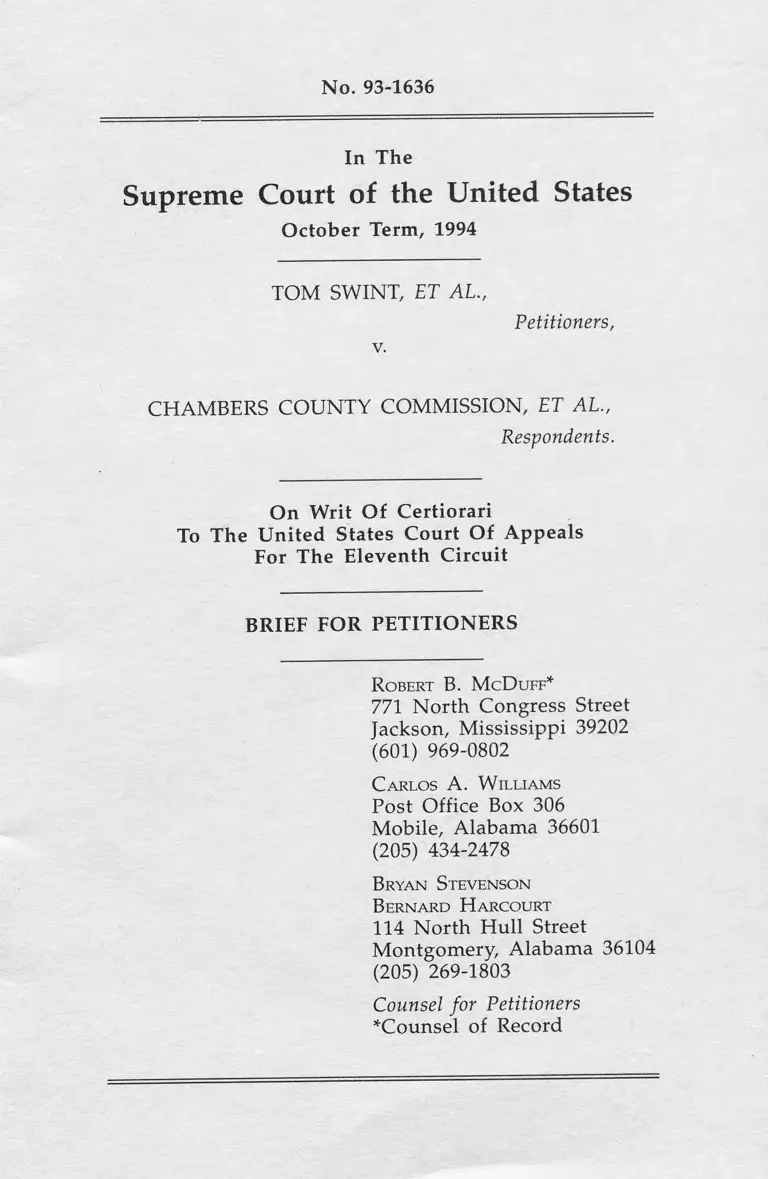
    No. 93-1636

In The

Supreme Court of the United States
October Term, 1994

TOM SWINT, ET AL.,
Petitioners,

v.

CHAMBERS COUNTY COMMISSION, ET AL.,
Respondents.

On Writ Of Certiorari
To The United States Court Of Appeals

For The Eleventh Circuit

BRIEF FOR PETITIONERS

Robert B. M cD uff*
771 North Congress Street
Jackson, Mississippi 39202
(601) 969-0802
C arlos A. W illiams
Post Office Box 306
Mobile, Alabama 36601
(205) 434-2478
Bryan Stevenson
Bernard H arcourt
114 North Hull Street
Montgomery, Alabama 36104
(205) 269-1803
Counsel for Petitioners
*Counsel of Record


1

QUESTION PRESENTED

Whether the Sheriff of a county is a final policymaker
for the county in matters of law enforcement for purposes of
county liability under 42 U.S.C. § 1983 in those jurisdictions
where the Sheriff is elected by the voters of the county, the
Sheriffs office is financed and the Sheriffs salary is paid by the
county, and the Sheriff has unreviewable law enforcement
authority within the county but not outside the county.


PARTIES

The parties in the court below are as follows:

Plaintiffs-Appellees: Tom Swint, Tony Spradley,
Drecilla James, and Jerome Lewis.

Defendants-Appellants: Chambers County Commission,
City of Wadley, Alabama, James C. Morgan, Freddie Morgan,
and Gregory Dendinger.

The plaintiffs-appellees are petitioners in this Court.


Ill

TABLE OF CONTENTS
Page

QUESTION PRESENTED
PARTIES . . . . .
TABLE OF CONTENTS . .
TABLE OF AUTHORITIES................. v
OPINIONS BELOW ......................  1
JURISDICTION ........................  2
STATUTORY PROVISIONS INVOLVED ........  2
STATEMENT OF THE CASE................. 2
SUMMARY OF ARGUMENT .................  6
ARGUMENT .........................  9
I. LOCAL GOVERNMENTS ARE LIABLE FOR

THE UNCONSTITUTIONAL ACTIONS OF
THOSE WITH FINAL POLICYMAKING
AUTHORITY .....................  9

II. THIS COURT'S DECISION IN PEMBAUR
V. CINCINNATI, REQUIRES REVERSAL
IN THE PRESENT C A S E ............ H

III. WHETHER IN ALABAMA OR ELSEWHERE,
SHERIFFS WITH FINAL POLICYMAKING
AUTHORITY EXERCISE IT WITH
RESPECT TO THEIR COUNTIES, NOT
THEIR STATES.................... ^


iv

IV. THE ELEVENTH CIRCUIT'S
"PARTNERSHIP" CRITERION IS
INCONSISTENT WITH THIS COURT’S
DECISIONS REGARDING THE FINAL
POLICYMAKER DOCTRINE ............ 22

V. THE ELEVENTH CIRCUIT'S ANALYSIS
WOULD DRASTICALLY LIMIT AND
PERHAPS ELIMINATE ALL LOCAL
GOVERNMENTAL LIABILITY FOR THE
UNCONSTITUTIONAL ACTIONS OF
HIGH-RANKING ELECTED OFFICIALS
AND SOME HIGH-RANKING APPOINTED
OFFICIALS IN THE EXECUTIVE
BRANCH OF LOCAL GOVERNMENT, AND
WOULD REQUIRE THE LOWER COURTS
TO TAKE AN ENTIRELY NEW APPROACH
FROM THAT WHICH MOST HAVE
TAKEN........................... 25

CONCLUSION .  ...................... 27


V

TABLE OF AUTHORITIES

Cases
Pages

Blackburn v. Snow, 111 F.2d
556 (1st Cir. 1985) ......... .. .26

City of St. Louis v. Prapotnik,
485 U.S. 112 (1988) . . . . passim

Crane v. Texas, 766 F.2d 193
(5th Cir.), cert, denied,
474 U.S. 1020 (1985) ........ . . 14

Crowder v. Sinyard, 884 F.2d
804 (5th Cir. 1989) ......... . . 26

Davis v. Mason County, 927 F.2d
1473 (9th Cir. 1991) . . . . . . . 26

Felder v. Casey, 487 U.S. 131
(1988) .....................

First Mercury Syndicate v.
Franklin, 623 So.2d 1075
(Ala. 1993) .................

In re County Officers, 143 So.
345 (Ala. 1932) ............. . . 14

Jefferson County v. Dockerty,
30 So.2d 474 (Ala. 1974) . . . . . 14

Jett v. Dallas Independent
School Dist., 491 U.S.
701 (1989) . . . .  7, 11, 16, 23

Lockridge v. Etowah County
Comm'n, 460 So.2d 1361
(Ala. Civ. App. 1984) ........


V I

Marchese v. Lucas, 758 F.2d
181 (6th Cir. 1985) .........

Martinez v. California, 444 U.S.
277 (1980) .................

Mitchell v. Forsyth, 472 U.S. 511
(1985) .....................

Monell v. New York City Dept, of
Social Services, 436 U.S. 658
(1978) . . . .  6, 9, 11, 13, 16, 26

Monroe v. Pape, 365 U.S. 167
(1961) .....................

Morgan v. Swint, No. 93-1638 (Pet.
for Cert, filed 4-18-94) . . .

Parker v. Amerson, 519 So.2d 442
(Ala. 1987) .................

Parker v. Williams, 862 F.2d
1471 (11th Cir. 1989) . . . . 5, 23

Pembaur v. Cincinnati, 475 U.S.
469 (1986) ............... passim

Pembaur v. Cincinnati, 746 F.2d
337 (6th Cir. 1984) . . . . . .

Soderheck v. Burnett County,
752 F.2d 285 (7th Cir. 1987),
821 F.2d 446 (7th Cir. 1987) . . .27

State ex rel. Martin v. Pratt,
68 So. 255 (Ala. 1915) ..........14

Swint v. City of Wadley,
Alabama, 5 F.3d 1435
(11th Cir. 1993) passim


Vll

Swint v. City of Wadley,
Alabama, 11 F.3d 1030
(11th Cir. 1994)   1/6

Turner v. Upton County, 915
F.2d 133 (5th Cir. 1990) ........ 26

Constitutional and Statutory Provisions

28 U.S.C. § 1254(1).............   2
28 U.S.C. § 1331 (1988)............... 4
28 U.S.C. § 1343 (1988)............... 4
42 U.S.C. § 1983   passim
Ala. Const. Art. V, § 138 . . . .  2, 13
Ala. Code § 11-1-11................... 2
Ala. Code § 11-2-30   2
Ala. Code § 11-4-23.................. 25
Ala. Code § 1 1 - 5 - 4.................. 25
Ala. Code § 12-17-93.................26
Ala. Code § 15-10-90.................21
Ala. Code § 15-10-91.................21
Ala. Code § 1 7 - 2 - 1 ...................26
Ala. Code § 3 2 - 2 - 1 ...................21
Ala. Code § 3 2 - 2 - 3 ...................21
Ala. Code § 3 2 - 2 - 4 ...................21


viii

Ala. Code § 32-2-20 .................  21
Ala. Code § 32-2-22 .................. 21
Ala. Code § 36-22-2 ................. ..
Ala. Code § 36-22-3 ........ 5, 13, 15
Ala. Code § 36-22-5 ...........  2, 13
Ala. Code § 36-22-6 ................. ..
Ala. Code § 36-22-13 ............. . 2
Ala. Code § 36-22-16 .......... 2, 13
Ala. Code § 36-22-17  2
Ala, Code § 36-22-18 .......... 2, 13
Ala. Code § 36-22-19 ............... ..
Ala. Code § 36-22-42   2
Ala. Code § 4 0 - 5 - 1 .................. 26
Ala. Code § 4 0 - 7 - 1 .................. 26

Other Materials

Walter H. Anderson, A Treatise
on the Law of Sheriffs, Coroners,
and Constables (Dennis and Co,
Inc. , 1 9 4 1 ) ..................... .

G. Bennett-Sandler, Robert
L. Frazier, Donald A.
Torres, Ronald J. Waldron,
Law Enforcement and Criminal
Justice (Houghton Mifflin
Co., 1979) 19


I X

Executive Order Number Fifty
-Five of Governor George C.
Wallace, October 15, 1974 . . . . . 21

George T. Felkenes, The Criminal
Justice System: Its Functions
and Personnel (Prentice-Hall,
1973) ...........................  19

John A. Humphrey and Michael E.
Milakovich, The Administration
of Justice: Law Enforcement,
Courts, and Corrections (Human
Science Press, 1981) ............ 18

George Thomas Kurian, World
Encylopedia of Police Forces
and Penal Systems (Facts on
File, 1989) ...............  18, 19

Dallas C. Sands & Michael E.
Libonati, Local Government
Law (Callaghan & Co., 1981) . . . .24

Paul Wager, County Government
Across the Nation
(University of North
Carolina Press, 1950) ........... 19


No. 93-1636

In The

SUPREME COURT OF THE UNITED STATES

October Term, 1994

To m Swint, et al.,
Petitioners,

V.

Chambers County Commission, et al.,
Respondents.

On Writ of Certiorari
to the United States Court

of Appeals for the Eleventh Circuit

BRIEF FOR PETITIONERS

OPINIONS BELOW

The November 3, 1993 opinion of the Eleventh Circui t is
reported as Swint v. City o f  Wadley, Alabama, 5 F.3d 1435
(11th Cir. 1993), and is reproduced in the appendix to the
petition for writ of certiorari, p. la. The January 18, 1994
opinion of the Eleventh Circuit on rehearing is reported as Swint
v. City o f Wadley, Alabama, 11 F.3d 1030 (11th Cir. 1994), and
is reproduced in the pet. app., p. 41a. The June 2, 1992 and
June 26, 1992 decisions of the United States District Court for
the Middle District of Alabama are unreported and are
reproduced in pet. app., p. 45a and p. 70a.


2

JURISDICTION

The opinion of the Eleventh Circuit was issued on
November 3, 1993. Upon a suggestion for rehearing en banc,
the panel issued a further opinion on January 18, 1994,
modifying its prior opinion and announcing that the suggestion
for rehearing en banc was denied. The petition for writ of
certiorari was docketed April 18, 1994, and the petition was
granted on June 13, 1994. This Court's jurisdiction is invoked
pursuant to 28 U.S.C. § 1254(1).

STATUTORY PROVISIONS INVOLVED

The federal statute involved is 42 U.S.C. § 1983. Article
V, § 138 of the Alabama Constitution is relevant, as are various
provisions of the Alabama Code, including §§ 36-22-2, 36-22-
5, 36-22-6, 36-22-13, 36-22-16, 36-22-17, 36-22-18, 36-22-19,
36-22-42, 11-1-11, and 11-2-30. All of these provisions are set
out verbatim in pet. app., pp. 74a-79a.

STATEMENT OF THE CASE

This case stems from two law enforcement raids on a
nightclub in Chambers County, Alabama, known as the Capri
Club. The plaintiffs in the case, who are petitioners in this
Court, are two of the owners of the club, a club employee, and
a club patron. Pet. App. 3a-4a; 5 F.3d at 1439.

After learning of allegations that narcotics transactions had
taken place at the Club, the Sheriff of Chambers County
authorized a raid involving 30 to 40 officers from various
localities and law enforcement agencies. It occurred on
December 14, 1990. An undercover officer went in the club
and purchased marijuana and other drugs. This officer then left


3

the club and signaled the others. The raid began with eight
SWAT team officers dressed in black, some wearing ski masks,
followed immediately by the rest of the 30-40 member task
force. The person who sold the drugs was identified and
arrested. Task force officers pointed their guns at some of the
citizens inside the club, including some of the plaintiffs,
searched the cash register and door receipts, and confiscated
currency from the door receipts. People in the club were not
allowed to leave or go to the restroom for the next sixty to
ninety minutes while the task force occupied the establishment.
Only two people were found to be involved in narcotics and
arrested, the person who sold the narcotics to the undercover
officer and that person's brother, who had some of the marked
money from the sale in his pocket. Pet. App.4a-6a; 5 F.3d at
1440.

A second raid took place a little over three months later,
again authorized by the Chambers County Sheriff. It was on
March 29, 1991, and started again with an undercover purchase
of drugs in the club, followed by a similar raid which, again,
lasted sixty to ninety minutes with little respite for those inside.
During the raid, task force members chambered rounds of
ammunition in their guns and pointed the guns at citizens in the
club, ordering them to the floor. A shotgun was pointed at the
face of one of the plaintiffs by an officer whose hand was on the
trigger. Another plaintiff was held at gunpoint much of the
time. Some of the citizens were searched, including one of the
plaintiffs, who was pushed outside the club, grabbed, shoved
against a wall, and searched. Another citizen was pushed off a
bar stool. No one was arrested during this second raid. Pet.
App. 6a; 5 F.3d at 1440.

During one of the raids, at least one officer said they would
keep coming back until the club was closed. No other law
enforcement operation of this kind had been conducted in the


4

twenty-one year tenure of the Sheriff of Chambers County. Pet.
App. 7a; 5 F.3d at 1440.

As a result of the raids, the plaintiffs filed their complaint
in the district court and included claims under 42 U.S.C. §
1983. Jurisdiction to hear the federal claims existed under 28
U.S.C. § 1331 and § 1343. The defendants were the Chambers
County Commission, the Chambers County Sheriffs
Department, Chambers County Sheriff James C. Morgan
(officially and individually), the City of Wadley, Alabama
(whose officers and chief were involved in the raid), Wadley
Police Chief Freddie Morgan (officially and individually), and
Officer Gregory Dendinger (officially and individually).
Motions to dismiss were granted in part and denied in part, and
are not at issue here. Motions for summary judgment also were
granted in part and denied in part, including a motion for
summary judgment by the Chambers County Commission,
which was denied. Pet. App. la-2a; 5 F.3d at 1439, 1441.

Because some of the denials of summary judgment
involved issues of qualified immunity, some of the defendants
appealed pursuant to Mitchell v. Forsyth, 472 U.S. 511 (1985).
The Chambers County Commission was one of those who
appealed and, even though its claim did not involve qualified
immunity, the Eleventh Circuit reviewed the County
Commission's appeal, along with the appeals of some of the
other defendants, under what the Court called its discretionary
"pendent appellate jurisdiction." Pet. App. 30a-31a; 5 F.3d at
1449-1450. The County Commission contended that it cannot
be liable for the actions of the Sheriff because he is not a final
policymaker for the County in the area of law enforcement. The
Eleventh Circuit agreed and reversed, holding that summary
judgment should be granted in the County Commission's favor.

In its opinion, dated November 3, 1993, the Eleventh


5

Circuit took note of the case law holding that a county is liable
for the actions of those who are final policymaking officials in
the relevant area of the county's business. The Court stated that,
under Alabama law, a sheriff is considered an officer of the
state and not an employee of the county, but added that this fact
is not at all dispositive. To the contrary, said the Court, in some
areas of his or her responsibility, an Alabama sheriff can be
considered a final county policymaker under § 1983
notwithstanding the sheriffs technical label as a state official.
Pet. App. 32a-33a; 5 F.3d at 1450, citing, Parker v. Williams,
862 F.2d 1471, 1478-1479 (11th Cir. 1989).

However, the Court went on to say that law enforcement
is not one of those areas and that Alabama sheriffs are not final
county policymakers in the realm of law enforcement. The
Court referred to the previous opinion of another Eleventh
Circuit panel in Parker v. Williams, which held that sheriffs
exercise final county authority in hiring jailers. Quoting
Parker, the Court said, "Alabama counties and their sheriffs
maintain their county jails in partnership." Pet. App. 33a, 5
F.3d at 1450, quoting 862 F.2d at 1478-1479. Taking this
"partnership" as an absolute criterion, the Eleventh Circuit in
the present case said, "unlike the jail function identified in
Parker v. Williams, there is no law enforcement 'partnership'
between Alabama counties and their sheriffs." Pet. App. 34a;
5 F.3d at 1451.

To illustrate the point, the Eleventh Circuit quoted the
Alabama statute stating that it is "the duty of sheriffs in their
respective counties . . .  to ferret out crime, to apprehend and
arrest criminals and . . .  to secure evidence of crimes in their
counties," pet. app. 33a, 5 F.3d at 1450, quoting Ala. Code §
36-22-3(4), and then added that "no similar law enforcement
duty or authority has been bestowed upon the County itself."
Pet. App. 33a; 5 F.3d at 1450.


6

In the absence of some explicit authorization of substantive
law enforcement responsibility upon the counties independent
of that given the sheriff, the Eleventh Circuit said there was no
liability:

Because Alabama counties are "authorized to do only those
things permitted or directed by the legislature of
Alabama," Lockridge v. Etowah County Comm'n, 460
So.2d 1361, 1363 (Ala. Civ. App. 1984), and because the
State has not assigned the counties any law enforcement
authority, the sheriff is not exercising county power when
he authorizes a raid on suspected criminal activity within
his county. . . . We hold that Sheriff Morgan is not the
final repository of Chambers County's general law
enforcement authority, because it has none. Therefore, the
County Commission is not liable for the Sheriffs law
enforcement actions under 42 U.S.C. § 1983, and it is
entitled to summary judgment on the § 1983 claims.

Pet. App. 33a-34a, 5 F.3d at 1451.

On January 18, 1994, the Eleventh Circuit issued a
decision modifying its earlier opinion with respect to one of the
individual defendants on an issue that is not relevant here. Pet.
App. 41a; 11 F.3d 1030. The petition for a writ of certiorari
was then filed in this case, raising the county liability issue, and
was granted. A cross-petition by Sheriff Morgan regarding his
personal liability was docketed and remains pending. Morgan
v. Swint, No. 93-1638 (Pet. for Cert, filed 4-18-94).

SUMMARY OF ARGUMENT

In a series of decisions from Monell v. New York City Dept,
o f Social Services, 436 U.S. 658 (1978), to Pembaur v.
Cincinnati, 475 U.S. 469 (1986), to City o f  St. Louis v.


7

Prapotnik, 485 U.S. 112 (1988), to Jett v. Dallas Independent
School Dist., 491 U.S. 701 (1989), this Court repeatedly has
held that local governmental liability exists under 42 U.S.C. §
1983 for the actions of those officials who are responsible for
establishing final policy with respect to the subject matter in
question. In Jett, a majority of the Court adopted the reasoning
of the plurality opinion in Prapotnik, which in turn had relied
heavily upon the plurality opinion in Pembaur.

Indeed, this Court's decision in Pembaur requires reversal
in the present case. A majority of the Court in Pembaur held
that both the county sheriff and the county prosecutor in
Hamilton County, Ohio were acting as final county
policymakers with respect to their involvement in an
unconstitutional raid on a physician's office. The majority's
conclusion that the sheriff was acting as a county policymaker
relied explicitly upon the Sixth Circuit's conclusion to that
effect in the same case, which in turn was based upon the fact
that, under Ohio law, sheriffs are elected by the residents of
their respective counties, with their offices, expenses, and
salaries funded the counties. The law is the same in Alabama
as in Ohio in this respect, and there is nothing of relevance to
distinguish the Alabama sheriff from the Ohio sheriff in
Pembaur. In addition, the plurality opinion in Pembaur, when
discussing how officials can be final county policymakers in
some areas and not others, reflected the common understanding
of sheriffs as local policymakers when it stated that "decisions
with respect to law enforcement practices, over which the
Sheriff is the official policymaker, would give rise to [local
governmental] liability." 475 U.S. at 483 n. 12.

The only conceivable distinction between Alabama and
Ohio is that sheriffs in Alabama have been labeled state
officials under Alabama law, but the Eleventh Circuit in the
present case correctly said that this point is not dispositive. If


8

it were, states could completely insulate their local governments
from § 1983 liability simply by labeling all final policymakers
as state officials. The case law from this Court makes it clear
that the federal interest encompassed by § 1983 cannot be
defeated by that sort of evasive action.

In its decision in this case, the Eleventh Circuit never
disputed the fact that the sheriff has final law enforcement
authority within the county, but simply held that it is not the
county's policy that the sheriff sets. However, the Eleventh
Circuit never identified whose policy it is if not the county's.
Because the sheriff does not, under color of law, set policy for
himself or herself, the only other possibility is that the sheriff
sets policy for the state.

However, that cannot be the case. The long-time
understanding of the office of sheriff, in Alabama and
elsewhere, is that the sheriff is a county official who sets policy
for the county, not for the state. The sheriff is elected by the
voters of the county, wielding power and setting policy only
within the county, not outside it. Indeed, the sheriff no more
sets law enforcement policy for the state than the county
commission sets legislative policy for the state. In Alabama,
state law enforcement policy is set by the Alabama Department
of Public Safety, which includes the Alabama Highway Patrol
and the Alabama Bureau of Investigation. The sheriff is not
part of this statewide command and policymaking structure and
need not answer to it, nor to any other state official, thus
confirming his or her status as a county policymaker rather than
a state policymaker.

According to the Eleventh Circuit's analysis in this case,
county officials other than the sheriff must be involved with the
sheriff in a substantive law enforcement "partnership" before
the sheriff can be considered a final county policymaker.


9

However, that approach conflicts with the final policymaker
doctrine as developed by this Court inasmuch as the presence of
a "partnership" with other county-based officials is not a
prerequisite to exercising final policymaking authority. To the
contrary, the fact that a particular official possesses sole and
ultimate authority corroborates the finality of his or her
policymaking power. Even if some sort of "partnership" were
a prerequisite, that would be met in this case by the fact that
other county officials are responsible for financing the sheriffs
law enforcement apparatus and paying his or her salary.

If the Eleventh Circuit's analysis were to prevail, local
governments would not be liable for the actions of many high-
ranking elected and appointed executive officials because those
who possess ultimate authority rarely possess it in "partnership"
with other officials, except to the extent that the local
governmental treasury funds their offices. As a result, much,
and perhaps most, local governmental liability under § 1983
would be eliminated, thus defeating the intent of Congress in
creating damage remedies against local governments.

ARGUMENT

I. LOCAL GOVERNMENTS ARE LIABLE FOR THE
UNCONSTITUTIONAL ACTIONS OF THOSE WITH
FINAL POLICYMAKING AUTHORITY.

In 1978, this Court overruled its decision of 17 years
earlier in Monroe v. Pape, 365 U.S. 167 (1961), and held that
local governmental bodies can be sued under 42 U.S.C. § 1983.
Monell v. New York City Dept, o f  Social Services, 436 U.S. 658
(1978). The Court in Monell analyzed the origins of the Civil
Rights Act of 1871, § 1 of which is now codified as § 1983,
concluding that § 1 "was intended to provide a remedy, to be
broadly construed, against all forms of official violation of


10

federally protected rights." Id. at 700-701. According to the
Court, the Congress intended this remedy to be available not
only against individuals but against local governments as well.
Id. at 685-685, 690. At the same time, the Court made it clear
that § 1983 liability cannot be predicated upon a theory of
respondeat superior, but only upon unlawful actions by a local
government's "lawmakers or by those whose edicts or acts may
fairly be said to represent official policy." Id. at 694.

Eight years later, the Court elaborated upon this standard
in Pembaur v. Cincinnati, 475 U.S. 469 (1986), in which
the majority held that a county in Ohio was liable for the actions
of the county sheriff and the county prosecutor in precipitating
an unconstitutional law enforcement raid on the office of a
physician. Justice Brennan's plurality opinion stated that
liability exists for the actions of "officials responsible for
establishing final policy with respect to the subject matter in
question," and that the question of final policymaking authority
"is a question of state law." Id. at 483. The majority held that
both the sheriff and the prosecutor were responsible for
establishing final policy in the area of law enforcement. Id. at
484-485.

Two years later, Justice O'Connor's plurality opinion in
City o f  St. Louis v. Prapotnik, 485 U.S. 112 (1988), discussed
the issue further, drawing heavily upon the plurality opinion in
Pembaur and concluding that "[local governmental] officials
who have 'final policymaking authority' may by their actions
subject the government to § 1983 liability." Id. at 123. The
Prapotnik plurality reiterated that the analysis of whether an
official has final policymaking authority is dependent upon state
law, custom, and usage. Id. at 123, 127. In addition, the
plurality concluded that the question of whether a particular
official has final policymaking authority should be decided by
the trial judge, not the jury. Id. at 126, 131.


11

One year later, a majority of the Court in Jett v. Dallas
Independent School Dist., 491 U.S. 701, 736-738 (1989),
adopted the reasoning of Justice O'Connor's plurality opinion in
Prapotnik with respect to the final policymaker issue, noting
that the opinion was based upon the teachings of prior cases,
including Pembaur. The Court in Jett then remanded the case
for further findings pursuant to the principles set out by the
Prapotnik plurality.

In light of all of this, it is clear that local governmental
liability under § 1983 exists for the actions of final
policymakers. The analysis of the final policymaker issue in
specific cases must be informed by the Court's holding in
Prapotnik and Justice O'Connor's plurality opinion, as well as
the Court's holding in Pembaur and Justice Brennan's plurality
opinion, upon which Justice O'Connor's opinion in Prapotnik is
based. In addition, any analysis must be mindful of the fact, as
this Court noted in Monell, that § 1983 was passed in order "to
provide a remedy, to be broadly construed, against all forms of
official violation of federally protected rights." 436 U.S. at
700-701.

II. THIS COURT'S DECISION IN PEMBAUR v.
CINCINNATI, REQUIRES REVERSAL IN THE
PRESENT CASE.

As noted in the previous section of this brief, a majority of
this Court in Pembaur held that both the County Prosecutor and
the County Sheriff of Hamilton County, Ohio, acted as final
policymakers for the county in the area of law enforcement,
including their involvement in an unlawful raid on a physician's
office. 475 U.S. at 476, 484-485. In addition, while explaining
that officials can be final policymakers in some areas and not
others, the plurality opinion noted that a sheriff generally is a
final county policymaker in the area of law enforcement:


12

[F]or example, the County Sheriff may have discretion to
hire and fire employees without also being the county
official responsible for establishing county employment
policy. If this were the case, the Sheriffs decisions
respecting employment would not give rise to municipal
liability, although similar decisions with respect to law
enforcement practices, over which the Sheriff is the official
policymaker, would give rise to municipal liability.

Id. at 483, n. 12 (emphasis added).

In holding that both the sheriff and the prosecutor
exercised final county power, the Pembaur majority explicitly
relied upon the conclusion of the Sixth Circuit Court of Appeals
to that effect in the same case. 475 U.S. at 484. The Sixth
Circuit stated that, under Ohio law, sheriffs are elected by the
residents of each county, serve as the chief law enforcement
officers in their respective counties, receive their offices, books,
furniture, and other materials from the counties, and receive
their salary and training expenses from the counties. Because
of these factors, the Sixth Circuit held that the sheriff is a final
policymaker for the county with respect to the law enforcement
activities at issue, and added that the prosecutor also is a final
county policymaker. Pembaur v. Cincinnati, 746 F.2d 337, 341
and n. 3 (6th Cir. 1984). This Court specifically affirmed on
those points. 475 U.S. at 484.

This Court's holding in Pembaur is controlling in the
present case. Under Alabama law, as in Ohio, sheriffs are
elected by the residents of their respective counties, receive
their offices, books, furniture, and other materials from their
respective counties, and receive their salary and expenses from
their respective counties. Ala. Const. Art. V, § 138; Ala. Code
§§ 36-22-3, 36-22-5, 36-22-16, 36-22-18. They serve as
the chief law enforcement officers in the counties inasmuch as


13

their decisions are final and unreviewable within their counties
and state law confers on them the duty to enforce the law "in
their respective counties." Ala. Code § 36-22-3(4). Thus, there
is nothing of relevance to distinguish the Alabama sheriff from
the Ohio sheriff in Pembaur.

The only conceivable distinction is that sheriffs are labeled
as state officials under Alabama law, but the Eleventh Circuit
in the present case made it clear that this point is not
dispositive. Nor could it be. As Justice O'Connor observed in
St. Louis v. Prapotnik, "if . . .  a city's lawful policymakers
could insulate the government from liability simply by
delegating their policymaking authority to others, § 1983
could not serve its useful purpose." 485 U.S. at 126. Similarly,
if states could insulate their counties from liability simply by
labeling sheriffs and others who operate on the local level as
"state officials," § 1983 would easily be thwarted. For example,
states could completely immunize their local governments by
labeling all final policymakers as state officials ~  sheriffs,
circuit clerks, county prosecutors, county executives, county
commissioners, city police chiefs, city mayors, city council
members, school superintendents, school board members, and
on and on.

If that were the case, local governmental liability could be
wiped out completely, and the intent of the 1871 Congress to
hold local governments responsible — as detailed in Monell —
would be derailed. Fortunately, that is not the state of the law.
As the Fifth Circuit noted several years ago, even where an
elected official operating on the local level is labeled a state
official under state law, county liability still exists because
"county responsibility for violation of the Constitution cannot
be evaded by such ingenious arrangments." Crane v. Texas,
766 F.2d 193, 195 (5th Cir.), cert, denied, 474 U.S. 1020
(1985). And as this Court held in Felder v. Casey, 487 U.S. 131


14

(1988), "a state law that immunizes government conduct
otherwise subject to suit under § 1983 is pre-empted... because
the application of the state immunity law would thwart the
congressional remedy." Id. at 139, citing, Martinez v.
California, 444 U.S. 277, 284 (1980).

Moreover, even if a state's label were controlling, Alabama
law does not specify that the sheriff sets law enforcement
policy for the state as opposed to the county, or that the sheriff
is not a final county policymaker in the area of law
enforcement. The only reference to the sheriffs label as a state
official comes in the Alabama Supreme Court's opinion in
Parker v. Amerson, 519 So.2d 442 (Ala. 1987), which said that
a sheriff is considered an officer of the state "and not an
employee of a county for purposes of imposing liability on the
county under a theory of respondeat superior," and that it has
been this way since 1901. Id. at 442, quoted in, Pet. App. 32a,
5 F.3d at 1450. Obviously, a state can structure its state law
respondeat superior liabilities and immunities any way it
chooses, but that does not mean the sheriff makes law
enforcement policy for the state rather than the county. Indeed,
Alabama law and the Alabama courts frequently have expressed
the common understanding of the sheriff as a county-based
official setting policy for the county. See, e.g., First Mercury
Syndicate v. Franklin, 623 So.2d 1075, 1075 (Ala. 1993)
(county purchases professional liability insurance for the
sheriff); Jefferson County v. Dockerty, 30 So.2d 474, 477 (Ala.
1974) ("the sheriff of Jefferson County is undoubtedly a
county officer"); In re County Officers, 143 So. 345 (Ala. 1932)
(sheriffs are "strictly speaking, county officers" for purposes of
1912 constitutional amendment regarding salaries); State ex rel.
Martin v. Pratt, 68 So. 255, 257 (Ala. 1915) ("a sheriff [is] the
highest purely executive officer of a county").

Rather than basing its decision in this case on any label of


15

the Alabama sheriff as a state official, the Eleventh Circuit
said that counties in Alabama have been given no explicit law
enforcement authority by state statute independent of that given
the sheriffs. Pet. App. 33a; 5 F.3d at 1450. While the Eleventh
Circuit noted that state law bestows law enforcement authority
upon sheriffs "in their respective counties," id., quoting Ala.
Code § 36-22-3(4), the court relied upon its assessment "that no
similar law enforcement duty or authority has been bestowed
upon the County itself." Id. However, neither the ruling of this
Court nor that of the Sixth Circuit in Pembaur was based upon
any express delegation of substantive law enforcement authority
to Ohio counties independent of that to the sheriffs. It is not as
if county governing boards in Ohio have independent law
enforcement authority, or directly supervise the law
enforcement activities of their sheriffs, or ride around with the
sheriffs in the patrol cars.

In Alabama, as in Ohio and many other states, county
officials other than the sheriff do have law enforcement
responsibilities in the sense that the county actually pays for the
office, the operating expenses, and the salary of the sheriff.
Therefore, the sheriffs law enforcement apparatus is clearly a
county operation with county support. The fact that no county
officials outside the sheriffs department actually go out and
investigate crimes, arrest people, and execute searches and raids
does not in any way preclude county liability, just as it did not
preclude liability in Pembaur.

One more point should be made as part of this discussion:
Both Pembaur and Prapotnik state that the final policymaker
issue is to be guided by state law (which includes custom and
usage). However, state statutes — whether in Alabama, Ohio,
or elsewhere — do not employ the terminology of § 1983
jurisprudence and do not specify whether particular officials
are "final county policymakers" for the purposes of applying §


16

1983. Similarly, they do not state in specific terminology
whether a sheriff or other official sets "county policy" or "state
policy." Thus, federal courts must examine the actual structures
of local government and the relationships of officials, as set out
by state law, and determine, in light of the goals of § 1983,
whether particular officials are "final policymakers" for local
governments as that term has been developed from Monell and
articulated in Pembaur, Prapotnik, and Jett. As Justice
O'Connor's opinion stated in Prapotnik.

We are not, of course, predicting that state law will always
speak with perfect clarity. We have no reason to suppose,
however, that federal courts will face greater difficulties
here than those that they routinely address in other
contexts.

485 U.S. at 125-126.

Thus, while the actual operation of local government is a
question of state law (as well as custom and usage), the question
remains — once the relevant principles of state law have been
established -  whether those state law principles add up to "final
policymaker" status as a matter of federal law. If the relevant
principles in Ohio lead this Court to conclude, as it did in
Pembaur, that particular officials are final county policymakers
for purposes of § 1983, then the existence of those same
principles in other states, such as Alabama, require that similar
officials in those states also be considered final county
policymakers. Accordingly, the challenge in this case is not so
much to the Eleventh Circuit's construction of state law, but to
its conclusion that this construction precludes county liability
under federal law. With respect to that issue, this Court's
holding in Pembaur is controlling, and the Eleventh Circuit's
decision is plainly in error.


17

In summary, the key factors are these: In Alabama, as in
Ohio, sheriffs are elected by the voters of their respective
counties and have final and unreviewable law enforcement
authority which is exercised only within their respective
counties, financed and supported by the county treasury. Thus,
counties in both states, as in many other states, truly do have
law enforcement authority, which is exercised in a final and
unreviewable manner by the sheriff. On the relevant factors,
then, there is little to distinguish Alabama from Ohio, and this
Court's decision in Pembaur requires reversal in the present
case.

HI. WHETHER IN ALABAMA OR ELSEWHERE,
SHERIFFS WITH FINAL POLICYMAKING
AUTHORITY EXERCISE IT WITH RESPECT TO
THEIR COUNTIES, NOT THEIR STATES.

In its ruling in this case, the Eleventh Circuit never disputed
the fact that the law enforcement policy set by a sheriff in
Alabama within his or her county is final and unreviewable.
Instead, the Court said it is not the county’s policy that the
sheriff sets. But the Court never identified whose policy it is.
Certainly, it is not simply the personal policy of the sheriff,
owned only by him or her, and it is not some policy set in a
vacuum, without a home.

The only alternative would be to assume that the sheriff
sets policy for the state. Apparently, that is what the Eleventh
Circuit has done, although it never said so.

However, that simply cannot be the case. In the traditional
county model, which still remains in most states, including
Alabama, sheriffs are elected officials, chosen by the county's
voters. They have final law enforcement authority, but that
authority does not extend beyond the confines of the county.


18

Within the county, the sheriff is the chief law enforcement
officer, and his or her policymaking authority is unreviewable.
But outside of the county, the sheriff has no authority — final

or otherwise — and the statewide law enforcement authority
belongs to the state police or similar agencies.

Thus, sheriffs traditionally have been considered county
policymakers and the chief law enforcement officers not for
their states, but for their counties. Indeed, the word "sheriff is
derived from the Saxon word "scyre," meaning shire or county,
and "reve," meaning keeper. Walter H. Anderson, A Treatise on
the Law o f Sheriffs, Coroners, and Constables, at 5 (Dennis and
Co, Inc., 1941).

Treatises and books regarding law enforcement uniformly
describe the position of sheriff in the United States as a position
with county authority:

The principal county police position is that of sheriff,
perhaps the oldest law-enforcement office in Anglo-
American history. . . . The sheriff has broad powers
covering the entire spectrum of criminal justice, including
detection and apprehension of offenders, administration of
county jails [and] execution of court orders. . . .

George Thomas Kurian, World Encylopedia o f Police Forces
and Penal Systems, at 430 (Facts on File, 1989). "The sheriffs
department is one of the major components of county
government. The sheriff is the principal police official within
a county . . : John A. Humphrey and Michael E. Milakovich,
The Administration o f Justice: Law Enforcement, Courts, and
Corrections, at 102 (Human Science Press, 1981). "Throughout
U.S. history, the sheriff has remained the principal law
enforcement officer in the county." George T. Felkenes, The
Criminal Justice System: Its Functions and Personnel, at 53


19

(Prentice-Hall, 1973). "The most universal of all the county
officers is the sheriff; he is found in every one of the 3,050
counties in the United States . . . Paul Wager, County
Government Across the Nation, at 15 (University of North
Carolina Press, 1950).

By contrast, statewide law enforcement authority is
exercised in nearly all of the states by the state police. Kurian,
at 429-430. In some few counties or states, law enforcement
authority has been taken away from sheriffs and given to the
state police in an effort to streamline law enforcement
operations and eliminate duplication. Wager, at 15, 120, 138,
197; G. Bennett-Sandler, Robert L. Frazier, Donald A. Torres,
Ronald J. Waldron, Law Enforcement and Criminal Justice, at
53 (Houghton Mifflin Co., 1979). In those jurisdictions, the
sheriff obviously is not a policymaker -  and certainly not a
final policymaker -  in the area of law enforcement. Instead, the
policymakers are those from the state police, who might
well be considered to be carrying out state policy, particularly
if their salaries and expenses are paid by the state and if their
actions are coordinated and reviewed by central headquarters in
the state capitol. For example, in such a jurisdiction, if each
county had its own state police office, but the director of
each county office was paid by the state and supervised by state
headquarters, a strong argument could be made that the
director's policymaking power was not final and was exercised
on behalf of the state and not the county.

But in the more typical situation, where the sheriff has full
law enforcement authority within the county and the statewide
law enforcement responsibility belongs to the state police, it is
totally wrong to suggest that the sheriff sets policy for the state.
Certainly, the county commission of a given county does
not set legislative policy for the state -  the state legislature
does. The county executive does not set executive policy


20

for the state -  the Governor does. And the sheriff does not set
law enforcement policy for the state — the director of the state
police does.

This is highlighted by the fact that sheriffs in most states,
including Alabama, are elected by the voters of the county. It
would be quite absurd to say that sheriffs set policy for the state
when they derive their legitimacy and authority only from the
voters of one county within the state and when their regular
duties are limited to that county.

The understanding of the sheriff as a county policymaker
is reflected in the language commonly used to describe sheriffs.
For example, the sheriff involved in Pembaur is known as the
"Sheriff of Hamilton County," not the "Sheriff of Ohio," and the
sheriff involved in the present case is known as "the Sheriff of
Chambers County," not the "Sheriff of Alabama." The plurality
opinion in Pembaur reflected this common understanding of
sheriffs as county law enforcement officers, stating that
"decisions with respect to law enforcement policies, over which
the sheriff is the official policymaker, would give rise to
[county] liability." 475 U.S. at 483 n.12 (emphasis in original).

Alabama has chosen the traditional and typical model,
leaving final and unreviewable law enforcement authority for
each county in the hands of that county's sheriff, elected by its
voters and financed by its treasury. Each sheriff serves only
one county and has no law enforcement power outside the
county. Thus, it is clear that sheriffs in Alabama make law
enforcement policy, and they make final policy, but they only
make it for their respective counties. Therefore, their policy is
county policy.

By contrast, Alabama has vested the authority for state law
enforcement policy in the Alabama Department of Public


2 1

Safety, which includes the Alabama Highway Patrol and the
Alabama Bureau of Investigation. Ala. Code, §§ 32-2-1, 32-2-
3, 32-2-4, 32-2-20, 32-2-22. See also, Executive Order Number
Fifty-Five of Governor George C. Wallace, October 15, 1974
(providing for the creation of the Alabama Bureau of
Investigation within the Department of Public Safety); Ala.
Code, §§ 15-10-90, 15-10-91 (referring to the state bureau of
investigation). Certainly, the Director of the Department
of Public Safety can be said to be a policymaker for the state,
and likely a final one. Similarly, the directors of the Alabama
Highway Patrol and the Alabama Bureau of Investigation can
be considered state policymakers, and perhaps final ones. Their
subordinates likely can be considered state policymakers,
although they may not be final policymakers.

However, the sheriffs of the individual counties in
Alabama do not serve in this statewide chain of command and
are not part of this state policymaking structure. Instead, they
exercise power in their own counties, supported by county
funds, answerable to no one but the counties' voters. Clearly,
sheriffs in Alabama exercise final policymaking authority, not
for the state, but for the county.

As noted previously in Section II of this brief, the fact that
sheriffs technically have been labeled state officials under
Alabama law was not considered dispositive by the Eleventh
Circuit and should make no difference to this Court.

Also, it makes no difference that sheriffs in Alabama and
many states spend much of their time enforcing state law as
opposed to county ordinances. The Eleventh Circuit never
raised or relied upon that point, and none of the decisions
of this Court have held that a final policymaker acts for a local
government only if he or she enforces that government's
legislative ordinances. For example, in Pembaur, the county


22

officials were attempting to enforce grand jury subpoenas
growing out of an investigation of a physician for defrauding
state welfare agencies in violation of state law. 475 U.S. at
471-472. Even though the sheriff and prosecutor were
enforcing state law rather than any county ordinance, this Court
held that they were final county policymakers. Id. at 484.
This is in recognition of the fact that it was not the state statute
that was unconstitutional, but the means of enforcement
employed by the county's policymakers.

If the rule were otherwise, local governments would rarely
be liable for unconstitutional law enforcement practices, since
the vast majority of actions by county sheriffs and city police
chiefs are undertaken as part of the enforcement of state
statutes. (Indeed, many counties have no county ordinances).
The problem would extend to other areas as well — school
boards and school superintendents often enforce state
educational laws and regulations, autonomous civil service
commissions often enforce state civil service laws, mayors
and city councils often enforce state statutes relating to
municipalities. However, as demonstrated by Pembaur,
enforcement of local ordinances is not a prerequisite to local
liability. If final policymakers on the local level act
unconstitutionally in enforcing valid state statutes, local
governments are liable.

IV. THE ELEVENTH CIRCUIT’S "PARTNERSHIP"
CRITERION IS INCONSISTENT WITH THIS
COURT'S DECISIONS REGARDING THE FINAL
POLICYMAKER DOCTRINE.

Section II of this brief discussed how the Eleventh Circuit's
holding is contrary to the result reached by this Court in
Pembaur. In addition, the means used by the Eleventh Circuit
to reach its holding — the "partnership" criterion — conflicts


23

with this Court's articulation of the final policymaker doctrine
in Pembaur and Prapotnik.

In its opinion, the Eleventh Circuit referred to the prior
holding of another Eleventh Circuit panel in Parker v. Williams,
862 F.2d 1471 (11th Cir. 1989), to the effect that counties in
Alabama are liable under § 1983 for the actions of their sheriffs
regarding the jails in each county. In the present case, the Court
quoted Parker's statement that "Alabama counties and their
sheriffs maintain their county jails in partnership." Pet. App.
33a, 5 F.3d at 1450, quoting 862 F.2d at 1478-1479. The court
then went on to contrast the present case with Parker by
saying that "there is no law enforcement 'partnership' between
Alabama counties and their sheriffs." Pet. App. 34a; 5 F.3d at
1451. Accordingly, said the Court, Alabama counties have no
law enforcement policy and sheriffs are not final county
policymaking officials in the law enforcement arena.

This "partnership" criterion is out of keeping with the
whole concept of a final policymaker as expressed in Pembaur,
Prapotnik, and Jett. In essence, the Eleventh Circuit has
required that some county official or body other than the
sheriff share substantive law enforcement power with the sheriff
before liability attaches. Flowever, as stated by Justice
O'Connor's opinion in Prapotnik, "only those [local
governmental] officials who have 'final policymaking authority'
may by their actions subject the government to § 1983 liability."
485 U.S. at 123 (emphasis added), quoting Pembaur, 475
U.S. at 483. While it is certainly true that policymakers can
share final authority in partnership — see, Pembaur, 475 U.S. at
484 (county sheriff and prosecutor were both final policymakers
for law enforcement under certain circumstances); Prapotnik,
485 U.S. at 126 ("there will be cases in which policymaking
responsibility is shared among more than one official or body")
— that sort of sharing is not required for an official to be a final


24

policymaker. To the contrary, the fact that ultimate authority in
a particular area may reside in a single individual confirms that
the individual's policymaking power is truly final and
unreviewable.

The Eleventh Circuit's entire analysis of Alabama law was
focused on this "partnership" inquiry. Indeed, the only specifics
of Alabama law that the Court mentioned were, first, that
sheriffs are technically consider state officals, pet. app. 32a-33a,
5 F.3d at 1450, second, that no statutory law enforcement
authority "similar" to that of the sheriff "has been bestowed
upon the County itself," pet. app. 33a, 5 F.3d at 1450, and,
third, that Alabama counties are authorized to do only those
things permitted or directed by the legislature. Pet. App. 33a,
5 F.3d at 1450-1451. As noted previously, the first point is not
considered dispositive by the Eleventh Circuit, nor could it be.
As for the third, counties in every state are merely creatures of
the state, and in most states are limited to those powers
permitted by state law. Dallas C. Sands & Michael E. Libonati,
Local Government Law, §§ 3.01, 8.01 (Callaghan & Co., 1981).
The second point is simply another way of expressing the
"partnership" requirement -  that county liability is predicated
not upon the sheriff having sole and final law enforcement
authority, but upon some other county official or body having
what the Eleventh Circuit called "similar" authority.

However, this Court's decisions require only a showing of
final policymaking authority in the venture at issue, not shared
policymaking authority. Accordingly, the Eleventh Circuit's
analysis is in error.

Finally, even if some sort of "partnership" with other
county officials were required to demonstrate county liability,
surely it would not have to be some sort of sharing of the actual
law enforcement operational duties — with other county


25

officials given the power to actually participate in arresting
people and investigating crimes. Instead, it would seem that
any "partnership" requirement certainly could be satisfied
by the fact that, in Alabama, county officials and the county
treasury are responsible for providing the sheriffs office and
equiptment, funding the sheriffs law enforcement operation,
and paying the sheriffs salary. The sufficiency of this sort of
link is clear from this Court's decision in Pembaur (as discussed
in Section II of this brief), in which these very factors -  along
with the fact that the sheriff was elected by the county's voters
-  established county liability.

V. THE ELEVENTH CIRCUIT’S ANALYSIS WOULD
DRASTICALLY LIMIT AND PERHAPS
ELIMINATE ALL LOCAL GOVERNMENTAL
LIABILITY FOR THE UNCONSTITUTIONAL
ACTIONS OF HIGH-RANKING ELECTED
OFFICIALS AND SOME HIGH-RANKING
APPOINTED OFFICIALS IN THE EXECUTIVE
BRANCH OF LOCAL GOVERNMENT, AND
WOULD REQUIRE THE LOWER COURTS TO
TAKE AN ENTIRELY NEW APPROACH FROM
THAT WHICH MOST HAVE TAKEN.

Under the Eleventh Circuit's analysis, local governments
are only liable for the actions of their officials if those officials
share final power in "partnership" with other officials or
bodies in the local government. However, most elected officials
in the executive branch of local government share final power
with no one, but instead are the sole and ultimate arbiters with
respect to the functions of their particular office.

For example, on the county level in Alabama, these elected
officials include the county coroner, Ala. Code § 11-5-4,
the county treasurer, § 11-4-23, the circuit clerk for each


26

county, § 12-17-93, the county tax collector, § 40-5-1, and
the county tax assessor. § 40-7-1. See also Ala. Code § 17-2-1.
On the municipal level in most cities in the nation, these
include, at a minimum, the mayor. The Eleventh Circuit's
analysis would also cover high-ranking appointed officials —
such as city police chiefs — so long as their power was final and
not shared with others in government.

If the Eleventh Circuit's view were to prevail, local
governments would not be liable for the unconstitutional
actions of these officials because the officials do not share final
power in "partnership" with others. This would eliminate
much, and perhaps most, of the local governmental liability
under § 1983, thereby contravening the mandate of the 1871
Congress that local governments be held responsible, in the
words of Monell, for the actions of "those whose edicts or
acts may fairly be said to represent official policy." 436 U.S. at
694. This would defeat the intent of Congress, which
promulgated § 1983 and left it in place these 123 years as a vital
mechanism in the enforcement of the Constitution for the
people of this nation.

In addition, the Eleventh Circuit's analysis is directly
contrary to the analysis employed by most of the lower courts,
and if the Eleventh Circuit's view prevailed, an entirely new
approach would be required among the lower courts. Those
courts, for the most part, have not required that there be some
sort of substantive "partnership" with other county officials
before a final policymaker can be held liable, and most have
held, instead, that a county is liable for the sheriffs actions,
particularly in the area of law enforcement. See, e.g., Turner v.
Upton County, 915 F.2d 133, 136-137 (5th Cir. 1990); Crowder
v. Sinyard, 884 F.2d 804, 828 (5th Cir. 1989); Blackburn v.
Snow, 111 F.2d 556, 571 (1st Cir. 1985); Marchese v. Lucas,
758 F.2d 181, 188-189 (6th Cir. 1985); Davis v. Mason County’,


2 7

927 F.2d 1473, 1480-1481 (9th Cir. 1991). But see, Soderbeck
v. Burnett County, 752 F.2d 285 (7th Cir. 1987) (no county
liability where plaintiff "made no effort to show that the sheriff
is a policy-making official of county government"), 821 F.2d
446, 452 (7th Cir. 1987) (reaffirming earlier decision).

In light of all of this, the Eleventh Circuit's "partnership"
approach is inconsistent with the purpose and role of local
governmental liability under § 1983, as well as the statute's
general interpretation by the courts.

CONCLUSION

For the foregoing reasons, and on the basis of the
authorities cited, the decision of the United States Court of
Appeals for the Eleventh Circuit should be reversed.

Respectfully Submitted,

ROBERT B. McDUFF*
771 North Congress Street
Jackson, Mississippi 39202
(601)969-0802

CARLOS A. WILLIAMS
Post Office Box 306
Mobile, Alabama 36601
(205) 434-2478

BRYAN STEVENSON
BERNARD HARCOURT
114 North Hull Street
Montgomery, Alabama 36104
(205)269-1803

Counsel for Petitioners
* Counsel of Record