Motion for Class Action Certification and Memorandum in Support
Public Court Documents
August 29, 1977
10 pages
-
Case Files, Hatcher v. Methodist Hospital - Hardbacks. Motion for Class Action Certification and Memorandum in Support, 1977. 4e1fead0-5384-f111-ab0f-7c1e527d5379. LDF Archives, Thurgood Marshall Institute. https://ldfrecollection.org/archives/archives-search/archives-item/6fa8f76e-508d-4ea6-86b6-ec352db1575f/motion-for-class-action-certification-and-memorandum-in-support. Accessed October 10, 2026.
Copied!
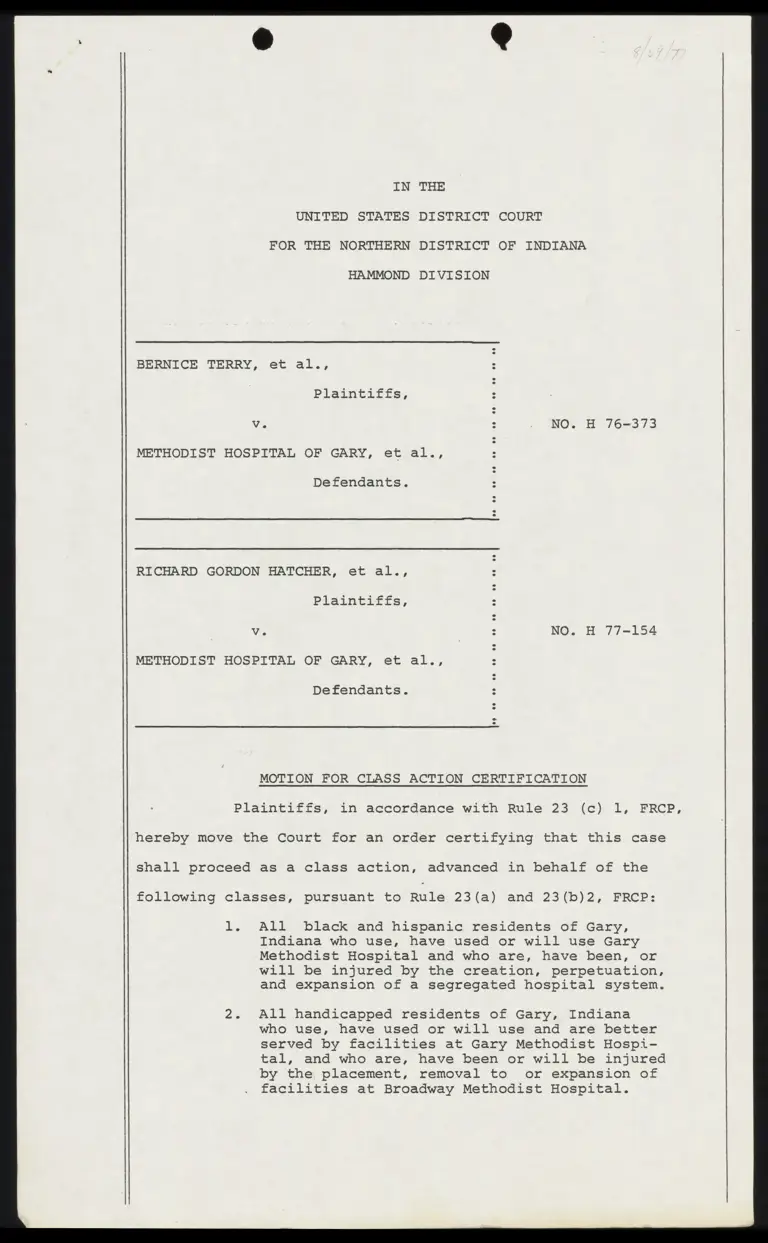
     [||a93f1183-9976-46d1-ad8f-0ec15d9a5085||] IN THE

UNITED STATES DISTRICT COURT

FOR THE NORTHERN DISTRICT OF INDIANA

HAMMOND DIVISION


BERNICE TERRY, et al.,

Plaintiffs,

Vv. NO. H 76-373

METHODIST HOSPITAL OF GARY, et al.,

Defendants.


RICHARD GORDON HATCHER, et al.,

Plaintiffs,

Vv. NO. H 77-154

METHODIST HOSPITAL OF GARY, et al.,

Defendants.

oO


00


00


ob


00


00


ob


oo


0b


eb


o0


oo


MOTION FOR CLASS ACTION CERTIFICATION


Plaintiffs, in accordance with Rule 23 (c¢) 1, FRCP,

hereby move the Court for an order certifying that this case

shall proceed as a class action, advanced in behalf of the

following classes, pursuant to Rule 23 (a) and 23(b)2, FRCP:

l. All black and hispanic residents of Gary,
Indiana who use, have used or will use Gary
Methodist Hospital and who are, have been, or
will be injured by the creation, perpetuation,
and expansion of a segregated hospital system.

2. All handicapped residents of Gary, Indiana
who use, have used or will use and are better
served by facilities at Gary Methodist Hospi-
tal, and who are, have been or will be injured
by the placement, removal to or expansion of

facilities at Broadway Methodist Hospital.


As demonstrated in a memorandum of law, herewith

submitted, all requisites to such certification are satis-

fied by this Action.

Respectfully submitted,


1

JACK \GREENBERG
MELVYN R. LEVENTHAL

BETH J. LIEF

10 Columbus Circle

New York, New York 10019

JULIAN ALLEN

2009 Broadway
Gary, Indiana 46407

MARILYN G. ROSE

CHRISTINE B. HICKMAN
1751 N Street, N. W.
Washington, D. C. 20036

Attorneys for Plaintiffs


IN THE

UNITED STATES DISTRICT COURT

FOR THE NORTHERN DISTRICT OF INDIANA

HAMMOND DIVISION


BERNICE TERRY, et al.,

Plaintiffs,

¥. : NO. H 76-373

METHODIST HOSPITAL OF GARY, INC.,

Defendants.


RICHARD GORDON HATCHER, et al.,

Plaintiffs,

. NO. H 77-154

METHODIST HOSPITAL OF GARY, INC., et al., :

Defendants.


MEMORANDUM OF LAW IN SUPPORT OF CLASS
ACTION CERTIFICATION


Plaintiffs are: (a) Richard G. Hatcher, a black

resident and Mayor of Gary, Indiana who will require the use

of health services and who, as Mayor, is "responsible... for

assuring that the social service and health needs of his

constituency...are met 3" (b) Willie Lee Page, a black resi-

dent of Gary, Indiana, 66 years old, who has already required

and continues to require regular use of hospital services and

facilities provided by defendants; (c) Metro Corps. Inc.,

a not-for-profit corporation which, inter alia, conducts pro-


grams to assure that transportation to defendants' hospital

facilities is available to the poor, the elderly and the handi-

capped of Gary. Metro Corps. Inc.'s by-laws provide that


® @®

a "minumum of one-third [of the Board of Directors be] representa-

tives of the poor and disadvantaged: elected by free elections,"

held in identified communities; an additional third of the Board

of Directors consists of organizations with a manifest interest

in and responsibility to the black, the Hispanic, the poor, the

elderly and the handicapped citizens of cars

The issue of whether named plaintiffs individually have

standing to bring this action is addressed in Memorandum of

Plaintiffs in Opposition to Motion to Dismiss submitted to the

Court on August 13, 1977. We herein argue in support of plain-

tiffs' Motion for Class Action Certification that the requirements

of Rule 23 are fully satisfied and that defendants' opposition to

certification is without merit.

I

Plaintiffs seek certification under Rule 23 (b) 2

which provides for class actions when:

the party opposing the class has acted or
refused to act on grounds generally
applicable to the class, thereby making
appropriate final injunctive relief
or corresponding declaratory relief with
respect to the class as a whole....

By its very terms Rule 23(b) 2 applies primarily to

injunctive and declaratory relief. And the Advisory Committee

Notes on revised Rule 23 state that "illustrative [of Rule 23(b)2

actions] are various actions in the civil rights field where a


party is charged with discriminating unlawfully against 2 class,

usually one whose members are incapable of specific enumeration."

39 F.R.D. 69, 102. (Emphasis added). Accordingly, virtually

without exception all actions alleging racial or other invidious

discrimination have been certified under Rule 23(b) 2 upon

the satisfaction of the requirements of Rule 23(a):

ve
The organizations listed are the "Urban League, Tenants Council,

Senior Citizens, Youth Representative (IU Dons) and the Gary
Housing Authority." Alternative representatives are listed as
Youth Services Bureau, Ministerial Alliance, NAACP, Baptist
Ministers' Conference of Gary and Vicinity."


-


Fujishima v. Board of Education, 460 F.2d 1355, 1360 (7th Cir.


1972); Albemarle Paper Company v. Moody, 422 U.S. 405, 414, n. 8


(1975): Penn v. San Juan Hospital, 528 F.2d 1181, 1188, (10th Cir.


1975); cf., Sprogis v, United Air Lines, Inc., 444 F.2d 1194, 1201+


1202 (7th Cir. 1971); Potts v, Flax, 313 P.2d 284, 1289-90 (5th


Cir. 1963). Federal courts have routinely recognized that the

class action device is particularly suitable for cases seeking in-

juntive relief against unlawful discrimination in facilities avail-

able to the general public. Bailey v. Patterson, 323 F.2d 201,


206 (5th Cir. 1963); Coleman v. Humphreys County Mem. Hospital,


44 F.R.D. 507 (N.D. Miss. 1972); Penn, supra; Potts, supra. This


is an action attacking defendants' policies and practices affect-

ing or "generally applicable" to all blacks, Hispanics and handi-

capped persons residing in Gary. It seeks "injunctive relief. . .

[and] declaratory relief with respect to [such] class[es] as a

whole." Defendants have not and cannot seriously dispute that

class certification is therefore here contemplated by Rule 23 (b) 2.

JX

An action cannot be maintained as a class action unless the

requirements of Rule 23(a) are satisfied, i.e., unless "the class

is so numerous that joinder of all members is impracticable,"

there are common questions of law and fact, the claims of the named

plaintiffs are typical of those of the class and the "representa-

tive parties will fairly and adequately protect the interests of

the class."

(2a) Numerosity


Gary's population in 1970 was 175,249 of which 107,600 (62%)

were black and Hispanic; approximately 13,300 of its residents were


over 65 years old. (Bureau of the Census data, 1970, recorded in

Draft Regional Health Plan, Northwest Indiana Comprehensive


Health Planning Council, Inc., 1975, pp. J-9, I-10). As a group,

the aged suffer disproportionately from physical and mental im-

pairments which substantially limit one or more of their major

life activities; they are handicapped within the meaning of 29

U.S:Cte § Jor Manifestly, the number of black, Rispanic and

handicapped residents who use and will use defendant's facilities

and services is "so numerous that joinder of all members is im-

practicable." Cypress v. Newport News General Hospital, supra,


375 F.2d at 653 and n. 9 (18 class members satisfies numerosity;

size of the class is infinite because prospective injunctive re-

3/
lief is sought.


2/ In Lake County, (80% of which is Gary) 54,000 people, more

than 10% of the population, suffer from one or more chronic con-

ditions which limit life activities and mobility. Chronic Condi-

tions and Limitations of Activity and Mobility, U.S., July 1965-
June 1967, NCHS, U.S. DHEW 1971 and 1970 (Census (based on NCHS

Household Survey, National Health Survey and North Central Region

Data), compiled by Health Data Unit, Indiana State Board of

Health, published in Indiana's Disabled Population and cited in

Draft Regional Health Plan, Northwest Indiana Comprehensive Health

Planning Council, Inc., 1975, p. I-32.


3/ Plaintiffs have propounded interrogatories seeking precise
statistical data on the number of persons by race and national

origin who have used defendant's hospitals. Although the Court

might find such information useful and presume that the number of

such persons treated in the past will approximate the number who

will be treated in the future, the census tract data provided in

the text are enough to demonstrate numerosity.


(b) Commonality


Professor Moore has observed that the "commonality" require-

ment of Rule 23(a)2 is surplusage since under Rule 23 (b)2 the

Court must separately find that the "party opposing the class has

acted or refused to act on grounds generally applicable to the

class." In view of the superfluity courts either ignore the re-

quirement or find it satisfied "undoubtedly," or "certainly."

Moore's, Federal Practice, Vol. 3B, €23.06-1, p. 23-301.


The common question of law and fact — the thread connect-

ing all aspects of this controversy — is whether defendant's

policies and practices are tainted by racial or other discrimina-

tion proscribed by federal law. The question arises for all

members of the classes named plaintiffs seek to represent. And

the existence of such a question satisfies Rule 23(a) (2). Norwalk

CORE v. Norwalk Development Agency, 395 F.2d 920 (2d Cir. 1968);


Jenkins v. United Gas Corp., 400 F.2d 28 (5th Cir. 1968);


Donaldson v. Pillsbury Co., 554 P.2d 825, 831, n. 5 (8th Cir.


1977).
4/

(Cc) Typlicality


Professor Moore opines that Rule 23(a)3's requirement of

"typicality" is included within 23(a)4. Moore's Federal Practice,


vol. 3B, €23.06-2. Nevertheless, "in an effort to give Rule

23 (a) 3 independent meaning, some courts have said that the typi-

cality provision requires a demonstration that there are other

members of the class who have the same or similar grievances as

the [named] plaintiff[s]." The claims need not be identical, nor

need they be advanced by all members of the class. Donaldson v.


4/ Defendants argue that plaintiffs do not satisfy the require-
ment of Rule 23(a)3: "The [named] plaintiffs . . . do not allege

that they have been denied any services by defendant . . . . The

Be


5/
Pillsbury Co., 554 F.2d 825, 830 (8th cir. 1977).


(d) Adequate Representation


Rule 23 (a)4's requirement of "adequate representation"

turns on whether the plaintiff's attorney "is qualified, exper-

ienced and generally able to conduct the proposed litigation and

« « « [whether plaintiff has an] interest antagonistic to those

of the class." Wetzel v. Liberty Mutual Insurance Co., 508 F.2d


239, 247 (3rd Cir. 1975); Senter v. General Motors Corp., 532 F.2d


511, 525 (6th Cir. 1976). "Factual identity between the [named]

plaintiff's claim and those of the class he seeks to represent


is not necessary." Senter, 532 F.2d at 524. Donaldson, supra;

Foster v. Sparks, 506 F.2d 805, 809 (5th Cir. 1975).


Counsel for plaintiffs are on the staff of or associated

with the NAACP Legal Defense Fund which has demonstrated in this

case and thousands more over a forty-year period an ability and

willingness to advance cases charging invidious discrimination.

And no class member can seriously oppose the elimination of racial

and other invidious discrimination in the provision of health


4/ '{Cont'd)

claim of the class is that . . . [it] has been denied some ser-
vice by defendant . . . . [Therefore], the named plaintiffs
claims are not substantially identical to the alleged claims of
the class . . . ." (Memorandum in Support of Defendant's Motion
Concerning the Status of this Suit as a Class Action, filed
January 19, 1977, pp. 1-2). Nothing in the Complaint supports de-
fendant's assertion. The claim of named plaintiffs, on their own
behalf as well as for the classes is that defendant is affording
services and is engaging in a construction program in a racially
discriminatory manner. Moreover, as we point out in the text,
and footnote 5 below, Rule 23(a) does not require that named plain-
tiffs' claims mirror those of the class.


5/ In Donaldson, named plaintiff claimed that her discharge re-
sulted from race and sex discrimination. Although she was found
to be lawfully discharged and hired under unusual circumstances

lye


i ®

6/
services by defendants.

IV

Defendants concede that under Rule 23 (b)2 notice to class

members is not required. Wetzel, supra, 508 F.2d at 254-57.


They argue, nevertheless, that due process considerations require

the issuance of a 23(d) 2 discretionary notice to class members

individually. Wetzel properly holds, however, that in a Rule

23 (b) 2 action the class is by its "very nature . . . homogeneous

without any conflicting interests between members of the class"

and accordingly that due process considerations do not require

notice. Wetzel, 508 F.2d at 256-57.

Conclusion


Plaintiffs' Motion For Class Action Certification should be

granted because the requirements of Rule 23(a) and (b)2 are sat-

isfied by this action. Notice to class members is neither re-

quired nor appropriate.

ES submitted,
A io op, §

= ir, Fas] ’ LE
7% GREENBERG
MELVYN R. LEVENTHAL

BETH J. LIEF

10 Columbus Circle, Suite 2030

New York, New York 10019

Attorneys for Plaintiffs


3/ {Cont'd)

her class action in behalf of all former and present black and fe-

male employees and all unsuccessful black and female applicants

for employment, was upheld.

6/ Defendants' assertion that this action seeks or will result in

preventing the construction of a health services building in down-

town Gary is patently false. Nothing in the Complaint can be con-

strued as seeking or effecting such a result. Defendants may

decide that if they can't construct facilities and provide ser-

vices on a discriminatory basis then they will not make any

additions to the Gary Methodist Hospital. But such a result would

deprive defendants' commitment to unlawful discrimination not from

any conflict between the objectives of named plaintiffs and other

class members.


Certificate of Service


I hereby certify that a copy of the foregoing Motion

For And Memorandum In Support Of Class Action Certification


was served by United States mail, postage prepaid, on

the 29th day of August 71977, on counsel "for


defendants as follows:

Rebecca L. Ross, Esq.
Department of Justice
10th and Pennsylvania Avenue
Washington D.C.

Marvin G. Garvin, Esg. and Edward L. Koven, Esq.
Regional Attorney and General Attorney
Department of Health, Education and Welfare
300 South Wacker Drive, 18th Floor
Chicago, Illinois

Fred W. Grady, Esq.
Assistant United States Attorney
Northern District of Indiana
Federal Building, 502 State Street
Hammond, Indiana 46325

Attorneys for Defendant Secretary of Health,
Education and Welfare

Hodges, Davis, Gruenberg, Compton & Sayers
Bruce E. Sayers, Esq.

5525 Broadway
Gary, Indiana 46401

Attorneys for Defendant Methodist Hospital
of Gary, Inc.

Theodore L. Sendak, Esq.
Assistant Attorney General of Indiana
219 State House
Indianapolis, Indiana

Attorneys for State Defendants

Anthony DeBonis, Jr., Esq.
Joseph E. Costanza, Esq.
Murphy, McAtee, Murphy & Costanza
First National Bank Building
720 W. Chicago Avenue
East Chicago, Indiana 46312

Attorneys for Defendant Kipton Kaplan

i Fa , 13 ;
A a Now Sey ora, A 3

> a

3 5 3 BJ bE | ¥ 3 ig ian 2 3
Wy pe) y :

bas Pa p i Ss fa
rn Fla ! ® DION £6 205: RET

{ Beth J. Lief
Counsel for Plaintiffs

F's


3 [||a93f1183-9976-46d1-ad8f-0ec15d9a5085||]