Plaintiff's Motion for Partial Summary Judgment on the Question of Liability; Memorandum of Law in Support
Public Court Documents
June 19, 1986
18 pages
-
Case Files, Garner Working Files. Plaintiff's Motion for Partial Summary Judgment on the Question of Liability; Memorandum of Law in Support, 1986. 6ea120f6-35a8-f011-bbd3-000d3a53d084. LDF Archives, Thurgood Marshall Institute. https://ldfrecollection.org/archives/archives-search/archives-item/705e36cd-7845-44bc-93d1-e0be8b755194/plaintiffs-motion-for-partial-summary-judgment-on-the-question-of-liability-memorandum-of-law-in-support. Accessed September 25, 2026.
Copied!
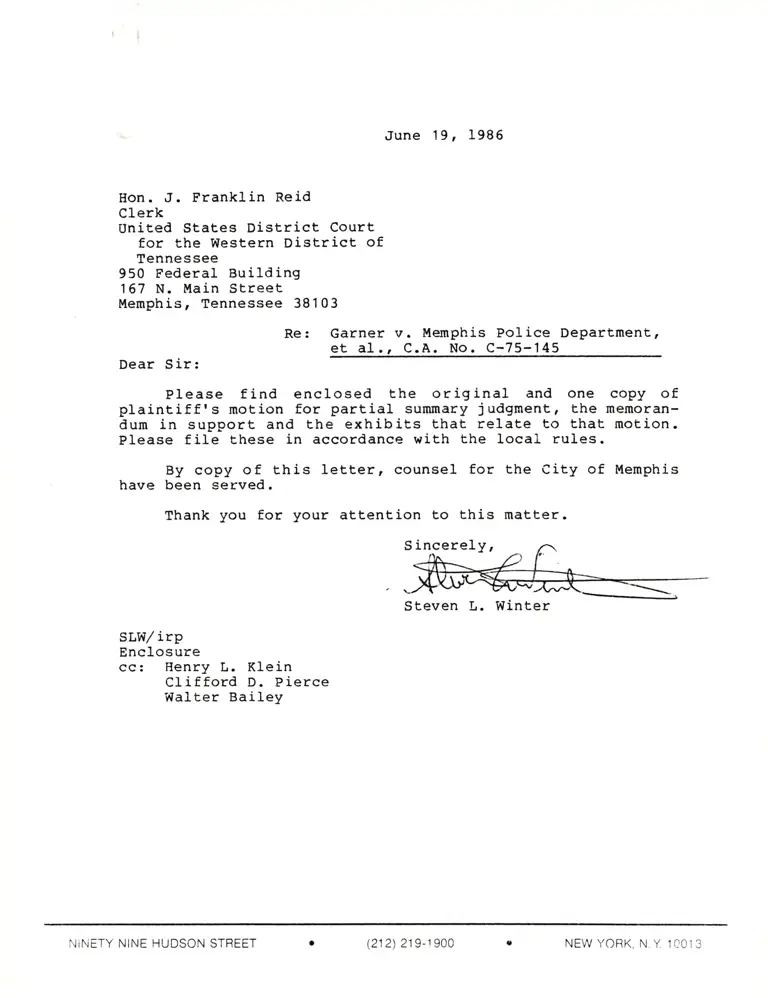
June 19, 1986
Hon. J. Franklin Reid
Clerk
United States District Court
for the Western District of
Tennessee
950 Federal Building
167 N. Main Street
Memphis, Tennessee 38103
Re: Garner v. Memphis Police Department,
et al., C.A. No. C-75-145
Dear Sir;
Please find enclosed the original and one copy of
plaintiff's motion for partial summary judgment, the memoran
dum in support and the exhibits that relate to that motion.
Please file these in accordance with the local rules.
By copy of this letter, counsel for the City of Memphis
have been served.
Thank you for your attention to this matter.
Sincerely,
Steven L. Winter
SLW/irp
Enclosure
cc: Henry L. Klein
Clifford D. Pierce
Walter Bailey
NINETY NINE HUDSON STREET (212) 219-1900 NEW YORK, N. Y 10013
IN THE UNITED STATES DISTRICT COURT
FOR THE WESTERN DISTRICT OF TENNESSEE
WESTERN DIVISION
CLEAMTEE GARNER/ father and next
of kin of EDWARD GARNER/ a deceased
minor/
Plaintiff/
V.
MEMPHIS POLICE DEPARTMENT/ CITY OF
MEMPHIS/ TENNESSEE; WYETH CHANDLER/
Mayor of Memphis; and JAY W. HUBBARD/
Director of Memphis Police/
Defendants.
CIVIL ACTION
No. C-75-145
PLAINTIFF'S MOTION FOR PARTIAL SUMMARY JUDGMENT
ON THE QUESTION OF LIABILITY
Plaintiff, Cleamtee Garner, respectfully moves the
court pursuant to F.R.C.P. 56 to grant summary judgment
against the City of Memphis on the question of liability.
In support of this motion, he shows the following;
1. On March 27, 1985, the Supreme Court affirmed the
judgment of the court of appeals that the shooting in this
case violated the fourth amendment. Tennessee v. Garner,
471, U.S. , 85 L.Ed.2d 1, 15-16 (1985), aff'g 710
F.2d 240, 246 (6th Cir. 1983). It remanded for further
proceedings to determine the city's liability under Monell
V. Department of Social Services, 436 U.S. 658 (1978). The
amount of damages is the only other issue that remains in
addition to the question of liability.
2. Under Monell v. New York Dept, of Social Services,
436 U.S. 658 (1978), municipalities are "persons" within the
meaning of § 1983 and subject to suit under that statute.
Under Monell, a city may be held liable in damages under
§ 1983 for constitutional deprivations that result from a
"policy or custom" followed by the city. Under that
standard, Mr. Garner is clearly entitled to relief.
3. "[I]t is when execution of a government's policy
or custom, whether made by its lawmakers or by those whose
edits or acts may fairly be said to represent official
policy, inflicts the injury that the government as an entity
is responsible under § 1983." Monell, 436 U.S. at 694. A
city is responsible for its own acts, "that is, acts which
the municipality has officially sanctioned or ordered."
Pembaur v. Cincinnati, 475 U.S. ___, 89 L.Ed.2d 452, 463
(1986). "[T]o establish the constitutional violation [as]
in Monell no evidence [i]s needed other than a statement of
the policy by the municipal corporation, and its exercise."
Oklahoma City v. Tuttle, 471 U.S. ___, 85 L.Ed.2d 791, 803
(1985).
- 2 -
4. Under these standards, plaintiff is entitled to
summary judgment on the issue of liability. All he need
show is the municipal policy and its exercise. There can be
no genuine issue of fact because it cannot be denied that
Memphis had an explicit, written policy sanctioning the
shooting in this case. It was this municipal policy of
Memphis that was "the moving force of the constitutional
violation." Monell, 436 U.S. at 694.
5. The record material attached to this motion
establishes beyond doubt that the Memphis deadly force
policy in effect on the night of Edward Eugene Garner's
death explicitly authorized the shooting of fleeing burglary
suspects. General Order No. 5-74, Attached as Exhibit 1, is
a policy statement signed by then Director of Police, J.W.
Hubbard (see Exhibit 4) — "a municipal policymaker."
Pembaur, 89 L.Ed.2d at 464-65; Tuttle, 85 L.Ed.2d at 804. It
was adopted with the explicit consideration and approval of
the Mayor, Wyeth Chandler. Indeed, although this policy is
more restrictive than state law, the inclusion of burglary
as an enumerated underlying felony justifying the use of
deadly force to prevent escape was a considered policy
choice "consciously chosen from among various alternatives
...," Tuttle, 85 L. Ed.2d at 804, by Mayor Chandler and
Director Hubbard. See Exhibit 2, 3, and 4. As the Mayor
testified in deposition: "One of the arguments was to
- 3 -
eliminate burglary and this type thing, some kinds of
burglary, which I did not do. I did not think it should be
done." Exhibit 2, Deposition of Mayor Wyeth Chandler at 22
(Dec. 19, 1979).
6. The district court previously found that:
Under ... regulations of the Memphis Police
Department ... lethal force may be used by police
officers to apprehend persons fleeing from the
commission of certain felonies.... Burglary of a
residence is one of the felonies covered ....
Lethal force may be resorted to in order to
apprehend a person fleeing from the commission of
a burglary such as that in which deceased Garner
was involved....
Memorandum Opinion of September 29, 1976, Slip. op. at 9-10.
On the first appeal, the court of appeals affirmed the
finding that the officer "shot because he believed that the
boy would elude capture," and that the officer "was taught
that it was proper to kill a fleeing felon rather than run
the risk of allowing him to escape." Garner v. Memphis
Police Department, 600 F.2d 52, 53 (6th Cir. 1979). There
can be no doubt that the officer was taught and acted
pursuant to the policies of the City of Memphis.
7. The Supreme Court held that, without probable
cause to believe that he is dangerous, the shooting of a
fleeing suspect solely because there is a probable cause to
believe that he committed a burglary violates the fourth
amendment. Garner, 85 L.Ed.2d at 16. The record leaves no
doubt that there can be no genuine issue of material fact:
- 4 -
(1) that this was the explicit policy of the City of
Memphis, adopted by its Mayor and Director of Police; (2)
that this policy was taught to Officer Hymon who fired the
fatal shot; and (3) that he shot because of the policy.
Accordingly, plaintiff is entitled to judgment on the
question of liability. He had made an incontrovertible
showing "sufficient to impose liability under Monell ...
[that] includes proof that [the unconstitutional shooting]
was caused by an existing, unconstitutional municipal
policy, which policy can be attributed to a municipal
policymaker." Tuttle, 85 L.Ed.2d at 804.
8. In Sartor v. Arkansas Natural Gas Corp., 321 U.S.
620 (1944), the Supreme Court held that "Rule 56 'authorizes
summary judgment only where the moving party is entitled to
judgment as a matter of law, where it is quite clear what
the truth is, that no genuine issue remains for trial.'" 6
Moore's Federal Practice H 56.15 [ 1-.00] (quoting Sartor,
321 U.S. act 627) (emphasis added). Given the Supreme
Court's holding in Garner, "it is quite clear what the truth
is" — a policy that authorized the use of deadly force
claimed the life of Edward Eugene Garner. The execution of
the city's policy, made by municipal decisionmakers,
inflicted the ultimate injury of death. The city is liable
under § 1983.
- 5 -
9. Even though the question of damages may be at
issue. Rule 56 clearly provides for partial summary judg
ment. According to Rule 56, a claimant may "move ... for a
summary judgment in his favor upon all or any part" of a
claim. F.R.C.P. 56; _see 6 Moore's Federal Practice
H56.20[3.-0] at 56-1208. Under subdivision (c) of F.R.C.P.
56, there is little doubt that summary judgment should be
granted in this case: "A summary judgment, interlocutory in
character, may be rendered on the issue of liability alone
although there is a genuine issue as to the amount of
damages." {emphasis added).
For the foregoing reasons, and as more fully set out in
the attached memorandum and exhibits, the motion for partial
summary judgment on the question of liability should be
granted.
Respectfully submitted.
JULIOS LeVONNE CHAMBERS
STEVEN L. WINTER
16th Floor
99 Hudson Street
New York, New York 10013
WALTER L. BAILEY, JR.Suite 901, Tenoke Building
161 Jefferson Avenue
Memphis, Tennessee 38103
COUNSEL FOR PLAINTIFF
- 6 -
IN THE UNITED STATES DISTRICT COURT
FOR THE WESTERN DISTRICT OF TENNESSEE
WESTERN DIVISION
CLEAMTEE GARNER, father and next
of kin of EDWARD GARNER, a deceased
minor.
Plaintiff,
V,
MEMPHIS POLICE DEPARTMENT, CITY OF
MEMPHIS, TENNESSEE: WYETH CHANDLER,
Mayor of Memphis; and JAY W. HUBBARD,
Director of Memphis Police,
Defendants.
CIVIL ACTION
No. C-75-145
MEMORANDUM 0F LAW IN SUPPORT OF PLAINTIFF'S MOTION
FOR PARTIAL SUMMARY JUDGMENT ON THE QUESTION OP
LIABILITY _____________________
I. THE CITY OF MEMPHIS IS LIABLE FOR AN UNCONSTITUTIONAL
ACT BY ONE OF ITS EMPLOYEES DURING THE COURSE OF HIS
EMPLOYMENT WHEN THERE IS AN OFFICIAL POLICY WHICH
SANCTIONED THAT ACT _______________________
In Tennessee v. Garner, 471 U.S. 85 L.Ed.2d 1
(1985), the Supreme Court held that the shooting in this
case violated the fourth amendment because a nonviolent
burglary suspect "may not be seize[d] ... by shooting him
dead." Id. at 10. The only question is the city's lia
bility under Monell v. Dept, of Social Services ̂ 436 U.S.
658 (1978). "[Wjhen execution of a government's policy or
custom, whether made by its lawmakers or by those whose
edicts or acts may fairly be said to represent official
policy, inflicts the injury ... the government as an entity
is responsible under § 1983." Monell, 436 U.S. at 695.
In two recent cases — Pembaur v. Cincinnati, 479 U.S.
___, 89 L.Ed.2d 452 (1986), and Oklahoma City v. Tuttle, 471
U.S. ___, 85 L.Ed.2d 791 ( 1985 ) — the Court has further
filled in the contours of Monell liability. "[T]here must
be an affirmative link between the policy and the particular
constitutional violation...." Tuttle, 85 L.Ed.2d at 804.
That link may be forged when "proof of the incident includes
proof that it was caused by an existing, unconstitutional
municipal policy, which policy can be attributed to a
1
municipal policymaker." I^. In Pembaur, the Court
clarified both aspects of this standard. First, it clari
fied that "Monell is a case about responsibility." Pembaur,
89 L.Ed.2d at 462. A city is responsible for the "acts 'of
the municipality' — that is acts which the municipality has
officially sanctioned or ordered." at 463. Second, it
̂ Although Tuttle was only a plurality opinion, the
concurring Justices (Brennan, Marshall, and Blackmun) and
the dissent (Stevens) supported a less rigorous standard.
Accordingly, all Justices would appear to support Monell
liability when, as here, the plurality's standard is met.
- 2 -
held that; "Municipal liability attaches only where the
decisionmaker possesses final authority to establish
municipal policy with respect to the action ordered." Id.
2
at 464.
When viewed under these standards, it is quite clear
that plaintiff is entitled to summary judgment on the
question of liability. For as we show below, there can be
no dispute that: (1) the city had an explicit written policy
that sanctioned the shooting in this case; (2) the policy
authorized precisely what the Supreme Court in Garner held
unconstitutional; (3) this policy was adopted by the Mayor
and Director of Police — authorized municipal policymakers
— after careful consideration and deliberation; and (4) the
shooting of young Garner was pursuant to this municipal
authorization.
The Memphis Deadly Force Policy, Order 5-74 attached as
Exhibit 1, specifically sanctioned the shooting in this
case, which was held unconstitutional by the Court. The
policy stated explicitly that it was designed "to define
Although Justice O'Connor did not join in this portion of
the majority opinion, she did join in Justice White's
concurring opinion which would impose liability on the
municipality when an officer with final authority to speak
for the municipality adopts a policy that has not yet been
declared unconstitutional. This, of course, is precisely
our case; When the Memphis deadly force policy was adopted
by the Mayor and Director of Police, no court had held such
a policy unconstitutional. Accordingly, it is clear that
under Pembaur, six Justices would find municipal liabilty in
a case such as ours.
- 3 -
circumstances under which Deadly Force and Non-Deadly Force
may be used to prevent the commission of an offense and to
effect an arrest.” Exhibit 1. Section 3(b)(3)(h) of
the policy specifically authorized the use of deadly force
to prevent flight from burglaries of the 1st, 2nd, or 3rd
degrees. Exhibit 1 at 2. This is the explicit policy
that authorized the shooting of Edward Eugene Garner.
It should be clear that this policy is precisely what
the Supreme Court disapproved in Garner. The Court held not
only that the shooting in this case was unconstitutional, 85
L.Ed.2d at 15-16, but also that flight from a burglary is
not sufficient probable cause to believe the suspect
dangerous — that burglary is not an inherently dangerous or
violent crime. , 85 L.Ed.2d at 16. Thus, the Memphis
policy that authorized the shooting in this case was
premised on the precise factor that the Garner Court held
insufficient. But, this was the official policy of the
Memphis Police Department signed by J. W. Hubbard, the
former director of police for the city of Memphis.
Section 3(b)(3)(h) of the Memphis Deadly Force policy
was a considered policy choice, "consciously chosen from
among various alternatives...." Tuttle, 85 L.Ed.2d at 804.
It was adopted by the senior municipal policymakers; the
Mayor, Wyeth Chandler, and the police director, Hubbard.
Mayor Chandler testified in deposition that he carefully
- 4 -
considered and personally approved the policy's inclusion of
burglary as an underlying offense justifying the use of
deadly force to prevent flight. The Mayor, in his role as
ultimate municipal decisionmaker, had a clear view of the
policy that he wanted to be implemented by the Memphis
police force; "I just don't think we ought to let people go
in and out at will, invade people's homes, businesses or
anything else, and, then, get away by simply running away
..." Exhibit 2 at 3. "I don't think he [any burglar] should
be allowed to just burgle at will as long as he can outrun
the police." Exhibit 2 at 33. Indeed at the very time the
Mayor acted to exempt joy riders from the use of deadly
force to prevent their escape, he reaffirmed its use in any
burglary, without regard to the circumstances; "It was my
opinion then and still is at this time that those [3rd
degree burglary suspects] should not be eliminated from the
fleeing felon policy." Exhibit 2 at 30.
Finally, it is also clear that the Memphis deadly force
policy was adhered to by the police officer and caused
Edward Eugene Garner's death; it was "the moving force of
the constitutional violation." The officer was taught that
it was proper to kill a fleeing felon rather than run the
risk of allowing him to escape. Garner, 600 F.2d 52, 53
(6th Cir. 1979). This is confirmed by the testimony at the
- 5 -
1976 trial which established that the firearms review board
found that the use of deadly force in this case was justi
fied and within policy. Trial Transcript at 608-25, 648.
In sum, Memphis's policy was deliberately adopted by
its senior policymakers and authorized the shooting in this
case. Under Monell, therefore, the city is liable.
II. THE CITY HAS NO GOOD FAITH OR QUALIFIED IMMUNITY
DEFENSE
In previous submissions, the city has attempted to
raise the issue of a putative good faith immunity for a
municipality similar to that accorded an individual defen
dant. Compare Garner, 600 F.2d at 51.
On the previous appeal, the city raised the identical
claim of good faith immunity. The court of appeals rejected
it. Garner v. Memphis Police Department, 710 F.2d 240,
248-49 (6th Cir. 1983). In its petition for a writ of
certiorari in the Supreme Court, the city did not challenge
that aspect of the court's decision. Thus, the Sixth
Circuit's ruling is the "law of the case." Petition of
United States Steel Corp, 479 F.2d 489, 493-94 (6th Cir.
1973).
Moreover, this ruling is plainly correct. On the prior
appeal, the court of appeals rejected the city's argument
that there is a good faith immunity for a municipality. The
court held that "the reasoning underlying the Supreme Court's
- 6 -
decision in Owen [v. City of Independence, 445 U.S. 622
(1980)], precludes a municipality's claim of good faith
immunity under § 1983 altogether." Garner, 710 F.3d at
248.
Review of the Owen decision confirms the court's
determination. Owen rejected the very arguments asserted by
the city in this case. Owen concerned "the question whether
local governments, although not entitled to an absolute
immunity, should be afforded some form of official immunity
in § 1983 suits." Owen, 445 U.S. at 624. The Eighth
Circuit said yes; the Supreme Court reversed. at 625.
In Owen, the City of Independence made the same argument
made by the City of Memphis here: that because the govern
ing constitutional rule had not been declared until after
the violation, "officials of the City ... could not have
been aware of [petitioner's] right" and, therefore, "[t]he
City ... should not be charged with predicting the future
course of constitutional law." Id. at 634 (quoting the
Eighth Circuit decision, 589 F.2d 335, 338 (8th Cir. 1978)).
The Supreme Court "disagree[d] with this holding." at
635. "In sum," the Court held "that municipalities have no
immunity from damages liability flowing from their con
stitutional violations...." Id. at 657.
- 7 -
There is no intervening law that casts any doubt on the
viability of this controlling authority. To the contrary,
the Court's recent decisions in Tuttle and Pembaur support
the ruling. In Tuttle, the Supreme Court reaffirmed its
prior holding in Monell that respondeat superior does not
apply and "that only deprivations visited pursuant to
municipal 'custom' or 'policy' could lead to municipal
liability. This language tracks the language of the statute;
it also provides a fault-based analysis for imposing
municipal liability." Tuttle, 85 L.Ed.2d at 801 (emphasis
added; footnote omitted). Similarly, in Pembaur, the Court
reaffirmed that "Monell is a case about responsibility." 89
L.Ed.2d at 462. Thus, in the Court's view liability
premised on a municipal policy _î liability based on fault,
even if, as in Owen, the individual municipal policymakers
3
relied in good faith on the prior decisional law.
In sum, the good faith immunity applies only to
individual officers, not cities which are responsible for
their policies.
It is also noteworthy that while the Court discussed the
good faith defense available to the individual, Tuttle, 85
L.Ed.2d at 797 & n.1, it adverted to no parallel immunity
for municipalities. Rather, it discussed only the para
meters of the "policy or custom" doctrine in its discussion
of the meaning of "fault-based" liability. Similarly, in
Pembaur, Justices White and O'Connor explained their view
that a city is particularly responsible for the decisions of
its senior policymakers when they choose policies not yet
held unconstitutional. See n.2, supra.
- 8 -
The innocent individual who is harmed by an abuse
of governmental authority is assured that he will
be compensated for his injury. The offending
official, so long as he conducts himself in good
faith, may go about his business secure in the
knowledge that a qualified immunity will protect
him from personal liability for damages that are
more appropriately chargeable to the populace as a
whole. And the public will be forced to bear only
the costs of injury inflicted by the "execution of
a government's policy or custom, whether made by
its lawmakers or by those whose edicts or acts may
fairly be said to represent official policy."
Owens, 445 U.S. 658 (quoting Monell v. New York City Dept,
of Social Services, 436 U.S. at 694).
CONCLUSION
Almost twelve years ago, a Memphis police officer
acting pursuant to an officially promulgated order and
regulation of the Memphis Police Department shot and killed
Mr. Garner's son. The Supreme Court's ruling makes clear
that both the shooting and the municipal policy that
explicitly authorized it violate the fourth amendment.
Accordingly, Mr. Garner is entitled to summary judgment
against the city on the issue of liability. There are no
genuine issues of fact other than the amount of damages
remaining for trial. "It is quite clear what the truth is;"
an unconstitutional policy of the Memphis Police Department
resulted in Edward Eugene Garner's death.
- 9 -
For the foregoing reasons, we respectfully request that
the motion for partial summary judgment on the question of
liability be granted.
Respectfully submitted.
JULIUS LeVONNE CHAMBERS
STEVEN L. WINTER
16th Floor
99 Hudson Street
New York, New York 10013
WALTER L. BAILEY, JR.Suite 901, Tenoke Building
161 Jefferson Avenue
Memphis, Tennessee 38103
COUNSEL FOR PLAINTIFF
- 10 -
CERTIFICATE OF SERVICES
I hereby certify that copies of the foregoing
Plaintiff's Motion for Partial Summary Judgment on the
Question of Liability and Memorandum of Law in Support of
Plaintiff's Motion for Partial Summary Judgment on the
Question of Liability have been served by placing same in
the United States mail, postage prepaid, addressed to Henry
L. Klein, Esquire, 770 Estate Place, Memphis, Tennessee
38117, Clifford D. Pierce, Jr., City Attorney, 314-125 N.
Mid America Mall, Memphis, Tennessee 38103, this ft *^day of
June, 1986.
Steven L. Winer
Counsel for Plaintiff