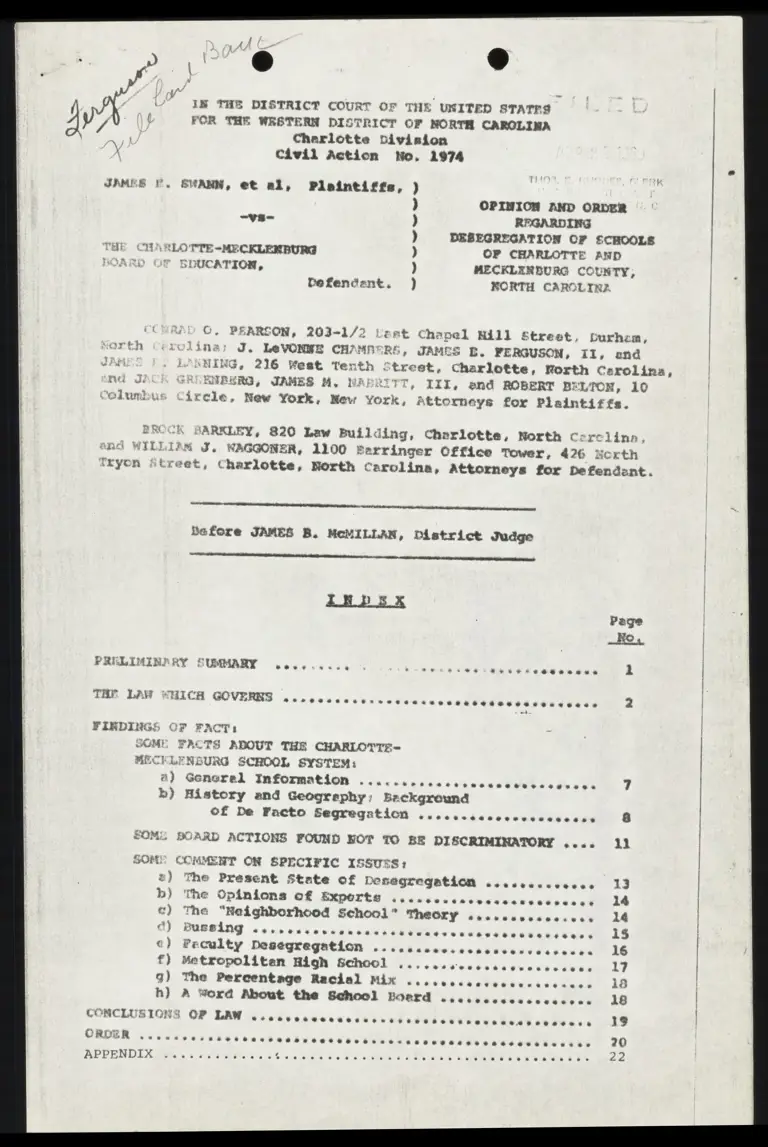
Opinion and Order Regarding Desegregation of Schools of Charlotte and Mecklenburg County, North Carolina

Public Court Documents
April 23, 1969

Opinion and Order Regarding Desegregation of Schools of Charlotte and Mecklenburg County, North Carolina preview

22 pages

Cite this item

  • Case Files, Swann v. Charlotte-Mecklenburg Hardbacks. Opinion and Order Regarding Desegregation of Schools of Charlotte and Mecklenburg County, North Carolina, 1969. f2a3af8d-2d34-f111-88b4-7c1e526962fd. LDF Archives, Thurgood Marshall Institute. https://ldfrecollection.org/archives/archives-search/archives-item/706daebb-8ec3-428b-9b0b-4f3543d07762/opinion-and-order-regarding-desegregation-of-schools-of-charlotte-and-mecklenburg-county-north-carolina. Accessed June 02, 2026.

    Copied!

     [||d0223500-96bc-4df4-b3cc-dc0f80f3ec60||] ® pooh % 


f) {8 IN THE DISTRICT COURT OF THE USITED STATES Ay v ) FOR THE WESTERN DISTRICT OF NORTH CAROLINA 
pil en Charlotte Division 

) civil Action No. 1974 

JAMES I’. SWANN, et al, Plaintiffs, ) 
OPINION AND ORDER 

REGARDING 

) 
-Va- ) 

) DEBEGREGATION OF SCHOOLS 
) 
) 
) 

  OP CHARLOTTE AND | 
MECKLENBURG COUNTY, | 

EORTH CAROLINA | 

FEE CHARLOTTE -MECKLENBURG 
BOARD OF BDUCATION, 

: Defendent., 

£'t CU. PEARCON, 203-1/2 Leet Chapel Hill Street, Curhzm, “Orth eXolina: J. LeVONNE CHMNMRTRE, JAMES B. FERGUSON, Il, ond oJ Ad LALHING, 216 West Tenth Street, Charlotte, Forth Carolina, 
nd JAUHK GRIENBERG, JAMES M, NARRITT, III. and ROBERT BILTCH, 10 
Clunbus Circle, New York, New York, attorneys for Plaintiffs. 

ERUCK DARKLEY, 820 Law Building, Charlotte, North Corclinn. 
no WILLIAM J. WAGGONER, 1100 Parringer Office Tower, 426 Nexth rycen ftreet, Charlotte, Forth Carolina, Attorneys for Defendant. 


Before JAMES B. MeMILIAN, District Judge 


IND 5x | 
Page 

BO 

FRELIMIMN RY SUMMARY a ee vs es 8 . » # * ¥ CEE ers vr onun 1 | 

THE LAN WRICH GOVERES wuvvsereussvutcsnesnttotonrsotasedes 2 

FIRDINGS OF FACT 

SOME ¥F 
BECKLENBURG SCHOOL BYSTEM: 

7) Genmrel Information BER A A APP 7 
b) History and Geogrephy: Bzekground 

of De Facto fegregation EEE EE Er EEE EEE ET YE" a 

FOML BOARD ACTIONS FOUND KOT TO BE DISCRIMINATORY .... 11 
SOME COMMENT ON SPECIFIC ISSUERS: 

2) The Present State of Desegregation sovvevceveces 13 
b) The Opinions of EXporte AREER Er YY RR ET 14 
©) The "Heighborhood School” TRAOLY ssersancesscese MM 
et) ruseing A RA AEE EE EE EE LE TTT Ya 15 
¢) Feculty Desegregation sesssasnviassensnsvacsnces 16 
f) Metropoliten High School ssvvastsnsshasunssesene 17 
9) The Percentage Racial MAX ....cevceveenceececces 1B 
h) A Word About the School Ioard sseseccscssssasses 18 

CONCLUSIONS or LAW Wa AAARAAAAA LEE ER A A EE ER ERE RIT ITY YI 19 


CRDER NH T23000400004000000000000000%000080800000000080utns 20 

APPENDIX: vais vsiivinnnes Letras sssssrdisnssnsaniannes  


J
 

a
 

Ss 


E
R
 

A 
SS E
T
 

FR 
S
E
 
T
R
 A
TT

 
HR 

P
R
 
e
C
 

WE
 
AT
I 
S
R
A
 

Un
 

a
t
t
 
O
A
R
 

WB
 

1
 

PRELIMINARY SUMMARY   

The cose, originally filed in 1965, is now before the court 
under the "MOTION FOR FURTHER RELIEF” filed by the plaintiffs on 
eptember 6, 1968. The motion seeks grester speed in demegrega- 

tion of the Cherlotta-Mecklenburg schools, end requests elimina~ 
tion of certain other alleged recinl inequalities. Evidence wes 
teken zt length on Merch 10, 11, 12, 13, 17 2nd 26, 193. The 
file end the axhidits sre shout two and one-half feet thick, and 

heave reculred considerable study. In brief, the results of that 
study sre os follows:  ] 

The Charlotte-Moecklenburg schools are not yet descgregrted. 
Approximately 14,000 of the 24,000 Negro students still attend 
schools that are sll blsck, or very nearly all black, snd most 
of the 24,000 have no white terchers. As & group Negro students 
score quite low on school wchievement tests (the most chjective 
method now in use for mersuring educational progress): tné the 

resulte are not improving under present conditions. The system 
of assigning pupils by "neighborhoods, ” with "freedom of choice” 

for both pupils and faculty. superimposed on an urban populeztion 
pattern where Negro residents have beccme concentrated almost 
entirely in one quadrant of a city of 270,000, is rescizlly dis- 
criminstory. This diecriminztion discourages initistive ond 
mekes guolity education impossible. The quality of public 
educrtion should not depend om the economic or racial accident | 
of the neighborhood in which a child's parents have chosen to 
live — or f£ind they must live -— nor on the color of his skin. 
The neighborhood school concept never prevented statutory racial 
segregation: it may mot now be velidly used to perpetunte segre- | 
gation, { 


Since this cese was last before this court in 1965, the law 
{cr 2t least the understanding of the lew) hes changed. School 
hoearde ere now clearly charged with the affirmative duty to 
desegregate schools "pow" by positive messures. The Bosrd is 

directed to submit by May 15. 1969 a positive plan for faculty 
dreeqregetion effactive in the fell of 1969, and » plan for 

effective desegregation of pupil population, to be predominantly 
effective in the fall of 1969 and to be completed by the fell 

of 1970. Such plen should try to void any re-zoning which 
tends to perpetuste segrogated pupil eesignment. The Poard 
ie free to consider all known weys of desegregation, including | J 

buseoing (the economics of which might pleasently surprise the 
t vers) ; peiring of grades or of schools: enlergement and 
re-slignaent of existing scnes; freedom of transfer coupled 
with free transportation for those who elect to sbandon de facte 
segrognted achools: and any other methods calculated to establish 
education as a public progrom cpersted according to its own inde- 
pendent standards, and unhompered and vncontrolled by the race of 
the faculty or pupils or the temporery housing patterns of the 
community. 


A
 
F
R
 

SI
 

St
 

AR
 

T
A
 
S
N
A
 

A
 

THE LAH WHICH GOVERNS 

This case vitally affects 63,000 school children of Cher- 
lotre end Mecklenburg County -— and their families. That wens 
virtunlly 211 of us. The School Poard and this court are bound 
by the Congtitution as the Supreme Court interprets it. In order 
that wa think in terms of law end human rights instesd of in terms 
of porscnal likes and preferences, we ought 0 read what the Supreme 
Court hues said. 


Nefore 1954, public education in Worth Carolina was scgregated § 
by lew: “Separste but equal” education wes acceptrble. This de jure | 

cegrogation was outlawed by the two decisions of the Supreme Court 

in frown v. Doard of Educetion, 347 U. B. 483 (1954) and 349 U, 5. 
2904 (1955). 

The first Frown opinicn held thet raciel segregation of schools 
by lew wae unconstitutionsl beciuse recial segregation, even though 
the vhysiczl facilities and other tangible factors might be equex, 
deprives Negro children of equel educational opportunities. The 
Court recalled prior decisions thant segregation of graduzte students 
was unlivful becruse it restricted the student's "ability to atudy, 
to engage in discussions end exchenge views with other students, 
ind, in general, to learn his profession.” The Court said: 

"Sach considerations apply with edded force to children 
in grads and high schools. To separate them from others 
of similar age and qualifications solely beczuse of their 
rece generates a feeling of inferiority as to their status 
in the community that may affect their hearts end minds | 4 
in a way unlikely ever to be undone.” 5 

Guoting a lower court opinion, the Supreme Court continued:   "'fegregation of white and colored children in public 
schools has a detrimentnl effect upon the colored children. 
The impact ie greater when it has the sanction of the law; 
for the policy of separating the races is usually inter- 
preted 2s denoting the inferiority of the Negro group. A | 
sense of inferiority effects the motivation of a child to | 
lezrn. Segregation with the sanction of law, therefore, 
has a tendency to [retard] the educational end mental 
development of Negro children snd to deprive them of 
some 0f the benefits they would receive im » racially] 
integrated school system.’ 

““"e conclude thet in the field of public education the 
doctrine of 'seporate but equal’ has no plece. Separate 
eduvceatiomal faeilitiesz sre inherently unequal, ..... .° 

: The second Rrown cese, decided Mey 31, 19535, directed school 
hoerrds to 40 whatever wes necessary to carry out the Court's 
directive as to the pending cases “with all deliberate speed” | 4 
(349 u. 8. 301). E 

  
2. 


North Carolina's most alghificant “25 response to Erowm 
wen the Pupil Assignment Act of 1955-56, under which locel 
school boards have the sole power to sssign pupils to schools, 
snd children are required to attend the schools to which they 
are asenigned. 

it is still to this day the local School Poprd, pnd pot 
the court, which has the duty to sssign pupils snd operate the 
gchaeela, suhiect to the requirements of the Constitution. It 
is the court's duty to assess any pupil sssignment plan in terms 
of the Constitution, which is still the supreme law of the land. 


Some tokem desegregrtion of Cherlotte city schools occurred 
during the laste 1950's. In 1961, upon economic snd admimietra- 
tive grounds not connected with questions of segregation, the 
Charlotte City schools and the Mecklenburg County schools were 
consolidated into one school sdministrative unit under cone nine 
manber board known es the Charlctte-Mecklenburg Bosrd of Educstiona. 
By 1964 p few dozen out of more than 20,000 Negro school children 
wore sttending schools with white pupils. 

This suit was filed on January 19, 1965, by Eegro patrons, | 
to seck crders expediting deseqregeticn of the schools. At that | 
time. serious quastions existed vhether Drown required any posi- 
tive zcticn by school boards to elimineste segregated schools or 
whether it simply forbade ective discriminstion. An order was 
entered in 1965 by the then District Judge im line with the law 
ng then understood, substantizlly spproving the Doard's plan | 
for desegregation. The Fourth Circuit Court eof Appeals affirmed | 
the order. 


of education in the matter of assicnment of children to the publig 

riminjetration of the public schoels, and provide for the effsc- 

MWy.c.o.5., § 115-176. Authority to provide for assignment 
end enrollment of pupils: rules and regulastions.~Izch county 
and city board of education is hereby suthorired and directed 
to provide for the assignment ¢0 a public echivol of each child 
residing within the aduinistrative unit who is qualified under 
the laws of this State for admission to a public school. Except 
sn otherwise provided in this srticle, the authority of each board 


schools ehell be full and complete, and its decision as to the 
senignment of any child to any school shall be final. ....... 
Guviaus “ene Fo child shall be enrolled in or permitted to attend 
eny public school other then the public school te which the child 
hres heen sesigned by the gppropriante boerd of education. In 

exercising the puthority conferred by this section, each county 
¢nd city board of education shrll mrke assignments of pupils to 

public schools eo es to provide for the orderly snd efficient 


tive instruction, health, safety, and general welfare of the 
pupile. Each board of elucstion may edept such reasonable rules 
and regulations es in the opinion of the board are necessary in 
the administration of this article. (Emphasis saddled.) 

3. {   


pursuant to the approved plen the Board closed certain 

all-Negro schools, established school zones, bullt ecme new 

schools, and set up a freedom of choice arrangement for the 

entire system. The studente in a zone surrounding each scheol 

are sesigned to thet school; a period is allotted each spring 

te recuest assignment to enother school: no reason for trenafer 

need be given: 211 transfer requests are henored unless the 

recuested schools are full: no transportation is available to 

implement such transfer, : 

In appraising the results under this plan in 1968, four 

yerrs later, we must be guided by some other and more recent 

things the Supreme Court has said. 

In Green v. New Kent County School Rosrd. 391 U. S. 430 

at 43% (1968), the Supreme Court held unlawful a county school 

pupil assignment system which maintained a black achcol and a 

white school for the seme grades. The Court said: 


"It was such dusl systems that 14 yesrs ago Brown I 

hold unconstitutional znd a yesr later Brown 1X held 

rust be sbolished: schocl boards operating such school 

systems were requirad by Brown II ‘to effectuste no 

trensition to a racially nondiscriminatory school 

system.’ 349 U. 8., at 301. It ie of course true 

thet for the time immediately after Prownm il the cun- 

cern wag with making sn initiel breek ip & long-estab- 

lished psttern of excluding Kegro children from schools 

attended by white children. The principal focus was 

cn obtaining for those Feqro children conrageous enough 

to break with tradition 2 place in the ‘white' schools. 

see, 9. g., Cooper v. Aaron, 3580 U. 8. 1. Under Prown 11 

thet immediate goal wns only the first step, however. 

The transition to 2 unitary, nonrscisl system of public 
Sucasion was and is the pitimate end to be brought Z 
shot? see SB" 


 ZT222 2222 222 2 2) 

“I+ iz against this background that 13 years after 

prown 31 commended the sholition of dual systens wa 

must measure the effectiveness of respondent School 

poard's ‘freedom-of-choice' plan to achieve that end. 

AREA PASEARROORS 

... In the light of the command of that case. what 

iz involved here is the cuesticn whether the hoard hes 

achieved the ‘racizlly nondiscriminatory school system’ 

Brown IX held must be effectuated in order to remady 

the established unconstitutional deficiencies of its 

segregated system. In the context of the stato-imposed 

segregated pattern of long standing. the fect that in 

196% the Roerd opened the doors of the former ‘white’ 

gchoel £0 Meqro children snd of the 'Megzo' school fo 


’ 

‘. 


AE
R 

S
O
I
R
 

SO
T 

F
R
E
T
 

§ 

i 
5 

# 
5 3 


cnildxen 
merely peging: ! ends, SNE 4nouALY 

the poerd had gaken A
A ples unte to spol ish 

om. Brown 1] wes © cell for 

HLL 
She PoE 

eqoted gynton. 
pro 

ched duel gysteme 

its “gurl. SS9ES 

the 73 pmantli
ng of well-entr

en 

sompexed 
by on aworene as thet conaple 

end multi 

grcoted 
problend 

would exrine which wou a require 

pie &DA Flexibility
 for o SUCCES ful resolution:


echoed 
the respondent then operztind 

gtake~ 
gynt 

theless 
clearly 

chaXd 

  
nold thet ' greedon

 of choice’ 
cen have no 

nn, We do not nold that =& ‘ freedom
” 

citutio
nal N 

ye So not 

s1pce An such & plen & 

of-chol 
: plen might of jreelf po UR 

althovw 
at BXGUT nt 

hae peen BE a upon © Rather 

jée toady is thet in cese cgotind 
a dunl 

cilizing 
"EE dom of chokes is nok 

> 
sat 1b. 

S. 


«+. Although the generzl experience under 'freedom 

| : of cholice' to date hos been such as to indlcote its 

j ine ffactivenass vs a tool of desegregation, there may 

well be instances in which it can serve ae zn effective - 

device. where it offers rezl promise of aiding a 

desegregation progrem to effectuate conversicn of a 

ctrte~imposed duel system to a unitary, nonraciezl 

eyetem there might be no chjection to allowing such 

» device to prove itself in operation. On the other 

hand, if there are reasonably available other ways, 

| such for illustration ss zoning, promising speedier 

| end more effective conversion to a unitary, nonracial 

| school system, 'freedom of choice' must be held 
| unacceptable.” 

REN ASREREORNRNED 

«.s The Board must be required to formulate a new 

slan and, in light of other courses which appear open 

| to the Posrd, such as zoning, fashion steps which 

| promise realistically to convert promptly to a system 

foe without a 'white’' school snd a ‘Negro’ school, but 

| just schools.” 

—
 

(All emphosis zdded except for the word “required” 
in the first cuoted parsqrzph znd the word "now" in 

the fifth quoted paregraph.) 

| it is chviocus that between 1955 and 1968 the mesning ond 

| the force of the constitutional guzranty that education if tax 

| paid be ecual for zll has been intensified. The duty now appesrs 

ae not simply a negetive duty to refrain from active legal racial 

direrimination, but a duty to act positively to feshiom affir- 

motively a2 school system ss free as possible from the lasting 

effects of such historical rpartheid. It is in thie light that 

the actions of school boerds must now be studied. 

H
R
 

R
I
R
E


Br
 
i


{ 

| 

FAHOINGS OF FACT 

SOME FACTS ADOUT TIE CHARMOTTE-NRCKLERDURG SCHOOL SYSTEM: 

a) Generzl Informetion.—— The system covers 550 scmare 
miles »nd serves more than 82,000 pupils. It is 43rd in size 
#otng the school administrative units of the United States. 
The county populstion is over 335,000. The populetion of Char- 
lotte is now about 270,000. The student population increases 

: rate betwesn 2,500 snd 3,000 students per year. The schools 
1G7 in number, including 76 elementsry schools (gredes 1 

th 6), 20 Junior high schooler (grezdee 7 through 9) snd 11 
weg ior high achools (gredes 10 through 12). The Borrd also 

cerstes a learning scacdamy, 4 child development centers 
| rqartens for the underprivileged) snd 3 pesycho-educa- 

tignal clinics. 

Te students on the rolls ap of January 1969 include 44,8335 
elementary students, 20,675 junior high students and 16,690 senior 

high students. Of these students, about 23% ere egro 2nd bout 

71% cre white. The ratic of black to white of all Egos in the 
Cot is sbout cne ¢o0 three. 

The 5.880 school employees include 3,533 classroom teachers: 
404 other members of the instructionsl etsff incivding principals, 

directors and special staff members. There include £60 guidance 
comnselors snd 114 librarirng. Other employees include 325 
secretaries and other clerical employees, $95 crfeteria employees. 
357 Janitors and maids, 219% meintensnce and transportation workers 

and 27 people messigned to educational television work. The school 
syetem ig the largest employer in the state's most populous county. 

The nine members of the Iorrd of Fducation ere elected three 

every two years on a non-partiesesn besis for six-year terms, 

Cver 18% of the 3,553 clasasrcom teachers heve graduate 

certificates. Scme 2,870 or nerrly 81% have Clams A certificates. 
Some 852 teachers are men. 

Of 1968's 4,093 hich school graduates, about 62% ox 2,539 

entered college. The drop-out rate for the paet two years has 

been spproximately 2.3% of the total enrollment of the achools. 

The operating budget for the system (not counting construc- 
tion costs) wes nearly $540.000,000 last year. Average per pupil 
expanee was over $530. Teachers' seleriee range from $5.669 to 
$10,230.25. &chool funds come 50% from the state, 35% from local 
scurces, and 7% from federal funds. 

Cless size averages approximately 28 students in elementary 

schools (the first six grades): 26.4 in junior high schools and 
29.3 in senior high schools, 

All echools have libraries. The total number of books in 

the libraries is over 806,000; which is nearly 10 books per pupil, 
with » value estimated st $2,677,804. (This ney be compared with 
the average of roughly one-half a book per pupil in the schools 

A
d
a
s
e
n


C
r
e
 

aa
 

: 


i 

i 
| 

{ 
i 
| 
| 
§ 
| 

| 
| 
i 

of the Dietrict of Columbia a couple of years ngo.) These are 
pot the textbooks which are furnished free by the state for 
irdividual use, but are library books for general circulation. 
Circulztion last yeer wes 2,804,232, or an average per pupil 
ef Jb books . 

The Board operates the largest food mervice industry in 
‘the stete, serving over 70,000 meals a day on a budget of four 
end one~half million dollers, 

Nearly one-fourth of ths students (almost 20,000 last year) 
stitend classes at the planetarium in the Children's Nature Museum. 
This is reportedly more children than attend regular classes st 
eny other planetarium in the country. 

Epociel consultants nd topchers sre provided in special 
rr2as such as art, music, lenguesges, social studies, science, 
methmatice and physical education. Speciel teachers are employed 
to teach closses for the gifted, the mentally retarded snd the 
physically handicapped. Guidance counselors. school psychologists 
end social workers axe available where needed. 

Feculty saleries are higher in Mecklenburg County than in 
most other counties of the state, by virtue of a substential 
tnlary supplement from local taxpayers. 

B=) : 3 gro 
tion. Cher Tote rh 000-p1ur) mei in the certer of Mecklenburg 
County (550 square miles, total population over 335,000). The 
central city mey be likened to en automobile hud cap, the peri- 
acter area to a wheel, and the county area to the rubber tire, 
rryon Street and the Southern Rellroed run generzlly through the 
county and the city from northesst to southwest. Trade Street 
runs generally northwest to southeast and crosses Tryon Street 
at the center of town at Independence Square. Charlotte coriginzlly 
grew along the Southern railroad tracks. Textile mills with mill 
vilizges, once slmost entirely vhite, were built, Pusiness and 
other industry followed the highways and the railxocad. The rail- 
rond amd parallel highways and business and industrial development 
formed something of a barrier between east and west. 


Py the end of World Wer II many Hegro families lived in the 
eertexr of Charlotte just east of Independence Squere in whet is 
race 28 the First Ward ~ Second Ward - Cherry - Brooklyn area. 
: ver, the bulk of Charlotte's black population lived west cof 
the railroad and Tryom Street, =nd north of Trade Straet, in the 
northoest part of town. The high priced. almost exclusively white, 
county was oast of Tryon Street and south of Trade in the Myers 
Perk = Providence - Shazon - lzazxtover areas. Charlotte thus had 
BE yory Jab degree of segregation of housing before the first 

Exovyn docision. 

many the forces which hrought shout these concentrations 
eheuld be listed the original location of industry elong and to 
the weet ¢ of the Southern railroad; the lecstion of Johnson C. 
fmith University two milee west of Tryon Street: the choice of 
builders in the early 1900's to go south end east instend of 

8. 


AC
A 

pt
 
i
 

SC
 
G
R
 

SO 
ng 


i 
{ 

H 

i H 
. } 

W 

3 | 

i 

¢ { 

s § { 

% 5 no 
o 

wopt for high priced dwelling construction: the effect of private 
sotion and public law on choice of dwelling sites by bleck snd by 

white purchasers or renters: real astete roning which began in 

1347: 2nd the econcmics of the situation which are that Eegroes 
hove carned lees money ind have been less able to buy or rent 
expensive living quarters. 

Local zoning crdinsnaces starting in 1947 generally sallow 
mora verled uses in the west than in the eest. Pow if ony areas 
identified ss black have & residential restriction stronger them 
R-6, which means that a house can be built on 2 lot zs smell as 
6,000 scusre feet. Zoning restrictions in other zreas go as 
high 28 12,000 and 15.000 square feet per lot. Neerxly 211 
industrial land in tha city is in the west. The airport in 
the southwest with its jet air traffic inhibits residential 
dowvaelopment. Many black citizens live in esrees zoned indus- 

trisl, which means thrt the voning law places no restriction 
on the use of the land. The 2¢tning laws follow the prttern 
of low cost housing and industry to the weet and high cont 
hoveing with some business and office developments to ths east. 

City plsaning has followed the same pattern. 

Tryon Street and the Southern railreosd were not built to 
roqregete recens. In the lect fifteen yesrs grade crossings 
have boon eliminated at grest expense at Fourth Street, Trade 
Street, Twelfth Street end Independence Loulevard; and an 
eleveted half-mile bridge, the Brodie Griffith Skywey. is now 
being built across the railrosd in Xorth Charlotte at a cost 

of wore than thres million dellare. The ramparts are being 
plorced in meny spots end inner-city highways now under con- 
struction will make communication much simpler. 

However, concentration of Negroes in the northwest continues. 
Under the urban ronewal program thousands of Regroes were moved 
out of their shotgun houses in the center of town ond hove 
reloceted in the low rent sreas to the west. This relocztion 
of course involved meny ad hoo decisions by individuals 2nd 
by city, county, state snd federal governments. Federal egencies 
(«hich hold the strings to lerge fedsral purses) reportedly 
disclzim eny responsibility for the directicn of the migration: 
thay raportedly say that the salection of urban renewsl sites 
znd the relocrtion of dirpleced persons are matters of decision 
( freedom of chelece?) by local individuals 2nd governments. 
Thin may be correct: the clear fact however is thet the dis 
plecement occurred with heavy federal financing end with active 
participation by loce2l governments. and it has further concen- 
treted Negroes until 95% or 0 of the ¢ity's FRegroes live west 
of the Tryon — rellroad ares, or on its iomedizte eastern fringes. 

Onto this migration the 1955 school sone plen with freedom 
of transfer was superimporsd. The Poard sccurately predicted 
that bleck pupils would be moved out of their midtown abhotgun 
housing and that white residents would continue to move genexally 

9. 

NC 
he 
O
H
 

M
A
 
E
R
 

K
N
 

i 
W
o
 

EL
 
i


sovth ond east. Schools were built to meet both groups. Black 

or nesrly black schocls resulted in the northwest and white or 

n ly all white schools resulted in the east and southeast. 

4 vm of students of both races to trenefer freely to schools 

| weir own choices has resulted in resegregation of some 

3 4 1+ which were temporari ly Jdesegregated. The «ffect of 

the black inner-city schools and allowing free choices 

swwerall result tended to perpuate and promote soegrega~ 

| 

| 10. 


SOME BOARD ACTIONS FCUMD NOT TO BE DISCRIMINATORY 

Po reciel discrimination or inequality is found in the 
fillowing disputed matters: -i 

1. The use of fedexzl funds for spacial pid to the dis- 
Cpdwantaged. The testimony snd the exhibits feiled to show that 
federal money was used with any discrimination by rece or with 
eny improper displacement of local money.   

2. Ure of pobile cliuercome. In recent yeeprs the gystem 
hues required the addition of nearly two classrooms per week. 
Mobile classrooms heve been used to provide extra space temporarily 

to cope with shifts and growth in school pepulation. Mobiles 
are not inferior in quality 2nd comfort to permenent classrooms, 
end recent models are superior in mony ways to meny existing 
permanent classrooms. Their use end location are matters to 
be determined by the Poerd in light of the court's instructions 
hereafter on the preparation of a rew plan for pupil resignment. 

3. The guelity of the school buildings snd ecujivment. . 
The evidence showed the per pupil velue ©f the land end buildings 
end escuiprent of the various schools. Average value of these 
items per pupil for elementary schools was £561: for junior high 
schools $1,229: and for senior high schools $1,567. Schools 
derccribed by witnesges 2g “"vhite” ranged well up and down on 
both sides of that averege figure 2nd schools described by 
withesses ex "black" showed 2 similar wveriation. Several of 
the oldest and most respected “white” elementary schcols in 

i the county (Sharon Rood ond Steele Creak, for exsmple) have 

| : very low per pupil facilities values. Cne of the newest but 
i nerrly 211 black high schools (West Charlotte) hoes one of the 
i | highest per pupil facilities values. The highest priced school 

2 ! (Clympic High) is totally desegregated (522 white and 259 black 
i | students). Bo rpeiel discrimination in spending money or pro- 
1 ry viding facilities appears. 

a 4. Coaching of sthistics. Coaches at the predominantly 
i bleck schools are usually bleek. Coaches at the predominantly 

| white schools sre usually white. Several Black conches have 
AV barn employed st “white” schools. No black coach was shown 

|i to hive applied and been refused a2 job. Ho pattern of dis- 
| crimination 2ppesrs in the coaching renks. 

0. Parent-Texcher Asaociation contridutions snd activities. 
serents contribute to school projects through voluntary Perent- 

: | Tercher Aseociatione. This voluntary perentsl action is not 
® | ropinl diseriminstion against children whose parents are loss 
| sxe to make such contributions. znd it does mot come about 

through stzte action. 

§ © 6. 8chool fees. It wana contended that the school foe 
i eyitenm in discriminatory. For exemple, eat the elemeontiry level, 
pt greder 1 through 6, each z2tudent is supposed to bring so doller 

CERES to school at the beginning of the year to provide some extras 

11. 


learning aids in the form of prper, ert meteriels and the like. 
in pocr communities collection of this fee averages only shout 
UE, whereas nearly all wealthy children pey 211 the fees 
sepeened An their schoola. This non-payment of school foes 
by the poor is not 8 recizl discriminestion sgainst the poor. a “eheole where people nye poorer have other funds by which 

“0€ per pupil ezn be made up. 

fchool lunches. 6chocl lunches ere provided free to 
students. The court finds that no one hes ever knowingly 

fox At. 

8. LiRxaxy books. library books of comparable cuality 
ent content are svaileble to all students, black end vhite, in 
#1 schools in en average number of neorly ten per pupil. 

9. Llective courses. Come elective courses such as German 
sre offered at some but not 211 of the high schools. They are 
offered at a school only if enough students express a desire for 
the course. Fot all schools therefore have zll elective courses 
every year. This situation is not the result of discriminstion 
on account of race. 

iC. Individual Pvelurtion of Students. Individusl students 
are eveluated annually in terme of schiovement in particular 
subjects, snd divided into groups for the study of particular 
subjects in accordance with their achievement. (This is not, 
truly described, the “track” system which was elaborately 
criticized by Judge Ekelly Wright in his 119-page opinion in 
golren ve. Hponsen, 269 FP. Supp. 401 (D.C. D.C., 1967).) Few 
black students sre in the advenced sections and most are in 
regular or slow secticne. lssiognments to sections are made 
by the various schools based pot on rece but on the achievement 
of the individual students in a particular subject. There is 
no legal remsom why fast learners in a particuler subject should 
not be allowed to move theed and avoid boredem while slow lezrners 
are brought along at their own pece to avoid frustration. It is 
&n educetionsl rather than a legsl metter to say whether this is 
done with the students 211 in one clessroom or seperated into 
Groups. 


11. Gerxymendering. Cerrymandering was contended in ths 
1565 herring of this case. Perhaps the evidence comes closer 
to proving it this time. 7The court is not by this order fore- 
closing the later sssertion of that contention or for that 
m2tter any other contention which mey be advanced, becouse 
it is the court's duty to keep the matter under advisement. 
However, in view of the court's orders hersin which are expected 
tc produce substantial changes in the pupil sesignment system and 
& resppraisal of all zoning considerations, it is believed that 
nothing in particular meed be said here about specific school 
district lines. 

12. 

W
a
l
 
i
s
a
n
 

an
e 

S
a
s
a
 
S
u
n
e
 

a
 

T
L
 
y
a
r
 

ad
ie

 
Fx 
R
H
E


x) The Present Stete of Dmsegregation.—~Defendent's Txhibit 

coven (nttached ss en #ppendix to this opinion) shows pupil end 

{faculty populetion for exch scheel in the system, by recess, in 
March of 1968 and in October of 1968. From this znd cther evi- 

dence the following faots zre apparent: 


1) Ihe Pure) Schools 2re Largely Duteqreqotod. 
Of the 32,000 rural children of rll twelve gredes, some 

23,000, black and white, sre being hauled by bus to 
jesegregated schools. Ho rural schools are sll-block. 
“he only 2ll-white county schools are four new schools 
in the scuth 2nd east portions of the county: Beverly 
woods, Devonshire, Idlewild end Lansdowne. 

2) The City Echeols pre till Largely Cegregotod. 
! A few city schools, tlizesbeth (58% Hegre): Highlind (13% 

| Eagro): Plaza hoed (19% Negro): Remndolph (28% Regro): 
| sedgefield (13% Begreo): fprugh (18% Hegre) snd Harding 

(17% Negro) have a2 substential degree of apparently 
gtabilired desegregation. FHRowever, moat of the fully 
dJosegregated eity schools are not steble in that situe- 
tion, but are replidly moving (through a temporary 
desegregation) from an 2ll-wvhite to sn all-black 
condition. Dramotic exemples sre Barringer (84% Negro): 
ville Beights (86% Nagro): Piedmont (89% Wegro): Tryon 

| ' Hille (50% Negro) Hawthorne Junior High (52% Negro): 
Lekeview (65% Hegre): snd apparently Dilworth (394 
Negro) snd Wilmore (33% Hegro). 


| 3) More Than Three~Fourthe of the Children Nttend 
} ht schools Which Hoye One ox More Childran cof the Oopogity 

frce. In Cornelius (49% Negro), Dilworth (39% Regro), 

|  Elizsheth (39% Negro) snd a fow others, the rsces are 
close to being balenced in numbers. However, most 
schools have only a smell hendful of the minority race. 
tllustxations ere: Second Werd Righ Scheol (1,139 
black snd three white) Midwood (522 vhite, one bleck)! 

Lincoln Heights (817 bleck, two white). 


ne
s 
A
 

P
O
 

Bor 
a 

e
s
.
 

ed
 

in
 

tt 
dn 

  4) post Black Students Attend Totally or Almost 
Totally Seqreqgeted Ccohocls. Out of 24,000 Black studente: 

4,780 attend nine zll-bleck elementary gchodls: 

3,380 attend sic slamentary schools which axe 

more than 29% black: 

2,491 attend three cli-black junior high schools; 

727 sttend York Road with only six white fellow 

junior hich students; 

1.%9 high school students sttend all-block West 

Charlotte: end 

1,139 blsck Second Werd High School students 

have only three white cl:issastes. 


we 

14,086 

13. 

T
T
 
E
N
 
A
 
A
N
 

G
A
N
 S
t
h
 
S
o
e
 
S
R
 

ar
id
! 


A
)
 

V
O
R
 

a


In other words, of the 24.000 or so black students, 
14,006 of them sttond school daily in schools thet 
sxe oll-black unless at York Rozd they see one of 
the six white students or at Second Ward they see 
cne of the three white students, who were enrolled 
thare last Cetober. 

5) Moat Yhite Stucants Attend Lorgely or Completely 
iearedgxted Sehools. Thirteen elementary schicols with 
1,044 pupils are 100% white: eighteen other elementary 
echoule with a pupil enrcliament of 10,631 have only 
130 black students. The total nuwaber of white elemen~ 
tary students is only 31,545. 2At the junior high level, 
7.641 cut of 14,741 white students attend school with 
only 193 black students in six schools. In the hich 
achools, 12,310 white students attend school with 
1.642 blecks, while 2.733 bleck students ot West 
Cherlotte ond Second Ward attend school with three 2 
white students. 


: rxoerts.—-Noctors Larson, Finger and 
Pracy, ii or Khode Islnd College, of Providence, ihwode Island, 
tvetified zt length. Thay submitted a $3-prge repost vhich ocut- 
linc several possible plana for realignment of school zones and 
for provision of trinaportesticn: for pairing schools: for setting 
up feeder systems: for aducsticnal parks: snd other spproaches 
towerds dermegregeation. Nene won 2s familier with the locel 
#itvaticn as the lecal Porrd snd school administrators. all 
draw certain conclusions from the Colemasn Report, which is = 
collection of statistics on performence of school children in 
certszin areas rhout the country. Some s2id that kindergarten for 
#11 children would help the situction. Some said underprivileged 
£11 lien should start getting public education several years 

fore first grade age. Lome gald that improving the faenlty 
wes jwportant. Avelleble stotistics and expert opinion zgreed 
that Hegro students ag 2 group do noticesbly worse on schievement 
teste then students generally. The experts agreed that if children 
vre underprivileged and undercultured, their school performance 
will be generally low. Ome expert, ur. Pessy, said that socic- 
econumic-cultursl background ie the sole major determinsnt of 
school performsnce. The Abrshem Lincoln——Charles Kettering 
thecry of the rise of Mericene from poor backgrounds received 
small support. 


Cne point on vhich tha experts =ll agree (and the statistics 
tend to beer them cut) is thet » recisl mix in which blick students 

wily predeminste tends to retard the progress of the whole 
grous, vheress 4f students z2re mingled with a clear vhite mejority, 
euch re 8 70/30 retic (epproximstely the ratic of white to black 
students in Mecklenburg County), the better students con held 
thalr pace, with substantizl improvement for the poorer students. 

©) The “Neighborhood School” Theoxry.=——Recently, the School 
oped hes followed what it czlls the "neighborhood school” theory. 
tfforts heve been made tO locate elementary schools in nefighbor- 
hoode, within welking distence of children. ‘The theory hes been 
cited te sccount for loaxtion ond population of junior snd eenior 
high schools else. 


14. 


P 

© 

E 

I 

} 

| 


t
n
e
 

pe
 

Neighborhood” in Charlotte tends to be a grovp of homes 
generally similar in race snd income. location of schools in 
(herlotte has followed the locezl prttern of reeidential develope 
ment, including its de focto patterns of segregrtion. with » 
few significant excapticns., such s=2 Olympic High Schcol (bout. 
173 black) and Randolph Roed Junior High School (28% black), 
the schools which have been built recently have been black 
or »lmost completely Black, or white or almost completely white, 
end this probability was apparent and predictable when the schools 
were built. Specific instances include Albemarle Road Elementary 
(99% white) : Beverly Woods (100% white); Bruns Avenue (99%+ black) 
Hidden Valley (100% white); Olde Providence (98% whits); Westerly 
Hills (100% white): Albemerle Road Junior High (93% white). 

Todey people drive ss much ee forty or fifty miles to work: 
five or ten miles to church: several hours to football games: 211 

the county for civic sfincire of vzricus types. The zutczobile 
nett anpleded the old-fashioned nelghborheod., Prarentes with children 

11 #ges moy be nenberz Of two or three separate nd wicely 
scoatterad school “communities.” Putting p school ip @ particulsp 
lusietion is the setive force which creates & tenporsry community 

interest gmong those who ct the moment have children in thet 
med fae parents’ community with the school ordinsrily ends 

zy tha youngest child gradustes. 


Cl
 

Lo
 
A
 

Be
gd

 
* 

[f this court were writing the philosophy ¢£ ¢lucation, he 
wend d suggest thet educators should concentrate on plinning schools 
8 oducaticnel institueticns rethoer than 2s neighborhecd proprietor= 
ships. The neighborhood schocl concept mey well be invalid for 
school edministrative purposes even without regard for raciel 
nroblems. The Charlotte~Mecklemburg School Boerd todzy, for 
exrnple, is transporting 23,000 students on school busses. First 
gredexs may be the largest group so transported. If & first 
grader lives far encugh from school to ride a bus, the school 
is noct part of his neighborhood. 

“hen racisl segregation wes recuired by lew, nobody evoked 
the neighborhood schoel thecxy to parpiit black children to sttend 
white achools close to where they lived. The values of the theory 
scnmehow ware not recognised before 1965. It was repudicted by 
the 1955 Forth Cerolins Generzl Assembly znd still stands repudirted 
in the Pupil Assignment Act of 1955-56, vhich is quoted sbove. The 
neighborhood school theory hse no stending to override the Conetitu- 
tichn. 

d) Bubsipg.--Under Forth Carolina Generel Statutes, §115-180, 
the Soard is expressly suthorired to operate school busses to 
transport school children. The state pays bus expenses only for 
rursl children snd for some who hove been annexed into the city 
in recent yeurs. This appsrent discrimination againat city dwellers 
is reportedly under attack in another court. This Board alreedy 

trenaports 23,000 students to achool every day cut of the 32,000 
whe live im the srea presently eligible for bus service. The 
present cost of school bussing is about $19 for bus operation 

185. 


> 


nluz the cost ¢f the bua which zt $4,500 per bus should not 
erneood $20 per pupil a year. In other words, it coats sbout 

Ha G40 « year per pupil to provide schocl bus trensportation, | 

i Fp cut of total per pupil school operating costs Of sbout $3540. | 

or | fhe income of many black fawilice is so low they are not eble - 

pe | to ny for the cost of transportotion out of segregated schools 

| te cthexr schools of their choice. 
k 

¢ | The Boerd hes the power to use school bueses for zl 

| legitimate echool purposes. Pusecs fOr many yoers were used 
He te foerete segregated schools. There ig no reason except 

| SIE emotion (and I confess te having felt my own share of emctica 
 : | on this eubject im »2ll the years before I studied the [acte) 

Eo why school busses can not be vwoed by the Poard to provide the 

4 flexibility and economy necessary to desegregate the schools, 

i apses sre cheespex then mew buildings; using them might even 

i keen property taxes down, 

   €) Trcul! esegreqetion. ~The Boosrd employs over 2.000 

white tepchers end over 900 block tasochers, New teschers hired 

lent verr numberad 700. Technically their controictas cre with 
the Pocrd of Education to teach where cssigned. The Po:rd makes 

Ee no susteined effort to demeqregrte faculties, The choice where 

EL to terch is 2 matter between the principal and the prespective 

tescher. The Foerd sesumes white teachers will tend to choose 

white schools and black teschers black schools. 

The results of this presive selection policy ere cbvicus. 

GE the thirteen all-black echeels in the syetem rerving 8,540 

stulents, only four have any white teachers. Those four hove 

ten white teachers snd 161 bleck teachers for 3,662 stulents. 

Few pre dominently black schools have sny substentisl number of 

white teschers, axcept » fow schools which cexve areas rapidly 

turning from white ¢o0 black. Eight other schools 39% or mors 
blrtk had only six white teichers emong them for 5,246 black 
no 24 white pupils. Second Werd and West Charlotte Eigh Schools, ie 

with 2.700 black students end three vhite students, have 111 i 
bleck teachers and only nine white teachers. 

” 
c
g
 

a.
 

po
r 

a 

UL 
L
l
 

Al
 

Rp 
A
f
 

Se 
Ln 

aii 
a
 

3 
. 

Syn
 

£11 of the vhite elementary schools have at least One and I] 

in ¢ fow ceses oe many 28 three or four Bleck teachers. The 
nroportiona of black teachers in the junior end senior high 
schools ran slightly higher. The system has not operated, 
however, to produce gny substantial tesching of black students i] 
by white teachers. | 

Desegregution of foonltics does not depend upon proof of 

superiority of one group of teeschers or students cover the cther. 

Yhetever the discriminzticon that mey result from a segregated 
feoulty, it will be eliminsted only when a child attending eny 
school in the system will free shout the seme chances of having 
a block of a vhite teacher »s he would in any other scheol. id 
Mecklenburg schools psy & sizesble salery supplement. Desegre-~ | 

16. 


| grtion is proceeding in other counties and school districts, 

L tt cen not be pasumed and ehould not be » teclt pert of roerd 

; a solicy that white schoel teechiors are opposed to equrlity of i 

| glucstion or that they will refuse to tescch in black schoolw. 

in fxot, white snd black terchers sre working together in sub- i 

i strntirl numbers in seversl schools of this system and there wes | 

EE ne evidence at the heering of :ny friction or difficulty caused 

i] by = bi-rreisl foculty. It is from the teachers thet children 

lesen their first glimmerxings of the right to equality of 

| cpportunity which etill constitutes 2merica’s chief contri- 

HR bution to medexrn civilization. The right of sll children to 

8 | eounl eduction is pert of thot right. It is believed that 

ery fi) 1f the Board tekes 2 stand that requires faculty desegregation 

g ‘nd treate pll teachers eguzlly in working towerds that end, 

| the tenchers will participete wholeheartedly. 

   
    hs £) Metro; zp Bb cehuel. Supported by impressive 

pk recommendations from Engelhart, fngelhert & Leggett, ecuce—~ 

tionrl consultents, the Boerd hes plenned and has two million 

2cllers on hend to build Metropolitan High School st or near 

the locetion of present Second werd High Scheel. In addition 

to being © school for conventionsl high school work, it is to 

be » center for veeationel troining and specisl courses in 

music, the crestive snd performing arte snd other speciel 

ruhiects not practieal to offer in all the high schools. 

fecond Hard is pow a 997+ black school in the Rrooklyn urban 

rerewsl sres four or five blocks south of the Court House and 

City Holl. The Pirst Baptist Church 2nd the cchool Borxrd itself 

heve buildings under way on adjzcent or nearby land. This is 

rere the geographical and traffic center of the city and county, 

ene-helf & mile from the central business district, » few blocks 

from Central Piedmont Community College and within ezsy travel 

distance of most of the city. The location and proposed purposes 

rppesr ideal. 


Plaintiffs’ sttorncys cbject to Metropolitan High School. 

seme present school patrons went the school built. The School 

porrd hos shncunced a stoppage of work en that schocl pending 

this decision. 

rll three groups mey be procecding upon an exXICHCOUS assumption 

+ th:t the schecl if built will be a black echool because the 

sucdil end freulty pepulstions will be governed by freedom of 

trinafor snd achoel tones rs presently administered. That zssump= 

tion should no longer be entertained. Pupils for regular and 

veestionzl subjects crn travel or be transported to snd from 

this srea, in 211 directions, with grester ezee than is true 

of any other locztion in the county. The nearest other high 

schools, Harding. West Charlotte, 3aringer, Faet and Myers Park, 

form » hollow pentagon six ox seven miles on the side surrounding 

tocond Wexd., It would be tragic to refrain from building 2 needed 

eueationzl feeility simply upon the cssuption that it has to be 

enn 2ll-black school end therefore either unlerwful or uwnattrrctive. 

me School Poerd is révised to meke plans for desegregation of 

thin schocl along with other schools in the system. ith the | 

unrestricted stetutory power te assign pupile and provide transe 1 

sortation, the only thing necessary to build Metropolitan High i 

dehool mocording to the dresms of its plenners is the decisicn 

tu do so. 

4 17. 


5 i 

| 

i 
1 

i } 

g 

| 8 
} 

h
o
 

cv


gq) The Percentzqe Rociel Mix.--Counsel for the plaintiffs 
grye that since the ratio of white to black students is about 
70/30, the School Board should assign the children on a basis 
70% white and 30% black, end bus them to all the schools. This 
court does not feel thet it hes the power to make such a spacifie 
order. Hewvertheless, the Foard does have the power to establish 

2 formmla and provide trensportation: and if this could be done, 
it would be a great benefit to the community. It would tend to 
eliminete shopping sround for echools: 211 the schools, in the 
Few Kept County language, would be "just schools”; it would make 
nll schools equally "desir:ble” or "undegirsble” depending on 

the point of view; it would equzlize the benefits end burdens 
of deseqregeaticn cver the whole county instead of leaving them 
resting largely upon the people of the northern, western and 

stuthwestern parts of the county: it would get the Board out 
«vf the businens of lawsuits end resl estate zoning snd leave 

it in the education burinecss: end it weuld ba 2 tremendous step 
towerd the stability of real estate values in the community snd 

" the progress of educaticn of children. Though seemingly radical 
in nrture, if viewed by people who live in totelly segregated 
neighborhecods, it mey like surgery be the most conservative 
golution to the vhole problem 2nd the one most likely to pro- 
duce good education for all at minimum cost. It would simply 

put the all-white and all-black school people in the some school 
situation now being experienced by patrons of Cornelius, Davideon, 
Renson, long Creek, Dilworth, Clympic, Buntersville, Pineville, 
Randolph Poad Junior High, Statesville Roed, and similer schools. 
Such action would be supported by the unznimous testimony of all 
the experts 2nd by inferences from the Colemen Report that 
plthough mixing a few whitee and a heavy majority of blacks 
retards the whole group, nevertheless mixing & substantial 
maicxity of whites end a few blacks helps the blacks to advance 
without reterding the whites. 

h) A Word rhout the School Pozrd.--The cbservaticns in this 
opinion ore not intended to reflect upon the motives or the judge 

ment of the School Board members. They hove operated for four 
yeare under a court order which reflected the general under- 
stending of 1963 sbout the law regerding desegregation. They 
herve achieved a degres and volume -of desegregation of schools 
roperently unsurpassed in theze ports, snd have exceeded the 

rerformance of any school board whose actions have been reviewed 

in rppellate court decisions. The Charlotte-lMecklenhurg schools 

in many respects are models for others. They are sttractive to 

vuteide teachers md offer good education. The problem before 
this court is only one part (aslbeit a major part) of the educa~ 
tionz]l problem. The purpose of this court is not to criticize 
the School Board, but to lay down some legal stendards by which 
the Poard can deal further with s most complex and difficult 

problem. The difference between 1965 and 1969 is simply the 
difference between Exown of 1955 and Green v. Hew Fent County 
cf 1968. ‘The rules of the guse have chenged, and the methods 
=nd rhilosophies which in good faith the Boerd has followed are 
ne longer sdequate to complete the job which the courts now say 
ge ba done "now." 


§ 

& 

t 

CCNC LUTIONS OF Lh 

1. Since 1963, the lew hos moved from on 2ttitude berring 
discrimination to an attitude requiring active desegregation. 
The a2eotione of school BRourds ond dietrict courts must now be 
juiged under Green Vv. Mew Kent Copnty rather then under the 
milder lash of Brown v. poerd of fducstion. The court hoe out- 
lined chenges which should be made in the activity end theory 
of the local Board. 


The menner in vhich the Board has located schools end 
oporoteod the pupil assignment system hes continued end in some 
gituntiona accentuated pottarne of rreial segregation in housing, 
nchoel ettendance and community development. The Boxrd 4id not 
eriginste those patterne; however, now is the time to stop 
ecviuiencing in those patterns. 

3. Freedom of transiex as opercted in this systema docs 
not enswer the problems of racisl segregation. The cvidence  - 
shits that the block students as 2 group hove very low incomes, 
Prowdon of transfer without tranaportation is to such a student 

cfton en empty right. 

4. The faculties hrve not been edequately descgregsted as 
directed. This permits and promotes inequality of education. 

3. The court does not find any inequality besed upon rseirel 
motives or ressons in the use of federzl funds: the use of mobile 
clopurooms: quality of school buildings and facilities: rthletice: 
PTA activities: school foes: free lunches; books: elective courses: 
ner An individual eveluzticon of students. The problem of alleged 
gerryasndering of district lines need not be covered separstely 
fram the gensral order herein meade. 

6. There has been substontizl descgregation in meny ress 
~~ postly the rursl areas — cof this large and complicated school 
system. A majority of the bleck students. however, still attend 
segregated schools and seldom, 41f ever, see & white fellow student. 

Many 2ll-bleck and sll-white schools still remain. The neighbor- 
hood echool concept and freedom of choice as sdmimistered are mot 
furthering desegregation. 

7. The School Board has en 20€irmative duty to promote faculty 
desegregation and desagragation of pupils, znd to deal with the 
sroblem of the all-bleck schools, 

- 

#. The Schocl Moasrd is free and encouraged to use school 
Pusses or other public trensportation and to use mobile clrssrooms 
a8 poeded to provide equelity of educstionel opportunity. 

2. The Board has sssots end experience beyond the resch of 
a juige to desl with all these problems, and should de recuested 
tec formulate a plen end tise tedble of positive action. 

19. 

8
 
S
R
E
 

B
l
 
S
S
 
S
S
 
a
 

A
 S
l
 
E
I
 

R
R
 

IT 
A
R
E
A
 

EN
 

H
R
 

S
a
 

E
I
T
 

o 
R
E
 

E
R
 

I 
f
l
r
 

l
L
 

k 


i 
Ig E 

E 
| 
i 

  
i 3 y 

3 : 

| 

‘ 

ORDER 
  

1. All findings or statements of fact in this opinion and 
order shall be deemed conclusions of law, 2nd 211 conclusions of 

daw shall be deemed to be findings of fact as necessary in support 
end furtherance of this order. All competent snd relevent evidence 
in the record has been considered in support of this order. 

Z. The defendant is directed to submit by May 15, 1969, a 
clon for the active and complete desegregation of teachers in 
the Chexlotte-Mecklenburg school system, to be effective with 
the 1969-70 gchool year. Such plan could spproach substantial 
ecuality of teaching in all schools by seeking to apportion 
terchers to sach school on substantizlly the seme ratio (shout 
three to one) as the ratio of white teachers and black teachers 
in the system at large. It is suggested that teschers' preferences 
not be especially sought and that tezchers be assigned as a routine 
metter for the purpose of accomplishing this equelizetion of the 
spplication of educestions]l manpower rnd womannower in the public 

schools. Such # plan should provide safeqguerds against racial 
dircrinination in the discharge of eny teachers whose jobs might 
be chenged or abolished. Such safogurrds should include provi- 
sions that if anyone hae tc be diechzrged, his cuslificetions 
will be weighed sgeinst those of zll personnel in the system 
rether then simply sgainst those in the cepecity in which he 
hoe been working: no teacher should be dismissed or demoted 
or denied employment or promotion hecruse of rece or color. 

In other words, the Poard will be expected to see to it that 
teschars displaced by virtue of thie order will not be dis- 
‘eximinested against on sccount of race. 

J. The defendent is directed tc submit by May 13, 1969, 
B plen and a time table for the active desegregation of the 
Fupile, to be prodominzntly effective in the fall of 1969 and 
tc be completed by the fll of 1970. Preedcm of choice and 
ening may be used in such a plen provided they promote rather 
then defeat desegregation. If freedom of choice is retained 
in such plan, Lt should include prevision for transportetion 
free for ony student who requests trensfer out of a school 
where his race is in the majority, .and to sny school where 
his rece is in the minority, and a means of insuring that sll 
students heve full and timely knowledge of the sveilebility 
of such transportation. 

4. In formulating ites plen the Posrd is, of course, free 
to use 211 of its own resources and any or all of the numerous 
methods vhich have been advanced, including pairing of grades and 
of schools: feeding elementary into junior high ond into senior 
high: combinations of zone snd free choice whore each method pro- 
ceeds logically towards eliminating segregation: snd buesing or 
other trensportation. The Poerd may elso consider setting up 

levger censolideted school units freely crossing city-county 
lines to eerve lorger aress. There is no magic in existing 
echionl zone lines nor in the present size of ray school. The 
gonrd is enoourzged to get such aid as may be svaileble from 
state rnd federal rgencies including the offices of the Depart- 

ment of Hoalth, Education and Welfare. The court does pot direct 

20. 


e
T
 
E
E
 
i
’
 

h
i
a
 

I
,
 
i
 
i
.
 

ty with the lepartment, but Joes suggest thet since its 
leyean exe in the business of dealing with these problems, 

y have a store of technical eesecte 2nd menpower snd infor- 
tion which could be use ful in the Board'e making sny parti- 
lar judgment or analyasie, 

The plan should be the plzn of the Board for the effective 
retion of the schools in 2 descoregeted atmosphere, removed 
the greptest extent poeeible from entanglement with emotions, 
shborhood problems, yexl sstete volues snd pride. The court's 

nes not been opsy., but it is fully realized that the task 
facing the Boerd is far more difficult snd will recuire & con- 
#picucus degree Of further public service by the Board's members. 

This the 23rd day of April, 1969, 

/8/] James B. McMillan 


Jrmes B, McMillan 

United States District Judge 

Mlork 
3 

V/ 151 prt é 
{ LA 
wonuty Clork 

21. [||d0223500-96bc-4df4-b3cc-dc0f80f3ec60||] 

Copyright notice

© NAACP Legal Defense and Educational Fund, Inc.

This collection and the tools to navigate it (the “Collection”) are available to the public for general educational and research purposes, as well as to preserve and contextualize the history of the content and materials it contains (the “Materials”). Like other archival collections, such as those found in libraries, LDF owns the physical source Materials that have been digitized for the Collection; however, LDF does not own the underlying copyright or other rights in all items and there are limits on how you can use the Materials. By accessing and using the Material, you acknowledge your agreement to the Terms. If you do not agree, please do not use the Materials.


Additional info

To the extent that LDF includes information about the Materials’ origins or ownership or provides summaries or transcripts of original source Materials, LDF does not warrant or guarantee the accuracy of such information, transcripts or summaries, and shall not be responsible for any inaccuracies.