Jackson v. Marvell School District Brief for Appellants
Public Court Documents
August 6, 1968
-
Brief Collection, LDF Court Filings. Jackson v. Marvell School District Brief for Appellants, 1968. 40c990f8-b89a-ee11-be36-6045bdeb8873. LDF Archives, Thurgood Marshall Institute. https://ldfrecollection.org/archives/archives-search/archives-item/723b77e7-1e96-4e35-af30-477c28a0f26b/jackson-v-marvell-school-district-brief-for-appellants. Accessed October 27, 2026.
Copied!
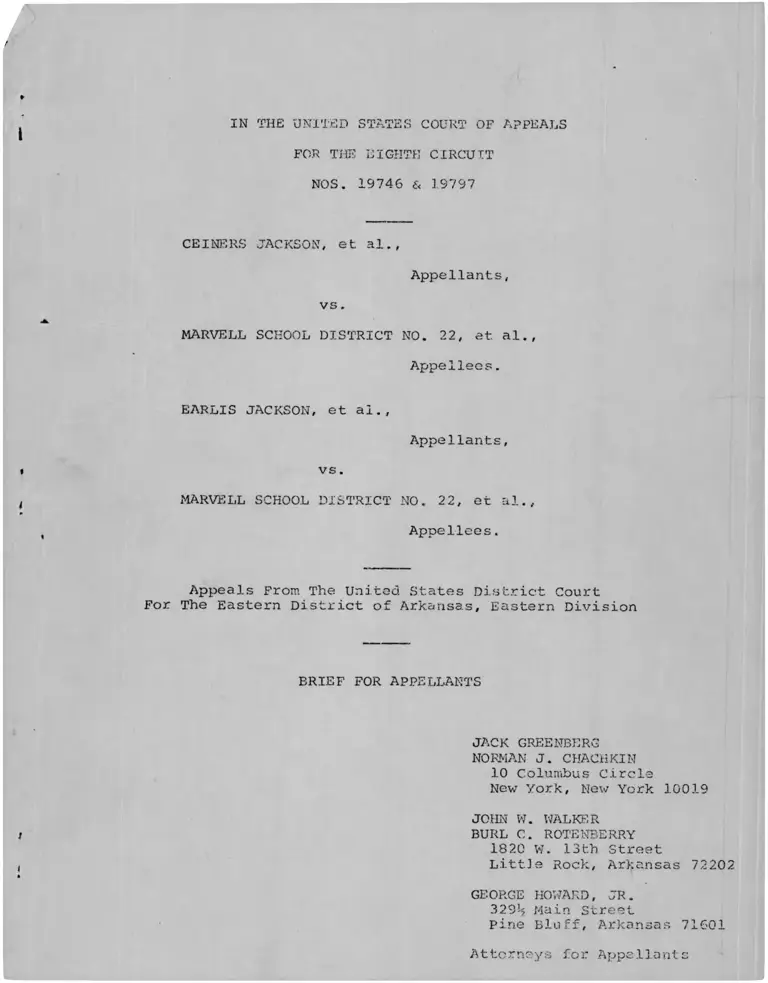
IN THE UNITED STATES COURT OF APPEALS
FOR THE EIGHTH CIRCUIT
NOS. 19746 £< 19797
CEINERS JACKSON, et al.,
Appellants,
vs.
MARVELL SCHOOL DISTRICT NO. 22, et al.,
Appellees.
EARLIS JACKSON, et al.,
Appellants,
vs.
MARVELL SCHOOL DISTRICT NO. 22, et al.,
Appellees.
Appeals From The United States District Court
For The Eastern District of Arkansas, Eastern Division
BRIEF FOR APPELLANTS
JACK GREENBERG
NORMAN J. CHACHKIN
10 Columbus Circle
New York, New York 10019
JOHN W. WALKER
BURL C. ROTENBERRY
18 20 W. 13th Street
Little Rock, Arkansas 72202
GEORGE HOWARD, JR.
329*5 Main Street
Pine Bluff, Arkansas 71601
Attorneys for Appellants
Pa^e
Table of Cases ...................................... ii
Preliminary Statement ................................ iv
Issue Presented for Review ............................ 1
Statement of the C a s e ................................ 2
Argument
The Court Below Erred In Permitting This School
District To Continue To Use Free Choice On The
Ground That Immediate Conversion To A Unitary
System Might Result in The Withdrawal of White
Students From The Public Schools . . 15
Conclusion............................................. 27
INDEX
x
Page
Aaron v. Cooper, 257 F.2d 33 (8th Cir. 1958)............ 17
Anthony v. Marshall County Bd. of Educ., No. 26432
(5th Cir., April 15, 1969).................... 18 :
Brown v. Board of Educ., 347 U.S. 483 (1954)............ 2, 23
Cato v. Parham, 293 F. Supp. 1375 (E.D. Ark. 1968) . . . . 23
Clark v. Board of Educ. of Little Rock, 369 F.2d 661
(8th Cir. 1966) .............................. 24
Coppedge v. Franklin County Bd. of Educ., 404 F.2d
1177 (4th Cir. 1968).......................... 26
Dove v. Parham, 282 F.2d 256 (8th Cir. 1960)............ 5
Dowell v. School Bd. of Oklahoma City, 244 F. Supp.
971 (W.D. Okla. 1965) ........................ 19
Felder v. Harnett County Bd. of Educ., No. 12,894
(4th Cir., April 22, 1969).................... 26
Gaston County, North Carolina v. United States,
___ U.S. ___, 23 L.ed. 2d 309 (1969) .......... 5
Gilbert v. Hoisting & Portable Engineers, 237 Ore.
139, 390 P. 2d 320 (1964)...................... 23
Green v. County School Bd. of New Kent County,
391 U.S. 430 (1968) .......................... 3, 8, 19
Hall v. St. Helena parish School Bd., No. 26450
(5th Cir., May 28, 1969)...................... 20
Haney v. County Bd. of Educ. of Sevier County,
No. 19404 (8th Cir., May 9, 1969) ............ 19, 20
Jackson v. Marvell School Dist. No. 22, 389 F.2d
740 (8th Cir. 1968) .......................... 2, 3, 21,
23, 24
Jackson Municipal Separate School Dist. v. Evers,
357 F. 2d 653 (5th Cir. 1966).................. 5
Kelley v. Altheimer, Arkansas School Dist. No. 22,
378 F. 2d 483 (8th Cir. 1967).................. 3, 5
Kelley v. Altheimer, Arkansas School Dist. No. 22,
297 F. Supp. 753 (E.D. Ark. 1969) ............ 18, 19, 22
Table of Cases
ii
Page
McNeese v. Board of Educ., 373 U.S. 668 (1963).......... 15
Monroe v. Board of Comm'rs of Jackson, 391 U.S.
450 (1968).................................... 3, 18
Moore v. Tangipahoa Parish School Bd., Civ. No.
15556 (E.D. La., July 2, 1969)................ 19
Newman v. Piggie park Enterprises, Inc., 390
U.S. 400 (1968) .............................. 23, 25
Raney v. Board of Educ. of Gould, 391 U.S. 443 (1968) . . '3, 18
Rolax v. Atlantic Coast Line R.R., 186 F.2d 473 (4th
Cir. 1951) .................................. 26
Sanders v. Russell, 401 F.2d 241 (5th Cir. 1968) ........ 25
Sprague v. Taconic Nat11 Bank, 307 U.S. 161 (1939) . . . . 23
Stell v. Savannah-Chatham Bd. of Educ., 318 F.2d
425 (5th Cir. 1963), 333 F.2d 55 (5th Cir.
1964), 387 F. 2d 486 (5th Cir. 1967) .......... 5
Thomas v. west Baton Rouge parish School Bd., civ.
No. 3208 (E.D. La., July 25, 1969)............ 19
Turner v. Goolsby, 255 F. Supp. 724 (S.D. Ga. 1965) . . . 9
United States v. Board of Educ. of Bessemer, 396
F.2d 44 (5th Cir. 1968) ...................... 20
United States v. Choctaw County Bd. of Educ., No.
27297 (5th Cir., June 26, 1969) .............. 20
United States v. Hinds County Bd. of Educ., No.
28030 (5th Cir., July 3, 1969)................ 18-19
United States v. Lincoln County Bd. of Educ., Civ.
No. 1400 (S.D. Ga., July 9, 1969) ............ 5
Vaughn v. Atkinson, 369 U.S. 567 (1962) ................ 23
Walker v. County School Bd. of Brunswick County, Va.,
No. 13,283 (4th Cir., July 11, 1969).......... 18
1
Preliminary Statement
These are appeals from the unreported orders of the
United States District Court for the Eastern District of
Arkansas, Eastern Division, Hon. Oren Harris, United States
District Judge, entered April 15, 1969 and June 13, 1969.
iv
r>
H I
IN THE UNITED STATES COURT OF APPEALS
FOR THE EIGHTH CIRCUIT
NOS. 19746 & 19797
CEINERS JACKSON, et al.,
Appellants,
vs.
MARVELL SCHOOL DISTRICT NO. 22, et al.,
Appellees.
EARLIS JACKSON, et al.,
vs.
Appellants,
MARVELL SCHOOL DISTRICT NO. 22, et al.,
Appellees.
Appeals From The United States District Court
For The Eastern District of Arkansas, Eastern Division
BRIEF FOR APPELLANTS
Issue Presented For Review
Whether the District Court erred in rejecting a deseg
regation plan which would immediately convert the Marvell public
schools into a unitary nonracial school system, because of the
possibility that white students might thereupon withdraw from
the system.
Statement of the Case
This is not the first time that this Court has been
called upon to review the lack of progress of the Marvell School
District in eliminating its dual school system based on race. When
appellants commenced the first of these actions"^ August 17, 1966,
more than twelve years had passed since the decision in Brown v.
Board of Education, 347 U.S. 483 (1954) but the school district
had never voluntarily undertaken even the most minute step toward
2/converting to a unitary school system.— in 1968 this Court
declined to rule out freedom of choice on the basis of the limited
record before it but did require greater affirmative action by
appellees to eliminate their dual system. Jackson v. Marvell
School Dist. No. 22, 389 F.2d 740 (8th Cir. 1968).
During the pendency of the first appeal, the second
3/action was commenced. in that case, appellants sought to enjoin
additional construction on the site of the (all-Negro) Tate High
School by the district, on the grounds that such construction would
perpetuate the dual school system based on race (Complaint in No.
H-67-C-20, 55 II, XI-/)
1/ Ceiners Jackson, et al. v. Marvell School District No. 22, et al., civ. No. H-66-C-35 (E.D. Ark., E.D.).
2/ In 1965, the district agreed to allow free choice in grades 1-4
during the 1965-66 school year in accordance with then current
H.E.W. Guidelines in order to retain its federal funds. Jackson v
Marvell School Dist. No, 22, No. 18762 (8th Cir.), Record, pp. 5-6,* 8—9 .
3/ Earlis Jackson, et al., v. Marvell School District No. 22, et al., Civ. No. H-67-C-20 (E.D. Ark., E.D.).
4/ On July 14, 1969, this Court granted appellants' motion to proceed upon the original papers herein.
5/ The Complaint alternatively prayed, should construction be
-2-
/
Subsequent to the May 27, 1968 decisions of the United
States Supreme Court in Green v. County School Bd. of New Kent
County, 391 U.S. 430; Monroe v. Board of Comm'rs of Jackson, 391
U.S. 450; and Raney v. Board of Educ. of Gould, 391 U.S. 443, and
after remand by this Court, Jackson v. Marvell School Dist. No. 22,
supra, plaintiffs in the original action filed a Motion for Further
Relief seeking to require that the district adopt and implement a
plan of desegregation other than a freedom of choice plan (Motion
for Further Relief, No. H-66-C-35). The two actions were consol
idated at the August 6, 1968 hearing (Tr. I 4;-^ Order entered
August 29, 1968, p. 2). This appeal is taken from the June 17
order of the district court approving continued free choice in
this school distict.
The district
Marvell School District No. 22 has operated under
freedom-of-choice plans for four school years. The following
table shows the results of the choice periods in those years:
permitted, for relief consistent with Kelley v. Altheimer, Arkansas
School Dist, No. 22, 378 F.2d 483 (8th Cir. 1967). The request for
injunction was subsequently withdrawn because construction had been
completed, and appellants stated that they would rely on their
prayer for alternative relief consistent with Kelley. (Letter from
undersigned counsel to Hon. Oren Harris, U.S. District Judge, dated
September 14, 1967, in No. H-67-C-20).
6/ Appellants have previously furnished the Court, at the time of
filing their Motion for Summary Reversal in No. 19746, certified
copies of the transcripts of the hearings below. The transcript of
the August 6, 1968 hearing is in two volumes and will be referred
to herein as Tr. I and Tr. II respectively; the one-volume trans
cript of the March 31, 1969 hearing will be referred to as Tr. III.
-3-
Year
Total
Negro
Stu
dents in
District
Number of
Negro Stu
dents in
"white"
Schools
% of
Negro Stu
dents in
"white"
Schools
Number of
white Stu
dents in
All-Negro Schools
% of
white stu
dents in
All-Negro Schools
7/1965-66- 1,700 17 1.0 % 0 0.0 %
8/1966-67- 1, 700 116 6.8 % 0 0.0 %
1967-68 1,566 207 13.2 % 0 0.0 %
1968-69 1,616 205 12.7 % 0 0.0 %
9/1969-70- 1,548 215 13.9 % 36 6.6%
The district presently operates the predominantly white Marvell
High School (opened in 1967-68) and Marvell Elementary School,
the all-Negro Tate High and Elementary Schools, and the Turner
School, a small, rural all-Negro elementary school
Marvell High and Marvell Elementary are about two blocks apart
and the Tate Schools are less than a mile away, also within the
town of Marvell (Tr. Ill 40).
7/ Grades 1-4 offered free choice.
8/ Grades 1-6, 11-12 offered free choice.
9/ Based on choices exercised to May 16, 1969.
10/According to the May 22, 1969 Report of the district, Tate
Elementary School will have thirty-six white students enrolled
during 1969-70; the Turner School will be closed and students who
chose it permitted to attend Tate or Marvell Elementary.
11/During the school year 1965-66, the district operated the white
Marvell Elementary and High schools on the present Marvell Elem
entary site (transfer of the predominantly white high school grades
to the newly constructed facility in 1967-68 left unused facilities
in Marvell Elementary; see Answers to Interrogatories in No. H-67-
C—20), the Negro Tate Elementary and High Schools on a single cam
pus at the present location, and three small Negro elementary
schools in rural locations. 389 F.2d at 742-43. One small all-
Negro school was closed prior to the 1966-67 school year and another
prior to the 1967-68 school year, leaving only Turner. (Answers to Interrogatories in No. H-67-C-20).
-4-
The Proceedings
Following the filing of the Motion for Further Relief
and consolidation of the two actions, an evidentiary hearing was
held on August 6, 1968. The district called its Superintendent
(Tr. I 6-107; Tr. II 3-24) and appellants called Dr. Myron Lieber-
12/man— as an expert witness. In general, the Superintendent
defended the district's record under freedom of choice, on the
grounds that every choice made had been honored, that in his
judgment the majority in both the white and Negro communities
favored free choice, that it was an educationally sound procedure,
that forced interracial association in the classroom was not
conducive to learning, that there was an achievement differential
between Negro and white students in the district— ^ that made any
plan but freedom of choice impossible, and that any plan other
than freedom of choice would result in the desertion of the dis
trict's white patrons and pupils.
12/ Dr. Lieberman testified as an expert witness for plaintiffs
in Kelley v. Altheimer, Arkansas School Dist. No. 22, 378 F.2d 483 (8th Cir. 1967).
13/ To the extent that this is an accurate statement of fact it
is the direct result of the inadequate segregated education
offered Negro children by this district. For example, the Answers
to Interrogatories in No. H-67-C-20 demonstrate that tie black
schools in the district had lower sq. ft./pupil ratios, higher
pupil/teacher ratios and higher pupil/bus route ratios than the
white schools. This was not the ground upon which the district
court sustained free choice, as he clearly could not have done.
Dove v. Parham, 282 F.2d 256 (8th Cir. 1960); Jackson Municipal
Separate School Dist. v. Evers, 357 F.2d 653 (5th Cir. 1966);
Stell v. Savannah-Chatham Bd. of Educ., 318 F.2d 425 (5th Cir. 1963),
333 F.2d 55 (5th Cir. 1964), 387 F.2d 486 (5th Cir. 1967); United
States v. Lincoln County Bd. of Educ., Civ. No. 1400 (S.D. Ga.,
July 9, 1969); cf. Gaston County, North Carolina v. United States,
___ U.S. ___, 23 L.ed.2d 309 (1969) . The separate and duplicative
bus routes serving Tate and Marvell schools were redrawn by the
district after a May, 1968 pretrial conference at which counsel
displayed a map of the overlapping segregated routes.
Dr. Lieberman stated that his analysis and study of
the district led him to conclude that the basic organization and
operation of the district were dictated by racial considerations,
that the duplication of facilities and inefficiency of operating
two separate twelve-grade schools in a district this size was so
devoid of educational purpose or justification that the rationale
could only be racial, that freedom of choice would never work to
eliminate the dual school system in this district, and that other
means of converting to a unitary school system were readily avail
able to the district. Specifically, Dr. Lieberman proposed pairing
and grade restructuring so that all students, Negro and white,
residing within the district, would attend the present Tate schools
for the elementary grades; Marvell Elementary would serve as a
junior high school; and the high school grades would be located
at the new Marvell High School. Dr. Lieberman felt that the
14/district could implement his plan in a few days— ■ and that it
promised immediate conversion to a unitary system offering better
education to all students of the district.
Although the district court agreed that freedom of
choice had shown itself worthless to break down the institutional
barriers of the segregated school system in Marvell, it rejected
Dr. Lieberman's estimate of the ease with which another plan
could be implemented, and announced that because so little time
15/remained before the opening of school for 19 68-69— ! free choice
14/ Tr. II 44-46.
15/ At the May 3, 1968 pre-trial conference, the district court
refused to set a trial date after appellants announced their intention to challenge the district's free choice plan, on the
ground that cases raising the issue were pending before the United
-6-
1
would be permitted for another year:
Here we have an important school program
in a transitional state at a time when
our circuit has suggested this Court
recognize that there should be some time
and opportunity in this transitional
period for the development of a consti
tutional desegregation program. The
thing that bothers me is just what the
court itself recognized, that there are
school boards and districts which simply
do not come to the reality of developing
the kind of a program that would be ac
cepted and approved and would provide the
objective which the Court said fourteen
years ago that we must come to ultimately
to do justice to all of those who are en
titled to an equal opportunity for public
education. So consequently the Circuit
Court of Appeals and this Court has given
an opportunity to this school district
for compliance, and I for one was hopeful
that the proposed plan for freedom-of-
choice would prove to be effective. . . .
. . . If you've got something that doesn't
work then we better look for something
else, and that is precisely what this Court
is going to do.
It is quite obvious to me that the freedom-
of-choice system is not working for this
district. It is clear from the testimony
and the record presented here that it will
not work, that you are not going to resolve
this problem with this kind of program. . . .
. . . I am therefore going to cancel and
disapprove your porposed desegregation
plan of freedom-of-choice. . . .
. . . This is the 6th of August. To leave
the school district in that kind of a sus
pended situation at this time would, in my
judgment, be cruel and certainly unjustified.
So the Court is going to permit the school
district to proceed with the school program
under the present arrangement beginning with
the school system.
States Supreme Court. Yet no hearing was held between May 27, 1968,
when those cases were decided adversely to free choice, and August
6, 1968.
-7-
Then I am going to ask that by February the
1st that you submit another type of plan be-
cause l_ am saying that for this school district
under the circumstances freedom-of-choice
is out the window. There is no need to
pursue a course that has already run out and is no good.
(Tr. II 110-11, 113, 114, 116 [emphasis supplied]). The district
court thereafter entered its written order August 29, 1968,
allowing the district until February, 1969 to submit a plan other
, 16/ than freedom of choice.—
At this point, appellants were disappointed by the
district court's failure to require a unitary school system in
1968-69 but fully expected that compliance with the Constitution
would be achieved by 1969-70. Except for the effective date of
17/the district court's order,— there was nothing to appeal,
although nothing concrete had been achieved, either.
16/ The order provided, inter alia:
2. The Plan of Desegregation of Marvell
School District No. 22 proposed on No
vember 25, 1966, and amended April 9, 1968,
is hereby disapproved as an unacceptable
method for the operation of this school
on a constitutional basis as interpreted
by the Supreme Court in Green v. County
School Board of New Kent County (No. 695
decided May 27, 1968).
3. The defendants are hereby ordered to
propose an alternate plan for the conver
sion of the school system to a unitary sys
tem in accordance with the decisions of
the Supreme Court made May 27, 1968, for
all students in attendance, and such plan
shall be presented to the Court on or be
fore E’ebruary 1, 19 69. Upon the filing
of said plan with the Court and after due
notice, a hearing will be held at a day
certain to be determined by the Court.
(Order entered August 29, 1968, p. 2) .
17/ Compare Kelley v. Altheimer, Arkansas School Dist. No. 22,
-8-
Appellees' "Report" filed February 1, 1969, however,
failed to comply with the district court's direction. it stated
that freedom of choice is the only feasible procedure in the
assignment of students in this system; there is no feasible al
ternative" (Report of Defendants dated January 31, 1969, p. 1).
Appellants filed a Motion February 21 opposing continued free
choice and praying that the district be given five days in which
to submit a new plan, failing which a receiver be appointed by
the court to operate the schools in accordance with the Constitu-
4. • Wtion. The district court scheduled a hearing March 31, 1969.
Appellees presented testimony by the Superintendent
(Tr. Ill 6-48), the Mayor of Marvell (Tr. ill 48-66) and two
Negro schoolteachers employed by the district (Tr. Ill 66-87). The
Superintendent testified that the District had rejected alter
natives other than freedom of choice because while in each instance
they would achieve total integration and conversion to a unitary
system, a withdrawal of white students from the Marvell public
schools was anticipated:
Q. But really, I just want to captalize [sic]
this, you are making your request for ad
ditional time, and your request for per
mission to continue with freedom of choice
primarily because of the disproportions of
blacks to whites in the school district,
is that correct. That is to say that you
have too many Negroes in the school system
and too few whites to make integration
8th Cir. No. 19419 (Motion for Summary Reversal denied September 16, 1968) .
18/ Cf. Turner v. Goolsby, 255 F. Supp. 724 (S.D. Ga. 1965).
-9-
/ !
attractive to white parents and their children.
A. in one immediate shot?
Q. Yes.
A. Yes. The school is based on acceptance
of the people in that community. if you
are going to destroy or chase people out
and cause them to abandon their school,
then the responsibility of the local
people is to keep their schools for the students.
(Tr. Ill 22-23). See also, Tr. Ill 19-20. 26-27, 30-31; cf. Tr
Ill 39. Both the Superintendent and the Mayor explained the "new
approach" to freedom of choice which they felt the district was
proposing, and in which the city government was apparently
cooperating efforts by the school district to encourage white
parents to choose . . 19/all-Negro schools. The new approach did not
promise immediate or speedy conversion to a unitary system;
Q. Is it fair to say that if you have not
been able to get white pupils to transfer
to the black schools under the freedom of
choice, in any numbers anyway, to transfer
to the black schools this next year?
A. That is something that I would be guessinq at.
Q. I understand that.
A. In any great numbers?
Q. Yes.
A. I do not believe that the first shot of
integrating a school is going to be
made with any great degree of enthusiasm.
19/ Apparently the district was satisfied with the rate of choice
of white schools by Negro students, even though that figure
̂ static at less than 14%. (The increases between 1965-66 and
967-68 are misleading. The first year students in all grades were offered free choice was 1967-68. See p. 4 supra.)
-10-
/ T! 1
Q. So if any white students accepted your
offer or invitation it would be token more
or less, would it not, a few white pupils?
A. I think the first step, yes, sir, would be
to get a few.
Q. How long do you propose, in case the court
grants your request, to operate under the
freedom-of-choice procedure, or the
solicitation procedure?
A. Well, of course, we feel like if the begin
ning is made that that foundation could
be built on.
(Tr. Ill 17-18).
The two Negro schoolteachers, employees of the district,
called by appellees, testified that from their knowledge and
experience as well as personal preference, freedom of choice was
a better method of desegregation than forced association through
pairing or zoning. They opined that the majority of the Negroes
in the Marvell school district favored free choice.
Appellants presented no testimony but took the position
that white reluctance or resistance was irrelevant and that the
district had not met its burden of demonstrating that free choice
was an effective means of converting to a unitary system. The
district court recognized that the situation in March was unchanged
from the situation in August:
. . . However, the school district is
still operating at this time a state-
imposed dual system. No progress has
been noted in the disestablishing of
the Negro school as such. . . .
(Tr. II 101).
-11-
But the court now reversed its earlier ruling to hold
that this new variant of freedom of choice should be given an
20/opportunity-- to prove itself:
There were many of us in the Congress
at the time [May 17, 1954] who felt
that the [Supreme] court arbitrarily
went way out in left field to change
the basic law which the Supreme Court
had enunciated in 1896. . . .
. . . I have made it very clear that
as long as those who have the respon
sibility will undertake to bring about
compliance, it may be the impact is
greater on some than on others, but as
long as there can be shown an effort
towards bringing about compliance with
the basic constitutional requirements,
I have great compassion and sympathy
and I am going to do what I can as the
court to assist the leadership and encouragement towards a constitutionally
operated system. . . . When it is
apparent that there is no real effort
being made to bring about better methods
and means of compliance, this court is
directed to act with this kind of
situation. . . .
. . . I want to compliment those who
have the responsibility in this diffi
cult problem. I can see a decidedly
changed attitude of the people through
out the school district who have children
and interested in their education . . . .
Of course, the best solution, if it could
be done, would be to have an all high
school where everyone would be assigned and
an all elementary school. . . .
From the testimony, it is apparent that
through efforts of the mayor, members of
the city council and other leaders in the
school district, the novel approach proposed
might provide a solution of this most
sensitive problem.
20/ Years?
-12-
So since there appears to be a good-faith
effort in the proposal and the court being
persuaded that with the proper guidance
and leadership and understanding, patience
and tolerance, real progress can be realized,
I am going to give the district an oppor
tunity. . . .
I am going to modify my previous ruling
in which I disapproved the continuation of
freedom of choice in the operation of the
schools of this district, at least for the
time being, in an effort to see just how
the proposal of the district will now work.
If, from the reports, no progress is indi
cated and there is no prospects of achieving
a constitutionally operated school system,
the court will have to take notice and act
accordingly. After the results are reported
about May 15 and should it become necessary
for the court to consider this problem in
a different light, the parties will be given
another opportunity to be heard. . . .
Now the court is going to approve this pro
cedure at the risk of being reversed by the
Circuit Court of Appeals. . . .
(Tr. Ill 99-101, 105-09)[emphasis supplied]. Accordingly, the
district court April 15, 1969 entered its order requiring the
district to hold a special choice period between April 15 and
May 15, 1969, and to report the results thereof to the district
court on or before May 22, 1969, after which time the court would
21/pass upon the continued use of freedom of choice.— 1
21/ April 24, 1969, appellants filed a Notice of Appeal from this
order, which was docketed as No. 19,746. Appellants filed a
Motion for Summary Reversal on May 17, 1969, which was denied June
6 "without prejudice to renew after the filing of any additional
order as contemplated in the District Court's order of April 15,
1969."
-13-
May 22, 1969, appellees filed a Report with the district
court which indicated the following results of the special choice
period:
School
Number
white stu-
dents choosing
Number
Negro stu-
dents choosing
Number faculty
bers of minority
race assigned
Marvell Elementary 251 117 0
Marvell High 261 98 1
Tate Elementary 36 660 4-2/3
Tate High 0 628 2-2/3
22/Turner Elementary-- 0 45 0
Total Number of Negro students choosing . . .
Total Number of white students choosing . . .
No. of Negro students choosing "white"
schools ..............................
No. of white students choosing all-
Negro schools ........................
% of Negro students in "white" schools . . .
% of white students in all-Negro schools . .
% of Negro students in all-Negro schools . .
1548
548
215
36
13.9 %
6.6 %
43.5 %
Without further hearing, the district court entered an order
approving the use of freedom of choice for 1969-70 because it
would "produce the maximum degree of desegregation possible at this
time when compared to the reasonably predictable results of other
alternatives." June 17, 1969, appellants filed Notice of Appeal.-^/
22/ The school district proposed to close Turner and offer its
Negro students a second choice between Tate Elementary and
Marvell Elementary Schools.
23/ The appeal was docketed as No. 19797. June 26, 1969, appel
lants filed a Motion to Consolidate Nos. 19746 and 19797, to
Proceed Upon the Original Papers, and for Summary Reversal. On
July 14, 1969, this Court denied summary reversal and remand, but
directed that the matter be set for oral argument and submission
at the September, 1969 session, and established an accelerated briefing schedule.
-14
ARGUMENT
The Court Below Erred In Permitting This
School District To Continue To Use Free
Choice On The Ground That Immediate
Conversion To A Unitary System Might
Result in The Withdrawal of White Students
From The Public Schools
Appellants' chagrin at the present status of the Marvell
School District No. 22 can hardly be described. Three years
after they first filed suit, the Marvell schools will be opening
under the same inefficient and discriminatory-^/ freedom of choice
plan in 1969-70, with the same racially identifiable black and
white schools staffed by racially identifiable faculties. Over a
year after the Supreme Court of the United States declared that
free choice plans were not constitutional means of pupil assignment
in New Kent County, Virginia, where only 15% of the Negro school-
children attended integrated schools, or in Gould, Arkansas, where
less than 15% attended integrated schools, the court below approved
continued free choice in the district despite the evidence that,
25/at best, 13.9% of the district's Negro students would attend
24/ It is habitual for school board counsel in these cases to main
tain that there has been honest and nondiscriminatory admini
stration of the free choice plan by the district. That is not the
sense in which we use the term here. We refer rather to that inher
ent characteristic of freedom of choice which places the burden
upon Negroes to bring about the conversion to a unitary nonracial
school system. Under free choice, Negro schoolchildren must
shoulder that burden despite the indignity of racially identifiable
schools. These children also find themselves isolated by the
district's failure to take steps now to create the unitary school
system which it would have established but for racial discrimination
To maintain that the school district's obligation ends with mechan
ical granting of all choices looks back to the concept of exhaustion
of administrative remedies, cf. McNeese v. Board of Educ., 373 U.S.
668 (1963), and ignores the close relationship between the dual
racial system of education and the "peculiar institution" outlawed by the Thirteenth Amendment. See, Blaustein, A. & Zangrando, R., ed
Civil Rights and the American Negro (1968) 180-322.
-15-
formerly all-white schools, and 6.6% of the district's white
students will attend a formerly all-Negro school. And finally,
appellants have seen their efforts of a year ago, which seemed
close to fruition when the district court required submission of
a new plan, stand for naught as the district court yielded to
the repeated entreaties of the school district not to upset the
whites in the district.
To make matters worse, there is not even the prospect
that the regime approved by the district court will result in a
unitary system in the foreseeable future. To the contrary,
appellees have never maintained that it will, and the district
court has no illusions:
Q. How long do you propose, in case
the court grants your request, to
operate under freedom-of-choice
procedure, or the solicitation
procedure ?
A. Well, of course, we feel like if
the beginning is made that that
foundation could be built on.
(Superintendent Cowsert)(Tr. Ill 18).
. . . of course, the best solution, if
it could be done, would be to have an
all [-district] high school where everyone
25/ The district's 1969-70 estimates are based on choice forms
returned as of May 15, 1969. The table attached to the May 22,
1969 Report shows some 48 Negro students, exclusive of graduating
seniors, who attended the all-Negro Tate and Turner Schools last
year, had not returned their forms. Since the percentage of Negro
children in formerly all-white schools has been stable (extrapola
ting from the figures for years when free choice did not extend to
all grades), it seems highly unlikely that the choices of these 48
will raise the percentage this year significantly, if at all. It
is of course unlikely that the Negro students who chose the Turner
School will on their second choice elect the predominantly white
Marvell Elementary School.
-16-
would be assigned and an all [-district]
elementary school. . . .
(Judge Harris)(Tr. Ill 105-06). Free choice was approved not
because it would work, much less because it could work most
effectively of any plan suggested, but because the district
raised the specter of "white flight" to delay realization of
appellants' constitutional rights.
Q. But really, I just want to captalize [sic]
this, you are making your request for ad
ditional time, and your request for per
mission to continue with freedom of choice
primarily because of the disproportions of
blacks to whites in the school district, is
that correct. That is to say that you have
too many Negroes in the school system and
too few whites to make integration attrac
tive to white parents and their children.
A. In one immediate shot?
Q. Yes.
A. Yes. The school is based on acceptance of
the people in the community. If you are
going to destroy or chase people out and
cause them to abandon their school, then
the responsibility of the local people is
to keep their schools for the students.
(Tr. Ill 22-23). See also, Tr. Ill 19-20, 26-27, 30-31; cf. Tr.
Ill 39; Response to Motion for Permission to Appeal Upon the
Original papers and to Consolidate Appeals, and in Opposition to
Motion for Summary Reversal, p . 5.
White hostility has never been accepted by the federal
courts as a ground for delaying the implementation of constitu
tional rights. This Court early held that such rights were para
mount. Aaron v. Cooper, 257 F.2d 33 (8th Cir. 1958). What is so
disheartening about the district court's action in this case is
that the same arguments, in the same context of free choice plans,
were made to and rejected by the Supreme Court of the United
-17-
States in Raney v. Board of Educ. of Gould, supra, and in Monroe
v. Board of Comm'rs of Jackson, supra, 391 U.S. at 459:
We are frankly told in the Brief that
without the transfer option it is
apprehended that white students will
flee the school system altogether.
"But it should go without saying that
the vitality of these constitutional
principles cannot be allowed to yield
simply because of disagreement with
them." Brown II at 300.
Accord, Anthony v. Marshall County Bd. of Educ., No. 26432 (5th
Cir., April 15, 1969); Walker v. County School Bd. of Brunswick
County, Va., No. 13,283 (4th Cir., July 11, 1969); Kelley v.
Altheimer, Arkansas School Dist. No. 22, 297 F. Supp. 753, 758
(E.D. Ark. 1969). "White flight" is an insidious argument. Once
accepted, it can be used as a sort of perpetual procrastinator of
26/constitutional rights. If whites have not learned to accept
the idea of integration between 1954 and 1969, what prospect is
there that they will be any more receptive by 1984? (Instructive
in this regard is the failure of this district to act between
1954 and 1965). Furthermore, it is an extremely slippery concept,
difficult to either prove or disprove. It is baldly asserted by
school administrators who desire to maintain free choice, but it
remains a speculative fancy. It was recently rejected by the
United States Court of Appeals for the Fifth Circuit even when
sought to be supported by "impartial public opinion surveys."
United States v. Hinds County Bd. of Educ., No. 28030 (5th Cir.,
26/ The same argument was proffered by the El Dorado School District
and accepted by the same district judge, to excuse that system's
failure to eliminate its segregated elementary schools. See Kemp
v. Beasley, No. 19782, pending in this Court.
-18-
July 3, 1969), preliminary slip opinion at pp. 6-8. Finally, as
this Court has recently emphasized, the constitutional right to
equal protection of the laws is not subject to the vote. Haney
v. County Bd. of Educ. of Sevier County, No. 19404 (8th Cir., May
9, 1969), slip opinion at pp. 9-10. This principle adheres whether
the vote is with the ballot or with the body, by a change of residence.
The decision below is equally unsupportable on any
other grounds. It is directly contrary to Green because it rejects
what even the court below recognized (Tr. Ill 105-06) to be the
most effective plan to eradicate the dual system based on race.
The appellees had more than sufficient opportunity to develop
their own plan to accomplish that purpose. When they did not,
the district court should have entered its own plan, or that
recommended by appellants' expert witness. See Moore v.
Tangipahoa Parish School Bd., Civ. No. 15556 (E.D. La., July 2,
1969); Thomas v. West Baton Rouge parish School Bd., Civ. No.
3208 (E.D. La., July 25, 1969); Kelley v. Altheimer, Arkansas
School Dist. No. 22, 297 F. Supp. 753 (E.D. Ark. 1969); cf,
Dowe11 v. School Bd. of Oklahoma City, 244 F. Supp. 971, 972 (W.D.
Okla. 1965).
Appellees are bound to argue that free choice is
resulting in acceptable progress towards a unitary system in
this district, pointing to the 1.2% increase in Negroes attending
white schools this year, and the 6.6% white students who chose
the Negro elementary school; and representing that all Negroes
at Tate Elementary will be attending an "integrated school" next
year. Even under this view of the facts, 43.5% of the Negro
19-
students in this district will continue to attend a segregated,
all-Negro school.
But this Court has recently said that "the time for
transition has now passed and that these problems should have
been worked out long ago." Haney v. County Bd. of Educ. of Sevier
County, supra, slip opinion at p. 11. Another Circuit has held,
"As a matter of law, there must be student desegregation now,
not 10 per cent in 1968-69, 20 per cent in 1969-70, and so on
until desegregation eventually is effected," United States v.
Choctaw County Bd. of Educ., No. 27297 (5th Cir., June 26, 1969),
slip opinion at p. 9. The district court accepted such a schedule
because it erroneously concluded that good faith vel non satisfied
the Constitution:
. . . I have made it very clear that
as long as those who have the respon
sibility will undertake to bring about
compliance, it may be the impact is
greater on some than others, but as
long as there can be shown an effort
towards bringing about compliance with
the basic constitutional requirements
I have great compassion and sympathy
and I am going to do what I can as the
court to assist the leadership and
encouragement towards a constitutionally
operated system.
(Tr. Ill 100-01).
"At this very, very late date in the glacial movement
toward school racial integration, it should no longer be an
issue of good faith," United States v. Board of Educ. of Bessemer,
396 F.2d 44, 49 (5th Cir. 1968); accord, Hall v. St. Helena
Parish School Bd., No. 26450 (5th Cir., May 28, 1969), slip
-20-
opinion at p. 16. Cf. Kemp v. Beasley, 389 F.2d 178, 185 n.10
(8th Cir. 1968) and accompanying text. At any rate, the record
here completely belies any claim of good faith. Between 1954
and 1965 the district failed to make a single move to eliminate
segregation. It did so only when prodded by H.E.W. in 1965. It
then withdrew in 1966 rather than substantially dismantle its
dual system, and whatever further measures have been effected are
due to the pressure of appellants and court orders. The district
waited until nine days before the last hearing in this matter —
well after it proposed on February 1 to continue free choice —
to send out the letter to white parents soliciting choices of the
Tate Schools (Tr. Ill 9). Even then, as noted, the response was
uninspiring. Furthermore, the district very clearly has acted
in' bad faith with regard to faculty desegregation. Despite this
Court's instruction on February 9, 1968 that "the Board should
be required to take affirmative action to (1) encourage voluntary
transfers . . . (2) assign members of the faculty and staff from
one school to another," Jackson v. Marvell School Dist. No. 22,
supra at 745, no such teacher assignments have ever been made
"against their wishes" (Tr. Ill 13).
This Court should require the Marvell district to imple
ment a unitary system now. 27/ There is in this record a plan for
27/ Contrary to appellees' representations, appellants' complaint
is not the lack of racial balance in the Marvell public schools.
Our dissatisfaction lies with the continued operation of a dual
school system in Marvell, which freedom of choice shows no prospect
of eliminating in the foreseeable future. We do contend that the
lack of substantial integration in the classes of this district
demonstrates the futility of freedom of choice, and reflects the
continued existence of the dual system based on race. We seek the
-21-
the operation of the Marvell public schools on a unitary nonracial
basis which the district court recognized to be the optimal plan.
It consists of grade reorganization and pairing so that all of
the district's pupils in a particular grade are assigned to the
same attendance center. Under this plan, faculty desegregation
would take care of itself. So would desegregation of the other
aspects of the educational program. See Kelley v. Altheimer, Ark
ansas School Dist. No. 22, 378 F.2d 483 (8th Cir. 1967).
The district court should be specifically instructed to
require implementation of this plan on remand.
Attorneys' Fees
Appellants submit that this district's obstinacy as
manifested on this record makes an award of counsel fees neces
sary. We recognize that no statute explicitly authorizes fees
in a case of this nature. But it is well established that the
federal courts have equitable power to award attorneys' fees
institution of a unitary nonracial system of public education; what
that means can be very simply stated: The district should be
operated, within the limitation of its present physical facilities,
as nearly as possible as it would be operated had racial discrim
ination never been a factor. in this small district it is obvious
beyond any question that, but for race, two twelve-grade schools
within several blocks of each other in the district's largest
community would never have been established. This was the opinion
of appellants' expert witness. The best remedy is to convert to a
single school system, for it is also apparent that were all the
students in the district of the same race, there would be but one
school facility for each grade.
-22-
/ ?1
in appropriate cases. See Vaughn v. Atkinson, 369 U.S. 567
(1962); Sprague v. Ticonic National Bank, 307 U.S. 161 (1939);
Newman v. Piggie park Enterprises, Inc., 390 U.S. 400, 402 n.4
(1968). This power has been exercised in school desegregation
cases. E.g., Cato v. Parham, 293 F. Supp. 1375 (E.D. Ark. 1968).
The main purpose of the American rule generally
disallowing counsel fees is to avoid discouraging use of the
courts for the resolution of bona fide disputes; however, this
purpose is not served by a trial of the issues "where the law
is clear and the facts free from ambiguity." Comment, 77 Harv.
L. Rev. 1135, 1138 (1964). In a case like the instant one,
forcing the plaintiffs below to sue to enforce their rights under
"clear facts and strong recent precedent seems an abuse of the
remedial system." Ibid..
This proceeding is private in form only the plain
tiffs acted as "private attorneys general" in vindicating the
rights of the class and in furthering the public policy of the
nation of eliminating racial discrimination in the public schools
Cf. Newman v. piggie park Enterprises, Inc., supra.
This appeal would not have been required had the
district complied as directed by the district court on August
29, 1968. Neither the appeal nor the trial below should have
been necessary at all. The mandate of Brown and Green is all
too clear. Negro citizens should not be forced to resort to
the courts for protection, bearing the "constant and crushing
-23-
expense of enforcing their constitutionally accorded rights."
Clark v. Board of Educ. of Little Rock, 369 F.2d 661, 671 (8th
Cir. 1966).
As early as Brown II and most recently in Green,
the Supreme Court reiterated that the burden is on the state
and indirectly the local boards to initiate, develop and
implement plans disestablishing prior state-imposed segregation.
In this case a dual school system has been maintained for some
15 years in flagrant violation of the Constitution. It should
not have been necessary for Negro plaintiffs to bring legal
action to obtain its dissolution. That burden should have been
assumed by the State through its agent, the School Board. Only
the award of substantial counsel fees, based upon the substantial
like sums expended from public funds in the attempt to preserve
the dual system, will prod unwilling state officials to assume,
at long last, their constitutional obligations by initiating,
without awaiting suit by Negroes, the requisite transitions to
unitary nonracial systems.
The time has come for this Court to make it clear to
recalcitrant school boards that their constitutional obligations
do not depend in each and every instance on specific orders
from the courts. The history of school desegregation in this
Circuit is a painful one. Again and again this Court has been
required to consider cases, such as this one, where the law and
the facts are perfectly clear but where the school board simply
will not budge without a court order. This situation is no
longer tolerable. it puts the burden of expensive litigation
-24-
on the Negro schoolchildren and their lawyers. The rights of
the schoolchildren are not vindicated unless attorneys or legal
service organizations are available to serve without fee and
subsidize the expenses of l i t i g a t i o n / There will inevitably
be many cases where there are no attorneys in a position to
exercise the diligence essential to protecting the rights of
the children. The only just solution is to impose the expense
of unnecessary desegregation litigation on the party causing the
expense — the recalcitrant school board — and to reward the
"private attorney general" (Newman, supra, 393 U.S. at 402) for
28/ Civil rights cases ordinarily do not generate legal fees,
contingent or otherwise. See generally, on problems of
representation in civil rights cases, Sanders v. Russell, 401
F.2d 241 (5th Cir. 1968). As to representation by legal service
organizations, Senator Hart made the following comments on the
counsel fees provision of the Fair Housing Act of 1968:
Frequently indigent plaintiffs are
represented by legal associations, acting
as "private attorneys general" in the
vindication of important constitutional
and statutorily created rights. it would
be most anomalous if courts were per
mitted to deny these costs, fees, and
damages to an obviously indigent plain
tiff, simply because he was represented
by a legal association. I think it
should be clearly understood that this
representation in no way limits a
plaintiff's right of recovery.
114 Cong. Rec. S2308 (daily ed., March 6, 1968).
See also, Sanders v. Russell, supra, at 244 n.5.
-25-
performing the public function of eradicating unconstitutional
discrimination in the public schools. This would also serve
the salutary purposes of inducing the school board to live up
to its clear obligations and of removing unnecessary litigation
from the courts. What is needed here is an added sanction
imposed against unnecessary litigation occasioned by clearly
unconstitutional conduct. What is needed is an effective deter—
to the recalcitrance and obstinate refusal to recognize that
court decrees mean what they say revealed by this record. We
believe that the imposition of attorneys' fees will go a long way
toward meeting those needs.
Finally, for the same reasons, this Court should award
counsel fees on the appeal. Cf. Gilbert v. Hoising & Portable
Engineers, 23[7 Ore. 139, 390 P.2d 320 (1964) ; Coppedge v. Franklin
County Bd. of Educ., 404 F.2d 1177 (4th Cir. 1968); but see,
Felder v. Harnett County Bd. of Educ., No. 12,894 (4th Cir.,
April 22, 1969).
29/ Awarding counsel fees to encourage "public" litigation by
private parties is an accepted device. For example, in Oregon,
union members who succeed in suing union officers guilty of wrong
doing are entitled to counsel fees both at the trial level and on
appeal, because they are protecting an interest of the general public
If those who wish to preserve the internal demo
cracy of the union are required to pay out of their own pockets the cost of employing counsel, they are
not apt to take legal action to correct the abuse.
. . . The allowance of attorneys' fees both in the
trial court and on appeal will tend to encourage
union members to bring into court their complaints
of union mis-management and thus the public interest
as well as the interest of the union will be served.
Gilbert v. Hoidinq & Portable Engineers, 237 Ore. 139, 390 P.2d
320 (1964) . See also Rolax v. Atlantic Coast Line R R . 186 F 2d 473 (4th Cir. 1951). ' --
-26-
CONCLUSION
For all of the above reasons, the order and judgment
of the district court should be reversed, and the cause remanded
with instructions to require thfe implementation at the earliest
possible moment of the desegregation plan proposed by appellants'
expert witness at the August 6, 1968 hearing of this cause, and
substantial attorneys' fees should be awarded to appellants as
part of their costs in this Court; the district court should be
further instructed to award plaintiffs-appellants reasonable
attorneys' fees. Appellants further pray that this Court award
them their costs, and for such other relief as to this Court may
appear appropriate and just.
Respectfully submitted
JACK GREENBERG
NORMAN J. CHACHKIN
10 Columbus Circle
New York, New York 10019
JOHN W. WALKER
BURL C. ROTENBERRY
1820 W. 13th Street
Little Rock, Arkansas 72202
GEORGE HOWARD, JR.
329% Main Street
Pine Bluff, Arkansas 71601
Attorneys for Appellants
-27-