Clark v. Ziedonis Court Opinion
Unannotated Secondary Research
October 29, 1973
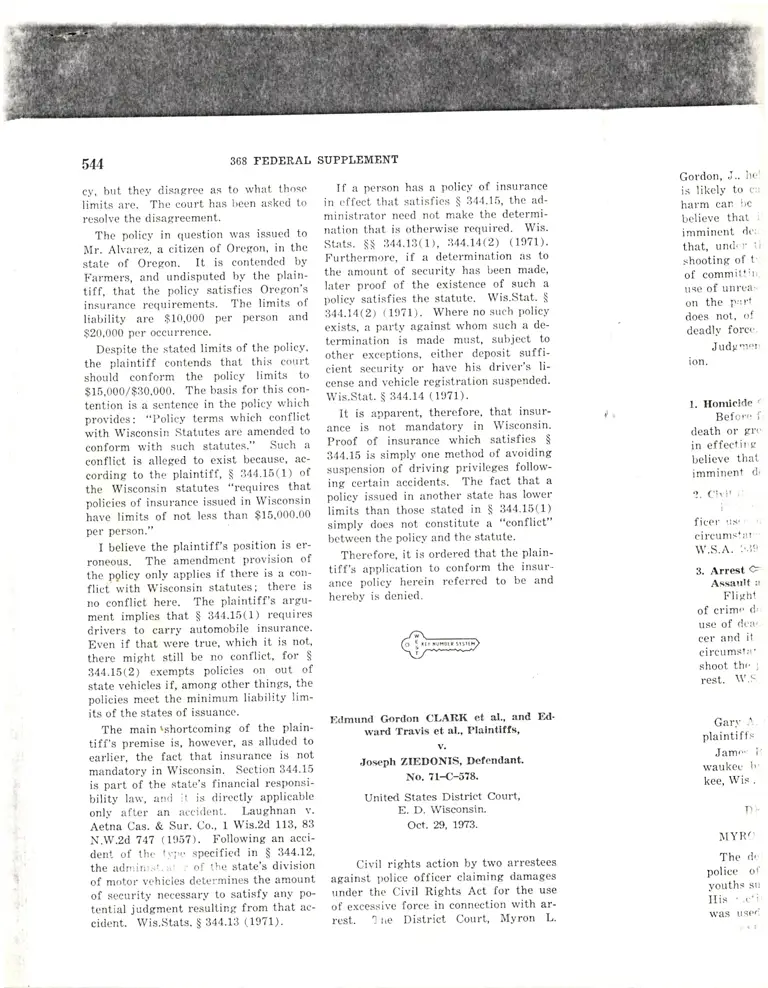
3 pages
-
Case Files, Garner Working Files. Clark v. Ziedonis Court Opinion, 1973. 9c04f369-33a8-f011-bbd3-000d3a53d084. LDF Archives, Thurgood Marshall Institute. https://ldfrecollection.org/archives/archives-search/archives-item/744aeffa-3bdb-4b7d-a8ad-a457346bb3de/clark-v-ziedonis-court-opinion. Accessed September 27, 2026.
Copied!
544 368 FEDERAL SUPPLEMENT
cy, but they disaRi'oe as to what those
limits are. The court has been asked to
resolve the disaRreement.
The policy in question was issued to
Mr. Alvarez, a citizen of OrcRon, in the
state of OrcRon. I t is contended by
Farmers, and undisputed by the plain
tiff , tha t the policy satisfies OreRon’s
insurance requirements. The limits of
liability arc $10,000 per person and
$20,000 per occurrence.
Despite tbe .stated limits of the policy,
the plaintiff contends tha t this court
should conform the policy limits to
$15,000/$30.000. The basis for this con
tention is a sentence in the policy which
provides: “Policy terms which conflict
with Wisconsin Statutes are amended to
conform with such sta tu tes .” Such a
conflict is allcRed to exist because, ac-
cordinR to the plaintiff, § 344.15(1) of
the Wisconsin sta tu tes “ requires th a t
policies of insurance issued in Wisconsin
have limits of not less than $15,000.00
per person.”
I believe the p la in t if f ’s position is e r
roneous. The amendment provision of
the pqlicy only applies if there is a con
flict with Wisconsin s ta tu tes ; there is
no conflict here. The p la in t if f ’s a rg u
ment implies th a t § 344.15(1) requires
drivers to carry automobile insurance.
Even if th a t were true, w'hich it is not,
there m ight still be no conflict, for §
344.15(2) exempts policies on out of
state vehicles if, among other things, the
policies meet the minimum liability lim
its of the states of issuance.
The main 'shortcoming of the plain
t i f f ’s premise is, however, as alluded to
earlier, the fact th a t insurance is not
mandatory in Wisconsin. Section 344.15
is pa r t of the s ta te ’s financial responsi
bility law, and it is directly applicable
only a f te r an accident. Laughnan v.
Aetna Cas. & Sur. Co., 1 Wis.2d 113, 83
N.W.2d 747 (l'.)57). Following an acci
dent of tbe specified in § 344.12,
the admin '.4. of the s ta te ’s division
of motor vehicles determines the amount
of security necessary to satisfy any po
tential judgm ent resulting from th a t ac
cident. Wis.Stats. § 344.13 (1971).
If a person has a policy of insurance
in effect th a t satisfies § 344.15, the ad
m in is tra tor need not make the determi
nation th a t is otherwise required. Wis.
Stats. 344.13(1), 344.14(2) (1971).
Furthermoi'c, if a determination as to
the amount of security has been made,
later proof of the existence of such a
policy satisfies the statute. Wis.Stat. §
344.14(2) (1971). Where no such policy
exists, a party against whom such a de
termination is made must, subject to
other exceptions, c ither deposit su ff i
cient security or have his driver’s li
cense and vehicle registra tion suspended.
Wis.Stat. S 344.14 (1971).
I t is apparent, therefore, th a t insur
ance is not mandatory in Wisconsin.
Proof of insurance which satisfies §
344.15 is simply one method of avoiding
suspension of driving privileges follow-
iTig certain accidents. The fact th a t a
policy issued in another sta te has lower
limits than those stated in § 344.15(1)
simply does not constitute a “conflict”
between the policy and the statute.
Therefore, it is ordered th a t the plain
t i f f ’s application to conform the insur
ance policy herein referred to be and
hereby is denied.
Kdmuntl Gordon CLARK et al., and Ed
ward Travis et al.. P laintiffs,
V .
Joseph ZIEDONIS, Defendant.
No. 71-C-578.
United States District Court,
E. D. Wisconsin.
Oct. 29, 1973.
Civil r igh ts action by two arrestees
against police officer claiming damages
under the Civil Rights Act for the use
of excessive force in connection with a r
rest. '] t.e Distric t Court, Myron L.
Gordon, J.. he
is likely to
harm can be
believe tha t
imminent d(~.
that, und‘ !• ti
shooting of t
of commitUn,
use of unrea-
on the purt
does not, of
deadly force
Judynv'i
ion.
1. Homicide '
Befoi'o f
death or gre
in effectii g
believe tha t
imminent d'
Civi'
i '
ficei- US'
circunis'iit
W.S.A. '.•■19
3. Arrest Cr
Assault a
Flight
of crime d'
use of dea
cer and it
circumste ■
shoot the ,
rest. W.'-
Gary .'
plaintiffs
Jame' 1
waukec !>■
kee, Wis .
T'
MYK^
The d'
police o'
youths su
i l i s ■ .e‘ i
was usee'
CLARK V.
C ite a s 3liS F .S
Gordon, J., held th a t before force which
is likely to cause death or g reat bodily
harm can be used, one must reasonably
believe tha t it is necessary to prevent
imminent death or great bodily harm,
that, undei- the circumstances, officer’s
shooting of two fleeing youths suspected
of committing a felony constituted the
use of unreasonable force and th a t flight
on the pa r t of one suspected of crime
does not, of itself, w arran t the use of
deadly force.
Judgm ent in accordance with opin
ion.
1. Homicide <^116(4)
Before force which is likely to cause
death or g reat bodily harm can be used
in effecting arrest, one must reasonably
believe th a t it is necessary to prevent
imminent death or great bodily harm.
2. Civil Rights C=13.13(3)
Evidence established tha t police of
ficer used unreasonable force under the
circumstances by shooting arrestees.
W.S.A. 9.39.49(1); 42 U.S.C.A. § 1983.
3. Arrest C=>68
Assault and Battery C=>6-1
Flight on the pa r t of one suspected
of crime does not, of itself, w a rran t the
use of deadly force by an arresting o ffi
cer and it is only in certain aggravated
circumstances th a t a police officer may
shoot the person he is a ttem pting to a r
rest. W.S.A. 939.49(1).
Gary A. Gerlach. Milwaukee, Wis., for
plaintiffs.
James B. Brennan, City Atty. of Mil
waukee by Rudolph T. Randa, Milwau
kee, Wis., for defendant.
DECISION AND ORDER
MYRON L. GORDON, District Judge.
The defendant, .loseph Ziedonis, is a
police officer who shot two fleeing
youths suspected of committing a felony.
Ills victims claim th a t excessive iorce
was used in connection witli the a r res t
368 F.Supp.— 35
ZIEDONIS 545
lip p . 5-11 (1973)
and seek damages under the Civil Rights
Act, 42 U.S.C. § 1983. The liability is
sue tu rns upon the ciuestion of justif ica
tion for his use of deadly force.
At the close of the bench tria l in this
matter, I made the following prelimi
nary determinations; a) the defendant
had reason to believe th a t a felony was
in progress; b) the p la in tiffs ’ accounts
of the incident lack credibility; and c)
the defendant’s version of the pertinent
events represents the factual backdrop
against which the liability issue must be
considered.
In McCluskey v. Steinhorst, 45 Wis.2d
350, 354, 173 N.W.2d 148 (1970), the
Wisconsin supreme court observed that
the tes t for liability is whether the
amount of force used by the arresting
officer was reasonable under the exist
ing circumstances. Applying this test
to the facts of this particular case, I
conclude th a t the defendant’s use of
deadly force was unreasonable and un
justified.
At approximately 10:00 P.M. on J a n u
ary 11. 1971, Mr. Ziedonis and his part-
nei’ responded to a radio dispatch indi
cating an “entry in progress, three ne
gro males on the scene.
Armed with a Remington 12-gauge shot
gun, Mr. Ziedonis positioned himself at
the scene on a lighted public sidewalk,
while his pa r tne r circled around to the
rear of the homes located on th a t block.
The defendant was within five to ten
yards from them when he observed three
black males emerge from the gangway
located between two houses. Each one
was of junior high school age and ap
proximately five feet six inches tall.
The plaintiff, Edward Travis, wielding a
thin, 12-inch steel-blue file, faced Mr.
Ziedonis for an instant a f te r he ordered
them to halt. All three then retreated
into the gangway located at the next
hou.se down, as the defendant fired his
shotgun over the ir heads. Mr. Ziedonis
then, ran up the sidewalk, parallel to
the ir path of retreat, and positioned
himself directly in front of th a t gang
way. He observed Edward Travis fac
ing him again, and fired a second shot.
■ .>.1
m
m
546 368 FEDERAL SUPPLEMENT
; 11 ' I
l!
i ; i | v
M;;!
i'
t r
U. ‘
"■n;
V* ■■■
i i : - -
M
which felled both Edward Travis and
the second of the plaintiffs, Edmund
Clark.
The defendant contends th a t when Ed
ward Travis f i rs t faced him, wielding
the file, he viewed the move as a con
frontation by someone holding a long-
barreled revolver, and tha t he feared for
his life. However, notwithstanding the
facts th a t the area was lighted, the dis
tance between them was short, and the
file does not resemble a gun, one point
is noteworthy; Mr. Ziedonis deliberately
fired over the head of his would-be as
sailant a t th a t time.
Following tha t warning shot, the
three suspects retreated to the gangway
located a t the next house. Mr. Ziedonis
had reason to know tha t his partner,
who was covering the rear yard, had
heard his w arning shot and th a t the sus
pects were not likely to escape. More
over, Mr. Ziedonis positioned himself di
rectly in front of the gangway contain
ing the three suspects, including the
“arm ed” one. While so exposed, he shot
directly a t them when he saw Edward
Travis "fac ing” him again. The plain
t i f f Clark was h i t in the back, and the
p lain tiff Travis, the object-wielder who
“faced” the defendant each time, was hit
through the head, from r igh t to left, as
well as in the forearm.
[1, 2] Before force which is likely to
cause death or g rea t bodily harm can be
used, one must reasonably believe th a t it
is necessary to prevent imminent death
or groat bodily harm. Thomas v. State,
53 Wis.2d 483, 192 N.W.2d 864 (1972).
While the defendant’s testimony as to
his frightened sta te of mind stands un
challenged by any of the testimony of
the plaintiffs, I conclude th a t the de
fendant’s second shot, which was aimed
directly a t the suspects, was clearly un
reasonable and unjustified. The lighted
conditions, the proximity of the actors,
the physical appearance of the file, the
nature of the wounds, the defendant’s
“w arn ing” shot during a “confronta
tion” which he says caused him to fear
for his life, the suspects’ i-etreat, and
the defendant’s awareness both of his
pa r tn e r’s presence at the suspects’ only
available avenue of escape, and of his
p a r tn e r’s knowledge of the warning
shot, represent the circumstances which
persuade me th a t the defendant used ex
cessive force in effecting the arrest.
[3] Flight on the pa r t of one sus
pected of crime does not, of itself, war
ran t the use of deadly force by an a r
resting officer. Mr. Ziedonis’ testimo
ny, however, suggests tha t he believed
tha t mere flight by one suspected of
burglary justif ied the use of his shot
gun. I t is only in certain aggravated
circumstances th a t a police officer may
shoot the person he is a ttempting to a r
rest. See Rauls v. Hutto, 304 F.Supp.
124 (D.C.La.1969) ; Jackson v. Martin,
261 F.Supp. 902 (D.C.Miss.1966). This
conclusion is bolstered by the language
of § 939.49(1), Wis.Stats. (1971), which
states in p a r t :
I t is not reasonable to in
tentionally use force intended or likely
to cause death or g reat bodily harm
for the sole purpose of defense of
. property.”
I conclude tha t this shooting constituted
the use of unreasonable force under the
circumstances. See McCluskey v. Stein-
horst, 45 Wis.2d 350, 173 N.W.2d 148
(1970).
Therefore, it is ordered tha t judgment
be and hereby is entered in favor of the
plaintiff, Edward Travis, and against
the defendant, for compensatory dam
ages in the amount of $1,500; in favor
of the plaintiff, Edmund Clark, and
against the defendant, for compensatory
damages in the amount of $5,000; in fa
vor of the plaintiff, Buster Clark, and
against the defendant, for special medi
cal damages in the amount of $1767.31;
and in favor of the plaintiff, Carrie S ta
ples, and against the defendant, for spe
cial medical damages in the amount of
$279.83.
•Tat
E. I.. I ’,
g in ia ‘
Ui
P e t !
of robi >
for a w
ed S’ati
District
tion wii
transfc'r
Coui't fi
gini-i. 1
Court, •
was not
which h
preme <
t i tioner
bond SC'
was be I
tion, ra
the cla;
ground
petition
to a liu'
titled
th a t he
time of
te rroga '
counsel,
petition
der Mil
counsel
thereaf ■
was no'
counsel
Pol
1. H al)0
Th-
procoGi
victed
commet