A Report: Police Use of Ammunition
Unannotated Secondary Research
1974
-
Case Files, Garner Working Files. A Report: Police Use of Ammunition, 1974. ddd16dbb-33a8-f011-bbd3-000d3a53d084. LDF Archives, Thurgood Marshall Institute. https://ldfrecollection.org/archives/archives-search/archives-item/75535d33-d223-4f80-a3ad-ea632809088d/a-report-police-use-of-ammunition. Accessed September 26, 2026.
Copied!
A Report:
POLICE USE OF AMMUNITION
mass, research center
POLICE USE Ai'iMUlv’ITIOlM
i>iar!i=;acuaR«'bl.i=! Pesparcu ’"'f^nlor, 3 S t r e e t , iioRtou, M assacLusetts 0210G
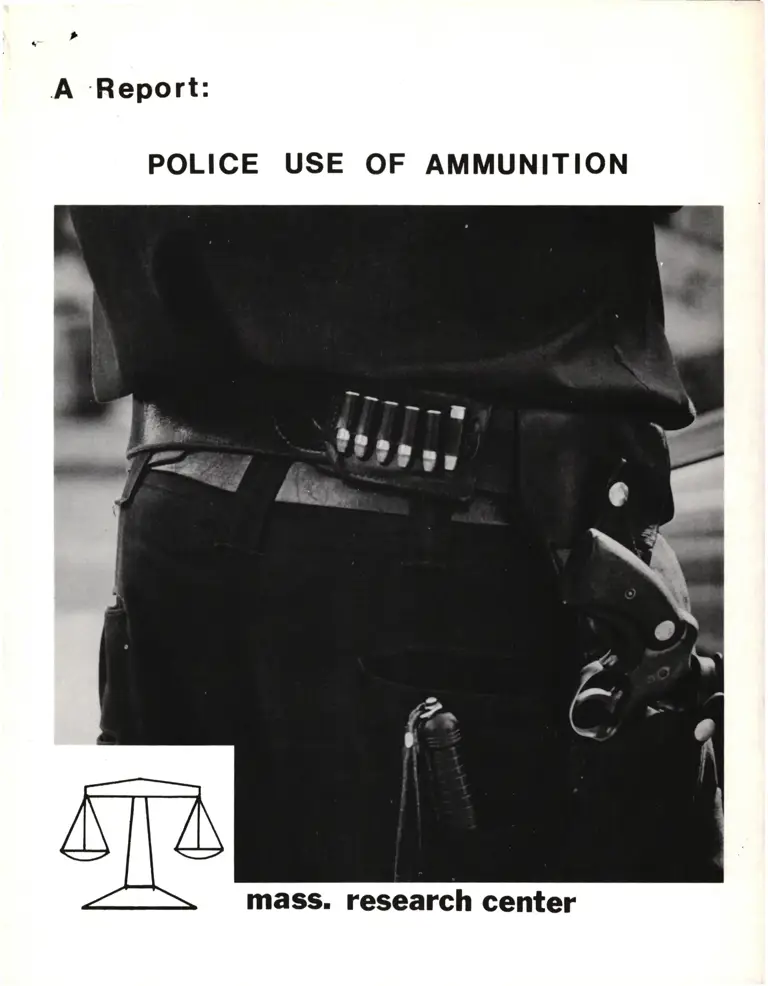
( cover puooOgraph, takezi h j W illiam J. Pop ser, If oI a p o lice
o f r ic e r wlio i s ca rry in g • 3o x'ounfl nose, lead al.loy arju anition ,
'=xcepL fo r on'’ p̂ ’ici-wad c u t te r on the f a r r ig h t of h is o e l t . )
PREFACE
The Massachusetts Research Center is publishing this report for the
general public. The Center’s interest is to Increase the awareness of
recent developments within our state on the use of ammunition by our police
departments. The report does not make any recommendations as the hope is
to Increase discussion of the facts and enable decisions with greater
knowledge to be made in the future. This report does not complete our
research on this project as there is a lack of information pertaining to the
semi-wad cutter. As additional tests can be done and as more ballistics
reports become available, the Center will make an additional presentation on
this particular bullet.
At this time it is my pleasure to thank Richard Hesky and Mike Daly,
who have done a great deal of the necessary work to make this report possible,
Also, Tim McNally who served as Project Manager for the research along with
Bonnie Neilan who provided continued general assistance, and Jordaui Paust
who provided expertise and background on the subject.
Special acknowledgment is given to William J. Rosser who is responsible
for all the photographs within this report.
Brian McDonald
Executive Director
This report should not be reprinted or reproduced in any form without the
permission of the Massachusetts Research Center.
TABLE OF CONTENTS
Executive Summary
Introduction
II Methodology
III Background
IV Wounding Capacity
V "Stopping Power" versus "Shocking Power"
VI Legality
11
19
21
VII Survey Results
VIII Photograph Section
Appendix I
Appendix II
Appendix III
25
photo-pages 1, 2, 3 & ^
questionnaire
cover letter
chart with responses from
cities and towns on weapon
and ammunition usage
Appendix IV The Semi-wad Cutter
11
iii
iv
EXECUTIVE SUMMARY
The Massachusetts Research Center has, in response to a number of
requests, conducted a study on the police selection and use of certain
weapons and ammunition. In the course of this research, personnel at the
Center examined the history of these weapons and ammunition, their wounding
capability, the legal issues involved both from an international and
national perspective, a review of stopping power and shocking power, as
well as participating in a test firing of some of the bullets.
All local cities and towns in Massachusetts with a police department
were surveyed and through general returns and follow up, there vrere I63
responses. Of these departments which responded, one out of three is using
either the semi-wad cutter or hollow point bullet. Ttierc were 33 dcparUicnts
or 2O0 of the survey sample using a hollow point type of anmiunition. Eor
coi.parative purposes, 23 major cities outside Massachusetts were sum/eyed
with tiie same questioiuiairc. One half of these out-of-state cities use
aijiii.uiiition other thaii thf̂ .3 3 lead alloy rouxad nose bullet ai:id one third use
some tjyp'̂ of hollow point bullet. A definite trend towards more powerful
bullets aiid weapons capable of shooting higher velocity bullets was apparent.
lest firing representative tj-pes of'a.im.unition Into CC lbs. blocKS of
soap (wulcn approximated the specific gravitj of huiiiaii tissue') r'̂ v̂ al"'̂ a great
diversity in woumdlng ciiaracterisoics.
fn'= traditional .30 caliber ro^nd nose lea'’ alloi bulle^ caus'̂ d a
p''i’i..anent track of abouc 2 ''-̂ of an inch in dlavueter hirougu tnc blocn.
In contrast, tnc nollow point bullets x^red ao a nigh velocity literally
exploded upon entering the block of snap. Ine "wound capitation" was x«aiv
tlines the c!i7,p ji’ tiic . 3'3 lead alloy I’nund nose track. See photo-pages 2 cc3*
rain increased wounding occurs for two reasons. First, the severity
of the wound caused ty any bullet is a function of the kinetic energy it
expends upon impact emd while travelling through an object. The kinetic
energy is obtained by multiplying the mass times the square of the velocity
d i v i d e d by two. ICE = mv^ /2 Tlius one means of increasing the wounding capacity
wl' a ballet is to increase the iiiass (weight) or to increase its .'■̂ locity.
Of the two, it is the velocity for which an increase is far more significajit.
A second meaiis of increasing the wounding capacity is to change Che shapes of
î ne ballet t,o increase its tendency to slow down or stop within th° object.
If a ballet slows down or stops within an object a great portion if not all
of its <=>nergy will b'’ f»::pended within the object or person. The holluw point
ouli^ts ai’c deslgne'^ to .i-ashrooiu upon entry into an object and will often
evpnn'̂ their total kinetic energy within the object.
For exar.ipls, if the traditionsQ. .3 2 caliber bullet strikes an object with
235 ft/lbs of Kinetic energy and exits (which it is likely to do with a
hoi..ati because of the bullet design) with 155 ft/lbs of energy, it has in
'Effect, barring other factors, done IOC ft/lbs of wounding dar^ge. If, on
thf* other hand, a bullet hit and remained in the body it would expend all
255 ft/lbs of energy in the tody of the person hit. The hollow point bullet
is designed to achieve this effect. By mushrooming and fragmenting upon
entry, the hollow point bullet creates a very large wound cavitation and
extensive damage to surrounding tissue. Even if the bullet were to exit
it would do so with a very low residual energy.
Two teimis Importamt to understand the differences between, have been
used virtually synonomously by manufacturers, sportsmen and police departments.
They should not be. Police depaurtments have escalated their weaponry
seeking greater "stopping power". Instead, with the adoption of hollow point
and high velocity aiiiEiunition they have achieved greater "shocking power".
The distinction is that a huilet w'oicn is capahie oT "stopping" or
halting an assailant need not he also designed to deliver naocinuia "shocking"
or wornding power to the flesh of the earget apon entrp.
Tor exainplej the .̂i-5 calioer biollet hits with great ».n.ss at low velocity^
knocking the person down, tut then passes tiiroijgh the tissue as it is round
nosed and f'ully copper jacketed, retaining lauch of its kinetic energy as it exits
the wound. In contrast, the hollow point bullet will dispel almost all of its
energy into the person hit as it is less likely to pass through the body. Tne
traditional .h") caliber illustrates great: "stopping or halting power". The high
velocity hollow point illustrates equally great "shocking or wounding power".
Irregularly shaped projectiles, projectiles filled with glass and projectiles
designed to expand greatly upon inroact, so called dun d'ons, were banned in warfare
by the Hague Declaration of 1399j "the 19^7 Hague Convention 2Io. TJ ajid nost recently
in principle, by the policies contained in the Geneva Conventions of 19^9* The
'J.S. was not a signatory to the 1399 Declaration but it is a signatory to all
other relevent conventions and declarations and it has subscribed to the principles
of the 1899 Declaration, and the ban on the irregular or duE duin bullet. LI. S.
Eilitary manuals reflect this prohibition and the principles behind it, "even
in combat suffering should be miniuiized and life preserved wherever possible.”
Similar phrases appear in joany najor police departmental directives on the use
of deadly force.
The hollow point bullet, definitely banned in international warfar'=*, is
contrary to the principles espoused by our z.dlitary and police d‘=partments, It
is argued by soi..e thao the eictraordinary w>oaniing capacity/ and consequent high
probability of the fatality of the hollow point bull'^t .::ay violate the xr/
Amendment of the united States Coastitucion which prohibits deprivation "of -life,
liberty or property without due process ol law" and the VIII A^nendment prohibi
tion of "cruel aizd unusual punisliment".
I. Introduction
The Massachusetts Research Center is a tax exempt, non - profit educational
organization engaged in research on social policy questions currently
confronting state and local government. Recent examples of the Center's
work include a seven part examination of school desegregation in Boston
and studies on the Massachusetts state government budget preparation process.
In June, 197^ ̂ the Connecticut state police formally changed their
weapons from the traditional .3 3 caliber police special firing a lead alloy,
round nosed, 1>3 grain bullet, to a .337 magnum pistol firing a soft, pure
lead, hollow point 110 grain bullet. The attendant or resulting fux'or
liighiightcd a growing national c^jneern. State and municipal piolice departments
have increasingly com'’ to believe that the traditional .3 3 caliber side arm
lacks sufficient "stopping power" to halt an assailant and thus, across the
country, departments are changing to more powerful weapons and or to the use
of flat or hollow point ammunition which is believed to provide greater
"stopping power".
Exactly what is the difference between these weapons and t;̂’pes of
ammunition? Is there any difference in "stopping power" or "shocking power"
and exactly what do those terms mean*’ Wlmt is the difference in wounding
capacity of these bullets'^ Are hollow point bullets "d'um dums" auid if so,
aren't such bullets outlawed by the Geneva and Hague Conventions'^ What
kinds of bullets do Massachusetts' city and town police use?
These and similar questions were asked by the Center's Executive Board
members in the wane of the Connecticut Statu Police change-over and the
revelation of usage by the Massachusetts State Police of hollow points.
The following report answers these questions.
II. Me thodology
To determine what kind of weapons and ammunition police departments
in Massachusetts were presently using, a questionnaire (attached as appendix,
l) was sent to all the police departments of all Massachusetts cities and
towns. The seune questionnaire was also sent to 25 additional major cities
outside Massachusetts for comparitive purposes. Results of the survey with
commentary are detailed in the survey section of this report.
After acquisition of appropriate licenses, samples of the most
frequently used types of ammunition were purchased and examined. All
relevent literature, including manufactvirers' catalogues, balistics texts,
and periodicals such as Guns and Ammo and Law and Order magazines were
examined. All major manufacturers were contacted for additional literature
concerning technical specifications of their ammunition and the chief
ballistician of each manufacturer was interviewed by telephone to determine
the extent of their testing and knowledge particularly concerning wounding
smd ricochet potential.
To determine the wounding capacity of various types of ammunition,
all available medical texts and relevent periodical literature were reviewed.
The authors of certain informative articles were Interviewed by telephone
for additional details. Authorities at two independent laboratories, the
U. S. Army Edgewood Arsenal, the Armed Forced Institute of Pathology, and
the Office of the Surgeon General were contacted by telephone and mail for
additional information as well as personal opinions.
Local medical examiners and area hospital emergency room personnel
with experience in gun shot wound characteristics were interviewed in
person and by telephone.
Ammunition commonly used by police departments was test fired in an
outdoor range to test and experience firing characteristics. To approximate
the wound characteristics of this ammunition, the rounds were fired into
60 pound blocks of soap of approximately the same specific gravity as human
muscle tissue.
After the firings, the blocks were cut open to enable photographs to be
taxen of the bullet tracks. (See photo-page 3)
ilit;; question of legality of dur.i dum or irregularly shaped bullets was
pursued by means of a thorough examination of pertinent literature to include
relevant international covenants and legal documents. Recent U. S. Army
•sianuals on the subject were obtained and reviewed and the author of several
of the Army manuals was interviewed.
III. Background
The survey disclosed,a wide range of handguns and eunmunition in common
use by various police departments in Massachusetts and throughout the country.
While complete results are presented in the survey section of this report,
succeeding sections will not be meaningful unless the reader has some sense
of the physical appearance and characteristics of the most commonly employed
weapons and ammunition.
Since the turn of the century the most popular police firearm has been
the .38 caliber ( caliber = 1 'lOO of 1", therefore .38 caliber = 38/IOO
of 1".') six shot revolver pistol with a two, four or six inch barrel length,
as seen on the cover of this report. Until recently, this weapon was almost
universally equipped with a . 38 caliber cartridge containing a I58 grain (weight)
lead alloy (as opposed to pure soft lead) round nosed bullet. When fired,
the bullet left the muzzle of the gun at a speed or velocity of 855 feet
per second.
As previously noted, over the past two decades, particularly during
the civil disturbances of the mid 1960's, officers increasingly complained
that this traditional weapon end load lacked the ability to stop an assailant
immediately without fear that the assailant would be able to return the fire.
Secondarily, some departments became concerned at what was believed to be
the high ricochet potential of the hard, round nosed bullet of the traditional
.38.
The response to these complaints took several forms as may be seen in
the photographs on photo-page 1.
Years before, during the Spanish-American War, United States soldiers in
the Philippines found the .38 caliber pistols unable to stop Phllippino
8
guerilla? making lunging spear attacks at short distances from ambush in tall
sugar cane stands. The U. S. Army adopted the now famous Colt .^5 caliber
automatic pistol with an enormous slug, nearly l/2 inch in diameter which
hits the assailant like a large fist and thus had tremendous "stopping power".
-̂/hile all U. S. military officers and military police retain the .^5
caliber pistol, it was believed to be too heavy and cumbersome for civilian
police work and consequently Remington Arms refined the concept to produce
the .̂ +1 caliber pistol having nearly the same impact at less weight.
Few departments took up the Remington .4 1, which had been specifically
developed with police use in mind, as it represented a large investment in
new pistols and training to familiarize officers with a new weapon still
believed by many to be heavy and cumbersome.
More recently the . 357 magnui;i pistol has become popular with many
Departments as it approximates the .38 caliber in size and yet is capable
of firing the higher velocity bullets described below.
Bullet development capitalized on two old ideas. In the late nineteenth
century Captain Bertie Clay, in charge of the British Royal Arsenal at
Dum Dun, India, outside Calcutta, discovered tiiat a large soft bullet was
more effective in stopping the charges of often fanatic hill tribesmen. He
further noted that if such bullets were scored or formed in irregular shapes
in addition to being made of pure soft lead without full copper sheathing,
they expeinded terrifically upon impact causing great damage to the person
struck by such a bullet. And so the term "dum dum" was born to describe
a soft bullet without full sheathing which would expand greatly upon impact.
The use of such bullets in warfare was outlawed by a series of
international conventions detailed in the legal section of this report for
reasons made clear in "Wounding Capacity". However, for years hunters in
Africa and elsewhere used various types of Captain Clay's discovery in order
to ensure that an animal shot once died instantly, and not a lingering
death days later. Tlie most common such "one shot" hunting bullets used pure,
soft lead with a hollow point to insure maximum spread or mushrooming of the
bullet on impact.
Another related development was the use of the soft, lead, flat pointed
bullet coimnonly known as the "wad cutter". This bullet was originally
developed for target shooting purposes. Round nosed bullets slice through
a paper target and thus the precise point of center impact is difficult
to determine. The flat nosed bullet punches a clean, round hole in the paper
target much like a paper punch and would punch a similarly clean hole in the
cloth "wad" used to clean the barrel of the weapon, hence the name "wad
cutter".
A "semi-wad cutter" bullet is an adaptation of a wad cutter, but with
a somewhat better aerodynamic shape. It is illustrated on photo-page 1 .
The second development in the search for greater "stopping power" was to
increase the velocity at which the bullet left the muzzle of the gun and
hence its velocity, or speed, upon impact. This was done by slightly reducing
the size of the bullet and packing the space gained within the cartridge case
with additional powder and/or powder which would produce greater velocity
when fired.
The Super Vel Corporation of Shelbyville, Indiana has achieved considerable
sales to police departments with a combination of the two developments.
Super Vel manufactures a .38 caliber bullet, 110 grains in weight permitting
additional powder to attain a muzzle velocity of I370 feet per second
(ft./sec.) as compared to 855 ft./sec. for the traditional .38 caliber roimd
nosed bullet. This high velocity cartridge may be obtained as either a flat
10
point with a partial copper Jacket (semi-wad cutter) or a partially-
jacketed hollow point.
Similar combinations are produced by several other manufacturers.
Super Vel is cited for illustration as it was an early specialist in the
manufacture of such bullets.
The development of such "super velocity" .38 cal. cartridges with or
without flat or hollow point bullets meant that greater power could be had
sinipuy by loading standard .38 cal. police special revolvers, used by almost
all American police departments, with the new cartridge thus obviating the
expense of equipping the entire department with new pistols.
Some Departments responding to our questionnaire and several manufacturers
further believed that use of the hollow point or semi-wad cutter diminished
ricochet potential as the flat point, especially at "ordinary" or traditional
855 ft/sec velocities was less likely to bounce off curbsides or other hard
objects. The Center's research was unable to discover any useful experLments
conducted by manufacturers, police departments or the military to prove
or disprove this assertion.
While the Center's research -was not able to uiicover definitive research
in the area of ricochet capacity, it did reveal a great deal of work by
various public and private medical authorities including the military into
the wounding capacities of the types of bullets described in this section.
11
r/. Wounding Capacity
Most of the criticisn of police use of hollow point .38 caliber
arnmunition has been directed at the excessive wounding capacity of these
bullets.^ The follcwing is intended as a brief explanation of what determines
wounding capacity and why hollow point bullets are considered efficient
wounding agents.
It is now widely accepted in medical and ballistics literature that the
kinetic energy transferred to the body by a bullet determines the severity
of the wound that a bullet will inflict. As Major French and Brig. Gen.
Callcndar state in their article, "Ballistics Characteristics of Wounding
Agents,"
...all physical phenomena-connected with the wound and its
formation were (found to be) direct functions of kinetic
energy. 2
0Kinetic energy is expressed by the formula E = mv /2 , where E represents
kinetic energy, m, the mass of the bullet and v2 the velocity or speed of the
bullet squared. Bullet velocity, because it is squared in this expression,
has greater effect on kinetic energy than does bullet mass, and is the major
factor in making a bullet capable of wounding.
Three different phases of a bullet's velocity are important in determining
wounding capacity. Muzzle velocity is the velocity of the bullet as it
leaves the gun, impact velocity is the velocity of the bullet as it strikes
a target, and residual velocity is the velocity of the bullet after it leaves
^ see Spitz & Dimaio, "Wounding Characteristics of Unusual Firearms", Journal
of Forensic Science, Vol. 17, July '7 2, p. 377-86 for a clear statement of
hollow point and soft point ammo wounding capacities.
2 from J . C. Beyer, Wound Ballistics. Office of the Surgeon General,
Department of the Army.
12
a target through which it has passed.
The impact velocity determines the probable severity of the wound,
and the difference between the impact velocity euid the residual velocity
determines the amount of energy actually doing work in producing the wound.
Although the impact velocity is less than muzzle velocity, except at point
blank range, at the average police combat range, 15 to 20 feet, the two can
be considered to be essentially equal.
High velocity bullets, carrying a large amount of kinetic energy, have
been found not only to leave a permanent track in the body, but also cause the
formation of a tenq)orary cavity as they pass through. Like the waves created
when a rock is dropped into a pond, shock waves radiate out from the bullet's
path, displacing and damaging tissue. This cavltatlonal effect has been
likened to an internal explosion. When the kinetic energy being absorbed is
great enough, "Tissues adjacent to the wound tract become secondary missiles",3
damaging tissue far removed from the bullet's actual path. Cavltatlonal
damage, however, is not readily apparent when wounds are later examined.
Because of the resiliancy of tissue, the temporary cavity collapses (just as
the water of the pond mentioned above flows back into the area of the stone's
impact after it has passed) leaving little overt indication of damage. While
the most prominent feature of a wound will be the permanent track, it will be
found that tissue outside of the permanent track will show severe damage:
Partially or completely disrupted nerves may be found
along with damaged blood vessels...Bone may be found
fractured without evidence of a direct hit. ^
Kinetic energy is measured in foot pounds, and the army considers 58
3 Vftn. Demuth, M.D., "Bullet Velocity and Design as Determinants of Wounding
Capacity," J. Trauma, Vol. 6, I966.
U French and Callender, p. I33.
15
ft. IbG. of energy sufficient to produce a casualty. As French and Callender
:tate,
Under optimal conditions, a missile with considerably less
energy than 53 ft. lbs. can produce a serious wound, but on
the average it is probable that this amount of energy
will ensure casualty. 5
The great importance of bullet velocity is apparent; even a small projec
tile can do damage if fired at high velocity. Standard .38 caliber
police special ammunition, a round nosed, lead alloy bullet, weighs 153
grains and has a muzzle velocity of 055 ft/sec. The muzzle energy for this
bullet (according to the Winchester catalogue) is 255 foot pounds, over
four times the energy that the Army considers sufficient to cause a serious
casualty.
In response to police complaints that this .38 caliber police special
bullet does not deliver enough "shocking power" (kinetic energy), other
bullets have been developed. The table below compares some of those newer
bullets with the . 38 police special:
( see next page. Table I )
5. Ibid., p. 9 .̂
14
TABLE I
Velocity (ft/cec) Eiiergy (ft-lLs.)
.33 cal. round
nose, lead alloy
(several ruanu-
facturers)
133 8>5 735 255
0 0 j U S .
199
Super Vel .38 cal.
semi-wad cutter
153 853 755 255 199
Winchester .38 cal
semi-wad cutter
(used by Boston P.D.)
133 1060 295
Super Vel .38 cal.
semi-jacKeted
hollow point
1370 12L0 » r O
375
Winchester
.357 magnuj.., semi-
Jacketed hollow pt.
110 loCO 550
Periling ton
.357 .cagnuin, semi
wad cutter
1 r O n 5 T /-VJ-HxU 895
(Note that where figures are available in the above table for loss of energy
o/er yards^ the loss was about one fifth. If we consider average police
cojnbat range to be 3 7 yards, it is evident that we can assume impact
energy at that range to essentially equal muzzle energy.)
The newer bullets, with their generally higher velocity and therefore
higher kinetic energy, clearly have a greater wounding capacity. It must be
remembered, however, that the energy available for transfer to the body on
Impact is not always completely expended. The energy available to form a
wound is the difference between the impact energy and the energy still
15
/ maintained by the bullet when it exits the body.
This fact helps to explain the deadly effectiveness of a hollow point
bullet. These bullets, composed of soft lead with a hollow point are
designed to deform upon contact with a target. In addition, these bullets
are often not fully jacketed. If not Jacketed, there is no restraint upon
the expansion of the soft lead; if semi-jacketed, the gilded semi-sheath
peels back like a banana skin on contact. The gross deformation of these
bullets causes them to decelerate very rapidly. They can therefore expend
all their available kinetic energy within the body, since if they exit at all,
it is with a small residual velocity. A 1973 study by the Dallas Police
Department indicated that a Winchester HP considered for use by the Department,
expended on the average 80^ of its energy within the body.
There are other considerations that operate to make hollow point bullets
more effective wound producers, most of which depend on the bullet's tendency
to yaw or tumble, both in travel through the air and after contact with a
denser medium. Many factors can affect this instability.
Bullets derive much of their stability or "gyroscopic inertia" in travel
through the air from the spin imparted to them by the rifling in the gun
barrel. Hunting rifles and target pistols have long barrels ranging upwards
from nine Inches. Most police revolvers have a six or four inch barrel.
Small personal weapons with two inch barrels are useless at much more than
point blank range; the minimum rifling makes them very inaccurate. These
little guns aren't meant to be aimed carefully; one simply points them in
the general direction of an assailant and pulls the trigger.
A bullet's shape also affects its travel throxigh the air. Much research
has gone into devising the best aerodynamic shape, and accuracy over much of
a distance seems to depend on a pointed nose shape, often with a hollow or
16
tapered “base.
Once in tissue, a bullet rarely retains its perfect nose-on position.
This is particularly true if it passes from one tissue to another of a
different density, or if it strikes bone. Tlie bullet may continue its flight
through the target sideways or even tail first.
Tlie extreme angles of yaw imparted to a ballet as it travels through
tissues of different densities, as from soft tissue through bone, then
muscle auid finally tlirough soft tissue again, increases its rate of retar
dation. Retardation increases as the square of the angle of yaw, a yaw of
170'̂ increases the rate of retardation 172 tii.ies (see French and Callender,
p. 132). This explains whj “v'̂ n high velocity bullebS are stopp«=d readily.
Because the hollow point is designed to uushroom or expand up-̂ n impact it
loses any gyroscopic stability it ha'̂ in air upon contact with a denser mediuiii.
Its erratic behavior in the body is a .l Jor reason for its high retardation,
meaning that most, if not all, of its energy will be transiiiitted to the
formation of a wound. Wliere a bullet with a better aerodynamic configuration
may enter a body nose-on, lose less of its stability within the denser tissue,
and therefore exit from the body with soiiie or most of its kinetic energy intact,
the hollow point can tuLible, tear and often fail to exit.
A hollow nose bullet, one that is designed to deform upon inipact, can
therefore cause more damage, because it expends more energy, than a bullet
with higher impact velocity that, because of its design, exits from the
body with substantial residual velocity and therefore substantial residual
energy.
Yaw and tumbling within the body Increases the rate of retardation and
therefore the energy expenditure of the missile, and thus Increases the
missile's ability to form the very damaging temporary cavity.
The extent of the woiuids caused by missiles transferring vanious eunounts
of kinetic energy can be fairly accurately calculated. It has been determined
17
that for every foot pound of energy doing work in wound formation there will
be a permanent cavity remaining with a volume of 2 -5^7 x 10 ^cubic inches. ^
For each foot pound of energy expended, the area of extravasation (destruction
of blood vessels with resultant hemorrhaging) is 30*105 x lO”̂ cubic inches.
The extent of the temporary cavity (with accompanying nerve damage and other
trauma) is 6 6 .2̂ +7 x 1 0 ” ̂cubic inches per foot pound of energy. ®
To help visualize the extent of wounding produced by these bullets, it is
useful to do the multiplication. The following table shows the size of the
wounds for various energy absorbed, assuming that the bullets do not exit
from the target but expend all their available energy within the body:
Cartridge
TABLE II
Muzzle Energy Area of
Permanent tract
(cubic in.)
Area of
Extravasation
(hemorrhage)
Area of
Temporary
Cavity (in^)
Super Vel .38
cal. seml-
Jacketed,
hollow point
L58 1.15 1 3-7'+ 31 -33
Winchester .3 5 7
magnum, semi-
Jacketed HP
550 1.38 16.50 36.30
Remington .357
msgnum, seml-
wad cutter
695 1 .7 +̂ 20.9 1̂ 5.87
The extent of the destruction measured in this table is extensive. It
is fair to assume that wounds of this magnitude, occurring anywhere on the
6 French and Callender, op clt, p. 13^
7 Ibid.
8 Ibid.
18
head or trunk areas, are likely to be fatal. **
It is important to point out that any bullet can kill. Only a few
foot pounds of energy, if directed at the right place, can cause death. The
energies calculated above, however, if expended totally or largely anywhere
within the tmnk of a human body, can almost guarantee death.
** A graphic illustration of wounding capacity is provided by referring to
to photo-pages 3 & U. In each a bullet of the type indicated in the caption
was fired into a 60 lb. block of soap which has a specific gravity of 1.03
which nearly approximates the 1.02 - l.oA specific gravity of human muscle
tissue. After firing, the block was cut open and photographed to illustrate
the path of the bullet.
V. Stopping Power vs. Shocking Power
19
Txie terms "stopping power" and "shocking power" have, or should have,
distinct and different meanings, they are, however, often confused and
often used interchangeahly. We believe that a proper understanding of
the differences in the two terms will help to clarify some of the debate
over the choice of police weaponry.
Shocking power is the power to wound, which is primarily a function
of the kinetic energy of the bullet, fis explained in the previous section
(IV. Wounding Capacity), kinetic energy increases with the square of the
velocity of the missile, and bullets that strike a target with a very high
velocity, or bullets designed to expend all or most of their kinetic energy
within the target, have a large wounding capacity.
Stopping power, on the other nand, is the power to stop or knock down,
and an increase in stopping power does not necessarily imply an increase
in shocking power. Stopping power is a function of the momentum of the
missile, which is defined as the mass times the velocity. In this equation,
mass is an equal partner of velocity, and momentum increases directly with
an increase in either factor.
Momentum can be doubled by doubling either the mass or the velocity.
Doubling the mass will also double the kinetic energy; however, doubling
the velocity will quadruple the kinetic energy, since kinetic energy increases
with the square of the velocity. Therefore, to increase the momentum, or
the power to knock down, while minimizing the increase in the energy, or
the power to wound, one can increase the mass of a projectile while keep
ing the velocity constant.
Considerations of momentum guided the U.S. Army in adopting the Colt
. 5̂ as standard issue sidearm. The large, heavy slug fired from this gun
20
knocks down a target, even though its velocity is relatively low. The .1+5
AGP bullet, a fully jacketed round nose, is designed for high penetration;
it will generally pass through a target. It will not deform or fragment.
It has great "stopping power" but relatively little "shocking power."
These principles are also behind the development of "stun guns" or
"bean Lag guns." A projectile of great mass or weight can knock down an
individual, even though the velocity is not high enough to penetrate the
skin. (At least 125 +>et per seconci is necessary to penetrate skin.)
Tills report has not attempted to evaluate the claim of many police
depai't...exits that th^ traditional . 3'3 caliber round nose ECiU.iuiiition fired
from tn® .38 Police Special revol/er is inadequate. We ha.e fouiid no
'̂ ata oi' statistics to either pro.'® u r dispiove this claiiii. nowe.e*'.
a cnautie xx. lie® weapoiii'̂ is ®̂ei..e:̂ liecessaiy, an und.®r®taxidix̂ ^̂ .A ,he
two ro u tes th a t can be followed -®: Uxer to g r e a te r Sooppiiig power ( g r e a te r
mnocK-d vWn p jwer'' or great® r shoort-ing j .̂ower (gr®acer w^undixig capacx -
.should iielp to c la r i . t^ uhe dopac® and uhe '=i«cision
21
VI. Legality
During the nineteenth century, bullets with irregular shapes, scored,
flattened or hollowed tips or filled with glass to enhance wounding capacity,
saw increasing use in warfare. These bullets not only disabled the
victin, but tended to cause a lingering death long after the casualty had
been removed from the battle field and ceased to function as €ui offensive
soldier.
liicse so-called duro d'um bullets were first internationally prohibited by
the Hague Declaration of lG59 again in the 190? Hag-ue Convention No. F/,
vhicu stated:
It is empressly forbidden....to eiuploy guns, projectiles
or r/iaterials calculated to cause excessive suffering (Art. 23E)
These prohibitions were ruost recently re-confirmed at the Geneva
CoiivenLioj.i of 19^9*
iiie Jiiited State® was a signatory to the 1907 Heigue Convention and the
19^9 Geneva Conventions. The Jnited States has observed the Hague prohibition
of :Tuj,i dums and US Army directives and manuals have consistently banned their use.
U. S. D. A. Pamphlet No. 2 7-2 0 0, Army Subject Schedule 2 7-1 , and Army
Field Manual 27 -1 0 all prohibit their use. The most recent of these, D. A.
Pa:-.:. No. 2 7-2 0 0, The Law of Land Warfare - A Self Inatractional Text (1972),
states that:
...irregular shaped bullets (dum dum) and projectiles filled
with glass are examples of weapons considered to be illegal per
se; that is, they may never be used...Misuse of a legitimate
weapon, such as cutting the points of issued ammunition, is a
violation of the law of war. (page 5)
Consequently neither hollow point nor soft point ammunition is used by
US Army troops or military police on foreign or domestic soil.
22
The principles underlying both International and US Army directives
prohibiting the use of dum dum bullets are the same: even In combat> suffering
should be minimized, cruel or Inhumane Injury prevented, and life preserved
wherever possible. When deadly force 9 is used, there is obviously high risk
of suffering emd death. In neither International law nor US Army directives
concerning ground combat, however, is this risk of death used as a rationale
for the use of weapons and aramimition which increases the incidence of fatality
above the minimum amount of necessary force.
Police officers are often faced with the necessity of using deadly force
and police directives covering use of deadly force consistently recognize a
similar desire to use only that minimal amount of force necessary to incapa
citate an assailant or combatant.
In Standard 2 1 .2 of the Report on Police, the National Advisory Commission
on Criminal Justice Standards and Goals argues that police weapons can only
be used in dire circumstances to protect lives:
...the police fireamii is primarily a defensive weapon Intended
to protect the lives of officers or other persons.
Tlie District of ColUimbla Metropolitan Police Manual suggests a similar
minimization of force in Chapter 2 , Sec. 2 .1 . District police are allowed
io use their weapons only in case of: l) self defense or defense of citizens;
P) arrests to prevent the escape of a dangerous felon (one who took part in
a felony which involved attac;k) ; 3) killing vicious animals; 1) target
practice, ‘i'he xManual strictly forbids the firing of firearms: l) to warn;
2) at vehicles, unless in the case of an escaping felon and then only if the
live'"' of innocenns are not endangered; 3) bhe case of a felony;
A concise definition of deadly force in the context of police work is found
in Châ ... 3, Ax-tlclc 7 of the Revised Statutes of Illinois: "force which is
likely to cause death or great bodily harri; includes 1) the firing of a fire
arm in the direction of a person to be arrested...2) the firing of a flreanu
at a vehicle in which the person to be arrested is riding."
23
In the case of misdemeanor. Similar directives are in force in most
states and metropolitan areas.
A police officer furthermore can never Justify an attempt to shoot to
kill a suspect. As T. Beatty states in "Responsibility of the Police Officer
in the Use and Handling of His Side Arm", Lav and Order, Vol I9, No. 1 0,
Oct. 1971, p. 58.
When a peace officer shoots a person, his sole intention
must be to stop that person. If a peace officer shoots to
kill, he has taken it upon himself to pre-Judge that person
he has shot.
Similarly, the Sharon, Massachusetts Police Department directive.
Use of Force, states that:
The police officer’s Job is to bring suspects before a court
of law to determine guilt or innocence, and not to punish
because of pre-determined guilt, (peige l)
Shooting to kill is tantamount to summary execution (execution without trial)
which has long been recognized as a war crime (19L9 Geneva Conventions, Article 3)
Shooting to kill certainly violates the XIV Amendment of the United
States Constitution's prohibition against the deprivation of "life, liberty
or property without due process of law." Such ammunition may also violate
the VIII Amendment's prohibition of "cruel and unusual punishment".
As a signatory to the I907 Hague and I9L9 Geneva Conventions, the United
States clearly subscribes to the prohibition of the use of dum dum bullets.
Although it may be argued that such international conventions and
declarations do not pertain internally, equally clearly, "use of force"
directives of most American police departments subscribe to the principles
•mderlying these international conventions. Craelty, inhumane injury and
death, and excessive force are all prohibited.
2k
These same "use of force" directives and the Amendment of the
Constitution prohibit the taking of life without the due process of law.
Given the inordinate wounding capacity of hollow point and high velocity
hollow point ammunition, it might well be argued that the use of such
eunmunition implies an intent to kill.
As may be seen in the succeeding and final section of this Report,
the use of such weapons and ananunition is far from limited.
VII. Survey Results
25
The Massachusetts Research Center, as part of this study on police
aiuiiiunition, conducted a survey of all local Massachusetts police departments
and, for comparative purposes, selected 25 major cities throughout the
nation. A sample questionnaire and cover letter are attached as appendixes
I and II. Approximately one half of the cities and towns that have police
forces (170) were chosen as an Initial respondant group. These police
forces received a follow-up letter and an additional copy of the questionnaire
if they had not responded within four weeks of the initial mailing. At this
point, all other police departments in the state were sent a sur'/ey. After
an additional four weeks those still not responding out of the I70 were
telephoned auid inquiries were conducted. There were l82 Massachusetts
police forces that did not respond to our mailing or in some cases refused
to give out any information on the subject when they were contacted by phone.
A hfp response (or I63 out of 3^5 cities auid towns) was obtained from
within Massachusetts and a 72^ response (18 of 2 5) from selected cities
outside of the Commonwealth.
The survey's main purpose was to find out what police departments were
using for their ammunition and their side arm. A listing is attached in
appendix III of those towns responding to our survey and their individual
answers on weapon and ammunition use. One out of every three responding
Massachusetts police departments use gither hollow point or semi-wad cutter
bullets as stsmdard issue ammunition. Twenty per cent of the total responses
(33 departments) use high velocity, hollow point ammunition. 126 departments
are using the round nose, solid lead alloy bullets. Of these departments
using solid lead alloy, ro\ind nose ammunition which answered the question on
26
how they would rank their reason for not changing to another bullet, 65 out
of 72 expressed their satisfaction with this ammunition. A few police chiefs,
when surveyed by telephone, expressed puzzlement on why other police forces
needed to increase their power to the point of using hollow point ammunition.
Specific information on the type of euiununition used and aggregate answers are
available by referring to appendix I, question 3 and question 7 j also see
Table III.
On question #1 concerning the standard side arms being used by
departments, approximately 26^ (̂ +7 out of I78) make use of weapons other than
the .38 caliber police special. I3I departments utilize the .38 caliber
police special, (it should be noted that 26^ is slightly higher than it should
be as you may note from the figures that several departments have more than
one type of side arm being used.) Fifteen departments stated they have
recently considered changing their weapon to a pistol capable of firing a
higher velocity bullet than the .38 caliber. Specific information on the
weapon type used and the aggregate answers to questions 1 and 2 are available
by referring to appendix I; also see Table IV.
TABLE III
Tze6_ of ammunition I63 towns 8e
cities in Mass.
TABLE IV
Type of weapon Number of depts.
using it
wad cutters 7 .22 caliber 2
semi-wad cutters 7
hollow point 33 .32 2
round nose 126
officers' preference 10 .38 131
.357 magnum 25
.Ll 1
.kk 0
.̂4-5 automatic 2
9 millimeter 5
various pistols 10
27
It is ad.8 0 important to note that in departments in Massachusetts where
officers were allowed to select their own weapons and ammunition, there was
a marked preference for .357 magn\im pistols and hollow point ammunition.
Only one of the selected cities outside of Massachusetts permits their police
to purchase their own weapons and bullets. In the response received from
Houston, Texas, it was stated:
Officers of the Houston Police Department may carry any
sidearm they choose as long as it is .38 caliber or
larger. Tlie majority of patrol officers carry the .357
magnum. Tlie same holds true for the ammunition. A
large majority carry hollow point or soft nose ammunition
as it has more stopping power and there is less chance
of ricochet.
In response to questions on the reason for the choice of armiunition
or on the reason for considering changing aiimunition, many different answers
were given and no findings of a definitive nature can be identified. However,
the questiomiaire offered the departments varying possibilities for the reason
■for their selections, including stopping power, shocking power, low ricochet
potential, officer faihliarity and/or accuracy aid cost an'̂ availability,
liany departments stated they used tiie .38 round nose lead aJ-loy eurmuni tioxi
because of its stopping power aid others stated because of officer familiarity.
In the case of the hollow point aimunition, departments also stated they
selected it because of its stopping power and others chose low ricochet
potential. This fact about departments utilizing hollow point bullets
believing they increase their stopping power by doing so is an indication of
the confusion around the issue of "stopping" versus "shocking" power. Tliese
departments choosing a hollow point bullet are increasing their shocking power
(wounding effect) in actuality.
For those selected cities outside of Massachusetts, it can be stated
28 '
that of the l3 replying, one half (50'̂ or 9 depaurtments) use ammunition other
than the .3O caliber round nose anmunition. One third of the surveyed
departments use hollow point bullets. Sixteen of the selected cities use
the .33 caliber pistol although three departments out of the I6 also use a
pistol other thaui the -3 3. Three of the departments use the .357 liiagnum and
six departments use weapons other than the .3O caliber. Again, as with the
cities and towns,within Massachusetts, five selected cities responding Indicated
use of the .3 3 lead alloy round nose for its stopping power. Four using the
hollow point bullet also stated they chose it because of its stopping power
when in fact they were gaining shocking power (greater wounding effect).
The above picture presents, from left to right,
the varying types of bullets utilized by
police forces. They are: (left to right)
lU8 grain wad cutter, I58 grain (lead alloy)
.38 round nose, 110 grain semi-jacketed hollow
point, 158 grain semi-wad cutter, I85 grain
round nose .45 AGP.
This picture illustrates the hollow nose of the 110 grain
semi-jacketed hollow point.
This picture illustrates enlarged expended bullets recovered from soap blocks.
(Left to right): .38 125 grain super-vel hollow point, .38 I58 grain round
nose, 158 grain .3 5 7 magnum hollow point, 158 grain .38 semi-wad cutter.
Note the mushroom effect of the hollow point bullets.
photo 1
The above block of soap (simulating a human target) at left shows entrance
holes of (top left) .38 125 grain super-vel hollow point; (TOP RIGHT) .38
153 grain round nose; (BOTTOM LEFT) 158 grain -357 magnum hollow point;
(BOTTOM RIGHT) .38 158 grain semi-wad cutter.
Block of soap at right shows exit holes of (TOP LEFT) 158 grain -357 magnum
hollow point; (TOP RIGHT) .38 I58 grain semi-wad cutter; (BOTTOM LEFT) .38
125 grain super-vel hollow point; (BOTTOM RIGHT) .38 I58 grain round nose.
photo 2
M 'l'I'i'i'N ' W W F F w TJTJTfTi m iM W p i' TJW i|i|i|i|i|i|i|i 'I ' l ’ IM'I'l'l' •1'
1 « 1 _ 2 1 * Q
IN U S A. O 4 5 6 i -7 1 i g 1 ' 9
This picture illustrates a 3A inch cavity caused by a 158 grain .38 round
nose (lead alloy) bullet.
■wjW 2....3 ' -i)'- ' 5 ■ ' '61 ' ' -71 • 8l
This illustration shows the cavitational effects of the .38 125 grain super-vel
ammunition. The bullet entered at right, causing a 1 3A inch cavity. The
cavity gets smaller as the bullet expends its energy.
The above photograph illustrates the cavitational effect of the 158 grain
.357 magnum. The bullet caused a 2 l /2 inch cavity in the soap. The
cavity again gets smaller as the bullet expends its energy entering the soap.
photo 3
^
The above close-up photograph is of an exit hole of the I58 grain -357 magnuia
hollow point. The bullet fragmented in the soap and exited in two places.
This caused a 1 (one) inch hole in the soap and the fragment (bottom right)
caused a 1 inch hole in the soap.
photo 4
- ■ T. t . • i J . •
aiirwori:.
n ,10.'7 t i V.
If ̂
.U. n
; Lhli
). ■?
1-a
r-tflijoACR'JSiTrrS RSoaaCK CiiHSHIR Apreu>ilx I
3 Joy street
Boston, J'iassac’ausetts 02108
(6 1 7) 523-^760
1. ‘.rhe currant standard issue side arra is:
131 ,33 _L__,1-1 _23.357 21 other (please indicate)
2. Have you r«eceutly considered changing to any caliber other than that
presently Issued? 1 > If so, /̂hat claiber?_____
3. v̂hat type of ainaunltiou is currently standard departnental issue?
3 .
■2 solid lead (lead alloy) round head bullet
__ i_3enii-wad cutter
’ ̂ ;ad cutter
hollow point
I" other (please state)
_grain
_grain
_grain
_grain
;?raia
riov/ TTould you rank the folloTriaig reasons for selection of present standard
issue ancunition? (rate in order of importance)
_ topping power (abilit;/ to halt the suspect)
_J~.' shocld.ng pov/er (ability to disable the suspect)
low ricochet potential
>_v officer faniliarity ard/or accuracy
> I cost end availability
___other (please state)
Have you recently considered changing to amunition type other than tiiat
now in use?_____ If so, to \rhat: type_____ hollow pt.)
caliber _____
grain _____
6. If such a change has been nade or is being considered, how would you ranic
the xolloiriT.' reasons for nahing such a change? (rack in order of iinportance)
1̂- rnre stepping power (ability to halt suspect)
no re sliocld.ng power (ability to disable suspect)
lover ricochet potential
greater accuracy
II cost
other (please state) __________________________
If the Department is HOT contemplating a change from .38 caliber solid
ic.2d, ro’jnd nosed anaunltion, how \.'ould you rank the following reasons
for no? doing so? (ranlc in order of iriportance)
sabisfaction d̂.ta .38 solid, round nosed aimiunition
29 concern for public reaction if sJ-temative aismunition were used
2~;̂ excessive dariiage or \/cunding cf person hit by' i/ad cutter cr hollow point
__23 cost
_2^1ack of officer faniliarit:' or accuracy 'vritli other amunition
____other (please state) ___________________________________
YfD, the Department Trould like a copy of the final tabTjlatioa of th is
sujr êy. ___
Appendex II li
MASSACHUSETTS RESSARCH CENTER
3 Joy Street
Boston, Massac'ausetts 02108
(617) 523-̂ <-760
Septeciber 11, 197^
Dear Sirs:
The Massachusetts Research Center is a non-profit, tax exeript,
educational organization perforr.iing research on various aspects of national,
state and municipal govemment. The Center lias recently undertaken a study
of police weapons euid acnunltion use policies throughout the United States.
As part of this effort the Center would appreciate it if you would conplete
the follo’,d.ng questionnaire and return it in the enclosed postage paid
envelope.
Thank you vary much for your cooperation and assistance in this natter.
Sincerely,
Tirvothy W, McNally
Project Coordinator
SX/>A/ ZAAXti
XUrrXie. itzxX) curre /iLcACttA A r x u A Z
& U -A
SXA9A AAAXi)
X U x7-yy U/ẑ 3 ctArr^ Z^’Actcx yy.
ryz^dr zryr______
ZS/t/ a / a r/o /Z /olST <px- A^S-S XX zi7AAAryx;A<./s ,SV’/L X' ■ 3 3___
/z5^&‘fx. . 3 8 /fZz Axsy/A/Xxxf, ^ ' .5 ^ .
y ^ B p x _ ■38> A y r x C / b X . 5ft,
/ S 9 < fy •Se-Atf /'-,~XXXS'XrX2> S o y x A c s /A r s A A ^ y x x / / za6 f x ■ 5 6...
,/A^ ̂ / ‘59<fx.-£------ A a 3 x 0 . ' 3x.XAxf>^AcACi cD-C^ spy . . .■ 3 6 ■
/ } yA~/^7tDyZ x S A £>x. -3<9 /\ -A x L J A u y y__ z A ^ y y X U S_g±^ 7 x ^ Z .__
.5S x J x z U x S x7 / 0 6 9X . 3 b--
A xJAAAru x4>)Aiym / 3 8 9 X ■ 3 8
s A - 3 8 AexrAX AATxxyAti X vX" __3 3 .___
/ S 8 x y ■ 3 ̂̂ x-?^/t^ /[/xA^XX ZAa .A>aaX^ a . 8 A c>x . . 3 6
/ 3 ^ iZ£<:a. y Z ^ S z/x. . 3 8 A c x x x K c y c U ^ y y 3 -3 p x \ ■3 8
A 3 S 7 x»4a, /V̂ XXAAyA-’XSXyX' . . / . . 3 a .p y . ■ 5 8
/ A 6.z. - , 3 8 /JoyrAXX^xzrxUA . A a z u y r x
Z 3 8 f x
^i/e-Ab ^ c S . i AXX A .1-6
«2J. -
/ S A ‘l y . 3 8 A x ^ x a t u . y .3 6 ^ x__ —
yp-rr-J' A:'h>A>. A • 3 ̂ /r*f/l(.y AZ,ixa/SAL(_ a U A7./OA-/S aZ xA'AXX̂ Xx 7 S 8 o x • S
xS^j^/A/ • 58 A-/2X X ĵ a x s y X 5ft
ySyt^yi^Sry /£f / S s « x - 3f? n r / s z 3 8 y y 5ft
/yy£x3 / r y /y /. a - 3s?xfXA*fi oxA-cxes> 3 3 7 avaao,
z^Aty/. / s / X" Ayy/<ptxs Ayyxrs -x . ^OX>y)S ><?" A exyxx X}aAAXAa, y y x x T Z x 'A .__ X S Z - xja : ■2 6___
/A//a='/ <: / ) ■ 3 8 z8xxxx.<AAyA>i Z ^ S OA- ■ 3 6
/^A/ /r<.
----
X P, z,'X. . 5 8 ___ A a yxX/Ar.A/XAX / 6 6 9 X
X A A XX , 3 8 xi>Xt.AAA.AA XXCAAIaX _z S 8 y A' 3 SZxHAf
\ A 3 8 zp u A x / x y___ z / ^ f y tA/£- U i S S c< X a
S t//ox>e■̂tkV ̂ __ .58
(Zoy^^njP ?i / ZiA XX 3 8 A 'y v x x x z y y z _______ -3ft;
/ fiC ZTA 3 8 A y y ^ A A V 6_ y s 8 ^ •38
/zrr bAxfjex A.< X A y x ^ r?y. A x u s x i y __ Z 3 8 . f x .58
/ -A aX \x' .AS^AxtAX^ A ■ir̂/' xfxxZ ) Z ^ f i .p r ■ 5ft
/ S S AfX ■ 3 8 A c t yy.ix. y r X 3 6 a; X •5ft___--- --A ^-
fA~ ■ 3 8 A c , .A ji .C A __ -S S Z ataao,
A x j X / X U S A a» a 3 8 A x xx/xs ra xX / 3 8 p /_ ■ 3 8___
/> y x x /^ /X A ' A A c /S S S X C__ >5 ■ 5ft
.Tzoyyx^ / / C ^y. ■ 3 8 A u r x A x x y ) Z 5 f i f x A xTajaXaD Z-3> 3 c x r , - t / oSaS S 3 / aatxaa.
2>uyX?zXze •/ ^CXX XX/^A
/S A X X A x} x x x 74 . / 3 6 p y . . 3 3
s - __ S aaix.Ol a a Xax_ y AA a7/4 -X X3,‘x-At; X B aa/ x ±_U S ASS 7 x>9xaX.
/ A z x y . 3 8 A x fU & c t/S__ / 5 6 < x . — 5ft___
\ZU /Z /X ii Z A x } XX, XytAT A x A X U X) X X -_ Z 'Z A - jx . 3 6
z^T^y yj X x\y ■56 55/̂ y c x Z__ 7 3 6 ox. 3 8
- 2 a ___ ^/■/x A Aj..AA-/<Ay x 5 6 p x ■ 5 8
S 'xy.-y^ 'A . .3 ^ 5 /Zuxx.iA u / y y 7 6 5<7a- ■58
Z x )u - /(^fiXz Tf -S6' .'sAiArAAxiyAAys c~ / 5ft o x - 5S7xtA^o,
^ x t 'Z X /L / ̂ y ,5ft SxiX XaA lU ! X X_ y s 6 OX_ yyfUzctps ̂_:?.r
Z S~A ox S y y x ^ z z y 7 S G o a 33Py7AfZz
T - ■ 3 8 3 xca^ x /7 y xn y A ^ p x / S A a- x . ^ 3 6 ___1
-y /A /ifZx^xxy- _
ZIa X y/x-MA
A A 8 8.a~XU/^aA XataX x 3 S o x . 5ft
A . 3 8 ■ <:r-& A ____ c>2./̂ f / / "
^ iA c Z C is y ^ Z L
/^yxi X y c x J
/A A > jtX
\ A
. 3 Q A uz>/:ic/Ay X X o A io a' . 3 8
A 5ft 3 LAj xA x x S y -/}___iX__ _2 8 ___
/ S P:C?A 3 8 T y u x x r e . -V ■ y . -.5ft___
/ s y i .^x ■ 3 8 XA-T.AJ X S X.3UXA / 3 8 p r 3 6
ZZy ^ A j i - y / x u [S jZ} A^ AXt 0 A s A .^ A x y /_ ■ 3 8
77>x A yxyzi ZSZicA, ■ 3 6
/y'zfTz^J^y/___
A " \
/ S f OA
X S O ^ X 3 6 A^-'S.x a c -c Z)__ x S B o x 3 6 ___-Z_sX-^-
y - y c / y A ___ / S 6 < ;,- . 5ft
3 S 7>:' x. xXA ̂A/yxy> zAx XA,\<̂ W X'O XXS ZZa SS ac-Z P̂ XAAX AX X (p < y p___
/ /c £ t /$ r o y ^ ^
a/ az. s/A a-â
—fi--> yg-C-
z m f c u — . . A xyyxA ijy____ y 3 £ ox 3 8
' . s s x c 'y x x XAXAZt ■ 3 8
A /y x > y y >A )/X AVr̂ -5ft uZ^A x>xA y -__ vX _5£___
/-/y.'^ jA/ aJ AAaJ y S A p y 5ft s i - y A XAxyxAi / 6 6 AĴ , 5ftl
Z/z^.^Sf^A./ A ■ S G ^ / x z y y A S 8
/ / aA A/AAy^A.' A^ A ^ y / x / AS z ,u x / s -/- A XA7 AAl z\ iXx'x xX aZxocaJX/ A 'S6<rx~ 3 3 :
7 A is i .y /z /z Z / S 4>X ■ 3 3 /yAAXA) Z (A yx ? s xA xy x S G f x s &
A /zxx ,y /c ixz X /C x,x ‘387X/XZ zxt/xu x s x t -y
l - x y z y / i - c x 3 8 ' U7f t y/l-U. ASAAAi__ ^5__ 5ft
A X AX XX <xyAy /57? ̂V"' A t C Z IA/aSX .KXCAXXiAAAOpt y / z f x __ tXA OAAiUS
<7 U AV
AyA i/6 s/?^<Ayy Z Z O x y 3 8 7Z7x< Xyxx ’/UA>cArx4 y y < y f y . ApXXl -AX
X/A^t^x 3 6 ZA7a'\aS c X-LAA/iAA /3 P f A ^ ■ 3 S 7 x ».^
/ .L /X Z ^ S a' X A A \ A , 5 3 y XAX)6 lAJrs XaAAIXAJXXa::A\J / / s y x ' ^
X y A /r . X Z ^ S ^ 'j -5ft AfAx-< x x x J Z5P. f x y
/ ,3ft
y X yy>£xz X ^ S 9 a - ■ 3 b z-AAAAi r x f - - y / s e 'p x ■ 3 8
A -/ XT A x X C x X / . .3 8 Z-{/aAI./ ■XrH..i/ScAy . .u6____ - 3 8 .___
A X itxx /x . X ZiA - s e AXZaAXA/AAV'X., XA /y
XAAX. X X X ^
U S X y ■ S S 7 x>aaax
Ac/Z)c. O iV__ / o B ca ■3& /xAaauxaa aA A.y> / S S p y
7
■ S &
X. //vX/ / “SSi^/ •SxAff/ -./4 X xXXX~/'i S x x x xt^'S " - 5ft ZaM,;A>.< U A a a- / S B A? X - S S 7 xhAfo.
Z /x /A /x / y zZ ̂
zZ /x^xxx . i x y y
/ SS’r,A' •5ft ZAAT-e. ry /A A /U A AZ / 3 6 o y
/
3 8
Z S f i x,A .3 8 ZU yyx / XA/yxA/ Xâ U .A X A -t * /X!
A A x y /e > x Z
-c-‘-‘-7*-
X6 A A!^ ■ 3 6
A lA d S xxA A A ._
-- W_̂A.C-
z S A ^ x . ■ 3 6 LVxsx 3 Zâ a Xxx ' / S 6 X X / / Z o x -3 6
y A zz x /x x y A Z 9 S izx 3 3 yZZS A/uA AX / 6$ o x 7 /
'58
a A A z a z y£> A J5B
/
y j / x x ^ x A / -3 8
/Z fx x X D X X X S B AT,X ■3 8
x x /x 'x x y > o x /_---- ---
A / C a, x ■36
x Z Z A 'y x /A x y c / A O f x ■ 3 8
/x/\x>y>A X x ^ A Z x Z C > f r / / a3}x x . - 3 6 ___
z y /z x Z ^ o A A CxAxiZyx XT) f ' ^ x x A x x ( A ■ 3 8
—
A^Z//. r x / A
/
/ S 8 ^ ^ Z X A ^ ■ 3 6
A Z A A C - ________ ii.__ 3 a t 7 ^ / A~) L - 3 - ^ 5 ~ __ L I a__
iv
Appendix IV; The Semi-wad Cutter
This report, for the most part, restricts Itself to a study and comparison
of the standard police special ammiuiltlon with higher velocity, hollow point
ammunition. We have not studied the possible greater wounding capacity of
soft point, semi-wad cutter bullets. Sufficient documentation and ballistics
reports have not yet been available to allow the Center to analyze the
characteristics of this particular bullet.
Our single field test included firings of the soft point, semi-wad cutter
bullet now used as standard issue by the Boston Police Department. This bullet
has muzzle velocity only slightly higher than standard round nose bullets and
in our test firings into soap, performed similarly to the .38 caliber round nose.
We did not, however, conduct tests to demonstrate the performance of
bullets striking bone within the target. We also did not test semi-wad cutters
of higher velocity.
It is possible that flattening or mushrooming may take place with a semi
wad cutter, if it strikes bone or if it is fired with a higher velocity. With
more extensive testing this will be examined. Higher velocity semi-wad
cutters are manufactured with a higher muzzle velocity than the one used by the
Boston Police Department.
The Center plans to continue its study of the seiril-wad cutter bullet ‘
and will issue the results as an.addendum to this report.
BIBLIOGRAPHY
Books, Digests and Pamphlets
Amber, John T. Gun Digest, Northfleld, 1 1 1., Digest Books, Inc. 197 *̂
Army Field Manual 2 7-1 0, Department oT the Army, Washington, D.C.
Army Sub.^ect Schedule 2 7-1 , Department of the Army, Washington, D.C.
Beatty, Tliomas, Lav and Order Magazine, Vol. 1 9, No. 1 0, October, 1 9 7 1-
Beyer, J. C. Wound Ballistics, Office of the Surgeon General, Department
of the Army, "Military Medicine", September, 1 9 5 5*
Department of the Arr..y Pamphlet 2 7-2C0 , The Lav of Land Warfare.
D»muth, Williajii "Ballet Velocity and Design as Determinants of Wounding",
Journal of Tra-gr.a, Vo 1. C, No. 2 , 1966.
Dimaio, V. J. and Spitz, U. "Unusual Fireariiis and Ammunition." Journal of
?or>»n8ic Science, Vol. 1 7, p* 377-3 6, July 1 9 7 2.
Frencn, Major Ralph W. and Callender, Brig. Gen. George R. Ballistics
Cnarac Leristics of Woundirig Agei^ts, Office of the Surgeon General,
D«partm'=»nt of the Army, Washington, D.C.
Paust, Jor'^an I-egal Memoranduj, on Police Use of Dum Pur, or Similar Bullets,
Prepared for the Connecticut C.L.U., June, 197 î--
Remington Arms Company, Ballistics Information, Bridgeport, Connecticut,197^
Report on Police, The National Advisory Commission of Criminal Justice
Standards and Goals, Standard 2 1 .2 , 1973*
Spiliotls, P. J. Lav and Order Magaizlne, Vol. 2 1, No. 1 0, October 1 9 7 3-
Super Vel Cartridge Corp., Centerflre Handgun Ballistics, Shelbyville,
Indiana, 197 *̂
ihe Police Chief Magazine, pages 2 6-2 7, June 1 9 7 3*
Use of Force, Sharon Police Department, Sharon, Massachusetts 197 *̂
Willia.:is, Mason,. Lav and Order Magazine, Vol. 2 0, No. 1 , June 1 9 7 2.
Wintiirop, Col., Military lav and Precedents, Government Printing Office,
2nd edition, 1920.
Declarations andL Conventlops
1848 Universal Declaration of Human Rights; Article 5.
1863 Lleter Code (pi^^mulgated "by Abraham Lincoln)
I86S Declaration of St. Petersburg
1899 Hague Convention
1907 Hague Convention No. r / .
1949 Geneva Convention; Article 3*
1950 European Convention of Human Rights; Articles 3 and I5.
19^8 International Covenant on Civil and Political Rights;
Articles 4 and 7
1969 Convention on Human Rights: Articles 5 and 27.
0
Names of medlceJ. examiners ve consulted eure on file.