Opinion Per Curiam; Order Denying Motion to Dismiss Appeal
Public Court Documents
May 19, 1981
6 pages
-
Case Files, Henry v. Clarksdale Hardbacks. Opinion Per Curiam; Order Denying Motion to Dismiss Appeal, 1981. 22abcf66-8418-f111-8342-7c1e526962fd. LDF Archives, Thurgood Marshall Institute. https://ldfrecollection.org/archives/archives-search/archives-item/76865566-0565-48d7-b20e-d70b39bed6ba/opinion-per-curiam-order-denying-motion-to-dismiss-appeal. Accessed September 28, 2026.
Copied!
     [||ec5e10ea-ed94-4986-9e58-9115c01b1c4c||] B A )

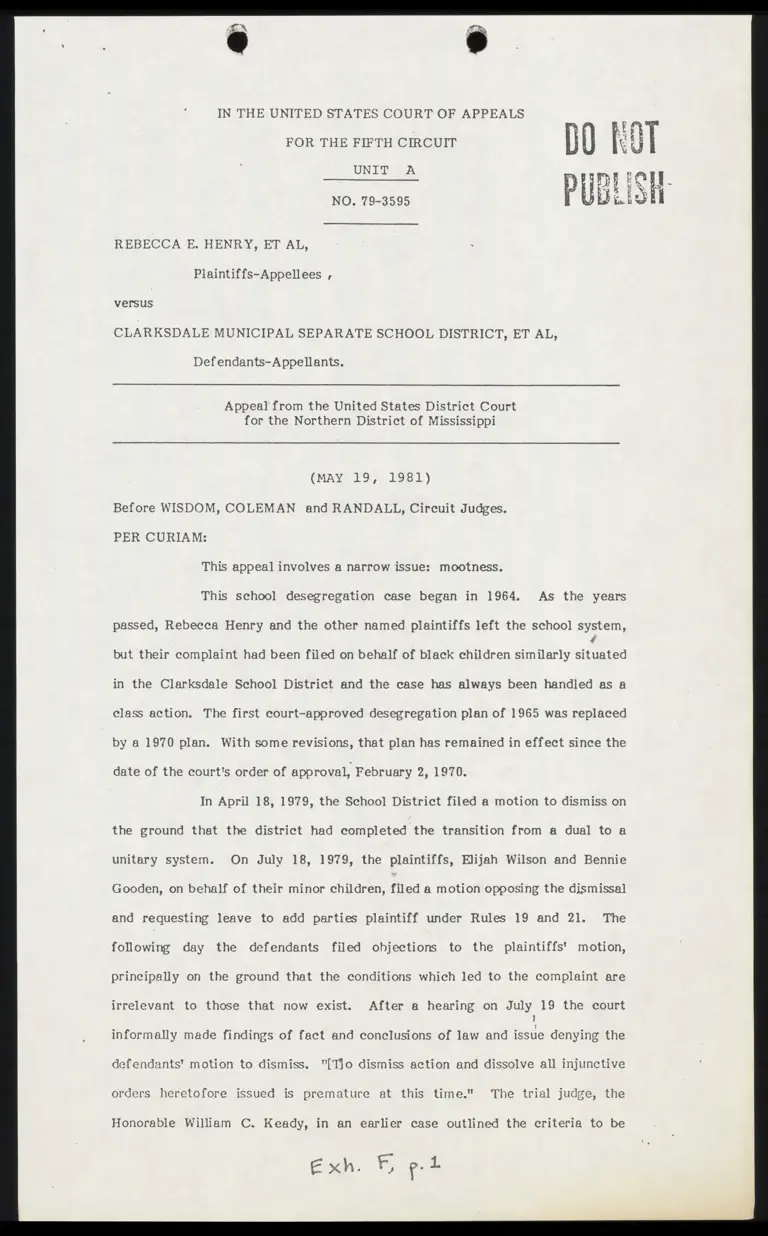
IN THE UNITED STATES COURT OF APPEALS

FOR THE FIFTH CIRCUIT

UNIT A

8
 o
s
s
 |


B
E
w
e
a
r
s


=
=

C
2


NO. 79-3595

REBECCA E. HENRY, ET AL,

Plaintiffs-Appellees ,

versus

CLARKSDALE MUNICIPAL SEPARATE SCHOOL DISTRICT, ET AL,

Defendants-Appellants.

Appeal from the United States District Court
for the Northern District of Mississippi

(MAY 19, 1981)

Before WISDOM, COLEMAN and RANDALL, Circuit Judges.

PER CURIAM:

This appeal involves a narrow issue: mootness.

This school desegregation case began in 1964. As the years

passed, Rebecca Henry and the other named plaintiffs left the school system,

but their complaint had been filed on behalf of black children similarly tasted

in the Clarksdale School District and the case has always been handled as a

class action. The first court-approved desegregation plan of 1965 was replaced

by a 1970 plan. With some revisions, that plan has remained in effect since the

date of the court's order of approval, February 2, 1970.

In April 18, 1979, the School District filed a motion to dismiss on

the ground that the district had completed the transition from a dual to a

unitary system. On July 18, 1979, the plaintiffs, Elijah Wilson and Bennie

Gooden, on behalf of their minor children, filed a motion opposing the dismissal

and requesting leave to add parties plaintiff under Rules 19 and 21. The

following day the defendants filed objections to the plaintiffs’ motion,

principally on the ground that the conditions which led to the complaint are

irrelevant to those that now exist. After a hearing on oy 19 the court

informally made findings of fact and conclusions of law and issue denying the

defendants’ motion to dismiss. "[Tlo dismiss action and dissolve all injunctive

orders heretofore issued is premature at this time." The trial judge, the

Honorable William C. Keady, in an earlier case outlined the criteria to be

Exh. F, p.1

a
a


<


} L
a
l

a


considered in evaluating the compliance of a school district with a court-

ordered integration plan. United States v. Corinth Municipal Separate School

Dustriet, 414 ©.oupp. 1336 (N.D. iiss. 108). an that case ...: ueld that the case

was ripe for dismissal. It is evident, therefore, that as of July 19, 1979, the

experienced trial judge rege: ded the Clarksdale litigation as a live case or

controversy based on issues 1 quiring the district court to continue to perform

its constitutional function. More bluntly, the School District had not shown

that it had complied with the court's injunction ordering conversion of the

district to a unitary system.

On July 23, 1979, the defendants filed additional objections to the

motion to add parties plaintiff. They alleged that there was no case or

controversy because (1) "none of the [originall plaintiffs in this action is any

longer a student in this school district; (2) this case has never been

certified ...." The district court overruled these objections, holding:

The court determines that the grounds asserted
by defendants are meritless, and cannot be regarded as
sufficient to vitiate this court's continuing jurisdiction
over the Clarksdale public school system and its various
orders entered in the case. The court and all parties
have, for a period of many years, regarded the case as a
class action, the named plaintiff having completed her
attendance in the city schools at least several years
ago.

The issue having now been raised, the court
allows the motion to admit the movants as represen-
tative plaintiffs to maintain the case as a class action in
lieu of Rebecca Henry, et al. ...

The court, of its own motion, and from an
examination of the jacket file, certifies that this school
desegregation case is maintainable as a class action
under Rule 23, . . . and the case should proceed, as
heretofore implied, as a class action maintainable under
subdividions b(2) for the benefit of a plaintiff class
consisting of all black students now or hereafter
attending the Clarksdale public schools.

We agree with the district court.

The short answer to the defendants is, as the trial judge stated,

that the "court and all parties have, for a period of many years, regarded the

case as a class action". The additional plaintiffs named by movants Wilson and

Gooden are black school children in Clarksdale who fall within the class.

Apparently, through a proper (although not strictly necessary) concern over the

procedural amenities, Judge Keady specifically defined the class and certified

it in his order of September 27, 1979.

An order certifying a class is not an appcalable order absent

exceptional circumstances. Blackie v. Barrack, 9 Cir. 1975, 524 F.2d 891;


Seiff er v. Topsy's International, Inc., 10 Cir. 1975, 520 F.2d 795, cert. denied,

96 S.Ct. 779 (1978). Parkinson v. Apri] Industries, Ine., 2 Cir. 1975, 520 F.2d

650; Katz v. Carte Blanche Corp., 3 Cir. 1974, 496 F.2d 747 (en banc), cert.

denied, 95 S.Ct. 152 (1974); Thill Securities Corp. v. New York Stock Exhange,

7 Cir. 1972, 469 F.2d 14; Walsh v. City of Detroit, 6 Cir. 1969, 412 F.2d 226; 9

Moore's Federal Practice ¥110.13[9].

Rule 21 of the Federal Rules of Civil Procedure gives a district

court broad authority to add parties: "Parties may be dropped or added by

order of the court on motion of any party or of its own initiative at any stage

of the action and on such terms as are just." The adding or dropping of parties

when necessary to afford proper relief will not be set aside unless the court has

abused its discretion. Anderson v. Moorer, 5 Cir. 1967, 372 F.2d 747.

Any question in this case as to the correctness of adding plaintiffs

was answered by the Supreme Court in United States Parole Commission v.

Geraghty, 1980, 445 U.S. 388, 100 S.Ct. , 63 L.Ed.2d 479. In that case a

federal prisoner challenging parole regulations attacked the district court's

dismissal of class certification after he had been released. The Court held

that: "an action brought on behalf of a class does not become moot upon

expiration of the named plaintiff's substantive claim, even though class

certification has been denied". The Court of Appeals for the Third Circuit had

stated in its opinion in Geraghty (579 F.2d at 250):

[Indianapolis School Commissioners v. Jacobs, 1975, 420
U.8.:128, S.Ct. , 43 L.Ed.2d 74] should not be
viewed as standing for the proposition that the federal
courts are constitutionally barred from continuing to
adjudicate disputes when the named plaintiff no longer
retains his claim. So long as a factually concrete legal
controversy continues to exist, it would appear that
constitutional power of a court over the case remains.
Consequently the holding of Jacobs is perhaps best
understood as a specific instance that must be seen in
the context of the over arching set of principles
adumbrated by the authorities cited above.

In United Airlines, Inc. v. McDonald, 432 U.S. 385, 393-95, 53

L.Ed.2d 423, 97 S.Ct. 2464 (1977), the court held that putative class members

may intervene, for the purpose of appealing the denial of a class certification

motion, after the named plaintiffs' claims have been satisfied and judgment

entered in their favor.

Fifth Circuit precedent is found in Cruz v. Hauck, 8 Cir, 1875,

515 F.2d 322, 325 n.1. There we said:

Cruz has been discharged and the record seems to
indicate that the other individual plaintiffs are no
longer confined in the Bexar County Jail. We have been

Exh, Firm
i


= a DA

unable to find any certification of this proceeding as a
class action. The parties, however, have treated the
litigation as though the district court made an
ppropriate certification Th~ defendants have not

raised the issue of mootness and since the legal issues
presented continue to affect the prisoners in the jail,
contrary to the situation in the Board of School
Cornmissioners v. Jacobs, 420 U.S. 128, 95 S.Ct. 848, 43
L.1:d.2d 74 (1975), a case or controversy exists with
resect to the validity of the rules at issue.

That holding covers the case perfectly.

Sannon v. United States, 5 Cir. 1980, 631 F.2d 1247, 1252, is

distinguishable. There the plaintiffs were Haitian refugees who contended that

they were wrongfully denied a hearing before an immigration judge on their

claims for asylum. The Immigration and Naturalization Service mooted their

individual claims by issuing new regulations entitling them to such hearings. As .

our Court pointed out, all petitioners (and all. members of the putative class)

are entitled to hearings on their asylum claims before the immigration. Here,

however, the black children still attending the schools in Clarksdale and those

who will attend the schools in the future are engaged in a live controversy over

the process of desegregating the school district.

We affirm the judgment and orders of the district court.

AFFIRMED.


a

NO. 79-3595 - REBECCA E. HENRY, ET AL. vs CLARKSDALE MUNICIPAL

SEPARATE SCHOOL DISTRICT, ET AL.

COLEMAN, Circuit Judge, concurring.

For the reasons therein stated I concur in the fore-

going opinion.

I must, however, say an additional word.

I am convinced that it is high time that this case

be brought to a close. This municipal separate school district,

with a total 1970 population in the City of Clarksdale of 21,673,

has been in this Court since 1969, as follows:

Y.  1969,.409 F.2d 682

2.:1920,.425 .F.2d 698

3. 1970, 433 F.2d 387

4. 1973, 480 F.2d 583

5. 1978, 579- F.2d 816

The 1978 case concerned only attorney fees. The 1973

case was concerned with transportation of students living more

than a mile and a half from school. The last case dealing with

a desegregation plan was in 1970, eleven years ago.


We need not invoke the special faculties of a wizard

to identify the victims of this prolonged warfare - they are

the children, who are entitled to sce degree of educational

tranquility.

While the law does not permit reversal on the matter

presently before us, I now respectfully presume to urge the able,

experienced District Judge, who is sitting in equity, to take

this case sternly in hand and to relentlessly drive ahead until

unitary status is achieved, if it does not already exist. It

should not take much to put an end to this twelve year old

litigation.

As the presiding judge (at Judge Wisdam's request)

of the panel which heard this case, I announce that the appel-

lee's motion to dismiss this appeal is DENIED, [||ec5e10ea-ed94-4986-9e58-9115c01b1c4c||]