Bias at Public Park Outlawed
Press Release
March 18, 1955
-
Press Releases, Loose Pages. Bias at Public Park Outlawed, 1955. 27b62215-bc92-ee11-be37-00224827e97b. LDF Archives, Thurgood Marshall Institute. https://ldfrecollection.org/archives/archives-search/archives-item/76d149cb-0351-426b-8234-34b5b649cc0d/bias-at-public-park-outlawed. Accessed October 07, 2026.
Copied!
    PRESS a e

NAACP LEGAL DEFENSE AND EDUCATIONAL FUND
107 WEST 43 STREET + NEW YORK 36, N. Y. © JUdson 6-8397

ARTHUR B. SPINGARN THURGOOD MARSHALL
President Director ond Counsel

WALTER WHITE ROBERT L. CARTER
Secretary Assistant Counsel

ALLAN KNIGHT CHALMERS ARNOLD DE MILLE
Treasurer Press Relations

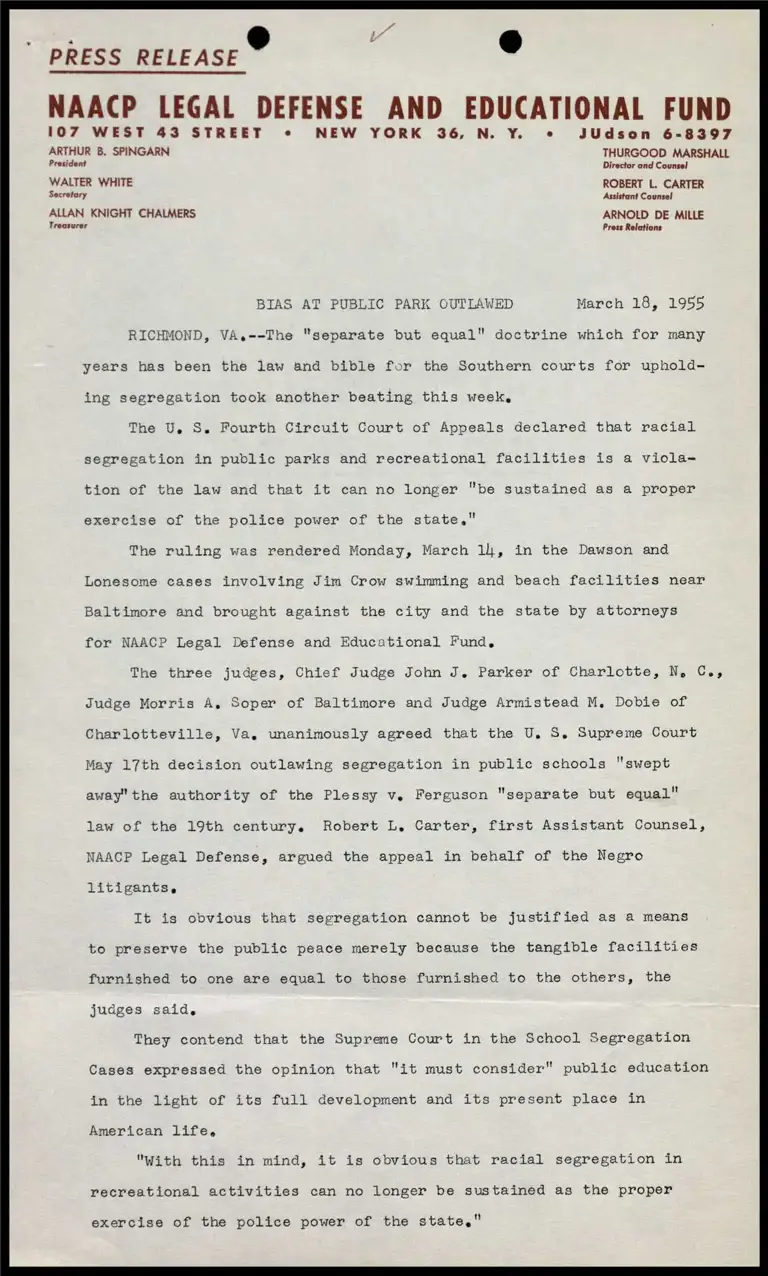
BIAS AT PUBLIC PARK OUTLAWED March 18, 1955

RICHMOND, VA,--The “separate but equal" doctrine which for many

years has been the law and bible for the Southern courts for uphold-

ing segregation took another beating this week,

The U. S. Fourth Circuit Court of Appeals declared that racial

segregation in public parks and recreational facilities is a viola-

tion of the law and that it can no longer "be sustained as a proper

exercise of the police power of the state,"

The ruling was rendered Monday, March 1h, in the Dawson and

Lonesome cases involving Jim Crow swimming and beach facilities near

Baltimore and brought against the city and the state by attorneys

for NAACP Legal Defense and Educational Fund.

The three judges, Chief Judge John J. Parker of Charlotte, Ne Ce,

Judge Morris A, Soper of Baltimore and Judge Armistead M. Dobie of

Charlotteville, Va. unanimously agreed that the U. S. Supreme Court

May 17th decision outlawing segregation in public schools "swept

away"the authority of the Plessy v. Ferguson "separate but equal"

law of the 19th century, Robert L. Carter, first Assistant Counsel,

NAACP Legal Defense, argued the appeal in behalf of the Negro

litigants.

It is obvious that segregation cannot be justified as a means

to preserve the public peace merely because the tangible facilities

furnished to one are equal to those furnished to the others, the

judges said,

They contend that the Supreme Court in the School Segregation

Cases expressed the opinion that "it must consider" public education

in the light of its full development and its present place in

American life,

"With this in mind, it is obvious that racial segregation in

recreational activities can no longer be sustained as the proper

exercise of the police power of the state,"


EPs

The two cases emanated from district courts in Baltimore which

upheld the Jim Crow policies at the public beaches and bathhouses

as operated by public authorities,

The Dawson case was brought against the City of Baltimore and

the operators of the city-owned public beach at Fort Smallwood Park

in 1950. Robert Dawson and a group of Negroes were denied the use

of the beach because of their race but despite a court order of

March 2, 1951 to cease discriminating against Negroes, the authori-

ties set aside certain days for the beach to be used by each racial

group.

In 1952 a segregated beach for Negroes was authorized and con-

structed. Despite protests, Negroes were refused the use of the

other beach on the ground that the law called for equality of phy-

sical facilities,

On May 27, 1954, ten days after the school segregation decision,

a motion for judgment was filed by NAACP Legal Defense attorneys

based on the fact that segregation was a violation of the federal

Constitution. On July 27, the court denied the motion on the grounds

that the May 17th decision did not outlaw segregation in recreational

facilities,

The Lonesome suit, filed on August 8, 1952, sought an injunction

against the state of Maryland to cease its Jim Crow policies on the

beaches at the Sendy Point State Park on the grounds that the beach

operated for Negroes did not " afford complete and wholesome

recreation."

Park officials claimed that the facilities at the two beaches

were equal. On June 2, 1953, the court issued a preliminary injunc-

tion disputing this fact but five weeks later reversed itself

claiming that the facilities were equal due to certain improvements

made at the Negro beach,

On December 20, 1954, attorneys for the Negroes filed a brief

consolidating both cases in the Fourth Circuit Court of Appeals.

The lower court's decision should be reversed, they argued, because

the opinions of the courts were based on the outdated and false

"separate but equal doctrine, The appeal was argued at Charlotte,

N. C,, January 11, 1955,


ae @ e
In ruling that segregation has no place in recreational

facilities the three circuit court judges cited two other cases

decided by the Supreme Court and lmocking out the practice of segre-

gation. ". . . we should keep in mind the idea of equality before

the law which characterizes our institutions," the judges asserted.

Both Judges. Parker and Dobie participated in two of the

original School Segregation Cases. Judge Parker voted for segrega-

tion in the South Carolina case and Judge Dobie did the same in the

Virginia case,

Legal Defense attorneys for the Negroes, other than Carter,

are Linwood Koger, Jr., and Tucker RK. Dearing, bo th of Baltimore,

and Thurgood Marshall, Director-Counsel and Jack Greenberg, Assis-

tant Counsel, both of Legal Defense in New York.

=30—

FEDERAL COURT DISMISSES LEVITT DISCRIMINATION CASE

PHILADELPHIA, PA.--NAACP Legal Defense and Educational Fund

lawyers lost the first round in their legal battle to have the

courts restrain builder William Levitt from discriminating against

Negroes in the sales of private homes at the modern community of

Levittown in Bucks County, Pa.

Chief Judge William H, Kirkpatrick ruled Wednesday, March 16,

that the suit against Levitt, the world's biggest builder of modern

homes, be dismissed on the grounds that Congress did not specifically

say that federal officials operating FHA and VA programs should have

the duty to order the end of segregation in such federally~aided

homes.

"Neither the FHA nor the VA has been charged by Congress with

the duty of preventing discrimination in the sales of housing pro-

ject properties," Judge Kirkpatrick said in a five page opinion

dismissing the case,

The suit against Levitt and Sons, Inc. was filed on January 13

with the U. S, District Court for the Eastern District of Pennsyl-

vania in behalf of six Negro veterans who were turned down when they

tried to buy homes in the 16,000 private home development outside

of Philadelphia, The petition sought to restrain Levitt from refus-

ing to sell to Negroes solely because of race or color, as long as

he uses FHA and VA mortgage assistance or approval,


ie

Named in the suit with Levitt are Norman P. Mason, Commissioner

of the FHA; William A. Kelley, Director of the Philadelphia Insuring

Office of the FHA; Harvey V. Higley, Administrator of Veterans

Affairs, and Charles E. Engard, Director of the Loan Guarantee

Section of the Philadelphia Regional Office of the VA.

Levitt and the federal officials filed motions for dismissal

with the court on the grounds that the federal court has no juris-

diction over the case, Arguments on the motion were heard on

February 23,

Judge Kirkpatrick in his dismissal opinion said that whether

the Negroes' rights were violated is not decided at this time, "the

only question is whether the plaintiffs! case can be maintained in

this court,"

Legal Defense attorneys had accused Levitt of being aided by

the government to the point where his action could be interpreted

as the action of the federal government,

"All of these do not, however, in my opinion, result in making

Levitt and Sons, Inc, of New York, the government of the United

States or a branch or agency of it, nor do they make the government

of the United States the builder or developer of the Levittown

project," Judge Kirkpatrick proclaimed,

Legal Defense lawyers argued further that Levitt, as developer

of Levittown, is subject to the control and supervision of various

officials and agencies of the Commonwealth of Pennsylvania in con-

structing schools, sewage, water mains, etc. and, in effect, a

municipality of Pennsylvania and a part of the state. Judge

Kirkpatrick dismissed this point by saying "it is too far fetched

to require discussion,"

Legal Defense attorneys do not consider the dismissal a defeat

in their case against Levitt, Mrs, Constance Baker Motley, Associate

Counsel of NAACP Legal Defense and Educational Fund said the case

will be appealed, Other attorneys for the Negroes are Thurgood

Marshall, Director Counsel of Legal Defense, Walter A. Gay, Jr, and

David £, Pinsky of Philadelphia,

-30-