Dandridge v. Jefferson Parish School Board Petition for Writ of Certiorari to the US Court of Appeals for the Fifth Circuit
Public Court Documents
June 1, 1972
-
Brief Collection, LDF Court Filings. Dandridge v. Jefferson Parish School Board Petition for Writ of Certiorari to the US Court of Appeals for the Fifth Circuit, 1972. f186d8e5-ae9a-ee11-be37-00224827e97b. LDF Archives, Thurgood Marshall Institute. https://ldfrecollection.org/archives/archives-search/archives-item/76dca6c8-3f71-4290-b107-d603bf5a6f51/dandridge-v-jefferson-parish-school-board-petition-for-writ-of-certiorari-to-the-us-court-of-appeals-for-the-fifth-circuit. Accessed October 06, 2026.
Copied!
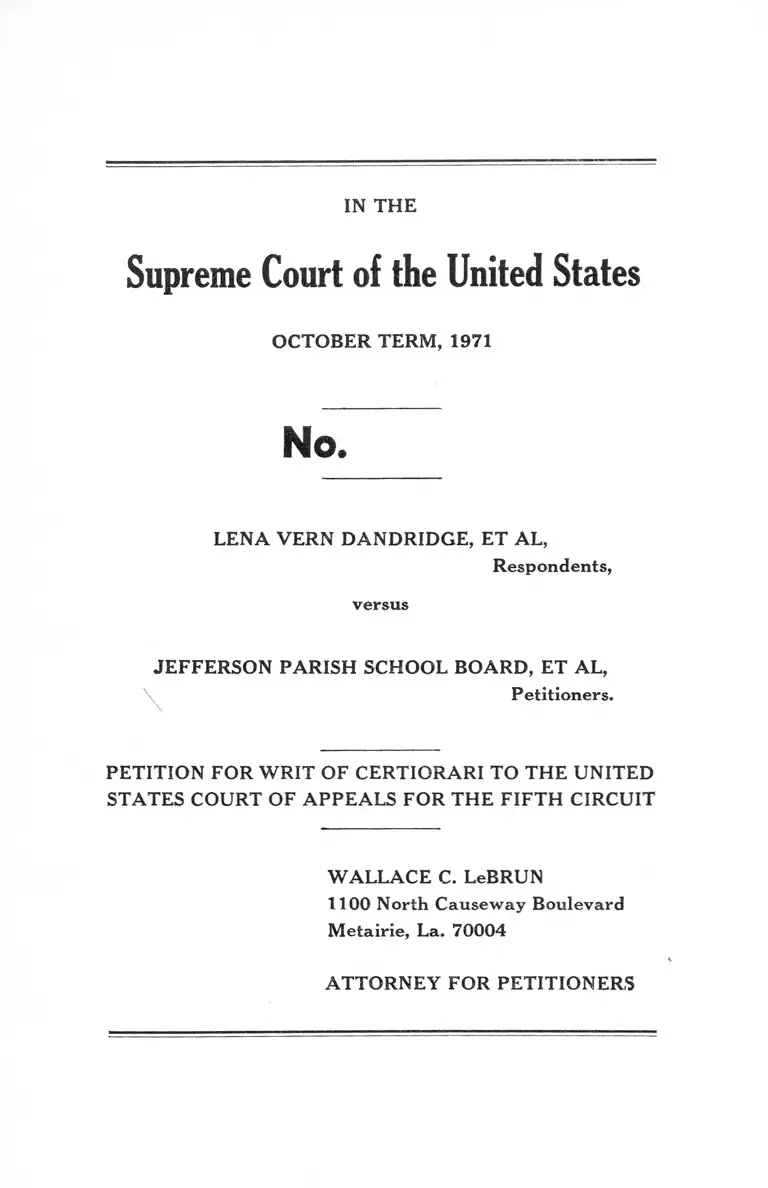
IN THE
Supreme Court of the United States
OCTOBER TERM, 1971
No.
LENA VERN DANDRIDGE, ET AL,
Respondents,
versus
JEFFERSON PARISH SCHOOL BOARD, ET AL,
Petitioners.
PETITION FOR WRIT OF CERTIORARI TO THE UNITED
STATES COURT OF APPEALS FOR THE FIFTH CIRCUIT
WALLACE C. LeBRUN
1100 North Causeway Boulevard
Metairie, La. 70004
ATTORNEY FOR PETITIONERS
IN THE
SUPREME COURT OF THE UNITED STATES
October Term, 1971
No.
LENA VERN DANDRIDGE, ET AL,
Respondents,
versus
JEFFERSON PARISH SCHOOL BOARD, ET AL,
Petitioners.
PETITION FOR WRIT OF CERTIORARI TO THE
UNITED STATES COURT OF APPEALS
FOR THE FIFTH CIRCUIT
TO THE HONORABLE THE CHIEF JUSTICE AND
THE ASSOCIATE JUSTICES OF THE SUPREME
COURT OF THE UNITED STATES:
Your petitioners, the Jefferson Parish School Board
and others respectfully adopt, by reference, the entire
petition of Albert B. Eason, and others, Intervenors, in
cluding both appendices. Your petitioners respectfully
pray that a Writ of Certiorari be issued out of and
under the seal of this Court to review the decision of
the United States Court of Appeals for the Fifth Circuit
in No. 71-2542, rendered on February 11, 1972, which
affirmed an earlier judgment by the District Court
of the United States for the Eastern District of Louisi-
2
ana, New Orleans Division, in civil action number 14,801,
granting Respondent further relief as originally prayed
for,
SUPPLEMENTAL ARGUMENT
The primary and main issue to be considered by this
Court concerns the application of the Equal Protection
Clause of the Fourteenth Amendment. More particular
ly, the question to be answered is whether the Equal
Protection Clause requires a judicially admitted uni
tary school system to implement the forced busing of
students out of their respective school districts to other
school districts merely to achieve a racial balance of
the entire student body.
Petitioners, in heavy reliance on a prior judgment of
the District Court, (appendix C), are firmly convinced
that it has operated a unitary school system on a com
pletely non-racial basis prior to and continuously since
the rendition of a previously rendered judgment.
Though there remained nineteen neighborhood schools
(in a system of seventy-five) that maintained a one
race or predominantly one race student body, the sys
tem was operated on a totally integrated basis. Every
one of the seventy-five schools operated with integrated
faculties; there was a single transportation system
which transported white and black students on a non-
discriminatory basis; there was a fully integrated ath
letic program; all other extra-curricular activities,
such as bands, drama, clubs, etc., were fully non-dis-
criminatory; and, finally, all of the seventy-five school
districts were created along geographic lines without
regard to the prospective racial overtones.
3
Plaintiffs, on May 10, 1971, moved for further relief
and particularly sought to have the District Court di
rect petitioners to formulate a new desegregation plan
which “through racial balance would eliminate the
racial identification of any particular school”, (empha
sis added). In addition, plaintiffs sought, inter alia, a
change whereby the faculty of each school would be
integrated “in substantially the same ratio of white
to black teachers throughout the school system”.
Petitioners re-urge in argument, the memorandum it
has previously submitted to United States Court of Ap
peals for the Fifth Circuit in support of petitioners’ mo
tion for a. Suspension and Stay of Injunction, dated
August 18, 1971 (Appendix C').
WHEREFORE, petitioners pray that this Honorable
Court will grant a Writ of Certiorari for the purpose of
evaluating and reversing the decision of the United
States Court of Appeals for the Fifth Circuit, No. 71-2542,
and the Judgment of the District Court of the United
States, Eastern District of Louisiana, New Orleans
Division, Civil Action Number 14,801, and reinstating
the previously Court approved plan for a unitary sys
tem in Jefferson Parish, Louisiana.
Metairie, Jefferson Parish, Louisiana, th is____day
of June, 1972.
WALLACE C. LeBRUN
1100 North Causeway Boulevard
Metairie, Louisiana 70004
ATTORNEY FOR PETITIONERS
4
PROOF OF SERVICE
In furtherance of the Rules I have served 2 copies
of the above and foregoing Petition for Writ of Certi
orari upon all parties, by pre-paid mail, addressed to
their Counsel, th is____day of June, 1972.
WALLACE C. LeBRUN
la
APPENDIX €
UNITED STATES COURT OF APPEALS
FIFTH CIRCUIT1
CIVIL ACTION
NUMBER: 71-2542
LENA VERN DANDRIDGE, et al
VS:
JEFFERSON PARISH SCHOOL BOARD, et al
MEMORANDUM IN SUPPORT OF MOTION FOR
SUSPENSION AND STAY OF INJUNCTION
This matter originated with plaintiffs’ complaint on
July 30, 1964. It seeks a preliminary and permanent
injunction enjoining defendants “from continuing their
policy, practice, custom and usage of maintaining and
operating a compulsory biracial school system in the
Parish and of assigning students, teachers and other
school personnel to the schools operated and controlled
by them on the basis of race” . See paragraph II of com
plaint.
The complaint alleges that the schools which the
black children attend are “all limited by defendants
to attendance by Negro children pursuant to the policy,
practice, custom and usage of defendants of operating
a compulsory biracial school system and assigning
school children therein and other personnel on the
grounds of race”.
2a
In their said original complaint, plaintiffs prayed for
eight different preliminary and permanent injunctions,
all of which, were based on the operation of a dual
public school system which was then being operated
on a racial basis.
The said matter was heard on August 10, 1964, and
after hearing some evidence the Court referred the
matter to a conference on a later date-. The conference
was held on August 24, 1964. On January 25, 1965 the
Court a qua, in a written order held that; “plaintiffs
were entitled to a preliminary injunction as prayed
for but that because of the short time remaining be
fore the opening of the Jefferson Parish schools for
the 1964-65 session and the many problems involved
an order entered at that time1 which would require
the Jefferson Parish School Board to discontinue the
operation of a compulsory bi-racial school system in
Jefferson Parish, Louisiana beginning with the 1964-
65 term of school could not be complied with without
seriously disrupting the school system to the detriment
of the pupils of both races”.
Further, the said order made the injunction efective
with the opening of the 1965-66 school term. Defendants
were enjoined from continuing to operate a compul
sory bi-racial school system and were ordered to sub
mit and file in this record, not later than March 31st,
1965, a plan which would “provide for the discontinuance
of the compulsory bi-racial school system in Jefferson
Parish, Louisiana”.
On June 7, 1965, the District Court considering the
law and the evidence ordered a plan of desegregation
3a
to be placed in operation by August 31, 1965. The said
plan called for the desegregation of certain grades in
the 1965-66, 1966-67 and 1967-68 school years. It also
called for implementing the “freedom of choice” con
cept, and set out guidelines for doing so.
A motion by plaintiffs for further relief was filed
herein on June 21, 1968. A conference concerning this
matter was held on July 5, 1968. On July 12, 1968 de
fendants were directed to submit another “plan for
the assignment of all students for the 1968-69 school
year upon the basis of a unitary system of non-racial
geographical zones or a plan for the consolidation of
grades or both ..
The defendants submitted a proposed plan but the
Court found that it did not provide for a unitary, non-
racial school system, but it did provide for further
integration of the school system. The record reflects
that although they submitted the plan, defendants did
not recommend it, contending that the plan was neither
educationally sound nor economically feasible.
On July 24, 1988, a hearing was held, at which time
testimony was offered concerning the said plan. Anoth
er conference regarding this matter was held on
August 20, 1968. On August 22, 1968 the Court, “after due
consideration of the evidence, the argument of counsel
and the law, and in light of the short period of time
remaining before the scheduled opening of the 1968-69
school year” found that “it is not feasible to require
the defendants to provide for a unitary, non-racial
school system at this time and that to put into effect
at this time the entire plan submitted by the defendants
would be unduly disruptive and detrimental to the Jef
4a
ferson Parish School System”. However, the Court did
order the implementation of a portion of the proposed
plan at that time. The order related to a few specifically
named schools and involved a relatively few pupils.
That order did not disturb the freedom of choice plan
under which the system was then operating.
On February 3, 1969 the plaintiffs again filed a motion
for further relief, seeking an order requiring defend
ants to submit a report on the progress being made in
fashioning a plan which would provide for the desegre
gation of all schools in the Parish on a unitary non-
racial basis for the 1969-70 school year and other relief
concerning faculty assignments for that school year.
A hearing was set for February 19, 1989, at which
time plaintiffs and defendants filed a joint motion in
which it was suggested that it was agreed that the
School Board would file in the record on or before
February 28, 1969 a plan providing for desegregation
of the Public School System of Jefferson Parish on a
unitary non-racial basis of operation for the 1969-70
school year and a report on faculty assignment for
that school year. The Court ordered that the School
Board file the plan of desegregation and the report
on the assignment of faculty on a non-racial basis con
templated by the joint motion.
In compliance with the court’s order the School
Board, on February 28, 1969, filed a plan for the de
segregation of the school system on a unitary non-
racial basis of operation for 1969-70 and a report on
the proposed assignment of faculty on a non-racial
basis for that school year. Maps indicating single dis
tricts were attached.
5a
On April 18, 1969, plaintiffs filed exceptions to the de
segregation plan submitted by the defendants and a
hearing was had on the exceptions on May 17, 1969, at
which time testimony was offered and the matter was
taken under advisement. A conference regarding the
matter was held by the Court on June 17, 1969.
On June 26, 1969, the Court rendered a judgment
herein. I quote from that judgment:
“Now, after due consideration of the law, the
evidence and the arguments of counsel, the
court finds that the plan providing for the de
segregation of the Public School System of the
Parish of Jefferson on a unitary non-racial
basis of operation for the 1969-70 school year,
submitted and filed on February 28, 1969, but
not recommended by the Jefferson Parish
School Board, is acceptable. The court further
finds that the proposed faculty integration
formula for the school year 1969-70 submitted by
the School Board is also acceptable. The court
further finds that the exceptions of the plain
tiffs to the plan submitted are not well founded
and must be overruled, accordingly.
“IT IS ORDERED, ADJUDGED AND DE
CREED that the plaintiffs’ motion for fur
ther relief be and it is hereby GRANTED.
“ IT IS FURTHER ORDERED, ADJUDGED
AND DECREED that the defendants, begin
ning with the 1969-70 school year, put into ef
fect the plan providing for the desegregation
of the Jefferson Parish School System on a uni
6a
tary, non-racial basis of operation which was
submitted on February 28, 1969 by the Jeffer
son Parish School Board, but not recom
mended by it; and
“IT IS FURTHER ORDERED, ADJUDGED
AND DECREED that the defendants put into
effect, beginning with the 1969-70 school year,
the faculty integration formula submitted by
the Jefferson Parish School Board. The de
fendants are to report to the court when they
have complied with the foregoing order.
“ IT IS FURTHER ORDERED, ADJUDGED
AND DECREED that the exceptions of the
plaintiffs to the plan submitted be and they
are hereby OVERRULED.”
On August 29, 1969, a minor amendment to the
judgment of June 26, 1969 was entered. It provided that
pupils who were residing in two certain geographical
zones who attended two certain schools in the 1968-69
school year be permitted to attend those same schools
in the 1969-70 school year.
Defendant Jefferson Parish School Board moved for
a rehearing of the Court’s order of August 29, 1969,
asking that the Court reconsider the freedom of choice
method on the best method of operation of the Pub
lic School System in Jefferson Parish; that in the alter
native, the Court issue an order permitting all students
who desire to do so to attend the school which they
attended during the 1968-69 school year; that, in the
7a
second alternative, the Court issue an order requiring
all students, without exception, to attend the schools
in their unitary district. On September 19, 1989 the
Court denied the motion of defendant.
The Swann v. Charlotte-Mecklenburg Board of Edu
cation case was decided by the United States Supreme
Court on April 20, 1971. And on May 10, 1971 plaintiffs
filed another motion for further relief asking that the
defendant Jefferson Parish School Board be ordered
to formulate a plan “that would provide for the desegre
gation of every school unit in Jefferson Parish on a
proportionate basis of a 65-35 white-black ratio, so
that there will be no basis for contending that one
school is racially different from the others, and there
fore, racially identifiable” . The said motion also re
quested that the defendant board be ordered to assign
faculty members to each school “on a basis substan
tially the same as the system-wide faculty racial com
position, and to hire new teachers on a non-racial
basis” .
In plaintiffs’ accompanying memorandum to its mo
tion of May 10, 1971, they principally rely on the Swann
case. They allege that they are entitled to facilities,
as Swann puts it, “to prepare students to live in a
pluralistic society”. The plaintiffs contend that, “ ob
viously then, whether segregation is de-jure or de-
facto, the feeling of inferiority experienced by the
members of the segregated race is equally vibrant and
real and thus both segregations are constitutionally in
decorous”.
8a
After two conferences with counsel for all parties
the District Court, on July 9, 1971 ordered the Jeffer
son Parish School Board, in cooperative consultation
with counsel for plaintiffs, formulate a desegregation
plan for the public schools of Jefferson Parish. The
plan was to comport with the requirements of Svmnn
and was to be submitted not later than August 2, 1971,
and was to be implemented in the 1971-72 school year.
The order further commanded the Jefferson Parish
School Board integrate the faculty of each school “so
that the ratio of white to black teachers in an individual
school reflects the ratio of white to black teachers in
the school system as a whole” .
The major controversy revolves about the issues of
1) providing a system of desegregation based on racial
balance in relation to the currently existing white-
black ratio of students and 2) providing forced busing
of students from, existing geographic zones for the
sole purpose of achieving that racial balance.
On June 18, 1971, a motion for intervention was filed
on behalf of Albert B. Eason and some 13,500 others
who signed petitions to the Court decrying the forced
busing of students from the geographic zones previous
ly approved by the Court.
In conferences with the District Court Judge and
counsel for all parties, it was pointed out that the
Jefferson Parish Public School System encompasses
schools on both sides of the Mississippi River and that
busing of the pupils from one side to the other would
be impractical. Counsel for all parties agreed that any
Sa
proposed plan that would be submitted would not pro
vide for transporting pupils across the Mississippi
River.
On August 2, 1971 the Jefferson Parish School Board,
in compliance with the Court’s order of July 9', 1971,
submitted another desegregation plan but did not
recommend its adoption. The District Court entered
judgment approving the said plan, on August 10, 1971.
Defendants respectfully contend that it is operating
a unitary system on a non-racial basis and have been
so operating since 1969 under the previously rendered
Court order. The Board sincerely contends that even
though there are several schools which are either all-
white, all-black or substantially so, the said schools
are so only as a result of de-facto segregation. The
Board shows that the segregated facilities exist solely
as a result of housing patterns. Not one governmental
act was alleged or proved to show the existence of de-
jure segregation.
Plaintiffs failed to produce a single witness to prove
a single case of de-jure segregation. Counsel contended
that the very existence of one-race schools was uncon
stitutional, completely by-passing the question of
whether the segregation was de-jure or de-facto in
nature.
Of course, without exception, all of the cases thus
far decided by the United States Supreme Court that
relate to public school desegregation are concerned
only with de-jure segregation. Swann specifically re-
10a
fers to de-jure segregation as violative of plaintiffs’
constitutional rights.
Defendants strongly urge that the order of the Dis
trict Court is erroneous. The defendants have been
operating within all constitutional requirements and
mandates. The August 10, 1971 order of the District
Court amounts to an unwarranted and illegal inter
ference with the operation of the Jefferson Parish
Public School system and it provides alleged remedies
relating to de-facto segregation only.
The only evidence adduced at the hearing on August
9, 1971 was conclusive in establishing that the bound
aries for the individual school districts were created
on a non-racial basis. However, the Court chose to dis
regard that evidence and apparently concluded, on its
own initiative, that the mere existence of the one-
race schools is violative of plaintiffs’ constitutional
rights in the premises.
At the hearing, defendants produced the planning
director and one of his executive assistants (his other
assistant at the time was out of town and unavailable
for testimony). They both testified that no one at any
time advised or instructed them, to make any plans
on a racial basis. Nor did they, in fact, make any plans
discriminating against any pupil on account of race.
At several of the pre-trial conferences, the Superin
tendent for the Jefferson Parish Public School System
assured the Court that the staff was, in fact, adminis
tering the system on a unitary non-racial basis. There
llja
is a single busing program that transports white and
black students alike, all of the schools are single dis
trict schools, i.e., the students are assigned to the
schools that are located within the geographic bound
aries for their respective districts, the faculties for all
schools are substantially integrated, and all curricula
and extracurricula activities are operated on an in
tegrated basis.
The School Superintendent further testified that in
every situation where there is a one-race school, it is
so only because of the housing patterns that exist in
each such district. For example, he testified that in
the area bounded by the Airline Highway, Williams
Boulevard in Kenner, Lake Ponchartrain and the Jef
ferson Parish-New Orleans line there are presently
living only five negro families. He further testified
that the children of those negro families were cur
rently assigned to the schools in the districts where
they reside. The area described by the superintendent
encompasses fourteen elementary schools (grades
1-5) and two middle schools (grades 6-8) that were
either all-white or predominantly all-white (but with
integrated facilities).
On the South side of the Airline Highway in the upper
portion of the Parish there exists long standing neigh
borhoods which are all-black or predominantly all
black. The composition of the neighborhoods has not
seriously changed in many years. Reference is specifi
cally made to the fact that the neighborhoods are the
same as they were at the time in 1969 when the Dis
trict Court found, after hearing evidence, that the Jef-
12a
ferson Parish School Board was operating on a uni
tary non-racial basis. In that area there are two ele
mentary schools that were all-black (but with inte
grated facilities) and one middle school which is pre
dominantly all-black.
On the West side of the Mississippi River, due to
housing patterns alone, there are only two elementary
schools which are all-white and three elementary
schools are all-black. All of those schools, however,
have integrated faculties. All middle schools on the
West side of the Mississippi are substantially inte
grated.
Finally, the defendants show that due to the relative
ly small number of high schools, all are substantially
integrated. In fact, the composition of the high schools
is not included in the Court’s latest order, nor is it at
issue.
The director of transportation for the Jefferson
Parish School Board was brought to testify by de
fendants. He stated that he had studied the proposed
plan of August 2, 1971, which was submitted by de
fendants. Based on his study and on the figures pre
sented to him by the School Board’s planning depart
ment heads, he calculated that some 3000 students
who are residing within walking distances of the
schools to which they are assigned will, under the
proposed plan, be forcefully bused to schools outside
of the district in which they reside. He opined that at
least 90 per cent of those who will be bused are black
children.
13a
Further, the transportation director testified that he
calculated that some of the children who will now be
bused will have to travel more than 14 miles per day
(round trip) and will be in transit for approximately
one hour daily (one way). The new plan will require an
average busing trip of over 7 miles in comparison with
the present plan, which requires an average busing
of approximately 2.5 miles. The witness testified that
the new plan will require 20-30 additional buses and
that that number of buses is not now available, that it
takes approximately six weeks to get delivery of new
buses, and that the Board would have to appoint new
bus drivers and those drivers would have to be trained.
The District Court, in its reasons for judgment,
states that, “There is little room for doubt that much
of the busing which is required in Jefferson Parish is
due to the past practices of a dual system, the ves
tiges of which have lingered on”. Defendants respect
fully suggest that there is not one bit of evidence in
the record to substantiate that belief.
In ordering the defendants to implement this new
proposed plan of August 2, 1971, the Court has created
a situation that the defendant cannot control without
causing serious harm to the educational program for
the Jefferson Parish Public School System for the
1971-72 school year. There is an insufficient amount of
time available to accomplish the results of the Court’s
order.
In previous situations in 1964 and again in 1968, under
comparable circumstances, the Court has delayed im
plementation of the relevant plans until the following
school year. In each of those instances the Jefferson
Parish School Board complied with the Court’s orders
without undue interference with its educational pro
gram.. It cannot do so under the order presently in ef
fect. It is respectfully suggested that the presently
existing circumstances are more serious than those
which existed in 1964 and 1968. In the 1964-65 school
year there was an enrollment of approximately 48,500
pupils and busing was limited to single district geo
graphic zones; under the new plan the expected en
rollment will be approximately 83,000 pupils with ap
proximately 3000 of those being; transported outside
their respective districts. Finally, the Court order will
encompass the spending of approximately $210,000.00
for the additional buses that will be needed during the
1971-72 school year. The Court correctly points out that
the defendant Board is reimbursed by the State of
Louisiana in the approximate amount of $200,000.00.
However, that reimbursement is on a budgeted basis
and there is serious doubt concerning the availability
of funds for the additional expense.
In conclusion, defendants respectfully pray that this
Honorable Court grant an immediate order suspending
and staying the injunction ordered by the District
Court on August 10, 1971, pending appeal herein of the
several important legal questions and unresolved
issues presented here.
Counsel for intervenors is currently out of town
and is unable to timely comply with the Court’s letter
request for counsel for plaintiffs-appellees to file a
15a
response to the motion for suspension and stay of in
junction pending appeal. However, Counsel for inter-
venors has requested that this memorandum be
adopted by him on behalf of intervenors.
Metairie, Louisiana, August 18, 1971.
Wallace C. LeBrun
Attorney for
Defendants-Appellants
1100 N. Causeway Boulevard
Metairie, Louisiana 70004
834-7676
Scofields’ Quality Printers, Inc. — New Orleans, La.