Objections by Defendants to Award of Attorneys' Fees
Public Court Documents
November 5, 1975
20 pages
-
Case Files, Henry v. Clarksdale Hardbacks. Objections by Defendants to Award of Attorneys' Fees, 1975. d619f641-8418-f111-8342-0022482cdbbc. LDF Archives, Thurgood Marshall Institute. https://ldfrecollection.org/archives/archives-search/archives-item/794f4769-5689-498b-97d7-93bdbbbb1dcc/objections-by-defendants-to-award-of-attorneys-fees. Accessed September 28, 2026.
Copied!
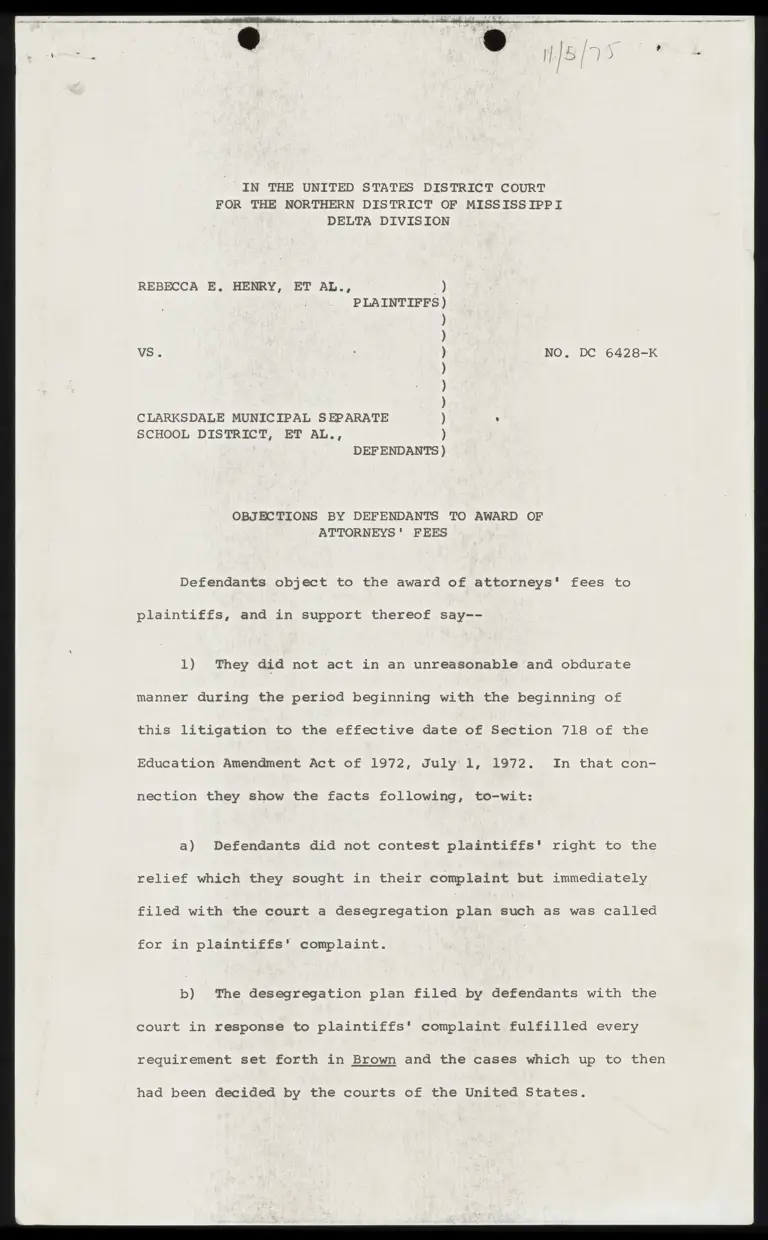
     [||b2ad72d6-dbe3-43f8-a533-fc2d5306f6f8||] IN THE UNITED STATES DISTRICT COURT

FOR THE NORTHERN DISTRICT OF MISSISSIPPI

DELTA DIVISION

REBECCA E. HENRY, ET AL., 5)
PLAINTIFFS)

)

VS. NO. DC 6428-K

CLARKSDALE MUNICIPAL SEPARATE

SCHOOL DISTRICT, ET AL.,

)
)
)
)
)
)
)

DEFENDANTS)

OBJECTIONS BY DEFENDANTS TO AWARD OF

ATTORNEYS' FEES

Defendants object to the award of attorneys' fees to

plaintiffs, and in support thereof say--

1) They did not act in an unreasonable and obdurate

manner during the period beginning with the beginning of

this litigation to the effective date of Section 718 of the

Education Amendment Act of 1972, July 1, 1972. In that con-

nection they show the facts following, to-wit:

a) Defendants did not contest plaintiffs' right to the

relief which they sought in their complaint but immediately

filed with the court a desegregation plan such as was called

for in plaintiffs' complaint.

b) The desegregation plan filed by defendants with the

court in response to plaintiffs' complaint fulfilled every

requirement set forth in Brown and the cases which up to then

had been decided by the courts of the United States.


c) The desegregation plan filed by defendants with

the court in response to plaintiffs’ complaint was found

by this court to comply with every requirement of Brown,

the Constitution of the United States and the decisions of

the courts of the United States, and was approved by judg-

ment of this court.

d) Plaintiffs appealed from the order of this court

dated August 10, 1965, approving the desegregation plan

filed by defendants in response to plaintiffs' complaint,

and such appeal was argued before the Court of Appeals for

the Fifth Circuit on May 25, 1966.

e) On March 6, 1969, almost three years after the

argument of the appeal, the case was remanded to the district

court by vote of two of the three judges who heard the appeal,

with this observation:

"A long time has elapsed since the trial,

partly because this Court delayed rendering its

decision in order to obtain further enlightenment

from the Supreme Court on the subject of attendance

zones plans as against freedom of choice plans. In

view of the delay, we believe that the interests of

justice require that the case be remanded for a

hearing to determine the effectiveness of the

Clachzdale plan in today's factual setting and in

the light of Green and other decisions of the Supreme

Court and of this Court."


es — %- PS LS Se “ iy rnp. M-—— re

@ y

The basis for the court's refusal to affirm the order of

this court was its conclusion that defendants, in drawing

up their desegregation plan, had not had in mind the "promo-

tion of desegregation," which it apparently equated with

integration. It was on that basis, and on the authority of

cases decided subsequent ‘to the hearing of such appeal, that

the Court of Appeals for the Fifth Circuit refused to affirm

the order of this court approving defendants' desegregation

plan.

f) By placing its decision on its conclusion that

defendants, in drawing up their desegregation plan, had not

used as a criteria the promotion of desegregation, which it

equated with integration, and by grounding its decision on

cases decided subsequent to the hearing of such appeal, the

Court of Appeals for the Fifth Circuit, in effect, admitted

that defendants' desegregation plan, at the time it was

filed with the court, and at the time of this court's order

of August 10, 1965, and at the time of the argument of the

appeal on May 25, 1966, met every requirement of Brown, the

Constitution of the United States, and the decisions of the

courts of the United States then in existence. For at the

times mentioned, there was no requirement that desegregation

plans should be formulated with the idea of promoting integra-

tion. Plaintiffs themselves had not so contended, as is shown

by nis paragraph from this court's Memorandum Opinion of

August 10, 1965:

"Nor, as it must be noted, do plaintiffs seek


here a right to require affirmative integration

in these schools. They clearly so state in their

brief."

And the Court of Appeals for the Fifth Circuit had held in

a number of cases that there was no obligation on the part

of anyone to further the mixing of the races in public in-

stitutions.

g) Between this Court's approval of defendants' de-

segregation plan and the hearing of the appeal therefrom,

plaintiffs, in September 1965, sought an order requiring

defendants to grant the transfer application of Bettye Jean

Yarbrough to attend Clarksdale High School in order to study

Latin, which was not taught at Higgins High School where she

was assigned in accordance with said plan. Defendants re-

sponded to said motion and showed that said transfer applica-

tion had been made on September 16, 1965, at 1:14 P.M., and

that the same had been denied because there were no exceptional

circumstances to justify it, its granting would have been con-

trary to good educational practices and requirements, and it

was impermissible under the rules and regulations of the school

district which provided, in part, as follows:

"After the first two weeks of school no

student's schedule of courses will be changed

except under exceptional circumstances, and

then only after a conference with teachers in-

volved, the principal, and the counselor."


Such rule or regulation was well known to all students of

Clarksdale High School and Higgins High School, including

plaintiff Bettye J. Yarbrough.

In this court's opinion and order granting the relief

prayed for in said motion, this court recognized the fact

that defendants were justified in denying said transfer

application but added:

"The court also fully recognizes that to

permit this transfer at this time will, to some

extent, have an adverse effect on discipline,

pupil control and staff morale. However, in

light of the peculiar circumstances which surround

this situation, and not as precedent to be followed

by this court in any similar gituation, it is

considered proper that this pupil be  ermitied

to transfer as she desires. (However, the court

strongly advises that serious reconsiderations be

given by Bettye Jean Yarbrough and her parents,

or those standing in loco parentis to her, to the

desirability of making this transfer at this late

date.)"

h) When the case again came on for hearing before this

court, the court had before it defendants' desegregation plan

and ea developed by the United States Office of Education,

Department of Health, Education and Welfare, which the court

had had prepared. After hearing the evidence with respect


to them, this court was forced to recognize defendants' plan

as fundamentally sound.

This court could fault defendants' plan for only one

thing: it had not produced racially balanced schools.

"The one defect in that concept is that it

hasn't produced an acceptable degree of integra-

tion. If it had, why, that would be an ideal

plan.”

In assessing the HEW plan, this court found its proposals

for the district's elementary schools to border on the indefens-

ible and beyond the rule of reason.

"Under the HEW proposal one of the most

serious objections is that the walking distance

for children in grades oneto six will be in-

creased to two miles or more, as against the

present average of approximately a half a mile.

That is a serious factor that arises above the

role of inconvenience and borders almost on the

indefensible. I am sure that more study could

improve that situation. The evidence in the case

is that to recast these grade schools in line with

the HEW plan would result in great obstacles and

great discomfort of the children attending school

from a purely physical standpoint. It would place

an undue burden on their parents if the grade schools

were restructured at this time in the light of the

HEW proposal. It does seem that, while it is necessary


to achieve desegregation a better plan could be

devised than one which would make one child go: to

three schools to get to the sixth grade. That seems

to be segmenting it beyond the rule of reason."

This court, apparently being of the opinion that it was

foreclosed by the appellate court's opinion and order of

March 6, 1969, from approving defendants' plan in toto,

thereupon (on January 10, 1970) drew up its ona plan. In

simple terms, this court consolidated the district's two

high schools and three junior high schools, with the excep-

tion of the 9th grade at Clarksdale Junior High School. That

grade, because there was not sufficient space at Higgins Sr.-

Jr. High School and Oliver Elementary School complex to

accommodate all of the district's junior high school pupils,

had to be left at Clarksdale Sr.-Jr. High School. The Oliver

Elementary School children, who were dispossessed by the

consolidation, were assigned to two other elementary schools.

i) In its order of January 10, 1970, this court, "be-

cause of the unusual complexities of the Clarksdale school

situation, particularly due to the location of its various

elementary schools,” appointed a Special Master "to make full

study and proper recommendations for student desegregation in

all grades for the 1970-71 school year as a result of all

relevant data," and in connection therewith directed the

Special Master to confer with and consider suggestions by

the School Board, the United States Office of Education,


Department of Health, Education and Welfare, and the bi-racial

advisory committee created by the order.

On March 11, 1970, the Special Master submitted A Plan

for the Continued Operation of the Clarksdale Municipal

Separate School District of Clarksdale, Mississippi. Ob-

jections thereto were he, filed by both plaintiffs

and defendants. After a Rating the district court, by its

order of May 8, 1970, overruled such jab tong and incor-

porated the recommendations of the Special Master into its

order of that date. By that order, "the prior order of this

court with respect to public school desegregation entered

January 10, 1970, (was) supplemented and amended to provide

for student desegregation to be instituted in all of the

district schools effective September 1970, and to continue

thereafter until further order of this court as follows:

(a) A single senior high school was established.

(b) A single junior high school was established

to serve grades 8 and 9.

¢) A single intermediate school was established

to serve grade 7.

(d) "All students enrolled in grades 1-6 shall

be assigned to elementary schools: Heidelberg, Kirk-

patrick, Oliver, Oakhurst, Myrtle Hall, Riverton and

Washington, nearest each student's residence, regardless

of zone, present or previous racial enrollment of the


school. In case the capacity of any school is exceded,

the student shall then attend the school next nearest

his residence, regardless of any zone lines, present or

previous racial enrollment; provided, however, that the

attendance of any child at the school nearest his resi-

dence is subject to a paramount, absolute right ordered

for any student transferring in accordance with the

next paragraph of this order.

(e) "Any student transferring from an elementary

school, the majority of whose students are of his same

race, to another elementary school, the majority of

whose students are of a different race, shall be granted

an absolute right for transfers, regardless of space,

and his right to transfer shall not be dependent upon

available space. Any student thus displaced from an

overcrowded school must attend the mext nearest elementary

school."

j) The appeals which were taken from this Court's order

of May 8, 1970, resulted (on August 12, 1970) in the reversal

of this Court's orders of January 10, 1970, arid May. 83,1970,

as they applied to elementary schools, and in directions to

implement the plan developed by the Department of Health,

Education & Welfare, despite the fact that the district court

has said that it "bordered almost on the indefensible . . .

and was beyond the rule of reason.”

k) By order dated January 19, 1971, this Court ordered ,

on the basis of a plan submitted by plaintiffs:


"(l1l). That effective for the school year

beginning in September 1971 all children enrolled

in elementary grades 1-6 shall be assigned in

accordance with the following desegregation plan:

"(a) All pupils residing in the Heidel-

berg, Kirkpatrick and Riverton zones shall

attend grades 1 and 2 at Riverton Elementary

School, grades 3 and 4 at Heidelberg Elementary

School, and grades 5 and 6 at Kirkpatrick Ele-

mentary School.

"(b) All pupils residing in the Myrtle

Hall, Oakhurst and Booker T. Washington zones

shall attend grades 1 and 2 at Myrtle Hall

Elementary School, grades 3 and 4 at Booker T.

Washington Elementary School, and grades 5 and

6 at Oakhurst Elementary School.

"(c) Oliver Elementary School shall be

reestablished as an elementary school. serving

grades 1-6 to be attended by all pupils residing

in the elementary zone heretofore established

for Oliver Elementary School and such territory

as may be added thereto to produce a substantial

biracial assignment of pupils at said school."

1) Defendants, subjected to the requirements of such

order, and a provision in the district court's order of

January 19, 1971, requiring them to "file with this court in


art PTE athe at Gl el a hs “ N pm a —__ i adi a oa

writing its views and recommendations for the Oliver atten-

dance zone lines and such other zone line changes as it deems

are in order to promote desegregation,” and chained to the

absurdities of the HEW plan, proceeded to file with the court

six separate proposals for pairing or clustering the district's

elementary school zones, -supplemented with (1) their views

about the best method for the operation of the schools of the

district, (2) a recital of the unfortunate results from the

changes in the operation of the schools of the district imposed

in response to the directions of this court, and (3) a sugges-

tion that further unfortunate results could be expected from

additional changes in the operation of the schools of the dis-

trict. (Over twelve hundred white children had been driven

from the schools of the district by the changes already made

and it was clearly apparent that further changes in the opera-

tion of the schools of the district would aly compound those

difficulties.) In addition, defendants stated to the court:

What defendants, and particularly the Clarksdale

Municipal Separate School District, now desperately

need, are directions from this Court for the future

operations of the schools of the district, coupled

with a judicial determination that the schools of

the district, operated in conformity with such direc-

tions, provide a "unitary" school system, This school

aistrict, if it is to provide the pupils of the

district with the education they deserve, must attain

that point spoken of in Swann:


"At some point, these school authorities and

others like them should have achieved full compliance

with this Court's decision in Brown I. The system

will then be 'unitary' in the sense required by our

decisions in Green and Alexander."

And because every proposal they had heretofore made,

regardless of its reasonableness and its conformity with the

requirements of the decisions of the Supréme Court of the

United States, had been rejected out of hand, defendants

added:

In order to eliminate the possibility that the

school system which will result from the order of

the court which will be entered herein, will not be

accepted as a "unitary" system, defendants ask that

the court make clear in its order that its arrange-

ments for the future operation of the schools of

this school district did not originate with any

suggestions by defendants.

m) Then, when the cause came on for hearing on May 27,

1971, defendants stated that they would implement that one

of the plans which the plaintiffs might select and the court

approve, or any different plan devised by plaintiffs and

approved by the court, in order to bring an end to the con-

tinual disruptions in the operations of the schools of the

district and so that plaintiffs could no longer contend that

defendants were not operating a "unitary" school system.


 ——

Upon the making of such announcement by defendants,

plaintiffs advised the court their desires in the matter,

and the same being agreeable to the court, the following

"terminal plan of pupil assignment" was instituted, to begin

with the school year 1971-72:

(a) All pupils in grades 10, 11 and 12 shall

be assigned to Clarksdale High School, which shall

be housed in the building complex consisting of the

Bobo, Elizabeth Dorr, and Annex buildings, located

at 100 West Second Street.

(b) All pupils in grades 8 and 9 shall be

assigned to Clarksdale Junior High School, which

shall be housed in the buildings formerly used by

the Higgins Senior-Junior High Schools.

(c) All pupils in grade 7 shall be assigned

to the Clarksdale Intermediate School, which shall

be housed in the building formerly used by the

Riverton Junior High School. This school shall be

a part, and subject to the administration of, the

Clarksdale Junior High School.

(4d) all elementary pupils residing in the

Heidelberg, Kirkpatrick, and Riverton Elementary

Zones shall be assigned to the Heidelberg, Kirkpatrick

and Riverton Elementary Schools. Grades 1 and 2 shall

be assigned to Riverton, grades 3 and 4 shall be

assigned to Heidelberg, and grades 5 and 6 shall be

assigned to Kirkpatrick.

LD


(e) All elementary pupils residing in the

Myrtle Hall, Booker T. Washington and Oakhurst

Elementary Zones shall be assigned to Myrtle Hall,

Booker T. Washington and Oakhurst Elementary Schools.

Grades 1 and 2 shall be assigned to Myrtle Hall,

grades 3 and 4 to Booker T. Washington, and grades

5 and 6 to Oakhurst.

(£) All elementary pupils attending grades 1

to 6 residing in the Oliver Elementary Zone and

Zones E3-A shall be assigned to Oliver Elementary

School.

n) When defendants were called on in 1964 to desegregate

the schools of the district, they did not seek to avoid their

responsibilities under Brown v. Board of Education, 347 U.S.

483, 98 L. Ed. .873; 349 U.S. 294, 99 L. zd. 1083. by taking

refuge in the "freedom-of-choice" approach then being utilized

almost universally throughout the South but which was clearly

not the method for operating schools called for by Brown.

Instead, they faced up to their responsibilities under Brown

by, first, abolishing their dual zone lines, and then by

adopting a desegregation plan which called for compact atten-

dance areas or zones, with reasonable, rational and natural

boundaries, and which included the requirement that all pupils,

without exception, attend the school in the zone wherein he or

she lived--thus basing their admission policy on residence and

not on race. By their plan every white pupil in a racially


residence to a formerly all-black school. The Clarksdale

Municipal Separate School District is the only school dis-

trict in the South known to have complied with the require-

ments of Brown when making the initive effort to reconstitute

its school system.

It is true that little racial mixing in the schools

of the district resulted from the operation of defendants’

desegregation plan. Two reasons, for neither of which are

defendants responsible, brought about that result. The

first, of course, is the housing patterns which exist in

the community. The second was the refusal of the white

pupils who lived in our racially mixed neighborhoods to

continue in our schools after they had been assigned, by

reason of their residences, to formerly all-black schools.

As the Supreme Court recognized in Swann, we live in

a pluralistic society. Our communities are as diverse as

the races and the ethnic groups which populate them. All-

white communities abound in sections outside the South. A

few all-Negro communities can be found in the South. Towns

made up of French-speaking citizens exist in Louisiana.

Scandinavian groups compose communities located in the Mid-

West. Perhaps the same can be said about German and Italian

groups. For this country has provided a refuge for those of

every race and nationality, with no restrictions on where

they should settle. And since like attracts like, our various

racial and ethnic groups have inevitably moved into those

communities which numbered among their inhabitants those of


tt ct ne nA er ren AAR rb he ri we etc Eel A pap —

their own group and have shunned those communities which do

not have those of their background. For instance, while

Mississippi has, along with its many Anglo-Saxons, those of

German and Italian stock, it has no Scandinavians or Poles.

It has Chinese but not Japanese. And other illustrations

could be given.

Where communities have sizable racial or ethnic groups,

those groups tend to congregate in identifiable sections of

their community. In parts of Boston, none but Irish can be

found. The same can be said of New York, which also includes

sections composed exclusively of Italians. In San Francisco,

Chinese have their own part of the city. Those are but ex-

amples of a phenomena well known to those familiar with

American communities. Other such examples can easily be

given.

Negroes have the same tendencies as the white groups.

Where they form a sizable proportion of the population,

whether it be in the South, North, East or West, they

naturally, and of their own volition, create their own

neighborhood. It can be safely said that there is not a

community in this country where Negroes, if there are enough

of them, do not congregate into a particular section of their

community. The instincts which motivate their white counter-

parts: to do so, also impel Negroes to live together.

There is de facto segregation in Clarksdale, just as

there is in every community in this nation where there is a


8


wv


sizable proportion of Negro population. Given the housing

patterns which prevail in towns and cities throughout the

country, any other result would be inconceivable. But the

de facto segregation found in Clarksdale is fortuitous de

facto segregation and not the result of any law or ordinance.

2) When this court entered its order of May 27, 1971,

by which it established a "terminal plan of pupil assignment"

--from which no appeal was taken by either party--this case,

as a case for compliance with the fourteenth amendment to the

Constitution of the United States as it pertains to elementary

and secondary education, was terminated, and this case, within

the purview of 20 USCS #1617, was not a pending case on its

effective date, July 1, 1972.

3) Since July 1, 1972, the effective date of Section

718 of the Education Amendment Act of 1972, there has been

but one significant proceeding in this case. It was instituted

on July 31, 1972, when plaintiffs moved for an order requiring

defendants to prepare a plan for the transportation of all

the elementary pupils of the district who are assigned to

schools more than a mile and a half from their homes.

Defendants did not object to the entry of an order

requiring them to furnish transportation to all pupils

entitled thereto under Swann and the decisions of this

court. All they asked was that the order conform to the

directions of Cisneros v. Corpus Christi Independent School

District, 467 F. 24 142, in which the Court of Appeals for

the Fifth Circuit held that in the conversion of a school


i el a SAM IS. rt di 8 S—_— - rte i A Nb: SA A AP IA ll 0 ti

system from a nontransportation to a transportation basis,

transportation requirements should be minimized as much as

possible and should be formulated in the light of the Swann

holding that the requirement of any particular degree of

racial balance or mixing is beyond the power of the courts.

After a hearing, this court denied defendants' request,

on the ground that the issue raised by plaintiffs' motion was

not an open one and was foreclosed by United States v. Green-

wood Municipal Separate School District.

In the brief filed by plaintiffs with the Court of

Appeals for the Fifth Circuit, it was argued that defendants’

proposal would result in the resegregation of the school

district. In response defendants stated in their reply

brief that if it was true that the reassignment of 115 blacks

who reside in the Riverton zone but who were then assigned to

Kirkpatrick, to Oakhurst, would change the ratio in Kirkpatrick

to 90 whites and 3 blacks, and if that was objectionable, their

motion could be considered as amended so as to ask for permis-

sion to reassign 55 blacks who resided in the Riverton zone

but who were then assigned to Kirkpatrick, to Oakhurst, and

to reassign 60 blacks who resided in the Riverton zone but

who were then assigned to Heidelberg, to Oakhurst. If that

was done, the ratio in Kirkpatrick would be 90 whites and 63

blacks, and in Heidelberg, 82 whites and 62 blacks.

Without referring to defendants’ suggestion the Court

of Appeals for the Fifth Circuit affirmed this court's order

of September 25, 1972.


It is pertinent to point out that the proceeding for

the transportation of all the elementary pupils of the dis-

trict who are assigned to schools more than a mile and a

half from their homes did not result in any additional

mixing of the races in the schools of the district. All it

did was to relieve some of the elementary pupils of the

inconveniences they had been forced to undergo because of

the invalidation of defendants' neighborhood school plan.

4) No motion for the allowance of an attorneys' fee

was filed in this court prior to the decision of the Court

of Appeals for the Fifth Circuit which appears in 480 F. 2d,

at page 583, and this is the first time that defendants have

had an opportunity to respond to such a motion and to show

the foregoing special circumstances which makes such an award

unjust.

5) This action was brought under 42 USC #1983, which

includes no language which could possibly justify an award

of attorneys' fees, and not under the Civil Rights Act of

1964, which includes a provision for attorneys' fees.

6) An award of attorneys' fees to plaintiffs is pro-

hibited by the Eleventh Amendment to the Constitution of the

United States.

Respectfully submitted,

2
Attorney for Defendants


CERTIFICATE OF SERVICE

A copy of the foregoing objections to award of attor-

neys' fees was served on Hon. Melvyn R. Leventhal by mailing

a copy to him, postage prepaid, at Suite 2030 10 Columbus

Circle, New York, N. Y., 10019 and 538% North Farish Street,

Jackson, Mississippi, 39202, on this 5th day of November,

1975. :

(Coo Attorney for Defendants [||b2ad72d6-dbe3-43f8-a533-fc2d5306f6f8||]